
Multi-Drug Resistant Tuberculosis
Dr. Ankit Chaudhary
Resident
Community Medicine
IGMC Shimla
TB Magnitude
▪ TB: 9th leading cause of death worldwide
▪ Leading cause from a single infectious agent, ranking above HIV/AIDS
▪ ≈1.3 million deaths in HIV-ve / 374 000 in HIV+ve people (2016)
8/20/2018
2
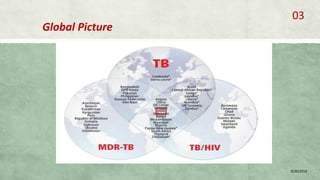
Global Picture
8/20/2018
03
MDR Problem Statement : Globally
▪ 5% of total TB cases, 3.9% of new cases, 21 % of previously Rx cases
▪ 490,000 estimated (2016)
▪ ++ 110 000 susceptible to INH but resistant to rifampicin (2016)
▪ 47% of global MDR burden in China, India & Russian Federation
▪ ≈ 9.5% of MDR-TB cases have additional DR (XDR-TB).
▪ 117 countries worldwide have reported at least one XDR-TB case
8/20/2018
04
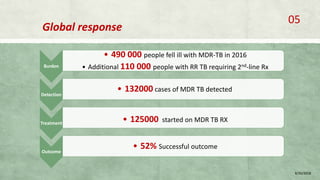
Global response
Burden
• 490 000 people fell ill with MDR-TB in 2016
• Additional 110 000 people with RR TB requiring 2nd-line Rx
Detection
• 132000 cases of MDR TB detected
Treatment
• 125000 started on MDR TB RX
Outcome
• 52% Successful outcome
8/20/2018
05
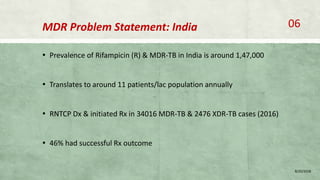
MDR Problem Statement: India
▪ Prevalence of Rifampicin (R) & MDR-TB in India is around 1,47,000
▪ Translates to around 11 patients/lac population annually
▪ RNTCP Dx & initiated Rx in 34016 MDR-TB & 2476 XDR-TB cases (2016)
▪ 46% had successful Rx outcome
8/20/2018
06
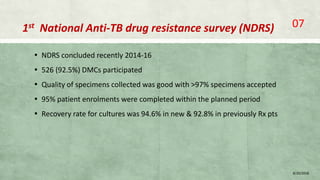
1st National Anti-TB drug resistance survey (NDRS)
▪ NDRS concluded recently 2014-16
▪ 526 (92.5%) DMCs participated
▪ Quality of specimens collected was good with >97% specimens accepted
▪ 95% patient enrolments were completed within the planned period
▪ Recovery rate for cultures was 94.6% in new & 92.8% in previously Rx pts
8/20/2018
07
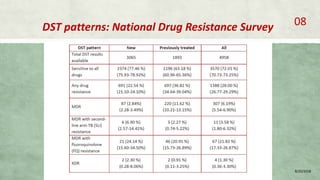
DST patterns: National Drug Resistance Survey
8/20/2018
08
MDR Problem Statement : Himachal (2017)
▪ Total 673 diagnosed
▪ 91 died, 36 defaulted
▪ 380 treated
▪ 7 XDR
▪ Kangra was the lead scorer
8/20/2018
09
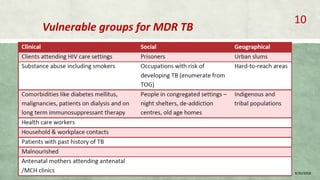
Vulnerable groups for MDR TB
8/20/2018
10
Case Definition
Presumptive DR TB:
 Failed Rx with 1st line drugs
 Pediatric Non responders
 Contacts of DR TB
 TB Pts found +ve on f/u sputum exam
 Previously Rx TB cases
 TB-HIV Co-infection
8/20/2018
11
RNTCP Criteria – MDR TB
▪ A new smear (+) pt. remaining smear (+) at end of 5th month
▪ A new smear (-) pt. becoming smear (+) at the end of 5th month
▪ A pt. Rx with regimen for previously Rx remaining (+) at 4th month
▪ Smear (+) contacts of an established / confirmed MDR-TB case
8/20/2018
12
Classification on Drug Resistance
▪ MR : Resistance to one 1st line ATB drug only
▪ PDR : Resistance to > one 1st line ATB drug (except both H & R)
▪ MDR : Resistance to at least both H & R
▪ RR : Resistance to R (pheno/genotypic method) with/without
resistance to other drugs excluding H
▪ XDR : MDR plus FQ resistance plus 2nd line injectable resistance
8/20/2018
13
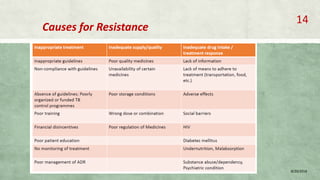
Causes for Resistance
8/20/2018
14
Diagnosis
▪ Lab based
Phenotypic DST (Solid/liquid culture)
OR
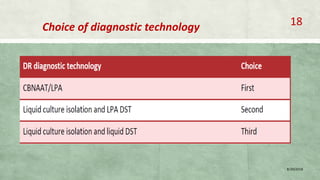
Genotypic (LPA/CBNAAT- RNTCP)
 CBNAAT: R LPA: H & R
 Genotypic faster; not growth based
 DST (LJ): 84 days Liq C (MGIT): 42 days LPA: 72 hrs CBNAAT: 2 hrs
8/20/2018
015
Diagnosis contd…..
▪ CBNAAT: Single specimen LPA: Two samples
▪ Wherever facilities available; DST of all drugs intended for regimen
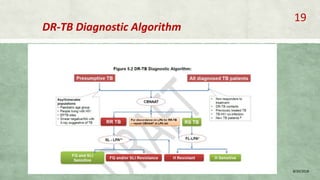
▪ If RR by CBNAAT/LPA
Liq C DST at base line for Levo, Moxi, Kana, Capreo, Ethambutol &
Ethionamide, Linezolid, Pyrazinamide
plus
LPA for INH on sample/culture isolate to decide on INH use
8/20/2018
16
Diagnosis contd…..
▪ If R sensitive (CBNAAT) in presumptive DR-TB cases, samples for LPA/Liq C
▪ INH sensitive Pts. after LPA testing OR awaiting LPA results should continue Rx
▪ If INH Resistance by LPA,
Report must mention KAT G or INH-A mutation
&
Liq C DST for E, Z, Kana, Levo
 If resistance to 2nd line injectables/FQs; DST for remaining 2nd line drugs
 Initiate/Modify Rx as per DST results
8/20/2018
17
Choice of diagnostic technology
8/20/2018
18
DR-TB Diagnostic Algorithm
8/20/2018
19
Pre-evaluation
 Detailed history (screening for mental illness, substance abuse etc.)
 Weight , Height
 Complete Blood Count
 Blood sugar to screen for Diabetes Mellitus
 LFTs/RFTs/TSH
 Urine examination – Routine and Microscopic
 Pregnancy test (for women in child bearing age gp)
 Chest X-Ray
8/20/2018
20
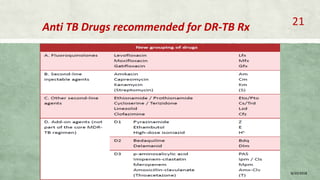
Anti TB Drugs recommended for DR-TB Rx
8/20/2018
21
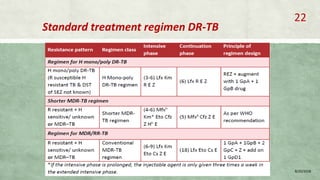
Standard treatment regimen DR-TB
8/20/2018
22
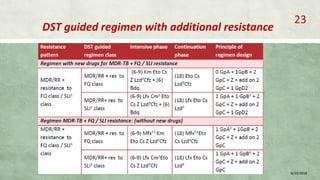
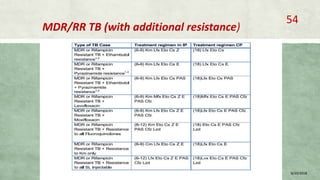
DST guided regimen with additional resistance
8/20/2018
23
8/20/2018
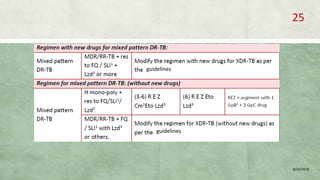
24
8/20/2018
25
guidelines
guidelines
Shorter MDR-TB Rx Regimen
Recommended for patients in whom the diagnosis of
▪ MDR/RR-TB has been reliably confirmed by molecular (e.g. CBNAAT/
LPA) or phenotypic DST method
▪ And are found to be sensitive to both FQ and SLI by SL-LPA
▪ Children & PLHIV on ART could receive the shorter MDR-TB regimen
▪ Standardized shorter MDR-TB regimen with 7 drugs & a Rx duration of
9- 11 months
8/20/2018
26
Shorter MDR-TB Rx Regimen contd…..
▪ Total duration is 9-11 months, depending on IP duration
▪ IP should be given for at least 4 months
▪ After 4th month of Rx, if the result of sputum microscopy is -ve then
CP should be initiated
▪ If sputum smear doesn’t become microscopy -ve by the 4th month of
Rx, IP should be prolonged till smear conversion
▪ If IP is prolonged, the injectable agent is only given 3 times/week.
▪ IP should be extended for a max of 2 months (IP is not > 6 months)
▪ Duration of CP is fixed for 5 months
8/20/2018
27
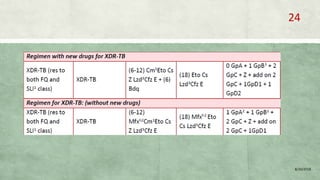
XDR-TB Rx Regimen
▪ Total duration would be of 24-30 months duration with 6-12 months
IP & 18 months CP
▪ The change from IP to CP will be done only after achievement of
culture conversion
▪ IP can be extended on monthly basis from 6 months up to a max of 12
months
8/20/2018
28
Management of Contacts of DR TB
▪ People living in same household as index pt. or spending many hours/day
together with pt. in same indoor space
▪ Should be identified through contact tracing & evaluated for active TB
▪ If contact is found to be suffering from PTB disease irrespective of smear
based MB, s/he will be identified as a Presumptive DR-TB
▪ Initiated on regimen for new/previously Rx pt. based on their previous history
▪ If pt. is confirmed as having DRTB, appropriate DR-TB Rx must be initiated
8/20/2018
29
Newer Anti MDR TB Drugs
▪ Bedaquiline: Blocks an enzyme inside MTB bacteria called ATP
synthase
▪ Recommended dose is 400 mg /day for 2 weeks & then 200 mg taken
3 times/week (with at least 48 hours b/w doses)
▪ Side effects are headache, dizziness, malaise, joint pain, QT
prolongation & increases in liver enzymes
8/20/2018
30
Newer Anti MDR TB Drugs contd…..
▪ Delamanid: Dihydro-nitroimidazooxazole derivative; inhibits synthesis
of cell wall components, methoxy mycolic acid & ketomycolic acid
▪ Dose: 100 mg/day
▪ Side effects are nausea, vomiting and dizziness. Anxiety, pins &
needles, shaking and QT prolongation
8/20/2018
31
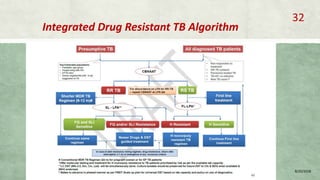
Integrated Drug Resistant TB Algorithm
8/20/2018
32
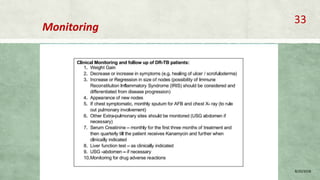
Monitoring
8/20/2018
33
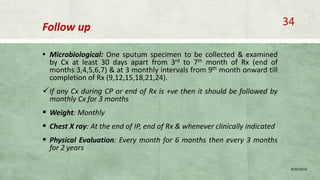
Follow up
▪ Microbiological: One sputum specimen to be collected & examined
by Cx at least 30 days apart from 3rd to 7th month of Rx (end of
months 3,4,5,6,7) & at 3 monthly intervals from 9th month onward till
completion of Rx (9,12,15,18,21,24).
If any Cx during CP or end of Rx is +ve then it should be followed by
monthly Cx for 3 months
 Weight: Monthly
 Chest X ray: At the end of IP, end of Rx & whenever clinically indicated
 Physical Evaluation: Every month for 6 months then every 3 months
for 2 years
8/20/2018
34
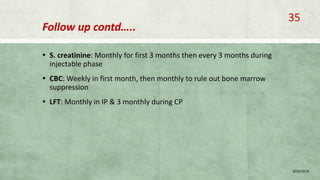
Follow up contd…..
▪ S. creatinine: Monthly for first 3 months then every 3 months during
injectable phase
▪ CBC: Weekly in first month, then monthly to rule out bone marrow
suppression
▪ LFT: Monthly in IP & 3 monthly during CP
8/20/2018
35
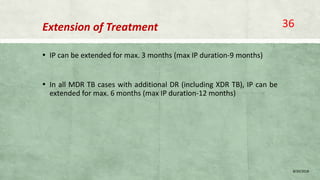
Extension of Treatment
▪ IP can be extended for max. 3 months (max IP duration-9 months)
▪ In all MDR TB cases with additional DR (including XDR TB), IP can be
extended for max. 6 months (max IP duration-12 months)
8/20/2018
36
Role of surgery in MDR-TB
When U/L resectable disease is present, surgery can be considered for
▪ Absence of clinical/MB response to therapy despite 6-9 months of Rx
▪ High risk of failure/relapse due to high degree of resistance/extensive
parenchymal involvement
▪ Morbid complications like haemoptysis, brochiectasis, empyema
▪ Recurrence of +ve culture status during Rx course
▪ Relapse after completion of ATT
8/20/2018
37
Treatment Outcomes in M/XDR TB
Interim outcomes
▪ Culture conversion: Pt. is considered to have Cx converted when 2
consecutive Cx, taken at least 30 days apart, are found to be -ve.
Specimen collection date of 1st -ve Cx is used as date of conversion
▪ Culture reversion: Pt. is considered to have Cx reverted when, after an
initial Cx conversion, 2 consecutive Cx, taken at least 30 days apart,
are found to be +ve. For purpose of defining Rx failed, reversion is
considered only when it occurs in CP
8/20/2018
38
Treatment outcomes in M/XDR TB contd…..
Final Outcomes
▪ Cured: Rx completed without evidence of failure AND ≥ 3 consecutive
Cx taken at least 30 days apart are –ve after IP
▪ Treatment completed: A patient who has completed Rx according to
guidelines but doesn’t meet definition for cure/failure due to lack of
bacteriological results
▪ Treatment success: Cured + Rx Completed
▪ Treatment failure: Lack of microbiological conversion by end of IP,
reversion in CP, evidence of acquired resistance to FQs/SLID or ADRxn
8/20/2018
39
Treatment Support Program
▪ Include initial & f/u counselling, supervision of Rx, additional
nutritional support, screening of ADR, co-morbidity management
▪ Compensation is provided for transport costs incurred by DR TB
patient for sending specimen for f/u or for travel to DR TB centre
▪ MDR TB Rx supporters get 5000/case for ensuring Rx completion
8/20/2018 40
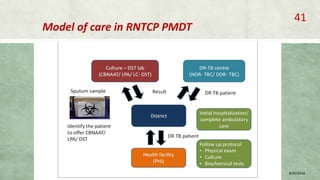
Model of care in RNTCP PMDT
8/20/2018
41
Drug Resistant TB Centre
▪ 147 DR-TBCs across India (2017), 1/10 million population, including
some private institutes
▪ 5-10 districts attached to each centre
▪ DR-TB pts. admitted for a short period & once stabilized on Rx
discharged & referred back to their districts for continuation &
completion of Rx
▪ Pts. are referred back to DR-TBCs for change of regimens/ ADR Mx
8/20/2018
42
▪ Since March 2016, 500 CBNAAT machines have been made functional
in addition to 128 existing machines to cover access to most of
districts in India
▪ These machines are currently utilized at district level for testing
presumptive DR-TB patients & presumptive TB patients among key
populations to detect presence of M. Tb in the biological specimen
with concomitant detection of RR-TB if present.
▪ A 35% rise in MDR/ RRTB patients notified was observed in Q2 2016
against Q1 2016 which is expected to further increase in future
8/20/2018 43
National Strategic Plan (2017-25) and PMDT
Objectives
▪ By 2017, complete nationwide geographical coverage of access to
baseline 2nd line DST using SL-LPA, access to shorter MDR-TB regimen
and newer drugs like Bedaquiline
▪ By 2025 ensure Universal access to rapid molecular DRT for all Dx TB
patients; Universal access to DST guided Rx expands access to newer
drugs; and management of NTM
8/20/2018
44
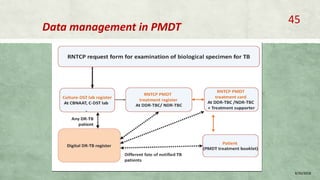
Data management in PMDT
8/20/2018
45
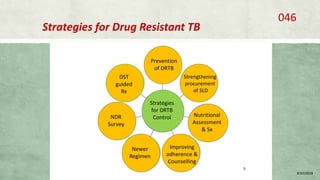
Strategies for Drug Resistant TB
8/20/2018
046
Strategies
for DRTB
Control
Prevention
of DRTB
DST
guided
Rx
NDR
Survey
Newer
Regimen
Improving
adherence &
Counselling
Nutritional
Assessment
& Sx
Strengthening
procurement
of SLD
References
 RNTCP Guidelines Programmatic Management of Drug Resistant TB 2017
 RNTCP Technical and operational guidelines of TB control in India 2016
 National strategic plan for TB elimination 2017–2025
 TB India 2017 RNTCP Annual Status Report
 WHO Global TB report 2017
 WHO MDR TB update 2016
8/20/2018
47
8/20/2018
48
Thank you…..!!!
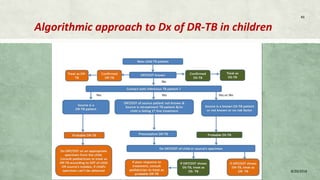
Algorithmic approach to Dx of DR-TB in children
8/20/2018
49
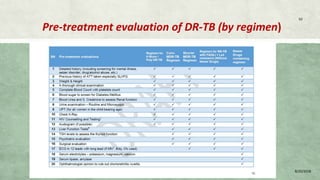
Pre-treatment evaluation of DR-TB (by regimen)
8/20/2018
50
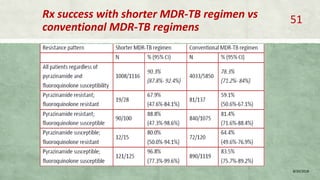
Rx success with shorter MDR-TB regimen vs
conventional MDR-TB regimens
8/20/2018
51
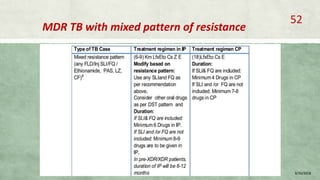
MDR TB with mixed pattern of resistance
8/20/2018
52
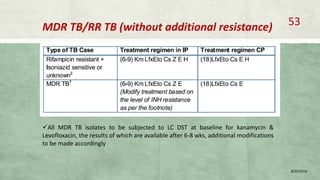
MDR TB/RR TB (without additional resistance)
8/20/2018
53
All MDR TB isolates to be subjected to LC DST at baseline for kanamycin &
Levofloxacin, the results of which are available after 6-8 wks, additional modifications
to be made accordingly
MDR/RR TB (with additional resistance)
8/20/2018
54
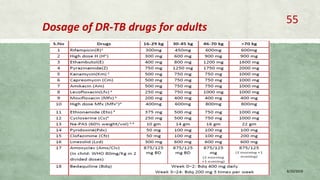
Dosage of DR-TB drugs for adults
8/20/2018
55
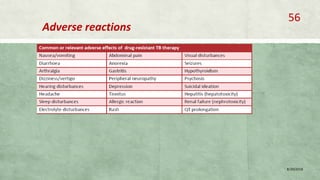
Adverse reactions
8/20/2018
56
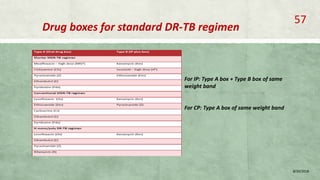
Drug boxes for standard DR-TB regimen
8/20/2018
57
For IP: Type A box + Type B box of same
weight band
For CP: Type A box of same weight band
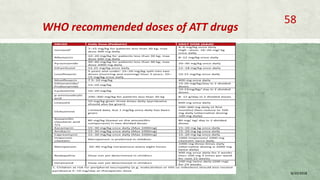
WHO recommended doses of ATT drugs
8/20/2018
58

Multi drug resistant tuberculosis

  • 1.
    Multi-Drug Resistant Tuberculosis Dr.Ankit Chaudhary Resident Community Medicine IGMC Shimla
  • 2.
    TB Magnitude ▪ TB:9th leading cause of death worldwide ▪ Leading cause from a single infectious agent, ranking above HIV/AIDS ▪ ≈1.3 million deaths in HIV-ve / 374 000 in HIV+ve people (2016) 8/20/2018 2
  • 3.
  • 4.
    MDR Problem Statement: Globally ▪ 5% of total TB cases, 3.9% of new cases, 21 % of previously Rx cases ▪ 490,000 estimated (2016) ▪ ++ 110 000 susceptible to INH but resistant to rifampicin (2016) ▪ 47% of global MDR burden in China, India & Russian Federation ▪ ≈ 9.5% of MDR-TB cases have additional DR (XDR-TB). ▪ 117 countries worldwide have reported at least one XDR-TB case 8/20/2018 04
  • 5.
    Global response Burden • 490000 people fell ill with MDR-TB in 2016 • Additional 110 000 people with RR TB requiring 2nd-line Rx Detection • 132000 cases of MDR TB detected Treatment • 125000 started on MDR TB RX Outcome • 52% Successful outcome 8/20/2018 05
  • 6.
    MDR Problem Statement:India ▪ Prevalence of Rifampicin (R) & MDR-TB in India is around 1,47,000 ▪ Translates to around 11 patients/lac population annually ▪ RNTCP Dx & initiated Rx in 34016 MDR-TB & 2476 XDR-TB cases (2016) ▪ 46% had successful Rx outcome 8/20/2018 06
  • 7.
    1st National Anti-TBdrug resistance survey (NDRS) ▪ NDRS concluded recently 2014-16 ▪ 526 (92.5%) DMCs participated ▪ Quality of specimens collected was good with >97% specimens accepted ▪ 95% patient enrolments were completed within the planned period ▪ Recovery rate for cultures was 94.6% in new & 92.8% in previously Rx pts 8/20/2018 07
  • 8.
    DST patterns: NationalDrug Resistance Survey 8/20/2018 08
  • 9.
    MDR Problem Statement: Himachal (2017) ▪ Total 673 diagnosed ▪ 91 died, 36 defaulted ▪ 380 treated ▪ 7 XDR ▪ Kangra was the lead scorer 8/20/2018 09
  • 10.
    Vulnerable groups forMDR TB 8/20/2018 10
  • 11.
    Case Definition Presumptive DRTB:  Failed Rx with 1st line drugs  Pediatric Non responders  Contacts of DR TB  TB Pts found +ve on f/u sputum exam  Previously Rx TB cases  TB-HIV Co-infection 8/20/2018 11
  • 12.
    RNTCP Criteria –MDR TB ▪ A new smear (+) pt. remaining smear (+) at end of 5th month ▪ A new smear (-) pt. becoming smear (+) at the end of 5th month ▪ A pt. Rx with regimen for previously Rx remaining (+) at 4th month ▪ Smear (+) contacts of an established / confirmed MDR-TB case 8/20/2018 12
  • 13.
    Classification on DrugResistance ▪ MR : Resistance to one 1st line ATB drug only ▪ PDR : Resistance to > one 1st line ATB drug (except both H & R) ▪ MDR : Resistance to at least both H & R ▪ RR : Resistance to R (pheno/genotypic method) with/without resistance to other drugs excluding H ▪ XDR : MDR plus FQ resistance plus 2nd line injectable resistance 8/20/2018 13
  • 14.
  • 15.
    Diagnosis ▪ Lab based PhenotypicDST (Solid/liquid culture) OR Genotypic (LPA/CBNAAT- RNTCP)  CBNAAT: R LPA: H & R  Genotypic faster; not growth based  DST (LJ): 84 days Liq C (MGIT): 42 days LPA: 72 hrs CBNAAT: 2 hrs 8/20/2018 015
  • 16.
    Diagnosis contd….. ▪ CBNAAT:Single specimen LPA: Two samples ▪ Wherever facilities available; DST of all drugs intended for regimen ▪ If RR by CBNAAT/LPA Liq C DST at base line for Levo, Moxi, Kana, Capreo, Ethambutol & Ethionamide, Linezolid, Pyrazinamide plus LPA for INH on sample/culture isolate to decide on INH use 8/20/2018 16
  • 17.
    Diagnosis contd….. ▪ IfR sensitive (CBNAAT) in presumptive DR-TB cases, samples for LPA/Liq C ▪ INH sensitive Pts. after LPA testing OR awaiting LPA results should continue Rx ▪ If INH Resistance by LPA, Report must mention KAT G or INH-A mutation & Liq C DST for E, Z, Kana, Levo  If resistance to 2nd line injectables/FQs; DST for remaining 2nd line drugs  Initiate/Modify Rx as per DST results 8/20/2018 17
  • 18.
    Choice of diagnostictechnology 8/20/2018 18
  • 19.
  • 20.
    Pre-evaluation  Detailed history(screening for mental illness, substance abuse etc.)  Weight , Height  Complete Blood Count  Blood sugar to screen for Diabetes Mellitus  LFTs/RFTs/TSH  Urine examination – Routine and Microscopic  Pregnancy test (for women in child bearing age gp)  Chest X-Ray 8/20/2018 20
  • 21.
    Anti TB Drugsrecommended for DR-TB Rx 8/20/2018 21
  • 22.
    Standard treatment regimenDR-TB 8/20/2018 22
  • 23.
    DST guided regimenwith additional resistance 8/20/2018 23
  • 24.
  • 25.
  • 26.
    Shorter MDR-TB RxRegimen Recommended for patients in whom the diagnosis of ▪ MDR/RR-TB has been reliably confirmed by molecular (e.g. CBNAAT/ LPA) or phenotypic DST method ▪ And are found to be sensitive to both FQ and SLI by SL-LPA ▪ Children & PLHIV on ART could receive the shorter MDR-TB regimen ▪ Standardized shorter MDR-TB regimen with 7 drugs & a Rx duration of 9- 11 months 8/20/2018 26
  • 27.
    Shorter MDR-TB RxRegimen contd….. ▪ Total duration is 9-11 months, depending on IP duration ▪ IP should be given for at least 4 months ▪ After 4th month of Rx, if the result of sputum microscopy is -ve then CP should be initiated ▪ If sputum smear doesn’t become microscopy -ve by the 4th month of Rx, IP should be prolonged till smear conversion ▪ If IP is prolonged, the injectable agent is only given 3 times/week. ▪ IP should be extended for a max of 2 months (IP is not > 6 months) ▪ Duration of CP is fixed for 5 months 8/20/2018 27
  • 28.
    XDR-TB Rx Regimen ▪Total duration would be of 24-30 months duration with 6-12 months IP & 18 months CP ▪ The change from IP to CP will be done only after achievement of culture conversion ▪ IP can be extended on monthly basis from 6 months up to a max of 12 months 8/20/2018 28
  • 29.
    Management of Contactsof DR TB ▪ People living in same household as index pt. or spending many hours/day together with pt. in same indoor space ▪ Should be identified through contact tracing & evaluated for active TB ▪ If contact is found to be suffering from PTB disease irrespective of smear based MB, s/he will be identified as a Presumptive DR-TB ▪ Initiated on regimen for new/previously Rx pt. based on their previous history ▪ If pt. is confirmed as having DRTB, appropriate DR-TB Rx must be initiated 8/20/2018 29
  • 30.
    Newer Anti MDRTB Drugs ▪ Bedaquiline: Blocks an enzyme inside MTB bacteria called ATP synthase ▪ Recommended dose is 400 mg /day for 2 weeks & then 200 mg taken 3 times/week (with at least 48 hours b/w doses) ▪ Side effects are headache, dizziness, malaise, joint pain, QT prolongation & increases in liver enzymes 8/20/2018 30
  • 31.
    Newer Anti MDRTB Drugs contd….. ▪ Delamanid: Dihydro-nitroimidazooxazole derivative; inhibits synthesis of cell wall components, methoxy mycolic acid & ketomycolic acid ▪ Dose: 100 mg/day ▪ Side effects are nausea, vomiting and dizziness. Anxiety, pins & needles, shaking and QT prolongation 8/20/2018 31
  • 32.
    Integrated Drug ResistantTB Algorithm 8/20/2018 32
  • 33.
  • 34.
    Follow up ▪ Microbiological:One sputum specimen to be collected & examined by Cx at least 30 days apart from 3rd to 7th month of Rx (end of months 3,4,5,6,7) & at 3 monthly intervals from 9th month onward till completion of Rx (9,12,15,18,21,24). If any Cx during CP or end of Rx is +ve then it should be followed by monthly Cx for 3 months  Weight: Monthly  Chest X ray: At the end of IP, end of Rx & whenever clinically indicated  Physical Evaluation: Every month for 6 months then every 3 months for 2 years 8/20/2018 34
  • 35.
    Follow up contd….. ▪S. creatinine: Monthly for first 3 months then every 3 months during injectable phase ▪ CBC: Weekly in first month, then monthly to rule out bone marrow suppression ▪ LFT: Monthly in IP & 3 monthly during CP 8/20/2018 35
  • 36.
    Extension of Treatment ▪IP can be extended for max. 3 months (max IP duration-9 months) ▪ In all MDR TB cases with additional DR (including XDR TB), IP can be extended for max. 6 months (max IP duration-12 months) 8/20/2018 36
  • 37.
    Role of surgeryin MDR-TB When U/L resectable disease is present, surgery can be considered for ▪ Absence of clinical/MB response to therapy despite 6-9 months of Rx ▪ High risk of failure/relapse due to high degree of resistance/extensive parenchymal involvement ▪ Morbid complications like haemoptysis, brochiectasis, empyema ▪ Recurrence of +ve culture status during Rx course ▪ Relapse after completion of ATT 8/20/2018 37
  • 38.
    Treatment Outcomes inM/XDR TB Interim outcomes ▪ Culture conversion: Pt. is considered to have Cx converted when 2 consecutive Cx, taken at least 30 days apart, are found to be -ve. Specimen collection date of 1st -ve Cx is used as date of conversion ▪ Culture reversion: Pt. is considered to have Cx reverted when, after an initial Cx conversion, 2 consecutive Cx, taken at least 30 days apart, are found to be +ve. For purpose of defining Rx failed, reversion is considered only when it occurs in CP 8/20/2018 38
  • 39.
    Treatment outcomes inM/XDR TB contd….. Final Outcomes ▪ Cured: Rx completed without evidence of failure AND ≥ 3 consecutive Cx taken at least 30 days apart are –ve after IP ▪ Treatment completed: A patient who has completed Rx according to guidelines but doesn’t meet definition for cure/failure due to lack of bacteriological results ▪ Treatment success: Cured + Rx Completed ▪ Treatment failure: Lack of microbiological conversion by end of IP, reversion in CP, evidence of acquired resistance to FQs/SLID or ADRxn 8/20/2018 39
  • 40.
    Treatment Support Program ▪Include initial & f/u counselling, supervision of Rx, additional nutritional support, screening of ADR, co-morbidity management ▪ Compensation is provided for transport costs incurred by DR TB patient for sending specimen for f/u or for travel to DR TB centre ▪ MDR TB Rx supporters get 5000/case for ensuring Rx completion 8/20/2018 40
  • 41.
    Model of carein RNTCP PMDT 8/20/2018 41
  • 42.
    Drug Resistant TBCentre ▪ 147 DR-TBCs across India (2017), 1/10 million population, including some private institutes ▪ 5-10 districts attached to each centre ▪ DR-TB pts. admitted for a short period & once stabilized on Rx discharged & referred back to their districts for continuation & completion of Rx ▪ Pts. are referred back to DR-TBCs for change of regimens/ ADR Mx 8/20/2018 42
  • 43.
    ▪ Since March2016, 500 CBNAAT machines have been made functional in addition to 128 existing machines to cover access to most of districts in India ▪ These machines are currently utilized at district level for testing presumptive DR-TB patients & presumptive TB patients among key populations to detect presence of M. Tb in the biological specimen with concomitant detection of RR-TB if present. ▪ A 35% rise in MDR/ RRTB patients notified was observed in Q2 2016 against Q1 2016 which is expected to further increase in future 8/20/2018 43
  • 44.
    National Strategic Plan(2017-25) and PMDT Objectives ▪ By 2017, complete nationwide geographical coverage of access to baseline 2nd line DST using SL-LPA, access to shorter MDR-TB regimen and newer drugs like Bedaquiline ▪ By 2025 ensure Universal access to rapid molecular DRT for all Dx TB patients; Universal access to DST guided Rx expands access to newer drugs; and management of NTM 8/20/2018 44
  • 45.
    Data management inPMDT 8/20/2018 45
  • 46.
    Strategies for DrugResistant TB 8/20/2018 046 Strategies for DRTB Control Prevention of DRTB DST guided Rx NDR Survey Newer Regimen Improving adherence & Counselling Nutritional Assessment & Sx Strengthening procurement of SLD
  • 47.
    References  RNTCP GuidelinesProgrammatic Management of Drug Resistant TB 2017  RNTCP Technical and operational guidelines of TB control in India 2016  National strategic plan for TB elimination 2017–2025  TB India 2017 RNTCP Annual Status Report  WHO Global TB report 2017  WHO MDR TB update 2016 8/20/2018 47
  • 48.
  • 49.
    Algorithmic approach toDx of DR-TB in children 8/20/2018 49
  • 50.
    Pre-treatment evaluation ofDR-TB (by regimen) 8/20/2018 50
  • 51.
    Rx success withshorter MDR-TB regimen vs conventional MDR-TB regimens 8/20/2018 51
  • 52.
    MDR TB withmixed pattern of resistance 8/20/2018 52
  • 53.
    MDR TB/RR TB(without additional resistance) 8/20/2018 53 All MDR TB isolates to be subjected to LC DST at baseline for kanamycin & Levofloxacin, the results of which are available after 6-8 wks, additional modifications to be made accordingly
  • 54.
    MDR/RR TB (withadditional resistance) 8/20/2018 54
  • 55.
    Dosage of DR-TBdrugs for adults 8/20/2018 55
  • 56.
  • 57.
    Drug boxes forstandard DR-TB regimen 8/20/2018 57 For IP: Type A box + Type B box of same weight band For CP: Type A box of same weight band
  • 58.
    WHO recommended dosesof ATT drugs 8/20/2018 58