Goals and Targets
Africa Asia
Oceania
Latin America
and the
Caribbean
Caucasus and
Central AsiaNorthern Sub-Saharan Eastern South-Eastern Southern Western
GOAL 1  |  Eradicate extreme poverty and hunger
Reduce extreme
poverty by half
low
poverty
very high
poverty
moderate
poverty
moderate
poverty
very high
poverty
low
poverty
very high
poverty
low
poverty
low
poverty
Productive
and decent employment
large
deficit
very large
deficit
moderate
deficit
large
deficit
very large
deficit
large
deficit
very large
deficit
moderate
deficit
moderate
deficit
Reduce hunger
by half
low
hunger
high
hunger
moderate
hunger
moderate
hunger
high
hunger
moderate
hunger
moderate
hunger
moderate
hunger
moderate
hunger
GOAL 2  |  Achieve universal primary education
Universal primary
schooling
high
enrolment
moderate
enrolment
high
enrolment
high
enrolment
high
enrolment
high
enrolment
moderate
enrolment
high
enrolment
high
enrolment
GOAL 3  |  Promote gender equality and empower women
Equal girls’ enrolment
in primary school
close
to parity
close
to parity
parity parity parity
close
to parity
close
to parity
parity parity
Women’s share
of paid employment
low
share
medium
share
high
share
medium
share
low
share
low
share
medium
share
high
share
high
share
Women’s equal representation
in national parliaments
moderate
representation
moderate
representation
moderate
representation
low
representation
low
representation
low
representation
very low
representation
moderate
representation
low
representation
GOAL 4  |  Reduce child mortality
Reduce mortality of under-
five-year-olds by two thirds
low
mortality
high
mortality
low
mortality
low
mortality
moderate
mortality
low
mortality
moderate
mortality
low
mortality
low
mortality
GOAL 5  |  Improve maternal health
Reduce maternal mortality
by three quarters
low
mortality
very high
mortality
low
mortality
moderate
mortality
moderate
mortality
low
mortality
moderate
mortality
low
mortality
low
mortality
Access to reproductive health
moderate
access
low
access
high
access
moderate
access
moderate
access
moderate
access
low
access
high
access
moderate
access
GOAL 6  |  Combat HIV/AIDS, malaria and other diseases
Halt and begin to reverse
the spread of HIV/AIDS
low
incidence
high
incidence
low
incidence
low
incidence
low
incidence
low
incidence
low
incidence
low
incidence
low
incidence
Halt and reverse
the spread of tuberculosis
low
mortality
moderate
mortality
low
mortality
moderate
mortality
moderate
mortality
low
mortality
high
mortality
low
mortality
low
mortality
GOAL 7  |  Ensure environmental sustainability
Halve proportion of population
without improved drinking water
high
coverage
low
coverage
high
coverage
moderate
coverage
high
coverage
high
coverage
low
coverage
high
coverage
moderate
coverage
Halve proportion of population
without sanitation
high
coverage
very low
coverage
low
coverage
low
coverage
very low
coverage
moderate
coverage
very low
coverage
moderate
coverage
high
coverage
Improve the lives
of slum-dwellers
moderate
proportion of
slum-dwellers
very high
proportion of
slum-dwellers
moderate
proportion of
slum-dwellers
high
proportion of
slum-dwellers
high
proportion of
slum-dwellers
moderate
proportion of
slum-dwellers
moderate
proportion of
slum-dwellers
moderate
proportion of
slum-dwellers
—
GOAL 8  |  Develop a global partnership for development
Internet users
high
usage
moderate
usage
high
usage
high
usage
moderate
usage
high
usage
moderate
usage
high
usage
high
usage
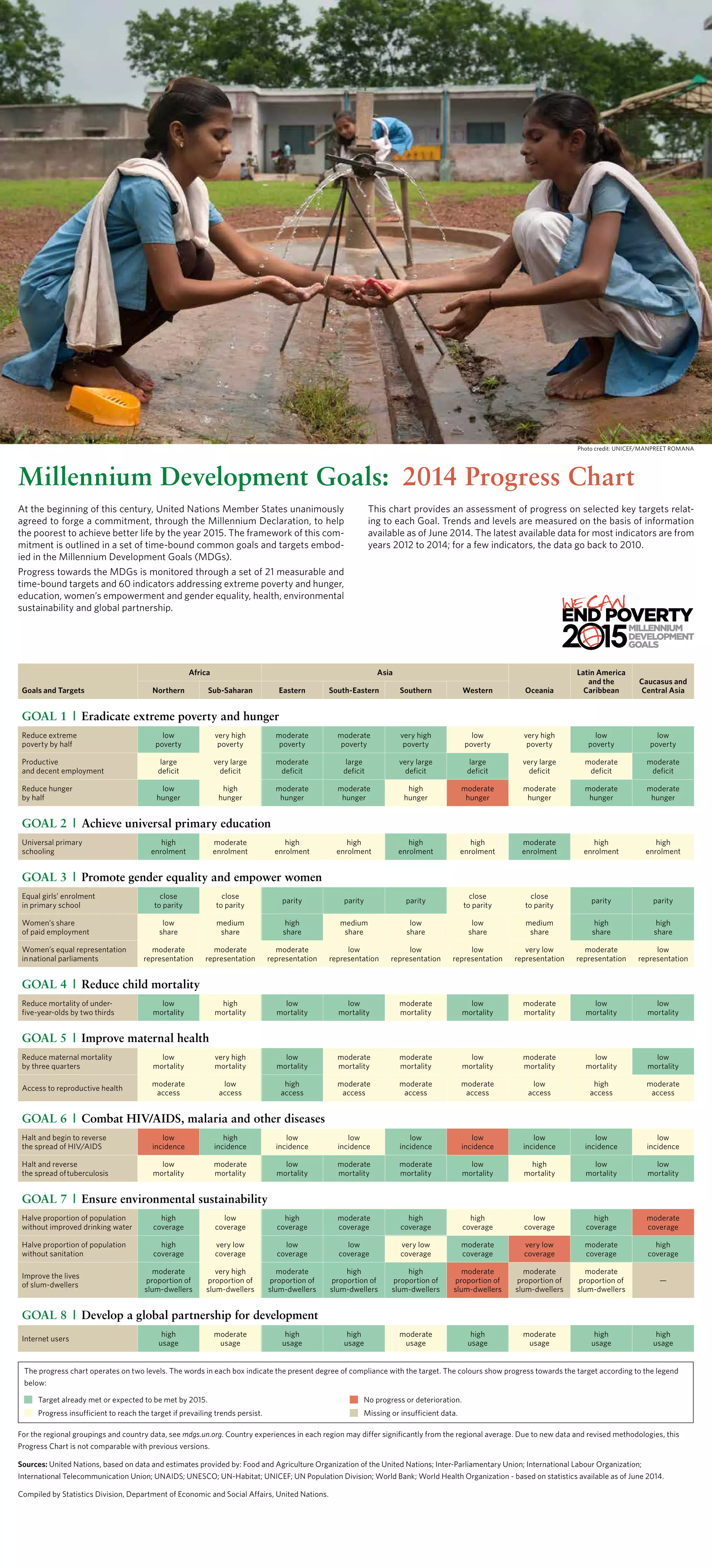
The progress chart operates on two levels. The words in each box indicate the present degree of compliance with the target. The colours show progress towards the target according to the legend
below:
Target already met or expected to be met by 2015. No progress or deterioration.
Progress insufficient to reach the target if prevailing trends persist. Missing or insufficient data.
For the regional groupings and country data, see mdgs.un.org. Country experiences in each region may differ significantly from the regional average. Due to new data and revised methodologies, this
Progress Chart is not comparable with previous versions.
Sources: United Nations, based on data and estimates provided by: Food and Agriculture Organization of the United Nations; Inter-Parliamentary Union; International Labour Organization;
International Telecommunication Union; UNAIDS; UNESCO; UN-Habitat; UNICEF; UN Population Division; World Bank; World Health Organization - based on statistics available as of June 2014.
Compiled by Statistics Division, Department of Economic and Social Affairs, United Nations.
Millennium Development Goals:  2014 Progress Chart
At the beginning of this century, United Nations Member States unanimously
agreed to forge a commitment, through the Millennium Declaration, to help
the poorest to achieve better life by the year 2015. The framework of this com-
mitment is outlined in a set of time-bound common goals and targets embod-
ied in the Millennium Development Goals (MDGs).
Progress towards the MDGs is monitored through a set of 21 measurable and
time-bound targets and 60 indicators addressing extreme poverty and hunger,
education, women’s empowerment and gender equality, health, environmental
sustainability and global partnership.
This chart provides an assessment of progress on selected key targets relat-
ing to each Goal. Trends and levels are measured on the basis of information
available as of June 2014. The latest available data for most indicators are from
years 2012 to 2014; for a few indicators, the data go back to 2010.
Photo credit: UNICEF/MANPREET ROMANA

Mdg 2014 progress chart english

  • 1.
    Goals and Targets AfricaAsia Oceania Latin America and the Caribbean Caucasus and Central AsiaNorthern Sub-Saharan Eastern South-Eastern Southern Western GOAL 1  |  Eradicate extreme poverty and hunger Reduce extreme poverty by half low poverty very high poverty moderate poverty moderate poverty very high poverty low poverty very high poverty low poverty low poverty Productive and decent employment large deficit very large deficit moderate deficit large deficit very large deficit large deficit very large deficit moderate deficit moderate deficit Reduce hunger by half low hunger high hunger moderate hunger moderate hunger high hunger moderate hunger moderate hunger moderate hunger moderate hunger GOAL 2  |  Achieve universal primary education Universal primary schooling high enrolment moderate enrolment high enrolment high enrolment high enrolment high enrolment moderate enrolment high enrolment high enrolment GOAL 3  |  Promote gender equality and empower women Equal girls’ enrolment in primary school close to parity close to parity parity parity parity close to parity close to parity parity parity Women’s share of paid employment low share medium share high share medium share low share low share medium share high share high share Women’s equal representation in national parliaments moderate representation moderate representation moderate representation low representation low representation low representation very low representation moderate representation low representation GOAL 4  |  Reduce child mortality Reduce mortality of under- five-year-olds by two thirds low mortality high mortality low mortality low mortality moderate mortality low mortality moderate mortality low mortality low mortality GOAL 5  |  Improve maternal health Reduce maternal mortality by three quarters low mortality very high mortality low mortality moderate mortality moderate mortality low mortality moderate mortality low mortality low mortality Access to reproductive health moderate access low access high access moderate access moderate access moderate access low access high access moderate access GOAL 6  |  Combat HIV/AIDS, malaria and other diseases Halt and begin to reverse the spread of HIV/AIDS low incidence high incidence low incidence low incidence low incidence low incidence low incidence low incidence low incidence Halt and reverse the spread of tuberculosis low mortality moderate mortality low mortality moderate mortality moderate mortality low mortality high mortality low mortality low mortality GOAL 7  |  Ensure environmental sustainability Halve proportion of population without improved drinking water high coverage low coverage high coverage moderate coverage high coverage high coverage low coverage high coverage moderate coverage Halve proportion of population without sanitation high coverage very low coverage low coverage low coverage very low coverage moderate coverage very low coverage moderate coverage high coverage Improve the lives of slum-dwellers moderate proportion of slum-dwellers very high proportion of slum-dwellers moderate proportion of slum-dwellers high proportion of slum-dwellers high proportion of slum-dwellers moderate proportion of slum-dwellers moderate proportion of slum-dwellers moderate proportion of slum-dwellers — GOAL 8  |  Develop a global partnership for development Internet users high usage moderate usage high usage high usage moderate usage high usage moderate usage high usage high usage The progress chart operates on two levels. The words in each box indicate the present degree of compliance with the target. The colours show progress towards the target according to the legend below: Target already met or expected to be met by 2015. No progress or deterioration. Progress insufficient to reach the target if prevailing trends persist. Missing or insufficient data. For the regional groupings and country data, see mdgs.un.org. Country experiences in each region may differ significantly from the regional average. Due to new data and revised methodologies, this Progress Chart is not comparable with previous versions. Sources: United Nations, based on data and estimates provided by: Food and Agriculture Organization of the United Nations; Inter-Parliamentary Union; International Labour Organization; International Telecommunication Union; UNAIDS; UNESCO; UN-Habitat; UNICEF; UN Population Division; World Bank; World Health Organization - based on statistics available as of June 2014. Compiled by Statistics Division, Department of Economic and Social Affairs, United Nations. Millennium Development Goals:  2014 Progress Chart At the beginning of this century, United Nations Member States unanimously agreed to forge a commitment, through the Millennium Declaration, to help the poorest to achieve better life by the year 2015. The framework of this com- mitment is outlined in a set of time-bound common goals and targets embod- ied in the Millennium Development Goals (MDGs). Progress towards the MDGs is monitored through a set of 21 measurable and time-bound targets and 60 indicators addressing extreme poverty and hunger, education, women’s empowerment and gender equality, health, environmental sustainability and global partnership. This chart provides an assessment of progress on selected key targets relat- ing to each Goal. Trends and levels are measured on the basis of information available as of June 2014. The latest available data for most indicators are from years 2012 to 2014; for a few indicators, the data go back to 2010. Photo credit: UNICEF/MANPREET ROMANA