mc_simulation
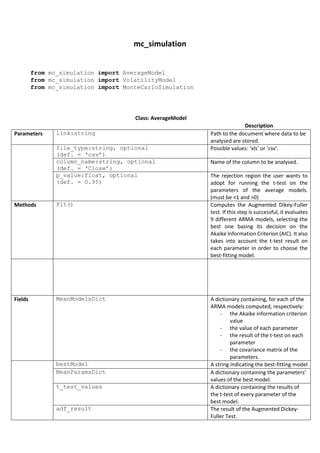
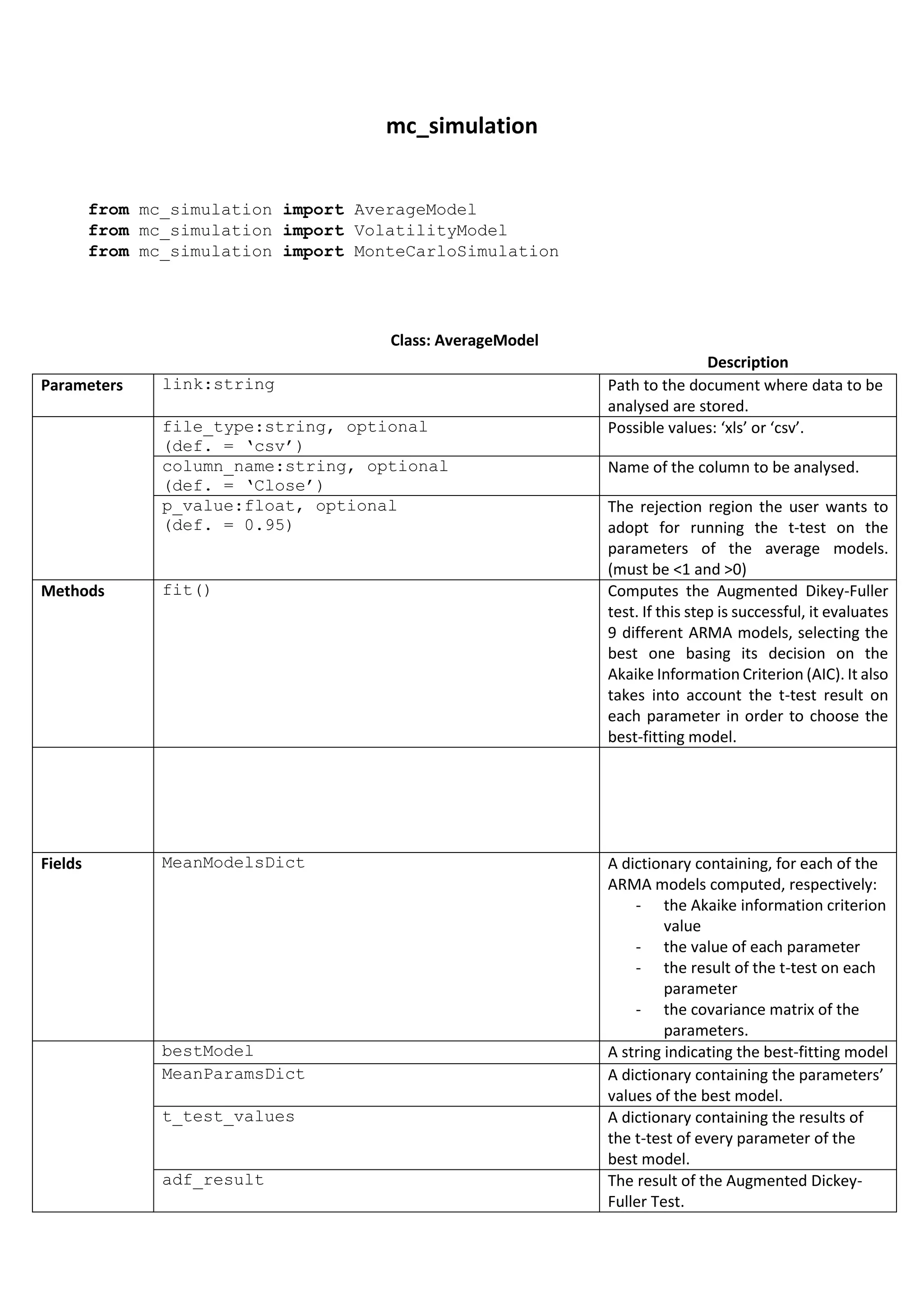
from mc_simulation import AverageModel
from mc_simulation import VolatilityModel
from mc_simulation import MonteCarloSimulation
Class: AverageModel
Description
Parameters link:string Path to the document where data to be
analysed are stored.
file_type:string, optional
(def. = ‘csv’)
Possible values: ‘xls’ or ‘csv’.
column_name:string, optional
(def. = ‘Close’)
Name of the column to be analysed.
p_value:float, optional
(def. = 0.95)
The rejection region the user wants to
adopt for running the t-test on the
parameters of the average models.
(must be <1 and >0)
Methods fit() Computes the Augmented Dikey-Fuller
test. If this step is successful, it evaluates
9 different ARMA models, selecting the
best one basing its decision on the
Akaike Information Criterion (AIC). It also
takes into account the t-test result on
each parameter in order to choose the
best-fitting model.
Fields MeanModelsDict A dictionary containing, for each of the
ARMA models computed, respectively:
- the Akaike information criterion
value
- the value of each parameter
- the result of the t-test on each
parameter
- the covariance matrix of the
parameters.
bestModel A string indicating the best-fitting model
MeanParamsDict A dictionary containing the parameters’
values of the best model.
t_test_values A dictionary containing the results of
the t-test of every parameter of the
best model.
adf_result The result of the Augmented Dickey-
Fuller Test.
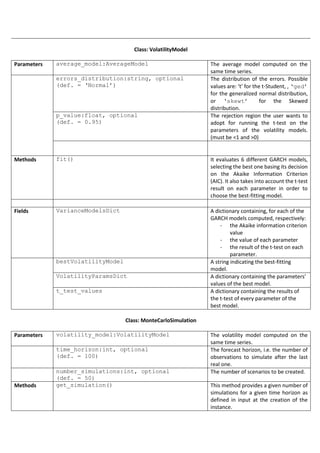
Class: VolatilityModel
Parameters average_model:AverageModel The average model computed on the
same time series.
errors_distribution:string, optional
(def. = ‘Normal’)
The distribution of the errors. Possible
values are: ‘t’ for the t-Student, , ‘ged’
for the generalized normal distribution,
or ‘skewt’ for the Skewed
distribution.
p_value:float, optional
(def. = 0.95)
The rejection region the user wants to
adopt for running the t-test on the
parameters of the volatility models.
(must be <1 and >0)
Methods fit() It evaluates 6 different GARCH models,
selecting the best one basing its decision
on the Akaike Information Criterion
(AIC). It also takes into account the t-test
result on each parameter in order to
choose the best-fitting model.
Fields VarianceModelsDict A dictionary containing, for each of the
GARCH models computed, respectively:
- the Akaike information criterion
value
- the value of each parameter
- the result of the t-test on each
parameter.
bestVolatilityModel A string indicating the best-fitting
model.
VolatilityParamsDict A dictionary containing the parameters’
values of the best model.
t_test_values A dictionary containing the results of
the t-test of every parameter of the
best model.
Class: MonteCarloSimulation
Parameters volatility_model:VolatilityModel The volatility model computed on the
same time series.
time_horizon:int, optional
(def. = 100)
The forecast horizon, i.e. the number of
observations to simulate after the last
real one.
number_simulations:int, optional
(def. = 50)
The number of scenarios to be created.
Methods get_simulation() This method provides a given number of
simulations for a given time horizon as
defined in input at the creation of the
instance.
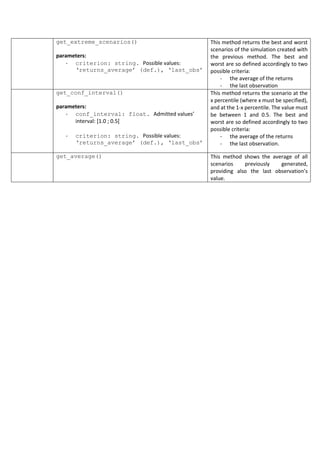
get_extreme_scenarios()
parameters:
- criterion: string. Possible values:
‘returns_average’ (def.), ‘last_obs’
This method returns the best and worst
scenarios of the simulation created with
the previous method. The best and
worst are so defined accordingly to two
possible criteria:
- the average of the returns
- the last observation
get_conf_interval()
parameters:
- conf_interval: float. Admitted values’
interval: [1.0 ; 0.5[
- criterion: string. Possible values:
‘returns_average’ (def.), ‘last_obs’
This method returns the scenario at the
x percentile (where x must be specified),
and at the 1-x percentile. The value must
be between 1 and 0.5. The best and
worst are so defined accordingly to two
possible criteria:
- the average of the returns
- the last observation.
get_average() This method shows the average of all
scenarios previously generated,
providing also the last observation’s
value.

mc_simulation documentation

  • 1.
    mc_simulation from mc_simulation importAverageModel from mc_simulation import VolatilityModel from mc_simulation import MonteCarloSimulation Class: AverageModel Description Parameters link:string Path to the document where data to be analysed are stored. file_type:string, optional (def. = ‘csv’) Possible values: ‘xls’ or ‘csv’. column_name:string, optional (def. = ‘Close’) Name of the column to be analysed. p_value:float, optional (def. = 0.95) The rejection region the user wants to adopt for running the t-test on the parameters of the average models. (must be <1 and >0) Methods fit() Computes the Augmented Dikey-Fuller test. If this step is successful, it evaluates 9 different ARMA models, selecting the best one basing its decision on the Akaike Information Criterion (AIC). It also takes into account the t-test result on each parameter in order to choose the best-fitting model. Fields MeanModelsDict A dictionary containing, for each of the ARMA models computed, respectively: - the Akaike information criterion value - the value of each parameter - the result of the t-test on each parameter - the covariance matrix of the parameters. bestModel A string indicating the best-fitting model MeanParamsDict A dictionary containing the parameters’ values of the best model. t_test_values A dictionary containing the results of the t-test of every parameter of the best model. adf_result The result of the Augmented Dickey- Fuller Test.
  • 2.
    Class: VolatilityModel Parameters average_model:AverageModelThe average model computed on the same time series. errors_distribution:string, optional (def. = ‘Normal’) The distribution of the errors. Possible values are: ‘t’ for the t-Student, , ‘ged’ for the generalized normal distribution, or ‘skewt’ for the Skewed distribution. p_value:float, optional (def. = 0.95) The rejection region the user wants to adopt for running the t-test on the parameters of the volatility models. (must be <1 and >0) Methods fit() It evaluates 6 different GARCH models, selecting the best one basing its decision on the Akaike Information Criterion (AIC). It also takes into account the t-test result on each parameter in order to choose the best-fitting model. Fields VarianceModelsDict A dictionary containing, for each of the GARCH models computed, respectively: - the Akaike information criterion value - the value of each parameter - the result of the t-test on each parameter. bestVolatilityModel A string indicating the best-fitting model. VolatilityParamsDict A dictionary containing the parameters’ values of the best model. t_test_values A dictionary containing the results of the t-test of every parameter of the best model. Class: MonteCarloSimulation Parameters volatility_model:VolatilityModel The volatility model computed on the same time series. time_horizon:int, optional (def. = 100) The forecast horizon, i.e. the number of observations to simulate after the last real one. number_simulations:int, optional (def. = 50) The number of scenarios to be created. Methods get_simulation() This method provides a given number of simulations for a given time horizon as defined in input at the creation of the instance.
  • 3.
    get_extreme_scenarios() parameters: - criterion: string.Possible values: ‘returns_average’ (def.), ‘last_obs’ This method returns the best and worst scenarios of the simulation created with the previous method. The best and worst are so defined accordingly to two possible criteria: - the average of the returns - the last observation get_conf_interval() parameters: - conf_interval: float. Admitted values’ interval: [1.0 ; 0.5[ - criterion: string. Possible values: ‘returns_average’ (def.), ‘last_obs’ This method returns the scenario at the x percentile (where x must be specified), and at the 1-x percentile. The value must be between 1 and 0.5. The best and worst are so defined accordingly to two possible criteria: - the average of the returns - the last observation. get_average() This method shows the average of all scenarios previously generated, providing also the last observation’s value.