MCQ Questions for Class 9 Science
Chapter 6 Tissues with Answers
Question 1.
Which of the following tissues has dead
cells?
(a) Parenchyma
(b) Sclerenchyma
(c) Collenchyma
(d) Epithelial tissue
Answer
Answer: (b) Sclerenchyma
Question 2.
Find out incorrect sentence.
(a) Parenchymatous tissues have
intercellular spaces.
(b) Collenchymatous tissues are irregularly
thickened at corners.
(c) Apical and intercalary meristems are
permanent tissues.
(d) Meristematic tissues, in its early stage,
lack vacuoles.
Answer
Answer: (c) Apical and intercalary
meristems are permanent tissues.
Question 3.
Girth of stem increases due to
(a) apical meristem
(b) lateral meristem
(c) intercalary meristem
(d) vertical meristem
Answer
Answer: (b) lateral meristem
Question 4.
Which cell does not have perforated cell
wall?
(a) Tracheids
(b) Companion cells
(c) Sieve tubes
(d) Vessels
Answer
Answer: (b) Companion cells
Question 5.
Intestine absorbs the digested food
materials. What type of epithelial cells are
responsible for that?
(a) Stratified squamous epithelium
(b) Columnar epithelium
(c) Spindle fibres
(d) Cuboidal epithelium
Answer
Answer: (b) Columnar epithelium
Question 6.
A person met with an accident in which two
long bones of the hand were dislocated.
Which among the following may be the
possible reason?
(a) Tendon break
(b) Break of skeletal muscle
(c) Ligament break
(d) Areolar tissue break
Answer
Answer: (c) Ligament break
Question 7.
While doing work and running, you move
your organs Like hands, legs etc. Which
among the following is correct?
(a) Smooth muscles contract and pull the
ligament to move the bones.
(b) Smooth muscles contract and pull the
tendons to move the bones.
(c) Skeletal muscles contract and pull the
ligament to move the bones.
(d) Skeletal muscles contract and pull the
tendon to move the bones.
Answer
Answer: (d) Skeletal muscles contract and
pull the tendon to move the bones.
Question 8.
Which muscles act involuntarily?
(i) Striated muscles
(ii) Smooth muscles
(iii) Cardiac muscles
(iv) Skeletal muscles
(a) (i) and (ii)
(b) (ii) and (iii)
(c) (iii) and (iv)
(d) (i) and (iv)
Answer
Answer: (b) (ii) and (iii)
Question 9.
Meristematic tissues in plants are
(a) localised and permanent
(b) not limited Lo certain regions
(c) localised and dividing cells
(d) growing in volume
Answer
Answer: (c) localised and dividing cells
Question 10.
Which is not a function of epidermis?
(a) Protection from adverse condition
(b) Gaseous exchange
(c) Conduction of water
(d) Transpiration
Answer
Answer: (c) Conduction of water
Question 11.
Select the incorrect sentence.
(a) Blood has a matrix containing proteins,
salts and hormones
(b) Two bones are connected by ligament
(c) Tendons are non-fibrous tissue and
fragile
(d) Cartilage is a form of connective tissue
Answer
Answer: (c) Tendons are non-fibrous tissue
and fragile
Question 12.
Cartilage is not found in
(a) nose
(b) ear
(c) kidney
(d) larynx
Answer
Answer: (c) kidney
Question 13.
Fats are stored in human body as
(a) Cuboidal epithelium
(b) Adipose tissue
(c) Bones
(d) Cartilage
Answer
Answer: (b) Adipose tissue
Question 14.
Bone matrix is rich in
(a) Fluoride and calcium
(b) Calcium and phosphorus
(c) Calcium and potassium
(d) Phosphorus and potassium
Answer
Answer: (b) Calcium and phosphorus
Question 15.
Contractile proteins are found in
(a) bones
(b) blood
(c) muscles
(d) cartilage
Answer
Answer: (c) muscles
Question 16.
Voluntary muscles are found in
(a) alimentary canal
(b) limbo
(c) iris of the eye
(d) bronchi of lungs
Answer
Answer: (b) limbo
Question 17.
Nervous tissue is not found in
(a) brain
(b) spinal cord
(c) tendons
(d) nerves
Answer
Answer: (c) tendons
Question 18.
Nerve cell does not contain
(a) axon
(b) nerve endings
(c) tendons
(d) dendrites
Answer
Answer: (c) tendons
Question 19.
Which of the following helps in repair of
tissue and fills up the space inside the
organ?
(a) Tendon
(b) Adipose tissue
(c) Areolar
(d) Cartilage
Answer
Answer: (c) Areolar
Question 20.
The muscular tissue which function
throughout life continuously without
fatigue is
(a) skeletal muscle
(b) cardiac muscle
(c) smooth muscle
(d) voluntary muscle
Answer
Answer: (b) cardiac muscle
Question 21.
Which of the following cells is found in the
cartilaginous tissue of the body?
(a) Mast cells
(b) Basophils
(c) Osteocytes
(d) Chondrocytes
Answer
Answer: (d) Chondrocytes
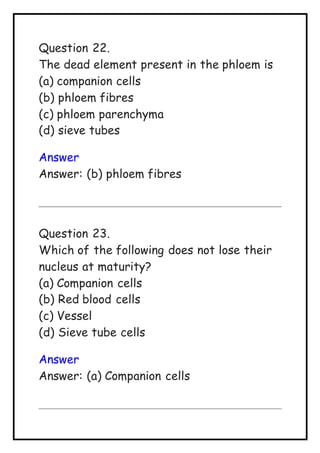
Question 22.
The dead element present in the phloem is
(a) companion cells
(b) phloem fibres
(c) phloem parenchyma
(d) sieve tubes
Answer
Answer: (b) phloem fibres
Question 23.
Which of the following does not lose their
nucleus at maturity?
(a) Companion cells
(b) Red blood cells
(c) Vessel
(d) Sieve tube cells
Answer
Answer: (a) Companion cells
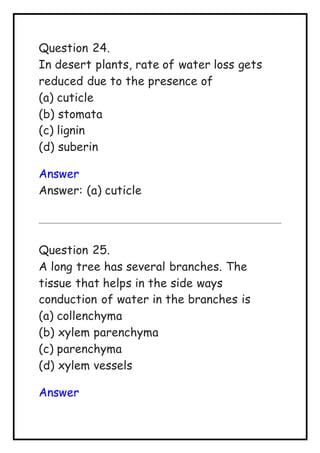
Question 24.
In desert plants, rate of water loss gets
reduced due to the presence of
(a) cuticle
(b) stomata
(c) lignin
(d) suberin
Answer
Answer: (a) cuticle
Question 25.
A long tree has several branches. The
tissue that helps in the side ways
conduction of water in the branches is
(a) collenchyma
(b) xylem parenchyma
(c) parenchyma
(d) xylem vessels
Answer
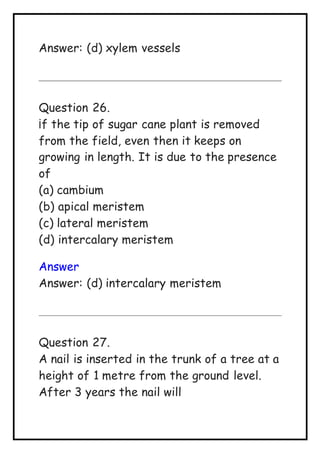
Answer: (d) xylem vessels
Question 26.
¡f the tip of sugar cane plant is removed
from the field, even then it keeps on
growing in length. It is due to the presence
of
(a) cambium
(b) apical meristem
(c) lateral meristem
(d) intercalary meristem
Answer
Answer: (d) intercalary meristem
Question 27.
A nail is inserted in the trunk of a tree at a
height of 1 metre from the ground level.
After 3 years the nail will
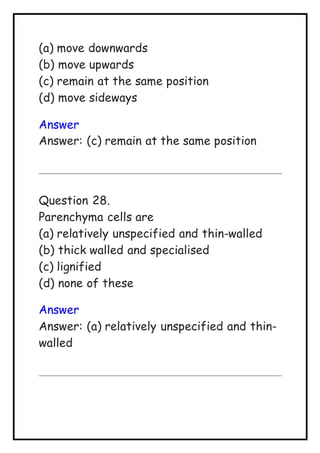
(a) move downwards
(b) move upwards
(c) remain at the same position
(d) move sideways
Answer
Answer: (c) remain at the same position
Question 28.
Parenchyma cells are
(a) relatively unspecified and thin-walled
(b) thick walled and specialised
(c) lignified
(d) none of these
Answer
Answer: (a) relatively unspecified and thin-
walled
Question 29.
Flexibility in plants is due to
(a) collenchyma
(b) scierenchyma
(c) parenchyma
(d) chiorenchyma
Answer
Answer: (a) collenchyma
Question 30.
Cork cells are made impervious to water
and gases by the presence of
(a) cellulose
(b) lipids
(c) suberin
(d) lignin
Answer
Answer: (c) suberin
Question 31.
Survival of plants in terrestrial
environment has been made possible by the
presence of
(a) intercalary meristem
(b) conducting tissue
(c) apical meristem
(d) parenchymatous tissue
Answer
Answer: (b) conducting tissue
Question 32.
Choose the wrong statement.
(a) The nature of matrix differs according
to the function of the tissue
(b) Fats are stored below the skin and in
between the internal organs
(c) Epithelial tissues have intercellular
spaces between them
(d) Cells of striated muscles are multinucle
ate and unbranched
Answer
Answer: (c) Epithelial tissues have
intercellular spaces between them
Question 33.
The water conducting tissue generally
present in gymnosperm is
(a) vessels
(b) sieve tube
(c) tracheids
(d) xylem fibres
Answer
Answer: (c) tracheids
Fill in the blanks:
1. Apical meristem is present at the growing
tips of stems and roots and increases the
……………. of the stem and the root.
Answer
Answer: Length
2. The ………….. meristem helps to increase
the girth of the stem or root.
Answer
Answer: lateral
3. The process by which cells take up a
permanent shape, size, and a function is
called ……………..
Answer
Answer: specialisation
4. Large air cavities present in parenchyma
of aquatic plants give ……………. to the plants
to help them float.
Answer
Answer: buoyancy
5. Collenchyma is a …………… tissue present in
plants which provides flexibility in plants.
Answer
Answer: simple permanent
6. The husk of a coconut is composed of
…………… tissue.
Answer
Answer: sclerenchyrna
7. Two kidney-shaped cells called ………………
cells enclose the stomata.
Answer
Answer: guard
8. Cells of cork are dead and have a
chemical called ……………. in their walls that
makes them impervious to gases and water.
Answer
Answer: suberin
9. The ……………. parenchyma stores food and
helps in the sideways conduction of water.
Answer
Answer: xylem
10. An extracellular fibrous …………….
membrane separates all epithelium from
the underlying tissue.
Answer
Answer: basement
11. The oesophagus and the lining of the
mouth are covered with ………………
epithelium.
Answer
Answer: squamous
12. The …………….. epithelium is formed when
the epithelial tissue folds inward and form
a multicellular gland.
Answer
Answer: glandular
13. Blood has a fluid (liquid) matrix called
…………….. in which red blood cells (RBCs),
white blood cells (WBCs) and are
suspended.
Answer
Answer: plasma, platelets
14. Bone cells are embedded in a hard
matrix that is composed of …………….. and
……………. compounds.
Answer
Answer: calcium and phosphorus
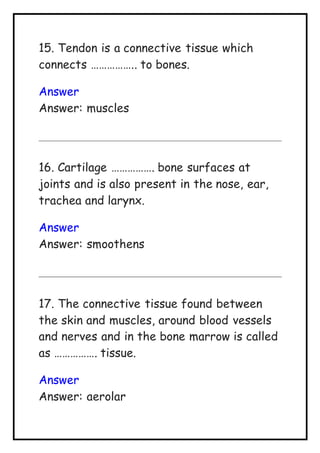
15. Tendon is a connective tissue which
connects …………….. to bones.
Answer
Answer: muscles
16. Cartilage ……………. bone surfaces at
joints and is also present in the nose, ear,
trachea and larynx.
Answer
Answer: smoothens
17. The connective tissue found between
the skin and muscles, around blood vessels
and nerves and in the bone marrow is called
as ……………. tissue.
Answer
Answer: aerolar
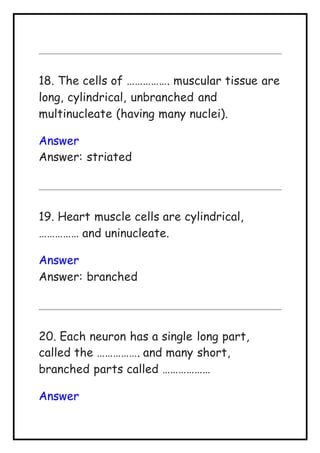
18. The cells of ……………. muscular tissue are
long, cylindrical, unbranched and
multinucleate (having many nuclei).
Answer
Answer: striated
19. Heart muscle cells are cylindrical,
…………… and uninucleate.
Answer
Answer: branched
20. Each neuron has a single long part,
called the ……………. and many short,
branched parts called ………………
Answer
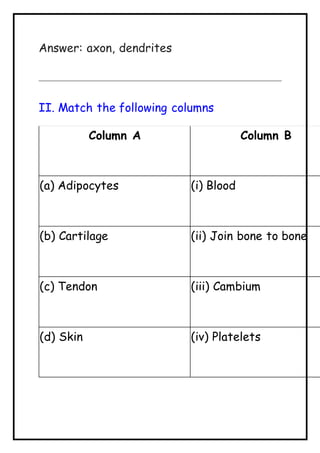
Answer: axon, dendrites
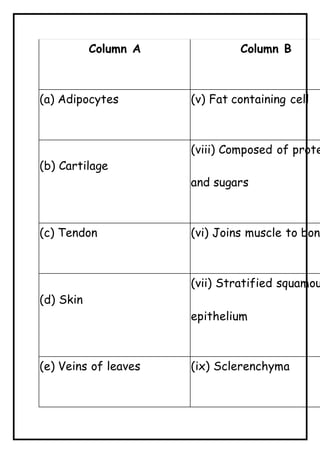
II. Match the following columns
Column A Column B
(a) Adipocytes (i) Blood
(b) Cartilage (ii) Join bone to bone
(c) Tendon (iii) Cambium
(d) Skin (iv) Platelets
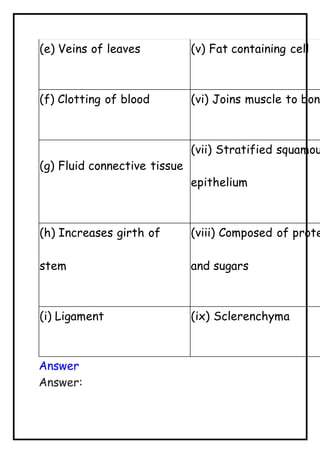
(e) Veins of leaves (v) Fat containing cell
(f) Clotting of blood (vi) Joins muscle to bone
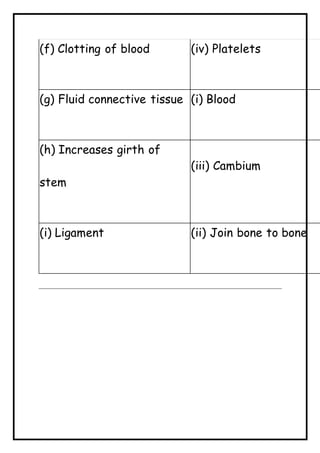
(g) Fluid connective tissue
(vii) Stratified squamou
epithelium
(h) Increases girth of
stem
(viii) Composed of prote
and sugars
(i) Ligament (ix) Sclerenchyma
Answer
Answer:
Column A Column B
(a) Adipocytes (v) Fat containing cell
(b) Cartilage
(viii) Composed of prote
and sugars
(c) Tendon (vi) Joins muscle to bone
(d) Skin
(vii) Stratified squamou
epithelium
(e) Veins of leaves (ix) Sclerenchyma
(f) Clotting of blood (iv) Platelets
(g) Fluid connective tissue (i) Blood
(h) Increases girth of
stem
(iii) Cambium
(i) Ligament (ii) Join bone to bone

Mcq's of class 9 chapter Tissues

  • 1.
    MCQ Questions forClass 9 Science Chapter 6 Tissues with Answers Question 1. Which of the following tissues has dead cells? (a) Parenchyma (b) Sclerenchyma (c) Collenchyma (d) Epithelial tissue Answer Answer: (b) Sclerenchyma Question 2. Find out incorrect sentence. (a) Parenchymatous tissues have intercellular spaces. (b) Collenchymatous tissues are irregularly thickened at corners. (c) Apical and intercalary meristems are
  • 2.
    permanent tissues. (d) Meristematictissues, in its early stage, lack vacuoles. Answer Answer: (c) Apical and intercalary meristems are permanent tissues. Question 3. Girth of stem increases due to (a) apical meristem (b) lateral meristem (c) intercalary meristem (d) vertical meristem Answer Answer: (b) lateral meristem Question 4. Which cell does not have perforated cell
  • 3.
    wall? (a) Tracheids (b) Companioncells (c) Sieve tubes (d) Vessels Answer Answer: (b) Companion cells Question 5. Intestine absorbs the digested food materials. What type of epithelial cells are responsible for that? (a) Stratified squamous epithelium (b) Columnar epithelium (c) Spindle fibres (d) Cuboidal epithelium Answer Answer: (b) Columnar epithelium
  • 4.
    Question 6. A personmet with an accident in which two long bones of the hand were dislocated. Which among the following may be the possible reason? (a) Tendon break (b) Break of skeletal muscle (c) Ligament break (d) Areolar tissue break Answer Answer: (c) Ligament break Question 7. While doing work and running, you move your organs Like hands, legs etc. Which among the following is correct? (a) Smooth muscles contract and pull the ligament to move the bones. (b) Smooth muscles contract and pull the tendons to move the bones.
  • 5.
    (c) Skeletal musclescontract and pull the ligament to move the bones. (d) Skeletal muscles contract and pull the tendon to move the bones. Answer Answer: (d) Skeletal muscles contract and pull the tendon to move the bones. Question 8. Which muscles act involuntarily? (i) Striated muscles (ii) Smooth muscles (iii) Cardiac muscles (iv) Skeletal muscles (a) (i) and (ii) (b) (ii) and (iii) (c) (iii) and (iv) (d) (i) and (iv) Answer
  • 6.
    Answer: (b) (ii)and (iii) Question 9. Meristematic tissues in plants are (a) localised and permanent (b) not limited Lo certain regions (c) localised and dividing cells (d) growing in volume Answer Answer: (c) localised and dividing cells Question 10. Which is not a function of epidermis? (a) Protection from adverse condition (b) Gaseous exchange (c) Conduction of water (d) Transpiration Answer
  • 7.
    Answer: (c) Conductionof water Question 11. Select the incorrect sentence. (a) Blood has a matrix containing proteins, salts and hormones (b) Two bones are connected by ligament (c) Tendons are non-fibrous tissue and fragile (d) Cartilage is a form of connective tissue Answer Answer: (c) Tendons are non-fibrous tissue and fragile Question 12. Cartilage is not found in (a) nose (b) ear
  • 8.
    (c) kidney (d) larynx Answer Answer:(c) kidney Question 13. Fats are stored in human body as (a) Cuboidal epithelium (b) Adipose tissue (c) Bones (d) Cartilage Answer Answer: (b) Adipose tissue Question 14. Bone matrix is rich in (a) Fluoride and calcium (b) Calcium and phosphorus
  • 9.
    (c) Calcium andpotassium (d) Phosphorus and potassium Answer Answer: (b) Calcium and phosphorus Question 15. Contractile proteins are found in (a) bones (b) blood (c) muscles (d) cartilage Answer Answer: (c) muscles Question 16. Voluntary muscles are found in (a) alimentary canal (b) limbo
  • 10.
    (c) iris ofthe eye (d) bronchi of lungs Answer Answer: (b) limbo Question 17. Nervous tissue is not found in (a) brain (b) spinal cord (c) tendons (d) nerves Answer Answer: (c) tendons Question 18. Nerve cell does not contain (a) axon (b) nerve endings
  • 11.
    (c) tendons (d) dendrites Answer Answer:(c) tendons Question 19. Which of the following helps in repair of tissue and fills up the space inside the organ? (a) Tendon (b) Adipose tissue (c) Areolar (d) Cartilage Answer Answer: (c) Areolar Question 20. The muscular tissue which function
  • 12.
    throughout life continuouslywithout fatigue is (a) skeletal muscle (b) cardiac muscle (c) smooth muscle (d) voluntary muscle Answer Answer: (b) cardiac muscle Question 21. Which of the following cells is found in the cartilaginous tissue of the body? (a) Mast cells (b) Basophils (c) Osteocytes (d) Chondrocytes Answer Answer: (d) Chondrocytes
  • 13.
    Question 22. The deadelement present in the phloem is (a) companion cells (b) phloem fibres (c) phloem parenchyma (d) sieve tubes Answer Answer: (b) phloem fibres Question 23. Which of the following does not lose their nucleus at maturity? (a) Companion cells (b) Red blood cells (c) Vessel (d) Sieve tube cells Answer Answer: (a) Companion cells
  • 14.
    Question 24. In desertplants, rate of water loss gets reduced due to the presence of (a) cuticle (b) stomata (c) lignin (d) suberin Answer Answer: (a) cuticle Question 25. A long tree has several branches. The tissue that helps in the side ways conduction of water in the branches is (a) collenchyma (b) xylem parenchyma (c) parenchyma (d) xylem vessels Answer
  • 15.
    Answer: (d) xylemvessels Question 26. ¡f the tip of sugar cane plant is removed from the field, even then it keeps on growing in length. It is due to the presence of (a) cambium (b) apical meristem (c) lateral meristem (d) intercalary meristem Answer Answer: (d) intercalary meristem Question 27. A nail is inserted in the trunk of a tree at a height of 1 metre from the ground level. After 3 years the nail will
  • 16.
    (a) move downwards (b)move upwards (c) remain at the same position (d) move sideways Answer Answer: (c) remain at the same position Question 28. Parenchyma cells are (a) relatively unspecified and thin-walled (b) thick walled and specialised (c) lignified (d) none of these Answer Answer: (a) relatively unspecified and thin- walled
  • 17.
    Question 29. Flexibility inplants is due to (a) collenchyma (b) scierenchyma (c) parenchyma (d) chiorenchyma Answer Answer: (a) collenchyma Question 30. Cork cells are made impervious to water and gases by the presence of (a) cellulose (b) lipids (c) suberin (d) lignin Answer Answer: (c) suberin
  • 18.
    Question 31. Survival ofplants in terrestrial environment has been made possible by the presence of (a) intercalary meristem (b) conducting tissue (c) apical meristem (d) parenchymatous tissue Answer Answer: (b) conducting tissue Question 32. Choose the wrong statement. (a) The nature of matrix differs according to the function of the tissue (b) Fats are stored below the skin and in between the internal organs (c) Epithelial tissues have intercellular spaces between them
  • 19.
    (d) Cells ofstriated muscles are multinucle ate and unbranched Answer Answer: (c) Epithelial tissues have intercellular spaces between them Question 33. The water conducting tissue generally present in gymnosperm is (a) vessels (b) sieve tube (c) tracheids (d) xylem fibres Answer Answer: (c) tracheids Fill in the blanks:
  • 20.
    1. Apical meristemis present at the growing tips of stems and roots and increases the ……………. of the stem and the root. Answer Answer: Length 2. The ………….. meristem helps to increase the girth of the stem or root. Answer Answer: lateral 3. The process by which cells take up a permanent shape, size, and a function is called …………….. Answer Answer: specialisation
  • 21.
    4. Large aircavities present in parenchyma of aquatic plants give ……………. to the plants to help them float. Answer Answer: buoyancy 5. Collenchyma is a …………… tissue present in plants which provides flexibility in plants. Answer Answer: simple permanent 6. The husk of a coconut is composed of …………… tissue. Answer Answer: sclerenchyrna
  • 22.
    7. Two kidney-shapedcells called ……………… cells enclose the stomata. Answer Answer: guard 8. Cells of cork are dead and have a chemical called ……………. in their walls that makes them impervious to gases and water. Answer Answer: suberin 9. The ……………. parenchyma stores food and helps in the sideways conduction of water. Answer Answer: xylem
  • 23.
    10. An extracellularfibrous ……………. membrane separates all epithelium from the underlying tissue. Answer Answer: basement 11. The oesophagus and the lining of the mouth are covered with ……………… epithelium. Answer Answer: squamous 12. The …………….. epithelium is formed when the epithelial tissue folds inward and form a multicellular gland.
  • 24.
    Answer Answer: glandular 13. Bloodhas a fluid (liquid) matrix called …………….. in which red blood cells (RBCs), white blood cells (WBCs) and are suspended. Answer Answer: plasma, platelets 14. Bone cells are embedded in a hard matrix that is composed of …………….. and ……………. compounds. Answer Answer: calcium and phosphorus
  • 25.
    15. Tendon isa connective tissue which connects …………….. to bones. Answer Answer: muscles 16. Cartilage ……………. bone surfaces at joints and is also present in the nose, ear, trachea and larynx. Answer Answer: smoothens 17. The connective tissue found between the skin and muscles, around blood vessels and nerves and in the bone marrow is called as ……………. tissue. Answer Answer: aerolar
  • 26.
    18. The cellsof ……………. muscular tissue are long, cylindrical, unbranched and multinucleate (having many nuclei). Answer Answer: striated 19. Heart muscle cells are cylindrical, …………… and uninucleate. Answer Answer: branched 20. Each neuron has a single long part, called the ……………. and many short, branched parts called ……………… Answer
  • 27.
    Answer: axon, dendrites II.Match the following columns Column A Column B (a) Adipocytes (i) Blood (b) Cartilage (ii) Join bone to bone (c) Tendon (iii) Cambium (d) Skin (iv) Platelets
  • 28.
    (e) Veins ofleaves (v) Fat containing cell (f) Clotting of blood (vi) Joins muscle to bone (g) Fluid connective tissue (vii) Stratified squamou epithelium (h) Increases girth of stem (viii) Composed of prote and sugars (i) Ligament (ix) Sclerenchyma Answer Answer:
  • 29.
    Column A ColumnB (a) Adipocytes (v) Fat containing cell (b) Cartilage (viii) Composed of prote and sugars (c) Tendon (vi) Joins muscle to bone (d) Skin (vii) Stratified squamou epithelium (e) Veins of leaves (ix) Sclerenchyma
  • 30.
    (f) Clotting ofblood (iv) Platelets (g) Fluid connective tissue (i) Blood (h) Increases girth of stem (iii) Cambium (i) Ligament (ii) Join bone to bone