1
Monte-Carlo Planning:
Introduction and Bandit Basics
Alan Fern
2
Large Worlds
We have considered basic model-based planning
algorithms
Model-based planning: assumes MDP model is
available
Methods we learned so far are at least poly-time in the
number of states and actions
Difficult to apply to large state and action spaces (though
this is a rich research area)
We will consider various methods for overcoming
this issue
3
Approaches for Large Worlds
 Planning with compact MDP representations
1. Define a language for compactly describing an MDP
 MDP is exponentially larger than description
 E.g. via Dynamic Bayesian Networks
2. Design a planning algorithm that directly works with that
language
 Scalability is still an issue
 Can be difficult to encode the problem you care
about in a given language
 May study in last part of course
4
Approaches for Large Worlds
 Reinforcement learning w/ function approx.
1. Have a learning agent directly interact with environment
2. Learn a compact description of policy or value function
 Often works quite well for large problems
 Doesn’t fully exploit a simulator of the environment
when available
 We will study reinforcement learning later in the
course
5
Approaches for Large Worlds:
Monte-Carlo Planning
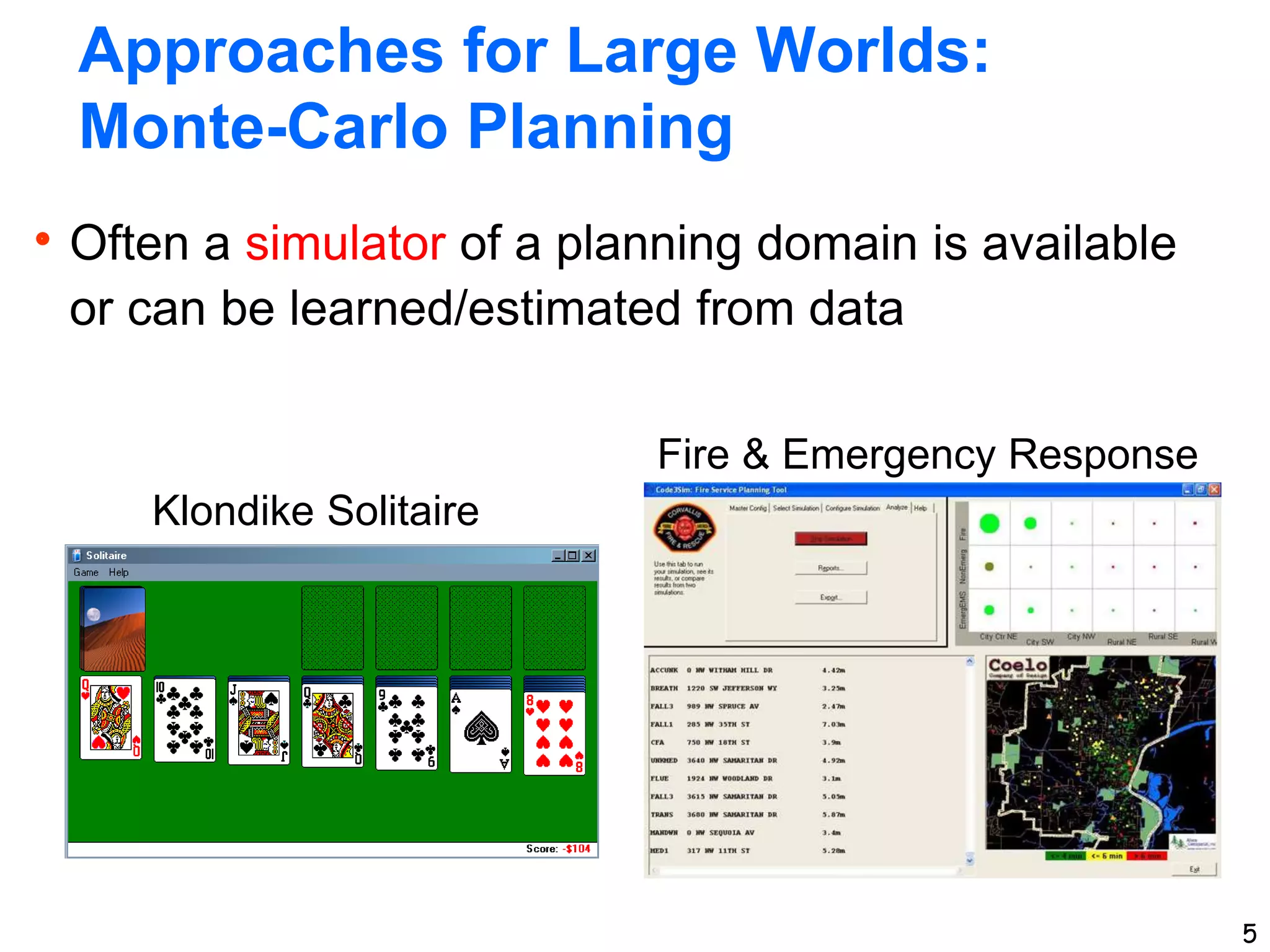
Often a simulator of a planning domain is available
or can be learned/estimated from data
5
Klondike Solitaire
Fire & Emergency Response
6
Large Worlds: Monte-Carlo Approach
Often a simulator of a planning domain is available
or can be learned from data
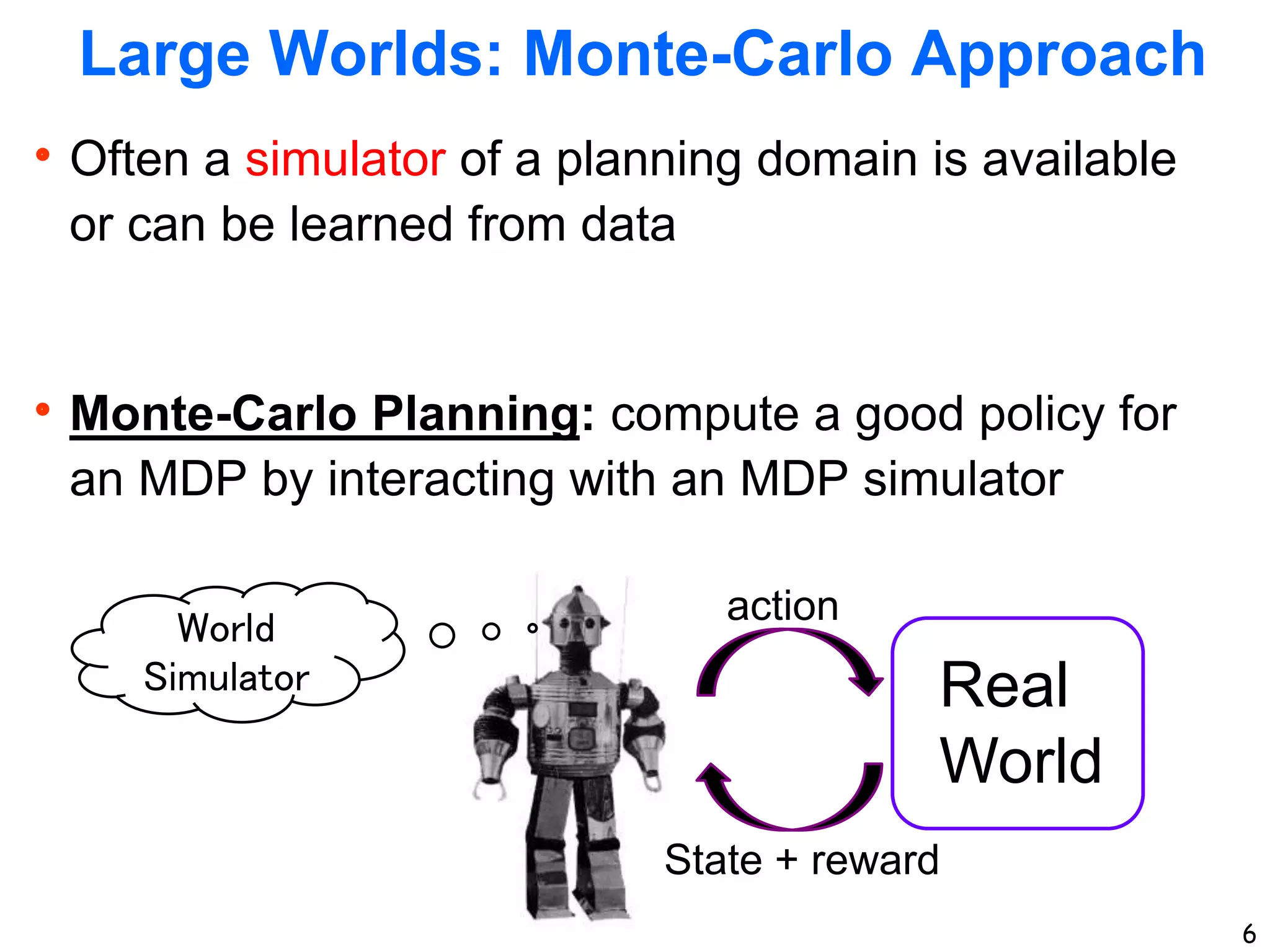
Monte-Carlo Planning: compute a good policy for
an MDP by interacting with an MDP simulator
6
World
Simulator Real
World
action
State + reward
7
Example Domains with Simulators
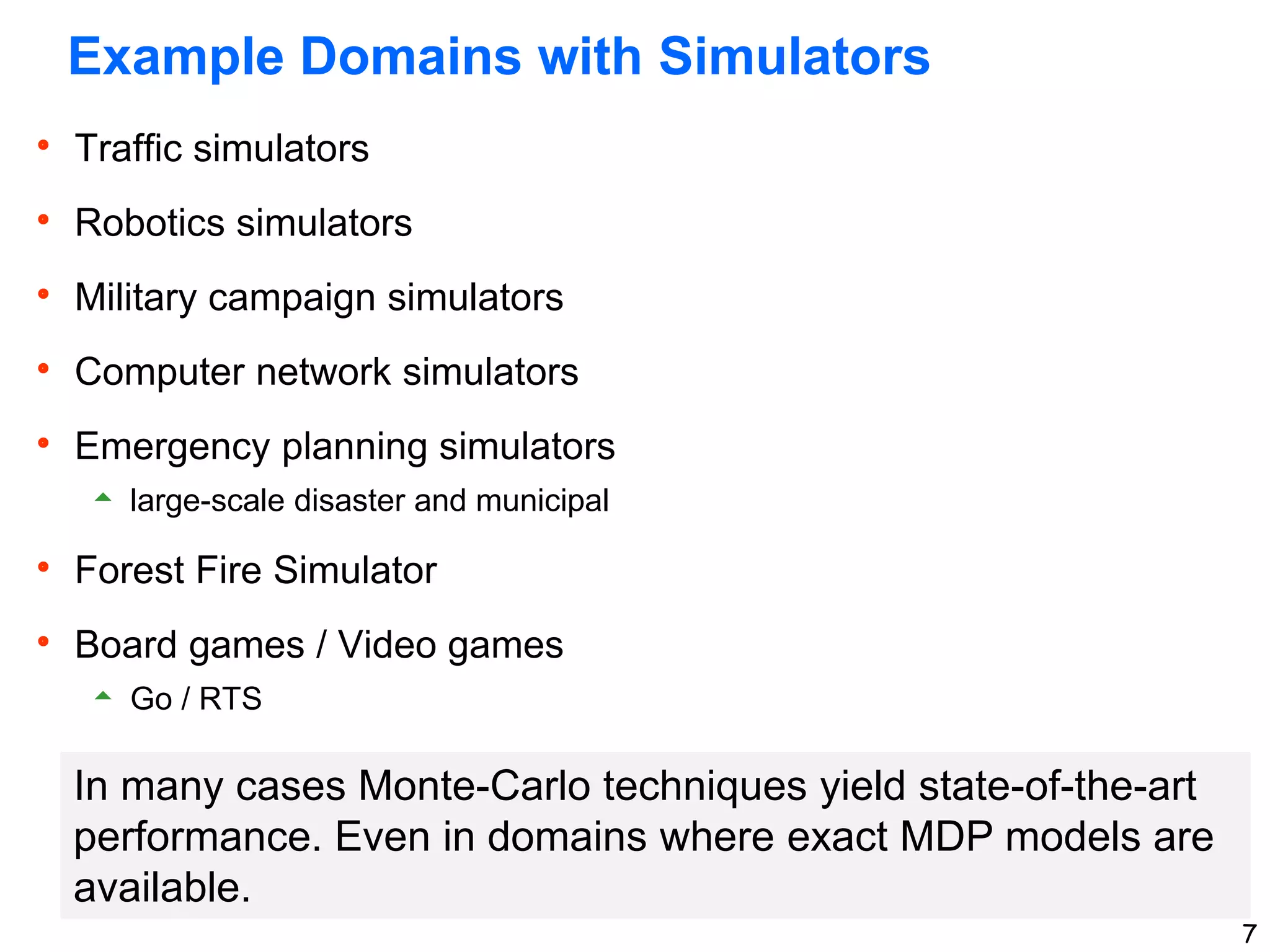
 Traffic simulators
 Robotics simulators
 Military campaign simulators
 Computer network simulators
 Emergency planning simulators
 large-scale disaster and municipal
 Forest Fire Simulator
 Board games / Video games
 Go / RTS
In many cases Monte-Carlo techniques yield state-of-the-art
performance. Even in domains where exact MDP models are
available.
8
MDP: Simulation-Based Representation
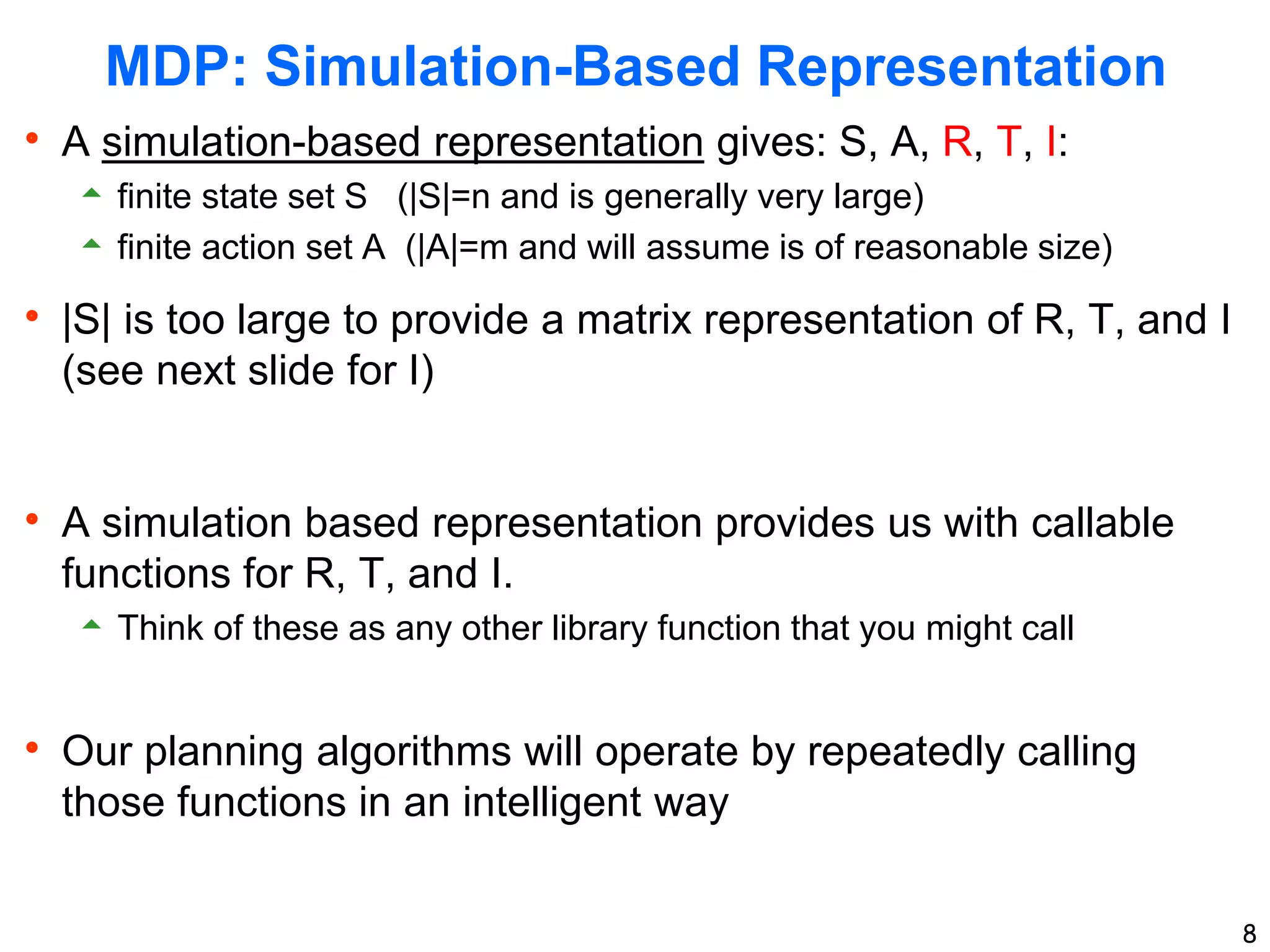
 A simulation-based representation gives: S, A, R, T, I:
 finite state set S (|S|=n and is generally very large)
 finite action set A (|A|=m and will assume is of reasonable size)
 |S| is too large to provide a matrix representation of R, T, and I
(see next slide for I)
 A simulation based representation provides us with callable
functions for R, T, and I.
 Think of these as any other library function that you might call
 Our planning algorithms will operate by repeatedly calling
those functions in an intelligent way
9
MDP: Simulation-Based Representation
 A simulation-based representation gives: S, A, R, T, I:
 finite state set S (|S|=n and is generally very large)
 finite action set A (|A|=m and will assume is of reasonable size)
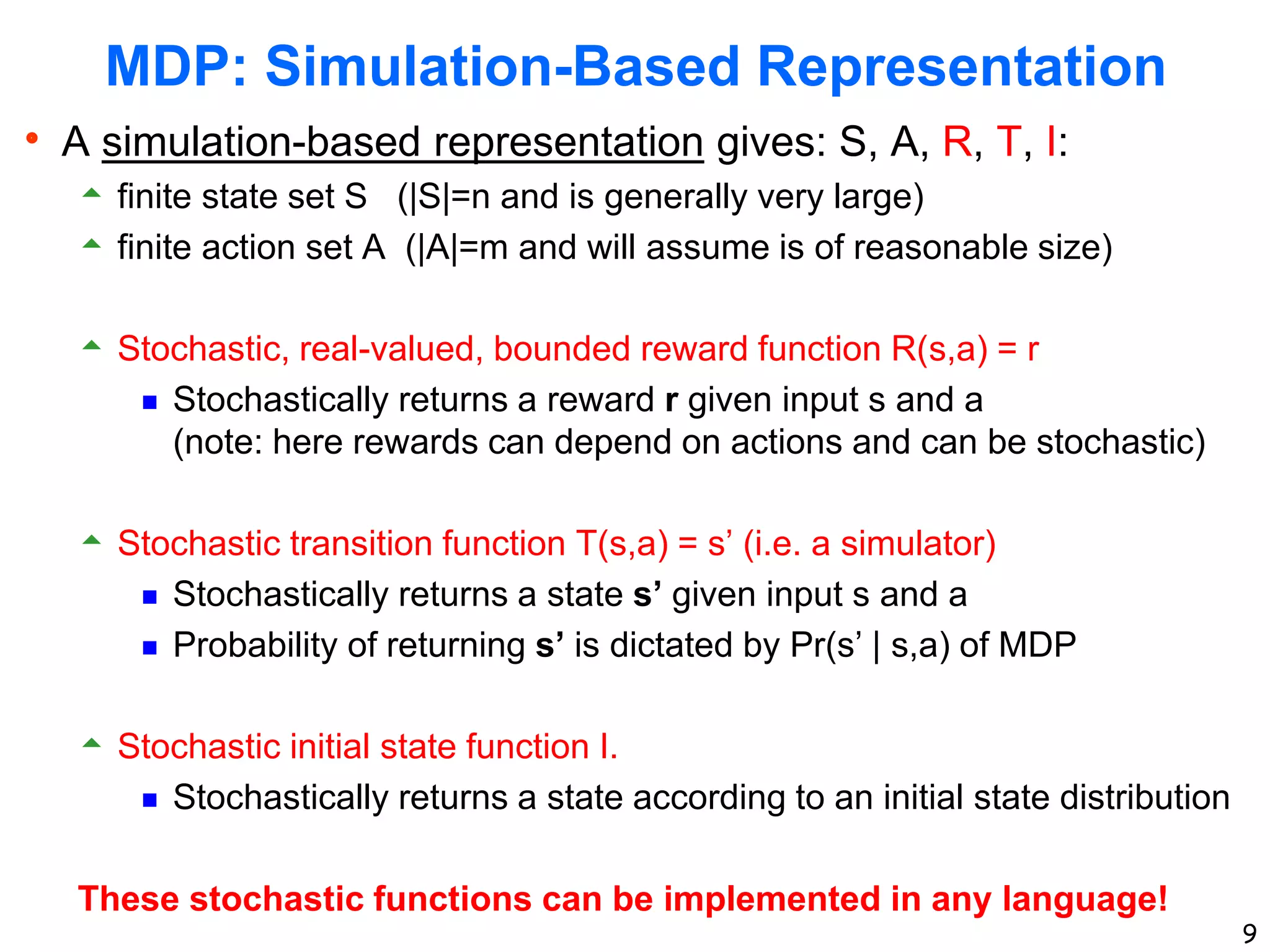
 Stochastic, real-valued, bounded reward function R(s,a) = r
 Stochastically returns a reward r given input s and a
(note: here rewards can depend on actions and can be stochastic)
 Stochastic transition function T(s,a) = s’ (i.e. a simulator)
 Stochastically returns a state s’ given input s and a
 Probability of returning s’ is dictated by Pr(s’ | s,a) of MDP
 Stochastic initial state function I.
 Stochastically returns a state according to an initial state distribution
These stochastic functions can be implemented in any language!
10
Monte-Carlo Planning Outline
Single State Case (multi-armed bandits)
A basic tool for other algorithms
Monte-Carlo Policy Improvement
Policy rollout
Policy Switching
Approximate Policy Iteration
Monte-Carlo Tree Search
Sparse Sampling
UCT and variants
11
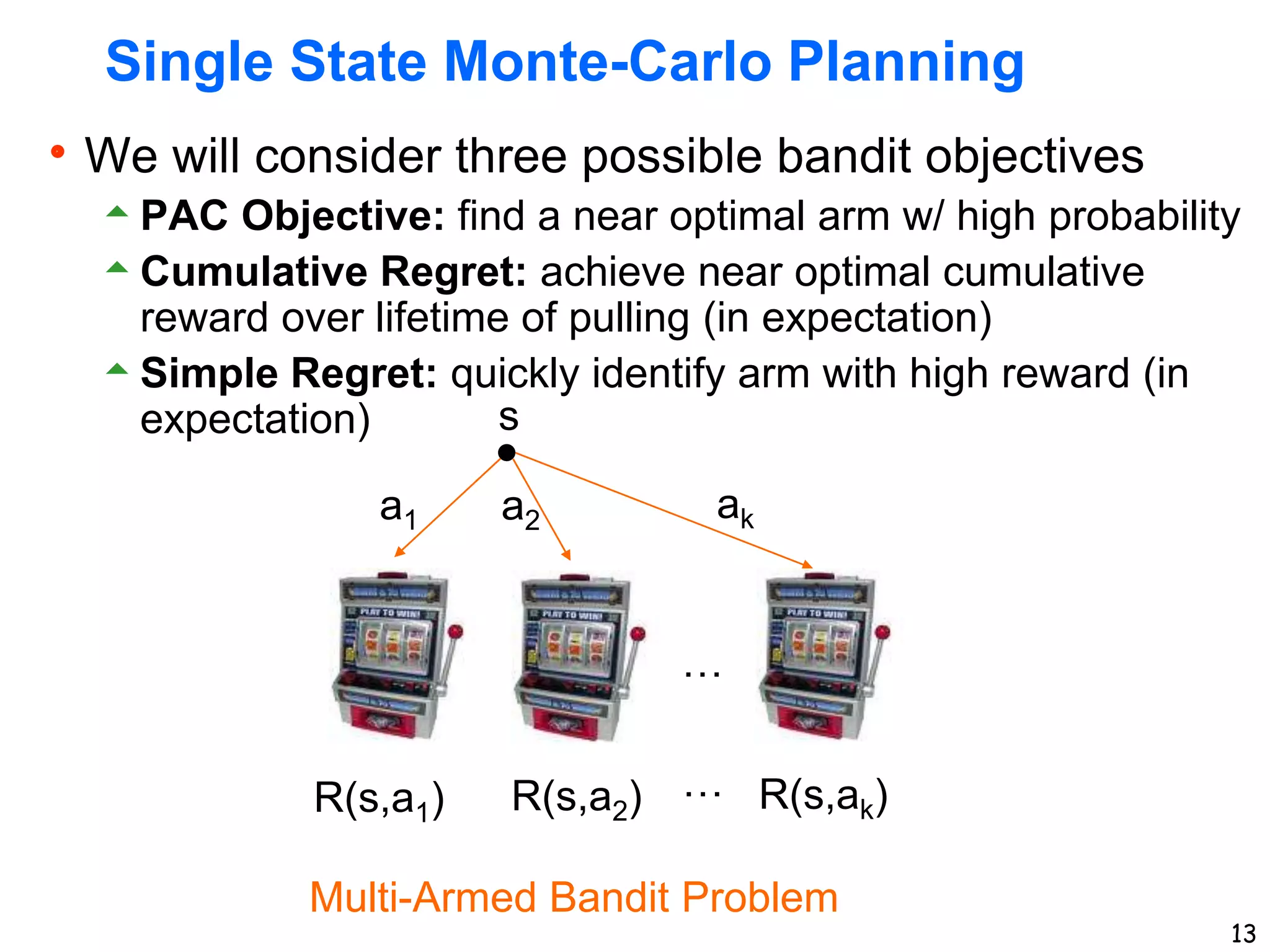
Single State Monte-Carlo Planning
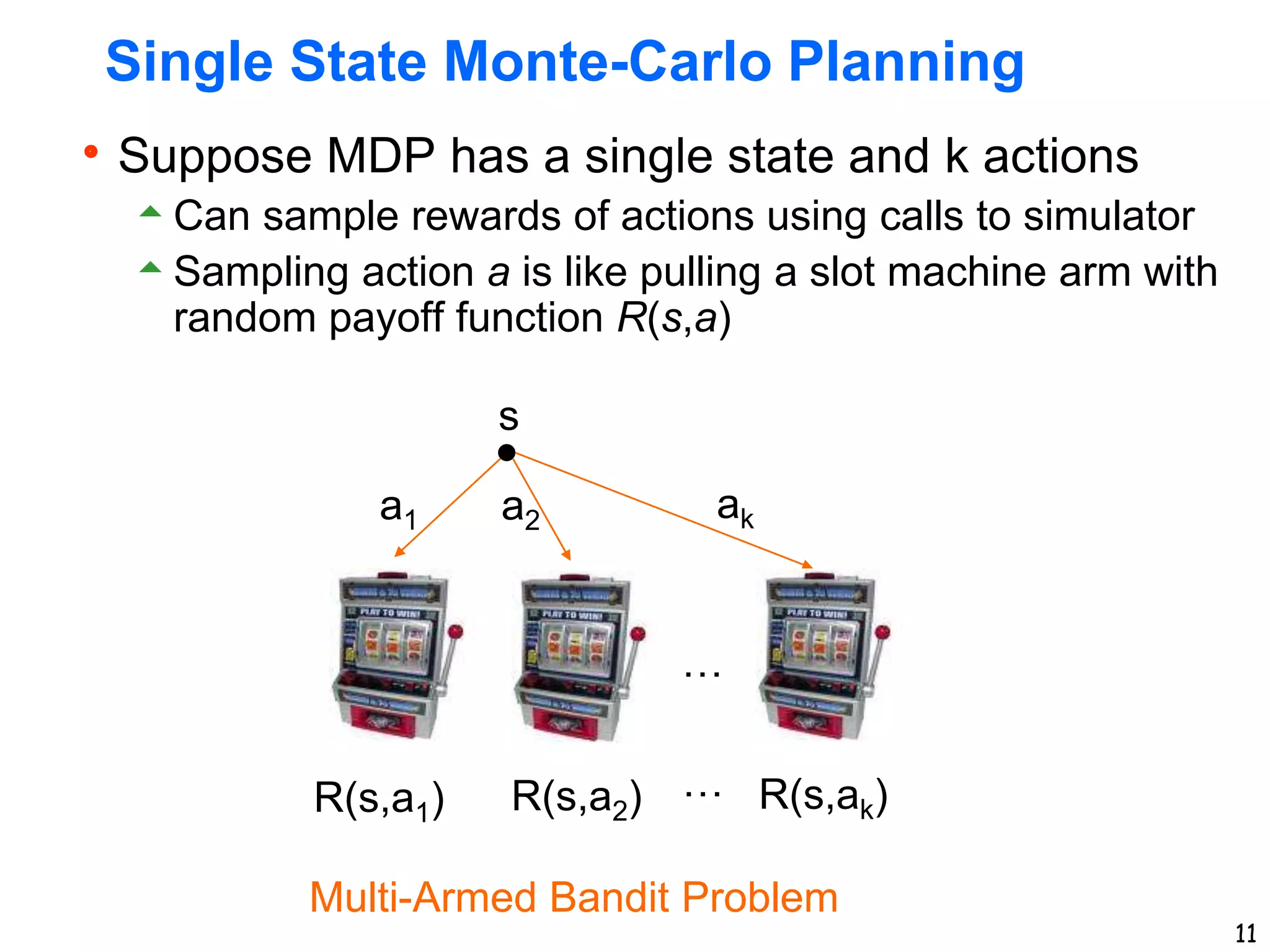
Suppose MDP has a single state and k actions
Can sample rewards of actions using calls to simulator
Sampling action a is like pulling a slot machine arm with
random payoff function R(s,a)
s
a1 a2 ak
R(s,a1) R(s,a2) R(s,ak)
Multi-Armed Bandit Problem
…
…
12
Single State Monte-Carlo Planning
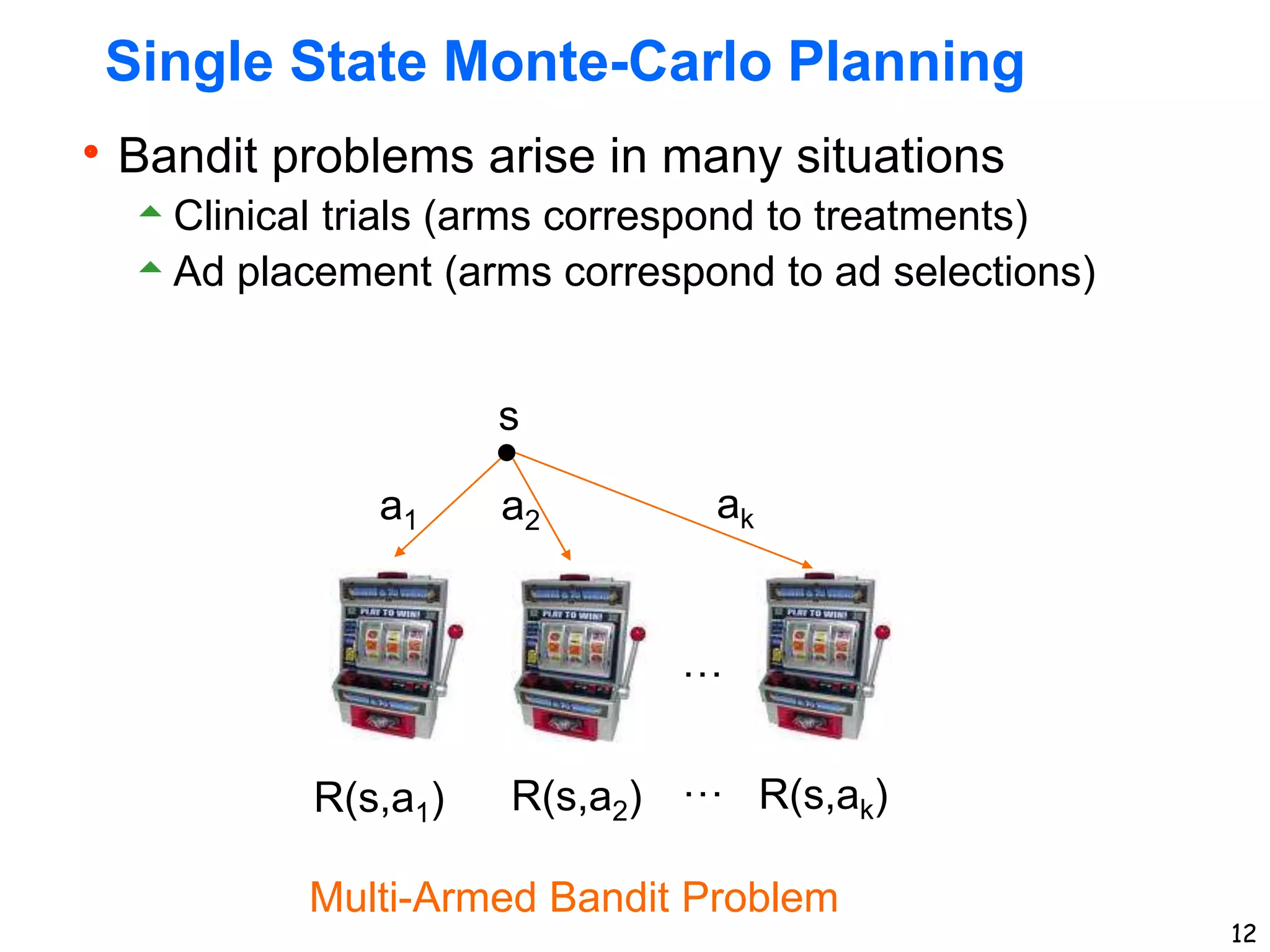
Bandit problems arise in many situations
Clinical trials (arms correspond to treatments)
Ad placement (arms correspond to ad selections)
s
a1 a2 ak
R(s,a1) R(s,a2) R(s,ak)
Multi-Armed Bandit Problem
…
…
13
Single State Monte-Carlo Planning
We will consider three possible bandit objectives
PAC Objective: find a near optimal arm w/ high probability
Cumulative Regret: achieve near optimal cumulative
reward over lifetime of pulling (in expectation)
Simple Regret: quickly identify arm with high reward (in
expectation) s
a1 a2 ak
R(s,a1) R(s,a2) R(s,ak)
Multi-Armed Bandit Problem
…
…
Multi-Armed Bandits
Bandit algorithms are not just useful as
components for multi-state Monte-Carlo planning
Pure bandit problems arise in many applications
Applicable whenever:
We have a set of independent options with unknown
utilities
There is a cost for sampling options or a limit on total
samples
Want to find the best option or maximize utility of our
samples
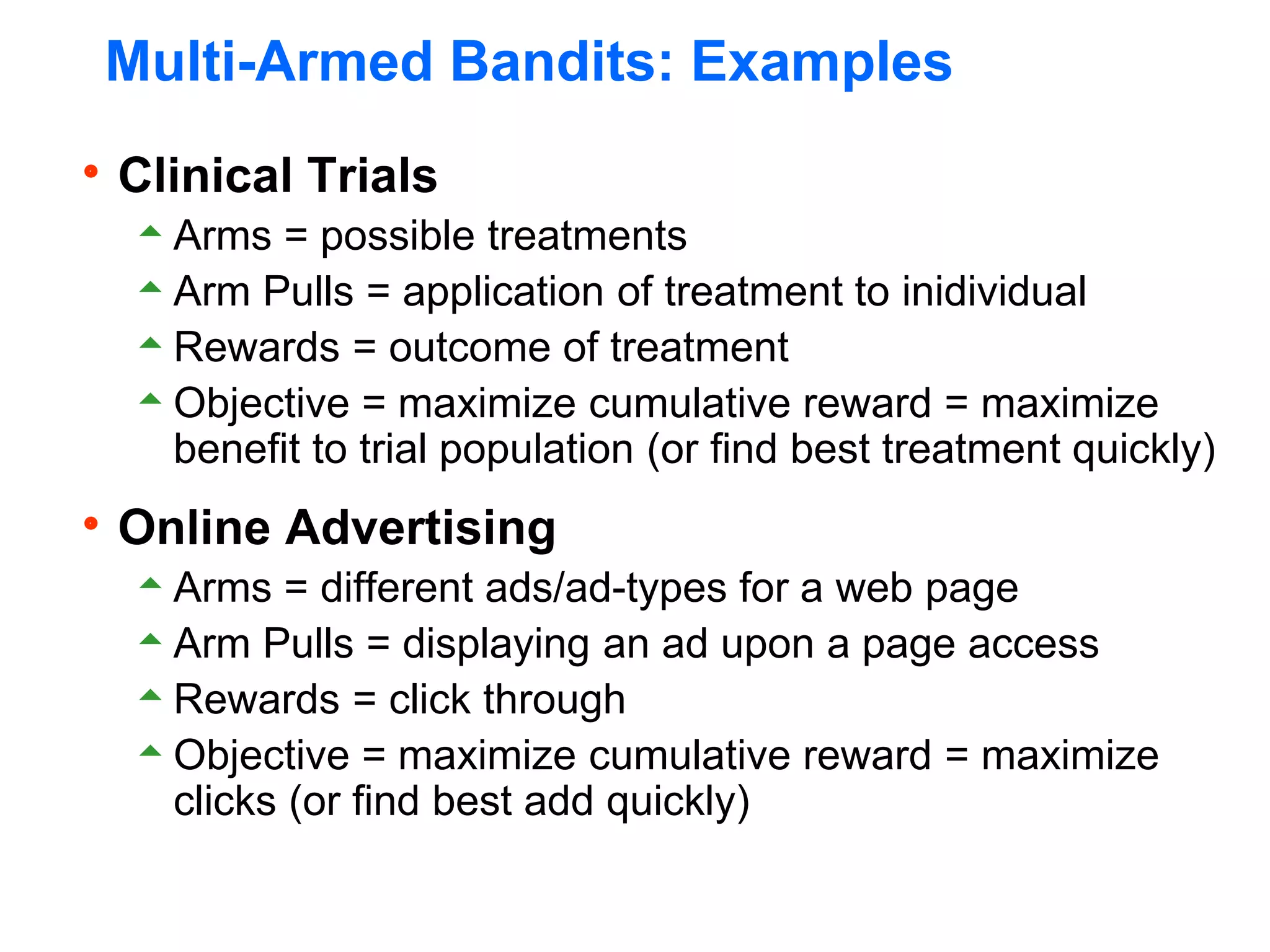
Multi-Armed Bandits: Examples
Clinical Trials
Arms = possible treatments
Arm Pulls = application of treatment to inidividual
Rewards = outcome of treatment
Objective = maximize cumulative reward = maximize
benefit to trial population (or find best treatment quickly)
Online Advertising
Arms = different ads/ad-types for a web page
Arm Pulls = displaying an ad upon a page access
Rewards = click through
Objective = maximize cumulative reward = maximize
clicks (or find best add quickly)
Bounded Reward Assumption
A common assumption we will make is that
rewards are in a bounded interval [-𝑅𝑚𝑎𝑥, 𝑅𝑚𝑎𝑥].
I.e., for each 𝑖, Pr 𝑅 𝑠, 𝑎𝑖 ∈ −𝑅𝑚𝑎𝑥, 𝑅𝑚𝑎𝑥 = 1.
Results are available for other types of
assumptions, e.g. Gaussian distributions
Require different type of analysis
17
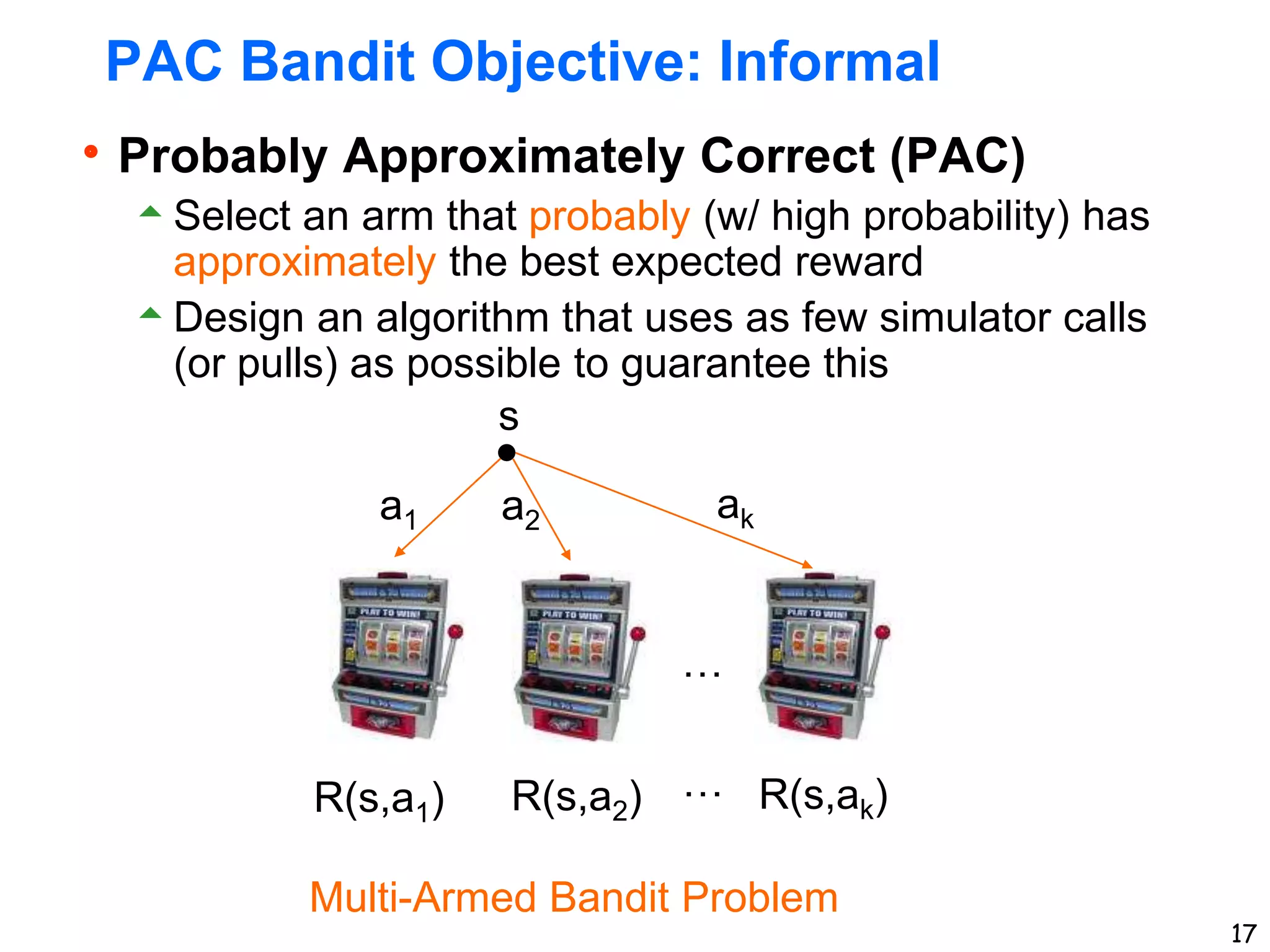
PAC Bandit Objective: Informal
Probably Approximately Correct (PAC)
Select an arm that probably (w/ high probability) has
approximately the best expected reward
Design an algorithm that uses as few simulator calls
(or pulls) as possible to guarantee this
s
a1 a2 ak
R(s,a1) R(s,a2) R(s,ak)
Multi-Armed Bandit Problem
…
…
18
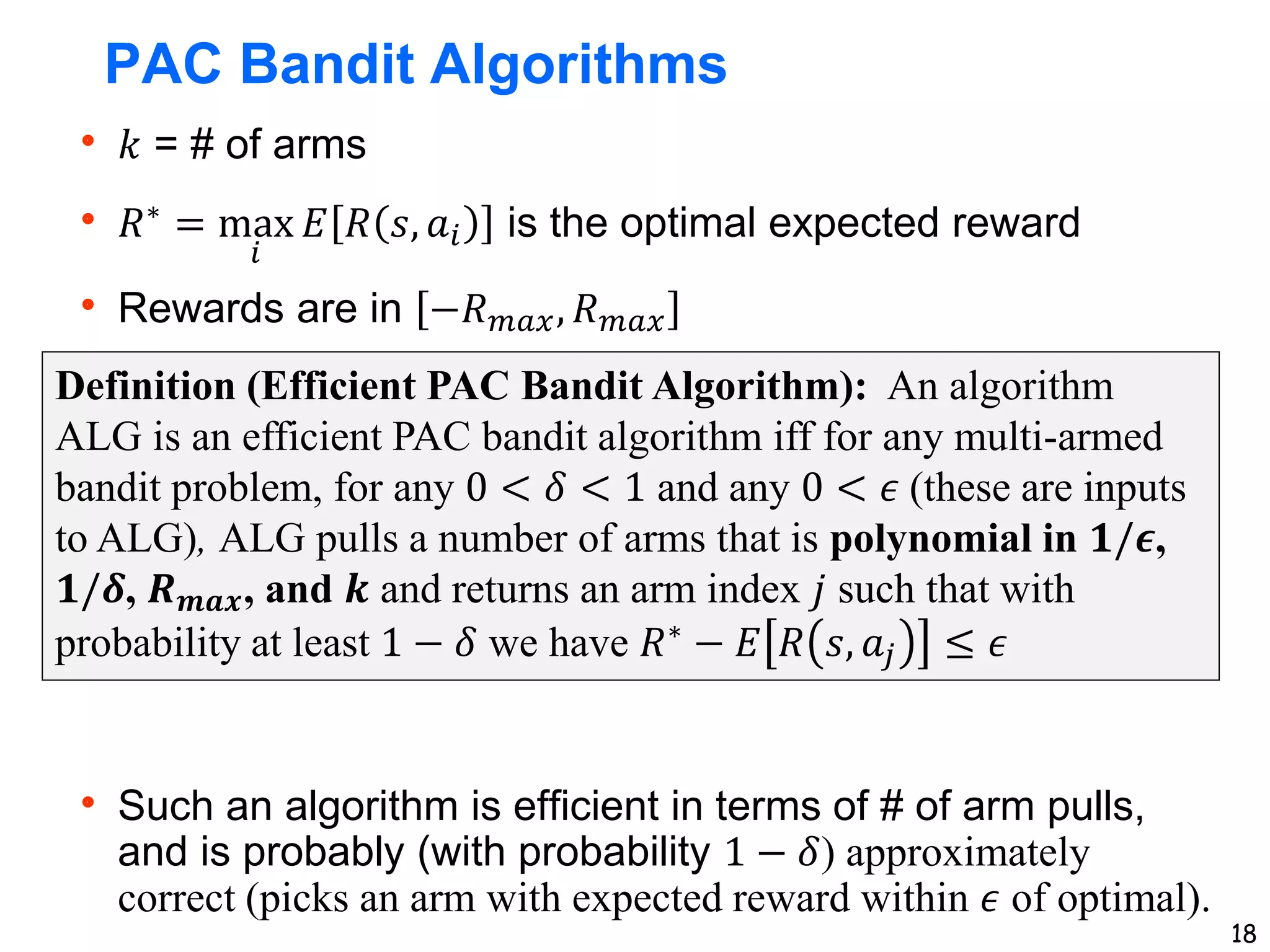
PAC Bandit Algorithms
 𝑘 = # of arms
 𝑅∗
= max
𝑖
𝐸 𝑅 𝑠, 𝑎𝑖 is the optimal expected reward
 Rewards are in −𝑅𝑚𝑎𝑥, 𝑅𝑚𝑎𝑥
 Such an algorithm is efficient in terms of # of arm pulls,
and is probably (with probability 1 − 𝛿) approximately
correct (picks an arm with expected reward within 𝜖 of optimal).
Definition (Efficient PAC Bandit Algorithm): An algorithm
ALG is an efficient PAC bandit algorithm iff for any multi-armed
bandit problem, for any 0 < 𝛿 < 1 and any 0 < 𝜖 (these are inputs
to ALG), ALG pulls a number of arms that is polynomial in 𝟏/𝝐,
𝟏/𝜹, 𝑹𝒎𝒂𝒙, and 𝒌 and returns an arm index 𝑗 such that with
probability at least 1 − 𝛿 we have 𝑅∗ − 𝐸 𝑅 𝑠, 𝑎𝑗 ≤ 𝜖
19
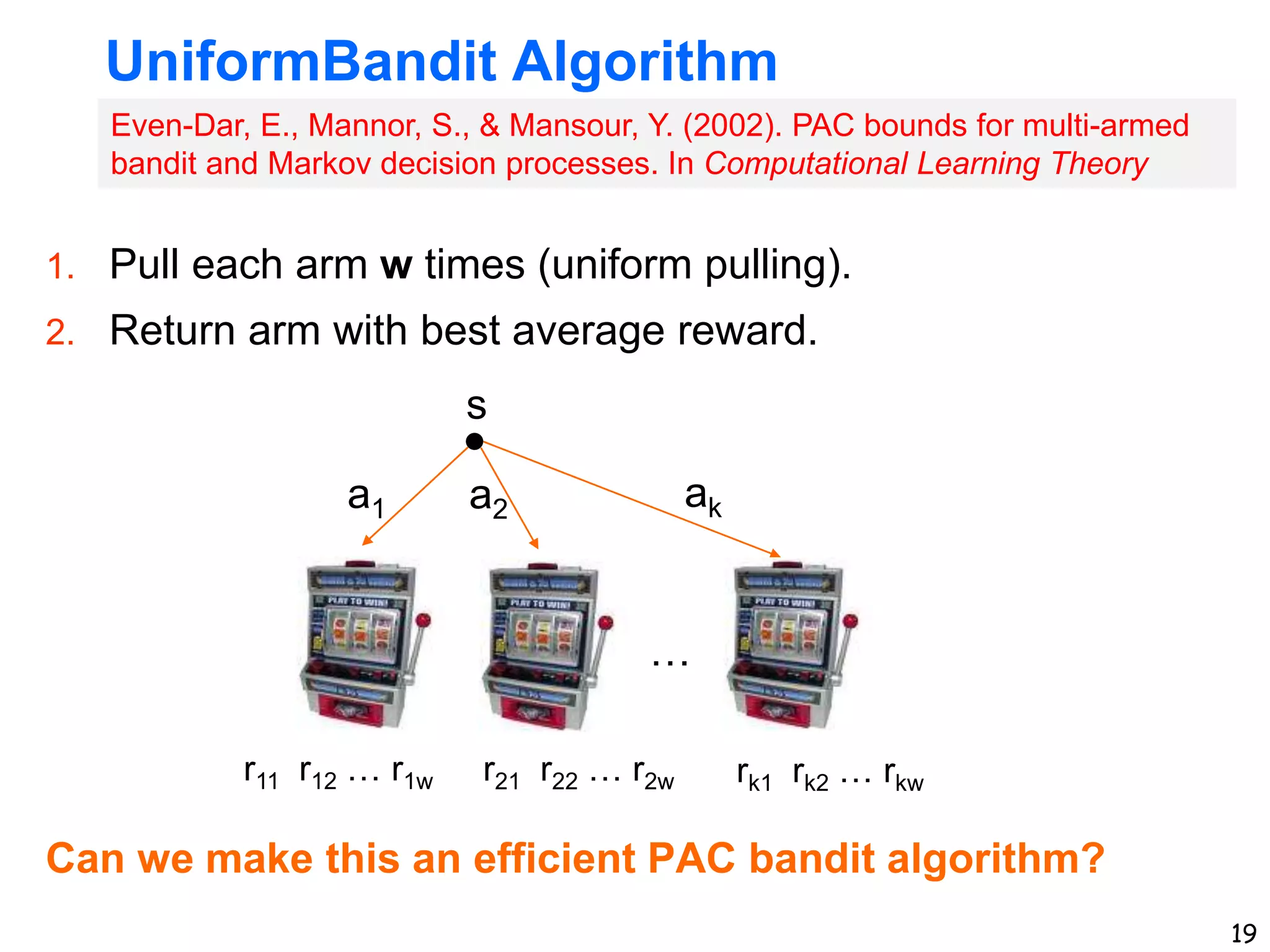
UniformBandit Algorithm
1. Pull each arm w times (uniform pulling).
2. Return arm with best average reward.
Can we make this an efficient PAC bandit algorithm?
s
a1 a2 ak
…
r11 r12 … r1w r21 r22 … r2w rk1 rk2 … rkw
Even-Dar, E., Mannor, S., & Mansour, Y. (2002). PAC bounds for multi-armed
bandit and Markov decision processes. In Computational Learning Theory
20
Aside: Additive Chernoff Bound
• Let R be a random variable with maximum absolute value Z.
An let ri i=1,…,w be i.i.d. samples of R
• The Chernoff bound gives a bound on the probability that the
average of the ri are far from E[R]

1
1
1
1
ln
]
[ w
w
i
i
w Z
r
R
E 
 

With probability at least we have that,


1

























 

w
Z
r
R
E
w
i
i
w
2
1
1
exp
]
[
Pr


Chernoff
Bound
Equivalent Statement:
21
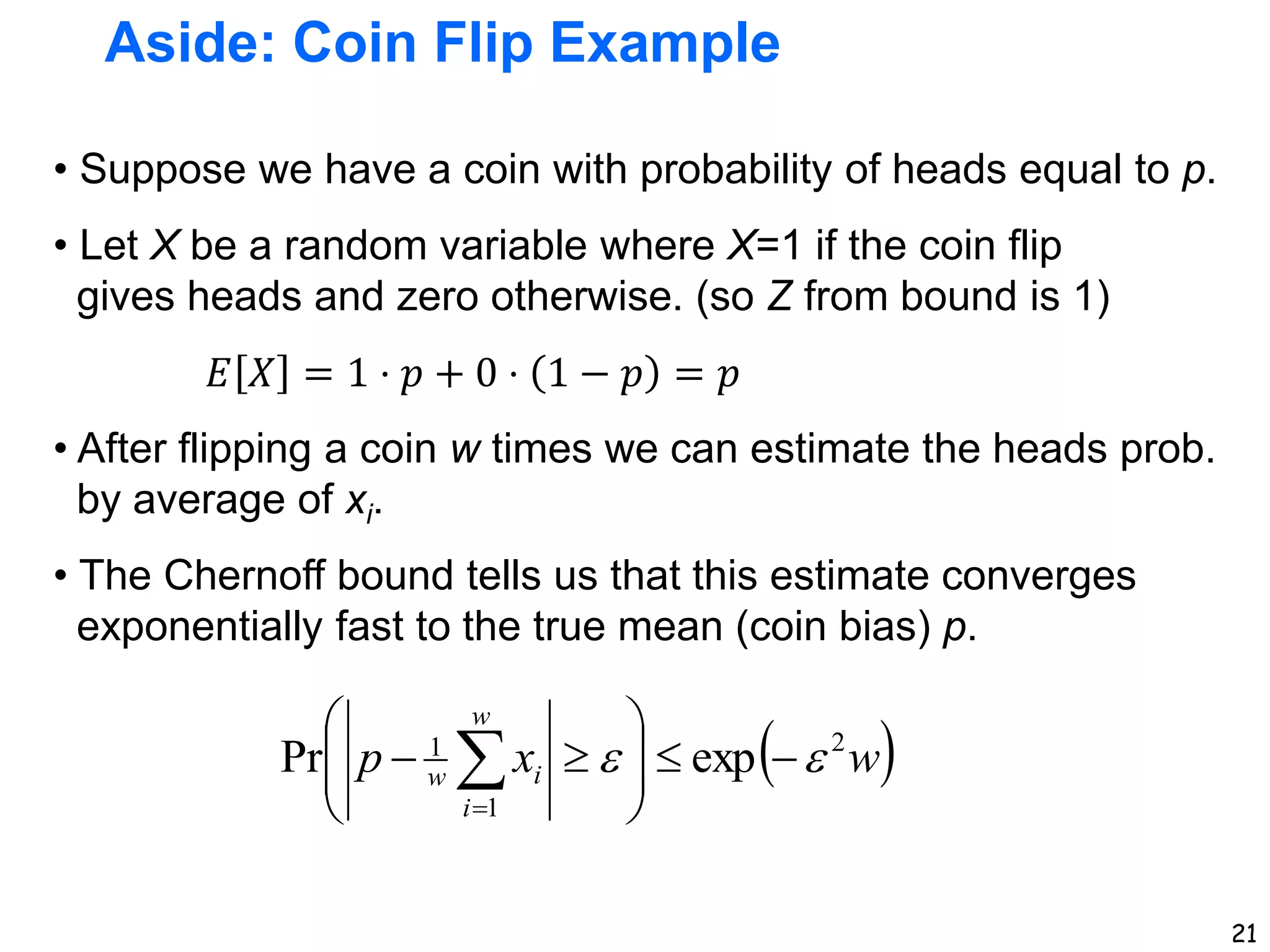
Aside: Coin Flip Example
• Suppose we have a coin with probability of heads equal to p.
• Let X be a random variable where X=1 if the coin flip
gives heads and zero otherwise. (so Z from bound is 1)
𝐸 𝑋 = 1 ⋅ 𝑝 + 0 ⋅ 1 − 𝑝 = 𝑝
• After flipping a coin w times we can estimate the heads prob.
by average of xi.
• The Chernoff bound tells us that this estimate converges
exponentially fast to the true mean (coin bias) p.
 
w
x
p
w
i
i
w
2
1
1
exp
Pr 
 










 

22
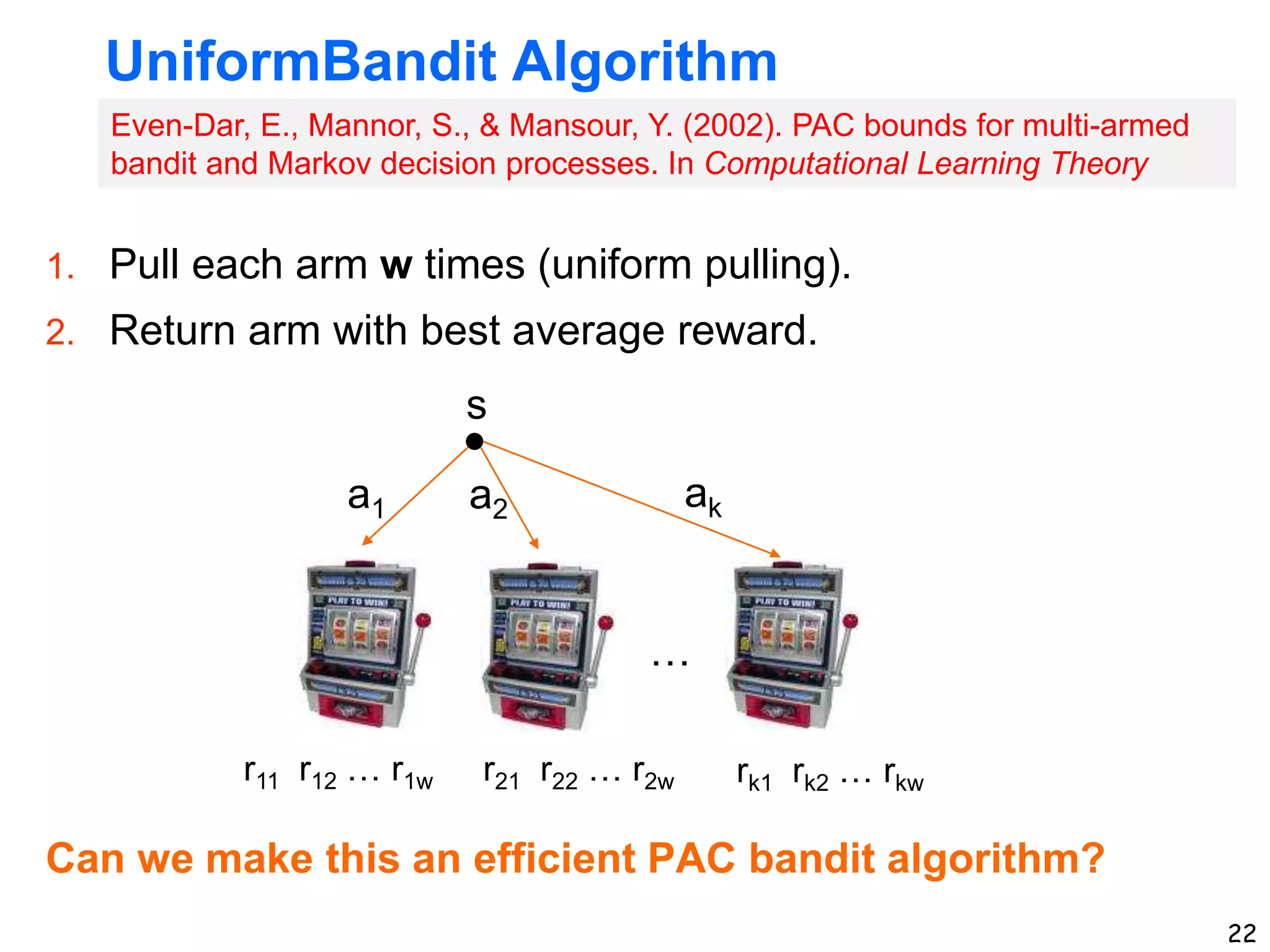
UniformBandit Algorithm
1. Pull each arm w times (uniform pulling).
2. Return arm with best average reward.
Can we make this an efficient PAC bandit algorithm?
s
a1 a2 ak
…
r11 r12 … r1w r21 r22 … r2w rk1 rk2 … rkw
Even-Dar, E., Mannor, S., & Mansour, Y. (2002). PAC bounds for multi-armed
bandit and Markov decision processes. In Computational Learning Theory
23
UniformBandit PAC Bound
• For a single bandit arm the Chernoff bound says (𝑍 = 𝑅𝑚𝑎𝑥):
• Bounding the error by ε gives:
• Thus, using this many samples for a single arm will guarantee
an ε-accurate estimate with probability at least
for a single arm.
'
1
1
max
1
1
ln
R
)]
,
(
[ 
w
w
j
ij
w
i r
a
s
R
E 
 

With probability at least we have that,
'
1 


 
'
1
1
max ln
w
R '
1
2
max
ln 








R
w
or equivalently
'
1 

24
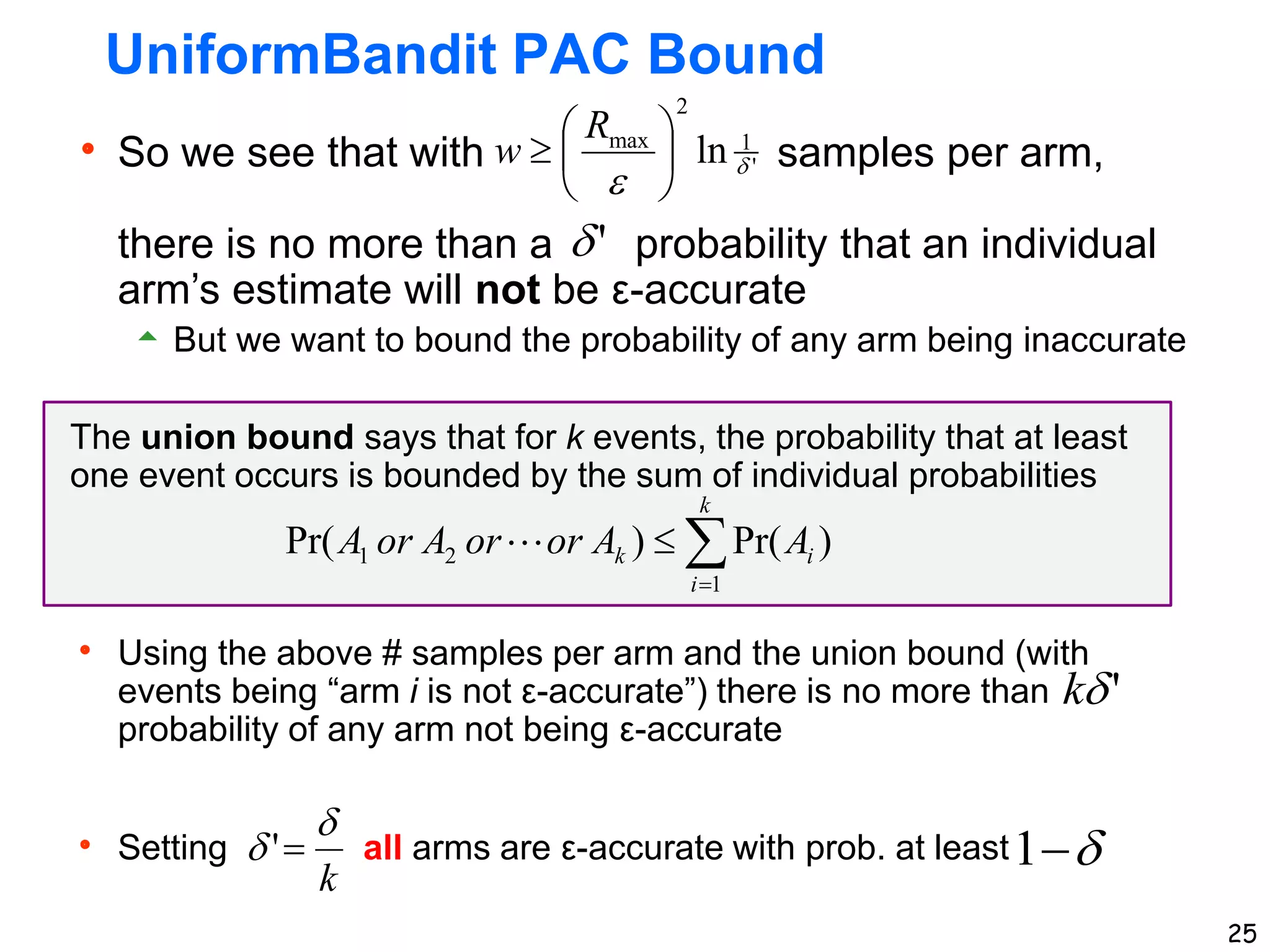
 So we see that with samples per arm,
there is no more than a probability that an individual
arm’s estimate will not be ε-accurate
 But we want to bound the probability of any arm being inaccurate
The union bound says that for k events, the probability that at least
one event occurs is bounded by the sum of individual probabilities
 Using the above # samples per arm and the union bound (with
events being “arm i is not ε-accurate”) there is no more than
probability of any arm not being ε-accurate
 Setting all arms are ε-accurate with prob. at least
25
UniformBandit PAC Bound


1
'
1
2
max
ln 








R
w
'

'

k
k

 
'



k
i
i
k A
A
or
or
A
or
A
1
2
1 )
Pr(
)
Pr( 
26
UniformBandit PAC Bound
If then for all arms simultaneously
with probability at least 

1


k
R
w ln
2
max







Putting everything together we get:
That is, estimates of all actions are ε – accurate
with probability at least 1-
Thus selecting estimate with highest value is
approximately optimal with high probability, or PAC



 

w
j
ij
w
i r
a
s
R
E
1
1
)]
,
(
[
27
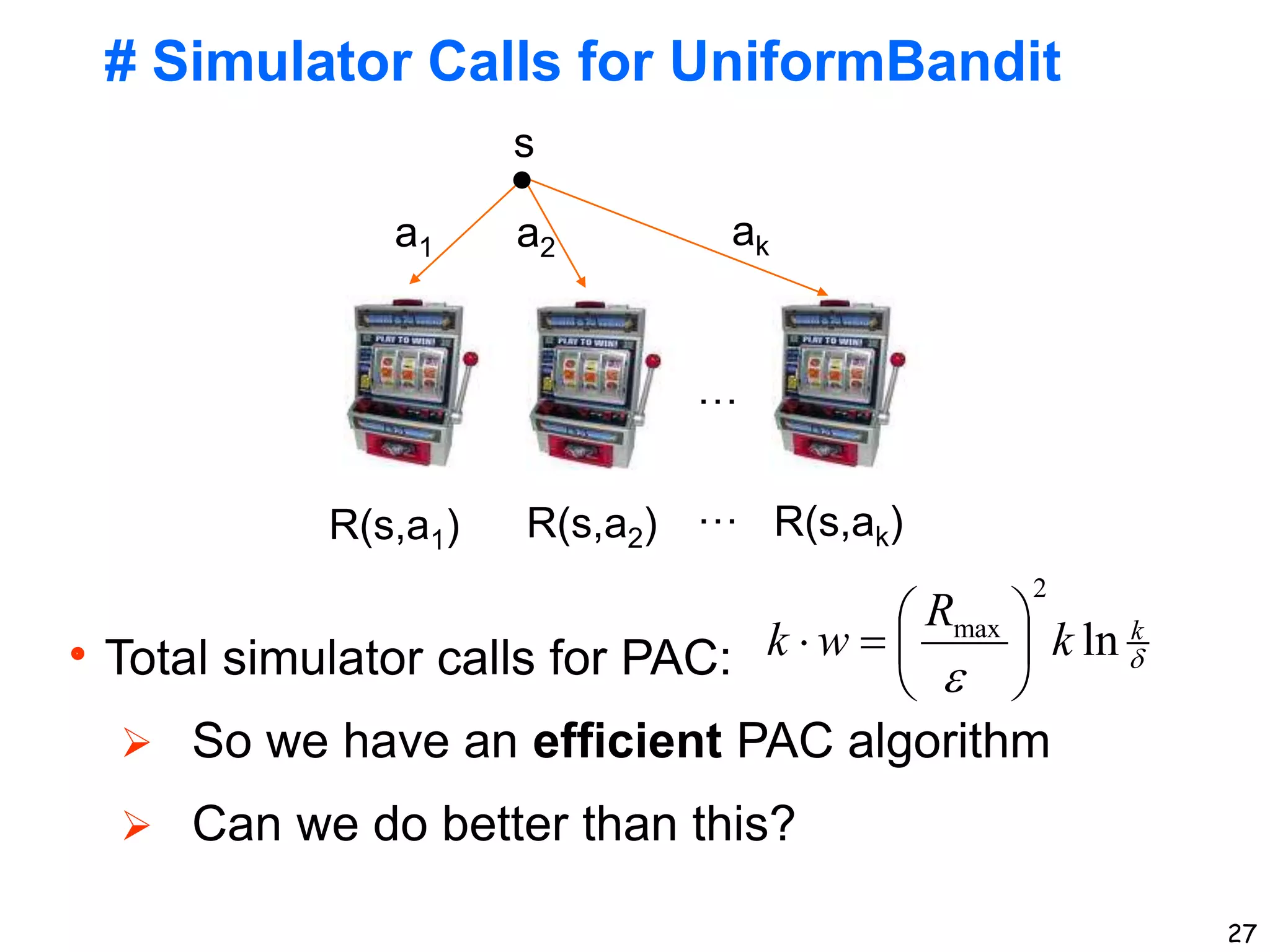
# Simulator Calls for UniformBandit
s
a1 a2 ak
R(s,a1) R(s,a2) R(s,ak)
…
…
Total simulator calls for PAC:
 So we have an efficient PAC algorithm
 Can we do better than this?


k
k
R
w
k ln
2
max








28
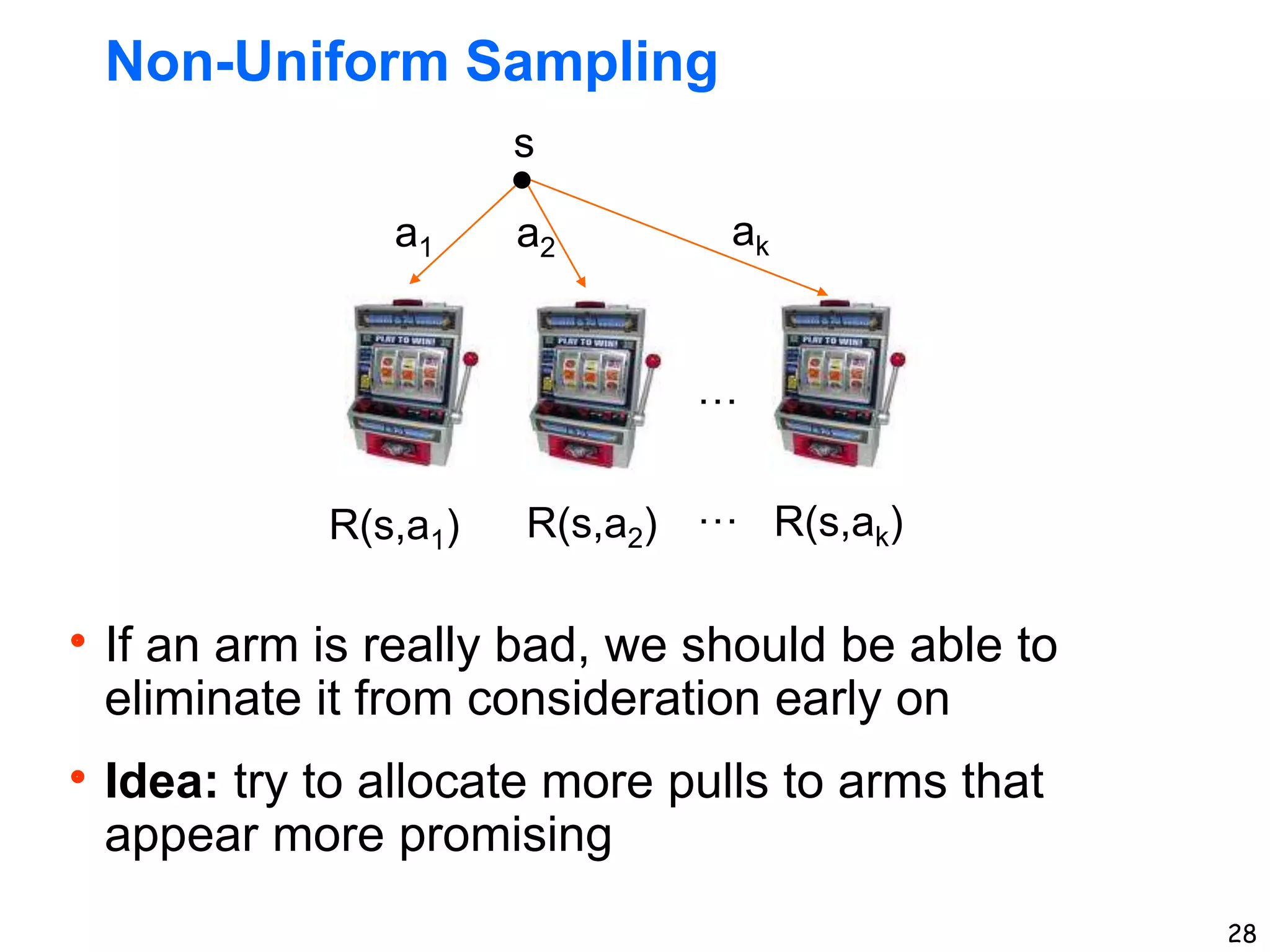
Non-Uniform Sampling
s
a1 a2 ak
R(s,a1) R(s,a2) R(s,ak)
…
…
If an arm is really bad, we should be able to
eliminate it from consideration early on
Idea: try to allocate more pulls to arms that
appear more promising
29
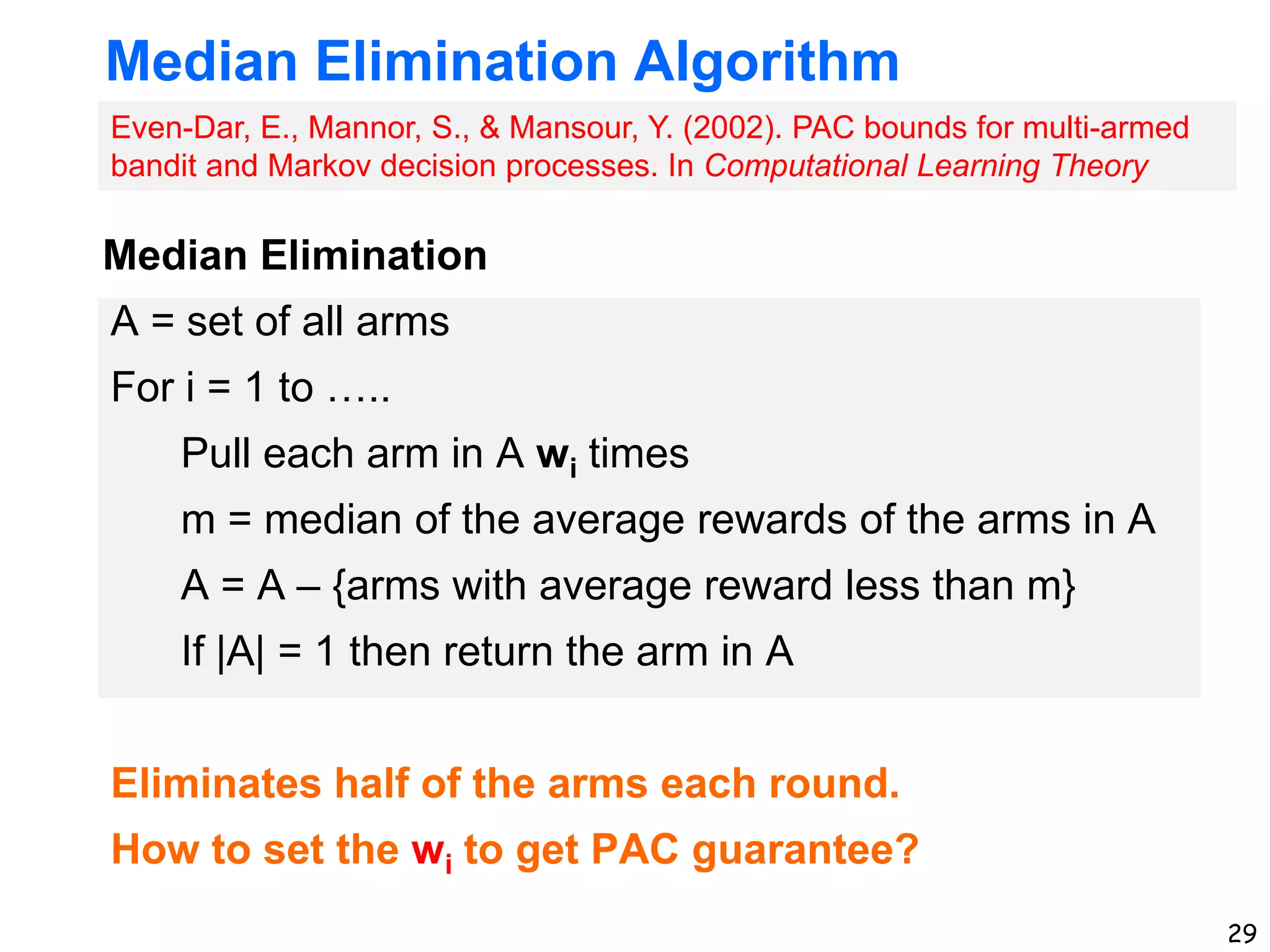
Median Elimination Algorithm
A = set of all arms
For i = 1 to …..
Pull each arm in A wi times
m = median of the average rewards of the arms in A
A = A – {arms with average reward less than m}
If |A| = 1 then return the arm in A
Eliminates half of the arms each round.
How to set the wi to get PAC guarantee?
Even-Dar, E., Mannor, S., & Mansour, Y. (2002). PAC bounds for multi-armed
bandit and Markov decision processes. In Computational Learning Theory
Median Elimination
30
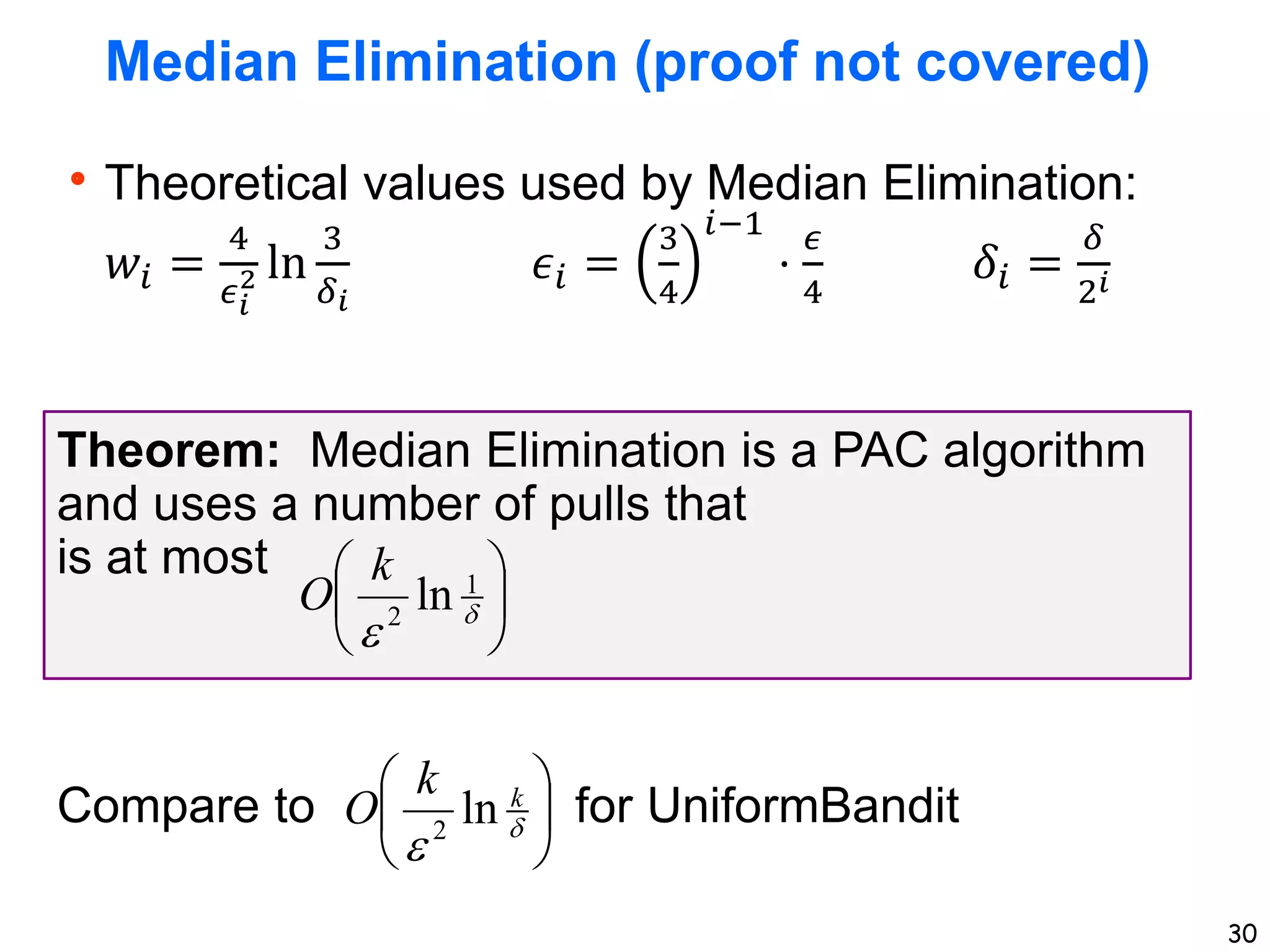
Median Elimination (proof not covered)
Theoretical values used by Median Elimination:
𝑤𝑖 =
4
𝜖𝑖
2 ln
3
𝛿𝑖
𝜖𝑖 =
3
4
𝑖−1
⋅
𝜖
4
𝛿𝑖 =
𝛿
2𝑖
Theorem: Median Elimination is a PAC algorithm
and uses a number of pulls that
is at most
Compare to for UniformBandit








1
2
ln
k
O








k
k
O ln
2
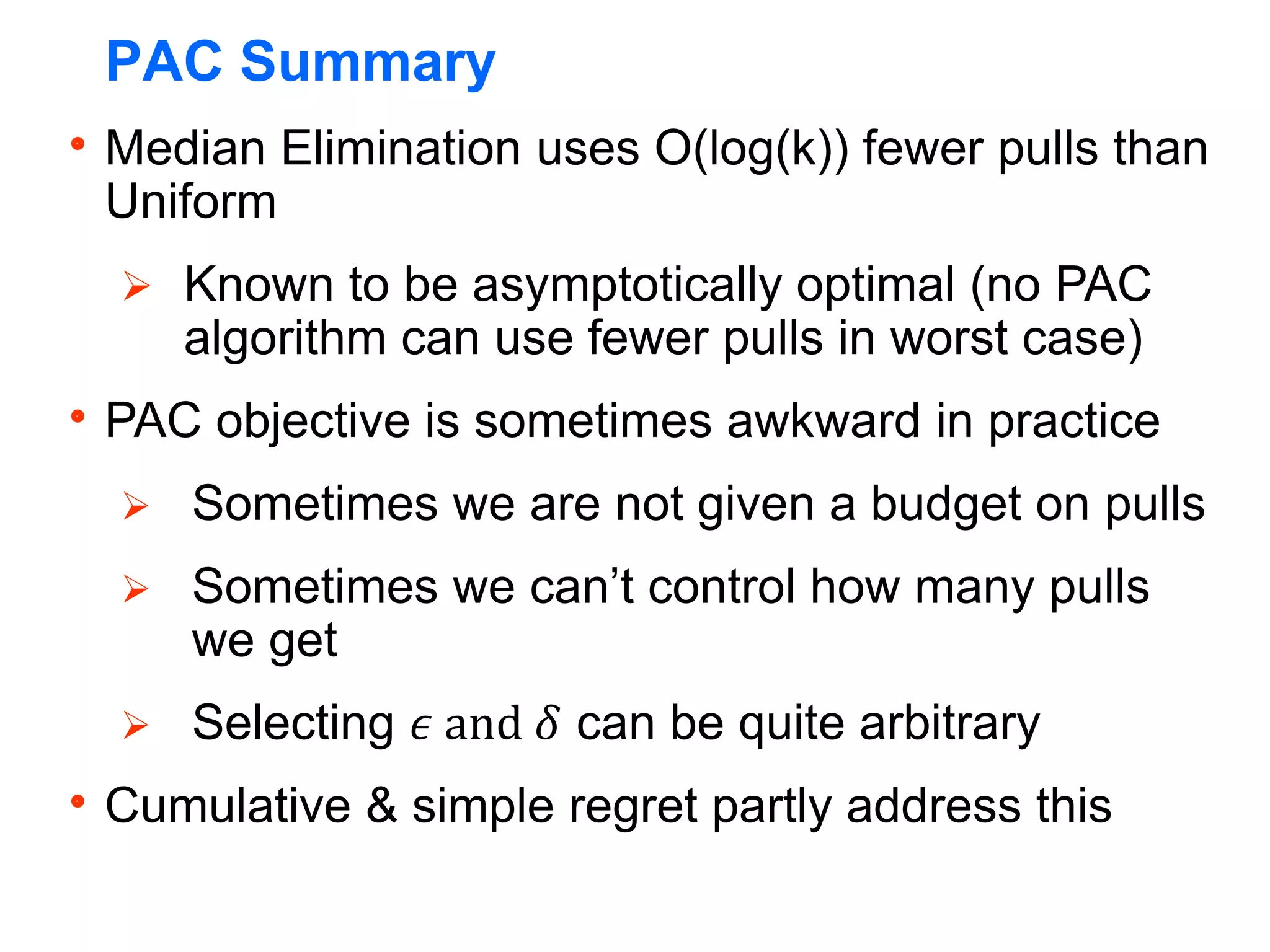
PAC Summary
Median Elimination uses O(log(k)) fewer pulls than
Uniform
 Known to be asymptotically optimal (no PAC
algorithm can use fewer pulls in worst case)
PAC objective is sometimes awkward in practice
 Sometimes we are not given a budget on pulls
 Sometimes we can’t control how many pulls
we get
 Selecting 𝜖 and 𝛿 can be quite arbitrary
Cumulative & simple regret partly address this
32
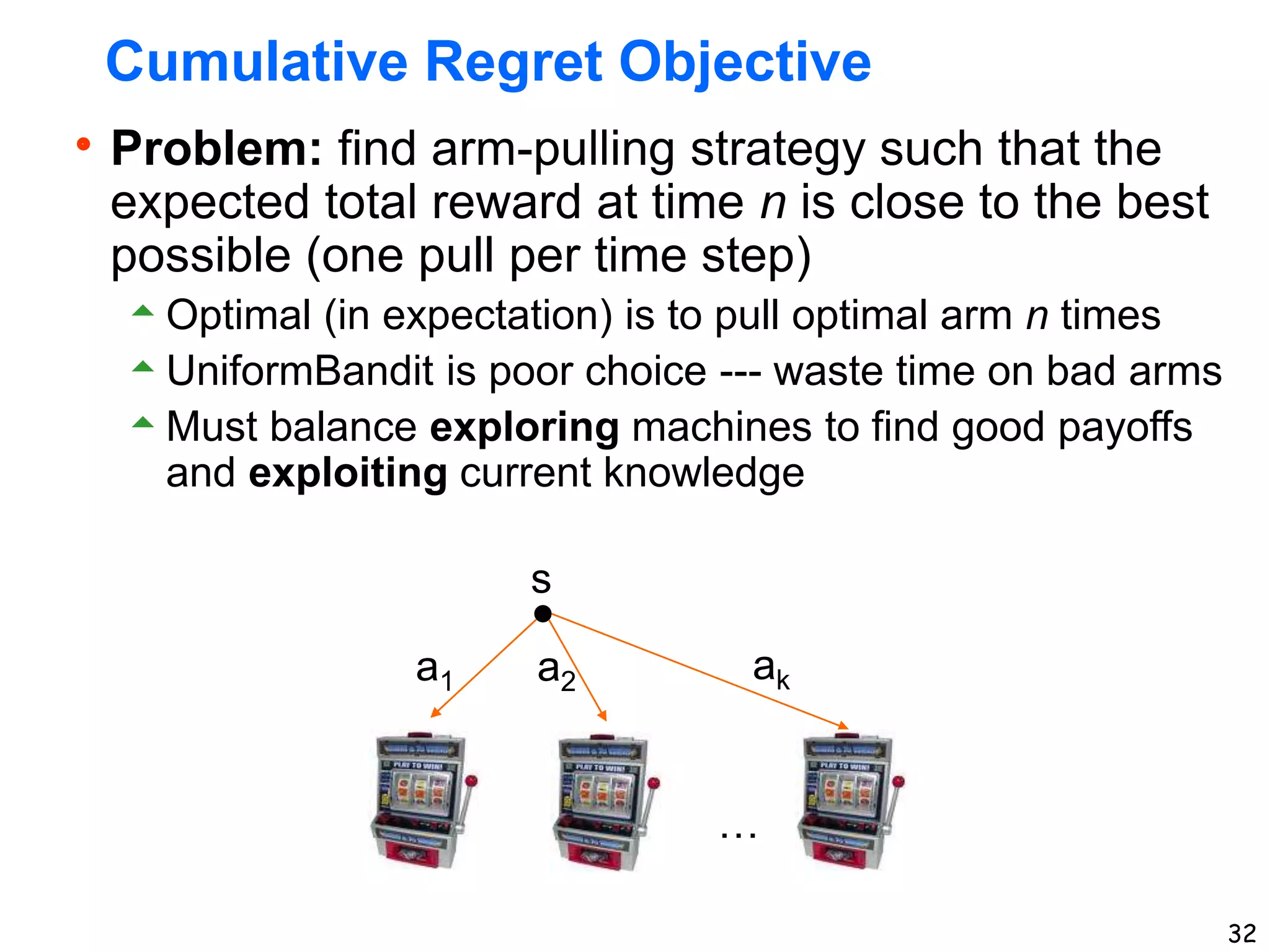
Cumulative Regret Objective
s
a1 a2 ak
…
Problem: find arm-pulling strategy such that the
expected total reward at time n is close to the best
possible (one pull per time step)
Optimal (in expectation) is to pull optimal arm n times
UniformBandit is poor choice --- waste time on bad arms
Must balance exploring machines to find good payoffs
and exploiting current knowledge
33
Cumulative Regret Objective
Theoretical results are often about “expected
cumulative regret” of an arm pulling strategy.
Protocol: At time step n the algorithm picks an
arm 𝑎𝑛 based on what it has seen so far and
receives reward 𝑟𝑛 (𝑎𝑛 and 𝑟𝑛 are random variables).
Expected Cumulative Regret (𝑬[𝑹𝒆𝒈𝒏]):
difference between optimal expected cummulative
reward and expected cumulative reward of our
strategy at time n
𝐸[𝑅𝑒𝑔𝑛] = 𝑛 ⋅ 𝑅∗ −
𝑖=1
𝑛
𝐸[𝑟𝑛]
34
UCB Algorithm for Minimizing Cumulative Regret
Q(a) : average reward for trying action a (in
our single state s) so far
n(a) : number of pulls of arm a so far
Action choice by UCB after n pulls:
Assumes rewards in [0,1]. We can always
normalize given a bounded reward
assumption
)
(
ln
2
)
(
max
arg
a
n
n
a
Q
a a
n 

Auer, P., Cesa-Bianchi, N., & Fischer, P. (2002). Finite-time analysis of the
multiarmed bandit problem. Machine learning, 47(2), 235-256.
35
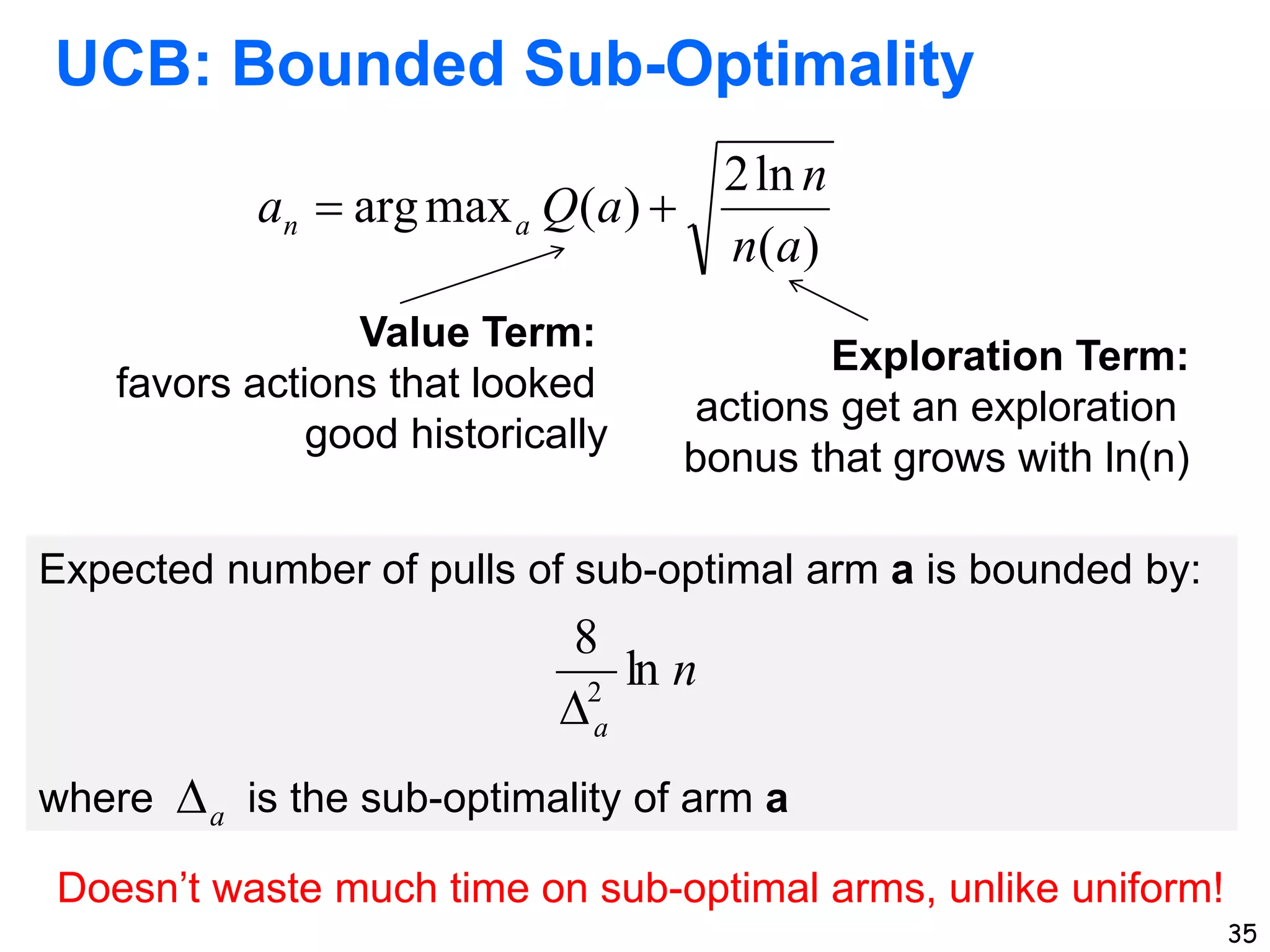
UCB: Bounded Sub-Optimality
)
(
ln
2
)
(
max
arg
a
n
n
a
Q
a a
n 

Value Term:
favors actions that looked
good historically
Exploration Term:
actions get an exploration
bonus that grows with ln(n)
Expected number of pulls of sub-optimal arm a is bounded by:
where is the sub-optimality of arm a
n
a
ln
8
2

a

Doesn’t waste much time on sub-optimal arms, unlike uniform!
36
UCB Performance Guarantee
[Auer, Cesa-Bianchi, & Fischer, 2002]
Theorem: The expected cumulative regret of UCB
𝑬[𝑹𝒆𝒈𝒏] after n arm pulls is bounded by O(log n)
Is this good?
Yes. The average per-step regret is O
log 𝑛
𝑛
Theorem: No algorithm can achieve a better
expected regret (up to constant factors)
37
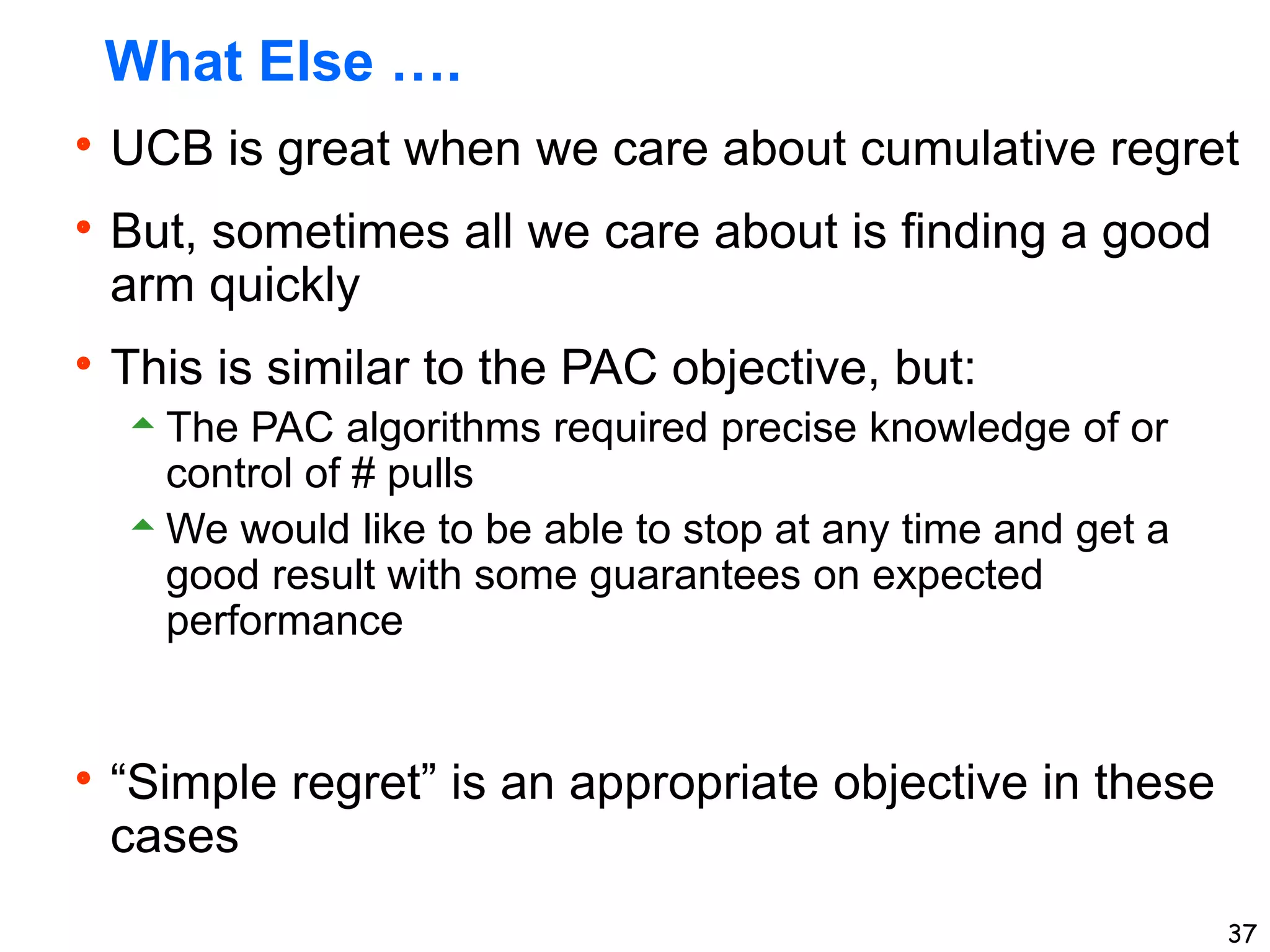
What Else ….
UCB is great when we care about cumulative regret
But, sometimes all we care about is finding a good
arm quickly
This is similar to the PAC objective, but:
The PAC algorithms required precise knowledge of or
control of # pulls
We would like to be able to stop at any time and get a
good result with some guarantees on expected
performance
“Simple regret” is an appropriate objective in these
cases
38
Simple Regret Objective
Protocol: At time step n the algorithm picks an
“exploration” arm 𝑎𝑛 to pull and observes reward
𝑟𝑛 and also picks an arm index it thinks is best 𝑗𝑛
(𝑎𝑛, 𝑗𝑛 and 𝑟𝑛 are random variables).
If interrupted at time n the algorithm returns 𝑗𝑛.
Expected Simple Regret (𝑬[𝑺𝑹𝒆𝒈𝒏]): difference
between 𝑅∗
and expected reward of arm 𝑗𝑛
selected by our strategy at time n
𝐸[𝑆𝑅𝑒𝑔𝑛] = 𝑅∗ − 𝐸[𝑅(𝑎𝑗𝑛
)]
Simple Regret Objective
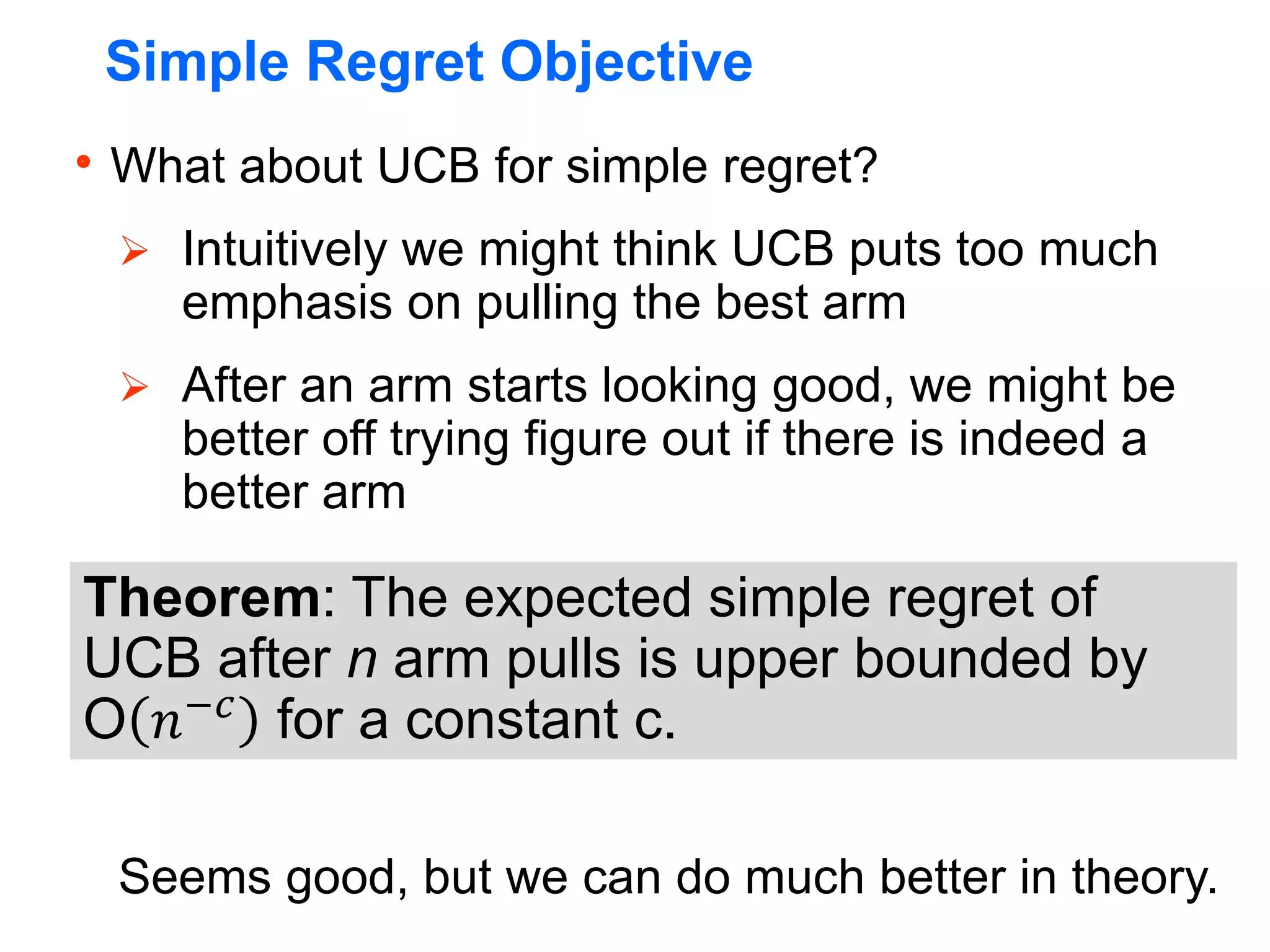
What about UCB for simple regret?
 Intuitively we might think UCB puts too much
emphasis on pulling the best arm
 After an arm starts looking good, we might be
better off trying figure out if there is indeed a
better arm
Seems good, but we can do much better in theory.
Theorem: The expected simple regret of
UCB after n arm pulls is upper bounded by
O 𝑛−𝑐
for a constant c.
40
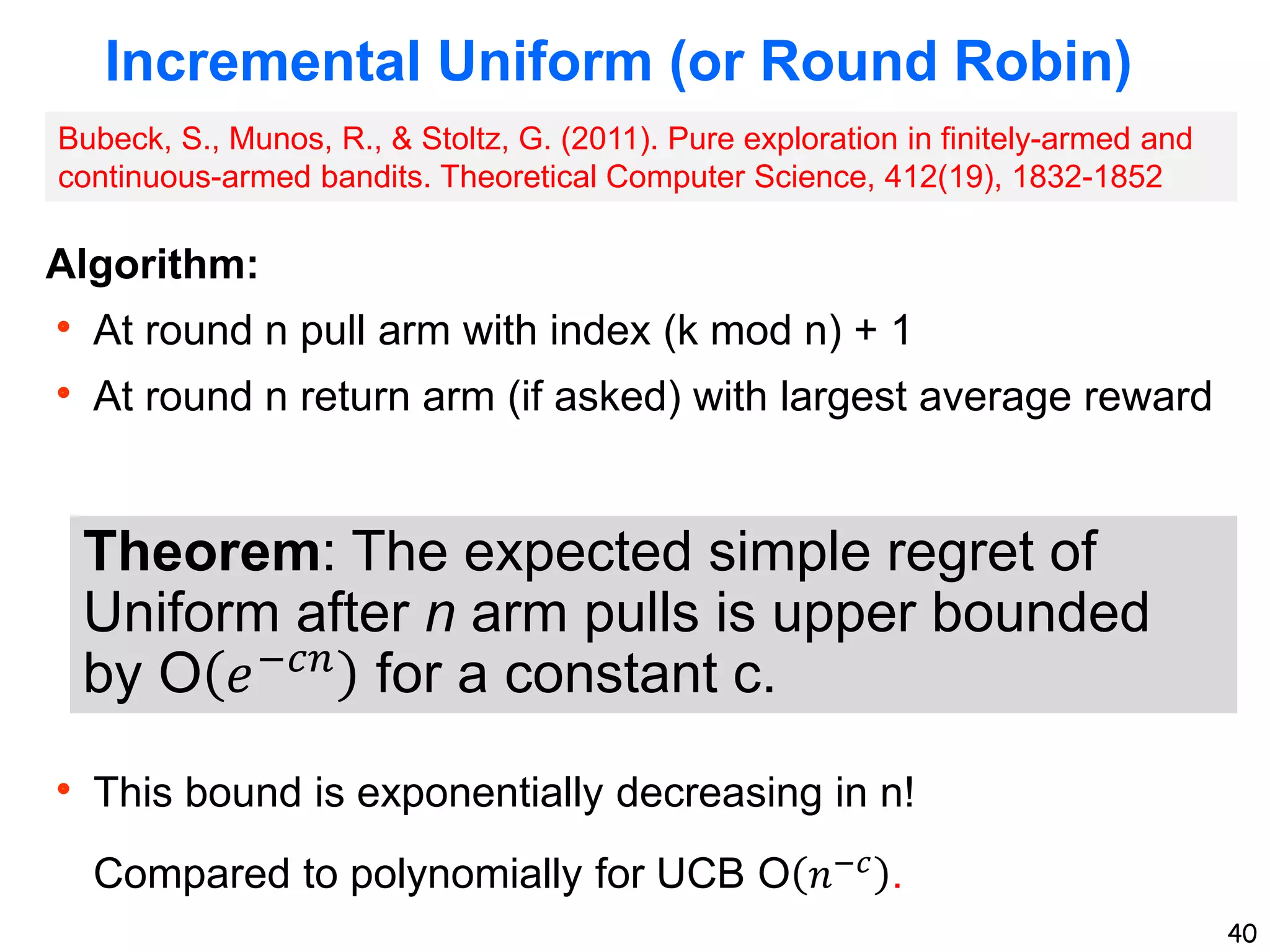
Incremental Uniform (or Round Robin)
Algorithm:
 At round n pull arm with index (k mod n) + 1
 At round n return arm (if asked) with largest average reward
 This bound is exponentially decreasing in n!
Compared to polynomially for UCB O 𝑛−𝑐 .
Theorem: The expected simple regret of
Uniform after n arm pulls is upper bounded
by O 𝑒−𝑐𝑛
for a constant c.
Bubeck, S., Munos, R., & Stoltz, G. (2011). Pure exploration in finitely-armed and
continuous-armed bandits. Theoretical Computer Science, 412(19), 1832-1852
41
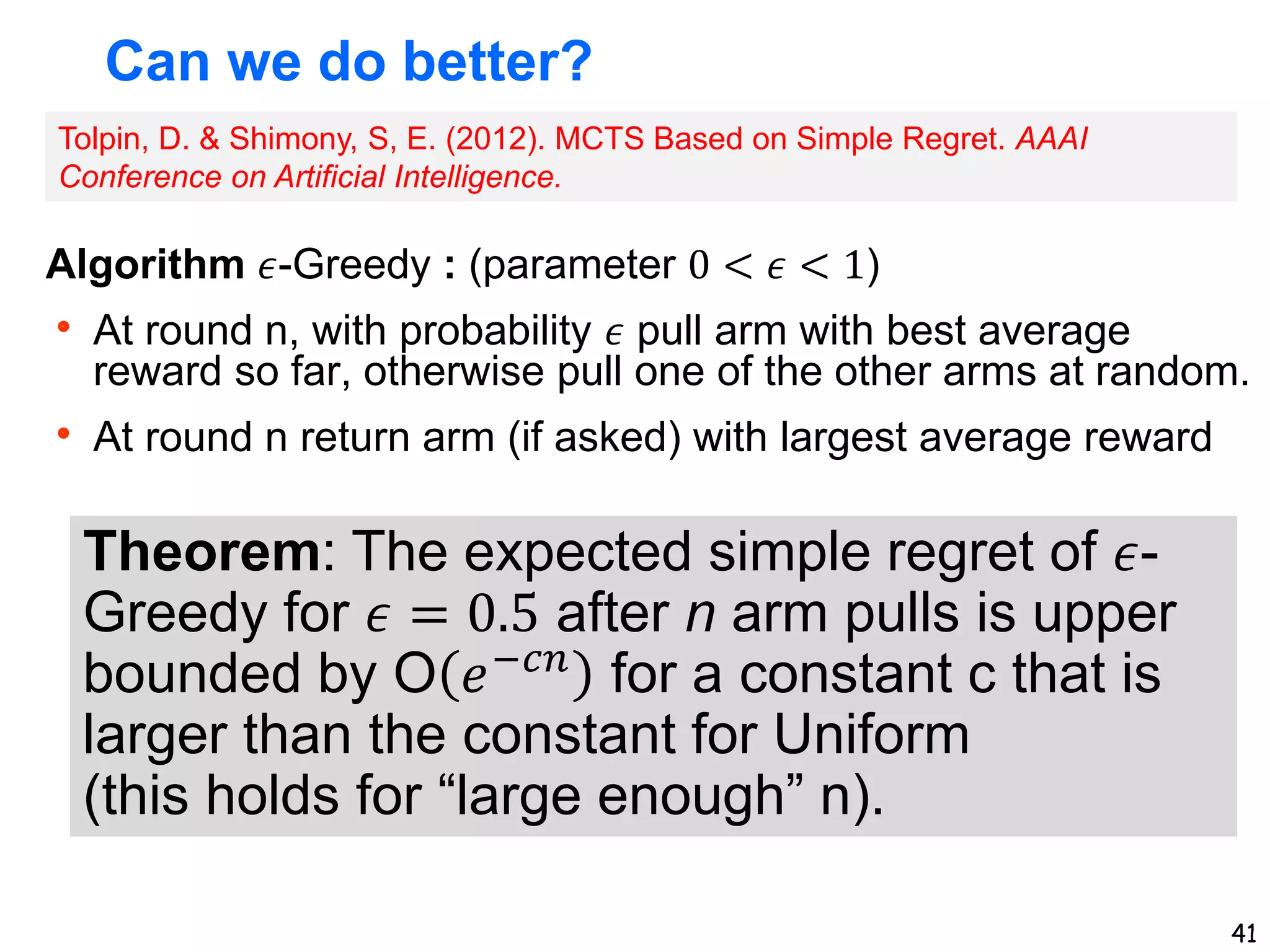
Can we do better?
Algorithm 𝜖-Greedy : (parameter 0 < 𝜖 < 1)
 At round n, with probability 𝜖 pull arm with best average
reward so far, otherwise pull one of the other arms at random.
 At round n return arm (if asked) with largest average reward
Theorem: The expected simple regret of 𝜖-
Greedy for 𝜖 = 0.5 after n arm pulls is upper
bounded by O 𝑒−𝑐𝑛
for a constant c that is
larger than the constant for Uniform
(this holds for “large enough” n).
Tolpin, D. & Shimony, S, E. (2012). MCTS Based on Simple Regret. AAAI
Conference on Artificial Intelligence.
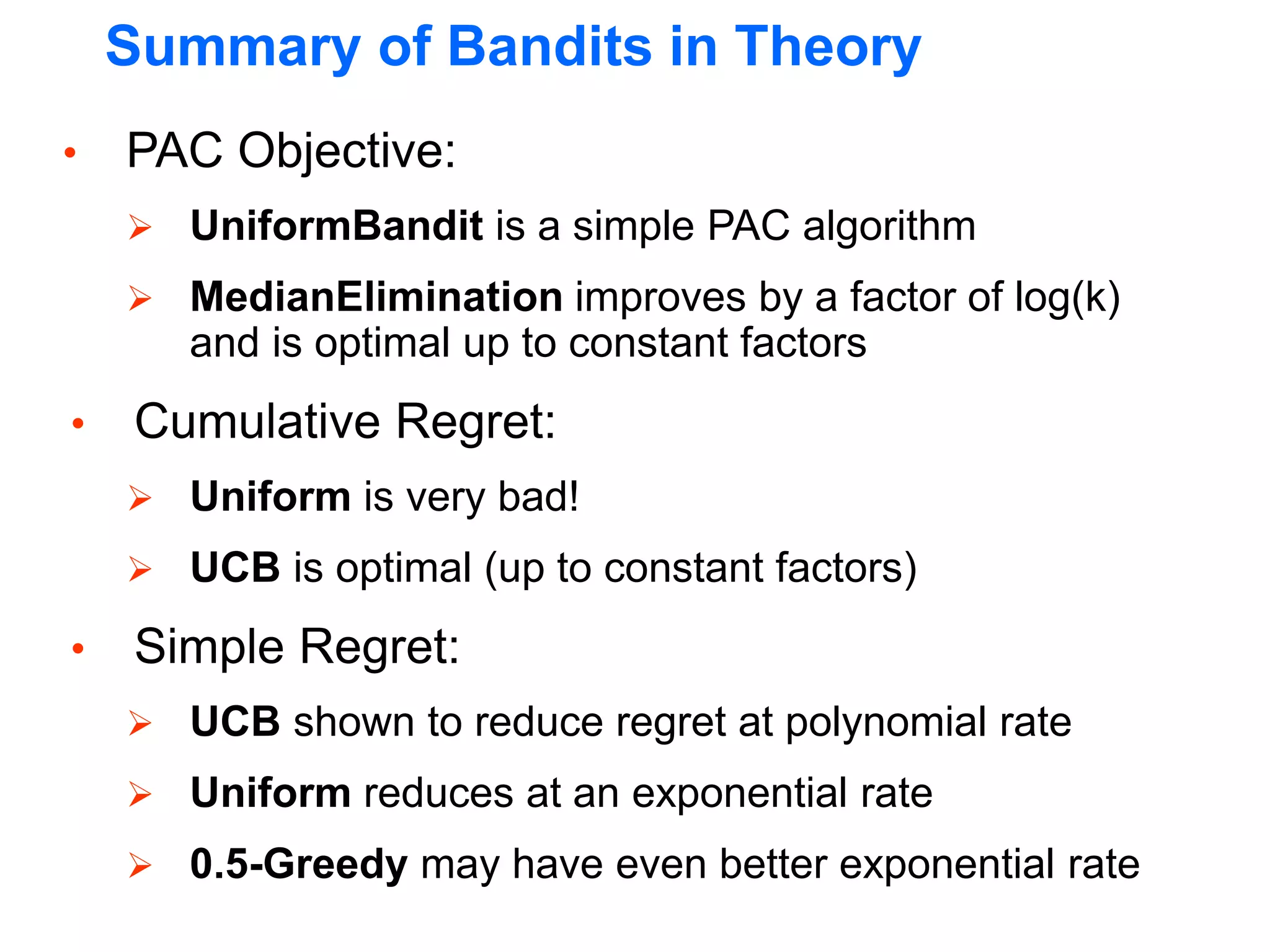
Summary of Bandits in Theory
• PAC Objective:
 UniformBandit is a simple PAC algorithm
 MedianElimination improves by a factor of log(k)
and is optimal up to constant factors
• Cumulative Regret:
 Uniform is very bad!
 UCB is optimal (up to constant factors)
• Simple Regret:
 UCB shown to reduce regret at polynomial rate
 Uniform reduces at an exponential rate
 0.5-Greedy may have even better exponential rate
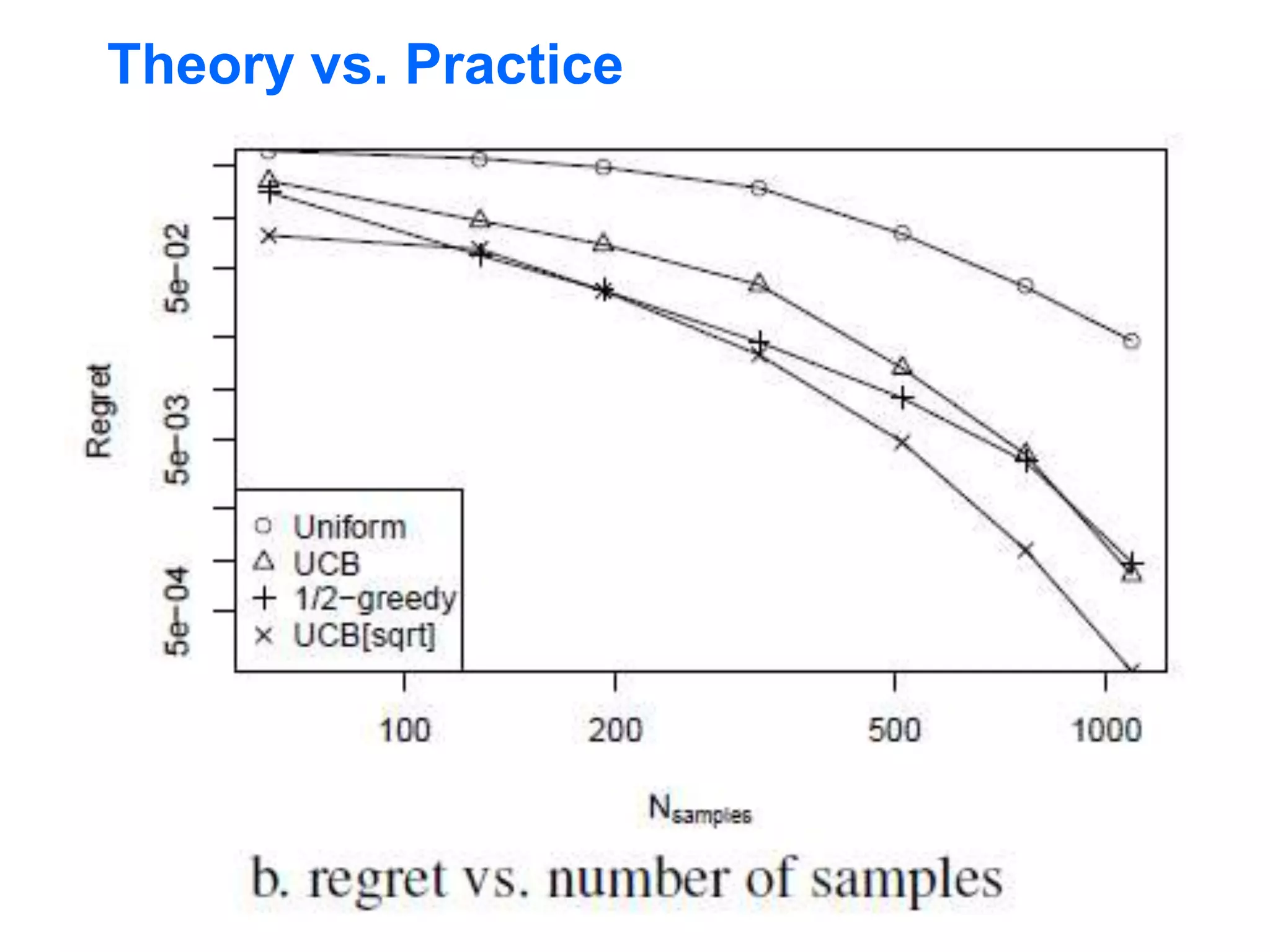
Theory vs. Practice
• The established theoretical relationships
among bandit algorithms have often been
useful in predicting empirical relationships.
• But not always ….
Theory vs. Practice

mcp-bandits.pptx

  • 1.
  • 2.
    2 Large Worlds We haveconsidered basic model-based planning algorithms Model-based planning: assumes MDP model is available Methods we learned so far are at least poly-time in the number of states and actions Difficult to apply to large state and action spaces (though this is a rich research area) We will consider various methods for overcoming this issue
  • 3.
    3 Approaches for LargeWorlds  Planning with compact MDP representations 1. Define a language for compactly describing an MDP  MDP is exponentially larger than description  E.g. via Dynamic Bayesian Networks 2. Design a planning algorithm that directly works with that language  Scalability is still an issue  Can be difficult to encode the problem you care about in a given language  May study in last part of course
  • 4.
    4 Approaches for LargeWorlds  Reinforcement learning w/ function approx. 1. Have a learning agent directly interact with environment 2. Learn a compact description of policy or value function  Often works quite well for large problems  Doesn’t fully exploit a simulator of the environment when available  We will study reinforcement learning later in the course
  • 5.
    5 Approaches for LargeWorlds: Monte-Carlo Planning Often a simulator of a planning domain is available or can be learned/estimated from data 5 Klondike Solitaire Fire & Emergency Response
  • 6.
    6 Large Worlds: Monte-CarloApproach Often a simulator of a planning domain is available or can be learned from data Monte-Carlo Planning: compute a good policy for an MDP by interacting with an MDP simulator 6 World Simulator Real World action State + reward
  • 7.
    7 Example Domains withSimulators  Traffic simulators  Robotics simulators  Military campaign simulators  Computer network simulators  Emergency planning simulators  large-scale disaster and municipal  Forest Fire Simulator  Board games / Video games  Go / RTS In many cases Monte-Carlo techniques yield state-of-the-art performance. Even in domains where exact MDP models are available.
  • 8.
    8 MDP: Simulation-Based Representation A simulation-based representation gives: S, A, R, T, I:  finite state set S (|S|=n and is generally very large)  finite action set A (|A|=m and will assume is of reasonable size)  |S| is too large to provide a matrix representation of R, T, and I (see next slide for I)  A simulation based representation provides us with callable functions for R, T, and I.  Think of these as any other library function that you might call  Our planning algorithms will operate by repeatedly calling those functions in an intelligent way
  • 9.
    9 MDP: Simulation-Based Representation A simulation-based representation gives: S, A, R, T, I:  finite state set S (|S|=n and is generally very large)  finite action set A (|A|=m and will assume is of reasonable size)  Stochastic, real-valued, bounded reward function R(s,a) = r  Stochastically returns a reward r given input s and a (note: here rewards can depend on actions and can be stochastic)  Stochastic transition function T(s,a) = s’ (i.e. a simulator)  Stochastically returns a state s’ given input s and a  Probability of returning s’ is dictated by Pr(s’ | s,a) of MDP  Stochastic initial state function I.  Stochastically returns a state according to an initial state distribution These stochastic functions can be implemented in any language!
  • 10.
    10 Monte-Carlo Planning Outline SingleState Case (multi-armed bandits) A basic tool for other algorithms Monte-Carlo Policy Improvement Policy rollout Policy Switching Approximate Policy Iteration Monte-Carlo Tree Search Sparse Sampling UCT and variants
  • 11.
    11 Single State Monte-CarloPlanning Suppose MDP has a single state and k actions Can sample rewards of actions using calls to simulator Sampling action a is like pulling a slot machine arm with random payoff function R(s,a) s a1 a2 ak R(s,a1) R(s,a2) R(s,ak) Multi-Armed Bandit Problem … …
  • 12.
    12 Single State Monte-CarloPlanning Bandit problems arise in many situations Clinical trials (arms correspond to treatments) Ad placement (arms correspond to ad selections) s a1 a2 ak R(s,a1) R(s,a2) R(s,ak) Multi-Armed Bandit Problem … …
  • 13.
    13 Single State Monte-CarloPlanning We will consider three possible bandit objectives PAC Objective: find a near optimal arm w/ high probability Cumulative Regret: achieve near optimal cumulative reward over lifetime of pulling (in expectation) Simple Regret: quickly identify arm with high reward (in expectation) s a1 a2 ak R(s,a1) R(s,a2) R(s,ak) Multi-Armed Bandit Problem … …
  • 14.
    Multi-Armed Bandits Bandit algorithmsare not just useful as components for multi-state Monte-Carlo planning Pure bandit problems arise in many applications Applicable whenever: We have a set of independent options with unknown utilities There is a cost for sampling options or a limit on total samples Want to find the best option or maximize utility of our samples
  • 15.
    Multi-Armed Bandits: Examples ClinicalTrials Arms = possible treatments Arm Pulls = application of treatment to inidividual Rewards = outcome of treatment Objective = maximize cumulative reward = maximize benefit to trial population (or find best treatment quickly) Online Advertising Arms = different ads/ad-types for a web page Arm Pulls = displaying an ad upon a page access Rewards = click through Objective = maximize cumulative reward = maximize clicks (or find best add quickly)
  • 16.
    Bounded Reward Assumption Acommon assumption we will make is that rewards are in a bounded interval [-𝑅𝑚𝑎𝑥, 𝑅𝑚𝑎𝑥]. I.e., for each 𝑖, Pr 𝑅 𝑠, 𝑎𝑖 ∈ −𝑅𝑚𝑎𝑥, 𝑅𝑚𝑎𝑥 = 1. Results are available for other types of assumptions, e.g. Gaussian distributions Require different type of analysis
  • 17.
    17 PAC Bandit Objective:Informal Probably Approximately Correct (PAC) Select an arm that probably (w/ high probability) has approximately the best expected reward Design an algorithm that uses as few simulator calls (or pulls) as possible to guarantee this s a1 a2 ak R(s,a1) R(s,a2) R(s,ak) Multi-Armed Bandit Problem … …
  • 18.
    18 PAC Bandit Algorithms 𝑘 = # of arms  𝑅∗ = max 𝑖 𝐸 𝑅 𝑠, 𝑎𝑖 is the optimal expected reward  Rewards are in −𝑅𝑚𝑎𝑥, 𝑅𝑚𝑎𝑥  Such an algorithm is efficient in terms of # of arm pulls, and is probably (with probability 1 − 𝛿) approximately correct (picks an arm with expected reward within 𝜖 of optimal). Definition (Efficient PAC Bandit Algorithm): An algorithm ALG is an efficient PAC bandit algorithm iff for any multi-armed bandit problem, for any 0 < 𝛿 < 1 and any 0 < 𝜖 (these are inputs to ALG), ALG pulls a number of arms that is polynomial in 𝟏/𝝐, 𝟏/𝜹, 𝑹𝒎𝒂𝒙, and 𝒌 and returns an arm index 𝑗 such that with probability at least 1 − 𝛿 we have 𝑅∗ − 𝐸 𝑅 𝑠, 𝑎𝑗 ≤ 𝜖
  • 19.
    19 UniformBandit Algorithm 1. Pulleach arm w times (uniform pulling). 2. Return arm with best average reward. Can we make this an efficient PAC bandit algorithm? s a1 a2 ak … r11 r12 … r1w r21 r22 … r2w rk1 rk2 … rkw Even-Dar, E., Mannor, S., & Mansour, Y. (2002). PAC bounds for multi-armed bandit and Markov decision processes. In Computational Learning Theory
  • 20.
    20 Aside: Additive ChernoffBound • Let R be a random variable with maximum absolute value Z. An let ri i=1,…,w be i.i.d. samples of R • The Chernoff bound gives a bound on the probability that the average of the ri are far from E[R]  1 1 1 1 ln ] [ w w i i w Z r R E     With probability at least we have that,   1                             w Z r R E w i i w 2 1 1 exp ] [ Pr   Chernoff Bound Equivalent Statement:
  • 21.
    21 Aside: Coin FlipExample • Suppose we have a coin with probability of heads equal to p. • Let X be a random variable where X=1 if the coin flip gives heads and zero otherwise. (so Z from bound is 1) 𝐸 𝑋 = 1 ⋅ 𝑝 + 0 ⋅ 1 − 𝑝 = 𝑝 • After flipping a coin w times we can estimate the heads prob. by average of xi. • The Chernoff bound tells us that this estimate converges exponentially fast to the true mean (coin bias) p.   w x p w i i w 2 1 1 exp Pr                
  • 22.
    22 UniformBandit Algorithm 1. Pulleach arm w times (uniform pulling). 2. Return arm with best average reward. Can we make this an efficient PAC bandit algorithm? s a1 a2 ak … r11 r12 … r1w r21 r22 … r2w rk1 rk2 … rkw Even-Dar, E., Mannor, S., & Mansour, Y. (2002). PAC bounds for multi-armed bandit and Markov decision processes. In Computational Learning Theory
  • 23.
    23 UniformBandit PAC Bound •For a single bandit arm the Chernoff bound says (𝑍 = 𝑅𝑚𝑎𝑥): • Bounding the error by ε gives: • Thus, using this many samples for a single arm will guarantee an ε-accurate estimate with probability at least for a single arm. ' 1 1 max 1 1 ln R )] , ( [  w w j ij w i r a s R E     With probability at least we have that, ' 1      ' 1 1 max ln w R ' 1 2 max ln          R w or equivalently ' 1  
  • 24.
  • 25.
     So wesee that with samples per arm, there is no more than a probability that an individual arm’s estimate will not be ε-accurate  But we want to bound the probability of any arm being inaccurate The union bound says that for k events, the probability that at least one event occurs is bounded by the sum of individual probabilities  Using the above # samples per arm and the union bound (with events being “arm i is not ε-accurate”) there is no more than probability of any arm not being ε-accurate  Setting all arms are ε-accurate with prob. at least 25 UniformBandit PAC Bound   1 ' 1 2 max ln          R w '  '  k k    '    k i i k A A or or A or A 1 2 1 ) Pr( ) Pr( 
  • 26.
    26 UniformBandit PAC Bound Ifthen for all arms simultaneously with probability at least   1   k R w ln 2 max        Putting everything together we get: That is, estimates of all actions are ε – accurate with probability at least 1- Thus selecting estimate with highest value is approximately optimal with high probability, or PAC       w j ij w i r a s R E 1 1 )] , ( [
  • 27.
    27 # Simulator Callsfor UniformBandit s a1 a2 ak R(s,a1) R(s,a2) R(s,ak) … … Total simulator calls for PAC:  So we have an efficient PAC algorithm  Can we do better than this?   k k R w k ln 2 max        
  • 28.
    28 Non-Uniform Sampling s a1 a2ak R(s,a1) R(s,a2) R(s,ak) … … If an arm is really bad, we should be able to eliminate it from consideration early on Idea: try to allocate more pulls to arms that appear more promising
  • 29.
    29 Median Elimination Algorithm A= set of all arms For i = 1 to ….. Pull each arm in A wi times m = median of the average rewards of the arms in A A = A – {arms with average reward less than m} If |A| = 1 then return the arm in A Eliminates half of the arms each round. How to set the wi to get PAC guarantee? Even-Dar, E., Mannor, S., & Mansour, Y. (2002). PAC bounds for multi-armed bandit and Markov decision processes. In Computational Learning Theory Median Elimination
  • 30.
    30 Median Elimination (proofnot covered) Theoretical values used by Median Elimination: 𝑤𝑖 = 4 𝜖𝑖 2 ln 3 𝛿𝑖 𝜖𝑖 = 3 4 𝑖−1 ⋅ 𝜖 4 𝛿𝑖 = 𝛿 2𝑖 Theorem: Median Elimination is a PAC algorithm and uses a number of pulls that is at most Compare to for UniformBandit         1 2 ln k O         k k O ln 2
  • 31.
    PAC Summary Median Eliminationuses O(log(k)) fewer pulls than Uniform  Known to be asymptotically optimal (no PAC algorithm can use fewer pulls in worst case) PAC objective is sometimes awkward in practice  Sometimes we are not given a budget on pulls  Sometimes we can’t control how many pulls we get  Selecting 𝜖 and 𝛿 can be quite arbitrary Cumulative & simple regret partly address this
  • 32.
    32 Cumulative Regret Objective s a1a2 ak … Problem: find arm-pulling strategy such that the expected total reward at time n is close to the best possible (one pull per time step) Optimal (in expectation) is to pull optimal arm n times UniformBandit is poor choice --- waste time on bad arms Must balance exploring machines to find good payoffs and exploiting current knowledge
  • 33.
    33 Cumulative Regret Objective Theoreticalresults are often about “expected cumulative regret” of an arm pulling strategy. Protocol: At time step n the algorithm picks an arm 𝑎𝑛 based on what it has seen so far and receives reward 𝑟𝑛 (𝑎𝑛 and 𝑟𝑛 are random variables). Expected Cumulative Regret (𝑬[𝑹𝒆𝒈𝒏]): difference between optimal expected cummulative reward and expected cumulative reward of our strategy at time n 𝐸[𝑅𝑒𝑔𝑛] = 𝑛 ⋅ 𝑅∗ − 𝑖=1 𝑛 𝐸[𝑟𝑛]
  • 34.
    34 UCB Algorithm forMinimizing Cumulative Regret Q(a) : average reward for trying action a (in our single state s) so far n(a) : number of pulls of arm a so far Action choice by UCB after n pulls: Assumes rewards in [0,1]. We can always normalize given a bounded reward assumption ) ( ln 2 ) ( max arg a n n a Q a a n   Auer, P., Cesa-Bianchi, N., & Fischer, P. (2002). Finite-time analysis of the multiarmed bandit problem. Machine learning, 47(2), 235-256.
  • 35.
    35 UCB: Bounded Sub-Optimality ) ( ln 2 ) ( max arg a n n a Q aa n   Value Term: favors actions that looked good historically Exploration Term: actions get an exploration bonus that grows with ln(n) Expected number of pulls of sub-optimal arm a is bounded by: where is the sub-optimality of arm a n a ln 8 2  a  Doesn’t waste much time on sub-optimal arms, unlike uniform!
  • 36.
    36 UCB Performance Guarantee [Auer,Cesa-Bianchi, & Fischer, 2002] Theorem: The expected cumulative regret of UCB 𝑬[𝑹𝒆𝒈𝒏] after n arm pulls is bounded by O(log n) Is this good? Yes. The average per-step regret is O log 𝑛 𝑛 Theorem: No algorithm can achieve a better expected regret (up to constant factors)
  • 37.
    37 What Else …. UCBis great when we care about cumulative regret But, sometimes all we care about is finding a good arm quickly This is similar to the PAC objective, but: The PAC algorithms required precise knowledge of or control of # pulls We would like to be able to stop at any time and get a good result with some guarantees on expected performance “Simple regret” is an appropriate objective in these cases
  • 38.
    38 Simple Regret Objective Protocol:At time step n the algorithm picks an “exploration” arm 𝑎𝑛 to pull and observes reward 𝑟𝑛 and also picks an arm index it thinks is best 𝑗𝑛 (𝑎𝑛, 𝑗𝑛 and 𝑟𝑛 are random variables). If interrupted at time n the algorithm returns 𝑗𝑛. Expected Simple Regret (𝑬[𝑺𝑹𝒆𝒈𝒏]): difference between 𝑅∗ and expected reward of arm 𝑗𝑛 selected by our strategy at time n 𝐸[𝑆𝑅𝑒𝑔𝑛] = 𝑅∗ − 𝐸[𝑅(𝑎𝑗𝑛 )]
  • 39.
    Simple Regret Objective Whatabout UCB for simple regret?  Intuitively we might think UCB puts too much emphasis on pulling the best arm  After an arm starts looking good, we might be better off trying figure out if there is indeed a better arm Seems good, but we can do much better in theory. Theorem: The expected simple regret of UCB after n arm pulls is upper bounded by O 𝑛−𝑐 for a constant c.
  • 40.
    40 Incremental Uniform (orRound Robin) Algorithm:  At round n pull arm with index (k mod n) + 1  At round n return arm (if asked) with largest average reward  This bound is exponentially decreasing in n! Compared to polynomially for UCB O 𝑛−𝑐 . Theorem: The expected simple regret of Uniform after n arm pulls is upper bounded by O 𝑒−𝑐𝑛 for a constant c. Bubeck, S., Munos, R., & Stoltz, G. (2011). Pure exploration in finitely-armed and continuous-armed bandits. Theoretical Computer Science, 412(19), 1832-1852
  • 41.
    41 Can we dobetter? Algorithm 𝜖-Greedy : (parameter 0 < 𝜖 < 1)  At round n, with probability 𝜖 pull arm with best average reward so far, otherwise pull one of the other arms at random.  At round n return arm (if asked) with largest average reward Theorem: The expected simple regret of 𝜖- Greedy for 𝜖 = 0.5 after n arm pulls is upper bounded by O 𝑒−𝑐𝑛 for a constant c that is larger than the constant for Uniform (this holds for “large enough” n). Tolpin, D. & Shimony, S, E. (2012). MCTS Based on Simple Regret. AAAI Conference on Artificial Intelligence.
  • 42.
    Summary of Banditsin Theory • PAC Objective:  UniformBandit is a simple PAC algorithm  MedianElimination improves by a factor of log(k) and is optimal up to constant factors • Cumulative Regret:  Uniform is very bad!  UCB is optimal (up to constant factors) • Simple Regret:  UCB shown to reduce regret at polynomial rate  Uniform reduces at an exponential rate  0.5-Greedy may have even better exponential rate
  • 43.
    Theory vs. Practice •The established theoretical relationships among bandit algorithms have often been useful in predicting empirical relationships. • But not always ….
  • 44.