Conservation Corridors:
Building a Path to Survival
Denise McGuigan
Table Of Contents
Executive Summary 3
Introduction 4
“Island” Ecosystems 5
Wildlife Knows No Boundaries 6
Main Corridor Types & Parameters 7
Man-Made Corridors 8
Large-Scale Corridor: Y2Y Initiative 9
Corridor Benefits 10
Private Landowner Challenges 11
TNC Montana: Recommendations 12
Conclusion 13
References 14
References Contd. 15
Executive Summary
Teaching landowners the values of preserving biodiversity is
not a simple task. It goes beyond education: instead,
interpersonal relationships must be developed, emphasizing
understanding and respect.
This paper is intended to describe the importance of wildlife
corridors, as well as the significance of large-scale corridors like
the Yellowstone to Yukon Initiative.
This Initiative would benefit from our involvement, due to our
distinguished reputation of negotiating with landowners and
other agencies.
This paper provides recommendations for continuing our
success, and should be implemented as soon as possible to
optimize conservation.
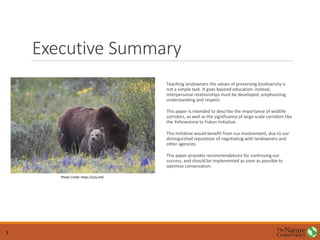
Photo Credit: https://y2y.net/
3
Introduction
As human populations rise exponentially and encroach on more
ecosystems, biodiversity is expected to reduce worldwide. Anthropogenic
activities have led to exacerbated climate change, the introduction of
invasive species, the exploitation and degradation of natural resources,
disrupted biogeochemical cycles, and fragmented landscapes and
habitats. Fragmented habitats inevitably lead to habitat destruction, with
wildlife corridors established to link these areas. Corridors allow species
to roam through various protected areas, thus promoting species
richness and diversity. Establishing corridors poses challenges, forcing
compromises between non-governmental organizations, federal agencies
and private landowners. A number of organizations have united to
promote large-scale corridors like The Yellowstone to Yukon Initiative
(Y2Y), connecting both fragmented and protected areas between the
United States and Canada.
Our Montana chapter within The Nature Conservancy (TNC) needs to
become involved in Y2Y to propel change within the Greater Yellowstone
Ecosystem (GYE), extending to Glacier National Park and beyond. Our
proven communication and negotiation skills would help to effectively
overcome landowner challenges and boost biodiversity within this region.
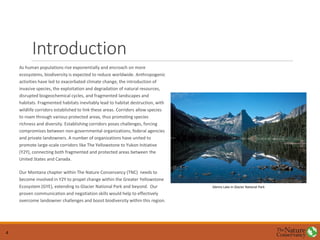
Glenns Lake in Glacier National Park
4
“Island” Ecosystems
Urban planning often does not incorporate habitat and natural
systems within its infrastructure. As cities, towns, and highways
become increasingly prevalent with rising human populations,
we can expect to see decreased suitable habitats and the
development of “island” ecosystems. “Island” ecosystems are
isolated habitats, not allowing for the safe migration of species
to other regions, limiting their mating, roaming, and foraging
options. When species become isolated, their “richness,” or the
number of different species within a given ecosystem,
dramatically declines. When this occurs, their genetic diversity
drops, making them a weakened species, more vulnerable to
disease. The same can be thought of with humans: when a
group becomes isolated over a long period of time and is
unable to expand their gene pool, their heritage is prone to
disease and mental vulnerabilities.
Within “island” ecosystems, animals who require plenty of land
area to forage for food or roam are unable to do so. Examples
include grizzly bears and wolves, as seen within the GYE.
Roaming mammals also tend to share other commonalities:
they are usually predatory mammals, but most often, they are
“keystone” species. Keystone species are necessary for the
overall health of an ecosystem, without whom the system
would deplete or be negatively impacted.
For example, wolves help keep elk and deer populations in
check. When wolves were extirpated from the GYE, elk
populations skyrocketed, leading to overgrazing of the land and
an unsustainable ecosystem, not allowing much else to thrive.
Once wolves were returned, the ecosystem began to correct
itself and become a more thriving habitat. Keystone species do
not always have to simply maintain the food web. Though
grizzly bears do help to regulate prey species, they also
disperse the seeds of many plant species. They help maintain
ecosystem health by aerating the soil as they dig for roots and
nuts, and allow for trees and other plants to absorb high levels
of nitrogen when they move spawning salmon carcasses into
the forest. Though the GYE holds millions of acres, this still
becomes an isolated habitat to roaming species who require
huge amounts of land.
5
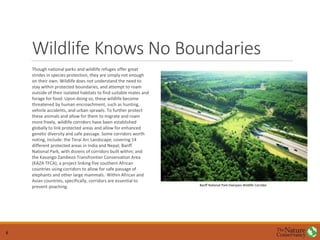
Wildlife Knows No Boundaries
Though national parks and wildlife refuges offer great
strides in species protection, they are simply not enough
on their own. Wildlife does not understand the need to
stay within protected boundaries, and attempt to roam
outside of their isolated habitats to find suitable mates and
forage for food. Upon doing so, these wildlife become
threatened by human encroachment, such as hunting,
vehicle accidents, and urban sprawls. To further protect
these animals and allow for them to migrate and roam
more freely, wildlife corridors have been established
globally to link protected areas and allow for enhanced
genetic diversity and safe passage. Some corridors worth
noting, include: the Terai Arc Landscape, covering 14
different protected areas in India and Nepal; Banff
National Park, with dozens of corridors built within; and
the Kavango Zambezo Transfrontier Conservation Area
(KAZA TFCA), a project linking five southern African
countries using corridors to allow for safe passage of
elephants and other large mammals., Within African and
Asian countries, specifically, corridors are essential to
prevent poaching. Banff National Park Overpass Wildlife Corridor
6
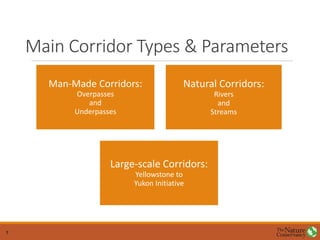
Main Corridor Types & Parameters
Man-Made Corridors:
Overpasses
and
Underpasses
Natural Corridors:
Rivers
and
Streams
Large-scale Corridors:
Yellowstone to
Yukon Initiative
7
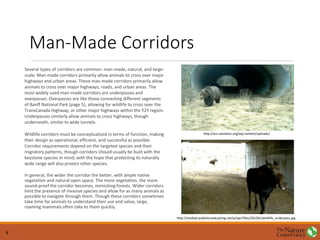
Man-Made Corridors
Several types of corridors are common: man-made, natural, and large-
scale. Man-made corridors primarily allow animals to cross over major
highways and urban areas. These man-made corridors primarily allow
animals to cross over major highways, roads, and urban areas. The
most widely used man-made corridors are underpasses and
overpasses. Overpasses are like those connecting different segments
of Banff National Park (page 5), allowing for wildlife to cross over the
TransCanada Highway, or other major highways within the Y2Y region.
Underpasses similarly allow animals to cross highways, though
underneath, similar to wide tunnels.
Wildlife corridors must be conceptualized in terms of function, making
their design as operational, efficient, and successful as possible.
Corridor requirements depend on the targeted species and their
migratory patterns, though corridors should usually be built with the
keystone species in mind, with the hope that protecting its naturally
wide range will also protect other species.
In general, the wider the corridor the better, with ample native
vegetation and natural open space. The more vegetation, the more
sound-proof the corridor becomes, mimicking forests. Wider corridors
limit the presence of invasive species and allow for as many animals as
possible to navigate through them. Though these corridors sometimes
take time for animals to understand their use and value, large,
roaming mammals often take to them quickly.
8
http://mediad.publicbroadcasting.net/p/wpr/files/201201/wildlife_underpass.jpg
http://arc-solutions.org/wp-content/uploads/
Large-Scale Corridor:
Y2Y Initiative
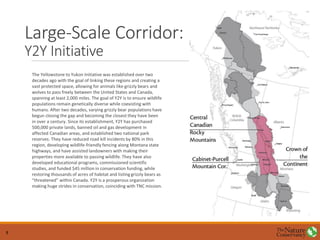
The Yellowstone to Yukon Initiative was established over two
decades ago with the goal of linking these regions and creating a
vast protected space, allowing for animals like grizzly bears and
wolves to pass freely between the United States and Canada,
spanning at least 2,000 miles. The goal of Y2Y is to ensure wildlife
populations remain genetically diverse while coexisting with
humans. After two decades, varying grizzly bear populations have
begun closing the gap and becoming the closest they have been
in over a century. Since its establishment, Y2Y has purchased
500,000 private lands, banned oil and gas development in
affected Canadian areas, and established two national park
reserves. They have reduced road kill incidents by 80% in this
region, developing wildlife-friendly fencing along Montana state
highways, and have assisted landowners with making their
properties more available to passing wildlife. They have also
developed educational programs, commissioned scientific
studies, and funded $45 million in conservation funding, while
restoring thousands of acres of habitat and listing grizzly bears as
“threatened” within Canada. Y2Y is a prosperous organization
making huge strides in conservation, coinciding with TNC mission.
9
Corridor Benefits
Increases Species Richness and Genetic Diversity
Preserves Biodiversity
Allows Animals to Roam and Migrate Safely
Provides Basic Needs: Food, Water, Shelter
Reduces Vehicle Collisions and Road Kill By 80%
Species are More Likely to Adapt to Climate Change
10
Private Landowner Challenges
Western private landowners want to maintain land rights and
independence, with little government interference, as
conservation practices proliferate. Understanding landowners’
needs and values is crucial to gaining their respect, changing
their mindsets and increasing participation with corridor
programs, especially with low enforcement capabilities. It is
important to educate landowners about corridor benefits and
overcome misconceptions.
Without corridors, animals are vulnerable to human
interactions, hunters, and to landowners considering them
nuisances. Mammals like grizzly bears are attracted to garbage
cans and apple trees, while wolves interfere with cattle herding,
making them more likely to be killed. Animals are unable to pass
through private lands due to impenetrable fencing, while
wilderness areas may be denigrated by off-road vehicles,
creating illegal roads. Changing attitudes and mindsets is
essential to the long-term success of corridors. True connectivity
occurs within the mind. Allowing landowners time to grow
accustomed to animals is therefore imperative. The
reintroduction of wolves was somewhat sprung on residents
within the GYE, proving the importance of a smooth transition.
TNC Montana Chapter will help expedite the installment of the
Y2Y corridors. Our reputation of working with private
landowners will allow for huge strides to be made in this area.
Corridors directly coincide with our overall mission of
“conserving the lands and waters on which all life depends. Our
vision is a world where the diversity of life thrives…” The Y2Y
Initiative would benefit from our chapter’s involvement. Since
1993, Y2Y and its 300 partners have increased protected areas
from 11 to 21% and improved conservation practices across an
additional 30% of lands, proving Y2Y is an established concept.
TNC: Idaho is already involved and has made progress
compromising with private landowners within their borders. In
our state, over 60% of land is privately owned, posing the
challenge of effectively working with landowners to convey the
importance of conservation. Y2Y supplies the vision while we
have the ability to physically work with landowners to develop
personal relationships, gain their respect, and increase their
involvement. Many landowners want little government
interference in their affairs and to retain land rights. In some
situations, landowners may be willing to sell their land while in
others, other types of incentives may be necessary.
11
TNC Montana: Recommendations
• Amend cultural mentalities so people feel a sense of pride for
living in “grizzly country.”
• Provide landowners with ranch handlers, whose responsibilities
include checking on cattle, herding them together, and rounding
them up at night. Keeping the herd close together benefits the
ranch. Bringing cattle in at night keeps them safe while roaming
mammals pass through the area.
• Help landowners install electric fencing or wildlife-friendly
fencing.
• Host apple fests where communities collect their apple pickings
and gather to have them pressed, thereby increasing community
collaboration while removing attractants for bears.
• Educate landowners and provide resources regarding the value
of conserving biodiversity, increasing involvement and de-
polarizing mindsets.
• Build trust, respect, and tolerance for the presence of wildlife on
private lands.
• Provide bear spray to protect landowners from aggressive
grizzlies.
TNC Montana may incentivize landowners in the following ways:
• Use technologies to show landowners the benefits of land
conservation. Preserving a natural ecosystem allows vegetation
to flourish and stimulate production. When presenting visual
depictions comparing protected land versus overgrazed
pastures, landowners usually prefer the more productive
option.
• Compensate landowners when cattle are killed. Financial
incentives are the most direct route to landowner participation.
• Work with non-traditional partners. Once one landowner is on
board, a domino effect occurs, leading to increased
involvement.
• Supply bear-proof garbage cans using federal funds, subsidies,
or fundraised money.
• Input a mandatory “hunting” class for those with hunting
permits, designed to educate hunters how to differentiate
between black bears and the more threatened grizzlies.
• Implement enforcement methods for those killing grizzlies.
• Understand the landowner’s values in order to learn how to
protect those values, whether they be aesthetic or more
practical, like protecting water quality.
12
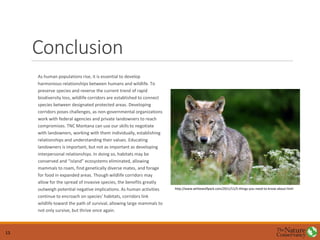
Conclusion
As human populations rise, it is essential to develop
harmonious relationships between humans and wildlife. To
preserve species and reverse the current trend of rapid
biodiversity loss, wildlife corridors are established to connect
species between designated protected areas. Developing
corridors poses challenges, as non-governmental organizations
work with federal agencies and private landowners to reach
compromises. TNC Montana can use our skills to negotiate
with landowners, working with them individually, establishing
relationships and understanding their values. Educating
landowners is important, but not as important as developing
interpersonal relationships. In doing so, habitats may be
conserved and “island” ecosystems eliminated, allowing
mammals to roam, find genetically diverse mates, and forage
for food in expanded areas. Though wildlife corridors may
allow for the spread of invasive species, the benefits greatly
outweigh potential negative implications. As human activities
continue to encroach on species’ habitats, corridors link
wildlife toward the path of survival, allowing large mammals to
not only survive, but thrive once again.
13
http://www.whitewolfpack.com/2011/11/5-things-you-need-to-know-about.html
References
1. Haddad, Nick. “Wildlife Corridors – NCSU.” Telephone interview by Denise McGuigan. October 28, 2016.
2. Hilty, Jodi. “Y2Y Initiative – Y2Y.” Telephone interview by Denise McGuigan. October 19, 2016.
3. Trotter, Kim. “Y2Y Initiative – Y2Y.” Telephone interview by Denise McGuigan. October 14, 2016.
4. Anderson, Anthony. “How to convince landowners about conservation corridors.” Applying Nature’s Design. Columbia University Press, New York, 2006.
5. Andrews, Candice Gaukel. “Video: wildlife corridors from around the world.” Good Nature Travel. October 2, 2014. http://goodnature.nathab.com/video-wildlife-corridors-from-
around-the-world/
6. Bass, Amity. Leslie, John. “Wildlife Habitat Corridors.” Landowners for Wildlife. Louisiana Wildlife and Fisheries. Accessed October 10, 2016.
7. Bloemmen, M. “European Corridors: Strategies for corridor development for target species.” European Centre for Nature Conservation, Tilburg, the Netherlands & Alterra, 2004.
8. Bond, Monica. “Principles of Wildlife Corridor Design.” Center for Biological Diversity, 2003.
9. Di Silvestro, Roger. “Know your NWF: The corridor connection.” National Wildlife Federation’s Blog. December 2, 2010. http://blog.nwf.org/2010/12/know-your-nwf-the-
corridor-connection/
10. Evans, Andrew. “The Alberta story: Wildlife crossing in Banff.” National Geographic. August 23, 2013. http://digitalnomad.nationalgeographic.com/2013/08/23/the-alberta-
story-wildlife-crossing-in-banff/
11. Hannibal, Mary Ellen. “Protecting wildlife corridors remains more theory than practice.” High Country News, 2011.
12. Ineveld, Renee van. “Wildlife Corridors: A solution to ending roadkill?” Finding Porpoise. Accessed October 15, 2016. https://wp.natsci.colostate.edu/findingporpoise/wildlife-
corridors-a-solution-to-ending-roadkill/
13. Lew, Josh. “10 important wildlife corridors.” Mother Nature Network. September 4, 2015. http://www.mnn.com/earth-matters/wilderness-resources/stories/10-important-
wildlife-corridors
14. Mcafee, W.R. “The making of a Mexico-to-Canada Corridor.” Canada Free Press. October 13, 2014. http://canadafreepress.com/article/the-making-of-a-mexico-to-canada-wolf-
corridor
15. Prevost, Ruffin. “Yellowstone to Yukon: Conservationist advocates for key wildlife corridor.” WyoFile. July 5, 2011. http://www.wyofile.com/yellowstone-to-yukon/
16. Richard, Michael Graham. “5 things you need to know about wildlife corridors.” Tree Hugger. November 10, 2011. http://www.treehugger.com/natural-sciences/five-things-
you-need-to-know-about-wildlife-corridors.html
17. Roach, John. “First evidence that wildlife corridors boost biodiversity.” National Geographic News. September 1, 2006.
http://news.nationalgeographic.com/news/2006/09/060901-plant-corridors.html
18. Robbins, Jim. “Can ecological corridors heal fragmented landscapes?” Environment360. October 10, 2011.
http://e360.yale.edu/feature/ecological_corridors_connecting_fragmented_pockets_of_wildlife_habitat/2450/
19. Shah, Anup. “Loss of biodiversity and extinctions.” Global Issues. January 19, 2014. http://www.globalissues.org/article/171/loss-of-biodiversity-and-extinctions
20. Steyn, Paul. “Urban wildlife corridors could save Africa’s free-roaming elephants.” National Geographic. December 12, 2013.
http://voices.nationalgeographic.com/2013/12/12/elephant-crossing-urban-wildlife-corridors-could-save-africas-free-roaming-elephants/
21. Wildlands Network. Accessed October 16, 2016. http://www.wildlandsnetwork.org/
14
References Contd.
22. “Biodiversity Corridors.” Regional Conservation Strategy, Chapter 7. Accessed October 20, 2016.
23. “Corridor Science.” Conservation Corridor. Accessed October 15, 2016. http://conservationcorridor.org/digests/corridor-science/
24. “Florida Wildlife Corridor.” Florida Wildlife Corridor. Accessed October 15, 2016. http://floridawildlifecorridor.org/
25. “Flyways and corridors.” National Wildlife Federation. Accessed October 22, 2016. http://www.nwf.org/Wildlife/Wildlife-Conservation/Flyways-and-Wildlife-
Corridors.aspx
26. “Genetic variation helps rescue endangered panthers.” Understanding Evolution. December, 2010. http://evolution.berkeley.edu/evolibrary/news/101201_panthers
27. “Grizzly Bears.” David Suzuki Foundation. Accessed October 12, 2016. http://www.davidsuzuki.org/issues/wildlife-habitat/science/critical-species/grizzly-bears/
28. “How reintroducing wolves helped save a famous park.” BBC News. January 28, 2014. http://www.bbc.com/future/story/20140128-how-wolves-saved-a-famous-park
29. “Landowner Relations Manual.” The Bruce Trail Conservancy, 2010
30. “Our work to build corridors for wildlife.” National Wildlife Federation. Accessed October 16, 2016. https://www.nwf.org/What-We-Do/Protect-Wildlife/Wildlife-
Corridors.aspx
31. “Public and private land percentages.” Summit Post. Accessed October 20, 2016. http://www.summitpost.org/public-and-private-land-percentages-by-us-states/186111
32. “Taking the elephant out of the room and into the corridor.” Cambridge Core. Accessed October 15, 2016.
https://www.cambridge.org/core/journals/oryx/article/taking-the-elephant-out-of-the-room-and-into-the-corridor-can-urban-corridors-
work/4C43E703569F63FEA771EB61D327F4F2/core-reader#
33. “Wildlife Corridors.” African Wildlife Foundation. Accessed October 16, 2016. http://www.awf.org/land-protection/wildlife-corridors
34. “Wildlife Corridors.” Department of Infrastructure, Planning and Natural Resources. CMA, 2004.)
35. “Wildlife Corridor.” Greenway. Accessed October 15, 2016. http://www.greenway.org.au/biodiversity/g-wildlife-corridor
36. “Wild Ways.” PBS NOVA, YouTube. May 4, 2016. https://www.youtube.com/watch?v=6HJ4BUhp-Hs
37. “Will networks allow invasive species and disease?” Scottish Natural Heritage. Accessed October 15, 2016. http://www.snh.gov.uk/land-and-sea/managing-the-
land/spatial-ecology/pros-and-cons-of-networks/invasive-species-disease/
38. “Yellowstone to Yukon Initiative.” Y2Y. Accessed October 10, 2016. https://y2y.net/
15

McGuigan_WhitePaper_Corridorspdf

  • 1.
    Conservation Corridors: Building aPath to Survival Denise McGuigan
  • 2.
    Table Of Contents ExecutiveSummary 3 Introduction 4 “Island” Ecosystems 5 Wildlife Knows No Boundaries 6 Main Corridor Types & Parameters 7 Man-Made Corridors 8 Large-Scale Corridor: Y2Y Initiative 9 Corridor Benefits 10 Private Landowner Challenges 11 TNC Montana: Recommendations 12 Conclusion 13 References 14 References Contd. 15
  • 3.
    Executive Summary Teaching landownersthe values of preserving biodiversity is not a simple task. It goes beyond education: instead, interpersonal relationships must be developed, emphasizing understanding and respect. This paper is intended to describe the importance of wildlife corridors, as well as the significance of large-scale corridors like the Yellowstone to Yukon Initiative. This Initiative would benefit from our involvement, due to our distinguished reputation of negotiating with landowners and other agencies. This paper provides recommendations for continuing our success, and should be implemented as soon as possible to optimize conservation. Photo Credit: https://y2y.net/ 3
  • 4.
    Introduction As human populationsrise exponentially and encroach on more ecosystems, biodiversity is expected to reduce worldwide. Anthropogenic activities have led to exacerbated climate change, the introduction of invasive species, the exploitation and degradation of natural resources, disrupted biogeochemical cycles, and fragmented landscapes and habitats. Fragmented habitats inevitably lead to habitat destruction, with wildlife corridors established to link these areas. Corridors allow species to roam through various protected areas, thus promoting species richness and diversity. Establishing corridors poses challenges, forcing compromises between non-governmental organizations, federal agencies and private landowners. A number of organizations have united to promote large-scale corridors like The Yellowstone to Yukon Initiative (Y2Y), connecting both fragmented and protected areas between the United States and Canada. Our Montana chapter within The Nature Conservancy (TNC) needs to become involved in Y2Y to propel change within the Greater Yellowstone Ecosystem (GYE), extending to Glacier National Park and beyond. Our proven communication and negotiation skills would help to effectively overcome landowner challenges and boost biodiversity within this region. Glenns Lake in Glacier National Park 4
  • 5.
    “Island” Ecosystems Urban planningoften does not incorporate habitat and natural systems within its infrastructure. As cities, towns, and highways become increasingly prevalent with rising human populations, we can expect to see decreased suitable habitats and the development of “island” ecosystems. “Island” ecosystems are isolated habitats, not allowing for the safe migration of species to other regions, limiting their mating, roaming, and foraging options. When species become isolated, their “richness,” or the number of different species within a given ecosystem, dramatically declines. When this occurs, their genetic diversity drops, making them a weakened species, more vulnerable to disease. The same can be thought of with humans: when a group becomes isolated over a long period of time and is unable to expand their gene pool, their heritage is prone to disease and mental vulnerabilities. Within “island” ecosystems, animals who require plenty of land area to forage for food or roam are unable to do so. Examples include grizzly bears and wolves, as seen within the GYE. Roaming mammals also tend to share other commonalities: they are usually predatory mammals, but most often, they are “keystone” species. Keystone species are necessary for the overall health of an ecosystem, without whom the system would deplete or be negatively impacted. For example, wolves help keep elk and deer populations in check. When wolves were extirpated from the GYE, elk populations skyrocketed, leading to overgrazing of the land and an unsustainable ecosystem, not allowing much else to thrive. Once wolves were returned, the ecosystem began to correct itself and become a more thriving habitat. Keystone species do not always have to simply maintain the food web. Though grizzly bears do help to regulate prey species, they also disperse the seeds of many plant species. They help maintain ecosystem health by aerating the soil as they dig for roots and nuts, and allow for trees and other plants to absorb high levels of nitrogen when they move spawning salmon carcasses into the forest. Though the GYE holds millions of acres, this still becomes an isolated habitat to roaming species who require huge amounts of land. 5
  • 6.
    Wildlife Knows NoBoundaries Though national parks and wildlife refuges offer great strides in species protection, they are simply not enough on their own. Wildlife does not understand the need to stay within protected boundaries, and attempt to roam outside of their isolated habitats to find suitable mates and forage for food. Upon doing so, these wildlife become threatened by human encroachment, such as hunting, vehicle accidents, and urban sprawls. To further protect these animals and allow for them to migrate and roam more freely, wildlife corridors have been established globally to link protected areas and allow for enhanced genetic diversity and safe passage. Some corridors worth noting, include: the Terai Arc Landscape, covering 14 different protected areas in India and Nepal; Banff National Park, with dozens of corridors built within; and the Kavango Zambezo Transfrontier Conservation Area (KAZA TFCA), a project linking five southern African countries using corridors to allow for safe passage of elephants and other large mammals., Within African and Asian countries, specifically, corridors are essential to prevent poaching. Banff National Park Overpass Wildlife Corridor 6
  • 7.
    Main Corridor Types& Parameters Man-Made Corridors: Overpasses and Underpasses Natural Corridors: Rivers and Streams Large-scale Corridors: Yellowstone to Yukon Initiative 7
  • 8.
    Man-Made Corridors Several typesof corridors are common: man-made, natural, and large- scale. Man-made corridors primarily allow animals to cross over major highways and urban areas. These man-made corridors primarily allow animals to cross over major highways, roads, and urban areas. The most widely used man-made corridors are underpasses and overpasses. Overpasses are like those connecting different segments of Banff National Park (page 5), allowing for wildlife to cross over the TransCanada Highway, or other major highways within the Y2Y region. Underpasses similarly allow animals to cross highways, though underneath, similar to wide tunnels. Wildlife corridors must be conceptualized in terms of function, making their design as operational, efficient, and successful as possible. Corridor requirements depend on the targeted species and their migratory patterns, though corridors should usually be built with the keystone species in mind, with the hope that protecting its naturally wide range will also protect other species. In general, the wider the corridor the better, with ample native vegetation and natural open space. The more vegetation, the more sound-proof the corridor becomes, mimicking forests. Wider corridors limit the presence of invasive species and allow for as many animals as possible to navigate through them. Though these corridors sometimes take time for animals to understand their use and value, large, roaming mammals often take to them quickly. 8 http://mediad.publicbroadcasting.net/p/wpr/files/201201/wildlife_underpass.jpg http://arc-solutions.org/wp-content/uploads/
  • 9.
    Large-Scale Corridor: Y2Y Initiative TheYellowstone to Yukon Initiative was established over two decades ago with the goal of linking these regions and creating a vast protected space, allowing for animals like grizzly bears and wolves to pass freely between the United States and Canada, spanning at least 2,000 miles. The goal of Y2Y is to ensure wildlife populations remain genetically diverse while coexisting with humans. After two decades, varying grizzly bear populations have begun closing the gap and becoming the closest they have been in over a century. Since its establishment, Y2Y has purchased 500,000 private lands, banned oil and gas development in affected Canadian areas, and established two national park reserves. They have reduced road kill incidents by 80% in this region, developing wildlife-friendly fencing along Montana state highways, and have assisted landowners with making their properties more available to passing wildlife. They have also developed educational programs, commissioned scientific studies, and funded $45 million in conservation funding, while restoring thousands of acres of habitat and listing grizzly bears as “threatened” within Canada. Y2Y is a prosperous organization making huge strides in conservation, coinciding with TNC mission. 9
  • 10.
    Corridor Benefits Increases SpeciesRichness and Genetic Diversity Preserves Biodiversity Allows Animals to Roam and Migrate Safely Provides Basic Needs: Food, Water, Shelter Reduces Vehicle Collisions and Road Kill By 80% Species are More Likely to Adapt to Climate Change 10
  • 11.
    Private Landowner Challenges Westernprivate landowners want to maintain land rights and independence, with little government interference, as conservation practices proliferate. Understanding landowners’ needs and values is crucial to gaining their respect, changing their mindsets and increasing participation with corridor programs, especially with low enforcement capabilities. It is important to educate landowners about corridor benefits and overcome misconceptions. Without corridors, animals are vulnerable to human interactions, hunters, and to landowners considering them nuisances. Mammals like grizzly bears are attracted to garbage cans and apple trees, while wolves interfere with cattle herding, making them more likely to be killed. Animals are unable to pass through private lands due to impenetrable fencing, while wilderness areas may be denigrated by off-road vehicles, creating illegal roads. Changing attitudes and mindsets is essential to the long-term success of corridors. True connectivity occurs within the mind. Allowing landowners time to grow accustomed to animals is therefore imperative. The reintroduction of wolves was somewhat sprung on residents within the GYE, proving the importance of a smooth transition. TNC Montana Chapter will help expedite the installment of the Y2Y corridors. Our reputation of working with private landowners will allow for huge strides to be made in this area. Corridors directly coincide with our overall mission of “conserving the lands and waters on which all life depends. Our vision is a world where the diversity of life thrives…” The Y2Y Initiative would benefit from our chapter’s involvement. Since 1993, Y2Y and its 300 partners have increased protected areas from 11 to 21% and improved conservation practices across an additional 30% of lands, proving Y2Y is an established concept. TNC: Idaho is already involved and has made progress compromising with private landowners within their borders. In our state, over 60% of land is privately owned, posing the challenge of effectively working with landowners to convey the importance of conservation. Y2Y supplies the vision while we have the ability to physically work with landowners to develop personal relationships, gain their respect, and increase their involvement. Many landowners want little government interference in their affairs and to retain land rights. In some situations, landowners may be willing to sell their land while in others, other types of incentives may be necessary. 11
  • 12.
    TNC Montana: Recommendations •Amend cultural mentalities so people feel a sense of pride for living in “grizzly country.” • Provide landowners with ranch handlers, whose responsibilities include checking on cattle, herding them together, and rounding them up at night. Keeping the herd close together benefits the ranch. Bringing cattle in at night keeps them safe while roaming mammals pass through the area. • Help landowners install electric fencing or wildlife-friendly fencing. • Host apple fests where communities collect their apple pickings and gather to have them pressed, thereby increasing community collaboration while removing attractants for bears. • Educate landowners and provide resources regarding the value of conserving biodiversity, increasing involvement and de- polarizing mindsets. • Build trust, respect, and tolerance for the presence of wildlife on private lands. • Provide bear spray to protect landowners from aggressive grizzlies. TNC Montana may incentivize landowners in the following ways: • Use technologies to show landowners the benefits of land conservation. Preserving a natural ecosystem allows vegetation to flourish and stimulate production. When presenting visual depictions comparing protected land versus overgrazed pastures, landowners usually prefer the more productive option. • Compensate landowners when cattle are killed. Financial incentives are the most direct route to landowner participation. • Work with non-traditional partners. Once one landowner is on board, a domino effect occurs, leading to increased involvement. • Supply bear-proof garbage cans using federal funds, subsidies, or fundraised money. • Input a mandatory “hunting” class for those with hunting permits, designed to educate hunters how to differentiate between black bears and the more threatened grizzlies. • Implement enforcement methods for those killing grizzlies. • Understand the landowner’s values in order to learn how to protect those values, whether they be aesthetic or more practical, like protecting water quality. 12
  • 13.
    Conclusion As human populationsrise, it is essential to develop harmonious relationships between humans and wildlife. To preserve species and reverse the current trend of rapid biodiversity loss, wildlife corridors are established to connect species between designated protected areas. Developing corridors poses challenges, as non-governmental organizations work with federal agencies and private landowners to reach compromises. TNC Montana can use our skills to negotiate with landowners, working with them individually, establishing relationships and understanding their values. Educating landowners is important, but not as important as developing interpersonal relationships. In doing so, habitats may be conserved and “island” ecosystems eliminated, allowing mammals to roam, find genetically diverse mates, and forage for food in expanded areas. Though wildlife corridors may allow for the spread of invasive species, the benefits greatly outweigh potential negative implications. As human activities continue to encroach on species’ habitats, corridors link wildlife toward the path of survival, allowing large mammals to not only survive, but thrive once again. 13 http://www.whitewolfpack.com/2011/11/5-things-you-need-to-know-about.html
  • 14.
    References 1. Haddad, Nick.“Wildlife Corridors – NCSU.” Telephone interview by Denise McGuigan. October 28, 2016. 2. Hilty, Jodi. “Y2Y Initiative – Y2Y.” Telephone interview by Denise McGuigan. October 19, 2016. 3. Trotter, Kim. “Y2Y Initiative – Y2Y.” Telephone interview by Denise McGuigan. October 14, 2016. 4. Anderson, Anthony. “How to convince landowners about conservation corridors.” Applying Nature’s Design. Columbia University Press, New York, 2006. 5. Andrews, Candice Gaukel. “Video: wildlife corridors from around the world.” Good Nature Travel. October 2, 2014. http://goodnature.nathab.com/video-wildlife-corridors-from- around-the-world/ 6. Bass, Amity. Leslie, John. “Wildlife Habitat Corridors.” Landowners for Wildlife. Louisiana Wildlife and Fisheries. Accessed October 10, 2016. 7. Bloemmen, M. “European Corridors: Strategies for corridor development for target species.” European Centre for Nature Conservation, Tilburg, the Netherlands & Alterra, 2004. 8. Bond, Monica. “Principles of Wildlife Corridor Design.” Center for Biological Diversity, 2003. 9. Di Silvestro, Roger. “Know your NWF: The corridor connection.” National Wildlife Federation’s Blog. December 2, 2010. http://blog.nwf.org/2010/12/know-your-nwf-the- corridor-connection/ 10. Evans, Andrew. “The Alberta story: Wildlife crossing in Banff.” National Geographic. August 23, 2013. http://digitalnomad.nationalgeographic.com/2013/08/23/the-alberta- story-wildlife-crossing-in-banff/ 11. Hannibal, Mary Ellen. “Protecting wildlife corridors remains more theory than practice.” High Country News, 2011. 12. Ineveld, Renee van. “Wildlife Corridors: A solution to ending roadkill?” Finding Porpoise. Accessed October 15, 2016. https://wp.natsci.colostate.edu/findingporpoise/wildlife- corridors-a-solution-to-ending-roadkill/ 13. Lew, Josh. “10 important wildlife corridors.” Mother Nature Network. September 4, 2015. http://www.mnn.com/earth-matters/wilderness-resources/stories/10-important- wildlife-corridors 14. Mcafee, W.R. “The making of a Mexico-to-Canada Corridor.” Canada Free Press. October 13, 2014. http://canadafreepress.com/article/the-making-of-a-mexico-to-canada-wolf- corridor 15. Prevost, Ruffin. “Yellowstone to Yukon: Conservationist advocates for key wildlife corridor.” WyoFile. July 5, 2011. http://www.wyofile.com/yellowstone-to-yukon/ 16. Richard, Michael Graham. “5 things you need to know about wildlife corridors.” Tree Hugger. November 10, 2011. http://www.treehugger.com/natural-sciences/five-things- you-need-to-know-about-wildlife-corridors.html 17. Roach, John. “First evidence that wildlife corridors boost biodiversity.” National Geographic News. September 1, 2006. http://news.nationalgeographic.com/news/2006/09/060901-plant-corridors.html 18. Robbins, Jim. “Can ecological corridors heal fragmented landscapes?” Environment360. October 10, 2011. http://e360.yale.edu/feature/ecological_corridors_connecting_fragmented_pockets_of_wildlife_habitat/2450/ 19. Shah, Anup. “Loss of biodiversity and extinctions.” Global Issues. January 19, 2014. http://www.globalissues.org/article/171/loss-of-biodiversity-and-extinctions 20. Steyn, Paul. “Urban wildlife corridors could save Africa’s free-roaming elephants.” National Geographic. December 12, 2013. http://voices.nationalgeographic.com/2013/12/12/elephant-crossing-urban-wildlife-corridors-could-save-africas-free-roaming-elephants/ 21. Wildlands Network. Accessed October 16, 2016. http://www.wildlandsnetwork.org/ 14
  • 15.
    References Contd. 22. “BiodiversityCorridors.” Regional Conservation Strategy, Chapter 7. Accessed October 20, 2016. 23. “Corridor Science.” Conservation Corridor. Accessed October 15, 2016. http://conservationcorridor.org/digests/corridor-science/ 24. “Florida Wildlife Corridor.” Florida Wildlife Corridor. Accessed October 15, 2016. http://floridawildlifecorridor.org/ 25. “Flyways and corridors.” National Wildlife Federation. Accessed October 22, 2016. http://www.nwf.org/Wildlife/Wildlife-Conservation/Flyways-and-Wildlife- Corridors.aspx 26. “Genetic variation helps rescue endangered panthers.” Understanding Evolution. December, 2010. http://evolution.berkeley.edu/evolibrary/news/101201_panthers 27. “Grizzly Bears.” David Suzuki Foundation. Accessed October 12, 2016. http://www.davidsuzuki.org/issues/wildlife-habitat/science/critical-species/grizzly-bears/ 28. “How reintroducing wolves helped save a famous park.” BBC News. January 28, 2014. http://www.bbc.com/future/story/20140128-how-wolves-saved-a-famous-park 29. “Landowner Relations Manual.” The Bruce Trail Conservancy, 2010 30. “Our work to build corridors for wildlife.” National Wildlife Federation. Accessed October 16, 2016. https://www.nwf.org/What-We-Do/Protect-Wildlife/Wildlife- Corridors.aspx 31. “Public and private land percentages.” Summit Post. Accessed October 20, 2016. http://www.summitpost.org/public-and-private-land-percentages-by-us-states/186111 32. “Taking the elephant out of the room and into the corridor.” Cambridge Core. Accessed October 15, 2016. https://www.cambridge.org/core/journals/oryx/article/taking-the-elephant-out-of-the-room-and-into-the-corridor-can-urban-corridors- work/4C43E703569F63FEA771EB61D327F4F2/core-reader# 33. “Wildlife Corridors.” African Wildlife Foundation. Accessed October 16, 2016. http://www.awf.org/land-protection/wildlife-corridors 34. “Wildlife Corridors.” Department of Infrastructure, Planning and Natural Resources. CMA, 2004.) 35. “Wildlife Corridor.” Greenway. Accessed October 15, 2016. http://www.greenway.org.au/biodiversity/g-wildlife-corridor 36. “Wild Ways.” PBS NOVA, YouTube. May 4, 2016. https://www.youtube.com/watch?v=6HJ4BUhp-Hs 37. “Will networks allow invasive species and disease?” Scottish Natural Heritage. Accessed October 15, 2016. http://www.snh.gov.uk/land-and-sea/managing-the- land/spatial-ecology/pros-and-cons-of-networks/invasive-species-disease/ 38. “Yellowstone to Yukon Initiative.” Y2Y. Accessed October 10, 2016. https://y2y.net/ 15