McCall’s Model
Submitted By: Sadia Sheraz
Roll no: 025156(2257)
MCCALL’S QUALITY FACTORS
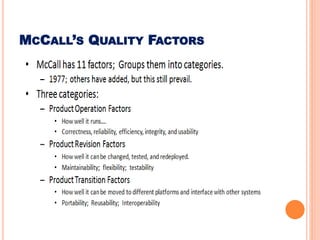
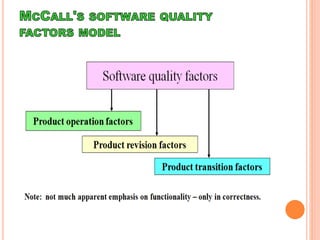
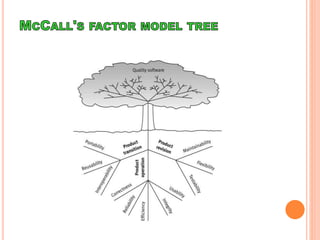
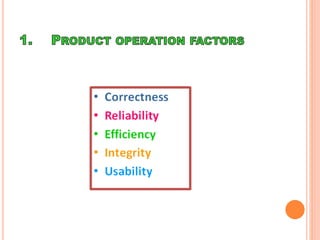
CATEGORY: PRODUCT OPERATION
FACTORS
 1. Correctness:
The functionality should match the specification.
 2. Reliability Requirements:
(remember, this quality factor is specified in the specs!)
 Reliability requirements deal with the failure to provide service.
 Address failure rates either overall or to required functions.
 Example specs:
 A heart monitoring system must have a failure rate of less than one
per million cases.
 Downtime for a system will not be more than ten minutes per month
(me)
 3. Efficiency Requirements:
Deals with the hardware resources needed to perform the
functions of the software.
 Here we consider MIPS, MHz (cycles per second); data storage capabilities
measured in MB or TB; communication lines (usually measured in KBPS,
MBPS, or GBPS).
 Example spec: simply very slow communications.
 4. Integrity:
It deal with system security that prevent unauthorized persons
access.
 5. Usability Requirements:
It deals with the scope of staff resources needed to train new
employees and to operate the software system.
 Deals with learn ability, utility, and more. (me)
 Example spec: A staff member should be able to process n transactions /
unit time. (me)
MCCALL’S QUALITY FACTORS
CATEGORY: PRODUCT REVISION SOFTWARE
FACTORS
 These deal with requirements that affect the complete range of software
maintenance activities:
 corrective maintenance,
 adaptive maintenance, and
 perfective maintenance
 1. Maintainability Requirements
 The degree of effort needed to identify reasons (find the problem) for
software failure and to correct failures and to verify the success of
the corrections.
 Deals with the modular structure of the software, internal program
documentation, programmer manuals
 Example specs: size of module <= 30 statements.
 2. Flexibility Requirements – deals with resources to
change (adopt) software to different types of customers
that use the app perhaps a little differently;
 May also involve a little perfective maintenance to perhaps do a
little better due to the customer’s perhaps slightly more robust
environment.
 3. Testability Requirements –
 Are intermediate results of computations predefined to assist
testing?
 Are log files created?
 Does the software diagnose itself prior to and perhaps during
operations?
MCCALL’S QUALITY FACTORS
CATEGORY: PRODUCT TRANSITION
SOFTWARE QUALITY FACTORS
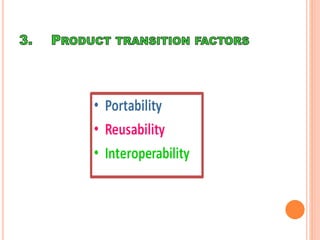
 1. Portability Requirements: If the software must be ported
to different environments (different hardware, operating
systems, …) and still maintain an existing environment, then
portability is a must.
 2. Reusability Requirements: Are we able to reuse parts of
the app for new applications?
 Can save immense development costs due to errors found / tested.
 Certainly higher quality software and development more quickly
results.
 Very big deal nowadays.
 3. Interoperability Requirements: Does the
application need to interface with other existing
systems
 Frequently these will be known ahead of time and plans
can be made to provide for this requirement during design
time.
 Sometimes these systems can be quite different; different platforms,
different databases, and more
 Also, industry or standard application structures in areas
can be specified as requirements.

6. McCall's Model.pptx

  • 1.
    McCall’s Model Submitted By:Sadia Sheraz Roll no: 025156(2257)
  • 2.
  • 6.
    MCCALL’S QUALITY FACTORS CATEGORY:PRODUCT OPERATION FACTORS  1. Correctness: The functionality should match the specification.  2. Reliability Requirements: (remember, this quality factor is specified in the specs!)  Reliability requirements deal with the failure to provide service.  Address failure rates either overall or to required functions.  Example specs:  A heart monitoring system must have a failure rate of less than one per million cases.  Downtime for a system will not be more than ten minutes per month (me)
  • 7.
     3. EfficiencyRequirements: Deals with the hardware resources needed to perform the functions of the software.  Here we consider MIPS, MHz (cycles per second); data storage capabilities measured in MB or TB; communication lines (usually measured in KBPS, MBPS, or GBPS).  Example spec: simply very slow communications.  4. Integrity: It deal with system security that prevent unauthorized persons access.  5. Usability Requirements: It deals with the scope of staff resources needed to train new employees and to operate the software system.  Deals with learn ability, utility, and more. (me)  Example spec: A staff member should be able to process n transactions / unit time. (me)
  • 9.
    MCCALL’S QUALITY FACTORS CATEGORY:PRODUCT REVISION SOFTWARE FACTORS  These deal with requirements that affect the complete range of software maintenance activities:  corrective maintenance,  adaptive maintenance, and  perfective maintenance  1. Maintainability Requirements  The degree of effort needed to identify reasons (find the problem) for software failure and to correct failures and to verify the success of the corrections.  Deals with the modular structure of the software, internal program documentation, programmer manuals  Example specs: size of module <= 30 statements.
  • 10.
     2. FlexibilityRequirements – deals with resources to change (adopt) software to different types of customers that use the app perhaps a little differently;  May also involve a little perfective maintenance to perhaps do a little better due to the customer’s perhaps slightly more robust environment.  3. Testability Requirements –  Are intermediate results of computations predefined to assist testing?  Are log files created?  Does the software diagnose itself prior to and perhaps during operations?
  • 12.
    MCCALL’S QUALITY FACTORS CATEGORY:PRODUCT TRANSITION SOFTWARE QUALITY FACTORS  1. Portability Requirements: If the software must be ported to different environments (different hardware, operating systems, …) and still maintain an existing environment, then portability is a must.  2. Reusability Requirements: Are we able to reuse parts of the app for new applications?  Can save immense development costs due to errors found / tested.  Certainly higher quality software and development more quickly results.  Very big deal nowadays.
  • 13.
     3. InteroperabilityRequirements: Does the application need to interface with other existing systems  Frequently these will be known ahead of time and plans can be made to provide for this requirement during design time.  Sometimes these systems can be quite different; different platforms, different databases, and more  Also, industry or standard application structures in areas can be specified as requirements.