Smart Cities
                                        and the Future Internet


                                                              Workshop by Eurocities and Fireball
                                                                    Brussels, 25th January 2012


                                                 Mário Campolargo
                                         European Commission - DG INFSO
                                Director, Emerging Technologies and Infrastructures
"The views expressed in this presentation are those of the author and do not necessarily reflect the views of the European Commission"
                                                                                                                                         1
smart, sustainable, inclusive

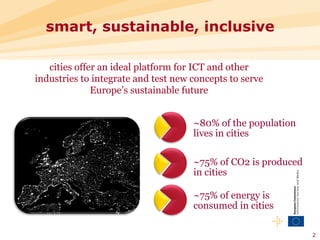
   cities offer an ideal platform for ICT and other
industries to integrate and test new concepts to serve
              Europe’s sustainable future


                                     ~80% of the population
                                     lives in cities

                                     ~75% of CO2 is produced
                                     in cities

                                     ~75% of energy is
                                     consumed in cities

                                                               2
smart cities


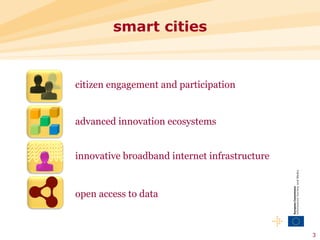
citizen engagement and participation


advanced innovation ecosystems


innovative broadband internet infrastructure


open access to data


                                               3
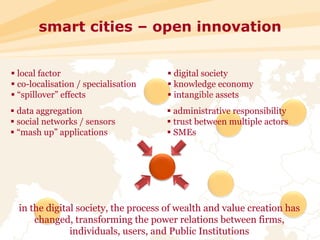
smart cities – open innovation


§  local factor                       §  digital society
§  co-localisation / specialisation   §  knowledge economy
§  “spillover” effects                §  intangible assets
§  data aggregation                   §  administrative responsibility
§  social networks / sensors          §  trust between multiple actors
§  “mash up” applications             §  SMEs


  in the digital society, the process of wealth and value creation has
      changed, transforming the power relations between firms,
               individuals, users, and Public Institutions                 4
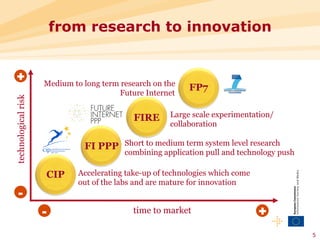
from research to innovation


 +                   Medium to long term research on the
                                                            FP7
                                        Future Internet
technological risk


                                             FIRE      Large scale experimentation/
                                                       collaboration

                               FI PPP Short to medium term system level research
                                          combining application pull and technology push

                     CIP      Accelerating take-up of technologies which come
                              out of the labs and are mature for innovation
    -
                     -                       time to market                     +
                                                                                           5
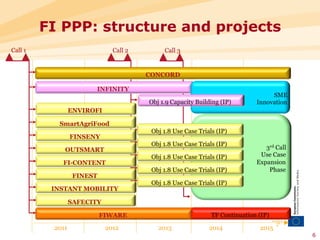
FI PPP: structure and projects
Call 1             Call 2    Call 3


          2011   2012       2013      2014   2015
                                                    6
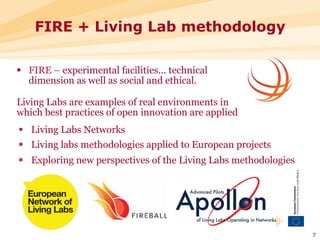
FIRE + Living Lab methodology

§  FIRE – experimental facilities... technical
    dimension as well as social and ethical.

Living Labs are examples of real environments in
which best practices of open innovation are applied
§  Living Labs Networks
§  Living labs methodologies applied to European projects
§  Exploring new perspectives of the Living Labs methodologies


                                                                  7
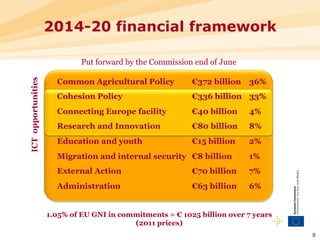
2014-20 financial framework

                             Put forward by the Commission end of June

                      Common Agricultural Policy          €372 billion   36%
ICT opportunities


                      Cohesion Policy                     €336 billion 33%
                      Connecting Europe facility          €40 billion    4%
                      Research and Innovation             €80 billion    8%
                      Education and youth                 €15 billion    2%
                      Migration and internal security €8 billion         1%
                      External Action                     €70 billion    7%
                      Administration                      €63 billion    6%


                    1.05% of EU GNI in commitments = € 1025 billion over 7 years
                                          (2011 prices)
                                                                                   8
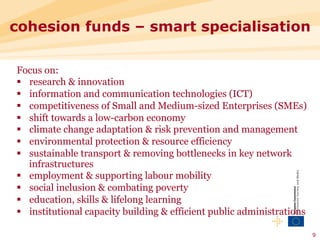
cohesion funds – smart specialisation

Focus on:
§  research & innovation
§  information and communication technologies (ICT)
§  competitiveness of Small and Medium-sized Enterprises (SMEs)
§  shift towards a low-carbon economy
§  climate change adaptation & risk prevention and management
§  environmental protection & resource efficiency
§  sustainable transport & removing bottlenecks in key network
    infrastructures
§  employment & supporting labour mobility
§  social inclusion & combating poverty
§  education, skills & lifelong learning
§  institutional capacity building & efficient public administrations

                                                                         9
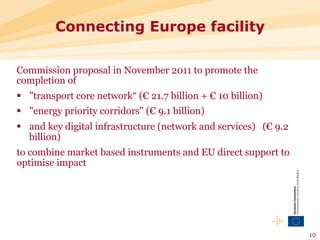
Connecting Europe facility

Commission proposal in November 2011 to promote the
completion of
§  "transport core network“ (€ 21.7 billion + € 10 billion)
§  "energy priority corridors" (€ 9.1 billion)
§  and key digital infrastructure (network and services) (€ 9.2
    billion)
to combine market based instruments and EU direct support to
optimise impact


                                                                   10
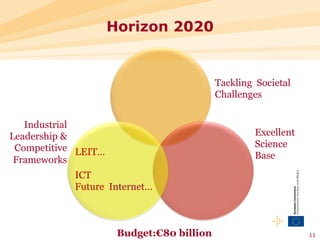
Horizon 2020


                                           Tackling Societal
                                           Challenges


   Industrial
Leadership &                                       Excellent
 Competitive LEIT…                                 Science
 Frameworks                                        Base

            ICT
            Future Internet…


                      Budget:€80 billion                       11
what is next?

§  Understand the needs of regional/local actors
§  Move from testing innovative ideas to piloting realistic solutions
    that will help us deliver in the 2020 timeframe
§  Take a comprehensive and integrated approach; break down
    silos between domains such as buildings, transport, energy
    networks and ICT
§  Ensure that solutions are actually taken up by key stakeholders,
    including citizens

§  Smart cities are a perfect framework:
§  To put the Future Internet Technologies “in context”
§  To take advantage of the new EU policy approach, with tighter
    integration between Research, innovation, regional deployment

                                                                         12
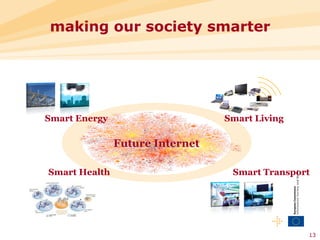
making our society smarter


Smart Energy                     Smart Living

               Future Internet

Smart Health                      Smart Transport


                                                13

Horizon 2020 & EC Innovation policy and Smart Cities EIP by Director Mario Campolargo, European Commission

  • 1.
    Smart Cities and the Future Internet Workshop by Eurocities and Fireball Brussels, 25th January 2012 Mário Campolargo European Commission - DG INFSO Director, Emerging Technologies and Infrastructures "The views expressed in this presentation are those of the author and do not necessarily reflect the views of the European Commission" 1
  • 2.
    smart, sustainable, inclusive cities offer an ideal platform for ICT and other industries to integrate and test new concepts to serve Europe’s sustainable future ~80% of the population lives in cities ~75% of CO2 is produced in cities ~75% of energy is consumed in cities 2
  • 3.
    smart cities citizen engagementand participation advanced innovation ecosystems innovative broadband internet infrastructure open access to data 3
  • 4.
    smart cities –open innovation §  local factor §  digital society §  co-localisation / specialisation §  knowledge economy §  “spillover” effects §  intangible assets §  data aggregation §  administrative responsibility §  social networks / sensors §  trust between multiple actors §  “mash up” applications §  SMEs in the digital society, the process of wealth and value creation has changed, transforming the power relations between firms, individuals, users, and Public Institutions 4
  • 5.
    from research toinnovation + Medium to long term research on the FP7 Future Internet technological risk FIRE Large scale experimentation/ collaboration FI PPP Short to medium term system level research combining application pull and technology push CIP Accelerating take-up of technologies which come out of the labs and are mature for innovation - - time to market + 5
  • 6.
    FI PPP: structureand projects Call 1 Call 2 Call 3 2011 2012 2013 2014 2015 6
  • 7.
    FIRE + LivingLab methodology §  FIRE – experimental facilities... technical dimension as well as social and ethical. Living Labs are examples of real environments in which best practices of open innovation are applied §  Living Labs Networks §  Living labs methodologies applied to European projects §  Exploring new perspectives of the Living Labs methodologies 7
  • 8.
    2014-20 financial framework Put forward by the Commission end of June Common Agricultural Policy €372 billion 36% ICT opportunities Cohesion Policy €336 billion 33% Connecting Europe facility €40 billion 4% Research and Innovation €80 billion 8% Education and youth €15 billion 2% Migration and internal security €8 billion 1% External Action €70 billion 7% Administration €63 billion 6% 1.05% of EU GNI in commitments = € 1025 billion over 7 years (2011 prices) 8
  • 9.
    cohesion funds –smart specialisation Focus on: §  research & innovation §  information and communication technologies (ICT) §  competitiveness of Small and Medium-sized Enterprises (SMEs) §  shift towards a low-carbon economy §  climate change adaptation & risk prevention and management §  environmental protection & resource efficiency §  sustainable transport & removing bottlenecks in key network infrastructures §  employment & supporting labour mobility §  social inclusion & combating poverty §  education, skills & lifelong learning §  institutional capacity building & efficient public administrations 9
  • 10.
    Connecting Europe facility Commissionproposal in November 2011 to promote the completion of §  "transport core network“ (€ 21.7 billion + € 10 billion) §  "energy priority corridors" (€ 9.1 billion) §  and key digital infrastructure (network and services) (€ 9.2 billion) to combine market based instruments and EU direct support to optimise impact 10
  • 11.
    Horizon 2020 Tackling Societal Challenges Industrial Leadership & Excellent Competitive LEIT… Science Frameworks Base ICT Future Internet… Budget:€80 billion 11
  • 12.
    what is next? § Understand the needs of regional/local actors §  Move from testing innovative ideas to piloting realistic solutions that will help us deliver in the 2020 timeframe §  Take a comprehensive and integrated approach; break down silos between domains such as buildings, transport, energy networks and ICT §  Ensure that solutions are actually taken up by key stakeholders, including citizens §  Smart cities are a perfect framework: §  To put the Future Internet Technologies “in context” §  To take advantage of the new EU policy approach, with tighter integration between Research, innovation, regional deployment 12
  • 13.
    making our societysmarter Smart Energy Smart Living Future Internet Smart Health Smart Transport 13