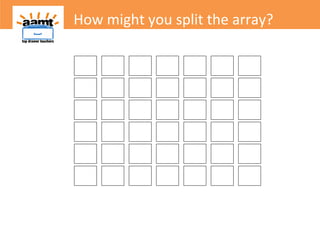
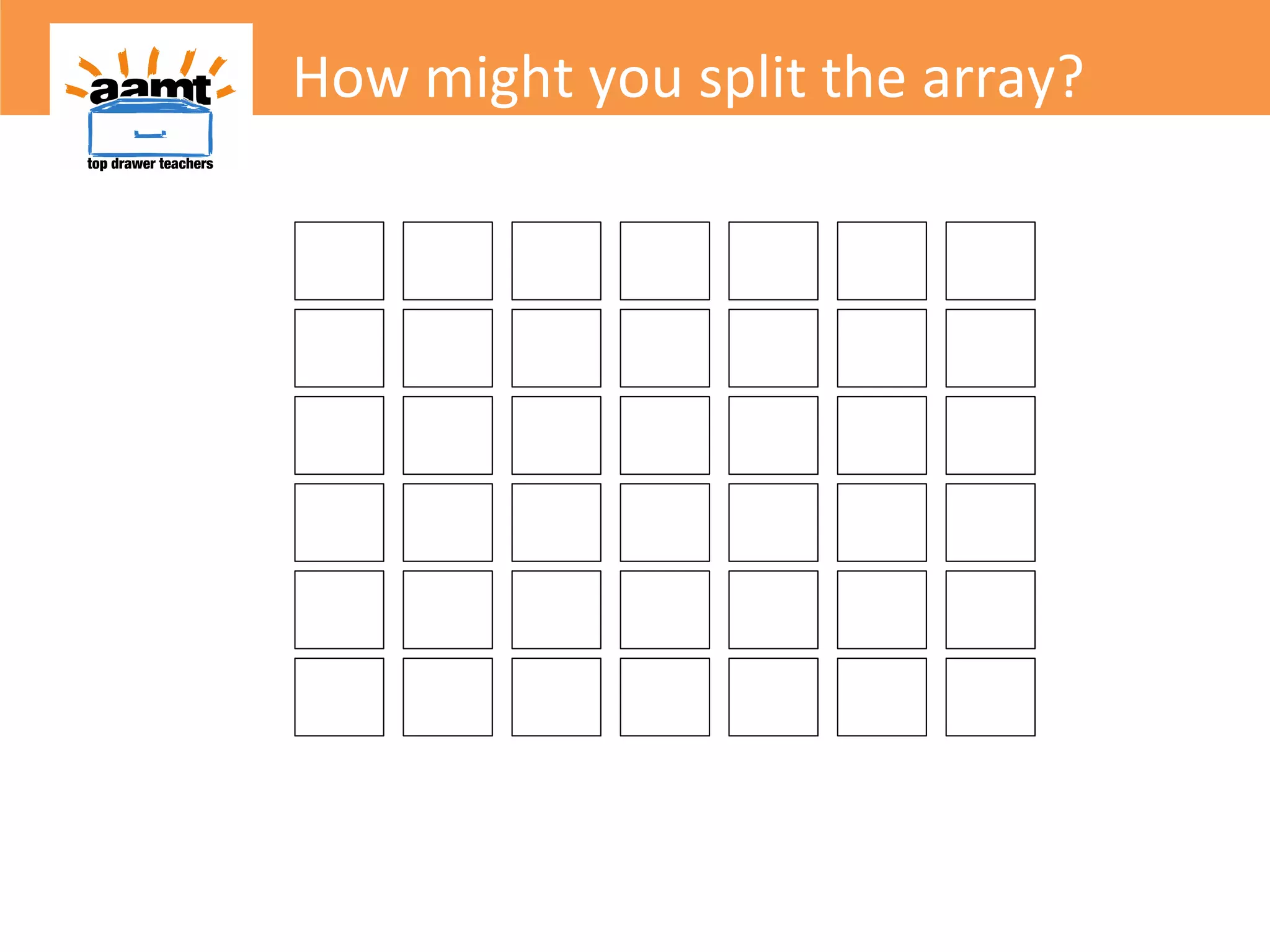
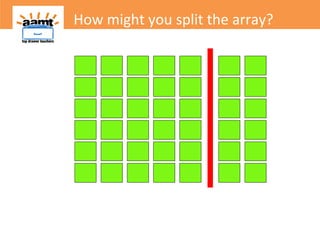
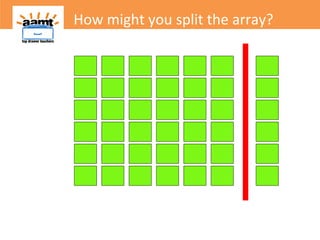
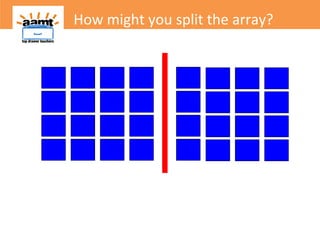
How might you split the array?
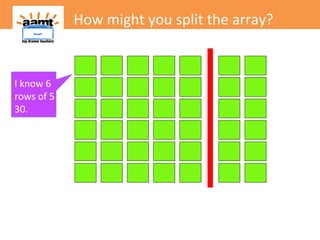
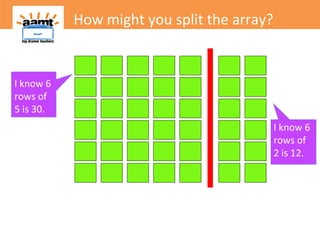
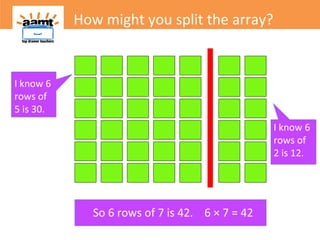
I know 6
rows of 5 is
30.
How might you split the array?
I know 6
rows of
2 is 12.
I know 6
rows of
5 is 30.
How might you split the array?
So 6 rows of 7 is 42. 6 × 7 = 42
I know 6
rows of
5 is 30.
I know 6
rows of
2 is 12.
How might you split the array?
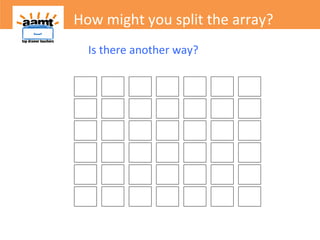
Is there another way?
How might you split the array?
I know!
6 rows
of 5 is 30
How might you split the array?
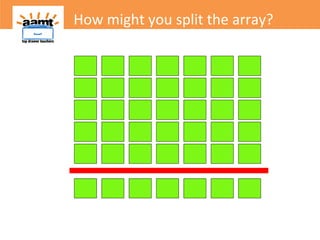
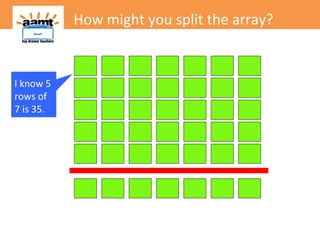
I know 5
rows of
7 is 35
I know 5
rows of
7 is 35.
How might you split the array?
I know 5
rows of
7 is 35
I know 5
rows of
7 is 35.
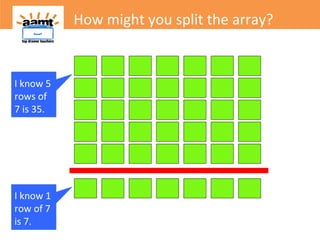
I know 1
row of 7
is 7.
How might you split the array?
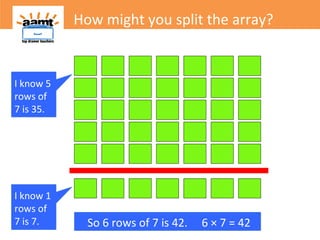
I know 5
rows of
7 is 35
I know 5
rows of
7 is 35.
I know 1
rows of
7 is 7. So 6 rows of 7 is 42. 6 × 7 = 42
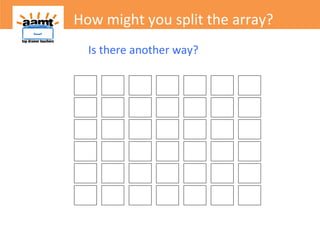
How might you split the array?
Is there another way?
How might you split the array?
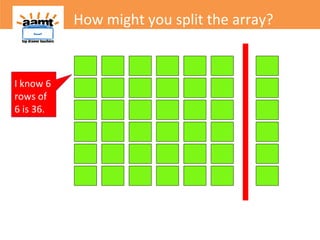
I know 6
rows of
6 is 36.
How might you split the array?
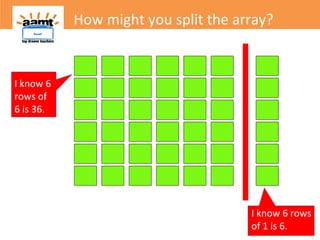
I know 6
rows of
6 is 36.
I know 6 rows
of 1 is 6.
How might you split the array?
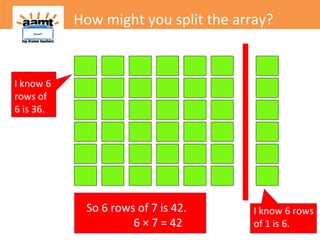
I know 6
rows of
6 is 36.
I know 6 rows
of 1 is 6.
So 6 rows of 7 is 42.
6 × 7 = 42
How might you split the array?
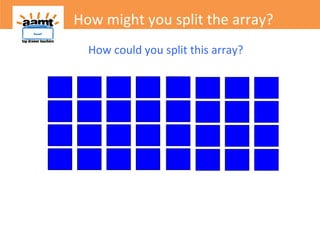
How could you split this array?
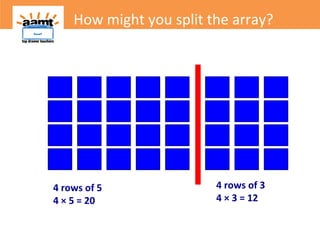
4 rows of 5
4 × 5 = 20
4 rows of 3
4 × 3 = 12
How might you split the array?
4 rows of 5
4 × 5 = 20
4 rows of 3
4 × 3 = 12
How might you split the array?
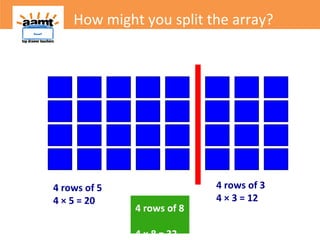
4 rows of 8
4 × 8 = 32
How might you split the array?
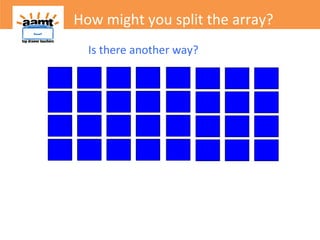
Is there another way?
How might you split the array?
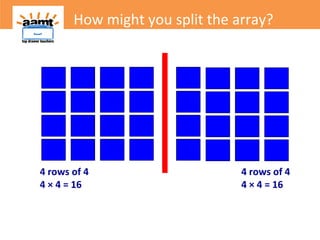
4 rows of 4
4 × 4 = 16
4 rows of 4
4 × 4 = 16
How might you split the array?
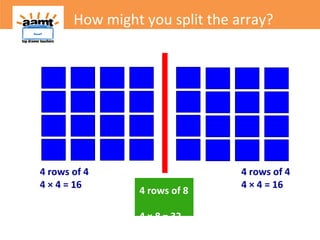
4 rows of 4
4 × 4 = 16
4 rows of 4
4 × 4 = 16
4 rows of 8
4 × 8 = 32
How might you split the array?
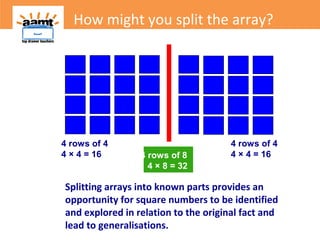
4 rows of 4
4 × 4 = 16
4 rows of 4
4 × 4 = 164 rows of 8
4 × 8 = 32
Splitting arrays into known parts provides an
opportunity for square numbers to be identified
and explored in relation to the original fact and
lead to generalisations.
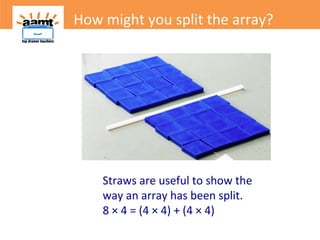
Straws are useful to show the
way an array has been split.
8 × 4 = (4 × 4) + (4 × 4)
How might you split the array?
Use colour to show the different
ways to split an array in to the
related known facts.
This enables students to see
connections such as doubling and
halving, and square numbers.
How might you split the array?
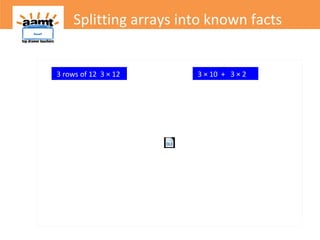
3 × 10 + 3 × 23 rows of 12 3 × 12
Splitting arrays into known facts
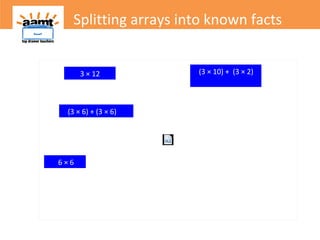
(3 × 10) + (3 × 2)3 × 12
(3 × 6) + (3 × 6)
6 × 6
Splitting arrays into known facts
3 × 12
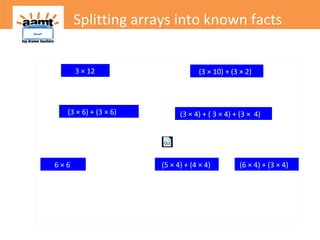
(3 × 4) + ( 3 × 4) + (3 × 4)
6 × 6 (6 × 4) + (3 × 4)(5 × 4) + (4 × 4)
Splitting arrays into known facts
(3 × 10) + (3 × 2)
(3 × 6) + (3 × 6)

Top Drawer Teachers: Splitting arrays into known parts

  • 1.
    How might yousplit the array?
  • 2.
    How might yousplit the array?
  • 3.
    How might yousplit the array? I know 6 rows of 5 is 30.
  • 4.
    How might yousplit the array? I know 6 rows of 2 is 12. I know 6 rows of 5 is 30.
  • 5.
    How might yousplit the array? So 6 rows of 7 is 42. 6 × 7 = 42 I know 6 rows of 5 is 30. I know 6 rows of 2 is 12.
  • 6.
    How might yousplit the array? Is there another way?
  • 7.
    How might yousplit the array? I know! 6 rows of 5 is 30
  • 8.
    How might yousplit the array? I know 5 rows of 7 is 35 I know 5 rows of 7 is 35.
  • 9.
    How might yousplit the array? I know 5 rows of 7 is 35 I know 5 rows of 7 is 35. I know 1 row of 7 is 7.
  • 10.
    How might yousplit the array? I know 5 rows of 7 is 35 I know 5 rows of 7 is 35. I know 1 rows of 7 is 7. So 6 rows of 7 is 42. 6 × 7 = 42
  • 11.
    How might yousplit the array? Is there another way?
  • 12.
    How might yousplit the array?
  • 13.
    How might yousplit the array? I know 6 rows of 6 is 36.
  • 14.
    How might yousplit the array? I know 6 rows of 6 is 36. I know 6 rows of 1 is 6.
  • 15.
    How might yousplit the array? I know 6 rows of 6 is 36. I know 6 rows of 1 is 6. So 6 rows of 7 is 42. 6 × 7 = 42
  • 16.
    How might yousplit the array? How could you split this array?
  • 17.
    4 rows of5 4 × 5 = 20 4 rows of 3 4 × 3 = 12 How might you split the array?
  • 18.
    4 rows of5 4 × 5 = 20 4 rows of 3 4 × 3 = 12 How might you split the array? 4 rows of 8 4 × 8 = 32
  • 19.
    How might yousplit the array? Is there another way?
  • 20.
    How might yousplit the array?
  • 21.
    How might yousplit the array? 4 rows of 4 4 × 4 = 16 4 rows of 4 4 × 4 = 16
  • 22.
    How might yousplit the array? 4 rows of 4 4 × 4 = 16 4 rows of 4 4 × 4 = 16 4 rows of 8 4 × 8 = 32
  • 23.
    How might yousplit the array? 4 rows of 4 4 × 4 = 16 4 rows of 4 4 × 4 = 164 rows of 8 4 × 8 = 32 Splitting arrays into known parts provides an opportunity for square numbers to be identified and explored in relation to the original fact and lead to generalisations.
  • 24.
    Straws are usefulto show the way an array has been split. 8 × 4 = (4 × 4) + (4 × 4) How might you split the array?
  • 25.
    Use colour toshow the different ways to split an array in to the related known facts. This enables students to see connections such as doubling and halving, and square numbers. How might you split the array?
  • 26.
    3 × 10+ 3 × 23 rows of 12 3 × 12 Splitting arrays into known facts
  • 27.
    (3 × 10)+ (3 × 2)3 × 12 (3 × 6) + (3 × 6) 6 × 6 Splitting arrays into known facts
  • 28.
    3 × 12 (3× 4) + ( 3 × 4) + (3 × 4) 6 × 6 (6 × 4) + (3 × 4)(5 × 4) + (4 × 4) Splitting arrays into known facts (3 × 10) + (3 × 2) (3 × 6) + (3 × 6)