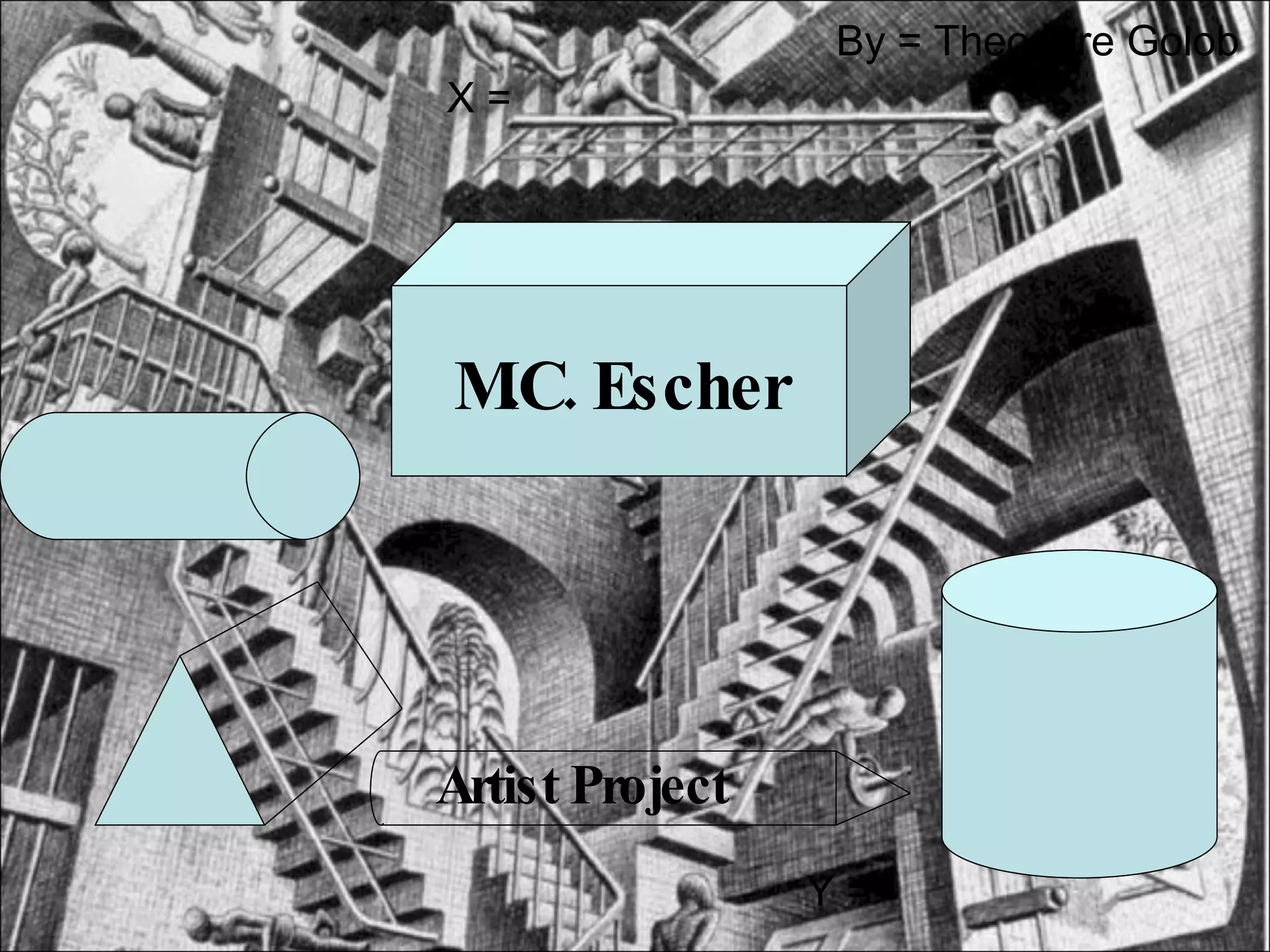
M.C. Escher Artist Project X =  Y = By = Theodore Golob
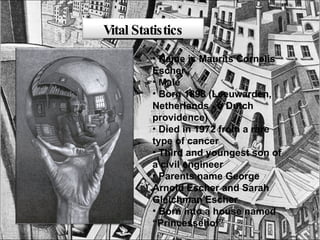
Name is Maurits Cornelis Escher  Male Born 1898 (Leeuwarden, Netherlands - a Dutch providence) Died in 1972 from a rare type of cancer Third and youngest son of a civil engineer Parents name George Arnold Escher and Sarah Gleichman Escher Born into a house named “Princessehof” Vital Statistics
Personal Background Failed high school exams - failed almost all courses - did not fail  math 1916 - First Graphic work Rejected from military due to poor health 1922 - first profitable woodcut-  St. Francis (Preaching to the Birds) 1919 - Escher attends school of Architecture and Decorative arts in Haarlem, Netherlands Dropped out of college, wanted to do graphic art For seven years learned about lithography and woodcutting Visited the Alhambra fourteen century Moorish castle in Granada and discovered the regular division of the Plane. This would stick with him until death - Spain 1922 After brother died in October 1925 in a mountaineering accident, made “Days of Creation” Traveled throughout Italy,1922-1934. Influenced backgrounds in his drawings 1936 - revisited Moorish castle, observed tiles, created metamorphosis 1956 - 58 , started to works symbolizing themes such as infinity and tiling the plane, “Smaller and Smaller” -1956
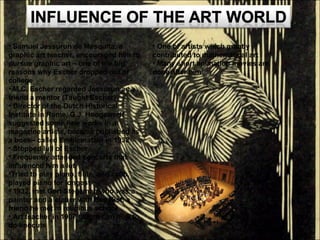
Samuel Jessurun de Mesquita, a graphic art teacher, encouraged him to pursue graphic art – one of the big reasons why Escher dropped out of college M.C. Escher regarded Jessurun as a friend a mentor (Taught Escher) Director of the Dutch Historical Institute in Rome, G.J. Hoogewerff suggested some new works in a magazine article, became published as a book– called Emblematain in 1932 Stopped lull of Escher Frequently attended concerts that influenced him a lot Tried to play piano, flute, and cello, played piano for longest 1932, met Gert Stegeman who was a painter and a etcher with Bas Kist, a friend he met in religious school Art teacher in 1907 taught him how to do linocuts One of artists which greatly contributed to mathematical art Many short animation movies are done after him
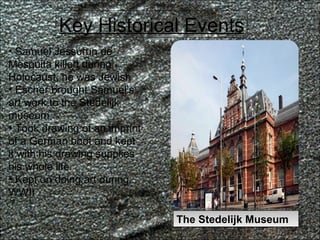
Key Historical Events Samuel Jessurun de Mesquita killed during Holocaust, he was Jewish Escher brought Samuel’s art work to the Stedelijk museum Took drawing of an imprint of a German boot and kept it with his drawing supplies his whole life Kept on doing art during WWII The Stedelijk Museum
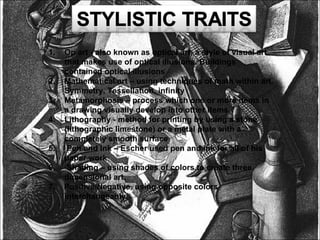
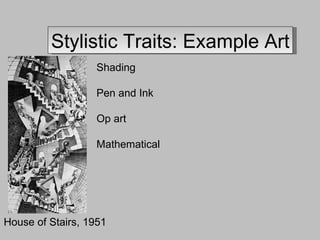
Op art - also known as optical art, a style of visual art that makes use of optical illusions. Buildings contained optical illusions Mathematical art – using techniques of math within art. Symmetry, Tessellation, infinity Metamorphosis – process which one or more items in a drawing visually develop into other items. Lithography - method for printing by using a stone (lithographic limestone) or a metal plate with a completely smooth surface Pen and Ink – Escher used pen and ink for all of his paper work Shading – using shades of colors to create three dimensional art. 7.  Positive/Negative, using opposite colors interchangeably.
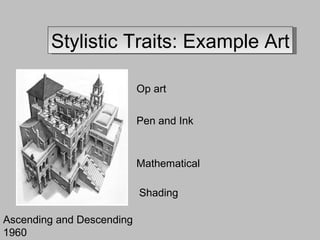
Stylistic Traits: Example Art Ascending and Descending 1960 Op art Mathematical Shading Pen and Ink
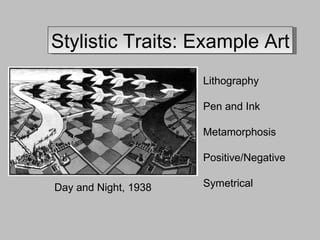
Stylistic Traits: Example Art Day and Night, 1938 Lithography Pen and Ink Metamorphosis Positive/Negative Symetrical
Stylistic Traits: Example Art House of Stairs, 1951 Shading Pen and Ink Op art Mathematical
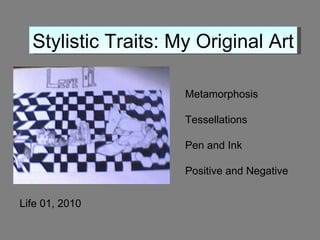
Stylistic Traits: My Original Art Metamorphosis Tessellations Pen and Ink Positive and Negative Life 01, 2010
Conclusion Observing the creative, genuine, and imaginative art of M.C. Escher was a privilege. Using the styles that he used such as tessellations and metamorphosis, I created a piece of art. I am glad that Escher  did an act of kindness towards his Jewish friend, Jessurun de Mesquita following the Holocaust. This proved that Escher was a caring and loving man in addition to all his other characteristics.  Overall, researching about Escher has enlightened me to how artistic one can be.

M.C. Escher - Theodore Golob

  • 1.
    M.C. Escher ArtistProject X = Y = By = Theodore Golob
  • 2.
    Name is MauritsCornelis Escher Male Born 1898 (Leeuwarden, Netherlands - a Dutch providence) Died in 1972 from a rare type of cancer Third and youngest son of a civil engineer Parents name George Arnold Escher and Sarah Gleichman Escher Born into a house named “Princessehof” Vital Statistics
  • 3.
    Personal Background Failedhigh school exams - failed almost all courses - did not fail math 1916 - First Graphic work Rejected from military due to poor health 1922 - first profitable woodcut- St. Francis (Preaching to the Birds) 1919 - Escher attends school of Architecture and Decorative arts in Haarlem, Netherlands Dropped out of college, wanted to do graphic art For seven years learned about lithography and woodcutting Visited the Alhambra fourteen century Moorish castle in Granada and discovered the regular division of the Plane. This would stick with him until death - Spain 1922 After brother died in October 1925 in a mountaineering accident, made “Days of Creation” Traveled throughout Italy,1922-1934. Influenced backgrounds in his drawings 1936 - revisited Moorish castle, observed tiles, created metamorphosis 1956 - 58 , started to works symbolizing themes such as infinity and tiling the plane, “Smaller and Smaller” -1956
  • 4.
    Samuel Jessurun deMesquita, a graphic art teacher, encouraged him to pursue graphic art – one of the big reasons why Escher dropped out of college M.C. Escher regarded Jessurun as a friend a mentor (Taught Escher) Director of the Dutch Historical Institute in Rome, G.J. Hoogewerff suggested some new works in a magazine article, became published as a book– called Emblematain in 1932 Stopped lull of Escher Frequently attended concerts that influenced him a lot Tried to play piano, flute, and cello, played piano for longest 1932, met Gert Stegeman who was a painter and a etcher with Bas Kist, a friend he met in religious school Art teacher in 1907 taught him how to do linocuts One of artists which greatly contributed to mathematical art Many short animation movies are done after him
  • 5.
    Key Historical EventsSamuel Jessurun de Mesquita killed during Holocaust, he was Jewish Escher brought Samuel’s art work to the Stedelijk museum Took drawing of an imprint of a German boot and kept it with his drawing supplies his whole life Kept on doing art during WWII The Stedelijk Museum
  • 6.
    Op art -also known as optical art, a style of visual art that makes use of optical illusions. Buildings contained optical illusions Mathematical art – using techniques of math within art. Symmetry, Tessellation, infinity Metamorphosis – process which one or more items in a drawing visually develop into other items. Lithography - method for printing by using a stone (lithographic limestone) or a metal plate with a completely smooth surface Pen and Ink – Escher used pen and ink for all of his paper work Shading – using shades of colors to create three dimensional art. 7. Positive/Negative, using opposite colors interchangeably.
  • 7.
    Stylistic Traits: ExampleArt Ascending and Descending 1960 Op art Mathematical Shading Pen and Ink
  • 8.
    Stylistic Traits: ExampleArt Day and Night, 1938 Lithography Pen and Ink Metamorphosis Positive/Negative Symetrical
  • 9.
    Stylistic Traits: ExampleArt House of Stairs, 1951 Shading Pen and Ink Op art Mathematical
  • 10.
    Stylistic Traits: MyOriginal Art Metamorphosis Tessellations Pen and Ink Positive and Negative Life 01, 2010
  • 11.
    Conclusion Observing thecreative, genuine, and imaginative art of M.C. Escher was a privilege. Using the styles that he used such as tessellations and metamorphosis, I created a piece of art. I am glad that Escher did an act of kindness towards his Jewish friend, Jessurun de Mesquita following the Holocaust. This proved that Escher was a caring and loving man in addition to all his other characteristics. Overall, researching about Escher has enlightened me to how artistic one can be.