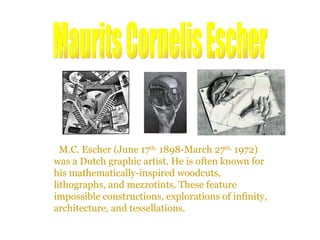
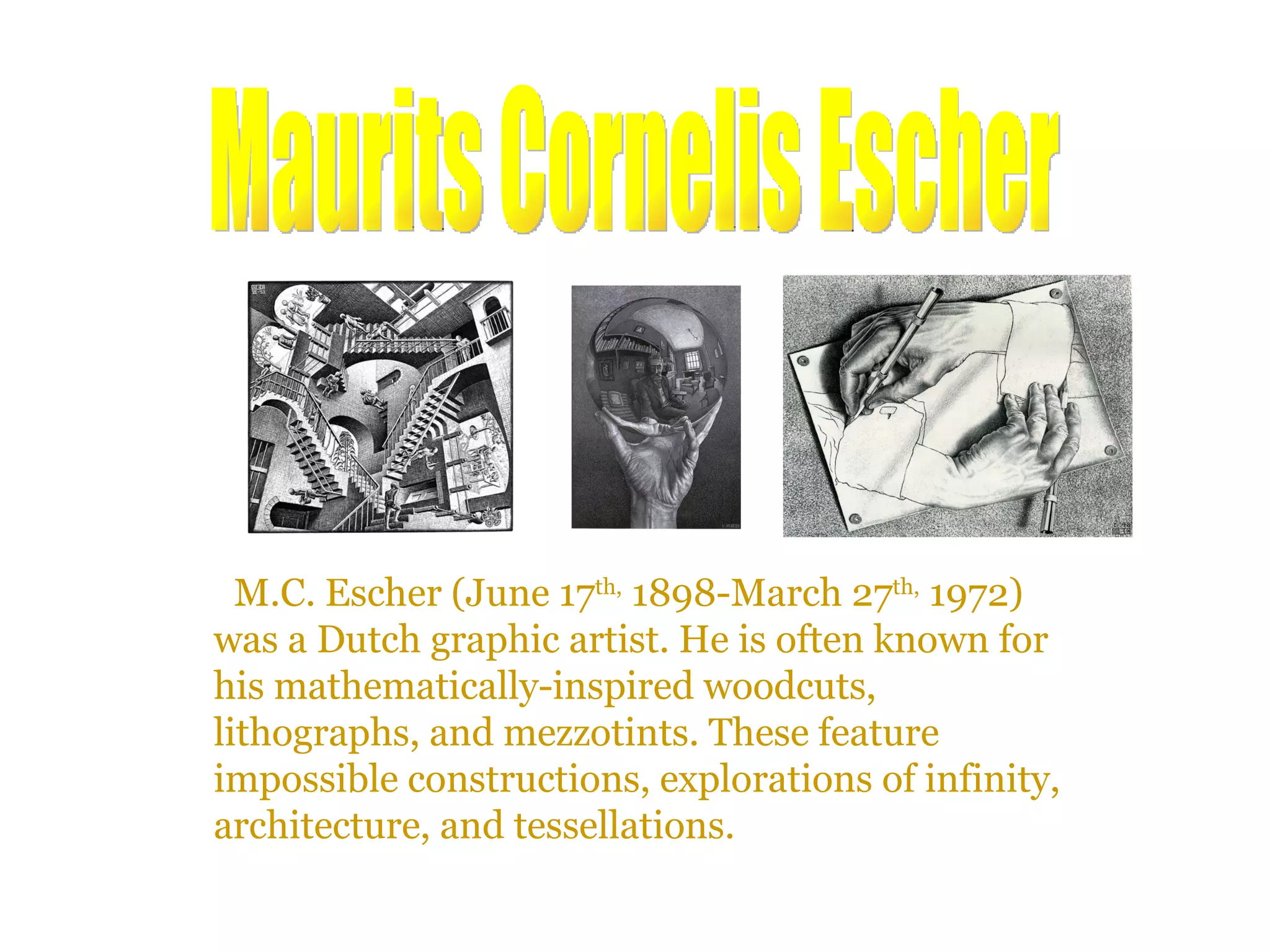
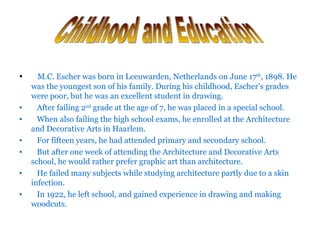
M.C. Escher (June 17 th,  1898-March 27 th,  1972) was a Dutch graphic artist. He is often known for his mathematically-inspired woodcuts, lithographs, and mezzotints. These feature impossible constructions, explorations of infinity, architecture, and tessellations. Maurits Cornelis Escher
M.C. Escher was born in Leeuwarden, Netherlands on June 17 th , 1898. He was the youngest son of his family. During his childhood, Escher’s grades were poor, but he was an excellent student in drawing. After failing 2 nd  grade at the age of 7, he was placed in a special school. When also failing the high school exams, he enrolled at the Architecture and Decorative Arts in Haarlem. For fifteen years, he had attended primary and secondary school. But after one week of attending the Architecture and Decorative Arts school, he would rather prefer graphic art than architecture. He failed many subjects while studying architecture partly due to a skin infection. In 1922, he left school, and gained experience in drawing and making woodcuts. Childhood and Education
After leaving school, he traveled to Italy, where he met Jetta Umiker and married her in 1924. They had a child, and named him Giorgio Arnaldo Escher, after his grandfather. While visiting Alhambra, he became fascinated by the regular division of the plane. M.C. Escher and his family lived in Rome until 1935, where their son was born. They next moved to Switzerland where they remained for two years. Escher, who had been very fond of and inspired by the landscapes in Italy, was decidedly unhappy in Switzerland, so in 1937, the family moved yet again to Ukkel, a town near Brussels, Belgium. In the 1950’s, he became internationally successful with exhibitions in Washington D.C., Italy, and Holland.  In 1941, he had found a permanent home in Holland. Then, in 1970, Escher moved into a retirement home for artists. Family and Travel
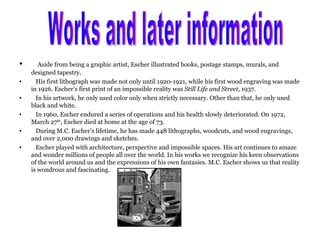
Aside from being a graphic artist, Escher illustrated books, postage stamps, murals, and designed tapestry. His first lithograph was made not only until 1920-1921, while his first wood engraving was made in 1926. Escher’s first print of an impossible reality was  Still Life and Street , 1937. In his artwork, he only used color only when strictly necessary. Other than that, he only used black and white. In 1960, Escher endured a series of operations and his health slowly deteriorated. On 1972, March 27 th , Escher died at home at the age of 73. During M.C. Escher’s lifetime, he has made 448 lithographs, woodcuts, and wood engravings, and over 2,000 drawings and sketches. Escher played with architecture, perspective and impossible spaces. His art continues to amaze and wonder millions of people all over the world. In his works we recognize his keen observations of the world around us and the expressions of his own fantasies. M.C. Escher shows us that reality is wondrous and fascinating. Works and later information
This Power point on M.C. Escher was created by……. Vinnie Zhang   Created By....

M.C. Escher Pp

  • 1.
    M.C. Escher (June17 th, 1898-March 27 th, 1972) was a Dutch graphic artist. He is often known for his mathematically-inspired woodcuts, lithographs, and mezzotints. These feature impossible constructions, explorations of infinity, architecture, and tessellations. Maurits Cornelis Escher
  • 2.
    M.C. Escher wasborn in Leeuwarden, Netherlands on June 17 th , 1898. He was the youngest son of his family. During his childhood, Escher’s grades were poor, but he was an excellent student in drawing. After failing 2 nd grade at the age of 7, he was placed in a special school. When also failing the high school exams, he enrolled at the Architecture and Decorative Arts in Haarlem. For fifteen years, he had attended primary and secondary school. But after one week of attending the Architecture and Decorative Arts school, he would rather prefer graphic art than architecture. He failed many subjects while studying architecture partly due to a skin infection. In 1922, he left school, and gained experience in drawing and making woodcuts. Childhood and Education
  • 3.
    After leaving school,he traveled to Italy, where he met Jetta Umiker and married her in 1924. They had a child, and named him Giorgio Arnaldo Escher, after his grandfather. While visiting Alhambra, he became fascinated by the regular division of the plane. M.C. Escher and his family lived in Rome until 1935, where their son was born. They next moved to Switzerland where they remained for two years. Escher, who had been very fond of and inspired by the landscapes in Italy, was decidedly unhappy in Switzerland, so in 1937, the family moved yet again to Ukkel, a town near Brussels, Belgium. In the 1950’s, he became internationally successful with exhibitions in Washington D.C., Italy, and Holland. In 1941, he had found a permanent home in Holland. Then, in 1970, Escher moved into a retirement home for artists. Family and Travel
  • 4.
    Aside from beinga graphic artist, Escher illustrated books, postage stamps, murals, and designed tapestry. His first lithograph was made not only until 1920-1921, while his first wood engraving was made in 1926. Escher’s first print of an impossible reality was Still Life and Street , 1937. In his artwork, he only used color only when strictly necessary. Other than that, he only used black and white. In 1960, Escher endured a series of operations and his health slowly deteriorated. On 1972, March 27 th , Escher died at home at the age of 73. During M.C. Escher’s lifetime, he has made 448 lithographs, woodcuts, and wood engravings, and over 2,000 drawings and sketches. Escher played with architecture, perspective and impossible spaces. His art continues to amaze and wonder millions of people all over the world. In his works we recognize his keen observations of the world around us and the expressions of his own fantasies. M.C. Escher shows us that reality is wondrous and fascinating. Works and later information
  • 5.
    This Power pointon M.C. Escher was created by……. Vinnie Zhang Created By....