MBBS PRACTICLE
INSTRUMENTS
Dr Ninad Patil
Department of Pediatrics
AMBU/BMV
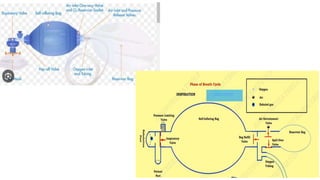
• Artificial Manual Breathing Unit/ Bag Mask Valve unit
• Material- silicon rubber bag ,self inflating bag
• Reusable -Sterilized with autoclave
• Used for artificial ventilation
• Portable and easy to use
• Valves – 3 valves , all are unidirectional
Inlet valve- entry of oxygen
Outlet valve-fish mouth valve/ patient end valve
Pop Up valve- 60 cm H2O , prevent baro-trauma
• AMBU Bag Sizes 250 ml/ 500 ml
• Outlet valve have standard 15 mm size opening (face mask attachment
port)
• USES-
 administration of High flow oxygen
 provision of control ventilation
 Provision of PEEP
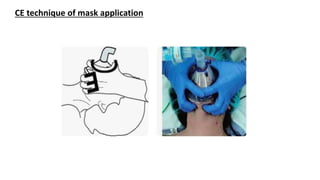
FACE MASK applied in CE technique
Contraindication of AMBU ventilations –
Diaphragmatic hernia
cleft palate
CE technique of mask application
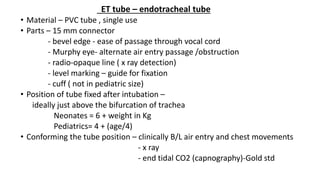
ET tube – endotracheal tube
• Material – PVC tube , single use
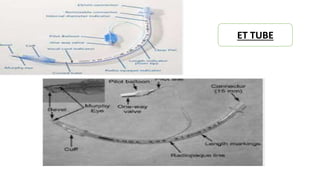
• Parts – 15 mm connector
- bevel edge - ease of passage through vocal cord
- Murphy eye- alternate air entry passage /obstruction
- radio-opaque line ( x ray detection)
- level marking – guide for fixation
- cuff ( not in pediatric size)
• Position of tube fixed after intubation –
ideally just above the bifurcation of trachea
Neonates = 6 + weight in Kg
Pediatrics= 4 + (age/4)
• Conforming the tube position – clinically B/L air entry and chest movements
- x ray
- end tidal CO2 (capnography)-Gold std
ET TUBE
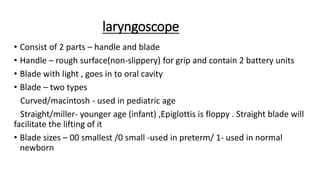
laryngoscope
• Consist of 2 parts – handle and blade
• Handle – rough surface(non-slippery) for grip and contain 2 battery units
• Blade with light , goes in to oral cavity
• Blade – two types
Curved/macintosh - used in pediatric age
Straight/miller- younger age (infant) ,Epiglottis is floppy . Straight blade will
facilitate the lifting of it
• Blade sizes – 00 smallest /0 small -used in preterm/ 1- used in normal
newborn
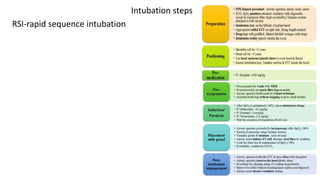
Intubation steps
RSI-rapid sequence intubation
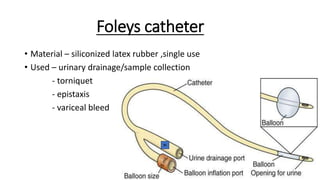
Foleys catheter
• Material – siliconized latex rubber ,single use
• Used – urinary drainage/sample collection
- torniquet
- epistaxis
- variceal bleed
Fr
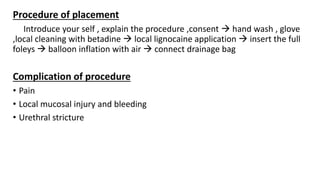
Procedure of placement
Introduce your self , explain the procedure ,consent  hand wash , glove
,local cleaning with betadine  local lignocaine application  insert the full
foleys  balloon inflation with air  connect drainage bag
Complication of procedure
• Pain
• Local mucosal injury and bleeding
• Urethral stricture
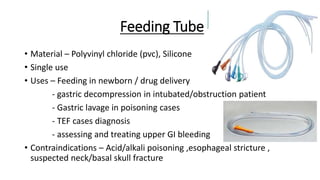
Feeding Tube
• Material – Polyvinyl chloride (pvc), Silicone
• Single use
• Uses – Feeding in newborn / drug delivery
- gastric decompression in intubated/obstruction patient
- Gastric lavage in poisoning cases
- TEF cases diagnosis
- assessing and treating upper GI bleeding
• Contraindications – Acid/alkali poisoning ,esophageal stricture ,
suspected neck/basal skull fracture
•Procedure of insertion
Introduce your self , explain the procedure ,consent --
hand wash , glove  measure the distance from Bridge of
nose to ear tragus to xiphisternum local lignocaine
application slight neck flexion insert the tube
in(Nose/Mouth) forwarding motion and ask patient
swallow conform its positionfix it , label
Conformation-
• Gastric secretion through tube
• Syringe and tube
• X ray
Complications-
• trauma to nasal/esophageal
mucosa
• insertion in trachea
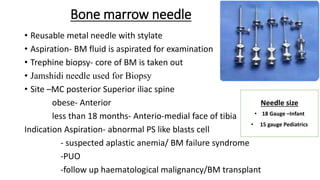
Bone marrow needle
• Reusable metal needle with stylate
• Aspiration- BM fluid is aspirated for examination
• Trephine biopsy- core of BM is taken out
• Jamshidi needle used for Biopsy
• Site –MC posterior Superior iliac spine
obese- Anterior
less than 18 months- Anterio-medial face of tibia
Indication Aspiration- abnormal PS like blasts cell
- suspected aplastic anemia/ BM failure syndrome
-PUO
-follow up haematological malignancy/BM transplant
Needle size
• 18 Gauge –Infant
• 15 gauge Pediatrics
• Indication Biopsy
- suspected BM fibrosis
- diagnosis and staging of Hodgkin & Non-Hodgkin Lymphoma
- diagnosis of aplastic anemia/MDS
• Contraindications-
- congenital coagulation disorders
- DIC
- local skin infection
- osteomyelitis
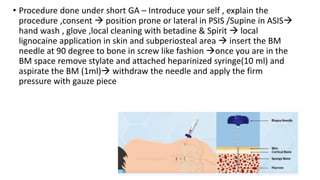
• Procedure done under short GA – Introduce your self , explain the
procedure ,consent  position prone or lateral in PSIS /Supine in ASIS
hand wash , glove ,local cleaning with betadine & Spirit  local
lignocaine application in skin and subperiosteal area  insert the BM
needle at 90 degree to bone in screw like fashion once you are in the
BM space remove stylate and attached heparinized syringe(10 ml) and
aspirate the BM (1ml) withdraw the needle and apply the firm
pressure with gauze piece
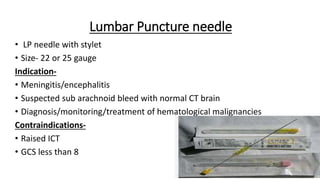
Lumbar Puncture needle
• LP needle with stylet
• Size- 22 or 25 gauge
Indication-
• Meningitis/encephalitis
• Suspected sub arachnoid bleed with normal CT brain
• Diagnosis/monitoring/treatment of hematological malignancies
Contraindications-
• Raised ICT
• GCS less than 8
• Procedure done under short GA
• 2 people needed - doctor + person to hold the baby
• Position – lateral lying (fetal position) preferred in pediatric
- upright – in newborn
Introduce your self , explain the procedure ,consent  position lateral
draw imaginary line from the upper border of iliac crest, it will intersect
the intervertebral space at L3-L4 junction  palpate the intervertebral
space L4 or below level hold the needle with bevel edge facing toward
ceiling & go forward directing toward the umbilicus  initial resistance
followed by give away of the resistance means you are in the space
remove the stylet and look for the free flow of the spinal fluid
Collect the sample – 3 container/ 10 drops each container
- sent it for RM/ glucose / cultures
Remove the needle and seal the site with tincture iodine

MBBS PEDIATRIC PRACTICAL INSTRUMENTS.pptx

  • 1.
    MBBS PRACTICLE INSTRUMENTS Dr NinadPatil Department of Pediatrics
  • 2.
    AMBU/BMV • Artificial ManualBreathing Unit/ Bag Mask Valve unit • Material- silicon rubber bag ,self inflating bag • Reusable -Sterilized with autoclave • Used for artificial ventilation • Portable and easy to use • Valves – 3 valves , all are unidirectional Inlet valve- entry of oxygen Outlet valve-fish mouth valve/ patient end valve Pop Up valve- 60 cm H2O , prevent baro-trauma
  • 3.
    • AMBU BagSizes 250 ml/ 500 ml • Outlet valve have standard 15 mm size opening (face mask attachment port) • USES-  administration of High flow oxygen  provision of control ventilation  Provision of PEEP FACE MASK applied in CE technique Contraindication of AMBU ventilations – Diaphragmatic hernia cleft palate
  • 5.
    CE technique ofmask application
  • 6.
    ET tube –endotracheal tube • Material – PVC tube , single use • Parts – 15 mm connector - bevel edge - ease of passage through vocal cord - Murphy eye- alternate air entry passage /obstruction - radio-opaque line ( x ray detection) - level marking – guide for fixation - cuff ( not in pediatric size) • Position of tube fixed after intubation – ideally just above the bifurcation of trachea Neonates = 6 + weight in Kg Pediatrics= 4 + (age/4) • Conforming the tube position – clinically B/L air entry and chest movements - x ray - end tidal CO2 (capnography)-Gold std
  • 7.
  • 8.
    laryngoscope • Consist of2 parts – handle and blade • Handle – rough surface(non-slippery) for grip and contain 2 battery units • Blade with light , goes in to oral cavity • Blade – two types Curved/macintosh - used in pediatric age Straight/miller- younger age (infant) ,Epiglottis is floppy . Straight blade will facilitate the lifting of it • Blade sizes – 00 smallest /0 small -used in preterm/ 1- used in normal newborn
  • 9.
  • 10.
    Foleys catheter • Material– siliconized latex rubber ,single use • Used – urinary drainage/sample collection - torniquet - epistaxis - variceal bleed Fr
  • 11.
    Procedure of placement Introduceyour self , explain the procedure ,consent  hand wash , glove ,local cleaning with betadine  local lignocaine application  insert the full foleys  balloon inflation with air  connect drainage bag Complication of procedure • Pain • Local mucosal injury and bleeding • Urethral stricture
  • 12.
    Feeding Tube • Material– Polyvinyl chloride (pvc), Silicone • Single use • Uses – Feeding in newborn / drug delivery - gastric decompression in intubated/obstruction patient - Gastric lavage in poisoning cases - TEF cases diagnosis - assessing and treating upper GI bleeding • Contraindications – Acid/alkali poisoning ,esophageal stricture , suspected neck/basal skull fracture
  • 13.
    •Procedure of insertion Introduceyour self , explain the procedure ,consent -- hand wash , glove  measure the distance from Bridge of nose to ear tragus to xiphisternum local lignocaine application slight neck flexion insert the tube in(Nose/Mouth) forwarding motion and ask patient swallow conform its positionfix it , label Conformation- • Gastric secretion through tube • Syringe and tube • X ray Complications- • trauma to nasal/esophageal mucosa • insertion in trachea
  • 14.
    Bone marrow needle •Reusable metal needle with stylate • Aspiration- BM fluid is aspirated for examination • Trephine biopsy- core of BM is taken out • Jamshidi needle used for Biopsy • Site –MC posterior Superior iliac spine obese- Anterior less than 18 months- Anterio-medial face of tibia Indication Aspiration- abnormal PS like blasts cell - suspected aplastic anemia/ BM failure syndrome -PUO -follow up haematological malignancy/BM transplant Needle size • 18 Gauge –Infant • 15 gauge Pediatrics
  • 15.
    • Indication Biopsy -suspected BM fibrosis - diagnosis and staging of Hodgkin & Non-Hodgkin Lymphoma - diagnosis of aplastic anemia/MDS • Contraindications- - congenital coagulation disorders - DIC - local skin infection - osteomyelitis
  • 16.
    • Procedure doneunder short GA – Introduce your self , explain the procedure ,consent  position prone or lateral in PSIS /Supine in ASIS hand wash , glove ,local cleaning with betadine & Spirit  local lignocaine application in skin and subperiosteal area  insert the BM needle at 90 degree to bone in screw like fashion once you are in the BM space remove stylate and attached heparinized syringe(10 ml) and aspirate the BM (1ml) withdraw the needle and apply the firm pressure with gauze piece
  • 17.
    Lumbar Puncture needle •LP needle with stylet • Size- 22 or 25 gauge Indication- • Meningitis/encephalitis • Suspected sub arachnoid bleed with normal CT brain • Diagnosis/monitoring/treatment of hematological malignancies Contraindications- • Raised ICT • GCS less than 8
  • 18.
    • Procedure doneunder short GA • 2 people needed - doctor + person to hold the baby • Position – lateral lying (fetal position) preferred in pediatric - upright – in newborn Introduce your self , explain the procedure ,consent  position lateral draw imaginary line from the upper border of iliac crest, it will intersect the intervertebral space at L3-L4 junction  palpate the intervertebral space L4 or below level hold the needle with bevel edge facing toward ceiling & go forward directing toward the umbilicus  initial resistance followed by give away of the resistance means you are in the space remove the stylet and look for the free flow of the spinal fluid Collect the sample – 3 container/ 10 drops each container - sent it for RM/ glucose / cultures Remove the needle and seal the site with tincture iodine