Leidse 
Onderwijsinstellingen 
Master 
of 
Business 
Administration 
(MBA) 
Author 
Iris 
Meyer 
irismeyer@hotmail.com 
Goa, 
India, 
March 
2014 
Title 
Integrating 
Corporate 
Social 
Responsibility 
into 
International 
Business 
Strategy 
The 
success 
of 
Starbucks 
in 
China 
and 
the 
role 
of 
CSR 
to 
that 
success
Table 
of 
Contents 
Title 
.................................................................................................................................................................................. 
0 
Acknowledgments 
........................................................................................................................................................... 
5 
Explanation 
of 
abbreviations 
........................................................................................................................................... 
6 
1. 
Introduction 
................................................................................................................................................................. 
7 
1.2 
Problem 
statement 
................................................................................................................................................ 
8 
1.3 
Methodology 
......................................................................................................................................................... 
8 
1.3.1 
Research 
method 
............................................................................................................................................ 
8 
1.3.2 
Conceptual 
model 
.......................................................................................................................................... 
9 
1.3.3 
Data 
collection 
method 
and 
data 
analysis 
...................................................................................................... 
9 
2. 
Theoretical 
framework 
.............................................................................................................................................. 
11 
2.1 
Corporate 
Social 
Responsibility 
and 
business 
strategy 
....................................................................................... 
11 
2.1.1 
Green 
washing 
.............................................................................................................................................. 
13 
2.2 
CSR 
in 
China 
......................................................................................................................................................... 
14 
2.3 
Chinese 
economy 
................................................................................................................................................ 
16 
2.4 
Chinese 
society 
.................................................................................................................................................... 
18 
2.5 
Chinese 
culture 
.................................................................................................................................................... 
18 
2.6 
Chinese 
government. 
.......................................................................................................................................... 
18 
2.7 
Guanxi. 
................................................................................................................................................................. 
19 
2.8 
Mianzi. 
................................................................................................................................................................. 
19 
2.9 
The 
Chinese 
coffee 
market 
.................................................................................................................................. 
19 
2.10 
International 
culture 
.......................................................................................................................................... 
21 
2.11 
Models 
used 
for 
the 
analyses 
-­‐ 
The 
EFQM 
Model 
with 
CSR, 
Value 
Chain, 
and 
the 
Diamond 
Framework 
........ 
21 
2.11.1 
EFQM 
Model. 
.............................................................................................................................................. 
21 
2.11.2 
The 
Value 
Chain 
– 
looking 
inside-­‐out. 
........................................................................................................ 
22 
2.11.3 
Porters' 
Diamond 
Framework 
– 
looking 
outside-­‐in. 
................................................................................... 
22 
3. 
Starbucks 
................................................................................................................................................................... 
23 
3.1 
The 
company 
....................................................................................................................................................... 
23 
3.3 
Starbucks 
and 
CSR 
............................................................................................................................................... 
24 
3.5 
Starbucks 
and 
international 
culture 
.................................................................................................................... 
25 
3.5.1 
Market 
entry. 
................................................................................................................................................ 
25 
3.5.2 
Country 
development. 
.................................................................................................................................. 
25
3.5.3 
Global 
integration. 
........................................................................................................................................ 
26 
3.6 
The 
Starbucks 
Model 
........................................................................................................................................... 
26 
3.6.1 
Starbucks’ 
Mission 
Statement. 
..................................................................................................................... 
26 
3.6.2 
Environmental 
Mission 
Statement. 
.............................................................................................................. 
28 
3.6.3 
Global 
Compact. 
........................................................................................................................................... 
28 
3.6.4 
Ethical 
Sourcing. 
........................................................................................................................................... 
29 
3.6.5 
Starbucks 
Global 
Responsibility 
Report. 
....................................................................................................... 
29 
4. 
Research 
results 
-­‐ 
Starbucks 
with 
EFQM 
CSR 
framework, 
the 
Value 
Chain, 
and 
Diamond 
framework 
.................... 
31 
4.1 
EFQM 
CSR 
Framework. 
........................................................................................................................................ 
31 
4.1.1 
Leadership 
.................................................................................................................................................... 
32 
4.1.2 
People 
........................................................................................................................................................... 
32 
4.1.3 
Policy 
and 
strategy 
....................................................................................................................................... 
33 
4.1.4 
Partnership 
and 
resources 
............................................................................................................................ 
33 
4.1.5 
Processes 
...................................................................................................................................................... 
33 
4.1.6 
People 
results 
............................................................................................................................................... 
34 
4.1.7 
Customer 
results 
.......................................................................................................................................... 
34 
4.1.8 
Society 
results 
............................................................................................................................................... 
34 
4.1.9 
Key 
performance 
results 
............................................................................................................................... 
35 
4.2 
Porters’ 
Value 
Chain 
– 
Looking 
inside-­‐out. 
.......................................................................................................... 
36 
4.2.1 
Inbound 
logistics 
........................................................................................................................................... 
36 
4.2.2 
Operations 
.................................................................................................................................................... 
38 
4.2.3 
Outbound 
logistics 
........................................................................................................................................ 
38 
4.2.4 
Marketing 
and 
sales 
..................................................................................................................................... 
38 
4.2.5 
After 
sales 
service 
......................................................................................................................................... 
41 
4.2.6 
Firm 
infrastructure 
....................................................................................................................................... 
41 
4.2.7 
Human 
Resource 
Management 
.................................................................................................................... 
41 
4.2.8 
Technology 
development 
............................................................................................................................. 
42 
4.2.9 
Procurement 
................................................................................................................................................. 
42 
4.3 
Porters' 
Diamond 
Framework 
– 
looking 
outside-­‐in. 
............................................................................................ 
43 
5. 
Conclusion 
................................................................................................................................................................. 
46 
5.1 
Research 
questions, 
conclusions 
and 
criticism 
.................................................................................................... 
46 
1
5.2 
Recommendations 
............................................................................................................................................... 
49 
5.3 
Limitations 
........................................................................................................................................................... 
49 
5.4 
Future 
research 
................................................................................................................................................... 
49 
References 
..................................................................................................................................................................... 
50 
Appendix 
1 
Timeline 
of 
Greater 
China. 
......................................................................................................................... 
55 
2
MBA 
THESIS 
– 
Integrating 
Corporate 
Social 
Responsibility 
into 
International 
Business 
Strategy 
Abstract 
The 
challenge 
of 
a 
China 
market 
entry 
has 
become 
increasingly 
important 
for 
Western 
companies. 
Rapidly 
changing 
demographics, 
rising 
incomes, 
increased 
consumer 
spending 
and 
an 
increasingly 
open 
business 
environment 
have 
all 
helped 
to 
make 
the 
Chinese 
market 
progressively 
more 
attractive 
to 
Western 
businesses 
across 
a 
variety 
of 
industries. 
Correspondingly, 
declining 
sales 
in 
home 
markets 
has 
forced 
many 
American 
and 
European 
companies 
to 
move 
China 
to 
the 
center 
of 
their 
long-­‐term 
global 
growth 
strategies 
(Hedley, 
2013, 
p. 
1). 
Breaking 
into 
the 
Chinese 
market 
successfully 
can 
seem 
like 
an 
almost 
impossible 
task 
to 
foreign 
companies. 
Home 
Depot 
and 
Best 
Buy 
closed 
their 
Chinese 
shops 
in 
2011. 
Google, 
eBay 
and 
Amazon 
tried 
and 
failed. 
All 
these 
companies 
play 
dominate 
roles 
in 
their 
home 
market 
and 
are 
very 
successful 
internationally 
but 
were 
not 
able 
to 
succeed 
in 
China. 
One 
of 
the 
companies 
that 
did 
succeed 
in 
China 
is 
Starbucks. 
The 
company 
is 
known 
for 
their 
good 
reputation 
in 
relation 
to 
social 
responsibility, 
they 
have 
embraced 
corporate 
social 
responsibility 
like 
few 
other 
companies 
and 
CSR 
plays 
an 
important 
role 
in 
their 
business 
strategy. 
This 
study 
investigates 
the 
relevance 
of 
CSR 
as 
a 
business 
strategy 
in 
China. 
There 
is 
relatively 
little 
information 
on 
CSR 
as 
a 
business 
strategy 
in 
the 
Chinese 
market 
and 
therefore 
the 
knowledge 
of 
this 
topic 
remained 
unexplored. 
The 
aim 
of 
this 
research 
is 
to 
advance 
the 
understanding 
of 
Starbucks’ 
CSR 
strategy 
in 
China, 
what 
the 
role 
of 
international 
culture 
is 
to 
Starbucks’ 
success 
and 
how 
China’s 
CSR 
practices 
influence 
Starbucks’ 
CSR 
strategy 
in 
in 
that 
country. 
The 
purpose 
is 
to 
provide 
insight 
and 
general 
understanding 
of 
these 
phenomena 
using 
this 
particular 
case. 
From 
reviewing 
the 
literature, 
several 
areas 
were 
recognized 
as 
important 
to 
a 
deeper 
understanding 
of 
the 
topic. 
These 
areas 
are: 
CSR 
and 
business 
strategy, 
CSR 
in 
China, 
Chinese 
economy, 
China’s 
middle 
class 
growth, 
Chinese 
society, 
Chinese 
culture, 
the 
Chinese 
coffee 
market, 
international 
culture 
and 
the 
models 
used 
for 
the 
analyses 
– 
the 
EFQM 
Model, 
Value 
Chain 
and 
the 
Diamond 
Framework. 
A 
qualitative 
case 
study 
research 
methodology 
was 
applied 
to 
investigate 
the 
research 
problem. 
The 
research 
contains 
both 
theoretical 
and 
case 
company-­‐specific 
parts. 
A 
literature 
review 
provided 
the 
theoretical 
foundation. 
Other 
sources 
are 
online 
interviews, 
reports, 
documents, 
observation 
and 
the 
Cone 
Communication/Echo 
Global 
CSR 
Study. 
The 
Cone 
Communication 
Study 
is 
a 
global 
survey 
of 
consumer 
attitudes, 
perceptions 
and 
behaviors 
around 
CSR. 
This 
research 
supports 
the 
view 
that 
Starbucks’ 
CSR 
strategy 
has 
contributed 
to 
their 
success 
significantly. 
Due 
to 
food 
scandals 
and 
environmental 
degradation 
the 
public 
and 
the 
authorities 
in 
China 
demand 
that 
companies 
are 
socially 
responsible. 
The 
findings 
of 
this 
study 
indicate 
that 
primary 
stakeholders 
are 
important 
and 
due 
to 
Starbucks 
CSR 
activities 
the 
company 
has 
a 
positive 
image 
in 
the 
eyes 
of 
employees, 
customers 
and 
the 
government.
4 
However 
one 
could 
conclude 
that 
there 
is 
a 
lack 
of 
transparency 
in 
their 
CSR 
reporting. 
Also 
Starbucks 
sourcing 
practices 
are 
under 
criticism 
and 
described 
as 
a 
set 
of 
guidelines 
co-­‐created 
and 
audited 
by 
Starbucks.
5 
Acknowledgments 
I 
would 
like 
to 
express 
my 
sincere 
gratitude 
to 
supervisor 
dr. 
Paul 
Breman 
CMC 
NXD 
and 
Prof. 
dr. 
Rob 
van 
Eijbergen 
for 
their 
supervision 
and 
guidance. 
I 
also 
would 
like 
to 
thank 
Lucas 
Wallace 
and 
Beverly 
Bakken 
for 
their 
valuable 
feedback 
and 
review.
6 
Explanation 
of 
abbreviations 
3 
PL 
Third-­‐party 
Logistic 
center 
C.A.F.E. 
Coffee 
and 
Farmer 
Equity 
CCTV 
China 
Central 
TV 
CDC 
Central 
Distribution 
Center 
CEO 
Chief 
Executive 
Officer 
CI 
Conservation 
International 
CPGs 
Consumer 
Packages 
Goods 
CSR 
Corporate 
Social 
Responsibility 
CUP 
Caring 
United 
Partners 
DC 
regional 
Distribution 
Center 
e.g. 
exempli 
gratia 
“for 
example” 
EFQM 
European 
Foundation 
for 
Quality 
Management 
EMEA 
Europe, 
Middle 
East 
and 
Africa 
GRI 
Global 
Reporting 
Initiative 
HR 
Human 
Resource 
ITC 
International 
Trade 
Center 
KFC 
Kentucky 
Fried 
Chicken 
LEED 
Leadership 
in 
Energy 
and 
Environmental 
Design 
Ltd 
limited 
company 
MNC 
Multi 
National 
Company 
MNE 
Multinational 
Enterprises 
NGO 
Non-­‐Governmental 
Organization 
PSR 
Purchasing 
Social 
Responsibility 
RMB 
Renminbi 
UK 
United 
Kingdom 
UN 
United 
Nations 
UNFCCC 
United 
Nations 
Framework 
Convention 
on 
Climate 
Change 
US 
United 
States 
WTO 
World 
Trade 
Organization 
YAAS 
Yunnan 
Academy 
of 
Agricultural 
Science
7 
1. 
Introduction 
This 
study 
examines 
the 
importance 
for 
corporations 
to 
integrate 
Corporate 
Social 
Responsibility 
into 
their 
International 
Business 
Strategy. 
This 
case 
study 
investigates 
how 
Starbucks 
integrates 
CSR 
into 
their 
business 
strategy 
in 
China 
and 
how 
important 
the 
role 
of 
CSR 
is 
to 
Starbucks’ 
success 
in 
that 
country. 
CSR 
is 
a 
concept 
whereby 
companies 
integrate 
social 
and 
environmental 
concerns 
in 
their 
business 
operations 
and 
in 
their 
interaction 
with 
their 
stakeholders 
on 
a 
voluntary 
basis’. 
Over 
the 
past 
decades 
the 
corporate 
world 
has 
experienced 
a 
noticeable 
increase 
in 
focus 
on 
organizations’ 
ethical 
behaviors 
and 
responsibilities 
towards 
their 
environment. 
Recently, 
news 
reports 
have 
highlighted 
various 
incidents 
that 
demonstrate 
poor 
CSR 
practices 
in 
China. 
Worker 
suicides, 
faulty 
consumer 
products, 
toxic 
emissions 
in 
the 
countryside, 
overworked 
and 
underpaid 
employees 
have 
all 
been 
major 
topics 
in 
the 
popular 
press. 
Given 
this 
negative 
publicity 
and 
the 
social 
notion 
of 
“saving 
face,” 
China’s 
government 
and 
industrial 
organizations 
have 
attempted 
to 
make 
sea 
changes 
in 
corporate 
practices. 
Although 
there 
is 
a 
perception 
that 
these 
changes 
are 
being 
adopted 
at 
a 
snail’s 
pace, 
the 
fact 
is 
that 
a 
move 
to 
assume 
greater 
CSR 
is 
actively 
under 
way 
(Sarkis, 
Ni, 
& 
Zhu, 
2011, 
p. 
1). 
In 
a 
certain 
way, 
China’s 
CSR 
practices 
are 
unique. 
Even 
though 
China 
has 
similar 
CSR 
dimensions 
as 
other 
developed 
and 
developing 
countries, 
unique 
dimensions 
also 
exist. 
Various 
cultural 
sensitivities 
and 
political 
biases 
are 
barriers 
that 
make 
it 
difficult 
to 
investigate 
CSR 
in 
China. 
Many 
Fortune 
500 
companies 
like 
Mattel, 
eBay, 
Google 
and 
Home 
Depot 
have 
succeeded 
in 
markets 
around 
the 
world, 
but 
not 
in 
China. 
One 
of 
the 
companies 
that 
did 
succeed 
in 
China 
is 
Starbucks. 
Starbucks, 
the 
largest 
coffeehouse 
company 
in 
the 
world 
with 
20,891 
stores 
in 
62 
countries, 
entered 
the 
Greater 
China 
market 
in 
1998. 
In 
2012 
the 
company 
announced 
that 
China 
is 
projected 
be 
their 
second 
largest 
market 
by 
2014. 
Starbucks’ 
largest 
market 
remains 
the 
US. 
The 
company 
expects 
to 
have 
1,500 
stores 
in 
more 
than 
over 
70 
Chinese 
cities 
by 
2015. 
China’s 
government 
is 
the 
most 
significant 
actor 
influencing 
industrial 
and 
commercial 
practices. 
Previous 
to 
1978, 
almost 
all 
companies 
in 
China 
were 
state-­‐owned. 
When 
many 
were 
privatized, 
in 
the 
1980’s 
and 
90’s, 
then 
private 
industry 
started 
making 
a 
significant 
contribution 
to 
China’s 
GDP. 
After 
its 
entry 
into 
the 
World 
Trade 
Organization 
(WTO) 
in 
2001, 
private 
ownership 
was 
extended 
to 
foreign 
direct 
investment. 
Each 
of 
these 
developments 
brought 
forth 
varying 
CSR 
concerns 
for 
organizations 
(Xu 
and 
Yang, 
2010). 
The 
national 
government 
adopted 
numerous 
mandatory 
and 
voluntary 
environmental 
regulatory 
policy 
strategies 
and 
instruments. 
But 
even 
with 
all 
these 
regulations 
‘on 
the 
books’, 
enforcement 
has 
been 
relatively 
lax. 
Encouraging 
enforcement 
requires 
effort 
by 
regional 
governments. 
Specific 
central 
government 
performance 
incentives, 
combined 
with 
targets 
set 
by 
regional 
level 
governmental 
agencies, 
can 
greatly 
influence 
enforcement 
(Sarkis 
et 
al., 
2011, 
p. 
1). 
China’s 
strong 
economic 
growth 
over 
the 
past 
25 
years 
(averaging 
more 
than 
9 
percent 
annually) 
is 
unparalleled 
in 
modern 
history. 
China’s 
“economic 
miracle” 
also 
coincided 
with 
a 
dramatic 
drop 
in 
extreme 
poverty 
(people 
living 
on 
$1 
or 
less 
per 
day), 
from 
250 
million 
people 
in 
1978 
to 
30 
million 
in 
2000. 
China 
has 
indeed 
become 
a 
magnet 
for 
foreign 
investment 
and 
an 
export 
powerhouse 
(Wen, 
2005, 
p. 
2).
Starbucks 
has 
a 
good 
reputation 
in 
terms 
of 
social 
responsibility. 
The 
company 
defines 
CSR 
as 
conducting 
business 
in 
ways 
that 
produce 
social, 
environmental 
and 
economic 
benefits 
to 
the 
communities 
where 
they 
operate. 
The 
company 
has 
been 
widely 
recognized 
for 
its 
commitment 
to 
numerous 
stakeholders 
including 
coffee 
growers, 
the 
environment, 
employees, 
and 
communities, 
while 
simultaneously 
achieving 
rapid 
financial 
growth. 
The 
company 
acknowledge 
that 
well-­‐managed 
CSR 
creates 
social 
and 
environmental 
value, 
while 
supporting 
a 
company's 
business 
objectives 
and 
reducing 
operating 
costs, 
and 
enhancing 
relationships 
with 
key 
stakeholders 
and 
customers 
(Rangan, 
2012, 
p. 
1). 
Howard 
Schultz, 
Starbucks’ 
CEO 
from 
1982 
to 
2000 
and 
from 
2008 
until 
present, 
has 
driven 
CSR 
throughout 
the 
business 
from 
the 
start. 
The 
company 
has 
a 
Senior 
Vice 
President 
of 
CSR 
who 
provides 
strategic 
development 
of 
policies, 
strategies, 
processes 
and 
tools 
to 
align 
corporate 
social 
responsibility 
with 
business 
success, 
and 
has 
oversight 
of 
the 
company’s 
environment, 
business 
practices 
and 
community 
efforts. 
1.2 
Problem 
statement 
The 
thesis 
intends 
to 
create 
a 
profound 
understanding 
of 
the 
relevance 
of 
CSR 
as 
a 
Business 
Strategy 
in 
China, 
using 
Starbucks 
as 
a 
case 
study. 
The 
study 
intends 
to 
answer 
the 
following 
questions: 
8 
Research 
question 
How 
does 
CSR 
as 
a 
Business 
Strategy 
contribute 
to 
Starbucks' 
success 
in 
China? 
Sub-­‐questions 
How 
does 
CSR 
influence 
the 
performance 
of 
Starbucks 
in 
China? 
What 
is 
the 
role 
of 
international 
culture 
to 
Starbucks’ 
success? 
How 
do 
China’s 
CSR 
requirements 
influence 
Starbucks' 
CSR 
strategy? 
1.3 
Methodology 
This 
chapter 
explains 
the 
research 
methodology 
that 
was 
applied 
in 
order 
to 
answer 
the 
research 
questions. 
It 
outlines 
the 
research 
method 
and 
explains 
the 
conceptual 
model, 
data 
collection 
method 
and 
data 
analysis. 
1.3.1 
Research 
method 
The 
thesis 
is 
based 
on 
a 
qualitative 
research 
approach 
and 
a 
case 
study 
method. 
The 
research 
contains 
both 
theoretical 
and 
case 
company-­‐specific 
parts. 
Literature 
reviews 
provide 
the 
theoretical 
foundation 
needed 
for 
the 
thesis. 
According 
to 
Yin 
the 
case 
study 
is 
the 
method 
of 
choice 
when 
the 
phenomenon 
under 
study 
is 
not 
readily 
distinguishable 
from 
its 
context 
(Yin, 
2003, 
p. 
4). 
Case 
study 
research 
enables 
you 
to 
investigate 
important 
topics 
not 
easily 
covered 
by 
other 
methods 
(Yin, 
2003, 
p. 
13). 
Qualitative 
case 
studies 
rely 
upon 
qualitative 
data 
obtained 
from 
reports, 
documents, 
observation, 
online 
interviews 
and 
the 
Cone 
Communication/Echo 
Global 
CSR 
Study. 
This 
study 
is 
a 
global 
survey 
of 
consumer 
attitudes, 
perceptions 
and 
behaviors 
around 
CSR.
There 
is 
limited 
literature 
dealing 
with 
the 
importance 
of 
integrating 
CSR 
into 
business 
strategy 
for 
success 
in 
the 
Chinese 
market 
and 
only 
a 
limited 
number 
of 
studies 
are 
devoted 
to 
this 
topic. 
In 
most 
of 
the 
research 
and 
scholarly 
books 
and 
articles, 
authors 
discuss: 
CSR 
in 
China, 
the 
integration 
of 
CSR 
into 
business 
strategies 
or 
business 
strategies 
used 
to 
enter 
the 
Chinese 
market. 
This 
study 
is 
unique 
in 
that 
it 
gathers 
this 
dispersed 
information 
into 
one 
research 
paper. 
9 
1.3.2 
Conceptual 
model 
A 
conceptual 
framework 
can 
guide 
research 
by 
providing 
a 
visual 
representation 
of 
theoretical 
constructs 
(and 
variables) 
of 
interest. 
Therefore, 
the 
conceptual 
model 
will 
be 
used 
as 
a 
guideline 
in 
this 
research. 
Within 
the 
context 
of 
the 
research 
questions, 
the 
dimension 
where 
the 
use 
of 
CSR 
is 
focused 
on 
is 
important. 
Research 
into 
the 
various 
dimensions 
gives 
a 
broad 
idea 
of 
the 
use 
of 
CSR, 
where 
it 
is 
concentrated 
and 
to 
what 
extent 
it 
is 
internally 
or 
externally 
focused. 
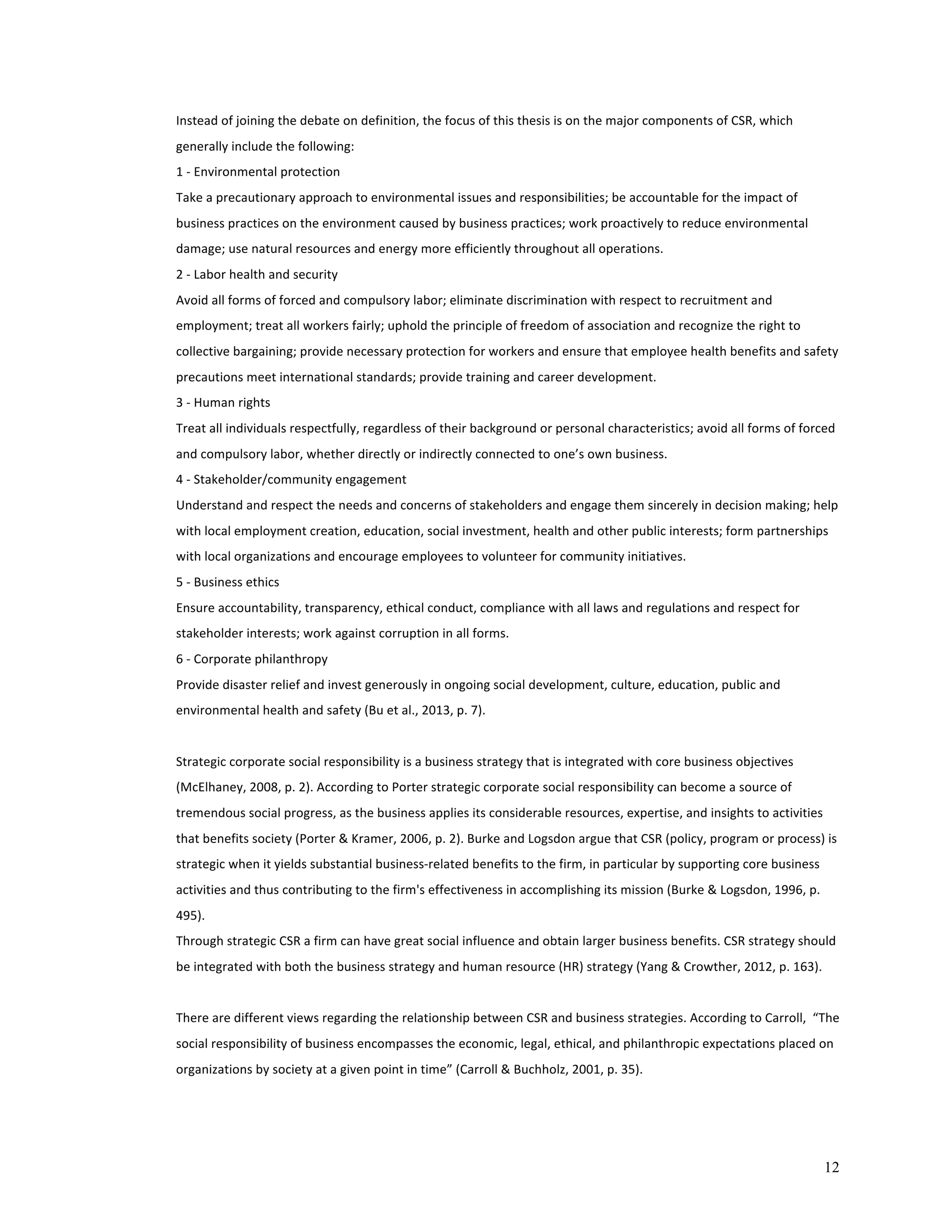
Sustainability 
is 
often 
seen 
to 
be 
about 
the 
triple 
bottom 
line 
of 
economy, 
environment, 
and 
society. 
But 
the 
triple 
bottom 
line 
is 
purely 
a 
way 
of 
measuring 
performance 
and 
just 
the 
first 
of 
the 
three 
dimensions 
in 
Figure 
1. 
The 
second 
involves 
its 
relational 
nature 
— 
its 
focus 
on 
those 
‘primary’ 
stakeholders 
who 
bear 
risk 
through 
having 
invested 
something 
of 
value 
in 
the 
organization. 
These 
stakeholders 
are 
an 
organization’s 
eyes 
and 
ears 
to 
the 
dynamic 
business 
environment; 
they 
decide 
its 
future, 
and 
they 
determine 
its 
reputation. 
The 
third 
dimension 
is 
responsibilities, 
the 
most 
fundamental 
being 
economic: 
If 
organizations 
do 
not 
make 
a 
profit 
they 
will 
not 
survive, 
nor 
be 
able 
to 
contribute 
to 
the 
sustainability 
of 
their 
community 
or 
the 
environment 
(Stapledon, 
2012, 
p. 
11). 
Figure 
1 
Conceptual 
model 
(Green, 
2007, 
p. 
1) 
1.3.3 
Data 
collection 
method 
and 
data 
analysis 
According 
to 
Yin, 
case 
study 
research 
is 
not 
limited 
to 
a 
single 
source 
of 
data, 
as 
in 
the 
use 
of 
questionnaires 
to 
carry 
out 
a 
survey 
study. 
In 
fact, 
good 
case 
studies 
benefit 
from 
having 
multiple 
sources 
of 
evidence 
(Yin, 
2003, 
p. 
9).
10 
The 
researcher 
of 
this 
thesis, 
who 
lives 
in 
Asia, 
has 
25 
years 
of 
experience 
in 
business-­‐to-­‐business 
sales 
and 
marketing 
in 
the 
technology 
sector 
with 
experience 
in 
Europe, 
the 
US 
and 
Asia. 
While 
the 
researcher 
lived 
in 
Singapore, 
India 
and 
Australia 
the 
importance 
of 
the 
Chinese 
market 
and 
its 
challenges 
came 
into 
focus. 
Over 
the 
last 
few 
years 
the 
researcher 
followed 
Starbucks 
in 
China 
and 
built 
up 
contacts 
within 
the 
company 
through 
LinkedIn. 
During 
the 
research 
for 
this 
thesis 
the 
researcher 
lived 
in 
China 
for 
two 
months 
and 
observed 
several 
Starbucks 
outlets 
in 
the 
Yunnan 
province. 
For 
the 
data 
collection, 
documentation, 
interviews, 
and 
direct 
observation 
at 
Starbucks 
outlets 
in 
China 
are 
used, 
as 
well 
as 
secondary 
data 
in 
the 
form 
of 
annual 
reports, 
web 
pages, 
case 
studies, 
journals 
and 
literature 
reviews. 
The 
interviews 
were 
collected 
from 
several 
sources, 
including 
periodicals, 
YouTube 
and 
the 
Starbucks 
website. 
The 
data 
is 
analyzed 
in 
order 
to 
answer 
the 
research 
questions.
11 
2. 
Theoretical 
framework 
The 
theoretical 
framework 
refers 
to 
the 
theories 
being 
used 
as 
a 
basis 
for 
the 
study 
that 
are 
drawn 
from 
scholarly 
literature; 
it 
contains 
the 
major 
ideas 
of 
authors, 
theorist, 
experts 
and 
specialists. 
The 
main 
topics 
of 
this 
theoretical 
framework 
are 
CSR 
and 
business 
strategy, 
CSR 
in 
China, 
Chinese 
economy, 
Chinese 
society, 
Chinese 
culture, 
Chinese 
government, 
guanxi, 
mianxi, 
the 
Chinese 
coffee 
market, 
international 
culture, 
models 
for 
analyses 
– 
the 
EFQM 
Model 
with 
CSR, 
Value 
Chain, 
and 
the 
Diamond 
Framework. 
These 
theories 
represent 
the 
basis 
of 
the 
research. 
2.1 
Corporate 
Social 
Responsibility 
and 
business 
strategy 
Since 
the 
concept 
of 
CSR 
was 
created, 
there 
has 
never 
been 
a 
clear, 
widely 
accepted 
definition 
of 
the 
term 
(Bu, 
Bloomfield, 
& 
An, 
2013, 
p. 
7). 
Adam 
Smith’s 
concept 
of 
self-­‐interest 
is 
still 
the 
driving 
force 
of 
post-­‐modern 
society, 
but 
sustainable 
progress 
will 
only 
occur 
when 
this 
self-­‐interest 
is 
enriched 
with 
sufficient 
ethical, 
social 
and 
environmental 
elements 
(Harjono 
& 
Marrewijk, 
2001, 
p. 
3). 
For 
Carroll 
the 
total 
social 
responsibility 
of 
business 
entails 
the 
simultaneous 
fulfillment 
of 
the 
firm’s 
economic, 
legal, 
ethical, 
and 
philanthropic 
responsibilities 
(Carroll 
& 
Buchholz, 
2001, 
p. 
36). 
The 
World 
Business 
Council 
for 
Sustainable 
Development 
defines 
CSR 
as 
follows: 
"Corporate 
Social 
Responsibility 
is 
the 
continuing 
commitment 
by 
business 
to 
behave 
ethically 
and 
contribute 
to 
economic 
development 
while 
improving 
the 
quality 
of 
life 
of 
the 
workforce 
and 
their 
families 
as 
well 
as 
of 
the 
local 
community 
and 
society 
at 
large" 
("wbcsd 
CSR," 
2013, 
p. 
1). 
Turker 
describes 
CSR 
as 
“corporate 
behaviors 
that 
aim 
to 
affect 
stakeholders 
positively 
and 
that 
go 
beyond 
its 
economic 
interest” 
(Turker, 
2009, 
p. 
413). 
According 
to 
her, 
a 
company 
has 
four 
stakeholders 
or 
interest 
groups. 
The 
first 
consists 
of 
society 
at 
large, 
the 
environment, 
the 
next 
generations, 
and 
NGOs. 
The 
second 
comprises 
the 
employees, 
for 
whom 
CSR 
policy 
is 
manifested 
in 
fairness 
and 
transparency 
in 
respect 
to 
the 
decisions 
that 
directly 
affect 
them. 
The 
third 
are 
the 
customers, 
for 
whom 
CSR 
is 
measured 
by 
fairness 
and 
transparency 
with 
regard 
to 
pricing, 
product 
quality, 
etc. 
The 
final 
interest 
group 
is 
the 
government, 
for 
which 
CSR 
is 
manifested, 
for 
example, 
in 
paying 
taxes 
and 
obeying 
the 
law 
(Turker, 
2009, 
p. 
413). 
A 
positive 
relationship 
has 
been 
found 
between 
CSR 
policies 
and 
organizational 
commitment 
among 
current 
employees 
leading 
to 
a 
rise 
in 
employee 
performance 
(Brammer, 
Millington, 
& 
Rayton, 
2005, 
p. 
21), 
(Turker, 
2009, 
p. 
200). 
Supply 
chain 
sustainability 
is 
increasingly 
recognized 
as 
a 
key 
component 
of 
corporate 
responsibility. 
Managing 
the 
social, 
environmental 
and 
economic 
impacts 
of 
supply 
chain 
makes 
good 
business 
sense 
(Sisco, 
Chorn, 
& 
Pruzan-­‐ 
Jorgensen, 
2010, 
p. 
5). 
The 
term 
Purchasing 
Social 
Responsibility 
(PSR) 
refers 
to 
the 
organizations‟ 
efforts 
on 
environmental 
purchasing, 
sourcing 
from 
minority-­‐owned 
suppliers, 
and 
human 
rights, 
safety, 
and 
philanthropy 
issues 
relating 
to 
supply 
management 
(Carter 
& 
Jennings, 
2002, 
p. 
40). 
The 
purchasing 
function 
plays 
a 
key 
role 
in 
a 
firm’s 
logistics 
operations 
and 
PSR 
has 
a 
direct 
and 
positive 
impact 
on 
supplier 
performance 
(Carter 
& 
Jennings, 
2002, 
p. 
38).
Instead 
of 
joining 
the 
debate 
on 
definition, 
the 
focus 
of 
this 
thesis 
is 
on 
the 
major 
components 
of 
CSR, 
which 
generally 
include 
the 
following: 
1 
-­‐ 
Environmental 
protection 
Take 
a 
precautionary 
approach 
to 
environmental 
issues 
and 
responsibilities; 
be 
accountable 
for 
the 
impact 
of 
business 
practices 
on 
the 
environment 
caused 
by 
business 
practices; 
work 
proactively 
to 
reduce 
environmental 
damage; 
use 
natural 
resources 
and 
energy 
more 
efficiently 
throughout 
all 
operations. 
2 
-­‐ 
Labor 
health 
and 
security 
Avoid 
all 
forms 
of 
forced 
and 
compulsory 
labor; 
eliminate 
discrimination 
with 
respect 
to 
recruitment 
and 
employment; 
treat 
all 
workers 
fairly; 
uphold 
the 
principle 
of 
freedom 
of 
association 
and 
recognize 
the 
right 
to 
collective 
bargaining; 
provide 
necessary 
protection 
for 
workers 
and 
ensure 
that 
employee 
health 
benefits 
and 
safety 
precautions 
meet 
international 
standards; 
provide 
training 
and 
career 
development. 
3 
-­‐ 
Human 
rights 
Treat 
all 
individuals 
respectfully, 
regardless 
of 
their 
background 
or 
personal 
characteristics; 
avoid 
all 
forms 
of 
forced 
and 
compulsory 
labor, 
whether 
directly 
or 
indirectly 
connected 
to 
one’s 
own 
business. 
4 
-­‐ 
Stakeholder/community 
engagement 
Understand 
and 
respect 
the 
needs 
and 
concerns 
of 
stakeholders 
and 
engage 
them 
sincerely 
in 
decision 
making; 
help 
with 
local 
employment 
creation, 
education, 
social 
investment, 
health 
and 
other 
public 
interests; 
form 
partnerships 
with 
local 
organizations 
and 
encourage 
employees 
to 
volunteer 
for 
community 
initiatives. 
5 
-­‐ 
Business 
ethics 
Ensure 
accountability, 
transparency, 
ethical 
conduct, 
compliance 
with 
all 
laws 
and 
regulations 
and 
respect 
for 
stakeholder 
interests; 
work 
against 
corruption 
in 
all 
forms. 
6 
-­‐ 
Corporate 
philanthropy 
Provide 
disaster 
relief 
and 
invest 
generously 
in 
ongoing 
social 
development, 
culture, 
education, 
public 
and 
environmental 
health 
and 
safety 
(Bu 
et 
al., 
2013, 
p. 
7). 
Strategic 
corporate 
social 
responsibility 
is 
a 
business 
strategy 
that 
is 
integrated 
with 
core 
business 
objectives 
(McElhaney, 
2008, 
p. 
2). 
According 
to 
Porter 
strategic 
corporate 
social 
responsibility 
can 
become 
a 
source 
of 
tremendous 
social 
progress, 
as 
the 
business 
applies 
its 
considerable 
resources, 
expertise, 
and 
insights 
to 
activities 
that 
benefits 
society 
(Porter 
& 
Kramer, 
2006, 
p. 
2). 
Burke 
and 
Logsdon 
argue 
that 
CSR 
(policy, 
program 
or 
process) 
is 
strategic 
when 
it 
yields 
substantial 
business-­‐related 
benefits 
to 
the 
firm, 
in 
particular 
by 
supporting 
core 
business 
activities 
and 
thus 
contributing 
to 
the 
firm's 
effectiveness 
in 
accomplishing 
its 
mission 
(Burke 
& 
Logsdon, 
1996, 
p. 
495). 
Through 
strategic 
CSR 
a 
firm 
can 
have 
great 
social 
influence 
and 
obtain 
larger 
business 
benefits. 
CSR 
strategy 
should 
be 
integrated 
with 
both 
the 
business 
strategy 
and 
human 
resource 
(HR) 
strategy 
(Yang 
& 
Crowther, 
2012, 
p. 
163). 
There 
are 
different 
views 
regarding 
the 
relationship 
between 
CSR 
and 
business 
strategies. 
According 
to 
Carroll, 
“The 
social 
responsibility 
of 
business 
encompasses 
the 
economic, 
legal, 
ethical, 
and 
philanthropic 
expectations 
placed 
on 
organizations 
by 
society 
at 
a 
given 
point 
in 
time” 
(Carroll 
& 
Buchholz, 
2001, 
p. 
35). 
12
13 
In 
her 
book, 
Just 
Good 
Business, 
McElhaney 
defines 
strategic 
corporate 
social 
responsibility 
as, 
“a 
Business 
Strategy 
that 
is 
integrated 
with 
core 
business 
objectives 
and 
core 
competencies 
of 
the 
firm 
and 
from 
the 
outset 
is 
designed 
to 
create 
business 
value 
and 
positive 
social 
change, 
and 
is 
embedded 
in 
day-­‐to-­‐day 
business 
culture 
and 
operations” 
(McElhaney, 
2008, 
p. 
5). 
CSR 
can 
help 
companies 
build 
customer 
loyalty, 
recruit 
and 
retain 
employees, 
and 
stand 
out 
in 
a 
crowded 
marketplace. 
But 
to 
be 
most 
effective 
CSR 
must 
be 
intimately 
connected 
to 
the 
corporate 
brand—it 
must 
reinforce 
a 
company’s 
unique 
identity, 
and 
be 
an 
integral 
part 
of 
how 
a 
company 
tells 
its 
story. 
CSR 
can 
help 
firms 
differentiate 
their 
brand 
in 
order 
to 
stand 
out 
when 
the 
price, 
quality, 
and 
convenience 
of 
their 
product 
is 
relatively 
equal 
to 
that 
of 
competitors. 
This 
positive 
impact 
creates 
a 
competitive 
advantage 
for 
these 
firms, 
both 
when 
markets 
are 
up 
and 
when 
they 
are 
down 
(McElhaney, 
2008, 
Chapter 
1). 
There 
are 
several 
reasons 
for 
considering 
CSR 
in 
developing 
countries 
when 
compared 
with 
developed 
countries, 
and 
these 
reasons 
are 
as 
follows: 
-­‐ 
Developing 
countries 
have 
the 
most 
profitable 
growth 
markets 
for 
business 
because 
the 
developing 
countries 
represent 
rapidly 
expanding 
economics. 
-­‐ 
Actually, 
social 
and 
environmental 
crises 
will 
give 
more 
influence 
to 
developing 
countries 
in 
the 
world. 
-­‐ 
Developing 
countries 
face 
a 
different 
series 
of 
CSR 
challenges 
and 
characteristics 
that 
are 
quite 
different 
from 
developed 
countries 
(Yang 
& 
Crowther, 
2012, 
p. 
157). 
Matten 
and 
Moon 
propose 
that 
differences 
in 
CSR 
among 
different 
countries 
are 
due 
to 
a 
variety 
of 
longstanding, 
historically 
entrenched 
institutions 
(Matten 
& 
Moon, 
2008, 
p. 
406). 
2.1.1 
Green 
washing 
Green 
washing 
is 
a 
compound 
word 
modeled 
on 
"whitewash", 
a 
form 
of 
spin 
in 
which 
green 
PR 
or 
green 
marketing 
is 
deceptively 
used 
to 
promote 
the 
perception 
that 
a 
company’s 
policies 
or 
products 
are 
environmentally 
friendly 
(MacDonald, 
2008, 
p. 
89). 
It 
is 
the 
overstating 
of 
the 
environmentally 
or 
socially 
conscious 
attributes 
of 
a 
firm’s 
offering 
and 
the 
understating 
of 
the 
negative 
attributes 
for 
the 
firm’s 
benefit 
("ft 
lexicon," 
2014, 
p. 
1). 
J. 
In 
recent 
years, 
there 
has 
been 
an 
expanding 
critique 
of 
several 
big 
NGOs. 
Corporate 
executives 
occupy 
the 
donor 
rolls 
and 
boards 
of 
many 
green 
non-­‐profits. 
Davis 
wrote 
in 
the 
Journal 
of 
Business 
Ethics 
that 
green 
washing 
is 
wrong 
because: 
1. 
Most 
obviously, 
green 
washing 
is 
misleading. 
2. 
Green 
washing 
could 
result 
in 
consumer 
and 
regulator 
complacency. 
If 
one 
corporation 
gets 
away 
with 
green 
washing, 
other 
corporations 
will 
follow 
suit, 
thereby 
creating 
an 
industry-­‐wide 
illusion 
of 
environmental 
sustainability, 
rather 
than 
sustainability 
itself. 
This 
creation 
of 
the 
illusion 
of 
environmental 
sustainability 
could 
have 
dire 
social 
consequences 
as 
consumers 
will 
continue 
to 
use 
products 
and 
support 
companies 
that 
further 
environmental 
degradation 
and 
reduce 
the 
quality 
of 
living 
conditions 
for 
future 
generations.
3. 
Green 
washing 
may 
also 
engender 
cynicism: 
if 
consumers 
come 
to 
expect 
self-­‐congratulatory 
ads 
from 
even 
the 
most 
environmentally 
backward 
corporations, 
this 
could 
render 
consumers 
skeptical 
of 
even 
sincere 
portrayals 
of 
legitimate 
corporate 
environmental 
successes. 
Thus 
well-­‐meaning 
companies, 
companies 
committed 
to 
responsible 
behavior 
with 
regard 
to 
the 
environment, 
have 
every 
reason 
to 
be 
critical 
of 
companies 
that 
green 
wash 
(Davis, 
1992, 
p. 
81-­‐87). 
2.2 
CSR 
in 
China 
While 
CSR 
is 
relatively 
new 
in 
China, 
it 
has 
developed 
quickly 
(Bu 
et 
al., 
2013, 
p. 
5). 
Seriously 
contaminated 
food, 
water 
and 
air, 
with 
consequent 
damage 
to 
public 
health 
and 
the 
environment, 
have 
led 
to 
rising 
social 
unrest 
and 
political 
action 
(Bu 
et 
al., 
2013, 
p. 
6). 
Both 
the 
Chinese 
government 
and 
the 
public 
increasingly 
demand 
that 
businesses 
improve 
their 
performance 
regarding 
public 
health, 
environmental 
protection, 
worker 
safety 
and 
social 
development 
(Bu 
et 
al., 
2013, 
p. 
5). 
CSR 
is 
a 
rapidly 
emerging 
concept 
in 
China. 
Along 
with 
modernization 
and 
rapid 
economic 
growth 
over 
the 
past 
20 
years, 
companies 
in 
China 
are 
gradually 
shifting 
away 
from 
focusing 
entirely 
on 
profit 
maximization, 
in 
favor 
of 
more 
attention 
on 
business 
ethics 
and 
meeting 
their 
responsibilities 
for 
addressing 
social 
and 
environmental 
issues. 
The 
principles 
of 
CSR 
and 
rising 
public 
expectations 
encourage 
companies 
to 
go 
beyond 
the 
minimum 
requirements 
regarding 
product 
safety, 
environmental 
protection, 
labor 
rights, 
and 
community 
development 
imposed 
by 
the 
government. 
It 
also 
requires 
companies 
to 
respect 
all 
stakeholders, 
including 
employees, 
consumers, 
local 
communities 
and 
suppliers, 
and 
to 
incorporate 
these 
expectations 
into 
the 
company’s 
business 
model 
(Bu 
et 
al., 
2013, 
p. 
18). 
The 
2013 
“Cone 
Communications/Echo 
Global 
CSR 
Study” 
presents 
the 
findings 
of 
an 
online 
survey 
conducted 
between 
February 
7-­‐28, 
2013 
by 
Echo 
Research 
among 
a 
demographically 
representative 
sample 
of 
10,287 
adults, 
comprising 
5,127 
men 
and 
5,160 
women 
18 
years 
of 
age 
and 
older. 
The 
global 
breakdown 
of 
the 
study 
reveals 
that 
CSR 
is 
a 
near-­‐universal 
mindset 
in 
China, 
where 
consumers 
consider 
social 
and 
environmental 
issues 
in 
major 
decisions, 
including 
where 
to 
work 
(80%) 
and 
what 
to 
buy 
or 
where 
to 
shop 
(83%). 
On 
all 
fronts, 
Chinese 
citizens 
are 
substantially 
more 
likely 
than 
their 
global 
peers 
to 
have 
engaged 
in 
companies’ 
CSR 
initiatives 
in 
the 
past 
12 
months, 
from 
buying 
products 
with 
a 
societal 
benefit 
(86% 
vs. 
67% 
globally) 
and 
making 
donations 
(69% 
vs. 
60% 
globally), 
to 
volunteering 
(45% 
vs. 
37% 
globally) 
and 
telling 
friends 
and 
family 
about 
corporate 
efforts 
(75% 
vs. 
50% 
globally) 
(Cone 
Communication, 
2013, 
p. 
53). 
Conversely, 
belief 
in 
the 
power 
of 
individuals 
to 
play 
a 
meaningful 
role 
through 
their 
purchases 
is 
the 
lowest 
among 
countries 
studied; 
only 
11 
percent 
feel 
they 
can 
have 
significant 
impact 
versus 
27 
percent 
globally. 
Brian 
Chi-­‐kuen 
Ho, 
China 
Council 
of 
CSR 
Executives, 
says 
that 
although 
the 
Chinese 
seem 
to 
feel 
comfortable 
serving 
as 
corporate 
watchdogs, 
their 
sense 
of 
personal 
responsibility 
is 
less 
ardent. 
“People 
feel 
responsible 
for 
encouraging 
change, 
but 
they 
don’t 
think 
their 
own 
actions 
can 
make 
those 
changes. 
They 
believe 
companies 
created 
the 
problems, 
and 
therefore, 
companies 
should 
solve 
them.” 
14
The 
government, 
Ho 
says, 
also 
takes 
a 
great 
interest 
in 
CSR, 
viewing 
it 
as 
an 
important 
concept 
for 
societal 
harmony. 
“Companies 
must 
publish 
corporate 
responsibility 
reports, 
and 
state-­‐owned 
enterprises 
must 
follow 
guidelines 
on 
both 
operations 
and 
community 
involvement,” 
he 
notes 
(Cone 
Communication, 
2013, 
p. 
51). 
15 
The 
concept 
of 
trust 
is 
an 
effective 
business 
strategy 
(Shurtleff, 
1998, 
p. 
4). 
According 
to 
the 
2013 
Edelman 
Trust 
Barometer, 
of 
the 
four 
institutions: 
NGOs, 
media, 
government 
and 
business; 
trust 
in 
NGOs 
remain 
high. 
In 
China, 
where 
only 
five 
years 
ago 
trust 
in 
NGOs 
was 
48 
percent; 
today 
it 
is 
81 
percent 
(Edelman, 
2013, 
p. 
4). 
Based 
on 
the 
most 
recent 
Edelman 
Trust 
Barometer 
findings, 
there 
are 
five 
elements 
that 
must 
be 
addressed 
if 
CSR 
& 
Sustainability 
is 
to 
help 
a 
business 
build 
trust. 
While 
the 
principles 
apply 
globally, 
there 
are 
some 
nuances 
to 
consider 
in 
the 
APAC 
region: 
Clarity 
The 
first 
step 
is 
to 
ensure 
that 
CSR 
& 
Sustainability 
have 
a 
clear 
purpose 
in 
the 
context 
of 
the 
company’s 
business 
objectives. 
Once 
the 
purpose 
is 
determined, 
setting 
a 
strategy 
with 
clearly 
defined 
targets 
across 
functions 
will 
help 
to 
ensure 
that 
activities 
are 
included 
in 
core 
operations 
and 
decisions 
can 
be 
made 
when 
tradeoffs 
are 
encountered. 
Relevance 
Listening 
to 
customers, 
employees, 
and 
other 
stakeholders 
and 
taking 
into 
consideration 
these 
outside 
views 
is 
a 
fundamental 
attribute 
of 
building 
trust 
in 
APAC. 
In 
the 
context 
of 
CSR 
& 
Sustainability, 
this 
means 
understanding 
which 
societal 
issues 
are 
relevant 
and 
to 
what 
degree 
the 
business 
is 
expected 
to 
address 
them. 
Integration 
Stakeholder 
engagement 
is 
the 
foundation 
of 
any 
CSR 
& 
Sustainability 
practice. 
Integrating 
CSR 
& 
Sustainability 
into 
the 
operations 
of 
the 
business 
requires 
significant 
internal 
engagement 
with 
employees 
across 
functions, 
levels 
and 
geographies. 
Transparency 
In 
APAC, 
business 
has 
a 
tendency 
to 
shy 
away 
from 
communicating 
about 
its 
social 
and 
environmental 
performance. 
There 
are 
a 
couple 
of 
reasons 
for 
this. 
One 
reason 
is 
that 
business 
in 
this 
region 
has 
not 
traditionally 
been 
expected 
to 
communicate 
about 
these 
issues. 
Another 
reason 
is 
corporate 
culture. 
Culture 
that 
has 
been 
nurtured 
for 
decades 
around 
“being 
humble” 
when 
it 
comes 
to 
social 
contributions 
has 
created 
internal 
communications 
barriers 
that 
impede 
business 
from 
informing 
stakeholders 
of 
this 
performance 
area. 
This 
is 
particularly 
distinct 
in 
the 
APAC 
region. 
Maintaining 
corporate 
culture 
is 
important, 
of 
course, 
but 
the 
tension 
between 
communications 
expectations 
and 
culture 
must 
be 
addressed 
if 
trust 
is 
to 
be 
established. 
Credibility 
Business 
is 
not 
expected 
to 
address 
the 
issues 
alone. 
Partnering 
with 
NGOs 
in 
the 
APAC 
region 
brings 
credibility 
to 
CSR 
& 
Sustainability 
investments, 
particularly 
if 
the 
NGO 
partner 
becomes 
an 
advocate 
for 
the 
company. 
To 
derive
the 
most 
value 
from 
NGO 
partnerships, 
business 
should 
learn 
from 
the 
NGO’s 
expertise 
to 
improve 
specific 
societal 
impacts 
of 
their 
business. 
Finding 
mutual 
ground 
at 
the 
outset 
of 
the 
partnership 
is 
key 
("Global 
practices," 
2014, 
p. 
1). 
16 
Critics 
argue 
that 
companies 
partner 
with 
NGOs 
in 
order 
to 
enhance 
their 
reputation 
and 
CSR 
is 
primarily 
about 
projecting 
a 
suitable 
image 
in 
order 
to 
placate 
critics 
and 
ensure 
‘business 
as 
usual’ 
(Hamann 
& 
Kapelus, 
2004, 
p. 
86). 
2.3 
Chinese 
economy 
China 
experienced 
remarkable 
economic 
growth. 
In 
terms 
of 
GDP 
numbers, 
its 
progress 
in 
reducing 
extreme 
poverty 
is 
impressive. 
In 
1999, 
the 
World 
Bank 
raised 
China’s 
classification 
from 
a 
“low 
income” 
to 
a 
“lower 
middle-­‐income” 
country 
based 
on 
its 
rise 
in 
income 
per 
capita 
(Wen, 
2005, 
p. 
8). 
According 
to 
the 
McKinsey 
Quarterly, 
the 
explosive 
growth 
of 
China’s 
emerging 
middle 
class 
has 
brought 
sweeping 
economic 
change 
and 
social 
transformation—and 
it’s 
not 
over 
yet. 
By 
2022, 
McKinsey’s 
research 
suggests, 
more 
than 
75 
percent 
of 
China’s 
urban 
consumers 
will 
earn 
60,000 
to 
229,000 
renminbi 
($9,000 
to 
$34,000) 
annually 
(Barton, 
Chen, 
& 
Jin, 
2013, 
p. 
1). 
In 
purchasing-­‐power-­‐parity 
terms, 
that 
is 
equivalent 
to 
range 
between 
the 
average 
income 
of 
Brazil 
and 
Italy. 
To 
put 
this 
in 
perspective, 
only 
4 
percent 
of 
urban 
Chinese 
households 
attained 
this 
income 
in 
the 
year 
2000 
– 
while 
by 
2012, 
68 
percent 
did. 
In 
the 
decade 
ahead, 
the 
middle 
class’s 
continued 
expansion 
will 
be 
powered 
by 
labor-­‐market 
and 
policy 
initiatives 
that 
push 
wages 
up, 
financial 
reforms 
that 
stimulate 
employment 
and 
income 
growth, 
and 
the 
rising 
role 
of 
private 
enterprise, 
which 
should 
encourage 
productivity 
and 
increase 
household 
income. 
Should 
all 
this 
play 
out 
as 
expected, 
urban-­‐household 
income 
will 
at 
least 
double 
by 
2022. 
Beneath 
the 
topline, 
figures 
are 
significant 
shifts 
in 
consumption 
dynamics, 
which 
have 
been 
tracked 
since 
2005 
using 
a 
combination 
of 
questionnaires 
and 
in-­‐depth 
interviews 
to 
create 
a 
detailed 
consumer 
portrait 
by 
income 
level, 
age 
profile, 
geographic 
location, 
and 
shopping 
behavior. 
McKinsey’s 
latest 
research 
suggests 
that 
within 
the 
burgeoning 
Chinese 
middle 
class, 
the 
upper 
middle 
class 
is 
poised 
to 
become 
the 
principal 
engine 
of 
consumer 
spending 
over 
the 
next 
decade 
(Barton 
et 
al., 
2013, 
p. 
1). 
The 
magnitude 
of 
China’s 
middle-­‐class 
growth 
is 
transforming 
the 
nation.
17 
Figure 
2 
China's 
middle 
class 
growth 
(Barton, 
Chen, 
& 
Jin, 
2013, 
p. 
1) 
However, 
official 
figures 
on 
exports 
and 
investments 
do 
not 
give 
a 
complete 
picture 
of 
the 
experience 
of 
the 
Chinese 
people 
during 
this 
period 
of 
rapid 
social 
and 
economic 
change. 
The 
free 
market 
reforms 
have 
affected 
broader 
quality 
of 
life 
indicators 
such 
as 
inequality, 
natural 
resources 
and 
environment, 
health 
and 
education 
as 
well 
as 
jobs 
and 
poverty 
(Wen, 
2005, 
p. 
2). 
Rapid 
industrialization 
is 
producing 
massive 
environmental 
devastation. 
China 
is 
the 
world’s 
second 
largest 
greenhouse 
gas 
emitter 
(the 
US 
is 
first). 
About 
60 
percent 
of 
China’s 
major 
rivers 
are 
classified 
as 
being 
unsuitable 
for 
human 
contact. 
Seven 
of 
the 
ten 
most 
polluted 
cities 
in 
the 
world 
are 
located 
in 
China 
(Wen, 
2005, 
p. 
3). 
The 
state 
of 
the 
ecology 
is 
one 
of 
the 
most 
critical 
factors 
that 
will 
determine 
China’s 
future 
(Wen, 
2005, 
p. 
10). 
Chinese 
companies 
did 
not 
develop 
a 
sense 
of 
responsibility 
in 
the 
course 
of 
making 
profits. 
Some 
Chinese 
scholars 
argue 
that 
the 
rampage 
of 
corporate 
irresponsibility 
in 
China 
has 
a 
root 
in 
the 
political 
ambience 
in 
the 
initial 
stage 
of 
economic 
development 
(Li-­‐Wen, 
2010, 
p. 
27). 
As 
global 
corporations 
have 
been 
firmly 
established 
in 
China, 
the 
ethical 
and 
social 
dimensions 
of 
their 
business 
practices 
have 
become 
a 
center 
of 
debate 
and 
controversy 
(Tang 
& 
Li, 
2009, 
p. 
199). 
The 
concept 
of 
CSR 
finds 
its 
philosophical 
root 
in 
the 
traditional 
western 
concepts 
of 
democracy, 
citizenship, 
and 
liberty 
that 
dated 
back 
to 
ancient 
thinkers 
such 
as 
Aristotle 
and 
Cicero 
(Tang 
& 
Li, 
2009, 
p. 
203). 
CSR 
practices 
in 
Asia 
should 
be 
understood 
through 
the 
lens 
of 
Confucianism, 
which 
centers 
social 
relations 
on 
bonds 
of 
family 
and 
friendship 
and 
respect 
for 
seniors 
(Tang 
& 
Li, 
2009, 
p. 
210). 
Li-­‐Wen 
argues 
that 
China 
has 
historical 
foundations 
and 
many 
real 
incentives 
to 
develop 
CSR, 
but 
meanwhile 
there 
are 
many 
political, 
social 
and 
economic 
constraints 
that 
do 
not 
allow 
CSR 
to 
develop 
at 
a 
quicker 
pace. 
The 
Chinese 
government 
plays 
an 
important 
role 
in 
developing 
the 
indigenous 
CSR 
initiatives. 
The 
government 
has 
political, 
social 
and 
economic 
motivations 
to 
encourage 
and 
also 
to 
control 
the 
development 
of 
CSR 
in 
China, 
resulting 
in
18 
uneven 
development 
of 
CSR 
issues. 
Environmental 
issues 
have 
the 
broadest 
space 
to 
develop 
while 
human 
rights 
have 
the 
most 
limited 
(Li-­‐Wen, 
2010, 
p. 
36). 
2.4 
Chinese 
society 
Community 
stakeholders 
are 
extremely 
important 
to 
companies. 
Companies 
may 
have 
positive 
impacts 
on 
their 
communities 
in 
two 
basic 
ways: 
donating 
the 
time 
and 
talents 
of 
managers 
and 
employees 
(volunteerism) 
and 
making 
financial 
contributions 
(Carroll 
& 
Buchholz, 
2001, 
p. 
432). 
Recently, 
companies 
in 
China 
are 
under 
increasing 
legal 
and 
institutional 
pressure 
from 
different 
stakeholders 
to 
be 
transparent 
about 
the 
social, 
ethical, 
and 
environmental 
dimensions 
of 
their 
business 
practices 
(Tang 
& 
Li, 
2009, 
p. 
203). 
Business 
cannot 
be 
discussed 
without 
considering 
the 
paramount 
role 
played 
by 
government. 
Although 
the 
two 
institutions 
have 
opposing 
systems 
of 
belief, 
they 
are 
intertwined 
in 
terms 
of 
their 
functioning 
in 
the 
socioeconomic 
system 
(Carroll 
& 
Buchholz, 
2001, 
p. 
236). 
The 
Chinese 
media 
have 
enthusiastically 
disclosed 
and 
condemned 
many 
foreign-­‐based 
multinational 
companies 
in 
China 
for 
their 
unsafe 
products 
or 
production 
processes, 
including 
Häagen-­‐Dazs’ 
unsanitary 
kitchens, 
Kentucky 
Fried 
Chicken's 
illegal 
use 
of 
red 
dye 
in 
food, 
Nestlé’s 
unsafe 
iodine 
in 
infant 
formula, 
to 
name 
just 
a 
few. 
The 
Research 
Center 
on 
Transnational 
Corporations 
of 
the 
Ministry 
of 
Commerce 
also 
has 
produced 
a 
series 
of 
reports 
targeting 
on 
CSR 
performance 
of 
foreign 
companies 
in 
China 
and 
advocated 
that 
foreign 
companies 
should 
undertake 
CSR 
in 
China 
(Li-­‐Wen, 
2010, 
p. 
31). 
2.5 
Chinese 
culture 
Culture 
has 
been 
defined 
in 
many 
ways; 
Hofstede’s 
shorthand 
definition 
is: 
"Culture 
is 
the 
collective 
programming 
of 
the 
mind 
that 
distinguishes 
the 
members 
of 
one 
group 
or 
category 
of 
people 
from 
others" 
(Hofstede, 
2011, 
p. 
3). 
Cultural 
differences 
in 
ethical 
decision-­‐making 
are 
most 
often 
discussed 
within 
the 
framework 
of 
Hofstede’s 
typology, 
which 
includes 
individualism/collectivism, 
uncertainty 
avoidance, 
power 
distance, 
masculinity/femininity, 
and 
Confucian 
dynamism. 
China 
is 
a 
very 
long-­‐term 
oriented 
society 
in 
which 
persistence 
and 
perseverance 
are 
normal. 
Relationships 
are 
ordered 
by 
status 
and 
the 
order 
is 
observed. 
Nice 
people 
are 
thrifty 
and 
sparing 
with 
resources 
and 
investment 
tends 
to 
be 
in 
long-­‐term 
projects 
such 
as 
real 
estate. 
Traditions 
can 
be 
adapted 
to 
suit 
new 
conditions 
(Hofstede, 
n.d., 
p. 
1). 
Recent 
development 
shows 
that 
China 
might 
be 
one 
of 
those 
rare 
cases, 
where 
after 
a 
period 
of 
relative 
isolation, 
decades 
of 
unparalleled 
double-­‐digit 
economic 
development 
concurrent 
with 
rapid 
global 
exposure 
and 
integration 
may 
be 
bringing 
about 
shifts, 
especially 
in 
the 
younger 
generation 
(Hofstede, 
2011, 
p. 
22). 
Understanding 
a 
culture 
is 
vital 
to 
the 
business 
success 
in 
emerging 
markets 
such 
as 
China, 
therefore, 
this 
thesis 
reviews 
the 
pertinent 
aspects 
of 
Chinese 
cultural 
dimensions. 
It 
discusses 
the 
Chinese 
government 
and 
the 
Mianzi 
and 
the 
Guanxi 
theories. 
2.6 
Chinese 
government. 
The 
development 
of 
CSR 
in 
China 
has 
been 
strongly 
influenced, 
even 
dominated, 
by 
the 
Chinese 
government, 
a 
key 
driver 
for 
CSR 
development 
(Bu, 
Bloomfield, 
& 
An, 
2013, 
p. 
54).
Building 
a 
resource 
saving 
and 
environmentally 
friendly 
society 
is 
one 
of 
the 
Chinese 
government’s 
top 
priorities 
during 
the 
current 
12th 
five-­‐year 
period. 
To 
achieve 
this, 
a 
large 
range 
of 
issues 
have 
been 
raised, 
including 
the 
necessity 
for 
proactively 
addressing 
climate 
change, 
resource 
conservation 
and 
management, 
developing 
a 
circular 
economy, 
promoting 
ecological 
protection 
and 
restoration, 
improving 
water 
resources, 
and 
heightening 
disaster 
prevention 
and 
mitigation 
systems. 
Developing 
a 
skilled 
population 
is 
also 
of 
great 
significance 
to 
China. 
MNCs 
can 
respond 
to 
this 
objective 
through 
personnel 
(occupational) 
training 
and 
investment 
in 
education 
through 
philanthropic 
programs. 
China 
is 
working 
to 
promote 
community 
self-­‐governance 
as 
well 
as 
improving 
the 
mechanisms 
for 
safeguarding 
people’s 
right 
(Bu 
et 
al., 
2013, 
p. 
54) 
2.7 
Guanxi. 
The 
term 
Guanxi 
refers 
to 
a 
person’s 
connections; 
in 
particular, 
to 
people 
in 
influential 
or 
higher 
positions 
who 
may 
be 
willing 
to 
perform 
favors 
for 
you, 
with 
the 
understanding 
that 
these 
favors 
will 
undoubtedly 
be 
reciprocated 
sometime 
in 
the 
future. 
2.8 
Mianzi. 
Meaning 
“face”, 
“Mian 
Zi” 
represents 
a 
person’s 
reputation 
and 
feelings 
of 
prestige 
(both 
real 
and 
imagined) 
within 
their 
family 
unit 
and 
among 
friends, 
at 
their 
workplace 
and 
in 
society. 
The 
concept 
of 
“face” 
is 
be 
more 
deeply 
understood 
if 
one 
recalls 
that 
China 
has 
traditionally 
been 
(and 
continues 
to 
be) 
a 
highly 
hierarchical 
society. 
The 
position 
a 
Chinese 
person 
occupies 
relative 
to 
others 
is 
typically 
thought 
to 
command 
a 
certain 
degree 
of 
respect 
and 
requires 
certain 
types 
of 
behavior 
(Upton-­‐McLaughlin, 
2013, 
p. 
1). 
2.9 
The 
Chinese 
coffee 
market 
The 
Chinese 
consumer 
market 
for 
coffee 
is 
still 
in 
the 
early 
stages 
of 
maturation. 
The 
retail 
sales 
volume 
of 
coffee 
in 
China 
was 
slightly 
more 
than 
30,000 
tons 
in 
2009. 
This 
translates 
to 
just 
over 
0.02 
kg 
per 
capita 
per 
year. 
It 
is 
China’s 
growing 
urban 
population 
of 
600 
million 
people 
that 
accounts 
for 
an 
estimated 
90% 
of 
coffee 
consumption 
in 
the 
country. 
This 
would 
place 
annual 
per 
capita 
consumption 
by 
the 
target 
consumer 
market 
at 
around 
0.05 
kg 
(International 
Trade 
center 
[ITC], 
2010, 
p. 
8). 
For 
comparison, 
figure 
3 
shows 
the 
coffee 
consumption 
in 
other 
countries. 
19
20 
Figure 
3 
Per 
capita 
coffee 
consumption 
in 
selected 
countries 
(ITC, 
2010, 
p. 
8) 
China's 
consumer 
coffee 
market 
offers 
boundless 
potential. 
Today's 
low 
coffee 
consumption 
at 
about 
5 
cups 
per 
capita 
per 
year 
provides 
robust 
growth 
opportunities. 
The 
drivers 
for 
that 
growth 
are 
the 
rising 
population 
and 
urbanization, 
rising 
disposable 
income, 
and 
the 
changing 
lifestyle. 
China, 
previously 
viewed 
as 
only 
a 
low-­‐cost 
manufacturing 
supply 
center, 
now 
offers 
new 
market 
opportunities 
with 
its 
growing 
middle 
class 
and 
a 
thirst 
for 
Western 
products 
(Chao, 
2012, 
p. 
2). 
Little 
known 
is 
the 
fact 
that 
coffee 
is 
actually 
grown 
in 
China. 
It 
is 
predominantly 
low-­‐quality 
Arabica, 
which 
is 
grown 
in 
full 
sun 
using 
high 
chemical 
inputs 
and 
processed 
into 
instant 
coffee. 
The 
Chinese 
government 
is 
clearly 
interested 
in 
boosting 
this 
market 
crop; 
it 
is 
aggressively 
promoting 
the 
expansion 
of 
coffee 
production 
into 
thousands 
of 
hectares 
of 
land 
(Craves, 
2010). 
The 
economic 
impetus 
is 
clear. 
A 
family 
with 
a 
hectare 
of 
coffee 
can 
earn 
more 
than 
$10,000 
a 
year, 
triple 
the 
amount 
for 
tea, 
and 
five 
times 
more 
than 
for 
maize 
or 
rice. 
Nestlé, 
along 
with 
the 
Chinese 
government 
and 
the 
United 
Nations’ 
Development 
Program, 
helped 
jump-­‐start 
coffee 
production 
in 
the 
area 
in 
the 
late 
1980s. 
Yunnan's 
first 
coffee 
growers, 
19th-­‐century 
European 
missionaries, 
found 
a 
suitable 
climate 
for 
their 
bitter 
juice, 
but 
little 
native 
interest 
in 
drinking 
it. 
Now 
Yunnan 
accounts 
for 
nearly 
all 
the 
coffee 
grown 
in 
China. 
Other 
buyers 
have 
followed 
Nestlé 
in 
recent 
years, 
and 
demand 
has 
outstripped 
supply 
("Coffee 
in 
China/The 
Economist," 
2012). 
Starbucks 
is 
the 
face 
of 
the 
coffee 
boom 
in 
Yunnan. 
In 
2009, 
the 
company 
rolled 
out 
its 
first 
line 
of 
coffee 
featuring 
beans 
from 
Yunnan, 
called 
“South 
of 
the 
Clouds” 
(a 
literal 
translation 
of 
the 
name 
Yunnan).
Since 
then, 
Starbucks 
has 
been 
working 
with 
local 
governments, 
firms, 
and 
the 
Yunnan 
Academy 
of 
Agricultural 
Science 
(YAAS) 
to 
expand 
its 
coffee 
production, 
increase 
quality, 
and 
improve 
sustainability. 
In 
2010, 
Starbucks 
signed 
an 
agreement 
with 
YAAS 
and 
the 
Pu’er 
city 
government 
to 
establish 
its 
first 
coffee 
bean 
farm 
in 
the 
region. 
In 
addition, 
in 
2012, 
Starbucks 
opened 
a 
coffee 
development 
center, 
a 
Farmer 
Support 
Center, 
and 
coffee 
processing 
centers. 
In 
2011, 
Starbucks 
set 
up 
a 
local 
joint-­‐venture 
with 
Ai 
Ni 
Group—an 
established 
coffee 
operator 
and 
agricultural 
company 
in 
Yunnan—to 
expand 
its 
coffee 
sourcing 
network 
in 
the 
region 
and 
more 
fully 
implement 
“best 
practice” 
coffee 
processing 
methods 
(Gibson, 
2013, 
p. 
1). 
2.10 
International 
culture 
In 
this 
thesis, 
cultural 
traditions 
that 
extend 
beyond 
national 
boundaries 
will 
be 
defined 
as 
international 
culture 
(Zhang, 
2009, 
p. 
1). 
Since 
China 
opened 
up 
to 
foreign 
investment 
in 
the 
late 
1970s, 
some 
of 
America’s 
most 
powerful 
corporations 
have 
gone 
confidently 
into 
the 
People’s 
Republic, 
only 
to 
stagger 
out 
a 
few 
years 
later, 
battered, 
confused, 
and 
defeated. 
It’s 
not 
because 
the 
businesses 
were 
incompetent. 
Many 
of 
the 
biggest 
failures 
belong 
to 
the 
Fortune 
500: 
Mattel, 
eBay, 
Google, 
Home 
Depot. 
All 
of 
these 
have 
thrived 
in 
markets 
around 
the 
world, 
but 
not 
in 
China. 
-­‐ 
Why? 
-­‐ 
“It’s 
a 
lack 
of 
understanding 
of 
the 
legal 
and 
cultural 
environment 
that 
leads 
to 
most 
failures,” 
says 
Shawn 
Mahoney, 
managing 
director 
of 
the 
EP 
China 
consulting 
group. 
“The 
only 
difference 
between 
a 
success 
and 
failure 
in 
my 
experience 
is 
that 
people 
who 
are 
successful 
are 
more 
willing 
to 
talk 
and 
learn 
about 
how 
things 
work 
on 
the 
ground” 
(Carlson, 
2013, 
p. 
1) 
Since 
China 
joined 
the 
WTO, 
in 
December 
2001, 
a 
mixture 
of 
cultural, 
economic 
and 
political 
influences 
drives 
the 
process 
of 
globalization. 
In 
China, 
globalization 
is 
a 
material 
reality. 
Global 
trends 
in 
all 
walks 
of 
life 
reflect 
that 
China, 
after 
having 
shut 
itself 
off 
from 
the 
outside 
world, 
has 
emerged 
into 
the 
world 
community 
in 
a 
deep 
and 
extensive 
manner. 
In 
the 
eyes 
of 
Chinese 
people, 
globalization 
is 
a 
new 
conception 
of 
security 
that 
can 
both 
meet 
the 
demands 
of 
modernization 
and 
help 
maintain 
stability 
and 
development 
(Zhang, 
2009). 
21 
2.11 
Models 
used 
for 
the 
analyses 
-­‐ 
The 
EFQM 
Model 
with 
CSR, 
Value 
Chain, 
and 
the 
Diamond 
Framework 
In 
this 
thesis 
the 
EFQM 
Model 
with 
CSR, 
Porters’ 
Value 
Chain 
and 
Diamond 
Framework 
are 
used 
to 
analyze 
Starbucks’ 
success 
and 
the 
role 
that 
CSR 
plays 
in 
that 
success. 
The 
EFQM 
Model 
analyzes 
Starbucks’ 
CSR 
activities, 
while 
the 
Value 
Chain 
and 
Diamond 
Framework 
are 
used 
to 
analyze 
why 
and 
how 
CSR 
improved 
Starbucks' 
performance 
and 
how 
CSR 
can 
be 
of 
strategic 
value 
for 
other 
companies 
(Porter 
& 
Kramer, 
2006) 
(Neergard 
& 
Pedersen, 
2012, 
p. 
54). 
2.11.1 
EFQM 
Model. 
The 
EFQM 
Model 
for 
Corporate 
Social 
Responsibility, 
which 
is 
based 
on 
the 
EFQM 
Excellence 
Model, 
Global 
Compact 
Principles 
and 
other 
sources, 
offers 
organizations 
a 
structured 
approach 
to 
corporate 
social 
responsibility. 
It 
is 
a 
useful 
theoretical 
model 
to 
determine 
the 
quality 
aspects 
of 
a 
firm's 
processes 
and 
delivery. 
This 
thesis 
intends 
to 
analyze 
Starbucks' 
CSR 
performance 
in 
relation 
to 
the 
EFQM 
model.
22 
2.11.2 
The 
Value 
Chain 
– 
looking 
inside-­‐out. 
The 
Value 
Chain 
depicts 
all 
the 
activities 
a 
company 
engages 
in 
while 
doing 
business, 
and 
can 
be 
used 
as 
a 
framework 
to 
identify 
the 
positive 
and 
negative 
social 
impact 
of 
those 
activities. 
The 
interdependence 
of 
a 
company 
and 
society 
can 
be 
analyzed 
with 
the 
same 
tools 
used 
to 
analyze 
competitive 
position 
and 
develop 
strategy. 
This 
model 
is 
used 
for 
'Looking 
inside-­‐out' 
(Porter 
& 
Kramer, 
2006, 
p. 
8). 
2.11.3 
Porters' 
Diamond 
Framework 
– 
looking 
outside-­‐in. 
To 
understand 
the 
social 
ramifications 
of 
the 
value 
chain, 
effective 
CSR 
requires 
an 
understanding 
of 
the 
social 
dimensions 
of 
the 
company's 
competitive 
context 
-­‐ 
the 
"outside-­‐in" 
linkage 
that 
affects 
its 
ability 
to 
improve 
productivity 
and 
execute 
strategy. 
These 
can 
be 
understood 
using 
the 
Diamond 
Framework, 
which 
shows 
how 
the 
conditions 
at 
a 
company’s 
location 
affect 
its 
ability 
to 
compete 
(Porter 
& 
Kramer, 
2006, 
p. 
9).
23 
3. 
Starbucks 
This 
chapter 
describes 
Starbucks’s 
entry 
into 
China, 
their 
CSR 
strategy, 
Starbucks 
and 
international 
culture, 
and 
the 
Starbucks 
Model. 
The 
Starbucks 
CSR 
approach 
is 
not 
without 
criticism, 
therefore 
this 
chapter 
describes 
the 
criticism 
on 
Starbucks’ 
Global 
Responsibility 
Report. 
3.1 
The 
company 
Starbucks, 
one 
of 
the 
largest 
coffee 
chains 
in 
the 
world, 
was 
started 
in 
1971 
in 
Seattle, 
USA. 
The 
company 
is 
regarded 
as 
the 
pioneer 
of 
the 
coffee 
culture 
in 
the 
US 
and 
in 
many 
other 
countries. 
During 
its 
early 
years 
Starbucks 
only 
dealt 
in 
coffee 
beans 
and 
equipment. 
Only 
in 
the 
1980s, 
with 
Howard 
Schultz 
taking 
charge 
as 
the 
marketing 
chief 
and 
later 
as 
CEO, 
did 
the 
company 
venture 
into 
building 
coffee 
houses. 
In 
1995, 
the 
company 
started 
its 
international 
expansion 
by 
entering 
Japan, 
followed 
by 
many 
other 
countries 
in 
the 
later 
years. 
It 
entered 
China 
around 
the 
mid-­‐1990s 
with 
a 
distribution 
business, 
before 
making 
a 
full-­‐fledged 
entry 
with 
its 
retail 
stores 
in 
1998. 
The 
company’s 
objective 
is 
to 
maintain 
Starbucks 
standing 
as 
one 
of 
the 
most 
recognized 
and 
respected 
brands 
in 
the 
world. 
To 
achieve 
this 
goal, 
the 
company 
is 
continuing 
the 
disciplined 
expansion 
of 
their 
global 
store 
base. 
In 
addition, 
by 
leveraging 
the 
experience 
gained 
through 
their 
traditional 
store 
model, 
they 
continue 
to 
offer 
consumers 
new 
coffee 
products 
in 
a 
variety 
of 
forms, 
across 
new 
categories, 
and 
through 
diverse 
channels. 
Starbucks 
Global 
Responsibility 
strategy 
and 
commitments 
are 
related 
to 
coffee 
and 
the 
communities 
they 
do 
business 
in, 
as 
well 
as 
their 
focus 
on 
being 
an 
employer 
of 
choice. 
(Annual 
Report 
2012, 
2012, 
p. 
2) 
In 
January 
1999 
Starbucks 
opened 
its 
first 
store 
in 
Beijing. 
This 
opening 
marked 
the 
first 
Starbucks 
store 
in 
Mainland 
China. 
In 
April 
2012 
John 
Culver, 
Starbucks’ 
head 
for 
China 
and 
Asia 
Pacific, 
announced 
that 
the 
company 
will 
have 
1,500 
stores 
in 
more 
than 
70 
Chinese 
cities 
by 
2015. 
China 
will 
become 
the 
Seattle-­‐based 
coffee 
chain’s 
second 
largest 
market 
outside 
the 
U.S. 
by 
2014, 
Culver 
said. 
Starbucks 
has 
about 
500 
outlets 
in 
China 
and 
currently 
operates 
in 
48 
cities. 
“Over 
the 
13 
years 
we’ve 
been 
in 
China, 
we 
have 
been 
able 
to 
introduce 
the 
coffee 
house 
culture 
in 
China 
and 
it’s 
no 
different 
when 
we 
move 
into 
those 
cities 
where 
we 
don’t 
currently 
have 
stores,” 
he 
said. 
“We 
see 
tremendous 
opportunity 
to 
continue 
to 
grow 
in 
cities 
that 
we 
are 
currently 
in 
-­‐ 
those 
tier 
one, 
tier 
two 
cities,” 
Culver 
said, 
“and 
also, 
thoughtfully 
to 
expand 
to 
tier 
three 
and 
tier 
four 
cities” 
("Starbucks 
Heads 
for 
Smaller 
China 
Cities", 
2012)” 
In 
the 
past 
two 
decades, 
numerous 
cities 
in 
China 
have 
experienced 
unprecedented 
economic 
growth 
and 
this 
economic 
phenomenon 
triggered 
the 
rise 
of 
a 
classification 
system 
based 
on 
“tiers”. 
This 
aims 
to 
rank 
cities 
throughout 
China 
in 
terms 
of 
population 
size, 
development 
of 
services, 
infrastructure 
and 
cosmopolitan 
nature. 
Although 
the 
tier 
system 
is 
often 
criticized 
for 
being 
inexact 
and 
lacking 
standardized 
criteria, 
it 
can 
serve 
as 
a 
useful 
reference 
for 
companies 
that 
are 
trying 
to 
structure 
their 
China 
strategy. 
Tier 
1 
cities 
were 
the 
first 
opened 
to 
competitive 
economic 
development 
by 
the 
Chinese 
government. 
Tier 
1 
Cities 
attract 
the 
attention 
of 
foreign 
enterprises 
given 
their 
large 
middle 
class 
representation 
and 
income 
levels 
well 
above 
the 
national 
average. 
Cities 
that 
fall 
within 
this 
category 
represent 
China’s 
most 
developed 
markets 
in 
terms
of 
consumer 
behavior. 
First 
tier 
cities 
register 
total 
retail 
sales 
of 
around 
30 
billion 
RMB 
($4.75 
billion 
USD), 
and 
an 
annual 
per 
capita 
income 
of 
around 
11,000 
RMB 
(1,774 
USD). 
Tier 
1 
Cities 
are: 
Shanghai, 
Beijing, 
Shenzhen, 
and 
Guangzhou. 
These 
cities 
are 
known 
for 
being 
important 
political, 
cultural, 
industrial 
and 
financial 
centers 
in 
China 
as 
well 
as 
key 
hubs 
for 
the 
greater 
East-­‐Asia 
region. 
The 
markets 
in 
Tier 
2 
cities 
are 
a 
lot 
less 
competitive 
and 
the 
labor 
costs 
are 
substantially 
cheaper 
compared 
to 
Tier 
1 
cities. 
A 
rapid 
increase 
in 
consumer 
spending 
in 
second 
tier 
cities 
is 
creating 
more 
demand 
for 
foreign 
brands. 
However, 
the 
income 
of 
consumers 
in 
second, 
third, 
and 
fourth 
tier 
cities 
has 
been 
reported 
to 
be 
less 
than 
half 
of 
those 
in 
first 
tier 
cities. 
At 
the 
end 
of 
2011 
around 
60 
cities 
in 
China 
qualified 
as 
second 
tier 
cities 
(OSIO, 
2013, 
p. 
1). 
According 
to 
the 
latest 
statistics 
provided 
by 
Starbucks, 
during 
its 
first 
financial 
quarter 
of 
2012, 
ending 
December 
30, 
the 
company's 
net 
income 
from 
the 
Chinese 
and 
Asia 
Pacific 
market 
reached 
USD 
214.1 
million, 
a 
year-­‐on-­‐year 
increase 
of 
28% 
compared 
with 
the 
same 
period 
in 
the 
2011 
financial 
year. 
At 
the 
same 
time, 
the 
company 
emphasized 
that 
in 
the 
2013 
financial 
year 
it 
plans 
to 
achieve 
a 
net 
increase 
of 
600 
chain 
cafes 
in 
China 
and 
Asia 
Pacific. 
Of 
those 
outlets, 
over 
half 
will 
be 
opened 
in 
China. 
The 
financial 
report 
showed 
that 
Starbucks' 
global 
net 
income 
reached 
a 
record 
high 
of 
USD 
3.8 
billion 
in 
the 
first 
financial 
quarter 
of 
2013, 
an 
increase 
of 
11% 
over 
last 
year. 
The 
rise 
was 
mainly 
attributed 
to 
the 
6% 
sales 
growth 
in 
its 
comparable 
outlets 
worldwide 
as 
well 
as 
the 
income 
from 
its 
401 
newly 
owned 
cafes 
opened 
in 
the 
past 
12 
months. 
In 
addition, 
the 
13% 
income 
growth 
of 
channel 
development 
and 
14% 
income 
growth 
of 
franchised 
stores 
also 
contributed 
to 
the 
success. 
In 
this 
financial 
report, 
the 
Chinese 
and 
Asia 
Pacific 
market 
is 
a 
highlight. 
In 
the 
first 
quarter 
of 
2013 
financial 
year, 
Starbucks' 
net 
income 
from 
China 
and 
Asia 
Pacific 
was 
USD 
214.1 
million, 
an 
increase 
of 
28% 
year-­‐on-­‐year. 
The 
increase 
was 
attributed 
to 
the 
net 
increase 
of 
166 
owned 
cafes 
in 
the 
past 
12 
months 
and 
the 
11% 
sales 
growth 
in 
comparable 
outlets. 
In 
addition, 
the 
income 
from 
franchised 
stores 
increased 
by 
14%. 
3.3 
Starbucks 
and 
CSR 
Starbucks 
recognizes 
that 
a 
CSR 
strategy 
creates 
not 
only 
social 
and 
environmental 
values 
but 
also 
business 
values. 
Starbucks’ 
mission 
statement 
reflects 
their 
corporate 
social 
values, 
in 
the 
expressed 
belief 
that 
conducting 
business 
ethically 
and 
striving 
to 
do 
the 
right 
thing 
are 
vital 
to 
the 
success 
of 
the 
company. 
From 
the 
start, 
Starbucks 
founder 
Howard 
Schultz 
has 
implemented 
CSR 
throughout 
the 
business. 
In 
1992 
Starbucks 
adopted 
a 
mission 
statement 
that 
included 
a 
vow 
to 
'contribute 
positively' 
to 
the 
environment. 
That 
was 
the 
year 
the 
Seattle-­‐based 
Starbucks 
went 
public. 
Today 
Ben 
Packard, 
who 
joined 
Starbucks 
in 
1998, 
is 
the 
Vice 
President 
for 
Global 
Responsibility 
at 
Starbucks 
Corp., 
where 
he 
leads 
the 
coffee 
giant's 
efforts 
to 
tread 
more 
lightly 
on 
the 
planet. 
Since 
2001 
the 
company 
has 
publicly 
reported 
their 
goals 
and 
performance 
in 
the 
area 
of 
corporate 
social 
responsibility. 
In 
China, 
Starbucks 
has 
partnerships 
with 
the 
following 
NGOs 
All-­‐China 
Women’s 
Federation, 
China 
Soong 
Ching 
Ling 
Foundation, 
Give 
to 
Asia, 
Unite 
for 
children 
and 
WORLD 
VISION 
("NGO 
partners 
China," 
2013, 
p. 
1) 
24
3.4 
Coffee 
and 
Water 
Coffee 
growing 
and 
processing 
is 
a 
surprisingly 
water-­‐intensive. 
Beyond 
brewing 
the 
ubiquitous 
drink, 
water 
is 
needed 
to 
grow 
the 
coffee 
plants 
and 
process 
the 
beans. 
Dutch 
scientists 
have 
estimated 
that 
it 
requires 
140 
liters 
of 
water 
to 
produce 
one 
cup 
of 
coffee 
(Gibson, 
2013, 
p. 
1). 
Although 
coffee 
cultivation 
is 
but 
a 
drop 
in 
the 
bucket 
in 
terms 
of 
Yunnan’s 
overall 
agricultural 
production, 
the 
province 
produces 
98 
percent 
of 
all 
Chinese 
coffee. 
Between 
2008 
and 
2011, 
the 
land 
area 
used 
for 
coffee 
in 
Pu’er 
County, 
which 
produces 
60 
percent 
of 
Yunnan’s 
coffee, 
doubled 
from 
14,000 
hectares 
to 
28,000. 
But 
there 
are 
questions 
about 
the 
environmental 
sustainability 
of 
Yunnan’s 
coffee 
boom. 
Most 
of 
the 
coffee 
grown 
in 
Yunnan 
is 
sun 
grown, 
which 
requires 
more 
chemical 
fertilizers 
than 
shade 
grown 
coffee 
to 
achieve 
similar 
yields. 
Coffee 
cultivation 
is 
also 
very 
water 
intensive, 
and 
Yunnan’s 
ongoing 
four-­‐year 
drought 
could 
threaten 
future 
yields. 
Notably, 
Starbucks 
purchases 
only 
shade-­‐grown 
coffee, 
a 
practice 
that 
underscores 
the 
potentially 
large 
environmental 
benefits 
of 
the 
company’s 
program 
to 
promoting 
sustainable 
coffee 
farming 
in 
the 
province 
(Gibson, 
2013, 
p. 
1). 
25 
3.5 
Starbucks 
and 
international 
culture 
As 
mentioned 
in 
chapter 
2.10 
cultural 
traditions 
that 
extend 
beyond 
national 
boundaries 
will 
be 
defined 
as 
international 
culture. 
This 
chapter 
outlines 
how 
Starbucks 
has 
successfully 
expanded 
into 
the 
Chinese 
market 
by 
following 
the 
three 
phases 
of 
globalization: 
1) 
Market 
entry 
2) 
Country 
development 
3) 
Global 
integration. 
3.5.1 
Market 
entry. 
Around 
the 
mid-­‐1990s, 
Starbucks 
entered 
the 
country 
through 
a 
licensing 
agreement 
to 
supply 
Starbucks 
coffee 
to 
Beijing 
Mei 
Da 
Coffee 
Ltd., 
who 
ran 
a 
wholesale 
distribution 
business 
of 
supplying 
coffee 
beans 
to 
various 
restaurants 
and 
hotels. 
Starbucks 
soon 
realized 
that 
the 
country 
was 
very 
bureaucratic 
and 
that 
it 
was 
difficult 
to 
get 
permits 
and 
sanctions 
to 
start 
and 
operate 
the 
business. 
It 
also 
realized 
that 
tie-­‐ups 
with 
local 
partners 
could 
ease 
the 
process 
of 
obtaining 
the 
required 
permits 
and 
ensure 
the 
company's 
smooth 
passage 
into 
the 
Chinese 
market. 
So 
the 
first 
strategy 
was 
to 
build 
and 
maintain 
a 
strong 
relationship 
with 
government 
officials, 
as 
well 
as 
local 
partners. 
Howard 
Schultz, 
Starbucks 
CEO, 
said: 
"We 
wanted 
to 
come 
to 
China 
the 
right 
way. 
Before 
we 
made 
a 
dollar 
of 
profit 
from 
this 
country, 
we 
sat 
down 
with 
our 
Chinese 
team 
and 
government 
officials 
and 
said 
we 
want 
to 
build 
a 
different 
kind 
of 
company 
in 
China. 
How 
can 
we 
do 
that?" 
(Chatterjee, 
Purkayasthra, 
& 
Indu, 
2009, 
p. 
6). 
3.5.2 
Country 
development. 
When 
Starbucks 
started 
in 
China 
one 
of 
the 
biggest 
challenges 
it 
faced 
was 
to 
make 
the 
customers 
become 
accustomed 
to 
drinking 
and 
appreciating 
coffee. 
This 
was 
difficult 
because 
of 
the 
age-­‐old 
tradition 
of 
tea 
drinking 
in 
the 
country, 
where 
coffee 
was 
seen 
as 
nothing 
less 
than 
a 
kind 
of 
Western 
invasion 
(Chatterjee 
et 
al., 
2009, 
p. 
7).
A 
careful 
market 
study 
revealed 
that 
as 
the 
Chinese 
middle 
class 
emerged, 
there 
existed 
an 
opportunity 
for 
Starbucks 
to 
introduce 
a 
Western 
coffee 
experience 
and 
a 
place 
where 
people 
could 
meet 
with 
their 
friends 
while 
drinking 
their 
favorite 
beverages. 
Once 
Starbucks 
decided 
to 
enter 
China, 
it 
implemented 
a 
smart 
market 
entry 
strategy. 
It 
did 
not 
use 
any 
advertising 
or 
promotions 
that 
could 
be 
perceived 
by 
the 
Chinese 
as 
a 
threat 
to 
their 
tea-­‐drinking 
culture. 
Instead, 
it 
focused 
on 
selecting 
high-­‐visibility 
and 
high-­‐traffic 
locations 
to 
project 
its 
brand 
image. 
26 
3.5.3 
Global 
integration. 
According 
to 
the 
Cambridge 
dictionary, 
global 
integration 
is 
the 
process 
by 
which 
a 
company 
combines 
different 
activities 
around 
the 
world 
so 
that 
they 
operate 
using 
the 
same 
methods 
(Cambridge 
Dictionaries 
Online, 
n.d., 
p. 
1) 
Instead 
of 
copying 
the 
same 
methods 
that 
they 
used 
in 
the 
US, 
Starbucks 
concentrated 
on 
finding 
the 
perfect 
balance 
of 
cultural 
integration 
and 
tradition 
for 
its 
market 
entry 
in 
China. 
To 
capitalize 
on 
the 
tea-­‐drinking 
culture 
of 
Chinese 
consumers 
they 
introduced 
beverages 
using 
popular 
local 
ingredients 
such 
as 
green 
tea. 
This 
strategy 
has 
effectively 
turned 
potential 
obstacles 
into 
Starbucks’ 
favor. 
Chinese 
consumers 
quickly 
developed 
a 
taste 
for 
Starbucks’ 
coffee, 
which 
was 
essential 
to 
Starbucks’ 
success 
in 
China. 
One 
of 
Starbucks’ 
key 
marketing 
strategies 
is 
to 
provide 
customers 
with 
an 
exceptional 
experience. 
The 
chic 
interior, 
comfortable 
lounge 
chairs, 
and 
upbeat 
music 
are 
not 
the 
only 
differentiators 
that 
sets 
Starbucks 
apart 
from 
the 
competition; 
it 
has 
a 
strong 
appeal 
to 
younger 
generations 
who 
fantasize 
about 
Western 
coffee 
culture 
as 
a 
symbol 
of 
the 
modern 
lifestyle. 
Many 
go 
to 
Starbucks 
not 
just 
for 
a 
Frappuccino, 
but 
also 
the 
Starbucks 
Experience 
that 
makes 
them 
feel 
cool 
and 
trendy. 
Thus, 
Starbucks 
has 
established 
itself 
as 
an 
aspiration 
brand 
and 
is 
able 
to 
charge 
premium 
prices 
(Wang, 
2012, 
p. 
1). 
3.6 
The 
Starbucks 
Model 
Schultz 
attributed 
his 
company's 
success 
to 
a 
business 
model 
that 
balances 
profitability 
and 
social 
consciousness. 
Although 
Starbucks' 
stock 
value 
has 
grown 
more 
than 
12,300 
percent 
since 
it 
first 
went 
public 
21 
years 
ago, 
Schultz 
said 
that 
putting 
employees 
and 
communities 
first 
has 
always 
been 
central 
to 
the 
coffee 
giant's 
success. 
Schultz 
said: 
“Our 
business 
model 
is 
not 
better 
than 
others, 
but 
distinctive. 
Our 
business 
model 
is 
to 
strike 
a 
balance 
between 
money 
and 
social 
responsibility, 
not 
only 
to 
make 
money 
but 
also 
contribute 
to 
the 
community 
starting 
from 
the 
first 
day. 
We 
are 
not 
in 
the 
coffee 
business 
serving 
people, 
we 
are 
in 
the 
people 
business 
serving 
coffee” 
(Starbucks 
CEO 
Howard 
Schultz, 
2012, 
p. 
1). 
3.6.1 
Starbucks’ 
Mission 
Statement. 
The 
company’s 
mission 
statement 
and 
guiding 
principles 
are: 
Starbucks’ 
mission: 
to 
inspire 
and 
nurture 
the 
human 
spirit 
– 
one 
person, 
one 
cup 
and 
one 
neighborhood 
at 
a 
time. 
Starbucks’ 
guiding 
principles: 
Our 
Coffee
It 
has 
always 
been, 
and 
will 
always 
be, 
about 
quality. 
We’re 
passionate 
about 
ethically 
sourcing 
the 
finest 
coffee 
beans, 
roasting 
them 
with 
great 
care, 
and 
improving 
the 
lives 
of 
people 
who 
grow 
them. 
We 
care 
deeply 
about 
all 
of 
this; 
our 
work 
is 
never 
done. 
Our 
Partners 
We’re 
called 
partners, 
because 
it’s 
not 
just 
a 
job, 
it’s 
our 
passion. 
Together, 
we 
embrace 
diversity 
to 
create 
a 
place 
where 
all 
of 
us 
can 
be 
ourselves. 
We 
always 
treat 
each 
other 
with 
respect 
and 
dignity. 
And 
we 
hold 
each 
other 
to 
that 
standard. 
Our 
Customers 
When 
we 
are 
fully 
engaged, 
we 
connect 
with, 
laugh 
with, 
and 
uplift 
the 
lives 
of 
our 
customers 
– 
even 
if 
just 
for 
a 
few 
moments. 
Sure, 
it 
starts 
with 
the 
promise 
of 
a 
perfectly 
made 
beverage, 
but 
our 
work 
goes 
far 
beyond 
that. 
It’s 
really 
about 
human 
connection. 
27 
Our 
Stores 
When 
our 
customers 
feel 
this 
sense 
of 
belonging, 
our 
stores 
become 
a 
haven, 
a 
break 
from 
the 
worries 
outside, 
a 
place 
where 
you 
can 
meet 
with 
friends. 
It’s 
about 
enjoyment 
at 
the 
speed 
of 
life 
– 
sometimes 
slow 
and 
savored, 
sometimes 
faster. 
Always 
full 
of 
humanity. 
Our 
Neighborhood 
Every 
store 
is 
part 
of 
a 
community, 
and 
we 
take 
our 
responsibility 
to 
be 
good 
neighbors 
seriously. 
We 
want 
to 
be 
invited 
in 
wherever 
we 
do 
business. 
We 
can 
be 
a 
force 
for 
positive 
action 
– 
bringing 
together 
our 
partners, 
customers, 
and 
the 
community 
to 
contribute 
every 
day. 
Our 
Shareholders 
We 
know 
that 
as 
we 
deliver 
in 
each 
of 
these 
areas, 
we 
enjoy 
the 
kind 
of 
success 
that 
rewards 
our 
shareholders. 
We 
are 
fully 
accountable 
to 
get 
each 
of 
these 
elements 
right 
so 
that 
Starbucks 
– 
and 
everyone 
it 
touches 
– 
can 
endure 
and 
thrive. 
Starbucks 
believes 
that 
conducting 
business 
ethically 
and 
striving 
to 
do 
the 
right 
thing 
are 
vital 
to 
the 
success 
of 
the 
company. 
Business 
Ethics 
and 
Compliance 
is 
a 
program 
that 
supports 
Our 
Starbucks 
Mission 
and 
helps 
protect 
our 
culture 
and 
our 
reputation 
by 
providing 
resources 
that 
help 
partners 
make 
ethical 
decisions 
at 
work. 
In 
2013 
for 
the 
seventh 
year 
in 
a 
row 
the 
Ethisphere 
Institute 
included 
Starbucks 
on 
the 
list 
of 
World’s 
most 
Ethical 
Companies.
28 
3.6.2 
Environmental 
Mission 
Statement. 
Starbucks 
is 
committed 
to 
a 
role 
of 
environmental 
leadership 
in 
all 
facets 
of 
the 
business. 
The 
company 
will 
fulfill 
this 
mission 
by 
a 
commitment 
to: 
-­‐ 
Understanding 
environmental 
issues 
and 
sharing 
information 
with 
our 
partners 
(employees). 
-­‐ 
Developing 
innovative 
and 
flexible 
solutions 
to 
bring 
about 
change. 
-­‐ 
Striving 
to 
buy, 
sell 
and 
use 
environmentally 
friendly 
products. 
-­‐ 
Recognizing 
that 
fiscal 
responsibility 
is 
essential 
to 
our 
environmental 
future. 
-­‐ 
Measuring 
and 
monitoring 
our 
progress 
for 
each 
project. 
-­‐ 
Encouraging 
all 
partners 
to 
share 
in 
our 
mission. 
-­‐ 
Instilling 
environmental 
responsibility 
as 
a 
corporate 
value. 
3.6.3 
Global 
Compact. 
The 
United 
Nations 
Global 
Compact 
is 
a 
voluntary 
international 
corporate 
citizenship 
network 
initiated 
to 
support 
participation 
of 
both 
the 
private 
sector 
and 
other 
social 
actors 
to 
advance 
responsible 
corporate 
citizenship 
and 
universal 
social 
and 
environmental 
principles 
to 
meet 
the 
challenges 
of 
globalization 
(UN 
Procurement 
Division, 
2004). 
Membership 
of 
the 
UN 
Global 
Compact 
is 
made 
up 
of 
corporations, 
UN 
agencies, 
trade 
unions 
and 
nongovernmental 
organizations. 
Starbucks 
signed 
the 
UN 
Global 
Compact 
in 
2004. 
As 
a 
member 
of 
the 
UN 
Global 
Compact 
Starbucks 
supports 
their 
10 
universal 
principles. 
These 
principles 
are 
based 
on 
the 
Universal 
Declaration 
of 
Human 
Rights; 
the 
International 
Labor 
Organization’s 
Declaration 
of 
the 
Fundamental 
Principles 
and 
Rights 
at 
Work; 
and 
the 
Rio 
Declaration 
on 
Environment 
and 
Development. 
Membership 
of 
the 
UN 
Global 
Compact 
is 
made 
up 
of 
corporations, 
UN 
agencies, 
trade 
unions 
and 
nongovernmental 
organizations. 
The 
Ten 
Universal 
Principles 
Human 
Rights 
1. Business 
should 
support 
and 
respect 
the 
protection 
of 
internationally 
proclaimed 
human 
rights. 
2. Business 
should 
ensure 
that 
they 
are 
not 
complicit 
in 
human 
rights 
abuses. 
Labor 
Standards 
3. Business 
should 
uphold 
the 
freedom 
of 
association 
and 
the 
effective 
recognition 
of 
the 
right 
to 
collective 
bargaining. 
4. Business 
should 
support 
the 
elimination 
of 
all 
forms 
of 
forced 
and 
compulsory 
labor. 
5. Business 
should 
support 
the 
effective 
abolition 
of 
child 
labor. 
6. Business 
should 
support 
the 
elimination 
of 
discrimination 
of 
employment 
and 
occupation. 
Environmental 
Standards 
7. Business 
should 
support 
a 
precautionary 
approach 
to 
environmental 
challenges. 
8. Business 
should 
undertake 
initiatives 
to 
promote 
greater 
environmental 
responsibility. 
9. Business 
should 
encourage 
the 
development 
and 
diffusion 
of 
environmentally 
friendly 
technologies. 
Corruption 
10. Business 
should 
work 
against 
corruption 
in 
all 
its 
forms, 
including 
extortion 
and 
bribery.
29 
3.6.4 
Ethical 
Sourcing. 
Starbucks 
does 
not 
own 
coffee 
plantations; 
it 
sources 
from 
a 
variety 
of 
producers, 
directly 
and 
indirectly 
through 
brokers, 
exporters, 
and 
growers. 
The 
company 
says 
they 
are 
committed 
to 
buying 
and 
serving 
high-­‐quality 
coffee 
that 
is 
responsibly 
grown 
and 
ethically 
traded. 
The 
Starbucks 
website 
states 
– 
“We 
honor 
this 
commitment 
through 
our 
responsible 
coffee 
purchasing 
practices, 
Farmer 
Support 
Centers, 
loan 
programs 
and 
forest 
conservation 
efforts. 
When 
we 
buy 
coffee 
this 
way, 
we 
believe 
that 
it 
helps 
foster 
a 
better 
future 
for 
farmers 
and 
helps 
mitigate 
the 
impacts 
of 
climate 
change 
for 
the 
planet. 
The 
cornerstone 
of 
our 
approach 
are 
C.A.F.E. 
Practices, 
our 
comprehensive 
coffee-­‐buying 
program 
that 
ensures 
coffee 
quality 
while 
promoting 
social, 
economic 
and 
environmental 
standards. 
C.A.F.E. 
Practices, 
which 
we 
developed 
in 
collaboration 
with 
Conservation 
International 
(CI) 
a 
decade 
ago, 
has 
created 
significant 
social 
and 
economic 
impacts 
for 
more 
than 
one 
million 
workers, 
and 
environmental 
improvements 
on 
the 
thousands 
of 
participating 
farms”. 
C.A.F.E. 
Practices 
is 
a 
comprehensive 
set 
of 
measurable 
standards 
focused 
on 
the 
following 
four 
areas: 
Product 
Quality: 
All 
coffee 
must 
meet 
our 
standards 
for 
high 
quality. 
Economic 
Accountability: 
Economic 
transparency 
is 
required. 
Suppliers 
must 
submit 
evidence 
of 
payments 
made 
throughout 
the 
coffee 
supply 
chain 
to 
demonstrate 
how 
much 
of 
the 
price 
that 
we 
pay 
for 
green 
coffee 
gets 
to 
the 
farmer. 
Social 
Responsibility: 
Measures 
evaluated 
by 
third-­‐party 
verifiers 
help 
protect 
the 
rights 
of 
workers 
and 
ensure 
safe, 
fair 
and 
humane 
working 
and 
living 
conditions. 
Compliance 
with 
minimum-­‐wage 
requirements 
and 
prohibition 
of 
child 
and 
forced 
labor 
is 
mandatory. 
Environmental 
Leadership: 
Measures 
evaluated 
by 
third-­‐party 
verifiers 
help 
manage 
waste, 
protect 
water 
quality, 
conserve 
water 
and 
energy, 
preserve 
biodiversity 
and 
reduce 
agrochemical 
use. 
In 
addition 
to 
these 
purchasing 
standards, 
Starbucks 
offers 
technical 
support 
to 
coffee 
producers 
through 
their 
Farmer 
Support 
Centers. 
These 
centers 
allow 
Starbucks 
agronomists 
and 
quality 
experts 
to 
collaborate 
directly 
with 
coffee 
farmers 
to 
encourage 
responsible 
growing 
practices 
and 
improve 
the 
quality 
and 
size 
of 
their 
harvests. 
Ultimately, 
these 
efforts 
can 
help 
farmers 
earn 
better 
prices 
and 
become 
more 
resilient, 
long-­‐term 
producers. 
As 
part 
of 
its 
commitment 
to 
elevate 
China’s 
Yunnan 
Province 
to 
a 
high-­‐quality 
coffee 
growing 
region, 
in 
December 
2012, 
Starbucks 
announced 
the 
opening 
of 
its 
first 
Asia-­‐based 
Starbucks 
Farmer 
Support 
Center 
in 
Pu’er, 
China. 
3.6.5 
Starbucks 
Global 
Responsibility 
Report. 
Starbucks 
published 
its 
first 
CSR 
report 
in 
2001. 
Now, 
every 
year, 
the 
company 
publishes 
a 
Global 
Responsibility 
Report 
and 
a 
Performance 
Scorecard. 
The 
scorecard 
shows 
the 
company’s 
long-­‐range 
goals 
and 
how 
they 
are 
doing. 
The 
goals 
are 
set 
in 
the 
three 
areas 
that 
Starbucks 
believe 
they 
can 
have 
the 
greatest 
impact 
– 
ethical 
sourcing, 
environment 
and 
community.
In 
2009 
and 
2010 
Starbucks’ 
Global 
Responsibility 
Report 
claims 
to 
conform 
to 
the 
GRI 
Framework 
at 
application 
level 
B+. 
The 
Global 
Reporting 
Initiative 
(GRI) 
is 
a 
non-­‐profit 
organization 
that 
has 
developed, 
the 
most 
widely 
used, 
sustainability 
reporting 
framework 
in 
the 
world. 
Elaine 
Cohen, 
CSR 
consultant 
and 
winner 
of 
the 
Corporate 
Responsibility 
Reporting 
Awards’ 
in 
2012, 
points 
out 
that, 
“according 
to 
Starbucks 
GRI 
Index, 
the 
report 
responds 
in 
full 
to 
only 
14 
Performance 
Indicators, 
and 
not 
the 
minimum 
of 
20 
required 
for 
a 
B 
level 
report. 
This 
report 
does 
not 
appear 
to 
conform 
to 
Application 
Level 
B 
of 
the 
GRI. 
I 
find 
this 
rather 
startling, 
for 
a 
company 
who 
works 
hard 
to 
build 
trust 
and 
advance 
sustainable 
development” 
(Cohen, 
2011, 
p. 
1). 
Dr. 
Mar 
Smith, 
the 
publisher 
of 
project 
CSR, 
joined 
‘Starbucks 
in 
Focus’ 
in 
2010, 
a 
meeting 
for 
reflection 
on 
CSR 
reporting 
with 
Starbucks 
Coffee 
Company 
Global 
Responsibility 
leader, 
Ben 
Packard. 
On 
her 
blog 
she 
wrote 
the 
following 
about 
the 
meeting: 
‘If 
you 
read 
the 
report, 
you’ll 
see 
that 
Starbucks 
is 
pretty 
transparent 
about 
their 
successes 
and 
their 
shortcomings 
in 
the 
corporate 
responsibility 
space. 
According 
to 
Packard 
the 
report 
provided 
the 
opportunity 
to 
engage 
in 
the 
conversation 
about 
responsibility 
both 
within 
Starbucks 
and 
with 
their 
stakeholders: 
suppliers, 
customers, 
shareholders, 
competitors, 
etc. 
Second, 
after 
producing 
the 
report, 
Starbucks 
soon 
discovered 
that 
their 
customers 
really 
did 
want 
to 
know 
where 
they 
were 
headed. 
Such 
reporting 
helped 
to 
build 
loyalty 
among 
their 
customers 
and 
shareholders 
while 
creating 
alignment 
within 
the 
company. 
When 
Ben 
Packard 
was 
asked 
why 
the 
Starbucks’ 
2010 
report 
was 
so 
brief 
and 
did 
not 
employ 
GRI 
reporting 
standards, 
he 
addressed 
this 
question 
by 
expressing 
his 
concern 
that 
consumers 
wouldn’t 
read 
a 
detailed 
report. 
GRI 
standards 
can 
be 
detailed 
and 
dry. 
For 
that 
reason, 
Starbucks 
has 
limited 
the 
length 
of 
their 
report’. 
(Smith, 
2011, 
p. 
1) 
Dr. 
Mar 
Smith 
disagreed 
with 
this 
perspective. 
She 
wrote: 
“I 
found 
the 
report 
too 
superficial. 
It 
gave 
the 
appearance 
of 
a 
marketing 
tool 
rather 
than 
a 
serious 
responsibility 
document 
comparable 
to 
a 
fiscal 
report. 
Such 
reports—by 
their 
nature—provide 
extensive 
metrics 
that 
should 
help 
shareholders 
and 
stakeholders 
gain 
an 
in-­‐depth 
understanding 
of 
the 
issues 
and 
hard 
data. 
In 
fiscal 
reporting, 
detailed 
requirements 
are 
in 
place 
to 
create 
transparency. 
When 
a 
report 
lacks 
supporting 
data 
and 
does 
not 
comply 
with 
industry 
standards, 
it 
raises 
the 
question 
of 
either 
that 
they 
only 
abide 
by 
their 
own 
goals 
and 
not 
industry 
standards 
or 
lack 
of 
transparency” 
(Smith, 
2011, 
p. 
1) 
30
31 
4. 
Research 
results 
-­‐ 
Starbucks 
with 
EFQM 
CSR 
framework, 
the 
Value 
Chain, 
and 
Diamond 
framework 
This 
chapter 
presents 
the 
results 
of 
the 
case 
study. 
Three 
models 
are 
used 
to 
analyze 
Starbucks’ 
CSR 
approach. 
The 
EFQM 
Model 
incorporated 
with 
CSR 
was 
chosen 
because 
it 
is 
a 
strategic 
assessment 
framework. 
Porters’ 
Value 
Chain 
was 
selected 
because 
it 
shows 
that 
every 
activity 
within 
the 
value 
chain 
influences 
society, 
and 
the 
Diamond 
was 
chosen 
because 
the 
model 
can 
help 
to 
understand 
the 
competitive 
position 
of 
a 
company. 
4.1 
EFQM 
CSR 
Framework. 
The 
EFQM 
Framework 
for 
CSR 
is 
based 
on 
the 
EFQM 
Excellence 
Model. 
It 
is, 
therefore 
not 
a 
new 
Excellence 
Model, 
but 
a 
framework 
that 
provides 
guidelines 
on 
how 
to 
identify, 
improve 
and 
integrate 
the 
social, 
environmental 
and 
economic 
impacts 
of 
its 
operations 
into 
policy 
and 
strategy 
and 
the 
day-­‐to-­‐day 
management 
of 
an 
organization, 
taking 
all 
stakeholders 
into 
account. 
The 
Framework 
is 
divided 
into 
the 
same 
nine 
criteria 
as 
the 
Excellence 
Model. 
The 
Enabler 
criteria 
focus 
on 
stakeholder 
engagement 
and 
dialogue, 
while 
the 
Result 
criteria 
focus 
on 
perception 
and 
performance 
of 
CSR 
results. 
Each 
criterion 
is 
then 
divided 
into 
areas 
of 
interest, 
with 
guidance 
points 
in 
each 
of 
these 
areas 
(Bianchi, 
2005, 
p. 
5). 
The 
EFQM 
Excellence 
Model 
is 
a 
self-­‐assessment 
framework 
for 
measuring 
the 
strengths 
and 
areas 
for 
improvement 
of 
an 
organization 
across 
all 
of 
its 
activities. 
The 
term 
‘excellence’ 
is 
used 
because 
the 
Excellence 
Model 
focuses 
on 
what 
an 
organization 
does, 
or 
could 
do, 
to 
provide 
an 
excellent 
service 
or 
product 
to 
its 
customers, 
service 
users 
or 
stakeholders. 
Figure 
4 
The 
Excellence 
Model 
Framework 
("EFQM 
model," 
2012, 
figure 
6) 
There 
are 
nine 
‘big 
ideas’ 
or 
criteria 
in 
the 
Model 
that 
underpin 
this 
premise 
and 
attempt 
to 
cover 
all 
an 
organization’s 
activities. 
These 
nine 
ideas 
are 
separated 
into 
Enablers 
(leadership, 
people, 
policy 
& 
strategy, 
partnership 
& 
resources, 
process) 
and 
Results 
(people 
results, 
customer 
results, 
society 
results, 
key 
performance 
results). 
The 
Enabler 
criteria 
are 
concerned 
with 
how 
the 
organization 
conducts 
itself 
-­‐ 
how 
it 
manages 
its 
staff 
and 
resources, 
how 
it 
plans 
its 
strategy 
and 
reviews 
and 
monitors 
key 
processes.
32 
4.1.1 
Leadership 
Howard 
Schultz’s 
philosophy 
of 
using 
the 
power 
of 
the 
human 
spirit 
in 
business 
has 
earned 
him 
many 
prestigious 
awards 
in 
both 
business 
and 
the 
community. 
He 
is 
the 
person 
who 
established 
the 
Starbucks 
vision, 
which 
led 
to 
Starbucks’ 
unrivaled 
success. 
Some 
of 
the 
key 
leadership 
themes 
Howard 
Schultz 
has 
mentioned 
are: 
-­‐ 
Business 
at 
its 
best 
is 
not 
about 
just 
making 
a 
profit. 
It’s 
about 
achieving 
the 
fragile 
balance 
between 
the 
fiscal 
responsibility 
that 
we 
have 
to 
our 
shareholders 
and 
constituencies 
as 
well 
as 
our 
commitment 
to 
benevolence 
and 
to 
the 
people 
in 
the 
communities 
that 
we 
represent. 
-­‐ 
Some 
of 
Starbucks’ 
key 
objectives 
in 
the 
formative 
stages 
of 
the 
company 
were 
to 
define 
the 
equity 
of 
the 
brand 
around 
quality 
coffee, 
a 
culture 
and 
value 
system, 
and 
to 
be 
known 
as 
a 
company 
that 
will 
not 
leave 
its 
people 
behind. 
-­‐ 
A 
large 
part 
of 
the 
success 
of 
the 
Starbucks 
brand 
has 
been 
its 
ability 
to 
help 
partners 
(employees) 
realize 
that 
they 
are 
part 
of 
an 
enterprise 
that 
will 
give 
them 
an 
opportunity 
to 
succeed 
at 
levels 
they 
never 
believed 
possible. 
Employees 
want 
to 
believe 
that 
they’re 
part 
of 
an 
organization 
that 
is 
not 
only 
winning 
but 
is 
doing 
the 
right 
thing 
("Leadership 
Howard 
Schultz," 
2012, 
p. 
1). 
4.1.2 
People 
The 
passion 
for 
coffee, 
skills 
and 
expertise 
presented 
at 
Starbucks 
stores 
require 
the 
persistence 
of 
each 
Starbucks 
partner 
in 
their 
individual 
learning 
journey. 
To 
help 
partners 
enhance 
their 
coffee 
and 
service 
expertise, 
the 
company 
has 
initiated 
its 
first 
class 
through 
the 
innovative 
Starbucks 
China 
University. 
The 
Starbucks 
China 
University 
curriculum 
advances 
the 
personal 
and 
career 
development 
of 
Starbucks 
partners 
across 
China, 
including 
leadership 
skills 
as 
well 
as 
a 
deep 
understanding 
of 
Starbucks 
coffee 
craftsmanship 
and 
culture. 
Starbucks 
China 
University 
is 
a 
world-­‐class 
corporate 
university 
that 
inspires 
coffee 
passion, 
builds 
retail 
expertise 
and 
nurtures 
the 
human 
spirit 
that 
connects 
it 
all. 
The 
virtual 
university 
features 
a 
personalized 
learning 
experience 
through 
various 
customized 
methods, 
including 
digital 
and 
mobile 
platforms, 
to 
provide 
partners 
with 
modules 
matching 
their 
interests 
and 
career 
development 
goals. 
Apart 
from 
investing 
in 
training 
to 
build 
the 
careers 
of 
its 
partners, 
Starbucks 
also 
set 
aside 
an 
additional 
RMB 
1million 
for 
the 
Starbucks 
China 
Caring 
Unites 
Partners 
(CUP) 
Fund, 
which 
will 
be 
used 
to 
provide 
financial 
assistance 
to 
partners 
in 
times 
of 
significant 
or 
immediate 
needs. 
"As 
Starbucks 
enters 
an 
exciting, 
historic 
phase 
of 
our 
growth 
in 
China, 
our 
partners 
will 
have 
unprecedented 
opportunities 
to 
build 
promising 
careers 
with 
the 
company," 
said 
Wong. 
"We 
want 
them 
to 
grow 
together 
with 
us, 
and 
we 
will 
invest 
in 
equipping 
them 
with 
the 
right 
skills 
to 
take 
on 
new 
career 
opportunities 
within 
Starbucks, 
as 
we 
continue 
our 
business 
growth 
momentum 
in 
the 
market." 
In 
2012, 
CEO 
Howard 
Schultz 
joined 
more 
than 
1,200 
Starbucks 
partners 
(employees), 
their 
parents 
and 
family 
members 
at 
two 
separate 
Starbucks 
Partner 
Family 
Forums 
in 
Beijing 
and 
Shanghai. 
Themed 
"Growing 
Together", 
the 
event 
is 
the 
first 
of 
its 
kind 
for 
the 
company 
and 
recognizes 
the 
special 
role 
Chinese 
families 
traditionally 
play, 
while 
highlighting 
the 
commitment 
by 
Starbucks 
to 
grow 
and 
develop 
its 
partners.
"Since 
our 
inception, 
Starbucks 
has 
believed 
in 
building 
a 
different 
kind 
of 
a 
company, 
one 
that 
grows 
in 
a 
way 
that 
is 
driven 
by 
our 
values. 
Our 
partners 
are 
at 
the 
heart 
and 
soul 
of 
our 
signature 
33 
Starbucks 
Experience, 
and 
have 
contributed 
greatly 
to 
Starbucks 
success 
through 
every 
single 
moment 
of 
personal 
connection 
they 
have 
built 
with 
our 
customers," 
Schultz 
said. 
"As 
we 
expand 
our 
footprint 
across 
China, 
we 
are 
committed 
to 
sharing 
our 
success 
and 
continue 
to 
grow 
together 
with 
them 
and 
their 
families 
("Commitment 
to 
China 
employment," 
2012). 
The 
company 
encourages 
open 
employee 
communication, 
values 
each 
employee 
as 
‘partner’, 
and 
provides 
medical 
care, 
stock 
options 
and 
vacations. 
The 
cultural 
phenomenon 
guanxi, 
mentioned 
in 
chapter 
2.10, 
can 
be 
illustrated 
in 
relation 
to 
Starbucks 
in 
China 
as 
follows: 
All 
job 
creation 
looks 
favorable 
to 
the 
government. 
Starbucks 
creates 
thousands 
of 
jobs 
there. 
By 
doing 
so, 
Starbucks 
gains 
some 
credit 
when 
they 
apply 
for 
the 
various 
permits 
necessary 
to 
expand 
their 
business. 
4.1.3 
Policy 
and 
strategy 
Schultz 
attributes 
his 
company's 
success 
to 
a 
business 
model 
that 
balances 
profitability 
and 
social 
consciousness. 
“For 
any 
company 
operating 
today, 
profitability 
cannot 
be 
the 
sole 
measure 
of 
success,” 
Schultz 
said. 
“Delivering 
long-­‐term 
shareholder 
value 
is 
essential. 
But 
today’s 
increasingly 
complex 
world 
requires 
companies 
to 
hold 
themselves 
to 
higher 
standards. 
Amidst 
continued 
worldwide 
economic 
uncertainty, 
Starbucks 
has 
demonstrated 
that 
it 
will 
continue 
to 
build 
shareholder 
value, 
but 
never 
before 
has 
that 
value 
been 
more 
closely 
aligned 
to 
our 
values 
(CNBC 
Mad 
Money, 
2013, 
p. 
1)." 
As 
a 
key 
facet 
of 
its 
vision 
for 
growth 
in 
China, 
Starbucks 
focuses 
on 
helping 
local 
communities 
thrive. 
Through 
its 
various 
community 
outreach 
initiatives, 
in 
2011 
Starbucks 
partners 
and 
customers 
across 
Mainland 
China 
contributed 
close 
to 
25,000 
community 
service 
hours. 
As 
it 
expands 
its 
footprint 
in 
China, 
Starbucks 
will 
also 
continue 
its 
efforts 
to 
connect 
directly 
with 
its 
customers 
and 
understand 
their 
needs 
with 
respect 
to 
the 
local 
culture. 
4.1.4 
Partnership 
and 
resources 
Starbucks 
claims 
on 
their 
website 
that 
the 
company: 
“seeks 
strategic 
relationships 
with 
organizations 
and 
institutions 
that 
reflect 
Starbucks 
diversity 
and 
inclusion 
values. 
By 
actively 
seeking 
diverse 
businesses 
to 
purchase 
from, 
we 
help 
build 
prosperous 
communities”. 
4.1.5 
Processes 
Starbucks 
has 
acquired 
an 
amazing 
supply 
chain 
that 
spans 
across 
almost 
nineteen 
countries. 
Cocoa 
beans 
can 
come 
from 
one 
country 
while 
milk 
might 
come 
from 
an 
entirely 
different 
country 
hundreds 
of 
miles 
away! 
This 
global 
resource 
span 
is 
a 
great 
way 
for 
Starbucks 
to 
expand 
the 
company 
and 
reach 
more 
countries 
than 
ever 
before. 
All 
raw 
materials 
are 
then 
sent 
to 
a 
roasting, 
manufacturing, 
and 
packaging 
plant. 
Starbucks 
has 
six 
roasting 
centers 
where 
the 
beans 
are 
prepared. 
This 
number 
may 
seem 
very 
small 
for 
such 
an 
incredibly 
large 
company 
like 
Starbucks, 
but 
this 
centralized 
system 
is 
very 
effective. 
These 
roasting 
centers 
make 
sure 
every 
single 
one 
of 
the 
beans 
is 
quickly 
prepared, 
manufactured, 
and 
packaged 
in 
the 
identical 
way, 
through 
a 
series 
of 
well-­‐designed
manufacturing 
processes. 
Once 
the 
beans 
are 
prepared, 
Starbucks 
has 
a 
reliable, 
well-­‐thought-­‐out 
delivery 
process 
(Cooke, 
2010, 
p. 
1). 
34 
4.1.6 
People 
results 
For 
a 
company 
like 
Starbucks, 
which 
expects 
growth 
over 
the 
next 
five 
years 
to 
be 
heavily 
weighted 
towards 
China, 
crafting 
a 
human 
resource 
system 
that 
can 
find 
new 
associates, 
train 
them 
in 
the 
Starbucks 
service 
and 
product 
culture, 
and 
ensure 
they 
stay, 
is 
central 
to 
the 
company’s 
ability 
to 
be 
successful. 
Starbucks 
will 
open 
approximately 
600 
new 
stores 
in 
China 
this 
year 
alone, 
and 
by 
2015 
plans 
to 
have 
1500 
stores 
in 
70 
cities 
across 
the 
country. 
This 
translates 
to 
a 
new 
store 
every 
1.5 
days. 
Every 
store 
has, 
on 
average, 
15 
employees 
who 
need 
15 
to 
20 
hours 
of 
training 
each. 
These 
growth 
plans 
could 
derail 
if 
the 
company’s 
human 
resource 
capabilities 
are 
not 
ready 
for 
the 
challenge. 
Belinda 
Wong, 
president 
of 
Starbucks 
China, 
says 
“Starbucks 
China 
University 
will 
be 
the 
platform 
to 
equip 
partners 
with 
the 
right 
skills 
to 
take 
on 
new 
career 
opportunities.” 
Done 
properly, 
the 
platform 
Starbucks 
develops 
will 
not 
only 
reinforce 
the 
company’s 
product 
and 
service 
culture, 
it 
will 
also 
become 
a 
means 
of 
showing 
its 
Chinese 
associates 
how 
to 
work 
their 
way 
up 
the 
organization 
from 
associate 
to 
positions 
with 
more 
responsibility. 
Formally 
opened 
in 
November 
2012, 
Starbucks 
China 
University 
has 
five 
unique 
sections: 
coffee 
and 
culture, 
a 
leadership 
academy, 
retail 
college, 
functional 
excellence 
center, 
and 
training 
service 
center 
(Shobert, 
2013, 
p. 
1). 
Starbucks 
has 
done 
an 
amazing 
job 
at 
recruiting, 
retaining, 
and 
training 
employees. 
30 
percent 
annual 
turnover 
is 
common 
in 
China 
according 
to 
data 
compiled 
by 
CNBC. 
Yet, 
Starbucks 
has 
far 
lower 
turnover 
than 
the 
industry 
average, 
due 
to 
its 
good 
compensation 
packages, 
work 
environments, 
and 
career 
paths 
(Rein, 
2012, 
p. 
1). 
4.1.7 
Customer 
results 
Starbucks' 
competitive 
advantage 
is 
built 
on 
product, 
service, 
and 
brand 
attributes, 
which 
have 
been 
shown 
through 
market 
research 
to 
be 
important 
to 
Starbucks' 
customers. 
Western 
brands 
have 
an 
advantage 
over 
local 
Chinese 
brands 
because 
of 
their 
commonly 
accepted 
reputation 
for 
consistently 
higher 
quality 
products 
and 
services, 
a 
factor 
that 
establishes 
the 
Western 
brands 
as 
premium 
brands 
in 
the 
minds 
of 
consumers. 
When 
Western 
brands 
attempt 
to 
increase 
market 
share 
by 
cutting 
prices, 
they 
erode 
the 
very 
competitive 
strategy 
that 
gives 
them 
an 
edge 
in 
consumer 
perceptions. 
Moreover, 
Western 
brands 
cannot 
effectively 
maintain 
a 
lower 
pricing 
strategy 
than 
local 
Chinese 
brands. 
Starbucks' 
global 
brand 
is 
valuable 
and 
maintaining 
brand 
integrity 
is 
a 
fundamental 
focus 
in 
Starbucks' 
internationalization 
efforts. 
The 
baristas 
in 
China 
act 
as 
brand 
ambassadors 
to 
help 
embed 
the 
Starbucks 
culture 
in 
the 
new 
market 
and 
ensure 
that 
high 
standards 
for 
customer 
service 
and 
product 
quality 
are 
maintained 
at 
each 
new 
and 
established 
local 
store 
(DeVault, 
2012, 
p. 
1). 
4.1.8 
Society 
results 
Starbucks 
created 
a 
lot 
of 
jobs 
in 
China. 
By 
the 
end 
of 
2012 
Starbucks 
had 
1200 
employees 
in 
China 
and 
the 
company 
will 
more 
than 
double 
their 
Chinese 
staff 
by 
2015 
as 
part 
of 
its 
expansion 
in 
the 
world’s 
second-­‐largest 
economy.
The 
connection 
that 
Starbucks 
establishes 
with 
the 
communities 
in 
which 
it 
operates 
extends 
beyond 
the 
daily 
interactions 
between 
barista 
and 
customer, 
and 
is 
embodied 
by 
the 
Starbucks™ 
Shared 
Planet™ 
commitment. 
Education 
and 
the 
environment 
are 
two 
issues 
seen 
as 
vital 
to 
bettering 
the 
lives 
of 
those 
within 
the 
regions, 
therefore 
Starbucks 
provides 
monetary 
contributions 
and 
encourages 
partners 
to 
volunteer 
their 
time, 
in 
support 
of 
creative 
efforts 
to 
benefit 
these 
issues. 
Demonstrating 
this 
commitment, 
the 
company 
announced 
a 
34.17 
million 
RMB 
(USD 
$5 
million) 
grant 
to 
the 
Starbucks 
China 
Education 
Project. 
The 
first 
donation 
of 
12 
million 
RMB 
(USD 
$1.75 
million) 
from 
this 
project 
was 
awarded 
to 
the 
China 
Soong 
Ching 
Ling 
Foundation, 
to 
support 
a 
program 
aimed 
at 
helping 
students 
and 
teachers 
in 
rural 
China. 
Additionally, 
Starbucks 
donated 
4.1 
million 
RMB 
(USD 
$600,000) 
to 
the 
China 
Women 
Development 
Foundation, 
supporting 
a 
program 
aimed 
at 
helping 
Chinese 
women 
obtain 
access 
to 
clean 
drinking 
water. 
In 
January 
2009, 
Starbucks 
allocated 
5 
million 
RMB 
(USD 
$730,000) 
from 
the 
Starbucks 
China 
Education 
Project 
to 
the 
Chengdu 
Education 
Foundation, 
to 
sustain 
teachers 
and 
their 
students 
in 
provinces 
deeply 
impacted 
by 
the 
2008 
Sichuan 
earthquake. 
In 
alliance 
with 
the 
American 
Red 
Cross, 
International 
Red 
Cross 
and 
the 
Red 
Crescent 
(supporting 
the 
Red 
Cross 
Society 
of 
China), 
The 
Starbucks 
Foundation 
has 
provided 
$250,000 
for 
immediate 
humanitarian 
and 
long-­‐term 
recovery 
efforts 
since 
the 
2008 
Sichuan 
earthquake. 
In 
addition 
to 
this 
support, 
Starbucks 
Coffee 
Greater 
China 
has 
contributed 
$100,000 
for 
immediate 
disaster 
relief 
and 
long-­‐term 
recovery 
through 
company 
donations 
and 
fundraising 
by 
partners 
and 
customers. 
35 
4.1.9 
Key 
performance 
results 
Starbucks’ 
established 
cafes 
in 
China 
maintained 
a 
double-­‐digit 
sales 
growth 
over 
the 
past 
couple 
of 
months 
of 
2012, 
compared 
to 
the 
year 
before. 
In 
the 
fourth 
quarter 
of 
2012, 
ending 
September 
30, 
Starbucks’ 
same-­‐store 
sales, 
at 
cafes 
open 
at 
least 
13 
months, 
rose 
10% 
in 
the 
China 
and 
Asia-­‐Pacific 
region. 
Starbucks 
stores 
in 
China 
now 
average 
$886,000 
in 
annual 
sales, 
up 
from 
$507,000 
in 
2008. 
The 
company 
expects 
China 
to 
become 
its 
largest 
market 
outside 
the 
U.S. 
by 
2014. 
“We 
continue 
to 
see 
very 
healthy 
growth 
coming 
out 
of 
China,” 
John 
Culver 
stated 
at 
an 
investors 
conference 
in 
2012. 
“We 
are 
very 
aware 
of 
the 
economic 
environment 
there, 
but 
there 
is 
clearly 
a 
pent-­‐up 
demand 
that 
is 
in 
the 
very 
nascent 
stage 
of 
us 
achieving 
saturation” 
he 
added 
(Gasparro, 
2012, 
p. 
1). 
Other 
major 
U.S. 
restaurant 
chains 
in 
China, 
such 
as 
Yum 
Brands 
Inc., 
which 
owns 
of 
KFC 
and 
Pizza 
Hut, 
and 
McDonald’s 
Corp. 
have 
seen 
sales 
growth 
slow 
in 
the 
region 
recently. 
Higher 
food 
and 
labor 
costs 
have 
forced 
eateries 
to 
raise 
menu 
prices, 
while 
Chinese 
consumers 
are 
more 
cost-­‐conscious 
due 
to 
economic 
uncertainty, 
preventing 
them 
from 
spending 
at 
the 
rate 
they 
once 
did. 
Starbucks 
says 
it 
still 
sees 
potential 
for 
thousands 
of 
cafes 
in 
China, 
and 
plans 
to 
reach 
1,500 
there 
in 
2015. 
Nonetheless 
recently 
Starbucks 
has 
come 
under 
fire 
from 
the 
Chinese 
state 
media 
for 
charging 
more 
for 
its 
coffee 
in 
China 
than 
in 
other 
countries, 
making 
it 
the 
latest 
western 
company 
to 
face 
scrutiny 
over 
its 
Chinese 
pricing 
strategy. 
The 
barrage 
of 
criticism 
on 
television 
and 
in 
newspapers 
comes 
as 
Starbucks 
has 
been 
rapidly 
expanding 
its 
China 
business. 
China 
Central 
Television 
(CCTV), 
the 
official 
broadcaster, 
has 
accused 
Starbucks 
of 
gouging
consumers 
by 
charging 
about 
a 
third 
more 
than 
in 
the 
US. 
“Starbucks 
coffee 
price 
investigation” 
shot 
up 
to 
become 
the 
second 
most 
popular 
topic 
on 
Sian 
Weibo, 
China’s 
Twitter-­‐like 
website. 
But 
rather 
than 
rallying 
to 
CCTV’s 
side, 
many 
of 
the 
users 
commenting 
on 
the 
story 
criticized 
the 
state 
broadcaster 
for 
dwelling 
on 
the 
price 
of 
coffee, 
something 
seen 
as 
an 
indulgence 
rather 
than 
a 
daily 
necessity 
in 
China 
(Rabinovitch, 
2013, 
p. 
1). 
4.2 
Porters’ 
Value 
Chain 
– 
Looking 
inside-­‐out. 
The 
so-­‐called 
inside-­‐out 
perspective 
states 
that 
every 
activity 
within 
the 
value 
chain 
of 
a 
business 
influences 
society 
in 
some 
way 
either 
positively 
or 
negatively. 
Therefore, 
it 
is 
essential 
to 
closely 
examine 
all 
business 
activities 
and 
identify 
those 
which 
offer 
the 
greatest 
chances 
of 
creating 
shared 
value 
for 
both 
parties 
("Doing 
good 
and 
deriving 
benefit," 
2012, 
p. 
1). 
36 
Figure 
5 
Porters' 
Value 
Chain 
(Porter 
& 
Kramer, 
2006, 
p. 
8) 
4.2.1 
Inbound 
logistics 
In 
2008 
Starbucks 
started 
to 
create 
a 
single, 
global 
logistics 
system 
because 
of 
its 
far-­‐flung 
supply 
chain.
The 
company 
generally 
brings 
coffee 
beans 
from 
Latin 
America, 
Africa, 
and 
Asia 
to 
the 
United 
States 
and 
Europe 
in 
ocean 
containers. 
From 
the 
port 
of 
entry, 
the 
"green" 
(unroasted) 
beans 
are 
trucked 
to 
six 
storage 
sites, 
either 
at 
a 
roasting 
plant 
or 
nearby. 
After 
the 
beans 
are 
roasted 
and 
packaged, 
the 
finished 
product 
is 
trucked 
to 
regional 
distribution 
centers. 
Starbucks 
runs 
five 
regional 
distribution 
centers 
(DCs) 
in 
the 
United 
States. 
Two 
are 
company-­‐ 
owned 
and 
the 
other 
three 
are 
operated 
by 
third-­‐party 
logistics 
companies 
(3PLs). 
Starbucks 
also 
has 
two 
distribution 
centers 
in 
Europe 
and 
two 
in 
Asia, 
all 
of 
which 
are 
managed 
by 
3PLs. 
Coffee, 
however, 
is 
only 
one 
of 
many 
products 
held 
at 
these 
warehouses. 
They 
also 
handle 
other 
items 
required 
by 
Starbucks' 
retail 
outlets— 
everything 
from 
furniture 
to 
cappuccino 
mix 
(Cooke, 
2010, 
p. 
1). 
Depending 
on 
their 
location, 
the 
stores 
are 
supplied 
by 
either 
the 
large, 
regional 
DCs 
or 
by 
smaller 
warehouses 
called 
central 
distribution 
centers 
(CDCs). 
Starbucks 
uses 
33 
such 
CDCs 
in 
the 
United 
States, 
seven 
in 
the 
Asia/Pacific 
region, 
five 
in 
Canada, 
and 
three 
in 
Europe; 
currently, 
all 
but 
one 
are 
operated 
by 
third-­‐party 
logistics 
companies. 
The 
CDCs 
carry 
dairy 
products, 
baked 
goods, 
and 
paper 
items 
like 
cups 
and 
napkins. 
They 
combine 
the 
coffee 
with 
these 
other 
items 
to 
make 
frequent 
deliveries 
via 
dedicated 
truck 
fleets 
to 
Starbucks' 
own 
retail 
stores 
and 
to 
retail 
outlets 
that 
sell 
Starbucks-­‐branded 
products 
(Cooke, 
2010, 
p. 
1). 
In 
2012 
Starbucks 
and 
its 
Indian 
partner 
Tata 
Coffee 
today 
inaugurated 
a 
roasting 
and 
packaging 
plant 
in 
Karnataka 
that 
will 
cater 
to 
the 
domestic 
as 
well 
as 
select 
overseas 
markets 
in 
future 
("Roasting 
plant 
in 
India," 
2013, 
p. 
1). 
37 
Although 
Starbucks 
has 
a 
raft 
of 
metrics 
for 
evaluating 
supply 
chain 
performance, 
it 
focuses 
on 
four 
high-­‐level 
categories 
to 
create 
consistency 
and 
balance 
across 
the 
global 
supply 
chain 
team: 
safety 
in 
operations, 
service 
measured 
by 
on-­‐time 
delivery 
and 
order 
fill 
rates, 
total 
end-­‐to-­‐end 
supply 
chain 
costs, 
and 
enterprise 
savings 
(Cooke, 
2010, 
p. 
1). 
The 
Climate 
Counts 
Company 
Scorecard 
provides 
an 
independent 
and 
transparent 
way 
to 
gauge 
which 
consumer 
brands 
are 
seriously 
committed 
to 
reducing 
their 
climate 
impact 
-­‐ 
and 
which 
are 
not. 
On 
the 
2012 
Climate 
Counts 
Company 
Scorecard, 
Starbucks 
score 
was 
69 
out 
of 
100 
possible 
points 
("Scorecard," 
2013, 
p. 
1) 
(Climate 
Counts, 
2013, 
p. 
6). 
Competitors, 
who 
also 
have 
outlets 
in 
China, 
have 
significantly 
lower 
scores: 
Starbucks 
69 
Yum! 
Brands 
46 
McDonald’s 
14 
Burger 
King 
2 
("Food 
services," 
2013, 
p. 
1) 
It 
is 
remarkable 
that 
the 
companies 
with 
a 
lower 
score 
are 
struggling 
in 
China. 
In 
2012 
the 
same-­‐store 
sales 
of 
Yum 
Brands 
in 
China 
declined 
6% 
in 
the 
fourth 
quarter. 
The 
reputation 
of 
the 
global 
fast 
food 
powerhouse, 
which 
operates 
thousands 
of 
KFC 
restaurants 
in 
China, 
has 
suffered 
in 
the 
wake 
of 
an 
investigation 
by 
Chinese 
food 
regulators. 
The 
inquiry 
was 
launched 
after 
media 
reports 
alleged 
that 
excess 
antibiotics 
and 
hormones 
were 
found 
in 
some 
chicken 
products 
sold 
at 
KFC 
locations. 
The 
revelation 
set 
Chinese 
consumers 
on 
edge 
and 
sparked 
calls 
for
a 
boycott 
(Riley, 
2013, 
p. 
1). 
Meanwhile 
MacDonald’s 
also 
saw 
a 
sales 
decrease 
in 
China. 
It’s 
Asia-­‐Pacific, 
Middle 
East 
and 
Africa 
segment 
reported 
a 
drop 
of 
3.3%, 
primarily 
due 
to 
negative 
sales 
results 
in 
China 
(Morrison, 
2013, 
p. 
1). 
Eight 
years 
after 
Burger 
King 
first 
entered 
the 
China 
market 
in 
2005, 
the 
world’s 
second 
largest 
burger 
chain 
restaurant 
has 
only 
63 
restaurants 
in 
the 
country, 
falling 
far 
short 
of 
its 
own 
plan 
of 
opening 
250 
to 
300 
restaurants 
by 
2012 
(Wang, 
2013, 
p. 
1). 
38 
4.2.2 
Operations 
Starbucks 
claims 
it 
is 
using 
a 
standard 
global 
practice 
and 
does 
not 
make 
changes 
for 
its 
China 
operations. 
These 
standards 
range 
from 
global 
ethical 
business 
standards 
to 
their 
own 
guidelines 
for 
doing 
business. 
This 
is 
not 
always 
easy. 
In 
2012 
a 
Beijing 
newspaper 
attacked 
the 
company 
for 
wasting 
water. 
Two 
articles 
in 
the 
Beijing 
Evening 
News 
accused 
the 
company 
of 
being 
unaware 
of 
the 
city's 
water-­‐saving 
guidelines 
due 
to 
its 
practice 
of 
setting 
taps 
on 
coffee 
workbenches 
to 
flow 
constantly. 
The 
People.com 
website 
even 
conducted 
an 
online 
survey 
that 
found 
about 
90 
per 
cent 
of 
2,434 
respondents 
considered 
Starbucks 
guilty 
of 
wasting 
water. 
But 
Starbucks 
defended 
itself, 
claiming 
it 
was 
an 
environmentally 
friendly 
enterprise. 
“Dipper 
wells 
are 
designed 
to 
have 
a 
constant 
stream 
of 
running 
fresh 
water 
to 
keep 
utensils 
clean 
between 
uses, 
especially 
preventing 
bacterial 
growth,” 
Starbucks 
said, 
“In 
order 
to 
conserve 
water, 
the 
flow 
is 
kept 
minimal 
while 
maintaining 
a 
strong 
enough 
stream 
of 
water 
to 
effectively 
rinse 
the 
utensils. 
We 
consistently 
re-­‐evaluate 
our 
equipment, 
store 
design 
and 
training 
opportunities 
to 
reduce 
our 
overall 
water 
use.” 
Starbucks 
had 
informed 
its 
staff 
to 
try 
their 
best 
to 
reduce 
water 
flow 
according 
to 
their 
workload 
and 
added 
that 
it 
would 
conduct 
spot 
checks 
at 
outlets 
to 
ensure 
staff 
compliance 
with 
the 
water-­‐saving 
policy 
(Wu, 
2012, 
p. 
1). 
4.2.3 
Outbound 
logistics 
In 
2010 
Starbucks 
announced 
its 
intention 
to 
complete 
U.S. 
Green 
Building 
Council's 
LEED 
certification 
for 
all 
new 
company-­‐owned 
stores, 
starting 
in 
late 
2010. 
LEED 
stands 
for 
Leadership 
in 
Energy 
and 
Environmental 
Design 
and 
is 
a 
set 
of 
rating 
systems 
for 
the 
design, 
construction, 
operation, 
and 
maintenance 
of 
green 
buildings, 
homes 
and 
neighborhoods. 
Since 
then 
a 
number 
of 
Starbucks 
stores 
have 
been 
built 
or 
remodeled 
as 
part 
of 
the 
new 
LEED 
Volume 
Certification 
program 
that 
Starbucks 
helped 
to 
establish. 
Since 
energy 
use 
in 
Starbucks' 
stores 
makes 
up 
roughly 
80 
percent 
of 
its 
entire 
carbon 
footprint 
(as 
reported 
in 
Starbucks 
CSR 
Report 
of 
2009), 
a 
sustainable 
building 
program 
will 
have 
significant 
impact. 
Before 
deciding 
on 
a 
building 
certification 
program, 
Starbucks 
established 
objectives, 
which 
included 
sourcing 
construction 
materials 
locally, 
reducing 
energy 
and 
water 
utilization, 
and 
providing 
a 
healthy 
and 
inviting 
environment 
for 
employees 
and 
customers 
(Girrbach, 
2010, 
p. 
1). 
By 
2012 
Starbucks 
achieved 
LEED 
certification 
for 
116 
stores 
in 
12 
countries. 
4.2.4 
Marketing 
and 
sales 
With 
a 
population 
of 
1.3 
billion, 
China 
presents 
an 
attractive 
market 
opportunity 
for 
many 
multinational 
companies, 
as 
well 
as 
some 
unique 
challenges 
in 
building 
and 
expanding 
a 
brand.
Starbucks 
has 
invested 
much 
of 
its 
efforts 
in 
localizing 
products. 
Aside 
from 
seasonal, 
regional 
and 
Asian-­‐inspired 
offerings, 
the 
company 
has 
also 
moved 
to 
deepen 
its 
connection 
to 
China 
in 
other 
ways. 
Starbucks’ 
willingness 
to 
cater 
to 
local 
tastes 
and 
sensibilities 
has 
paid 
off 
in 
kind. 
Growth 
in 
the 
China 
and 
Asia-­‐ 
Pacific 
region 
has 
consistently 
outpaced 
the 
rest 
of 
Starbucks’ 
business, 
and 
China 
has 
been 
the 
driving 
force. 
Loyalty 
amongst 
Chinese 
customers 
has 
led 
to 
the 
highest 
per-­‐store 
average 
-­‐ 
2,000 
members 
per 
store, 
of 
the 
‘My 
Starbucks 
Rewards’ 
benefits 
program 
per 
store. 
This 
is 
a 
powerful 
endorsement 
of 
the 
emotional 
attachment 
that 
Chinese 
customers 
have 
to 
the 
Starbucks 
brand. 
(Ferdman, 
2013, 
p. 
1). 
Starbucks 
entered 
Beijing 
in 
1999 
through 
a 
joint-­‐venture 
agreement 
with 
a 
local 
operating 
partner 
and 
later 
expanded 
into 
Shanghai 
and 
the 
Jiangsu 
and 
Zhejiang 
provinces. 
After 
China 
joined 
the 
World 
Trade 
Organization 
in 
2001, 
Starbucks 
was 
allowed 
to 
buy 
back 
equity 
in 
their 
joint-­‐ventures 
and 
set 
up 
its 
own 
independent 
company 
structure. 
Starbucks 
made 
this 
strategic 
decision 
in 
order 
to 
maintain 
consistency 
in 
branding 
and 
better 
control 
over 
operational 
efficiency 
("Branding 
in 
China," 
2009, 
p. 
1). 
In 
the 
west 
the 
main 
criticism 
from 
customers 
is 
Starbucks 
lack 
of 
a 
recycling 
infrastructure 
because 
Starbucks’ 
cups 
still 
cannot 
be 
processed 
by 
many 
paper-­‐recycling 
systems 
(Lozanova, 
2009, 
p. 
1). 
Another 
significant 
topic 
of 
criticism 
in 
the 
west 
was 
the 
avoidance 
of 
paying 
tax 
on 
their 
British 
sales 
in 
2012. 
In 
that 
year 
Starbucks 
had 
sales 
of 
£400m 
in 
the 
UK 
but 
paid 
no 
corporation 
tax. 
To 
eliminate 
its 
corporate 
tax 
liabilities, 
the 
company 
transferred 
some 
money 
to 
a 
Dutch 
sister 
company 
in 
royalty 
payments, 
bought 
coffee 
beans 
from 
Switzerland 
and 
paid 
high 
interest 
rates 
to 
borrow 
from 
other 
parts 
of 
the 
business. 
As 
the 
public 
has 
an 
increased 
understanding 
of 
corporate 
tax 
avoidance, 
there 
is 
a 
clear 
sense 
of 
outrage 
that 
is 
going 
well 
beyond 
a 
small 
group 
of 
protesters 
and 
the 
public 
feels 
that 
the 
current 
system 
is 
not 
right 
(Barford 
& 
Holt, 
2013, 
p. 
1). 
In 
the 
west, 
Starbucks 
is 
criticized 
for 
its 
recycling 
policy 
and 
tax 
avoidance. 
In 
China 
cultural 
problems 
are 
the 
main 
source 
of 
criticism 
and 
Starbucks 
ran 
into 
problems 
on 
several 
occasions. 
In 
2007 
Starbucks 
closed 
its 
coffeehouse 
in 
China's 
former 
Imperial 
Palace 
as 
a 
result 
of 
protests 
by 
Chinese 
critics 
who 
said 
it 
damaged 
a 
major 
historical 
site. 
The 
controversy 
over 
Starbucks 
at 
the 
587-­‐year-­‐old 
Forbidden 
City 
in 
Beijing 
has 
highlighted 
Chinese 
sensitivity 
about 
cultural 
symbols 
and 
unease 
over 
an 
influx 
of 
foreign 
popular 
culture. 
The 
Starbucks 
coffeehouse 
had 
opened 
in 
2000 
at 
the 
invitation 
of 
palace 
managers, 
hoping 
to 
raise 
money 
to 
maintain 
the 
72-­‐hectare 
complex 
of 
villas 
and 
gardens. 
But 
critics 
said 
the 
move 
was 
inappropriate. 
An 
anchor 
for 
Chinese 
state 
television 
led 
an 
online 
protest, 
saying 
the 
coffeehouse 
diminished 
Chinese 
culture 
("Starbucks 
closes 
coffeehouse 
in 
Forbidden 
City," 
2007, 
p. 
1). 
In 
2011 
Starbucks 
again 
drew 
protest 
in 
China 
over 
its 
latest 
marketing 
efforts 
-­‐ 
this 
time 
upsetting 
the 
descendants 
of 
Bao 
Zheng, 
a 
renowned 
11th 
century 
judge 
after 
seeing 
his 
face 
plastered 
on 
the 
chain's 
coffee 
mugs. 
Starbucks 
ran 
into 
trouble 
after 
opening 
its 
first 
branch 
in 
the 
city 
of 
Hefei, 
the 
capital 
of 
east 
China’s 
Anhui 
Province. 
The 
branch 
was 
selling 
coffee 
mugs 
and 
bottles 
featuring 
Bao 
Zheng, 
more 
commonly 
known 
as 
“Bao 
Gong.” 
Bao 
Zheng 
(999-­‐1062), 
who 
was 
born 
in 
present-­‐day 
Feidong 
County 
near 
the 
city 
of 
Hefei, 
was 
a 
senior 
official 
of 
the 
Northern 
Song 
Dynasty 
(960-­‐1127). 
He 
was 
highly 
esteemed 
for 
his 
strictness 
in 
upholding 
justice 
and 
opposing 
corruption, 
no 
matter 
how 
powerful 
the 
offending 
party 
was. 
Bao 
Xun'an, 
a 
36th-­‐generation 
descendent 
of 
Bao 
and 
head 
of 
an 
association 
that 
studies 
and 
promotes 
Bao's 
spirit 
of 
integrity, 
said 
he 
was 
"shocked" 
to 
see 
his 
ancestor's 
face 
on 
the 
mug. 
He 
said 
that 
the 
company's 
marketing 
39
strategy 
is 
disrespectful 
and 
might 
even 
be 
a 
violation 
of 
intellectual 
property 
rights. 
The 
mug 
features 
a 
stern-­‐faced 
Bao 
clad 
in 
traditional 
official 
attire 
sitting 
on 
a 
judge's 
chair 
under 
large 
text 
proclaiming 
"Hefei, 
Starbucks 
Coffee." 
("Legendary 
judge 
has 
case 
against 
Starbucks," 
2011, 
p. 
1) 
In 
2013 
a 
picture 
of 
a 
pen 
with 
an 
alpaca-­‐like 
ornament 
at 
its 
top 
next 
to 
a 
Starbucks 
cup, 
posted 
by 
Starbucks 
China 
on 
its 
official 
Weibo 
account, 
attracted 
a 
flurry 
of 
some 
3,000 
comments 
and 
40,000 
retweets. 
As 
pronunciation 
of 
the 
Chinese 
nickname 
for 
alpacas, 
“cao 
ni 
ma 
(directly 
translates 
as 
Grass 
Mud 
Horse),” 
suggests 
vulgarity, 
most 
commentators 
interpreted 
the 
picture 
to 
be 
Starbucks’ 
veiled 
strike-­‐back 
at 
a 
recent 
TV 
program 
by 
China’s 
state 
broadcaster 
investigating 
its 
high 
prices. 
(Shao, 
2013, 
p. 
1). 
Since 
Mr. 
Xi 
Jinping 
became 
President 
of 
the 
People’s 
Republic 
of 
China 
a 
year 
ago, 
foreign 
companies 
have 
been 
targeted 
by 
corruption 
investigations, 
price-­‐fixing 
accusations 
and 
state 
media-­‐led 
smear 
campaigns. 
"The 
perception 
amongst 
foreign 
investors 
is 
that 
it 
is 
getting 
harder 
to 
do 
business 
here," 
says 
Michael 
Crain, 
Beijing 
director 
of 
administration 
for 
law 
firm 
Bingham 
McCutchen, 
which 
advises 
international 
companies 
doing 
business 
in 
China. 
"In 
most 
of 
the 
government 
investigations 
and 
media 
exposés 
this 
year 
the 
focus 
has 
definitely 
been 
on 
the 
behavior 
of 
foreign 
companies." 
Nationalist 
rhetoric, 
communist 
revivalist 
symbolism 
and 
crackdowns 
on 
all 
perceived 
challenges 
to 
Communist 
party 
rule 
have 
characterized 
his 
tenure 
since 
he 
took 
power 
(Anderlini, 
2013, 
p. 
1). 
Starbucks 
overarching 
competitive 
strategy 
is 
to 
create 
an 
aspirational 
brand. 
Prospective 
Starbucks 
customers 
in 
China 
could 
look 
forward 
to 
what 
Starbucks 
refers 
to 
as 
The 
Third 
Place 
experience, 
the 
place 
between 
home 
and 
work. 
The 
Starbucks 
Experience 
conveys 
status 
that 
is 
highly 
appealing 
to 
those 
aspiring 
to 
Western 
standards 
or 
to 
climbing 
the 
ladder 
in 
their 
own 
culture. 
The 
middle 
class 
in 
China 
has 
rapidly 
accepted 
Western 
standards 
as 
a 
standard 
for 
the 
bourgeois 
class. 
Moreover, 
Chinese 
consumers 
accept 
purchases 
of 
luxury 
goods 
as 
a 
means 
to 
pursuing 
quality 
lifestyles, 
and 
no 
longer 
consider 
it 
to 
be 
decadent 
or 
indicative 
of 
a 
lack 
of 
a 
nationalistic 
orientation. 
Capitalism 
in 
The 
Peoples' 
Republic 
of 
China 
supports 
the 
status 
conscious 
population 
that 
manifests 
its 
interest 
in 
keeping 
up 
with 
the 
Jones' 
through 
excessive 
luxury 
consumption. 
China 
is 
not 
one 
homogeneous 
market. 
The 
organizational 
strategies 
employed 
by 
Starbucks 
address 
the 
many 
Chinese 
markets. 
The 
culture 
dominant 
in 
northern 
China 
differs 
radically 
from 
the 
culture 
in 
the 
eastern 
parts 
of 
China, 
as 
reflected 
in 
the 
differences 
in 
consumer 
spending 
power 
inland 
which 
is 
considerably 
lower 
than 
the 
spending 
power 
in 
in 
coastal 
cities. 
Starbucks' 
ability 
to 
address 
changing 
markets 
is 
honed 
by 
ongoing, 
effective 
market 
research. 
Establishing 
and 
maintaining 
a 
global 
Starbucks 
brand 
does 
not 
mean 
having 
a 
global 
platform 
or 
uniform 
global 
products. 
Starbucks’ 
marketing 
strategy 
in 
China 
was 
based 
on 
customization 
in 
response 
to 
diverse 
Chinese 
consumer 
target 
segmentation. 
Starbucks 
created 
extensive 
consumer 
taste 
analyses 
that 
are 
sufficiently 
flexible 
to 
enable 
them 
to 
change 
with 
the 
market 
and 
create 
an 
attractive 
East 
meets 
West 
product 
mix. 
Moreover, 
the 
localization 
effort 
is 
sufficiently 
adjustable 
in 
order 
to 
permit 
each 
store 
to 
have 
the 
flexibility 
to 
choose 
from 
a 
wide 
beverage 
portfolio 
(DeVault, 
2012, 
p. 
1). 
40
41 
4.2.5 
After 
sales 
service 
Starbucks 
is 
committed 
to 
significantly 
reducing 
and 
diverting 
the 
waste 
that 
their 
stores 
generate. 
Cup 
recycling 
is 
just 
one 
way 
to 
do 
this 
but 
it 
is 
the 
most 
visible 
to 
the 
consumer. 
About 
four 
billion 
cups 
are 
provided 
to 
their 
customers 
globally 
per 
year 
and 
they 
almost 
all 
end 
up 
in 
the 
trash. 
Environmental 
groups 
have 
criticized 
Starbucks 
about 
this 
fact. 
Since 
2008, 
Starbucks 
has 
worked 
on 
a 
system-­‐based 
approach 
to 
cup 
recycling 
with 
Massachusetts 
Institute 
of 
Technology 
and 
the 
Society 
for 
Organizational 
Learning. 
In 
2009, 
they 
began 
two 
pilot 
projects. 
The 
first 
one 
was 
to 
recycle 
used 
cups 
into 
new 
cups, 
cooperating 
with 
cup 
supplier, 
International 
Paper 
and 
recycle 
pulp 
producer 
Mississippi 
River 
Pulp. 
The 
second 
project 
was 
to 
gather 
used 
cups 
from 
Starbucks 
stores 
in 
Chicago 
and 
make 
paper 
napkins 
for 
Starbucks 
and 
other 
customers 
at 
Geogia-­‐Pacific 
paper 
mill 
in 
Green 
Bay, 
Wisconsin. 
These 
became 
successful 
recycling 
solutions 
for 
used 
cups. 
Starbucks 
is 
now 
expanding 
these 
solutions 
not 
only 
in 
North 
America 
but 
also 
worldwide. 
It 
is 
ideal 
for 
Starbucks 
to 
construct 
a 
recycle 
supply 
chain 
network 
in 
a 
local 
area 
because 
of 
shorter 
lead-­‐time 
and 
lower 
logistics 
cost 
(Fujimori, 
2013, 
p. 
1). 
But 
it 
remains 
a 
complex 
problem. 
Starbucks’ 
iconic 
green 
and 
white 
hot-­‐beverage 
cup, 
made 
with 
10 
percent 
post-­‐ 
consumer 
recycled 
fiber, 
is 
itself 
technically 
recyclable 
and 
compostable 
right 
now. 
The 
issue 
is 
infrastructure. 
“We 
define 
recyclability 
or 
compost 
ability 
based 
on 
access 
and 
not 
on 
materiality,” 
says 
Jim 
Hanna, 
Starbucks’s 
Director 
of 
environmental 
impact. 
“That 
means 
we’re 
not 
going 
to 
call 
our 
cups 
recyclable 
until 
we 
know 
our 
customers 
actually 
have 
access 
to 
recycling.” 
Indeed, 
with 
a 
few 
exceptions 
(Seattle, 
Toronto 
and 
San 
Francisco 
for 
now), 
the 
company 
does 
not 
offer 
recycling 
for 
the 
soiled, 
plastic-­‐lined 
paper 
cups 
in 
its 
store 
because 
most 
communities 
don’t 
recycle 
them 
(Lara, 
2011, 
p. 
1). 
4.2.6 
Firm 
infrastructure 
Starbucks 
recently 
moved 
to 
a 
new 
three-­‐region 
organizational 
structure: 
China 
and 
Asia 
Pacific: 
All 
Asia 
Pacific 
markets 
and 
China 
Americas: 
United 
States, 
Canada, 
Mexico 
and 
Latin 
America 
EMEA: 
Europe, 
U.K., 
Middle 
East, 
Russia 
and 
Africa 
A 
president 
for 
each 
region 
will 
oversee 
the 
company-­‐operated 
retail 
business, 
working 
closely 
with 
both 
the 
licensed 
and 
joint-­‐venture 
business 
partners 
in 
each 
market. 
They 
also 
work 
closely 
with 
the 
Starbucks 
Global 
Consumer 
Products 
and 
Foodservice 
team 
to 
continue 
building 
out 
Starbucks 
brands 
and 
channels 
in 
each 
region. 
China 
and 
Asia 
Pacific 
Region: 
John 
Culver 
has 
been 
named 
president, 
Starbucks 
China 
and 
Asia 
Pacific. 
Culver's 
focus 
and 
accountability 
will 
center 
on 
Starbucks 
retail 
business 
in 
Asia 
Pacific, 
including 
China, 
Japan 
and 
Starbucks 
newest 
market 
entry 
India. 
China, 
Japan 
and 
India 
are 
important 
areas 
of 
growth 
for 
the 
company 
and 
Culver 
brings 
the 
extensive 
global 
experience 
navigating 
complex 
operating 
environments 
to 
drive 
even 
greater 
business 
results 
in 
this 
region. 
John 
Culver 
and 
his 
team 
have 
delivered 
strong 
international 
growth 
and 
set 
the 
foundation 
for 
the 
company's 
international 
business 
and 
growth 
opportunities 
ahead. 
4.2.7 
Human 
Resource 
Management 
The 
workforce 
is 
duly 
perceived 
by 
Starbucks 
to 
be 
the 
most 
valuable 
resource.
42 
In 
an 
interview 
with 
Inc. 
Magazine 
Howard 
Schultz 
said: 
“That 
the 
most 
important 
discipline 
at 
Starbucks 
is 
human 
resources. 
Every 
enterprise 
has 
a 
memory. 
And 
that 
memory 
is 
imprinted 
with 
a 
history 
and 
a 
way 
of 
doing 
business. 
As 
leaders, 
we 
have 
to 
make 
sure 
that 
we're 
attracting 
the 
right 
people 
and 
that 
the 
values 
of 
the 
company 
are 
being 
upheld. 
When 
you 
see 
something 
that 
isn't 
right, 
you 
have 
to 
make 
sure 
that 
you're 
not 
a 
bystander. 
I've 
said 
for 
years 
that 
the 
most 
important 
aspect 
of 
our 
company 
is 
the 
culture. 
And 
people 
laugh 
at 
that, 
but 
that's 
the 
truth” 
(Gossage, 
2011, 
p. 
1). 
4.2.8 
Technology 
development 
With 
the 
perception 
that 
purchasing 
is 
less 
of 
an 
avenue 
to 
drive 
change 
than 
social 
media, 
the 
Chinese 
instead 
take 
to 
their 
screens 
to 
participate 
in 
CSR 
discussions. 
Simply 
put, 
social 
media 
is 
king. 
Ninety 
percent 
of 
Chinese 
consumers 
— 
the 
highest 
of 
all 
countries 
surveyed 
— 
use 
social 
media 
to 
engage 
with 
companies 
around 
critical 
issues. 
They 
are 
leveraging 
social 
channels 
to 
share 
both 
positive 
(58%) 
and 
negative 
(49%) 
information 
with 
their 
networks, 
as 
well 
as 
to 
learn 
more 
about 
specific 
companies 
or 
issues 
(37%). 
Social 
media 
(11%) 
and 
company 
websites 
(11%) 
are 
tied 
for 
the 
third 
most 
effective 
channel 
to 
reach 
Chinese 
consumers 
with 
CSR 
messages, 
behind 
the 
media 
(23%) 
and 
on-­‐product 
communication 
(16%). 
In 
a 
country 
where 
free 
speech 
is 
not 
a 
given, 
social 
media 
represents 
a 
bastion 
of 
open 
conversation, 
driving 
both 
awareness 
and 
action 
around 
issues 
such 
as 
product 
safety, 
pollution 
and 
labor 
practices. 
“Social 
media 
speech 
is 
quite 
free 
as 
long 
as 
it’s 
not 
attacking 
the 
government. 
That’s 
why 
there 
are 
a 
lot 
of 
reports 
on 
corporate 
behavior 
from 
citizens,” 
Mr. 
Ho 
(convener, 
China 
Council 
of 
CSR 
Executives) 
observes. 
“These 
stories 
apply 
pressure 
to 
government 
to 
get 
involved, 
which 
then 
results 
in 
a 
change 
of 
business 
behavior” 
(Cone 
Communication, 
2013, 
p. 
51). 
The 
power 
of 
social 
media 
was 
made 
clear 
after 
the 
massive 
earthquake 
in 
Sichuan 
on 
May 
12, 
2008, 
measuring 
7.9 
on 
the 
Richter 
scale. 
The 
earthquake 
claimed 
the 
lives 
of 
70,000 
people 
and 
left 
five 
million 
homeless. 
Shortly 
after 
the 
earthquake 
a 
list 
titled 
‘international 
iron 
rooster’ 
was 
widely 
circulated 
via 
the 
Internet 
and 
cell 
phones 
messages, 
and 
updated 
constantly. 
Using 
the 
culturally 
significant 
term 
iron 
rooster, 
which 
refers 
to 
a 
bird 
that 
has 
no 
feathers 
to 
give 
and 
is 
used 
in 
the 
Chinese 
language 
as 
a 
metaphor 
for 
an 
individual 
that 
is 
stingy 
with 
his 
money, 
this 
list, 
in 
its 
various 
forms 
delivered 
the 
similar 
message 
that: 
“ 
MNCs, 
which 
have 
made 
profits 
in 
China, 
are 
too 
stingy 
to 
make 
donations 
when 
the 
county 
is 
confronted 
with 
a 
devastating 
disaster. 
All 
Chinese 
should 
boycott 
these 
companies 
and 
spread 
the 
news.” 
Among 
the 
global 
companies 
included 
on 
various 
versions 
of 
this 
list 
were 
KFC, 
McDonald’s, 
Nokia, 
and 
Coca 
Cola. 
The 
quick 
spread 
of 
the 
lists 
led 
to 
an 
immediate 
impact 
on 
these 
companies. 
McDonald’s 
faced 
a 
boycott 
in 
Sichuan 
province, 
the 
area 
most 
severely 
impacted 
by 
the 
earthquake 
(Fang, 
2010, 
p. 
16). 
Starbucks 
China 
promotes 
the 
same 
message 
of 
quality, 
social 
responsibility, 
and 
community 
building 
across 
all 
of 
its 
social-­‐media 
efforts. 
The 
company’s 
approach 
is 
designed 
to 
interact 
meaningfully 
with 
fans, 
generate 
buzz, 
and 
deepen 
customer 
engagement 
with 
the 
brand 
(Chiu, 
Ip, 
& 
Silverman, 
2012, 
p. 
1). 
4.2.9 
Procurement 
An 
essential 
dimension 
of 
CSR 
is 
business 
responsibility 
of 
foreign 
suppliers 
from 
whom 
MNCs’ 
procure 
goods 
to 
meet 
their 
global 
demand. 
Starbucks 
claims 
on 
their 
website 
that 
“We 
are 
committed 
to 
buying 
and 
serving 
high-­‐
quality 
coffee 
that 
is 
responsibly 
grown 
and 
ethically 
traded. 
The 
cornerstone 
of 
our 
approach 
are 
the 
C.A.F.E. 
Practices, 
our 
comprehensive 
coffee-­‐buying 
program 
that 
ensures 
coffee 
quality 
while 
promoting 
social, 
economic 
and 
environmental 
standards.” 
These 
standards 
were 
developed 
in 
partnership 
with 
Conservation 
International, 
a 
Virginia-­‐based 
nonprofit 
that 
aims 
to 
protect 
the 
earth’s 
biodiversity. 
Critics 
say 
that 
C.A.F.E. 
standards 
are 
simply 
a 
set 
of 
guidelines 
co-­‐created 
and 
audited 
by 
Starbucks 
for 
larger 
coffee 
farms. 
Starbucks 
self-­‐auditing 
cannot 
be 
reasonably 
considered 
as 
a 
Fair 
Trade 
means 
of 
business 
certification 
when 
the 
company 
operates 
on 
such 
a 
global 
scale 
and 
directly 
reaps 
the 
benefits 
of 
its 
auditing 
(Rhiannonkate, 
2013, 
p. 
1). 
“Unlike 
Fair 
Trade, 
their 
standards 
do 
not 
include 
a 
guaranteed 
minimum 
price 
to 
the 
producer,” 
according 
to 
Marie-­‐Christine 
Renard, 
a 
sociologist 
from 
the 
University 
of 
Chapingo 
in 
Mexico 
State 
(Paley, 
2012, 
p. 
1). 
In 
2008 
Starbucks 
made 
a 
$7.5 
million 
multi-­‐year 
commitment 
to 
CI 
and 
critics 
see 
something 
unseemly 
about 
this 
deal. 
Nonprofit 
groups 
taking 
cash 
from 
big 
companies 
are 
unlikely 
to 
push 
their 
donors 
very 
hard 
(Gunther, 
2008, 
p. 
1). 
C. 
MacDonald, 
the 
writer 
of 
the 
book 
‘Green 
Inc.’ 
who 
worked 
for 
CI 
for 
one 
year, 
accuses 
CI 
of 
green 
washing, 
(MacDonald, 
2008, 
p. 
89). 
Other 
critics 
argue 
that 
CI 
is 
nothing 
more 
than 
a 
green 
PR 
company 
and 
that 
they 
should 
be 
stripped 
of 
their 
UN 
NGO 
Observer 
Status 
and 
expelled 
from 
the 
various 
NGO 
caucuses 
within 
the 
UNFCCC 
[United 
Nations 
Framework 
Convention 
on 
Climate 
Change] 
(Lang, 
2011, 
p. 
1). 
4.3 
Porters' 
Diamond 
Framework 
– 
looking 
outside-­‐in. 
The 
outside-­‐in 
perspective 
is 
based 
on 
the 
assumption 
that 
entrepreneurial 
activity 
not 
only 
influences 
society 
but 
that 
conversely 
social 
conditions 
also 
impact 
a 
business’s 
ability 
to 
compete. 
The 
Diamond 
Model, 
developed 
by 
Porter, 
based 
on 
the 
four 
interdependent 
areas 
of 
strategy 
and 
competition, 
production 
factors, 
supporting 
industries, 
and 
demand 
conditions 
is 
used 
to 
analyze 
the 
competitive 
environment 
for 
opportunities 
for 
CSR 
initiatives 
("Doing 
good 
and 
deriving 
benefit," 
2012). 
In 
addition 
to 
understanding 
the 
social 
ramifications 
of 
the 
value 
chain, 
effective 
CSR 
requires 
an 
understanding 
of 
the 
social 
dimensions 
of 
the 
company's 
competitive 
context 
-­‐ 
the 
"outside-­‐in" 
linkage 
that 
affect 
its 
ability 
to 
improve 
productivity 
and 
execute 
strategy 
(Porter 
& 
Kramer, 
2006, 
p. 
9). 
43
44 
Figure 
6 
Porters' 
Diamond 
Framework 
(Porter, 
1993, 
p. 
151) 
(1) 
Firm 
Strategy, 
Structure, 
and 
Rivalry: 
Firms 
start 
programs 
of 
corporate 
citizenship 
as 
a 
specific 
instrument 
of 
its 
CSR 
strategy 
to 
support 
local 
community 
projects 
with 
donations, 
sponsoring 
or 
even 
as 
a 
project 
partner. 
They 
are 
often 
dedicated 
to 
educational 
projects 
that 
offer 
access 
to 
knowledge 
or 
new 
technologies. 
It 
is 
crucial 
that 
corporate 
strategy 
combines 
the 
internal 
competencies 
of 
the 
firm 
with 
external 
opportunities 
in 
the 
local 
environment 
(Kupke, 
Schneider, 
& 
Lattemann, 
2007, 
p. 
1). 
Starbucks 
strategy 
is 
to 
connect 
with 
the 
Chinese 
market 
on 
three 
levels. 
On 
the 
first 
level 
the 
company 
tries 
to 
connect 
with 
its 
partners 
(employees). 
On 
the 
second 
level, 
it 
connects 
with 
the 
communities 
in 
which 
the 
company 
operates 
-­‐ 
the 
daily 
interactions 
between 
barista 
and 
customer 
is 
part 
of 
the 
Starbucks™ 
Shared 
Planet™ 
commitment 
to 
community 
involvement. 
Starbucks 
provides 
monetary 
contributions 
and 
encourages 
partners 
to 
volunteer 
their 
time 
in 
support 
of 
these 
efforts. 
In 
order 
to 
show 
its 
commitment 
to 
China 
Starbucks 
also 
donates 
to 
educational 
programs 
in 
rural 
China. 
On 
the 
third 
level 
Starbucks 
connects 
with 
the 
Chinese 
market 
by 
sourcing 
coffee 
from 
China. 
(2) 
Demand 
Conditions: 
The 
CSR 
activities 
influence 
the 
demand 
conditions 
within 
the 
region 
because 
the 
firm’s 
image 
increases 
and 
it 
becomes 
more 
attractive 
to 
local 
customers 
and 
other 
stakeholders 
(Kupke 
et 
al., 
2007, 
p. 
1). 
Starbucks 
has 
shown 
a 
willingness 
to 
embrace 
certain 
aspects 
of 
Eastern 
culture 
in 
its 
personnel 
policies. 
There 
are 
definitely 
adaptations 
because 
China 
is 
a 
different 
type 
of 
market. 
Perhaps 
the 
best 
example 
of 
such 
an 
adaptation 
is 
the 
launch 
of 
‘Starbucks 
Partner 
Family 
Forums’ 
in 
Beijing 
and 
Shanghai. 
These 
forums 
demonstrate 
deference 
to 
several 
notable 
Chinese 
norms, 
including 
the 
importance 
of 
filial 
piety 
and 
family 
expectations 
in 
the 
traditionally 
Confucian 
country. 
These 
forums, 
which 
were 
attended 
by 
the 
company’s 
CEO, 
Howard 
Schultz, 
served 
as 
an 
opportunity 
for 
Starbucks 
to 
explain 
to 
parents 
who 
“would 
rather 
their 
children 
be 
working 
behind 
bank 
counters 
than 
serving 
up 
Sumatra” 
that 
progression 
up 
the 
company’s 
career 
ladder 
is 
possible. 
As 
evidence 
of 
this 
possibility, 
they 
offered 
testimonials 
from 
existing 
managers 
who 
began 
in 
entry-­‐level 
positions 
(O’Brian, 
2012, 
p. 
1). 
(3) 
Factor 
Conditions: 
A 
country 
creates 
its 
own 
important 
factors 
such 
as 
skilled 
resources 
and 
technological 
base. 
Local 
disadvantages 
may 
include 
factors 
of 
production 
force 
innovation. 
Adverse 
conditions 
such 
as 
labor 
shortages
or 
scarce 
raw 
materials 
force 
firms 
to 
develop 
new 
methods, 
and 
this 
innovation 
often 
leads 
to 
a 
national 
comparative 
advantage 
("Porter’s 
Diamond," 
2010, 
p. 
1). 
Skilled 
resources 
can 
be 
hard 
to 
find 
in 
China 
and 
Starbucks 
will 
need 
to 
recruit 
thousands 
of 
employees. 
Many 
of 
them 
have 
extraordinarily 
close 
ties 
to 
their 
parents, 
due 
to 
the 
country's 
one-­‐child 
rule. 
In 
order 
to 
get 
a 
good 
relationship 
with 
the 
parents 
Starbucks 
China 
hosted 
what 
may 
be 
called 
the 
world’s 
largest 
employee/parent 
conference 
in 
Beijing 
end 
Shanghai. 
In 
an 
interview 
with 
Maria 
Bartiromo 
from 
45 
USA 
Today 
Howard 
Schultz 
said: 
“The 
reason 
we 
did 
that 
is 
that 
we 
have 
to 
present 
ourselves 
in 
a 
way 
that 
is 
locally 
relevant, 
not 
only 
with 
our 
customers, 
but 
with 
our 
employees. 
We 
felt 
strongly 
that 
we 
wanted 
to 
describe 
our 
relationship 
as 
a 
company 
to 
the 
parents 
so 
they 
understood 
what 
we 
stand 
for” 
(Bartiromo, 
2013, 
p. 
1). 
(4) 
Related 
and 
Supporting 
Industries: 
Often 
CSR 
programs 
integrate 
the 
supplier 
firms 
as 
well 
as 
corporate 
partners. 
Sometimes 
it 
can 
be 
observed 
that 
a 
CSR 
strategy 
leads 
to 
a 
local 
CSR 
network 
in 
which 
several 
firms 
are 
involved. 
This 
may 
evolve 
especially 
if 
a 
local 
supply 
chain 
exists. 
(5) 
Government: 
Political 
initiatives 
can 
enable 
and 
support 
CSR 
Strategies 
and 
thus 
promote 
sustainable 
development 
of 
the 
specific 
regions. 
Furthermore, 
the 
customer’s 
demand 
for 
highly 
developed 
and 
sustainably-­‐ 
produced 
products 
could 
be 
stimulated 
(Kupke 
et 
al., 
2007, 
p. 
1).
46 
5. 
Conclusion 
This 
final 
chapter 
includes 
the 
conclusions 
based 
on 
the 
analyses 
in 
previous 
chapters. 
The 
researcher 
answers 
the 
research 
questions 
and 
provides 
overall 
conclusions 
regarding 
the 
findings 
of 
this 
study. 
First 
the 
sub 
questions 
are 
answered 
and 
then 
the 
main 
question. 
This 
chapter 
also 
includes 
recommendations, 
limitations 
of 
the 
study 
and 
suggestions 
for 
further 
research. 
5.1 
Research 
questions, 
conclusions 
and 
criticism 
The 
focus 
of 
this 
thesis 
is 
to 
investigate 
the 
relevance 
of 
CSR 
as 
a 
Business 
Strategy 
in 
China. 
The 
global 
company, 
Starbucks, 
was 
chosen 
as 
a 
case 
study 
due 
to 
its 
position 
as 
market 
leader 
within 
its 
business 
area. 
The 
company 
is 
engaged 
in 
many 
social, 
ethical 
and 
environmentally 
responsible 
activities, 
and 
is 
recognized 
as 
a 
committed 
company 
within 
the 
field 
of 
CSR. 
How 
does 
CSR 
influence 
the 
performance 
of 
Starbucks 
in 
China? 
While 
relatively 
new, 
CSR 
has 
developed 
quickly 
in 
China 
and 
both 
the 
Chinese 
government 
and 
the 
public, 
increasingly 
demand 
that 
businesses 
improve 
their 
performance 
regarding 
public 
health, 
environmental 
protection, 
worker 
safety 
and 
social 
development. 
Seriously 
contaminated 
food, 
water 
and 
air, 
with 
consequent 
damage 
to 
public 
health 
and 
the 
environment, 
have 
led 
to 
rising 
social 
unrest 
and 
political 
action 
(Bu 
et 
al., 
2013, 
p. 
6). 
Companies, 
like 
Starbucks, 
with 
a 
well-­‐considered 
CSR 
strategy 
have 
an 
advantageous 
position 
in 
the 
eye 
of 
the 
public 
and 
the 
government 
and 
are 
more 
likely 
to 
be 
successful 
in 
China. 
Starbucks 
main 
objective 
is 
to 
establish 
Starbucks 
as 
the 
most 
recognized 
and 
respected 
brand 
in 
the 
world. 
Starbucks 
promotes 
their 
coffee 
shops 
as 
The 
Third 
Place 
experience, 
the 
place 
between 
home 
and 
work. 
The 
Starbucks 
experience 
conveys 
status 
that 
is 
highly 
appealing 
to 
those 
aspiring 
to 
Western 
standards. 
The 
company 
has 
established 
itself 
as 
an 
aspiration 
brand 
and 
is 
able 
to 
charge 
premium 
prices. 
The 
middle 
class 
in 
China 
has 
rapidly 
accepted 
Western 
standards 
and 
accepts 
purchases 
of 
luxury 
goods. 
Starbucks’ 
CSR 
strategy 
and 
commitments 
are 
mainly 
focused 
on 
their 
employees, 
customer 
relationship 
and 
coffee 
sourcing. 
In 
connection 
with 
an 
effective 
CSR 
strategy 
trust 
is 
an 
important 
element. 
Based 
on 
the 
most 
recent 
Edelman 
Trust 
Barometer 
findings, 
there 
are 
five 
elements 
that 
must 
be 
addressed 
if 
CSR 
& 
Sustainability 
is 
to 
help 
a 
business 
build 
trust 
in 
the 
APAC 
region. 
The 
elements 
are 
clarity, 
relevance, 
integration, 
transparency 
and 
credibility. 
To 
ensure 
that 
CSR 
& 
Sustainability 
has 
a 
clear 
purpose 
in 
the 
context 
of 
Starbucks’ 
main 
business 
objectives 
the 
company 
connects 
with 
the 
Chinese 
market 
on 
three 
levels. 
On 
the 
first 
level, 
Starbucks 
connects 
deeply 
with 
its 
employees. 
By 
the 
end 
of 
2012 
Starbucks 
had 
1200 
employees 
in 
China 
and 
the 
company 
will 
more 
than 
double 
their 
Chinese 
staff 
by 
2015. 
The 
company 
sees 
their 
employees 
as 
the 
heart 
and 
soul 
of 
the 
Starbucks 
Experience, 
and 
also 
the 
cornerstone 
of 
their 
success. 
Starbucks 
encourages 
open 
employee 
communication, 
values 
each 
employee 
as 
‘partner’, 
and 
provides 
good 
work 
environments, 
medical 
care, 
stock 
options, 
career 
paths 
and 
vacations. 
The 
result 
is 
a 
low 
employee 
turnover. 
While 
30 
percent 
annual 
turnover 
is 
common 
in 
China 
according 
to 
data 
compiled 
by 
CNBC, 
Starbucks 
has 
far 
lower 
turnover 
than 
the 
industry 
average 
(Rein, 
2012, 
p. 
1).
On 
the 
second 
level 
Starbucks 
connects 
with 
the 
communities 
in 
which 
the 
company 
operates. 
Through 
its 
various 
community 
outreach 
initiatives, 
in 
2011 
Starbucks 
partners 
and 
customers 
across 
Mainland 
China 
contributed 
close 
to 
25,000 
community 
service 
hours. 
These 
activities 
are 
important 
because 
research 
shows 
that 
Chinese 
citizens 
are 
substantially 
more 
likely 
than 
their 
global 
peers 
to 
have 
engaged 
in 
companies’ 
CSR 
initiatives, 
from 
buying 
products 
with 
a 
societal 
benefit 
(86% 
vs. 
67% 
globally) 
and 
making 
donations 
(69% 
vs. 
60% 
globally), 
to 
volunteering 
(45% 
vs. 
37% 
globally) 
and 
telling 
friends 
and 
family 
about 
corporate 
efforts 
(75% 
vs. 
50% 
globally) 
(Cone 
Communication, 
2013, 
p. 
53). 
On 
the 
third 
level 
Starbucks 
connects 
with 
the 
Chinese 
market 
and 
government 
by 
sourcing 
coffee 
from 
China. 
The 
cornerstone 
of 
their 
approach 
are 
the 
C.A.F.E. 
Practices, 
a 
comprehensive 
coffee-­‐buying 
program 
that 
Starbucks 
promotes 
as 
important 
to 
ensuring 
coffee 
quality 
while 
promoting 
social, 
economic 
and 
environmental 
standards. 
The 
economic 
motivation 
for 
growing 
coffee 
in 
China 
instead 
of 
tea 
is 
clear. 
With 
a 
hectare 
of 
coffee 
a 
family 
can 
earn 
more 
than 
$10,000 
a 
year, 
triple 
the 
amount 
for 
tea. 
As 
most 
Chinese 
people 
don’t 
like 
the 
taste 
of 
coffee 
Starbucks' 
has 
an 
ongoing, 
effective 
market 
research. 
Their 
marketing 
strategy 
in 
China 
is 
based 
on 
customization 
in 
response 
to 
diverse 
Chinese 
consumer 
target 
segmentation. 
Starbucks 
created 
extensive 
consumer 
taste 
analyses 
that 
enable 
them 
to 
change 
with 
the 
market, 
which 
permits 
each 
store 
to 
have 
the 
flexibility 
to 
choose 
from 
a 
wide 
beverage 
portfolio. 
Starbucks’ 
willingness 
to 
cater 
to 
local 
tastes 
and 
sensibilities 
has 
paid 
off 
in 
kind. 
Growth 
in 
the 
China 
and 
Asia-­‐ 
Pacific 
region 
has 
consistently 
outpaced 
the 
rest 
of 
Starbucks’ 
business, 
and 
China 
has 
been 
the 
driving 
force. 
Loyalty 
amongst 
Chinese 
customers 
has 
led 
to 
the 
highest 
per-­‐store 
average 
-­‐ 
2,000 
members 
per 
store, 
of 
the 
‘My 
Starbucks 
Rewards’ 
benefits 
program 
per 
store. 
This 
is 
a 
powerful 
endorsement 
of 
the 
emotional 
attachment 
that 
Chinese 
customers 
have 
to 
the 
Starbucks 
brand. 
(Ferdman, 
2013, 
p. 
1). 
47 
The 
Climate 
Counts 
Company 
Scorecard 
provides 
an 
independent 
and 
transparent 
way 
to 
gauge 
which 
consumer 
brands 
are 
seriously 
committed 
to 
reducing 
their 
climate 
impact 
-­‐ 
and 
which 
are 
not. 
On 
the 
2012 
Climate 
Counts 
Company 
Scorecard, 
Starbucks 
score 
was 
69 
out 
of 
100 
possible 
points 
("Scorecard," 
2013, 
p. 
1) 
(Climate 
Counts, 
2013, 
p. 
6). 
Competitors, 
who 
also 
have 
outlets 
in 
China, 
have 
significantly 
lower 
scores: 
Starbucks 
69 
Yum! 
Brands 
46 
McDonald’s 
14 
Burger 
King 
2 
("Food 
services," 
2013, 
p. 
1) 
It 
is 
remarkable 
that 
the 
companies 
with 
a 
lower 
score 
are 
struggling 
in 
China. 
In 
2012 
the 
same-­‐store 
sales 
of 
Yum 
Brands 
in 
China 
declined 
6% 
in 
the 
fourth 
quarter. 
Meanwhile 
MacDonald’s 
also 
saw 
a 
sales 
decrease 
in 
China. 
Eight
years 
after 
Burger 
King 
first 
entered 
the 
China 
market 
in 
2005, 
the 
company 
has 
only 
63 
restaurants 
in 
China, 
falling 
far 
short 
of 
its 
own 
plan 
of 
opening 
250 
to 
300 
restaurants 
by 
2012. 
According 
to 
Edelman 
partnering 
with 
NGOs 
in 
the 
APAC 
region 
brings 
credibility 
to 
CSR, 
particularly 
if 
the 
NGO 
partner 
becomes 
an 
advocate 
for 
the 
company. 
Starbucks 
established 
partnerships 
with 
several 
Chinese 
NGOs. 
The 
Edelman 
Trust 
barometer 
shows 
that 
in 
China, 
where 
only 
five 
years 
ago 
trust 
in 
NGO’s 
was 
48 
percent; 
today 
it 
is 
81 
percent 
(Edelman, 
2013, 
p. 
4). 
Nonetheless 
there 
is 
criticism. 
Critics 
say 
that 
C.A.F.E. 
standards, 
which 
where 
developed 
in 
partnership 
with 
CI, 
a 
nonprofit 
that 
aims 
to 
protect 
the 
earth’s 
biodiversity, 
are 
simply 
a 
set 
of 
guidelines 
co-­‐created 
and 
audited 
by 
Starbucks 
for 
larger 
coffee 
farms. 
Moreover 
the 
reputation 
of 
CI 
is 
doubtful, 
the 
nonprofit 
is 
accused 
of 
green 
washing 
and 
critics 
argue 
that 
the 
organization 
should 
be 
stripped 
of 
its 
UN 
NGO 
Observer 
Status 
and 
expelled 
from 
the 
various 
NGO 
caucuses 
within 
the 
UNFCCC 
[United 
Nations 
Framework 
Convention 
on 
Climate 
Change] 
(Lang, 
2011, 
p. 
1). 
Starbucks 
also 
has 
been 
strongly 
criticized 
by 
the 
government 
for 
their 
high 
prices 
and 
for 
their 
lack 
of 
cultural 
sensitivity 
on 
several 
occasions. 
The 
most 
important 
criticism 
was 
having 
a 
coffee 
shop 
in 
the 
Forbidden 
City. 
A 
doubtful 
reputation 
can 
have 
significant 
consequences 
in 
China 
where 
consumers 
consider 
social 
and 
environmental 
issues 
in 
major 
decisions, 
including 
where 
to 
work 
(80%) 
and 
what 
to 
buy 
or 
where 
to 
shop 
(83%). 
48 
What 
is 
the 
role 
of 
international 
culture 
to 
Starbucks’ 
success 
in 
China? 
International 
culture 
is 
of 
importance 
but 
adjusting 
to 
the 
local 
culture 
significantly 
contributes 
to 
Starbucks’ 
success. 
The 
company 
recognized 
that 
establishing 
and 
maintaining 
a 
global 
brand 
does 
not 
mean 
having 
a 
global 
platform 
or 
uniform 
global 
products. 
Starbucks 
concentrates 
on 
finding 
the 
perfect 
balance 
of 
cultural 
integration 
and 
tradition 
for 
the 
Chinese 
market. 
Companies 
like 
Mattel, 
eBay, 
Google 
and 
Home 
Depot 
have 
thrived 
in 
markets 
around 
the 
world, 
but 
are 
not 
successful 
in 
China. 
-­‐ 
Why? 
-­‐ 
“It’s 
a 
lack 
of 
understanding 
of 
the 
legal 
and 
cultural 
environment 
that 
leads 
to 
most 
failures,” 
says 
Shawn 
Mahoney, 
managing 
director 
of 
the 
EP 
China 
consulting 
group 
(Carlson, 
2013, 
p. 
1). 
How 
do 
China’s 
CSR 
requirements 
influence 
Starbucks' 
CSR 
strategy? 
Saving 
resources 
and 
protecting 
the 
environment 
are 
top 
priorities 
for 
the 
Chinese 
government 
during 
the 
current 
five-­‐year 
plan 
and 
it 
has 
been 
clearly 
demonstrated 
that 
business 
entities 
with 
good 
CSR 
practice 
will 
receive 
more 
support 
from 
the 
authorities 
(Bu 
et 
al., 
2013, 
p. 
55). 
Not 
only 
the 
government 
but 
also 
the 
public 
demands 
social 
responsible 
behavior. 
Ninety 
percent 
of 
Chinese 
consumers 
use 
social 
media 
to 
engage 
with 
companies 
around 
critical 
issues. 
They 
are 
leveraging 
social 
channels 
to 
share 
both 
positive 
(58%) 
and 
negative 
(49%) 
information 
with 
their 
networks 
(Cone 
Communication, 
2013, 
p. 
51). 
The 
power 
of 
social 
media 
was 
made 
clear 
after 
the 
massive 
earthquake 
in 
Sichuan 
in 
2008, 
which 
claimed 
the 
lives 
of 
70,000 
people 
and 
left 
five 
million 
homeless. 
Shortly 
after 
the 
earthquake 
a 
list 
titled 
‘international 
iron 
rooster’ 
was 
widely 
circulated 
via 
the 
Internet. 
The 
companies 
on 
that 
list 
were 
accused 
of 
making 
profits 
in 
China 
but
unwilling 
to 
make 
donations 
when 
the 
county 
was 
confronted 
with 
a 
devastating 
disaster. 
Many 
Chinese 
people 
boycotted 
these 
companies 
and 
spread 
the 
news. 
Among 
the 
global 
companies 
on 
this 
list 
were 
KFC, 
McDonald’s, 
Nokia, 
and 
Coca 
Cola. 
The 
quick 
spread 
of 
the 
list 
led 
to 
an 
immediate 
drop 
in 
sales 
for 
these 
companies 
(Fang, 
2010, 
p. 
16). 
Immediately 
after 
the 
earthquake 
Starbucks 
donated 
money 
through 
the 
Red 
Cross 
and 
didn’t 
experienced 
negative 
publicity. 
Today 
Starbucks 
China 
promotes 
the 
same 
message 
of 
quality, 
social 
responsibility, 
and 
community 
building 
across 
all 
of 
its 
social-­‐media 
efforts, 
as 
well 
as 
in 
its 
stores. 
How 
does 
CSR 
as 
a 
Business 
Strategy 
contribute 
to 
Starbucks' 
success 
in 
China? 
Starbucks’ 
CSR 
strategy 
has 
contributed 
to 
their 
success 
significantly. 
Due 
to 
food 
scandals 
and 
environmental 
degradation 
the 
public 
and 
the 
authorities 
demand 
that 
companies 
are 
socially 
responsible. 
In 
Starbucks’ 
CSR 
strategy, 
the 
focus 
is 
on 
their 
employees, 
the 
communities 
in 
which 
their 
business 
is 
located 
and 
their 
suppliers. 
The 
high 
value 
they 
place 
on 
their 
employees 
leads 
to 
a 
low 
employee 
turnover. 
Starbucks’ 
willingness 
to 
cater 
to 
local 
tastes 
and 
cultural 
sensibilities 
has 
created 
loyalty 
amongst 
Chinese 
customers 
and 
has 
led 
to 
the 
highest 
per-­‐ 
store 
average 
of 
the 
‘My 
Starbucks 
Rewards’ 
benefits 
program 
per 
store. 
Starbucks 
sourcing 
practices 
are 
the 
C.A.F.E. 
standards, 
which 
claim 
to 
ensure 
coffee 
quality 
while 
promoting 
social, 
economic 
and 
environmental 
norms. 
Critics 
say 
that 
C.A.F.E. 
standards, 
which 
were 
co-­‐developed 
with 
CI, 
are 
simply 
a 
set 
of 
guidelines 
co-­‐created 
and 
audited 
by 
Starbucks 
and 
that 
the 
reputation 
of 
CI 
is 
doubtful. 
5.2 
Recommendations 
Based 
on 
the 
findings 
of 
this 
research 
it 
can 
be 
argued 
that 
Starbucks 
is 
serious 
in 
its 
attempt 
to 
obtain 
the 
status 
of 
a 
corporation 
with 
a 
positive 
CSR 
commitment. 
However 
one 
could 
conclude, 
that 
there 
is 
a 
lack 
of 
transparent 
communication, 
which 
could 
increase 
pressure 
groups 
skepticism. 
Therefore 
it 
would 
be 
recommend 
that 
Starbucks 
be 
more 
selective 
in 
their 
choice 
of 
NGO 
partners 
and 
more 
comprehensive 
in 
the 
transparency 
of 
its 
reporting. 
5.3 
Limitations 
The 
limitations 
of 
this 
thesis 
are 
due 
to 
the 
nature 
of 
the 
research 
data 
available 
regarding 
Starbucks 
and 
China. 
The 
first 
limitation 
is 
that 
information 
acquired 
from 
Starbucks 
concerns 
the 
company 
as 
a 
whole, 
not 
specifically 
China. 
The 
second 
limitation 
is 
that 
changes 
are 
occurring 
so 
rapidly 
in 
the 
Chinese 
society, 
that 
up-­‐to-­‐date 
information 
is 
not 
always 
available. 
The 
third 
limitation 
is 
that 
there 
was 
no 
direct 
contact 
with 
Starbucks. 
5.4 
Future 
research 
The 
findings 
of 
this 
study 
have 
a 
number 
of 
important 
implications 
for 
future 
research. 
It 
would 
be 
valuable 
to 
research 
the 
CSR 
strategy 
of 
a 
Chinese 
company 
and 
to 
see 
how 
they 
integrate 
CSR 
into 
their 
business 
strategy. 
The 
role 
of 
the 
Chinese 
government 
is 
decisive, 
therefore 
it 
would 
be 
interesting 
to 
research 
to 
what 
extent 
the 
government 
influences 
the 
Chinese 
multi 
national 
companies’ 
CSR 
engagement. 
49
50 
References 
Anderlini, 
J. 
(2013). 
China: 
Red 
restoration. 
Retrieved 
from 
www.cnbc.com 
Barford, 
V., 
& 
Holt, 
G. 
(2013). 
Google, 
Amazon, 
Starbucks: 
The 
rise 
of 
’tax 
shaming’. 
Retrieved 
from 
www.bbc.co.uk 
Bartiromo, 
M. 
(2013). 
Starbucks’ 
Schultz 
eyes 
global 
growth. 
Retrieved 
from 
www.usatoday.com 
Barton, 
D., 
Chen, 
Y., 
& 
Jin, 
A. 
(2013). 
Mapping 
China’s 
middle 
class. 
Retrieved 
from 
www.mckinsey.com 
Bianchi, 
P. 
(2005). 
Corporate 
Sustainable 
Development. 
Retrieved 
from 
www.eop.org 
Brammer, 
S., 
Millington, 
A., 
& 
Rayton, 
B. 
(2005). 
The 
contribution 
of 
corporate 
social 
responsibility 
to 
organisational 
commitment. 
University 
of 
Bath 
School 
of 
Managemenr 
working 
paper. 
Retrieved 
from 
www.bath.ac.uk 
Branding 
in 
China 
~ 
The 
challenge 
of 
selling 
Starbucks 
coffee 
in 
a 
tea-­‐drinking 
nation 
and 
other 
lessons 
. 
(2009). 
Retrieved 
from 
www.nzcta.co.nz 
Bu, 
L., 
Bloomfield, 
M., 
& 
An, 
J. 
(2013). 
CSR 
guide 
for 
multinational 
corporations 
in 
China. 
Retrieved 
from 
harmony 
foundation: 
www.harmonyfdn.ca 
Burke, 
L., 
& 
Logsdon, 
J. 
M. 
(1996, 
August). 
How 
corporate 
social 
responsibility 
pays 
off, 
Long 
Range 
Planning. 
Sciencedirect, 
29, 
495-­‐502. 
http://dx.doi.org//10.1016/0024-­‐6301(96)00041-­‐6 
CNBC 
Mad 
Money. 
(2013). 
www.cnbc.com 
Cambridge 
Dictionaries 
Online. 
(n.d.). 
dictionary.cambridge.org 
Carlson, 
B. 
(2013). 
Why 
big 
American 
businesses 
fail 
in 
China. 
Retrieved 
from 
www.globalpost.com 
Carroll, 
A. 
B., 
& 
Buchholz, 
A. 
B. 
(2001). 
Business 
and 
Society: 
Ethics 
and 
Stakeholders 
Management. 
: 
Cengage 
Learning. 
Carter, 
C. 
R., 
& 
Jennings, 
M. 
M. 
(2002). 
Social 
responisibility 
and 
supply 
chain 
relationships. 
Transport 
Research 
Part 
E, 
38, 
37-­‐52. 
Retrieved 
from 
www.elsevier.com 
Chao, 
S. 
(2012). 
A 
guide 
to 
doing 
business 
in 
China 
for 
Small-­‐ 
and 
Medium-­‐ 
Sized 
Companies. 
[Kindle 
DX]. 
Retrieved 
from 
www.amazon.com 
Chatterjee, 
P., 
Purkayasthra, 
D., 
& 
Indu, 
P. 
(2009). 
Starbucks’ 
success 
story 
in 
China. 
, 
BSTR/306, 
25. 
Retrieved 
from 
http://www.ecch.com 
Chiu, 
C., 
Ip, 
C., 
& 
Silverman, 
A. 
(2012). 
Understanding 
social 
media 
in 
China. 
Retrieved 
from 
www.mckinsey.com 
Climate 
Counts. 
(2013). 
Methods. 
Climate 
counts 
annual 
company 
scorecard 
report. 
Retrieved 
from 
www.climatecounts.org 
Cohen, 
E. 
(2011, 
April 
19). 
according 
to 
Starbucks 
GRI 
Index 
[Blog 
post]. 
Retrieved 
from 
Starbucks 
sustainability 
reporting 
challenges: 
csr-­‐reporting.blogspot.in 
Cone 
Communication. 
(2013). 
Global 
CSR 
study. 
Retrieved 
from 
cone 
communication 
website: 
www.conecomm.com 
Cooke, 
J. 
A. 
(2010). 
From 
bean 
to 
cup: 
How 
Starbucks 
transformed 
its 
supply 
chain. 
Retrieved 
from 
www.supplychainquarterly.com 
Corporate 
Social 
Responsibility 
(CSR). 
(2013). 
Retrieved 
from 
www.wbcsd.org 
Craves, 
J. 
(Ed.). 
(2010). 
Growing 
coffee 
in 
China. 
Retrieved 
from 
www.coffeehabitat.com 
Davis, 
J. 
(1992). 
Ethics 
and 
evironmental 
marketing. 
Journal 
of 
Business 
Ethics, 
11:2, 
81-­‐87. 
DeVault, 
G. 
(2012). 
Market 
Research 
Case 
Study 
-­‐ 
Starbucks’ 
Entry 
into 
China. 
Retrieved 
from 
http://marketresearch.about.com 
Definition 
of 
green 
washing. 
(2014). 
Retrieved 
from 
lexicon.ft.com
51 
Doing 
good 
and 
deriving 
benefit. 
(2012). 
Retrieved 
from 
www.solyp.com 
EFQM 
Excllence 
Model. 
(n.d.). 
http://www.proveandimprove.org 
Edelman. 
(2013). 
Trust 
in 
institutions 
-­‐ 
NGOs, 
media, 
government 
and 
business. 
2013 
Edelman 
Trust 
Barometre 
executive 
summary. 
Retrieved 
from 
www.edelman.com 
Fang, 
Y. 
(2010). 
Corporate 
Social 
Responsibility 
in 
China: 
A 
Study 
on 
corporate 
social 
responsibility 
for 
multinational 
corporations 
in 
China 
(Doctoral 
dissertation, 
School 
of 
Communication 
American 
University). 
Retrieved 
from 
www.american.edu 
Ferdman, 
R. 
(2013). 
Good 
morning 
China! 
Starbucks 
will 
soon 
be 
selling 
frappuccinos 
in 
your 
grocery 
stores. 
Retrieved 
from 
qz.com/84493 
Food 
services. 
(2013). 
Retrieved 
from 
www.climatecounts.org 
For 
all 
the 
coffee 
in 
China. 
(2012). 
Retrieved 
from 
www.economist.com 
Fujimori, 
F. 
(2013, 
February 
12). 
Starbucks’ 
approach 
to 
recycle 
supply 
chain 
[Blog 
post]. 
Retrieved 
from 
Supply 
Chain 
Management: 
cmuscm.blogspot.com 
Gasparro, 
A. 
(2012). 
Starbucks: 
China 
to 
Become 
No. 
2 
Market. 
Retrieved 
from 
blogs.wsj.com 
Gibson, 
D. 
T. 
(2013). 
Can 
Coffee 
Make 
Yunnan 
a 
Model 
for 
Chinese 
Agricultural 
Reform? 
Retrieved 
from 
www.newsecuritybeat.org 
Gibson, 
D. 
T. 
(2013). 
Exploring 
Water-­‐Energy-­‐Food 
Confrontations 
in 
Southwestern 
China. 
Retrieved 
from 
www.wilsoncenter.org 
Girrbach, 
C. 
(2010). 
How 
Starbucks 
took 
the 
lead 
on 
LEED. 
Retrieved 
from 
www.greenbiz.com 
Global 
practices. 
(2014). 
Retrieved 
from 
www.edelman.com 
Globalization 
is 
the 
international 
integration 
of 
intercultural 
ideas, 
perspectives, 
product/services, 
culture, 
and 
technology. 
(n.d.). 
Retrieved 
from 
www.boundless.com 
Gossage, 
B. 
(2011). 
Howard 
Schultz 
on 
How 
to 
Lead 
a 
Turnaround. 
Retrieved 
from 
www.inc.com 
Green, 
D. 
(2007). 
Culture 
change 
for 
sustainable 
commercial 
buildings. 
Retrieved 
from 
www.yourbuilding.org 
Gunther, 
M. 
(2008). 
Corporate 
ties 
bedevil 
green 
groups. 
Retrieved 
from 
money.cnn.com 
Hamann, 
R., 
& 
Kapelus, 
P. 
(2004). 
Corporate 
Social 
Responsibility 
in 
mining 
in 
South 
Africa: 
fair 
accountability 
or 
greenwash? 
Society 
for 
international 
development 
Local/Global 
encounter, 
47(3), 
85-­‐92. 
Retrieved 
from 
www.sidint.org 
Harjono, 
T. 
W., 
& 
Marrewijk, 
M. 
V. 
(2001, 
). 
The 
Social 
Dimensions 
of 
BusinessExcellence. 
Corporate 
environmental 
strategy, 
8(4), 
10. 
Hedley, 
M. 
(2013). 
Entering 
Chinese 
Business-­‐to-­‐Business 
markets: 
The 
challenges 
& 
opportunities 
. 
Retrieved 
from 
www.b2binternational.com 
Hofstede, 
G. 
(2011). 
Dimensionalizing 
Cultures: 
The 
Hofstede 
Model 
in 
Context. 
Online 
reading 
in 
psychology 
and 
culture, 
2(1), 
26. 
http://dx.doi.org/10.9707/2307-­‐0919.1014 
Hofstede, 
G. 
(n.d.). 
What 
about 
China? 
Retrieved 
from 
geert-­‐hofstede.com 
Howard 
Schultz 
on 
Leaderschip. 
(2011). 
www.youtube.com 
International 
Trade 
center. 
(2010). 
The 
coffee 
sector 
in 
China 
-­‐ 
an 
overview 
of 
production, 
trade 
and 
consumption 
(SC-­‐10-­‐188.E). 
Retrieved 
from 
http://goo.gl/6eyLp
52 
Kupke, 
S., 
Schneider, 
A., 
& 
Lattemann, 
C. 
(2007). 
Corporate 
Social 
Responsibility 
and 
its 
Impact 
on 
the 
Competitiveness 
of 
Regions. 
www.uni-­‐potsdam.de, 
2. 
La 
Monica, 
P. 
R. 
(2013). 
Is 
Howard 
Schultz 
of 
Starbucks 
the 
best 
CEO 
ever? 
Retrieved 
from 
buzz.money.cnn.com 
Lang, 
C. 
(2011). 
Are 
they 
any 
more 
than 
a 
green 
PR 
company? 
Retrieved 
from 
www.redd-­‐monitor.org 
Lara, 
A. 
N. 
(2011). 
Starbucks 
Cup 
Recycling: 
What’s 
the 
Holdup? 
Retrieved 
from 
earth911.com 
Legendary 
Chinese 
judge 
has 
a 
case 
against 
popular 
Starbucks 
coffee 
mugs. 
(2011). 
Retrieved 
from 
english.peopledaily.com.cn 
Li-­‐Wen, 
L. 
(2010). 
Corporate 
Social 
Responsibility 
in 
China: 
Window 
Dressing 
or 
Structural 
Change. 
Berkeley 
J. 
Int’l 
Law, 
28(64). 
Retrieved 
from 
scholarship.law.berkeley.edu 
Lifestyle 
coffee 
drinkers 
to 
keep 
demand 
growing 
in 
China. 
(2011). 
Retrieved 
from 
chinabevnews.wordpress.com 
Lozanova, 
S. 
(2009). 
Starbucks 
Coffee: 
Green 
or 
Greenwashed? 
Retrieved 
from 
www.greenbiz.com 
MacDonald, 
C. 
(2008). 
Green, 
Inc. 
Retrieved 
from 
www.amazon.com 
Matten, 
D., 
& 
Moon, 
J. 
(2008). 
“Implicit” 
and 
“explicit” 
CSR: 
A 
conceptual 
framework 
for 
a 
comparative 
understanding 
of 
corporate 
social 
responsibility. 
Academy 
of 
management 
review, 
33(2), 
404-­‐424. 
Retrieved 
from 
amr.aom.org/content/33/2/404.short 
McElhaney, 
K. 
(2008). 
Just 
Good 
Business: 
The 
Strategic 
Guide 
to 
Aligning 
Corporate 
Responsibility 
and 
Brand. 
Retrieved 
from 
http://www.scribd.com 
Mianzi 
-­‐ 
how 
to 
make 
& 
keep 
’Face“ 
in 
China. 
(2013). 
Retrieved 
from 
learnchinesebusiness.com 
Morrison, 
M. 
(2013). 
McDonald’s 
sales 
drop 
despite 
aggressive 
discounting. 
Retrieved 
from 
adage.com 
Neergard, 
P., 
& 
Pedersen, 
E. 
R. 
(2012). 
The 
business 
excellence 
mdel 
got 
CSR 
implementation? 
[journal]. 
Nang 
Yan 
Business 
Journal, 
1 
-­‐ 
08, 
54. 
Retrieved 
from 
www.hkbs.edu.hk 
OSIO. 
(2013, 
November 
16). 
China’s 
City 
Tier 
System 
[Blog 
post]. 
Retrieved 
from 
osio-­‐china.com 
O’Brian, 
R. 
(2012). 
In 
China, 
Starbucks 
balances 
global 
image, 
local 
needs: 
personal 
and 
marketing. 
Retrieved 
from 
contextchina.com 
Paley, 
D. 
(2012). 
Green 
monopolist: 
Starbucks 
and 
Conservation 
International 
in 
Chiapas. 
Retrieved 
from 
wrongkindofgreen.org 
Porter, 
M. 
E. 
(1993). 
Nationale 
Wettbewerbsvorteile, 
Erfolgreich 
konkurrieren 
auf 
dem 
Weltmarkt. 
Austria: 
Verlag 
Carl 
Ueberreuter. 
Porter, 
M. 
E., 
& 
Kramer, 
M. 
R. 
(2006, 
December). 
Strategy 
and 
society 
-­‐ 
the 
link 
between 
competitive 
advantage 
and 
Corporate 
Social 
Responsibility. 
Harvard 
Business 
Review, 
84(12), 
1-­‐15. 
Retrieved 
from 
http://www.thailca.com 
Porter’s 
Diamond 
of 
National 
Advantage. 
(2010). 
Retrieved 
from 
www.quickmba.com 
Q+A 
John 
Culver. 
(2013). 
Retrieved 
from 
www.chinadaily.com.cn 
QualityUNE-­‐EN 
15038, 
ISO 
9001:2008, 
EFQM. 
(2012). 
Retrieved 
from 
www.star-­‐spain.com 
Rabinovitch, 
S. 
(2013, 
October 
21). 
Chinese 
steam 
over 
pricey 
Starbucks 
coffee. 
Financial 
Times. 
Retrieved 
from 
www.ft.com 
Rangan, 
V. 
K. 
(2012). 
Why 
every 
company 
needs 
a 
CSR 
strategy 
and 
how 
to 
built 
it. 
Retrieved 
from 
hbswk.hbs.edu 
Rein, 
S. 
(2012). 
Why 
Starbucks 
Succeeds 
in 
China 
. 
Retrieved 
from 
www.cnbc.com
53 
Rhiannonkate 
(2013). 
Starbucks 
coffee 
company: 
a 
sustainable 
corporation? 
Retrieved 
from 
www.brownbearcafe.com 
Riley, 
C. 
(2013). 
China 
trouble 
deepens 
for 
Yum 
Brands. 
Retrieved 
from 
money.cnn.com 
Sarkis, 
J., 
Ni, 
N., 
& 
Zhu, 
Q. 
(2011). 
Winds 
of 
change: 
Corporate 
Social 
Respnsibility 
in 
China. 
Retrieved 
from 
iveybusinessjournal.com 
Scorecard 
Starbucks. 
(2013). 
Retrieved 
from 
http://climatecounts.org/searchresults.php?p=term&term=Starbucks 
Shao, 
H. 
(2013). 
Critique 
Of 
Starbucks 
By 
China’s 
State 
Broadcaster 
Backfires. 
Retrieved 
from 
www.forbes.com 
Shobert, 
B. 
(2013). 
Starbucks 
China 
University: 
Learning 
the 
Culture 
of 
Service. 
Retrieved 
from 
contextchina.com 
Shurtleff, 
M. 
G. 
(1998). 
Building 
trust. 
United 
States: 
CrispLearing. 
Sisco, 
C., 
Chorn, 
B., 
& 
Pruzan-­‐Jorgensen, 
P. 
M. 
(2010). 
Supply 
chain 
sustainability 
. 
A 
practical 
guide 
for 
continuous 
improvement. 
Retrieved 
from 
www.unglobalcompact.org 
Smith, 
M. 
(2011, 
June 
1). 
Responsibility 
Reporting: 
A 
Glance 
at 
Starbucks 
[Blog 
post]. 
Retrieved 
from 
Project 
CSR: 
projectcsr.wordpress.com 
Stapledon, 
T. 
(2012). 
Why 
infrastructure 
sustainability 
is 
good 
for 
business. 
Retrieved 
from 
www.wfeo.net 
Starbucks. 
(2001). 
Corporate 
Social 
Respnsibility 
Annual 
Report. 
Retrieved 
from 
http://www.starbucks.com/responsibility/global-­‐report 
Starbucks 
CEO 
Howard 
Schulz. 
(2012, 
October 
19). 
Business 
model 
[Blog 
post]. 
Retrieved 
from 
http://tanyaoyi.blogspot.com 
Starbucks 
China. 
(2013). 
Retrieved 
from 
www.chinacsrmap.org 
Starbucks 
Corporation 
Fiscal 
2012 
Annual 
Report 
[Annual 
report 
2012]. 
(2012). 
Retrieved 
from 
investor.starbucks.com 
Starbucks 
Heads 
for 
Smaller 
China 
Cities 
as 
Coffee 
Shops 
Triple. 
(2012). 
Retrieved 
from 
www.bloomberg.com 
Starbucks 
Opens 
First 
Farmer 
Support 
Center 
in 
Yunnan, 
China; 
Strengthening 
Commitment 
to 
China 
Farming 
Communities. 
(2012). 
Retrieved 
from 
www.businesswire.com 
Starbucks, 
Tata 
Coffee 
open 
roasting 
plant 
in 
Karnataka. 
(2013). 
Retrieved 
from 
articles.economictimes.indiatimes.com 
Starbucks 
closes 
coffeehouse 
in 
Beijing’s 
Forbidden 
City. 
(2007). 
Retrieved 
from 
www.nytimes.com 
Starbucks 
joins 
UN 
Global 
Compact. 
(2004). 
Retrieved 
from 
http://www.greenbiz.com 
Starbucks 
strengthens 
commitment 
to 
China 
employment 
growth. 
(2012). 
Retrieved 
from 
www.fastcasual.com 
Tang, 
B. 
(2012). 
Contemporary 
Corporate 
Social 
Responsibility 
(CSR) 
inChina: 
a 
case 
study 
of 
a 
Chinese 
compliant. 
Moral 
Cents, 
1(2), 
13-­‐22. 
Retrieved 
from 
http://sevenpillarsinstitute.org 
Tang, 
L., 
& 
Li, 
H. 
(2009, 
September). 
Corporate 
social 
responsibility 
communication 
of 
Chinese 
and 
global 
corporations 
in 
China. 
Public 
Relation 
Review, 
35, 
199-­‐212. 
http://dx.doi.org/10.1016/j.pubrev.2009.05.016 
The 
pathway 
to 
be 
an 
excellent 
leader. 
(2012). 
Retrieved 
from 
poppycsr.tripod.com 
Timeline 
-­‐ 
greater 
China. 
(2010). 
Retrieved 
from 
http://news.starbucks.com 
Turker, 
D. 
(2009). 
How 
corporate 
social 
responsibility 
influences 
organizational 
commitment. 
Journal 
of 
Business 
Ethics, 
89, 
189-­‐204. 
http://dx.doi.org/10.1007/s10551-­‐008-­‐9993-­‐8
54 
Turker, 
D. 
(2009). 
Measuring 
corporate 
social 
responsibility: 
A 
scale 
development 
study. 
Journal 
of 
Business 
Ethics, 
85, 
411-­‐427. 
Tyler 
Gibson, 
D. 
(2013). 
Sustainable 
coffee 
growing 
in 
Yunan. 
Retrieved 
from 
www.wilsoncenter.org 
UN 
Procurement 
Division. 
(2004). 
http://www.un.org 
University 
Petru 
Maior 
Targu 
Mures. 
(2006). 
Studies 
and 
research 
regarding 
implemetation 
of 
CSR 
in 
organizations. 
Retrieved 
from 
UPM: 
www.upm.ro 
Upton-­‐McLaughlin, 
S. 
(2013). 
Mianzi 
-­‐ 
how 
to 
make 
& 
keep 
’Face’ 
in 
China. 
Retrieved 
from 
learnchinesebusiness.com 
Verbeke, 
A. 
(2009). 
International 
Business 
Strategy 
Rethinking 
the 
Foundations 
of 
Global 
Corporate 
Success. 
[].. 
Retrieved 
from 
http://tinyurl.com/p6zae6h 
Wang, 
H. 
H. 
(2012, 
October 
8). 
Five 
things 
Starbucks 
did 
to 
get 
China 
right. 
Forbes. 
Retrieved 
from 
www.forbes.com 
Wang, 
H. 
H. 
(2013). 
How 
Burger 
King 
can 
recover 
in 
China. 
Retrieved 
from 
Wen, 
D. 
(2005, 
December). 
China 
Copeswith 
GlobalizationA 
mixed 
review. 
The 
international 
forum 
on 
globalization, 
51. 
Retrieved 
from 
www.ifg.org 
Wu, 
V. 
(2012). 
Starbucks 
in 
the 
grinder 
over 
water 
use. 
Retrieved 
from 
www.scmp.com 
Yang, 
Q., 
& 
Crowther, 
D. 
(2012). 
The 
relationship 
between 
CSR, 
profitability 
and 
sustainability 
in 
China. 
In 
Developments 
in 
corporate 
governance 
and 
responsibility, 
pp. 
155-­‐175). 
[]. 
http://dx.doi.org/10.1108 
Yin, 
R. 
K. 
(2003). 
Applications 
of 
case 
study 
research 
(2nd 
ed.). 
California: 
Sage 
Publications. 
Zhang, 
P. 
(2009, 
April 
1, 
2009). 
Rethinking 
the 
impact 
of 
globalization 
and 
cultural 
identity 
in 
China. 
China 
Media 
Research. 
Retrieved 
from 
http://www.thelibrary.com
55 
Appendix 
1 
Timeline 
of 
Greater 
China. 
1995 
Starbucks 
Coffee 
International 
is 
established. 
1998 
In 
March, 
Starbucks 
enters 
the 
Greater 
China 
market 
with 
its 
first 
store 
in 
Taipei, 
Taiwan 
through 
a 
joint-­‐ 
venture 
agreement 
with 
President 
Enterprise 
Corp./President 
Chain 
Store 
Corp. 
1999 
In 
January, 
Starbucks 
opens 
its 
first 
store 
in 
Beijing, 
China 
through 
a 
licensing 
agreement 
with 
Mei 
Da 
Coffee 
Co. 
Ltd. 
This 
opening 
marks 
the 
first 
Starbucks 
store 
in 
Mainland 
China. 
2000 
In 
May, 
Starbucks 
opens 
its 
first 
store 
in 
Hong 
Kong/Macau 
with 
its 
first 
store 
in 
Exchange 
Square, 
Hong 
Kong, 
through 
a 
joint-­‐venture 
agreement 
with 
Maxim’s 
Caterers, 
Ltd. 
In 
May, 
Starbucks 
enters 
the 
Shanghai 
market 
with 
its 
first 
store 
in 
the 
Lippo 
Tower, 
through 
a 
joint-­‐venture 
agreement 
with 
President 
(Coffee) 
Cayman 
Holdings, 
Ltd. 
2002 
In 
October, 
Starbucks 
opens 
its 
first 
store 
in 
Shenzhen 
through 
a 
joint-­‐venture 
agreement 
with 
Mei-­‐Xin 
International 
Ltd., 
forming 
Coffee 
Concepts 
(South 
China) 
Ltd. 
President 
Starbucks 
Taiwan 
Limited 
introduces 
Green 
Tea 
Frappuccino® 
Blended 
Crème 
beverage, 
which 
enjoys 
tremendous 
success 
locally 
and 
is 
later 
adopted 
with 
equal 
enthusiasm 
in 
the 
Asia 
Pacific 
region, 
then 
North 
American 
markets. 
2003 
In 
July, 
Starbucks 
Coffee 
International 
increases 
its 
equity 
position 
in 
the 
Shanghai 
and 
Taiwanese 
operations, 
acquiring 
a 
50 
percent 
ownership 
interest 
in 
its 
Shanghai 
joint-­‐venture 
with 
President 
Enterprise 
Corp. 
and 
a 
50 
percent 
ownership 
interest 
in 
its 
Taiwanese 
joint-­‐venture 
with 
President 
Chain 
Store 
Corp. 
In 
August, 
Starbucks 
enters 
Guangzhou 
with 
its 
first 
store 
in 
the 
heart 
of 
Dongshan, 
at 
the 
Peace 
World 
Plaza. 
The 
company 
further 
extends 
its 
presence 
beyond 
Shanghai 
with 
announcements 
of 
entry 
into 
Nanjing 
and 
Ningbo. 
2004 
In 
April, 
Starbucks 
opens 
its 
first 
store 
in 
Suzhou. 
In 
May, 
Starbucks 
opens 
its 
first 
store 
in 
Wuxi. 
In 
November, 
Starbucks 
opens 
its 
first 
store 
in 
Changzhou. 
2005 
In 
April, 
Starbucks 
enters 
the 
Qingdao 
market 
under 
the 
legal 
operating 
entity 
name 
of 
Qingdao 
American 
Starbucks 
Coffee 
Company 
Ltd.. 
Qingdao 
marks 
the 
first 
Starbucks 
company-­‐operated 
market 
in 
China. 
In 
September, 
Starbucks 
chairman 
Howard 
Schultz 
announces 
a 
grant 
of 
34.17 
million 
RMB 
(USD 
5 
million) 
for 
the 
Starbucks 
China 
Soong 
Ching 
Ling 
Foundation, 
to 
sponsor 
educational 
programs 
in 
China. 
In 
September, 
Starbucks 
opens 
its 
first 
store 
in 
Dalian. 
During 
the 
same 
month, 
the 
company 
expands 
into 
Western 
China 
with 
the 
opening 
of 
its 
first 
store 
in 
Chengdu, 
under 
a 
cooperative 
joint-­‐venture 
agreement 
between 
partners 
Coffee 
Concepts 
Limited 
and 
Starbucks 
Coffee 
International. 
In 
December, 
Starbucks 
enters 
the 
Shenyang 
market 
with 
its 
first 
Taiyuan 
store. 
Starbucks 
establishes 
the 
Greater 
China 
Regional 
Support 
Center 
in 
Shanghai. 
2006 
In 
January, 
Starbucks 
enters 
the 
Chongqing 
market, 
expanding 
its 
reach 
to 
19 
mainland 
cities. 
In 
February, 
Starbucks 
allocates 
12 
million 
RMB 
(USD 
1.75 
million) 
from 
the 
Starbucks 
China 
Education 
Project 
to 
the 
China 
Soong 
Ching 
Ling 
Foundation, 
supporting 
a 
program 
aimed 
at 
helping 
students 
and 
teachers 
in 
need 
in 
rural 
China. 
In 
October, 
Starbucks 
acquires 
majority 
ownership 
in 
its 
Beijing 
and 
Tianjian 
operations 
from 
High 
Grown 
Investment 
Group 
(Hong 
Kong) 
Ltd. 
2007 
In 
November, 
Starbucks 
launches 
ready-­‐to-­‐drink 
Starbucks® 
bottled 
Frappuccino® 
coffee 
drinks 
in 
China. 
2008 
In 
February, 
Starbucks 
enters 
the 
Wuhan 
market, 
expanding 
its 
reach 
to 
26 
mainland 
cities. 
In 
March, 
Starbucks 
celebrates 
its 
10th 
anniversary 
in 
Taiwan. 
In 
May, 
Starbucks 
donates 
2.7 
million 
RMB 
(USD 
395,000) 
to 
provide 
relief 
in 
the 
areas 
of 
Sichuan 
most 
impacted 
by 
a 
devastating 
earthquake. 
In 
October, 
Jinlong 
Wang, 
President, 
Starbucks 
Greater 
China 
is 
awarded 
the 
China 
Entrepreneur 
of 
the 
Year 
Award 
at 
the 
2008 
China 
Business 
Leader 
Awards 
(CBLA).
56 
2009 
In 
January, 
Starbucks 
celebrates 
its 
10th 
anniversary 
in 
Mainland 
China. 
Also 
in 
January, 
Starbucks 
launches 
South 
of 
the 
Clouds 
Blend™ 
in 
Greater 
China, 
marking 
the 
first 
ever 
Starbucks 
blend 
to 
feature 
coffee 
beans 
sourced 
from 
China. 
Also 
in 
January, 
Starbucks 
announces 
a 
strategic 
relationship 
with 
The 
People’s 
Government 
of 
Yunnan 
Province 
to 
improve 
coffee 
quality 
and 
develop 
the 
coffee 
industry 
in 
this 
key 
Chinese 
coffee 
growing 
region. 
Also 
in 
January, 
Starbucks 
allocates 
5 
million 
RMB 
(USD 
730,000) 
from 
the 
Starbucks 
China 
Education 
Project 
to 
the 
Chengdu 
Education 
Foundation, 
to 
sustain 
teachers 
and 
their 
students 
in 
provinces 
deeply 
impacted 
by 
the 
2008 
Sichuan 
earthquake. 
In 
December, 
Starbucks 
launched 
the 
Starbucks™ 
Shared 
Planet™ 
in 
China 
and 
kicked 
off 
of 
the 
Starbucks 
“I’m 
In!” 
campaign, 
an 
initiative 
that 
supports 
Starbucks’ 
commitment 
to 
communities 
within 
Mainland 
China. 
2010 
In 
March, 
Starbucks 
celebrated 
the 
launch 
of 
its 
new 
Starbucks® 
Tea 
in 
China. 
Available 
in 
nine 
varieties, 
including 
brewed, 
infusion 
and 
Chinese 
tea 
selections, 
the 
new 
Full 
Leaf 
Starbucks® 
Teas 
combine 
the 
company’s 
international 
tea 
expertise, 
and 
the 
authentic 
Starbucks 
Experience, 
to 
provide 
its 
customers 
with 
even 
more 
reasons 
to 
want 
to 
come 
together 
at 
their 
favorite 
Starbucks 
store. 
In 
May, 
Starbucks 
enters 
the 
Zhu 
Hai 
market, 
expanding 
its 
reach 
to 
27 
mainland 
cities. 
In 
September, 
Starbucks 
opens 
two 
stores 
in 
Changsha, 
making 
it 
the 
30th 
mainland 
market. 
In 
the 
same 
month, 
Starbucks 
enters 
the 
Fuzhou 
market, 
expanding 
to 
31 
mainland 
cities 
("Timeline 
-­‐ 
greater 
China," 
2010).

Integrating Corporate Social Responsibility into International Business Strategy

  • 1.
    Leidse Onderwijsinstellingen Master of Business Administration (MBA) Author Iris Meyer irismeyer@hotmail.com Goa, India, March 2014 Title Integrating Corporate Social Responsibility into International Business Strategy The success of Starbucks in China and the role of CSR to that success
  • 2.
    Table of Contents Title .................................................................................................................................................................................. 0 Acknowledgments ........................................................................................................................................................... 5 Explanation of abbreviations ........................................................................................................................................... 6 1. Introduction ................................................................................................................................................................. 7 1.2 Problem statement ................................................................................................................................................ 8 1.3 Methodology ......................................................................................................................................................... 8 1.3.1 Research method ............................................................................................................................................ 8 1.3.2 Conceptual model .......................................................................................................................................... 9 1.3.3 Data collection method and data analysis ...................................................................................................... 9 2. Theoretical framework .............................................................................................................................................. 11 2.1 Corporate Social Responsibility and business strategy ....................................................................................... 11 2.1.1 Green washing .............................................................................................................................................. 13 2.2 CSR in China ......................................................................................................................................................... 14 2.3 Chinese economy ................................................................................................................................................ 16 2.4 Chinese society .................................................................................................................................................... 18 2.5 Chinese culture .................................................................................................................................................... 18 2.6 Chinese government. .......................................................................................................................................... 18 2.7 Guanxi. ................................................................................................................................................................. 19 2.8 Mianzi. ................................................................................................................................................................. 19 2.9 The Chinese coffee market .................................................................................................................................. 19 2.10 International culture .......................................................................................................................................... 21 2.11 Models used for the analyses -­‐ The EFQM Model with CSR, Value Chain, and the Diamond Framework ........ 21 2.11.1 EFQM Model. .............................................................................................................................................. 21 2.11.2 The Value Chain – looking inside-­‐out. ........................................................................................................ 22 2.11.3 Porters' Diamond Framework – looking outside-­‐in. ................................................................................... 22 3. Starbucks ................................................................................................................................................................... 23 3.1 The company ....................................................................................................................................................... 23 3.3 Starbucks and CSR ............................................................................................................................................... 24 3.5 Starbucks and international culture .................................................................................................................... 25 3.5.1 Market entry. ................................................................................................................................................ 25 3.5.2 Country development. .................................................................................................................................. 25
  • 3.
    3.5.3 Global integration. ........................................................................................................................................ 26 3.6 The Starbucks Model ........................................................................................................................................... 26 3.6.1 Starbucks’ Mission Statement. ..................................................................................................................... 26 3.6.2 Environmental Mission Statement. .............................................................................................................. 28 3.6.3 Global Compact. ........................................................................................................................................... 28 3.6.4 Ethical Sourcing. ........................................................................................................................................... 29 3.6.5 Starbucks Global Responsibility Report. ....................................................................................................... 29 4. Research results -­‐ Starbucks with EFQM CSR framework, the Value Chain, and Diamond framework .................... 31 4.1 EFQM CSR Framework. ........................................................................................................................................ 31 4.1.1 Leadership .................................................................................................................................................... 32 4.1.2 People ........................................................................................................................................................... 32 4.1.3 Policy and strategy ....................................................................................................................................... 33 4.1.4 Partnership and resources ............................................................................................................................ 33 4.1.5 Processes ...................................................................................................................................................... 33 4.1.6 People results ............................................................................................................................................... 34 4.1.7 Customer results .......................................................................................................................................... 34 4.1.8 Society results ............................................................................................................................................... 34 4.1.9 Key performance results ............................................................................................................................... 35 4.2 Porters’ Value Chain – Looking inside-­‐out. .......................................................................................................... 36 4.2.1 Inbound logistics ........................................................................................................................................... 36 4.2.2 Operations .................................................................................................................................................... 38 4.2.3 Outbound logistics ........................................................................................................................................ 38 4.2.4 Marketing and sales ..................................................................................................................................... 38 4.2.5 After sales service ......................................................................................................................................... 41 4.2.6 Firm infrastructure ....................................................................................................................................... 41 4.2.7 Human Resource Management .................................................................................................................... 41 4.2.8 Technology development ............................................................................................................................. 42 4.2.9 Procurement ................................................................................................................................................. 42 4.3 Porters' Diamond Framework – looking outside-­‐in. ............................................................................................ 43 5. Conclusion ................................................................................................................................................................. 46 5.1 Research questions, conclusions and criticism .................................................................................................... 46 1
  • 4.
    5.2 Recommendations ............................................................................................................................................... 49 5.3 Limitations ........................................................................................................................................................... 49 5.4 Future research ................................................................................................................................................... 49 References ..................................................................................................................................................................... 50 Appendix 1 Timeline of Greater China. ......................................................................................................................... 55 2
  • 5.
    MBA THESIS – Integrating Corporate Social Responsibility into International Business Strategy Abstract The challenge of a China market entry has become increasingly important for Western companies. Rapidly changing demographics, rising incomes, increased consumer spending and an increasingly open business environment have all helped to make the Chinese market progressively more attractive to Western businesses across a variety of industries. Correspondingly, declining sales in home markets has forced many American and European companies to move China to the center of their long-­‐term global growth strategies (Hedley, 2013, p. 1). Breaking into the Chinese market successfully can seem like an almost impossible task to foreign companies. Home Depot and Best Buy closed their Chinese shops in 2011. Google, eBay and Amazon tried and failed. All these companies play dominate roles in their home market and are very successful internationally but were not able to succeed in China. One of the companies that did succeed in China is Starbucks. The company is known for their good reputation in relation to social responsibility, they have embraced corporate social responsibility like few other companies and CSR plays an important role in their business strategy. This study investigates the relevance of CSR as a business strategy in China. There is relatively little information on CSR as a business strategy in the Chinese market and therefore the knowledge of this topic remained unexplored. The aim of this research is to advance the understanding of Starbucks’ CSR strategy in China, what the role of international culture is to Starbucks’ success and how China’s CSR practices influence Starbucks’ CSR strategy in in that country. The purpose is to provide insight and general understanding of these phenomena using this particular case. From reviewing the literature, several areas were recognized as important to a deeper understanding of the topic. These areas are: CSR and business strategy, CSR in China, Chinese economy, China’s middle class growth, Chinese society, Chinese culture, the Chinese coffee market, international culture and the models used for the analyses – the EFQM Model, Value Chain and the Diamond Framework. A qualitative case study research methodology was applied to investigate the research problem. The research contains both theoretical and case company-­‐specific parts. A literature review provided the theoretical foundation. Other sources are online interviews, reports, documents, observation and the Cone Communication/Echo Global CSR Study. The Cone Communication Study is a global survey of consumer attitudes, perceptions and behaviors around CSR. This research supports the view that Starbucks’ CSR strategy has contributed to their success significantly. Due to food scandals and environmental degradation the public and the authorities in China demand that companies are socially responsible. The findings of this study indicate that primary stakeholders are important and due to Starbucks CSR activities the company has a positive image in the eyes of employees, customers and the government.
  • 6.
    4 However one could conclude that there is a lack of transparency in their CSR reporting. Also Starbucks sourcing practices are under criticism and described as a set of guidelines co-­‐created and audited by Starbucks.
  • 7.
    5 Acknowledgments I would like to express my sincere gratitude to supervisor dr. Paul Breman CMC NXD and Prof. dr. Rob van Eijbergen for their supervision and guidance. I also would like to thank Lucas Wallace and Beverly Bakken for their valuable feedback and review.
  • 8.
    6 Explanation of abbreviations 3 PL Third-­‐party Logistic center C.A.F.E. Coffee and Farmer Equity CCTV China Central TV CDC Central Distribution Center CEO Chief Executive Officer CI Conservation International CPGs Consumer Packages Goods CSR Corporate Social Responsibility CUP Caring United Partners DC regional Distribution Center e.g. exempli gratia “for example” EFQM European Foundation for Quality Management EMEA Europe, Middle East and Africa GRI Global Reporting Initiative HR Human Resource ITC International Trade Center KFC Kentucky Fried Chicken LEED Leadership in Energy and Environmental Design Ltd limited company MNC Multi National Company MNE Multinational Enterprises NGO Non-­‐Governmental Organization PSR Purchasing Social Responsibility RMB Renminbi UK United Kingdom UN United Nations UNFCCC United Nations Framework Convention on Climate Change US United States WTO World Trade Organization YAAS Yunnan Academy of Agricultural Science
  • 9.
    7 1. Introduction This study examines the importance for corporations to integrate Corporate Social Responsibility into their International Business Strategy. This case study investigates how Starbucks integrates CSR into their business strategy in China and how important the role of CSR is to Starbucks’ success in that country. CSR is a concept whereby companies integrate social and environmental concerns in their business operations and in their interaction with their stakeholders on a voluntary basis’. Over the past decades the corporate world has experienced a noticeable increase in focus on organizations’ ethical behaviors and responsibilities towards their environment. Recently, news reports have highlighted various incidents that demonstrate poor CSR practices in China. Worker suicides, faulty consumer products, toxic emissions in the countryside, overworked and underpaid employees have all been major topics in the popular press. Given this negative publicity and the social notion of “saving face,” China’s government and industrial organizations have attempted to make sea changes in corporate practices. Although there is a perception that these changes are being adopted at a snail’s pace, the fact is that a move to assume greater CSR is actively under way (Sarkis, Ni, & Zhu, 2011, p. 1). In a certain way, China’s CSR practices are unique. Even though China has similar CSR dimensions as other developed and developing countries, unique dimensions also exist. Various cultural sensitivities and political biases are barriers that make it difficult to investigate CSR in China. Many Fortune 500 companies like Mattel, eBay, Google and Home Depot have succeeded in markets around the world, but not in China. One of the companies that did succeed in China is Starbucks. Starbucks, the largest coffeehouse company in the world with 20,891 stores in 62 countries, entered the Greater China market in 1998. In 2012 the company announced that China is projected be their second largest market by 2014. Starbucks’ largest market remains the US. The company expects to have 1,500 stores in more than over 70 Chinese cities by 2015. China’s government is the most significant actor influencing industrial and commercial practices. Previous to 1978, almost all companies in China were state-­‐owned. When many were privatized, in the 1980’s and 90’s, then private industry started making a significant contribution to China’s GDP. After its entry into the World Trade Organization (WTO) in 2001, private ownership was extended to foreign direct investment. Each of these developments brought forth varying CSR concerns for organizations (Xu and Yang, 2010). The national government adopted numerous mandatory and voluntary environmental regulatory policy strategies and instruments. But even with all these regulations ‘on the books’, enforcement has been relatively lax. Encouraging enforcement requires effort by regional governments. Specific central government performance incentives, combined with targets set by regional level governmental agencies, can greatly influence enforcement (Sarkis et al., 2011, p. 1). China’s strong economic growth over the past 25 years (averaging more than 9 percent annually) is unparalleled in modern history. China’s “economic miracle” also coincided with a dramatic drop in extreme poverty (people living on $1 or less per day), from 250 million people in 1978 to 30 million in 2000. China has indeed become a magnet for foreign investment and an export powerhouse (Wen, 2005, p. 2).
  • 10.
    Starbucks has a good reputation in terms of social responsibility. The company defines CSR as conducting business in ways that produce social, environmental and economic benefits to the communities where they operate. The company has been widely recognized for its commitment to numerous stakeholders including coffee growers, the environment, employees, and communities, while simultaneously achieving rapid financial growth. The company acknowledge that well-­‐managed CSR creates social and environmental value, while supporting a company's business objectives and reducing operating costs, and enhancing relationships with key stakeholders and customers (Rangan, 2012, p. 1). Howard Schultz, Starbucks’ CEO from 1982 to 2000 and from 2008 until present, has driven CSR throughout the business from the start. The company has a Senior Vice President of CSR who provides strategic development of policies, strategies, processes and tools to align corporate social responsibility with business success, and has oversight of the company’s environment, business practices and community efforts. 1.2 Problem statement The thesis intends to create a profound understanding of the relevance of CSR as a Business Strategy in China, using Starbucks as a case study. The study intends to answer the following questions: 8 Research question How does CSR as a Business Strategy contribute to Starbucks' success in China? Sub-­‐questions How does CSR influence the performance of Starbucks in China? What is the role of international culture to Starbucks’ success? How do China’s CSR requirements influence Starbucks' CSR strategy? 1.3 Methodology This chapter explains the research methodology that was applied in order to answer the research questions. It outlines the research method and explains the conceptual model, data collection method and data analysis. 1.3.1 Research method The thesis is based on a qualitative research approach and a case study method. The research contains both theoretical and case company-­‐specific parts. Literature reviews provide the theoretical foundation needed for the thesis. According to Yin the case study is the method of choice when the phenomenon under study is not readily distinguishable from its context (Yin, 2003, p. 4). Case study research enables you to investigate important topics not easily covered by other methods (Yin, 2003, p. 13). Qualitative case studies rely upon qualitative data obtained from reports, documents, observation, online interviews and the Cone Communication/Echo Global CSR Study. This study is a global survey of consumer attitudes, perceptions and behaviors around CSR.
  • 11.
    There is limited literature dealing with the importance of integrating CSR into business strategy for success in the Chinese market and only a limited number of studies are devoted to this topic. In most of the research and scholarly books and articles, authors discuss: CSR in China, the integration of CSR into business strategies or business strategies used to enter the Chinese market. This study is unique in that it gathers this dispersed information into one research paper. 9 1.3.2 Conceptual model A conceptual framework can guide research by providing a visual representation of theoretical constructs (and variables) of interest. Therefore, the conceptual model will be used as a guideline in this research. Within the context of the research questions, the dimension where the use of CSR is focused on is important. Research into the various dimensions gives a broad idea of the use of CSR, where it is concentrated and to what extent it is internally or externally focused. Sustainability is often seen to be about the triple bottom line of economy, environment, and society. But the triple bottom line is purely a way of measuring performance and just the first of the three dimensions in Figure 1. The second involves its relational nature — its focus on those ‘primary’ stakeholders who bear risk through having invested something of value in the organization. These stakeholders are an organization’s eyes and ears to the dynamic business environment; they decide its future, and they determine its reputation. The third dimension is responsibilities, the most fundamental being economic: If organizations do not make a profit they will not survive, nor be able to contribute to the sustainability of their community or the environment (Stapledon, 2012, p. 11). Figure 1 Conceptual model (Green, 2007, p. 1) 1.3.3 Data collection method and data analysis According to Yin, case study research is not limited to a single source of data, as in the use of questionnaires to carry out a survey study. In fact, good case studies benefit from having multiple sources of evidence (Yin, 2003, p. 9).
  • 12.
    10 The researcher of this thesis, who lives in Asia, has 25 years of experience in business-­‐to-­‐business sales and marketing in the technology sector with experience in Europe, the US and Asia. While the researcher lived in Singapore, India and Australia the importance of the Chinese market and its challenges came into focus. Over the last few years the researcher followed Starbucks in China and built up contacts within the company through LinkedIn. During the research for this thesis the researcher lived in China for two months and observed several Starbucks outlets in the Yunnan province. For the data collection, documentation, interviews, and direct observation at Starbucks outlets in China are used, as well as secondary data in the form of annual reports, web pages, case studies, journals and literature reviews. The interviews were collected from several sources, including periodicals, YouTube and the Starbucks website. The data is analyzed in order to answer the research questions.
  • 13.
    11 2. Theoretical framework The theoretical framework refers to the theories being used as a basis for the study that are drawn from scholarly literature; it contains the major ideas of authors, theorist, experts and specialists. The main topics of this theoretical framework are CSR and business strategy, CSR in China, Chinese economy, Chinese society, Chinese culture, Chinese government, guanxi, mianxi, the Chinese coffee market, international culture, models for analyses – the EFQM Model with CSR, Value Chain, and the Diamond Framework. These theories represent the basis of the research. 2.1 Corporate Social Responsibility and business strategy Since the concept of CSR was created, there has never been a clear, widely accepted definition of the term (Bu, Bloomfield, & An, 2013, p. 7). Adam Smith’s concept of self-­‐interest is still the driving force of post-­‐modern society, but sustainable progress will only occur when this self-­‐interest is enriched with sufficient ethical, social and environmental elements (Harjono & Marrewijk, 2001, p. 3). For Carroll the total social responsibility of business entails the simultaneous fulfillment of the firm’s economic, legal, ethical, and philanthropic responsibilities (Carroll & Buchholz, 2001, p. 36). The World Business Council for Sustainable Development defines CSR as follows: "Corporate Social Responsibility is the continuing commitment by business to behave ethically and contribute to economic development while improving the quality of life of the workforce and their families as well as of the local community and society at large" ("wbcsd CSR," 2013, p. 1). Turker describes CSR as “corporate behaviors that aim to affect stakeholders positively and that go beyond its economic interest” (Turker, 2009, p. 413). According to her, a company has four stakeholders or interest groups. The first consists of society at large, the environment, the next generations, and NGOs. The second comprises the employees, for whom CSR policy is manifested in fairness and transparency in respect to the decisions that directly affect them. The third are the customers, for whom CSR is measured by fairness and transparency with regard to pricing, product quality, etc. The final interest group is the government, for which CSR is manifested, for example, in paying taxes and obeying the law (Turker, 2009, p. 413). A positive relationship has been found between CSR policies and organizational commitment among current employees leading to a rise in employee performance (Brammer, Millington, & Rayton, 2005, p. 21), (Turker, 2009, p. 200). Supply chain sustainability is increasingly recognized as a key component of corporate responsibility. Managing the social, environmental and economic impacts of supply chain makes good business sense (Sisco, Chorn, & Pruzan-­‐ Jorgensen, 2010, p. 5). The term Purchasing Social Responsibility (PSR) refers to the organizations‟ efforts on environmental purchasing, sourcing from minority-­‐owned suppliers, and human rights, safety, and philanthropy issues relating to supply management (Carter & Jennings, 2002, p. 40). The purchasing function plays a key role in a firm’s logistics operations and PSR has a direct and positive impact on supplier performance (Carter & Jennings, 2002, p. 38).
  • 14.
    Instead of joining the debate on definition, the focus of this thesis is on the major components of CSR, which generally include the following: 1 -­‐ Environmental protection Take a precautionary approach to environmental issues and responsibilities; be accountable for the impact of business practices on the environment caused by business practices; work proactively to reduce environmental damage; use natural resources and energy more efficiently throughout all operations. 2 -­‐ Labor health and security Avoid all forms of forced and compulsory labor; eliminate discrimination with respect to recruitment and employment; treat all workers fairly; uphold the principle of freedom of association and recognize the right to collective bargaining; provide necessary protection for workers and ensure that employee health benefits and safety precautions meet international standards; provide training and career development. 3 -­‐ Human rights Treat all individuals respectfully, regardless of their background or personal characteristics; avoid all forms of forced and compulsory labor, whether directly or indirectly connected to one’s own business. 4 -­‐ Stakeholder/community engagement Understand and respect the needs and concerns of stakeholders and engage them sincerely in decision making; help with local employment creation, education, social investment, health and other public interests; form partnerships with local organizations and encourage employees to volunteer for community initiatives. 5 -­‐ Business ethics Ensure accountability, transparency, ethical conduct, compliance with all laws and regulations and respect for stakeholder interests; work against corruption in all forms. 6 -­‐ Corporate philanthropy Provide disaster relief and invest generously in ongoing social development, culture, education, public and environmental health and safety (Bu et al., 2013, p. 7). Strategic corporate social responsibility is a business strategy that is integrated with core business objectives (McElhaney, 2008, p. 2). According to Porter strategic corporate social responsibility can become a source of tremendous social progress, as the business applies its considerable resources, expertise, and insights to activities that benefits society (Porter & Kramer, 2006, p. 2). Burke and Logsdon argue that CSR (policy, program or process) is strategic when it yields substantial business-­‐related benefits to the firm, in particular by supporting core business activities and thus contributing to the firm's effectiveness in accomplishing its mission (Burke & Logsdon, 1996, p. 495). Through strategic CSR a firm can have great social influence and obtain larger business benefits. CSR strategy should be integrated with both the business strategy and human resource (HR) strategy (Yang & Crowther, 2012, p. 163). There are different views regarding the relationship between CSR and business strategies. According to Carroll, “The social responsibility of business encompasses the economic, legal, ethical, and philanthropic expectations placed on organizations by society at a given point in time” (Carroll & Buchholz, 2001, p. 35). 12
  • 15.
    13 In her book, Just Good Business, McElhaney defines strategic corporate social responsibility as, “a Business Strategy that is integrated with core business objectives and core competencies of the firm and from the outset is designed to create business value and positive social change, and is embedded in day-­‐to-­‐day business culture and operations” (McElhaney, 2008, p. 5). CSR can help companies build customer loyalty, recruit and retain employees, and stand out in a crowded marketplace. But to be most effective CSR must be intimately connected to the corporate brand—it must reinforce a company’s unique identity, and be an integral part of how a company tells its story. CSR can help firms differentiate their brand in order to stand out when the price, quality, and convenience of their product is relatively equal to that of competitors. This positive impact creates a competitive advantage for these firms, both when markets are up and when they are down (McElhaney, 2008, Chapter 1). There are several reasons for considering CSR in developing countries when compared with developed countries, and these reasons are as follows: -­‐ Developing countries have the most profitable growth markets for business because the developing countries represent rapidly expanding economics. -­‐ Actually, social and environmental crises will give more influence to developing countries in the world. -­‐ Developing countries face a different series of CSR challenges and characteristics that are quite different from developed countries (Yang & Crowther, 2012, p. 157). Matten and Moon propose that differences in CSR among different countries are due to a variety of longstanding, historically entrenched institutions (Matten & Moon, 2008, p. 406). 2.1.1 Green washing Green washing is a compound word modeled on "whitewash", a form of spin in which green PR or green marketing is deceptively used to promote the perception that a company’s policies or products are environmentally friendly (MacDonald, 2008, p. 89). It is the overstating of the environmentally or socially conscious attributes of a firm’s offering and the understating of the negative attributes for the firm’s benefit ("ft lexicon," 2014, p. 1). J. In recent years, there has been an expanding critique of several big NGOs. Corporate executives occupy the donor rolls and boards of many green non-­‐profits. Davis wrote in the Journal of Business Ethics that green washing is wrong because: 1. Most obviously, green washing is misleading. 2. Green washing could result in consumer and regulator complacency. If one corporation gets away with green washing, other corporations will follow suit, thereby creating an industry-­‐wide illusion of environmental sustainability, rather than sustainability itself. This creation of the illusion of environmental sustainability could have dire social consequences as consumers will continue to use products and support companies that further environmental degradation and reduce the quality of living conditions for future generations.
  • 16.
    3. Green washing may also engender cynicism: if consumers come to expect self-­‐congratulatory ads from even the most environmentally backward corporations, this could render consumers skeptical of even sincere portrayals of legitimate corporate environmental successes. Thus well-­‐meaning companies, companies committed to responsible behavior with regard to the environment, have every reason to be critical of companies that green wash (Davis, 1992, p. 81-­‐87). 2.2 CSR in China While CSR is relatively new in China, it has developed quickly (Bu et al., 2013, p. 5). Seriously contaminated food, water and air, with consequent damage to public health and the environment, have led to rising social unrest and political action (Bu et al., 2013, p. 6). Both the Chinese government and the public increasingly demand that businesses improve their performance regarding public health, environmental protection, worker safety and social development (Bu et al., 2013, p. 5). CSR is a rapidly emerging concept in China. Along with modernization and rapid economic growth over the past 20 years, companies in China are gradually shifting away from focusing entirely on profit maximization, in favor of more attention on business ethics and meeting their responsibilities for addressing social and environmental issues. The principles of CSR and rising public expectations encourage companies to go beyond the minimum requirements regarding product safety, environmental protection, labor rights, and community development imposed by the government. It also requires companies to respect all stakeholders, including employees, consumers, local communities and suppliers, and to incorporate these expectations into the company’s business model (Bu et al., 2013, p. 18). The 2013 “Cone Communications/Echo Global CSR Study” presents the findings of an online survey conducted between February 7-­‐28, 2013 by Echo Research among a demographically representative sample of 10,287 adults, comprising 5,127 men and 5,160 women 18 years of age and older. The global breakdown of the study reveals that CSR is a near-­‐universal mindset in China, where consumers consider social and environmental issues in major decisions, including where to work (80%) and what to buy or where to shop (83%). On all fronts, Chinese citizens are substantially more likely than their global peers to have engaged in companies’ CSR initiatives in the past 12 months, from buying products with a societal benefit (86% vs. 67% globally) and making donations (69% vs. 60% globally), to volunteering (45% vs. 37% globally) and telling friends and family about corporate efforts (75% vs. 50% globally) (Cone Communication, 2013, p. 53). Conversely, belief in the power of individuals to play a meaningful role through their purchases is the lowest among countries studied; only 11 percent feel they can have significant impact versus 27 percent globally. Brian Chi-­‐kuen Ho, China Council of CSR Executives, says that although the Chinese seem to feel comfortable serving as corporate watchdogs, their sense of personal responsibility is less ardent. “People feel responsible for encouraging change, but they don’t think their own actions can make those changes. They believe companies created the problems, and therefore, companies should solve them.” 14
  • 17.
    The government, Ho says, also takes a great interest in CSR, viewing it as an important concept for societal harmony. “Companies must publish corporate responsibility reports, and state-­‐owned enterprises must follow guidelines on both operations and community involvement,” he notes (Cone Communication, 2013, p. 51). 15 The concept of trust is an effective business strategy (Shurtleff, 1998, p. 4). According to the 2013 Edelman Trust Barometer, of the four institutions: NGOs, media, government and business; trust in NGOs remain high. In China, where only five years ago trust in NGOs was 48 percent; today it is 81 percent (Edelman, 2013, p. 4). Based on the most recent Edelman Trust Barometer findings, there are five elements that must be addressed if CSR & Sustainability is to help a business build trust. While the principles apply globally, there are some nuances to consider in the APAC region: Clarity The first step is to ensure that CSR & Sustainability have a clear purpose in the context of the company’s business objectives. Once the purpose is determined, setting a strategy with clearly defined targets across functions will help to ensure that activities are included in core operations and decisions can be made when tradeoffs are encountered. Relevance Listening to customers, employees, and other stakeholders and taking into consideration these outside views is a fundamental attribute of building trust in APAC. In the context of CSR & Sustainability, this means understanding which societal issues are relevant and to what degree the business is expected to address them. Integration Stakeholder engagement is the foundation of any CSR & Sustainability practice. Integrating CSR & Sustainability into the operations of the business requires significant internal engagement with employees across functions, levels and geographies. Transparency In APAC, business has a tendency to shy away from communicating about its social and environmental performance. There are a couple of reasons for this. One reason is that business in this region has not traditionally been expected to communicate about these issues. Another reason is corporate culture. Culture that has been nurtured for decades around “being humble” when it comes to social contributions has created internal communications barriers that impede business from informing stakeholders of this performance area. This is particularly distinct in the APAC region. Maintaining corporate culture is important, of course, but the tension between communications expectations and culture must be addressed if trust is to be established. Credibility Business is not expected to address the issues alone. Partnering with NGOs in the APAC region brings credibility to CSR & Sustainability investments, particularly if the NGO partner becomes an advocate for the company. To derive
  • 18.
    the most value from NGO partnerships, business should learn from the NGO’s expertise to improve specific societal impacts of their business. Finding mutual ground at the outset of the partnership is key ("Global practices," 2014, p. 1). 16 Critics argue that companies partner with NGOs in order to enhance their reputation and CSR is primarily about projecting a suitable image in order to placate critics and ensure ‘business as usual’ (Hamann & Kapelus, 2004, p. 86). 2.3 Chinese economy China experienced remarkable economic growth. In terms of GDP numbers, its progress in reducing extreme poverty is impressive. In 1999, the World Bank raised China’s classification from a “low income” to a “lower middle-­‐income” country based on its rise in income per capita (Wen, 2005, p. 8). According to the McKinsey Quarterly, the explosive growth of China’s emerging middle class has brought sweeping economic change and social transformation—and it’s not over yet. By 2022, McKinsey’s research suggests, more than 75 percent of China’s urban consumers will earn 60,000 to 229,000 renminbi ($9,000 to $34,000) annually (Barton, Chen, & Jin, 2013, p. 1). In purchasing-­‐power-­‐parity terms, that is equivalent to range between the average income of Brazil and Italy. To put this in perspective, only 4 percent of urban Chinese households attained this income in the year 2000 – while by 2012, 68 percent did. In the decade ahead, the middle class’s continued expansion will be powered by labor-­‐market and policy initiatives that push wages up, financial reforms that stimulate employment and income growth, and the rising role of private enterprise, which should encourage productivity and increase household income. Should all this play out as expected, urban-­‐household income will at least double by 2022. Beneath the topline, figures are significant shifts in consumption dynamics, which have been tracked since 2005 using a combination of questionnaires and in-­‐depth interviews to create a detailed consumer portrait by income level, age profile, geographic location, and shopping behavior. McKinsey’s latest research suggests that within the burgeoning Chinese middle class, the upper middle class is poised to become the principal engine of consumer spending over the next decade (Barton et al., 2013, p. 1). The magnitude of China’s middle-­‐class growth is transforming the nation.
  • 19.
    17 Figure 2 China's middle class growth (Barton, Chen, & Jin, 2013, p. 1) However, official figures on exports and investments do not give a complete picture of the experience of the Chinese people during this period of rapid social and economic change. The free market reforms have affected broader quality of life indicators such as inequality, natural resources and environment, health and education as well as jobs and poverty (Wen, 2005, p. 2). Rapid industrialization is producing massive environmental devastation. China is the world’s second largest greenhouse gas emitter (the US is first). About 60 percent of China’s major rivers are classified as being unsuitable for human contact. Seven of the ten most polluted cities in the world are located in China (Wen, 2005, p. 3). The state of the ecology is one of the most critical factors that will determine China’s future (Wen, 2005, p. 10). Chinese companies did not develop a sense of responsibility in the course of making profits. Some Chinese scholars argue that the rampage of corporate irresponsibility in China has a root in the political ambience in the initial stage of economic development (Li-­‐Wen, 2010, p. 27). As global corporations have been firmly established in China, the ethical and social dimensions of their business practices have become a center of debate and controversy (Tang & Li, 2009, p. 199). The concept of CSR finds its philosophical root in the traditional western concepts of democracy, citizenship, and liberty that dated back to ancient thinkers such as Aristotle and Cicero (Tang & Li, 2009, p. 203). CSR practices in Asia should be understood through the lens of Confucianism, which centers social relations on bonds of family and friendship and respect for seniors (Tang & Li, 2009, p. 210). Li-­‐Wen argues that China has historical foundations and many real incentives to develop CSR, but meanwhile there are many political, social and economic constraints that do not allow CSR to develop at a quicker pace. The Chinese government plays an important role in developing the indigenous CSR initiatives. The government has political, social and economic motivations to encourage and also to control the development of CSR in China, resulting in
  • 20.
    18 uneven development of CSR issues. Environmental issues have the broadest space to develop while human rights have the most limited (Li-­‐Wen, 2010, p. 36). 2.4 Chinese society Community stakeholders are extremely important to companies. Companies may have positive impacts on their communities in two basic ways: donating the time and talents of managers and employees (volunteerism) and making financial contributions (Carroll & Buchholz, 2001, p. 432). Recently, companies in China are under increasing legal and institutional pressure from different stakeholders to be transparent about the social, ethical, and environmental dimensions of their business practices (Tang & Li, 2009, p. 203). Business cannot be discussed without considering the paramount role played by government. Although the two institutions have opposing systems of belief, they are intertwined in terms of their functioning in the socioeconomic system (Carroll & Buchholz, 2001, p. 236). The Chinese media have enthusiastically disclosed and condemned many foreign-­‐based multinational companies in China for their unsafe products or production processes, including Häagen-­‐Dazs’ unsanitary kitchens, Kentucky Fried Chicken's illegal use of red dye in food, Nestlé’s unsafe iodine in infant formula, to name just a few. The Research Center on Transnational Corporations of the Ministry of Commerce also has produced a series of reports targeting on CSR performance of foreign companies in China and advocated that foreign companies should undertake CSR in China (Li-­‐Wen, 2010, p. 31). 2.5 Chinese culture Culture has been defined in many ways; Hofstede’s shorthand definition is: "Culture is the collective programming of the mind that distinguishes the members of one group or category of people from others" (Hofstede, 2011, p. 3). Cultural differences in ethical decision-­‐making are most often discussed within the framework of Hofstede’s typology, which includes individualism/collectivism, uncertainty avoidance, power distance, masculinity/femininity, and Confucian dynamism. China is a very long-­‐term oriented society in which persistence and perseverance are normal. Relationships are ordered by status and the order is observed. Nice people are thrifty and sparing with resources and investment tends to be in long-­‐term projects such as real estate. Traditions can be adapted to suit new conditions (Hofstede, n.d., p. 1). Recent development shows that China might be one of those rare cases, where after a period of relative isolation, decades of unparalleled double-­‐digit economic development concurrent with rapid global exposure and integration may be bringing about shifts, especially in the younger generation (Hofstede, 2011, p. 22). Understanding a culture is vital to the business success in emerging markets such as China, therefore, this thesis reviews the pertinent aspects of Chinese cultural dimensions. It discusses the Chinese government and the Mianzi and the Guanxi theories. 2.6 Chinese government. The development of CSR in China has been strongly influenced, even dominated, by the Chinese government, a key driver for CSR development (Bu, Bloomfield, & An, 2013, p. 54).
  • 21.
    Building a resource saving and environmentally friendly society is one of the Chinese government’s top priorities during the current 12th five-­‐year period. To achieve this, a large range of issues have been raised, including the necessity for proactively addressing climate change, resource conservation and management, developing a circular economy, promoting ecological protection and restoration, improving water resources, and heightening disaster prevention and mitigation systems. Developing a skilled population is also of great significance to China. MNCs can respond to this objective through personnel (occupational) training and investment in education through philanthropic programs. China is working to promote community self-­‐governance as well as improving the mechanisms for safeguarding people’s right (Bu et al., 2013, p. 54) 2.7 Guanxi. The term Guanxi refers to a person’s connections; in particular, to people in influential or higher positions who may be willing to perform favors for you, with the understanding that these favors will undoubtedly be reciprocated sometime in the future. 2.8 Mianzi. Meaning “face”, “Mian Zi” represents a person’s reputation and feelings of prestige (both real and imagined) within their family unit and among friends, at their workplace and in society. The concept of “face” is be more deeply understood if one recalls that China has traditionally been (and continues to be) a highly hierarchical society. The position a Chinese person occupies relative to others is typically thought to command a certain degree of respect and requires certain types of behavior (Upton-­‐McLaughlin, 2013, p. 1). 2.9 The Chinese coffee market The Chinese consumer market for coffee is still in the early stages of maturation. The retail sales volume of coffee in China was slightly more than 30,000 tons in 2009. This translates to just over 0.02 kg per capita per year. It is China’s growing urban population of 600 million people that accounts for an estimated 90% of coffee consumption in the country. This would place annual per capita consumption by the target consumer market at around 0.05 kg (International Trade center [ITC], 2010, p. 8). For comparison, figure 3 shows the coffee consumption in other countries. 19
  • 22.
    20 Figure 3 Per capita coffee consumption in selected countries (ITC, 2010, p. 8) China's consumer coffee market offers boundless potential. Today's low coffee consumption at about 5 cups per capita per year provides robust growth opportunities. The drivers for that growth are the rising population and urbanization, rising disposable income, and the changing lifestyle. China, previously viewed as only a low-­‐cost manufacturing supply center, now offers new market opportunities with its growing middle class and a thirst for Western products (Chao, 2012, p. 2). Little known is the fact that coffee is actually grown in China. It is predominantly low-­‐quality Arabica, which is grown in full sun using high chemical inputs and processed into instant coffee. The Chinese government is clearly interested in boosting this market crop; it is aggressively promoting the expansion of coffee production into thousands of hectares of land (Craves, 2010). The economic impetus is clear. A family with a hectare of coffee can earn more than $10,000 a year, triple the amount for tea, and five times more than for maize or rice. Nestlé, along with the Chinese government and the United Nations’ Development Program, helped jump-­‐start coffee production in the area in the late 1980s. Yunnan's first coffee growers, 19th-­‐century European missionaries, found a suitable climate for their bitter juice, but little native interest in drinking it. Now Yunnan accounts for nearly all the coffee grown in China. Other buyers have followed Nestlé in recent years, and demand has outstripped supply ("Coffee in China/The Economist," 2012). Starbucks is the face of the coffee boom in Yunnan. In 2009, the company rolled out its first line of coffee featuring beans from Yunnan, called “South of the Clouds” (a literal translation of the name Yunnan).
  • 23.
    Since then, Starbucks has been working with local governments, firms, and the Yunnan Academy of Agricultural Science (YAAS) to expand its coffee production, increase quality, and improve sustainability. In 2010, Starbucks signed an agreement with YAAS and the Pu’er city government to establish its first coffee bean farm in the region. In addition, in 2012, Starbucks opened a coffee development center, a Farmer Support Center, and coffee processing centers. In 2011, Starbucks set up a local joint-­‐venture with Ai Ni Group—an established coffee operator and agricultural company in Yunnan—to expand its coffee sourcing network in the region and more fully implement “best practice” coffee processing methods (Gibson, 2013, p. 1). 2.10 International culture In this thesis, cultural traditions that extend beyond national boundaries will be defined as international culture (Zhang, 2009, p. 1). Since China opened up to foreign investment in the late 1970s, some of America’s most powerful corporations have gone confidently into the People’s Republic, only to stagger out a few years later, battered, confused, and defeated. It’s not because the businesses were incompetent. Many of the biggest failures belong to the Fortune 500: Mattel, eBay, Google, Home Depot. All of these have thrived in markets around the world, but not in China. -­‐ Why? -­‐ “It’s a lack of understanding of the legal and cultural environment that leads to most failures,” says Shawn Mahoney, managing director of the EP China consulting group. “The only difference between a success and failure in my experience is that people who are successful are more willing to talk and learn about how things work on the ground” (Carlson, 2013, p. 1) Since China joined the WTO, in December 2001, a mixture of cultural, economic and political influences drives the process of globalization. In China, globalization is a material reality. Global trends in all walks of life reflect that China, after having shut itself off from the outside world, has emerged into the world community in a deep and extensive manner. In the eyes of Chinese people, globalization is a new conception of security that can both meet the demands of modernization and help maintain stability and development (Zhang, 2009). 21 2.11 Models used for the analyses -­‐ The EFQM Model with CSR, Value Chain, and the Diamond Framework In this thesis the EFQM Model with CSR, Porters’ Value Chain and Diamond Framework are used to analyze Starbucks’ success and the role that CSR plays in that success. The EFQM Model analyzes Starbucks’ CSR activities, while the Value Chain and Diamond Framework are used to analyze why and how CSR improved Starbucks' performance and how CSR can be of strategic value for other companies (Porter & Kramer, 2006) (Neergard & Pedersen, 2012, p. 54). 2.11.1 EFQM Model. The EFQM Model for Corporate Social Responsibility, which is based on the EFQM Excellence Model, Global Compact Principles and other sources, offers organizations a structured approach to corporate social responsibility. It is a useful theoretical model to determine the quality aspects of a firm's processes and delivery. This thesis intends to analyze Starbucks' CSR performance in relation to the EFQM model.
  • 24.
    22 2.11.2 The Value Chain – looking inside-­‐out. The Value Chain depicts all the activities a company engages in while doing business, and can be used as a framework to identify the positive and negative social impact of those activities. The interdependence of a company and society can be analyzed with the same tools used to analyze competitive position and develop strategy. This model is used for 'Looking inside-­‐out' (Porter & Kramer, 2006, p. 8). 2.11.3 Porters' Diamond Framework – looking outside-­‐in. To understand the social ramifications of the value chain, effective CSR requires an understanding of the social dimensions of the company's competitive context -­‐ the "outside-­‐in" linkage that affects its ability to improve productivity and execute strategy. These can be understood using the Diamond Framework, which shows how the conditions at a company’s location affect its ability to compete (Porter & Kramer, 2006, p. 9).
  • 25.
    23 3. Starbucks This chapter describes Starbucks’s entry into China, their CSR strategy, Starbucks and international culture, and the Starbucks Model. The Starbucks CSR approach is not without criticism, therefore this chapter describes the criticism on Starbucks’ Global Responsibility Report. 3.1 The company Starbucks, one of the largest coffee chains in the world, was started in 1971 in Seattle, USA. The company is regarded as the pioneer of the coffee culture in the US and in many other countries. During its early years Starbucks only dealt in coffee beans and equipment. Only in the 1980s, with Howard Schultz taking charge as the marketing chief and later as CEO, did the company venture into building coffee houses. In 1995, the company started its international expansion by entering Japan, followed by many other countries in the later years. It entered China around the mid-­‐1990s with a distribution business, before making a full-­‐fledged entry with its retail stores in 1998. The company’s objective is to maintain Starbucks standing as one of the most recognized and respected brands in the world. To achieve this goal, the company is continuing the disciplined expansion of their global store base. In addition, by leveraging the experience gained through their traditional store model, they continue to offer consumers new coffee products in a variety of forms, across new categories, and through diverse channels. Starbucks Global Responsibility strategy and commitments are related to coffee and the communities they do business in, as well as their focus on being an employer of choice. (Annual Report 2012, 2012, p. 2) In January 1999 Starbucks opened its first store in Beijing. This opening marked the first Starbucks store in Mainland China. In April 2012 John Culver, Starbucks’ head for China and Asia Pacific, announced that the company will have 1,500 stores in more than 70 Chinese cities by 2015. China will become the Seattle-­‐based coffee chain’s second largest market outside the U.S. by 2014, Culver said. Starbucks has about 500 outlets in China and currently operates in 48 cities. “Over the 13 years we’ve been in China, we have been able to introduce the coffee house culture in China and it’s no different when we move into those cities where we don’t currently have stores,” he said. “We see tremendous opportunity to continue to grow in cities that we are currently in -­‐ those tier one, tier two cities,” Culver said, “and also, thoughtfully to expand to tier three and tier four cities” ("Starbucks Heads for Smaller China Cities", 2012)” In the past two decades, numerous cities in China have experienced unprecedented economic growth and this economic phenomenon triggered the rise of a classification system based on “tiers”. This aims to rank cities throughout China in terms of population size, development of services, infrastructure and cosmopolitan nature. Although the tier system is often criticized for being inexact and lacking standardized criteria, it can serve as a useful reference for companies that are trying to structure their China strategy. Tier 1 cities were the first opened to competitive economic development by the Chinese government. Tier 1 Cities attract the attention of foreign enterprises given their large middle class representation and income levels well above the national average. Cities that fall within this category represent China’s most developed markets in terms
  • 26.
    of consumer behavior. First tier cities register total retail sales of around 30 billion RMB ($4.75 billion USD), and an annual per capita income of around 11,000 RMB (1,774 USD). Tier 1 Cities are: Shanghai, Beijing, Shenzhen, and Guangzhou. These cities are known for being important political, cultural, industrial and financial centers in China as well as key hubs for the greater East-­‐Asia region. The markets in Tier 2 cities are a lot less competitive and the labor costs are substantially cheaper compared to Tier 1 cities. A rapid increase in consumer spending in second tier cities is creating more demand for foreign brands. However, the income of consumers in second, third, and fourth tier cities has been reported to be less than half of those in first tier cities. At the end of 2011 around 60 cities in China qualified as second tier cities (OSIO, 2013, p. 1). According to the latest statistics provided by Starbucks, during its first financial quarter of 2012, ending December 30, the company's net income from the Chinese and Asia Pacific market reached USD 214.1 million, a year-­‐on-­‐year increase of 28% compared with the same period in the 2011 financial year. At the same time, the company emphasized that in the 2013 financial year it plans to achieve a net increase of 600 chain cafes in China and Asia Pacific. Of those outlets, over half will be opened in China. The financial report showed that Starbucks' global net income reached a record high of USD 3.8 billion in the first financial quarter of 2013, an increase of 11% over last year. The rise was mainly attributed to the 6% sales growth in its comparable outlets worldwide as well as the income from its 401 newly owned cafes opened in the past 12 months. In addition, the 13% income growth of channel development and 14% income growth of franchised stores also contributed to the success. In this financial report, the Chinese and Asia Pacific market is a highlight. In the first quarter of 2013 financial year, Starbucks' net income from China and Asia Pacific was USD 214.1 million, an increase of 28% year-­‐on-­‐year. The increase was attributed to the net increase of 166 owned cafes in the past 12 months and the 11% sales growth in comparable outlets. In addition, the income from franchised stores increased by 14%. 3.3 Starbucks and CSR Starbucks recognizes that a CSR strategy creates not only social and environmental values but also business values. Starbucks’ mission statement reflects their corporate social values, in the expressed belief that conducting business ethically and striving to do the right thing are vital to the success of the company. From the start, Starbucks founder Howard Schultz has implemented CSR throughout the business. In 1992 Starbucks adopted a mission statement that included a vow to 'contribute positively' to the environment. That was the year the Seattle-­‐based Starbucks went public. Today Ben Packard, who joined Starbucks in 1998, is the Vice President for Global Responsibility at Starbucks Corp., where he leads the coffee giant's efforts to tread more lightly on the planet. Since 2001 the company has publicly reported their goals and performance in the area of corporate social responsibility. In China, Starbucks has partnerships with the following NGOs All-­‐China Women’s Federation, China Soong Ching Ling Foundation, Give to Asia, Unite for children and WORLD VISION ("NGO partners China," 2013, p. 1) 24
  • 27.
    3.4 Coffee and Water Coffee growing and processing is a surprisingly water-­‐intensive. Beyond brewing the ubiquitous drink, water is needed to grow the coffee plants and process the beans. Dutch scientists have estimated that it requires 140 liters of water to produce one cup of coffee (Gibson, 2013, p. 1). Although coffee cultivation is but a drop in the bucket in terms of Yunnan’s overall agricultural production, the province produces 98 percent of all Chinese coffee. Between 2008 and 2011, the land area used for coffee in Pu’er County, which produces 60 percent of Yunnan’s coffee, doubled from 14,000 hectares to 28,000. But there are questions about the environmental sustainability of Yunnan’s coffee boom. Most of the coffee grown in Yunnan is sun grown, which requires more chemical fertilizers than shade grown coffee to achieve similar yields. Coffee cultivation is also very water intensive, and Yunnan’s ongoing four-­‐year drought could threaten future yields. Notably, Starbucks purchases only shade-­‐grown coffee, a practice that underscores the potentially large environmental benefits of the company’s program to promoting sustainable coffee farming in the province (Gibson, 2013, p. 1). 25 3.5 Starbucks and international culture As mentioned in chapter 2.10 cultural traditions that extend beyond national boundaries will be defined as international culture. This chapter outlines how Starbucks has successfully expanded into the Chinese market by following the three phases of globalization: 1) Market entry 2) Country development 3) Global integration. 3.5.1 Market entry. Around the mid-­‐1990s, Starbucks entered the country through a licensing agreement to supply Starbucks coffee to Beijing Mei Da Coffee Ltd., who ran a wholesale distribution business of supplying coffee beans to various restaurants and hotels. Starbucks soon realized that the country was very bureaucratic and that it was difficult to get permits and sanctions to start and operate the business. It also realized that tie-­‐ups with local partners could ease the process of obtaining the required permits and ensure the company's smooth passage into the Chinese market. So the first strategy was to build and maintain a strong relationship with government officials, as well as local partners. Howard Schultz, Starbucks CEO, said: "We wanted to come to China the right way. Before we made a dollar of profit from this country, we sat down with our Chinese team and government officials and said we want to build a different kind of company in China. How can we do that?" (Chatterjee, Purkayasthra, & Indu, 2009, p. 6). 3.5.2 Country development. When Starbucks started in China one of the biggest challenges it faced was to make the customers become accustomed to drinking and appreciating coffee. This was difficult because of the age-­‐old tradition of tea drinking in the country, where coffee was seen as nothing less than a kind of Western invasion (Chatterjee et al., 2009, p. 7).
  • 28.
    A careful market study revealed that as the Chinese middle class emerged, there existed an opportunity for Starbucks to introduce a Western coffee experience and a place where people could meet with their friends while drinking their favorite beverages. Once Starbucks decided to enter China, it implemented a smart market entry strategy. It did not use any advertising or promotions that could be perceived by the Chinese as a threat to their tea-­‐drinking culture. Instead, it focused on selecting high-­‐visibility and high-­‐traffic locations to project its brand image. 26 3.5.3 Global integration. According to the Cambridge dictionary, global integration is the process by which a company combines different activities around the world so that they operate using the same methods (Cambridge Dictionaries Online, n.d., p. 1) Instead of copying the same methods that they used in the US, Starbucks concentrated on finding the perfect balance of cultural integration and tradition for its market entry in China. To capitalize on the tea-­‐drinking culture of Chinese consumers they introduced beverages using popular local ingredients such as green tea. This strategy has effectively turned potential obstacles into Starbucks’ favor. Chinese consumers quickly developed a taste for Starbucks’ coffee, which was essential to Starbucks’ success in China. One of Starbucks’ key marketing strategies is to provide customers with an exceptional experience. The chic interior, comfortable lounge chairs, and upbeat music are not the only differentiators that sets Starbucks apart from the competition; it has a strong appeal to younger generations who fantasize about Western coffee culture as a symbol of the modern lifestyle. Many go to Starbucks not just for a Frappuccino, but also the Starbucks Experience that makes them feel cool and trendy. Thus, Starbucks has established itself as an aspiration brand and is able to charge premium prices (Wang, 2012, p. 1). 3.6 The Starbucks Model Schultz attributed his company's success to a business model that balances profitability and social consciousness. Although Starbucks' stock value has grown more than 12,300 percent since it first went public 21 years ago, Schultz said that putting employees and communities first has always been central to the coffee giant's success. Schultz said: “Our business model is not better than others, but distinctive. Our business model is to strike a balance between money and social responsibility, not only to make money but also contribute to the community starting from the first day. We are not in the coffee business serving people, we are in the people business serving coffee” (Starbucks CEO Howard Schultz, 2012, p. 1). 3.6.1 Starbucks’ Mission Statement. The company’s mission statement and guiding principles are: Starbucks’ mission: to inspire and nurture the human spirit – one person, one cup and one neighborhood at a time. Starbucks’ guiding principles: Our Coffee
  • 29.
    It has always been, and will always be, about quality. We’re passionate about ethically sourcing the finest coffee beans, roasting them with great care, and improving the lives of people who grow them. We care deeply about all of this; our work is never done. Our Partners We’re called partners, because it’s not just a job, it’s our passion. Together, we embrace diversity to create a place where all of us can be ourselves. We always treat each other with respect and dignity. And we hold each other to that standard. Our Customers When we are fully engaged, we connect with, laugh with, and uplift the lives of our customers – even if just for a few moments. Sure, it starts with the promise of a perfectly made beverage, but our work goes far beyond that. It’s really about human connection. 27 Our Stores When our customers feel this sense of belonging, our stores become a haven, a break from the worries outside, a place where you can meet with friends. It’s about enjoyment at the speed of life – sometimes slow and savored, sometimes faster. Always full of humanity. Our Neighborhood Every store is part of a community, and we take our responsibility to be good neighbors seriously. We want to be invited in wherever we do business. We can be a force for positive action – bringing together our partners, customers, and the community to contribute every day. Our Shareholders We know that as we deliver in each of these areas, we enjoy the kind of success that rewards our shareholders. We are fully accountable to get each of these elements right so that Starbucks – and everyone it touches – can endure and thrive. Starbucks believes that conducting business ethically and striving to do the right thing are vital to the success of the company. Business Ethics and Compliance is a program that supports Our Starbucks Mission and helps protect our culture and our reputation by providing resources that help partners make ethical decisions at work. In 2013 for the seventh year in a row the Ethisphere Institute included Starbucks on the list of World’s most Ethical Companies.
  • 30.
    28 3.6.2 Environmental Mission Statement. Starbucks is committed to a role of environmental leadership in all facets of the business. The company will fulfill this mission by a commitment to: -­‐ Understanding environmental issues and sharing information with our partners (employees). -­‐ Developing innovative and flexible solutions to bring about change. -­‐ Striving to buy, sell and use environmentally friendly products. -­‐ Recognizing that fiscal responsibility is essential to our environmental future. -­‐ Measuring and monitoring our progress for each project. -­‐ Encouraging all partners to share in our mission. -­‐ Instilling environmental responsibility as a corporate value. 3.6.3 Global Compact. The United Nations Global Compact is a voluntary international corporate citizenship network initiated to support participation of both the private sector and other social actors to advance responsible corporate citizenship and universal social and environmental principles to meet the challenges of globalization (UN Procurement Division, 2004). Membership of the UN Global Compact is made up of corporations, UN agencies, trade unions and nongovernmental organizations. Starbucks signed the UN Global Compact in 2004. As a member of the UN Global Compact Starbucks supports their 10 universal principles. These principles are based on the Universal Declaration of Human Rights; the International Labor Organization’s Declaration of the Fundamental Principles and Rights at Work; and the Rio Declaration on Environment and Development. Membership of the UN Global Compact is made up of corporations, UN agencies, trade unions and nongovernmental organizations. The Ten Universal Principles Human Rights 1. Business should support and respect the protection of internationally proclaimed human rights. 2. Business should ensure that they are not complicit in human rights abuses. Labor Standards 3. Business should uphold the freedom of association and the effective recognition of the right to collective bargaining. 4. Business should support the elimination of all forms of forced and compulsory labor. 5. Business should support the effective abolition of child labor. 6. Business should support the elimination of discrimination of employment and occupation. Environmental Standards 7. Business should support a precautionary approach to environmental challenges. 8. Business should undertake initiatives to promote greater environmental responsibility. 9. Business should encourage the development and diffusion of environmentally friendly technologies. Corruption 10. Business should work against corruption in all its forms, including extortion and bribery.
  • 31.
    29 3.6.4 Ethical Sourcing. Starbucks does not own coffee plantations; it sources from a variety of producers, directly and indirectly through brokers, exporters, and growers. The company says they are committed to buying and serving high-­‐quality coffee that is responsibly grown and ethically traded. The Starbucks website states – “We honor this commitment through our responsible coffee purchasing practices, Farmer Support Centers, loan programs and forest conservation efforts. When we buy coffee this way, we believe that it helps foster a better future for farmers and helps mitigate the impacts of climate change for the planet. The cornerstone of our approach are C.A.F.E. Practices, our comprehensive coffee-­‐buying program that ensures coffee quality while promoting social, economic and environmental standards. C.A.F.E. Practices, which we developed in collaboration with Conservation International (CI) a decade ago, has created significant social and economic impacts for more than one million workers, and environmental improvements on the thousands of participating farms”. C.A.F.E. Practices is a comprehensive set of measurable standards focused on the following four areas: Product Quality: All coffee must meet our standards for high quality. Economic Accountability: Economic transparency is required. Suppliers must submit evidence of payments made throughout the coffee supply chain to demonstrate how much of the price that we pay for green coffee gets to the farmer. Social Responsibility: Measures evaluated by third-­‐party verifiers help protect the rights of workers and ensure safe, fair and humane working and living conditions. Compliance with minimum-­‐wage requirements and prohibition of child and forced labor is mandatory. Environmental Leadership: Measures evaluated by third-­‐party verifiers help manage waste, protect water quality, conserve water and energy, preserve biodiversity and reduce agrochemical use. In addition to these purchasing standards, Starbucks offers technical support to coffee producers through their Farmer Support Centers. These centers allow Starbucks agronomists and quality experts to collaborate directly with coffee farmers to encourage responsible growing practices and improve the quality and size of their harvests. Ultimately, these efforts can help farmers earn better prices and become more resilient, long-­‐term producers. As part of its commitment to elevate China’s Yunnan Province to a high-­‐quality coffee growing region, in December 2012, Starbucks announced the opening of its first Asia-­‐based Starbucks Farmer Support Center in Pu’er, China. 3.6.5 Starbucks Global Responsibility Report. Starbucks published its first CSR report in 2001. Now, every year, the company publishes a Global Responsibility Report and a Performance Scorecard. The scorecard shows the company’s long-­‐range goals and how they are doing. The goals are set in the three areas that Starbucks believe they can have the greatest impact – ethical sourcing, environment and community.
  • 32.
    In 2009 and 2010 Starbucks’ Global Responsibility Report claims to conform to the GRI Framework at application level B+. The Global Reporting Initiative (GRI) is a non-­‐profit organization that has developed, the most widely used, sustainability reporting framework in the world. Elaine Cohen, CSR consultant and winner of the Corporate Responsibility Reporting Awards’ in 2012, points out that, “according to Starbucks GRI Index, the report responds in full to only 14 Performance Indicators, and not the minimum of 20 required for a B level report. This report does not appear to conform to Application Level B of the GRI. I find this rather startling, for a company who works hard to build trust and advance sustainable development” (Cohen, 2011, p. 1). Dr. Mar Smith, the publisher of project CSR, joined ‘Starbucks in Focus’ in 2010, a meeting for reflection on CSR reporting with Starbucks Coffee Company Global Responsibility leader, Ben Packard. On her blog she wrote the following about the meeting: ‘If you read the report, you’ll see that Starbucks is pretty transparent about their successes and their shortcomings in the corporate responsibility space. According to Packard the report provided the opportunity to engage in the conversation about responsibility both within Starbucks and with their stakeholders: suppliers, customers, shareholders, competitors, etc. Second, after producing the report, Starbucks soon discovered that their customers really did want to know where they were headed. Such reporting helped to build loyalty among their customers and shareholders while creating alignment within the company. When Ben Packard was asked why the Starbucks’ 2010 report was so brief and did not employ GRI reporting standards, he addressed this question by expressing his concern that consumers wouldn’t read a detailed report. GRI standards can be detailed and dry. For that reason, Starbucks has limited the length of their report’. (Smith, 2011, p. 1) Dr. Mar Smith disagreed with this perspective. She wrote: “I found the report too superficial. It gave the appearance of a marketing tool rather than a serious responsibility document comparable to a fiscal report. Such reports—by their nature—provide extensive metrics that should help shareholders and stakeholders gain an in-­‐depth understanding of the issues and hard data. In fiscal reporting, detailed requirements are in place to create transparency. When a report lacks supporting data and does not comply with industry standards, it raises the question of either that they only abide by their own goals and not industry standards or lack of transparency” (Smith, 2011, p. 1) 30
  • 33.
    31 4. Research results -­‐ Starbucks with EFQM CSR framework, the Value Chain, and Diamond framework This chapter presents the results of the case study. Three models are used to analyze Starbucks’ CSR approach. The EFQM Model incorporated with CSR was chosen because it is a strategic assessment framework. Porters’ Value Chain was selected because it shows that every activity within the value chain influences society, and the Diamond was chosen because the model can help to understand the competitive position of a company. 4.1 EFQM CSR Framework. The EFQM Framework for CSR is based on the EFQM Excellence Model. It is, therefore not a new Excellence Model, but a framework that provides guidelines on how to identify, improve and integrate the social, environmental and economic impacts of its operations into policy and strategy and the day-­‐to-­‐day management of an organization, taking all stakeholders into account. The Framework is divided into the same nine criteria as the Excellence Model. The Enabler criteria focus on stakeholder engagement and dialogue, while the Result criteria focus on perception and performance of CSR results. Each criterion is then divided into areas of interest, with guidance points in each of these areas (Bianchi, 2005, p. 5). The EFQM Excellence Model is a self-­‐assessment framework for measuring the strengths and areas for improvement of an organization across all of its activities. The term ‘excellence’ is used because the Excellence Model focuses on what an organization does, or could do, to provide an excellent service or product to its customers, service users or stakeholders. Figure 4 The Excellence Model Framework ("EFQM model," 2012, figure 6) There are nine ‘big ideas’ or criteria in the Model that underpin this premise and attempt to cover all an organization’s activities. These nine ideas are separated into Enablers (leadership, people, policy & strategy, partnership & resources, process) and Results (people results, customer results, society results, key performance results). The Enabler criteria are concerned with how the organization conducts itself -­‐ how it manages its staff and resources, how it plans its strategy and reviews and monitors key processes.
  • 34.
    32 4.1.1 Leadership Howard Schultz’s philosophy of using the power of the human spirit in business has earned him many prestigious awards in both business and the community. He is the person who established the Starbucks vision, which led to Starbucks’ unrivaled success. Some of the key leadership themes Howard Schultz has mentioned are: -­‐ Business at its best is not about just making a profit. It’s about achieving the fragile balance between the fiscal responsibility that we have to our shareholders and constituencies as well as our commitment to benevolence and to the people in the communities that we represent. -­‐ Some of Starbucks’ key objectives in the formative stages of the company were to define the equity of the brand around quality coffee, a culture and value system, and to be known as a company that will not leave its people behind. -­‐ A large part of the success of the Starbucks brand has been its ability to help partners (employees) realize that they are part of an enterprise that will give them an opportunity to succeed at levels they never believed possible. Employees want to believe that they’re part of an organization that is not only winning but is doing the right thing ("Leadership Howard Schultz," 2012, p. 1). 4.1.2 People The passion for coffee, skills and expertise presented at Starbucks stores require the persistence of each Starbucks partner in their individual learning journey. To help partners enhance their coffee and service expertise, the company has initiated its first class through the innovative Starbucks China University. The Starbucks China University curriculum advances the personal and career development of Starbucks partners across China, including leadership skills as well as a deep understanding of Starbucks coffee craftsmanship and culture. Starbucks China University is a world-­‐class corporate university that inspires coffee passion, builds retail expertise and nurtures the human spirit that connects it all. The virtual university features a personalized learning experience through various customized methods, including digital and mobile platforms, to provide partners with modules matching their interests and career development goals. Apart from investing in training to build the careers of its partners, Starbucks also set aside an additional RMB 1million for the Starbucks China Caring Unites Partners (CUP) Fund, which will be used to provide financial assistance to partners in times of significant or immediate needs. "As Starbucks enters an exciting, historic phase of our growth in China, our partners will have unprecedented opportunities to build promising careers with the company," said Wong. "We want them to grow together with us, and we will invest in equipping them with the right skills to take on new career opportunities within Starbucks, as we continue our business growth momentum in the market." In 2012, CEO Howard Schultz joined more than 1,200 Starbucks partners (employees), their parents and family members at two separate Starbucks Partner Family Forums in Beijing and Shanghai. Themed "Growing Together", the event is the first of its kind for the company and recognizes the special role Chinese families traditionally play, while highlighting the commitment by Starbucks to grow and develop its partners.
  • 35.
    "Since our inception, Starbucks has believed in building a different kind of a company, one that grows in a way that is driven by our values. Our partners are at the heart and soul of our signature 33 Starbucks Experience, and have contributed greatly to Starbucks success through every single moment of personal connection they have built with our customers," Schultz said. "As we expand our footprint across China, we are committed to sharing our success and continue to grow together with them and their families ("Commitment to China employment," 2012). The company encourages open employee communication, values each employee as ‘partner’, and provides medical care, stock options and vacations. The cultural phenomenon guanxi, mentioned in chapter 2.10, can be illustrated in relation to Starbucks in China as follows: All job creation looks favorable to the government. Starbucks creates thousands of jobs there. By doing so, Starbucks gains some credit when they apply for the various permits necessary to expand their business. 4.1.3 Policy and strategy Schultz attributes his company's success to a business model that balances profitability and social consciousness. “For any company operating today, profitability cannot be the sole measure of success,” Schultz said. “Delivering long-­‐term shareholder value is essential. But today’s increasingly complex world requires companies to hold themselves to higher standards. Amidst continued worldwide economic uncertainty, Starbucks has demonstrated that it will continue to build shareholder value, but never before has that value been more closely aligned to our values (CNBC Mad Money, 2013, p. 1)." As a key facet of its vision for growth in China, Starbucks focuses on helping local communities thrive. Through its various community outreach initiatives, in 2011 Starbucks partners and customers across Mainland China contributed close to 25,000 community service hours. As it expands its footprint in China, Starbucks will also continue its efforts to connect directly with its customers and understand their needs with respect to the local culture. 4.1.4 Partnership and resources Starbucks claims on their website that the company: “seeks strategic relationships with organizations and institutions that reflect Starbucks diversity and inclusion values. By actively seeking diverse businesses to purchase from, we help build prosperous communities”. 4.1.5 Processes Starbucks has acquired an amazing supply chain that spans across almost nineteen countries. Cocoa beans can come from one country while milk might come from an entirely different country hundreds of miles away! This global resource span is a great way for Starbucks to expand the company and reach more countries than ever before. All raw materials are then sent to a roasting, manufacturing, and packaging plant. Starbucks has six roasting centers where the beans are prepared. This number may seem very small for such an incredibly large company like Starbucks, but this centralized system is very effective. These roasting centers make sure every single one of the beans is quickly prepared, manufactured, and packaged in the identical way, through a series of well-­‐designed
  • 36.
    manufacturing processes. Once the beans are prepared, Starbucks has a reliable, well-­‐thought-­‐out delivery process (Cooke, 2010, p. 1). 34 4.1.6 People results For a company like Starbucks, which expects growth over the next five years to be heavily weighted towards China, crafting a human resource system that can find new associates, train them in the Starbucks service and product culture, and ensure they stay, is central to the company’s ability to be successful. Starbucks will open approximately 600 new stores in China this year alone, and by 2015 plans to have 1500 stores in 70 cities across the country. This translates to a new store every 1.5 days. Every store has, on average, 15 employees who need 15 to 20 hours of training each. These growth plans could derail if the company’s human resource capabilities are not ready for the challenge. Belinda Wong, president of Starbucks China, says “Starbucks China University will be the platform to equip partners with the right skills to take on new career opportunities.” Done properly, the platform Starbucks develops will not only reinforce the company’s product and service culture, it will also become a means of showing its Chinese associates how to work their way up the organization from associate to positions with more responsibility. Formally opened in November 2012, Starbucks China University has five unique sections: coffee and culture, a leadership academy, retail college, functional excellence center, and training service center (Shobert, 2013, p. 1). Starbucks has done an amazing job at recruiting, retaining, and training employees. 30 percent annual turnover is common in China according to data compiled by CNBC. Yet, Starbucks has far lower turnover than the industry average, due to its good compensation packages, work environments, and career paths (Rein, 2012, p. 1). 4.1.7 Customer results Starbucks' competitive advantage is built on product, service, and brand attributes, which have been shown through market research to be important to Starbucks' customers. Western brands have an advantage over local Chinese brands because of their commonly accepted reputation for consistently higher quality products and services, a factor that establishes the Western brands as premium brands in the minds of consumers. When Western brands attempt to increase market share by cutting prices, they erode the very competitive strategy that gives them an edge in consumer perceptions. Moreover, Western brands cannot effectively maintain a lower pricing strategy than local Chinese brands. Starbucks' global brand is valuable and maintaining brand integrity is a fundamental focus in Starbucks' internationalization efforts. The baristas in China act as brand ambassadors to help embed the Starbucks culture in the new market and ensure that high standards for customer service and product quality are maintained at each new and established local store (DeVault, 2012, p. 1). 4.1.8 Society results Starbucks created a lot of jobs in China. By the end of 2012 Starbucks had 1200 employees in China and the company will more than double their Chinese staff by 2015 as part of its expansion in the world’s second-­‐largest economy.
  • 37.
    The connection that Starbucks establishes with the communities in which it operates extends beyond the daily interactions between barista and customer, and is embodied by the Starbucks™ Shared Planet™ commitment. Education and the environment are two issues seen as vital to bettering the lives of those within the regions, therefore Starbucks provides monetary contributions and encourages partners to volunteer their time, in support of creative efforts to benefit these issues. Demonstrating this commitment, the company announced a 34.17 million RMB (USD $5 million) grant to the Starbucks China Education Project. The first donation of 12 million RMB (USD $1.75 million) from this project was awarded to the China Soong Ching Ling Foundation, to support a program aimed at helping students and teachers in rural China. Additionally, Starbucks donated 4.1 million RMB (USD $600,000) to the China Women Development Foundation, supporting a program aimed at helping Chinese women obtain access to clean drinking water. In January 2009, Starbucks allocated 5 million RMB (USD $730,000) from the Starbucks China Education Project to the Chengdu Education Foundation, to sustain teachers and their students in provinces deeply impacted by the 2008 Sichuan earthquake. In alliance with the American Red Cross, International Red Cross and the Red Crescent (supporting the Red Cross Society of China), The Starbucks Foundation has provided $250,000 for immediate humanitarian and long-­‐term recovery efforts since the 2008 Sichuan earthquake. In addition to this support, Starbucks Coffee Greater China has contributed $100,000 for immediate disaster relief and long-­‐term recovery through company donations and fundraising by partners and customers. 35 4.1.9 Key performance results Starbucks’ established cafes in China maintained a double-­‐digit sales growth over the past couple of months of 2012, compared to the year before. In the fourth quarter of 2012, ending September 30, Starbucks’ same-­‐store sales, at cafes open at least 13 months, rose 10% in the China and Asia-­‐Pacific region. Starbucks stores in China now average $886,000 in annual sales, up from $507,000 in 2008. The company expects China to become its largest market outside the U.S. by 2014. “We continue to see very healthy growth coming out of China,” John Culver stated at an investors conference in 2012. “We are very aware of the economic environment there, but there is clearly a pent-­‐up demand that is in the very nascent stage of us achieving saturation” he added (Gasparro, 2012, p. 1). Other major U.S. restaurant chains in China, such as Yum Brands Inc., which owns of KFC and Pizza Hut, and McDonald’s Corp. have seen sales growth slow in the region recently. Higher food and labor costs have forced eateries to raise menu prices, while Chinese consumers are more cost-­‐conscious due to economic uncertainty, preventing them from spending at the rate they once did. Starbucks says it still sees potential for thousands of cafes in China, and plans to reach 1,500 there in 2015. Nonetheless recently Starbucks has come under fire from the Chinese state media for charging more for its coffee in China than in other countries, making it the latest western company to face scrutiny over its Chinese pricing strategy. The barrage of criticism on television and in newspapers comes as Starbucks has been rapidly expanding its China business. China Central Television (CCTV), the official broadcaster, has accused Starbucks of gouging
  • 38.
    consumers by charging about a third more than in the US. “Starbucks coffee price investigation” shot up to become the second most popular topic on Sian Weibo, China’s Twitter-­‐like website. But rather than rallying to CCTV’s side, many of the users commenting on the story criticized the state broadcaster for dwelling on the price of coffee, something seen as an indulgence rather than a daily necessity in China (Rabinovitch, 2013, p. 1). 4.2 Porters’ Value Chain – Looking inside-­‐out. The so-­‐called inside-­‐out perspective states that every activity within the value chain of a business influences society in some way either positively or negatively. Therefore, it is essential to closely examine all business activities and identify those which offer the greatest chances of creating shared value for both parties ("Doing good and deriving benefit," 2012, p. 1). 36 Figure 5 Porters' Value Chain (Porter & Kramer, 2006, p. 8) 4.2.1 Inbound logistics In 2008 Starbucks started to create a single, global logistics system because of its far-­‐flung supply chain.
  • 39.
    The company generally brings coffee beans from Latin America, Africa, and Asia to the United States and Europe in ocean containers. From the port of entry, the "green" (unroasted) beans are trucked to six storage sites, either at a roasting plant or nearby. After the beans are roasted and packaged, the finished product is trucked to regional distribution centers. Starbucks runs five regional distribution centers (DCs) in the United States. Two are company-­‐ owned and the other three are operated by third-­‐party logistics companies (3PLs). Starbucks also has two distribution centers in Europe and two in Asia, all of which are managed by 3PLs. Coffee, however, is only one of many products held at these warehouses. They also handle other items required by Starbucks' retail outlets— everything from furniture to cappuccino mix (Cooke, 2010, p. 1). Depending on their location, the stores are supplied by either the large, regional DCs or by smaller warehouses called central distribution centers (CDCs). Starbucks uses 33 such CDCs in the United States, seven in the Asia/Pacific region, five in Canada, and three in Europe; currently, all but one are operated by third-­‐party logistics companies. The CDCs carry dairy products, baked goods, and paper items like cups and napkins. They combine the coffee with these other items to make frequent deliveries via dedicated truck fleets to Starbucks' own retail stores and to retail outlets that sell Starbucks-­‐branded products (Cooke, 2010, p. 1). In 2012 Starbucks and its Indian partner Tata Coffee today inaugurated a roasting and packaging plant in Karnataka that will cater to the domestic as well as select overseas markets in future ("Roasting plant in India," 2013, p. 1). 37 Although Starbucks has a raft of metrics for evaluating supply chain performance, it focuses on four high-­‐level categories to create consistency and balance across the global supply chain team: safety in operations, service measured by on-­‐time delivery and order fill rates, total end-­‐to-­‐end supply chain costs, and enterprise savings (Cooke, 2010, p. 1). The Climate Counts Company Scorecard provides an independent and transparent way to gauge which consumer brands are seriously committed to reducing their climate impact -­‐ and which are not. On the 2012 Climate Counts Company Scorecard, Starbucks score was 69 out of 100 possible points ("Scorecard," 2013, p. 1) (Climate Counts, 2013, p. 6). Competitors, who also have outlets in China, have significantly lower scores: Starbucks 69 Yum! Brands 46 McDonald’s 14 Burger King 2 ("Food services," 2013, p. 1) It is remarkable that the companies with a lower score are struggling in China. In 2012 the same-­‐store sales of Yum Brands in China declined 6% in the fourth quarter. The reputation of the global fast food powerhouse, which operates thousands of KFC restaurants in China, has suffered in the wake of an investigation by Chinese food regulators. The inquiry was launched after media reports alleged that excess antibiotics and hormones were found in some chicken products sold at KFC locations. The revelation set Chinese consumers on edge and sparked calls for
  • 40.
    a boycott (Riley, 2013, p. 1). Meanwhile MacDonald’s also saw a sales decrease in China. It’s Asia-­‐Pacific, Middle East and Africa segment reported a drop of 3.3%, primarily due to negative sales results in China (Morrison, 2013, p. 1). Eight years after Burger King first entered the China market in 2005, the world’s second largest burger chain restaurant has only 63 restaurants in the country, falling far short of its own plan of opening 250 to 300 restaurants by 2012 (Wang, 2013, p. 1). 38 4.2.2 Operations Starbucks claims it is using a standard global practice and does not make changes for its China operations. These standards range from global ethical business standards to their own guidelines for doing business. This is not always easy. In 2012 a Beijing newspaper attacked the company for wasting water. Two articles in the Beijing Evening News accused the company of being unaware of the city's water-­‐saving guidelines due to its practice of setting taps on coffee workbenches to flow constantly. The People.com website even conducted an online survey that found about 90 per cent of 2,434 respondents considered Starbucks guilty of wasting water. But Starbucks defended itself, claiming it was an environmentally friendly enterprise. “Dipper wells are designed to have a constant stream of running fresh water to keep utensils clean between uses, especially preventing bacterial growth,” Starbucks said, “In order to conserve water, the flow is kept minimal while maintaining a strong enough stream of water to effectively rinse the utensils. We consistently re-­‐evaluate our equipment, store design and training opportunities to reduce our overall water use.” Starbucks had informed its staff to try their best to reduce water flow according to their workload and added that it would conduct spot checks at outlets to ensure staff compliance with the water-­‐saving policy (Wu, 2012, p. 1). 4.2.3 Outbound logistics In 2010 Starbucks announced its intention to complete U.S. Green Building Council's LEED certification for all new company-­‐owned stores, starting in late 2010. LEED stands for Leadership in Energy and Environmental Design and is a set of rating systems for the design, construction, operation, and maintenance of green buildings, homes and neighborhoods. Since then a number of Starbucks stores have been built or remodeled as part of the new LEED Volume Certification program that Starbucks helped to establish. Since energy use in Starbucks' stores makes up roughly 80 percent of its entire carbon footprint (as reported in Starbucks CSR Report of 2009), a sustainable building program will have significant impact. Before deciding on a building certification program, Starbucks established objectives, which included sourcing construction materials locally, reducing energy and water utilization, and providing a healthy and inviting environment for employees and customers (Girrbach, 2010, p. 1). By 2012 Starbucks achieved LEED certification for 116 stores in 12 countries. 4.2.4 Marketing and sales With a population of 1.3 billion, China presents an attractive market opportunity for many multinational companies, as well as some unique challenges in building and expanding a brand.
  • 41.
    Starbucks has invested much of its efforts in localizing products. Aside from seasonal, regional and Asian-­‐inspired offerings, the company has also moved to deepen its connection to China in other ways. Starbucks’ willingness to cater to local tastes and sensibilities has paid off in kind. Growth in the China and Asia-­‐ Pacific region has consistently outpaced the rest of Starbucks’ business, and China has been the driving force. Loyalty amongst Chinese customers has led to the highest per-­‐store average -­‐ 2,000 members per store, of the ‘My Starbucks Rewards’ benefits program per store. This is a powerful endorsement of the emotional attachment that Chinese customers have to the Starbucks brand. (Ferdman, 2013, p. 1). Starbucks entered Beijing in 1999 through a joint-­‐venture agreement with a local operating partner and later expanded into Shanghai and the Jiangsu and Zhejiang provinces. After China joined the World Trade Organization in 2001, Starbucks was allowed to buy back equity in their joint-­‐ventures and set up its own independent company structure. Starbucks made this strategic decision in order to maintain consistency in branding and better control over operational efficiency ("Branding in China," 2009, p. 1). In the west the main criticism from customers is Starbucks lack of a recycling infrastructure because Starbucks’ cups still cannot be processed by many paper-­‐recycling systems (Lozanova, 2009, p. 1). Another significant topic of criticism in the west was the avoidance of paying tax on their British sales in 2012. In that year Starbucks had sales of £400m in the UK but paid no corporation tax. To eliminate its corporate tax liabilities, the company transferred some money to a Dutch sister company in royalty payments, bought coffee beans from Switzerland and paid high interest rates to borrow from other parts of the business. As the public has an increased understanding of corporate tax avoidance, there is a clear sense of outrage that is going well beyond a small group of protesters and the public feels that the current system is not right (Barford & Holt, 2013, p. 1). In the west, Starbucks is criticized for its recycling policy and tax avoidance. In China cultural problems are the main source of criticism and Starbucks ran into problems on several occasions. In 2007 Starbucks closed its coffeehouse in China's former Imperial Palace as a result of protests by Chinese critics who said it damaged a major historical site. The controversy over Starbucks at the 587-­‐year-­‐old Forbidden City in Beijing has highlighted Chinese sensitivity about cultural symbols and unease over an influx of foreign popular culture. The Starbucks coffeehouse had opened in 2000 at the invitation of palace managers, hoping to raise money to maintain the 72-­‐hectare complex of villas and gardens. But critics said the move was inappropriate. An anchor for Chinese state television led an online protest, saying the coffeehouse diminished Chinese culture ("Starbucks closes coffeehouse in Forbidden City," 2007, p. 1). In 2011 Starbucks again drew protest in China over its latest marketing efforts -­‐ this time upsetting the descendants of Bao Zheng, a renowned 11th century judge after seeing his face plastered on the chain's coffee mugs. Starbucks ran into trouble after opening its first branch in the city of Hefei, the capital of east China’s Anhui Province. The branch was selling coffee mugs and bottles featuring Bao Zheng, more commonly known as “Bao Gong.” Bao Zheng (999-­‐1062), who was born in present-­‐day Feidong County near the city of Hefei, was a senior official of the Northern Song Dynasty (960-­‐1127). He was highly esteemed for his strictness in upholding justice and opposing corruption, no matter how powerful the offending party was. Bao Xun'an, a 36th-­‐generation descendent of Bao and head of an association that studies and promotes Bao's spirit of integrity, said he was "shocked" to see his ancestor's face on the mug. He said that the company's marketing 39
  • 42.
    strategy is disrespectful and might even be a violation of intellectual property rights. The mug features a stern-­‐faced Bao clad in traditional official attire sitting on a judge's chair under large text proclaiming "Hefei, Starbucks Coffee." ("Legendary judge has case against Starbucks," 2011, p. 1) In 2013 a picture of a pen with an alpaca-­‐like ornament at its top next to a Starbucks cup, posted by Starbucks China on its official Weibo account, attracted a flurry of some 3,000 comments and 40,000 retweets. As pronunciation of the Chinese nickname for alpacas, “cao ni ma (directly translates as Grass Mud Horse),” suggests vulgarity, most commentators interpreted the picture to be Starbucks’ veiled strike-­‐back at a recent TV program by China’s state broadcaster investigating its high prices. (Shao, 2013, p. 1). Since Mr. Xi Jinping became President of the People’s Republic of China a year ago, foreign companies have been targeted by corruption investigations, price-­‐fixing accusations and state media-­‐led smear campaigns. "The perception amongst foreign investors is that it is getting harder to do business here," says Michael Crain, Beijing director of administration for law firm Bingham McCutchen, which advises international companies doing business in China. "In most of the government investigations and media exposés this year the focus has definitely been on the behavior of foreign companies." Nationalist rhetoric, communist revivalist symbolism and crackdowns on all perceived challenges to Communist party rule have characterized his tenure since he took power (Anderlini, 2013, p. 1). Starbucks overarching competitive strategy is to create an aspirational brand. Prospective Starbucks customers in China could look forward to what Starbucks refers to as The Third Place experience, the place between home and work. The Starbucks Experience conveys status that is highly appealing to those aspiring to Western standards or to climbing the ladder in their own culture. The middle class in China has rapidly accepted Western standards as a standard for the bourgeois class. Moreover, Chinese consumers accept purchases of luxury goods as a means to pursuing quality lifestyles, and no longer consider it to be decadent or indicative of a lack of a nationalistic orientation. Capitalism in The Peoples' Republic of China supports the status conscious population that manifests its interest in keeping up with the Jones' through excessive luxury consumption. China is not one homogeneous market. The organizational strategies employed by Starbucks address the many Chinese markets. The culture dominant in northern China differs radically from the culture in the eastern parts of China, as reflected in the differences in consumer spending power inland which is considerably lower than the spending power in in coastal cities. Starbucks' ability to address changing markets is honed by ongoing, effective market research. Establishing and maintaining a global Starbucks brand does not mean having a global platform or uniform global products. Starbucks’ marketing strategy in China was based on customization in response to diverse Chinese consumer target segmentation. Starbucks created extensive consumer taste analyses that are sufficiently flexible to enable them to change with the market and create an attractive East meets West product mix. Moreover, the localization effort is sufficiently adjustable in order to permit each store to have the flexibility to choose from a wide beverage portfolio (DeVault, 2012, p. 1). 40
  • 43.
    41 4.2.5 After sales service Starbucks is committed to significantly reducing and diverting the waste that their stores generate. Cup recycling is just one way to do this but it is the most visible to the consumer. About four billion cups are provided to their customers globally per year and they almost all end up in the trash. Environmental groups have criticized Starbucks about this fact. Since 2008, Starbucks has worked on a system-­‐based approach to cup recycling with Massachusetts Institute of Technology and the Society for Organizational Learning. In 2009, they began two pilot projects. The first one was to recycle used cups into new cups, cooperating with cup supplier, International Paper and recycle pulp producer Mississippi River Pulp. The second project was to gather used cups from Starbucks stores in Chicago and make paper napkins for Starbucks and other customers at Geogia-­‐Pacific paper mill in Green Bay, Wisconsin. These became successful recycling solutions for used cups. Starbucks is now expanding these solutions not only in North America but also worldwide. It is ideal for Starbucks to construct a recycle supply chain network in a local area because of shorter lead-­‐time and lower logistics cost (Fujimori, 2013, p. 1). But it remains a complex problem. Starbucks’ iconic green and white hot-­‐beverage cup, made with 10 percent post-­‐ consumer recycled fiber, is itself technically recyclable and compostable right now. The issue is infrastructure. “We define recyclability or compost ability based on access and not on materiality,” says Jim Hanna, Starbucks’s Director of environmental impact. “That means we’re not going to call our cups recyclable until we know our customers actually have access to recycling.” Indeed, with a few exceptions (Seattle, Toronto and San Francisco for now), the company does not offer recycling for the soiled, plastic-­‐lined paper cups in its store because most communities don’t recycle them (Lara, 2011, p. 1). 4.2.6 Firm infrastructure Starbucks recently moved to a new three-­‐region organizational structure: China and Asia Pacific: All Asia Pacific markets and China Americas: United States, Canada, Mexico and Latin America EMEA: Europe, U.K., Middle East, Russia and Africa A president for each region will oversee the company-­‐operated retail business, working closely with both the licensed and joint-­‐venture business partners in each market. They also work closely with the Starbucks Global Consumer Products and Foodservice team to continue building out Starbucks brands and channels in each region. China and Asia Pacific Region: John Culver has been named president, Starbucks China and Asia Pacific. Culver's focus and accountability will center on Starbucks retail business in Asia Pacific, including China, Japan and Starbucks newest market entry India. China, Japan and India are important areas of growth for the company and Culver brings the extensive global experience navigating complex operating environments to drive even greater business results in this region. John Culver and his team have delivered strong international growth and set the foundation for the company's international business and growth opportunities ahead. 4.2.7 Human Resource Management The workforce is duly perceived by Starbucks to be the most valuable resource.
  • 44.
    42 In an interview with Inc. Magazine Howard Schultz said: “That the most important discipline at Starbucks is human resources. Every enterprise has a memory. And that memory is imprinted with a history and a way of doing business. As leaders, we have to make sure that we're attracting the right people and that the values of the company are being upheld. When you see something that isn't right, you have to make sure that you're not a bystander. I've said for years that the most important aspect of our company is the culture. And people laugh at that, but that's the truth” (Gossage, 2011, p. 1). 4.2.8 Technology development With the perception that purchasing is less of an avenue to drive change than social media, the Chinese instead take to their screens to participate in CSR discussions. Simply put, social media is king. Ninety percent of Chinese consumers — the highest of all countries surveyed — use social media to engage with companies around critical issues. They are leveraging social channels to share both positive (58%) and negative (49%) information with their networks, as well as to learn more about specific companies or issues (37%). Social media (11%) and company websites (11%) are tied for the third most effective channel to reach Chinese consumers with CSR messages, behind the media (23%) and on-­‐product communication (16%). In a country where free speech is not a given, social media represents a bastion of open conversation, driving both awareness and action around issues such as product safety, pollution and labor practices. “Social media speech is quite free as long as it’s not attacking the government. That’s why there are a lot of reports on corporate behavior from citizens,” Mr. Ho (convener, China Council of CSR Executives) observes. “These stories apply pressure to government to get involved, which then results in a change of business behavior” (Cone Communication, 2013, p. 51). The power of social media was made clear after the massive earthquake in Sichuan on May 12, 2008, measuring 7.9 on the Richter scale. The earthquake claimed the lives of 70,000 people and left five million homeless. Shortly after the earthquake a list titled ‘international iron rooster’ was widely circulated via the Internet and cell phones messages, and updated constantly. Using the culturally significant term iron rooster, which refers to a bird that has no feathers to give and is used in the Chinese language as a metaphor for an individual that is stingy with his money, this list, in its various forms delivered the similar message that: “ MNCs, which have made profits in China, are too stingy to make donations when the county is confronted with a devastating disaster. All Chinese should boycott these companies and spread the news.” Among the global companies included on various versions of this list were KFC, McDonald’s, Nokia, and Coca Cola. The quick spread of the lists led to an immediate impact on these companies. McDonald’s faced a boycott in Sichuan province, the area most severely impacted by the earthquake (Fang, 2010, p. 16). Starbucks China promotes the same message of quality, social responsibility, and community building across all of its social-­‐media efforts. The company’s approach is designed to interact meaningfully with fans, generate buzz, and deepen customer engagement with the brand (Chiu, Ip, & Silverman, 2012, p. 1). 4.2.9 Procurement An essential dimension of CSR is business responsibility of foreign suppliers from whom MNCs’ procure goods to meet their global demand. Starbucks claims on their website that “We are committed to buying and serving high-­‐
  • 45.
    quality coffee that is responsibly grown and ethically traded. The cornerstone of our approach are the C.A.F.E. Practices, our comprehensive coffee-­‐buying program that ensures coffee quality while promoting social, economic and environmental standards.” These standards were developed in partnership with Conservation International, a Virginia-­‐based nonprofit that aims to protect the earth’s biodiversity. Critics say that C.A.F.E. standards are simply a set of guidelines co-­‐created and audited by Starbucks for larger coffee farms. Starbucks self-­‐auditing cannot be reasonably considered as a Fair Trade means of business certification when the company operates on such a global scale and directly reaps the benefits of its auditing (Rhiannonkate, 2013, p. 1). “Unlike Fair Trade, their standards do not include a guaranteed minimum price to the producer,” according to Marie-­‐Christine Renard, a sociologist from the University of Chapingo in Mexico State (Paley, 2012, p. 1). In 2008 Starbucks made a $7.5 million multi-­‐year commitment to CI and critics see something unseemly about this deal. Nonprofit groups taking cash from big companies are unlikely to push their donors very hard (Gunther, 2008, p. 1). C. MacDonald, the writer of the book ‘Green Inc.’ who worked for CI for one year, accuses CI of green washing, (MacDonald, 2008, p. 89). Other critics argue that CI is nothing more than a green PR company and that they should be stripped of their UN NGO Observer Status and expelled from the various NGO caucuses within the UNFCCC [United Nations Framework Convention on Climate Change] (Lang, 2011, p. 1). 4.3 Porters' Diamond Framework – looking outside-­‐in. The outside-­‐in perspective is based on the assumption that entrepreneurial activity not only influences society but that conversely social conditions also impact a business’s ability to compete. The Diamond Model, developed by Porter, based on the four interdependent areas of strategy and competition, production factors, supporting industries, and demand conditions is used to analyze the competitive environment for opportunities for CSR initiatives ("Doing good and deriving benefit," 2012). In addition to understanding the social ramifications of the value chain, effective CSR requires an understanding of the social dimensions of the company's competitive context -­‐ the "outside-­‐in" linkage that affect its ability to improve productivity and execute strategy (Porter & Kramer, 2006, p. 9). 43
  • 46.
    44 Figure 6 Porters' Diamond Framework (Porter, 1993, p. 151) (1) Firm Strategy, Structure, and Rivalry: Firms start programs of corporate citizenship as a specific instrument of its CSR strategy to support local community projects with donations, sponsoring or even as a project partner. They are often dedicated to educational projects that offer access to knowledge or new technologies. It is crucial that corporate strategy combines the internal competencies of the firm with external opportunities in the local environment (Kupke, Schneider, & Lattemann, 2007, p. 1). Starbucks strategy is to connect with the Chinese market on three levels. On the first level the company tries to connect with its partners (employees). On the second level, it connects with the communities in which the company operates -­‐ the daily interactions between barista and customer is part of the Starbucks™ Shared Planet™ commitment to community involvement. Starbucks provides monetary contributions and encourages partners to volunteer their time in support of these efforts. In order to show its commitment to China Starbucks also donates to educational programs in rural China. On the third level Starbucks connects with the Chinese market by sourcing coffee from China. (2) Demand Conditions: The CSR activities influence the demand conditions within the region because the firm’s image increases and it becomes more attractive to local customers and other stakeholders (Kupke et al., 2007, p. 1). Starbucks has shown a willingness to embrace certain aspects of Eastern culture in its personnel policies. There are definitely adaptations because China is a different type of market. Perhaps the best example of such an adaptation is the launch of ‘Starbucks Partner Family Forums’ in Beijing and Shanghai. These forums demonstrate deference to several notable Chinese norms, including the importance of filial piety and family expectations in the traditionally Confucian country. These forums, which were attended by the company’s CEO, Howard Schultz, served as an opportunity for Starbucks to explain to parents who “would rather their children be working behind bank counters than serving up Sumatra” that progression up the company’s career ladder is possible. As evidence of this possibility, they offered testimonials from existing managers who began in entry-­‐level positions (O’Brian, 2012, p. 1). (3) Factor Conditions: A country creates its own important factors such as skilled resources and technological base. Local disadvantages may include factors of production force innovation. Adverse conditions such as labor shortages
  • 47.
    or scarce raw materials force firms to develop new methods, and this innovation often leads to a national comparative advantage ("Porter’s Diamond," 2010, p. 1). Skilled resources can be hard to find in China and Starbucks will need to recruit thousands of employees. Many of them have extraordinarily close ties to their parents, due to the country's one-­‐child rule. In order to get a good relationship with the parents Starbucks China hosted what may be called the world’s largest employee/parent conference in Beijing end Shanghai. In an interview with Maria Bartiromo from 45 USA Today Howard Schultz said: “The reason we did that is that we have to present ourselves in a way that is locally relevant, not only with our customers, but with our employees. We felt strongly that we wanted to describe our relationship as a company to the parents so they understood what we stand for” (Bartiromo, 2013, p. 1). (4) Related and Supporting Industries: Often CSR programs integrate the supplier firms as well as corporate partners. Sometimes it can be observed that a CSR strategy leads to a local CSR network in which several firms are involved. This may evolve especially if a local supply chain exists. (5) Government: Political initiatives can enable and support CSR Strategies and thus promote sustainable development of the specific regions. Furthermore, the customer’s demand for highly developed and sustainably-­‐ produced products could be stimulated (Kupke et al., 2007, p. 1).
  • 48.
    46 5. Conclusion This final chapter includes the conclusions based on the analyses in previous chapters. The researcher answers the research questions and provides overall conclusions regarding the findings of this study. First the sub questions are answered and then the main question. This chapter also includes recommendations, limitations of the study and suggestions for further research. 5.1 Research questions, conclusions and criticism The focus of this thesis is to investigate the relevance of CSR as a Business Strategy in China. The global company, Starbucks, was chosen as a case study due to its position as market leader within its business area. The company is engaged in many social, ethical and environmentally responsible activities, and is recognized as a committed company within the field of CSR. How does CSR influence the performance of Starbucks in China? While relatively new, CSR has developed quickly in China and both the Chinese government and the public, increasingly demand that businesses improve their performance regarding public health, environmental protection, worker safety and social development. Seriously contaminated food, water and air, with consequent damage to public health and the environment, have led to rising social unrest and political action (Bu et al., 2013, p. 6). Companies, like Starbucks, with a well-­‐considered CSR strategy have an advantageous position in the eye of the public and the government and are more likely to be successful in China. Starbucks main objective is to establish Starbucks as the most recognized and respected brand in the world. Starbucks promotes their coffee shops as The Third Place experience, the place between home and work. The Starbucks experience conveys status that is highly appealing to those aspiring to Western standards. The company has established itself as an aspiration brand and is able to charge premium prices. The middle class in China has rapidly accepted Western standards and accepts purchases of luxury goods. Starbucks’ CSR strategy and commitments are mainly focused on their employees, customer relationship and coffee sourcing. In connection with an effective CSR strategy trust is an important element. Based on the most recent Edelman Trust Barometer findings, there are five elements that must be addressed if CSR & Sustainability is to help a business build trust in the APAC region. The elements are clarity, relevance, integration, transparency and credibility. To ensure that CSR & Sustainability has a clear purpose in the context of Starbucks’ main business objectives the company connects with the Chinese market on three levels. On the first level, Starbucks connects deeply with its employees. By the end of 2012 Starbucks had 1200 employees in China and the company will more than double their Chinese staff by 2015. The company sees their employees as the heart and soul of the Starbucks Experience, and also the cornerstone of their success. Starbucks encourages open employee communication, values each employee as ‘partner’, and provides good work environments, medical care, stock options, career paths and vacations. The result is a low employee turnover. While 30 percent annual turnover is common in China according to data compiled by CNBC, Starbucks has far lower turnover than the industry average (Rein, 2012, p. 1).
  • 49.
    On the second level Starbucks connects with the communities in which the company operates. Through its various community outreach initiatives, in 2011 Starbucks partners and customers across Mainland China contributed close to 25,000 community service hours. These activities are important because research shows that Chinese citizens are substantially more likely than their global peers to have engaged in companies’ CSR initiatives, from buying products with a societal benefit (86% vs. 67% globally) and making donations (69% vs. 60% globally), to volunteering (45% vs. 37% globally) and telling friends and family about corporate efforts (75% vs. 50% globally) (Cone Communication, 2013, p. 53). On the third level Starbucks connects with the Chinese market and government by sourcing coffee from China. The cornerstone of their approach are the C.A.F.E. Practices, a comprehensive coffee-­‐buying program that Starbucks promotes as important to ensuring coffee quality while promoting social, economic and environmental standards. The economic motivation for growing coffee in China instead of tea is clear. With a hectare of coffee a family can earn more than $10,000 a year, triple the amount for tea. As most Chinese people don’t like the taste of coffee Starbucks' has an ongoing, effective market research. Their marketing strategy in China is based on customization in response to diverse Chinese consumer target segmentation. Starbucks created extensive consumer taste analyses that enable them to change with the market, which permits each store to have the flexibility to choose from a wide beverage portfolio. Starbucks’ willingness to cater to local tastes and sensibilities has paid off in kind. Growth in the China and Asia-­‐ Pacific region has consistently outpaced the rest of Starbucks’ business, and China has been the driving force. Loyalty amongst Chinese customers has led to the highest per-­‐store average -­‐ 2,000 members per store, of the ‘My Starbucks Rewards’ benefits program per store. This is a powerful endorsement of the emotional attachment that Chinese customers have to the Starbucks brand. (Ferdman, 2013, p. 1). 47 The Climate Counts Company Scorecard provides an independent and transparent way to gauge which consumer brands are seriously committed to reducing their climate impact -­‐ and which are not. On the 2012 Climate Counts Company Scorecard, Starbucks score was 69 out of 100 possible points ("Scorecard," 2013, p. 1) (Climate Counts, 2013, p. 6). Competitors, who also have outlets in China, have significantly lower scores: Starbucks 69 Yum! Brands 46 McDonald’s 14 Burger King 2 ("Food services," 2013, p. 1) It is remarkable that the companies with a lower score are struggling in China. In 2012 the same-­‐store sales of Yum Brands in China declined 6% in the fourth quarter. Meanwhile MacDonald’s also saw a sales decrease in China. Eight
  • 50.
    years after Burger King first entered the China market in 2005, the company has only 63 restaurants in China, falling far short of its own plan of opening 250 to 300 restaurants by 2012. According to Edelman partnering with NGOs in the APAC region brings credibility to CSR, particularly if the NGO partner becomes an advocate for the company. Starbucks established partnerships with several Chinese NGOs. The Edelman Trust barometer shows that in China, where only five years ago trust in NGO’s was 48 percent; today it is 81 percent (Edelman, 2013, p. 4). Nonetheless there is criticism. Critics say that C.A.F.E. standards, which where developed in partnership with CI, a nonprofit that aims to protect the earth’s biodiversity, are simply a set of guidelines co-­‐created and audited by Starbucks for larger coffee farms. Moreover the reputation of CI is doubtful, the nonprofit is accused of green washing and critics argue that the organization should be stripped of its UN NGO Observer Status and expelled from the various NGO caucuses within the UNFCCC [United Nations Framework Convention on Climate Change] (Lang, 2011, p. 1). Starbucks also has been strongly criticized by the government for their high prices and for their lack of cultural sensitivity on several occasions. The most important criticism was having a coffee shop in the Forbidden City. A doubtful reputation can have significant consequences in China where consumers consider social and environmental issues in major decisions, including where to work (80%) and what to buy or where to shop (83%). 48 What is the role of international culture to Starbucks’ success in China? International culture is of importance but adjusting to the local culture significantly contributes to Starbucks’ success. The company recognized that establishing and maintaining a global brand does not mean having a global platform or uniform global products. Starbucks concentrates on finding the perfect balance of cultural integration and tradition for the Chinese market. Companies like Mattel, eBay, Google and Home Depot have thrived in markets around the world, but are not successful in China. -­‐ Why? -­‐ “It’s a lack of understanding of the legal and cultural environment that leads to most failures,” says Shawn Mahoney, managing director of the EP China consulting group (Carlson, 2013, p. 1). How do China’s CSR requirements influence Starbucks' CSR strategy? Saving resources and protecting the environment are top priorities for the Chinese government during the current five-­‐year plan and it has been clearly demonstrated that business entities with good CSR practice will receive more support from the authorities (Bu et al., 2013, p. 55). Not only the government but also the public demands social responsible behavior. Ninety percent of Chinese consumers use social media to engage with companies around critical issues. They are leveraging social channels to share both positive (58%) and negative (49%) information with their networks (Cone Communication, 2013, p. 51). The power of social media was made clear after the massive earthquake in Sichuan in 2008, which claimed the lives of 70,000 people and left five million homeless. Shortly after the earthquake a list titled ‘international iron rooster’ was widely circulated via the Internet. The companies on that list were accused of making profits in China but
  • 51.
    unwilling to make donations when the county was confronted with a devastating disaster. Many Chinese people boycotted these companies and spread the news. Among the global companies on this list were KFC, McDonald’s, Nokia, and Coca Cola. The quick spread of the list led to an immediate drop in sales for these companies (Fang, 2010, p. 16). Immediately after the earthquake Starbucks donated money through the Red Cross and didn’t experienced negative publicity. Today Starbucks China promotes the same message of quality, social responsibility, and community building across all of its social-­‐media efforts, as well as in its stores. How does CSR as a Business Strategy contribute to Starbucks' success in China? Starbucks’ CSR strategy has contributed to their success significantly. Due to food scandals and environmental degradation the public and the authorities demand that companies are socially responsible. In Starbucks’ CSR strategy, the focus is on their employees, the communities in which their business is located and their suppliers. The high value they place on their employees leads to a low employee turnover. Starbucks’ willingness to cater to local tastes and cultural sensibilities has created loyalty amongst Chinese customers and has led to the highest per-­‐ store average of the ‘My Starbucks Rewards’ benefits program per store. Starbucks sourcing practices are the C.A.F.E. standards, which claim to ensure coffee quality while promoting social, economic and environmental norms. Critics say that C.A.F.E. standards, which were co-­‐developed with CI, are simply a set of guidelines co-­‐created and audited by Starbucks and that the reputation of CI is doubtful. 5.2 Recommendations Based on the findings of this research it can be argued that Starbucks is serious in its attempt to obtain the status of a corporation with a positive CSR commitment. However one could conclude, that there is a lack of transparent communication, which could increase pressure groups skepticism. Therefore it would be recommend that Starbucks be more selective in their choice of NGO partners and more comprehensive in the transparency of its reporting. 5.3 Limitations The limitations of this thesis are due to the nature of the research data available regarding Starbucks and China. The first limitation is that information acquired from Starbucks concerns the company as a whole, not specifically China. The second limitation is that changes are occurring so rapidly in the Chinese society, that up-­‐to-­‐date information is not always available. The third limitation is that there was no direct contact with Starbucks. 5.4 Future research The findings of this study have a number of important implications for future research. It would be valuable to research the CSR strategy of a Chinese company and to see how they integrate CSR into their business strategy. The role of the Chinese government is decisive, therefore it would be interesting to research to what extent the government influences the Chinese multi national companies’ CSR engagement. 49
  • 52.
    50 References Anderlini, J. (2013). China: Red restoration. Retrieved from www.cnbc.com Barford, V., & Holt, G. (2013). Google, Amazon, Starbucks: The rise of ’tax shaming’. Retrieved from www.bbc.co.uk Bartiromo, M. (2013). Starbucks’ Schultz eyes global growth. Retrieved from www.usatoday.com Barton, D., Chen, Y., & Jin, A. (2013). Mapping China’s middle class. Retrieved from www.mckinsey.com Bianchi, P. (2005). Corporate Sustainable Development. Retrieved from www.eop.org Brammer, S., Millington, A., & Rayton, B. (2005). The contribution of corporate social responsibility to organisational commitment. University of Bath School of Managemenr working paper. Retrieved from www.bath.ac.uk Branding in China ~ The challenge of selling Starbucks coffee in a tea-­‐drinking nation and other lessons . (2009). Retrieved from www.nzcta.co.nz Bu, L., Bloomfield, M., & An, J. (2013). CSR guide for multinational corporations in China. Retrieved from harmony foundation: www.harmonyfdn.ca Burke, L., & Logsdon, J. M. (1996, August). How corporate social responsibility pays off, Long Range Planning. Sciencedirect, 29, 495-­‐502. http://dx.doi.org//10.1016/0024-­‐6301(96)00041-­‐6 CNBC Mad Money. (2013). www.cnbc.com Cambridge Dictionaries Online. (n.d.). dictionary.cambridge.org Carlson, B. (2013). Why big American businesses fail in China. Retrieved from www.globalpost.com Carroll, A. B., & Buchholz, A. B. (2001). Business and Society: Ethics and Stakeholders Management. : Cengage Learning. Carter, C. R., & Jennings, M. M. (2002). Social responisibility and supply chain relationships. Transport Research Part E, 38, 37-­‐52. Retrieved from www.elsevier.com Chao, S. (2012). A guide to doing business in China for Small-­‐ and Medium-­‐ Sized Companies. [Kindle DX]. Retrieved from www.amazon.com Chatterjee, P., Purkayasthra, D., & Indu, P. (2009). Starbucks’ success story in China. , BSTR/306, 25. Retrieved from http://www.ecch.com Chiu, C., Ip, C., & Silverman, A. (2012). Understanding social media in China. Retrieved from www.mckinsey.com Climate Counts. (2013). Methods. Climate counts annual company scorecard report. Retrieved from www.climatecounts.org Cohen, E. (2011, April 19). according to Starbucks GRI Index [Blog post]. Retrieved from Starbucks sustainability reporting challenges: csr-­‐reporting.blogspot.in Cone Communication. (2013). Global CSR study. Retrieved from cone communication website: www.conecomm.com Cooke, J. A. (2010). From bean to cup: How Starbucks transformed its supply chain. Retrieved from www.supplychainquarterly.com Corporate Social Responsibility (CSR). (2013). Retrieved from www.wbcsd.org Craves, J. (Ed.). (2010). Growing coffee in China. Retrieved from www.coffeehabitat.com Davis, J. (1992). Ethics and evironmental marketing. Journal of Business Ethics, 11:2, 81-­‐87. DeVault, G. (2012). Market Research Case Study -­‐ Starbucks’ Entry into China. Retrieved from http://marketresearch.about.com Definition of green washing. (2014). Retrieved from lexicon.ft.com
  • 53.
    51 Doing good and deriving benefit. (2012). Retrieved from www.solyp.com EFQM Excllence Model. (n.d.). http://www.proveandimprove.org Edelman. (2013). Trust in institutions -­‐ NGOs, media, government and business. 2013 Edelman Trust Barometre executive summary. Retrieved from www.edelman.com Fang, Y. (2010). Corporate Social Responsibility in China: A Study on corporate social responsibility for multinational corporations in China (Doctoral dissertation, School of Communication American University). Retrieved from www.american.edu Ferdman, R. (2013). Good morning China! Starbucks will soon be selling frappuccinos in your grocery stores. Retrieved from qz.com/84493 Food services. (2013). Retrieved from www.climatecounts.org For all the coffee in China. (2012). Retrieved from www.economist.com Fujimori, F. (2013, February 12). Starbucks’ approach to recycle supply chain [Blog post]. Retrieved from Supply Chain Management: cmuscm.blogspot.com Gasparro, A. (2012). Starbucks: China to Become No. 2 Market. Retrieved from blogs.wsj.com Gibson, D. T. (2013). Can Coffee Make Yunnan a Model for Chinese Agricultural Reform? Retrieved from www.newsecuritybeat.org Gibson, D. T. (2013). Exploring Water-­‐Energy-­‐Food Confrontations in Southwestern China. Retrieved from www.wilsoncenter.org Girrbach, C. (2010). How Starbucks took the lead on LEED. Retrieved from www.greenbiz.com Global practices. (2014). Retrieved from www.edelman.com Globalization is the international integration of intercultural ideas, perspectives, product/services, culture, and technology. (n.d.). Retrieved from www.boundless.com Gossage, B. (2011). Howard Schultz on How to Lead a Turnaround. Retrieved from www.inc.com Green, D. (2007). Culture change for sustainable commercial buildings. Retrieved from www.yourbuilding.org Gunther, M. (2008). Corporate ties bedevil green groups. Retrieved from money.cnn.com Hamann, R., & Kapelus, P. (2004). Corporate Social Responsibility in mining in South Africa: fair accountability or greenwash? Society for international development Local/Global encounter, 47(3), 85-­‐92. Retrieved from www.sidint.org Harjono, T. W., & Marrewijk, M. V. (2001, ). The Social Dimensions of BusinessExcellence. Corporate environmental strategy, 8(4), 10. Hedley, M. (2013). Entering Chinese Business-­‐to-­‐Business markets: The challenges & opportunities . Retrieved from www.b2binternational.com Hofstede, G. (2011). Dimensionalizing Cultures: The Hofstede Model in Context. Online reading in psychology and culture, 2(1), 26. http://dx.doi.org/10.9707/2307-­‐0919.1014 Hofstede, G. (n.d.). What about China? Retrieved from geert-­‐hofstede.com Howard Schultz on Leaderschip. (2011). www.youtube.com International Trade center. (2010). The coffee sector in China -­‐ an overview of production, trade and consumption (SC-­‐10-­‐188.E). Retrieved from http://goo.gl/6eyLp
  • 54.
    52 Kupke, S., Schneider, A., & Lattemann, C. (2007). Corporate Social Responsibility and its Impact on the Competitiveness of Regions. www.uni-­‐potsdam.de, 2. La Monica, P. R. (2013). Is Howard Schultz of Starbucks the best CEO ever? Retrieved from buzz.money.cnn.com Lang, C. (2011). Are they any more than a green PR company? Retrieved from www.redd-­‐monitor.org Lara, A. N. (2011). Starbucks Cup Recycling: What’s the Holdup? Retrieved from earth911.com Legendary Chinese judge has a case against popular Starbucks coffee mugs. (2011). Retrieved from english.peopledaily.com.cn Li-­‐Wen, L. (2010). Corporate Social Responsibility in China: Window Dressing or Structural Change. Berkeley J. Int’l Law, 28(64). Retrieved from scholarship.law.berkeley.edu Lifestyle coffee drinkers to keep demand growing in China. (2011). Retrieved from chinabevnews.wordpress.com Lozanova, S. (2009). Starbucks Coffee: Green or Greenwashed? Retrieved from www.greenbiz.com MacDonald, C. (2008). Green, Inc. Retrieved from www.amazon.com Matten, D., & Moon, J. (2008). “Implicit” and “explicit” CSR: A conceptual framework for a comparative understanding of corporate social responsibility. Academy of management review, 33(2), 404-­‐424. Retrieved from amr.aom.org/content/33/2/404.short McElhaney, K. (2008). Just Good Business: The Strategic Guide to Aligning Corporate Responsibility and Brand. Retrieved from http://www.scribd.com Mianzi -­‐ how to make & keep ’Face“ in China. (2013). Retrieved from learnchinesebusiness.com Morrison, M. (2013). McDonald’s sales drop despite aggressive discounting. Retrieved from adage.com Neergard, P., & Pedersen, E. R. (2012). The business excellence mdel got CSR implementation? [journal]. Nang Yan Business Journal, 1 -­‐ 08, 54. Retrieved from www.hkbs.edu.hk OSIO. (2013, November 16). China’s City Tier System [Blog post]. Retrieved from osio-­‐china.com O’Brian, R. (2012). In China, Starbucks balances global image, local needs: personal and marketing. Retrieved from contextchina.com Paley, D. (2012). Green monopolist: Starbucks and Conservation International in Chiapas. Retrieved from wrongkindofgreen.org Porter, M. E. (1993). Nationale Wettbewerbsvorteile, Erfolgreich konkurrieren auf dem Weltmarkt. Austria: Verlag Carl Ueberreuter. Porter, M. E., & Kramer, M. R. (2006, December). Strategy and society -­‐ the link between competitive advantage and Corporate Social Responsibility. Harvard Business Review, 84(12), 1-­‐15. Retrieved from http://www.thailca.com Porter’s Diamond of National Advantage. (2010). Retrieved from www.quickmba.com Q+A John Culver. (2013). Retrieved from www.chinadaily.com.cn QualityUNE-­‐EN 15038, ISO 9001:2008, EFQM. (2012). Retrieved from www.star-­‐spain.com Rabinovitch, S. (2013, October 21). Chinese steam over pricey Starbucks coffee. Financial Times. Retrieved from www.ft.com Rangan, V. K. (2012). Why every company needs a CSR strategy and how to built it. Retrieved from hbswk.hbs.edu Rein, S. (2012). Why Starbucks Succeeds in China . Retrieved from www.cnbc.com
  • 55.
    53 Rhiannonkate (2013). Starbucks coffee company: a sustainable corporation? Retrieved from www.brownbearcafe.com Riley, C. (2013). China trouble deepens for Yum Brands. Retrieved from money.cnn.com Sarkis, J., Ni, N., & Zhu, Q. (2011). Winds of change: Corporate Social Respnsibility in China. Retrieved from iveybusinessjournal.com Scorecard Starbucks. (2013). Retrieved from http://climatecounts.org/searchresults.php?p=term&term=Starbucks Shao, H. (2013). Critique Of Starbucks By China’s State Broadcaster Backfires. Retrieved from www.forbes.com Shobert, B. (2013). Starbucks China University: Learning the Culture of Service. Retrieved from contextchina.com Shurtleff, M. G. (1998). Building trust. United States: CrispLearing. Sisco, C., Chorn, B., & Pruzan-­‐Jorgensen, P. M. (2010). Supply chain sustainability . A practical guide for continuous improvement. Retrieved from www.unglobalcompact.org Smith, M. (2011, June 1). Responsibility Reporting: A Glance at Starbucks [Blog post]. Retrieved from Project CSR: projectcsr.wordpress.com Stapledon, T. (2012). Why infrastructure sustainability is good for business. Retrieved from www.wfeo.net Starbucks. (2001). Corporate Social Respnsibility Annual Report. Retrieved from http://www.starbucks.com/responsibility/global-­‐report Starbucks CEO Howard Schulz. (2012, October 19). Business model [Blog post]. Retrieved from http://tanyaoyi.blogspot.com Starbucks China. (2013). Retrieved from www.chinacsrmap.org Starbucks Corporation Fiscal 2012 Annual Report [Annual report 2012]. (2012). Retrieved from investor.starbucks.com Starbucks Heads for Smaller China Cities as Coffee Shops Triple. (2012). Retrieved from www.bloomberg.com Starbucks Opens First Farmer Support Center in Yunnan, China; Strengthening Commitment to China Farming Communities. (2012). Retrieved from www.businesswire.com Starbucks, Tata Coffee open roasting plant in Karnataka. (2013). Retrieved from articles.economictimes.indiatimes.com Starbucks closes coffeehouse in Beijing’s Forbidden City. (2007). Retrieved from www.nytimes.com Starbucks joins UN Global Compact. (2004). Retrieved from http://www.greenbiz.com Starbucks strengthens commitment to China employment growth. (2012). Retrieved from www.fastcasual.com Tang, B. (2012). Contemporary Corporate Social Responsibility (CSR) inChina: a case study of a Chinese compliant. Moral Cents, 1(2), 13-­‐22. Retrieved from http://sevenpillarsinstitute.org Tang, L., & Li, H. (2009, September). Corporate social responsibility communication of Chinese and global corporations in China. Public Relation Review, 35, 199-­‐212. http://dx.doi.org/10.1016/j.pubrev.2009.05.016 The pathway to be an excellent leader. (2012). Retrieved from poppycsr.tripod.com Timeline -­‐ greater China. (2010). Retrieved from http://news.starbucks.com Turker, D. (2009). How corporate social responsibility influences organizational commitment. Journal of Business Ethics, 89, 189-­‐204. http://dx.doi.org/10.1007/s10551-­‐008-­‐9993-­‐8
  • 56.
    54 Turker, D. (2009). Measuring corporate social responsibility: A scale development study. Journal of Business Ethics, 85, 411-­‐427. Tyler Gibson, D. (2013). Sustainable coffee growing in Yunan. Retrieved from www.wilsoncenter.org UN Procurement Division. (2004). http://www.un.org University Petru Maior Targu Mures. (2006). Studies and research regarding implemetation of CSR in organizations. Retrieved from UPM: www.upm.ro Upton-­‐McLaughlin, S. (2013). Mianzi -­‐ how to make & keep ’Face’ in China. Retrieved from learnchinesebusiness.com Verbeke, A. (2009). International Business Strategy Rethinking the Foundations of Global Corporate Success. [].. Retrieved from http://tinyurl.com/p6zae6h Wang, H. H. (2012, October 8). Five things Starbucks did to get China right. Forbes. Retrieved from www.forbes.com Wang, H. H. (2013). How Burger King can recover in China. Retrieved from Wen, D. (2005, December). China Copeswith GlobalizationA mixed review. The international forum on globalization, 51. Retrieved from www.ifg.org Wu, V. (2012). Starbucks in the grinder over water use. Retrieved from www.scmp.com Yang, Q., & Crowther, D. (2012). The relationship between CSR, profitability and sustainability in China. In Developments in corporate governance and responsibility, pp. 155-­‐175). []. http://dx.doi.org/10.1108 Yin, R. K. (2003). Applications of case study research (2nd ed.). California: Sage Publications. Zhang, P. (2009, April 1, 2009). Rethinking the impact of globalization and cultural identity in China. China Media Research. Retrieved from http://www.thelibrary.com
  • 57.
    55 Appendix 1 Timeline of Greater China. 1995 Starbucks Coffee International is established. 1998 In March, Starbucks enters the Greater China market with its first store in Taipei, Taiwan through a joint-­‐ venture agreement with President Enterprise Corp./President Chain Store Corp. 1999 In January, Starbucks opens its first store in Beijing, China through a licensing agreement with Mei Da Coffee Co. Ltd. This opening marks the first Starbucks store in Mainland China. 2000 In May, Starbucks opens its first store in Hong Kong/Macau with its first store in Exchange Square, Hong Kong, through a joint-­‐venture agreement with Maxim’s Caterers, Ltd. In May, Starbucks enters the Shanghai market with its first store in the Lippo Tower, through a joint-­‐venture agreement with President (Coffee) Cayman Holdings, Ltd. 2002 In October, Starbucks opens its first store in Shenzhen through a joint-­‐venture agreement with Mei-­‐Xin International Ltd., forming Coffee Concepts (South China) Ltd. President Starbucks Taiwan Limited introduces Green Tea Frappuccino® Blended Crème beverage, which enjoys tremendous success locally and is later adopted with equal enthusiasm in the Asia Pacific region, then North American markets. 2003 In July, Starbucks Coffee International increases its equity position in the Shanghai and Taiwanese operations, acquiring a 50 percent ownership interest in its Shanghai joint-­‐venture with President Enterprise Corp. and a 50 percent ownership interest in its Taiwanese joint-­‐venture with President Chain Store Corp. In August, Starbucks enters Guangzhou with its first store in the heart of Dongshan, at the Peace World Plaza. The company further extends its presence beyond Shanghai with announcements of entry into Nanjing and Ningbo. 2004 In April, Starbucks opens its first store in Suzhou. In May, Starbucks opens its first store in Wuxi. In November, Starbucks opens its first store in Changzhou. 2005 In April, Starbucks enters the Qingdao market under the legal operating entity name of Qingdao American Starbucks Coffee Company Ltd.. Qingdao marks the first Starbucks company-­‐operated market in China. In September, Starbucks chairman Howard Schultz announces a grant of 34.17 million RMB (USD 5 million) for the Starbucks China Soong Ching Ling Foundation, to sponsor educational programs in China. In September, Starbucks opens its first store in Dalian. During the same month, the company expands into Western China with the opening of its first store in Chengdu, under a cooperative joint-­‐venture agreement between partners Coffee Concepts Limited and Starbucks Coffee International. In December, Starbucks enters the Shenyang market with its first Taiyuan store. Starbucks establishes the Greater China Regional Support Center in Shanghai. 2006 In January, Starbucks enters the Chongqing market, expanding its reach to 19 mainland cities. In February, Starbucks allocates 12 million RMB (USD 1.75 million) from the Starbucks China Education Project to the China Soong Ching Ling Foundation, supporting a program aimed at helping students and teachers in need in rural China. In October, Starbucks acquires majority ownership in its Beijing and Tianjian operations from High Grown Investment Group (Hong Kong) Ltd. 2007 In November, Starbucks launches ready-­‐to-­‐drink Starbucks® bottled Frappuccino® coffee drinks in China. 2008 In February, Starbucks enters the Wuhan market, expanding its reach to 26 mainland cities. In March, Starbucks celebrates its 10th anniversary in Taiwan. In May, Starbucks donates 2.7 million RMB (USD 395,000) to provide relief in the areas of Sichuan most impacted by a devastating earthquake. In October, Jinlong Wang, President, Starbucks Greater China is awarded the China Entrepreneur of the Year Award at the 2008 China Business Leader Awards (CBLA).
  • 58.
    56 2009 In January, Starbucks celebrates its 10th anniversary in Mainland China. Also in January, Starbucks launches South of the Clouds Blend™ in Greater China, marking the first ever Starbucks blend to feature coffee beans sourced from China. Also in January, Starbucks announces a strategic relationship with The People’s Government of Yunnan Province to improve coffee quality and develop the coffee industry in this key Chinese coffee growing region. Also in January, Starbucks allocates 5 million RMB (USD 730,000) from the Starbucks China Education Project to the Chengdu Education Foundation, to sustain teachers and their students in provinces deeply impacted by the 2008 Sichuan earthquake. In December, Starbucks launched the Starbucks™ Shared Planet™ in China and kicked off of the Starbucks “I’m In!” campaign, an initiative that supports Starbucks’ commitment to communities within Mainland China. 2010 In March, Starbucks celebrated the launch of its new Starbucks® Tea in China. Available in nine varieties, including brewed, infusion and Chinese tea selections, the new Full Leaf Starbucks® Teas combine the company’s international tea expertise, and the authentic Starbucks Experience, to provide its customers with even more reasons to want to come together at their favorite Starbucks store. In May, Starbucks enters the Zhu Hai market, expanding its reach to 27 mainland cities. In September, Starbucks opens two stores in Changsha, making it the 30th mainland market. In the same month, Starbucks enters the Fuzhou market, expanding to 31 mainland cities ("Timeline -­‐ greater China," 2010).