Maximising Customer Satisfaction MTD Training, 5 Orchard Court, Binley Business Park, Coventry, CV3 2TQ Web: www.mtdtraining.com Phone: 0800 849 6732
A Stakeholder Is... ... ‘an individual or group with an interest in the success of an organisation in delivering intended results and maintaining the viability of the organisation's products and services’.   |   Glossary of Terms at: www.ichnet.org/glossary.htm
Stakeholders Can Include … External customers Internal customers (employees) Owners/shareholders/investors Suppliers Partners Government Society at large |
Buckingham and Coffman Identified four expectations Vital for customer satisfaction, retention and loyalty Must fulfil lower level expectations first |
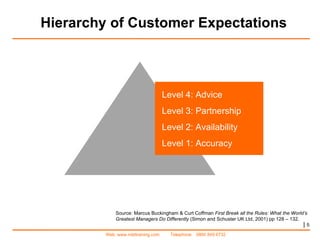
Hierarchy of Customer Expectations |   Source: Marcus Buckingham & Curt Coffman  First Break all the Rules: What the World’s Greatest Managers Do Differently   (Simon and Schuster UK Ltd, 2001) pp 128 – 132. Level 4: Advice Level 3: Partnership Level 2: Availability Level 1: Accuracy
Preventing Customer Dissatisfaction |   Levels 1 and 2 are relatively easy to meet Only prevent customer dissatisfaction – they do not generate feelings of satisfaction Easy for competitors to replicate
Customer Satisfaction, Loyalty and Retention When levels 3 and 4 are met consistently, customers will feel positive and satisfied at a level that directly relates to loyalty Organisations that can retain and develop employees with an aptitude and talent for partnering, will not only enjoy high levels of customer satisfaction, but may well secure significant competitive advantage |
T hink  L ike a  C ustomer |   A technique to help you imagine what it feels like to be a customer Broadens perceptions Increases understanding
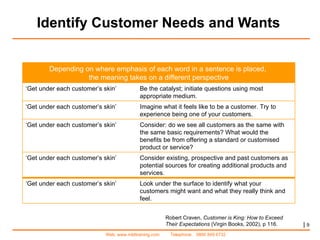
Identify Customer Needs and Wants |   Robert Craven,  Customer is King: How to Exceed Their Expectations  (Virgin Books, 2002), p 116.  Depending on where emphasis of each word in a sentence is placed,  the meaning takes on a different perspective ‘ Get under each customer’s skin’ Be the catalyst; initiate questions using most appropriate medium. ‘ Get under each customer’s skin’  Imagine what it feels like to be a customer. Try to experience being one of your customers. ‘ Get under each customer’s skin’ Consider: do we see all customers as the same with the same basic requirements? What would the benefits be from offering a standard or customised product or service? ‘ Get under each customer’s skin’ Consider existing, prospective and past customers as potential sources for creating additional products and services.  ‘ Get under each customer’s skin’ Look under the surface to identify what your customers might want and what they really think and feel.
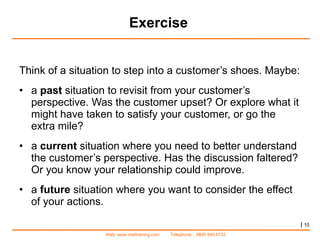
Exercise Think of a situation to step into a customer’s shoes. Maybe: a  past  situation to revisit from your customer’s perspective. Was the customer upset? Or explore what it might have taken to satisfy your customer, or go the extra mile? a  current  situation where you need to better understand the customer’s perspective. Has the discussion faltered? Or you know your relationship could improve. a  future  situation where you want to consider the effect of your actions. |
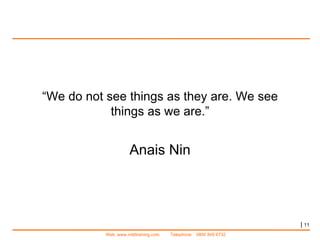
|   “ We do not see things as they are. We see things as we are.” Anais Nin
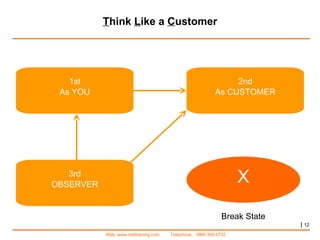
T hink  L ike a  C ustomer |   Break State X 2nd As CUSTOMER 3rd OBSERVER 1st As YOU
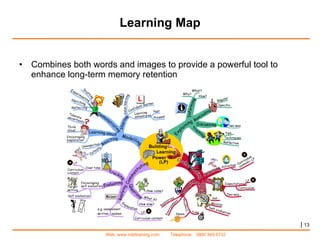
Learning Map Combines both words and images to provide a powerful tool to enhance long-term memory retention |
Learning Map Benefits Information condensed onto one page Visual presentation means can be absorbed immediately Focuses on essential ideas and connections between them Cuts out irrelevant material Create your own order to others’ ideas Process of reworking a learning map reinforces key learning points |
|   “ As far as customers are concerned you are the company.  This is not a burden, but the core of your job.  You hold in your hands the power to keep customers coming back – perhaps even to make or break the company.” Unknown
Customer Facing Employees Are responsible for: creating good impressions upholding values maintaining reputation of whole organisation “ Customers may forget what you said, but  they’ll never forget how you made them feel.”  Unknown |
Train Your Front Line Staff Important skills for dealing with customers include: Courtesy Listening Responsiveness Intelligent questioning Conflict management Non-verbal communication Knowledge of customer and product Written and telephone communication Internal skills, e.g. teamwork and delegation |
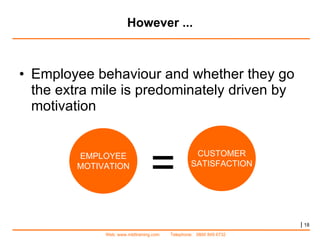
However ... Employee behaviour and whether they go the extra mile is predominately driven by motivation |   CUSTOMER SATISFACTION EMPLOYEE MOTIVATION =
What Motivates Employees? Monetary rewards rarely enough Genuine concern and respect for employees Sense of control and ownership - feel valued and trusted Regular feedback and appreciation for genuine performance Involvement in decision-making processes Lead by example Play to individual’s natural talents Develop employees ensuring they grow  Fresh challenges  Improve processes – ensure smooth and efficient service  Encourage and listen to ideas and opinions –  use them to improve the service  |
Empowering Employees Generates positive emotions – people feel valued and trusted Ensures people can make decisions and take the necessary action to provide excellent customer service When necessary, deal with problems and complaints |
A Great Working Environment Will... have a positive psychological effect on team members  boost team confidence and motivation reflect in all types of communication with customers  help create a positive visual image of your team for customers who visit your office |
Kaizen Culture Centred On … Quality Service Customer satisfaction Low cost On-time delivery |   All of which can be delivered without significant capital investment
Kaizen Results Small incremental changes  Continuous, day-to-day steady improvement  Over time will result in significant improvements to productivity, efficiency and delivery Increasing customer satisfaction  Resulting in significant competitive advantage |
Involve and Empower Employees |   Employees are brought together to examine their jobs, sections, and processes They decide: which areas of the organisation require changes what changes will be made how they will be made  and subsequently how they will be measured
Additional Benefits to Kaizen Increased morale as employees are encouraged to make suggestions and are empowered to make changes in the way they work Once improvements have been made, they will also find their work easier and more enjoyable |
Implementing Kaizen in a Customer Care Context Disregard the status quo Question everything Know the areas that require change Improve procedures  Think of opportunities not problems  Correct mistakes immediately Use experience and collective knowledge rather than capital investment Seek the cause of problems, not the symptoms Seek out as many different opinions as possible Generate innovative actions Eliminate waste (customers do not pay for non-value adding activities) Better to sacrifice quality if it means making a start sooner rather than later |
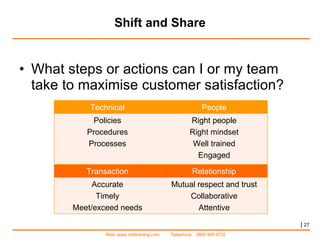
Shift and Share What steps or actions can I or my team take to maximise customer satisfaction? |   Technical People Policies Procedures Processes Right people Right mindset Well trained Engaged Transaction Relationship Accurate Timely Meet/exceed needs Mutual respect and trust Collaborative Attentive
|   That’s All Folks! Visit  www.mtdtraining.com   for a free email management course

Maximising Customer Satisfaction

  • 1.
    Maximising Customer SatisfactionMTD Training, 5 Orchard Court, Binley Business Park, Coventry, CV3 2TQ Web: www.mtdtraining.com Phone: 0800 849 6732
  • 2.
    A Stakeholder Is...... ‘an individual or group with an interest in the success of an organisation in delivering intended results and maintaining the viability of the organisation's products and services’.   | Glossary of Terms at: www.ichnet.org/glossary.htm
  • 3.
    Stakeholders Can Include… External customers Internal customers (employees) Owners/shareholders/investors Suppliers Partners Government Society at large |
  • 4.
    Buckingham and CoffmanIdentified four expectations Vital for customer satisfaction, retention and loyalty Must fulfil lower level expectations first |
  • 5.
    Hierarchy of CustomerExpectations | Source: Marcus Buckingham & Curt Coffman First Break all the Rules: What the World’s Greatest Managers Do Differently (Simon and Schuster UK Ltd, 2001) pp 128 – 132. Level 4: Advice Level 3: Partnership Level 2: Availability Level 1: Accuracy
  • 6.
    Preventing Customer Dissatisfaction| Levels 1 and 2 are relatively easy to meet Only prevent customer dissatisfaction – they do not generate feelings of satisfaction Easy for competitors to replicate
  • 7.
    Customer Satisfaction, Loyaltyand Retention When levels 3 and 4 are met consistently, customers will feel positive and satisfied at a level that directly relates to loyalty Organisations that can retain and develop employees with an aptitude and talent for partnering, will not only enjoy high levels of customer satisfaction, but may well secure significant competitive advantage |
  • 8.
    T hink L ike a C ustomer | A technique to help you imagine what it feels like to be a customer Broadens perceptions Increases understanding
  • 9.
    Identify Customer Needsand Wants | Robert Craven, Customer is King: How to Exceed Their Expectations (Virgin Books, 2002), p 116.  Depending on where emphasis of each word in a sentence is placed, the meaning takes on a different perspective ‘ Get under each customer’s skin’ Be the catalyst; initiate questions using most appropriate medium. ‘ Get under each customer’s skin’ Imagine what it feels like to be a customer. Try to experience being one of your customers. ‘ Get under each customer’s skin’ Consider: do we see all customers as the same with the same basic requirements? What would the benefits be from offering a standard or customised product or service? ‘ Get under each customer’s skin’ Consider existing, prospective and past customers as potential sources for creating additional products and services. ‘ Get under each customer’s skin’ Look under the surface to identify what your customers might want and what they really think and feel.
  • 10.
    Exercise Think ofa situation to step into a customer’s shoes. Maybe: a past situation to revisit from your customer’s perspective. Was the customer upset? Or explore what it might have taken to satisfy your customer, or go the extra mile? a current situation where you need to better understand the customer’s perspective. Has the discussion faltered? Or you know your relationship could improve. a future situation where you want to consider the effect of your actions. |
  • 11.
    | “ We do not see things as they are. We see things as we are.” Anais Nin
  • 12.
    T hink L ike a C ustomer | Break State X 2nd As CUSTOMER 3rd OBSERVER 1st As YOU
  • 13.
    Learning Map Combinesboth words and images to provide a powerful tool to enhance long-term memory retention |
  • 14.
    Learning Map BenefitsInformation condensed onto one page Visual presentation means can be absorbed immediately Focuses on essential ideas and connections between them Cuts out irrelevant material Create your own order to others’ ideas Process of reworking a learning map reinforces key learning points |
  • 15.
    | “ As far as customers are concerned you are the company. This is not a burden, but the core of your job. You hold in your hands the power to keep customers coming back – perhaps even to make or break the company.” Unknown
  • 16.
    Customer Facing EmployeesAre responsible for: creating good impressions upholding values maintaining reputation of whole organisation “ Customers may forget what you said, but they’ll never forget how you made them feel.” Unknown |
  • 17.
    Train Your FrontLine Staff Important skills for dealing with customers include: Courtesy Listening Responsiveness Intelligent questioning Conflict management Non-verbal communication Knowledge of customer and product Written and telephone communication Internal skills, e.g. teamwork and delegation |
  • 18.
    However ... Employeebehaviour and whether they go the extra mile is predominately driven by motivation | CUSTOMER SATISFACTION EMPLOYEE MOTIVATION =
  • 19.
    What Motivates Employees?Monetary rewards rarely enough Genuine concern and respect for employees Sense of control and ownership - feel valued and trusted Regular feedback and appreciation for genuine performance Involvement in decision-making processes Lead by example Play to individual’s natural talents Develop employees ensuring they grow Fresh challenges Improve processes – ensure smooth and efficient service Encourage and listen to ideas and opinions – use them to improve the service |
  • 20.
    Empowering Employees Generatespositive emotions – people feel valued and trusted Ensures people can make decisions and take the necessary action to provide excellent customer service When necessary, deal with problems and complaints |
  • 21.
    A Great WorkingEnvironment Will... have a positive psychological effect on team members boost team confidence and motivation reflect in all types of communication with customers help create a positive visual image of your team for customers who visit your office |
  • 22.
    Kaizen Culture CentredOn … Quality Service Customer satisfaction Low cost On-time delivery | All of which can be delivered without significant capital investment
  • 23.
    Kaizen Results Smallincremental changes Continuous, day-to-day steady improvement Over time will result in significant improvements to productivity, efficiency and delivery Increasing customer satisfaction Resulting in significant competitive advantage |
  • 24.
    Involve and EmpowerEmployees | Employees are brought together to examine their jobs, sections, and processes They decide: which areas of the organisation require changes what changes will be made how they will be made and subsequently how they will be measured
  • 25.
    Additional Benefits toKaizen Increased morale as employees are encouraged to make suggestions and are empowered to make changes in the way they work Once improvements have been made, they will also find their work easier and more enjoyable |
  • 26.
    Implementing Kaizen ina Customer Care Context Disregard the status quo Question everything Know the areas that require change Improve procedures Think of opportunities not problems Correct mistakes immediately Use experience and collective knowledge rather than capital investment Seek the cause of problems, not the symptoms Seek out as many different opinions as possible Generate innovative actions Eliminate waste (customers do not pay for non-value adding activities) Better to sacrifice quality if it means making a start sooner rather than later |
  • 27.
    Shift and ShareWhat steps or actions can I or my team take to maximise customer satisfaction? | Technical People Policies Procedures Processes Right people Right mindset Well trained Engaged Transaction Relationship Accurate Timely Meet/exceed needs Mutual respect and trust Collaborative Attentive
  • 28.
    | That’s All Folks! Visit www.mtdtraining.com for a free email management course