PERMANENT
MAXILLARY MOLARS
DENTAL ANATOMY
DR.SIDDHARTH ROY BDS RGUHS 2020
PERMANENT
MAXILLARY
MOLARS
• DENTAL ANATOMY
• Dr.Siddharth roy bds rguhs 2020
ARMOR 10
IRON
LEGION
The future you seek is in your hands.
Utilize every moment & The POWER
you seek is within you !!!
- Dr. Siddharth Roy
INTRODUCTION
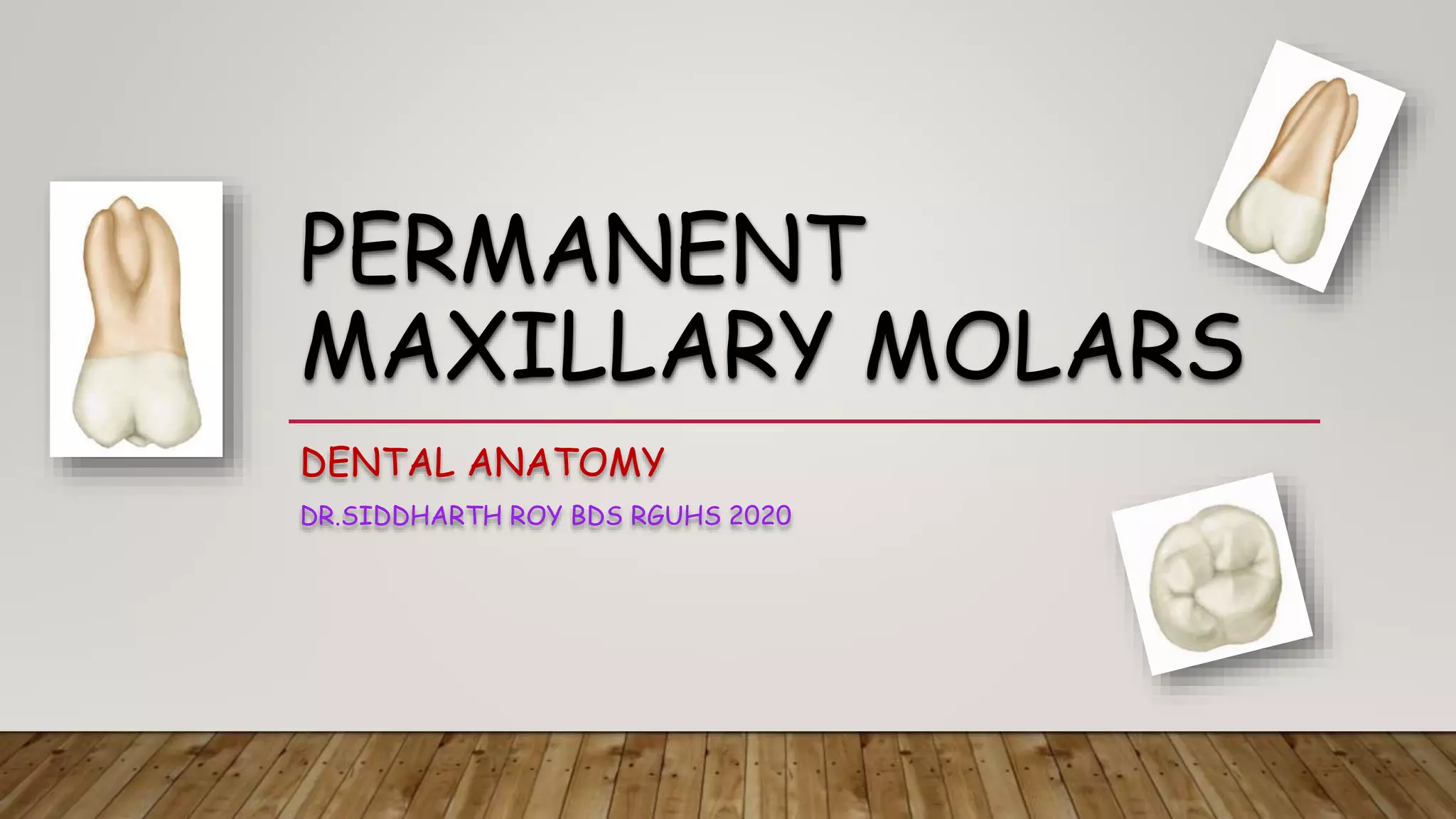
• The maxillary molars are unique tooth and they are different from any
other tooth in the oral cavity.
• They are the largest and strongest teeth due to their bulk and as well
as their anchorage in their jaws
• The root of the teeth are usually shorter than those of premolars but
their dimensions are greater than all aspects
• The crown of the tooth is wider buccolingually than mesiodistally.
• The maxillary 1st molar is normally the largest tooth in the maxillary
arch.
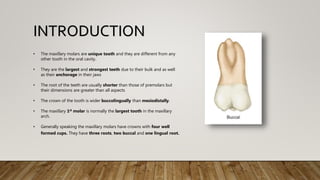
• Generally speaking the maxillary molars have crowns with four well
formed cups. They have three roots, two buccal and one lingual root.
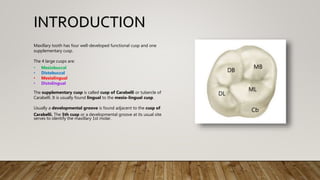
Maxillary tooth has four well-developed functional cusp and one
supplementary cusp.
The 4 large cusps are:
• Mesiobuccal
• Distobuccal
• Mesiolingual
• Distolingual
The supplementary cusp is called cusp of Carabelli or tubercle of
Carabelli. It is usually found lingual to the mesio-lingual cusp.
Usually a developmental groove is found adjacent to the cusp of
Carabelli. The 5th cusp or a developmental groove at its usual site
serves to identify the maxillary 1st molar.
MB
ML
DL
DB
Cb
INTRODUCTION
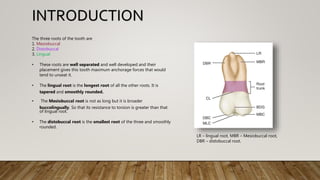
The three roots of the tooth are
1. Mesiobuccal
2. Distobuccal
3. Lingual
• These roots are well separated and well developed and their
placement gives this tooth maximum anchorage forces that would
tend to unseat it.
• The lingual root is the longest root of all the other roots. It is
tapered and smoothly rounded.
• The Mesiobuccal root is not as long but it is broader
buccolingually. So that its resistance to torsion is greater than that
of lingual root.
• The distobuccal root is the smallest root of the three and smoothly
rounded.
LR – lingual root, MBR – Mesiobuccal root,
DBR – distobuccal root.
INTRODUCTION
BUCCAL
ASPECT
BUCCAL ASPECT
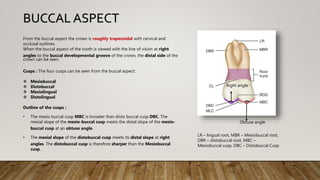
From the buccal aspect the crown is roughly trapezoidal with cervical and
occlusal outlines.
When the buccal aspect of the tooth is viewed with the line of vision at right
angles to the buccal developmental groove of the crown, the distal side of the
crown can be seen.
Cusps : The four cusps can be seen from the buccal aspect:
 Mesiobuccal
 Distobuccal
 Mesiolingual
 Distolingual
Outline of the cusps :
• The mesio buccal cusp MBC is broader than disto buccal cusp DBC. The
mesial slope of the mesio-buccal cusp meets the distal slope of the mesio-
buccal cusp at an obtuse angle.
• The mesial slope of the distobuccal cusp meets its distal slope at right
angles. The distobuccal cusp is therefore sharper than the Mesiobuccal
cusp.
LR – lingual root, MBR – Mesiobuccal root,
DBR – distobuccal root. MBC –
Mesiobuccal cusp, DBC – Distobuccal Cusp
Obtuse angle
Right angle
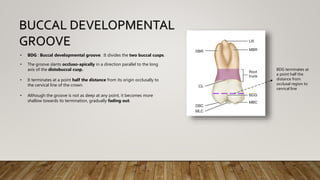
• BDG : Buccal developmental groove: It divides the two buccal cusps.
• The groove slants occluso-apically in a direction parallel to the long
axis of the distobuccal cusp.
• It terminates at a point half the distance from its origin occlusally to
the cervical line of the crown.
• Although the groove is not as deep at any point, it becomes more
shallow towards its termination, gradually fading out.
BUCCAL DEVELOPMENTAL
GROOVE
BDG terminates at
a point half the
distance from
occlusal region to
cervical line
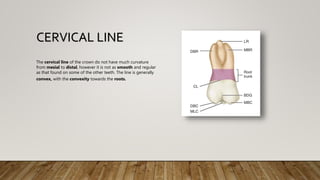
The cervical line of the crown do not have much curvature
from mesial to distal, however it is not as smooth and regular
as that found on some of the other teeth. The line is generally
convex, with the convexity towards the roots.
CERVICAL LINE
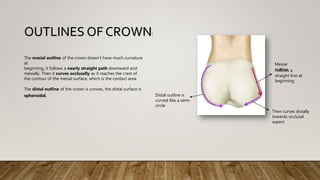
The mesial outline of the crown doesn't have much curvature
at
beginning, it follows a nearly straight path downward and
mesially. Then it curves occlusally as it reaches the crest of
the contour of the mesial surface, which is the contact area.
The distal outline of the crown is convex, the distal surface is
spheroidal.
OUTLINES OF CROWN:
Follows a
straight line at
beginning
Then curves distally
towards occlusal
aspect
Distal outline is
curved like a semi-
circle
Mesial
outline
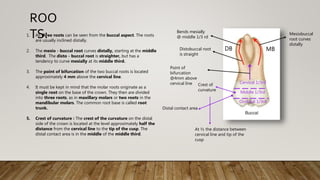
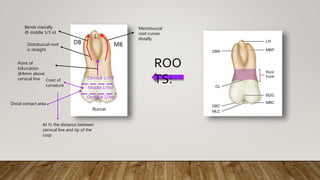
1. All three roots can be seen from the buccal aspect. The roots
are usually inclined distally.
2. The mesio - buccal root curves distally, starting at the middle
third. The disto - buccal root is straighter, but has a
tendency to curve mesially at its middle third.
3. The point of bifurcation of the two buccal roots is located
approximately 4 mm above the cervical line.
4. It must be kept in mind that the molar roots originate as a
single root on the base of the crown. They then are divided
into three roots, as in maxillary molars or two roots in the
mandibular molars. The common root base is called root
trunk.
5. Crest of curvature : The crest of the curvature on the distal
side of the crown is located at the level approximately half the
distance from the cervical line to the tip of the cusp. The
distal contact area is in the middle of the middle third.
ROO
TS:
Cervical 1/3rd
Middle 1/3rd
Occlusal 1/3rd
Crest of
curvature
At ½ the distance between
cervical line and tip of the
cusp
Bends mesially
@ middle 1/3 rd
Distobuccal root
is straight
MB
Point of
bifurcation
@4mm above
cervical line
Distal contact area
Mesiobuccal
root curves
distally
DB
Cervical 1/3rd
Middle 1/3rd
Occlusal 1/3rd
Crest of
curvature
At ½ the distance between
cervical line and tip of the
cusp
Bends mesially
@ middle 1/3 rd
Distobuccal root
is straight
Mesiobuccal
root curves
distally
MB
DB
L
Point of
bifurcation
@4mm above
cervical line
ROO
TS:
Distal contact area
LINGUA
L
ASPECT
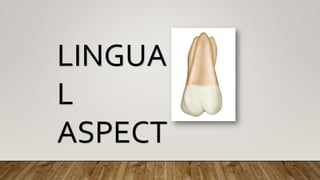
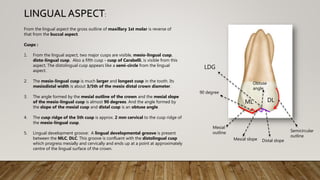
From the lingual aspect the gross outline of maxillary 1st molar is reverse of
that from the buccal aspect.
Cusps :
1. From the lingual aspect, two major cusps are visible, mesio-lingual cusp,
disto-lingual cusp. Also a fifth cusp - cusp of Carabelli, is visible from this
aspect. The distolingual cusp appears like a semi-circle from the lingual
aspect.
2. The mesio-lingual cusp is much larger and longest cusp in the tooth. Its
mesiodistal width is about 3/5th of the mesio distal crown diameter.
3. The angle formed by the mesial outline of the crown and the mesial slope
of the mesio-lingual cusp is almost 90 degrees. And the angle formed by
the slope of the mesial cusp and distal cusp is an obtuse angle.
4. The cusp ridge of the 5th cusp is approx. 2 mm cervical to the cusp ridge of
the mesio-lingual cusp.
5. Lingual development groove: A lingual developmental groove is present
between the MLC, DLC. This groove is confluent with the distolingual cusp
which progress mesially and cervically and ends up at a point at approximately
centre of the lingual surface of the crown.
LINGUAL ASPECT:
ML DL
Semicircular
outline
Mesial
outline
Mesial slope Distal slope
90 degree
Obtuse
angle
LDG
The mesio-lingual cusp is much larger and longest
cusp in the tooth. Its mesiodistal width is about
3/5th of the mesio distal crown diameter.
ML DL ML
ML CUSP WIDTH =
3/5 OF TOTAL
CROWN WIDTH
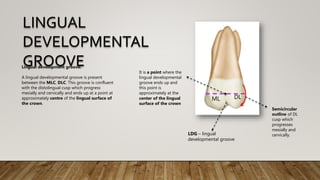
Lingual development groove:
A lingual developmental groove is present
between the MLC, DLC. This groove is confluent
with the distolingual cusp which progress
mesially and cervically and ends up at a point at
approximately centre of the lingual surface of
the crown.
ML DL
LDG – lingual
developmental groove
Semicircular
outline of DL
cusp which
progresses
mesially and
cervically.
It is a point where the
lingual developmental
groove ends up and
this point is
approximately at the
center of the lingual
surface of the crown
LINGUAL
DEVELOPMENTAL
GROOVE
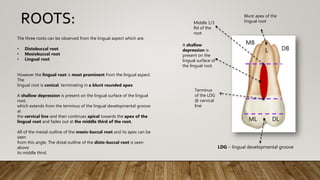
The three roots can be observed from the lingual aspect which are:
• Distobuccal root
• Mesiobuccal root
• Lingual root
However the lingual root is most prominent from the lingual aspect.
The
lingual root is conical, terminating in a blunt rounded apex.
A shallow depression is present on the lingual surface of the lingual
root,
which extends from the terminus of the lingual developmental groove
at
the cervical line and then continues apical towards the apex of the
lingual root and fades out at the middle third of the root.
All of the mesial outline of the mesio-buccal root and its apex can be
seen
from this angle. The distal outline of the disto-buccal root is seen
above
its middle third.
ROOTS:
A shallow
depression is
present on the
lingual surface of
the lingual root.
LDG – lingual developmental groove
Terminus
of the LDG
@ cervical
line
Middle 1/3
Rd of the
root
L
MB
DB
DL
ML
Blunt apex of the
lingual root
MESIA
L
ASPEC
T
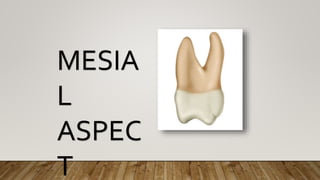
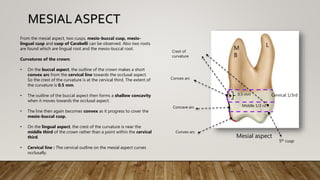
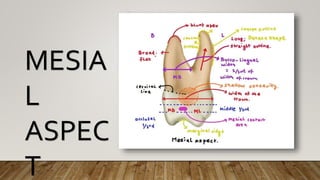
From the mesial aspect, two cusps, mesio-buccal cusp, mesio-
lingual cusp and cusp of Carabelli can be observed. Also two roots
are found which are lingual root and the mesio-buccal root.
Curvatures of the crown:
• On the buccal aspect, the outline of the crown makes a short
convex arc from the cervical line towards the occlusal aspect.
So the crest of the curvature is at the cervical third. The extent of
the curvature is 0.5 mm.
• The outline of the buccal aspect then forms a shallow concavity
when it moves towards the occlusal aspect.
• The line then again becomes convex as it progress to cover the
mesio-buccal cusp.
• On the lingual aspect, the crest of the curvature is near the
middle third of the crown rather than a point within the cervical
third.
• Cervical line : The cervical outline on the mesial aspect curves
occlusally.
MESIAL ASPECT
Convex arc
Concave arc
Convex arc
0.5 mm
Crest of
curvature
Middle 1/3 rd
Cervical 1/3rd
Mesial aspect
M
B
L
5th cusp
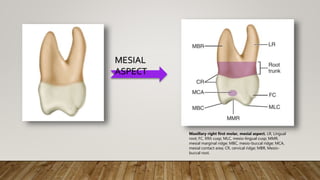
Maxillary right first molar, mesial aspect. LR, Lingual
root; FC, fifth cusp; MLC, mesio-lingual cusp; MMR,
mesial marginal ridge; MBC, mesio-buccal ridge; MCA,
mesial contact area; CR, cervical ridge; MBR, Mesio-
buccal root.
MESIAL
ASPECT
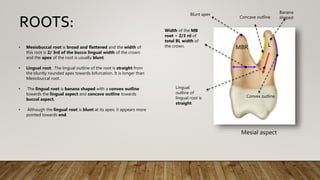
• Mesiobuccal root is broad and flattened and the width of
this root is 2/ 3rd of the bucco lingual width of the crown
and the apex of the root is usually blunt.
• Lingual root: The lingual outline of the root is straight from
the bluntly rounded apex towards bifurcation. It is longer than
Mesiobuccal root.
• The lingual root is banana shaped with a convex outline
towards the lingual aspect and concave outline towards
buccal aspect.
• Although the lingual root is blunt at its apex; it appears more
pointed towards end.
ROOTS:
MBR
Width of the MB
root = 2/3 rd of
total BL width of
the crown. L
Blunt apex
Lingual
outline of
lingual root is
straight
Banana
shaped
Concave outline
Convex outline
Mesial aspect
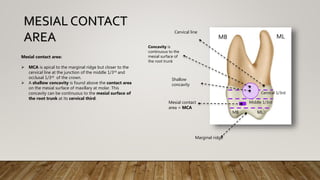
Mesial contact area:
 MCA is apical to the marginal ridge but closer to the
cervical line at the junction of the middle 1/3rd and
occlusal 1/3rd of the crown.
 A shallow concavity is found above the contact area
on the mesial surface of maxillary at molar. This
concavity can be continuous to the mesial surface of
the root trunk at its cervical third.
MESIAL CONTACT
AREA
MB ML
Cervical 1/3rd
Middle 1/3rd
Mesial contact
area = MCA
Shallow
concavity
Cervical line
Marginal ridge
MB ML
Concavity is
continuous to the
mesial surface of
the root trunk
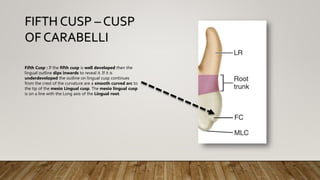
Fifth Cusp : If the fifth cusp is well developed then the
lingual outline dips inwards to reveal it. If it is
underdeveloped the outline on lingual cusp continues
from the crest of the curvature are a smooth curved arc to
the tip of the mesio Lingual cusp. The mesio lingual cusp
is on a line with the Long axis of the Lingual root.
FIFTH CUSP – CUSP
OF CARABELLI
MESIA
L
ASPEC
T
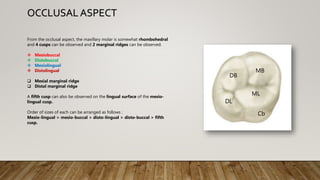
From the occlusal aspect, the maxillary molar is somewhat rhombohedral
and 4 cusps can be observed and 2 marginal ridges can be observed.
 Mesiobuccal
 Distobuccal
 Mesiolingual
 Distolingual
 Mesial marginal ridge
 Distal marginal ridge
A fifth cusp can also be observed on the lingual surface of the mesio-
lingual cusp.
Order of sizes of each can be arranged as follows :
Mesio-lingual > mesio-buccal > disto-lingual > disto-buccal > fifth
cusp.
OCCLUSAL ASPECT
MB
ML
DL
DB
Cb
The distolingual cusp usually becomes shorter and shorter
as we move towards the premolars with the greatest
distolingual cusp of the maxillary 1st molar.
The 3 molar cusps form a triangular arrangement called
maxillary molar primary cusp triangle. The 3 cusps are
mesio-buccal, mesio-lingual and disto-lingual.
The characteristic triangular figure is also made by the
oblique ridge & the marginal ridge.
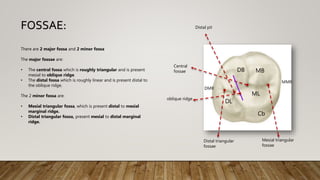
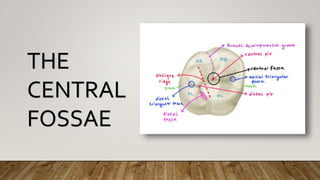
There are 2 major fossa and 2 minor fossa
The major fossae are:
• The central fossa which is roughly triangular and is present
mesial to oblique ridge.
• The distal fossa which is roughly linear and is present distal to
the oblique ridge.
The 2 minor fossa are:
• Mesial triangular fossa, which is present distal to mesial
marginal ridge.
• Distal triangular fossa, present mesial to distal marginal
ridge.
FOSSAE:
MB
ML
DL
DB
Cb
Central
fossae
oblique ridge
Mesial triangular
fossae
Distal triangular
fossae
Distal pit
MMR
DMR
MB
ML
DL
DB
Cb
Central
fossae
oblique ridge
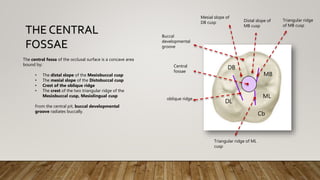
The central fossa of the occlusal surface is a concave area
bound by:
• The distal slope of the Mesiobuccal cusp
• The mesial slope of the Distobuccal cusp
• Crest of the oblique ridge
• The crest of the two triangular ridge of the
Mesiobuccal cusp, Mesiolingual cusp
From the central pit, buccal developmental
groove radiates buccally.
THE CENTRAL
FOSSAE
Distal slope of
MB cusp
Mesial slope of
DB cusp
Triangular ridge
of MB cusp
Triangular ridge of ML
cusp
Buccal
developmental
groove
THE
CENTRAL
FOSSAE
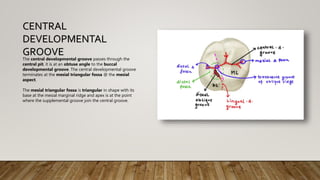
The central developmental groove passes through the
central pit. it is at an obtuse angle to the buccal
developmental groove. The central developmental groove
terminates at the mesial triangular fossa @ the mesial
aspect.
The mesial triangular fossa is triangular in shape with its
base at the mesial marginal ridge and apex is at the point
where the supplemental groove join the central groove.
CENTRAL
DEVELOPMENTAL
GROOVE
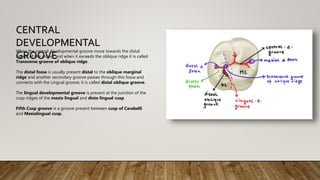
When the central developmental groove move towards the distal
aspect of the crown; and when it exceeds the oblique ridge it is called
Transverse groove of oblique ridge.
The distal fossa is usually present distal to the oblique marginal
ridge and another secondary groove passes through this fossa and
connects with the Lingual groove; it is called distal oblique groove.
The lingual developmental groove is present at the junction of the
cusp ridges of the mesio lingual and disto lingual cusp.
Fifth Cusp groove is a groove present between cusp of Carabelli
and Mesiolingual cusp.
CENTRAL
DEVELOPMENTAL
GROOVE
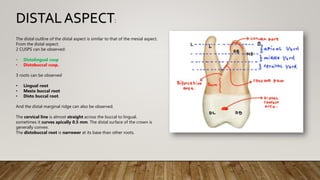
The distal outline of the distal aspect is similar to that of the mesial aspect.
From the distal aspect:
2 CUSPS can be observed:
• Distolingual cusp
• Distobuccal cusp.
3 roots can be observed
• Lingual root
• Mesio buccal root
• Disto buccal root.
And the distal marginal ridge can also be observed.
The cervical line is almost straight across the buccal to lingual.
sometimes it curves apically 0.5 mm. The distal surface of the crown is
generally convex.
The distobuccal root is narrower at its base than other roots.
DISTALASPECT:
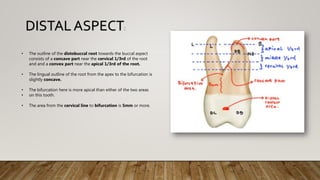
• The outline of the distobuccal root towards the buccal aspect
consists of a concave part near the cervical 1/3rd of the root
and and a convex part near the apical 1/3rd of the root.
• The lingual outline of the root from the apex to the bifurcation is
slightly concave.
• The bifurcation here is more apical than either of the two areas
• on this tooth.
• The area from the cervical line to bifurcation is 5mm or more.
DISTALASPECT:
THANK YOU
Reference: Wheeler’s Dental Anatomy
Dr. Siddharth Roy BDS RGUHS 2020

Maxillary molars Dental Anatomy

  • 1.
  • 2.
  • 3.
    ARMOR 10 IRON LEGION The futureyou seek is in your hands. Utilize every moment & The POWER you seek is within you !!! - Dr. Siddharth Roy
  • 4.
    INTRODUCTION • The maxillarymolars are unique tooth and they are different from any other tooth in the oral cavity. • They are the largest and strongest teeth due to their bulk and as well as their anchorage in their jaws • The root of the teeth are usually shorter than those of premolars but their dimensions are greater than all aspects • The crown of the tooth is wider buccolingually than mesiodistally. • The maxillary 1st molar is normally the largest tooth in the maxillary arch. • Generally speaking the maxillary molars have crowns with four well formed cups. They have three roots, two buccal and one lingual root.
  • 5.
    Maxillary tooth hasfour well-developed functional cusp and one supplementary cusp. The 4 large cusps are: • Mesiobuccal • Distobuccal • Mesiolingual • Distolingual The supplementary cusp is called cusp of Carabelli or tubercle of Carabelli. It is usually found lingual to the mesio-lingual cusp. Usually a developmental groove is found adjacent to the cusp of Carabelli. The 5th cusp or a developmental groove at its usual site serves to identify the maxillary 1st molar. MB ML DL DB Cb INTRODUCTION
  • 6.
    The three rootsof the tooth are 1. Mesiobuccal 2. Distobuccal 3. Lingual • These roots are well separated and well developed and their placement gives this tooth maximum anchorage forces that would tend to unseat it. • The lingual root is the longest root of all the other roots. It is tapered and smoothly rounded. • The Mesiobuccal root is not as long but it is broader buccolingually. So that its resistance to torsion is greater than that of lingual root. • The distobuccal root is the smallest root of the three and smoothly rounded. LR – lingual root, MBR – Mesiobuccal root, DBR – distobuccal root. INTRODUCTION
  • 7.
  • 8.
    BUCCAL ASPECT From thebuccal aspect the crown is roughly trapezoidal with cervical and occlusal outlines. When the buccal aspect of the tooth is viewed with the line of vision at right angles to the buccal developmental groove of the crown, the distal side of the crown can be seen. Cusps : The four cusps can be seen from the buccal aspect:  Mesiobuccal  Distobuccal  Mesiolingual  Distolingual Outline of the cusps : • The mesio buccal cusp MBC is broader than disto buccal cusp DBC. The mesial slope of the mesio-buccal cusp meets the distal slope of the mesio- buccal cusp at an obtuse angle. • The mesial slope of the distobuccal cusp meets its distal slope at right angles. The distobuccal cusp is therefore sharper than the Mesiobuccal cusp. LR – lingual root, MBR – Mesiobuccal root, DBR – distobuccal root. MBC – Mesiobuccal cusp, DBC – Distobuccal Cusp Obtuse angle Right angle
  • 9.
    • BDG :Buccal developmental groove: It divides the two buccal cusps. • The groove slants occluso-apically in a direction parallel to the long axis of the distobuccal cusp. • It terminates at a point half the distance from its origin occlusally to the cervical line of the crown. • Although the groove is not as deep at any point, it becomes more shallow towards its termination, gradually fading out. BUCCAL DEVELOPMENTAL GROOVE BDG terminates at a point half the distance from occlusal region to cervical line
  • 10.
    The cervical lineof the crown do not have much curvature from mesial to distal, however it is not as smooth and regular as that found on some of the other teeth. The line is generally convex, with the convexity towards the roots. CERVICAL LINE
  • 11.
    The mesial outlineof the crown doesn't have much curvature at beginning, it follows a nearly straight path downward and mesially. Then it curves occlusally as it reaches the crest of the contour of the mesial surface, which is the contact area. The distal outline of the crown is convex, the distal surface is spheroidal. OUTLINES OF CROWN: Follows a straight line at beginning Then curves distally towards occlusal aspect Distal outline is curved like a semi- circle Mesial outline
  • 12.
    1. All threeroots can be seen from the buccal aspect. The roots are usually inclined distally. 2. The mesio - buccal root curves distally, starting at the middle third. The disto - buccal root is straighter, but has a tendency to curve mesially at its middle third. 3. The point of bifurcation of the two buccal roots is located approximately 4 mm above the cervical line. 4. It must be kept in mind that the molar roots originate as a single root on the base of the crown. They then are divided into three roots, as in maxillary molars or two roots in the mandibular molars. The common root base is called root trunk. 5. Crest of curvature : The crest of the curvature on the distal side of the crown is located at the level approximately half the distance from the cervical line to the tip of the cusp. The distal contact area is in the middle of the middle third. ROO TS: Cervical 1/3rd Middle 1/3rd Occlusal 1/3rd Crest of curvature At ½ the distance between cervical line and tip of the cusp Bends mesially @ middle 1/3 rd Distobuccal root is straight MB Point of bifurcation @4mm above cervical line Distal contact area Mesiobuccal root curves distally DB
  • 13.
    Cervical 1/3rd Middle 1/3rd Occlusal1/3rd Crest of curvature At ½ the distance between cervical line and tip of the cusp Bends mesially @ middle 1/3 rd Distobuccal root is straight Mesiobuccal root curves distally MB DB L Point of bifurcation @4mm above cervical line ROO TS: Distal contact area
  • 14.
  • 15.
    From the lingualaspect the gross outline of maxillary 1st molar is reverse of that from the buccal aspect. Cusps : 1. From the lingual aspect, two major cusps are visible, mesio-lingual cusp, disto-lingual cusp. Also a fifth cusp - cusp of Carabelli, is visible from this aspect. The distolingual cusp appears like a semi-circle from the lingual aspect. 2. The mesio-lingual cusp is much larger and longest cusp in the tooth. Its mesiodistal width is about 3/5th of the mesio distal crown diameter. 3. The angle formed by the mesial outline of the crown and the mesial slope of the mesio-lingual cusp is almost 90 degrees. And the angle formed by the slope of the mesial cusp and distal cusp is an obtuse angle. 4. The cusp ridge of the 5th cusp is approx. 2 mm cervical to the cusp ridge of the mesio-lingual cusp. 5. Lingual development groove: A lingual developmental groove is present between the MLC, DLC. This groove is confluent with the distolingual cusp which progress mesially and cervically and ends up at a point at approximately centre of the lingual surface of the crown. LINGUAL ASPECT: ML DL Semicircular outline Mesial outline Mesial slope Distal slope 90 degree Obtuse angle LDG
  • 16.
    The mesio-lingual cuspis much larger and longest cusp in the tooth. Its mesiodistal width is about 3/5th of the mesio distal crown diameter. ML DL ML ML CUSP WIDTH = 3/5 OF TOTAL CROWN WIDTH
  • 17.
    Lingual development groove: Alingual developmental groove is present between the MLC, DLC. This groove is confluent with the distolingual cusp which progress mesially and cervically and ends up at a point at approximately centre of the lingual surface of the crown. ML DL LDG – lingual developmental groove Semicircular outline of DL cusp which progresses mesially and cervically. It is a point where the lingual developmental groove ends up and this point is approximately at the center of the lingual surface of the crown LINGUAL DEVELOPMENTAL GROOVE
  • 18.
    The three rootscan be observed from the lingual aspect which are: • Distobuccal root • Mesiobuccal root • Lingual root However the lingual root is most prominent from the lingual aspect. The lingual root is conical, terminating in a blunt rounded apex. A shallow depression is present on the lingual surface of the lingual root, which extends from the terminus of the lingual developmental groove at the cervical line and then continues apical towards the apex of the lingual root and fades out at the middle third of the root. All of the mesial outline of the mesio-buccal root and its apex can be seen from this angle. The distal outline of the disto-buccal root is seen above its middle third. ROOTS: A shallow depression is present on the lingual surface of the lingual root. LDG – lingual developmental groove Terminus of the LDG @ cervical line Middle 1/3 Rd of the root L MB DB DL ML Blunt apex of the lingual root
  • 19.
  • 20.
    From the mesialaspect, two cusps, mesio-buccal cusp, mesio- lingual cusp and cusp of Carabelli can be observed. Also two roots are found which are lingual root and the mesio-buccal root. Curvatures of the crown: • On the buccal aspect, the outline of the crown makes a short convex arc from the cervical line towards the occlusal aspect. So the crest of the curvature is at the cervical third. The extent of the curvature is 0.5 mm. • The outline of the buccal aspect then forms a shallow concavity when it moves towards the occlusal aspect. • The line then again becomes convex as it progress to cover the mesio-buccal cusp. • On the lingual aspect, the crest of the curvature is near the middle third of the crown rather than a point within the cervical third. • Cervical line : The cervical outline on the mesial aspect curves occlusally. MESIAL ASPECT Convex arc Concave arc Convex arc 0.5 mm Crest of curvature Middle 1/3 rd Cervical 1/3rd Mesial aspect M B L 5th cusp
  • 21.
    Maxillary right firstmolar, mesial aspect. LR, Lingual root; FC, fifth cusp; MLC, mesio-lingual cusp; MMR, mesial marginal ridge; MBC, mesio-buccal ridge; MCA, mesial contact area; CR, cervical ridge; MBR, Mesio- buccal root. MESIAL ASPECT
  • 22.
    • Mesiobuccal rootis broad and flattened and the width of this root is 2/ 3rd of the bucco lingual width of the crown and the apex of the root is usually blunt. • Lingual root: The lingual outline of the root is straight from the bluntly rounded apex towards bifurcation. It is longer than Mesiobuccal root. • The lingual root is banana shaped with a convex outline towards the lingual aspect and concave outline towards buccal aspect. • Although the lingual root is blunt at its apex; it appears more pointed towards end. ROOTS: MBR Width of the MB root = 2/3 rd of total BL width of the crown. L Blunt apex Lingual outline of lingual root is straight Banana shaped Concave outline Convex outline Mesial aspect
  • 23.
    Mesial contact area: MCA is apical to the marginal ridge but closer to the cervical line at the junction of the middle 1/3rd and occlusal 1/3rd of the crown.  A shallow concavity is found above the contact area on the mesial surface of maxillary at molar. This concavity can be continuous to the mesial surface of the root trunk at its cervical third. MESIAL CONTACT AREA MB ML Cervical 1/3rd Middle 1/3rd Mesial contact area = MCA Shallow concavity Cervical line Marginal ridge MB ML Concavity is continuous to the mesial surface of the root trunk
  • 24.
    Fifth Cusp :If the fifth cusp is well developed then the lingual outline dips inwards to reveal it. If it is underdeveloped the outline on lingual cusp continues from the crest of the curvature are a smooth curved arc to the tip of the mesio Lingual cusp. The mesio lingual cusp is on a line with the Long axis of the Lingual root. FIFTH CUSP – CUSP OF CARABELLI
  • 25.
  • 26.
    From the occlusalaspect, the maxillary molar is somewhat rhombohedral and 4 cusps can be observed and 2 marginal ridges can be observed.  Mesiobuccal  Distobuccal  Mesiolingual  Distolingual  Mesial marginal ridge  Distal marginal ridge A fifth cusp can also be observed on the lingual surface of the mesio- lingual cusp. Order of sizes of each can be arranged as follows : Mesio-lingual > mesio-buccal > disto-lingual > disto-buccal > fifth cusp. OCCLUSAL ASPECT MB ML DL DB Cb
  • 27.
    The distolingual cuspusually becomes shorter and shorter as we move towards the premolars with the greatest distolingual cusp of the maxillary 1st molar. The 3 molar cusps form a triangular arrangement called maxillary molar primary cusp triangle. The 3 cusps are mesio-buccal, mesio-lingual and disto-lingual. The characteristic triangular figure is also made by the oblique ridge & the marginal ridge.
  • 28.
    There are 2major fossa and 2 minor fossa The major fossae are: • The central fossa which is roughly triangular and is present mesial to oblique ridge. • The distal fossa which is roughly linear and is present distal to the oblique ridge. The 2 minor fossa are: • Mesial triangular fossa, which is present distal to mesial marginal ridge. • Distal triangular fossa, present mesial to distal marginal ridge. FOSSAE: MB ML DL DB Cb Central fossae oblique ridge Mesial triangular fossae Distal triangular fossae Distal pit MMR DMR
  • 29.
    MB ML DL DB Cb Central fossae oblique ridge The centralfossa of the occlusal surface is a concave area bound by: • The distal slope of the Mesiobuccal cusp • The mesial slope of the Distobuccal cusp • Crest of the oblique ridge • The crest of the two triangular ridge of the Mesiobuccal cusp, Mesiolingual cusp From the central pit, buccal developmental groove radiates buccally. THE CENTRAL FOSSAE Distal slope of MB cusp Mesial slope of DB cusp Triangular ridge of MB cusp Triangular ridge of ML cusp Buccal developmental groove
  • 30.
  • 31.
    The central developmentalgroove passes through the central pit. it is at an obtuse angle to the buccal developmental groove. The central developmental groove terminates at the mesial triangular fossa @ the mesial aspect. The mesial triangular fossa is triangular in shape with its base at the mesial marginal ridge and apex is at the point where the supplemental groove join the central groove. CENTRAL DEVELOPMENTAL GROOVE
  • 32.
    When the centraldevelopmental groove move towards the distal aspect of the crown; and when it exceeds the oblique ridge it is called Transverse groove of oblique ridge. The distal fossa is usually present distal to the oblique marginal ridge and another secondary groove passes through this fossa and connects with the Lingual groove; it is called distal oblique groove. The lingual developmental groove is present at the junction of the cusp ridges of the mesio lingual and disto lingual cusp. Fifth Cusp groove is a groove present between cusp of Carabelli and Mesiolingual cusp. CENTRAL DEVELOPMENTAL GROOVE
  • 33.
    The distal outlineof the distal aspect is similar to that of the mesial aspect. From the distal aspect: 2 CUSPS can be observed: • Distolingual cusp • Distobuccal cusp. 3 roots can be observed • Lingual root • Mesio buccal root • Disto buccal root. And the distal marginal ridge can also be observed. The cervical line is almost straight across the buccal to lingual. sometimes it curves apically 0.5 mm. The distal surface of the crown is generally convex. The distobuccal root is narrower at its base than other roots. DISTALASPECT:
  • 34.
    • The outlineof the distobuccal root towards the buccal aspect consists of a concave part near the cervical 1/3rd of the root and and a convex part near the apical 1/3rd of the root. • The lingual outline of the root from the apex to the bifurcation is slightly concave. • The bifurcation here is more apical than either of the two areas • on this tooth. • The area from the cervical line to bifurcation is 5mm or more. DISTALASPECT:
  • 35.
    THANK YOU Reference: Wheeler’sDental Anatomy Dr. Siddharth Roy BDS RGUHS 2020