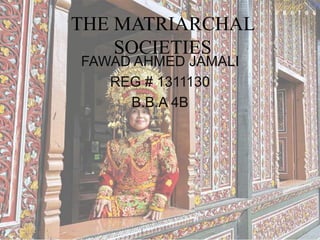
THE MATRIARCHAL
SOCIETIES
FAWAD AHMED JAMALI
REG # 1311130
B.B.A 4B
OUTLINE…
 WHAT IS MATRIARCHY?
INTER-LINKED TERMS
 MATRIARCHAL SOCITIES
 SOCIETY OPERATIONS
 DIFFERING VALUES/NORMS
 DISCUSSION POINT
MATRIARCHY???
 A form of social organization in which the mother or
the oldest female heads the family.
 Descents and relationships are determined through
female line.
OR
 A social system organized around the principle of
mother-rule in which mothers, or females are at the
top of the power structure.
“The opposite of matriarchy is patriarchy”
INTER-LINKED
TERMS
 Matrilineal
 Matrifocal
 Matricentric
LIST OF EXISTING MATRIARCHAL
SOCIETIES
 Minangkabau
 Masuo
 Akan
 Bribri
 Garo
MINANGKABAU
• Indigenous to the Minangkabau highlands of
Western Sumatra in Indonesia
• Strongly Muslims but also follow “adat”
• The culture is partly matrilineal
• Numbers around 8 million
MINANG CULTURE
• Property is inherited through female lineage unit
• Boys leave their houses as early as the age of 7 to
live in “Surau”
• Man to wait until a marriage proposal is received
from some young woman’s family
• Husbands having visitor status
• Maternal home considered ideal for married
sisters
MASUO
• Also known as “Na”
• Yunnan and Sichuan provinces of China
• Numbers around 40000
• Linkage with Buddhism, Taoism
MASUO CULTURAL HIGHLIGHTS
• Women being head of the family, heir to the
property and business decision maker
• Barter-based system
• Preserved pork for upto 10 years
• Men and women role
• Walking marriages
AKAN
• Ghana and Ivory Coast
• Number around 20 million, but only half of them
follow matrilineal customs
• Mainly Christians
• Minority follow Islam, Akan religion and Atheism
AKAN CULTURAL HIGHLIGHTS
• Famous for gold weights
• Clan-based system
• Marriage with mutual agreement
• Initially engaged in slave trade
BRIBRI
• Indigenous people of Talamanca region, Costa Rica
• Numbers around 12000
• Bribri and Spanish language
• Organized into clans
BRIBRI CUTURAL HIGHLIGHTS
• Men and women roles
• Preparation of cacao
• Beliefs regarding ailment
• Iguana farming
GARO
• Indigenous people of Meghalaya, India and
neighboring areas of Bangladesh
• Call themselves A-Chik/Manda
• Mainly Christians
• Population around 1 million
GARO CULTURAL HIGHLIGHTS
• Youngest daughter inherits property
• Boys sent into bachelor’s dormitory
• Marriage is cross-cultural
• Food is simple, not spicy
• House is multi-attribute
WHAT IF….
WHAT, IN YOUR OPINION, WOULD THE WORLD
WOULD HAVE LIKED IF WE HAD WOMEN IN
POWER???
Matriarchal societies

Matriarchal societies

  • 1.
    THE MATRIARCHAL SOCIETIES FAWAD AHMEDJAMALI REG # 1311130 B.B.A 4B
  • 2.
    OUTLINE…  WHAT ISMATRIARCHY? INTER-LINKED TERMS  MATRIARCHAL SOCITIES  SOCIETY OPERATIONS  DIFFERING VALUES/NORMS  DISCUSSION POINT
  • 3.
    MATRIARCHY???  A formof social organization in which the mother or the oldest female heads the family.  Descents and relationships are determined through female line. OR  A social system organized around the principle of mother-rule in which mothers, or females are at the top of the power structure. “The opposite of matriarchy is patriarchy”
  • 4.
  • 5.
    LIST OF EXISTINGMATRIARCHAL SOCIETIES  Minangkabau  Masuo  Akan  Bribri  Garo
  • 6.
    MINANGKABAU • Indigenous tothe Minangkabau highlands of Western Sumatra in Indonesia • Strongly Muslims but also follow “adat” • The culture is partly matrilineal • Numbers around 8 million
  • 7.
    MINANG CULTURE • Propertyis inherited through female lineage unit • Boys leave their houses as early as the age of 7 to live in “Surau” • Man to wait until a marriage proposal is received from some young woman’s family • Husbands having visitor status • Maternal home considered ideal for married sisters
  • 8.
    MASUO • Also knownas “Na” • Yunnan and Sichuan provinces of China • Numbers around 40000 • Linkage with Buddhism, Taoism
  • 9.
    MASUO CULTURAL HIGHLIGHTS •Women being head of the family, heir to the property and business decision maker • Barter-based system • Preserved pork for upto 10 years • Men and women role • Walking marriages
  • 10.
    AKAN • Ghana andIvory Coast • Number around 20 million, but only half of them follow matrilineal customs • Mainly Christians • Minority follow Islam, Akan religion and Atheism
  • 11.
    AKAN CULTURAL HIGHLIGHTS •Famous for gold weights • Clan-based system • Marriage with mutual agreement • Initially engaged in slave trade
  • 12.
    BRIBRI • Indigenous peopleof Talamanca region, Costa Rica • Numbers around 12000 • Bribri and Spanish language • Organized into clans
  • 13.
    BRIBRI CUTURAL HIGHLIGHTS •Men and women roles • Preparation of cacao • Beliefs regarding ailment • Iguana farming
  • 14.
    GARO • Indigenous peopleof Meghalaya, India and neighboring areas of Bangladesh • Call themselves A-Chik/Manda • Mainly Christians • Population around 1 million
  • 15.
    GARO CULTURAL HIGHLIGHTS •Youngest daughter inherits property • Boys sent into bachelor’s dormitory • Marriage is cross-cultural • Food is simple, not spicy • House is multi-attribute
  • 16.
    WHAT IF…. WHAT, INYOUR OPINION, WOULD THE WORLD WOULD HAVE LIKED IF WE HAD WOMEN IN POWER???