Take
Risks
Think, re-think
and check
Reflect on their
thinking
Learn from
others
Solve problems in
different ways
Explain and
justify their
thinking
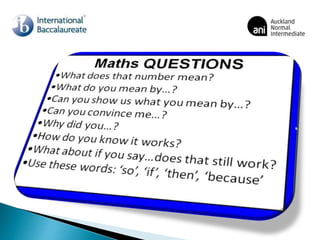
Ask good math
questions
Friendly
argue
Use different
strategies
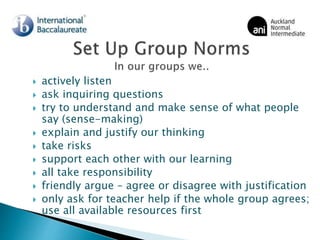
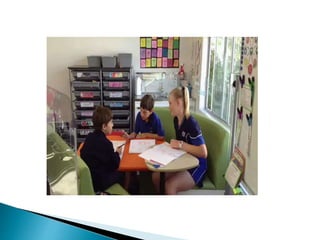
 actively listen
 ask inquiring questions
 try to understand and make sense of what people
say (sense-making)
 explain and justify our thinking
 take risks
 support each other with our learning
 all take responsibility
 friendly argue – agree or disagree with justification
 only ask for teacher help if the whole group agrees;
use all available resources first
 Students work in scrap books
 Work with one learning community at a time (the
other learning community is doing practice)
 Inside student books are 3 differentiated problems
(multiple solutions)
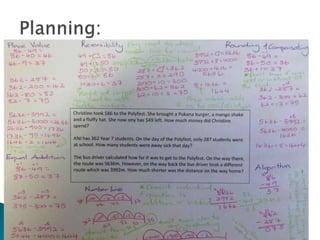
 The teacher has anticipated answers and possible
misconceptions prior to lesson (planning)
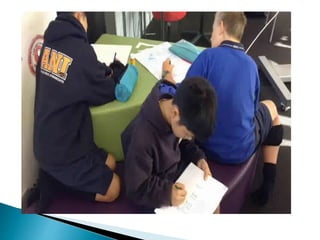
 Independent Thinking Time: Students solve the
problem individually without being influenced by other student’s
thinking
 Represent your thinking in any way: act out, draw pictures or
diagrams, use symbols, use materials, verbalise, model
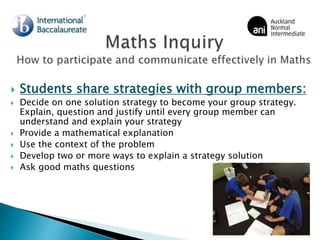
 Students share strategies with group members:
 Decide on one solution strategy to become your group strategy.
Explain, question and justify until every group member can
understand and explain your strategy
 Provide a mathematical explanation
 Use the context of the problem
 Develop two or more ways to explain a strategy solution
 Ask good maths questions
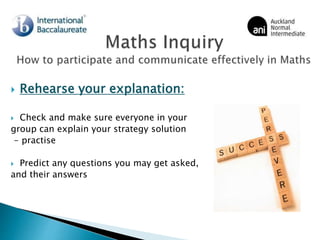
 Rehearse your explanation:
 Check and make sure everyone in your
group can explain your strategy solution
- practise
 Predict any questions you may get asked,
and their answers
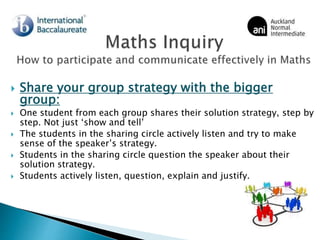
 Share your group strategy with the bigger
group:
 One student from each group shares their solution strategy, step by
step. Not just ‘show and tell’
 The students in the sharing circle actively listen and try to make
sense of the speaker’s strategy.
 Students in the sharing circle question the speaker about their
solution strategy.
 Students actively listen, question, explain and justify.
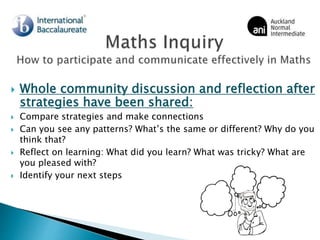
 Whole community discussion and reflection after
strategies have been shared:
 Compare strategies and make connections
 Can you see any patterns? What’s the same or different? Why do you
think that?
 Reflect on learning: What did you learn? What was tricky? What are
you pleased with?
 Identify your next steps
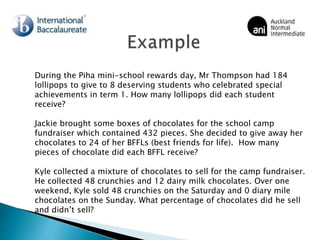
During the Piha mini-school rewards day, Mr Thompson had 184
lollipops to give to 8 deserving students who celebrated special
achievements in term 1. How many lollipops did each student
receive?
Jackie brought some boxes of chocolates for the school camp
fundraiser which contained 432 pieces. She decided to give away her
chocolates to 24 of her BFFLs (best friends for life). How many
pieces of chocolate did each BFFL receive?
Kyle collected a mixture of chocolates to sell for the camp fundraiser.
He collected 48 crunchies and 12 dairy milk chocolates. Over one
weekend, Kyle sold 48 crunchies on the Saturday and 0 diary mile
chocolates on the Sunday. What percentage of chocolates did he sell
and didn’t sell?
In your pack are three sample questions. Spend
some time doing the following:
 Independently thinking and recording
 Sharing your process with someone else
 Friendly arguing
 Identifying misconceptions
Your pack contains the basics of what you need
to get started:
 A copy of the process for students
 A more detailed copy of the process for you
 Some example questions
 A sample of ‘good math questions’
 Contact details:
 Christine Abercrombie:
cabercrombie@ani.school.nz
 Matt Aukett:
maukett@ani.school.nz

Maths inquiry symposium

  • 5.
    Take Risks Think, re-think and check Reflecton their thinking Learn from others Solve problems in different ways Explain and justify their thinking Ask good math questions Friendly argue Use different strategies
  • 7.
     actively listen ask inquiring questions  try to understand and make sense of what people say (sense-making)  explain and justify our thinking  take risks  support each other with our learning  all take responsibility  friendly argue – agree or disagree with justification  only ask for teacher help if the whole group agrees; use all available resources first
  • 13.
     Students workin scrap books  Work with one learning community at a time (the other learning community is doing practice)  Inside student books are 3 differentiated problems (multiple solutions)  The teacher has anticipated answers and possible misconceptions prior to lesson (planning)
  • 15.
     Independent ThinkingTime: Students solve the problem individually without being influenced by other student’s thinking  Represent your thinking in any way: act out, draw pictures or diagrams, use symbols, use materials, verbalise, model
  • 17.
     Students sharestrategies with group members:  Decide on one solution strategy to become your group strategy. Explain, question and justify until every group member can understand and explain your strategy  Provide a mathematical explanation  Use the context of the problem  Develop two or more ways to explain a strategy solution  Ask good maths questions
  • 20.
     Rehearse yourexplanation:  Check and make sure everyone in your group can explain your strategy solution - practise  Predict any questions you may get asked, and their answers
  • 21.
     Share yourgroup strategy with the bigger group:  One student from each group shares their solution strategy, step by step. Not just ‘show and tell’  The students in the sharing circle actively listen and try to make sense of the speaker’s strategy.  Students in the sharing circle question the speaker about their solution strategy.  Students actively listen, question, explain and justify.
  • 23.
     Whole communitydiscussion and reflection after strategies have been shared:  Compare strategies and make connections  Can you see any patterns? What’s the same or different? Why do you think that?  Reflect on learning: What did you learn? What was tricky? What are you pleased with?  Identify your next steps
  • 25.
    During the Pihamini-school rewards day, Mr Thompson had 184 lollipops to give to 8 deserving students who celebrated special achievements in term 1. How many lollipops did each student receive? Jackie brought some boxes of chocolates for the school camp fundraiser which contained 432 pieces. She decided to give away her chocolates to 24 of her BFFLs (best friends for life). How many pieces of chocolate did each BFFL receive? Kyle collected a mixture of chocolates to sell for the camp fundraiser. He collected 48 crunchies and 12 dairy milk chocolates. Over one weekend, Kyle sold 48 crunchies on the Saturday and 0 diary mile chocolates on the Sunday. What percentage of chocolates did he sell and didn’t sell?
  • 26.
    In your packare three sample questions. Spend some time doing the following:  Independently thinking and recording  Sharing your process with someone else  Friendly arguing  Identifying misconceptions
  • 27.
    Your pack containsthe basics of what you need to get started:  A copy of the process for students  A more detailed copy of the process for you  Some example questions  A sample of ‘good math questions’
  • 28.
     Contact details: Christine Abercrombie: cabercrombie@ani.school.nz  Matt Aukett: maukett@ani.school.nz