MATHEMATICS
IN THE UNIVERSE
Presented by:
Ralph Justine Alconaba, Lord Jervy Thomson Leopoldo,
Louise Angela Villanueva
MATHEMATICS IN THE MODERN WORLD
GRAVITATIONAL PULL AMONG
THE PLANETS
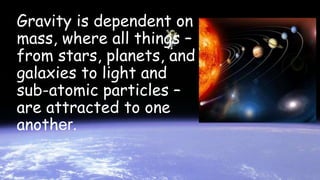
Gravity is dependent on
mass, where all things –
from stars, planets, and
galaxies to light and
sub-atomic particles –
are attracted to one
another.
Depending on the size, mass and
density of the object, the
gravitational force it exerts varies.
Gravitational pull of the
planets
COMETS AND METEORS
COMETS
• Comets are frozen leftovers from
the formation of the solar system
composed of dust, rock and ices. They
range from a few miles to tens of
miles wide, but as they orbit closer
to the sun, they heat up and spew
gases and dust into a glowing head
that can be larger than a planet.
This material forms a tail that
stretches millions of miles.
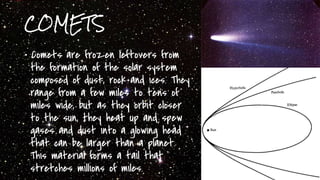
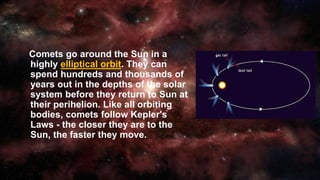
Comets go around the Sun in a
highly elliptical orbit. They can
spend hundreds and thousands of
years out in the depths of the solar
system before they return to Sun at
their perihelion. Like all orbiting
bodies, comets follow Kepler's
Laws - the closer they are to the
Sun, the faster they move.
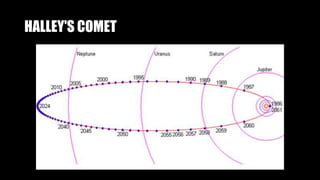
HALLEY'S COMET
METEORS
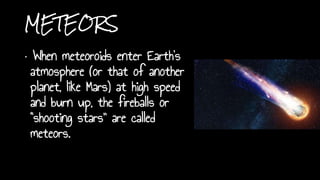
• When meteoroids enter Earth’s
atmosphere (or that of another
planet, like Mars) at high speed
and burn up, the fireballs or
“shooting stars” are called
meteors.
A meteor shower occurs when Earth passes through this material, which
generally happens at only one point in its orbit. As Earth passes that point
at the same time every year, we can predict meteor shower times with good
accuracy.
DARK ENERGY AND
DARK MATTER
DARK ENERGY
One explanation for dark energy is
that it is a property of space. Albert
Einstein was the first person to
realize that empty space is not
nothing. Space has amazing
properties, many of which are just
beginning to be understood. The
first property that Einstein
discovered is that it is possible for
more space to come into existence.
DARK MATTER
First, it is dark, meaning that it is
not in the form of stars and planets
that we see. Observations show that
there is far too little visible matter
in the universe to make up the 27%
required by the observations. Second,
it is not in the form of dark clouds
of normal matter, matter made up of
particles called baryons.
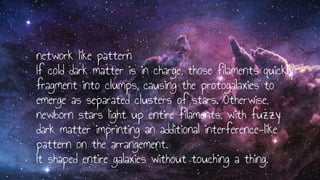
• network like pattern
• If cold dark matter is in charge, those filaments quickly
fragment into clumps, causing the protogalaxies to
emerge as separated clusters of stars. Otherwise,
newborn stars light up entire filaments, with fuzzy
dark matter imprinting an additional interference-like
pattern on the arrangement.
• It shaped entire galaxies without touching a thing.
THANK YOU!
REFERENCES
• https://phys.org/news/2016-01-strong-gravity-planets.html
• https://solarsystem.nasa.gov/asteroids-comets-and-
meteors/comets/overview/?page=0&per_page=40&order=name+asc&s
earch=&condition_1=102%3Aparent_id&condition_2=comet%3Abody_t
ype%3Ailike
• https://www.st-
andrews.ac.uk/~bds2/ltsn/ljm/JAVA/COMETORB/COMET.HTM
• https://astronomy.com/magazine/ask-astro/2011/10/calculating-falling-
stars?fbclid=IwAR35Hi28GTBRVqNd-
RwYwa3BYKUhFVtaKeyObLMpWoOvVaH9FfiDAsUyFTI
• https://science.nasa.gov/astrophysics/focus-areas/what-is-darkenergy
• https://physics.aps.org/articles/v12/s112

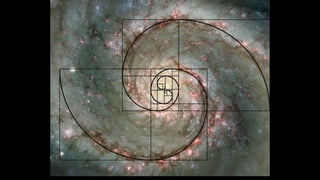
Mathematics patterns in the universe

  • 1.
    MATHEMATICS IN THE UNIVERSE Presentedby: Ralph Justine Alconaba, Lord Jervy Thomson Leopoldo, Louise Angela Villanueva MATHEMATICS IN THE MODERN WORLD
  • 2.
  • 3.
    Gravity is dependenton mass, where all things – from stars, planets, and galaxies to light and sub-atomic particles – are attracted to one another.
  • 4.
    Depending on thesize, mass and density of the object, the gravitational force it exerts varies.
  • 5.
  • 6.
  • 7.
    COMETS • Comets arefrozen leftovers from the formation of the solar system composed of dust, rock and ices. They range from a few miles to tens of miles wide, but as they orbit closer to the sun, they heat up and spew gases and dust into a glowing head that can be larger than a planet. This material forms a tail that stretches millions of miles.
  • 8.
    Comets go aroundthe Sun in a highly elliptical orbit. They can spend hundreds and thousands of years out in the depths of the solar system before they return to Sun at their perihelion. Like all orbiting bodies, comets follow Kepler's Laws - the closer they are to the Sun, the faster they move.
  • 9.
  • 10.
    METEORS • When meteoroidsenter Earth’s atmosphere (or that of another planet, like Mars) at high speed and burn up, the fireballs or “shooting stars” are called meteors.
  • 11.
    A meteor showeroccurs when Earth passes through this material, which generally happens at only one point in its orbit. As Earth passes that point at the same time every year, we can predict meteor shower times with good accuracy.
  • 12.
  • 13.
    DARK ENERGY One explanationfor dark energy is that it is a property of space. Albert Einstein was the first person to realize that empty space is not nothing. Space has amazing properties, many of which are just beginning to be understood. The first property that Einstein discovered is that it is possible for more space to come into existence.
  • 14.
    DARK MATTER First, itis dark, meaning that it is not in the form of stars and planets that we see. Observations show that there is far too little visible matter in the universe to make up the 27% required by the observations. Second, it is not in the form of dark clouds of normal matter, matter made up of particles called baryons.
  • 15.
    • network likepattern • If cold dark matter is in charge, those filaments quickly fragment into clumps, causing the protogalaxies to emerge as separated clusters of stars. Otherwise, newborn stars light up entire filaments, with fuzzy dark matter imprinting an additional interference-like pattern on the arrangement. • It shaped entire galaxies without touching a thing.
  • 18.
  • 19.
    REFERENCES • https://phys.org/news/2016-01-strong-gravity-planets.html • https://solarsystem.nasa.gov/asteroids-comets-and- meteors/comets/overview/?page=0&per_page=40&order=name+asc&s earch=&condition_1=102%3Aparent_id&condition_2=comet%3Abody_t ype%3Ailike •https://www.st- andrews.ac.uk/~bds2/ltsn/ljm/JAVA/COMETORB/COMET.HTM • https://astronomy.com/magazine/ask-astro/2011/10/calculating-falling- stars?fbclid=IwAR35Hi28GTBRVqNd- RwYwa3BYKUhFVtaKeyObLMpWoOvVaH9FfiDAsUyFTI • https://science.nasa.gov/astrophysics/focus-areas/what-is-darkenergy • https://physics.aps.org/articles/v12/s112