
In Counting
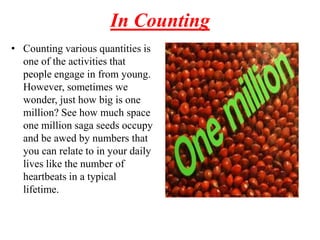
• Counting various quantities is
  one of the activities that
  people engage in from young.
  However, sometimes we
  wonder, just how big is one
  million? See how much space
  one million saga seeds occupy
  and be awed by numbers that
  you can relate to in your daily
  lives like the number of
  heartbeats in a typical
  lifetime.
In Nature
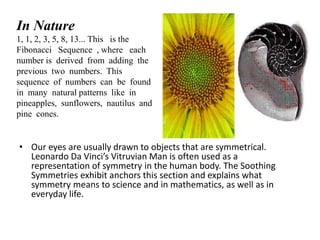
1, 1, 2, 3, 5, 8, 13... This is the
Fibonacci Sequence , where each
number is derived from adding the
previous two numbers. This
sequence of numbers can be found
in many natural patterns like in
pineapples, sunflowers, nautilus and
pine cones.


• Our eyes are usually drawn to objects that are symmetrical.
  Leonardo Da Vinci’s Vitruvian Man is often used as a
  representation of symmetry in the human body. The Soothing
  Symmetries exhibit anchors this section and explains what
  symmetry means to science and in mathematics, as well as in
  everyday life.
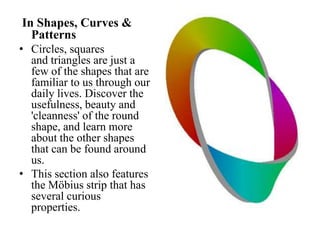
In Shapes, Curves &
  Patterns
• Circles, squares
  and triangles are just a
  few of the shapes that are
  familiar to us through our
  daily lives. Discover the
  usefulness, beauty and
  'cleanness' of the round
  shape, and learn more
  about the other shapes
  that can be found around
  us.
• This section also features
  the Möbius strip that has
  several curious
  properties.
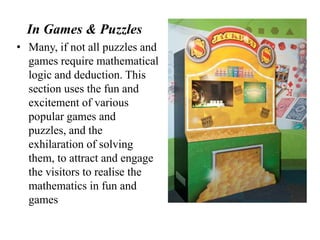
In Games & Puzzles
• Many, if not all puzzles and
  games require mathematical
  logic and deduction. This
  section uses the fun and
  excitement of various
  popular games and
  puzzles, and the
  exhilaration of solving
  them, to attract and engage
  the visitors to realise the
  mathematics in fun and
  games
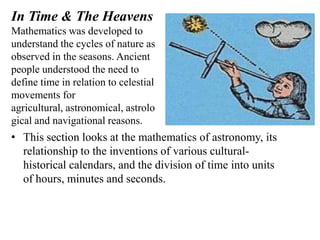
In Time & The Heavens
Mathematics was developed to
understand the cycles of nature as
observed in the seasons. Ancient
people understood the need to
define time in relation to celestial
movements for
agricultural, astronomical, astrolo
gical and navigational reasons.
• This section looks at the mathematics of astronomy, its
  relationship to the inventions of various cultural-
  historical calendars, and the division of time into units
  of hours, minutes and seconds.
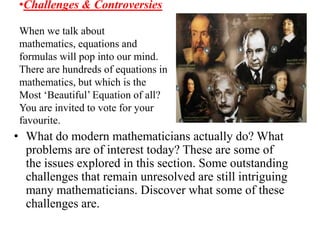
•Challenges & Controversies

 When we talk about
 mathematics, equations and
 formulas will pop into our mind.
 There are hundreds of equations in
 mathematics, but which is the
 Most ‘Beautiful’ Equation of all?
 You are invited to vote for your
 favourite.
• What do modern mathematicians actually do? What
  problems are of interest today? These are some of
  the issues explored in this section. Some outstanding
  challenges that remain unresolved are still intriguing
  many mathematicians. Discover what some of these
  challenges are.
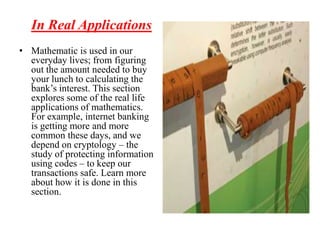
In Real Applications
• Mathematic is used in our
  everyday lives; from figuring
  out the amount needed to buy
  your lunch to calculating the
  bank’s interest. This section
  explores some of the real life
  applications of mathematics.
  For example, internet banking
  is getting more and more
  common these days, and we
  depend on cryptology – the
  study of protecting information
  using codes – to keep our
  transactions safe. Learn more
  about how it is done in this
  section.
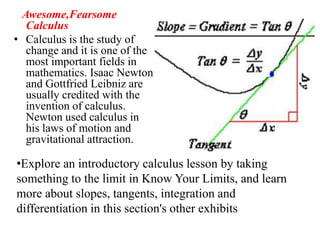
Awesome,Fearsome
   Calculus
• Calculus is the study of
   change and it is one of the
   most important fields in
   mathematics. Isaac Newton
   and Gottfried Leibniz are
   usually credited with the
   invention of calculus.
   Newton used calculus in
   his laws of motion and
   gravitational attraction.

•Explore an introductory calculus lesson by taking
something to the limit in Know Your Limits, and learn
more about slopes, tangents, integration and
differentiation in this section's other exhibits
Mathematics everywhere & everyday

Mathematics everywhere & everyday

  • 2.
    In Counting • Countingvarious quantities is one of the activities that people engage in from young. However, sometimes we wonder, just how big is one million? See how much space one million saga seeds occupy and be awed by numbers that you can relate to in your daily lives like the number of heartbeats in a typical lifetime.
  • 3.
    In Nature 1, 1,2, 3, 5, 8, 13... This is the Fibonacci Sequence , where each number is derived from adding the previous two numbers. This sequence of numbers can be found in many natural patterns like in pineapples, sunflowers, nautilus and pine cones. • Our eyes are usually drawn to objects that are symmetrical. Leonardo Da Vinci’s Vitruvian Man is often used as a representation of symmetry in the human body. The Soothing Symmetries exhibit anchors this section and explains what symmetry means to science and in mathematics, as well as in everyday life.
  • 4.
    In Shapes, Curves& Patterns • Circles, squares and triangles are just a few of the shapes that are familiar to us through our daily lives. Discover the usefulness, beauty and 'cleanness' of the round shape, and learn more about the other shapes that can be found around us. • This section also features the Möbius strip that has several curious properties.
  • 5.
    In Games &Puzzles • Many, if not all puzzles and games require mathematical logic and deduction. This section uses the fun and excitement of various popular games and puzzles, and the exhilaration of solving them, to attract and engage the visitors to realise the mathematics in fun and games
  • 6.
    In Time &The Heavens Mathematics was developed to understand the cycles of nature as observed in the seasons. Ancient people understood the need to define time in relation to celestial movements for agricultural, astronomical, astrolo gical and navigational reasons. • This section looks at the mathematics of astronomy, its relationship to the inventions of various cultural- historical calendars, and the division of time into units of hours, minutes and seconds.
  • 7.
    •Challenges & Controversies When we talk about mathematics, equations and formulas will pop into our mind. There are hundreds of equations in mathematics, but which is the Most ‘Beautiful’ Equation of all? You are invited to vote for your favourite. • What do modern mathematicians actually do? What problems are of interest today? These are some of the issues explored in this section. Some outstanding challenges that remain unresolved are still intriguing many mathematicians. Discover what some of these challenges are.
  • 8.
    In Real Applications •Mathematic is used in our everyday lives; from figuring out the amount needed to buy your lunch to calculating the bank’s interest. This section explores some of the real life applications of mathematics. For example, internet banking is getting more and more common these days, and we depend on cryptology – the study of protecting information using codes – to keep our transactions safe. Learn more about how it is done in this section.
  • 9.
    Awesome,Fearsome Calculus • Calculus is the study of change and it is one of the most important fields in mathematics. Isaac Newton and Gottfried Leibniz are usually credited with the invention of calculus. Newton used calculus in his laws of motion and gravitational attraction. •Explore an introductory calculus lesson by taking something to the limit in Know Your Limits, and learn more about slopes, tangents, integration and differentiation in this section's other exhibits