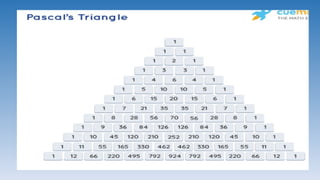
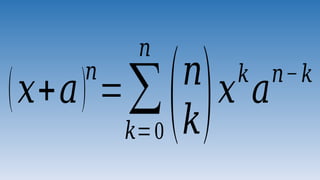
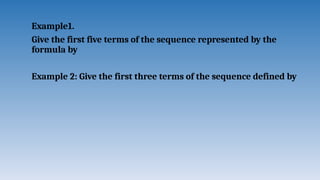
Example1.
Give the firstfive terms of the sequence represented by the
formula by
Example 2: Give the first three terms of the sequence defined by
11.
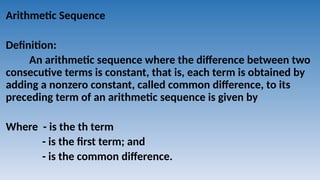
Arithmetic Sequence
Definition:
An arithmeticsequence where the difference between two
consecutive terms is constant, that is, each term is obtained by
adding a nonzero constant, called common difference, to its
preceding term of an arithmetic sequence is given by
Where - is the th term
- is the first term; and
- is the common difference.
12.
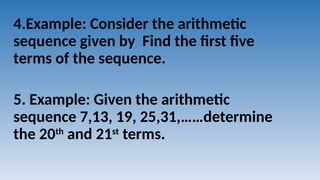
4.Example: Consider thearithmetic
sequence given by Find the first five
terms of the sequence.
5. Example: Given the arithmetic
sequence 7,13, 19, 25,31,……determine
the 20th
and 21st
terms.
13.
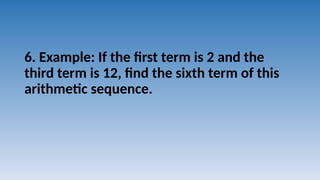
6. Example: Ifthe first term is 2 and the
third term is 12, find the sixth term of this
arithmetic sequence.
14.
Geometric Sequence
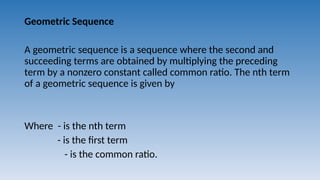
A geometricsequence is a sequence where the second and
succeeding terms are obtained by multiplying the preceding
term by a nonzero constant called common ratio. The nth term
of a geometric sequence is given by
Where - is the nth term
- is the first term
- is the common ratio.
15.
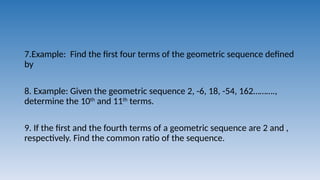
7.Example: Find thefirst four terms of the geometric sequence defined
by
8. Example: Given the geometric sequence 2, -6, 18, -54, 162……….,
determine the 10th
and 11th
terms.
9. If the first and the fourth terms of a geometric sequence are 2 and ,
respectively. Find the common ratio of the sequence.
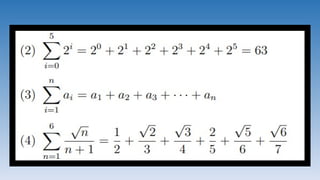
Series
Now that wehave recalled how to find the nth term of a sequence, we
then recall how to determine the sum of a specified number of terms.
This sum is referred to as series. Let us see the next example.
22.
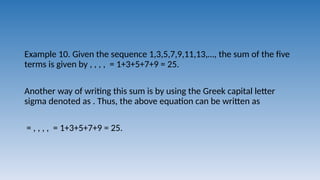
Example 10. Giventhe sequence 1,3,5,7,9,11,13,…, the sum of the five
terms is given by , , , , = 1+3+5+7+9 = 25.
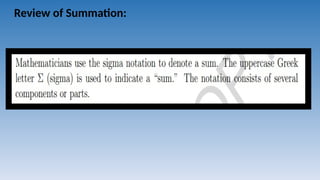
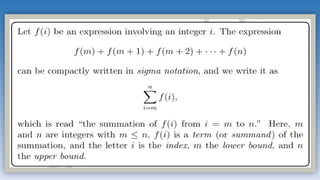
Another way of writing this sum is by using the Greek capital letter
sigma denoted as . Thus, the above equation can be written as
= , , , , = 1+3+5+7+9 = 25.
23.
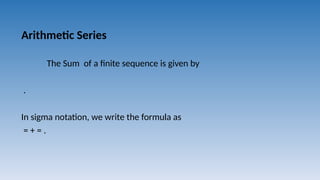
Arithmetic Series
The Sumof a finite sequence is given by
.
In sigma notation, we write the formula as
= + = .
24.
Example 11. Usingthe previous formula, we can now determine the
sum of the first 1,000 positive integers, that is,