7
Lesson Exemplar
for Mathematics
Lesson
1
Quarter 1
Quarter 1
Lesson Exemplar for Mathematics Grade 7
Quarter 1: Lesson 1 (Week 1)
SY 2024-2025
This material is intended exclusively for the use of teachers in the implementation of the MATATAG K to 10 Curriculum during the School Year 2024-
2025. It aims to assist in delivering the curriculum content, standards, and lesson competencies. Any unauthorized reproduction, distribution, modification, or
utilization of this material beyond the designated scope is strictly prohibited and may result in appropriate legal actions and disciplinary measures.
Borrowed content included in this material are owned by their respective copyright holders. Every effort has been made to locate and obtain permission
to use these materials from their respective copyright owners. The publisher and development team do not represent nor claim ownership over them.
Every care has been taken to ensure the accuracy of the information provided in this material. For inquiries or feedback, please write or call the Office
of the Director of the Bureau of Learning Resources via telephone numbers (02) 8634-1072 and 8631-6922 or by email at blr.od@deped.gov.ph.
Development Team
Writers:
• Magdalena C. Valdez
• Maria-Josephine T. Arguilles (Tinajeros National High School)
Validator:
• Aurora B. Gonzales, Ph.D. (Philippine Normal University – Manila)
Management Team
Philippine Normal University
Research Institute for Teacher Quality
SiMERR National Research Centre
1
MATHEMATICS / QUARTER 1 / GRADE 7
I. CURRICULUM CONTENT, STANDARDS, AND LESSON COMPETENCIES
A. Content
Standards
The learners demonstrate knowledge and understanding of:
1. regular and irregular polygons and their features/properties; and
2. determination of measures of angles and the number of sides of polygons.
B. Performance
Standards
By the end of the quarter, the learners are able to draw and describe the features/properties of regular and irregular
polygon.
C. Learning
Competencies
and Objectives
Learning Objectives:
At the end of the lesson, the learners will be able to:
1. Define a polygon.
2. Classify polygon according to its sides and as regular or irregular.
3. Name, describe, and compare regular and irregular polygons and polygons with 5, 6, 8, or 10 sides based on
measurements of sides and angles
4. Draw triangles, quadrilaterals and polygons with 5, 6, 8, or 10 using a ruler, protractor, and a compass
D. Content Properties of Regular and Irregular Polygons
E. Integration Paintings and Artwork, signboard etc.
II. LEARNING RESOURCES
DRAWINGEDUTECH. (n.d.). Introduction to perspective drawing [Video]. YouTube. https://www.youtube.com/watch?v=IJC6Cfb3Ck0
ikenschool. (n.d.). Learn basic English grammar [Video]. YouTube. https://www.youtube.com/watch?v=Pz64J1hJV8E
MathTuklaswithSirJojo. (n.d.). How to graph a quadratic function in standard form [Video]. YouTube.
https://www.youtube.com/watch?v=W_a7gywc6fg
Maythmatics. (n.d.). The beauty of mathematics [Video]. YouTube. https://www.youtube.com/watch?v=YyyNpgaNn_8
PAAcademy. (n.d.). The Fibonacci sequence and the golden ratio [Video]. YouTube. https://www.youtube.com/watch?v=SSxNxyx6FzY
RVTUTORIALS. (n.d.). Math 101: Introduction to algebra [Video]. YouTube. https://www.youtube.com/watch?v=ujz_8-zweEY
2
III. TEACHING AND LEARNING PROCEDURE NOTES TO TEACHERS
A. Activating Prior
Knowledge
DAY 1
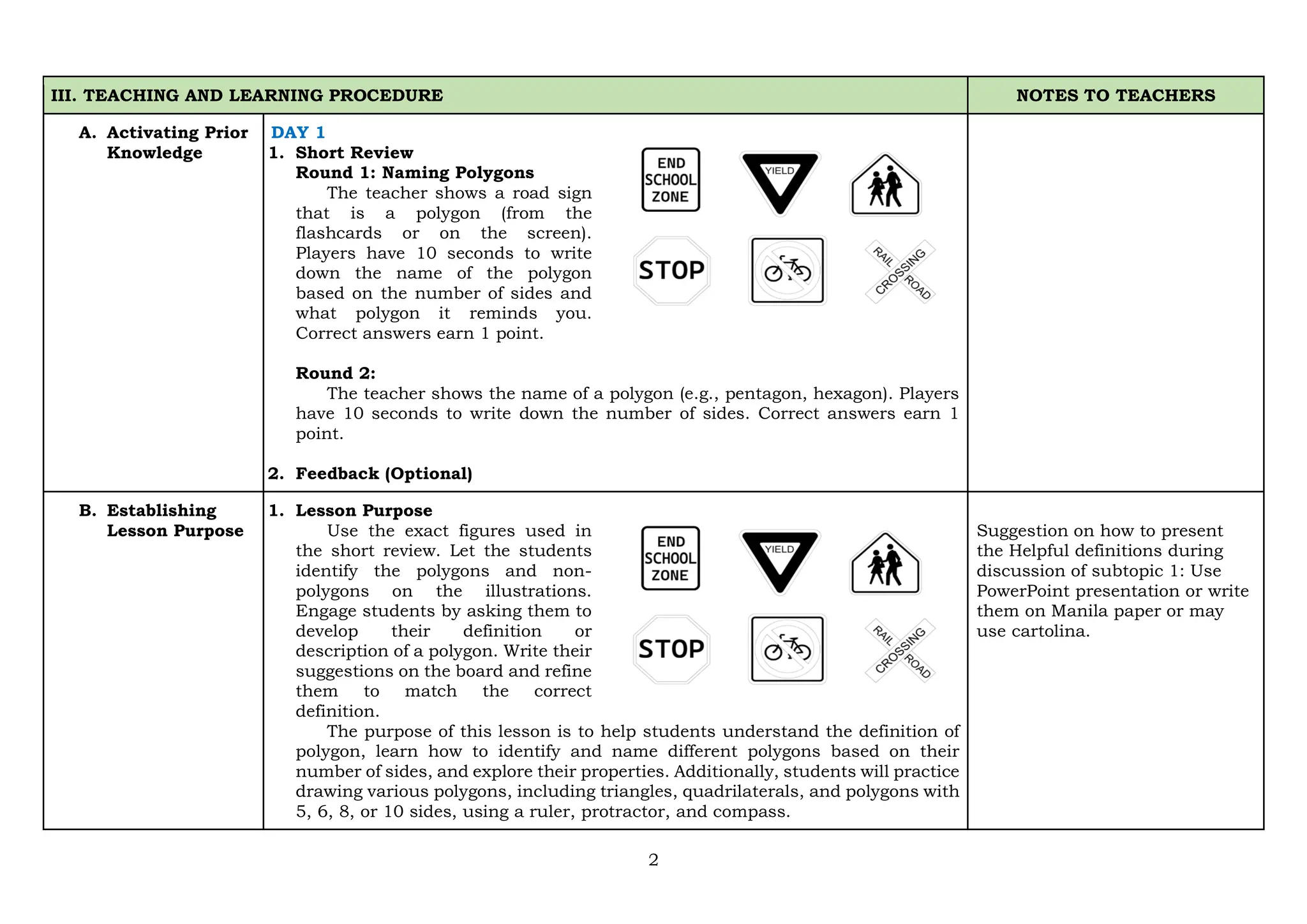
1. Short Review
Round 1: Naming Polygons
The teacher shows a road sign
that is a polygon (from the
flashcards or on the screen).
Players have 10 seconds to write
down the name of the polygon
based on the number of sides and
what polygon it reminds you.
Correct answers earn 1 point.
Round 2:
The teacher shows the name of a polygon (e.g., pentagon, hexagon). Players
have 10 seconds to write down the number of sides. Correct answers earn 1
point.
2. Feedback (Optional)
B. Establishing
Lesson Purpose
1. Lesson Purpose
Use the exact figures used in
the short review. Let the students
identify the polygons and non-
polygons on the illustrations.
Engage students by asking them to
develop their definition or
description of a polygon. Write their
suggestions on the board and refine
them to match the correct
definition.
The purpose of this lesson is to help students understand the definition of
polygon, learn how to identify and name different polygons based on their
number of sides, and explore their properties. Additionally, students will practice
drawing various polygons, including triangles, quadrilaterals, and polygons with
5, 6, 8, or 10 sides, using a ruler, protractor, and compass.
Suggestion on how to present
the Helpful definitions during
discussion of subtopic 1: Use
PowerPoint presentation or write
them on Manila paper or may
use cartolina.
3
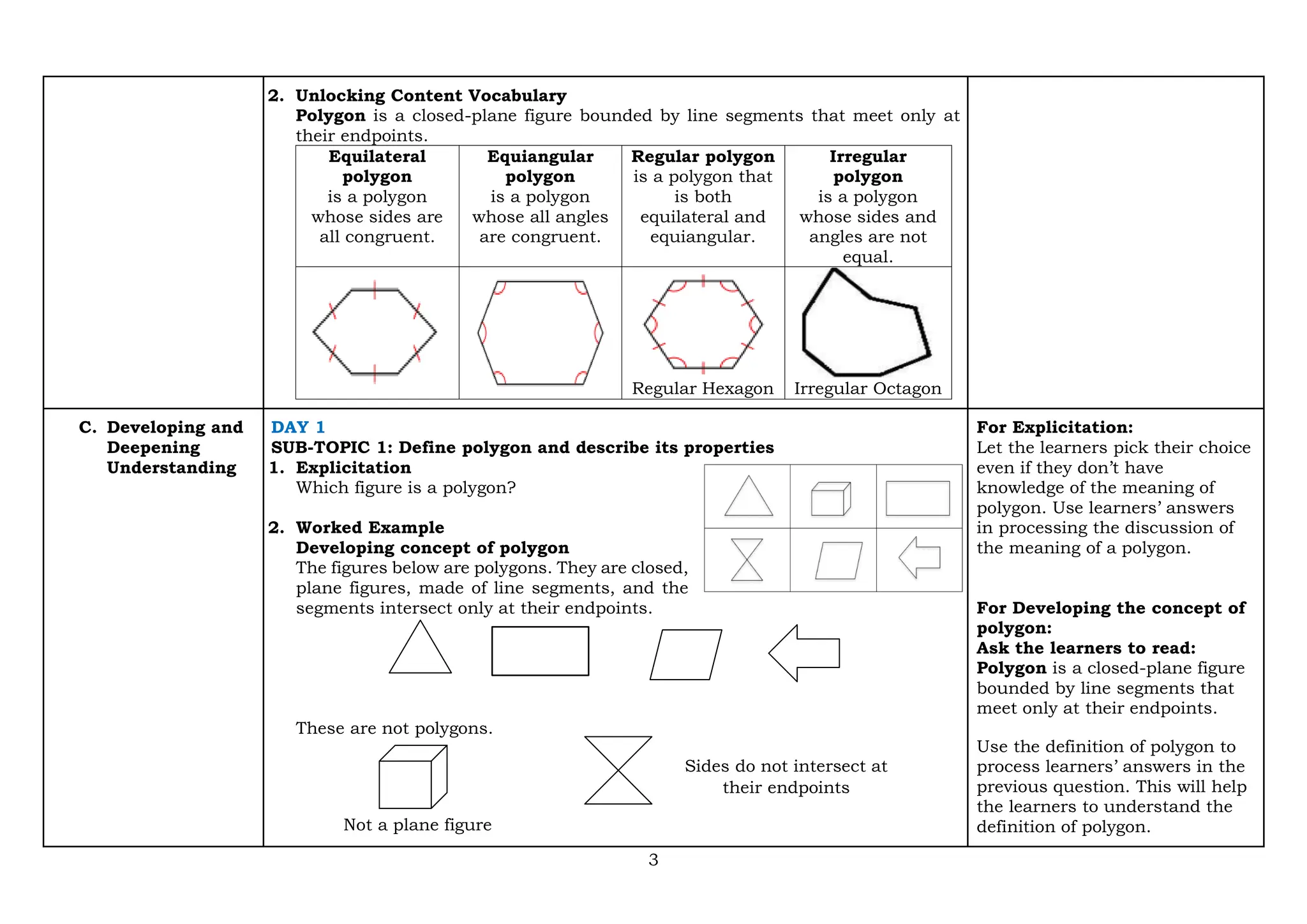
2. Unlocking Content Vocabulary
Polygon is a closed-plane figure bounded by line segments that meet only at
their endpoints.
Equilateral
polygon
is a polygon
whose sides are
all congruent.
Equiangular
polygon
is a polygon
whose all angles
are congruent.
Regular polygon
is a polygon that
is both
equilateral and
equiangular.
Irregular
polygon
is a polygon
whose sides and
angles are not
equal.
Regular Hexagon Irregular Octagon
C. Developing and
Deepening
Understanding
DAY 1
SUB-TOPIC 1: Define polygon and describe its properties
1. Explicitation
Which figure is a polygon?
2. Worked Example
Developing concept of polygon
The figures below are polygons. They are closed,
plane figures, made of line segments, and the
segments intersect only at their endpoints.
These are not polygons.
For Explicitation:
Let the learners pick their choice
even if they don’t have
knowledge of the meaning of
polygon. Use learners’ answers
in processing the discussion of
the meaning of a polygon.
For Developing the concept of
polygon:
Ask the learners to read:
Polygon is a closed-plane figure
bounded by line segments that
meet only at their endpoints.
Use the definition of polygon to
process learners’ answers in the
previous question. This will help
the learners to understand the
definition of polygon.
Not a plane figure
Sides do not intersect at
their endpoints
4
Ask the learner: What is a polygon?
Give your own example of a polygon or ask them to draw a polygon.
For formative evaluation, ask the learners to give/or draw a polygon that is not
the same with the examples found in your discussion.
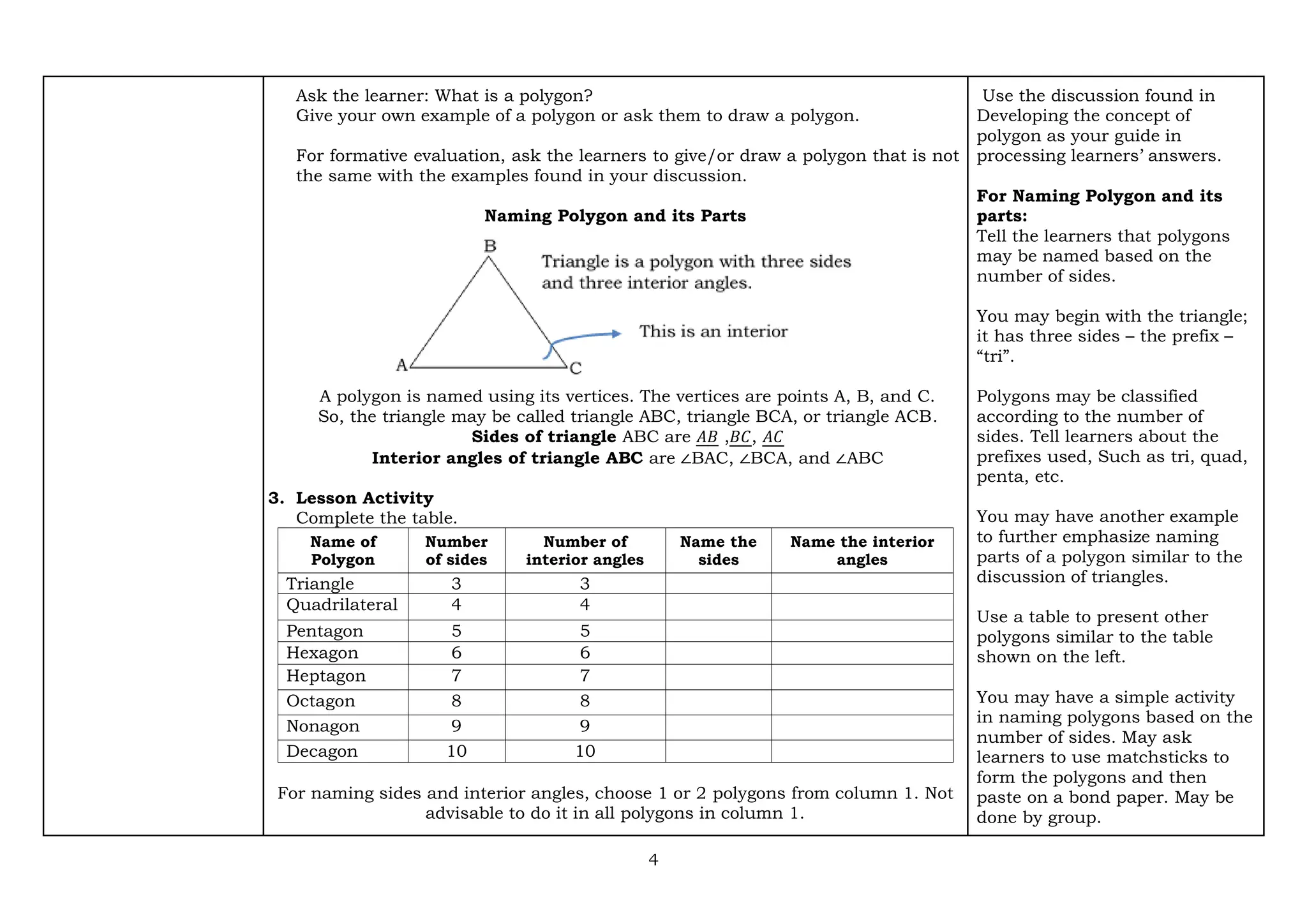
Naming Polygon and its Parts
A polygon is named using its vertices. The vertices are points A, B, and C.
So, the triangle may be called triangle ABC, triangle BCA, or triangle ACB.
Sides of triangle ABC are 𝐴𝐵 ,𝐵𝐶, 𝐴𝐶
Interior angles of triangle ABC are ∠BAC, ∠BCA, and ∠ABC
3. Lesson Activity
Complete the table.
Name of
Polygon
Number
of sides
Number of
interior angles
Name the
sides
Name the interior
angles
Triangle 3 3
Quadrilateral 4 4
Pentagon 5 5
Hexagon 6 6
Heptagon 7 7
Octagon 8 8
Nonagon 9 9
Decagon 10 10
For naming sides and interior angles, choose 1 or 2 polygons from column 1. Not
advisable to do it in all polygons in column 1.
Use the discussion found in
Developing the concept of
polygon as your guide in
processing learners’ answers.
For Naming Polygon and its
parts:
Tell the learners that polygons
may be named based on the
number of sides.
You may begin with the triangle;
it has three sides – the prefix –
“tri”.
Polygons may be classified
according to the number of
sides. Tell learners about the
prefixes used, Such as tri, quad,
penta, etc.
You may have another example
to further emphasize naming
parts of a polygon similar to the
discussion of triangles.
Use a table to present other
polygons similar to the table
shown on the left.
You may have a simple activity
in naming polygons based on the
number of sides. May ask
learners to use matchsticks to
form the polygons and then
paste on a bond paper. May be
done by group.
5
DAY 2
SUB-TOPIC 2: Name, describe, and compare regular and irregular polygons
with 5, 6, 8, or 10 sides based on measurements of sides and angles
1. Explicitation
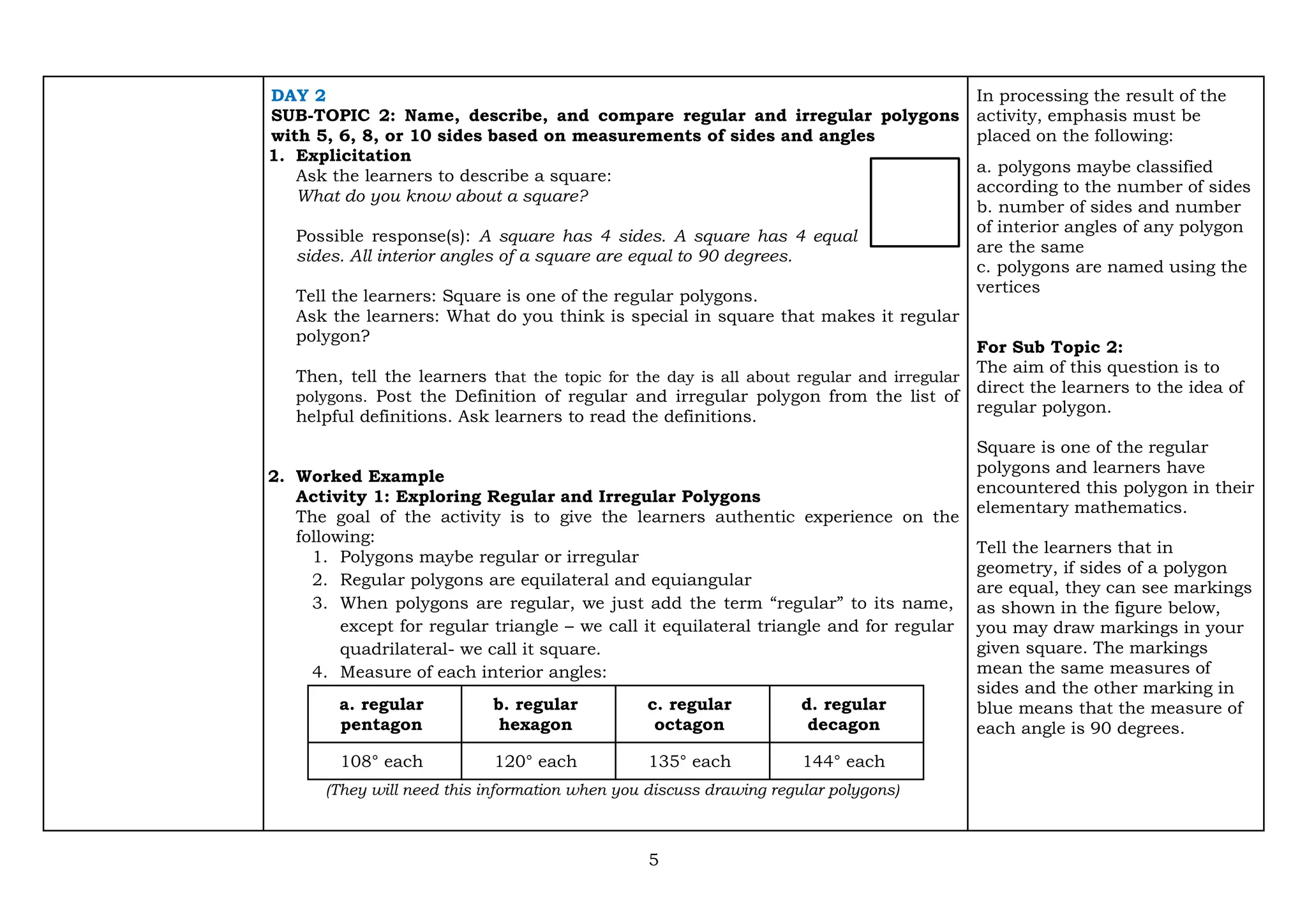
Ask the learners to describe a square:
What do you know about a square?
Possible response(s): A square has 4 sides. A square has 4 equal
sides. All interior angles of a square are equal to 90 degrees.
Tell the learners: Square is one of the regular polygons.
Ask the learners: What do you think is special in square that makes it regular
polygon?
Then, tell the learners that the topic for the day is all about regular and irregular
polygons. Post the Definition of regular and irregular polygon from the list of
helpful definitions. Ask learners to read the definitions.
2. Worked Example
Activity 1: Exploring Regular and Irregular Polygons
The goal of the activity is to give the learners authentic experience on the
following:
1. Polygons maybe regular or irregular
2. Regular polygons are equilateral and equiangular
3. When polygons are regular, we just add the term “regular” to its name,
except for regular triangle – we call it equilateral triangle and for regular
quadrilateral- we call it square.
4. Measure of each interior angles:
a. regular
pentagon
b. regular
hexagon
c. regular
octagon
d. regular
decagon
108° each 120° each 135° each 144° each
(They will need this information when you discuss drawing regular polygons)
In processing the result of the
activity, emphasis must be
placed on the following:
a. polygons maybe classified
according to the number of sides
b. number of sides and number
of interior angles of any polygon
are the same
c. polygons are named using the
vertices
For Sub Topic 2:
The aim of this question is to
direct the learners to the idea of
regular polygon.
Square is one of the regular
polygons and learners have
encountered this polygon in their
elementary mathematics.
Tell the learners that in
geometry, if sides of a polygon
are equal, they can see markings
as shown in the figure below,
you may draw markings in your
given square. The markings
mean the same measures of
sides and the other marking in
blue means that the measure of
each angle is 90 degrees.
6
5. the sum of the interior angles:
for regular and
irregular
pentagon
for regular and
irregular
hexagon
for regular and
irregular
octagon
for regular and
irregular
decagon
540° 720° 1080° 1,440°
3. Lesson Activity
Activity 1: Exploring Regular and Irregular Polygons
Length of
each side
Length of
each angle
Name of the
polygon
Classify as regular
or irregular polygon
Draw /paste/attach here a regular
pentagon with side lengths equal to
3 cm each. Angle measurements are
108° each.
Draw /paste/attach here a pentagon
with different side lengths. Use
definite lengths only in centimeters.
Draw /paste/attach here a hexagon
with different side lengths. Use
definite lengths only in centimeters.
Draw /paste/attach here a regular
hexagon with side lengths equal to 3
cm each. Angle measurements are
120° each.
Draw /paste/attach here an octagon
with different side lengths. Use
definite lengths only in centimeters.
Draw /paste/attach here a regular
octagon with side lengths equal to
1.5cm each. Angle measurements are
135° each.
Draw /paste/attach here a decagon
with different side lengths. Use
definite lengths only in centimeters.
Draw /paste/attach here a regular
decagon with side lengths equal to 1
cm each. Angle measurements are
144° each.
(Side length assignment for each polygon may be changed)
For the polygons in column 1 of
Activity 1: It is highly
recommended that the
polygons on the first column
must have definite length for
each side and interior angle
measurements. This is to
achieve the goal of the activity.
You may construct regular
polygons from Geogebra for exact
measurements or download from
the internet, or construct
manually (see subtopic 2 on how
to do it) using compass, ruler,
and protractor.
Activity 1 should be done as a
collaborative work. Prepare at
least five (5) sets of this. Tell the
learners that in each group,
there must be a team lead to
guide the members in
accomplishing the task.
Better, if you will model first to
the learners how to measure side
lengths of a polygon using ruler
and how to measure an interior
angle of a polygon using
protractor.
7
Activity 2: “Who Am I?”
This learning activity should be given as an exercise to end Day 1.
DAY 3-4
SUB-TOPIC 3: Draw polygons with 5, 6, 8, or 10 sides using a ruler, protractor,
and a compass.
1. Explicitation
Begin the session by reviewing the information gathered from doing Activity 1.
You may prepare a short game in a quiz bee format for the recall of the
information.
Quiz Bee: Polygon Identification and Properties
Questions:
1. What do you call a polygon with 6 sides?
2. What is the sum of the interior angles of an octagon?
3. A polygon has 10 sides. What is it called?
4. What is a polygon called if all its sides and angles are equal?
5. What is the measure of each interior angle of a regular hexagon?
6. What do you call a polygon with 8 sides?
7. What do you call a polygon with 5 sides?
8. A polygon has 4 sides. What is it called and how is it classified if all sides
and angles are equal?
9. What do you call a polygon with 7 sides?
2. Worked Example
Activity 3: Drawing Polygons
Instructions: Draw each polygon using your ruler, protractor, and compass.
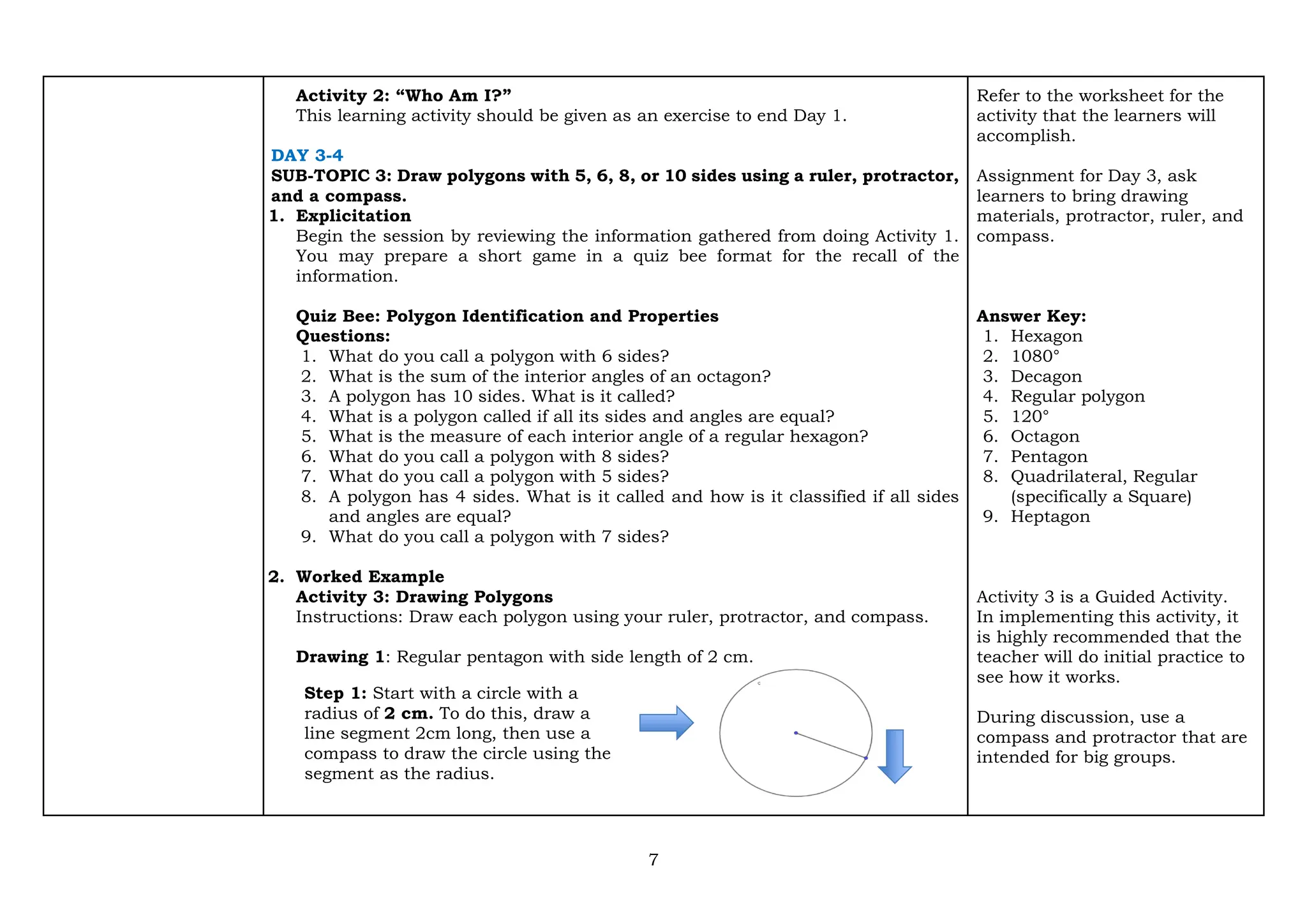
Drawing 1: Regular pentagon with side length of 2 cm.
Step 1: Start with a circle with a
radius of 2 cm. To do this, draw a
line segment 2cm long, then use a
compass to draw the circle using the
segment as the radius.
Refer to the worksheet for the
activity that the learners will
accomplish.
Assignment for Day 3, ask
learners to bring drawing
materials, protractor, ruler, and
compass.
Answer Key:
1. Hexagon
2. 1080°
3. Decagon
4. Regular polygon
5. 120°
6. Octagon
7. Pentagon
8. Quadrilateral, Regular
(specifically a Square)
9. Heptagon
Activity 3 is a Guided Activity.
In implementing this activity, it
is highly recommended that the
teacher will do initial practice to
see how it works.
During discussion, use a
compass and protractor that are
intended for big groups.
8
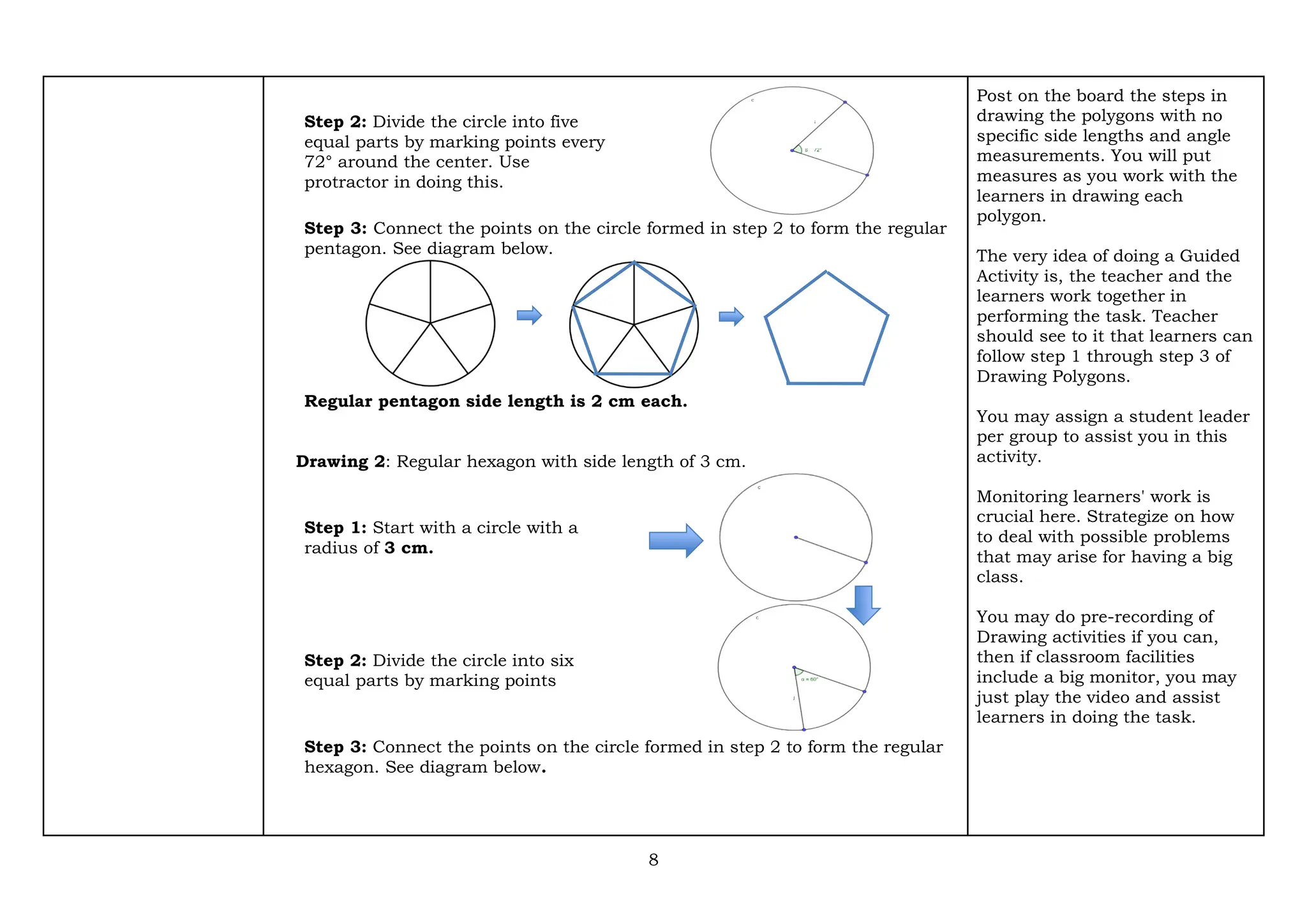
Step 2: Divide the circle into five
equal parts by marking points every
72° around the center. Use
protractor in doing this.
Step 3: Connect the points on the circle formed in step 2 to form the regular
pentagon. See diagram below.
Regular pentagon side length is 2 cm each.
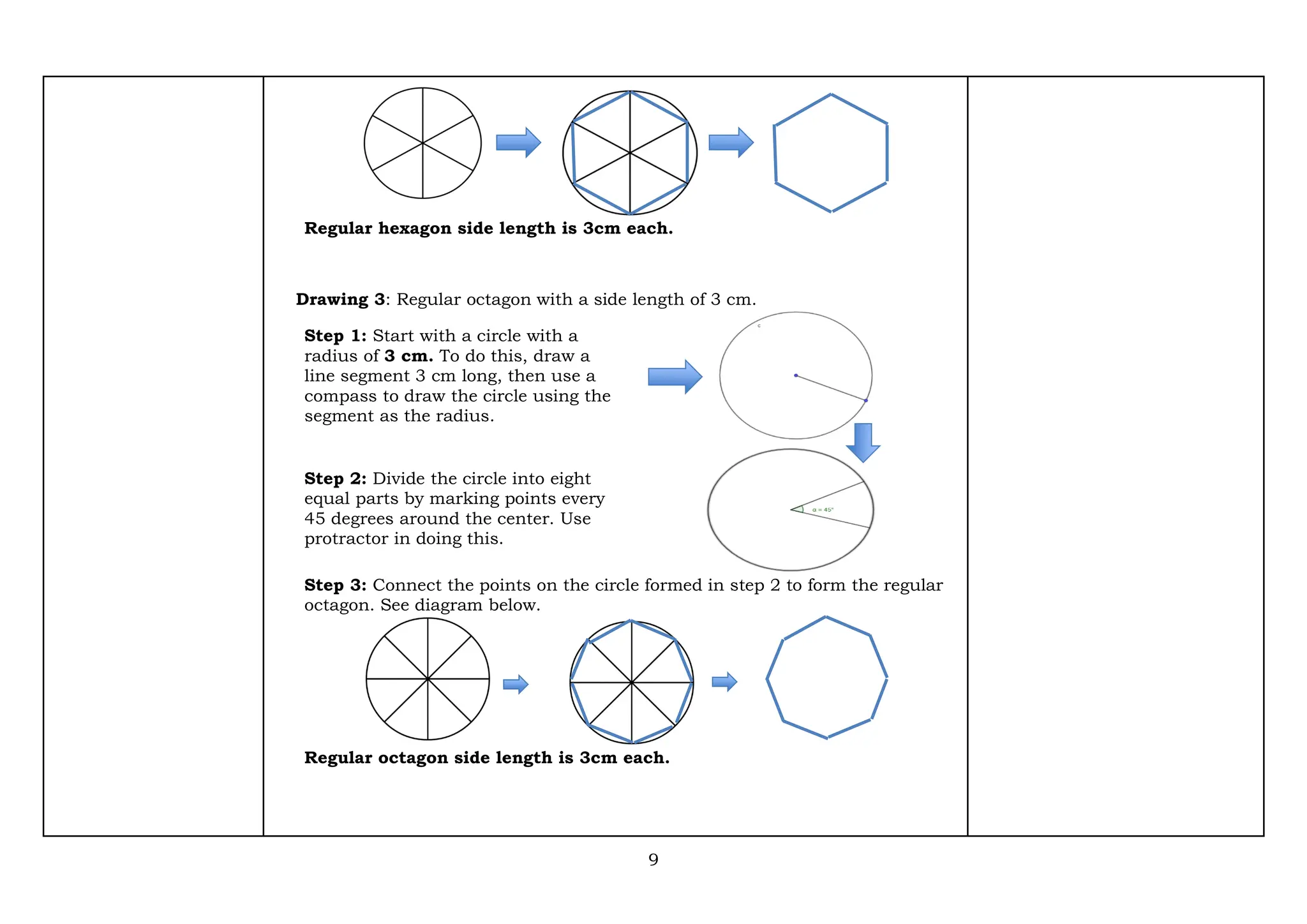
Drawing 2: Regular hexagon with side length of 3 cm.
Step 1: Start with a circle with a
radius of 3 cm.
Step 2: Divide the circle into six
equal parts by marking points
Step 3: Connect the points on the circle formed in step 2 to form the regular
hexagon. See diagram below.
Post on the board the steps in
drawing the polygons with no
specific side lengths and angle
measurements. You will put
measures as you work with the
learners in drawing each
polygon.
The very idea of doing a Guided
Activity is, the teacher and the
learners work together in
performing the task. Teacher
should see to it that learners can
follow step 1 through step 3 of
Drawing Polygons.
You may assign a student leader
per group to assist you in this
activity.
Monitoring learners' work is
crucial here. Strategize on how
to deal with possible problems
that may arise for having a big
class.
You may do pre-recording of
Drawing activities if you can,
then if classroom facilities
include a big monitor, you may
just play the video and assist
learners in doing the task.
9
Regular hexagon side length is 3cm each.
Drawing 3: Regular octagon with a side length of 3 cm.
Step 1: Start with a circle with a
radius of 3 cm. To do this, draw a
line segment 3 cm long, then use a
compass to draw the circle using the
segment as the radius.
Step 2: Divide the circle into eight
equal parts by marking points every
45 degrees around the center. Use
protractor in doing this.
Step 3: Connect the points on the circle formed in step 2 to form the regular
octagon. See diagram below.
Regular octagon side length is 3cm each.
10
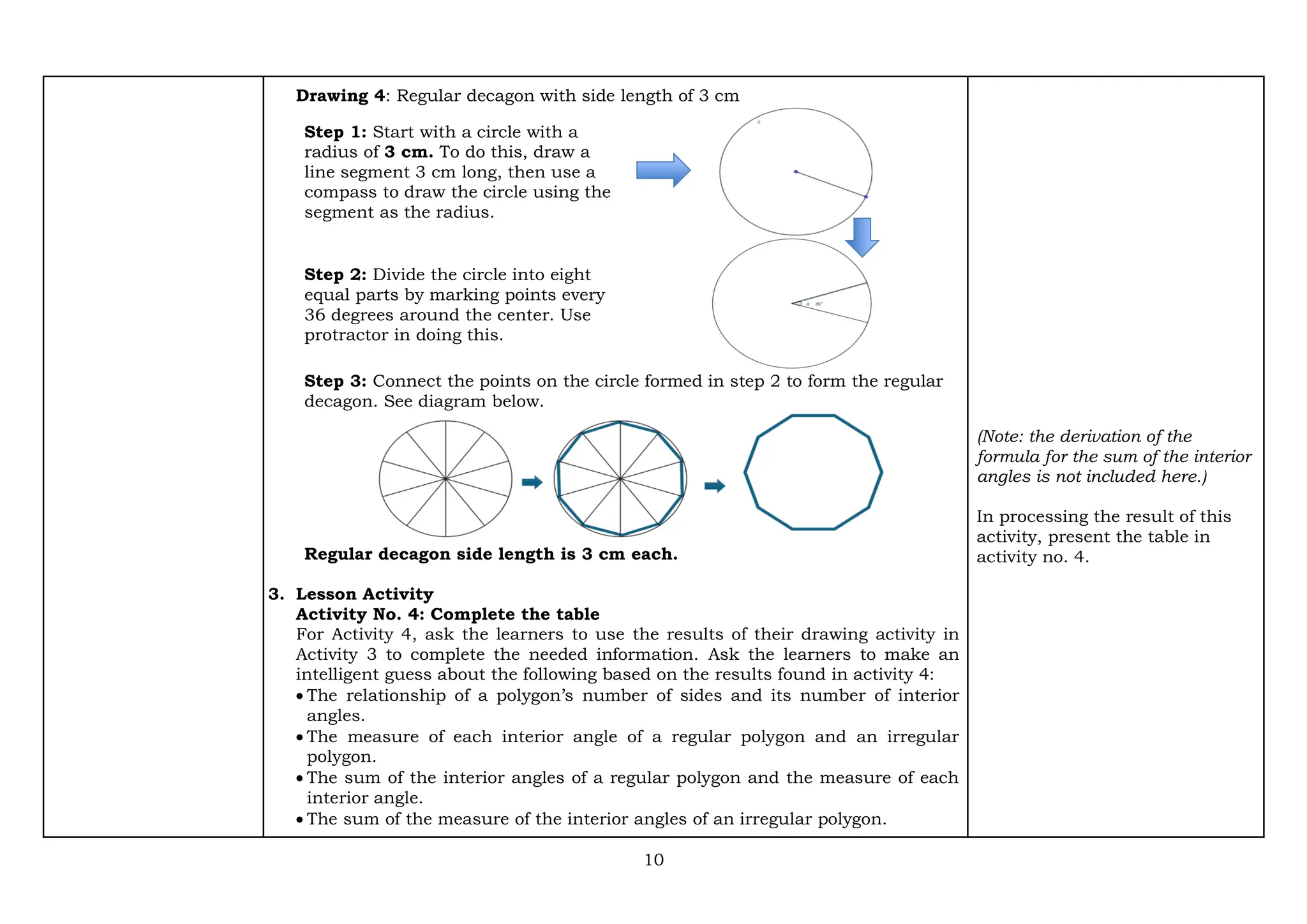
Drawing 4: Regular decagon with side length of 3 cm
Step 1: Start with a circle with a
radius of 3 cm. To do this, draw a
line segment 3 cm long, then use a
compass to draw the circle using the
segment as the radius.
Step 2: Divide the circle into eight
equal parts by marking points every
36 degrees around the center. Use
protractor in doing this.
Step 3: Connect the points on the circle formed in step 2 to form the regular
decagon. See diagram below.
Regular decagon side length is 3 cm each.
3. Lesson Activity
Activity No. 4: Complete the table
For Activity 4, ask the learners to use the results of their drawing activity in
Activity 3 to complete the needed information. Ask the learners to make an
intelligent guess about the following based on the results found in activity 4:
• The relationship of a polygon’s number of sides and its number of interior
angles.
• The measure of each interior angle of a regular polygon and an irregular
polygon.
• The sum of the interior angles of a regular polygon and the measure of each
interior angle.
• The sum of the measure of the interior angles of an irregular polygon.
(Note: the derivation of the
formula for the sum of the interior
angles is not included here.)
In processing the result of this
activity, present the table in
activity no. 4.
11
Activity 5: Drawing triangles and quadrilaterals
This activity may be given as a group task. They will need to use their experience
in Activity 3 to be able to draw the given polygon.
D. Making
Generalizations
1. Learners’ Takeaways
• Can you think of real-life examples where understanding how to construct
polygons, triangles, or quadrilaterals would be beneficial?
• What are some strategies for ensuring accuracy when measuring angles and
side lengths in geometric constructions?
2. Reflection on Learning
Reflect on any challenges you faced during the drawing process and how you
addressed them during the lesson of Regular Polygons.
IV. EVALUATING LEARNING: FORMATIVE ASSESSMENT AND TEACHER’S REFLECTION NOTES TO TEACHERS
A. Evaluating
Learning
DAY 4
1. Formative Assessment
I. Fill in the blank with the correct word to make the statement true.
1. __________ are closed plane figures that are formed by straight line
segments that meet only at their endpoints.
2. Polygons are classified according to the number of __________.
3. __________ are polygons with all of its sides and angles equal.
4. __________ are quadrilaterals with 4 right angles & have all sides equal.
5. __________ is a five-sided polygon with equal sides and equal angles.
6. __________ are polygons that have non-congruent sides.
7. __________ is an eight-sided polygon with unequal sides.
8. __________ is a three-sided polygon with equal sides.
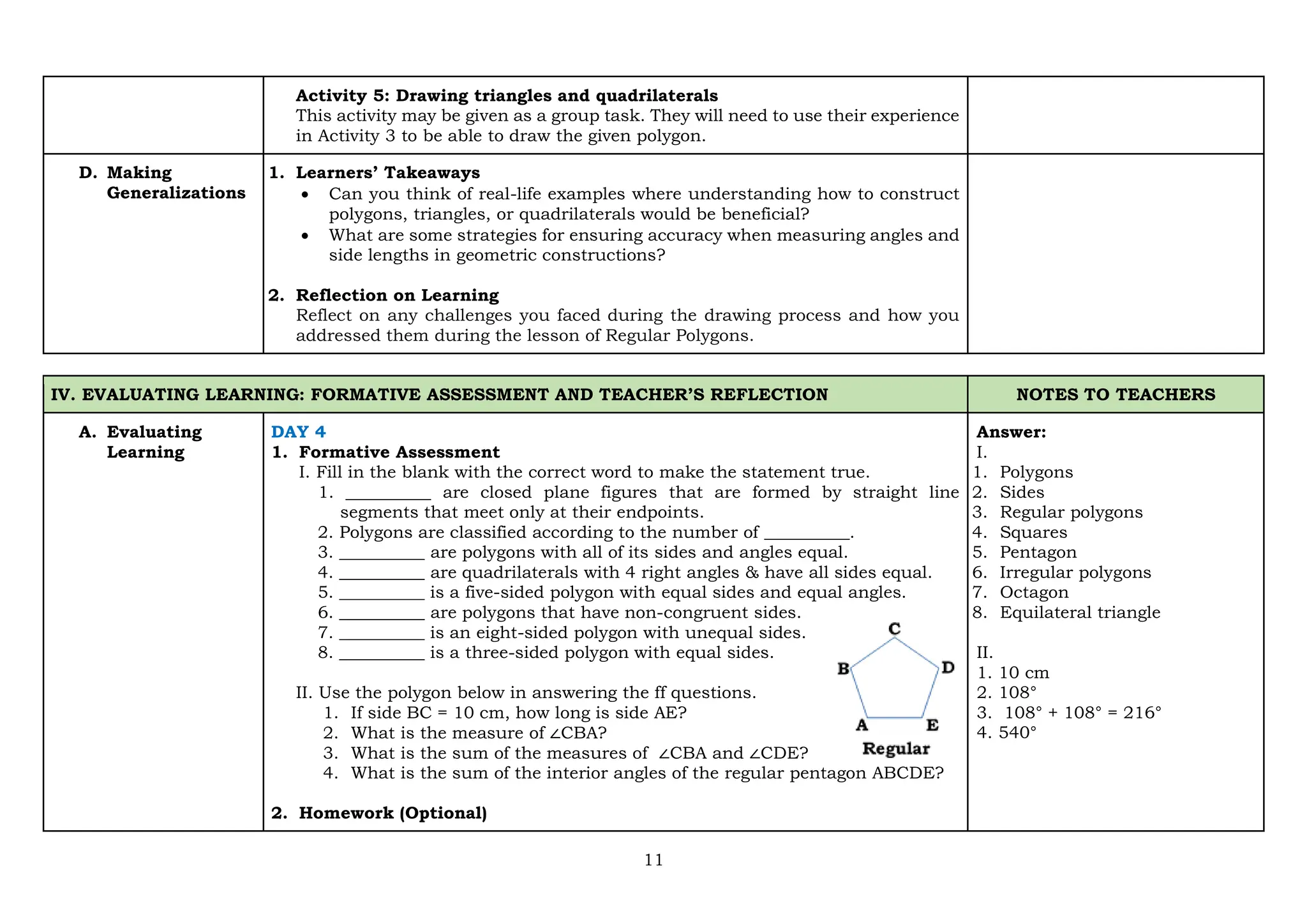
II. Use the polygon below in answering the ff questions.
1. If side BC = 10 cm, how long is side AE?
2. What is the measure of ∠CBA?
3. What is the sum of the measures of ∠CBA and ∠CDE?
4. What is the sum of the interior angles of the regular pentagon ABCDE?
2. Homework (Optional)
Answer:
I.
1. Polygons
2. Sides
3. Regular polygons
4. Squares
5. Pentagon
6. Irregular polygons
7. Octagon
8. Equilateral triangle
II.
1. 10 cm
2. 108°
3. 108° + 108° = 216°
4. 540°
12
B. Teacher’s
Remarks
Note observations on any
of the following areas:
Effective Practices Problems Encountered
The teacher may take note of
some observations related to the
effective practices and problems
encountered after utilizing the
different strategies, materials
used, learner engagement, and
other related stuff.
Teachers may also suggest ways
to improve the different activities
explored/lesson exemplar.
strategies explored
materials used
learner engagement/
interaction
others
C. Teacher’s
Reflection
Reflection guide or prompt can be on:
• principles behind the teaching
What principles and beliefs informed my lesson?
Why did I teach the lesson the way I did?
• students
What roles did my students play in my lesson?
What did my students learn? How did they learn?
• ways forward
What could I have done differently?
What can I explore in the next lesson?
Teacher’s reflection in every
lesson conducted/facilitated is
essential and necessary to
improve practice. You may also
consider this as an input for the
LAC/Collab sessions.

Mathematics 7:Lesson 1- Week 1 Exemplar .pdf

  • 1.
  • 2.
    Lesson Exemplar forMathematics Grade 7 Quarter 1: Lesson 1 (Week 1) SY 2024-2025 This material is intended exclusively for the use of teachers in the implementation of the MATATAG K to 10 Curriculum during the School Year 2024- 2025. It aims to assist in delivering the curriculum content, standards, and lesson competencies. Any unauthorized reproduction, distribution, modification, or utilization of this material beyond the designated scope is strictly prohibited and may result in appropriate legal actions and disciplinary measures. Borrowed content included in this material are owned by their respective copyright holders. Every effort has been made to locate and obtain permission to use these materials from their respective copyright owners. The publisher and development team do not represent nor claim ownership over them. Every care has been taken to ensure the accuracy of the information provided in this material. For inquiries or feedback, please write or call the Office of the Director of the Bureau of Learning Resources via telephone numbers (02) 8634-1072 and 8631-6922 or by email at blr.od@deped.gov.ph. Development Team Writers: • Magdalena C. Valdez • Maria-Josephine T. Arguilles (Tinajeros National High School) Validator: • Aurora B. Gonzales, Ph.D. (Philippine Normal University – Manila) Management Team Philippine Normal University Research Institute for Teacher Quality SiMERR National Research Centre
  • 3.
    1 MATHEMATICS / QUARTER1 / GRADE 7 I. CURRICULUM CONTENT, STANDARDS, AND LESSON COMPETENCIES A. Content Standards The learners demonstrate knowledge and understanding of: 1. regular and irregular polygons and their features/properties; and 2. determination of measures of angles and the number of sides of polygons. B. Performance Standards By the end of the quarter, the learners are able to draw and describe the features/properties of regular and irregular polygon. C. Learning Competencies and Objectives Learning Objectives: At the end of the lesson, the learners will be able to: 1. Define a polygon. 2. Classify polygon according to its sides and as regular or irregular. 3. Name, describe, and compare regular and irregular polygons and polygons with 5, 6, 8, or 10 sides based on measurements of sides and angles 4. Draw triangles, quadrilaterals and polygons with 5, 6, 8, or 10 using a ruler, protractor, and a compass D. Content Properties of Regular and Irregular Polygons E. Integration Paintings and Artwork, signboard etc. II. LEARNING RESOURCES DRAWINGEDUTECH. (n.d.). Introduction to perspective drawing [Video]. YouTube. https://www.youtube.com/watch?v=IJC6Cfb3Ck0 ikenschool. (n.d.). Learn basic English grammar [Video]. YouTube. https://www.youtube.com/watch?v=Pz64J1hJV8E MathTuklaswithSirJojo. (n.d.). How to graph a quadratic function in standard form [Video]. YouTube. https://www.youtube.com/watch?v=W_a7gywc6fg Maythmatics. (n.d.). The beauty of mathematics [Video]. YouTube. https://www.youtube.com/watch?v=YyyNpgaNn_8 PAAcademy. (n.d.). The Fibonacci sequence and the golden ratio [Video]. YouTube. https://www.youtube.com/watch?v=SSxNxyx6FzY RVTUTORIALS. (n.d.). Math 101: Introduction to algebra [Video]. YouTube. https://www.youtube.com/watch?v=ujz_8-zweEY
  • 4.
    2 III. TEACHING ANDLEARNING PROCEDURE NOTES TO TEACHERS A. Activating Prior Knowledge DAY 1 1. Short Review Round 1: Naming Polygons The teacher shows a road sign that is a polygon (from the flashcards or on the screen). Players have 10 seconds to write down the name of the polygon based on the number of sides and what polygon it reminds you. Correct answers earn 1 point. Round 2: The teacher shows the name of a polygon (e.g., pentagon, hexagon). Players have 10 seconds to write down the number of sides. Correct answers earn 1 point. 2. Feedback (Optional) B. Establishing Lesson Purpose 1. Lesson Purpose Use the exact figures used in the short review. Let the students identify the polygons and non- polygons on the illustrations. Engage students by asking them to develop their definition or description of a polygon. Write their suggestions on the board and refine them to match the correct definition. The purpose of this lesson is to help students understand the definition of polygon, learn how to identify and name different polygons based on their number of sides, and explore their properties. Additionally, students will practice drawing various polygons, including triangles, quadrilaterals, and polygons with 5, 6, 8, or 10 sides, using a ruler, protractor, and compass. Suggestion on how to present the Helpful definitions during discussion of subtopic 1: Use PowerPoint presentation or write them on Manila paper or may use cartolina.
  • 5.
    3 2. Unlocking ContentVocabulary Polygon is a closed-plane figure bounded by line segments that meet only at their endpoints. Equilateral polygon is a polygon whose sides are all congruent. Equiangular polygon is a polygon whose all angles are congruent. Regular polygon is a polygon that is both equilateral and equiangular. Irregular polygon is a polygon whose sides and angles are not equal. Regular Hexagon Irregular Octagon C. Developing and Deepening Understanding DAY 1 SUB-TOPIC 1: Define polygon and describe its properties 1. Explicitation Which figure is a polygon? 2. Worked Example Developing concept of polygon The figures below are polygons. They are closed, plane figures, made of line segments, and the segments intersect only at their endpoints. These are not polygons. For Explicitation: Let the learners pick their choice even if they don’t have knowledge of the meaning of polygon. Use learners’ answers in processing the discussion of the meaning of a polygon. For Developing the concept of polygon: Ask the learners to read: Polygon is a closed-plane figure bounded by line segments that meet only at their endpoints. Use the definition of polygon to process learners’ answers in the previous question. This will help the learners to understand the definition of polygon. Not a plane figure Sides do not intersect at their endpoints
  • 6.
    4 Ask the learner:What is a polygon? Give your own example of a polygon or ask them to draw a polygon. For formative evaluation, ask the learners to give/or draw a polygon that is not the same with the examples found in your discussion. Naming Polygon and its Parts A polygon is named using its vertices. The vertices are points A, B, and C. So, the triangle may be called triangle ABC, triangle BCA, or triangle ACB. Sides of triangle ABC are 𝐴𝐵 ,𝐵𝐶, 𝐴𝐶 Interior angles of triangle ABC are ∠BAC, ∠BCA, and ∠ABC 3. Lesson Activity Complete the table. Name of Polygon Number of sides Number of interior angles Name the sides Name the interior angles Triangle 3 3 Quadrilateral 4 4 Pentagon 5 5 Hexagon 6 6 Heptagon 7 7 Octagon 8 8 Nonagon 9 9 Decagon 10 10 For naming sides and interior angles, choose 1 or 2 polygons from column 1. Not advisable to do it in all polygons in column 1. Use the discussion found in Developing the concept of polygon as your guide in processing learners’ answers. For Naming Polygon and its parts: Tell the learners that polygons may be named based on the number of sides. You may begin with the triangle; it has three sides – the prefix – “tri”. Polygons may be classified according to the number of sides. Tell learners about the prefixes used, Such as tri, quad, penta, etc. You may have another example to further emphasize naming parts of a polygon similar to the discussion of triangles. Use a table to present other polygons similar to the table shown on the left. You may have a simple activity in naming polygons based on the number of sides. May ask learners to use matchsticks to form the polygons and then paste on a bond paper. May be done by group.
  • 7.
    5 DAY 2 SUB-TOPIC 2:Name, describe, and compare regular and irregular polygons with 5, 6, 8, or 10 sides based on measurements of sides and angles 1. Explicitation Ask the learners to describe a square: What do you know about a square? Possible response(s): A square has 4 sides. A square has 4 equal sides. All interior angles of a square are equal to 90 degrees. Tell the learners: Square is one of the regular polygons. Ask the learners: What do you think is special in square that makes it regular polygon? Then, tell the learners that the topic for the day is all about regular and irregular polygons. Post the Definition of regular and irregular polygon from the list of helpful definitions. Ask learners to read the definitions. 2. Worked Example Activity 1: Exploring Regular and Irregular Polygons The goal of the activity is to give the learners authentic experience on the following: 1. Polygons maybe regular or irregular 2. Regular polygons are equilateral and equiangular 3. When polygons are regular, we just add the term “regular” to its name, except for regular triangle – we call it equilateral triangle and for regular quadrilateral- we call it square. 4. Measure of each interior angles: a. regular pentagon b. regular hexagon c. regular octagon d. regular decagon 108° each 120° each 135° each 144° each (They will need this information when you discuss drawing regular polygons) In processing the result of the activity, emphasis must be placed on the following: a. polygons maybe classified according to the number of sides b. number of sides and number of interior angles of any polygon are the same c. polygons are named using the vertices For Sub Topic 2: The aim of this question is to direct the learners to the idea of regular polygon. Square is one of the regular polygons and learners have encountered this polygon in their elementary mathematics. Tell the learners that in geometry, if sides of a polygon are equal, they can see markings as shown in the figure below, you may draw markings in your given square. The markings mean the same measures of sides and the other marking in blue means that the measure of each angle is 90 degrees.
  • 8.
    6 5. the sumof the interior angles: for regular and irregular pentagon for regular and irregular hexagon for regular and irregular octagon for regular and irregular decagon 540° 720° 1080° 1,440° 3. Lesson Activity Activity 1: Exploring Regular and Irregular Polygons Length of each side Length of each angle Name of the polygon Classify as regular or irregular polygon Draw /paste/attach here a regular pentagon with side lengths equal to 3 cm each. Angle measurements are 108° each. Draw /paste/attach here a pentagon with different side lengths. Use definite lengths only in centimeters. Draw /paste/attach here a hexagon with different side lengths. Use definite lengths only in centimeters. Draw /paste/attach here a regular hexagon with side lengths equal to 3 cm each. Angle measurements are 120° each. Draw /paste/attach here an octagon with different side lengths. Use definite lengths only in centimeters. Draw /paste/attach here a regular octagon with side lengths equal to 1.5cm each. Angle measurements are 135° each. Draw /paste/attach here a decagon with different side lengths. Use definite lengths only in centimeters. Draw /paste/attach here a regular decagon with side lengths equal to 1 cm each. Angle measurements are 144° each. (Side length assignment for each polygon may be changed) For the polygons in column 1 of Activity 1: It is highly recommended that the polygons on the first column must have definite length for each side and interior angle measurements. This is to achieve the goal of the activity. You may construct regular polygons from Geogebra for exact measurements or download from the internet, or construct manually (see subtopic 2 on how to do it) using compass, ruler, and protractor. Activity 1 should be done as a collaborative work. Prepare at least five (5) sets of this. Tell the learners that in each group, there must be a team lead to guide the members in accomplishing the task. Better, if you will model first to the learners how to measure side lengths of a polygon using ruler and how to measure an interior angle of a polygon using protractor.
  • 9.
    7 Activity 2: “WhoAm I?” This learning activity should be given as an exercise to end Day 1. DAY 3-4 SUB-TOPIC 3: Draw polygons with 5, 6, 8, or 10 sides using a ruler, protractor, and a compass. 1. Explicitation Begin the session by reviewing the information gathered from doing Activity 1. You may prepare a short game in a quiz bee format for the recall of the information. Quiz Bee: Polygon Identification and Properties Questions: 1. What do you call a polygon with 6 sides? 2. What is the sum of the interior angles of an octagon? 3. A polygon has 10 sides. What is it called? 4. What is a polygon called if all its sides and angles are equal? 5. What is the measure of each interior angle of a regular hexagon? 6. What do you call a polygon with 8 sides? 7. What do you call a polygon with 5 sides? 8. A polygon has 4 sides. What is it called and how is it classified if all sides and angles are equal? 9. What do you call a polygon with 7 sides? 2. Worked Example Activity 3: Drawing Polygons Instructions: Draw each polygon using your ruler, protractor, and compass. Drawing 1: Regular pentagon with side length of 2 cm. Step 1: Start with a circle with a radius of 2 cm. To do this, draw a line segment 2cm long, then use a compass to draw the circle using the segment as the radius. Refer to the worksheet for the activity that the learners will accomplish. Assignment for Day 3, ask learners to bring drawing materials, protractor, ruler, and compass. Answer Key: 1. Hexagon 2. 1080° 3. Decagon 4. Regular polygon 5. 120° 6. Octagon 7. Pentagon 8. Quadrilateral, Regular (specifically a Square) 9. Heptagon Activity 3 is a Guided Activity. In implementing this activity, it is highly recommended that the teacher will do initial practice to see how it works. During discussion, use a compass and protractor that are intended for big groups.
  • 10.
    8 Step 2: Dividethe circle into five equal parts by marking points every 72° around the center. Use protractor in doing this. Step 3: Connect the points on the circle formed in step 2 to form the regular pentagon. See diagram below. Regular pentagon side length is 2 cm each. Drawing 2: Regular hexagon with side length of 3 cm. Step 1: Start with a circle with a radius of 3 cm. Step 2: Divide the circle into six equal parts by marking points Step 3: Connect the points on the circle formed in step 2 to form the regular hexagon. See diagram below. Post on the board the steps in drawing the polygons with no specific side lengths and angle measurements. You will put measures as you work with the learners in drawing each polygon. The very idea of doing a Guided Activity is, the teacher and the learners work together in performing the task. Teacher should see to it that learners can follow step 1 through step 3 of Drawing Polygons. You may assign a student leader per group to assist you in this activity. Monitoring learners' work is crucial here. Strategize on how to deal with possible problems that may arise for having a big class. You may do pre-recording of Drawing activities if you can, then if classroom facilities include a big monitor, you may just play the video and assist learners in doing the task.
  • 11.
    9 Regular hexagon sidelength is 3cm each. Drawing 3: Regular octagon with a side length of 3 cm. Step 1: Start with a circle with a radius of 3 cm. To do this, draw a line segment 3 cm long, then use a compass to draw the circle using the segment as the radius. Step 2: Divide the circle into eight equal parts by marking points every 45 degrees around the center. Use protractor in doing this. Step 3: Connect the points on the circle formed in step 2 to form the regular octagon. See diagram below. Regular octagon side length is 3cm each.
  • 12.
    10 Drawing 4: Regulardecagon with side length of 3 cm Step 1: Start with a circle with a radius of 3 cm. To do this, draw a line segment 3 cm long, then use a compass to draw the circle using the segment as the radius. Step 2: Divide the circle into eight equal parts by marking points every 36 degrees around the center. Use protractor in doing this. Step 3: Connect the points on the circle formed in step 2 to form the regular decagon. See diagram below. Regular decagon side length is 3 cm each. 3. Lesson Activity Activity No. 4: Complete the table For Activity 4, ask the learners to use the results of their drawing activity in Activity 3 to complete the needed information. Ask the learners to make an intelligent guess about the following based on the results found in activity 4: • The relationship of a polygon’s number of sides and its number of interior angles. • The measure of each interior angle of a regular polygon and an irregular polygon. • The sum of the interior angles of a regular polygon and the measure of each interior angle. • The sum of the measure of the interior angles of an irregular polygon. (Note: the derivation of the formula for the sum of the interior angles is not included here.) In processing the result of this activity, present the table in activity no. 4.
  • 13.
    11 Activity 5: Drawingtriangles and quadrilaterals This activity may be given as a group task. They will need to use their experience in Activity 3 to be able to draw the given polygon. D. Making Generalizations 1. Learners’ Takeaways • Can you think of real-life examples where understanding how to construct polygons, triangles, or quadrilaterals would be beneficial? • What are some strategies for ensuring accuracy when measuring angles and side lengths in geometric constructions? 2. Reflection on Learning Reflect on any challenges you faced during the drawing process and how you addressed them during the lesson of Regular Polygons. IV. EVALUATING LEARNING: FORMATIVE ASSESSMENT AND TEACHER’S REFLECTION NOTES TO TEACHERS A. Evaluating Learning DAY 4 1. Formative Assessment I. Fill in the blank with the correct word to make the statement true. 1. __________ are closed plane figures that are formed by straight line segments that meet only at their endpoints. 2. Polygons are classified according to the number of __________. 3. __________ are polygons with all of its sides and angles equal. 4. __________ are quadrilaterals with 4 right angles & have all sides equal. 5. __________ is a five-sided polygon with equal sides and equal angles. 6. __________ are polygons that have non-congruent sides. 7. __________ is an eight-sided polygon with unequal sides. 8. __________ is a three-sided polygon with equal sides. II. Use the polygon below in answering the ff questions. 1. If side BC = 10 cm, how long is side AE? 2. What is the measure of ∠CBA? 3. What is the sum of the measures of ∠CBA and ∠CDE? 4. What is the sum of the interior angles of the regular pentagon ABCDE? 2. Homework (Optional) Answer: I. 1. Polygons 2. Sides 3. Regular polygons 4. Squares 5. Pentagon 6. Irregular polygons 7. Octagon 8. Equilateral triangle II. 1. 10 cm 2. 108° 3. 108° + 108° = 216° 4. 540°
  • 14.
    12 B. Teacher’s Remarks Note observationson any of the following areas: Effective Practices Problems Encountered The teacher may take note of some observations related to the effective practices and problems encountered after utilizing the different strategies, materials used, learner engagement, and other related stuff. Teachers may also suggest ways to improve the different activities explored/lesson exemplar. strategies explored materials used learner engagement/ interaction others C. Teacher’s Reflection Reflection guide or prompt can be on: • principles behind the teaching What principles and beliefs informed my lesson? Why did I teach the lesson the way I did? • students What roles did my students play in my lesson? What did my students learn? How did they learn? • ways forward What could I have done differently? What can I explore in the next lesson? Teacher’s reflection in every lesson conducted/facilitated is essential and necessary to improve practice. You may also consider this as an input for the LAC/Collab sessions.