An introduction to looking at
             Shapes
 Grade   Level: Kindergarten *(can be
  modified for K-6)*
 Topic: Geometry
Class Setting:
This will be a whole group lesson where the students will listen
to the teacher read a book aloud and then participate in a group
discussion on shapes. Students that have a tendency to “Tune
out,” or are distracted easily during whole-group settings, may
need their seats to be moved closer to the teacher.
Concepts
In kindergarten, students are introduced to the different
geometric shapes: Rectangle, Square, Diamond (Rhombus),
Oval, Circle, and Triangle. Students need to be able to
recognize these different shapes by sight, as well as be able to
distinguish and describe the attributes or characteristics that
make each shape different from one another. A lesson such as
this one requires students to display their knowledge by
identifying shapes, by properly describing the attributes of each
shape that distinguishes it from other shapes, and then using
them to create a drawing that represents a real life situation.
Background
   Teacher Background
           Ability to recognize and describe the following geometric
            shapes: Rectangle, Square, Diamond (Rhombus), Oval, Circle,
            and Triangle
           Ability to make observations and communicate them effectively
   Student Background
           Ability to recognize and describe the following geometric
            shapes: Rectangle, Square, Diamond (Rhombus), Oval, Circle,
            and Triangle
           Ability to make observations and communicate them effectively
           Ability to use pencil, scissors, and glue stick
Connection To Other Areas

The students will become familiar with different geometric
shapes by noticing that they occur in the natural world that
exists around them. This real world connection of observing
how shapes appear in everyday objects helps to give the
students the experience of seeing how the abstract concepts
and topics of mathematics have a consistent, logical and
coherent connection to the experiences that they know first-
hand, thus making their understanding of the concepts more
meaningful.
Connection To Past And
     Future Lessons
This lesson will introduce the students to the content of recognizing and
describing geometric shapes by using the correct mathematical terminology. In
past lessons, students may have been able to recognize and describe geometric
shapes, but did so without using the correct vocabulary, which means they did
not fully possess understanding of geometric shapes. In order to complete
future lessons in the correct manner, students must master this lesson’s
geometry content by becoming familiar with the different geometric shapes and
the correct terminology for describing them. By completing this lesson, the
student will be able to identify and describe a geometric shape in a context that
is familiar to them (drawing that they will make) which demonstrates their
understanding of the content of the lesson. Each subsequent and related lesson
will give the students more opportunities to test and utilize their understanding of
the lesson’s content in new and different ways.
STANDARDS:
  Pennsylvania Department of Education
Approaches to Learning
AL 3: Demonstrate Reasoning and Problem Solving
AL 3.8 Classify, compare and contrast objects, events and experiences
Mathematics
2.4 Mathematical Reasoning and Connections
A. Use math vocabulary comparison terms when making predictions
    regarding the quantity, size, and shape of objects
2.9 Geometry
A. Identify common two and three-dimensional geometric shapes
D. Name and describe two-dimensional geometric shapes in real life
Temple University
     Performance Standards:
   Understanding Content
    Standard 6: The ability to teach
    subject-matter content so that it is
    understood
   Real-World Connections
    Standard 4: Teaching for all students
    that enhances Real-World Connections
OBJECTIVES/GOALS
Student will be able to:
         Brainstorm the different shapes that they already know and can identify
         Recognize and describe the following geometric shapes: Rectangle, Square, Diamond
          (Rhombus), Oval, Circle, and Triangle
         Look at these geometric shapes and discuss, identify, and describe them using the
          proper mathematical vocabulary
         Know the characteristics that make each shape unique and different from the other
          shapes
         Identify and describe the different types of 2-dimensional or 3-dimensional shapes and
          configurations that they notice in real life
         Demonstrate that they understand the content of the lesson by completing a picture
          that is comprised of different geometric shapes
         Recognize the logical and sequential connection to how a picture can be created by
          using the different geometric shapes to represent various real world objects/people
         Explain what shapes they used to make their picture
         Explain what their picture is a representation of by writing a sentence describing it
MATERIALS
Students:

       Worksheet
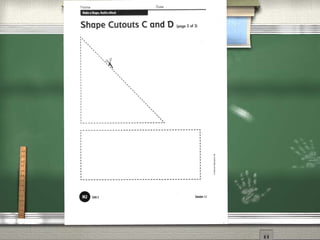
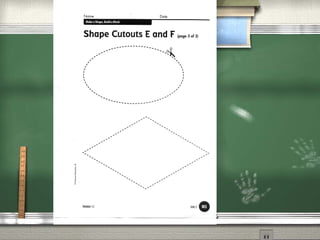
       Shapes cutouts   (Rectangle, Square, Diamond
        (Rhombus), Oval, Circle, and Triangle)
       Sample writing of shape’s name
       Pencil, scissors, colored pencils or crayons, glue stick
MATERIALS
Teacher:
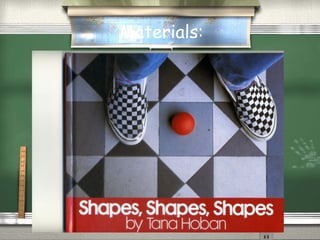
          Book: Hoban, Tonya (1986). Shapes, Shapes, Shapes. New
           York, NY: Greenwillow Books.
          Picture of or plastic manipulative for each of the different
           geometric shapes (Rectangle, Square, Diamond (Rhombus),
           Oval, Circle, and Triangle)
          Dry erase/chalk board or large pad of paper
          Dry erase pen, chalk, or marker
          Worksheet
          Shapes cutouts (Rectangle, Square, Diamond (Rhombus),
           Oval, Circle, and Triangle)
          Sample writing of shape’s name
          Pencil, scissors, colored pencils or crayons, glue stick
CLASSROOM
CLIMATE/TRANSITIONS
 Students  will sit on rug in whole group for the
  reading of the story and the discussion of what
  “Shapes” they see
 Students will then move to their seats for
  creation of “Shapes picture”
 Students will reconvene on rug as whole group
  to present work if time permits
PROCEDURE
Motivation Activity: Shapes Story/shapes discussion (10-15 minutes)
   Before reading the story, the teacher will ask the students to name and identify
   the different shapes that they already know. The students will have to describe
   how they can identify which shape is which, by giving the characteristics that
   qualify it as a particular shape. For example, a square is “Like a box” or a
   triangle has “Three pointy parts.”
           The teacher will make a list of these shapes/qualities on the
              board/paper
           The teacher will assess the list of shapes and verify that the shapes
              that the lesson is focusing on have been listed (i.e.: Rectangle, Square,
              Diamond (Rhombus), Oval, Circle, and Triangle)
           The teacher will add any shape that was not included to the list
           The teacher will tell the students that they will be reading a story about
              shapes that exist in the real world
           The teacher will read the story and ask the students to identify/describe
              the different shapes that they see
PROCEDURE
Activity 1: Shapes Picture (15-20 minutes)
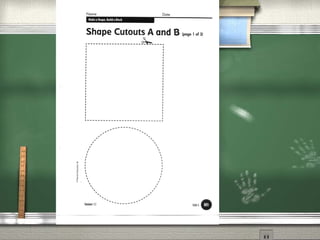
   After reading the book, the students will choose a shape cutout to use as the
   basis for creating a picture.
           The teacher will tell the students that they will be making a picture by
             taking one of the shapes cutouts and then adding things to it
           The teacher will explain that they will take one shape cutout and glue it
             onto their worksheet after they cut it out
           The teacher will explain that the students will then add other shapes or
             more drawing onto the worksheet to create a picture of something of
             their choice
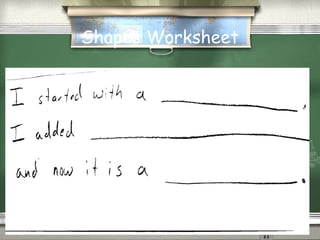
           The students will fill in the sentence that describes the picture that they
             created
           The students will fill in the sentence that identifies the different shapes
             that they used to make their picture
PROCEDURE
Closure Activity (5-10 Minutes)
  The teacher will select a few pictures that show understanding of the
  content and exemplary work. The students will reconvene on rug as a
  whole group. Selected students will be given the opportunity to share or
  present their shapes pictures to other members of the class. If the
  student is too shy to present, the teacher will ask if they can present the
  work for them. If time permits, the teacher will review with the students
  the different geometric shapes and their attributes by verbally quizzing
  them.
Transitions
Students will need to move into a seat on the
rug where they are able to see/hear the
teacher as they read the book or lead the
discussions. After the story and discussion
are over, the students will return to their seats
to complete the picture that they will make on
their worksheet
Materials:
Hoban, Tonya (1986). Shapes, Shapes, Shapes. New York, NY: Greenwillow Books.
Shapes Worksheet
ASSESSMENT

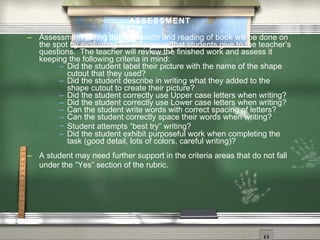
   Assessment during the discussion and reading of book will be done on
    the spot by evaluating the responses that students give to the teacher’s
    questions. The teacher will review the finished work and assess it
    keeping the following criteria in mind:
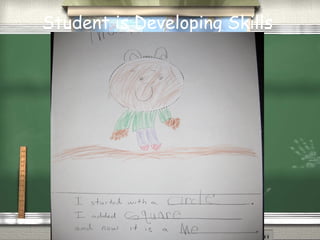
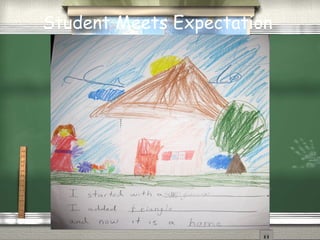
           Did the student label their picture with the name of the shape
            cutout that they used?
           Did the student describe in writing what they added to the
            shape cutout to create their picture?
           Did the student correctly use Upper case letters when writing?
           Did the student correctly use Lower case letters when writing?
           Can the student write words with correct spacing of letters?
           Can the student correctly space their words when writing?
           Student attempts “best try” writing?
           Did the student exhibit purposeful work when completing the
            task (good detail, lots of colors, careful writing)?
   A student may need further support in the criteria areas that do not fall
    under the “Yes” section of the rubric.
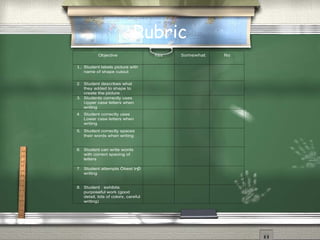
Rubric
           Objective                 Yes   Somewhat   No


1. Student labels picture with
   name of shape cutout


2. Student describes what
   they added to shape to
   create the picture
3. Students correctly uses
   Upper case letters when
   writing
4. Student correctly uses
   Lower case letters when
   writing
5. Student correctly spaces
   their words when writing


6. Student can write words
   with correct spacing of
   letters

7. Student attempts Òbest try
                            Ó
   writing


8. Student exhibits
   purposeful work (good
   detail, lots of colors, careful
   writing)
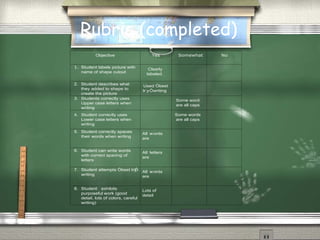
Rubric (completed)
           Objective                      Yes          Somewhat      No


1. Student labels picture with          Clearly
   name of shape cutout                labeled.

2. Student describes what            Used Òbest
   they added to shape to            tr y Ó writing
   create the picture
3. Students correctly uses                            Some word
   Upper case letters when
                                                      are all caps
   writing
4. Student correctly uses                             Some words
   Lower case letters when                            are all caps
   writing
5. Student correctly spaces          All w ords
   their words when writing          are


6. Student can write words           All letters
   with correct spacing of           are
   letters

7. Student attempts Òbest try
                            Ó        All w ords
   writing                           are


8. Student exhibits                  Lots of
   purposeful work (good
                                     detail
   detail, lots of colors, careful
   writing)
Sample Work
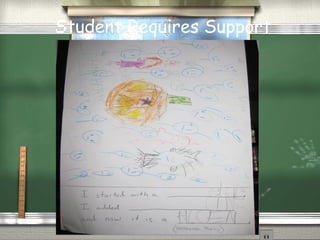
Student Requires Support
Student is Developing Skills
Student Meets Expectation
RESOURCES
   Hoban, Tonya (1986). Shapes, Shapes,
    Shapes. New York, NY: Greenwillow Books.
   Wittenberg, L., Economopoulos, K., Bastable,
    V., Bloomfield, K., Cochran, K., Earnest, D.,
    et al. Investigations in Number, Data and
    Space Second. Glenview, Illinois: Pearson
    Education, 2008. Session 1.1 pages 23-27.

Mathedlesson

  • 1.
    An introduction tolooking at Shapes Grade Level: Kindergarten *(can be modified for K-6)* Topic: Geometry
  • 2.
    Class Setting: This willbe a whole group lesson where the students will listen to the teacher read a book aloud and then participate in a group discussion on shapes. Students that have a tendency to “Tune out,” or are distracted easily during whole-group settings, may need their seats to be moved closer to the teacher.
  • 3.
    Concepts In kindergarten, studentsare introduced to the different geometric shapes: Rectangle, Square, Diamond (Rhombus), Oval, Circle, and Triangle. Students need to be able to recognize these different shapes by sight, as well as be able to distinguish and describe the attributes or characteristics that make each shape different from one another. A lesson such as this one requires students to display their knowledge by identifying shapes, by properly describing the attributes of each shape that distinguishes it from other shapes, and then using them to create a drawing that represents a real life situation.
  • 4.
    Background Teacher Background Ability to recognize and describe the following geometric shapes: Rectangle, Square, Diamond (Rhombus), Oval, Circle, and Triangle Ability to make observations and communicate them effectively Student Background Ability to recognize and describe the following geometric shapes: Rectangle, Square, Diamond (Rhombus), Oval, Circle, and Triangle Ability to make observations and communicate them effectively Ability to use pencil, scissors, and glue stick
  • 5.
    Connection To OtherAreas The students will become familiar with different geometric shapes by noticing that they occur in the natural world that exists around them. This real world connection of observing how shapes appear in everyday objects helps to give the students the experience of seeing how the abstract concepts and topics of mathematics have a consistent, logical and coherent connection to the experiences that they know first- hand, thus making their understanding of the concepts more meaningful.
  • 6.
    Connection To PastAnd Future Lessons This lesson will introduce the students to the content of recognizing and describing geometric shapes by using the correct mathematical terminology. In past lessons, students may have been able to recognize and describe geometric shapes, but did so without using the correct vocabulary, which means they did not fully possess understanding of geometric shapes. In order to complete future lessons in the correct manner, students must master this lesson’s geometry content by becoming familiar with the different geometric shapes and the correct terminology for describing them. By completing this lesson, the student will be able to identify and describe a geometric shape in a context that is familiar to them (drawing that they will make) which demonstrates their understanding of the content of the lesson. Each subsequent and related lesson will give the students more opportunities to test and utilize their understanding of the lesson’s content in new and different ways.
  • 7.
    STANDARDS: PennsylvaniaDepartment of Education Approaches to Learning AL 3: Demonstrate Reasoning and Problem Solving AL 3.8 Classify, compare and contrast objects, events and experiences Mathematics 2.4 Mathematical Reasoning and Connections A. Use math vocabulary comparison terms when making predictions regarding the quantity, size, and shape of objects 2.9 Geometry A. Identify common two and three-dimensional geometric shapes D. Name and describe two-dimensional geometric shapes in real life
  • 8.
    Temple University Performance Standards: Understanding Content Standard 6: The ability to teach subject-matter content so that it is understood Real-World Connections Standard 4: Teaching for all students that enhances Real-World Connections
  • 9.
    OBJECTIVES/GOALS Student will beable to: Brainstorm the different shapes that they already know and can identify Recognize and describe the following geometric shapes: Rectangle, Square, Diamond (Rhombus), Oval, Circle, and Triangle Look at these geometric shapes and discuss, identify, and describe them using the proper mathematical vocabulary Know the characteristics that make each shape unique and different from the other shapes Identify and describe the different types of 2-dimensional or 3-dimensional shapes and configurations that they notice in real life Demonstrate that they understand the content of the lesson by completing a picture that is comprised of different geometric shapes Recognize the logical and sequential connection to how a picture can be created by using the different geometric shapes to represent various real world objects/people Explain what shapes they used to make their picture Explain what their picture is a representation of by writing a sentence describing it
  • 10.
    MATERIALS Students: Worksheet Shapes cutouts (Rectangle, Square, Diamond (Rhombus), Oval, Circle, and Triangle) Sample writing of shape’s name Pencil, scissors, colored pencils or crayons, glue stick
  • 11.
    MATERIALS Teacher: Book: Hoban, Tonya (1986). Shapes, Shapes, Shapes. New York, NY: Greenwillow Books. Picture of or plastic manipulative for each of the different geometric shapes (Rectangle, Square, Diamond (Rhombus), Oval, Circle, and Triangle) Dry erase/chalk board or large pad of paper Dry erase pen, chalk, or marker Worksheet Shapes cutouts (Rectangle, Square, Diamond (Rhombus), Oval, Circle, and Triangle) Sample writing of shape’s name Pencil, scissors, colored pencils or crayons, glue stick
  • 12.
    CLASSROOM CLIMATE/TRANSITIONS Students will sit on rug in whole group for the reading of the story and the discussion of what “Shapes” they see Students will then move to their seats for creation of “Shapes picture” Students will reconvene on rug as whole group to present work if time permits
  • 13.
    PROCEDURE Motivation Activity: ShapesStory/shapes discussion (10-15 minutes) Before reading the story, the teacher will ask the students to name and identify the different shapes that they already know. The students will have to describe how they can identify which shape is which, by giving the characteristics that qualify it as a particular shape. For example, a square is “Like a box” or a triangle has “Three pointy parts.” The teacher will make a list of these shapes/qualities on the board/paper The teacher will assess the list of shapes and verify that the shapes that the lesson is focusing on have been listed (i.e.: Rectangle, Square, Diamond (Rhombus), Oval, Circle, and Triangle) The teacher will add any shape that was not included to the list The teacher will tell the students that they will be reading a story about shapes that exist in the real world The teacher will read the story and ask the students to identify/describe the different shapes that they see
  • 14.
    PROCEDURE Activity 1: ShapesPicture (15-20 minutes) After reading the book, the students will choose a shape cutout to use as the basis for creating a picture. The teacher will tell the students that they will be making a picture by taking one of the shapes cutouts and then adding things to it The teacher will explain that they will take one shape cutout and glue it onto their worksheet after they cut it out The teacher will explain that the students will then add other shapes or more drawing onto the worksheet to create a picture of something of their choice The students will fill in the sentence that describes the picture that they created The students will fill in the sentence that identifies the different shapes that they used to make their picture
  • 15.
    PROCEDURE Closure Activity (5-10Minutes) The teacher will select a few pictures that show understanding of the content and exemplary work. The students will reconvene on rug as a whole group. Selected students will be given the opportunity to share or present their shapes pictures to other members of the class. If the student is too shy to present, the teacher will ask if they can present the work for them. If time permits, the teacher will review with the students the different geometric shapes and their attributes by verbally quizzing them.
  • 16.
    Transitions Students will needto move into a seat on the rug where they are able to see/hear the teacher as they read the book or lead the discussions. After the story and discussion are over, the students will return to their seats to complete the picture that they will make on their worksheet
  • 17.
  • 18.
    Hoban, Tonya (1986).Shapes, Shapes, Shapes. New York, NY: Greenwillow Books.
  • 22.
  • 23.
    ASSESSMENT Assessment during the discussion and reading of book will be done on the spot by evaluating the responses that students give to the teacher’s questions. The teacher will review the finished work and assess it keeping the following criteria in mind: Did the student label their picture with the name of the shape cutout that they used? Did the student describe in writing what they added to the shape cutout to create their picture? Did the student correctly use Upper case letters when writing? Did the student correctly use Lower case letters when writing? Can the student write words with correct spacing of letters? Can the student correctly space their words when writing? Student attempts “best try” writing? Did the student exhibit purposeful work when completing the task (good detail, lots of colors, careful writing)? A student may need further support in the criteria areas that do not fall under the “Yes” section of the rubric.
  • 24.
    Rubric Objective Yes Somewhat No 1. Student labels picture with name of shape cutout 2. Student describes what they added to shape to create the picture 3. Students correctly uses Upper case letters when writing 4. Student correctly uses Lower case letters when writing 5. Student correctly spaces their words when writing 6. Student can write words with correct spacing of letters 7. Student attempts Òbest try Ó writing 8. Student exhibits purposeful work (good detail, lots of colors, careful writing)
  • 25.
    Rubric (completed) Objective Yes Somewhat No 1. Student labels picture with Clearly name of shape cutout labeled. 2. Student describes what Used Òbest they added to shape to tr y Ó writing create the picture 3. Students correctly uses Some word Upper case letters when are all caps writing 4. Student correctly uses Some words Lower case letters when are all caps writing 5. Student correctly spaces All w ords their words when writing are 6. Student can write words All letters with correct spacing of are letters 7. Student attempts Òbest try Ó All w ords writing are 8. Student exhibits Lots of purposeful work (good detail detail, lots of colors, careful writing)
  • 26.
  • 27.
  • 28.
  • 29.
  • 30.
    RESOURCES Hoban, Tonya (1986). Shapes, Shapes, Shapes. New York, NY: Greenwillow Books. Wittenberg, L., Economopoulos, K., Bastable, V., Bloomfield, K., Cochran, K., Earnest, D., et al. Investigations in Number, Data and Space Second. Glenview, Illinois: Pearson Education, 2008. Session 1.1 pages 23-27.