Rationale
 Math is everywhere, just look around! Did you know
  most bookshelves are comprised of rectangles? I didn’t.
  Did you know there is a ratio of two shutters for every
  window? I didn’t. All of the pictures that I incorporated
  in the “Photo Essay” are objects/places/things that I
  walk by daily on Miami University’s campus. Although I
  walk by them daily, I usually have my head in the clouds
  or am texting on my cell phone. I never stop to observe
  these structures that have a strong connection to my
  education, particularly mathematics. Each of the critical
  thinking questions are geared toward the standards of
  either geometry or operations and algebraic thinking.
  My photos and questions were created in hopes that
  students would actively see how math is incorporated in
  the many objects/places/things they are familiar with.
Instructions
 There are three questions. Each question is based on
  the provided picture.

 Answer each question. Refer back to the picture for
  help!
Question #1
1. What shape does this piece
   of brick make?

2. How many sides does this
   shape have? How many
   corners are there?

3. Draw a shape with the same
   amount of sides and corners.
   It can’t look exactly like the
   picture.
Question #2
1.   How many parts
     are there to the
     whole?

2.   Shade in 1/2.

3.   Find something in
     the classroom that
     is this shape, and
     divide it into the
     same amount of
     equal parts.
Question #3
     1. What 3D shape is this?

     2. How many faces does this
        shape have?

     3. Name something in your
        house that is also this
        shape.


        Hint: You find a lot of this shape
        in the kitchen.
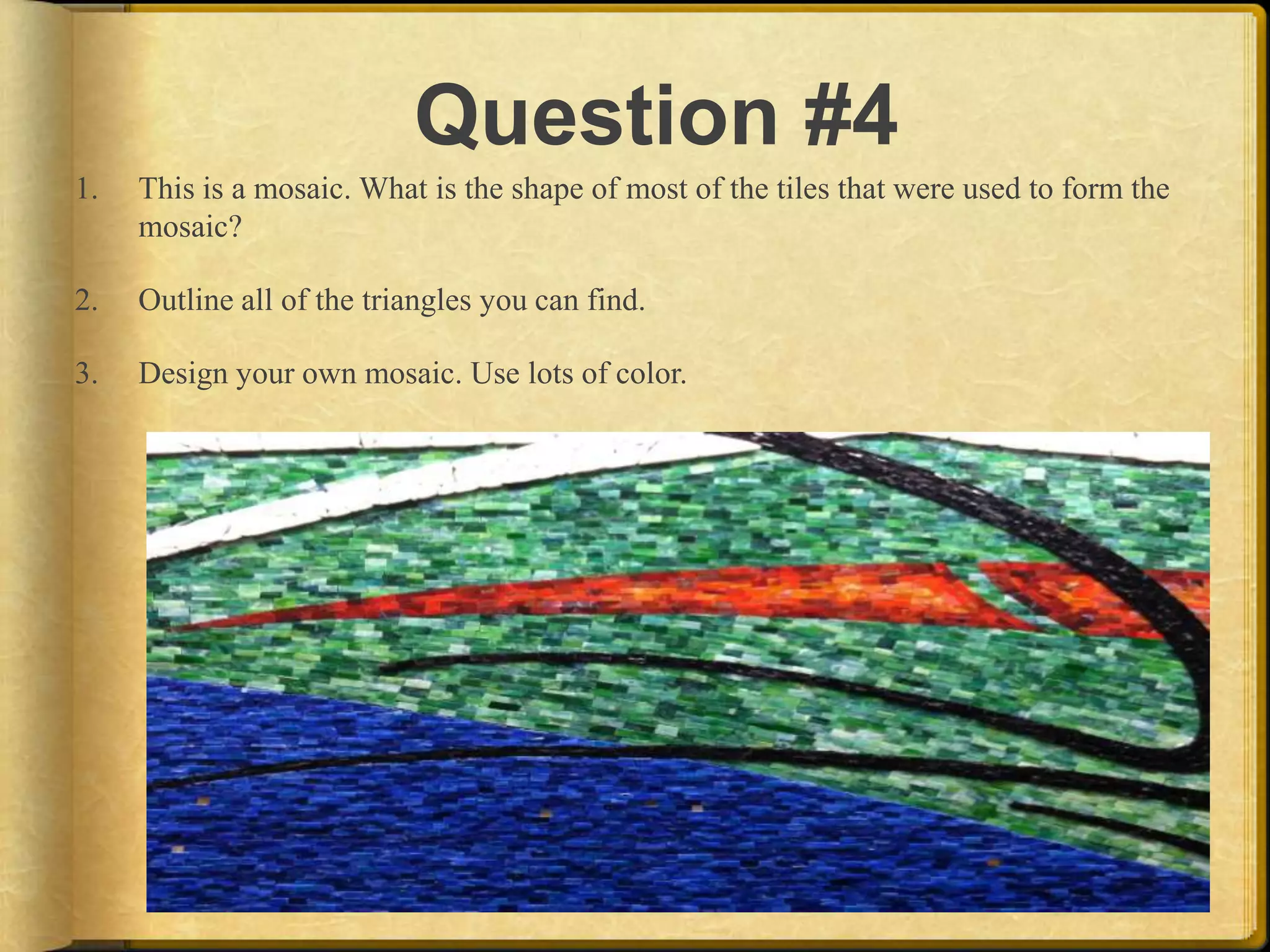
Question #4
1.   This is a mosaic. What is the shape of most of the tiles that were used to form the
     mosaic?

2.   Outline all of the triangles you can find.

3.   Design your own mosaic. Use lots of color.
Question #5
1.   This picture has a lot of squares and
     rectangles. Highlight/count all of the
     rectangles you can find and do the
     same for squares.

2.   What are the similarities and
     differences of these two shapes?

3.   Now, find doors throughout the
     school. Do the shapes included in
     these doors resemble the shapes
     included in the doors of your school?
     Name some new shapes that you
     have found.
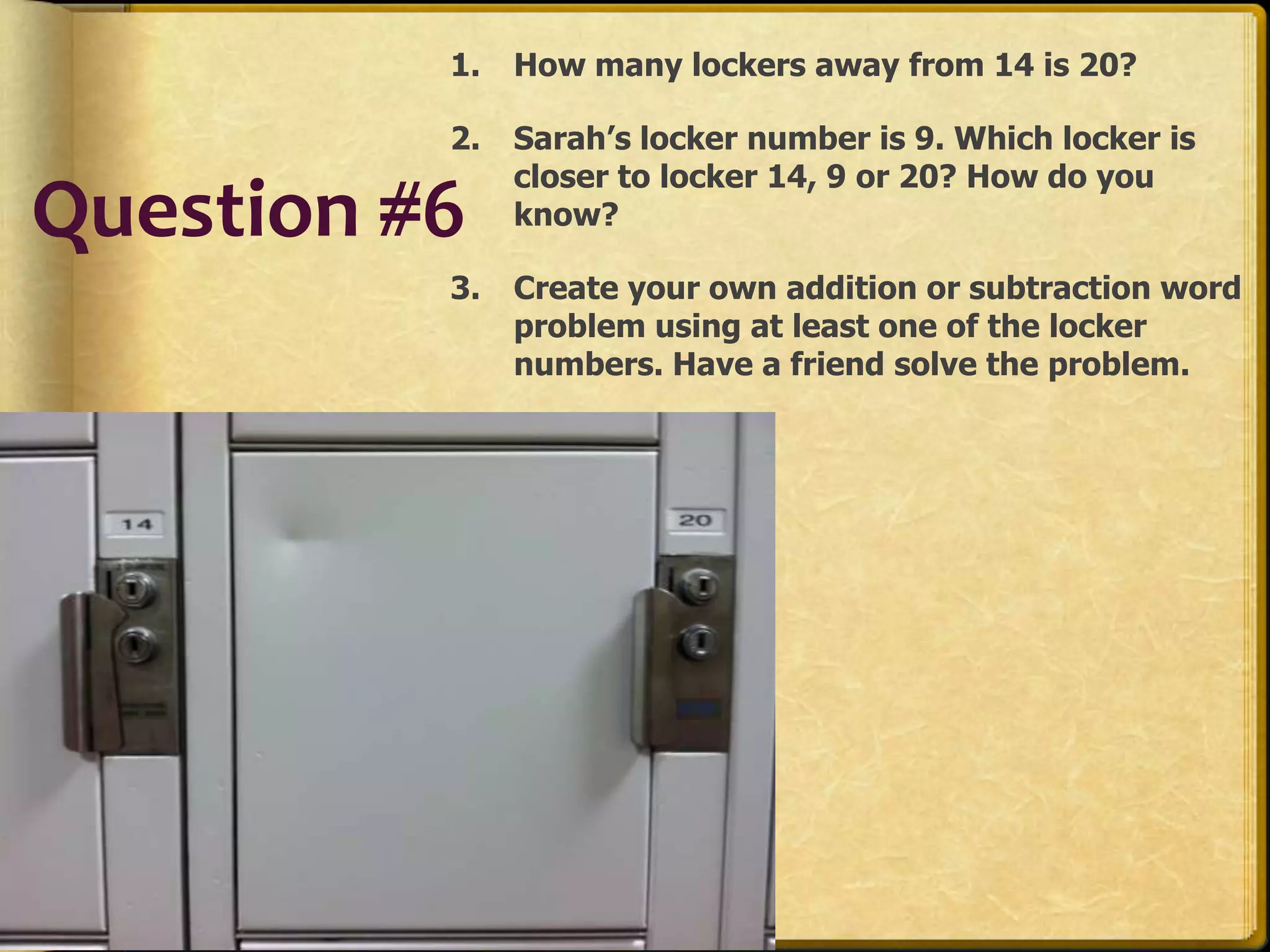
1.   How many lockers away from 14 is 20?

          2.   Sarah’s locker number is 9. Which locker is
               closer to locker 14, 9 or 20? How do you
Question #6    know?

          3.   Create your own addition or subtraction word
               problem using at least one of the locker
               numbers. Have a friend solve the problem.
Question #7
1.   How many more shutters
     are there than windows?

2.   The other side of the
     house has the same
     amount of windows. How
     many windows are there
     all together?

3.   If there was a house with
     15 windows and each
     window had two
     shutters, how many
     shutters would there be?
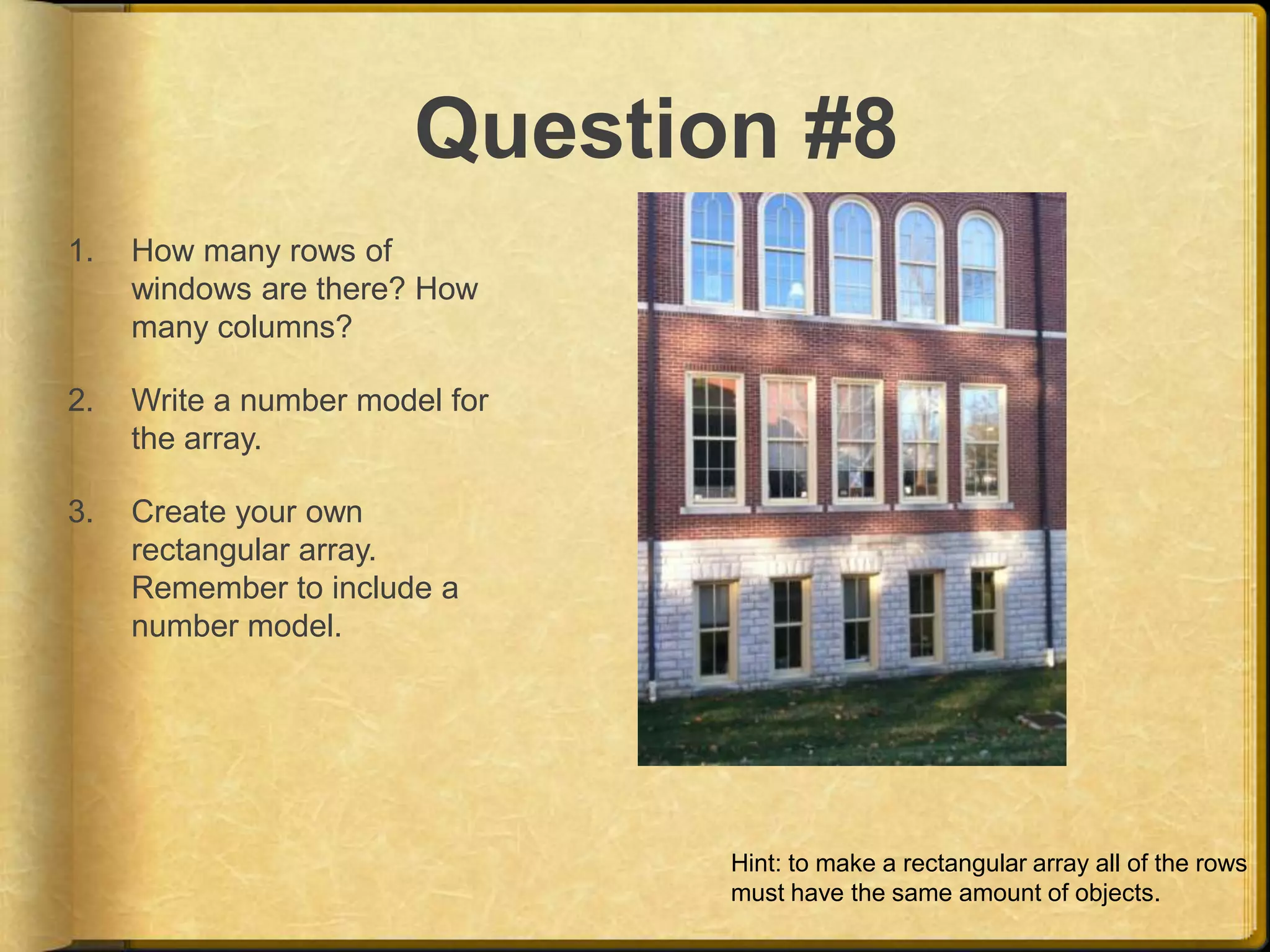
Question #8
1.   How many rows of
     windows are there? How
     many columns?

2.   Write a number model for
     the array.

3.   Create your own
     rectangular array.
     Remember to include a
     number model.


                                Hint: to make a rectangular array all of the rows
                                must have the same amount of objects.
Question #9


                              1. Name everything you
                                 can find that comes in
                                 twos.

                              2. If there were three
                                 branches with five
                                 leaves each, would the
                                 number of leaves be
                                 odd or even?

3. If you had 20 owls, how many eyes would there
be? Will the number of eyes always be odd or even,
why?
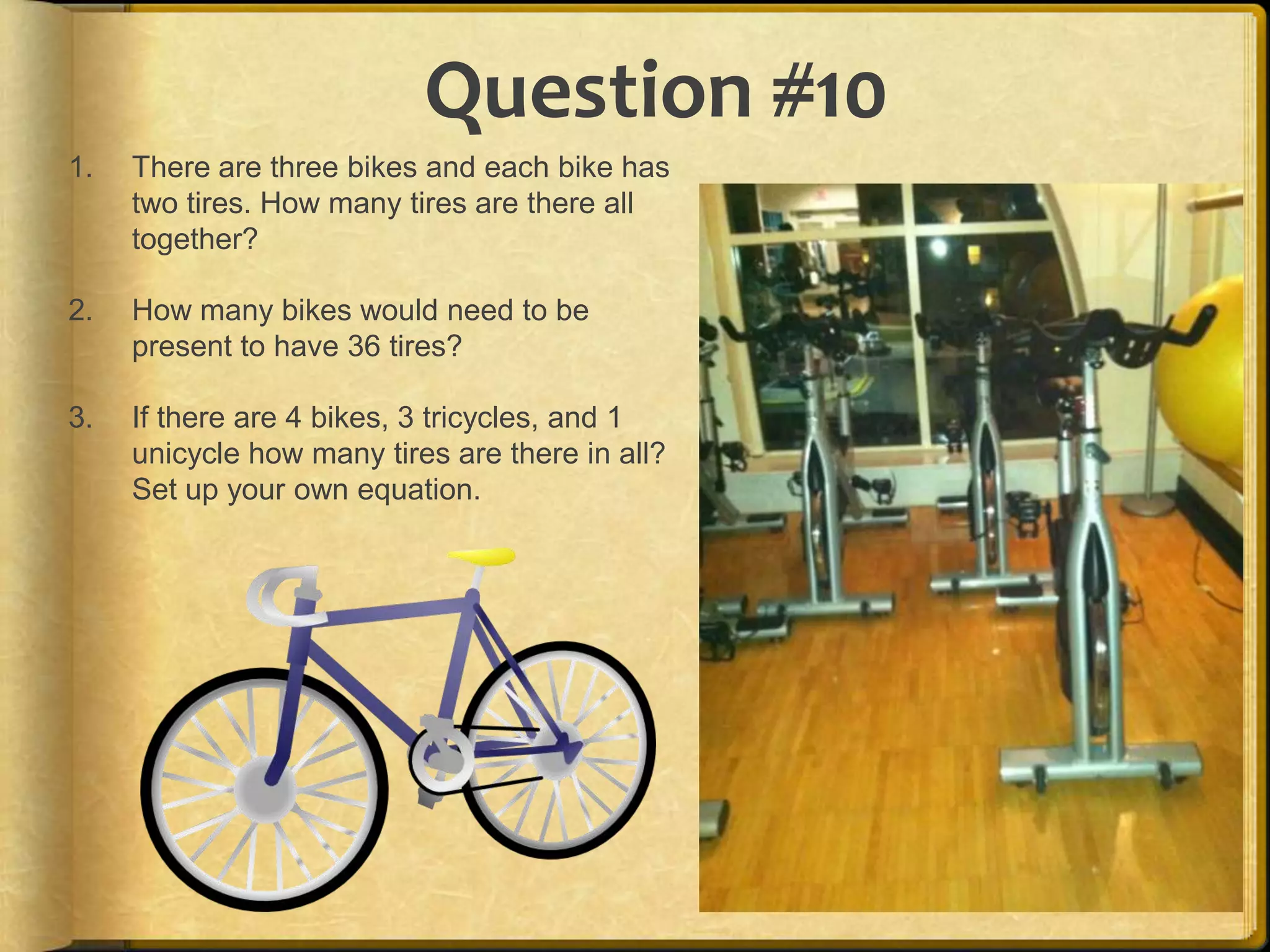
Question #10
1.   There are three bikes and each bike has
     two tires. How many tires are there all
     together?

2.   How many bikes would need to be
     present to have 36 tires?

3.   If there are 4 bikes, 3 tricycles, and 1
     unicycle how many tires are there in all?
     Set up your own equation.
1. What shape is this?

2. How many angles are there?
   What type of angles are
   these?

3. Draw another common
   shape that has the same
   amount of sides and angles.
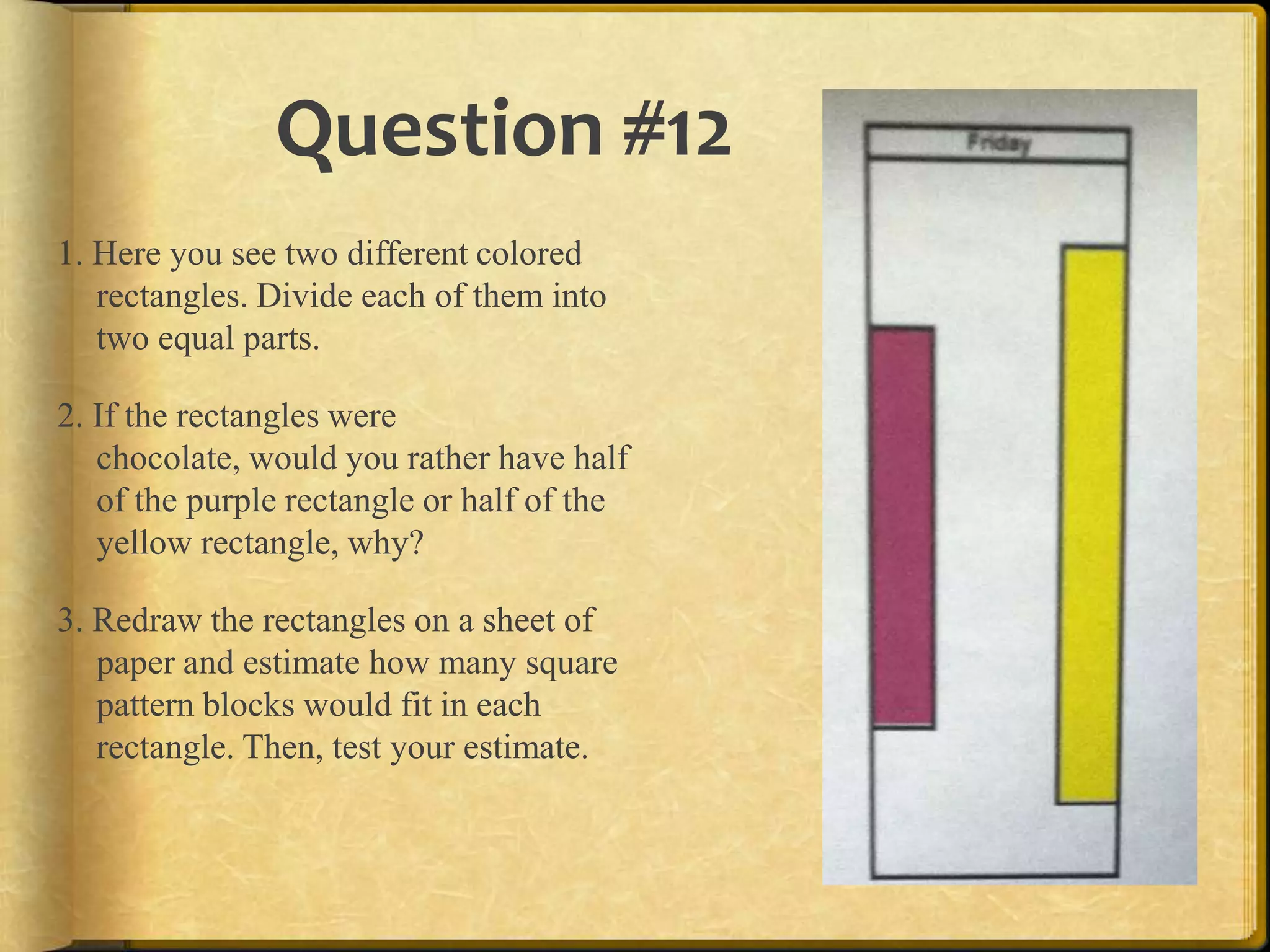
Question #12
1. Here you see two different colored
   rectangles. Divide each of them into
   two equal parts.

2. If the rectangles were
   chocolate, would you rather have half
   of the purple rectangle or half of the
   yellow rectangle, why?

3. Redraw the rectangles on a sheet of
   paper and estimate how many square
   pattern blocks would fit in each
   rectangle. Then, test your estimate.
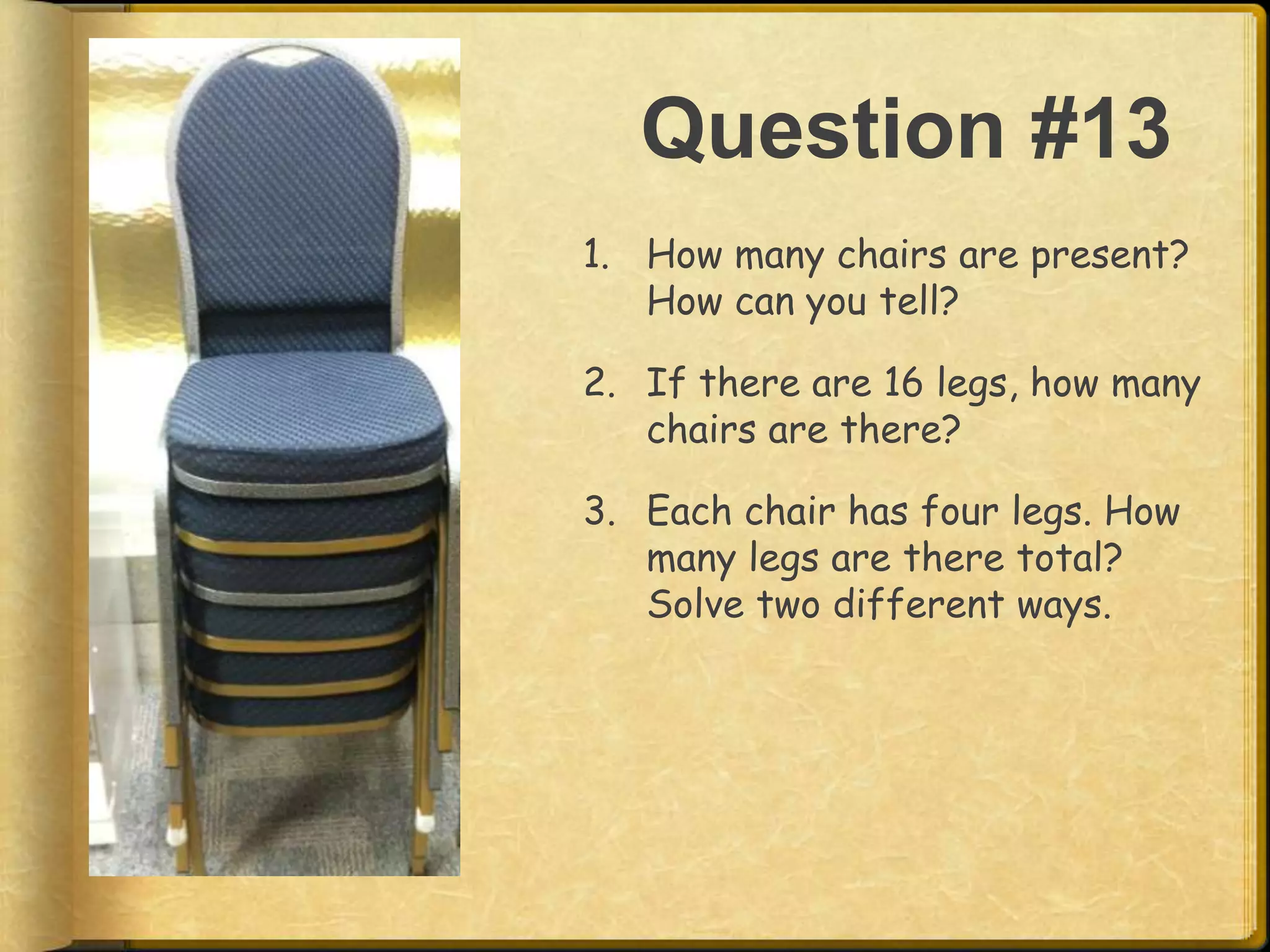
Question #13
1. How many chairs are present?
   How can you tell?

2. If there are 16 legs, how many
   chairs are there?

3. Each chair has four legs. How
   many legs are there total?
   Solve two different ways.
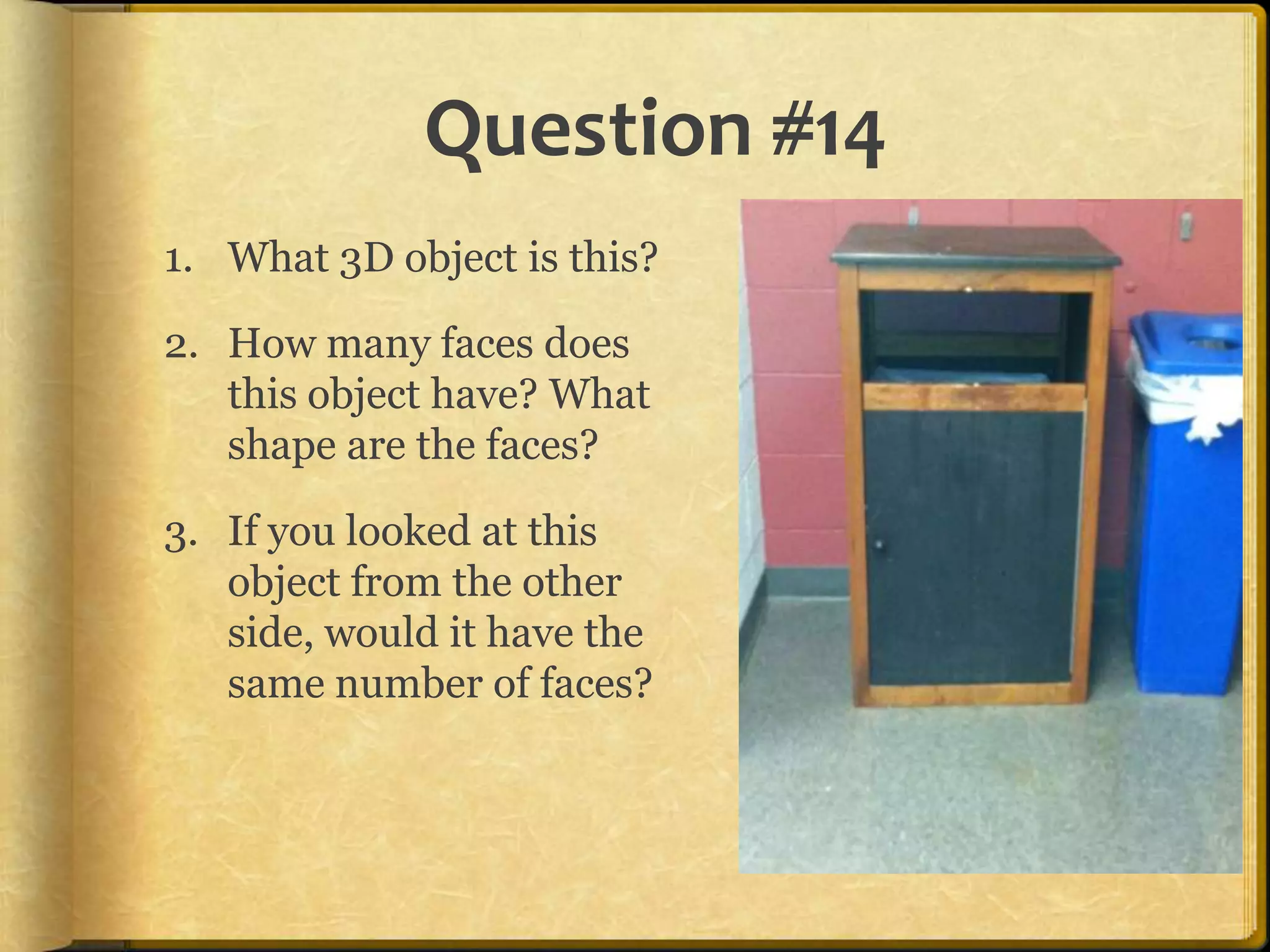
Question #14
1. What 3D object is this?

2. How many faces does
   this object have? What
   shape are the faces?

3. If you looked at this
   object from the other
   side, would it have the
   same number of faces?
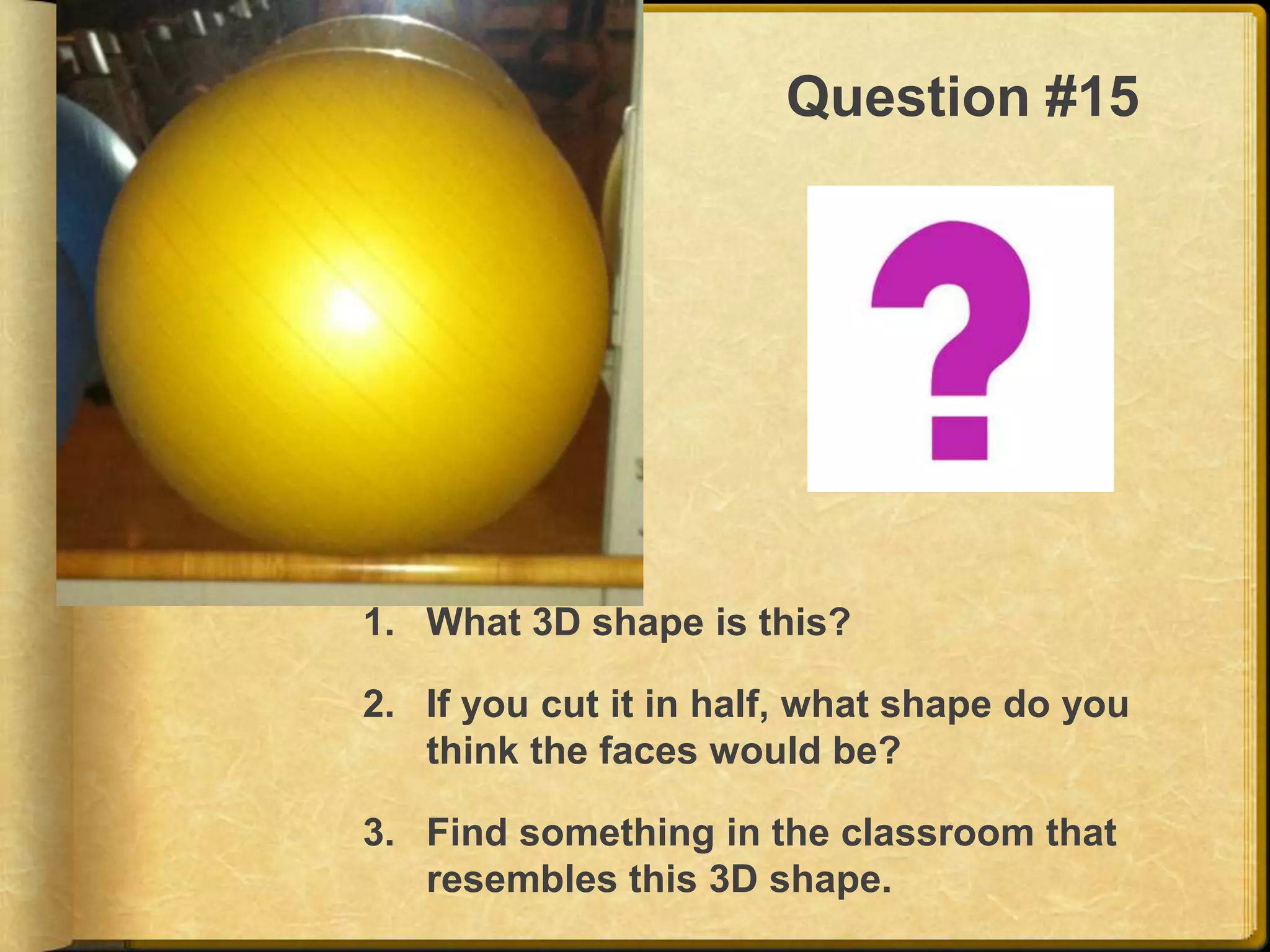
Question #15


1. What 3D shape is this?

2. If you cut it in half, what shape do you
   think the faces would be?

3. Find something in the classroom that
   resembles this 3D shape.
Conclusion
This essay is just the beginning on ways to connect
mathematics to our everyday lives. It introduces the idea
that things throughout our daily lives have
properties, just as math problems do. The photo essay
also shows that the properties of these things can be
factors in an equation. I chose to have most of the
geometry questions geared towards first graders and
most of the operations and algebraic questions geared
towards the upper elementary grades. In my head, it
made sense to first know basic 2D and 3D shapes and
their properties before trying to solve math equations
asked about the different shapes. I am really happy that I
completed this photo essay. It was very beneficial. When
I have my own classroom, I will definitely relate math to
the real world.
Common Core Standard & Bloom’s Taxonomy
   Picture 1
     Standard: Reason with shapes and their attributes 
1.G1 Distinguish between defining attributes (e.g. triangles are closed
         and three-sided) versus non-defining attributes (e.g., color, orientation, overall size); build and draw shapes to possess
         defining attributes.
     Question 1: Knowledge
     Question 2: Comprehension
     Question 3: Evaluation

   Picture 2
     Standard: Reason with shapes and their attributes.
          1.G3 Partition circles and rectangles into two and four equal shares, describe the shares using the words halves, fourths,
         and quarters, and use the phrases half of, fourth of, and quarter of. Describe the whole as two of, or four of the shares.
         Understand for these examples that decomposing into more equal shares creates smaller shares.
     Question 1: Knowledge
     Question 2: Comprehension
     Question 3: Evaluation


   Picture 3
     Standard: Reason with shapes and their attributes 
1.G1 Distinguish between defining attributes (e.g. triangles are closed
         and three-sided) versus non-defining attributes (e.g., color, orientation, overall size); build and draw shapes to possess
         defining attributes.
     Question 1: Knowledge
     Question 2: Comprehension
     Question 3: Evaluation
   Picture 4
       Standard: Reason with shapes and their attributes 
1.G2 Compose two-dimensional shapes
        (rectangles, squares, trapezoids, triangles, half-circles, and quarter-circles) or three-dimensional shapes
        (cubes, right rectangular prisms, right circular cones, and right circular cylinders) to create a composite shape
        and compose new shapes from the composite shape.
       Question 1: Knowledge
       Question 2: Comprehension
       Question 3: Synthesis

   Picture 5
       Standard: Reason with shapes and their attributes.
        1.G1 Distinguish between defining attributes (e.g. triangles are closed and three-sided) versus non-defining attributes
        (e.g., color, orientation, overall size); build and draw shapes to possess defining attributes.
       Question 1: Knowledge
       Question 2: Analysis
       Question 3: Evaluation


   Picture 6
       Standard: Add and subtract within 20
2.OA2 Fluently add and subtract within 20 using mental strategies. By end of
        Grade 2, know from memory all sums of two one-digit numbers.
       Question 1: Knowledge
       Question 2: Comprehension
       Question 3: Synthesis
   Picture 7
       Standard:Represent and solve problems involving addition and subtraction 
2.OA1 Use addition and subtraction
        within 100 to solve one and two step word problems involving situations of adding to, taking from, putting
        together, taking apart, and comparing, with unknowns in all positions, e.g. by using drawings and equations with
        a symbol for the unknown number to represent the problem.
       Question 1: Knowledge
       Question 2: Comprehension
       Question 3: Analysis

   Picture 8
       Standard: 2.OA4 Use addition to find the total number of objects arranged in rectangular arrays with up to 5
        rows and up to 5 columns; write an equation to express the total as a sum of equal addends.
       Question 1: Knowledge
       Question 2: Comprehension
       Question 3: Synthesis


   Picture 9
       Standard:Work with equal groups of objects to gain foundations for multiplication
2.OA3 Determine whether a
        group of objects (up to 20) has an odd or even number of members, e.g. by pairing objects or counting them by
        2s; write an equation to express an even number as a sum of two equal addends.
       Question 1: Knowledge
       Question 2: Application
       Question 3: Evaluation
   Picture 10
       Standard:3.OA4 Determine the unknown whole number in a multiplication or division equation relating three whole
        numbers. For example, determine the unknown number that makes the equation true in each of the equations 8
        x?=48, 5 = ? 3, 6x6 =?
       Question 1: Knowledge
       Question 2: Comprehension
       Question 3: Synthesis

   Picture 11
       Standard:Reason with shapes and their attributes 
2.G1 Recognize and draw shapes having specified attributes, such
        as a given number of angles or a given number of equal faces. Identify triangles, quadrilaterals, pentagons,
        hexagons, and cubes
       Question 1: Knowledge
       Question 2: Comprehension
       Question 3: Evaluation


   Picture 12
       Standard:2.G2 Partition a rectangle into rows and columns of same-size squares and count to find the total number of
        them.oftwo one-digit numbers.
       Question 1: Knowledge
       Question 2: Application
       Question 3: Evaluation
   Picture 13
       Standard:3.OA3 Use multiplication and division within 100 to solve word problems in situations involving equal
        groups, arrays, and measurement quantities, e.g. by using drawings and equations with a symbol for the unknown
        number to represent the problem.
       Question 1: Knowledge
       Question 2: Application
       Question 3: Analysis

   Picture 14
       Standard:Reason with shapes and their attributes 
2.G1 Recognize and draw shapes having specified attributes,
        such as a given number of angles or a given number of equal faces. Identify triangles, quadrilaterals, pentagons,
        hexagons, and cubes
       Question 1: Knowledge
       Question 2: Comprehension
       Question 3: Evaluation


   Picture 15
       Standard:Reason with shapes and their attributes 
2.G1 Recognize and draw shapes having specified attributes,
        such as a given number of angles or a given number of equal faces. Identify triangles, quadrilaterals, pentagons,
        hexagons, and cubes
       Question 1: Knowledge
       Question 2: Comprehension
       Question 3: Evaluation

Spencerphotoessay

  • 2.
    Rationale  Math iseverywhere, just look around! Did you know most bookshelves are comprised of rectangles? I didn’t. Did you know there is a ratio of two shutters for every window? I didn’t. All of the pictures that I incorporated in the “Photo Essay” are objects/places/things that I walk by daily on Miami University’s campus. Although I walk by them daily, I usually have my head in the clouds or am texting on my cell phone. I never stop to observe these structures that have a strong connection to my education, particularly mathematics. Each of the critical thinking questions are geared toward the standards of either geometry or operations and algebraic thinking. My photos and questions were created in hopes that students would actively see how math is incorporated in the many objects/places/things they are familiar with.
  • 3.
    Instructions  There arethree questions. Each question is based on the provided picture.  Answer each question. Refer back to the picture for help!
  • 4.
    Question #1 1. Whatshape does this piece of brick make? 2. How many sides does this shape have? How many corners are there? 3. Draw a shape with the same amount of sides and corners. It can’t look exactly like the picture.
  • 5.
    Question #2 1. How many parts are there to the whole? 2. Shade in 1/2. 3. Find something in the classroom that is this shape, and divide it into the same amount of equal parts.
  • 6.
    Question #3 1. What 3D shape is this? 2. How many faces does this shape have? 3. Name something in your house that is also this shape. Hint: You find a lot of this shape in the kitchen.
  • 7.
    Question #4 1. This is a mosaic. What is the shape of most of the tiles that were used to form the mosaic? 2. Outline all of the triangles you can find. 3. Design your own mosaic. Use lots of color.
  • 8.
    Question #5 1. This picture has a lot of squares and rectangles. Highlight/count all of the rectangles you can find and do the same for squares. 2. What are the similarities and differences of these two shapes? 3. Now, find doors throughout the school. Do the shapes included in these doors resemble the shapes included in the doors of your school? Name some new shapes that you have found.
  • 9.
    1. How many lockers away from 14 is 20? 2. Sarah’s locker number is 9. Which locker is closer to locker 14, 9 or 20? How do you Question #6 know? 3. Create your own addition or subtraction word problem using at least one of the locker numbers. Have a friend solve the problem.
  • 10.
    Question #7 1. How many more shutters are there than windows? 2. The other side of the house has the same amount of windows. How many windows are there all together? 3. If there was a house with 15 windows and each window had two shutters, how many shutters would there be?
  • 11.
    Question #8 1. How many rows of windows are there? How many columns? 2. Write a number model for the array. 3. Create your own rectangular array. Remember to include a number model. Hint: to make a rectangular array all of the rows must have the same amount of objects.
  • 12.
    Question #9 1. Name everything you can find that comes in twos. 2. If there were three branches with five leaves each, would the number of leaves be odd or even? 3. If you had 20 owls, how many eyes would there be? Will the number of eyes always be odd or even, why?
  • 13.
    Question #10 1. There are three bikes and each bike has two tires. How many tires are there all together? 2. How many bikes would need to be present to have 36 tires? 3. If there are 4 bikes, 3 tricycles, and 1 unicycle how many tires are there in all? Set up your own equation.
  • 14.
    1. What shapeis this? 2. How many angles are there? What type of angles are these? 3. Draw another common shape that has the same amount of sides and angles.
  • 15.
    Question #12 1. Hereyou see two different colored rectangles. Divide each of them into two equal parts. 2. If the rectangles were chocolate, would you rather have half of the purple rectangle or half of the yellow rectangle, why? 3. Redraw the rectangles on a sheet of paper and estimate how many square pattern blocks would fit in each rectangle. Then, test your estimate.
  • 16.
    Question #13 1. Howmany chairs are present? How can you tell? 2. If there are 16 legs, how many chairs are there? 3. Each chair has four legs. How many legs are there total? Solve two different ways.
  • 17.
    Question #14 1. What3D object is this? 2. How many faces does this object have? What shape are the faces? 3. If you looked at this object from the other side, would it have the same number of faces?
  • 18.
    Question #15 1. What3D shape is this? 2. If you cut it in half, what shape do you think the faces would be? 3. Find something in the classroom that resembles this 3D shape.
  • 19.
    Conclusion This essay isjust the beginning on ways to connect mathematics to our everyday lives. It introduces the idea that things throughout our daily lives have properties, just as math problems do. The photo essay also shows that the properties of these things can be factors in an equation. I chose to have most of the geometry questions geared towards first graders and most of the operations and algebraic questions geared towards the upper elementary grades. In my head, it made sense to first know basic 2D and 3D shapes and their properties before trying to solve math equations asked about the different shapes. I am really happy that I completed this photo essay. It was very beneficial. When I have my own classroom, I will definitely relate math to the real world.
  • 20.
    Common Core Standard& Bloom’s Taxonomy  Picture 1  Standard: Reason with shapes and their attributes 
1.G1 Distinguish between defining attributes (e.g. triangles are closed and three-sided) versus non-defining attributes (e.g., color, orientation, overall size); build and draw shapes to possess defining attributes.  Question 1: Knowledge  Question 2: Comprehension  Question 3: Evaluation  Picture 2  Standard: Reason with shapes and their attributes. 1.G3 Partition circles and rectangles into two and four equal shares, describe the shares using the words halves, fourths, and quarters, and use the phrases half of, fourth of, and quarter of. Describe the whole as two of, or four of the shares. Understand for these examples that decomposing into more equal shares creates smaller shares.  Question 1: Knowledge  Question 2: Comprehension  Question 3: Evaluation  Picture 3  Standard: Reason with shapes and their attributes 
1.G1 Distinguish between defining attributes (e.g. triangles are closed and three-sided) versus non-defining attributes (e.g., color, orientation, overall size); build and draw shapes to possess defining attributes.  Question 1: Knowledge  Question 2: Comprehension  Question 3: Evaluation
  • 21.
    Picture 4  Standard: Reason with shapes and their attributes 
1.G2 Compose two-dimensional shapes (rectangles, squares, trapezoids, triangles, half-circles, and quarter-circles) or three-dimensional shapes (cubes, right rectangular prisms, right circular cones, and right circular cylinders) to create a composite shape and compose new shapes from the composite shape.  Question 1: Knowledge  Question 2: Comprehension  Question 3: Synthesis  Picture 5  Standard: Reason with shapes and their attributes. 1.G1 Distinguish between defining attributes (e.g. triangles are closed and three-sided) versus non-defining attributes (e.g., color, orientation, overall size); build and draw shapes to possess defining attributes.  Question 1: Knowledge  Question 2: Analysis  Question 3: Evaluation  Picture 6  Standard: Add and subtract within 20
2.OA2 Fluently add and subtract within 20 using mental strategies. By end of Grade 2, know from memory all sums of two one-digit numbers.  Question 1: Knowledge  Question 2: Comprehension  Question 3: Synthesis
  • 22.
    Picture 7  Standard:Represent and solve problems involving addition and subtraction 
2.OA1 Use addition and subtraction within 100 to solve one and two step word problems involving situations of adding to, taking from, putting together, taking apart, and comparing, with unknowns in all positions, e.g. by using drawings and equations with a symbol for the unknown number to represent the problem.  Question 1: Knowledge  Question 2: Comprehension  Question 3: Analysis  Picture 8  Standard: 2.OA4 Use addition to find the total number of objects arranged in rectangular arrays with up to 5 rows and up to 5 columns; write an equation to express the total as a sum of equal addends.  Question 1: Knowledge  Question 2: Comprehension  Question 3: Synthesis  Picture 9  Standard:Work with equal groups of objects to gain foundations for multiplication
2.OA3 Determine whether a group of objects (up to 20) has an odd or even number of members, e.g. by pairing objects or counting them by 2s; write an equation to express an even number as a sum of two equal addends.  Question 1: Knowledge  Question 2: Application  Question 3: Evaluation
  • 23.
    Picture 10  Standard:3.OA4 Determine the unknown whole number in a multiplication or division equation relating three whole numbers. For example, determine the unknown number that makes the equation true in each of the equations 8 x?=48, 5 = ? 3, 6x6 =?  Question 1: Knowledge  Question 2: Comprehension  Question 3: Synthesis  Picture 11  Standard:Reason with shapes and their attributes 
2.G1 Recognize and draw shapes having specified attributes, such as a given number of angles or a given number of equal faces. Identify triangles, quadrilaterals, pentagons, hexagons, and cubes  Question 1: Knowledge  Question 2: Comprehension  Question 3: Evaluation  Picture 12  Standard:2.G2 Partition a rectangle into rows and columns of same-size squares and count to find the total number of them.oftwo one-digit numbers.  Question 1: Knowledge  Question 2: Application  Question 3: Evaluation
  • 24.
    Picture 13  Standard:3.OA3 Use multiplication and division within 100 to solve word problems in situations involving equal groups, arrays, and measurement quantities, e.g. by using drawings and equations with a symbol for the unknown number to represent the problem.  Question 1: Knowledge  Question 2: Application  Question 3: Analysis  Picture 14  Standard:Reason with shapes and their attributes 
2.G1 Recognize and draw shapes having specified attributes, such as a given number of angles or a given number of equal faces. Identify triangles, quadrilaterals, pentagons, hexagons, and cubes  Question 1: Knowledge  Question 2: Comprehension  Question 3: Evaluation  Picture 15  Standard:Reason with shapes and their attributes 
2.G1 Recognize and draw shapes having specified attributes, such as a given number of angles or a given number of equal faces. Identify triangles, quadrilaterals, pentagons, hexagons, and cubes  Question 1: Knowledge  Question 2: Comprehension  Question 3: Evaluation