Contents
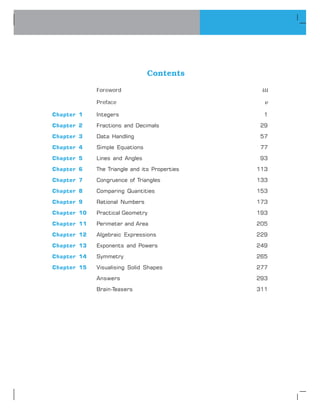
Foreword iii
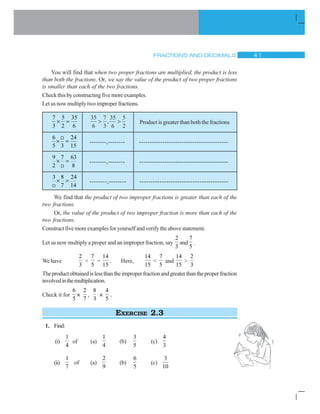
Preface v
Chapter 1 Integers 1
Chapter 2 Fractions and Decimals 29
Chapter 3 Data Handling 57
Chapter 4 Simple Equations 77
Chapter 5 Lines and Angles 93
Chapter 6 The Triangle and its Properties 113
Chapter 7 Congruence of Triangles 133
Chapter 8 Comparing Quantities 153
Chapter 9 Rational Numbers 173
Chapter 10 Practical Geometry 193
Chapter 11 Perimeter and Area 205
Chapter 12 Algebraic Expressions 229
Chapter 13 Exponents and Powers 249
Chapter 14 Symmetry 265
Chapter 15 Visualising Solid Shapes 277
Answers 293
Brain-Teasers 311
1.1 INTRODUCTION
We have learnt about whole numbers and integers in ClassVI.
We know that integers form a bigger collection of numbers
which contains whole numbers and negative numbers. What
other differences do you find between whole numbers and
integers? In this chapter, we will study more about integers,
their properties and operations. First of all, we will review and
revise what we have done about integers in our previous class.
1.2 RECALL
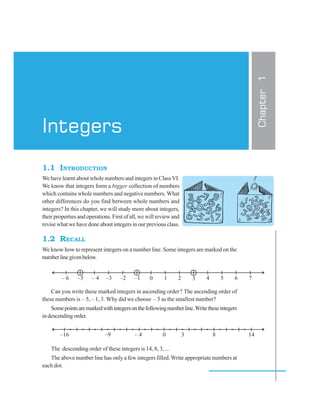
We know how to represent integers on a number line. Some integers are marked on the
numberlinegivenbelow.
Can you write these marked integers in ascending order? The ascending order of
these numbers is – 5, – 1, 3. Why did we choose – 5 as the smallest number?
Somepointsaremarkedwithintegersonthefollowingnumberline.Writetheseintegers
indescendingorder.
The descending order of these integers is 14, 8, 3, ...
The above number line has only a few integers filled.Write appropriate numbers at
each dot.
Chapter1
Integers
MATHEMATICS2
–3 –2
A B C D E F G H I J K L M N O
TRY THESE
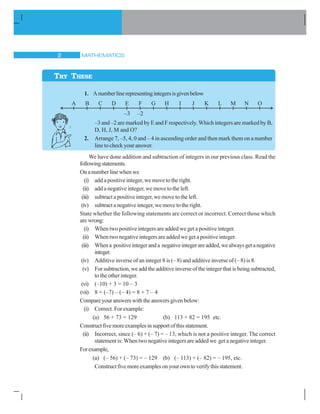
1. Anumberlinerepresentingintegersisgivenbelow
–3 and –2 are marked by E and F respectively. Which integers are marked by B,
D, H, J, M and O?
2. Arrange 7, –5, 4, 0 and – 4 in ascending order and then mark them on a number
line to check your answer.
We have done addition and subtraction of integers in our previous class. Read the
followingstatements.
On a number line when we
(i) add a positive integer, we move to the right.
(ii) add a negative integer, we move to the left.
(iii) subtract a positive integer, we move to the left.
(iv) subtract a negative integer, we move to the right.
State whether the following statements are correct or incorrect. Correct those which
are wrong:
(i) When two positive integers are added we get a positive integer.
(ii) When two negative integers are added we get a positive integer.
(iii) Whena positiveintegeranda negativeintegerareadded,wealwaysgetanegative
integer.
(iv) Additive inverse of an integer 8 is (– 8) and additive inverse of (– 8) is 8.
(v) For subtraction, we add the additive inverse of the integer that is being subtracted,
to the other integer.
(vi) (–10) + 3 = 10 – 3
(vii) 8 + (–7) – (– 4) = 8 + 7 – 4
Compareyouranswerswiththeanswersgivenbelow:
(i) Correct. For example:
(a) 56 + 73 = 129 (b) 113 + 82 = 195 etc.
Constructfivemoreexamplesinsupportofthisstatement.
(ii) Incorrect, since (– 6) + (– 7) = – 13, which is not a positive integer. The correct
statement is: When two negative integers are added we get a negative integer.
Forexample,
(a) (– 56) + (– 73) = – 129 (b) (– 113) + (– 82) = – 195, etc.
Constructfivemoreexamplesonyourowntoverifythisstatement.
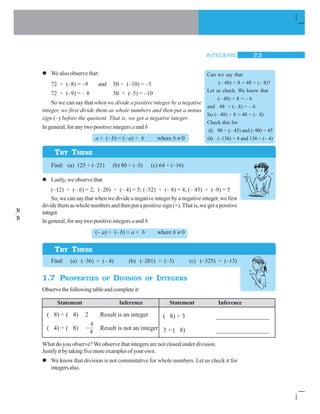
INTEGERS 3
TRY THESE
(iii) Incorrect,since–9+16=7,whichisnotanegativeinteger.Thecorrectstatementis:
When one positive and one negative integers are added, we take their difference
andplacethesignofthebiggerinteger.Thebiggerintegerisdecidedbyignoringthe
signs of boththeintegers.Forexample:
(a) (– 56) + (73) = 17 (b) (– 113) + 82 = – 31
(c) 16 + (– 23) = – 7 (d) 125 + (– 101) = 24
Constructfivemoreexamplesforverifyingthisstatement.
(iv) Correct. Some other examples of additive inverse are as given below:
Integer Additive inverse
10 –10
–10 10
76 –76
–76 76
Thus, the additive inverse of any integer a is – a and additive inverse of (– a) is a.
(v) Correct. Subtraction is opposite of addition and therefore, we add the additive
inverse of the integer that is being subtracted, to the other integer. For example:
(a) 56 – 73 = 56 + additive inverse of 73 = 56 + (–73) = –17
(b) 56 – (–73) = 56 + additive inverse of (–73) = 56 + 73 = 129
(c) (–79) – 45 = (–79) + (– 45) = –124
(d) (–100) – (–172) = –100 + 172 = 72 etc.
Writeatleastfivesuchexamplestoverifythisstatement.
Thus, we find that for any two integers a and b,
a – b = a + additive inverse of b = a + (– b)
and a – (– b) = a + additive inverse of (– b) = a + b
(vi) Incorrect, since (–10) + 3 = –7 and 10 – 3 = 7
therefore, (–10) + 3 ≠ 10 – 3
(vii) Incorrect, since, 8 + (–7) – (– 4) = 8 + (–7) + 4 = 1 + 4 = 5
and 8 + 7 – 4 = 15 – 4 = 11
However, 8 + (–7) – (– 4) = 8 – 7 + 4
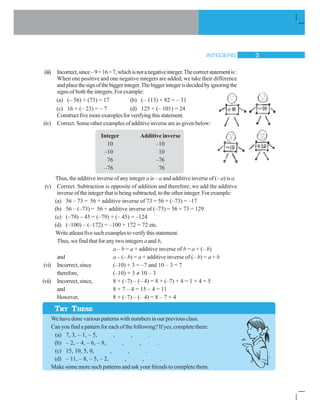
We have done various patterns with numbers in our previous class.
Can you find a pattern for each of the following? If yes, complete them:
(a) 7, 3, – 1, – 5, , , .
(b) – 2, – 4, – 6, – 8, , , .
(c) 15, 10, 5, 0, , , .
(d) – 11, – 8, – 5, – 2, , , .
Make some more such patterns and ask your friends to complete them.
MATHEMATICS4
–10 –5 0 5 10 15 20 25
Lahulspiti Srinagar Shimla Ooty Bangalore
EXERCISE 1.1
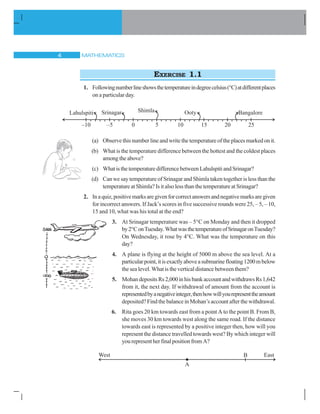
1. Followingnumberlineshowsthetemperatureindegreecelsius(°C)atdifferentplaces
on a particular day.
(a) Observe this number line and write the temperature of the places marked on it.
(b) What is the temperature difference between the hottest and the coldest places
among the above?
(c) WhatisthetemperaturedifferencebetweenLahulspitiandSrinagar?
(d) Can we say temperature of Srinagar and Shimla taken together is less than the
temperature at Shimla? Is it also less than the temperature at Srinagar?
2. Inaquiz,positivemarksaregivenforcorrectanswersandnegativemarksaregiven
for incorrect answers. If Jack’s scores in five successive rounds were 25, – 5, – 10,
15 and 10, what was his total at the end?
3. At Srinagar temperature was – 5°C on Monday and then it dropped
by2°ConTuesday.WhatwasthetemperatureofSrinagaronTuesday?
On Wednesday, it rose by 4°C. What was the temperature on this
day?
4. A plane is flying at the height of 5000 m above the sea level. At a
particularpoint,itisexactlyaboveasubmarinefloating1200mbelow
the sea level. What is the vertical distance between them?
5. MohandepositsRs2,000inhisbankaccountandwithdrawsRs1,642
from it, the next day. If withdrawal of amount from the account is
representedbyanegativeinteger,thenhowwillyourepresenttheamount
deposited? Find the balance in Mohan’s account after the withdrawal.
6. Rita goes 20 km towards east from a point A to the point B. From B,
she moves 30 km towards west along the same road. If the distance
towards east is represented by a positive integer then, how will you
represent the distance travelled towards west? By which integer will
yourepresentherfinalpositionfromA?
INTEGERS 5
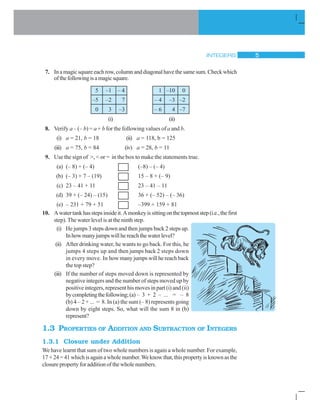
7. Inamagicsquareeachrow,columnanddiagonalhavethesamesum.Checkwhich
ofthefollowingisamagicsquare.
5 –1 – 4 1 –10 0
–5 –2 7 – 4 –3 –2
0 3 –3 – 6 4 –7
(i) (ii)
8. Verify a – (– b) = a + b for the following values of a and b.
(i) a = 21, b = 18 (ii) a = 118, b = 125
(iii) a = 75, b = 84 (iv) a = 28, b = 11
9. Use the sign of >, < or = in the box to make the statements true.
(a) (– 8) + (– 4) (–8) – (– 4)
(b) (– 3) + 7 – (19) 15 – 8 + (– 9)
(c) 23 – 41 + 11 23 – 41 – 11
(d) 39 + (– 24) – (15) 36 + (– 52) – (– 36)
(e) – 231 + 79 + 51 –399 + 159 + 81
10. Awatertankhasstepsinsideit.Amonkeyissittingonthetopmoststep(i.e.,thefirst
step). The water level is at the ninth step.
(i) He jumps 3 steps down and then jumps back 2 steps up.
Inhowmanyjumpswillhereachthewaterlevel?
(ii) After drinking water, he wants to go back. For this, he
jumps 4 steps up and then jumps back 2 steps down
in every move. In how many jumps will he reach back
the top step?
(iii) If the number of steps moved down is represented by
negative integers and the number of steps moved up by
positive integers, represent his moves in part (i) and (ii)
bycompletingthefollowing;(a) – 3 + 2 – ... = – 8
(b) 4 – 2 + ... = 8. In (a) the sum (– 8) represents going
down by eight steps. So, what will the sum 8 in (b)
represent?
1.3 PROPERTIES OF ADDITION AND SUBTRACTION OF INTEGERS
1.3.1 Closure under Addition
We have learnt that sum of two whole numbers is again a whole number. For example,
17 +24=41whichisagainawholenumber.Weknowthat,thispropertyisknownasthe
closure property for addition of the whole numbers.
MATHEMATICS6
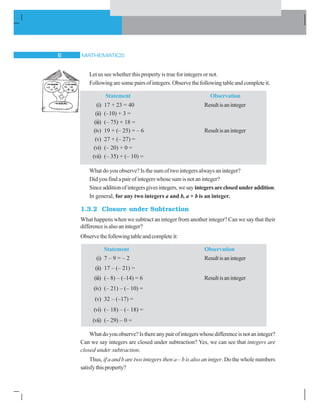
Let us see whether this property is true for integers or not.
Followingaresomepairsofintegers.Observethefollowingtableandcompleteit.
Statement Observation
(i) 17 + 23 = 40 Resultisaninteger
(ii) (–10) + 3 =
(iii) (– 75) + 18 =
(iv) 19 + (– 25) = – 6 Resultisaninteger
(v) 27 + (– 27) =
(vi) (– 20) + 0 =
(vii) (– 35) + (– 10) =
What do you observe? Is the sum of two integers always an integer?
Did you find a pair of integers whose sum is not an integer?
Sinceadditionofintegersgivesintegers,wesay integersareclosedunderaddition.
In general, for any two integers a and b, a + b is an integer.
1.3.2 Closure under Subtraction
What happens when we subtract an integer from another integer? Can we say that their
differenceisalsoaninteger?
Observethefollowingtableandcompleteit:
Statement Observation
(i) 7 – 9 = – 2 Resultisaninteger
(ii) 17 – (– 21) =
(iii) (– 8) – (–14) = 6 Resultisaninteger
(iv) (– 21) – (– 10) =
(v) 32 – (–17) =
(vi) (– 18) – (– 18) =
(vii) (– 29) – 0 =
Whatdoyouobserve?Isthereanypairofintegerswhosedifferenceisnotaninteger?
Can we say integers are closed under subtraction? Yes, we can see that integers are
closed under subtraction.
Thus, if a and b are two integers then a – b is also an intger. Do the whole numbers
satisfythisproperty?
INTEGERS 7
1.3.3 Commutative Property
We know that 3 + 5 = 5 + 3 = 8, that is, the whole numbers can be added in any order. In
otherwords,additioniscommutativeforwholenumbers.
Can we say the same for integers also?
We have 5 + (– 6) = –1 and (– 6) + 5 = –1
So, 5 + (– 6) = (– 6) + 5
Arethefollowingequal?
(i) (– 8) + (– 9) and (– 9) + (– 8)
(ii) (– 23) + 32 and 32 + (– 23)
(iii) (– 45) + 0 and 0 + (– 45)
Trythiswithfiveotherpairsofintegers.Doyoufindanypairofintegersforwhichthe
sums are different when the order is changed? Certainly not. Thus, we conclude that
addition is commutative for integers.
In general, for any two integers a and b, we can say
a + b = b + a
We know that subtraction is not commutative for whole numbers. Is it commutative
for integers?
Consider the integers 5 and (–3).
Is 5 – (–3) the same as (–3) –5? No, because 5 – ( –3) = 5 + 3 = 8, and (–3) – 5
= – 3 – 5 = – 8.
Take atleast five different pairs of integers and check this.
We conclude that subtraction is not commutative for integers.
1.3.4 Associative Property
Observethefollowingexamples:
Consider the integers –3, –2 and –5.
Look at (–5) + [(–3) + (–2)] and [(–5) + (–3)] + (–2).
In the first sum (–3) and (–2) are grouped together and in the second (–5) and (–3)
are grouped together.We will check whether we get different results.
(–5) + [(–3) + (–2)] [(–5) + (–3)] + (–2)
MATHEMATICS8
TRY THESE
In both the cases, we get –10.
i.e., (–5) + [(–3) + (–2)] = [(–5) + (–2)] + (–3)
Similarly consider –3 , 1 and –7.
( –3) + [1 + (–7)] = –3 + =
[(–3) + 1] + (–7) = –2 + =
Is (–3) + [1 + (–7)] same as [(–3) + 1] + (–7)?
Takefivemoresuchexamples.Youwillnotfindanyexampleforwhichthesumsare
different. This shows that addition is associative for integers.
In general for any integers a, b and c, we can say
a + (b + c) = (a + b) + c
1.3.5 Additive Identity
When we add zero to any whole number, we get the same whole number. Zero is an
additiveidentityforwholenumbers.Isitanadditiveidentityagainforintegersalso?
Observethefollowingandfillintheblanks:
(i) (– 8) + 0 = – 8 (ii) 0 + (– 8) = – 8
(iii) (–23) + 0 = (iv) 0 + (–37) = –37
(v) 0 + (–59) = (vi) 0 + = – 43
(vii) – 61 + = – 61 (viii) + 0 =
Theaboveexamplesshow that zerois anadditive identityforintegers.
Youcanverifyitbyaddingzerotoanyotherfiveintegers.
Ingeneral,foranyinteger a
a + 0 = a = 0 + a
1. Writeapairofintegerswhosesumgives
(a) anegativeinteger (b) zero
(c) anintegersmallerthanboththeintegers. (d) anintegersmallerthanonlyoneoftheintegers.
(e) an integer greater than both the integers.
2. Writeapairofintegerswhosedifferencegives
(a) anegativeinteger. (b) zero.
(c) anintegersmallerthanboththeintegers. (d) anintegergreaterthanonlyoneoftheintegers.
(e) an integer greater than both the integers.
INTEGERS 9
EXAMPLE 1 Write down a pair of integers whose
(a) sum is –3 (b) difference is –5
(c) differenceis2 (d) sumis0
SOLUTION (a) (–1) + (–2) = –3 or (–5) + 2 = –3
(b) (–9) – (– 4) = –5 or (–2) – 3 = –5
(c) (–7) – (–9) = 2 or 1 – (–1) = 2
(d) (–10) + 10 = 0 or 5 + (–5) = 0
Can you write more pairs in these examples?
EXERCISE 1.2
1. Write down a pair of integers whose:
(a) sum is –7 (b) difference is –10 (c) sumis0
2. (a) Writeapairofnegativeintegerswhosedifferencegives8.
(b) Write a negative integer and a positive integer whose sum is –5.
(c) Write a negative integer and a positive integer whose difference is –3.
3. In a quiz, team A scored – 40, 10, 0 and team B scored 10, 0, – 40 in three
successive rounds. Which team scored more? Can we say that we can add
integers in any order?
4. Fillintheblankstomakethefollowingstatementstrue:
(i) (–5) + (............) = (– 8) + (............)
(ii) –53 + ............ = –53
(iii) 17 + ............ = 0
(iv) [13 + (– 12)] + (............) = ............ + [(–12) + (–7)]
(v) (– 4) + [............ + (–3)] = [............ + 15] + ............
1.4 MULTIPLICATION OF INTEGERS
We can add and subtract integers. Let us now learn how to multiply integers.
1.4.1 Multiplication of a Positive and a Negative Integer
Weknowthatmultiplicationofwholenumbersisrepeatedaddition.Forexample,
5 + 5 + 5 = 3 × 5 = 15
Can you represent addition of integers in the same way?
MATHEMATICS10
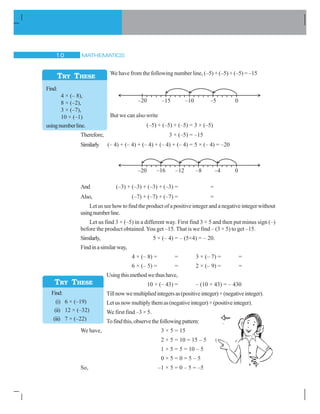
We have from the following number line, (–5) + (–5) + (–5) = –15
But we can also write
(–5) + (–5) + (–5) = 3 × (–5)
Therefore, 3 × (–5) = –15
Similarly (– 4) + (– 4) + (– 4) + (– 4) + (– 4) = 5 × (– 4) = –20
And (–3) + (–3) + (–3) + (–3) = =
Also, (–7) + (–7) + (–7) = =
Letusseehowtofindtheproductofapositiveintegerandanegativeintegerwithout
usingnumberline.
Let us find 3 × (–5) in a different way. First find 3 × 5 and then put minus sign (–)
before the product obtained.You get –15. That is we find – (3 × 5) to get –15.
Similarly, 5 × (– 4) = – (5×4) = – 20.
Findinasimilarway,
4 × (– 8) = = 3 × (– 7) = =
6 × (– 5) = = 2 × (– 9) = =
Usingthismethodwethushave,
10 × (– 43) = – (10 × 43) = – 430
Tillnowwemultipliedintegersas(positiveinteger)×(negativeinteger).
Letusnowmultiplythemas(negativeinteger)×(positiveinteger).
We first find –3 × 5.
Tofindthis,observethefollowingpattern:
We have, 3 × 5 = 15
2 × 5 = 10 = 15 – 5
1 × 5 = 5 = 10 – 5
0 × 5 = 0 = 5 – 5
So, –1 × 5 = 0 – 5 = –5
–20 –16 –12 –8 –4 0
–20 –15 –10 –5 0
TRY THESE
Find:
4 × (– 8),
8 × (–2),
3 × (–7),
10 × (–1)
usingnumberline.
TRY THESE
Find:
(i) 6 × (–19)
(ii) 12 × (–32)
(iii) 7 × (–22)
INTEGERS 11
TRY THESE
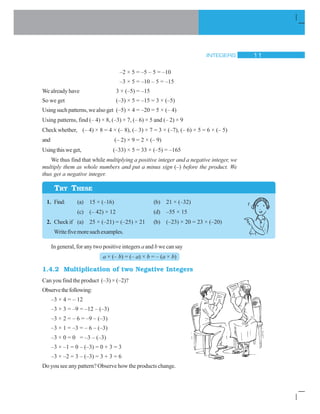
–2 × 5 = –5 – 5 = –10
–3 × 5 = –10 – 5 = –15
We already have 3 × (–5) = –15
So we get (–3) × 5 = –15 = 3 × (–5)
Using such patterns, we also get (–5) × 4 = –20 = 5 × (– 4)
Using patterns, find (– 4) × 8, (–3) × 7, (– 6) × 5 and (– 2) × 9
Check whether, (– 4) × 8 = 4 × (– 8), (– 3) × 7 = 3 × (–7), (– 6) × 5 = 6 × (– 5)
and (– 2) × 9 = 2 × (– 9)
Usingthisweget, (–33) × 5 = 33 × (–5) = –165
We thus find that while multiplying a positive integer and a negative integer, we
multiply them as whole numbers and put a minus sign (–) before the product. We
thus get a negative integer.
1. Find: (a) 15 × (–16) (b) 21 × (–32)
(c) (– 42) × 12 (d) –55 × 15
2. Checkif (a) 25 × (–21) = (–25) × 21 (b) (–23) × 20 = 23 × (–20)
Writefivemoresuchexamples.
In general, for any two positive integers a and b we can say
a × (– b) = (– a) × b = – (a × b)
1.4.2 Multiplication of two Negative Integers
Can you find the product (–3) × (–2)?
Observethefollowing:
–3 × 4 = – 12
–3 × 3 = –9 = –12 – (–3)
–3 × 2 = – 6 = –9 – (–3)
–3 × 1 = –3 = – 6 – (–3)
–3 × 0 = 0 = –3 – (–3)
–3 × –1 = 0 – (–3) = 0 + 3 = 3
–3 × –2 = 3 – (–3) = 3 + 3 = 6
Do you see any pattern? Observe how the products change.
MATHEMATICS12
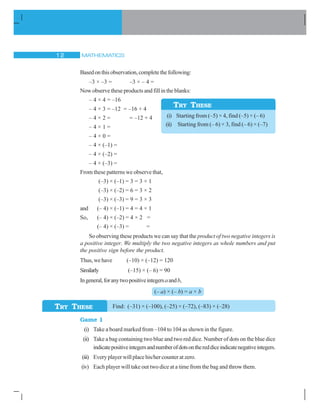
Basedonthisobservation,completethefollowing:
–3 × –3 = –3 × – 4 =
Now observe these products and fill in the blanks:
– 4 × 4 = –16
– 4 × 3 = –12 = –16 + 4
– 4 × 2 = = –12 + 4
– 4 × 1 =
– 4 × 0 =
– 4 × (–1) =
– 4 × (–2) =
– 4 × (–3) =
From these patterns we observe that,
(–3) × (–1) = 3 = 3 × 1
(–3) × (–2) = 6 = 3 × 2
(–3) × (–3) = 9 = 3 × 3
and (– 4) × (–1) = 4 = 4 × 1
So, (– 4) × (–2) = 4 × 2 =
(– 4) × (–3) = =
So observing these products we can say that the product of two negative integers is
a positive integer. We multiply the two negative integers as whole numbers and put
the positive sign before the product.
Thus,wehave (–10) × (–12) = 120
Similarly (–15) × (– 6) = 90
Ingeneral,foranytwopositiveintegersaandb,
(– a) × (– b) = a × b
Find: (–31) × (–100), (–25) × (–72), (–83) × (–28)
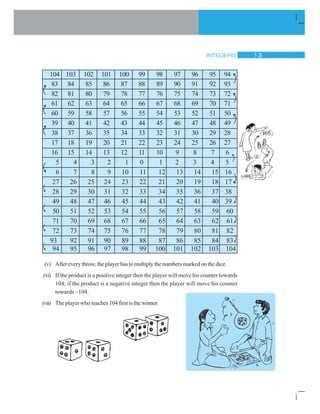
Game 1
(i) Take a board marked from –104 to 104 as shown in the figure.
(ii) Take a bag containing two blue and two red dice. Number of dots on the blue dice
indicatepositiveintegersandnumberofdotsonthereddiceindicatenegativeintegers.
(iii) Everyplayerwillplacehis/hercounteratzero.
(iv) Each player will take out two dice at a time from the bag and throw them.
TRY THESE
(i) Starting from (–5) × 4, find (–5) × (– 6)
(ii) Starting from (– 6) × 3, find (– 6) × (–7)
TRY THESE
INTEGERS 13
104 103 102 101 100 99 98 97 96 95 94
83 84 85 86 87 88 89 90 91 92 93
82 81 80 79 78 77 76 75 74 73 72
61 62 63 64 65 66 67 68 69 70 71
60 59 58 57 56 55 54 53 52 51 50
39 40 41 42 43 44 45 46 47 48 49
38 37 36 35 34 33 32 31 30 29 28
17 18 19 20 21 22 23 24 25 26 27
16 15 14 13 12 11 10 9 8 7 6
5 4 3 2 1 0 1 2 3 4 5
6 7 8 9 10 11 12 13 14 15 16
27 26 25 24 23 22 21 20 19 18 17
28 29 30 31 32 33 34 35 36 37 38
49 48 47 46 45 44 43 42 41 40 39
50 51 52 53 54 55 56 57 58 59 60
71 70 69 68 67 66 65 64 63 62 61
72 73 74 75 76 77 78 79 80 81 82
93 92 91 90 89 88 87 86 85 84 83
94 95 96 97 98 99 100 101 102 103 104
(v) After every throw, the player has to multiply the numbers marked on the dice.
(vi) If the product is a positive integer then the player will move his counter towards
104; if the product is a negative integer then the player will move his counter
towards –104.
(vii) The player who reaches 104 first is the winner.
MATHEMATICS14
1.4.3 Product of three or more Negative Integers
We observedthattheproductoftwonegativeintegersisapositiveinteger.
Whatwillbetheproductofthreenegativeintegers?Fournegativeintegers?
Letusobservethefollowingexamples:
(a) (– 4) × (–3) = 12
(b) (– 4) × (–3) × (–2) = [(– 4) × (–3)] × (–2) = 12 × (–2) = – 24
(c) (– 4) × (–3) × (–2) × (–1) = [(– 4) × (–3) × (–2)] × (–1) = (–24) × (–1)
(d) (–5) × [(–4) × (–3) × (–2) × (–1)] = (–5) × 24 = –120
From the above products we observe that
(a) theproductoftwonegativeintegers
isapositiveinteger;
(b) theproductofthreenegativeintegers
isanegativeinteger.
(c) product of four negative integers is
apositiveinteger.
Whatistheproductoffivenegativeintegersin
(d)?
So what will be the product of six negative
integers?
We further see that in (a) and (c) above,
the number of negative integers that are
multipliedareeven[twoandfourrespectively]
and the product obtained in (a) and (c) are
positive integers. The number of negative
integers that are multiplied in (b) and (d) are
odd and the products obtained in (b) and (d)
arenegativeintegers.
We find that if the number of negative integers in a product is even, then the
product is a positive integer; if the number of negative integers in a product is odd,
then the product is a negative integer.
Justifyitbytakingfivemoreexamplesofeachkind.
THINK, DISCUSS AND WRITE
(i) The product (–9) × (–5) × (– 6)×(–3) is positive whereas the product
(–9) × ( 5) × 6 × (–3) is negative. Why?
(ii) Whatwillbethesignoftheproductifwemultiplytogether:
(a) 8negativeintegersand3positiveintegers?
(b) 5negativeintegersand4positiveintegers?
EulerinhisbookAnkitungzur
Algebra(1770), was one of
the first mathematicians to
attempt to prove
(–1) × (–1) = 1
A Special Case
Consider the following statements and
theresultantproducts:
(–1) × (–1) = +1
(–1) × (–1) × (–1) = –1
(–1) × (–1) × (–1) × (–1) = +1
(–1) × (–1) × (–1) × (–1) × (–1) = –1
This means that if the integer
(–1)ismultipliedevennumberoftimes,
the product is +1 and if the integer (–1)
is multiplied odd number of times, the
product is –1. You can check this by
making pairs of (–1) in the statement.
Thisisusefulinworkingoutproductsof
integers.
INTEGERS 15
(c) (–1),twelvetimes?
(d) (–1), 2m times, m is a natural number?
1.5 PROPERTIES OF MULTIPLICATION OF INTEGERS
1.5.1 Closure under Multiplication
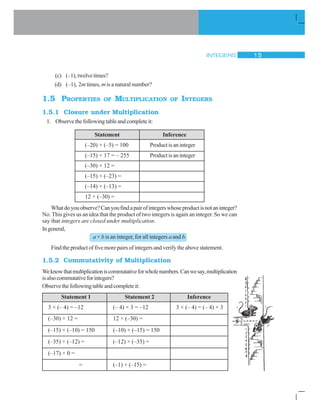
1. Observethefollowingtableandcompleteit:
Statement Inference
(–20) × (–5) = 100 Product is an integer
(–15) × 17 = – 255 Product is an integer
(–30) × 12 =
(–15) × (–23) =
(–14) × (–13) =
12 × (–30) =
Whatdoyouobserve?Canyoufindapairofintegerswhoseproductisnotaninteger?
No. This gives us an idea that the product of two integers is again an integer. So we can
say that integers are closed under multiplication.
Ingeneral,
a × b is an integer, for all integers a and b.
Find the product of five more pairs of integers and verify the above statement.
1.5.2 Commutativity of Multiplication
Weknowthatmultiplicationiscommutativeforwholenumbers.Canwesay,multiplication
isalsocommutativeforintegers?
Observethefollowingtableandcompleteit:
Statement 1 Statement 2 Inference
3 × (– 4) = –12 (– 4) × 3 = –12 3 × (– 4) = (– 4) × 3
(–30) × 12 = 12 × (–30) =
(–15) × (–10) = 150 (–10) × (–15) = 150
(–35) × (–12) = (–12) × (–35) =
(–17) × 0 =
= (–1) × (–15) =
MATHEMATICS16
0 is the additive identity whereas 1 is the
multiplicative identity for integers. We get
additive inverse of an integer a when we multiply
(–1) to a, i.e. a × (–1) = (–1) × a = – a
What are your observations? The above examples suggest multiplication is
commutative for integers. Write five more such examples and verify.
In general, for any two integers a and b,
a × b = b × a
1.5.3 Multiplication by Zero
Weknowthatanywholenumberwhenmultipliedbyzerogiveszero.Observethefollowing
productsofnegativeintegersandzero.Theseareobtainedfromthepatternsdoneearlier.
(–3) × 0 = 0
0 × (– 4) = 0
– 5 × 0 =
0 × (– 6) =
This shows that the product of a negative integer and zero is zero.
In general, for any integera,
a × 0 = 0 × a = 0
1.5.4 Multiplicative Identity
Weknowthat1isthemultiplicativeidentityforwholenumbers.
Check that 1 is the multiplicative identity for integers as well. Observe the following
products of integers with 1.
(–3) × 1 = –3 1 × 5 = 5
(– 4) × 1 = 1 × 8 =
1 × (–5) = 3 × 1 =
1 × (– 6) = 7 × 1 =
Thisshowsthat1isthemultiplicativeidentityforintegersalso.
In general, for any integer a we have,
a × 1 = 1 × a = a
Whathappenswhenwemultiplyanyintegerwith–1? Completethefollowing:
(–3) × (–1) = 3
3 × (–1) = –3
(– 6) × (–1) =
(–1) × 13 =
(–1) × (–25) =
18 × (–1) =
What do you observe?
Canwesay–1isamultiplicativeidentityofintegers?No.
INTEGERS 17
1.5.5 Associativity for Multiplication
Consider –3, –2 and 5.
Look at [(–3) × (–2)] × 5 and (–3) × [(–2) × 5].
In the first case (–3) and (–2) are grouped together and in the second (–2) and 5 are
groupedtogether.
We see that [(–3) × (–2)] × 5 = 6 × 5 = 30
and (–3) × [(–2) × 5] = (–3) × (–10) = 30
So, we get the same answer in both the cases.
Thus, [(–3) × (–2)] × 5 = (–3) × [(–2) × 5]
Look at this and complete the products:
[(7) × (– 6)] × 4 = × 4 =
7 × [(– 6) × 4] = 7 × =
Is [7 × (– 6)] × (– 4) = 7 × [(– 6) × (– 4)]?
Does the grouping of integers affect the product of integers? No.
In general, for any three integers a, b and c
(a × b) × c = a × (b × c)
Take any five values for a, b and c each and verify this property.
Thus, like whole numbers, the product of three integers does not depend upon
the grouping of integers and this is called the associative property for multiplication
of integers.
1.5.6 Distributive Property
We know
16 × (10 + 2) = (16 × 10) + (16 × 2) [Distributivityofmultiplicationoveraddition]
Let us check if this is true for integers also.
Observethefollowing:
(a) (–2) × (3 + 5) = –2 × 8 = –16
and [(–2) × 3] + [(–2) × 5] = (– 6) + (–10) = –16
So, (–2) × (3 + 5) = [(–2) × 3] + [(–2) × 8]
(b) (– 4) × [(–2) + 7] = (– 4) × 5 = –20
and [(– 4) × (–2)] + [(– 4) × 7] = 8 + (–28) = –20
So, (– 4) × [(–2) + 7] = [(– 4) × (–2)] + [(– 4) × 7]
(c) (– 8) × [(–2) + (–1)] = (– 8) × (–3) = 24
and [(– 8) × (–2)] + [(– 8) × (–1)] = 16 + 8 = 24
So, (– 8) × [(–2) + (–1)] = [(– 8) × (–2)] + [(– 8) × (–1)]
MATHEMATICS18
TRY THESE
TRY THESE
Can we say that the distributivity of multiplication over addition is true for integers
also?Yes.
In general, for any integers a, b and c,
a × (b + c) = a × b + a × c
Takeatleastfivedifferentvaluesforeachofa,bandcandverifytheaboveDistributive
property.
(i) Is 10 × [(6 + (–2)] = 10 × 6 + 10 × (–2)?
(ii) Is (–15) × [(–7) + (–1)] = (–15) × (–7) + (–15) × (–1)?
Nowconsiderthefollowing:
Can we say 4 × (3 – 8) = 4 × 3 – 4 × 8?
Let us check:
4 × (3 – 8) = 4 × (–5) = –20
4 × 3 – 4 × 8 = 12 – 32 = –20
So, 4 × (3 – 8) = 4 × 3 – 4 × 8.
Lookatthefollowing:
( –5) × [( – 4) – ( – 6)] = ( –5) × 2 = –10
[( –5) × ( – 4)] – [ ( –5) × ( – 6)] = 20 – 30 = –10
So, ( –5) × [( – 4) – ( – 6)] = [( –5) × ( – 4)] – [ ( –5) × ( – 6)]
Check this for ( –9) × [ 10 – ( –3)] and [( –9) × 10 ] – [ ( –9) × ( –3)]
Youwillfindthatthesearealsoequal.
In general, for any three integers a, b and c,
a × (b – c) = a × b – a × c
Take atleast five different values for each of a,b and cand verify this property.
(i) Is 10 × (6 – (–2)] = 10 × 6 – 10 × (–2)?
(ii) Is (–15) × [(–7) – (–1)] = (–15) × (–7) – (–15) × (–1)?
1.5.7 Making Multiplication Easier
Considerthefollowing:
(i) We can find (–25) × 37 × 4 as
[(–25) × 37] × 4 = (– 925)× 4 = –3700
INTEGERS 19
TRY THESE
Or, we can do it this way,
(–25) × 37 × 4 = (–25) × 4 × 37 = [(–25) × 4] × 37 = (–100) × 37 = –3700
Which is the easier way?
Obviously the second way is easier because multiplication of (–25) and 4 gives
–100 which is easier to multiply with 37. Note that the second way involves
commutativityandassociativityofintegers.
So,wefindthatthecommutativity,associativityanddistributivityofintegershelpto
make our calculations simpler. Let us further see how calculations can be made
easier using these properties.
(ii) Find 16 × 12
16 × 12 can be written as 16 × (10 + 2).
16 × 12 = 16 × (10 + 2) = 16 × 10 + 16 × 2 = 160 + 32 = 192
(iii) (–23) × 48 = (–23) × [50 – 2] = (–23) × 50 – (–23) × 2 = (–1150) – (– 46)
= –1104
(iv) (–35) × (–98) = (–35) × [(–100) + 2] = (–35) × (–100) + (–35) × 2
= 3500 + (–70) = 3430
(v) 52 × (– 8) + (–52) × 2
(–52) × 2 can also be written as 52 × (–2).
Therefore, 52 × (– 8) + (–52) × 2 = 52 × (– 8) + 52 × (–2)
= 52 × [(– 8) + (–2)] = 52 × [(–10)] = –520
Find (ñ49) × 18; (ñ25) × (ñ31); 70 × (–19) + (–1) × 70 using distributive property.
EXAMPLE 2 Findeachofthefollowingproducts:
(i) (–18) × (–10) × 9 (ii) (–20) × (–2) × (–5) × 7
(iii) (–1) × (–5) × (– 4) × (– 6)
SOLUTION
(i) (–18) × (–10) × 9 = [(–18) × (–10)] × 9 = 180 × 9 = 1620
(ii) (–20) × (–2) × (–5) × 7 = – 20 × (–2 × –5) × 7 = [–20 × 10] × 7 = – 1400
(iii) (–1) × (–5) × (– 4) × (– 6) = [(–1) × (–5)] × [(– 4) × (– 6)] = 5 × 24 = 120
EXAMPLE 3 Verify (–30) × [13 + (–3)] = [(–30) × 13] + [(–30) × (–3)]
SOLUTION (–30) × [13 + (–3)] = (–30) × 10 = –300
MATHEMATICS20
[(–30) × 13] + [(–30) × (–3)] = –390 + 90 = –300
So, (–30) × [13 + (–3)] = [(–30) × 13] + [(–30) × (–3)]
EXAMPLE 4 In a class test containing 15 questions, 4 marks are given for every
correct answer and (–2) marks are given for every incorrect answer.
(i) Gurpreetattemptsallquestionsbutonly9ofheranswersarecorrect.
What is her total score? (ii) One of her friends gets only 5 answers
correct. What will be her score?
SOLUTION
(i) Marks given for one correct answer = 4
So, marks given for 9 correct answers = 4 × 9 = 36
Marks given for one incorrect answer = – 2
So, marks given for 6 = (15 – 9) incorrect answers = (–2) × 6 = –12
Therefore, Gurpreet’s total score = 36 + ( –12) = 24
(ii) Marks given for one correct answer = 4
So, marks given for 5 correct answers = 4 × 5 = 20
Marks given for one incorrect answer = (–2)
So, marks given for 10 (=15 – 5) incorrect answers = (–2) × 10 = –20
Therefore, her friend’s total score = 20 + ( –20) = 0
EXAMPLE 5 Supposewerepresentthedistanceabovethegroundbyapositiveinteger
andthatbelowthegroundbyanegativeinteger,thenanswerthefollowing:
(i) An elevator descends into a mine shaft at the rate of 5 metre per minute. What will
be its position after one hour?
(ii) Ifitbeginstodescendfrom15mabovetheground,whatwillbeitspositionafter45
minutes?
SOLUTION
(i) Since the elevator is going down, so the distance covered by it will be represented
byanegativeinteger.
Change in position of the elevator in one minute = – 5 m
Position of the elevator after 60 minutes = (–5) × 60 = – 300 m, i.e., 300 m below
groundlevel.
(ii) Change in position of the elevator in 45 minutes = (–5) × 45 = –225 m, i.e., 225 m
belowgroundlevel.
So, the final position of the elevator = –225 + 15 = –210 m, i.e., 210 m below
groundlevel.
INTEGERS 21
EXERCISE 1.3
1. Findeachofthefollowingproducts:
(a) 3 × (–1) (b) (–1) × 225
(c) (–21) × (–30) (d) (–316) × (–1)
(e) (–15) × 0 × (–18) (f) (–12) × (–11) × (10)
(g) 9 × (–3) × (– 6) (h) (–18) × (–5) × (– 4)
(i) (–1) × (–2) × (–3) × 4 (j) (–3) × (–6) × (–2) × (–1)
2. Verifythefollowing:
(a) 18 × [7 + (–3)] = [18 × 7] + [18 × (–3)]
(b) (–21) × [(– 4) + (– 6)] = [(–21) × (– 4)] + [(–21) × (– 6)]
3. (i) For any integer a, what is (–1) × a equal to?
(ii) Determine the integer whose product with (–1) is
(a) –22 (b) 37 (c) 0
4. Starting from (–1) × 5, write various products showing some pattern to show
(–1) × (–1) = 1.
5. Findtheproduct,usingsuitableproperties:
(a) 26 × (– 48) + (– 48) × (–36) (b) 8 × 53 × (–125)
(c) 15 × (–25) × (– 4) × (–10) (d) (– 41) × 102
(e) 625 × (–35) + (– 625) × 65 (f) 7 × (50 – 2)
(g) (–17) × (–29) (h) (–57) × (–19) + 57
6. A certain freezing process requires that room temperature be lowered from 40°C at
the rate of 5°C every hour. What will be the room temperature 10 hours after the
process begins?
7. Inaclasstestcontaining10questions,5marksareawardedforeverycorrectanswer
and (–2) marks are awarded for every incorrect answer and 0 for questions not
attempted.
(i) Mohan gets four correct and six incorrect answers. What is his score?
(ii) Reshmagetsfivecorrectanswersandfiveincorrectanswers,whatisherscore?
(iii) Heena gets two correct and five incorrect answers out of seven questions she
attempts. What is her score?
8. A cement company earns a profit of Rs 8 per bag of white cement sold and a loss of
Rs 5 per bag of grey cement sold.
(a) Thecompanysells3,000bagsofwhitecementand5,000bagsofgreycement
in a month. What is its profit or loss?
MATHEMATICS22
(b) Whatisthenumberof whitecementbagsitmustselltohaveneitherprofit
nor loss, if the number of grey bags sold is 6,400 bags.
9. Replace the blank with an integer to make it a true statement.
(a) (–3) × = 27 (b) 5 × = –35
(c) × (– 8) = –56 (d) × (–12) = 132
1.6 DIVISION OF INTEGERS
Weknowthatdivisionistheinverseoperationofmultiplication.Letusseeanexample
forwholenumbers.
Since 3 × 5 = 15
So 15 ÷ 5 = 3 and 15 ÷ 3 = 5
Similarly, 4 × 3 = 12 gives 12 ÷ 4 = 3 and 12 ÷ 3 = 4
We can say for each multiplication statement of whole numbers there are two
divisionstatements.
Canyouwritemultiplicationstatementanditscorrespondingdivisonstatements
forintegers?
Observethefollowingandcompleteit.
Multiplication Statement
2 × ( 6) ( 12)
( 4) × 5 ( 20)
( 8) × ( 9) 72
( 3) × ( 7) _____
( 8) × 4 ____
5 × ( 9) _____
( 10) × ( 5)
Corresponding Division Statements
( 12) ÷ ( 6) 2 , ( 12) ÷ 2 ( 6)
( 20) ÷ (5) ( 4) , ( 20) ÷ ( 4) 5
72 ÷ _____ _____ , 72 ÷ _____ _____
_____ ÷ ( 3) ____ , _____________
_____________ , _____________
_____________ , _____________
_____________ , _____________
From the above we observe that :
(–12) ÷ 2 = (– 6)
(–20) ÷ (5) = (– 4)
(–32) ÷ 4 = – 8
(– 45) ÷ 5 = – 9
We observe that when we divide a negative integer by a positive integer, we divide
them as whole numbers and then put a minus sign (–) before the quotient. We, thus,
get a negative integer.
Find:
(a) (–100) ÷ 5 (b) (–81) ÷ 9
(c) (–75) ÷ 5 (d) (–32) ÷ 2
TRY THESE
INTEGERS 23
We also observe that:
72 ÷ (–8) = –9 and 50 ÷ (–10) = –5
72 ÷ (–9) = – 8 50 ÷ (–5) = –10
So we can say that when we divide a positive integer by a negative
integer, we first divide them as whole numbers and then put a minus
sign (–) before the quotient. That is, we get a negative integer.
In general, for any two positive integers aand b
a ÷ (–b) = (– a) ÷ b where b ≠ 0
Find: (a) 125 ÷ (–25) (b) 80 ÷ (–5) (c) 64 ÷ (–16)
Lastly, we observe that
(–12) ÷ (– 6) = 2; (–20) ÷ (– 4) = 5; (–32) ÷ (– 8) = 4; (– 45) ÷ (–9) = 5
So, we can say that when we divide a negative integer by a negative integer, we first
divide them as whole numbers and then put a positive sign (+). That is, we get a positive
integer.
In general, for any two positive integers aand b
(– a) ÷ (–b) = a ÷ b where b ≠ 0
Find: (a) (–36) ÷ (– 4) (b) (–201) ÷ (–3) (c) (–325) ÷ (–13)
1.7 PROPERTIES OF DIVISION OF INTEGERS
Observethefollowingtableandcompleteit:
TRY THESE
Can we say that
(– 48) ÷ 8 = 48 ÷ (– 8)?
Let us check. We know that
(– 48) ÷ 8 = – 6
and 48 ÷ (– 8) = – 6
So (– 48) ÷ 8 = 48 ÷ (– 8)
Check this for
(i) 90 ÷ (– 45) and (–90) ÷ 45
(ii) (–136) ÷ 4 and 136 ÷ (– 4)
TRY THESE
Statement Inference Statement Inference
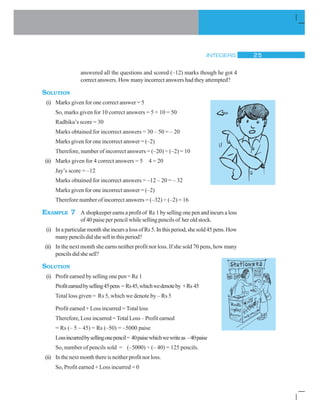
( 8) ÷ ( 4) 2 Result is an integer
( 4) ÷ ( 8)
4
8
Result is not an integer
( 8) ÷ 3
8
3
________________
3 ÷ ( 8)
3
8
________________
What do you observe? We observe that integers are not closed under division.
Justifyitbytakingfivemoreexamplesofyourown.
We know that division is not commutative for whole numbers. Let us check it for
integersalso.
MATHEMATICS24
You can see from the table that (– 8) ÷ (– 4) ≠ (– 4) ÷ (– 8).
Is (– 9) ÷ 3 the same as 3 ÷ (– 9)?
Is (– 30) ÷ (– 6) the same as (– 6) ÷ (– 30)?
Canwesaythatdivisioniscommutativeforintegers?No.
Youcanverifyitbytakingfivemorepairsofintegers.
Likewholenumbers,anyintegerdividedbyzeroismeaninglessandzerodividedby
an integer other than zero is equal to zero i.e., for any integer a, a ÷ 0 is not defined
but 0 ÷ a = 0 for a ≠ 0.
When we divide a whole number by 1 it gives the same whole number. Let us check
whetheritistruefornegativeintegersalso.
Observethefollowing:
(– 8) ÷ 1 = (– 8) (–11) ÷ 1 = –11 (–13) ÷ 1 = –13
(–25) ÷ 1 = (–37) ÷ 1 = (– 48) ÷ 1 =
This shows that negative integer divided by 1 gives the same negative integer.
So, any integer divided by 1 gives the same integer.
In general, for any integera,
a ÷ 1 = a
What happens when we divide any integer by (–1)? Complete the following table
(– 8) ÷ (–1) = 8 11 ÷ (–1) = –11 13 ÷ (–1) =
(–25) ÷ (–1) = (–37) ÷ (–1) = – 48 ÷ (–1) =
What do you observe?
We can say that if any integer is divided by (–1) it does not give the same integer.
Can we say [(–16) ÷ 4] ÷ (–2) is the same as
(–16) ÷ [4 ÷ (–2)]?
We know that [(–16) ÷ 4] ÷ (–2) = (– 4) ÷ (–2) = 2
and (–16) ÷ [4 ÷ (–2)] = (–16) ÷ (–2) = 8
So [(–16) ÷ 4] ÷ (–2) ≠ (–16) ÷ [4 ÷ (–2)]
Canyousaythatdivisionisassociativeforintegers?No.
Verifyitbytakingfivemoreexamplesofyourown.
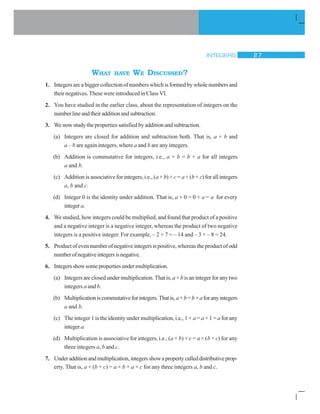
EXAMPLE 6 In a test (+5) marks are given for every correct answer and (–2) marks
aregivenforeveryincorrectanswer.(i)Radhikaansweredallthequestions
and scored 30 marks though she got 10 correct answers. (ii) Jay also
TRY THESE
Is (i) 1 ÷ a = 1?
(ii) a ÷ (–1) = –a? for any integer a.
Take different values of a and check.
INTEGERS 25
answered all the questions and scored (–12) marks though he got 4
correct answers. How many incorrect answers had they attempted?
SOLUTION
(i) Marks given for one correct answer = 5
So, marks given for 10 correct answers = 5 × 10 = 50
Radhika’s score = 30
Marks obtained for incorrect answers = 30 – 50 = – 20
Marks given for one incorrect answer = (–2)
Therefore, number of incorrect answers = (–20) ÷ (–2) = 10
(ii) Marks given for 4 correct answers = 5 4 = 20
Jay’s score = –12
Marks obtained for incorrect answers = –12 – 20 = – 32
Marks given for one incorrect answer = (–2)
Therefore number of incorrect answers = (–32) ÷ (–2) = 16
EXAMPLE 7 Ashopkeeperearnsaprofitof Re1bysellingonepenandincursaloss
of 40 paise per pencil while selling pencils of her old stock.
(i) InaparticularmonthsheincursalossofRs5.Inthisperiod,shesold45pens.How
manypencilsdidshesellinthisperiod?
(ii) In the next month she earns neither profit nor loss. If she sold 70 pens, how many
pencilsdidshesell?
SOLUTION
(i) Profit earned by selling one pen = Re 1
Profitearnedbyselling45pens = Rs45,whichwedenoteby +Rs 45
Total loss given = Rs 5, which we denote by – Rs 5
Profit earned + Loss incurred = Total loss
Therefore, Loss incurred = Total Loss – Profit earned
= Rs (– 5 – 45) = Rs (–50) = –5000 paise
Lossincurredbysellingonepencil= 40paisewhichwewriteas –40paise
So, number of pencils sold = (–5000) ÷ (– 40) = 125 pencils.
(ii) Inthe next month there isneitherprofitnorloss.
So, Profit earned + Loss incurred = 0
MATHEMATICS26
i.e., Profit earned = – Loss incurred.
Now, profit earned by selling 70 pens = Rs 70
Hence, loss incurred by selling pencils = Rs 70 which we indicate by – Rs 70 or
– 7,000 paise.
Total number of pencils sold = (–7000) ÷ (– 40) = 175 pencils.
EXERCISE 1.4
1. Evaluateeachofthefollowing:
(a) (–30) ÷ 10 (b) 50 ÷ (–5) (c) (–36) ÷ (–9)
(d) (– 49) ÷ (49) (e) 13 ÷ [(–2) + 1] (f) 0 ÷ (–12)
(g) (–31) ÷ [(–30) + (–1)]
(h) [(–36) ÷ 12] ÷ 3 (i) [(– 6) + 5)] ÷ [(–2) + 1]
2. Verifythat a÷(b+c) ≠ (a÷ b)+(a÷ c)foreachofthefollowingvaluesofa, bandc.
(a) a = 12, b = – 4, c = 2 (b) a = (–10), b = 1, c = 1
3. Fillintheblanks:
(a) 369 ÷ = 369 (b) (–75) ÷ = –1
(c) (–206) ÷ = 1 (d) – 87 ÷ = 87
(e) ÷ 1 = – 87 (f) ÷ 48 = –1
(g) 20 ÷ = –2 (h) ÷ (4) = –3
4. Write five pairs of integers (a, b) such that a ÷ b = –3. One such pair is (6, –2)
because 6 ÷ (–2) = (–3).
5. The temperature at 12 noon was 10°C above zero. If it decreases at the rate of 2°C
per hour until midnight, at what time would the temperature be 8°C below zero?
What would be the temperature at mid-night?
6. In a class test (+ 3) marks are given for every correct answer and (–2) marks are
given for every incorrect answer and no marks for not attempting any question.
(i) Radhikascored20marks.Ifshehasgot12correctanswers,howmanyquestions
hassheattemptedincorrectly?(ii)Mohiniscores–5marksinthistest,thoughshehas
got 7 correct answers. How many questions has she attempted incorrectly?
(iii) Rakesh scores 18 marks by attempting 16 questions. How many questions has
he attempted correctly and how many has he attempted incorrectly?
7. An elevator descends into a mine shaft at the rate of 6 m/min. If the descent starts
from 10 m above the ground level, how long will it take to reach – 350 m.
INTEGERS 27
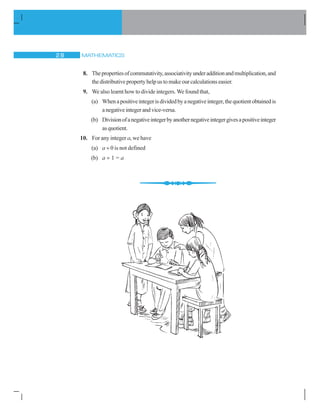
WHAT HAVE WE DISCUSSED?
1. Integers are a bigger collection of numbers which is formed by whole numbers and
their negatives. These were introduced in Class VI.
2. You have studied in the earlier class, about the representation of integers on the
numberlineandtheiradditionandsubtraction.
3. We now study the properties satisfied by addition and subtraction.
(a) Integers are closed for addition and subtraction both. That is, a + b and
a – b are again integers, where a and b are any integers.
(b) Addition is commutative for integers, i.e., a + b = b + a for all integers
a and b.
(c) Addition is associative for integers, i.e., (a+ b) + c= a + (b+ c) for all integers
a, b and c.
(d) Integer 0 is the identity under addition. That is, a + 0 = 0 + a = a for every
integera.
4. We studied, how integers could be multiplied, and found that product of a positive
and a negative integer is a negative integer, whereas the product of two negative
integers is a positive integer. For example, – 2 × 7 = – 14 and – 3 × – 8 = 24.
5. Productofevennumberofnegativeintegersispositive,whereastheproductofodd
numberofnegativeintegersisnegative.
6. Integersshowsomepropertiesundermultiplication.
(a) Integers are closed under multiplication. That is, a×b is an integer for any two
integers a and b.
(b) Multiplicationiscommutativeforintegers.Thatis,a×b=b×aforanyintegers
a and b.
(c) The integer 1 is the identity under multiplication, i.e., 1 × a = a × 1 = a for any
integera.
(d) Multiplication is associative for integers, i.e., (a × b) × c = a × (b × c) for any
three integers a, b and c.
7. Underadditionandmultiplication,integersshowapropertycalleddistributiveprop-
erty. That is, a × (b + c) = a × b + a × c for any three integers a, b and c.
MATHEMATICS28
8. Thepropertiesofcommutativity,associativityunderadditionandmultiplication,and
the distributive property help us to make our calculations easier.
9. We also learnt how to divide integers. We found that,
(a) Whenapositiveintegerisdividedbyanegativeinteger,thequotientobtainedis
anegativeintegerandvice-versa.
(b) Divisionofanegativeintegerbyanothernegativeintegergivesapositiveinteger
asquotient.
10. For any integer a, we have
(a) a ÷ 0 is not defined
(b) a ÷ 1 = a
FRACTIONS AND DECIMALS '
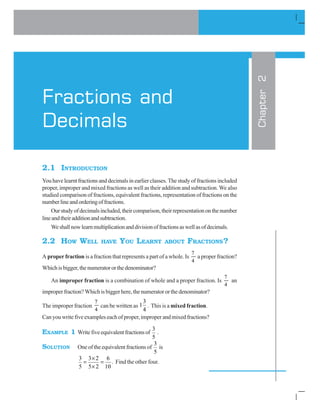
2.1 INTRODUCTION
You have learnt fractions and decimals in earlier classes. The study of fractions included
proper, improper and mixed fractions as well as their addition and subtraction. We also
studied comparison of fractions, equivalent fractions, representation of fractions on the
numberlineandorderingoffractions.
Ourstudyofdecimalsincluded,theircomparison,theirrepresentationonthenumber
lineandtheiradditionandsubtraction.
Weshallnowlearnmultiplicationanddivisionoffractionsaswellasofdecimals.
2.2 HOW WELL HAVE YOU LEARNT ABOUT FRACTIONS?
A proper fraction is a fraction that represents a part of a whole. Is
7
4
a proper fraction?
Whichisbigger,thenumeratororthedenominator?
An improper fraction is a combination of whole and a proper fraction. Is
7
4
an
improperfraction?Whichisbiggerhere,thenumeratororthedenominator?
The improper fraction
7
4
can be written as
3
1
4
. This is a mixed fraction.
Can you write five examples each of proper, improper and mixed fractions?
EXAMPLE 1 Writefiveequivalentfractionsof
3
5
.
SOLUTION One of the equivalent fractions of
3
5
is
3 3 2 6
5 5 2 10
u
u
. Find the other four.
Chapter2
Fractions and
Decimals
MATHEMATICS! 
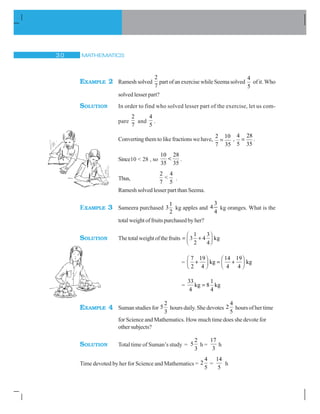
EXAMPLE 2 Ramesh solved
2
7
part of an exercise while Seema solved
4
5
of it. Who
solved lesser part?
SOLUTION In order to find who solved lesser part of the exercise, let us com-
pare
2
7
and
4
5
.
Converting them to like fractions we have,
2 10
7 35
,
4 28
5 35
.
Since10  28 , so
10 28
35 35
 .
Thus,
2 4

7 5
.
Ramesh solved lesser part than Seema.
EXAMPLE 3 Sameera purchased
1
3
2
kg apples and
3
4
4
kg oranges. What is the
totalweightoffruitspurchasedbyher?
SOLUTION Thetotalweightofthefruits
1 3
3 4 kg
2 4
§ ·
¨ ¸© ¹
=
7 19 14 19
kg kg
2 4 4 4
§ · § ·
 ¨ ¸ ¨ ¸© ¹ © ¹
=
33 1
kg 8 kg
4 4
EXAMPLE 4 Suman studies for
2
5
3
hours daily. She devotes
4
2
5
hours of her time
for Science and Mathematics. How much time does she devote for
other subjects?
SOLUTION Total time of Suman’s study =
2
5
3
h =
17
3
h
Time devoted by her for Science and Mathematics =
4
2
5
=
14
5
h
FRACTIONS AND DECIMALS ! 
Thus, time devoted by her for other subjects =
17 14
3 5
§ ·
¨ ¸© ¹ h
=
17 5 14 3
– h
15 15
u u§ ·
¨ ¸© ¹ =
85 – 42
h
15
§ ·
¨ ¸© ¹
=
43
15
h =
13
2
15
h
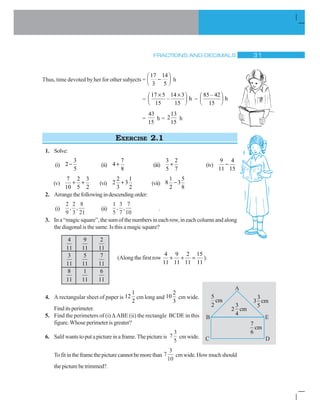
EXERCISE 2.1
1. Solve:
(i)
3
2
5
 (ii)
7
4
8
 (iii)
3 2
5 7
 (iv)
9 4
11 15

(v)
7 2 3
10 5 2
  (vi)
2 1
2 3
3 2
 (vii)
1 5
8 3
2 8

2. Arrangethefollowingindescendingorder:
(i)
2
9
2
3
8
21
, , (ii)
1
5
3
7
7
10
, , .
3. In a “magic square”, the sum of the numbers in each row, in each column and along
the diagonal is the same. Is this a magic square?
4
11
3
11
8
11
9
11
5
11
1
11
2
11
7
11
6
11
4. A rectangular sheet of paper is
1
12
2
cm long and
2
10
3
cm wide.
Finditsperimeter.
5. Find the perimeters of (i) ' ABE (ii) the rectangle BCDE in this
figure.Whoseperimeterisgreater?
6. Salilwantstoputapictureinaframe.Thepictureis 7
3
5
cmwide.
Tofitintheframethepicturecannotbemorethan 7
3
10
cmwide.Howmuchshould
thepicturebetrimmed?.
(Alongthefirstrow
4 9 2 15
11 11 11 11
  ).
5
cm
2 3
2 cm
4
3
3 cm
5
7
cm
6
MATHEMATICS!
7. Rituate
3
5
partofanappleandtheremainingapplewaseatenbyherbrotherSomu.
How much part of the apple did Somu eat? Who had the larger share? By how
much?
8. Michaelfinishedcolouringapicturein
7
12
hour.Vaibhavfinishedcolouringthesame
picture in
3
4
hour. Who worked longer? By what fraction was it longer?
2.3 MULTIPLICATION OF FRACTIONS
You know how to find the area of a rectangle. It is equal to length × breadth. If the length
and breadth of a rectangle are 7 cm and 4 cm respectively, then what will be its area? Its
area would be 7 × 4 = 28 cm2
.
What will be the area of the rectangle if its length and breadth are 7
1
2
cm and
3
1
2
cm respectively? You will say it will be 7
1
2
× 3
1
2
=
15
2
×
7
2
cm2
.Thenumbers
15
2
and
7
2
arefractions.Tocalculatetheareaofthegivenrectangle,weneedtoknowhowto
multiplyfractions.Weshalllearnthatnow.
2.3.1 Multiplication of a Fraction by a Whole Number
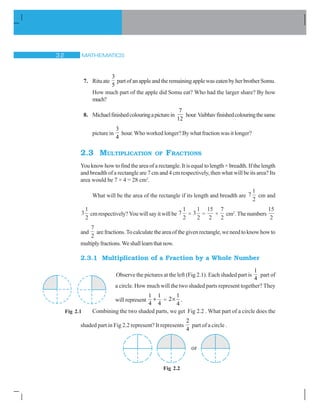
Observe the pictures at the left (Fig 2.1). Each shaded part is
1
4
part of
a circle. How much will the two shaded parts represent together? They
will represent
1 1
4 4
 =
1
2
4
u .
Combining the two shaded parts, we get Fig 2.2 . What part of a circle does the
shaded part in Fig 2.2 represent? It represents
2
4
part of a circle .
Fig 2.1
Fig 2.2
or
FRACTIONS AND DECIMALS ! !
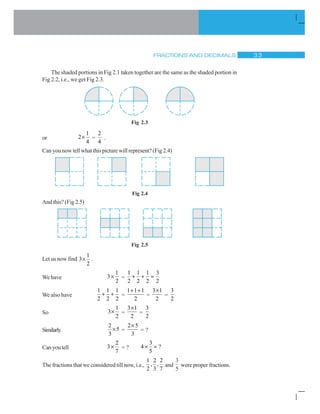
The shaded portions in Fig 2.1 taken together are the same as the shaded portion in
Fig 2.2, i.e., we get Fig 2.3.
Fig 2.3
or
1
2
4
u =
2
4
.
Can you now tell what this picture will represent? (Fig 2.4)
Fig 2.4
And this? (Fig 2.5)
Fig 2.5
Let us now find
1
3
2
u .
We have
1
3
2
u =
1 1 1 3
2 2 2 2
 
We also have
1 1 1
2 2 2
  =
1 1 1
2
 
=
3 1
2
u
=
3
2
So
1
3
2
u =
3 1
2
u
=
3
2
Similarly
2
5
3
u =
2 5
3
u
= ?
Canyoutell
2
3
7
u = ?
3
4 ?
5
u
The fractions that we considered till now, i.e.,
1 2 2
, ,
2 3 7
and
3
5
were proper fractions.
MATHEMATICS! 
For improper fractions also we have,
5
2
3
u =
2 5
3
u
=
10
3
Try,
8
3
7
u = ?
7
4
5
u = ?
Thus, to multiply a whole number with a proper or an improper fraction, we
multiply the whole number with the numerator of the fraction, keeping the
denominator same.
1. Find: (a)
2
3
7
u (b)
9
6
7
u (c)
1
3
8
u (d)
13
6
11
u
If the product is an improper fraction express it as a mixed fraction.
2. Represent pictorially : 2
2
5
4
5
u
To multiply a mixed fraction to a whole number, first convert the
mixed fraction to an improper fraction and then multiply.
Therefore,
5
3 2
7
u =
19
3
7
u =
57
7
=
1
8
7
.
Similarly,
2
2 4
5
u =
22
2
5
u = ?
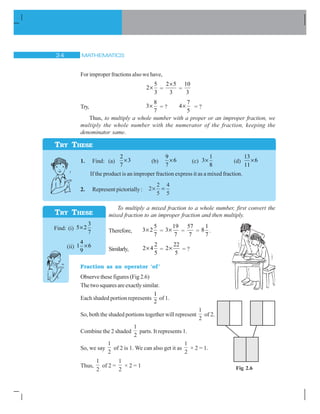
Fraction as an operator ‘of’
Observe these figures (Fig 2.6)
Thetwosquaresareexactlysimilar.
Each shaded portion represents
1
2
of 1.
So, both the shaded portions together will represent
1
2
of 2.
Combine the 2 shaded
1
2
parts. It represents 1.
So, we say
1
2
of 2 is 1. We can also get it as
1
2
× 2 = 1.
Thus,
1
2
of 2 =
1
2
× 2 = 1
TRY THESE
TRY THESE
Find: (i)
3
5 2
7
u
(ii)
4
1 6
9
u
Fig 2.6
FRACTIONS AND DECIMALS ! #
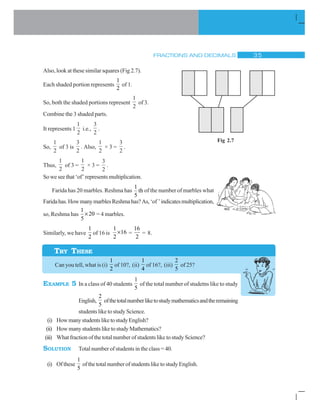
Also, look at these similar squares (Fig 2.7).
Each shaded portion represents
1
2
of 1.
So, both the shaded portions represent
1
2
of 3.
Combine the 3 shaded parts.
It represents 1
1
2
i.e.,
3
2
.
So,
1
2
of 3 is
3
2
. Also,
1
2
× 3 =
3
2
.
Thus,
1
2
of 3 =
1
2
× 3 =
3
2
.
Soweseethat‘of’representsmultiplication.
Farida has 20 marbles. Reshma has
1
th
5
of the number of marbles what
Faridahas.HowmanymarblesReshmahas?As,‘of ’indicatesmultiplication,
so, Reshma has
1
20
5
u = 4 marbles.
Similarly, we have
1
2
of 16 is
1
16
2
u =
16
2
= 8.
Can you tell, what is (i)
1
2
of 10?, (ii)
1
4
of 16?, (iii)
2
5
of 25?
EXAMPLE 5 In a class of 40 students
1
5
of the total number of studetns like to study
English,
2
5
ofthetotalnumberliketostudymathematicsandtheremaining
students like to study Science.
(i) HowmanystudentsliketostudyEnglish?
(ii) HowmanystudentsliketostudyMathematics?
(iii) What fraction of the total number of students like to study Science?
SOLUTION Total number of students in the class = 40.
(i) Of these
1
5
of the total number of students like to study English.
Fig 2.7
TRY THESE
MATHEMATICS! $
Thus, the number of students who like to study English =
1
5
of 40 =
1
40
5
u = 8.
(ii) Tryyourself.
(iii) ThenumberofstudentswholikeEnglishandMathematics=8+16=24.Thus,the
number of students who like Science = 40 – 24 = 16.
Thus, the required fraction is 16
40
.
EXERCISE 2.2
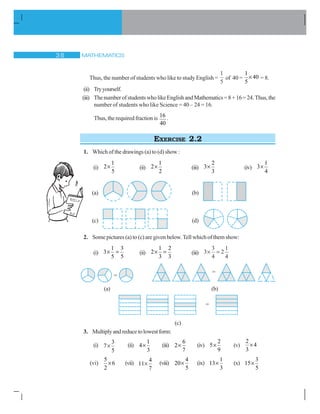
1. Which of the drawings (a) to (d) show :
(i)
1
2
5
u (ii)
1
2
2
u (iii)
2
3
3
u (iv)
1
3
4
u
(a) (b)
(c) (d)
2. Some pictures (a) to (c) are given below.Tell which of them show:
(i)
1 3
3
5 5
u (ii)
1 2
2
3 3
u (iii) 3
3
4
2
1
4
u
(a) (b)
(c)
3. Multiplyandreducetolowestform:
(i)
3
7
5
u (ii)
1
4
3
u (iii)
6
2
7
u (iv)
2
5
9
u (v)
2
4
3
u
(vi)
5
6
2
u (vii)
4
11
7
u (viii)
4
20
5
u (ix)
1
13
3
u (x)
3
15
5
u
=
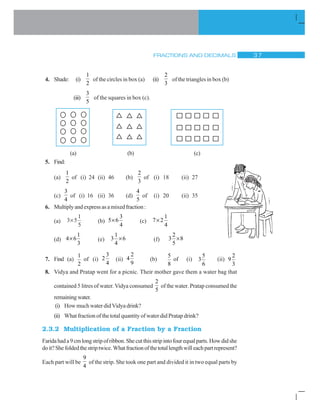
=
FRACTIONS AND DECIMALS ! %
4. Shade: (i)
1
2
of the circles in box (a) (ii)
2
3
of the triangles in box (b)
(iii)
3
5
of the squares in box (c).
(a) (b) (c)
5. Find:
(a)
1
2
of (i) 24 (ii) 46 (b)
2
3
of (i) 18 (ii) 27
(c)
3
4
of (i) 16 (ii) 36 (d)
4
5
of (i) 20 (ii) 35
6. Multiplyandexpressasamixedfraction:
(a) 3 5
1
5
u (b)
3
5 6
4
u (c)
1
7 2
4
u
(d)
1
4 6
3
u (e)
1
3 6
4
u (f)
2
3 8
5
u
7. Find (a)
1
2
of (i)
3
2
4
(ii)
2
4
9
(b)
5
8
of (i)
5
3
6
(ii)
2
9
3
8. Vidya and Pratap went for a picnic. Their mother gave them a water bag that
contained 5 litres of water. Vidya consumed
2
5
of the water. Pratap consumed the
remainingwater.
(i) How much water did Vidya drink?
(ii) What fraction of the total quantity of water did Pratap drink?
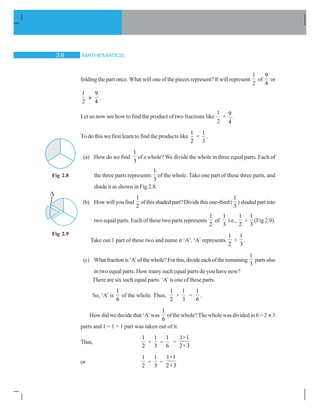
2.3.2 Multiplication of a Fraction by a Fraction
Faridahada9cmlongstripofribbon.Shecutthisstripintofourequalparts.Howdidshe
doit?Shefoldedthestriptwice.Whatfractionofthetotallengthwilleachpartrepresent?
Each part will be
9
4
of the strip. She took one part and divided it in two equal parts by
MATHEMATICS! 
folding the part once. What will one of the pieces represent? It will represent
1
2
of
9
4
or
1
2
×
9
4
.
Let us now see how to find the product of two fractions like
1
2
×
9
4
.
To do this we first learn to find the products like
1
2
×
1
3
.
(a) How do we find
1
3
of a whole? We divide the whole in three equal parts. Each of
the three parts represents
1
3
of the whole. Take one part of these three parts, and
shade it as shown in Fig 2.8.
(b) Howwillyoufind
1
2
ofthisshadedpart?Dividethisone-third(
1
3
)shadedpartinto
two equal parts. Each of these two parts represents
1
2
of
1
3
i.e.,
1
2
×
1
3
(Fig 2.9).
Take out 1 part of these two and name it ‘A’. ‘A’ represents
1
2
×
1
3
.
(c) Whatfractionis‘A’ofthewhole?Forthis,divideeachoftheremaining
1
3
partsalso
in two equal parts. How many such equal parts do you have now?
There are six such equal parts. ‘A’ is one of these parts.
So, ‘A’ is
1
6
of the whole. Thus,
1
2
×
1
3
=
1
6
.
How did we decide that‘A’was
1
6
of the whole? The whole was divided in 6 = 2 ×3
parts and 1 = 1 × 1 part was taken out of it.
Thus,
1
2
×
1
3
=
1
6
=
1×1
2×3
or
1
2
×
1
3
=
1×1
2×3
Fig 2.8
Fig 2.9
A
FRACTIONS AND DECIMALS ! '
The value of
1
3
×
1
2
can be found in a similar way. Divide the whole into two equal
parts and then divide one of these parts in three equal parts. Take one of these parts. This
will represent 1
3
×
1
2
i.e.,
1
6
.
Therefore
1
3
×
1
2
=
1
6
=
1 1
3 2
u
u
as discussed earlier.
Hence
1
2
×
1
3
=
1
3
×
1
2
=
1
6
Find
1
3
×
1
4
and
1
4
×
1
3
;
1
2
×
1
5
and
1
5
×
1
2
and check whether you get
1
3
×
1
4
=
1
4
×
1
3
;
1
2
×
1
5
=
1
5
×
1
2
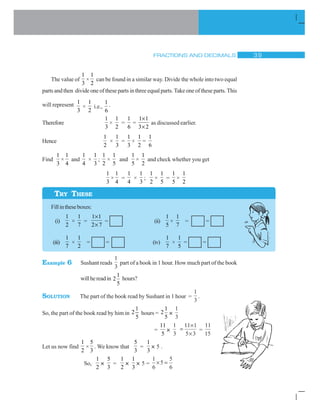
Fillintheseboxes:
(i)
1
2
×
1
7
=
1 1
2 7
u
u
= (ii)
1
5
×
1
7
= =
(iii)
1
7
×
1
2
= = (iv)
1
7
×
1
5
= =
Example 6 Sushant reads
1
3
part of a book in 1 hour. How much part of the book
willhereadin
1
2
5
hours?
SOLUTION The part of the book read by Sushant in 1 hour =
1
3
.
So, the part of the book read by him in
1
2
5
hours =
1
2
5
×
1
3
=
11
5
×
1
3
u
u
11 1
5 3
=
11
15
Let us now find
1
2
×
5
3
. We know that
5
3
=
1
3
× 5 .
So,
1
2
×
5
3
=
1
2
×
1
3
× 5 =
1
6
5
5
6
u
TRY THESE
MATHEMATICS 
Also,
5
6
=
1 5
2 3
u
u
. Thus,
1
2
×
5
3
=
1 5
2 3
u
u
=
5
6
.
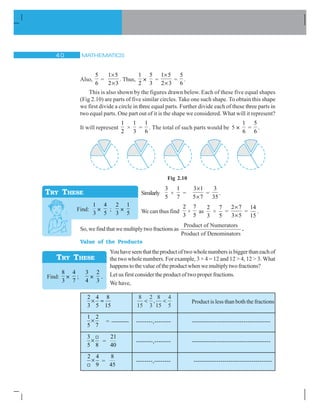
This is also shown by the figures drawn below. Each of these five equal shapes
(Fig 2.10) are parts of five similar circles. Take one such shape. To obtain this shape
we first divide a circle in three equal parts. Further divide each of these three parts in
two equal parts. One part out of it is the shape we considered. What will it represent?
It will represent
1
2
×
1
3
=
1
6
. The total of such parts would be 5 ×
1
6
=
5
6
.
Similarly
3
5
×
1
7
=
3 1
5 7
u
u
=
3
35
.
We can thus find
2
3
×
7
5
as
2
3
×
7
5
=
2 7
3 5
u
u
=
14
15
.
So, we find that we multiply two fractions as
Product of Numerators
Product of Denominators
.
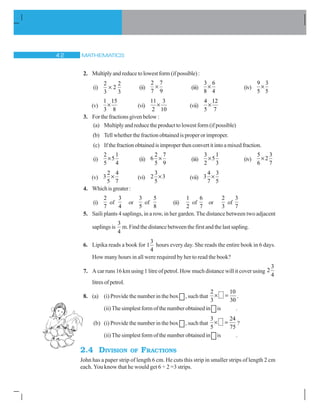
Value of the Products
Youhaveseenthattheproductoftwowholenumbersisbiggerthaneachof
the two whole numbers. For example, 3 × 4 = 12 and 12  4, 12  3. What
happens to the value of the product when we multiply two fractions?
Let us first consider the product of two proper fractions.
We have,
2 4 8
3 5 15
u
8
15
 
2
3
8
15
4
5
, Product is less than both the fractions
1 2
5 7
u = --------- --------,-------- --------------------------------------
3
5 8
u
9
=
21
40
--------,-------- --------------------------------------
2 4
9
u
9
=
8
45
--------,-------- --------------------------------------
TRY THESE
Find:
1
3
×
4
5
;
2
3
×
1
5
TRY THESE
Find:
8
3
×
4
7
;
3
4
×
2
3
.
Fig 2.10
FRACTIONS AND DECIMALS  
You will find that when two proper fractions are multiplied, the product is less
than both the fractions. Or, we say the value of the product of two proper fractions
is smaller than each of the two fractions.
Checkthisbyconstructingfivemoreexamples.
Letusnowmultiplytwoimproperfractions.
7 5 35
3 2 6
u
35
6
7
3
35
6
5
2
! !, Product is greater than both the fractions
6 24
5 3 15
u
9
--------,-------- ------------------------------------------
9 7 63
2 8
u
9
--------,-------- ------------------------------------------
3 8 24
7 14
u
9
--------,-------- ----------------------------------------
We find that the product of two improper fractions is greater than each of the
two fractions.
Or, the value of the product of two improper fraction is more than each of the
two fractions.
Constructfivemoreexamplesforyourselfandverifytheabovestatement.
Let us now multiply a proper and an improper fraction, say
2
3
and
7
5
.
We have
2
3
×
7
5
=
14
15
. Here,
14
15

7
5
and
14
15

2
3
Theproductobtainedislessthantheimproperfractionandgreaterthantheproperfraction
involvedinthemultiplication.
Check it for
6
5
×
2
7
,
8
3
×
4
5
.
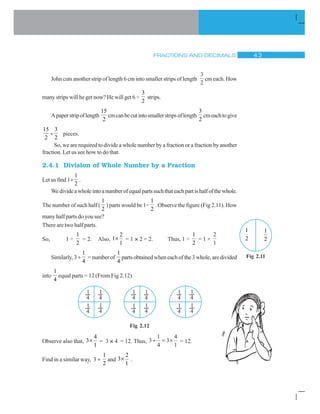
EXERCISE 2.3
1. Find:
(i)
1
4
of (a)
1
4
(b)
3
5
(c)
4
3
(ii)
1
7
of (a)
2
9
(b)
6
5
(c)
3
10
MATHEMATICS
2. Multiplyandreducetolowestform(ifpossible):
(i)
2 2
2
3 3
u (ii)
2 7
7 9
u (iii)
3 6
8 4
u (iv)
9 3
5 5
u
(v)
1 15
3 8
u (vi)
11 3
2 10
u (vii)
4 12
5 7
u
3. Forthefractionsgivenbelow:
(a) Multiply and reduce the product to lowest form (if possible)
(b) Tell whether the fraction obtained is proper or improper.
(c) Ifthefractionobtainedisimproperthenconvertitintoamixedfraction.
(i)
2 1
5
5 4
u (ii)
2 7
6
5 9
u (iii)
3 1
5
2 3
u (iv)
5 3
2
6 7
u
(v)
2 4
3
5 7
u (vi)
3
2 3
5
u (vii)
4 3
3
7 5
u
4. Whichisgreater:
(i)
2
7
of
3
4
or
3
5
of
5
8
(ii)
1
2
of
6
7
or
2
3
of
3
7
5. Saili plants 4 saplings, in a row, in her garden. The distance between two adjacent
saplings is
3
4
m. Find the distance between the first and the last sapling.
6. Lipika reads a book for
3
1
4
hours every day. She reads the entire book in 6 days.
How many hours in all were required by her to read the book?
7. A car runs 16 km using 1 litre of petrol. How much distance will it cover using
3
2
4
litresofpetrol.
8. (a) (i) Provide the number in the box , such that
2 10
3 30
u .
(ii) The simplest form of the number obtained in is .
(b) (i) Provide the number in the box , such that
3 24
5 75
u ?
(ii) The simplest form of the number obtained in is .
2.4 DIVISION OF FRACTIONS
John has a paper strip of length 6 cm. He cuts this strip in smaller strips of length 2 cm
each. You know that he would get 6 ÷ 2 =3 strips.
FRACTIONS AND DECIMALS  !
John cuts another strip of length 6 cm into smaller strips of length
3
2
cm each. How
many strips will he get now? He will get 6 ÷
3
2
strips.
Apaperstripoflength
15
2
cmcanbecutintosmallerstripsoflength
3
2
cmeachtogive
15
2
y
3
2
pieces.
So, we are required to divide a whole number by a fraction or a fraction by another
fraction. Let us see how to do that.
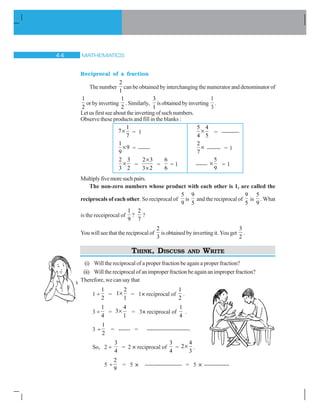
2.4.1 Division of Whole Number by a Fraction
Let us find 1y
1
2
.
Wedivideawholeintoanumberofequalpartssuchthateachpartishalfofthewhole.
The number of such half (
1
2
) parts would be 1÷
1
2
. Observe the figure (Fig 2.11). How
many half parts do you see?
There are two half parts.
So, 1 ÷
1
2
= 2. Also,
2
1
1
u = 1 × 2 = 2. Thus, 1 ÷
1
2
= 1 ×
2
1
Similarly,3 y
1
4
=numberof
1
4
partsobtainedwheneachofthe3whole,aredivided
into
1
4
equal parts = 12 (From Fig 2.12)
Fig 2.12
Observe also that,
4
3
1
u = 3 × 4 = 12. Thus, 3
1
4
3
4
1
y u = 12.
Find in a similar way, 3 y
1
2
and
2
3
1
u .
1
2
1
2
Fig 2.11
1
4
1
4
1
4
1
4
1
4
1
4
1
4
1
4
1
4
1
4
1
4
1
4
MATHEMATICS 
Reciprocal of a fraction
The number
2
1
can be obtained by interchanging the numerator and denominator of
1
2
orbyinverting
1
2
.Similarly,
3
1
isobtainedbyinverting
1
3
.
Letusfirstseeabouttheinvertingofsuchnumbers.
Observe these products and fill in the blanks :
1
7
7
u = 1
5 4
4 5
u = ---------
1
9
9
u = ------
2
7
u ------- = 1
2 3
3 2
u =
2 3
3 2
u
u
=
6
6
= 1 ------
5
9
u = 1
Multiplyfivemoresuchpairs.
The non-zero numbers whose product with each other is 1, are called the
reciprocals of each other. So reciprocal of
5
9
is
9
5
and the reciprocal of
9
5
is
5
9
. What
is the receiprocal of
1
9
?
2
7
?
You will see that the reciprocal of
2
3
is obtained by inverting it. You get
3
2
.
THINK, DISCUSS AND WRITE
(i) Will the reciprocal of a proper fraction be again a proper fraction?
(ii) Willthereciprocalofanimproperfractionbeagainanimproperfraction?
Therefore, we can say that
1 y
1
2
=
2
1
1
u = 1× reciprocal of
1
2
.
3 y
1
4
=
4
3
1
u = 3× reciprocal of
1
4
.
3 y
1
2
= ------ = ----------------------.
So, 2 y
3
4
= 2 × reciprocal of
3
4
=
4
2
3
u .
5 y
2
9
= 5 × ------------------- = 5 × -------------
FRACTIONS AND DECIMALS  #
Thus, to divide a whole number by any fraction, multiply that whole number by
the reciprocal of that fraction.
Find: (i) 7 ÷
2
5
(ii) 6 ÷
4
7
(iii) 2 ÷
8
9
l While dividing a whole number by a mixed fraction, first convert the mixed
fraction into improper fraction and then solve it.
Thus, 4 ÷
2
2
5
= 4 ÷
12
5
= ? Also, 5 ÷ 3
1
3
= 3 ÷
10
3
= ?
2.4.2 Division of a Fraction by a Whole Number
l What will be
3
4
y 3?
Based on our earlier observations we have:
3
4
y 3 =
3
4
3
1
y =
3
4
×
1
3
=
3
12
=
1
4
So,
2
3
y 7 =
2
3
×
1
7
= ? What is
5
7
y 6 ,
2
7
y 8 ?
l While dividing mixed fractions by whole numbers, convert the mixed fractions into
improperfractions.Thatis,
2
2
3
5y =
8
3
5y = ------ ;
2
4 3
5
y = ------ = ------;
3
2 2
5
y = ------ = ------
2.4.3 Division of a Fraction by Another Fraction
We can now find
1
3
y
5
6
.
1
3
y
5
6
=
1
3
× reciprocal of
5
6
=
1
3
×
5
6
=
2
5
.
Similarly,
8 2 8
5 3 5
y × reciprocal of
2
3
= ? and,
1
2
y
3
4
= ?
Find: (i)
3 1
5 2
y (ii)
1 3
2 5
y (iii)
1 3
2
2 5
y (iv)
1 9
5
6 2
y
TRY THESE
TRY THESE
Find: (i) 6 y
1
5
3
(ii) 7 y
4
2
7
TRY THESE
MATHEMATICS $
EXERCISE 2.4
1. Find:
(i)
3
12
4
y (ii)
5
14
6
y (iii)
7
8
3
y (iv)
8
4
3
y
(v)
1
3 2
3
y (vi)
4
5 3
7
y
2. Find the reciprocal of each of the following fractions. Classify the reciprocals as
properfractions,improperfractionsandwholenumbers.
(i)
3
7
(ii)
5
8
(iii)
9
7
(iv)
6
5
(v)
12
7
(vi)
1
8
(vii)
1
11
3. Find:
(i)
7
2
3
y (ii)
4
5
9
y (iii)
6
7
13
y (iv) 4
1
3
3y
(v)
1
3 4
2
y (vi)
3
4 7
7
y
4. Find:
(i)
2 1
5 2
y (ii)
4 2
9 3
y (iii)
3 8
7 7
y (iv)
1 3
2
3 5
y (v) 3
1
2
8
3
y
(vi)
2 1
1
5 2
y (vii)
1 2
3 1
5 3
y (viii)
1 1
2 1
5 5
y
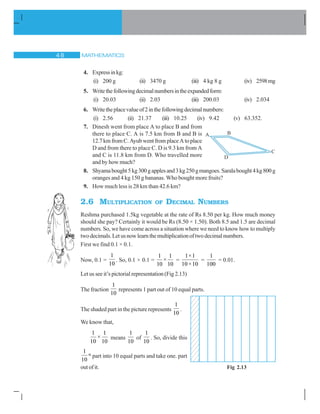
2.4 HOW WELL HAVE YOU LEARNT ABOUT DECIMAL NUMBERS
You have learnt about decimal numbers in the earlier classes. Let us briefly recall them
here. Look at the following table and fill up the blank spaces.
Hundreds Tens Ones Tenths Hundredths Thousandths Number
(100) (10) (1)
1
10
§ ·
¨ ¸© ¹
1
100
§ ·
¨ ¸© ¹
1
1000
§ ·
¨ ¸© ¹
2 5 3 1 4 7 253.147
6 2 9 3 2 1 ..............
0 4 3 1 9 2 ..............
........ 1 4 2 5 1 514.251
2 ....... 6 5 1 2 236.512
........ 2 ........ 5 ........ 3 724.503
6 ....... 4 ........ 2 ....... 614.326
0 1 0 5 3 0 ...............
FRACTIONS AND DECIMALS  %
Inthetable,youwrotethedecimalnumber,givenitsplace-valueexpansion.Youcan
do the reverse, too. That is, given the number you can write its expanded form. For
example, 253.417 = 2 × 100 + 5 × 10 + 3 × 1 + 4 ×
1
10
§ ·
¨ ¸© ¹ + 1 ×
1
100
§ ·
¨ ¸© ¹ + 7 ×
1
1000
§ ·
¨ ¸© ¹ .
John has Rs 15.50 and Salma has Rs 15.75. Who has more money? To find this we
need to compare the decimal numbers 15.50 and 15.75. To do this, we first compare the
digitsontheleftofthedecimalpoint,startingfromtheleftmostdigit.Hereboththedigits1
and 5, to the left of the decimal point, are same. So we compare the digits on the right of
the decimal point starting from the tenths place. We find that 5  7, so we say
15.50  15.75. Thus, Salma has more money than John.
Ifthedigitsatthetenthsplacearealsosamethencomparethedigitsatthehundredths
place and so on.
Now compare quickly, 35.63 and 35.67; 20.1 and 20.01; 19.36 and 29.36.
Whileconvertinglowerunitsofmoney,lengthandweight,totheirhigherunits,weare
required to use decimals. For example, 3 paise = Rs
3
100
= Rs 0.03, 5g =
5
1000
g
= 0.005 kg, 7 cm = 0.07 m.
Write 75 paise = Rs , 250 g = kg, 85 cm = m.
We also know how to add and subtract decimals. Thus, 21.36 + 37.35 is
21.36
37.35
58.71

What is the value of 0.19 + 2.3 ?
The difference 29.35  4.56 is 29.35
04.56
24.79

Tell the value of 39.87  21.98.
EXERCISE 2.5
1. Whichisgreater?
(i) 0.5 or 0.05 (ii) 0.7 or 0.5 (iii) 7 or 0.7
(iv) 1.37 or 1.49 (v) 2.03 or 2.30 (vi) 0.8 or 0.88.
2. Expressasrupeesusingdecimals:
(i) 7 paise (ii) 7 rupees 7 paise (iii) 77 rupees 77 paise
(iv) 50 paise (v) 235 paise.
3. (i) Express 5 cm in metre and kilometre (ii) Express 35 mm in cm, m and km
MATHEMATICS 
4. Expressinkg:
(i) 200 g (ii) 3470 g (iii) 4 kg 8 g (iv) 2598mg
5. Writethefollowingdecimalnumbersintheexpandedform:
(i) 20.03 (ii) 2.03 (iii) 200.03 (iv) 2.034
6. Writetheplacevalueof2inthefollowingdecimalnumbers:
(i) 2.56 (ii) 21.37 (iii) 10.25 (iv) 9.42 (v) 63.352.
7. Dinesh went from place A to place B and from
there to place C. A is 7.5 km from B and B is
12.7kmfromC.AyubwentfromplaceAtoplace
D and from there to place C. D is 9.3 km from A
and C is 11.8 km from D. Who travelled more
and by how much?
8. Shyamabought5kg300gapplesand3kg250gmangoes.Saralabought4kg800g
oranges and 4 kg 150 g bananas. Who bought more fruits?
9. How much less is 28 km than 42.6 km?
2.6 MULTIPLICATION OF DECIMAL NUMBERS
Reshma purchased 1.5kg vegetable at the rate of Rs 8.50 per kg. How much money
should she pay? Certainly it would be Rs (8.50 × 1.50). Both 8.5 and 1.5 are decimal
numbers. So, we have come across a situation where we need to know how to multiply
twodecimals.Letusnowlearnthemultiplicationoftwodecimalnumbers.
First we find 0.1 × 0.1.
Now, 0.1 =
1
10
. So, 0.1 × 0.1 =
1 1
×
10 10
=
1×1
10×10
=
1
100
= 0.01.
Let us see it’s pictorial representation (Fig 2.13)
The fraction
1
10
represents 1 part out of 10 equal parts.
The shaded part in the picture represents
1
10
.
We know that,
1 1
×
10 10
means
1
10
of
1
10
. So, divide this
1
10
th
part into 10 equal parts and take one. part
out of it. Fig 2.13
FRACTIONS AND DECIMALS  '
Thus, we have, (Fig 2.14).
Fig 2.14
The dotted square is one part out of 10 of the
1
10
th
part. That is, it represents
1 1
×
10 10
or 0.1 × 0.1.
Can the dotted square be represented in some other way?
How many small squares do you find in Fig 2.14?
There are 100 small squares. So the dotted square represents one out of 100 or 0.01.
Hence, 0.1 × 0.1 = 0.01.
Note that 0.1 occurs two times in the product. In 0.1 there is one digit to the right of
thedecimalpoint.In0.01therearetwodigits(i.e.,1+1)totherightofthedecimalpoint.
Let us now find 0.2 × 0.3.
We have, 0.2 × 0.3 =
2 3
×
10 10
As we did for
1
10
1
10
¸ , let us divide the square into 10
equal parts and take three parts out of it, to get
3
10
. Again
divide each of these three equal parts into 10 equal parts and
take two from each. We get
2 3
×
10 10
.
The dotted squares represent
2 3
×
10 10
or 0.2 ×0.3. (Fig 2.15)
Since there are 6 dotted squares out of 100, so they also
reprsent 0.06. Fig 2.15
MATHEMATICS# 
Thus, 0.2 × 0.3 = 0.06.
Observethat2×3=6andthenumberofdigitstotherightofthedecimalpointin
0.06 is 2 (= 1 + 1).
Check whether this applies to 0.1 × 0.1 also.
Find 0.2 × 0.4 by applying these observations.
While finding 0.1 × 0.1 and 0.2 × 0.3, you might have noticed that first we
multiplied themaswholenumbersignoringthedecimalpoint.In0.1× 0.1,wefound
01 × 01 or 1 × 1. Similarly in 0.2 × 0.3 we found 02 × 03 or 2 × 3.
Then,wecountedthenumberofdigitsstartingfromtherightmostdigitandmoved
towardsleft.Wethenputthedecimalpointthere.Thenumberofdigitstobecounted
is obtained by adding the number of digits to the right of the decimal point in the
decimalnumbersthatarebeingmultiplied.
Let us now find 1.2 × 2.5.
Multiply 12 and 25. We get 300. Both, in 1.2 and 2.5, there is 1 digit to the right
ofthedecimalpoint.So,count1+1=2digitsfromtherightmostdigit(i.e.,0)in300
and move towards left. We get 3.00 or 3.
Find in a similar way 1.5 × 1.6, 2.4 × 4.2.
Whilemultiplying2.5and1.25,youwillfirstmultiply25and125.Forplacingthe
decimal in the product obtained, you will count 1 + 2 = 3 (Why?) digits starting from
the rightmost digit. Thus, 2.5 × 1.25 = 3.225
Find 2.7 × 1.35.
1. Find: (i) 2.7 × 4 (ii) 1.8 × 1.2 (iii) 2.3 × 4.35
2. Arrange the products obtained in (1) in descending order.
EXAMPLE 7 The side of an equilateral triangle is 3.5 cm. Find its perimeter.
SOLUTION Allthesidesofanequilateraltriangleareequal.
So, length of each side = 3.5 cm
Thus, perimeter = 3 × 3.5 cm = 10.5 cm
EXAMPLE 8 The length of a rectangle is 7.1 cm and its breadth is 2.5 cm. What
is the area of the rectangle?
SOLUTION Length of the rectangle = 7.1 cm
Breadth of the rectangle = 2.5 cm
Therefore, area of the rectangle = 7.1 × 2.5 cm2
= 17.75 cm2
TRY THESE
FRACTIONS AND DECIMALS # 
2.6.1 Multiplication of Decimal Numbers by 10, 100 and 1000
Reshma observed that 2.3 =
23
10
whereas 2.35 =
235
100
. Thus, she found that depending
onthepositionofthedecimalpointthedecimalnumbercanbeconvertedtoafractionwith
denominator10or100.Shewonderedwhatwouldhappenifadecimalnumberismultiplied
by 10 or 100 or 1000.
Let us see if we can find a pattern of multiplying numbers by 10 or 100 or 1000.
Have a look at the table given below and fill in the blanks:
1.76 × 10 =
176
100
× 10 = 17.6 2.35 ×10 = 12.356 × 10 =
1.76 × 100 =
176
100
× 100 = 176 or 176.0 2.35 ×100 = 12.356 × 100 =
1.76 × 1000 =
176
100
× 1000 = 1760 or 2.35 ×1000 = 12.356 × 1000 =
1760.0
0.5 × 10 =
5
10
× 100 = 5 ; 0.5 × 100 = ; 0.5 × 1000 =
Observe the shift of the decimal point of the products in the table. Here the numbers
are multiplied by 10,100 and 1000. In 1.76 × 10 = 17.6, the digits are same i.e., 1, 7 and
6. Do you observe this in other products also? Observe 1.76 and 17.6. To which side has
the decimal point shifted, right or left? The decimal point has shifted to the right by one
place. Note that 10 has one zero over 1.
In 1.76×100 = 176.0, observe 1.76 and 176.0. To which side and by how many
digits has the decimal point shifted? The decimal point has shifted to the right by two
places.
Note that 100 has two zeros over one.
Doyouobservesimilarshiftingofdecimalpointinotherproductsalso?
So we say, when a decimal number is multiplied by 10, 100 or 1000, the digits in
the product the are same as in the decimal number but the decimal
point in the product is shifted to the right by as , many of places as
there are zeros over one.
Based on these observations we can now say
0.07 × 10 = 0.7, 0.07 × 100 = 7 and 0.07 × 1000 = 70.
Can you now tell 2.97 × 10 = ? 2.97 × 100 = ? 2.97 × 1000 = ?
Can you now help Reshma to find the total amount i.e., Rs 8.50 × 150, that she has
to pay?
TRY THESE
Find: (i) 0.3 × 10
(ii) 1.2 × 100
(iii) 56.3 × 1000
MATHEMATICS#
EXERCISE 2.6
1. Find:
(i) 0.2 × 6 (ii) 8 × 4.6 (iii) 2.71 × 5 (iv) 20.1 × 4
(v) 0.05 × 7 (vi) 211.02 × 4 (vii) 2 × 0.86
2. Find the area of rectangle whose length is 5.7cm and breadth is 3 cm.
3. Find:
(i) 1.3 × 10 (ii) 36.8 × 10 (iii) 153.7 × 10 (iv) 168.07 × 10
(v) 31.1 × 100 (vi) 156.1 × 100 (vii) 3.62 × 100 (viii) 43.07 × 100
(ix) 0.5 × 10 (x) 0.08 × 10 (xi) 0.9 × 100 (xii) 0.03 × 1000
4. Atwo-wheelercoversadistanceof55.3kminonelitreofpetrol.Howmuchdistance
willitcoverin10litresofpetrol?
5. Find:
(i) 2.5 × 0.3 (ii) 0.1 × 51.7 (iii) 0.2 × 316.8 (iv) 1.3×3.1
(v) 0.5 × 0.05 (vi) 11.2 × 0.15 (vii) 1.07 × 0.02
(viii) 10.05 × 1.05 (ix) 101.01 × 0.01 (x) 100.01 × 1.1
2.7 DIVISION OF DECIMAL NUMBERS
Savita was preparing a design to decorate her classroom. She needed a few coloured
strips of paper of length 1.9 cm each. She had a strip of coloured paper of length 9.5 cm.
Howmanypiecesoftherequiredlengthwillshegetoutofthisstrip?Shethoughtitwould
be
9.5
1.9
cm. Is she correct?
Both 9.5 and 1.9 are decimal numbers. So we need to know the division of
decimalnumberstoo!
2.7.1 Division by 10, 100 and 1000
Let us find the division of a decimal number by 10, 100 and 1000.
Consider 31.5 y 10.
31.5 y 10 =
315 1
×
10 10
=
315
100
= 3.15
Similarly, 31 5 100
315
10
1
100
. y ¸
315
1000
0 315.
Letusseeifwecanfindapatternfordividingnumbersby10,100or1000.Thismay
help us in dividing numbers by 10, 100 or 1000 in a shorter way.
31.5 ÷ 10 = 3.15 231.5 ÷ 10 = 1.5 ÷ 10 = 29.36 ÷ 10 =
31.5 ÷ 100 = 0.315 231.5 ÷ 10 = 1.5 ÷ 100 = 29.36 ÷ 100 =
31.5 ÷1000 = 0.0315 231.5 ÷ 1000 = 1.5 ÷ 1000 = 29.36 ÷1000 =
FRACTIONS AND DECIMALS # !
Take 31.5 10 = 31.5. In 31.5 and 3.15, the digits are
same i.e., 3, 1, and 5 but the decimal point has shifted in the
quotient. To which side and by how many digits? The decimal
point has shifted to the left by one place. Note that 10 has one
zero over one.
Consider now 31.5 ÷ 100 = 0.315. In 31.5 and 0.315 the
digitsaresame,butwhataboutthedecimalpointinthequotient?
It has shifted to the left by two places. Note that 100 has two zeros over one.
So we can say that, while dividing a number by 10, 100 or 1000, the digits of the
number and the quotient are same but the decimal point in the quotient shifts to the
left by as many places as there are zeros over one. Using this observation let us now
quickly find: 2.38 ÷ 10 = 0.238, 2.38 ÷ 100 = 0.0238, 2.38 ÷ 1000 = 0.00238
2.7.2 Division of a Decimal Number by a Whole Number
Let us find
6.4
2
. Remember we also write it as 6.4 y 2.
So, 6.4 y 2 =
64
10
y 2 =
64 1
10 2
u as learnt in fractions..
=
64 1
10 2
1 64
10 2
1
10
64
2
u
u
u
u
u =
1
10
32
32
10
3 2u .
Or, let us first divide 64 by 2. We get 32. There is one digit to the right of the decimal
point in 6.4. Place the decimal in 32 such that there would be one digit to its
right. We get 3.2 again.
To find 19.5 ÷ 5, first find 195 ÷5. We get 39. There is one digit to the
rightofthedecimalpointin19.5.Placethedecimalpointin39suchthatthere
would be one digit to its right. You will get 3.9.
Now, 12.96 y 4 =
1296
4
100
y =
1296 1
×
100 4
=
1 1296
×
100 4
=
1
× 324
100
= 3.24
Or, divide 1296 by 4. You get 324. There are two digits to the right of the decimal in
12.96. Making similar placement of the decimal in 324, you will get 3.24.
Note that here and in the next section, we have considered only those
divisions in which, ignoring the decimal, the number would be completely
divisible by another number to give remainder zero. Like, in 19.5 ÷ 5, the
number 195 when divided by 5, leaves remainder zero.
However,therearesituationsinwhichthenumbermaynotbecompletely
divisible by another number, i.e., we may not get remainder zero. For example, 195 ÷ 7.
Wedealwithsuchsituationsinlaterclasses.
Thus, 40.86 y 6 = 6.81
TRY THESE
Find: (i) 235.4 ÷ 10
(ii) 235.4 ÷100
(iii) 235.4 ÷ 1000
(i) 35.7 y 3 = ?;
(ii) 25.5 y 3 = ?
TRY THESE
TRY THESE
(i) 43.15 y 5 = ?;
(ii) 82.44 y 6 = ?
TRY THESE
Find: (i) 15.5 y 5
(ii) 126.35 y 7
MATHEMATICS# 
EXAMPLE 9 Find the average of 4.2, 3.8 and 7.6.
SOLUTION The average of 4.2, 3.8 and 7.6 is
4.2 3.8 7.6
3
 
=
15.6
3
= 5.2.
2.7.3 Division of a Decimal Number by another Decimal
Number
Letusfind
25.5
0.5
i.e., 25.5 y 0.5.
We have 25.5 y 0.5 =
255 5
10 10
y =
255 10
×
10 5
= 51. Thus, 25.5 y 0.5 = 51
What do you observe? For
25.5
0.5
, we find that there is one digit to the right of the
decimalin0.5.Thiscouldbeconvertedtowholenumberbydividingby10.Accordingly
25.5 was also converted to a fraction by dividing by 10.
Or, we say the decimal point was shifted by one place to the right in 0.5 to make it 5.
So, there was a shift of one decimal point to the right in 25.5 also to make it 255.
Thus, 22.5 ÷ 1.5 =
22 5
1 5
.
.
=
225
15
= 15
Find
20 3
0 7
.
.
and
15 2
0 8
.
.
in a similar way.
Let us now find 20.55 y 1.5.
We can write it is as 205.5 y 15, as discussed above. We get 13.7. Find
3.96
0.4
,
2.31
0.3
.
Consider now,
33.725
0.25
.We can write it as
3372.5
25
(How?) and we get the quotient
as 134.9. How will you find
27
0.03
? We know that 27 can be written as 27.0.
So,
27 27.00 2700
0.03 0.03 3
= ?
EXAMPLE 10 Eachsideofaregularpolygonis2.5cminlength.Theperimeterofthe
polygon is 12.5cm. How many sides does the polygon have?
SOLUTION The perimeter of a regular polygon is the sum of the lengths of all its
equal sides = 12.5 cm.
Length of each side = 2.5 cm. Thus, the number of sides =
12.5
2.5
=
125
25
= 5
The polygon has 5 sides.
Find: (i)
7.75
0.25
(ii)
42.8
0.02
(iii)
5.6
1.4
TRY THESE
FRACTIONS AND DECIMALS # #
EXAMPLE 11 A car covers a distance of 89.1 km in 2.2 hours. What is the average
distance covered by it in 1 hour?
SOLUTION Distance covered by the car = 89.1 km.
Time required to cover this distance = 2.2 hours.
So distance covered by it in 1 hour =
89.1
2.2
=
891
22
= 40.5 km.
EXERCISE 2.7
1. Find:
(i) 0.4 y 2 (ii) 0.35 y 5 (iii) 2.48 y 4 (iv) 65.4 y 6
(v) 651.2 y 4 (vi) 14.49 y 7 (vii) 3.96 y 4 (viii) 0.80 y 5
2. Find:
(i) 4.8 y 10 (ii) 52.5 y 10 (iii) 0.7 y 10 (iv) 33.1 y 10
(v) 272.23 y 10 (vi) 0.56 y 10 (vii) 3.97 y10
3. Find:
(i) 2.7 y 100 (ii) 0.3 y 100 (iii) 0.78 y 100
(iv) 432.6 y 100 (v) 23.6 y100 (vi) 98.53 y 100
4. Find:
(i) 7.9 ÷ 1000 (ii) 26.3 ÷ 1000 (iii) 38.53 ÷ 1000
(iv) 128.9 ÷ 1000 (v) 0.5 ÷ 1000
5. Find:
(i) 7 y 3.5 (ii) 36 y 0.2 (iii) 3.25 y 0.5 (iv) 30.94 y 0.7
(v) 0.5 y 0.25 (vi) 7.75 y 0.25 (vii) 76.5 y 0.15 (viii) 37.8 y 1.4
(ix) 2.73 y 1.3
6. Avehiclecoversadistanceof43.2kmin2.4litresofpetrol.Howmuchdistancewill
it cover in one litre of petrol?
WHAT HAVE WE DISCUSSED?
1. Wehavelearntaboutfractionsanddecimalsalongwiththeoperationsofadditionand
subtractiononthem,intheearlierclass.
2. Wenowstudytheoperationsofmultiplicationanddivisiononfractionsaswellason
decimals.
3. Wehavelearnthowtomultiplyfractions.Twofractionsaremultipliedbymultiplying
their numerators and denominators seperately and writing the product as
productof numerators
productof denominators
. For example,
2 5 2×5 10
×
3 7 3× 7 21
.
4. A fraction acts as an operator ‘of ’. For example,
1
2
of 2 is
1
2
× 2 = 1.
MATHEMATICS# $
5. (a) The product of two proper fractions is less than each of the fractions that are
multiplied.
(b) The product of a proper and an improper fraction is less than the improper
fraction and greater than the proper fraction.
(c) The product of two imporper fractions is greater than the two fractions.
6. Areciprocalofafractionisobtainedbyinvertingitupsidedown.
7. We have seen how to divide two fractions.
(a) While dividing a whole number by a fraction, we multiply the whole number
withthereciprocalofthatfraction.
For example,
3 5 10
2 2
5 3 3
y u
(b) While dividing a fraction by a whole number we multiply the fraction by the
reciprocalofthewholenumber.
For example,
2 2 1 2
7 ×
3 3 7 21
y
(c) Whiledividingonefractionbyanotherfraction,wemultuiplythefirstfractionby
the reciprocal of the other. So,
2 5 2 7 14
×
3 7 3 5 15
y .
8. Wealsolearnthowtomultiplytwodecimalnumbers.Whilemultiplyingtwodecimal
numbers,firstmultiplythemaswholenumbers.Countthenumberofdigitstotheright
ofthedecimalpointinboththedecimalnumbers.Addthenumberofdigitscounted.
Put the decimal point in the product by counting the digits from its rightmost place.
The count should be the sum obtained earlier.
For example, 0.5 × 0.7 = 0.35
9. Tomultiplyadecimalnumberby10,100or1000,wemovethedecimalpointinthe
number to the right by as many places as there are zeros over 1.
Thus 0.53 × 10 = 5.3, 0.53 × 100 = 53, 0.53 × 1000 = 530
10. We have seen how to divide decimal numbers.
(a) To divide a decimal number by a whole number, we first divide them as whole
numbers.Thenplacethedecimalpointinthequotientasinthedecimalnumber.
For example, 8.4 y 4 = 2.1
Notethathereweconsideronlythosedivisionsinwhichtheremainderiszero.
(b) To divide a decimal number by 10, 100 or 1000, shift the digits in the decimal
number to the left by as many places as there are zeros over 1, to get the
quotient.
So, 23.9 y 10 = 2.39,23.9 y 100 = 0 .239, 23.9 y 1000 = 0.0239
(c) Whiledividingtwodecimalnumbers,firstshiftthedecimalpointtotherightby
equalnumberofplacesinboth,toconvertthedivisortoawholenumber.Then
divide. Thus, 2.4 y 0.2 = 24 y 2 = 12.
DATA HANDLING # %
3.1 INTRODUCTION
In your previous classes, you have dealt with various types of data. You have learnt to
collect data, tabulate and put it in the form of bar graphs. The collection, recording and
presentation of data help us organise our experiences and draw inferences from them.
In this chapter, we will take one more step towards learning how to do this. You will
come across some more kinds of data and graphs. You have seen several kinds of data
through newspapers, magazines, television and other sources. You also know that all
data give us some sort of information. Let us look at some common forms of data that
you come across:
Chapter3
Data
Handling
Temperatures of cities
as on 20.6.2006
Max. Min.
Ahmedabad 38qC 29qC
Amritsar 37qC 26qC
Bangalore 28qC 21qC
Chennai 36qC 27qC
Delhi 38qC 28qC
Jaipur 39qC 29qC
Jammu 41qC 26qC
Mumbai 32qC 27qC
Table 3.1
MarksoffivestudentsinaHinditest
of 10 marks are: 4, 5, 8, 6, 7
Table 3.2
Table 3.3
Football
World Cup 2006
Ukraine beat Saudi Arabia by 4 - 0
SpainbeatTunisiaby 3 - 1
Switzerland beat Togo by 2 - 0
Data showing weekly absentees
in a class
Monday
Tuesday
Wednesday -
Thursday
Friday
Saturday
represents one child
MATHEMATICS# 
What do these collections of data tell you?
For example you can say that the highest maximum temperature was in Jammu on
20.06.2006 (Table 3.1) or we can say that, on Wednesday, no child was absent.
(Table 3.3)
Can we organise and present these data in a different way, so that their analysis and
interpretation becomes better? We shall address such questions in this chapter.
3.2 COLLECTING DATA
Thedataaboutthetemperaturesofcities(Table3.1)cantellusmanythings,butitcannot
tellusthecitywhichhadthehighestmaximumtemperatureduringtheyear.Tofindthat,we
needtocollectdataregardingthehighestmaximumtemperaturereachedineachofthese
citiesduringtheyear.Inthatcase,thetemperaturechartofoneparticulardateoftheyear,
asgiveninTable3.1willnotbesufficient.
Thisshowsthatagivencollectionofdatamaynotgiveusaspecificinformationrelated
to that data. For this we need to collect data keeping in mind that specific information. In
the above case the specific information needed by us, was about the highest maximum
temperature of the cities during the year, which we could not get from Table 3.1
Thus, before collecting data, we need to know what we would use it for.
Givenbelowareafewsituations.
You want to study the
– PerformanceofyourclassinMathematics.
– PerformanceofIndiainfootballorincricket.
– Female literacy rate in a given area, or
– Numberofchildrenbelowtheageoffiveinthefamiliesaroundyou..
Whatkindofdatawouldyouneedintheabovesituations?Unlessanduntilyoucollect
appropriate data, you cannot know the desired information. What is the appropriate data
for each?
Discuss with your friends and identify the data you would need for each.
Some of this data is easy to collect and some difficult.
3.3 ORGANISATION OF DATA
When we collect data, we have to record and organise it. Why do we need to
dothat?Considerthefollowingexample.
Ms Neelam, class teacher wanted to find how children had performed
in English. She writes down the marks obtained by the students in the
followingway:
23, 35, 48, 30, 25, 46, 13, 27, 32, 38
In this form, the data was not easy to understand. She also did not know whether her
impressionofthestudentsmatchedtheirperformance.
DATA HANDLING # '
Neelam’scolleaguehelped her organise the data in the following way (Table 3.4).
Table 3.4
Roll No. Names Marks Roll No. Names Marks
Out of 50 Out of 50
1 Ajay 23 6 Govind 46
2 Armaan 35 7 Jay 13
3 Ashish 48 8 Kavita 27
4 Dipti 30 9 Manisha 32
5 Faizaan 25 10 Neeraj 38
Inthisform,Neelamwasabletoknowwhichstudenthasgothowmanymarks.Butshe
wanted more. Deepika suggested another way to organise this data (Table 3.5).
Table 3.5
Roll No. Names Marks Roll No. Names Marks
Out of 50 Out of 50
3 Ashish 48 4 Dipti 30
6 Govind 46 8 Kavita 27
10 Neeraj 38 5 Faizaan 25
2 Armaan 35 1 Ajay 23
9 Manisha 32 7 Jay 13
Now Neelam was able to see who had done the best and who needed help.
Manykindsofdatawecomeacrossareputintabularform.Ourschoolrolls,progress
report, index in the note books, temperature record and many others are all in tabular
form. Can you think of a few more data that you come across in tabular form?
When we put data in a proper table it becomes easy to understand and interpret.
Weigh(inkg)atleast20children(girlsandboys)ofyourclass.Organisethedata,and
answerthefollowingquestionsusingthisdata.
(i) Whoistheheaviestofall? (ii) Whatisthemostcommonweight?
(iii) What is the difference between your weight and that of your best friend?
3.4 REPRESENTATIVE VALUES
Youmightbeawareofthetermaverageandwouldhavecomeacrossstatementsinvolving
theterm‘average’inyourday-to-daylife:
l Isha spends on an average of about 5 hours daily for her studies.
TRY THESE
MATHEMATICS$ 
l The average temperature at this time of the year is about 40 degree Celsius.
l The average age of pupils in my class is 12 years.
l The average attendance of students in a school during its final examination was
98 per cent.
Manymoreofsuchstatementscouldbethere.Thinkaboutthestatementsgivenabove.
Doyouthinkthatthechildinthefirststatementstudiesexactlyfor5hoursdaily?
Or,isthetemperatureofthegivenplaceduringthatparticulartimealways40degrees?
Or, is the age of each pupil in that class 12 years? Obviously not.
Then what do these statements tell you?
By average we understand that Isha, usually, studies for 5 hours. On some days,
she may study for less number of hours and on the other days she may study longer.
Similarly, the average temperature of 40 degree celsius, means that, very often,
thetemperatureatthistimeoftheyearisaround40degreecelsius.Sometimes,itmay
be less than 40 degree celsius and at other times, it may be more than 40°C.
Thus,werealisethataverageisanumberthatrepresentsorshowsthecentraltendency
of a group of observations or data. Since average lies between the highest and the lowest
valueofthegivendataso,wesayaverageisameasureofthecentraltendencyofthegroup
of data. Different forms of data need different forms of representative or central value to
describe it. One of these representative values is the “Arithmetic Mean”. You will learn
about the other representative values in the later of the chapter.
3.5 ARITHMETIC MEAN
The most common representative value of a group of data is the arithmetic mean or the
mean.To understand this in a better way, let us look at the following example:
Twovesselscontain20litresand60litresofmilkrespectively.Whatistheamountthat
eachvesselwouldhave,if bothsharethemilkequally?Whenweaskthisquestionweare
seekingthearithmeticmean.
In the above case, the average or the arithmetic mean would be
Total quantity of milk
Number of vessels
=
20 60
2

litres = 40 litres.
Thus,eachvesselswould have 40litres ofmilk.
TheaverageorArithmeticmean(A.M.)orsimplymeanisdefinedasfollows:
mean =
Sum of all observations
number of observations
Consider these examples.
EXAMPLE 1 Ashish studies for 4 hours, 5 hours and 3 hours respectively on three
consecutive days. How many hours does he study daily on an average?
DATA HANDLING $ 
SOLUTION TheaveragestudytimeofAshishwouldbe
Total number of study hours
Number of days for which he studdied
=
4 5 3
3
 
hours = 4 hours per day
Thus, we can say that Ashish studies for 4 hours daily on an average.
EXAMPLE 2 Abatsmanscoredthefollowingnumberofrunsinsixinnings:
36, 35, 50, 46, 60, 55
Calculatethemeanrunsscoredbyhiminaninning.
SOLUTION Total runs = 36 + 35 + 50 + 46 + 60 + 55 = 282.
Tofindthemean,wefindthesumofalltheobservationsanddivideitbythenumberof
observations.
Therefore,inthiscase,mean=
282
6
=47.Thus,themeanrunsscoredinaninningare47.
Where does the arithmetic mean lie
TRY THESE
How would you find the average of your study hours for the whole week?
THINK, DISCUSS AND WRITE
Considerthedataintheaboveexamplesandthinkonthefollowing:
l Is the mean bigger than each of the observations?
l Isitsmallerthaneachobservation?
Discuss with your friends. Frame one more example of this type and answer the
samequestions.
Youwillfindthatthemeanliesinbetweenthegreatestandthesmallestobservations.
In particular, the mean of two numbers will always lie between the two numbers.
For example the mean of 5 and 11 is
5 11
2
8

, which lies between 5 and 11.
Can you use this idea to show that between any two fractional numbers, you can find
as many fractional numbers as you like. For example between
1
2
and
1
4
you have their
average
1
2
1
4
2

=
3
8
and then between
1
2
and
3
8
, you have their average
7
16
and so on.
1. Find the mean of your sleeping hours during one week.
2. Find atleast 5 numbers between
1
2
and
1
3
.
TRY THESE
MATHEMATICS$
3.5.1 Range
The difference between the highest and the lowest observation gives us an idea of the
spread of the observations. This can be found by subtracting the lowest observation from
the highest observation. We call the result the range of the observation. Look at the
followingexample:
EXAMPLE 3 The ages in years of 10 teachers of a school are:
32, 41, 28, 54, 35, 26, 23, 33, 38, 40
(i) What is the age of the oldest teacher and that of the youngest teacher?
(ii) What is the range of the ages of the teachers?
(iii) What is the mean age of these teachers?
SOLUTION
(i) Arrangingtheagesinascendingorder,weget:
23, 26, 28, 32, 33, 35, 38, 40, 41, 54
We find that the age of the oldest teacher is 54 years and the age of the youngest
teacher is 23 years.
(ii) Range of the ages of the teachers = (54 – 23) years = 31 years
(iii) Mean age of the teachers
=
23 26 28 32 33 35 38 40 41 54
10
        
years
=
350
10
years = 35 years
EXERCISE 3.1
1. Find the range of heights of any ten students of your class.
2. Organisethefollowingmarksinaclassassessment,inatabularform.
4 6 7 5 3 5 4 5 2 6
2 5 1 9 6 5 8 4 6 7
(i) Whichnumber isthehighest? (ii) Whichnumberisthelowest?
(iii) What is the range of the data? (iv) Findthearithmeticmean.
3. Findthemeanofthefirstfivewholenumbers.
4. Acricketerscoresthefollowingrunsineightinnings:
58, 76, 40, 35, 46, 45, 0, 100.
Find the mean score.
DATA HANDLING $ !
5. Following table shows the points of each player scored in four games:
Player Game Game Game Game
1 2 3 4
A 14 16 10 10
B 0 8 6 4
C 8 11 Didnot 13
Play
Nowanswerthefollowingquestions:
(i) Find the mean to determine A’s average number of points scored per game.
(ii) To find the mean number of points per game for C, would you divide the total
points by 3 or by 4? Why?
(iii) Bplayed in all the four games. How would you find the mean?
(iv) Who is the best performer?
6. The marks (out of 100) obtained by a group of students in a science test are 85, 76,
90, 85, 39, 48, 56, 95, 81 and 75. Find the:
(i) Highest and the lowest marks obtained by the students.
(ii) Range of the marks obtained.
(iii) Mean marks obtained by the group.
7. Theenrolmentinaschoolduringsixconsecutiveyearswasasfollows:
1555, 1670, 1750, 2013, 2540, 2820
Find the mean enrolment of the school for this period.
8. The rainfall (in mm) in a city on 7 days of a certain week was recorded as follows:
Day Mon Tue Wed Thurs Fri Sat Sun
Rainfall 0.0 12.2 2.1 0.0 20.5 5.5 1.0
(inmm)
(i) Find the range of the rainfall in the above data.
(ii) Findthemeanrainfallfortheweek.
(iii) Onhowmanydayswastherainfalllessthanthemeanrainfall.
9. The heights of 10 girls were measured in cm and the results are as follows:
135, 150, 139, 128, 151, 132, 146, 149, 143, 141.
(i) Whatistheheightofthetallestgirl? (ii) Whatistheheightoftheshortestgirl?
(iii) What is the range of the data? (iv) Whatisthemeanheightofthegirls?
(v) Howmanygirlshaveheightsmorethanthemeanheight.
MATHEMATICS$ 
3.6 MODE
As we have said Mean is not the only measure of Central tendency or the only form of
representative value. For different requirements from a data other measures of Central
tendencies are used.
Look at the following example
Tofindouttheweeklydemandfordifferentsizesofshirt,ashopkeeperkeptrecordsofsales
of sizes 90 cm, 95 cm, 100 cm, 105 cm, 110 cm.. Following is the record for a week:
Size (in inches) 90 cm 95 cm 100 cm 105 cm 110 cm Total
Number of shirts sold 8 22 32 37 6 105
If he found the mean number of shirts sold, do you think that he would be able to
decide which shirt sizes to keep in stock?
Mean of total shirts sold =
Total number of shirts sold
Number of different sizes of shiirts
105
5
21
Should he obtain 21 shirts of each size? If he does so, will he be able to cater to the
needs of the customers?
The shopkeeper, on looking at the record, decides to procure shirts of sizes 95cm,
100cm, 105cm. He decided to postpone the procurement of the shirts of other sizes
becauseoftheirsmallnumberofbuyers.
Look at another example
The owner of a readymade dress shop says, “The most popular size of dress I sell is the
size90cm.
Observe that here also, the owner is concerned about the number
of shirts of different sizes sold. She is however looking at the shirt size
that is sold the most. This is another representative value for the data.
Thehighestoccuringeventisthesaleofsize90cm.Thisrepresentative
value is called the mode of the data.
The mode of a set of observations is the observation that occurs
most often.
EXAMPLE 4 Find the mode of the given set of numbers: 1, 1, 2, 4, 3, 2, 1, 2, 2, 4
SOLUTION Arrangingthenumberswithsamevaluestogether,weget
1, 1, 1, 2, 2, 2, 2, 3, 4, 4
Mode of this data is 2 because it occurs more frequently than other observations.
3.6.1 Mode of Large Data
Putting the same observations together and counting them is not easy if the number of
observations is large. In such cases we tabulate the data. Tabulation can begin by putting
tallymarksandfindingthefrequency,asyoudidinyourpreviousclass.
DATA HANDLING $ #
Lookatthefollowingexample:
EXAMPLE 5 Followingarethemarginsofvictoryinthefootball
matches of a league.
1, 3, 2, 5, 1, 4, 6, 2, 5, 2, 2, 2, 4, 1, 2, 3, 1, 1, 2, 3, 2,
6, 4, 3, 2, 1, 1, 4, 2, 1, 5, 3, 3, 2, 3, 2, 4, 2, 1, 2
Find the mode of this data.
SOLUTION Let us put the data in a tabular form:
Margins of victory Tallybars Number of matches
1 9
2 14
3 7
4 5
5 3
6 2
Total 40
Looking at the table, we can quickly say that 2 is the ‘mode’ since 2 has occured the
highestnumberoftimes.Thus,mostofthematcheshavebeenwonwithavictorymargin
of 2 goals.
THINK, DISCUSS AND WRITE
Can a set of numbers have more than one mode?
EXAMPLE 6 Find the mode of the numbers: 2, 2, 2, 3, 3, 4, 5, 5, 5, 6, 6, 8
SOLUTION Here, 2 and 5 both occur three times. Therefore, they both are modes of
the data.
1. Rec ordtheageinyearsofallyourclassmates.Tabulatethedataandfindthemode.
2. Record the heights in centimetres of your classmates and find the mode.
1. Findthemodeofthefollowingdata:
12, 14, 12, 16, 15, 13, 14, 18, 19, 12, 14, 15, 16, 15, 16, 16, 15,
17, 13, 16, 16, 15, 15, 13, 15, 17, 15, 14, 15, 13, 15, 14
Find the mode of
(i) 2, 6, 5, 3, 0, 3, 4, 3, 2, 4, 5,
2, 4,
(ii) 2, 14, 16, 12, 14, 14, 16,
14, 10, 14, 18, 14
TRY THESE
DO THIS
TRY THESE
MATHEMATICS$ $
2. Heights(incm)of25childrenaregivenbelow:
168, 165, 163, 160, 163, 161, 162, 164, 163, 162, 164, 163, 160, 163, 16, 165,
163, 162, 163, 164, 163, 160, 165, 163, 162
What is the mode of their heights? What do we understand by Mode here?
Whereasmeangivesustheaverageofallobservationsofthedata,themodegivesthat
observationwhichoccursmostfrequentlyinthedata.
Letusconsiderthefollowingexamples:
(a) You have to decide upon the number of chapattis needed for 25 people called for a
feast.
(b) A shopkeeper selling shirts has decided to replenish her stock.
(c) We need to find the height of the door needed in our house.
(d) When going on a picnic, if only one fruit can be bought for everyone, which is the
fruitthatwewouldget.
In which of these situations can we use the mode as a good estimate?
Considerthefirststatement.Supposethenumberofchapattisneededbyeachperson
is 2, 3, 2, 3, 2, 1, 2, 3, 2, 2, 4, 2, 2, 3, 2, 4, 4, 2, 3, 2, 4, 2, 4, 3, 5
Themodeofthedatais2chapattis.Ifweusemodeastherepresentativevalueforthis
data, then we need 50 chapattis only, 2 for each of the 25 persons. However the total
numberwouldclearlybeinadequate.Wouldmeanbeanappropriaterepresentativevalue?
For the third statement the height of the door is related to the height of the persons
usingthatdoor.Supposethereare5childrenand4adultsusingthedoorandtheheightof
each of 5 children is around 135 cm. The mode for the heights is 135
cm. Should we get a door that is 144 cm high? Would all the adults be
abletogothroughthatdoor?Itisclearthatmodeisnottheappropriate
representative value for this data. Would mean be an appropriate
representativevaluehere?
Why not? Which representative value of height should be used to
decidethedoorheight?
Similarlyanalysetherestofthestatementsandfindtherepresentative
valueusefulforthatissue.
Discusswithyourfriendsandgive
(a) Two situations where mean would be an appropriate representative value to
use, and
(b) Twosituationswheremodewouldbe andappropriaterepresentativevaluetouse.
TRY THESE
DATA HANDLING $ %
3.7 MEDIAN
Wehaveseenthatinsomesituations,arithmeticmeanisanappropriatemeasureofcentral
tendency whereas in some other situations, mode is the appropriate measure of central
tendency.
Let us now look at another example. Consider a group of 17 students with the following
heights (in cm): 106, 110, 123, 125, 117, 120, 112, 115, 110, 120, 115, 102, 115, 115,
109, 115, 101.
The games teacher wants to divide the class into two groups so that each group has
equalnumberofstudents,onegrouphasstudentswithheightlesserthanaparticularheight
andtheothergrouphasstudentwithheightsgreaterthantheparticularheight.Howwould
she do that?
Let us see the various options she has:
(i) She can find the mean. The mean is
Yourfriendfoundthemedianandthe
mode of a given data. Describe and
correctyourfriendserrorifany:
35, 32, 35, 42, 38, 32, 34
Median = 42, Mode = 32
TRY THESE
1930
17
113 5.
106 110 123 125 117 120 112 115 110 120 115 102 115 115 10              99 115 101
17
 
So,iftheteacherdividesthestudentsintotwogroupsonthebasisofthismeanheight,
such that one group has students of height less than the mean height and the other group
hasstudentswithheightmorethanthemeanheight,thenthegroupswouldbeofunequal
size. They would have 7 and 10 members respectively.
(ii) Thesecondoptionforheristofindmode.Theobservationwithhighestfrequencyis
115 cm, which would be taken as mode.
There are 7 children below the mode and 10 children at the mode and above the
mode. Therefore, we cannot divide the group into equal parts.
Let us therefore think of an alternative representative value or measure of central
tendency. For doing this we again look at the given heights (in cm) of students arrange
theminascendingorder.Wehavethefollowingobservations:
101, 102, 106, 109, 110, 110, 112, 115, 115, 115, 115, 115, 117, 120, 120, 123, 125
The middle value in this data is 115 because this value divides the students into two
equal groups of 8 students each. This value is called as Median. Median refers to the
value which lies in the middle of the data (when arranged in an
increasing or decreasing order) with half of the observations
above it and the other half below it. The games teacher decides
to keep the middle student as a refree in the game.
Here, we consider only those cases where number of
observations is odd.
Thus, in a given data, arranged in ascending or descending
order, the median gives us the middle observation.
MATHEMATICS$ 
Note that in general, we may not get the same value for median and mode.
Thuswerealisethatmean,modeandmedianarethenumbersthataretherepresentative
values of a group of observations or data. They lie between the minimum and maximum
values of the data. They are also called the measures of the central tendency.
EXAMPLE 7 Find the median of the data: 24, 36, 46, 17, 18, 25, 35
SOLUTION We arrange the data in ascending order, we get 17, 18, 24, 25, 35, 36, 46
Median is the middle observation. Therefore 25 is the median.
EXERCISE 3.2
1. The scores in mathematics test (out of 25) of 15 students is as follows:
19, 25, 23, 20, 9, 20, 15, 10, 5, 16, 25, 20, 24, 12, 20
Find the mode and median of this data. Are they same?
2. The runs scored in a cricket match by 11 players is as follows:
6, 15, 120, 50, 100, 80, 10, 15, 8, 10, 15
Find the mean, mode and median of this data. Are the three same?
3. The weights (in kg.) of 15 students of a class are:
38, 42, 35, 37, 45, 50, 32, 43, 43, 40, 36, 38, 43, 38, 47
(i) Find the mode and median of this data.
(ii) Is there more than one mode?
4. Find the mode and median of the data: 13, 16, 12, 14, 19, 12, 14, 13, 14
5. Tellwhetherthestatementistrueorfalse:
(i) The mode is always one of the numbers in a data.
(ii) The mean can be one of the numbers in a data.
(iii) The median is always one of the numbers in a data.
(iv) A data always has a mode.
(v) The data 6, 4, 3, 8, 9, 12, 13, 9 has mean 9.
3.8 USE OF BAR GRAPHS WITH A DIFFERENT PURPOSE
We have seen last year how information collected could be first arranged in a frequency
distribution table and then this information could be put as a visual representation in the
form of pictographs or bar graphs. You can look at the bar graphs and make deductions
aboutthedata.Youcanalsogetinformationbasedonthesebargraphs.Forexample,you
can say that the mode is the longest bar if the bar represents the frequency.
3.8.1 Choosing a Scale
We know that a bar graph is a representation of numbers using bars of uniform width and
the lengths of the bars depend upon the frequency and the scale you have chosen. For
example,inabargraphwherenumbersinunitsaretobeshown,thegraphrepresentsone
unitlengthforoneobservationandifithastoshownumbersintensorhundreds,oneunit
length can represent 10 or 100 observations. Consider the following examples:
DATA HANDLING $ '
EXAMPLE 8 Twohundredstudentsof6th
and7th
classwereaskedtonametheirfavourite
colour so as to decide upon what should be the colour of their School
Building.Theresultsareshowninthefollowingtable.Representthegiven
data on a bar graph.
FavouriteColour Red Green Blue Yellow Orange
Number of Students 43 19 55 49 34
Answerthefollowingquestionswiththehelpofthebargraph:
(i) Which is the most preferred colour and which is the least preferred?
(ii) Howmanycoloursarethereinall?Whatare
they?
SOLUTION Choose a suitable scale as follows:
Startthescaleat0.Thegreatestvalueinthedatais
55, so end the scale at a value greater than 55,
suchas60.Useequaldivisionsalongtheaxes,such
as increments of 10. You know that all the bars
would lie between 0 and 60. We choose the scale
such that the length between 0 and 60 is neither
too long nor too small. Here we take 1 unit for 10
students.
We then draw and label the graph as shown.
From the bar graph we conclude that
(i) Blue is the most preferred colour (Because the bar representing Blue is the tallest).
(ii) Green is the least preferred colour. (Because the bar representing Green is the
shortest).
(iii) There are five colours. They are Red, Green, Blue, Yellow and Orange. (These are
observedonthehorizontalline)
EXAMPLE 9 Following data gives total marks (out of 600) obtained by six children of
a particular class. Represent the data on a bar graph.
Students Ajay Bali Dipti Faiyaz Geetika Hari
Marks Obtained 450 500 300 360 400 540
SOLUTION
(i) To choose an appropriate scale we make equal divisions taking increments of 100.
Thus1unitwillrepresent100marks.(Whatwouldbethedifficultyifwechooseone
unit to represent 10 marks?)
Scale : 1 unit 10 students
0
10
20
30
40
50
60
Red
Green
Bue
Yeow
Orange
Students
MATHEMATICS% 
0
100
200
300
400
500
600
Ajay
Bali
Dipti
Faiyaz
Geetika
Marksoutof600
Hari
Students
Scale : 1 unit 100 marks
(ii) Now represent the data on the bar graph.
Drawing Double Bar Graph
Considerthefollowingtwocollectionsdatagivingtheaveragedailyhoursofsunshinein
two cities Aberdeen and Margate for all the twelve months of the year. These cities are
near the south pole and hence have only a few hourse of sunshine each day.
In Margate
Jan Feb Mar April May June July Aug Sept. Oct. Nov. Dec.
Average
hours of 2 4 4 8 7 6 4 2
Sunshine
In Aberdeen
Average
hours of 3 6 5 4 3
Sunshine
Bydrawingindividualbargraphsyoucouldanswerquestionslike
(i) Inwhichmonthdoeseachcityhasmaximumsunlight? or
(ii) Inwhichmonthsdoeseachcityhasminimumsunlight?
However,toanswerquestionslike“Inaparticularmonth,whichcityhasmoresunshine
hours”,weneedtocomparetheaveragehoursofsunshineofboththecities.Todothiswe
will learn to draw what is called a double bar graph giving the information of both cities
side by side.
This bar graph (Fig 3.1) shows the average sunshine of both the cities.
For each month we have two bars, the heights of which give the average hours of
sunshine in each city. From this we can infer that except for the month of April, there is
alwaysmoresunshineinMargatethaninAberdeen.Youcouldputtogetherasimiliarbar
graph for your area or for your city.
1
3
4
3
7
4
1
7
2
1
6
4
1
1
2
1
3
2
1
5
2
1
5
2
1
6
2
1
4
2
3
1
4
DATA HANDLING % 
Let us look at another example more related to us.
EXAMPLE 10 Amathematicsteacherwantstosee,whetherthenewtechniqueofteach-
ing she applied after quarterly test was effective or not. She takes the
scores of the 5 weakest children in the quarterly test (out of 25) and in
the half yearly test (out of 25):
Students Ashish Arun Kavish Maya Rita
Quarterly 10 15 12 20 9
Half yearly 15 18 16 21 15
SOLUTION Since there seems to be a marked improvement in most of
thestudents,theteacherdecidesthatsheshouldcontinueto
usethenewtechniqueofteaching.
Can you think of a few more situtions where you could use double
bar graphs?
1. The bar chart (Fig 3.2) shows the result of a survey to test water resistant watches
madebydifferentcompanies.
Each of these companies claimed that their watches were water resistant. After a
test the above results were revealed.
0
2
Jan
Feb.
March
April
May
Scale : 1 unit = 1 hour of sunshine
4
6
8
June
July
August
Sept.
Oct.
Nov.
Dec.
Aberdeen
Margate
Houseofsunshine
Fig 3.1
TRY THESE
MATHEMATICS%
(a) Can you work a fraction of the number of watches that
leaked to the number tested for each company?
(b) Could you tell on this basis which company has better
watches?
2. Sale of English and Hindi books in the years 1995, 1996,
1997 and 1998 are given below:
Fig 3.2
1995 1996 1997 1998
English 350 400 450 620
Hindi 500 525 600 650
Drawadoublebargraphandanswerthefollowingquestions:
(a) In which year was the difference in the sale of the two
language books least?.
(b) Can you say that the demand for English books rose
faster?Justify.
EXERCISE 3.3
1. Use the bar graph (Fig 3.3) to answer the following questions.
(a) Whichisthemostpopularpet? (b) Howmanychildrenhavedogasapet?
Fig 3.3
2. Read the bar graph (Fig 3.4) and answer the questions that follow:
Number of books sold by a bookstore during five consecutive years.
(i) About how many books were sold in 1989? 1990? 1992?
(ii) In which year were about 475 books sold? About 225 books sold?
Fig 3.4
Scale : 1cm = 100 books
DATA HANDLING % !
(iii) In which years were fewer than 250 books sold?
(iv) Can you explain how you would estimate the number of books sold in 1989?
3. Number of children in six different classes are given below. Represent the data on a
bar graph.
Class Fifth Sixth Seventh Eighth Ninth Tenth
NumberofChildren 135 120 95 100 90 80
(a) How would you choose a scale.
(b) Answerthefollowingquestions:
(i) Whichclasshasthemaximumnumberofchildren?Andtheminimum?
(ii) Find the ratio of students of class sixth to the students of class eight.
4. The performance of students in 1st
Term and 2nd
Term is given. Draw a double bar
graphchoosingappropriatescaleandanswerthefollowing:
Subject English Hindi Maths Science S. Science
1st
Term (M.M. 100) 67 72 88 81 73
2nd
Term (M.M. 100) 70 65 95 85 75
(i) Inwhichsubject,hasthechildimprovedhisperformancethemost?
(ii) Inwhichsubjectistheimprovementtheleast?
(iii) Has the performance gone down in any subject?.
5. Consider this data collected from a survey of a colony.
Favourite Sport Cricket Basket Ball Swimming Hockey Athletics
Watching 1240 470 510 423 250
Participating 620 320 320 250 105
(i) Draw a double bar graph choosing an appropriate scale.
What do you infer from the bar graph?
(ii) Which sport is most popular?
(iii) Whichismorepreferred,watchingorparticipatinginsports?
6. Take the data giving the minimum and the maximum temperature of various cities
given in the beginning of this chapter (Table 3.1). Plot a double bar graph using the
dataandanswerthefollowing:
(i) Whichcityhasthelargestdifferenceintheminimumandmaximumtemperature
on the given date?
(ii) Which is the hottest city and which is the coldest city?
(iii) Nametwocitieswheremaximumtemperatureofonewaslessthantheminimum
temperature of the other.
(iv) Name the city which has the least difference between its minimum and the
maximumtemperature.
MATHEMATICS% 
3.9 CHANCE AND PROBABILITY
These words often come up in our daily life. We often say, “there is no chance of it
raining today” and also say things like “it is quite probable that India will win the
WorldCup.”Letustryandunderstandthesetermsabitmore.Considerthestatements;
(i) The Sun coming up from the West (ii) Anantgrowingto3mheight.
(iii) If you take a cube of larger volume its side will also be larger.
(iv) If you take a circle with larger area then it’s radius will also be larger.
(v) Indiawinningthenexttestseries.
If welookatthestatementsgivenaboveyouwouldsaythattheSuncomingupfrom
theWestisimpossible,anantgrowingto3m isalsonotpossible.Ontheotherhandif
thecircleisofalargerareaitiscertainthatitwillhavealargerradius.Youcansaythesame
aboutthelargervolumeof thecubeandthelargerside.OntheotherhandIndiacanwin
thenexttestseriesorloseit.Botharepossible.
3.9.1 Chance
If you toss a coin, can you always correctly predict what you will get? Try tossing
a coin and predicting the outcome each time. Write your observations in the
followingtable:
Toss number Prediction Outcome
Do this 10 times. Look at the observed outcomes. Can you see a pattern in
them? What do you get after each head? Is it that you get head all the time? Repeat the
observation for another 10 tosses and write the observations in the table.
You will find that the observations show no clear pattern. In the table below we give
you observations generated in 25 tosses by Sushila and Salma. Here H represents Head
and T represents Tail.
No. 1 2 3 4 5 6 7 8 9 10 11 12 13 14 15
Outcome H T T H T T T H T T H H H H H
No. 16 17 18 19 20 21 22 23 24 25
Outcome T T H T T T T T T T
What does this data tell you? Can you find a predictable pattern for head and tail?
Clearly there is no fixed pattern of occurrence of head and tail. When you throw the coin
each time the outcome of every throw can be either head or tail. It is a matter of chance
that in one particular throw you get either of these.
In the above data, count the number of heads and the number of tails. Throw the coin
somemoretimesandkeeprecordingwhat youobtain. Findout the total numberoftimes
you get a head and the total number of times you get a tail.
You also might have played with a die. The die has six faces. When you throw a die, can
you predict the number that will be obtained? While playing Ludo or Snake and ladders
you may have often wished that in a throw you get a particular outcome.
Think of
some
situations,
atleast 3
examples of
each, that are
certain to
happen, some
that are
impossible
and some that
may or may
not happen
i.e., situations
thathave
some chance
of happening.
TRY THESE
DATA HANDLING % #
|||| |||| |||| |||| |||| |||||||
|||| |||| |||| |||| |||| |||| |||| |||||
|||| |||| |||| |||| |||| |||| |||| |||| ||||||
|||| |||| |||| |||| ||||| |||| |||| |||| |||| ||||||
|||| |||| |||| |||| |||| |||| |||||||
||||| |||| |||| |||| |||| |||| |||| ||||
Does the die always fall according to your wishes? Take a die and throw it 150
timesandfillthedatainthefollowingtable:
Number on Die Tally Marks Number of times it occured
1
2
Makeatallymarkeachtimeyougettheoutcome,againsttheappropriatenumber.
Forexampleinthefirstthrowyouget5.Putatallyinfrontof5.Thenextthrowgivesyou
1. Make a tally for 1. Keep on putting tally marks for the appropriate number. Repeat
this exercise for 150 throws and find out the number of each outcome for 150 throws.
Make bar graph using the above data showing the number of times 1, 2, 3, 4, 5, 6
have occured in the data.
(Do in a group)
1. Tossacoin100timesandrecordthedata.Findthenumberoftimesheadsandtails
occurinit.
2. Aftaabthrewadie250timesandgotthefollowingtable.Drawabargraphforthisdata.
Number on the Die Tally Marks
1
2
3
4
5
6
3. Throw a die 100 times and record the data. Find the number of times 1, 2, 3, 4, 5,
6 occur.
What is probability?
We knowthatwhenacoinisthrown,ithastwopossibleoutcomes,Head orTailandfor
adiewehave6possibleoutcomes.Wealsoknow fromexperience that fora coin, Head
orTailisequallylikelytobeobtained.WesaythattheprobabilityofgettingHeadorTail
is equal and is
1
2
for each.
For a die, possibility of getting either of 1, 2, 3, 4, 5 or 6 is equal. That is for a die
there are 6 equally likely possible outcomes. We say each of 1, 2, 3, 4, 5, 6 has one-
sixth(
1
6
)probability.Wewilllearnaboutthisinthelaterclasses.Butfromwhatwehave
done,itmayperhapsbeobviousthateventsthathavemanypossibilitiescanhaveprobability
TRY THESE
MATHEMATICS% $
between 0 and 1. Those which have no chance of happening have probability 0 and
those that are bound to happen have probability 1.
Given any situation we need to understand the different possible outcomes
and study the possible chances for each outcome. It may be possible that the
outcomes may not have equal chance of occuring unlike the cases of the coin and
die. For example if a container has 5 red balls and 9 white balls and if a ball is
pulled out without seeing, the chances of getting a red ball are much more. Can
you see why? How many times are the chances of getting a red ball than getting
a white ball, probabilities for both being between 0 and 1.
EXERCISE 3.4
1. Tellwhetherthefollowingiscertaintohappen,impossible,canhappenbutnotcertain.
(i) You are older today than yesterday. (ii) Atossedcoinwilllandheadsup.
(iii) A die when tossed shall land up with 8 on top.
(iv) Thenexttrafficlightseenwillbegreen. (v) Tomorrow will be a cloudy day.
2. There are 6 marbles in a box with numbers from 1 to 6 marked on each of them.
(i) Whatistheprobabilityofdrawingamarblewithnumber2?
(ii) Whatistheprobabilityofdrawingamarblewithnumber5?
3. A coin is flipped to decide which team starts the game. What is the probability that
yourteamwillstart?
4. A box contains pairs of socks of two colours (black and white). I have picked out a
white sock. I pick out one more with my eyes closed. What is the probability that it
willmakeapair?
WHAT HAVE WE DISCUSSED?
1. The collection, recording and presentation of data help us organise our experiences
anddrawinferencesfromthem.
2. Before collecting data we need to know what we would use it for.
3. The data that is collected needs to be organised in a proper table, so that it becomes
easy to understand and interpret.
4. Average is a number that represents or shows the central tendency of a group of
observations or data.
5. Arithmeticmeanisoneoftherepresentativevaluesofdata.
6. Modeisanotherformofcentraltendencyorrepresentativevalue.Themodeofaset
of observations is the observation that occurs most often.
7. Median is also a form of representative value. It refers to the value which lies in the
middle of the data with half of the observations above it and the other half below it.
8. Abargraphisarepresentationofnumbersusingbarsofuniformwidths.
9. Double bar graphs help to compare two collections of data at a glance.
10. There are situations in our life, that are certain to happen, some that are impossible
andsomethatmayormaynothappen.Thesituationthatmayormaynothappenhas
achanceofhappening.
Construct or
thinkoffive
situationswhere
outcomes do not
haveequal
chances.
TRY THESE
I L ATI N % %
4.1 A MIND-READING GAME!
The teacher has said that she would be starting a new chapter in
mathematics and it is going to be simple equations. Appu, Sarita
and Ameena have revised what they learnt in algebra chapter in
ClassVI.Haveyou?Appu,SaritaandAmeenaareexcitedbecause
theyhaveconstructedagamewhichtheycallmindreaderandthey
want to present it to the whole class.
Theteacherappreciatestheirenthusiasmandinvitesthemtopresenttheirgame.Ameena
begins;sheasksSaratothinkofanumber,multiplyitby4andadd5totheproduct.Then,
sheasksSaratotelltheresult.Shesaysitis65.Ameenainstantlydeclaresthatthenumber
Sara had thought of is 15. Sara nods. The whole class including Sara is surprised.
ItisAppu’sturnnow.HeasksBalutothinkofanumber,multiplyitby10andsubtract
20 from the product. He then asks Balu what his result is? Balu says it is 50. Appu
immediatelytellsthenumberthoughtbyBalu.Itis7, Baluconfirmsit.
Everybody wants to know how the ‘mind reader’ presented by Appu, Sarita and
Ameena works. Can you see how it works? After studying this chapter and chapter 12,
youwillverywellknowhowthegameworks.
4.2 SETTING UP OF AN EQUATION
LetustakeAmeena’sexample.AmeenaasksSaratothinkofanumber.Ameenadoesnot
know the number. For her, it could be anything 1, 2, 3, . . ., 11, . . . , 100, . . . . Let us
denote this unknown number by a letter, say x. You may use y or t or some other letter in
placeofx.ItdoesnotmatterwhichletterweusetodenotetheunknownnumberSarahas
thought of. When Sara multiplies the number by 4, she gets 4x. She then adds 5 to the
product, which gives 4x + 5. The value of (4x + 5) depends on the value of x. Thus
if x = 1, 4x+ 5 = 4 ×1 + 5 = 9. This means that if Sara had 1 in her mind, her result would
have been 9. Similarly, if she thought of 5, then for x = 5, 4x + 5 = 4 × 5 + 5 = 25; Thus
if Sara had chosen 5, the result would have been 25.
Chapter4
Simple
Equations
MATHEMATICS% 
To find the number thought by Sara let us work backward from her answer 65. We
have to find x such that
4x + 5 = 65 (4.1)
SolutiontotheequationwillgiveusthenumberwhichSaraheldinhermind.
LetussimilarlylookatAppu’sexample.LetuscallthenumberBaluchoseasy.Appu
asks Balu to multiply the number by 10 and subtract 20 from the product. That is, from y,
Balu first gets 10y and from there (10y – 20). The result is known to be 50.
Therefore, 10y – 20 = 50 (4.2)
ThesolutionofthisequationwillgiveusthenumberBaluhadthoughtof.
4.3 REVIEW OF WHAT WE KNOW
Note, (4.1) and (4.2) are equations. Let us recall what we learnt about equations in Class
VI. An equation is a condition on a variable. In equation (4.1), the variable is x; in
equation (4.2), the variable is y.
The word variable means something that can vary, i.e. change. A variable takes on
different numerical values; its value is not fixed. Variables are denoted usually by
letters of the alphabet, such as x, y, z, l, m, n, p etc. From variables, we form
expressions.Theexpressionsareformedbyperformingoperationslikeaddition,subtraction,
multiplication and division on the variables. From x, we formed the expression (4x + 5).
For this, first we multiplied x by 4 and then added 5 to the product. Similarly, from y,we
formed the expression (10y – 20). For this, we multiplied yby 10 and then subtracted 20
from the product. All these are examples of expressions.
Thevalueofanexpressionthusformeddependsuponthechosenvalueofthevariable.
As we have already seen, when x = 1, 4x + 5 = 9; when x = 5, 4x + 5 = 25. Similarly,
when x = 15, 4 x + 5 = 4×15 + 5 = 65;
when x = 0, 4 x + 5 = 4 × 0 + 5 = 5; and so on.
Equation(4.1)isaconditiononthevariable x.Itstatesthatthevalueoftheexpression
(4x + 5) is 65. The condition is satisfied when x = 15. It is the solution to the equation
4x + 5 = 65. When x = 5, 4x + 5 = 25 and not 65. Thus x = 5 is not a solution to the
equation. Similarly, x = 0 is not a solution to the equation. No other value of x other than
15 satisfies the condition 4x + 5 = 65.
The value of the expression (10y – 20) depends on the value of y. Verify this by
giving five different values to y and finding for each y the value of (10 y – 20). From
the different values of (10y – 20) you obtain, do you see a solution to 10y – 20 = 50?
If there is no solution, try giving more values to y and find whether the condition
10y – 20 = 50 is met.
TRY THESE
SIMPLE EQUATIONS % '
4.4 WHAT EQUATION IS?
In an equation there is always anequalitysign. The equality sign shows that the value of
the expression to the left of the sign (the left hand side or L.H.S.) is equal to
the value of the expression to the right of the sign (the right hand side or R.H.S.). In
Equation (4.1), the L.H.S. is (4x + 5) and the R.H.S. is 65. In equation (4.2), the L.H.S.
is (10y – 20) and the R.H.S. is 50.
IfthereissomesignotherthantheequalitysignbetweentheL.H.S.andtheR.H.S.,
it is not an equation. Thus, 4x + 5  65 is not an equation.
It says that, the value of (4x + 5) is greater than 65.
Similarly, 4x + 5  65 is not an equation. It says that the value of (4x + 5) is smaller
than 65.
In equations, we often find that the R.H.S. is just a number. In Equation (4.1), it is 65
and in Equation (4.2), it is 50. But this need not be always so. The R.H.S. of an equation
maybeanexpressioncontainingthevariable.Forexample,theequation
4x + 5 = 6x – 25
has the expression (4x + 5) on the left and (6x – 25) on the right of the equality sign.
In short, an equation is a condition on a variable. The condition is that two
expressions should have equal value. Note that at least one of the two expressions
must contain the variable.
We also note a simple and useful property of equations. The equation 4x +5 = 65 is
the same as 65 = 4x + 5. Similarly, the equation 6x – 25 = 4x +5 is the same as
4x + 5 = 6x – 25. An equation remains the same, when the expression on the left
and on the right are interchanged. This property is often useful in solving equations.
EXAMPLE 1 Writethefollowingstatementsintheformofequations:
(i) The sum of three times x and 11 is 32.
(ii) If you subtract 5 from 6 times a number, you get 7.
(iii) One fourth of m is 3 more than 7.
(iv) One third of a number plus 5 is 8.
SOLUTION
(i) Three times x is 3x.
Sum of 3x and 11 is 3x + 11. The sum is 32.
The equation is 3x + 11 = 32.
(ii) Let us say the number is z; z multiplied by 6 is 6z.
Subtracting 5 from 6z, one gets 6z – 5. The result is 7.
The equation is 6z – 5 = 7
MATHEMATICS 
(iii) One fourth of m is
m
4
.
It is greater than 7 by 3. This means the difference (
m
4
7) is 3.
The equation is
m
4
7 = 3.
(iv) Take the number to be n. One third of n is
n
3
.
The number plus 5 is
n
3
+ 5. It is 8.
The equation is
n
3
+ 5 = 8.
EXAMPLE 2 Convertthefollowingequationsinstatementform:
(i) x – 5 = 9 (ii) 5p = 20 (iii) 3n + 7 = 1 (iv)
m
5
– 2 = 6
SOLUTION (i) Taking away 5 from x gives 9.
(ii) Five times a number p is 20.
(iii) Add 7 to three times n to get 1.
(iv) You get 6, when you subtract 2 from one fifth of a number m.
Whatisimportanttonoteisthatforagivenequation,notjustone,butmanystatements
forms can be given. For example, for Equation (i) above, you can say:
Subtract 5 from x, you get 9.
or The number x is 5 more than 9.
or The number x is greater by 5 than 9.
or The difference between x and 5 is 9, and so on.
EXAMPLE 3 Considerthefollowingsituation:
Raju’s father’s age is 5 years more than three times Raju’s age. Raju’s father is 44 years
old. Set up an equation to find Raju’s age.
SOLUTION We do not know Raju’s age. Let us take it to be y years. Three times
Raju’s age is 3y years. Raju’s father’s age is 5 years more than 3y; that
is, Raju’s father is (3y + 5) years old. It is also given that Raju’s father
is 44 years old.
Therefore, 3y + 5 = 44 (4.3)
Thisisanequationiny.ItwillgiveRaju’sagewhensolved.
EXAMPLE 4 A shopkeeper sells mangoes in two types of boxes, one small and one
large. A large box contains as many as 8 small boxes plus 4 loose man-
goes.Setupanequationwhichgivesthenumberofmangoesineachsmall
box. The number of mangoes in a large box is given to be 100.
SOLUTION Let a small box contain m mangoes. A large box contains 4 more than 8
times m, that is, 8m + 4 mangoes. But this is given to be 100. Thus
8m + 4 = 100 (4.4)
Youcangetthenumberofmangoesinasmallboxbysolvingthisequation.
Writeatleastoneotherformfor
eachEquation(ii),(iii)and(iv).
TRY THESE
SIMPLE EQUATIONS  
EXERCISE 4.1
1. Complete the last column of the table.
S. Equation Value Say, whether the equation
No. is satisfied. (Yes/ No)
(i) x + 3 = 0 x = 3
(ii) x + 3 = 0 x = 0
(iii) x + 3 = 0 x = – 3
(iv) x – 7 = 1 x = 7
(v) x – 7 = 1 x = 8
(vi) 5x = 25 x = 0
(vii) 5x = 25 x = 5
(viii) 5x = 25 x = – 5
(ix)
m
3
= 2 m = – 6
(x)
m
3
= 2 m = 0
(xi)
m
3
= 2 m = 6
2. Check whether the value given in the brackets is a solution to the given equation or
not:
(a) n + 5 = 19 (n = 1) (b) 7n + 5 = 19 (n = – 2) (c) 7n + 5 = 19 (n = 2)
(d) 4p – 3 = 13 (p = 1) (e) 4p – 3 = 13 (p = – 4) (f) 4p – 3 = 13 (p = 0)
3. Solvethefollowingequationsbytrialanderrormethod:
(i) 5p + 2 = 17 (ii) 3m – 14 = 4
4. Writeequationsforthefollowingstatements:
(i) The sum of numbers x and 4 is 9. (ii) Thedifferencebetweenyand2is8.
(iii) Ten times a is 70. (iv) The number b divided by 5 gives 6.
(v) Three fourth of t is 15. (vi) Seven times m plus 7 gets you 77.
(vii) One fourth of a number minus 4 gives 4.
(viii) If you take away 6 from 6 times y, you get 60.
(ix) If you add 3 to one third of z, you get 30.
5. Writethefollowingequationsinstatementforms:
(i) p + 4 = 15 (ii) m – 7 = 3 (iii) 2m = 7 (iv)
m
5
= 3
(v)
3
5
m
= 6 (vi) 3p + 4 = 25 (vii) 4p – 2 = 18 (viii)
p
2
+ 2 = 8
MATHEMATICS
6. Setupanequationinthefollowingcases:
(i) Irfan says that he has 7 marbles more than five times the marbles Parmit has.
Irfan has 37 marbles. (Take m to be the number of Parmit’s marbles.)
(ii) Laxmi’sfatheris49yearsold.Heis4yearsolderthanthreetimesLaxmi’sage.
(Take Laxmi’s age to be y years.)
(iii) The teacher tells the class that the highest marks obtained by a student in her
class is twice the lowest marks plus 7. The highest score is 87. (Take the lowest
score to be l.)
(iv) Inanisoscelestriangle,thevertexangleistwiceeitherbaseangle.(Letthebase
angle be b in degrees. Remember that the sum of angles of a triangle is 180
degrees).
4.4.1 Solving an Equation
Consider 8 – 3 = 4 + 1 (4.5)
Since there is an equality sign between the two sides, so, at present we call it a numerical
equation.Youwillstudyaboutitsformalterminologyinthelaterclasses.
The equation (4.5) is true. Let us call it balanced, since both sides of the equation are
equal. (Each is equal to 5).
l Let us now add 2 to both sides; as a result
L.H.S. = 8 – 3 + 2 = 5 + 2 = 7, R.H.S. = 4 + 1 + 2 = 5 + 2 = 7.
Again we have an equation that is balanced. We say that the balance is retained or
undisturbed.
Thus if we add the same number to both sides of a balance equation, the balance
is undisturbed.
l Let us now subtract 2 from both the sides; as a result,
L.H.S. = 8 – 3 – 2 = 5 – 2 = 3, R.H.S. = 4 + 1 – 2 = 5 – 2 = 3.
Again, we get a balanced equation.
Thus if we subtract the same number from both sides of a balance equation, the
balance is undisturbed.
l Similarly, if we multiply or divide both sides of the equation by the same number,
the balance is undisturbed.
For example let us multiply both the sides of the equation by 3, we get
L.H.S. = 3 × (8 – 3) = 3 × 5 = 15, R.H.S. = 3 × (4 + 1) = 3 × 5 = 15.
Thebalanceisundisturbed.
Let us now divide both sides of the equation by 2.
L.H.S. = (8 – 3) ÷ 2 = 5 ÷ 2 =
5
2
R.H.S. = (4+1) ÷ 2 = 5 ÷ 2 =
5
2
= L.H.S.
Again,thebalanceisundisturbed.
SIMPLE EQUATIONS  !
Ifwetakeanyothernumericalequation,weshallfindthesameconclusions.
Suppose, we do not observe these rules. Specificially, suppose we add different
numbers,tothetwosidesofabalancedequation.Weshallfindinthiscasethatthebalance
is disturbed. For example, let us take again Equation (4.5),
8 – 3 = 4 + 1
add 2 to the L.H.S. and 3 to the R.H.S. The new L.H.S. is 8 – 3 + 2 = 5 + 2 = 7 and the
new R.H.S. is 4 + 1 + 3 = 5 + 3 = 8. The balance is disturbed, because the new L.H.S.
and R.H.S. are not equal.
Thus if we fail to do the same mathematical operation on both sides of a balanced
equation, the balance is disturbed.
These conclusions are also valid for equations with variables as, in each
equation variable represents a number only.
Oftenanequationissaidtobelikeaweighingbalance.Doingamathematicaloperation
onanequationislikeaddingweightstoorremovingweightsfromthepansofaweighing
balance.
A balanced equation is like a weighing balance with equal
weights on both its pans, in which case the arm of the balance is
exactly horizontal. If we add the same weights to both the pans,
thearmremainshorizontal.Similarly,ifweremovethesameweights
fromboththepans,thearmremainshorizontal.Ontheotherhand
ifweadddifferentweightstothepansorremovedifferentweights
from them, the balance is tilted; that is, the arm of the balance
doesnotremainhorizontal.
Weusethisprincipleforsolvinganequation.Here,ofcourse,
the balance is imaginary and numbers can be used as weights that can be physically
balanced against each other. This is the real purpose in presenting the principle. Let us
take some examples.
l Consider the equation: x + 3 = 8 (4.6)
We shall subtract 3 from both sides of this equation.
The new L.H.S. is x + 3 – 3 = x and the new R.H.S. is 8 – 3 = 5
Since this does not disturb the balance, we have
New L.H.S. = New R.H.S. or x = 5
which is exactly what we want, the solution of the equation (4.6).
Why should we subtract
3, and not some other
number? Try adding 3.
Will it help? Why not?
It is because subtract
ing 3 reduces the L.H.S.
to N.
A balanced equation is like a
weighing balance with equal weights
in the two pans.
L.H.S. R.H.S.
MATHEMATICS 
To confirm whether we are right, we shall put x = 5 in the original equation. We get
L.H.S. = x + 3 = 5 + 3 = 8, which is equal to the R.H.S. as required.
Bydoingtherightmathematicaloperation(i.e.,subtracting3)onboththesidesofthe
equation, we arrived at the solution of the equation.
l Let us look at another equation x – 3 = 10 (4.7)
What should we do here? We should add 3 to both the sides, By doing so, we shall
retain the balance and also the L.H.S. will reduce to just x.
New L.H.S. = x – 3 + 3 = x , New R.H.S. = 10 + 3 = 13
Therefore, x = 13, which is the required solution.
Byputtingx=13intheoriginalequation(4.7)weconfirmthat
thesolutioniscorrect:
L.H.S. of original equation = x – 3 = 13 – 3 = 10
This is equal to the R.H.S. as required.
l Similarly,letuslookattheequations
5y = 35 (4.8)
m
2
= 5 (4.9)
In the first case, we shall divide both the sides by 5. This will give us justy onL.H.S.
New L.H.S. =
5
5
5
5
y y
y
u
, New R.H.S. =
35
5
5 7
5
7
u
Therefore, y = 7
This is the required solution. We can substitute y = 7 in Eq. (4.8) and check that it is
satisfied.
In the second case, we shall multiply both sides by 2. This will give us just m on the
L.H.S.
The new L.H.S. =
m
2
2u = m. The new R.H.S. = 5 × 2 = 10.
Hence,m=10(Itistherequiredsolution.Youcancheckwhetherthesolutioniscorrect).
One can see that in the above examples, the operation we need to perform depends
on the equation. Our attempt should be to get the variable in the equation separated.
Sometimes,fordoingsowemayhavetocarryoutmorethanonemathematicaloperation.
Letussolvesomemoreequationswiththisinmind.
EXAMPLE 5 Solve: (a) 3n + 7 = 25 (4.10)
(b) 2p – 1 = 23 (4.11)
SOLUTION
(a) Wegostepwisetoseparatethevariable nontheL.H.S.oftheequation.TheL.H.S.
is 3n + 7. We shall first subtract 7 from it so that we get 3n. From this, in the next
step we shall divide by 3 to get n. Remember we must do the same operation on
both sides of the equation. Therefore, subtracting 7 from both sides,
3n + 7 – 7 = 25 – 7 (Step 1)
or 3n = 18
SIMPLE EQUATIONS  #
Now divide both sides by 3,
3
3
n
=
18
3
(Step 2)
or n = 6,whichisthesolution.
(b) What should we do here? First we shall add 1 to both the sides:
2p – 1 + 1 = 23 + 1 (Step 1)
or 2p = 24
Now divide both sides by 2, we get
2
2
24
2
p
(Step 2)
or p = 12,whichisthesolution.
One good practice you should develop is to check the solution you have obtained.
Although we have not done this for (a) above, let us do it for this example.
Let us put the solution p = 12 back into the equation.
L.H.S. = 2p – 1 = 2 × 12 – 1 = 24 – 1
= 23 = R.H.S.
The solution is thus checked for its correctness.
Why do you not check the solution of (a) also?
We are now in a position to go back to the mind-reading game presented by Appu,
Sarita, and Ameena and understand how they got their answers. For this purpose, let us
look at the equations (4.1) and (4.2) which correspond respectively to Ameena’s and
Appu’sexamples.
l First consider the equation 4x + 5 = 65. (4.1)
Subtract 5 from both sides, 4x + 5 – 5 = 65 – 5.
i.e. 4x = 60
Divide both sides by 4; this will separate x. We get
4
4
x
=
60
4
or x = 15, which is the solution. (Check, if it is correct.)
l Now consider,10y – 20 = 50 (4.2)
Adding 20 to both sides, we get 10y – 20 + 20 = 50 + 20 or 10y = 70
Divide both sides by 10, we get
10
10
y
=
70
10
or y = 7, which is the solution. (Check if it is correct.)
YouwillrealisethatexactlytheseweretheanswersgivenbyAppu,SaritaandAmeena.
Theyhadlearnttoset-upequationsandsolvethem.Thatiswhytheycouldconstructtheir
mindreadergameandimpressthewholeclass. WeshallcomebacktothisinSection4.7.
MATHEMATICS $
EXERCISE 4.2
1. Give first the step you will use to separate the variable and then solve the equation:
(a) x – 1 = 0 (b) x + 1 = 0 (c) x – 1 = 5 (d) x + 6 = 2
(e) y – 4 = – 7 (f) y – 4 = 4 (g) y + 4 = 4 (h) y + 4 = – 4
2. Give first the step you will use to separate the variable and then solve the equation:
(a) 3l = 42 (b)
b
2
6 (c)
p
7
4 (d) 4x = 25
(e) 8y = 36 (f)
z
3
5
4
(g)
a
5
7
15
(h) 20t = – 10
3. Give the steps you will use to separate the variable and then solve the equation:
(a) 3n – 2 = 46 (b) 5m + 7 = 17 (c)
20
3
40
p
(d)
3
10
6
p
4. Solvethefollowingequations:
(a) 10p = 100 (b) 10p + 10 = 100 (c)
p
4
5 (d)
p
3
5
(e)
3
4
6
p
(f) 3s = –9 (g) 3s + 12 = 0 (h) 3s = 0
(i) 2q = 6 (j) 2q – 6 = 0 (k) 2q + 6 = 0 (l) 2q + 6 = 12
4.5 MORE EQUATIONS
Letuspractisesolvingsomemoreequations.Whilesolvingtheseequations,weshalllearn
abouttransposinganumber,i.e.,movingitfromonesidetotheother.Wecantransposea
number instead of adding or subtracting it from both sides of the equation.
EXAMPLE 6 Solve: 12p – 5 = 25 (4.12)
SOLUTION
l Adding 5 on both sides of the equation,
12p – 5 + 5 = 25 + 5 or 12p = 30
l Dividingbothsidesby12,
12
12
30
12
p
or p =
5
2
Check Putting p =
5
2
in the L.H.S. of equation 4.12,
L.H.S. = 12
5
2
5u = 6 × 5 – 5
= 30 – 5 = 25 = R.H.S.
Note adding 5 to both sides
is the same as changing side
of (– 5).
12p – 5 = 25
12p = 25 + 5
Changing side is called
transposing. While trans-
posing a number, we change
its sign.
SIMPLE EQUATIONS  %
Aswehaveseen,whilesolvingequationsonecommonlyusedoperationisaddingor
subtracting the same number on both sides of the equation. Transposing a number (i.e.
changing the side of the number) is the same as adding or subtracting the number
from both sides. In doing so, the sign of the number has to be changed. What applies to
numbers also applies to expressions. Let us take two more examples of transposing.
AddingorSubtracting Transposing
on both sides
(i) 3p – 10 = 5 (i) 3p – 10 = 5
Add 10 to both sides Transpose (–10) from L.H.S. to R.H.S.
3p – 10 + 10 = 5 + 10 (On transposing – 10 becomes + 10).
or 3p = 15 3p = 5 + 10 or 3p = 15
(ii) 5x + 12 = 27 (ii) 5x + 12 = 27
Subtract 12 from both sides Transposing + 12
(On transposing + 12 becomes – 12)
5x + 12 – 12 = 27 – 12 5x = 27 – 12
or 5x = 15 or 5x = 15
Weshallnowsolvetwomoreequations.Asyoucanseetheyinvolvebrackets,which
have to be solved before proceeding.
EXAMPLE 7 Solve
(a) 4 (m + 3) = 18 (b) – 2(x + 3) = 5
SOLUTION
(a) 4(m + 3) = 18
Letusdivideboththesidesby4.ThiswillremovethebracketsintheL.H.S.Weget,
m  3
18
4
or m  3
9
2
or m
9
2
3 (transposing 3 to R.H.S.)
or m
3
2
(requiredsolution) as
9
2
3
9
2
6
2
3
2
 
§
©¨
·
¹¸
Check L.H.S. = 4
3
2
3 4
3
2
4 3 2 3 4 3
ª
¬«
º
¼» u  u u  u [put m =
3
2
]
= 6 + 12 = 18 = R.H.S.
(b) –2(x + 3) = 5
We divide both sides by (– 2), so as to remove the brackets in the L.H.S. We get,
x  3
5
2
or x =
5
2
3 (transposing 3 to R.H.S.)
i.e. x =
5 6
2
or x =
11
2

(requiredsolution)
MATHEMATICS 
Check L.H.S. = 2
11
2
3 2
11
2
6
2
2
11 6
2

§
©¨
·
¹¸ 
§
©¨
·
¹¸
 §
©¨
·
¹¸
= –2
5
2
2 5
2
5
§
©¨
·
¹¸
u
= R.H.S. as required.
4.6 FROM SOLUTION TO EQUATION
Atul always thinks differently. He looks at successive steps that one takes to solve an
equation. He wonders why not follow the reverse path:
Equation Solution (normalpath)
Solution Equation (reverse path)
Hefollowsthepathgivenbelow:
Startwith x = 5
Multiply bothsides by4, 4x = 20 Divide both sides by 4.
Subtract 3 from both sides, 4x – 3 = 17 Add 3 to both sides.
This has resulted in an equation. If we follow the reverse path with each
step, as shown on the right, we get the solution of the equation.
Hetalfeelsinterested.Shestartswiththesamefirststepandbuildsupanother
equation.
x = 5
Multiplybothsidesby3 3x = 15
Add 4 to both sides 3x + 4 = 19
Start with y= 4 and make two different equations. Ask three of your friends to do the
same.Aretheirequationsdifferentfromyours?
Is it not nice that not only can you solve an equation, but you can make
equations? Further, did you notice that given an equation, you get one solution;
but given a solution, you can make many equations?
Now,Sarawantstheclasstoknowwhatsheisthinking.Shesays,“IshalltakeHetal’s
equation and put it into a statement form and that makes a puzzle. For example,
Think of a number; multiply it by 3 and add 4 to the product. Tell me the sum you get.
Ifthesumis19,theequationHetalgotwillgiveusthesolutiontothepuzzle.Infact,we
know it is 5, because Hetal started with it.”
She turns to Appu, Ameena and Sarita to check whether they made
theirpuzzlethisway.Allthreesay,“Yes!”
We now know how to create number puzzles and many other similar
problems.
Try to make two number
puzzles,onewiththesolution
11andanotherwith100
TRY THESE
Start with the same step
x=5andmaketwodifferent
equations. Ask two of your
classmates to solve the
equations. Check whether
they get the solution x = 5.
TRY THESE
SIMPLE EQUATIONS  '
EXERCISE 4.3
1. Solvethefollowingequations.
(a) 2
5
2
37
2
y  (b) 5t + 28 = 10 (c)
a
5
3 2 (d)
q
4
7 5
(e)
5
2
10x (f)
5
2
25
4
x (g) 7
19
2
13m  (h) 6z + 10 = –2
(i)
3
2
2
3
l
(j)
2
3
5 3
b
2. Solvethefollowingequations.
(a) 2(x + 4) = 12 (b) 3(n – 5) = 21 (c) 3(n – 5) = – 21
(d) 3 – 2(2 – y ) = 7 (e) – 4(2 – x) = 9 (f) 4(2 – x) = 9
(g) 4 + 5 (p – 1) = 34 (h) 34 – 5(p – 1) = 4
3. Solvethefollowingequations.
(a) 4 = 5(p – 2) (b) – 4 = 5(p – 2) (c) –16 = –5 (2 – p)
(d) 10 = 4 + 3(t + 2) (e) 28 = 4 + 3(t + 5) (f) 0 = 16 + 4(m – 6)
4. (a) Construct 3 equations starting with x = 2
(b) Construct 3 equations starting with x = – 2
4.7 APPLICATIONS OF SIMPLE EQUATIONS TO PRACTICAL
SITUATIONS
Wehavealreadyseenexamplesinwhichwehavetakenstatementsineverydaylanguage
andconvertedthemintosimpleequations.Wealsohavelearnthowtosolvesimpleequations.
Thuswearereadytosolvepuzzles/problemsfrompracticalsituations.Themethodisfirst
to form equations corresponding to such situations and then to solve those equations to
give the solution to the puzzles/problems. We begin with what we have already seen
(Example 1 (i) and (iii), Section 4.2)
EXAMPLE 8 The sum of three times a number and 11 is 32. Find the number.
SOLUTION
l Iftheunknownnumberistakentobex,thenthreetimesthenumberis3x andthesum
of 3x and 11 is 32. That is, 3x + 11 = 32
l To solve this equation, we transpose 11 to R.H.S., so that
3x = 32 – 11 or 3x = 21
Now, divide both sides by 3
So x =
21
3
= 7
This equation was obtained
earlierinSection4.2,Example1.
MATHEMATICS' 
The required number is 7. (We may check it by taking 3 times 7 and adding 11 to it. It
gives 32 as required.)
EXAMPLE 9 Find a number, such that one fourth of the number is 3 more than 7.
SOLUTION
l Let us take the unknown number to be y; one fourth of y is
y
4
.
This number
y
4
§
©¨
·
¹¸ is more than 7 by 3.
Hence we get the equation for y as
y
4
– 7 = 3
l To solve this equation, first transpose 7 to R.H.S. We get,
y
4
= 3 + 7 = 10.
We then multiply both sides of the equation by 4, to get
y
4
× 4 = 10 × 4 or y = 40 (therequirednumber)
Letuschecktheequationformed.Puttingthevalueofyintheequation,
L.H.S. =
40
4
– 7 = 10 – 7 = 3 = R.H.S., as required.
EXAMPLE 10 Raju’s father’s age is 5 years more than three times Raju’s age. Find
Raju’s age, if his father is 44 years old.
SOLUTION
l If Raju's age is taken to be yyears, his father's age is 3y + 5 and this is given to be 44.
Hence, the equation that gives Raju's age is 3y + 5 = 44
l To solve it, we first transpose 5, to get 3y = 44 – 5 = 39
Dividing both sides by 3, we get y = 13
That is, Raju's age is 13 years. (You may check the answer.)
TRY THESE
(i) When you multiply a
number by 6 and subtract
5 from the product, you
get 7. Can you tell what
thenumberis?
(ii) What is that number one
third of which added to 5
gives8?
TRY THESE
Therearetwotypesofboxescontainingmangoes.Eachboxofthelargertypecontains
4 more mangoes than the number of mangoes contained in 8 boxes of the smaller type.
Each larger box contains 100 mangoes. Find the number of mangoes contained in the
smallerbox?
SIMPLE EQUATIONS ' 
EXERCISE 4.4
1. Setupequationsandsolvethemtofindtheunknownnumbersinthefollowingcases:
(a) Add 4 to eight times a number; you get 60.
(b) Onefifthofanumberminus4gives3.
(c) If I take three fourths of a number and count up 3 more, I get 21.
(d) When I subtracted 11 from twice a number, the result was 15.
(e) Munna subtracts thrice the number of notebooks he has from 50, he finds the
result to be 8.
(f) Ibenhal thinks of a number. If she adds 19 to it and divides the sum by 5, she
willget8.
(g) Anwar thinks of a number. If he takes away 7 from
5
2
of the number, the
result is
11
2
.
2. Solvethefollowing:
(a) The teacher tells the class that the highest marks obtained by a student in her
class is twice the lowest marks plus 7. The highest score is 87. What is the
lowest score?
(b) In an isosceles triangle, the base angles are equal. The vertex angle is 40°.
Whatarethebaseanglesofthetriangle?(Remember,thesumofthreeanglesof
a triangle is 180°).
(c) Smita’s mother is 34 years old. Two years from now mother’s age will be 4
times Smita’s present age. What is Smita’s present age?
(d) Sachin scored twice as many runs as Rahul. Together, their runs fell two short
of a double century. How many runs did each one score?
3. Solvethefollowing:
(i) Irfan says that he has 7 marbles more than five times the marbles Parmit has.
Irfan has 37 marbles. How many marbles does Parmit have?
(ii) Laxmi'sfatheris49yearsold.Heis4yearsolderthanthreetimesLaxmi'sage.
WhatisLaxmi'sage?
(iii) Maya, Madhura and Mohsina are friends studying in the same class. In a class
test in geography, Maya got 16 out of 25. Madhura got 20. Their average score
was 19. How much did Mohsina score?
(iv) PeopleofSundargramplantedatotalof102treesinthevillagegarden.Someof
the trees were fruit trees. The number of non-fruit trees were two more than
threetimesthenumberoffruittrees.Whatwasthenumberoffruittreesplanted?
MATHEMATICS'
4. Solvethefollowingriddle:
I am a number,
Tellmyidentity!
Take me seven times over
And add a fifty!
To reach a triple century
Youstillneedforty!
WHAT HAVE WE DISCUSSED?
1. An equation is a condition on a variable such that two expressions in the variable
shouldhaveequalvalue.
2. Thevalueofthevariableforwhichtheequationissatisfiediscalledthesolutionofthe
equation.
3. An equation remains the same if the L.H.S. and the R.H.S. are interchanged.
4. In case of the balanced equation, if we
(i) add the same number to both the sides, or (ii) subtract the same number from
both the sides, or (iii) multiply both sides by the same number, or (iv) divide both
sides by the same number, the balance remains undisturbed, i.e., the value of the
L.H.S. remains equal to the value of the R.H.S.
5. Theabovepropertygivesasystematicmethodofsolvinganequation.Wecarryout
aseriesofidenticalmathematicaloperationsonthetwosidesoftheequationinsuch
awaythatononeof thesideswegetjustthevariable.Thelaststepisthesolutionof
theequation.
6. Transposingmeansmovingtotheotherside.Transpositionofanumberhasthesame
effectasaddingsamenumberto(orsubtractingthesamenumberfrom)bothsidesof
the equation. When you transpose a number from one side of the equation to the
other side, you change its sign. For example, transposing +3 from the L.H.S. to the
R.H.S. in equation x+ 3 = 8 gives x= 8 – 3 (= 5). We can carry out the transposition
of an expression in the same way as the transposition of a number.
7. We have learnt how to construct simple algebraic expressions corresponding to
practicalsituations.
8. We also learnt how, using the technique of doing the same mathematical operation
(for example adding the same number) on both sides, we could build an equation
startingfromits solution.Further,wealsolearntthatwecouldrelateagivenequation
to some appropriate practical situation and build a practical word problem/puzzle
fromtheequation.
5.1 INTRODUCTION
You already know how to identify different lines, line segments and angles in a given
shape. Can you identify the different line segments and angles formed in the following
figures? (Fig 5.1)
(i) (ii) (iii) (iv)
Fig 5.1
Can you also identify whether the angles made are acute or obtuse or right?
Recall that a line segment has two end points. If we extend the two end points in either
directionendlessly,wegetaline.Thus,wecansaythatalinehasnoendpoints.Ontheother
hand, recall that a ray has one end point (namely its starting point). For example, look at the
figuresgivenbelow:
Fig 5.2
Here, Fig 5.2 (i) shows a line segment, Fig 5.2 (ii) shows a line and Fig 5.2 (iii) is that
ofa ray.AlinesegmentPQisgenerallydenotedbythesymbol PQ,alineABisdenotedby
thesymbol AB
HJJG
andtherayOPisdenotedby OP
J GJJ
.Givesomeexamplesoflinesegmentsand
raysfromyourdailylifeanddiscussthemwithyourfriends.
Chapter5
Lines and
Angles
(iii)
(i) (ii)
MATHEMATICS9 4
Again recall that an angle is formed when lines or line segments meet. In Fig 5.1,
observe the corners. These corners are formed when two lines or line segments intersect
at a point. For example, look at the figures given below:
Fig 5.3
In Fig 5.3 (i) line segmentsAB and BC intersect at B to form angleABC, and again
line segments BC and AC intersect at C to form angle ACB and so on. Whereas, in
Fig 5.3 (ii) lines PQ and RS intersect at O to form four angles POS,
SOQ, QOR and ROP. An angle ABC is represented by the symbol
∠ABC.Thus,inFig5.3(i),thethreeanglesformedare ∠ABC,∠BCA
and∠BAC,andinFig5.3(ii),thefouranglesformedare∠POS,∠SOQ,
∠QORand ∠POR.Youhavealreadystudiedhowtoclassifytheangles
as acute, obtuse or right angle.
Note: WhilereferringtothemeasureofanangleABC,weshallwritem∠ABCassimply
∠ABC.Thecontextwillmakeitclear,whetherwearereferringtotheangleoritsmeasure.
5.2 RELATED ANGLES
5.2.1 Complementary Angles
Whenthesumofthemeasuresoftwoanglesis90°,theanglesarecalledcomplementary
angles.
(i) (ii)
List ten figures around you
andidentifytheacute,obtuse
andrightanglesfoundinthem.
TRY THESE
Whenever two angles are complementary, each angle is said to be thecomplement
oftheotherangle.Intheabovediagram(Fig5.4),the‘30°angle’isthecomplementofthe
‘60° angle’ and vice versa.
Are these two angles complementary?
No
(i) (ii) (iii) (iv)
Are these two angles complementary?
Yes
Fig 5.4
LINES AND ANGLES 9 5
THINK, DISCUSS AND WRITE
1. Can two acute angles be complement to each other?
2. Can two obtuse angles be complement to each other?
3. Can two right angles be complement to each other?
1. Whichpairsoffollowinganglesarecomplementary?(Fig5.5)
Fig 5.5
2. Whatisthemeasureofthecomplementofeachofthefollowingangles?
(i) 45º (ii) 65º (iii) 41º (iv) 54º
3. Thedifferenceinthemeasuresoftwocomplementaryanglesis12o
.Findthemeasuresoftheangles.
5.2.2 Supplementary Angles
Let us now look at the following pairs of angles (Fig 5.6):
TRY THESE
(i) (ii)
(iii) (iv)
(i) (ii)
MATHEMATICS9 6
Fig 5.6
Do you notice that the sum of the measures of the angles in each of the above pairs
(Fig 5.6) comes out to be 180º? Such pairs of angles are called supplementary angles.
Whentwoanglesaresupplementary,eachangleissaidtobethesupplementoftheother.
THINK, DISCUSS AND WRITE
1. Can two obtuse angles be supplementary?
2. Can two acute angles be supplementary?
3. Cantworightanglesbesupplementary?
1. FindthepairsofsupplementaryanglesinFig5.7:
Fig 5.7
(iii) (iv)
TRY THESE
(iii) (iv)
(i) (ii)
LINES AND ANGLES 9 7
2. Whatwillbethemeasureofthesupplementofeachoneofthefollowingangles?
(i) 100º (ii) 90º (iii) 55º (iv) 125º
3. Among two supplementary angles the measure of the larger angle is 44o
more than
themeasureofthesmaller.Findtheirmeasures.
5.2.3. Adjacent Angles
Lookatthefollowingfigures:
Fig 5.8
At both the verticesAand B, we find, a pair of angles are placed next to each other.
Theseanglesaresuchthat:
(i) theyhaveacommonvertex;
(ii) they have a common arm; and
(iii) the non-common arms are on either side of the common arm.
Such pairs of angles are called adjacent angles. Adjacent angles have a common
vertex and a common arm but no common interior points.
1. Are the angles marked 1 and 2 adjacent? (Fig 5.9). If they are not adjacent,
say,‘why’.
A
B
When you open a book it looks like the above
figure. In A and B, we find a pair of angles,
placed next to each other.
Look at this steering wheel of a car. At the
centre of the wheel you find three angles
being formed, lying next to one another.
TRY THESE
(i) (ii) (iii)
MATHEMATICS9 8
Fig 5.9
2. InthegivenFig5.10,arethefollowingadjacentangles?
(a) ∠AOB and ∠BOC
(b) ∠BOD and ∠BOC
Justifyyouranswer.
THINK, DISCUSS AND WRITE
1. Can two adjacent angles be supplementary?
2. Can two adjacent angles be complementary?
3. Can two obtuse angles be adjacent angles?
4. Can an acute angle be adjacent to an obtuse angle?
5.2.4 Linear Pair
Alinearpairisapairofadjacentangleswhosenon-commonsidesareoppositerays.
Are ∠1, ∠2 a linear pair? Yes Are ∠1, ∠2 a linear pair? No! (Why?)
(i) Fig 5.11 (ii)
In Fig 5.11 (i) above, observe that the opposite rays (which are the non-common
sides of ∠1 and ∠2) form a line. Thus, ∠1 + ∠2 amounts to 180o
.
Theanglesinalinearpairaresupplementary.
Haveyounoticedmodelsofalinearpairinyourenvironment?
Note carefully that a pair of supplementary angles form a linear pair when
placed adjacent to each other. Do you find examples of linear pair in your daily life?
(iv) (v)
Fig 5.10
LINES AND ANGLES 9 9
Observe a vegetable chopping board (Fig 5.12).
A vegetable chopping board A pen stand
The chopping blade makes a The pen makes a linear
linear pair of angles with the board. pair of angles with the stand.
Fig 5.12
Can you say that the chopping blade is making a linear pair of angles with the board?
Again, look at a pen stand (Fig 5.12). What do you observe?
THINK, DISCUSS AND WRITE
1. Can two acute angles form a linear pair?
2. Can two obtuse angles form a linear pair?
3. Cantworightanglesformalinearpair?
Checkwhichofthefollowingpairsofanglesformalinearpair(Fig5.13):
TRY THESE
80°
90°
65°
40°
60°
60°
Fig 5.13
(i) (ii)
(iii) (iv)
MATHEMATICS100
5.2.5 Vertically Opposite Angles
Next take two pencils and tie them with the help of a rubber band at the middle as shown
(Fig 5.14).
Look at the four angles formed ∠1, ∠2, ∠3 and ∠4.
∠1 is vertically opposite to ∠3.
and ∠2 is vertically opposite to ∠4.
We call ∠1 and ∠3, a pair of vertically opposite angles.
Can you name the other pair of vertically opposite angles?
Does ∠1 appear to be equal to ∠3? Does ∠2 appear to be equal to ∠4?
Beforecheckingthis,letusseesomereallifeexamplesforverticallyoppositeangles
(Fig 5.15).
Fig 5.15
Draw two lines l and m, intersecting at a point.You can now mark ∠1, ∠2, ∠3 and
∠4 as in the Fig (5.16).
Take a tracecopy of the figure on a transparent sheet.
Place the copy on the original such that∠1matcheswithitscopy,∠2matcheswith
its copy, ... etc.
Fix a pin at the point of intersection. Rotate the copy by 180o
. Do the lines coincide
again?
can be rotated to get
Fig 5.16
You find that ∠1 and ∠3 have interchanged their positions and so have ∠2 and ∠4.
Thishasbeendonewithoutdisturbingthepositionofthelines.
Thus, ∠1 = ∠3 and ∠2 = ∠4.
Fig 5.14
DO THIS
LINES AND ANGLES 101
We conclude that when two lines intersect, the vertically opposite angles so
formed are equal.
Let us try to prove this using Geometrical Idea.
Let us consider two lines l and m. (Fig 5.17)
Wecanarriveatthisresultthroughlogicalreasoningasfollows:
Let l and m be two lines, which intersect at O,
making angles ∠1, ∠2, ∠3 and ∠4.
We want to prove that ∠1 = ∠3 and ∠2 = ∠4
Now, ∠1 = 180º – ∠2 (Because ∠1, ∠2 form a linear pair, so, ∠1 + ∠2 = 180o
) (i)
Similarly, ∠3 = 180º – ∠2 (Since ∠2, ∠3 form a linear pair, so, ∠2 + ∠3 = 180o
) (ii)
Therfore, ∠1 = ∠3 [By(i)and(ii)]
Similarly, we can prove that ∠2 = ∠4, (Try it!)
1. Inthegivenfigure,if
∠1 = 30º, find ∠2 and ∠3.
2. Giveanexampleforverticallyoppositeanglesin
yoursurroundings.
EXAMPLE 1 InFig(5.18)identify:
(i) Five pairs of adjacent angles. (ii) Threelinearpairs.
(iii) Twopairsofverticallyoppositeangles.
SOLUTION
(i) Five pairs of adjacent angles are (∠AOE, ∠EOC), (∠EOC, ∠COB),
(∠AOC, ∠COB), (∠COB, ∠BOD), (∠EOB, ∠BOD)
(ii) Linear pairs are (∠AOE, ∠EOB), (∠AOC, ∠COB),
(∠COB, ∠BOD)
(iii) Vertically opposite angles are: (∠COB, ∠AOD), and (∠AOC, ∠BOD)
EXERCISE 5.1
1. Findthecomplementofeachofthefollowingangles:
(i) (ii) (iii)
Fig 5.17
TRY THESE
Fig 5.18
MATHEMATICS102
2. Findthesupplementofeachofthefollowingangles:
(i) (ii) (iii)
3. Identify which of the following pairs of angles are complementary and which are
supplementary.
(i) 65º, 115º (ii) 63º, 27º (iii) 112º, 68º
(iv) 130º, 50º (v) 45º, 45º (vi) 80º, 10º
4. Findtheanglewhichisequaltoitscomplement.
5. Findtheanglewhichisequaltoitssupplement.
6. In the given figure, ∠1 and ∠2 are supplementary
angles.
If ∠1 is decreased, what changes should take place
in ∠2 so that both the angles still remain
supplementary.
7. Can two angles be supplementary if both of them are:
(i) acute? (ii) obtuse? (iii) right?
8. An angle is greater than 45º. Is its complementary angle greater than 45º or equal to
45º or less than 45º?
9. Intheadjoiningfigure:
(i) Is ∠1 adjacent to ∠2?
(ii) Is ∠AOC adjacent to ∠AOE?
(iii) Do ∠COE and ∠EOD form a linear pair?
(iv) Are ∠BOD and ∠DOA supplementary?
(v) Is ∠1 vertically opposite to ∠4?
(vi) What is the vertically opposite angle of∠5?
10. Indicatewhichpairsofanglesare:
(i) Verticallyoppositeangles. (ii) Linearpairs.
LINES AND ANGLES 103
11. In the following figure, is∠1 adjacent to∠2? Give reasons.
12. Find the values of the anglesx,y, and z in each of the following:
(i) (ii)
13. Fillintheblanks:
(i) If two angles are complementary, then the sum of their measures is .
(ii) If two angles are supplementary, then the sum of their measures is .
(iii) Two angles forming a linear pair are .
(iv) If two adjacent angles are supplementary, they form a .
(v) If two lines intersect at a point, then the vertically opposite angles are always
.
(vi) If two lines intersect at a point, and if one pair of vertically opposite angles are
acute angles, then the other pair of vertically opposite angles are .
14. Intheadjoiningfigure,namethefollowingpairsofangles.
(i) Obtuseverticallyoppositeangles
(ii) Adjacentcomplementaryangles
(iii) Equalsupplementaryangles
(iv) Unequalsupplementaryangles
(v) Adjacent angles that do not form a linear pair
5.3 PAIRS OF LINES
5.3.1 Intersecting Lines
Fig 5.19
MATHEMATICS104
Theblackboardonitsstand,theletterYmadeupoflinesegmentsandthegrill-doorof
awindow(Fig5.19),whatdoallthesehaveincommon?Theyareexamplesofintersecting
lines.
Two lines l and m intersect if they have a point in common. This common point O is
their point of intersection.
THINK, DISCUSS AND WRITE
In Fig 5.20,AC and BE intersect at P.
AC and BC intersect at C,AC and EC intersect at C.
Trytofindanothertenpairsofintersectinglinesegments.
Should any two lines or line segments necessarily
intersect?Canyoufindtwopairsofnon-intersectingline
segmentsinthefigure?
Can two lines intersect in more than one point? Think about it.
1. Findexamplesfromyoursurroundingswherelinesintersectatrightangles.
2. Find the measures of the angles made by the intersecting lines at the vertices of an
equilateraltriangle.
3. Drawanyrectangleandfindthemeasuresofanglesatthefourverticesmadebythe
intersectinglines.
4. Iftwolinesintersect,dotheyalwaysintersectatrightangles?
5.3.2 Transversal
You might have seen a road crossing two or more roads or a railway line crossing several
other lines (Fig 5.21). These give an idea of a transversal.
(i) Fig 5.21 (ii)
A line that intersects two or more lines at distinct points is called a transversal.
Fig 5.20
TRY THESE
LINES AND ANGLES 105
In the Fig 5.22, p is a transversal to the lines l and m.
Fig 5.22 Fig 5.23
In Fig 5.23 the line p is not a transversal, although it cuts two
lines l and m. Can you say, ‘why’?
5.3.3. Angles made by a Transversal
In Fig 5.24, you see linesl and mcut by transversalp. The eight
angles marked 1 to 8 have their special names:
TRY THESE
1. Suppose two lines are given.
Howmanytransversalscanyou
draw for these lines?
2. If a line is a transversal to three
lines, how many points of
intersectionsarethere?
3. Trytoidentifyafewtransversals
inyoursurroundings.
Fig 5.24
Interiorangles ∠3, ∠4, ∠5, ∠6
Exteriorangles ∠1, ∠2, ∠7, ∠8
PairsofCorrespondingangles ∠1 and ∠5, ∠2 and ∠6,
∠3 and ∠7, ∠4 and ∠8
PairsofAlternateinteriorangles ∠3 and ∠6, ∠4 and ∠5
PairsofAlternateexteriorangles ∠1 and ∠8, ∠2 and ∠7
Pairsofinterioranglesonthe ∠3 and ∠5, ∠4 and ∠6
same side of the transversal
Note: Corresponding angles (like ∠1 and ∠5 in Fig 5.25) include
(i) differentvertices (ii) are on the same side of the transversal and
MATHEMATICS106
(iii) are in ‘corresponding’positions (above or below, left or right) relative to the
twolines.
Fig 5.25
Alternate interior angles (like∠3 and ∠6 in Fig 5.26)
(i) havedifferentvertices
(ii) are on opposite sides of the transversal and
(iii) lie‘between’thetwolines.
TRY THESE
Fig 5.26
Namethepairsofanglesineachfigure:
5.3.4 Transversal of Parallel Lines
Do you remember what parallel lines are? They are lines on a plane that do not meet
anywhere.Canyouidentifyparallellinesinthefollowingfigures?(Fig5.27)
Transversalsofparallellinesgiverisetoquiteinterestingresults.
Fig 5.27
LINES AND ANGLES 107
Take a ruled sheet of paper. Draw (in thick colour) two parallel linesl and m.
Draw a transversal t to the lines l and m. Label ∠1 and ∠2 as shown [Fig 5.28(i)].
Place a tracing paper over the figure drawn.Trace the lines l, m and t.
Slide the tracing paper alongt, untill coincides withm.
Youfindthat∠1onthetracedfigurecoincideswith∠2oftheoriginalfigure.
Infact,youcanseeallthefollowingresultsbysimilartracingandslidingactivity.
(i) ∠1 = ∠2 (ii) ∠3 = ∠4 (iii) ∠5 = ∠6 (iv) ∠7 = ∠8
DO THIS
Thisactivityillustratesthefollowingfact:
If two parallel lines are cut by a transversal, each pair of corresponding angles are
equalinmeasure.
We use this result to get another interesting result. Look at Fig 5.29.
When t cuts the parallel lines, l, m, we get, ∠3 = ∠7 (vertically opposite angles).
But ∠7 = ∠8 (corresponding angles). Therefore, ∠3 = ∠8
Fig 5.28(iii) (iv)
(i) (ii)
MATHEMATICS108
Youcansimilarlyshowthat∠1=∠6.Thus,wehave
thefollowingresult:
Iftwoparallellinesarecutbyatransversal,each
pairofalternateinterioranglesareequal.
This second result leads to another interesting
property.Again, from Fig 5.29.
∠3 + ∠1 = 180° (∠3 and ∠1 form a linear pair)
But ∠1 = ∠6 (A pair of alternate interior angles)
Therefore, we can say that ∠3 + ∠6 = 180°.
Similarly, ∠1+ ∠8 = 180°.Thus, we obtain the following result:
Iftwoparallellinesarecutbyatransversal,theneachpairofinterioranglesonthesame
sideofthetransversalaresupplementary.
You can very easily remember these results if you can look for relevant ‘shapes’.
The F-shape stands for corresponding angles:
The Z - shape stands for alternate angles.
Fig 5.29
DO THIS
Draw a pair of parallel lines and a transversal.Verify the above three statements by actually
measuringtheangles.
LINES AND ANGLES 109
Lines l || m; Lines a || b; l1
, l2
be two lines
t is a transversal c is a transversal t is a transversal
∠ x = ? ∠ y = ? Is ∠ 1 = ∠2 ?
Lines l || m; Lines l || m; Lines l || m, p || q;
t is a transversal t is a transversal Find a, b, c, d
∠ z = ? ∠ x = ?
TRY THESE
5.4 CHECKING FOR PARALLEL LINES
If twolinesareparallel,thenyouknowthatatransversalgivesriseto
pairs of equal corresponding angles, equal alternate interior angles
and interior angles on the same side of the transversal being
supplementary.
Whentwolinesaregiven,isthereanymethodtocheckiftheyare
parallelornot?Youneedthisskillinmanylife-orientedsituations.
Adraftsman uses a carpenter’s square and a straight edge (ruler)
todrawthesesegments(Fig5.30).Heclaimstheyareparallel.How?
Are you able to see that he has kept the corresponding angles to
be equal? (What is the transversal here?)
Thus, when a transversal cuts two lines, such that pairs of
corresponding angles are equal, then the lines have to be parallel.
Look at the letter Z(Fig 5.31). The horizontal segments here are
parallel, because the alternate angles are equal.
When a transversal cuts two lines, such that pairs of alternate
interior angles are equal, the lines have to be parallel.
Fig 5.30
Fig 5.31
MATHEMATICS110
Draw a line l (Fig 5.32).
Draw a linem, perpendicular tol.Again draw a line p,
such that p is perpendicular to m.
Thus, p is perpendicular to a perpendicular to l.
You find p || l. How?This is because you draw p such
that ∠1 + ∠2 = 180o
.
Thus, when a transversal cuts two lines, such that pairs of interior angles on the
same side of the transversal are supplementary, the lines have to be parallel.
Fig 5.32
TRY THESE
Is l || m? Why? Is l || m ? Why? If l || m, what is ∠x?
EXERCISE 5.2
1. State the property that is used in each of the
followingstatements?
(i) If a || b, then ∠1 = ∠5.
(ii) If ∠4 = ∠6, then a || b.
(iii) If ∠4 + ∠5 = 180°, then a || b.
2. Intheadjoiningfigure,identify
(i) thepairsofcorrespondingangles.
(ii) thepairsofalternateinteriorangles.
(iii) the pairs of interior angles on the same
sideofthetransversal.
(iv) theverticallyoppositeangles.
3. Intheadjoiningfigure,p||q.Findtheunknown
angles.
LINES AND ANGLES 111
4. Find the value ofx in each of the following figures ifl || m.
(i) (ii) (iii)
5. Inthegivenfigure,thearmsoftwoanglesareparallel.
If ∠ABC = 70º, then find
(i) ∠DGC
(ii) ∠DEF
6. In the given figures below, decide whether l is parallel to m.
WHAT HAVE WE DISCUSSED?
1. We recall that (i) A line-segmenthastwoendpoints.
(ii) A ray has only one end point (its vertex); and
(iii) A line has no end points on either side.
2. Anangleisformedwhentwolines(orraysorline-segments)meet.
Pairs ofAngles Condition
Twocomplementaryangles Measures add up to 90°
Twosupplementaryangles Measures add up to 180°
Two adjacent angles Have a common vertex and a common
armbutnocommoninterior.
Linearpair Adjacentandsupplementary
3. When two lines l and m meet, we say they intersect; the meeting point is called the
pointofintersection.
When lines drawn on a sheet of paper do not meet, however far produced, we call
them to be parallel lines.
(i) (ii)
(iii) (iv)
l m
MATHEMATICS112
4. (i) Whentwolinesintersect(lookingliketheletterX)wehavetwopairsofopposite
angles. They are called vertically opposite angles. They are equal in measure.
(ii) A transversal is a line that intersects two or more lines at distinct points.
(iii) A transversalgivesrisetoseveral typesofangles.
(iv) Inthefigure,wehave
Types of Angles Angles Shown
Interior ∠3, ∠4, ∠5, ∠6
Exterior ∠1, ∠2, ∠7, ∠8
Corresponding ∠1 and ∠5, ∠2 and ∠6,
∠3 and ∠7, ∠4 and ∠8
Alternateinterior ∠3 and ∠6, ∠4 and ∠5
Alternateexterior ∠1 and ∠8, ∠2 and ∠7
Interior, on the same ∠3 and ∠5, ∠4 and ∠6
sideoftransversal
(v) When a transversal cuts two parallel lines, we have the following interesting
relationships:
Each pair of corresponding angles are equal.
∠1 = ∠5, ∠3 = ∠7, ∠2 = ∠6, ∠4 = ∠8
Each pair of alternate interior angles are equal.
∠3 = ∠6, ∠4 = ∠5
Each pair of interior angles on the same side of transversal are supplementary.
∠3 + ∠5 = 180°, ∠4 + ∠6 = 180°
6.1 INTRODUCTION
A triangle, you have seen, is a simple closed curve made of three line
segments. It has three vertices, three sides and three angles.
Here is ΔABC (Fig 6.1). It has
Sides: AB, BC , CA
Angles: ∠BAC, ∠ABC, ∠BCA
Vertices: A, B, C
The side opposite to the vertexAis BC. Can you name the angle opposite to the sideAB?
You know how to classify triangles based on the (i) sides (ii) angles.
(i) Based on Sides: Scalene, Isosceles and Equilateral triangles.
(ii) BasedonAngles:Acute-angled,Obtuse-angledandRight-angledtriangles.
Makepaper-cutmodelsoftheabovetriangularshapes.Compareyourmodelswiththose
of your friends and discuss about them.
1. Write the six elements (i.e., the 3 sides and the 3 angles) of ΔABC.
2. Writethe:
(i) Side opposite to the vertex Q of ΔPQR
(ii) Angle opposite to the side LM of ΔLMN
(iii) Vertex opposite to the side RT of ΔRST
3. Look at Fig 6.2 and classify each of the triangles according to its
(a) Sides
(b) Angles
Chapter6
The Triangle and
its Properties
Fig 6.1
TRY THESE
MATHEMATICS114
Fig 6.2
Now, let us try to explore something more about triangles.
6.2 MEDIANS OF A TRIANGLE
Given a line segment, you know how to find its perpendicular bisector by paper folding.
Cut out a triangleABC from a piece of paper (Fig 6.3). Consider any one of its sides, say,
BC .Bypaper-folding,locatetheperpendicularbisectorof BC .Thefoldedcreasemeets
BC at D, its mid-point. Join AD .
Fig 6.3
Thelinesegment AD,joiningthemid-pointof BC toitsoppositevertexAiscalleda
medianofthetriangle.
Consider the sides AB and CA and find two more medians of the triangle.
A median connects a vertex of a triangle to the mid-point of the opposite side.
THINK, DISCUSS AND WRITE
1. Howmanymedianscanatrianglehave?
2. Does a median lie wholly in the interior of the triangle? (If you think that this is not
true, draw a figure to show such a case).
P
Q R6cm
10cm
8cm
(ii)
L
M N
7cm
7cm
(iii)
A
B C
D
A
B C
D
THE TRIANGLE AND ITS PROPERTIES 115
6.3 ALTITUDES OF A TRIANGLE
Make a triangular shaped cardboardABC. Place it upright, on a
table. How “tall” is the triangle? The height is the distance from
vertexA(in the Fig 6.4) to the base BC .
FromAto BC youcanthinkofmanylinesegments(seethe
nextFig6.5).Whichamongthemwillrepresentitsheight?
The height is given by the line segment that starts fromA,
comes straight down to BC , and is perpendicular to BC .
Thislinesegment AL isanaltitudeofthetriangle.
An altitude has one end point at a vertex of the triangle
andtheotheronthelinecontainingtheoppositeside.Through
each vertex, an altitude can be drawn.
THINK, DISCUSS AND WRITE
1. Howmanyaltitudescanatrianglehave?
2. DrawroughsketchesofaltitudesfromAto BC forthefollowingtriangles(Fig6.6):
Acute-angled Right-angled Obtuse-angled
(i) (ii) (iii)
Fig 6.6
3. Willanaltitudealwayslieintheinteriorofatriangle?Ifyouthinkthatthisneednotbe
true, draw a rough sketch to show such a case.
4. Canyouthinkofatriangleinwhichtwoaltitudesofthetrianglearetwoofitssides?
5. Can the altitude and median be same for a triangle?
(Hint:ForQ.No. 4and5,investigatebydrawingthealtitudesforeverytypeoftriangle).
Take several cut-outs of
(i) anequilateraltriangle (ii) anisoscelestriangleand
(iii) ascalenetriangle.
Findtheiraltitudesandmedians.Doyoufindanythingspecialaboutthem?Discussit
withyourfriends.
A
B C
Fig 6.4
A
B CL
Fig 6.5
A
B C
A
B C
A
B C
DO THIS
MATHEMATICS116
EXERCISE 6.1
1. In Δ PQR, D is the mid-point of QR .
PM is _________________.
PD is _________________.
Is QM MR?
2. Drawroughsketchesforthefollowing:
(a) In ΔABC, BE is a median.
(b) In ΔPQR, PQ and PR are altitudes of the triangle.
(c) In ΔXYZ,YLis an altitude in the exterior of the triangle.
3. Verifybydrawingadiagramifthemedianandaltitudeofanisoscelestrianglecanbe
same.
6.4 EXTERIOR ANGLE OF A TRIANGLE AND ITS PROPERTY
1. DrawatriangleABCandproduceoneofitssides,
say BC as shown in Fig 6.7. Observe the angle
ACD formed at the point C. This angle lies in the
exterior of ΔABC. We call it an exterior angle
of the ΔABC formed at vertex C.
Clearly∠BCAisanadjacentangleto∠ACD.The
remainingtwoanglesofthetrianglenamely∠Aand∠Bare
called thetwointerioroppositeanglesorthetworemote
interior angles of ∠ACD. Now cut out (or make trace copies of) ∠A and ∠B and
placethemadjacenttoeachotherasshowninFig6.8.
Do these two pieces together entirely cover ∠ACD?
Can you say that
m ∠ACD m ∠A + m ∠B?
2. As done earlier, draw a triangleABC and form an exterior angleACD. Now take a
protractor and measure ∠ACD, ∠A
and ∠B.
Find the sum ∠A + ∠B and compare
itwiththemeasureof∠ACD.Doyou
observethat∠ACDisequal(ornearly
equal, if there is an error in
measurement) to ∠A + ∠B?
P
Q R
DM
DO THIS
Fig 6.7
Fig 6.8
THE TRIANGLE AND ITS PROPERTIES 117
You may repeat the above two activities by drawing some more triangles along with
theirexteriorangles.Everytime,youwillfindthattheexteriorangleofatriangleisequalto
the sum of its two interior opposite angles.
Alogicalstep-by-stepargumentcanfurtherconfirmthisfact.
An exterior angle of a triangle is equal to the sum of its interior opposite
angles.
Given Consider ΔABC.
∠ACD is an exterior angle.
To Show: m∠ACD m∠A + m∠B
Through C draw CE , parallel to BA .
Justification
Steps Reasons
(a) ∠1 ∠x BA CE|| and AC is a transversal.
Therefore,alternateanglesshouldbeequal.
(b) ∠2 ∠y BA CE|| and BD is a transversal.
Therefore,correspondinganglesshouldbeequal.
(c) ∠1 + ∠2 ∠x + ∠y
(d) Now, ∠x + ∠y m ∠ACD From Fig 6.9
Hence, ∠1 + ∠2 ∠ACD
The above relation between an exterior angle and its two interior opposite angles is
referred to as the ExteriorAngle Property of a triangle.
THINK, DISCUSS AND WRITE
1. Exterioranglescanbeformedforatriangleinmanyways.Threeofthemareshown
here (Fig 6.10)
Fig 6.10
There are three more ways of getting exterior angles. Try to produce those rough
sketches.
2. Are the exterior angles formed at each vertex of a triangle equal?
3. What can you say about the sum of an exterior angle of a triangle and its adjacent
interiorangle?
Fig 6.9
MATHEMATICS118
EXAMPLE 1 Find angle x in Fig 6.11.
SOLUTION Sumofinterioroppositeangles Exteriorangle
or 50° + x 110°
or x 60°
THINK, DISCUSS AND WRITE
1. Whatcanyousayabouteachoftheinterioroppositeangles,whentheexteriorangleis
(i) arightangle? (ii) an obtuse angle? (iii) an acuteangle?
2. Can the exterior angle of a triangle be a straight angle?
1. Anexteriorangleofatriangleisofmeasure70ºandoneofitsinterioropposite
angles is of measure 25º. Find the measure of the other interior opposite
angle.
2. Thetwointerioroppositeanglesofanexteriorangleofatriangleare60ºand
80º. Find the measure of the exterior angle.
3. Issomethingwronginthisdiagram(Fig6.12)?Comment.
EXERCISE 6.2
1. Findthevalueoftheunknownexterioranglexinthefollowingdiagrams:
Fig 6.11
TRY THESE
Fig 6.12
THE TRIANGLE AND ITS PROPERTIES 119
2. Findthevalueoftheunknowninterioranglexinthefollowingfigures:
6.5 ANGLE SUM PROPERTY OF A TRIANGLE
Thereisaremarkablepropertyconnectingthethreeanglesofatriangle.Youaregoingto
seethisthroughthefollowingfouractivities.
1. Drawatriangle.Cutonthethreeangles.RearrangethemasshowninFig6.13(i),(ii).
Thethreeanglesnowconstituteoneangle.Thisangleisastraightangleandsohas
measure 180°.
Fig 6.13
Thus, the sum of the measures of the three angles of a triangle is 180°.
2. The same fact you can observe in a different way also. Take three copies of any
triangle, say ΔABC (Fig 6.14).
(i) (ii)
Fig 6.14
MATHEMATICS120
Arrange them as in Fig 6.15.
What do you observe about ∠1 + ∠2 + ∠3?
(Doyoualsoseethe‘exteriorangle
property’?)
3. Take a piece of paper and cut out a triangle, say, ΔABC (Fig 6.16).
Make the altitudeAM by folding ΔABC such that it passes throughA.
Fold now the three corners such that all the three verticesA, B and C touch at M.
(i) (ii) (iii)
Fig 6.16
Youfindthatallthethreeanglesformtogetherastraightangle.Thisagainshowsthat
the sum of the measures of the three angles of a triangle is 180°.
4. Draw any three triangles, say ΔABC, ΔPQR and ΔXYZ in your notebook.
Use your protractor and measure each of the angles of these triangles.
Tabulateyourresults
Name of ΔΔ Measures of Angles Sum of the Measures
of the three Angles
ΔABC m∠A m∠B m∠C m∠A + m∠B + m∠C
ΔPQR m∠P m∠Q m∠R m∠P + m∠Q + m∠R
ΔXYZ m∠X m∠Y m∠Z m∠X + m∠Y + m∠Z
Allowing marginal errors in measurement, you will find that the last column always
gives 180° (or nearly 180°).
Whenperfectprecisionispossible,thiswillalsoshowthatthesumofthemeasuresof
the three angles of a triangle is 180°.
You are now ready to give a formal justification of your assertion through logical
argument.
Statement The total measure of
the three angles of a
triangle is 180°.
Tojustifythisletususetheexterior
anglepropertyofatriangle.
A
M M
A
B C
B C
A
Fig 6.17
Fig 6.15
THE TRIANGLE AND ITS PROPERTIES 121
Given ∠1, ∠2, ∠3 are angles of ΔABC (Fig 6.17).
∠4 is the exterior angle when BC is extended to D.
Justification ∠1 + ∠2 ∠4 (by exterior angle property)
∠1 + ∠2 + ∠3 ∠4 + ∠3 (adding ∠3 to both the sides)
But ∠4 and ∠3 form a linear pair so it is 180°. Therefore, ∠1 + ∠2 + ∠3 180°.
Let us see how we can use this property in a number of ways.
EXAMPLE 2 Inthegivenfigure(Fig6.18)findm∠P.
SOLUTION By angle sum property of a triangle,
m∠P + 47° + 52° 180°
Therefore m∠P 180° 47° 52°
180° 99° 81°
EXERCISE 6.3
1. Findthevalueoftheunknownxinthefollowingdiagrams:
2. Findthevaluesoftheunknownsxand yinthefollowingdiagrams:
Fig 6.18
P
47° 52°Q R
MATHEMATICS122
1. Two angles of a triangle are 30º and 80º. Find the third angle.
2. One of the angles of a triangle is 80º and the other two angles are equal. Find the
measure of each of the equal angles.
3. Thethreeanglesofatriangleareintheratio1:2:1.Findalltheanglesofthetriangle.
Classifythetriangleintwodifferentways.
THINK, DISCUSS AND WRITE
1. Canyouhaveatrianglewithtworightangles?
2. Can you have a triangle with two obtuse angles?
3. Can you have a triangle with two acute angles?
4. Can you have a triangle with all the three angles greater than 60º?
5. Can you have a triangle with all the three angles equal to 60º?
6. Can you have a triangle with all the three angles less than 60º?
6.6 TWO SPECIAL TRIANGLES : EQUILATERAL AND ISOSCELES
A triangle in which all the three sides are of equal lengths is called an equilateral
triangle.
Take two copies of an equilateral triangleABC (Fig 6.19). Keep one of them fixed.
Placethesecondtriangleonit.Itfitsexactlyintothefirst.Turnitroundinanywayandstill
theyfitwithoneanotherexactly.Areyou
able to see that when the three sides of a
trianglehaveequallengthsthenthethree
angles are also of the same size?
Weconcludethatinanequilateraltriangle:
(i) allsideshavesamelength.
(ii) each angle has measure 60°.
TRY THESE
C
A
B
(i) (ii)
Fig 6.19
THE TRIANGLE AND ITS PROPERTIES 123
A triangle in which two sides are of equal lengths is called an isosceles triangle.
Fig 6.20
From a piece of paper cut out an isosceles triangle XYZ, with XY XZ (Fig 6.20).
Fold it such that Z lies onY.The line XM through X is now the axis of symmetry (which
youwillreadinChapter14).Youfindthat ∠Yand ∠Zfitoneachotherexactly.XYand
XZ are called equal sides; YZ is called the base; ∠Yand ∠Z are called base angles and
these are also equal.
Thus,inanisoscelestriangle:
(i) twosideshavesamelength.
(ii) base angles opposite to the equal sides are equal.
1. Findanglexineachfigure:
TRY THESE
MATHEMATICS124
2. Find angles x and y in each figure.
6.7 SUM OF THE LENGTHS OF TWO SIDES OF A TRIANGLE
1. Mark three non-collinear spotsA, B and C in your playground. Using lime powder
mark the paths AB, BC and AC.
Ask your friend to start from Aand reach C, walking along one or
more of these paths. She can, for example, walk first along AB and then
along BC to reach C; or she can walk straight along AC. She will naturally
prefer the direct pathAC. If she takes the other path (AB and then BC ),
she will have to walk more. In other words,
AB + BC  AC (i)
Similarly, if one were to start from B and go toA, he or she will not take the route
BC and CA but will prefer BA This is because
BC + CA  AB (ii)
Byasimilarargument,youfindthat
CA + AB  BC (iii)
These observations suggest that the sum of the lengths of any two sides of a
triangle is greater than the third side.
2. Collect fifteen small sticks (or strips) of different lengths, say, 6 cm, 7 cm, 8 cm,
9 cm, ..., 20 cm.
Take any three of these sticks and try to form a triangle. Repeat this by choosing
differentcombinationsofthreesticks.
Supposeyoufirstchoosetwosticksoflength6cmand12cm.Yourthirdstickhasto
be of length more than 12 6 6 cm and less than 12 + 6 18 cm.Try this and find
out why it is so.
To form a triangle you will need any three sticks such that the sum of the lengths of
any two of them will always be greater than the length of the third stick.
Thisalsosuggeststhatthesumofthelengthsofanytwosidesofatriangleisgreater
thanthethirdside.
Fig 6.21
THE TRIANGLE AND ITS PROPERTIES 125
3. Draw any three triangles, say ΔABC, ΔPQR and ΔXYZ in your notebook
(Fig 6.22).
(i) (ii) (iii)
Fig 6.22
Useyourrulertofindthelengthsoftheirsideandthentabulateyourresultsasfollows:
Name of ΔΔ Lengths of Sides Is this True?
Δ ABC AB ___ AB BC  CA (Yes/No)
___ + ___  ___
BC ___ BC CA  AB (Yes/No)
___ + ___  ___
CA ___ CA AB  BC (Yes/No)
___ + ___  ___
Δ PQR PQ ___ PQ QR  RP (Yes/No)
___ + ___  ___
QR ___ QR RP  PQ (Yes/No)
___ + ___  ___
RP ___ RP PQ  QR (Yes/No)
___ + ___  ___
Δ XYZ XY ___ XY YZ  ZX (Yes/No)
___ + ___  ___
YZ ___ YZ ZX  XY (Yes/No)
___ + ___  ___
ZX ___ ZX XY  YZ (Yes/No)
___ + ___  ___
Thisalsostrengthensourearlierguess.Therefore,weconcludethatsumofthelengths
of any two sides of a triangle is greater than the length of the third side.
We also find that the difference between the length of any two sides of a triangle is
smallerthanthelengthofthethirdside.
A
B C
R
P Q
MATHEMATICS126
EXAMPLE 3 Is there a triangle whose sides have lengths 10.2 cm, 5.8 cm and 4.5 cm?
SOLUTION Supposesuchatriangleispossible.Thenthesumofthelengthsofanytwo
sides would be greater than the length of the third side. Let us check this.
Is 4.5 + 5.8  10.2? Yes
Is 5.8 + 10.2  4.5? Yes
Is 10.2 + 4.5  5.8? Yes
Therefore,thetriangleispossible.
EXAMPLE 4 The lengths of two sides of a triangle are 6 cm and 8 cm. Between which
twonumberscanlengthofthethirdsidefall?
SOLUTION We know that the sum of two sides of a triangle is always greater than
the third.
Therefore,one-thirdsidehastobelessthanthesumofthetwosides.Thethirdsideis
thus less than 8 + 6 14 cm.
The side cannot be less than the difference of the two sides. Thus the third side has to
be more than 8 6 2 cm.
The length of the third side could be any length greater than 2 and less than 14 cm.
EXERCISE 6.4
1. Isitpossibletohaveatrianglewiththefollowingsides?
(i) 2 cm, 3 cm, 5 cm (ii) 3 cm, 6 cm, 7 cm
(iii) 6 cm, 3 cm, 2 cm
2. Take any point O in the interior of a triangle PQR. Is
(i) OP + OQ  PQ?
(ii) OQ + OR  QR?
(iii) OR + OP  RP?
3. AM is a median of a triangleABC.
Is AB + BC + CA  2 AM?
(Consider the sides of triangles
ΔABM and ΔAMC.)
4. ABCDisaquadrilateral.
Is AB + BC + CD + DA  AC + BD?
5. ABCDisquadrilateral.Is
AB + BC + CD + DA  2 (AC + BD)?
R
P Q
O
A
B C
M
THE TRIANGLE AND ITS PROPERTIES 127
6. The lengths of two sides of a triangle are 12 cm and 15 cm. Between what two
measuresshouldthelengthofthethirdsidefall?
THINK, DISCUSS AND WRITE
1. Is the sum of any two angles of a triangle always greater than the third angle?
6.8 RIGHT-ANGLED TRIANGLES AND PYTHAGORAS PROPERTY
Pythagoras, a Greek philosopher of sixth century
B.C.issaidtohavefoundaveryimportantanduseful
propertyofright-angledtrianglesgiveninthissection.
The property is hence named after him. In fact, this
property was known to people of many other
countriestoo.TheIndianmathematicianBaudhayan
has also given an equivalent form of this property.
We now try to explain the Pythagoras property.
In a right angled triangle, the sides have some
special names. The side opposite to the right angle
is called the hypotenuse; the other two sides are
known as the legs of the right-angled triangle.
In ΔABC(Fig6.23),theright-angleisatB.So,
AC is the hypotenuse. AB and BC are the legs of
ΔABC.
Make eight identical copies of right angled
triangle of any size you prefer. For example, you
makearight-angledtrianglewhosehypotenuseisa
units long and the legs are of lengths b units and c
units(Fig6.24).
Drawtwoidenticalsquaresonasheetwithsides
of lengths b + c.
You are to place four triangles in one square and the remaining four triangles in the
other square, as shown in the following diagram (Fig 6.25).
Square A Square B
Fig 6.23
Fig 6.24
Fig 6.25
MATHEMATICS128
Thesquaresareidentical;theeighttrianglesinsertedarealsoidentical.
Hence the uncovered area of squareA Uncovered area of square B.
i.e.,AreaofinnersquareofsquareA ThetotalareaoftwouncoveredsquaresinsquareB.
a2
b2
+ c2
This is Pythagoras property. It may be stated as follows:
Inaright-angledtriangle,
the square on the hypotenuse sum of the squares on the legs.
Pythagoras property is a very useful tool in mathematics. It is formally proved as a
theorem in later classes.You should be clear about its meaning.
It says that for any right-angled triangle, the area of the square on the hypotenuse is
equal to the sum of the areas of the squares on the legs.
Draw a right triangle, preferably on
a square sheet, construct squares on
its sides, compute the area of these
squares and verify the theorem
practically (Fig 6.26).
If you have a right-angled triangle,
the Pythagoras property holds. If the
Pythagoras property holds for some
triangle, will the triangle be right-
angled? (Such problems are known as
converse problems). We will try to
answer this. Now, we will show that,
if there is a triangle such that sum of
the squares on two of its sides is equal
to the square of the third side, it must
be a right-angled triangle.
1. Have cut-outs of squares with sides 4 cm,
5 cm, 6 cm long.Arrange to get a triangular
shape by placing the corners of the squares
suitably as shown in the figure (Fig 6.27).
Trace out the triangle formed. Measure each
angle of the triangle.You find that there is no
right angle at all.
Infact,inthiscaseeachanglewillbeacute!Note
that 42
+ 52
≠ 62
, 52
+ 62
≠ 42
and 62
+ 42
≠ 52
.
Fig 6.26
DO THIS
5
2
6
2
4
2
5 6
4
Fig 6.27
THE TRIANGLE AND ITS PROPERTIES 129
2. Repeat the above activity with squares whose sides have lengths 4 cm, 5 cm and
7 cm.You get an obtuse angled triangle! Note that
42
+ 52
≠ 72
etc.
This shows that Pythagoras property holds if and only if the triangle is right-angled.
Hence we get this fact:
If the Pythagoras property holds, the triangle must be right-angled.
EXAMPLE 5 Determine whether the triangle whose lengths of sides are 3 cm, 4 cm,
5cmisaright-angledtriangle.
SOLUTION 32
3 × 3 9; 42
4 × 4 16; 52
5 × 5 25
We find 32
+ 42
52
.
Therefore,thetriangleisright-angled.
Note: Inanyright-angledtriangle,thehypotenusehappenstobethelongestside.Inthis
example,thesidewithlength5cmisthehypotenuse.
EXAMPLE 6 Δ ABC is right-angled at C. If
AC 5 cm and BC 12 cm find
thelengthofAB.
SOLUTION Aroughfigurewillhelpus(Fig6.28).
By Pythagoras property,
AB2
AC2
+ BC2
52
+ 122
25 + 144 169 132
or AB2
132
. So, AB 13
or the length ofAB is 13 cm.
Note: Toidentifyperfectsquares,youmayuseprimefactorisationtechnique.
Findtheunknownlengthxinthefollowingfigures(Fig6.29):
Fig 6.28
TRY THESE
MATHEMATICS130
EXERCISE 6.5
1. PQR is a triangle right angled at P. If PQ 10 cm
and PR 24 cm, find QR.
2. ABCisatrianglerightangledatC.IfAB 25cm
andAC 7 cm, find BC.
3. A 15 m long ladder reached a window 12 m high
from the ground on placing it against a wall at a
distance a. Find the distance of the foot of the
ladderfromthewall.
4. Whichofthefollowingcanbethesidesofaright
triangle?
(i) 2.5 cm,6.5 cm, 6 cm.
(ii) 2 cm, 2 cm, 5 cm.
(iii) 1.5 cm, 2cm, 2.5 cm.
In the case of right-angled triangles, identify the
rightangles.
5. Atreeisbrokenataheightof5mfromtheground
and its top touches the ground at a distance of
12 m from the base of the tree. Find the original
heightofthetree.
6. Angles Q and R of a ΔPQR are 25º and 65º.
Writewhichofthefollowingistrue:
(i) PQ2
+ QR2
RP2
(ii) PQ2
+ RP2
QR2
(iii) RP2
+ QR2
PQ2
7. Find the perimeter of the rectangle whose length is 40 cm and a diagonal is 41 cm.
8. The diagonals of a rhombus measure 16 cm and 30 cm. Find its perimeter.
x
24
7
(iv)
x
37 37
(v)
12
Fig 6.29
25° 65°
P
Q R
THE TRIANGLE AND ITS PROPERTIES 131
THINK, DISCUSS AND WRITE
1. WhichisthelongestsideinthetrianglePQRrightangledatP?
2. WhichisthelongestsideinthetriangleABCrightangledatB?
3. Whichisthelongestsideofarighttriangle?
4. “The diagonal of a rectangle produce by itself the same area as produced by its
length and breadth” This is Baudhayan Theorem. Compare it with the Pythagoras
property.
Enrichment activity
TherearemanyproofsforPythagorastheorem,using‘dissection’and‘rearrangement’
procedure.Try to collect a few of them and draw charts explaining them.
WHAT HAVE WE DISCUSSED?
1. The six elements of a triangle are its three angles and the three sides.
2. Thelinesegmentjoiningavertexofatriangletothemidpointofitsoppositesideis
called a median of the triangle. Atriangle has 3 medians.
3. The perpendicular line segment from a vertex of a triangle to its opposite side is
called an altitude of the triangle. Atriangle has 3 altitudes.
4. An exterior angle of a triangle is formed when a side of a triangle is produced.At
each vertex, you have two ways of forming an exterior angle.
5. Apropertyofexteriorangles:
Themeasureofanyexteriorangleofatriangleisequaltothesumofthemeasuresof
itsinterioroppositeangles.
6. Theanglesumpropertyofatriangle:
The total measure of the three angles of a triangle is 180°.
7. A triangle is said to be equilateral if each one of its sides has the same length.
Inanequilateraltriangle,eachanglehasmeasure60°.
8. A triangle is said to be isosceles if atleast any two of its sides are of same length.
The non-equal side of an isosceles triangle is called its base; the base angles of an
isoscelestrianglehaveequalmeasure.
9. Propertyofthelengthsofsidesofatriangle:
The sum of the lengths of any two sides of a triangle is greater than the length of the
thirdside.
Thedifferencebetweenthelengthsofanytwosidesissmallerthanthelengthofthe
thirdside.
DO THIS
MATHEMATICS132
Thispropertyisusefultoknowifitispossibletodrawatrianglewhenthelengthsof
the three sides are known.
10. Inarightangledtriangle,thesideoppositetotherightangleiscalledthehypotenuse
and the other two sides are called its legs.
11. PythagorasProperty:
Inaright-angledtriangle,
the square on the hypotenuse the sum of the squares on its legs.
If a triangle is not right angled this property does not hold good. This property is
usefultodecidewhetheragiventriangleisrightangledornot.
7.1 INTRODUCTION
You are now ready to learn a very important geometrical idea, Congruence. In particular,
youwillstudyalotaboutcongruenceoftriangles.
To understand what congruence is, we turn to some activities.
Take two stamps (Fig 7.1) of same denomination. Place one stamp over
the other. What do you observe?
Fig 7.1
Onestampcoverstheothercompletelyandexactly.Thismeansthatthetwostampsare
of the same shape and same size. Such objects are said to be congruent. The two stamps
used by you are congruent to one another. Congruent objects are exact copies of one
another.
Can you, now, say if the following objects are congruent or not?
1. Shaving blades of the same company [Fig 7.2 (i)].
2. Sheetsofthesameletter-pad[Fig7.2(ii)]. 3. Biscuitsinthesamepacket[Fig7.2(iii)].
4. Toys made of the same mould. [Fig 7.2(iv)]
(i) (ii) (iii) (iv)
Chapter7
Congruence of
Triangles
DO THIS
Fig 7.2
MATHEMATICS134
The relation of two objects being congruent is called congruence. For the present,
wewilldealwithplanefiguresonly,althoughcongruenceisageneralideaapplicableto
three-dimensional shapes also.We will try to learn a precise meaning of the congruence
ofplanefiguresalreadyknown.
7.2 CONGRUENCE OF PLANE FIGURES
Look at the two figures given here (Fig 7.3).Are they congruent?
(i) (ii)
Fig 7.3
You can use the method of superposition.Take a trace-copy of one of them and place
itovertheother.Ifthefigurescovereachothercompletely,theyarecongruent.Alternatively,
you may cut out one of them and place it over the other. Beware!You are not allowed to
bend, twist or stretch the figure that is cut out (or traced out).
In Fig 7.3, if figure F1
is congruent to figure F2
, we write F1
≅ F2
.
7.3 CONGRUENCE AMONG LINE SEGMENTS
When are two line segments congruent? Observe the two pairs of line segments given
here (Fig 7.4).
(i) (ii)
Fig 7.4
Usethe‘trace-copy’superpositionmethodforthepairoflinesegmentsin[Fig7.4(i)].
Copy CDand place it on AB.You find that CD covers AB, with C onAand D on B.
Hence, the line segments are congruent. We write AB CD≅ .
Repeat this activity for the pair of line segments in [Fig 7.4(ii)]. What do you find?
They are not congruent. How do you know it? It is because the line segments do not
coincide when placed one over other.
Youshouldhavebynownoticedthatthepairoflinesegmentsin[Fig7.4(i)]matched
with each other because they had same length; and this was not the case in [Fig 7.4(ii)].
If two line segments have the same (i.e., equal) length, they are congruent. Also,
if two line segments are congruent, they have the same length.
CONGRUENCE OF TRIANGLES 135
In view of the above fact, when two line segments are congruent, we sometimes just
saythatthelinesegmentsareequal;andwealsowriteAB=CD.(Whatweactuallymean
is AB≅ CD).
7.4 CONGRUENCE OF ANGLES
Look at the four angles given here (Fig 7.5).
(i) (ii) (iii) (iv)
Fig 7.5
Make a trace-copy of ∠PQR. Try to superpose it on ∠ABC. For this, first place Q
on B and QP
JJJG
along AB
J GJJ
. Where does
Q
JJJG
fall? It falls on
BC
JJJG
.
Thus, ∠PQR matches exactly with∠ABC.
That is, ∠ABC and ∠PQR are congruent.
(Note that the measurement of these two congruent angles are same).
We write ∠ABC ≅ ∠PQR (i)
or m∠ABC = m ∠PQR(In this case, measure is 40°).
Now, you take a trace-copy of ∠LMN.Try to superpose it on ∠ABC. Place M on B
and
JJJG
along
A
JJJG
.Does
MN
JJJJG
fallon
BC
JJJG
?No,inthiscaseitdoesnothappen.Youfind
that ∠ABC and ∠LMN do not cover each other exactly. So, they are not congruent.
(Note that, in this case, the measures of ∠ABC and ∠LMN are not equal).
What about angles ∠XYZ and ∠ABC? The rays
YX
JJJG
and
YZ
JJJG
, respectively appear
[in Fig 7.5 (iv)] to be longer than
A
JJJG
and
BC
JJJG
. You may, hence, think that ∠ABC is
‘smaller’than∠XYZ.Butrememberthattheraysinthefigureonlyindicatethedirection
andnotanylength.Onsuperposition,youwillfindthatthesetwoanglesarealsocongruent.
We write ∠ABC ≅ ∠XYZ (ii)
or m∠ABC = m∠XYZ
In view of (i) and (ii), we may even write
∠ABC ≅ ∠PQR ≅ ∠XYZ
If two angles have the same measure, they are congruent. Also, if two angles are
congruent, their measures are same.
MATHEMATICS136
Asinthecaseoflinesegments,congruencyofanglesentirelydependsontheequality
oftheirmeasures.So,tosaythattwoanglesarecongruent,wesometimesjustsaythatthe
angles are equal; and we write
∠ABC = ∠PQR (to mean ∠ABC ≅ ∠PQR).
7.5 CONGRUENCE OF TRIANGLES
We saw that two line segments are congruent where one of them, is just a copy of the
other.Similarly,twoangles are congruent ifone ofthemis a copyofthe other.We extend
thisideatotriangles.
Two triangles are congruent if they are copies of each other and when superposed,
they cover each other exactly.
(i) (ii)
Fig 7.6
ΔABC and ΔPQR have the same size and shape. They are congruent. So, we would
express this as
ΔABC ≅ ΔPQR
This means that, when you place ΔPQR on ΔABC, Pfalls on A, Q falls on B and R
fallsonC,also fallsalong AB , QR fallsalong BC and PR fallsalong AC.If,under
a given correspondence, two triangles are congruent, then their corresponding parts
(i.e., angles and sides) that match one another are equal. Thus, in these two congruent
triangles,wehave:
Correspondingvertices : Aand P, B and Q, C and R.
Correspondingsides : ABand PQ, BC and QR , AC and PR .
Correspondingangles : ∠A and ∠P, ∠B and ∠Q, ∠C and ∠R.
If you place ΔPQR on ΔABC such that P falls on B, then, should the other vertices
also correspond suitably? It need not happen! Take trace, copies of the triangles and try
tofindout.
Thisshowsthatwhiletalkingaboutcongruenceoftriangles,notonlythemeasuresof
anglesandlengthsofsidesmatter,butalsothematchingofvertices.Intheabovecase,the
correspondence is
A ↔ P, B ↔ Q, C ↔ R
We may write this as ABC ↔ PQR
A
B C
CONGRUENCE OF TRIANGLES 137
EXAMPLE 1 ΔABC and ΔPQR are congruent under the correspondence:
ABC ↔ RQP
Write the parts of ΔABC that correspond to
(i) ∠P (ii) ∠Q (iii) RP
SOLUTION Forbetterunderstandingofthecorrespondence,letususeadiagram(Fig7.7).
Fig 7.7
The correspondence isABC ↔ RQP.This means
A ↔ R ; B ↔ Q; and C ↔ P.
So, (i) PQ ↔ CB (ii) ∠Q ↔ ∠B and (iii) RP ↔ AC
THINK, DISCUSS AND WRITE
Whentwotriangles,sayABCandPQRaregiven,thereare,inall,sixpossiblematchings
or correspondences. Two of them are
(i) ABC ↔ PQR and (ii) ABC ↔ QRP.
Find the other four correspondences by using two cutouts of triangles.Will all these
correspondences lead to congruence? Think about it.
EXERCISE 7.1
1. Completethefollowingstatements:
(a) Two line segments are congruent if .
(b) Among two congruent angles, one has a measure of 70°; the measure of the
other angle is .
(c) When we write ∠A = ∠B, we actually mean .
2. Giveanytworeal-lifeexamplesforcongruentshapes.
3. If ΔABC ≅ ΔFED under the correspondence ABC ↔ FED, write all the
correspondingcongruentpartsofthetriangles.
4. If ΔDEF ≅ ΔBCA, write the part(s) of ΔBCA that correspond to
(i) ∠E (ii) EF (iii) ∠F (iv) DF
MATHEMATICS138
7.6 CRITERIA FOR CONGRUENCE OF TRIANGLES
We make use of triangular structures and patterns frequently in day-to-day life. So, it is
rewardingtofindoutwhentwotriangularshapeswillbecongruent.Ifyouhavetwotriangles
drawninyournotebookandwanttoverifyiftheyarecongruent,youcannoteverytimecut
out one of them and use method of superposition. Instead, if we can judge congruency in
terms of approrpriate measures, it would be quite useful. Let us try to do this.
A Game
Appu andTippu play a game.Appu has drawn a triangleABC (Fig 7.8) and
has noted the length of each of its sides and measure of each of its angles.
Tippu has not seen it.Appu challenges Tippu if he can draw a copy of his
ΔABCbasedonbitsofinformationthatAppuwouldgive.Tippuattemptsto
drawatrianglecongruenttoΔABC,usingtheinformationprovidedbyAppu.
Thegamestarts.Carefullyobservetheirconversationandtheirgames.
SSS Game
Appu : One side of ΔABC is 5.5 cm.
Tippu : With this information, I can draw any number of triangles (Fig 7.9)
but they need not be copies of ΔABC. The triangle I draw may be
obtuse-angled or right-angled or acute-angled. For example, here are a few.
(Obtuse-angled) (Right-angled) (Acute-angled)
Fig 7.9
I have used some arbitrary lengths for other sides. This gives me many triangles with
length of base 5.5 cm.
So, giving only one side-length will not help me to produce a copy of ΔABC.
Appu : Okay. I will give you the length of one more side.Take two sides ofΔABC to be
of lengths 5.5 cm and 3.4 cm.
Tippu : Even this will not be sufficient for the purpose. I can draw several triangles
(Fig 7.10) with the given information which may not be copies ofΔABC. Here are a few
tosupportmyargument:
Fig 7.10
One cannot draw an exact copy of your triangle,if only the lengths of two sides
are given.
Fig 7.8
Triangle drawn by
Appu
5.5 cm 5.5 cm 5.5 cm
CONGRUENCE OF TRIANGLES 139
Fig 7.11
Appu:Alright.Letmegivethelengthsofallthethreesides.InΔABC,IhaveAB=5cm,
BC = 5.5 cm and AC = 3.4 cm.
Tippu : I think it should be possible. Let me try now.
First I draw a rough figure so that I can remember the lengths easily.
I draw BC with length 5.5 cm.
With B as centre, I draw an arc of radius 5 cm. The pointAhas to be somewhere on
thisarc.WithCascentre,Idrawanarcofradius3.4cm.ThepointAhastobeonthisarc
also.
So,Alies on both the arcs drawn.This meansAis the point of intersection of the arcs.
I know now the positions of pointsA, B and C.Aha! I can join them and get ΔABC
(Fig 7.11).
Appu : Excellent. So, to draw a copy of a given ΔABC (i.e., to draw a triangle
congruent to ΔABC), we need the lengths of three sides. Shall we call this condition
as side-side-side criterion?
Tippu : Why not we call it SSS criterion, to be short?
SSS Congruence criterion:
If under a given correspondence, the three sides of one triangle are equal to the three
correspondingsidesofanothertriangle,thenthetrianglesarecongruent.
EXAMPLE 2 In triangles ABC and PQR, AB = 3.5 cm, BC = 7.1 cm,
AC = 5 cm, PQ = 7.1 cm, QR = 5 cm and PR = 3.5 cm.
Examinewhetherthetwotrianglesarecongruentornot.
Ifyes,writethecongruencerelationinsymbolicform.
SOLUTION Here, AB = PR (= 3.5 cm),
BC = PQ ( = 7.1 cm)
and AC = QR (= 5 cm)
Thisshowsthatthethreesidesofonetriangleareequaltothethreesides
of the other triangle. So, by SSS congruence rule, the two triangles are
congruent. From the above three equality relations, it can be easily seen
that A ↔ R, B ↔ P and C ↔ Q.
So, we have ΔABC ≅ ΔRPQ
Importantnote: Theorderofthelettersinthenamesofcongruenttrianglesdisplaysthe
corresponding relationships. Thus, when you write ΔABC ≅ ΔRPQ, you would know
thatAlies on R, B on P, C on Q, AB along RP , BC along PQ and AC along RQ .
QP
R
7.1 cm
5
cm
3.5cm
Fig 7.12
MATHEMATICS140
EXAMPLE 3 In Fig 7.13,AD = CD andAB = CB.
(i) State the three pairs of equal parts in ΔABD and ΔCBD.
(ii) Is ΔABD ≅ ΔCBD? Why or why not?
(iii) Does BD bisect ∠ABC? Give reasons.
SOLUTION
(i) In ΔABD and ΔCBD, the three pairs of equal parts are as given below:
AB = CB (Given)
AD = CD (Given)
and BD = BD (Common in both)
(ii) From (i) above, ΔABD ≅ ΔCBD (By SSS congruence rule)
(iii) ∠ABD = ∠CBD (Corresponding parts of congruent triangles)
So, BD bisects ∠ABC.
1. In Fig 7.14, lengths of the sides of the triangles are indicated. By applying the SSS
congruence rule, state which pairs of triangles are congruent. In case of congruent
triangles,writetheresultinsymbolicform:
Fig 7.13
TRY THESE
(i)
(ii)
(iii) (iv)Fig 7.14
CONGRUENCE OF TRIANGLES 141
Fig 7.15
A
B C
D
2. In Fig 7.15,AB =AC and D is the mid-point of BC .
(i) State the three pairs of equal parts in
ΔADB and ΔADC.
(ii) Is ΔADB ≅ ΔADC? Give reasons.
(iii) Is ∠B = ∠C? Why?
3. In Fig 7.16,AC = BD andAD = BC. Which
ofthefollowingstatementsismeaningfullywritten?
(i) ΔABC ≅ ΔABD (ii) ΔABC ≅ ΔBAD.
THINK, DISCUSS AND WRITE
ABC is an isosceles triangle withAB =AC (Fig 7.17).
Take a trace-copy of ΔABC and also name it as ΔABC.
(i) State the three pairs of equal parts in ΔABC and ΔACB.
(ii) Is ΔABC ≅ ΔACB? Why or why not?
(iii) Is ∠B = ∠C ? Why or why not?
AppuandTippunowturntoplayingthegamewithaslightmodification.
SAS Game
Appu : Letmenowchangetherulesofthetriangle-copyinggame.
Tippu : Right,goahead.
Appu : Youhavealreadyfoundthatgivingthelengthofonlyonesideisuseless.
Tippu : Of course, yes.
Appu : In that case, let me tell that in ΔABC, one side is 5.5 cm and one angle is 65°.
Tippu : This again is not sufficient for the job. I can find many triangles satisfying your
information, but are not copies of ΔABC. For example, I have given here some of them
(Fig7.18):
Fig 7.18
CD
A B
Fig 7.16
A
B C
Fig 7.17
MATHEMATICS142
Appu : So, what shall we do?
Tippu:Moreinformationisneeded.
Appu : Then, let me modify my earlier statement. In ΔABC, the length of two sides are
5.5 cm and 3.4 cm, and the angle between these two sides is 65°.
Tippu : This information should help me. Let me try. I draw first BC of length 5.5. cm
[Fig 7.19 (i)]. Now I make 65° at C [Fig 7.19 (ii)].
Fig 7.19
Yes, I got it,Amust be 3.4 cm away from C along this angular line through C.
I draw an arc of 3.4 cm with C as centre. It cuts the 65° line atA.
Now, I joinAB and get ΔABC [Fig 7.19(iii)].
Appu : Youhaveusedside-angle-side,wheretheangleis‘included’betweenthesides!
Tippu : Yes.Howshallwenamethiscriterion?
Appu : It is SAS criterion. Do you follow it?
Tippu : Yes, of course.
SAS Congruence criterion:
Ifunderacorrespondence,twosidesandtheangleincludedbetweenthemofatriangle
are equal to two corresponding sides and the angle included between them of another
triangle,thenthetrianglesarecongruent.
EXAMPLE 4 Given below are measurements of some parts of two triangles. Examine
whetherthetwotrianglesarecongruentornot,byusingSAScongruence
rule.Ifthetrianglesarecongruent,writetheminsymbolicform.
ΔABC ΔDEF
(a) AB = 7 cm, BC = 5 cm, ∠B = 50° DE = 5 cm, EF = 7 cm, ∠E = 50°
(b) AB = 4.5 cm, AC = 4 cm, ∠A = 60° DE = 4 cm, FD = 4.5 cm, ∠D = 55°
(c) BC = 6 cm, AC = 4 cm, ∠B = 35° DF = 4 cm, EF = 6 cm, ∠E = 35°
(It will be always helpful to draw a rough figure, mark the measurements and then
probe the question).
5.5 cm
B C
5.5 cm
B C
65°
(i) (ii) (iii)
CONGRUENCE OF TRIANGLES 143
D
E F35°
6 cm
4 cm
SOLUTION
(a) Here, AB = EF ( = 7 cm), BC = DE ( = 5 cm) and
included ∠B = included ∠E ( = 50°).Also,A↔ F B ↔ E and C ↔ D.
Therefore, ΔABC ≅ ΔFED (By SAS congruence rule) (Fig 7.20)
(b) Here,AB = FD and AC = DE (Fig 7.21).
Butincluded∠A≠included∠D.So,wecannotsaythatthetrianglesare
congruent.
(c) Here, BC = EF, AC = DF and ∠B = ∠E.
But ∠B is not the included angle between the sidesAC and BC.
Similarly, ∠E is not the included angle between the sides EF and DF.
So, SAS congruence rule cannot be applied and we cannot conclude
thatthetwotrianglesarecongruent.
EXAMPLE 5 In Fig 7.23,AB =AC andAD is the bisector of ∠BAC.
(i) State three pairs of equal parts in trianglesADB andADC.
(ii) Is ΔADB ≅ ΔADC? Give reasons.
(iii) Is ∠B = ∠C? Give reasons.
SOLUTION
(i) The three pairs of equal parts are as follows:
AB =AC (Given)
∠BAD = ∠CAD (AD bisects ∠BAC) andAD =AD (common)
(ii) Yes, ΔADB ≅ ΔADC (By SAS congruence rule)
(iii) ∠B = ∠C (Corresponding parts of congruent triangles)
1. Which angle is included between the sides DE and EF of ΔDEF?
2. By applying SAS congruence rule, you want to establish thatΔPQR ≅ ΔFED. It is
giventhat PQ=FE andRP=DF.Whatadditionalinformationisneededtoestablish
thecongruence?
Fig 7.21
B
A
C
4
60°
4.5cm
Fig 7.20
B
A
C
5 cm
7cm
50° E
D
F
7 cm
5cm
50°
Fig 7.22
Fig 7.23
A
B CD
TRY THESE
MATHEMATICS144
3. InFig7.24,measuresofsomepartsofthetrianglesareindicated.ByapplyingSAS
congruence rule, state the pairs of congruent triangles, if any, in each case. In case
ofcongruenttriangles,writetheminsymbolicform.
4. In Fig 7.25, AB and CD bisect each other at O.
(i) State the three pairs of equal parts in two
trianglesAOC and BOD.
(ii) Whichofthefollowingstatementsaretrue?
(a) ΔAOC ≅ ΔDOB
(b) ΔAOC ≅ ΔBOD
ASA Game
Can you drawAppu’s triangle, if you know
(i) onlyoneofitsangles? (ii) onlytwoofitsangles?
(iii) two angles and any one side?
(iv) two angles and the side included between them?
Attemptstosolvetheabovequestionsleadustothefollowingcriterion:
ASA Congruence criterion:
If under a correspondence, two angles and the included side of a triangle are equal to
two corresponding angles and the included side of another triangle, then the triangles
arecongruent.
EXAMPLE 6 ByapplyingASAcongruencerule,itistobeestablishedthatΔABC≅ΔQRP
and it is given that BC = RP. What additional information is needed to
establishthecongruence?
(i)
Fig 7.24(iii) (iv)
(ii)
Fig 7.25
CONGRUENCE OF TRIANGLES 145
SOLUTION ForASA congruence rule, we need the two angles between which the
two sides BC and RP are included. So, the additional information is
as follows:
∠B = ∠R
and ∠C = ∠P
EXAMPLE 7 In Fig 7.26, can you useASAcongruence
rule and conclude that ΔAOC ≅ ΔBOD?
SOLUTION In the two trianglesAOC and BOD, ∠C = ∠D (each 70° )
Also, ∠AOC = ∠BOD = 30° (vertically opposite angles)
So, ∠A of ΔAOC = 180° – (70° + 30°) = 80°
(usinganglesumpropertyofatriangle)
Similarly, ∠B of ΔBOD = 180° – (70° + 30°) = 80°
Thus,wehave ∠A = ∠B, AC = BD and ∠C = ∠D
Now, sideAC is between ∠Aand ∠C and side BD is between ∠B and ∠D.
So, byASAcongruence rule, ΔAOC ≅ ΔBOD.
Remark
Given two angles of a triangle, you can always find the third angle of the triangle. So,
whenever, two angles and one side of one triangle are equal to the corresponding two
anglesandonesideofanothertriangle,youmayconvertitinto‘twoanglesandtheincluded
side’form of congruence and then apply theASAcongruence rule.
1. What is the side included between the angles M and N of ΔMNP?
2. You want to establish ΔDEF ≅ ΔMNP, using the ASA congruence rule. You are
given that ∠D = ∠M and ∠F = ∠P. What information is needed to establish the
congruence?(Drawaroughfigureandthentry!)
3. In Fig 7.27, measures of some parts are indicated. By applyingASAcongruence
rule, state which pairs of triangles are congruent. In case of congruence, write the
resultinsymoblicform.
Fig 7.26
TRY THESE
(i) (ii)
MATHEMATICS146
4. Givenbelowaremeasurementsofsomepartsoftwotriangles.Examinewhetherthe
twotrianglesarecongruentornot,byASAcongruencerule.Incaseofcongruence,
writeitinsymbolicform.
ΔΔDEF ΔΔPQR
(i) ∠D = 60º, ∠F = 80º, DF = 5 cm ∠Q = 60º, ∠R = 80º, QR = 5 cm
(ii) ∠D = 60º, ∠F = 80º, DF = 6 cm ∠Q = 60º, ∠R = 80º, QP = 6 cm
(iii) ∠E = 80º, ∠F = 30º, EF = 5 cm ∠P = 80º, PQ = 5 cm, ∠R = 30º
5. In Fig 7.28, rayAZ bisects ∠DAB as well as
∠DCB.
(i) State the three pairs of equal parts in
triangles BAC and DAC.
(ii) Is ΔBAC ≅ ΔDAC? Give reasons.
(iii) IsAB =AD? Justify your answer.
(iv) Is CD = CB? Give reasons.
7.7 CONGRUENCE AMONG RIGHT-ANGLED TRIANGLES
Congruenceinthecaseoftworighttrianglesdeservesspecialattention.Insuchtriangles,
obviously, the right angles are equal. So, the congruence criterion becomes easy.
Can you draw ΔABC (shown in Fig 7.29) with ∠B = 90°, if
(i) onlyBCisknown? (ii) only∠C is known?
(iii) ∠A and ∠C are known? (iv) AB and BC are known?
(v) AC and one ofAB or BC are known?
Try these with rough sketches. You will find that (iv) and (v) help you to draw the
triangle.Butcase(iv)issimplytheSAScondition.Case(v)issomethingnew.Thisleadsto
thefollowingcriterion:
RHS Congruence criterion:
If under a correspondence, the hypotenuse and one side of a right-angled triangle are
respectivelyequaltothehypotenuseandonesideofanotherright-angledtriangle,then
thetrianglesarecongruent.
Why do we call this ‘RHS’ congruence? Think about it.
CD
A B
45°
30° 30°
45°
(iii) (iv)
Fig 7.28
Fig 7.27
Fig 7.29
CONGRUENCE OF TRIANGLES 147
EXAMPLE 8 Givenbelowaremeasurementsofsomepartsoftwotriangles.Examine
whether the two triangles are congruent or not, using RHS congruence
rule.Incaseofcongruenttriangles,writetheresultinsymbolicform:
ΔABC ΔPQR
(i) ∠B = 90°, AC = 8 cm, AB = 3 cm ∠P = 90°, PR = 3 cm, QR = 8 cm
(ii) ∠A = 90°, AC = 5 cm, BC = 9 cm ∠Q = 90°, PR = 8 cm, PQ = 5 cm
SOLUTION
(i) Here, ∠B = ∠P = 90º,
hypotenuse,AC = hypotenuse, RQ (= 8 cm) and
sideAB = side RP( = 3 cm)
So, ΔABC ≅ ΔRPQ (By RHS Congruence rule). [Fig 7.30(i)]
(i) (ii)
(ii) Here, ∠A = ∠Q(= 90°) and
side AC = side PQ ( = 5 cm).
But hypotenuse BC ≠ hypotenuse PR [Fig 7.30(ii)]
So, the triangles are not congruent.
EXAMPLE 9In Fig 7.31, DA ⊥ AB, CB ⊥ AB and AC = BD.
State the three pairs of equal parts in ΔABC and ΔDAB.
Whichofthefollowingstatementsismeaningful?
(i) ΔABC ≅ ΔBAD (ii) ΔABC ≅ ΔABD
SOLUTION The three pairs of equal parts are:
∠ABC = ∠BAD (= 90°)
AC = BD (Given)
AB = BA(Commonside)
From the above, ΔABC ≅ ΔBAD (By RHS congruence rule).
So, statement (i) is true
Statement(ii)isnotmeaningful,inthesensethatthecorrespondenceamongthevertices
isnotsatisfied.
Fig 7.30
Fig 7.31
MATHEMATICS148
1. In Fig 7.32, measures of some parts of triangles are given.By applying RHS
congruence rule, state which pairs of triangles are congruent. In case of congruent
triangles,writetheresultinsymbolicform.
TRY THESE
2. ItistobeestablishedbyRHScongruencerulethatΔABC ≅ΔRPQ.
Whatadditionalinformationisneeded,ifitisgiventhat
∠B = ∠P = 90º and AB = RP?
3. In Fig 7.33, BD and CE are altitudes of ΔABC such that BD = CE.
(i) State the three pairs of equal parts in ΔCBD and ΔBCE.
(ii) Is ΔCBD ≅ ΔBCE? Why or why not?
(iii) Is ∠DCB = ∠EBC? Why or why not?
4. ABC is an isosceles triangle with AB = AC and AD is one of its
altitudes(Fig7.34).
(i) State the three pairs of equal parts in ΔADB and ΔADC.
(ii) Is ΔADB ≅ ΔADC? Why or why not?
(iii) Is ∠B = ∠C? Why or why not?
(iv) Is BD = CD? Why or why not?
Fig 7.33
(i) (ii)
Fig 7.32
B
A
C
D
Fig 7.34
(iii) (iv)
CONGRUENCE OF TRIANGLES 149
We now turn to examples and problems based on the criteria seen so far.
EXERCISE 7.2
1. Whichcongruencecriteriondoyouuseinthefollowing?
(a) Given: AC = DF
AB = DE
BC = EF
So, ΔABC ≅ ΔDEF
(b) Given: ZX = RP
RQ = ZY
∠PRQ = ∠XZY
So, ΔPQR ≅ ΔXYZ
(c) Given: ∠MLN = ∠FGH
∠NML = ∠GFH
ML = FG
So, ΔLMN ≅ ΔGFH
(d) Given: EB = DB
AE = BC
∠A = ∠C = 90°
So, ΔABE ≅ ΔCDB
2. You want to show that ΔART ≅ ΔPEN,
(a) If you have to use SSS criterion, then you need to show
(i) AR = (ii) RT = (iii) AT =
(b) If it is given that ∠T = ∠N and you are to use SAS criterion,
you need to have
(i) RT = and (ii) PN =
(c) If it is given thatAT = PN and you are to useASAcriterion,
you need to have
(i) ? (ii) ?
A
B C E F
D
R
P
Q
Z
X
Y
L
M
N
F
H
G
D
E
A B C
MATHEMATICS150
3. You have to show that ΔAMP ≅ ΔAMQ.
Inthefollowingproof,supplythemissingreasons.
Steps Reasons
(i) PM = QM (i) ...
(ii) ∠PMA = ∠QMA (ii) ...
(iii) AM =AM (iii) ...
(iv) ΔAMP ≅ ΔAMQ (iv) ...
4. In ΔABC, ∠A = 30° , ∠B = 40° and ∠C = 110°
In ΔPQR, ∠P = 30° , ∠Q = 40° and ∠R = 110°
Astudent says that ΔABC ≅ ΔPQR byAAA
congruence criterion. Is he justified? Why or
whynot?
5. In the figure, the two triangles are congruent.
The corresponding parts are marked. We can
write ΔRAT ≅ ?
6. Completethecongruencestatement:
ΔBCA ≅ ? ΔQRS ≅ ?
7. In a squared sheet, draw two triangles of equal areas such that
(i) thetrianglesarecongruent.
(ii) thetrianglesarenotcongruent.
What can you say about their perimeters?
8. Drawaroughsketchoftwotrianglessuch
thattheyhavefivepairsofcongruentparts
butstillthetrianglesarenotcongruent.
9. If ΔABC andΔPQR are to be congruent,
nameoneadditionalpairofcorresponding
parts. What criterion did you use?
R
A T
N O
W
P
Q R
T
S
CONGRUENCE OF TRIANGLES 151
10. Explain,why
ΔABC ≅ ΔFED.
Enrichment activity
We saw that superposition is a useful method to test congruence of plane figures. We
discussedconditionsforcongruenceoflinesegments,anglesandtriangles.Youcannow
try to extend this idea to other plane figures as well.
1. Consider cut-outs of different sizes of squares. Use the method of superposition to
find out the condition for congruence of squares. How does the idea of
‘correspondingparts’undercongruenceapply?Aretherecorrespondingsides?Are
therecorrespondingdiagonals?
2. What happens if you take circles? What is the condition for congruence of two
circles?Again,youcanusethemethodofsuperposition.Investigate.
3. Try to extend this idea to other plane figures like regular hexagons, etc.
4. Take two congruent copies of a triangle. By paper folding, investigate if they have
equalaltitudes.Dotheyhaveequalmedians?Whatcanyousayabouttheirperimeters
and areas?
WHAT HAVE WE DISCUSSED?
1. Congruent objects are exact copies of one another.
2. The method of superposition examines the congruence of plane figures.
3. Two plane figures, say, F1
and F2
are congruent if the trace-copy of F1
fits exactly on
that of F2
. We write this as F1
≅ F2
.
4. Two line segments, say, AB and CD , are congruent if they have equal lengths. We
write this as AB CD . However, it is common to write it as AB = CD .
5. Two angles, say, ∠ABC and ∠PQR, are congruent if their measures are equal. We
write this as ∠ABC ≅ ∠PQR or as m∠ABC = m∠PQR. However, in practice, it is
common to write it as ∠ABC = ∠PQR.
6. SSS Congruence of two triangles:
Under a given correspondence, two triangles are congruent if the three sides of the
one are equal to the three corresponding sides of the other.
7. SAS Congruence of two triangles:
Under a given correspondence, two triangles are congruent if two sides and the angle
included between them in one of the triangles are equal to the corresponding sides and
the angle included between them of the other triangle.
A
B C
D E
F
MATHEMATICS152
8. ASA Congruence of two triangles:
Under a given correspondence, two triangles are congruent if two angles and the side
included between them in one of the triangles are equal to the corresponding angles
and the side included between them of the other triangle.
9. RHS Congruence of two right-angled triangles:
Under a given correspondence, two right-angled triangles are congruent if the hypotenuse
and a leg of one of the triangles are equal to the hypotenuse and the corresponding leg
of the other triangle.
10. There is no such thing as AAA Congruence of two triangles:
Two triangles with equal corresponding angles need not be congruent. In such a
correspondence, one of them can be an enlarged copy of the other. (They would be
congruent only if they are exact copies of one another).
8.1 INTRODUCTION
Inourdailylife,therearemanyoccasionswhenwecomparetwoquantities.
Suppose we are comparing heights of Heena andAmir. We find that
1. HeenaistwotimestallerthanAmir.
Or
2. Amir’sheightis
1
2
ofHeena’sheight.
Consider another example, where 20 marbles are divided between Rita and
Amit such that Rita has 12 marbles and
Amit has 8 marbles. We say,
1. Rita has
3
2
times the marbles thatAmit has.
Or
2. Amit has
2
3
part of what Rita has.
Yet another example is where we compare
speeds of a Cheetah and a Man.
ThespeedofaCheetahis6timesthespeed
of a Man.
Or
The speed of a Man is
1
6
of the speed of
the Cheetah.
Do you remember comparisons like this? In Class VI, we have learnt to make comparisons
by saying how many times one quantity is of the other. Here, we see that it can also be
inverted and written as what part one quantity is of the other.
Chapter8
Comparing
Quantities
150 cm 75 cm
Heena Amir
150
75
Speed of Cheetah Speed of Man
120 km per hour 20 km per hour
MATHEMATICS154
In the given cases, we write the ratio of the heights as :
Heena’s height :Amir’s height is 150 : 75 or 2 : 1.
Can you now write the ratios for the other comparisons?
These are relative comparisons and could be same for two different situations.
If Heena’sheightwas150cmandAmir’swas100cm,thentheratiooftheirheightswouldbe,
Heena’s height :Amir’s height = 150 : 100 =
150
100
3
2
= or 3 : 2.
This is same as the ratio for Rita’s toAmit’s share of marbles.
Thus,weseethattheratiofortwodifferentcomparisonsmaybethesame.Remember
that to compare two quantities, the units must be the same.
EXAMPLE 1 Find the ratio of 3 km to 300 m.
SOLUTION First convert both the distances to the same unit.
So, 3 km = 3 × 1000 m = 3000 m.
Thus, the required ratio, 3 km : 300 m is 3000 : 300 = 10 : 1.
8.2 EQUIVALENT RATIOS
Differentratioscanalsobecomparedwitheachothertoknowwhethertheyareequivalent
or not. To do this, we need to write the ratios in the form of fractions and then compare
thembyconvertingthemtolikefractions.Iftheselikefractionsareequal,wesaythegiven
ratiosareequivalent.
EXAMPLE 2 Are the ratios 1:2 and 2:3 equivalent?
SOLUTION To check this, we need to know whether
1
2
2
3
= .
We have,
1 1 3 3
2 2 3 6
×
= =
×
;
2
3
2 2
3 2
4
6
=
×
×
=
Wefindthat
3
6
4
6
 , which means that
1
2
2
3
 .
Therefore, the ratio 1:2 is not equivalent to the ratio 2:3.
Use of such comparisons can be seen by the following example.
EXAMPLE 3 Followingistheperformanceofacricketteaminthematchesitplayed:
Year Wins Losses
Last year 8 2 In which year was the record better?
Thisyear 4 2 How can you say so?
COMPARING QUANTITIES 155
SOLUTION Last year, Wins: Losses = 8 : 2 = 4 : 1
This year, Wins: Losses = 4 : 2 = 2 : 1
Obviously, 4 : 1  2 : 1 (Infractionalform,
4
1
2
1
 )
Hence, we can say that the team performed better last year.
In Class VI, we have also seen the importance of equivalent ratios. The ratios which
are equivalent are said to be in proportion. Let us recall the use of proportions.
Keeping things in proportion and getting solutions
Aruna made a sketch of the building she lives in and drew sketch of her
motherstandingbesidethebuilding.
Monasaid,“Thereseemstobesomethingwrongwiththedrawing”
Can you say what is wrong? How can you say this?
Inthiscase,theratioofheightsinthedrawingshouldbethesameasthe
ratioofactualheights.Thatis
Actual height of building
Actual height of mother
=
Height of building in drawing
Height of mother in the drawinng
.
Only then would these be in proportion. Often when proportions are maintained, the
drawingseemspleasingtotheeye.
Anotherexamplewhereproportionsareusedisinthemakingofnationalflags.
Do you know that the flags are always made in a fixed ratio of length to its breadth?
These may be different for different countries but are mostly around 1.5 : 1 or 1.7 : 1.
We can take an approximate value of this ratio as 3 : 2. Even the Indian post card is
around the same ratio.
Now,canyousaywhetheracardwithlength4.5cmandbreadth3.0cm
is near to this ratio. That is we need to ask, is 4.5 : 3.0 equivalent to 3 : 2?
We note that 4 5 3 0
4 5
3 0
45
30
3
2
. : .
.
.
= = =
Hence, we see that 4.5 : 3.0 is equivalent to 3 : 2.
We see a wide use of such proportions in real life. Can you think of some more
situations?
We have also learnt a method in the earlier classes known as Unitary Method in
whichwefirstfindthevalueofoneunitandthenthevalueoftherequirednumberofunits.
Let us see how both the above methods help us to achieve the same thing.
EXAMPLE 4 Amapisgivenwithascaleof 2cm=1000km.Whatistheactualdistance
betweenthetwoplacesinkms,ifthedistanceinthemapis2.5cm?
MATHEMATICS156
SOLUTION
Arun does it like this Meera does it like this
Let distance = x km 2 cm means 1000 km.
then, 1000 : x = 2 : 2.5 So, 1 cm means
1000
km
2
1000 2
2 5x
=
.
Hence, 2.5 cm means
1000
2
2 5km.
1000 2 5 2
2 5
2 5
x
x
x
.
.
.= = 1250 km
1000 × 2.5 = x × 2 x = 1250
Arun has solved it by equating ratios to make proportions and then by solving the
equation.Meerahasfirstfoundthedistancethatcorrespondsto1cmandthenusedthatto
find what 2.5 cm would correspond to. She used the unitary method.
Letussolvesomemoreexamplesusingtheunitarymethod.
EXAMPLE 5 6 bowls cost Rs 90. What would be the cost of 10 such bowls?
SOLUTION Cost of 6 bowls is Rs 90.
Therefore, cost of 1 bowl = Rs
90
6
Hence, cost of 10 bowls = Rs
90
6
× 10 = Rs 150
EXAMPLE 6 The car that I own can go 150 km with 25 litres of petrol. How far can
it go with 30 litres of petrol?
SOLUTION With 25 litres of petrol, the car goes 150 km.
With 1 litre the car will go
150
25
km.
Hence, with 30 litres of petrol it would go
150
30
25
× km = 180 km
Inthismethod,wefirstfoundthevalueforoneunitortheunitrate.Thisisdonebythe
comparison of two different properties. For example, when you compare total cost to
numberofitems,wegetcostperitemorifyoutakedistancetravelledtotimetaken,weget
distanceperunittime.
Thus, you can see that we often use per to mean for each.
For example, km per hour, children per teacher etc., denote unit rates.
COMPARING QUANTITIES 157
THINK, DISCUSS AND WRITE
An ant can carry 50 times its weight. If a person can do the same, how much would
you be able to carry?
EXERCISE 8.1
1. Findtheratioof:
(a) Rs 5 to 50 paise (b) 15 kg to 210 g
(c) 9 m to 27 cm (d) 30 days to 36 hours
2. Inacomputerlab,thereare3computersforevery6students.Howmany
computers will be needed for 24 students?
3. PopulationofRajasthan=570lakhsandpopulationof UP=1660lakhs.
Area of Rajasthan = 3 lakh km2
and area of UP = 2 lakh km2
.
(i) How many people are there per km2
in both these States?
(ii) Which State is less populated?
8.3 PERCENTAGE – ANOTHER WAY OF COMPARING QUANTITIES
Anita’s Report Rita’s Report
Total 320/400 Total 300/360
Percentage: 80 Percentage: 83.3
Anita said that she has done better as she got 320 marks whereas Rita got only 300. Do
you agree with her? Who do you think has done better?
Mansi told them that they cannot decide who has done better by just comparing the
totalmarksobtainedbecausethemaximummarksoutofwhichtheygotthemarksarenot
thesame.
She said why don’t you see the Percentages given in your report cards?
Anita’s Percentage was 80 and Rita’s was 83. So, this shows Rita has done better.
Do you agree?
Percentages are numerators of fractions with denominator 100 and have been
used in comparing results. Let us try to understand in detail about it.
8.3.1 Meaning of Percentage
Per cent is derived from Latin word ‘per centum’ meaning ‘per hundred’.
Percentisrepresentedbythesymbol%andmeanshundredthstoo.Thatis1%means
1 out of hundred or one hundredth. It can be written as: 1% =
1
100
= 0.01
MATHEMATICS158
Tounderstandthis,letusconsiderthefollowingexample.
Rina made a table top of 100 different coloured tiles. She counted yellow, green, red
and blue tiles separately and filled the table below. Can you help her complete the table?
Colour Number Rate per Fraction Written as Read as
of Tiles Hundred
Yellow 14 14
14
100
14% 14 per cent
Green 26 26
26
100
26% 26 per cent
Red 35 35 ---- ---- ----
Blue 25 -------- ---- ---- ----
Total 100
1. FindthePercentageofchildrenofdifferentheightsforthefollowingdata.
Height NumberofChildren InFraction In Percentage
110 cm 22
120 cm 25
128 cm 32
130 cm 21
Total 100
2. Ashophasthefollowingnumberofshoepairsofdifferent
sizes.
Size 2 : 20 Size 3 : 30 Size 4 : 28
Size 5 : 14 Size 6 : 8
Writethisinformationintabularformasdoneearlierand
findthePercentageofeachshoesizeavailableintheshop.
Percentages when total is not hundred
Inalltheseexamples,thetotalnumberofitemsaddupto100.Forexample,Rinahad100
tiles in all, there were 100 children and 100 shoe pairs. How do we calculate Percentage
of an item if the total number of items do not add up to 100? In such cases, we need to
convertthefractiontoanequivalentfractionwithdenominator100.Considerthefollowing
example.You have a necklace with twenty beads in two colours.
TRY THESE
COMPARING QUANTITIES 159
Colour Number Fraction Denominator Hundred In Percentage
of Beads
Red 8
8
20
8
20
100
100
40
100
× = 40%
Blue 12
12
20
12
20
100
100
60
100
× = 60%
Total 20
We see that these three methods can be used to find the Percentage when the total
does not add to give 100. In the method shown in the table, we multiply the fraction by
100
100
.Thisdoesnotchangethevalueofthefraction.Subsequently,only100remainsinthe
denominator.
Anwar has used the unitary method. Asha has multiplied by
5
5
to get 100 in the
denominator.You can use whichever method you find suitable. May be, you can make
your own method too.
ThemethodusedbyAnwarcanworkforallratios.CanthemethodusedbyAshaalso
work for all ratios?Anwar saysAsha’s method can be used only if you can find a natural
numberwhichonmultiplicationwiththedenominatorgives100.Sincedenominatorwas20,
she could multiply it by 5 to get 100. If the denominator was 6, she would not have been
able to use this method. Do you agree?
1. Acollectionof10chipswithdifferentcoloursisgiven.
Colour Number Fraction DenominatorHundred In Percentage
Green
Blue
Red
Total
Fill the table and find the percentage of chips of each colour.
Asha does it like this
8
20
8 5
20 5
=
×
×
==
40
100
= 40%
AnwarfoundthePercentageofredbeadslikethis
Out of 20 beads, the number of red beads are 8.
Hence, out of 100, the number of red beads are
8
100 40
20
× = (out of hundred) = 40%
TRY THESE
G G G G
R R R
BBB
MATHEMATICS160
2. Mala has a collection of bangles. She has 20 gold bangles and 10 silver bangles.
What is the percentage of bangles of each type? Can you put it in the tabular form
as done in the above example?
THINK, DISCUSS AND WRITE
1. Look at the examples below and in each of them, discuss which is better for
comparison.
In the atmosphere, 1 g of air contains:
.78 g Nitrogen 78% Nitrogen
.21 g Oxygen or 21%Oxygen
.01 g Other gas 1% Other gas
2. Ashirthas:
3
5
Cotton 60% Cotton
2
5
Polyster 40% Polyster
8.3.2 Converting Fractional Numbers to Percentage
Fractional numbers can have different denominator. To compare fractional numbers, we
need a common denominator and we have seen that it is more convenient to compare if
ourdenominatoris100.Thatis,weareconvertingthefractionstoPercentages.Letustry
convertingdifferentfractionalnumberstoPercentages.
EXAMPLE 7 Write
1
3
as per cent.
SOLUTION We have,
1 1 100 1
100%
3 3 100 3
= × = ×
=
100 1
% 33 %
3 3
=
XAMPLE 8 Out of 25 children in a class, 15 are girls. What is the percentage of girls?
OLUTION Out of 25 children, there are 15 girls.
Therefore, percentage of girls =
15
25
100 60= . There are 60% girls in the class.
EXAMPLE 9 Convert
5
4
to per cent.
SOLUTION We have,
5
4
5
4
100 125= × =% %
or
COMPARING QUANTITIES 161
Fromtheseexamples,wefindthatthepercentagesrelatedtoproperfractionsareless
than 100 whereas percentages related to improper fractions are more than 100.
THINK AND DISCUSS
(i) Can you eat 50% of a cake? Can you eat 100% of a cake?
Can you eat 150% of a cake?
(ii) Can a price of an item go up by 50%? Can a price of an item go up by 100%?
Can a price of an item go up by 150%?
8.3.3 Converting Decimals to Percentage
We have seen how fractions can be converted to per cents. Let us now find how decimals
can be converted to pre cents.
EXAMPLE 10 Convert the given decimals to per cents:
(a) 0.75 (b) 0.09 (c) 0.2
SOLUTION
(a) 0.75 = 0.75 × 100 % (b) 0.09 =
9
100
= 9 %
=
75
100
× 100 % = 75%
(c) 0.2 =
2
10
× 100% = 20 %
1. Convertthefollowingtopercents:
(a)
12
16
(b) 3.5 (c)
49
50
(d)
2
2
(e) 0.05
2. (i) Out of 32 students, 8 are absent. What per cent of the students are absent?
(ii) There are 25 radios, 16 of them are out of order. What per cent of radios are
out of order?
(iii) Ashophas500parts,outofwhich5aredefective.Whatpercentaredefective?
(iv) There are 120 voters, 90 of them voted yes. What per cent voted yes?
8.3.4 Converting Percentages to Fractions or Decimals
We have so far converted fractions and decimals to percentages. We can also do the
reverse.Thatis,givenpercents,wecanconvertthemtodecimalsorfractions.Lookatthe
TRY THESE
MATHEMATICS162
table, observe and complete it:
Per cent 1% 10% 25% 50% 90% 125% 250%
Fraction
1
100
10
100
1
10
=
Decimal 0.01 0.10
Parts always add to give a whole
In the examples for coloured tiles, for the heights of
children and for gases in the air, we find that when we
add the Percentages we get 100.All the parts that form
thewholewhenaddedtogethergivesthewholeor100%.
So, if we are given one part, we can always find out the
other part. Suppose, 30% of a given number of students are boys.
This means that if there were 100 students, 30 out of them would be boys and the
remaining wouldbegirls.
Then girls would obviously be (100 – 30)% = 70%.
1. 35% + % = 100%, 64% + 20% + % = 100%
45% = 100% – %, 70% = % – 30%
2. If65%ofstudentsinaclasshaveabicycle,whatpercent
of the student do not have bicycles?
3. We have a basket full of apples, oranges and mangoes.
If 50% are apples, 30% are oranges, then what per cent
aremangoes?
THINK, DISCUSS AND WRITE
Consider the expenditure made on a dress
20% on embroidery, 50% on cloth, 30% on stitching.
Canyouthinkofmoresuchexamples?
=
TRY THESE
Make some
more such
examples and
solve them.
COMPARING QUANTITIES 163
8.3.5 Fun with Estimation
Percentages help us to estimate the parts of an area.
EXAMPLE 11 What per cent of the adjoining figure is shaded?
SOLUTION Wefirstfindthefractionofthefigurethatisshaded.Fromthisfraction,
the percentage of the shaded part can be found.
Youwillfindthathalfofthefigureisshaded.And,
1 1
×100 % 50 %
2 2
Thus, 50 % of the figure is shaded.
What per cent of these figures are shaded?
(i) (ii)
Tangram
Youcanmakesomemorefiguresyourselfandaskyourfriendstoestimatethe
shaded parts.
8.4 USE OF PERCENTAGES
8.4.1 Interpreting Percentages
We saw how percentages were helpful in comparison. We have also learnt to convert
fractional numbers and decimals to percentages. Now, we shall learn how percentages
canbeusedinreallife.Forthis,westartwithinterpretingthefollowingstatements:
— 5% of the income is saved by Ravi. — 20% of Meera’s dresses are blue in colour.
— Rekha gets 10% on every book sold by her.
What can you infer from each of these statements?
By 5% we mean 5 parts out of 100 or we write it as
5
100
. It means Ravi is saving
Rs5outofeveryRs100thatheearns.Inthesameway,interprettherestofthestatements
givenabove.
8.4.2 Converting Percentages to “How Many”
Considerthefollowingexamples:
EXAMPLE 12 A survey of 40 children showed that 25% liked playing football. How
manychildrenlikedplayingfootball?
SOLUTION Here,thetotalnumberofchildrenare40.Outofthese,25%likeplaying
football.MeenaandArunusedthefollowingmethodstofindthenumber.
You can choose either method.
TRY THESE
1
1 6
1
1 6
1
4
1
8
1
4
1
8
1
8
MATHEMATICS164
TRY THESE
Arun does it like this
Out of 100, 25 like playing football
Sooutof40,numberofchildrenwholike
playing football =
25
× 40
100
= 10
Hence, 10 children out of 40 like
playingfootball.
Meena does it like this
25% of 40 =
25
× 40
100
= 10
1. Find:
(a) 50% of 164 (b) 75% of 12 (c)
1
12
2
% of 64
2. 8% children of a class of 25 like getting wet in the rain. How many children like
gettingwetintherain.
EXAMPLE 13 Rahul bought a sweater and saved Rs 20 when a discount of 25% was
given. What was the price of the sweater before the discount?
SOLUTION Rahul has saved Rs 20 when price of sweater is reduced by 25%. This
meansthat25%reductioninpriceistheamountsavedbyRahul.Letus
see how Mohan andAbdul have found the original cost of the sweater.
Mohan’s solution Abdul’ssolution
25% of the original price = Rs 20 Rs 25 is saved for every Rs 100
Let the price (in Rs) be P Amount for which Rs 20 is saved
So, 25% of P = 20 or
25
20
100
uP =
100
20
25
× = Rs 80
or, 20
4
P
or P = 20 × 4
Therefore, P = 80
1. 9 is 25% of what number? 2. 75% of what number is 15?
EXERCISE 8.2
1. Convertthegivenfractionalnumberstopercents.
(a)
1
8
(b)
5
4
(c)
3
40
(d)
2
7
Thusbothobtainedtheoriginalpriceof
sweater as Rs 80.
TRY THESE
COMPARING QUANTITIES 165
2. Convert the given decimal fractions to per cents.
(a) 0.65 (b) 2.1 (c) 0.02 (d) 12.35
3. Estimate what part of the figures is coloured and hence find the per cent which is
coloured.
4. Find:
(a) 15% of 250 (b) 1% of 1 hour (c) 20% of Rs 2500 (d) 75% of 1 kg
5. Findthewholequantityif
(a) 5% of it is 600. (b) 12% of it is Rs 1080. (c) 40% of it is 500 km.
(d) 70% of it is 14 minutes. (e) 8% of it is 40 litres.
6. Convertgivenpercentstodecimalfractionsandalsotofractionsinsimplestforms:
(a) 25% (b) 150% (c) 20% (d) 5%
7. Inacity,30%arefemales,40%aremalesandremainingarechildren.Whatpercent
arechildren?
8. Out of 15,000 voters in a constituency, 60% voted. Find the percentage of voters
who did not vote. Can you now find how many actually did not vote?
9. Meeta saves Rs 400 from her salary. If this is 10% of her salary. What is her salary?
10. A local cricket team played 20 matches in one season. It won 25% of them. How
manymatchesdidtheywin?
8.4.3 Ratios to Percents
Sometimes, parts are given to us in the form of ratios and we need to convert those to
percentages.Considerthefollowingexample:
EXAMPLE 14 Reena’s mother said, to make idlis, you must take two parts rice and
one part urad dal. What percentage of such a mixture would be rice
and what percentage would be urad dal?
SOLUTION In terms of ratio we would write this as Rice : Urad dal = 2 : 1.
Now, 2 + 1=3 is the total of all parts. This means
2
3
part is rice and
1
3
part is urad dal.
Then, percentage of rice would be
2
3
100
200
3
66
2
3
× = =% %.
Percentage of urad dal would be
1 100 1
100 % 33 %
3 3 3
.
(i) (ii) (iii)
MATHEMATICS166
EXAMPLE 15If Rs 250 is to be divided amongst Ravi, Raju and Roy, so that Ravi
gets two parts, Raju three parts and Roy five parts. How much money
willeachget?Whatwillitbeinpercentages?
OLUTION The parts which the three boys are getting can be written in terms of
ratios as 2 : 3 : 5. Total of the parts is 2 + 3 + 5 = 10.
Amounts received by each Percentages of money for each
2
10
250× Rs = Rs 50 Ravigets
2
×100 % 20 %
10
3
Rs 250
10
= Rs 75 Raju gets
3
×100 % 30 %
10
5
Rs 250
10
= Rs 125 Roy gets
5
×100 % 50 %
10
1. Divide 15 sweets between Manu and Sonu so that they get 20 %
and 80 % of them respectively.
2. If angles of a triangle are in the ratio 2 : 3 : 4. Find the value of
each angle.
8.4.4 Increase or Decrease as Per Cent
There are times when we need to know the increase or decrease in a certain quantity as
percentage. For example, if the population of a state increased from 5,50,000 to
6,05,000. Then the increase in population can be understood better if we say, the
population increased by 10 %.
Howdoweconverttheincreaseordecreaseinaquantityasapercentageoftheinitial
amount?Considerthefollowingexample.
EXAMPLE 16 Aschool team won 6 games this year against 4 games won last year.
What is the per cent increase?
OLUTION Theincreaseinthenumberofwins(oramountofchange)=6–4=2.
Percentage increase =
amount of change
original amount or base
100
=
increase in the number of wins
×100
original number of wins
=
2
4
100 = 50
EXAMPLE 17 Thenumberofilliteratepersonsinacountrydecreasedfrom150lakhs
to 100 lakhs in 10 years. What is the percentage of decrease?
OLUTION Originalamount=thenumberofilliteratepersonsinitially=150lakhs.
TRY THESE
COMPARING QUANTITIES 167
Amountofchange=decreaseinthenumberofilliteratepersons=150–100=50lakhs
Therefore, the percentage of decrease
=
amount of change
original amount
100 =
50
150
100 33
1
3
× =
1. Find Percentage of increase or decrease:
– Price of shirt decreased from Rs 80 to Rs 60.
– Marks in a test increased from 20 to 30.
2. My mother says, in her childhood petrol was Re 1 a litre. It is Rs 52 per litre today.
By what Percentage has the price gone up?
8.5 PRICES RELATED TO AN ITEM OR BUYING AND SELLING
I bought it for Rs 600
and will sell it for Rs 610
The buying price of any item is known as its cost price. It is written in short as CP.
The price at which you sell is known as the selling price or in short SP.
Whatwouldyousayisbetter,toyouselltheitematalowerprice,samepriceorhigher
price than your buying price? You can decide whether the sale was profitable or not
depending on the CPand SP. If CP SP then you made a profit = SP– CP.
If CP = SP then you are in a no profit no loss situation.
If CP  SP then you have a loss = CP – SP.
Let us try to interpret the statements related to prices of items.
z A toy bought for Rs 72 is sold at Rs 80.
z AT-shirt bought for Rs 120 is sold at Rs 100.
z A cycle bought for Rs 800 is sold for Rs 940.
Let us consider the first statement.
Thebuyingprice(orCP)isRs72andthesellingprice(orSP)isRs80.ThismeansSP
is more than CP. Hence profit made = SP – CP = Rs 80 – Rs 72 = Rs 8
Nowtryinterpretingtheremainingstatementsinasimilarway.
8.5.1 Profit or Loss as a Percentage
The profit or loss can be converted to a percentage. It is always calculated on the CP.
For the above examples, we can find the profit % or loss %.
Let us consider the example related to the toy. We have CP = Rs 72, SP = Rs 80,
Profit=Rs8.Tofindthepercentageofprofit,NehaandShekharhaveusedthefollowing
methods.
TRY THESE
MATHEMATICS168
Thus, the profit is Rs 8 and
profit Per cent is
1
11
9
.
Neha does it this way Shekhar does it this way
Profit per cent =
Profit
CP
× 100 =
8
72
100 On Rs 72 the profit is Rs 8
=
1
9
100× = 11
1
9
On Rs 100, profit =
8
72
100
= 11
1
9
. Thus, profit per cent =
1
11
9
Similarlyyoucanfindthelosspercentinthesecondsituation.Here,
CP = Rs 120, SP = Rs 100.
Therefore, Loss = Rs 120 – Rs 100 = Rs 20
Loss per cent =
Loss
×100
CP
=
20
×100
120 = × = =
20
120
100
50
3
16
2
3
=
50 2
16
3 3
Thus, loss per cent is
2
16
3
Try the last case.
Now we see that given any two out of the three quantities related to prices that is, CP,
SP, amount of Profit or Loss or their percentage, we can find the rest.
EXAMPLE 18 The cost of a flower vase is Rs 120. If the shopkeeper sells it at a loss
of 10%, find the price at which it is sold.
OLUTION We are given that CP = Rs 120 and Loss per cent = 10. We have to
find the SP.
Sohan does it like this Anandi does it like this
Loss of 10% means if CP is Rs 100, Loss is 10% of the cost price
LossisRs10 = 10% of Rs 120
Therefore,SPwouldbe =
10
120
100
× = Rs 12
Rs (100 – 10) = Rs 90 Therefore
When CP is Rs 100, SP is Rs 90. SP = CP – Loss
Therefore, if CP were Rs 120 then = Rs 120 – Rs 12 = Rs 108
SP =
90
120
100
= Rs 108
On Rs 120, the loss is Rs 20
So on Rs 100, the loss
Thus, by both methods we get the SP as
Rs 108.
COMPARING QUANTITIES 169
EXAMPLE 19 Selling price of a toy car is Rs 540. If the profit made by shop-
keeper is 20%, what is the cost price of this toy?
SOLUTION WearegiventhatSP=Rs540andthe Profit=20%.WeneedtofindtheCP.
Amina does it like this Arun does it like this
20% profit will mean if CP is Rs 100, Profit = 20% of CP and SP = CP + Profit
profit is Rs 20 So, 540 = CP + 20% of CP
= CP +
20
100
× CP =
1
1 CP
5
⎡ ⎤
+⎢ ⎥
⎣ ⎦
=
6
CP
5
. Therefore, 5
540 CP
6
× =
or Rs 450 = CP
Thus, by both methods, the cost price is Rs 450.
1. A shopkeeper bought a chair for Rs 375 and sold it for Rs 400. Find the gain
Percentage.
2. Cost of an item is Rs 50. It was sold with a profit of 12%. Find the selling price.
3. An article was sold for Rs 250 with a profit of 5%. What was its cost price?
4. An item was sold for Rs 540 at a loss of 5%. What was its cost price?
8.6 CHARGE GIVEN ON BORROWED MONEY OR SIMPLE
INTEREST
Sohini said that they were going to buy a new scooter. Mohan asked her
whether they had the money to buy it. Sohini said her father was going
to take a loan from a bank. The money you borrow is known as sum
borrowed or principal.
Thismoneywouldbeusedbytheborrowerforsometimebeforeitis
returned. For keeping this money for some time the borrower has to pay
some extra money to the bank. This is known as Interest.
You can find the amount you have to pay at the end of the year by adding the sum
borrowed and the interest. That is, Amount = Principal + Interest.
Interestisgenerallygiveninpercentforaperiodofoneyear.Itiswrittenas say10%
per year or per annum or in short as 10% p.a. (per annum).
10% p.a. means on every Rs 100 borrowed, Rs 10 is the interest you have to pay for
one year. Let us take an example and see how this works.
EXAMPLE 20 Anita takes a loan of Rs 5,000 at 15% per year as rate of interest. Find
the interest she has to pay at end of one year.
Therefore, SP = 100 + 20 = 120
Now, when SPis Rs 120,
then CP is Rs 100.
Therefore, when SP is Rs 540,
then CP =
100
540
120
= Rs 450
TRY THESE
MATHEMATICS170
SOLUTION The sum borrowed = Rs 5,000, Rate of interest = 15% per year.
This means if Rs 100 is borrowed, she has to pay Rs 15 as interest for one year. If she has
borrowed Rs 5,000, then the interest she has to pay for one year
= Rs
15
5000
100
× = Rs 750
So, at the end of the year she has to give an amount of Rs 5,000 + Rs 750 = Rs 5,750.
We can write a general relation to find interest for one year.TakeP as the principal or
sum and R % as Rate per cent per annum.
Now on every Rs 100 borrowed, the interest paid is Rs R
Therefore, on Rs P borrowed, the interest paid for one year would be
100
R P×
=
P R×
100
.
8.6.1 Interest for Multiple Years
If the amount is borrowed for more than one year the interest is calculated for the period
themoneyiskeptfor.Forexample,ifAnitareturnsthemoneyattheendoftwoyearsand
therateofinterestisthesamethenshewouldhavetopaytwicetheinteresti.e.,Rs750for
thefirstyearandRs750forthesecond.Thiswayofcalculatinginterestwhereprincipalis
not changed is known as simple interest.As the number of years increase the interest
also increases. For Rs 100 borrowed for 3 years at 18%, the interest to be paid at the end
of 3 years is 18 + 18 + 18 = 3 × 18 = Rs 54.
We can find the general form for simple interest for more than one year.
We know that on a principal of Rs P at R% rate of interest per year, the interest paid
for one year is . Therefore, interest I paid forT years would be
And amount you have to pay at the end of T years is A = P + I
1. Rs 10,000 is invested at 5% interest rate p.a. Find the interest at the end of one
year.
2. Rs3,500isgivenat7%p.a.rateofinterest.Findtheinterestwhichwillbereceived
at the end of two years.
3. Rs 6,050 is borrowed at 6.5% rate of interest p.a.. Find the interest and the amount
to be paid at the end of 3 years.
4. Rs 7,000 is borrowed at 3.5% rate of interest p.a. borrowed for 2 years. Find the
amount to be paid at the end of the second year.
Just as in the case of prices related to items, if you are given any two of the three
quantitiesintherelation
100
P T R
I
× ×
= ,youcouldfindtheremainingquantity.
TRY THESE
COMPARING QUANTITIES 171
EXAMPLE 21If Manohar pays an interest of Rs 750 for 2 years on a sum of
Rs 4,500, find the rate of interest.
Solution 1
I
100
=
× ×P T R
Therefore, 750
4500 2
100
=
× × R
or
750
45 2×
= R
Therefore, Rate = 8
1
3
%
Solution 2
For 2 years, interest paid is Rs 750
Therefore,for1year,interestpaidRs
750
2
375= Rs
On Rs 4,500, interest paid is Rs 375
Therefore, on Rs 100, rate of interest paid
=
×
=
375 100
4500
8
1
3
%
1. YouhaveRs2,400inyouraccountandtheinterestrateis5%.Afterhowmanyyears
would you earn Rs 240 as interest.
2. On a certain sum the interest paid after 3 years is Rs 450 at 5% rate of interest per
annum.Findthesum.
EXERCISE 8.3
1. Tellwhatistheprofitorlossinthefollowingtransactions.Alsofindprofitpercentor
loss per cent in each case.
(a) Gardening shears bought for Rs 250 and sold for Rs 325.
(b) A refrigerater bought for Rs 12,000 and sold at Rs 13,500.
(c) A cupboard bought for Rs 2,500 and sold at Rs 3,000.
(d) A skirt bought for Rs 250 and sold at Rs 150.
2. Convert each part of the ratio to percentage:
(a) 3:1 (b) 2:3:5 (c) 1:4 (d) 1:2:5
3. The population of a city decreased from 25,000 to 24,500. Find the percentage
decrease.
4. Arun bought a car for Rs 3,50,000. The next year, the price went upto
Rs 3,70,000. What was the Percentage of price increase?
5. I buy a T.V. for Rs 10,000 and sell it at a profit of 20%. How much money do I get
forit?
6. JuhisellsawashingmachineforRs13,500.Sheloses20%inthebargain.Whatwas
the price at which she bought it?
7. (i) Chalkcontainscalcium,carbonandoxygenintheratio10:3:12.Findthepercentage
of carbon in chalk.
(ii) If in a stick of chalk, carbon is 3g, what is the weight of the chalk stick?
TRY THESE
MATHEMATICS172
8. Amina buys a book for Rs 275 and sells it at a loss of 15%. How much does she sell
itfor?
9. Find the amount to be paid at the end of 3 years in each case:
(a) Principal = Rs 1,200 at 12% p.a. (b) Principal = Rs 7,500 at 5% p.a.
10. What rate gives Rs 280 as interest on a sum of Rs 56,000 in 2 years?
11. If Meena gives an interest of Rs 45 for one year at 9% rate p.a.. What is the sum she
has borrowed?
WHAT HAVE WE DISCUSSED?
1. Weareoftenrequiredtocomparetwoquantitiesinourdailylife.Theymaybeheights,
weights,salaries,marksetc.
2. Whilecomparingheightsoftwopersonswithheights150cmand75cm,wewriteit
as the ratio 150 : 75 or 2 : 1.
3. Tworatioscanbecomparedbyconvertingthemtolikefractions.Ifthetwofractions
are equal, we say the two given ratios are equivalent.
4. If two ratios are equivalent then the four quantities are said to be in proportion. For
example, the ratios 8 : 2 and 16 : 4 are equivalent therefore 8, 2, 16 and 4 are in
proportion.
5. Awayofcomparingquantitiesispercentage.Percentagesarenumeratorsoffractions
with denominator 100. Per cent means per hundred.
For example 82% marks means 82 marks out of hundred.
6. Fractions can be converted to percentages and vice-versa.
For example,
1 1
100 %
4 4
whereas, 75% =
75 3
100 4
7. Decimals too can be converted to percentages and vice-versa.
For example, 0.25 = 0.25 × 100% = = 25%
8. Percentagesarewidelyusedinourdailylife,
(a) Wehavelearnttofindexactnumberwhenacertainpercentofthetotalquantity
isgiven.
(b) When parts of a quantity are given to us as ratios, we have seen how to convert
them to percentages.
(c) Theincreaseordecreaseinacertainquantitycanalsobeexpressedaspercentage.
(d) The profit or loss incurred in a certain transaction can be expressed in terms of
percentages.
(e) Whilecomputinginterestonanamountborrowed,therateofinterestisgivenin
terms of per cents. For example, Rs 800 borrowed for 3 years at 12% per
annum.
9.1 INTRODUCTION
You began your study of numbers by counting objects around you.
The numbers used for this purpose were called counting numbers or
natural numbers. They are 1, 2, 3, 4, ... By including 0 to natural
numbers, we got the whole numbers, i.e., 0, 1, 2, 3, ... The negatives
ofnaturalnumbers were then put together with whole numbers to make
up integers. Integers are ..., –3, –2, –1, 0, 1, 2, 3, .... We, thus, extended
the number system, from natural numbers to whole numbers and from
whole numbers to integers.
You were also introduced to fractions. These are numbers of the form
numerator
denominator
,
where thenumerator is either 0 or a positive integer and the denominator, apositive integer.
You compared two fractions, found their equivalent forms and studied all the four basic
operations ofaddition, subtraction,multiplicationanddivisiononthem.
InthisChapter, weshallextend the number systemfurther. We shallintroducethe concept
ofrationalnumbersalongwiththeiraddition,subtraction, multiplicationanddivisionoperations.
9.2 NEED FOR RATIONAL NUMBERS
Earlier, we have seen how integers could be used to denote opposite situations involving
numbers. For example, ifthe distanceof3 kmto the right ofa place was denoted by3, then
the distance of5 kmto the left of the same place could be denoted by–5. Ifa profit ofRs 150
was represented by150 then a lossof Rs 100 could be written as –100.
Therearemanysituationssimilar to the above situations that involve fractionalnumbers.
You can represent a distance of 750m above sea level as
3
4
km. Can we represent 750m
below sea levelin km? Can we denote thedistance of
3
4
kmbelow sea levelby
–3
4
?We can
see
–3
4
isneither an integer, nor a fractionalnumber. We need to extend ournumber system
to includesuchnumbers.
Chapter9
Rational
Numbers
MATHEMATICS1 7 4
9.3 WHAT ARE RATIONAL NUMBERS?
The word ‘rational’arises from theterm‘ratio’.You know that a ratio like 3:2canalso be
written as
3
2
. Here, 3 and 2 are naturalnumbers.
Similarly, the ratio oftwo integers pand q (q ≠ 0), i.e., p:q can bewritten in the form
p
q . This is the forminwhich rationalnumbers are expressed.
A rational number is defined as a number that can be expressed in the
form
p
q , where p and q are integers and q ≠ 0.
Thus,
4
5
is arationalnumber. Here, p = 4 and q = 5.
Is
–3
4
also a rationalnumber?Yes, because p = – 3 and q = 4 are integers.
You have seen many fractions like
3 4 2
, ,1
8 8 3
etc.All fractions are rational
numbers. Can you saywhy?
How about the decimal numbers like 0.5, 2.3, etc.? Each of such numbers can be
written as anordinaryfraction and, hence, are rationalnumbers. For example, 0.5 =
5
10
,
0.333 =
333
1000
etc.
1. Is the number
2
–3
rational?Thinkabout it. 2. List tenrationalnumbers.
Numerator and Denominator
In
p
q , the integer p is the numerator, and the integer q(≠ 0) is the denominator..
Thus, in
–3
7
, the numerator is –3 and the denominator is 7.
Mention five rationalnumbers eachofwhose
(a) Numerator is a negative integer and denominator is a positive integer.
(b) Numerator is a positive integer and denominator is a negative integer.
(c) Numerator and denominator both arenegative integers.
(d) Numerator and denominatorbothare positive integers.
Are integersalso rationalnumbers?
Any integer can be thought of as a rational number. For example, the integer –5 is a
rational number, because you can write it as
–5
1
. The integer 0 can also be written as
0 0
0 or
2 7
etc. Hence, it is also a rationalnumber..
Thus, rational numbers include integers and fractions.
TRY THESE
RATIONAL NUMBERS 1 7 5
Equivalent rational numbers
Arationalnumbercanbewrittenwithdifferent numeratorsanddenominators.For example,
consider therationalnumber
–2
3
.
–2
3
=
2× 2 4
3× 2 6
. We see that
–2
3
is the same as
– 4
6
.
Also,
–2
3
=
( ) ( )
( )
– 2 × –5 10
3× –5 –15
. So,
– 2
3
is also the same as
10
15
.
Thus,
–2
3
=
– 4
6
=
10
15
. Suchrationalnumbers that are equal to each other are said to
be equivalent to each other.
Again,
10
15
=
10
15
(How?)
By multiplying the numerator and denominator of a rational
number by the same non zero integer, we obtain another rational
number equivalent to the given rational number. This is exactly like
obtainingequivalent fractions.
Just as multiplication, thedivisionof thenumerator and denominator
bythesame non zero integer, also gives equivalent rationalnumbers. For
example,
10
–15
=
( )
( )
10 –5 –2
–15 –5 3
÷
÷
,
–12
24
=
–12 12 –1
24 12 2
÷
÷
We write
–2 2 –10 10
as – , as –
3 3 15 15
, etc.
9.4 POSITIVE AND NEGATIVE RATIONAL NUMBERS
Consider therationalnumber
2
3
. Boththenumerator anddenominator ofthisnumber are
positiveintegers. Sucharationalnumber iscalledapositiverationalnumber.So,
3 5 2
, ,
8 7 9
etc. arepositive rationalnumber.
The numerator of
–3
5
is a negativeinteger, whereasthe denominator
is a positive integer. Sucha rationalnumber is called a negative rational
number. So,
–5 –3 –9
, ,
7 8 5
etc. are negativerationalnumbers.
TRY THESE
Fillinthe boxes:
(i)
5 25 –15
4 16
(ii)
–3 9 –6
7 14
TRY THESE
1. Is 5 a positive rational
number?
2. List five more positive
rationalnumbers.
MATHEMATICS1 7 6
Is
8
3
a negative rational number? We know that
8
3
=
8× 1
3× 1
=
8
3
,
and
8
3
is anegativerationalnumber.So,
8
3
isanegativerationalnumber.
Similarly,
5 6 2
, ,
–7 –5 –9
etc. areallnegativerationalnumbers.Note that their
numerators arepositiveand their denominators negative.
The number 0 is neither apositive nor a negative rationalnumber.
What about
–3
–5
?
You willsee that
3 3 ( 1) 3
5 5 ( 1) 5
×
×
.So,
–3
–5
isapositiverationalnumber.
Thus,
–2 –5
,
–5 –3
etc. are positive rationalnumbers.
Whichofthese are negative rationalnumbers?
(i)
–2
3
(ii)
5
7
(iii)
3
–5
(iv) 0 (v)
6
11
(vi)
–2
–9
9.5 RATIONAL NUMBERS ON A NUMBER LINE
You know how to represent integerson a number line. Let us draw onesuchnumber line.
The points to the right of 0are denoted by+signand are positiveintegers. The points
to the left of0 are denoted by– signand are negative integers.
Representation offractions on a number line is also knownto you.
Let us see how the rational numbers can be represented ona number line.
Let us represent the number
1
2
onthe number line.
Asdone inthecase ofpositiveintegers,thepositive rationalnumberswouldbemarked
on the right of0 and thenegative rationalnumbers would be marked on theleft of0.
To whichside of0 willyou mark
1
2
? Beinga negative rationalnumber, it would be
marked to the left of0.
You know that while marking integers on the number line, successive integers are
marked at equalintervels.Also, from0, the pair 1 and –1 is equidistant. So arethe pairs 2
and –2, 3 and –3.
TRY THESE
1. Is – 8 a negative
rationalnumber?
2. List five more
negative rational
numbers.
TRY THESE
RATIONAL NUMBERS 1 7 7
In the same way, the rationalnumbers
1
2
and
1
2
wouldbe at equaldistancefrom0.
We know how to mark the rational number
1
2
. It is marked at a point which is half the
distance between0and 1. So,
1
2
would be marked at a point halfthe distance between
0 and –1.
We know how to mark
3
2
on the number line. It is marked on the right of0 and lies
halfwaybetween1 and 2. Let us now mark
3
2
onthe number line. It lies on the left of0
and is at the same distance as
3
2
from0.
In decreasing order, we have,
1 2
, ( 1)
2 2
,
3 4
, ( 2)
2 2
. This shows that
3
2
lies between – 1 and – 2. Thus,
3
2
lies halfway between – 1 and – 2.
Mark
5
2
and
7
2
in a similar way..
Similarly,
1
3
isto the left ofzero andat the same distance fromzero as
1
3
isto the
right. So asdone above,
1
3
canberepresented on the number line. Once weknow how
to represent
1
3
on the number line, we cango on representing
2 4 5
, – , –
3 3 3
andso on.
Allotherrationalnumbers withdifferent denominatorscanberepresentedina similarway
9.6 RATIONAL NUMBERS IN STANDARD FORM
Observe the rationalnumbers
3 5 2 7
, , ,
5 8 7 11
.
The denominatorsof these rationalnumbers are positive integers and 1 is
the onlycommon factor betweenthe numerators and denominators. Further,
the negative signoccursonlyinthe numerator.
Such rationalnumbers are said to be in standardform.
3
2
( )
2
–1
2
1
2
( )
0
0
2
1
2
( )
2
1
2
3
2
( )
4
2
2
( )
4
–2
2
MATHEMATICS1 7 8
A rational number is said to be in the standard form if its denominator is a
positive integer and the numerator and denominator have no common factor other
than 1.
If a rational number is not in the standard form, then it can be reduced to the
standard form.
Recallthat for reducing fractionsto theirlowest forms, we dividedthe numerator and
the denominator of the fraction bythe same non zero positive integer. We shalluse the
same method forreducing rationalnumbers to their standard form.
EXAMPLE 1 Reduce
– 45
30
to the standard form.
SOLUTION We have,
– 45 – 45 3 –15 –15 5 –3
30 30 3 10 10 5 2
÷ ÷
÷ ÷
We had to divide twice. First time by3 and then by5. This could also be done as
– 45 – 45 15 –3
30 30 15 2
÷
÷
In this example, note that 15 is the HCF of45 and 30.
Thus, to reduce the rational number to its standard form, we divide its numerator
and denominator by their HCF ignoring the negative sign, if any. (The reason for
ignoring the negative sign will be studied in Higher Classes)
Ifthere is negative signinthe denominator, divide by‘– HCF’.
EXAMPLE 2 Reduceto standard form:
(i)
36
–24
(ii)
–3
–15
SOLUTION
(i) The HCF of 36 and 24 is 12.
Thus, its standard form would be obtained bydividing by–12.
36 36 ( 12) 3
24 24 ( 12) 2
÷
÷
(ii) The HCF of 3 and 15 is 3.
Thus,
–3 –3 (–3) 1
–15 –15 (–3) 5
÷
÷
Find thestandard formof (i)
–18
45
(ii)
–12
18
TRY THESE
RATIONAL NUMBERS 1 7 9
9.7 COMPARISON OF RATIONAL NUMBERS
We know how to compare two integers or two fractionsand tellwhichissmaller or which
is greater among them. Let us now see how we cancompare two rationalnumbers.
Two positive rationalnumbers, like
2 5
and
3 7
canbecompared as studiedearlier inthe
caseoffractions.
Marycompared two negative rationalnumbers
1
2
and
1
5
usingnumber line. She
knew that the integer whichwason the right sideof the other integer,was the greater
integer.
For example, 5 is to the right of 2 on thenumber line and 5  2. The integer – 2 is on
the right of – 5 on the number line and – 2  – 5.
Sheusedthismethodfor rationalnumbersalso.Sheknewhowto markrationalnumbers
on the number line. She marked
1
2
and
1
5
as follows:
Hasshecorrectlymarkedthe two points?How and whydid she convert
1
2
to
5
10
and
1
5
to
2
10
?Shefoundthat
1
5
istotheright of
1
2
.Thus,
1
5

1
2
or
1
2

1
5
.
Can you compare
3
4
and
2
3
?
1
3
and
1
5
?
We know from our study of fractions that
1
5

1
2
.And what did Mary get for
1
2
and
1
5
? Was it not exactly the opposite?
You willfind that,
1
2

1
5
but
1
2

1
5
.
Do you observe the same for
3
4
,
2
3
and
1
3
,
1
5
?
Maryrememberedthat in integers she had studied 4  3
but – 4  –3, 5  2 but –5  –2 etc.
1 5
2 10
1 2
5 10
MATHEMATICS1 8 0
The case ofpairs of negative rational numbers is similar. To compare two negative
rational numbers, we compare them ignoring their negative signs and then reverse
the order.
For example, to compare
7
5
and
5
3
, we first compare
7
5
and
5
3
.
We get
7
5

5
3
and conclude that
–7 –5

5 3
.
Take fivemore such pairs and compare them.
Which is greater
3
8
or
2
7
?;
4
3
or
3
2
?
Comparisonofanegative and apositiverationalnumber is obvious.Anegative rational
numberis to the left ofzero whereasa positiverationalnumberisto therightofzero on
a numberline. So, anegativerationalnumber willalwaysbelessthanapositiverational
number.
Thus,
2 1
– 
7 2
.
To compare rational numbers
3 2
and
5 7
reduce them to their standard forms and
then compare them.
EXAMPLE 3 Do
4
9
and
16
36
represent the same rationalnumber?
SOLUTION Yes, because
4 4 (– 4) –16 –16 –16 – 4 4
or
–9 –9 (– 4) 36 36 36 – 4 –9
× ÷
× ÷
.
9.8 RATIONAL NUMBERS BETWEEN TWO RATIONAL NUMBERS
Reshma wanted to count the whole numbersbetween 3 and 10. Fromher earlier classes,
she knew there would be exactly 6 whole numbers between 3 and 10. Similarly, she
wanted to know the totalnumber of integers between –3 and 3. The integers between –3
and 3 are –2, –1, 0, 1, 2. Thus, there are exactly 5 integers between –3 and 3.
Are there any integers between –3 and –2? No, there is no integer between
–3 and –2. Between two successive integers the number ofintegers is 0.
RATIONAL NUMBERS 1 8 1
Thus, wefind that number ofintegersbetweentwo integers arelimited (finite).
Willthe same happenin the case ofrationalnumbers also?
Reshma took two rationalnumbers
–3 –1
and
5 3
.
She converted themto rationalnumberswithsame denominators.
So
–3 –9 –1 –5
and
5 15 3 15
We have
–9 –8 –7 –6 –5
15 15 15 15 15
    or
–3 –8 –7 –6 –1
5 15 15 15 3
   
She could find rationalnumbers
–8 –7 –6
, ,
15 15 15
between
3 1
and
5 3
.
Are the numbers
8 7 6
, ,
15 15 15
the onlyrational numbers between
3 1
and
5 3
?
We have
–3 –18 –8 –16
and
5 30 15 30
And
–18 –17 –16
30 30 30
  . i.e.,
–3 –17 –8
5 30 15
 
Hence
–3 –17 –8 – 7 – 6 –1
5 30 15 15 15 3
    
So, we could find one more rationalnumber between
–3 –1
and
5 3
.
Byusing this method, you can insert as manyrationalnumbers asyou want between
two rationalnumbers.
For example,
–3 –3 30 –90 –1 –1 50 –50
and
5 5 30 150 3 3 50 150
× ×
× ×
We get 39 rational numbers
89 51
,...,
150 150
⎛ ⎞
⎜ ⎟⎝ ⎠ between
–90 –50
and
150 150
i.e., between
–3 –1
and
5 3
.Youwillfind that thelist is unending.
Canyou list fiverationalnumbersbetween
–5 –8
and
3 7
?
We can find unlimited number of rational numbers between any two
rational numbers.
TRY THESE
Findfiverationalnumbers
between
5 3
and
7 8
.
MATHEMATICS1 8 2
EXAMPLE 4 List three rationalnumbers between – 2 and – 1.
SOLUTION Let us write –1 and –2 as rationalnumbers withdenominator 5. (Why?)
We have, –1 =
5
5
and –2 =
10
5
So,
–10 –9 –8 –7 –6 –5
5 5 5 5 5 5
     or
–9 –8 – 7 – 6
– 2 –1
5 5 5 5
    
The three rationalnumbers between –2 and –1 would be,
9 8 7
, ,
5 5 5
(You can take anythree of
–9 –8 – 7 – 6
, , ,
5 5 5 5
)
EXAMPLE 5 Write fourmore numbersinthefollowingpattern:
1 2 3 4
, , , ,...
3 6 9 12
SOLUTION We have,
2 1 2 3 1 3 4 1 4
, ,
6 3 2 9 3 3 12 3 4
× × ×
× × ×
or
–1 1 1 –1 2 – 2 –1 3 –3 –1 4 – 4
, , ,
3 1 3 3 2 6 3 3 9 3 4 12
× × × ×
× × × ×
Thus, weobserve a pattern inthese numbers.
The other numbers would be
1 5 5 1 6 6 1 7 7
, ,
3 5 15 3 6 18 3 7 21
× × ×
× × ×
.
EXERCISE 9.1
1. List fiverationalnumbers between:
(i) –1 and 0 (ii) –2 and –1 (iii)
4 2
and
5 3
(iv)
1 2
– and
2 3
2. Write four morerationalnumbers ineachofthe following patterns:
(i)
3 6 9 12
, , , ,.....
5 10 15 20
(ii)
1 2 3
, , ,.....
4 8 12
RATIONAL NUMBERS 1 8 3
(iii)
1 2 3 4
, , , ,.....
6 12 18 24
(iv)
2 2 4 6
, , , ,.....
3 3 6 9
3. Givefour rationalnumbers equivalent to:
(i)
2
7
(ii)
5
3
(iii)
4
9
4. Draw thenumber line and represent the following rationalnumbersonit:
(i)
3
4
(ii)
5
8
(iii)
7
4
(iv)
7
8
5. The points P, Q, R, S, T, U,Aand Bonthe number line are suchthat, TR =RS = SU
andAP = PQ = QB. Name the rational numbers represented byP, Q, R and S.
6. Whichofthe following pairs represent the same rationalnumber?
(i)
7 3
and
21 9
(ii)
16 20
and
20 25
(iii)
2 2
and
3 3
(iv)
3 12
and
5 20
(v)
8 24
and
5 15
(vi)
1 1
and
3 9
(vii)
5 5
and
9 9
7. Rewrite thefollowingrationalnumbersinthe simplest form:
(i)
8
6
(ii)
25
45
(iii)
44
72
(iv)
8
10
8. Fillin theboxes with the correct symbol out of , , and =.
(i)
5 2
7 3
(ii)
4 5
5 7
(iii)
7 14
8 16
(iv)
8 7
5 4
(v)
1 1
3 4
(vi)
5 5
11 11
(vii)
7
0
6
MATHEMATICS1 8 4
9. Whichisgreater ineachofthefollowing:
(i)
2 5
,
3 2
(ii)
5 4
,
6 3
(iii)
3 2
,
4 3
(iv)
1 1
,
4 4
(v)
2 4
3 , 3
7 5
10. Write thefollowing rationalnumbers inascending order:
(i)
3 2 1
, ,
5 5 5
(ii)
–1 2 4
, ,
3 9 3
(iii)
3 3 3
, ,
7 2 4
9.9 OPERATIONS ON RATIONAL NUMBERS
You know how to add, subtract, multiplyand divide integersas wellas fractions. Let us
now studythese basic operations onrationalnumbers.
9.9.1 Addition
Let us add two rationalnumbers withsamedenominators, say
7 5
and
3 3
.
We find
7 5
3 3
⎛ ⎞
+ ⎜ ⎟⎝ ⎠
On the number line, we have:
The distance between two consecutive points is
1
3
. So adding
5
3
to
7
3
will
mean, moving to the left of
7
3
, making 5 jumps. Where do we reach? We reach at
2
3
.
So,
7 5 2
3 3 3
⎛ ⎞
+ ⎜ ⎟⎝ ⎠
.
Let us nowtry this way:
( ) ( )5 7 57 2
3 3 3 3
+
+
We get the same answer.
Find
( ) ( )2 56 3
,
5 5 7 7
+ + in both ways and check ifyou get thesame answers.
3
3
2
3
1
3
0
3
1
3
2
3
3
3
4
3
5
3
6
3
7
3
8
3
RATIONAL NUMBERS 1 8 5
Similarly,
7 5
8 8
+ would be
What do you get?
Also,
7 5 7 5
?
8 8 8
+
+ Are thetwo values same?
So, we find that while adding rational numbers with same denominators, we add
the numerators keeping the denominators same.
Thus,
11 7 11 7 4
5 5 5 5
+
+
How do we add rational numbers with different denominators? As in the case of
fractions, wefirst findtheLCMofthetwo denominators. Then, wefindthe equivalent
rationalnumbers of the given rationalnumbers with this LCM as the denominator.
Then, add thetwo rationalnumbers.
For example, let us add
7 2
and
5 3
.
LCM of 5 and 3 is 15.
So,
7 21 2 10
and
5 15 3 15
Thus,
( ) ( )2 107 21
5 3 15 15
+ +
31
15
Additive Inverse
What willbe
4 4
?
7 7
+
4 4 4 4
0
7 7 7
+
+ . Also,
4 4
0
7 7
⎛ ⎞
+ ⎜ ⎟⎝ ⎠
.
TRY THESE
Find:
13 6
7 7
+ ,
19 7
5 5
+
TRY THESE
Find:
(i)
3 2
7 3
+
(ii)
5 3
6 11
+
7
8
6
8
5
8
4
8
3
8
2
8
1
8
0
8
1
8
2
8
3
8
5
8
4
8
MATHEMATICS1 8 6
Similarly,
2 2 2 2
0
3 3 3 3
⎛ ⎞
+ +⎜ ⎟
⎝ ⎠
.
In the case ofintegers, we call– 2 as the additive inverse
of2 and 2 as the additive inverse of – 2.
For rational numbers also, we call
4
7
as the additive
inverse of
4
7
and
4
7
as the additive inverseof
4
7
. Similarly,,
2
3
is the additive inverse of
2
3
and
2
3
is the additive inverse of
2
3
.
What willbe the additive inverse of
3 9 5
?, ?, ?
9 11 7
EXAMPLE 6 Satpal walks
2
3
km from a place P, towards east and then from there
5
1
7
kmtowards west. Where willhe be now fromP?
SOLUTION Let usdenote the distance travelled towards east bypositive sign. So,
the distances towardswest would be denoted bynegative sign.
Thus, distance ofSatpalfrom the point P would be
2 5
1
3 7
⎛ ⎞
+ ⎜ ⎟⎝ ⎠ =
( ) ( )12 12 32 2 7
3 7 3 7 7 3
××
+ +
× ×
=
14 36 22
21 21
1
1
21
Since it is negative, it means Satpalis at a distance
1
1
21
kmtowardswest ofP..
9.9.2 Subtraction
Savita foundthe differenceoftwo rationalnumbers
5 3
and
7 8
inthis way:
5 3
7 8
=
40 21 19
56 56
Farida knew that for two integers a and b she could write a – b = a + (– b)
TRY THESE
P
RATIONAL NUMBERS 1 8 7
She tried this for rationalnumbers also and found,
( )35 3 5 19
7 8 7 8 56
+ .
Both obtainedthe same difference.
Tryto find
7 5 3 8
,
8 9 11 7
in bothways. Did you get the same answer?
So, we say while subtracting two rational numbers, we add the additive inverse of
the rational number that is being subtracted, to the other rational number.
Thus,
2 4 5 14
1 2
3 5 3 5
=
5
3
+ additiveinverse of
( )1414 5
5 3 5
+
17 2
1
15 15
.
What willbe
2 5
?
7 6
⎛ ⎞
⎜ ⎟⎝ ⎠
2 5 2
7 6 7
⎛ ⎞
+⎜ ⎟⎝ ⎠
additive inverse of
5
6
⎛ ⎞
⎜ ⎟⎝ ⎠
2 5 47 5
1
7 6 42 42
+
9.9.3 Multiplication
Let us multiplythe rationalnumber
3
5
by2, i.e., we find
3
× 2
5
.
On the numberline, it willmean two jumps of
3
5
to the left.
Where do we reach?We reach at
6
5
. Let us find it as we did in fractions.
3 3× 2 6
× 2
5 5 5
We arrive at the same rationalnumber.
Find
4 6
× 3, × 4
7 5
using both ways. What do you observe?
TRY THESE
Find:
(i)
7 2
9 5
(ii)
( )11
2
5 3
6
5
5
5
4
5
3
5
2
5
1
5
0
( 0)
5
1
5
2
5
3
5
MATHEMATICS1 8 8
So, we find that while multiplying a rational number by a positive integer, we
multiply the numerator by that integer, keeping the denominator unchanged.
Let usnowmultiplya rationalnumber bya negativeinteger,
2
× ( 5)
9
=
2× ( 5) 10
9 9
Remember, –5 can be written as
5
1
.
So,
2 5
×
9 1
=
( )2× 510
9 9×1
Similarly,
3
× ( 2)
11
=
3× ( 2) 6
11×1 11
Based onthese observations, we find that,
3 5 3 5 15
8 7 8 7 56
×
×
×
So, as we did in the case of fractions, we multiply two rational numbers in the
following way:
Step 1 Multiplythe numerators ofthetwo rationalnumbers.
Step 2 Multiplythe denominators ofthetwo rationalnumbers.
Step 3 Write the product as
Result of Step 1
Result of Step 2
Thus,
3 2 3 2 6
5 7 5 7 35
×
×
×
.
Also,
5 9 5 ( 9) 45
8 7 8 7 56
×
×
×
9.9.4 Division
We have studied reciprocals of a fractionearlier. What is the reciprocal of
2
7
? It willbe
7
2
. We extend this idea of reciprocals to rationalnumbers also.
The reciprocalof
2
7
willbe
7
2
i.e.,
7
2
; that of
3
5
would be
5
3
.
TRY THESE
What willbe
( )
3 6
(i) 7? (ii) 2 ?
5 5
× ×
Find:
(i)
3 1
4 7
×
(ii)
2 –5
3 9
×
TRY THESE
RATIONAL NUMBERS 1 8 9
What willbe the reciprocalof
6 8
? and ?
11 5
Product of reciprocals
The product ofa rationalnumber withits reciprocalis always 1.
For example,
– 4 – 4
reciprocal of
9 9
⎛ ⎞
× ⎜ ⎟⎝ ⎠
=
– 4 –9
1
9 4
×
Similarly,
– 6 –13
×
13 6
= 1
Trysomemore examples andconfirmthis observation.
Savita divided a rationalnumber
4
9
byanother rationalnumber
5
7
as,
4 5 4 7 28
9 7 9 5 45
÷ × .
She used the idea ofreciprocalas done in fractions.
Arpit first divided
4
9
by
5
7
and got
28
45
.
He finallysaid
4 5 28
9 7 45
÷ . How did he get that?
He divided themasfractions, ignoringthenegativesignand thenput thenegativesign
in thevalue so obtained.
Both ofthem got the same value
28
45
. Trydividing
2
3
by
5
7
both ways and see if
you get the same answer.
This shows, to divide one rational number by the other rational numbers we
multiply the rational number by the reciprocal of the other.
Thus,
6 2 6 –2 6 3 18
reciprocal of
5 3 –5 3 5 2 10
⎛ ⎞
÷ × ×⎜ ⎟
⎝ ⎠
TRY THESE
MATHEMATICS1 9 0
EXERCISE 9.2
1. Find thesum:
(i)
5 11
4 4
⎛ ⎞
+ ⎜ ⎟⎝ ⎠ (ii)
5 3
3 5
+ (iii)
9 22
10 15
+
(iv)
3 5
11 9
+ (v)
( )28
19 57
+ (vi)
2
0
3
+
(vii)
1 3
2 4
3 5
+
2. Find
(i)
7 17
24 36
(ii)
5 6
63 21
⎛ ⎞
⎜ ⎟⎝ ⎠ (iii)
6 7
13 15
⎛ ⎞
⎜ ⎟⎝ ⎠
(iv)
3 7
8 11
(v)
1
2 6
9
3. Find the product:
(i)
9 7
2 4
⎛ ⎞
× ⎜ ⎟⎝ ⎠ (ii) ( )3
9
10
× (iii)
6 9
5 11
×
(iv)
3 2
7 5
⎛ ⎞
× ⎜ ⎟⎝ ⎠ (v)
3 2
11 5
× (vi)
3 5
5 3
×
4. Findthevalue of:
(i)
2
( 4)
3
÷ (ii)
3
2
5
÷ (iii) ( )4
3
5
÷
(iv)
1 3
8 4
÷ (v)
2 1
13 7
÷ (vi)
7 2
12 13
⎛ ⎞
÷ ⎜ ⎟⎝ ⎠
(vii)
3 4
13 65
⎛ ⎞
÷ ⎜ ⎟⎝ ⎠
TRY THESE
Find: (i)
2 7
3 8
× (ii)
– 6 5
7 7
×
RATIONAL NUMBERS 1 9 1
WHAT HAVE WE DISCUSSED?
1. A number that can be expressed in the form
p
q , where p and q are integers and
q ≠ 0, is called a rationalnumber.The numbers
2 3
, ,3
7 8
etc. are rationalnumbers.
2. Allintegers and fractions are rationalnumbers.
3. Ifthe numeratorand denominator ofarationalnumber are multiplied ordivided bya
non-zero integer,we get arationalnumber whichis saidto beequivalent to thegiven
rationalnumber. For example
3 3 2 6
7 7 2 14
×
×
. So, we say
6
14
is the equivalent
formof
3
7
.Also note that
6 6 2 3
14 14 2 7
÷
÷
.
4. Rationalnumbersare classified as Positiveand Negativerationalnumbers. Whenthe
numerator anddenominator, both, arepositiveintegers,it isapositiverationalnumber.
When either the numerator or the denominator is a negative integer, it is a negative
rational number. For example,
3
8
is a positive rational number whereas
8
9
is a
negativerationalnumber.
5. The number 0 is neither apositive nor a negative rationalnumber.
6. A rationalnumber is said to be in the standard formif its denominator is a positive
integer and the numerator and denominator have no common factor other than 1.
The numbers
1 2
,
3 7
etc. are in standard form.
7. There are unlimited number ofrationalnumbers betweentwo rationalnumbers.
8. Two rational numbers with the same denominator can be added by adding their
numerators, keeping the denominator same. Two rationalnumbers with different
denominators are added by first taking the LCM of the two denominators and
then converting both the rational numbers to their equivalent forms having the
LCM as the denominator. For example,
2 3 16 9 16 9 7
3 8 24 24 24 24
+
+ + . Here,
LCM of 3 and 8 is 24.
9. While subtracting two rationalnumbers, we add the additive inverse of the rational
number to besubtracted to the other rationalnumber.
Thus,
7 2 7 2
additive inverse of
8 3 8 3
+ =
7 ( 2) 21 ( 16) 5
8 3 24 24
+
+ .
MATHEMATICS1 9 2
10. To multiplytwo rationalnumbers, we multiplytheir numerators and denominators
separately, and write the product as
productof numerators .
productof denominators
11. To divideonerationalnumberbytheother non-zero rationalnumber, wemultiplythe
rationalnumber bythe reciprocalofthe other. Thus,
7 4 7
2 3 2
÷ × (reciprocalof
4
3
)
7 3 21
×
2 4 8
.
10.1 INTRODUCTION
Youarefamiliarwithanumberofshapes.Youlearnthowtodrawsomeofthemintheearlier
classes. For example, you can draw a line segment of given length, a line perpendicular to a
givenlinesegment,anangle,ananglebisector,acircleetc.
Now, you will learn how to draw parallel lines and some types of triangles.
10.2 CONSTRUCTION OF A LINE PARALLEL TO A GIVEN LINE,
THROUGH A POINT NOT ON THE LINE
Letusbeginwithanactivity(Fig10.1)
(i) Take a sheet of paper. Make a fold. This
fold represents a line l.
(ii) Unfold the paper. Mark a point A on the
paper outside l.
(iii) Foldthepaperperpendiculartothelinesuch
that this perpendicular passes throughA.
Name the perpendicularAN.
(iv) Make a fold perpendicular to this
perpendicular through the pointA. Name
the new perpendicular line as m. Now, l ||
m. Do you see ‘why’?
Whichpropertyorpropertiesofparallellines
can help you here to say that lines l and m
areparallel.
Chapter10
Practical
Geometry
(i) (ii)
(iii)
(iv)
(v)
Fig 10.1
MATHEMATICS194
You can use any one of the properties regarding the transversal and parallel lines to
make this construction using ruler and compasses only.
Step 1 Take a line ‘l’and a point ‘A’outside ‘l ’[Fig10.2 (i)].
Step 2 Take any point B on l and join B toA [Fig 10.2(ii)].
Step 3 With B as centre and a convenient radius, draw an arc cutting l at C and BAat D
[Fig10.2(iii)].
Step 4 NowwithAascentreandthesameradiusasinStep3,drawanarcEFcuttingAB
at G [Fig 10.2 (iv)].
PRACTICAL GEOMETRY 195
Step 5 Place the pointed tip of the compasses at C and adjust the opening so that the
pencil tip is at D [Fig 10.2 (v)].
Step 6 With the same opening as in Step 5 and with G as centre, draw an arc cutting the
arc EF at H [Fig 10.2 (vi)].
Step 7 Now,joinAHtodrawaline‘m’[Fig10.2(vii)].
Note that ∠ABC and ∠BAH are alternate interior angles.
Therefore m || l
THINK, DISCUSS AND WRITE
1. In the above construction, can you draw any other line throughAthat would be also
paralleltothelinel?
2. Canyouslightlymodifytheaboveconstructiontousetheideaofequalcorresponding
anglesinsteadofequalalternateangles?
Fig 10.2 (i)–(vii)
MATHEMATICS196
EXERCISE 10.1
1. Draw a line, sayAB, take a point C outside it.Through C, draw a line parallel toAB
usingrulerandcompassesonly.
2. Draw a line l. Draw a perpendicular to l at any point on l. On this perpendicular
choose a point X, 4 cm away from l. Through X, draw a line m parallel to l.
3. Let l be a line and Pbe a point not on l.Through P, draw a line m parallel to l. Now
join P to any point Q on l. Choose any other point R on m. Through R, draw a line
paralleltoPQ.LetthismeetlatS.Whatshapedothetwosetsofparallellinesenclose?
10.3 CONSTRUCTION OF TRIANGLES
Itisbetterforyoutogothroughthissectionafterrecallingideas
ontriangles,inparticular,thechaptersonpropertiesoftriangles
andcongruenceoftriangles.
You know how triangles are classified based on sides or
anglesandthefollowingimportantpropertiesconcerningtriangles:
(i) The exterior angle of a triangle is equal in measure to the
sumofinterioroppositeangles.
(ii) The total measure of the three angles of a triangle is 180°.
(iii) Sumofthelengthsofanytwosidesofatriangleisgreater
thanthelengthofthethirdside.
(iv) In any right-angled triangle, the square of the length of
hypotenuse is equal to the sum of the squares of the lengths of the other two
sides.
Inthechapteron‘CongruenceofTriangles’,wesawthatatrianglecanbedrawnifany
oneofthefollowingsetsofmeasurementsaregiven:
(i) Threesides.
(ii) Two sides and the angle between them.
(iii) Two angles and the side between them.
(iv) The hypotenuse and a leg in the case of a right-angled triangle.
We will now attempt to use these ideas to construct triangles.
10.4 CONSTRUCTING A TRIANGLE WHEN THE LENGTHS OF
ITS THREE SIDES ARE KNOWN (SSS CRITERION)
In this section, we would construct triangles when all its sides are known.We draw first a
rough sketch to give an idea of where the sides are and then begin by drawing any one of
∠3 = ∠1 + ∠2
a+ b  c
∠1+∠2+∠3=180°
b2
+ a2
= c2
PRACTICAL GEOMETRY 197
thethreelines.Seethefollowingexample:
EXAMPLE 1 ConstructatriangleABC,giventhatAB=5cm,BC=6cmandAC=7cm.
SOLUTION
Step 1 First,wedrawaroughsketchwithgivenmeasure,(Thiswillhelpusin
deciding how to proceed) [Fig 10.3(i)].
Step 2 Draw a line segment BC of length 6 cm [Fig 10.3(ii)].
Step 3 From B, pointAis at a distance of 5 cm. So, with B as centre, draw an arc of
radius 5 cm. (NowAwill be somewhere on this arc. Our job is to find where
exactlyAis)[Fig10.3(iii)].
Step 4 From C, pointAis at a distance of 7 cm. So, with C as centre, draw an arc of
radius 7 cm. (A will be somewhere on this arc, we have to fix it) [Fig 10.3(iv)].
(ii)
(i)
(iii)
(iv)
(Rough Sketch)
MATHEMATICS198
Step 5 A has to be on both the arcs drawn. So, it is the point of intersection of arcs.
Mark the point of intersection of arcs asA. JoinAB andAC. ΔABCisnowready
[Fig10.3(v)].
Now, let us construct another triangle DEF such that DE = 5 cm, EF = 6 cm, and
DF = 7 cm. Take a cutout of ΔDEF and place it on ΔABC. What do we observe?
We observe that ΔDEF exactly coincides with ΔABC. (Note that the triangles have
been constructed when their three sides are given.) Thus, if three sides of one triangle are
equal to the corresponding three sides of another triangle, then the two triangles are
congruent.ThisisSSScongruencyrulewhichwehavelearntinourearlierchapter.
THINK, DISCUSS AND WRITE
Astudentattemptedtodrawatrianglewhoseroughfigureisgivenhere.HedrewQRfirst.
Then with Q as centre, he drew an arc of 3 cm and with R as centre, he drew an arc of
2 cm. But he could not get P.What is the reason?What property of
triangledoyouknowinconnectionwiththisproblem?
Cansuchatriangleexist?(Rememberthepropertyoftriangles
‘The sum of any two sides of a traingle is always greater than the
thirdside’!)
Fig 10.3 (i)–(v)
(v)
DO THIS
Q 6 cm R
3 cm 2 cm
P
Fig 10.4 Think: Is this right?
PRACTICAL GEOMETRY 199
EXERCISE 10.2
1. Construct ΔXYZ in which XY= 4.5 cm, YZ = 5 cm and ZX = 6 cm.
2. Construct an equilateral triangle of side 5.5 cm.
3. Draw ΔPQR with PQ = 4 cm, QR = 3.5 cm and PR = 4 cm. What type of triangle
isthis?
4. Construct ΔABCsuchthatAB=2.5cm,BC=6cmandAC=6.5cm.Measure∠B.
10.5 CONSTRUCTING A TRIANGLE WHEN THE LENGTHS OF TWO
SIDES AND THE MEASURE OF THE ANGLE BETWEEN THEM
ARE KNOWN. (SAS CRITERION)
Here, we have two sides given and the one angle between them. We first draw a sketch
and then draw one of the given line segments.The other steps follow. See Example 2.
EXAMPLE 2ConstructatrianglePQR,given
that PQ = 3 cm, QR = 5.5 cm
and ∠PQR = 60°.
SOLUTION
Step 1 First, we draw a rough sketch with
given measures. (This helps us
to determine the procedure in
construction)[Fig10.5(i)].
Step 2 Draw a line segment QR of length
5.5 cm [Fig 10.5(ii)].
Step 3 AtQ,drawQXmaking60°withQR.
(The point P must be somewhere
onthisrayoftheangle)
[Fig10.5(iii)].
Step 4 (To fix P, the distance QP has been
given).
WithQascentre,drawanarcofradius
3 cm. It cuts QX at the point P
[Fig10.5(iv)].
(Rough Sketch)
(i)
(ii)
(iii)
(iv)
MATHEMATICS200
Step 5 Join PR. ΔPQR is now obtained (Fig 10.5(v)).
Let us now construct another triangleABC such that AB = 3 cm, BC = 5.5 cm and
m∠ABC = 60°. Take a cut out of ΔABC and place it on ΔPQR.What do we observe?
WeobservethatΔABCexactlycoincideswithΔPQR.Thus,iftwosidesandtheincluded
angle of one triangle are equal to the corresponding two sides and the included angle of
anothertriangle,thenthetwotrianglesarecongruent.ThisisSAScongruencyrulewhich
wehavelearntinourearlierchapter.(Notethatthetriangleshavebeenconstructedwhen
their two sides and the angle included between these two sides are given.)
THINK, DISCUSS AND WRITE
Intheaboveconstruction,lengthsoftwosidesandmeasureofoneangleweregiven.Now
studythefollowingproblems:
In ΔABC, ifAB = 3cm,AC = 5 cm and m∠C = 30°. Can we draw this triangle? We
maydrawAC=5cmanddraw∠Cofmeasure30°.CAisonearmof∠C.PointBshould
be lying on the other arm of ∠C. But, observe that point B cannot be located uniquely.
Therefore,thegivendataisnotsufficientforconstructionofΔABC.
Now, try to construct ΔABC ifAB = 3cm,AC = 5 cm and m∠B = 30°. What do we
observe?Again, ΔABC cannot be constructed uniquely. Thus, we can conclude that a
uniquetrianglecanbeconstructedonlyifthelengthsofitstwosidesandthemeasureofthe
includedanglebetweenthemisgiven.
EXERCISE 10.3
1. Construct ΔDEF such that DE = 5 cm, DF = 3 cm and m∠EDF = 90°.
2. Constructanisoscelestriangleinwhichthelengthsofeachofitsequalsidesis6.5cm
and the angle between them is 110°.
3. Construct ΔABC with BC = 7.5 cm,AC = 5 cm and m∠C = 60°.
Fig 10.5 (i) – (v)
DO THIS
(v)
PRACTICAL GEOMETRY 201
10.6 CONSTRUCTING A TRIANGLE WHEN THE MEASURES OF
TWO OF ITS ANGLES AND THE LENGTH OF THE SIDE
INCLUDED BETWEEN THEM IS GIVEN. (ASA CRITERION)
As before, draw a rough sketch. Now, draw the given line segment. Make angles on the
two ends. See the Example 3.
EXAMPLE 3 ConstructΔXYZifitisgiventhatXY=6cm,
m∠ZXY = 30° and m∠XYZ = 100°.
SOLUTION
Step 1 Before actual construction, we draw
aroughsketchwithmeasuresmarked
on it. (This is just to get an idea as
how to proceed)
[Fig10.6(i)].
Step 2 Draw XY of length 6 cm.
Step 3 AtX,drawarayXPmakinganangle
of30°withXY.Bythegivencondition
Z must be somewhere on the XP.
Step 4 At Y, draw a ray YQ making an
angle of 100° with YX. By the
given condition, Z must be on the
ray YQ also.
Step 5 Z has to lie on both the rays XP and
YQ. So, the point of intersection of
the two rays is Z.
ΔXYZ is now completed.
(Rough Sketch)
(i)
(ii)
(iii)
(iv)
Fig 10.6 (i) – (v) (v)
MATHEMATICS202
Now, draw another ΔLMN, where m∠NLM = 30°, LM = 6 cm and
m∠NML = 100°. Take a cutout of ΔLMN and place it on the ΔXYZ. We observe
that ΔLMN exactly coincides with ΔXYZ. Thus, if two angles and the included
side of one triangle are equal to the corresponding two angles and the included side
of another triangle, then the two triangles are congruent. This isASAcongruency
rule which you have learnt in the earlier chapter. (Note that the triangles have been
constructed when two angles and the included side between these angles are given.)
THINK, DISCUSS AND WRITE
Intheaboveexample,lengthofasideandmeasuresoftwoanglesweregiven.Nowstudy
thefollowingproblem:
In ΔABC, if AC = 7 cm, m∠A= 60° and m∠B = 50°, can you draw the triangle?
(Angle-sumpropertyofatrianglemayhelpyou!)
EXERCISE 10.4
1. Construct ΔABC, given m∠A= 60°, m∠B = 30° andAB = 5.8 cm.
2. Construct ΔPQR if PQ = 5 cm, m∠PQR = 105° and m∠QRP = 40°.
(Hint:Recallangle-sumpropertyofatriangle).
3. Examine whether you can constructΔDEFsuchthatEF=7.2cm,m∠E = 110° and
m∠F = 80°. Justify your answer.
10.7 CONSTRUCTING A RIGHT-ANGLED TRIANGLE WHEN THE
LENGTH OF ONE LEG AND ITS HYPOTENUSE ARE GIVEN
(RHS CRITERION)
Here it is easy to make the rough sketch. Now, draw a line as per the given side.
Makearightangleononeofitspoints.Usecompassestomarklengthofsideand
hypotenuseofthetriangle.Completethetriangle.Considerthefollowing:
EXAMPLE 4 Construct ΔLMN, right-angled at M, given that LN = 5 cm and
MN = 3 cm.
SOLUTION
Step 1 Draw a rough sketch and mark the measures. Remember to mark the
rightangle[Fig10.7(i)].
Step 2 Draw MN of length 3 cm.
[Fig10.7(ii)].
DO THIS
(Rough Sketch)
(i)
(ii)
PRACTICAL GEOMETRY 203
Step 3 At M, draw MX ⊥ MN. (L should be
somewhere on this perpendicular)
[Fig 10.7(iii)].
Step 4 WithNascentre,drawanarcofradius5cm.
(Lmustbeonthisarc,sinceitisatadistance
of 5 cm from N) [Fig 10.7(iv)].
Step 5 L has to be on the perpendicular line MX
as well as on the arc drawn with centre N.
Therefore, L is the meeting point of these
two.
ΔLMN is now obtained.
[Fig 10.7 (v)]
EXERCISE 10.5
1. Construct the right angled ΔPQR, where m∠Q = 90°, QR = 8cm and
PR = 10 cm.
2. Constructaright-angledtrianglewhosehypotenuseis6cmlongandoneofthelegs
is4cmlong.
3. Construct an isosceles right-angled triangle ABC, where m∠ACB = 90° and
AC = 6 cm.
(iii)
(iv)
(v)
M N
Fig 10.7 (i)–(v)
MATHEMATICS204
Miscellaneous questions
Belowaregiventhemeasuresofcertainsidesandanglesoftriangles.Identifythose
which cannot be constructed and, say why you cannot construct them. Construct rest of
thetriangles.
Triangle Given measurements
1. ΔABC m∠A= 85°; m∠B= 115°; AB = 5 cm.
2. ΔPQR m∠Q = 30°; m∠R= 60°; QR = 4.7 cm.
3. ΔABC m∠A= 70°; m∠B= 50°; AC = 3 cm.
4. ΔLMN m∠L= 60°; m∠N = 120°; LM = 5 cm.
5. ΔABC BC = 2 cm; AB = 4 cm; AC = 2 cm.
6. ΔPQR PQ = 3.5 cm.; QR = 4 cm.; PR = 3.5 cm.
7. ΔXYZ XY= 3 cm; YZ = 4 cm; XZ = 5 cm
8. ΔDEF DE = 4.5cm; EF = 5.5cm; DF = 4 cm.
WHAT HAVE WE DISCUSSED?
InthisChapter,welookedintothemethodsofsomerulerandcompassesconstructions.
1. Given a line l and a point not on it, we used the idea of ‘equal alternate angles’ in a
transversal diagram to draw a line parallel tol.
We could also have used the idea of ‘equal corresponding angles’ to do the
construction.
2. Westudiedthemethodofdrawingatriangle,usingindirectlytheconceptofcongruence
oftriangles.
Thefollowingcaseswerediscussed:
(i) SSS:Giventhethreesidelengthsofatriangle.
(ii) SAS: Given the lengths of any two sides and the measure of the
angle between these sides.
(iii) ASA: Given the measures of two angles and the length of side
includedbetweenthem.
(iv) RHS:Giventhelengthofhypotenuseofaright-angledtriangleand
thelengthofoneofitslegs.
11.1 INTRODUCTION
In Class VI, you have already learnt perimeters of plane figures and areas of squares and
rectangles. Perimeter is the distance around a closed figure while area is the part of plane or
regionoccupiedbytheclosedfigure.
In this class, you will learn about perimeters and areas of a few more plane figures.
11.2 SQUARES AND RECTANGLES
Ayush and Deeksha made pictures.Ayush made his picture on a rectangular sheet of length
60 cm and breadth 20 cm while Deeksha made hers on a rectangular sheet of length 40 cm
and breadth 35 cm. Both these pictures have to be separately framed and laminated.
Who has to pay more for framing, if the cost of framing is Rs 3.00 per cm?
If the cost of lamination is Rs 2.00 per cm2
, who has to pay more for lamination?
Forfindingthecostofframing,weneedtofindperimeterandthenmultiplyitbytherate
forframing.Forfindingthecostoflamination,weneedtofindareaandthenmultiplyitbythe
rateforlamination.
What would you need to find, area or perimeter, to answer the following?
1. How much space does a blackboard occupy?
2. What is the length of a wire required to fence a rectangular flower bed?
3. What distance would you cover by taking two rounds of a triangular park?
4. How much plastic sheet do you need to cover a rectangular swimming pool?
Doyouremember,
Perimeter of a regular polygon = number of sides × length of one side
Perimeter of a square = 4 × side
Chapter11
Perimeter and
Area
TRY THESE
MATHEMATICS206
Perimeter of a rectangle = 2 × (l + b)
Area of a rectangle = l × b,Area of a square = side × side
Tanya needed a square of side 4 cm for completing a collage. She had a
rectangularsheetoflength28cmandbreadth21cm(Fig11.1).Shecutsoff
asquareofside4cmfromtherectangularsheet.Herfriendsawtheremaining
sheet(Fig11.2)andaskedTanya,“Hastheperimeterofthesheet increased
or decreased now?”
Has the total length of sideAD increased after cutting off the square?
Has the area increased or decreased?
Tanya cuts off one more square from the opposite side (Fig 11.3).
Willtheperimeteroftheremainingsheetincreasefurther?
Will the area increase or decrease further?
So, what can we infer from this?
It is clear that the increase of perimeter need not lead to increase in area.
1. Experimentwithseveralsuchshapesandcut-outs.Youmightfinditusefultodraw
these shapes on squared sheets and compute their areas and perimeters.
Youhaveseenthatincreaseinperimeterdoesnotmeanthatareawillalsoincrease.
2. Give two examples where the area increases as the perimeter increases.
3. Give two examples where the area does not increase when perimeter increases.
EXAMPLE 1 Adoor-frameofdimensions3m×2misfixedonthewallofdimension
10 m × 10 m. Find the total labour charges for painting the wall if the
labour charges for painting 1 m2
of the wall is Rs 2.50.
SOLUTION Painting of the wall has to be done excluding the area of the door.
Area of the door = l × b
= 3 × 2 m2
= 6 m2
Areaofwallincludingdoor= side × side = 10 m × 10 m = 100 m2
Areaofwallexcludingdoor= (100 − 6) m2
= 94 m2
Total labour charges for painting the wall = Rs 2.50 × 94 = Rs 235
EXAMPLE 2 The area of a rectangular sheet is 500 cm2
. If the length of the sheet is
25 cm,whatisitswidth?Alsofindtheperimeteroftherectangularsheet.
SOLUTION Area of the rectangular sheet = 500 cm2
Length(l)= 25 cm
Fig 11.2
B
A D
CFig 11.3
A D
B C
Fig 11.1
TRY THESE
Fig 11. 4
PERIMETER AND AREA 207
Area of the rectangle = l × b (where b = width of the sheet)
Therefore, width b =
Area
l
=
500
25
= 20 cm
Perimeter of sheet = 2 × (l + b) = 2 × (25 + 20) cm = 90 cm
So, the width of the rectangular sheet is 20 cm and its perimeter is 90 cm.
EXAMPLE 3Anu wants to fence the garden in front of her
house (Fig 11.5), on three sides with lengths
20m,12mand12m.Findthecostoffencing
at the rate of Rs 150 per metre.
SOLUTION Thelengthofthefencerequiredistheperimeter
of the garden (excluding one side)which is
equal to 20 m + 12 m + 12 m, i.e., 44 m.
Cost of fencing = Rs 150 × 44 = Rs 6,600.
EXAMPLE 4A wire is in the shape of a square of side 10 cm. If the wire is
rebent into a rectangle of length 12 cm, find its breadth. Which encloses
more area, the square or the rectangle?
SOLUTION Side of the square = 10 cm
Length of the wire = Perimeter of the square = 4 × side = 4 × 10 cm
= 40 cm
Length of the rectangle, l = 12 cm. Let b be the breadth of the rectangle.
Perimeterofrectangle= Length of wire = 40 cm
Perimeter of the rectangle = 2 (l + b)
Thus, 40 = 2 (12 + b)
or
40
2
= 12 + b
Therefore, b = 20 − 12 = 8 cm
The breadth of the rectangle is 8 cm.
Area of the square = (side)2
= 10 cm × 10 cm = 100 cm2
Area of the rectangle = l × b
= 12 cm × 8 cm = 96 cm2
So,thesquareenclosesmoreareaeventhoughitsperimeteristhesameasthatoftherectangle.
EXAMPLE 5The area of a square and a rectangle are equal. If the side of the square is
40 cm and the breadth of the rectangle is 25 cm, find the length of the
rectangle.Also,findtheperimeteroftherectangle.
SOLUTION Area of square = (side)2
= 40 cm × 40 cm = 1600 cm2
Fig 11.5
MATHEMATICS208
Itisgiventhat,
The area of the rectangle = The area of the square
Area of the rectangle = 1600 cm2
, breadth of the rectangle = 25 cm.
Area of the rectangle = l × b
or 1600 = l × 25
or
1600
25
= l or l = 64 cm
So, the length of rectangle is 64 cm.
Perimeter of the rectangle = 2 (l + b) = 2 (64 + 25) cm
= 2 × 89 cm = 178 cm
So, the perimeter of the rectangle is 178 cm even though its area is the same as that of
the square.
EXERCISE 11.1
1. The length and the breadth of a rectangular piece of land are 500 m and 300 m
respectively.Find
(i) its area (ii) the cost of the land, if 1 m2
of the land costs Rs 10,000.
2. Find the area of a square park whose perimeter is 320 m.
3. Find the breadth of a rectangular plot of land, if its area is 440 m2
and the length is
22m.Alsofinditsperimeter.
4. Theperimeterofarectangularsheetis100cm.Ifthelengthis35cm,finditsbreadth.
Also find the area.
5. The area of a square park is the same as of a rectangular park. If the side of the
squareparkis60mandthelengthoftherectangularparkis90m,findthebreadthof
the rectangular park.
6. A wire is in the shape of a rectangle. Its length is 40 cm and breadth is 22 cm. If the
same wire is rebent in the shape of a square, what will be the measure of each side.
Also find which shape encloses more area?
7. Theperimeterofarectangleis130cm.Ifthebreadthoftherectangleis
30 cm, find its length.Also find the area of the rectangle.
8. Adooroflength2mandbreadth 1misfittedinawall.Thelengthofthe
wall is 4.5 m and the breadth is 3.6 m (Fig11.6). Find the cost of white
washing the wall, if the rate of white washing the wall is Rs 20 per m2
.Fig 11.6
PERIMETER AND AREA 209
11.2.1 Triangles as Parts of Rectangles
Take a rectangle of sides 8 cm and 5 cm. Cut the rectangle along its diagonal to get two
triangles(Fig11.7).
Superpose one triangle on the other.
Aretheyexactlythesameinsize?
Can you say that both the triangles are equal in area?
Arethetrianglescongruentalso?
What is the area of each of these triangles?
You were find that sum of the areas of the two triangles is the same as the area of the
rectangle. Both the triangles are equal in area.
The area of each triangle =
1
2
(Area of the rectangle)
=
1
2
× ×( )l b =
1
2
8 5( )×
=
40
2
20 2
= cm
Take a square of side 5 cm and divide it into 4 triangles as shown (Fig 11.8).
Arethefourtrianglesequalinarea?
Are they congruent to each other? (Superpose the triangles to check).
What is the area of each triangle?
The area of each triangle =
1
4
Area of the square( )
=
1
4
1
4
5 2
( ( )side) cm2 2
= = 6.25 cm2
11.2.2 Generalising for other Congruent Parts of Rectangles
A rectangle of length 6 cm and breadth 4 cm is divided into two
parts as shown in the Fig (11.9). Trace the rectangle on another
paper and cut off the rectangle along EF to divide it into two parts.
Superpose one part on the other, see if they match. (You may
have to rotate them).
Are they congurent?The two parts are congruent to each other. So,
the area of one part is equal to the area of the other part.
Therefore,theareaofeachcongruentpart=
1
2
(Theareaoftherectangle)
=
1
2
6 4× ×( )cm2
= 12 cm2
Fig 11.7
Fig 11.8
Fig 11.9
MATHEMATICS210
Each of the following rectangles of length 6 cm and breadth 4 cm is composed of
congruent polygons. Find the area of each polygon.
11.3 AREA OF A PARALLELOGRAM
We come across many shapes other than squares and rectangles.
Howwillyoufindtheareaofalandwhichisaparallelograminshape?
Let us find a method to get the area of a parallelogram.
Can a parallelogram be converted into a rectangle of equal area?
Draw a parallelogram on a graph paper as shown in Fig 11.10(i). Cut out the
parallelogram. Draw a line from one vertex of the parallelogram perpendicular to the
opposite side [Fig 11.10(ii)]. Cut out the triangle. Move the triangle to the other side of
theparallelogram.
TRY THESE
(i) (ii) (iii)
Fig 11.10
What shape do you get?You get a rectangle.
Is the area of the parallelogram equal to the area of the rectangle formed?
Yes, area of the parallelogram = area of the rectangle formed
What are the length and the breadth of the rectangle?
We find that the length of the rectangle formed is equal to the
baseoftheparallelogramandthebreadthoftherectangleisequalto
theheightoftheparallelogram(Fig11.11).
Now, Areaofparallelogram= Areaofrectangle
= length × breadth = l × b
But the length l and breadth b of the rectangle are exactly the
base b and the heighth,respectively of the parallelogram.
Thus, the area of parallelogram = base × height = b × h.Fig 11.11
PERIMETER AND AREA 211
Any side of a parallelogram can be chosen as base of the
parallelogram.Theperpendiculardroppedonthatsidefromtheopposite
vertexisknownasheight(altitude).IntheparallelogramABCD,DEis
perpendicular toAB. HereAB is the
base and DE is the height of the
parallelogram.
In this parallelogram ABCD, BF is the
perpendicular to opposite side AD. Here AD is the
base and BF is the height.
Considerthefollowingparallelograms(Fig11.12).
base
D
C
A B
height
F
D C
A
E
base
B
height
Find the areas of the parallelograms by counting the squares enclosed within the figures
andalsofindtheperimetersbymeasuringthesides.
Completethefollowingtable:
Parallelogram Base Height Area Perimeter
(a) 5units 3units 5 × 3 = 15 sq units
(b)
(c)
(d)
(e)
(f)
(g)
Youwillfindthatalltheseparallelogramshaveequalareasbutdifferentperimeters.Now,
Fig 11.12
MATHEMATICS212
consider the following parallelograms with sides 7 cm and 5 cm (Fig 11.13).
Fig 11.13
Find the perimeter and area of each of these parallelograms.Analyse your results.
Youwillfindthattheseparallelogramshavedifferentareasbutequalperimeters.
This shows that to find the area of a parallelogram, you need to know only the base
andthecorrespondingheightoftheparallelogram.
11.4 AREA OF A TRIANGLE
Agardenerwantstoknowthecostofcoveringthewholeofatriangulargardenwith
grass.
In this case we need to know the area of the triangular region.
Let us find a method to get the area of a triangle.
TRY THESE
Findtheareaoffollowingparallelograms:
(i) (ii)
(iii) InaparallelogramABCD,AB=7.2cmandtheperpendicularfromConABis4.5cm.
PERIMETER AND AREA 213
Drawascalenetriangleonapieceofpaper.Cutoutthetriangle.
Placethistriangleonanotherpieceofpaperandcutoutanother
triangleofthesamesize.
So now you have two scalene triangles of the same size.
Areboththetrianglescongruent?
Superpose one triangle on the other so that they match.
You may have to rotate one of the two triangles.
Nowplaceboththetrianglessuchthattheircorresponding
sides are joined (as shown in Fig 11.14).
Isthefigurethusformedaparallelogram?
Compare the area of each triangle to the area of the
parallelogram.
Comparethebaseandheightofthetriangleswiththebase
andheightoftheparallelogram.
Youwillfindthatthesumoftheareasofboththetriangles
is equal to the area of the parallelogram. The base and the
heightofthetrianglearethesameasthebaseandtheheightof
theparallelogram,respectively.
Area of each triangle =
1
2
(Areaofparallelogram)
=
1
2
(base×height)(Sinceareaofaparallelogram=base× height)
=
1
2
( )b h× (or
1
2
bh , in short)
1. Trytheaboveactivitywithdifferenttypesoftriangles.
2. Takedifferentparallelograms.Divideeachoftheparallelogramsintotwotrianglesby
cuttingalonganyofitsdiagonals.Arethetrianglescongruent?
In the figure (Fig 11.15) all the triangles are on the baseAB = 6 cm.
What can you say about the height of each of the triangles
corresponding to the baseAB?
Can we say all the triangles are equal in area?Yes.
Are the triangles congruent also? No.
We conclude that all the congruent triangles are equal in
area but the triangles equal in area need not be congruent.
Fig 11.14
D
E
F
A
B
C
TRY THESE
Fig 11.15
6 cm
MATHEMATICS214
Consider the obtuse-angled triangleABC of base 6 cm (Fig 11.16).
Its heightAD which is perpendicular from the vertexAis outside the
triangle.
Can you find the area of the triangle?
EXAMPLE 6 One of the sides and the corresponding height of a
parallelogramare4cmand3cmrespectively.Findthe
area of the parallelogram (Fig 11.17).
SOLUTION Given that length of base (b) = 4 cm, height (h) = 3 cm
Areaoftheparallelogram= b × h
= 4 cm × 3 cm = 12 cm2
EXAMPLE 7 Find the height ‘x’ if the area of the
parallelogramis24cm2
andthebaseis
4 cm.
SOLUTION Area of parallelogram = b × h
Therefore, 24 = 4 × x (Fig 11.18)
or
24
4
= x or x = 6 cm
So, the height of the parallelogram is 6 cm.
EXAMPLE 8 ThetwosidesoftheparallelogramABCDare6cmand4cm.Theheight
corresponding to the base CD is 3 cm (Fig 11.19). Find the
(i) areaoftheparallelogram. (ii) the height corresponding to the baseAD.
SOLUTION
(i) Areaofparallelogram= b × h
= 6 cm × 3 cm = 18 cm2
(ii) base (b) = 4 cm, height = x (say),
Area = 18 cm2
Areaofparallelogram= b × x
18 = 4 × x
18
4
= x
Therefore, x = 4.5 cm
Thus, the height corresponding to baseAD is 4.5 cm.
A
D C
4cm
6 cmB
Fig 11.16
Fig 11.17
Fig 11.18
A B
D C
x
4cm
6 cm
3cm
Fig 11.19
PERIMETER AND AREA 215
EXAMPLE 9 Findtheareaofthefollowingtriangles(Fig11.20).
(i) Fig 11.20 (ii)
SOLUTION
(i) Areaoftriangle =
1
2
bh =
1
2
× QR × PS
=
1
2
4 2× ×cm cm = 4 cm2
(ii) Areaoftriangle =
1
2
bh =
1
2
× MN × LO
=
1
2
3 2× ×cm cm = 3 cm2
EXAMPLE 10 Find BC, if the area of the triangleABC is 36 cm2
and the heightAD is
3 cm (Fig 11.21).
SOLUTION Height = 3 cm,Area = 36 cm2
Area of the triangleABC =
1
2
bh
or 36 =
1
2
3× ×b i.e., b =
36 2
3
×
= 24 cm
So, BC = 24 cm
EXAMPLE 11 In ΔPQR, PR = 8 cm, QR = 4 cm and PL = 5 cm (Fig 11.22). Find:
(i) the area of the ΔPQR (ii) QM
SOLUTION
(i) QR = base = 4 cm, PL = height = 5 cm
Area of the triangle PQR =
1
2
bh
=
1
2
4 5× ×cm cm = 10 cm2
Fig 11.21
Fig 11.22
S
MATHEMATICS216
(ii) PR = base = 8 cm QM = height = ? Area = 10 cm2
Areaoftriangle=
1
2
× ×b h i.e., 10 =
1
2
8× × h
h =
10
4
=
5
2
= 2.5. So, QM = 2.5 cm
EXERCISE 11.2
1. Findtheareaofeachofthefollowingparallelograms:
2. Findtheareaofeachofthefollowingtriangles:
3. Findthemissingvalues:
(a) (b) (c)
(d) (e)
(a) (b) (c) (d)
S.No. Base Height Area of the Parallelogram
a. 20 cm 246 cm2
b. 15 cm 154.5 cm2
c. 8.4 cm 48.72 cm2
d. 15.6 cm 16.38 cm2
PERIMETER AND AREA 217
4. Findthemissingvalues:
5. PQRS is a parallelogram (Fig 11.23). QM is the height from Q
to SR and QN is the height from Q to PS. If SR = 12 cm and
QM = 7.6 cm. Find:
(a) the area of the parallegram PQRS (b) QN, if PS = 8 cm
6. DLand BM are the heights on sidesAB andAD respectively of
parallelogramABCD(Fig11.24).Iftheareaoftheparallelogram
is 1470 cm2
,AB = 35 cm andAD = 49 cm, find the length of BM
and DL.
7. ΔABC is right angled atA(Fig 11.25).AD is perpendicular to BC. IfAB = 5 cm,
BC = 13 cm and AC = 12 cm, Find the area of ΔABC. Also find the length of
AD.
8. ΔABC is isosceles withAB =AC = 7.5 cm and BC = 9 cm (Fig 11.26). The height
AD from A to BC, is 6 cm. Find the area of ΔABC. What will be the height from C
to AB i.e., CE?
11.5 CIRCLES
Aracing track is semi-circular at both ends (Fig 11.27).
Can youfindthedistancecoveredbyanathleteifhetakestworounds
of a racing track?We need to find a method to find the distances around
when a shape is circular.
11.5.1 Circumference of a Circle
Tanyacutdifferentcards,incurvedshapefromacardboard.Shewantstoputlacearound
Base Height Area of Triangle
15 cm 87 cm2
31.4mm 1256 mm2
22 cm 170.5 cm2
Fig 11.23
Fig 11.24
Fig 11.25 Fig 11.26
Fig 11.27
MATHEMATICS218
to decorate these cards. What length of the lace does she require for each? (Fig 11.28)
(a) (b) (c)
Fig 11.28
Youcannotmeasurethecurveswiththehelpofaruler,asthesefiguresarenot“straight”.
What can you do?
Here is a way to find the length of lace required for shape in Fig 11.28(a). Mark a
point on the edge of the card and place the card on the table. Mark the position of the
point on the table also (Fig 11. 29).
Nowrollthecircularcardonthetablealongastraightlinetill
the marked point again touches the table. Measure the distance
along the line. This is the length of the lace required
(Fig 11.30). It is also the distance along the edge of the card
from the marked point back to the marked point.
Youcanalsofindthedistancebyputtingastringontheedge
of the circular object and taking all round it.
The distance around a circular region is known as its circumference.
Take a bottle cap, a bangle or any other circular object and find the circumference.
Now, can you find the distance covered by the athlete on the track by this method?
Still,itwillbeverydifficulttofindthedistancearoundthetrackoranyothercircular
objectbymeasuringthroughstring.Moreover,themeasurementwillnotbeaccurate.
So, we need some formula for this, as we have for rectilinear figures or shapes.
Letusseeifthereisanyrelationshipbetweenthediameterandthecircumferenceof
thecircles.
Considerthefollowingtable:Drawsixcirclesofdifferentradiiandfindtheircircumference
byusingstring.Alsofindtheratioofthecircumferencetothediameter.
Circle Radius Diameter Circumference Ratio of Circumference
to Diameter
1. 3.5 cm 7.0 cm 22.0 cm
22
7
= 3.14
Fig 11.29
Fig 11.30
DO THIS
PERIMETER AND AREA 219
2. 7.0 cm 14.0 cm 44.0 cm
44
14
= 3.14
3. 10.5 cm 21.0 cm 66.0 cm
66
21
= 3.14
4. 21.0 cm 42.0 cm 132.0 cm
132
42
= 3.14
5. 5.0 cm 10.0 cm 32.0 cm
32
10
= 3.2
6. 15.0 cm 30.0 cm 94.0 cm
94
30
= 3.13
What do you infer from the above table? Is this ratio approximately the same?Yes.
Can you say that the circumference of a circle is always more than three times its
diameter?Yes.
This ratio is a constant and is denoted by π (pi). Its approximate value is
22
7
or 3.14.
So,wecansaythat
C
d
= π ,where‘C’representscircumferenceofthecircleand‘d’
itsdiameter.
or C = πd
We know that diameter (d) of a circle is twice the radius (r) i.e., d = 2r
So, C = πd = π × 2r or C = 2πr.
In Fig 11.31,
(a) Which square has the larger perimeter?
(b) Which is larger, perimeter of smaller square or the
circumferenceofthecircle?
Take one each of quarter plate and half plate. Roll once each of these on
atable-top.Whichplatecoversmoredistanceinonecompleterevolution?
Whichplatewilltakelessnumberofrevolutionstocoverthelengthofthe
table-top?
DO THIS
TRY THESE
Fig 11.31
MATHEMATICS220
EXAMPLE 12 Whatisthecircumferenceofacircleofdiameter10cm(Takeπ=3.14)?
SOLUTION Diameter of the circle (d) = 10 cm
Circumferenceofcircle= πd
= 3.14 × 10 cm = 31.4 cm
So, the circumference of the circle of diameter 10 cm is 31.4 cm.
EXAMPLE 13 What is the circumference of a circular disc of radius 14 cm?
Use π =
⎛
⎝⎜
⎞
⎠⎟
22
7
SOLUTION Radiusofcirculardisc (r) = 14 cm
Circumferenceofdisc= 2πr
= 2
22
7
14× × cm = 88 cm
So, the circumference of the circular disc is 88 cm.
EXAMPLE 14 The radius of a circular pipe is 10 cm. What length of a tape is required
to wrap once around the pipe (π = 3.14)?
SOLUTION Radius of the pipe (r) = 10 cm
Length of tape required is equal to the circumference of the pipe.
Circumference of the pipe = 2πr
= 2 × 3.14 × 10 cm
= 62.8 cm
Therefore, length of the tape needed to wrap once around the pipe is 62.8 cm.
EXAMPLE 15 Find the perimeter of the given shape (Fig 11.32) (Take π =
22
7
).
SOLUTION Inthisshapeweneedtofindthecircumferenceofsemicirclesoneachside
ofthesquare.Doyouneedtofindtheperimeterofthesquarealso?No.
Theouterboundary,ofthisfigureismadeupofsemicircles.Diameterof
eachsemicircleis14cm.
We know that:
Circumferenceofthecircle= πd
Circumferenceofthe semicircle=
1
2
πd
=
1
2
22
7
14cm = 22 cm
Circumferenceofeachofthesemicirclesis22cm
Therefore, perimeter of the given figure = 4 × 22 cm = 88 cm
14cm
14cm
Fig 11.32
PERIMETER AND AREA 221
EXAMPLE 16 Sudhanshu divides a circular disc of radius 7 cm in two equal parts.
What is the perimeter of each semicircular shape disc? (Use π =
22
7
)
SOLUTION Tofindtheperimeterofthesemicirculardisc(Fig11.33),weneedtofind
(i) Circumferenceofsemicircularshape (ii) Diameter
Given that radius (r) = 7 cm. We know that the circumference of circle = 2πr
So, thecircumferenceofthesemicircle=
1
2
2 r = πr
=
22
7
7cm = 22 cm
So, the diameter of the circle = 2r = 2 × 7 cm = 14 cm
Thus, perimeterofeachsemicirculardisc= 22 cm + 14 cm = 36 cm
11.5.2 Area of Circle
Considerthefollowing:
z A farmer dug a flower bed of radius 7 m at the centre of a field. He needs to
purchase fertiliser. If 1 kg of fertiliser is required for 1 square metre area,
howmuch fertilisershouldhepurchase?
z Whatwillbethecostofpolishingacirculartable-topofradius2mattherate
of Rs 10 per square metre?
Can you tell what we need to find in such cases, Area or Perimeter? In such
cases we need to find the area of the circular region. Let us find the area of a circle, using
graph paper.
Draw a circle of radius 4 cm on a graph paper (Fig 11.34). Find the area by counting
the number of squares enclosed.
As the edges are not straight, we get a rough estimate of the area of circle by this method.
There is another way of finding the area of a circle.
Draw a circle and shade one half of the circle [Fig 11.35(i)]. Now fold the circle into
eighths and cut along the folds [Fig 11.35(ii)].
Fig 11.33
Fig 11.34
Arrange the separate pieces as shown, in Fig 11.36, which is roughly a parallelogram.
The more sectors we have, the nearer we reach an appropriate parallelogram
(Fig 11.37).
Fig 11.35
(i) (ii)
Fig 11.36
MATHEMATICS222
As done above if we divide the circle in 64 sectors, and arrange these sectors. It
gives nearly a rectangle (Fig 11.37).
Fig 11.37
Whatisthebreadthofthisrectangle?Thebreadthofthisrectangleistheradiusofthe
circle, i.e., ‘r’.
Asthewholecircleisdividedinto64sectorsandoneachsidewehave32sectors,the
length of the rectangle is the length of the 32 sectors, which is half of the circumference.
(Fig 11.37)
Area of the circle =Area of rectangle thus formed = l × b
= (Half of circumference) × radius =
1
2
2pr
⎛
⎝⎜
⎞
⎠⎟ × r = πr2
So, the area of the circle = πr2
Draw circles of different radii on a graph paper. Find the area by counting the
number of squares.Also find the area by using the formula. Compare the two answers.
EXAMPLE 17 Find the area of a circle of radius 30 cm (use π = 3.14).
SOLUTION Radius, r = 30 cm
Area of the circle = πr2
= 3.14 × 302
= 2,826 cm2
EXAMPLE 18 Diameter of a circular garden is 9.8 m. Find its area.
SOLUTION Diameter, d = 9.8 m. Therefore, radius r = 9.8 ÷ 2 = 4.9 m
Area of the circle = πr2
=
22
7
4 9 2
× ( . ) m2
=
22
7
4 9 4 9× ×. . m2
= 75.46 m2
EXAMPLE 19 The adjoining figure shows two circles with the
same centre. The radius of the larger circle is
10cmandtheradiusofthesmallercircleis4cm.
Find: (a) the area of the larger circle
(b) theareaofthesmallercircle
(c) the shaded area between the two circles. (π = 3.14)
TRY THESE
PERIMETER AND AREA 223
SOLUTION
(a) Radiusofthelargercircle = 10 cm
So, area of the larger circle = πr2
= 3.14 × 10 × 10 = 314 cm2
(b) Radiusofthesmallercircle = 4 cm
Areaofthesmallercircle = πr2
= 3.14 × 4 × 4 = 50.24 cm2
(c) Area of the shaded region = (314 – 50.24) cm2
= 263.76 cm2
EXERCISE 11.3
1. Findthecircumferenceofthecircleswiththefollowingradius:(Takeπ=
22
7
)
(a) 14 cm (b) 28mm (c) 21 cm
2. Findtheareaofthefollowingcircles,giventhat:
(a) radius = 14 mm (Take π =
22
7
) (b) diameter = 49 m
(c) radius = 5 cm
3. Ifthecircumferenceofacircularsheetis154m,finditsradius.Alsofindtheareaof
the sheet. (Take π =
22
7
)
4. A gardener wants to fence a circular garden of diameter 21m. Find the length of the
rope he needs to purchase, if he makes 2 rounds of fence.Also find the costs of the
rope, if it cost Rs 4 per meter. (Take π =
22
7
)
5. Fromacircularsheetofradius4cm,acircleofradius3cmisremoved.Findthearea
of the remaining sheet. (Take π = 3.14)
6. Saima wants to put a lace on the edge of a circular table cover of diameter 1.5 m.
Findthelengthofthelacerequiredandalsofinditscostifonemeterofthelacecosts
Rs 15. (Take π = 3.14)
7. Findtheperimeteroftheadjoiningfigure,whichisasemicircleincluding
itsdiameter.
8. Find the cost of polishing a circular table-top of diameter 1.6 m, if
the rate of polishing is Rs 15/m2
. (Take π = 3.14)
9. Shazli took a wire of length 44 cm and bent it into the shape of a circle.
Findtheradiusofthatcircle.Alsofinditsarea.Ifthesamewireisbentintotheshape
ofasquare,whatwillbethelengthofeachofitssides?Whichfigureenclosesmore
area, the circle or the square? (Take π =
22
7
)
10. From a circular card sheet of radius 14 cm, two circles of radius 3.5 cm and a
rectangle of length 3 cm and breadth 1cm are removed. (as shown in the adjoining
figure). Find the area of the remaining sheet. (Take π =
22
7
)
MATHEMATICS224
11. A circle of radius 2 cm is cut out from a square piece of an aluminium sheet of side
6 cm.What is the area of the left over aluminium sheet? (Take π = 3.14)
12. The circumference of a circle is 31.4 cm. Find the radius and the area of the circle?
(Take π = 3.14)
13. A circular flower bed is surrounded by a path 4 m wide. The diameter of the flower
bed is 66 m. What is the area of this path? (π = 3.14)
14. A circular flower garden has an area of 314 m2
. A sprinkler at the centre of the
gardencancoveranareathathasaradiusof12m.Willthesprinklerwatertheentire
garden? (Take π = 3.14)
15. Findthecircumferenceoftheinnerandtheoutercircles,shownintheadjoiningfigure?
(Take π = 3.14)
16. How many times a wheel of radius 28 cm must rotate to go 352 m? (Take π =
22
7
)
17. Theminutehandofacircularclockis15cmlong.Howfardoesthetipoftheminute
hand move in 1 hour. (Take π = 3.14)
11.6 CONVERSION OF UNITS
Weknowthat1cm=10mm.Canyoutell1cm2
isequaltohowmanymm2
?Letusexplore
similarquestionsandfindhowtoconvertunitswhilemeasuringareastoanotherunit.
Draw a square of side 1cm (Fig 11.38), on a graph sheet.
Youfindthatthissquareofside1cmwillbedividedinto100squares,eachofside1mm.
Area of a square of side 1cm =Area of 100 squares, of each side 1mm.
Therefore, 1 cm2
= 100 × 1 mm2
or 1 cm2
= 100 mm2
Similarly, 1 m2
= 1 m × 1 m
= 100 cm × 100 cm (As 1 m = 100 cm)
= 10000 cm2
Now can you convert 1 km2
into m2
?
In the metric system, areas of land are also measured in hectares [written “ha” in short].
A square of side 100 m has an area of 1 hectare.
So, 1 hectare = 100 × 100 m2
= 10,000 m2
When we convert a unit of area to a smaller unit, the resulting number of units will
be bigger.
Forexample, 1000 cm2
= 1000 × 100 mm2
= 100000 mm2
66m
Fig 11.38
PERIMETER AND AREA 225
But when we convert a unit of area to a larger unit, the number of larger units will be
smaller.
Forexample, 1000 cm2
=
1000
10000
m2
= 0.1 m2
Convertthefollowing:
(i) 50 cm2
inmm2
(ii) 2 ha in m2
(iii) 10 m2
in cm2
(iv) 1000 cm2
in m2
11.7 APPLICATIONS
Youmusthaveobservedthatquiteoften,ingardensorparks,somespaceisleftallaround
in the form of path or in between as cross paths.Aframed picture has some space left all
aroundit.
We need to find the areas of such pathways or borders when
we want to find the cost of making them.
EXAMPLE 20 Arectangularparkis45mlongand30mwide.
A path 2.5 m wide is constructed outside the
park. Find the area of the path.
SOLUTION LetABCD represent the rectangular park and
theshadedregionrepresentthepath2.5mwide.
To find the area of the path, we need to find (Area of rectangle
PQRS –Area of rectangleABCD).
We have, PQ = (45 + 2.5 + 2.5) m = 50 m
PS = (30 + 2.5 + 2.5) m = 35 m
Area of the rectangleABCD = l × b = 45 × 30 m2
= 1350 m2
AreaoftherectanglePQRS = l × b = 50 × 35 m2
= 1750 m2
Area of the path = Area of the rectangle PQRS − Area of the rectangle ABCD
= (1750 − 1350) m2
= 400 m2
EXAMPLE 21 A path 5 m wide runs along inside a square park of side
100 m. Find the area of the path. Also find the cost of
cementing it at the rate of Rs 250 per 10 m2
.
SOLUTION Let ABCD be the square park of side 100 m. The
shaded region represents the path 5 m wide.
PQ = 100 – (5 + 5) = 90 m
Area of squareABCD = (side)2
= (100)2
m2
= 10000 m2
Area of square PQRS = (side)2
= (90)2
m2
= 8100 m2
Therefore, area of the path = (10000 − 8100) m2
= 1900 m2
Cost of cementing 10 m2
= Rs 250
TRY THESE
P Q
S R
A B45 m
30 m
D C
2.5 m
2.5m
A B
D C
P Q
S R
100
MATHEMATICS226
Therefore, cost of cementing 1 m2
= Rs
250
10
So, cost of cementing 1900 m2
= Rs
250
10
1900× = Rs 47,500
EXAMPLE 22 Twocrossroads,eachofwidth5m,runatrightanglesthroughthecentre
ofarectangularparkof length70mandbreadth45mandparalleltoits
sides. Find the area of the roads.Also find the cost of constructing the
roads at the rate of Rs 105 per m2
.
SOLUTION Area of the cross roads is the area of shaded portion, i.e., the area of
the rectangle PQRS and the area of the rectangle EFGH. But while
doing this, the area of the square KLMN is taken twice,
which is to be subtracted.
Now, PQ = 5 m and PS = 45 m
EH = 5 m and EF = 70 m
KL = 5 m and KN = 5 m
Area of the path = Area of the rectangle PQRS area of
the rectangle EFGH –Area of the square KLMN
= PS × PQ + EF × EH – KL × KN
= (45 × 5 + 70 × 5 − 5 × 5) m2
= (225 + 350 − 25) m2
= 550 m2
Cost of constructing the path = Rs 105 × 550 = Rs 57,750
EXERCISE 11.4
1. Agarden is 90 m long and 75 m broad.Apath 5 m wide is to be built outside and
around it. Find the area of the path.Also find the area of the garden in hectare.
2. A 3 m wide path runs outside and around a rectangular park of length 125 m and
breadth 65 m. Find the area of the path.
3. A picture is painted on a cardboard 8 cm long and 5 cm wide such that there is a
margin of 1.5 cm along each of its sides. Find the total area of the margin.
4. A verandah of width 2.25 m is constructed all along outside a room which is 5.5 m
longand4mwide.Find:
(i) the area of the verandah.
(ii) the cost of cementing the floor of the verandah at the rate of Rs 200 per m2
.
5. Apath1mwideisbuiltalongtheborderandinsideasquaregardenofside30m.Find:
(i) the area of the path
(ii) the cost of planting grass in the remaining portion of the garden at the rate of
Rs 40 per m2
.
PERIMETER AND AREA 227
6. Two cross roads, each of width 10 m, cut at right angles through the centre of a
rectangularparkoflength700mandbreadth300mandparalleltoitssides.Findthe
area of the roads. Also find the area of the park excluding cross roads. Give the
answer in hectares.
7. Through a rectangular field of length 90 m and breadth 60 m, two roads are
constructedwhichareparalleltothesidesandcuteachotheratrightanglesthrough
the centre of the fields. If the width of each road is 3 m, find
(i) the area covered by the roads.
(ii) the cost of constructing the roads at the rate of Rs 110 per m2
.
8. Pragya wrapped a cord around a circular pipe of radius 4 cm (adjoining figure) and
cut off the length required of the cord. Then she wrapped it around a square box of
side 4 cm (also shown). Did she have any cord left? (π = 3.14)
9. The adjoining figure represents a rectangular lawn with a circular flower bed in the
middle.Find:
(i) the area of the whole land (ii) the area of the flower bed
(iii) the area of the lawn excluding the area of the flower bed
(iv) thecircumferenceoftheflowerbed.
10. Inthefollowingfigures,findtheareaoftheshadedportions:
11. Find the area of the quadrilateralABCD.
Here, AC = 22 cm, BM = 3 cm,
DN = 3 cm, and
BM ⊥ AC, DN ⊥ AC
(i) (ii)
MATHEMATICS228
WHAT HAVE WE DISCUSSED?
1. Perimeter is the distance around a closed figure whereas area is the part of plane
occupied by the closed figure.
2. Wehavelearnthowtofindperimeterandareaofasquareandrectangleintheearlier
class.Theyare:
(a) Perimeter of a square = 4 × side
(b) Perimeter of a rectangle = 2 × (length + breadth)
(c) Area of a square = side × side
(d) Area of a rectangle = length × breadth
3. Area of a parallelogram = base × height
4. Area of a triangle =
1
2
(area of the parallelogram generated from it)
=
1
2
× base × height
5. Thedistancearoundacircularregionisknownasitscircumference.
Circumference of a circle = πd, where d is the diameter of a circle and
22
ʌ
7
or 3.14 (approximately).
6. Area of a circle = πr2
, where r is the radius of the circle.
7. Based on the conversion of units for lengths, studied earlier, the units of areas can
also be converted:
1 cm2
= 100 mm2
, 1 m2
= 10000 cm2
, 1 hectare = 10000 m2
.
12.1 INTRODUCTION
We have already come across simple algebraic expressions like x + 3, y – 5, 4x + 5,
10y–5andsoon.InClassVI,wehaveseenhowtheseexpressionsareusefulinformulating
puzzles and problems.We have also seen examples of several expressions in the chapter on
simpleequations.
Expressions are a central concept in algebra. This Chapter is devoted to algebraic
expressions. When you have studied this Chapter, you will know how algebraic
expressions are formed, how they can be combined, how we can find their values and
how they can be used.
12.2 HOW ARE EXPRESSIONS FORMED?
We now know very well what a variable is. We use letters x, y, l, m, ... etc. to denote
variables.Avariable can take various values. Its value is not fixed. On the other hand, a
constant has a fixed value. Examples of constants are: 4, 100, –17, etc.
Wecombinevariablesandconstantstomakealgebraicexpressions.Forthis,weusethe
operationsofaddition,subtraction,multiplicationanddivision.Wehavealreadycomeacross
expressions like 4x + 5, 10y – 20. The expression 4x + 5 is obtained from the variablex, first
by multiplying x by the constant 4 and then adding the constant 5 to the product. Similarly,
10y – 20 is obtained by first multiplying y by 10 and then subtracting 20 from the product.
The above expressions were obtained by combining variables with constants.We can
alsoobtainexpressionsbycombiningvariableswiththemselvesorwithothervariables.
Lookathowthefollowingexpressionsareobtained:
x2
, 2y2
, 3x2
– 5, xy, 4xy + 7
(i) Theexpressionx2
isobtainedbymultiplyingthevariablexbyitself;
x × x = x2
Just as 4 × 4 is written as 42
, we write x × x = x2
. It is commonly read as x squared.
Chapter12
Algebraic
Expressions
MATHEMATICS230
(Later, when you study the chapter ‘Exponents and Powers’you will realise that x2
may also be read as x raised to the power 2).
In the same manner, we can write x × x × x = x3
Commonly, x3
is read as ‘x cubed’. Later, you will realise that x3
may also be read
as x raised to the power 3.
x, x2
, x3
, ... are all algebraic expressions obtained from x.
(ii) The expression 2y2
is obtained fromy: 2y2
= 2 × y × y
Herebymultiplyingywithyweobtainy2
andthenwemultiplyy2
bytheconstant2.
(iii) In (3x2
– 5) we first obtain x2
, and multiply it by 3 to get 3x2
.
From 3x2
, we subtract 5 to finally arrive at 3x2
– 5.
(iv) In xy, we multiply the variable x with another variable y. Thus,
x × y = xy.
(v) In 4xy + 7, we first obtain xy, multiply it by 4 to get 4xy and add
7 to 4xy to get the expression.
12.3 TERMS OF AN EXPRESSION
Weshallnowputinasystematicformwhatwehavelearntaboveabouthowexpressions
are formed. For this purpose, we need to understand what terms of an expression and
their factors are.
Consider the expression (4x + 5). In forming this expression, we first formed 4x
separatelyasaproductof4andxandthenadded5toit.Similarlyconsidertheexpression
(3x2
+ 7y). Here we first formed 3x2
separately as a product of 3, x and x. We then
formed 7y separately as a product of 7 and y. Having formed 3x2
and 7y separately, we
added them to get the expression.
You will find that the expressions we deal with can always be seen this way. They
have parts which are formed separately and then added. Such parts of an expression
which are formed separately first and then added are known as terms. Look at the
expression (4x2
– 3xy). We say that it has two terms, 4x2
and –3xy. The term 4x2
is a
product of 4, x and x, and the term (–3xy) is a product of (–3), x and y.
Terms are added to form expressions. Just as the terms 4x and 5 are added to
form the expression (4x + 5), the terms 4x2
and (–3xy) are added to give the expression
(4x2
– 3xy). This is because 4x2
+ (–3xy) = 4x2
– 3xy.
Note,theminussign(–) isincludedintheterm.Intheexpression4x2
–3xy,we
tookthetermas(–3xy)andnotas(3xy).Thatiswhywedonotneedtosaythat
termsare‘addedorsubtracted’toformanexpression;just‘added’isenough.
Factors of a term
We saw above that the expression (4x2
– 3xy) consists of two terms 4x2
and –3xy. The
term 4x2
is a product of 4, x and x; we say that 4, x and x are the factors of the term 4x2
.
Aterm is a product of its factors. The term –3xy is a product of the factors –3, x and y.
Describe how the
following expressions
areobtained:
7xy + 5, x2
y, 4x2
– 5x
TRY THESE
ALGEBRAIC EXPRESSIONS 231
We can represent the terms and factors of
the terms of an expression conveniently and
elegantly by a tree diagram. The tree for the
expression (4x2
– 3xy) is as shown in the
adjacentfigure.
Note, in the tree diagram, we have used
dotted lines for factors and continuous lines for
terms.Thisistoavoidmixingthem.
Letusdrawatreediagramfortheexpression
5xy + 10.
The factors are such that they cannot be
further factorised. Thus we do not write 5xy as
5 × xy, because xy can be further factorised.
Similarly,ifx3
wereaterm,itwouldbewrittenas
x × x × x and not x2
× x. Also, remember that
1 is not taken as a separate factor.
Coefficients
We have learnt how to write a term as a product of factors.
Oneofthesefactorsmaybenumericalandtheothersalgebraic
(i.e.,theycontainvariables).Thenumericalfactorissaidtobe
thenumericalcoefficientorsimplythecoefficientoftheterm.
Itisalsosaidtobethecoefficientoftherestoftheterm(which
isobviouslytheproductofalgebraicfactorsof theterm).Thus
in5xy,5isthecoefficientoftheterm.Itisalsothecoefficient
of xy. In the term 10xyz, 10 is the coefficient of xyz, in the
term –7x2
y2
, –7 is the coefficient ofx2
y2
.
Whenthecoefficientofatermis+1,itisusuallyomitted.
For example, 1x is written as x; 1 x2
y2
is written as x2
y2
and
so on.Also, the coefficient (–1) is indicated only by the
minus sign. Thus (–1) x is written as – x; (–1) x2
y2
is
written as – x2
y2
and so on.
Sometimes,theword‘coefficient’isusedinamoregeneralway.Thus
wesaythatintheterm5xy,5isthecoefficientofxy,xisthecoefficientof5y
and y is the coefficient of 5x. In10xy2
,10isthecoefficientof xy2
,xisthe
coefficientof10y2
andy2
isthecoefficientof10x.Thus,inthismoregeneral
way,acoefficientmaybeeitheranumericalfactororanalgebraicfactoror
a product of two or more factors. It is said to be the coefficient of the
productoftheremainingfactors.
EXAMPLE 1 Identify,inthefollowingexpressions,termswhicharenot
constants.Givetheirnumericalcoefficients:
xy + 4, 13 – y2
, 13 – y + 5y2
, 4p2
q – 3pq2
+ 5
TRY THESE
1. What are the terms in the
following expressions?
Show how the terms are
formed.Drawatreediagram
foreachexpression:
8y + 3x2
, 7mn – 4, 2x2
y.
2. Writethreeexpressioneach
having4terms.
Identify the coefficients
of the terms of following
expressions:
4x–3y,a+b+5,2y+5,2xy
TRY THESE
MATHEMATICS232
SOLUTION
S. No. Expression Term (which is not Numerical
a Constant) Coefficient
(i) xy + 4 xy 1
(ii) 13 – y2
– y2
–1
(iii) 13 – y + 5y2
–y –1
5y2
5
(iv) 4p2
q – 3pq2
+ 5 4p2
q 4
– 3pq2
–3
EXAMPLE 2
(a) Whatarethecoefficientsofxinthefollowingexpressions?
4x – 3y, 8 – x + y, y2
x – y, 2z – 5xz
(b) Whatarethecoefficientsof y inthefollowingexpressions?
4x – 3y, 8 + yz, yz2
+ 5, my + m
SOLUTION
(a) In each expression we look for a term with x as a factor.The remaining part of that
term is the coefficient of x.
S. No. Expression Term with Factor x Coefficient of x
(i) 4x – 3y 4x 4
(ii) 8 – x + y –x –1
(iii) y2
x – y y2
x y2
(iv) 2z – 5xz – 5xz – 5z
(b) The method is similar to that in (a) above.
S. No. Expression Term with factory Coefficient of y
(i) 4x – 3y – 3y –3
(ii) 8 + yz yz z
(iii) yz2
+ 5 yz2
z2
(iv) my + m my m
12.4 LIKE AND UNLIKE TERMS
Whentermshavethesamealgebraicfactors,theyareliketerms.Whentermshavedifferent
algebraicfactors,theyareunliketerms.Forexample,intheexpression2xy–3x+5xy–4,
look at the terms 2xy and 5xy. The factors of 2xy are 2, x and y. The factors of 5xy are 5,
x and y.Thus their algebraic (i.e., those which contain variables) factors are the same and
ALGEBRAIC EXPRESSIONS 233
hence they are like terms. On the other hand the
terms2xyand–3x,havedifferentalgebraicfactors.
They are unlike terms. Similarly, the terms, 2xy
and 4, are unlike terms.Also, the terms –3x and 4
areunliketerms.
12.5 MONOMIALS, BINOMIALS, TRINOMIALS AND
POLYNOMIALS
An expression with only one term is called a monomial; for example, 7xy, – 5m,
3z2
, 4 etc.
Anexpressionwhichcontainstwounliketermsiscalleda
binomial; for example, x + y, m – 5, mn + 4m, a2
– b2
are
binomials. The expression 10pq is not a binomial; it is a
monomial. The expression (a + b + 5) is not a binomial.
It contains three terms.
An expression which contains three terms is called a
trinomial; for example, the expressions x + y + 7, ab + a +b,
3x2
– 5x + 2, m + n + 10 are trinomials. The expression
ab + a + b + 5 is, however not a trinomial; it contains four
terms and not three. The expression x + y + 5xis not a trinomial as the terms x and 5x are
liketerms.
In general, an expression with one or more terms is called a polynomial. Thus a
monomial,abinomialandatrinomialareallpolynomials.
EXAMPLE 3 Statewithreasons,whichofthefollowingpairsoftermsareoflike
termsandwhichareofunliketerms:
(i) 7x, 12y (ii) 15x, –21x (iii) – 4ab, 7ba (iv) 3xy, 3x
(v) 6xy2
, 9x2
y (vi) pq2
, – 4pq2
(vii) mn2
, 10mn
SOLUTION
S. Pair Factors Algebraic Like/ Remarks
No. factors same Unlike
or different terms
(i) 7x 7, x Different Unlike Thevariablesinthe
12y 12, y termsaredifferent.
(ii) 15x 15, x Same Like
–21x –21, x
(iii) – 4ab – 4, a, b Same Like Remember
7 ba 7, a, b ab = ba
TRY THESE
Group the like terms together from the
following:
12x, 12, – 25x, – 25, – 25y, 1, x, 12y, y
TRY THESE
Classify the following
expressionsasamonomial,
abinomialoratrinomial:a,
a + b, ab + a + b, ab + a
+ b – 5, xy, xy + 5,
5x2
– x + 2, 4pq – 3q + 5p,
7, 4m – 7n + 10, 4mn + 7.
MATHEMATICS234
(iv) 3xy 3, x, y Different Unlike Thevariableyisonly
3x 3, x inoneterm.
(v) 6xy2
6, x, y, y Different Unlike Thevariablesinthetwo
9x2
y 9, x, x, y termsmatch,buttheir
powers do not match.
(vi) pq2
1, p, q, q Same Like Note,numerical
– 4pq2
– 4, p, q, q factor 1 is not shown
Following simple steps will help you to decide whether the given terms are like
or unlike terms:
(i) Ignore the numerical coefficients. Concentrate on the algebraic part of the
terms.
(ii) Check the variables in the terms. They must be the same.
(iii) Next, check the powers of each variable in the terms. They must be the same.
Note that in deciding like terms, two things do not matter (1) the numerical
coefficients of the terms and (2) the order in which the variables are multiplied in the
terms.
EXERCISE 12.1
1. Get the algebraic expressions in the following cases using variables, constants and
arithmeticoperations.
(i) Subtraction ofzfrom y.
(ii) One-half of the sum of numbers x and y.
(iii) Thenumberzmultipliedbyitself.
(iv) One-fourth of the product of numbers p and q.
(v) Numbers x and y both squared and added.
(vi) Number 5 added to three times the product of numbers m and n.
(vii) Product of numbers y and z subtracted from 10.
(viii) Sum of numbers a and b subtracted from their product.
2. (i) Identifythetermsandtheirfactorsinthefollowingexpressions
Show the terms and factors by tree diagrams.
(a) x – 3 (b) 1 + x + x2
(c) y – y3
(d) 5xy2
+ 7x2
y (e) – ab + 2b2
– 3a2
(ii) Identifytermsandfactorsintheexpressionsgivenbelow:
(a) – 4x + 5 (b) – 4x + 5y (c) 5y + 3y2
(d) xy + 2x2
y2
(e) pq + q (f) 1.2 ab – 2.4 b + 3.6 a
ALGEBRAIC EXPRESSIONS 235
(g)
3
4
x +
1
4
(h) 0.1 p2
+ 0.2 q2
3. Identify the numerical coefficients of terms (other than constants) in the following
expressions:
(i) 5 – 3t2
(ii) 1 + t + t2
+ t3
(iii) x + 2xy + 3y
(iv) 100m + 1000n (v) – p2
q2
+ 7pq (vi) 1.2 a + 0.8 b
(vii) 3.14 r2
(viii) 2 (l + b) (ix) 0.1 y + 0.01 y2
4. (a) Identifytermswhichcontainx andgivethecoefficientofx.
(i) y2
x + y (ii) 13y2
– 8yx (iii) x + y + 2
(iv) 5 + z + zx (v) 1 + x + xy (vi) 12xy2
+ 25
(vii) 7x + xy2
(b) Identifytermswhichcontainy2
andgivethecoefficientofy2
.
(i) 8 – xy2
(ii) 5y2
+ 7x (iii) 2x2
y – 15xy2
+ 7y2
5. Classifyintomonomials,binomialsandtrinomials.
(i) 4y – 7z (ii) y2
(iii) x + y – xy (iv) 100
(v) ab – a – b (vi) 5 – 3t (vii) 4p2
q – 4pq2
(viii) 7mn
(ix) z2
– 3z + 8 (x) a2
+ b2
(xi) z2
+ z
(xii) 1 + x + x2
6. State whether a given pair of terms is of like or unlike terms.
(i) 1, 100 (ii) –7x,
5
2
x (iii) – 29x, – 29y
(iv) 14xy, 42yx (v) 4m2
p, 4mp2
(vi) 12xz, 12x2
z2
7. Identifyliketermsinthefollowing:
(a) – xy2
, – 4yx2
, 8x2
, 2xy2
, 7y, – 11x2
, – 100x, – 11yx, 20x2
y,
– 6x2
, y, 2xy, 3x
(b) 10pq, 7p, 8q, – p2
q2
, – 7qp, – 100q, – 23, 12q2
p2
, – 5p2
, 41, 2405p, 78qp,
13p2
q, qp2
, 701p2
12.6 ADDITION AND SUBTRACTION OF ALGEBRAIC
EXPRESSIONS
Considerthefollowingproblems:
1. Sarita has some marbles. Ameena has 10 more. Appu says that he has 3 more
marblesthanthenumberofmarblesSaritaandAmeenatogetherhave.Howdoyou
get the number of marbles thatAppu has?
Since it is not given how many marbles Sarita has, we shall take it to be x.Ameena
then has 10 more, i.e., x + 10. Appu says that he has 3 more marbles than what
Sarita andAmeena have together. So we take the sum of the numbers of Sarita’s
MATHEMATICS236
marbles andAmeena’s marbles, and to this sum add 3, that is, we take the sum of
x, x + 10 and 3.
2. Ramu’s father’s present age is 3 times Ramu’s age. Ramu’s grandfather’s age is 13
years more than the sum of Ramu’s age and Ramu’s father’s age. How do you find
Ramu’sgrandfather’sage?
Since Ramu’s age is not given, let us take it to be y years. Then his father’s age is
3yyears.TofindRamu’sgrandfather’sagewehavetotakethesumofRamu’sage(y)
and his father’s age (3y) and to the sum add 13, that is, we have to take the sum of
y, 3y and 13.
3. In a garden, roses and marigolds are planted in square plots. The length of the
squareplotinwhichmarigoldsareplantedis3metresgreaterthanthelengthofthe
squareplotinwhichrosesareplanted.Howmuchbiggerinareaisthemarigoldplot
than the rose plot?
Letustakel metrestobelengthofthesideoftheroseplot.Thelengthofthesideof
themarigoldplotwillbe(l +3)metres.Theirrespectiveareaswillbel2
and(l +3)2
.
The difference between (l2
+ 3)2
and l2
will decide how much bigger in area the
marigoldplotis.
In all the three situations, we had to carry out addition or subtraction of algebraic
expressions. There are a number of real life problems in which we need to use
expressionsanddoarithmeticoperationsonthem.Inthissection,weshallseehow
algebraic expressions are added and subtracted.
Think of atleast two situations in each of which you need to form two algebraic
expressions and add or subtract them
Adding and subtracting like terms
Thesimplestexpressionsaremonomials.Theyconsistofonlyoneterm.Tobeginwithwe
shall learn how to add or subtract like terms.
z Let us add 3x and 4x. We know x is a number and so also are 3x and 4x.
Now, 3x + 4x = (3 × x) + (4 × x)
= (3 + 4) × x (using distributive law)
= 7 × x = 7x
or 3x + 4x = 7x
zzzzz Let us next add 8xy, 4xy and 2xy
8xy + 4xy + 2xy = (8 × xy) + (4 × xy) + (2 × xy)
= (8 + 4 + 2) × xy
= 14 × xy = 14xy
or 8xy + 4xy + 2xy = 14 xy
TRY THESE
Since variables are numbers, we can
usedistributivelawforthem.
ALGEBRAIC EXPRESSIONS 237
zzzzz Let us subtract 4n from 7n.
7n – 4n = (7 × n) – (4 × n)
= (7 – 4) × n = 3 × n = 3n
or 7n – 4n = 3n
zzzzz In the same way, subtract 5ab from 11ab.
11ab – 5ab = (11 – 5) ab = 6ab
Thus, the sum of two or more like terms is a like term with a numerical coefficient
equal to the sum of the numerical coefficients of all the like terms.
Similarly, the difference between two like terms is a like term with a numerical
coefficient equal to the difference between the numerical coefficients of the two
like terms.
Note, unlike terms cannot be added or subtracted the way like terms are added
or subtracted. We have already seen examples of this, when 5 is added to x, we write the
result as (x + 5). Observe that in (x + 5) both the terms 5 and x are retained.
Similarly, if we add the unlike terms 3xy and 7, the sum is 3xy + 7.
If we subtract 7 from 3xy, the result is 3xy – 7
Adding and subtracting general algebraic expressions
Let us take some examples:
zzzzz Add 3x + 11 and 7x – 5
The sum = 3x + 11 + 7x – 5
Now, we know that the terms 3x and 7x are like terms and so also are 11 and – 5.
Further 3x + 7x = 10 x and 11 + (– 5) = 6. We can, therefore, simplify the sum as:
The sum = 3x + 11 + 7x – 5
= 3x + 7x + 11 – 5 (rearrangingterms)
= 10x + 6
Hence, 3x + 11 + 7x – 5 = 10x + 6
zzzzz Add 3x + 11 + 8z and 7x – 5.
The sum = 3x + 11 + 8z + 7x – 5
= 3x + 7x + 11 – 5 + 8z (rearrangingterms)
Note we have put like terms together; the single unlike term 8zwillremainasitis.
Therefore, the sum = 10x + 6 + 8z
MATHEMATICS238
zzzzz Subtract a – b from 3a – b + 4
Thedifference= 3a – b + 4 – (a – b)
= 3a – b + 4 – a + b
Observe how we took (a – b) in brackets and took
careofsignsinopeningthebracket.Rearrangingthe
terms to put like terms together,
Thedifference= 3a – a + b – b + 4
= (3 – 1) a + (1 – 1) b + 4
Thedifference= 2a + (0) b + 4 = 2a + 4
or 3a – b + 4 – (a – b) = 2a + 4
We shall now solve some more examples on addition and subtraction of expression
for practice.
EXAMPLE 4 Collectliketermsandsimplifytheexpression:
12m2
– 9m + 5m – 4m2
– 7m + 10
SOLUTION Rearrangingterms,wehave
12m2
– 4m2
+ 5m – 9m – 7m + 10
= (12 – 4) m2
+ (5 – 9 – 7) m + 10
= 8m2
+ (– 4 – 7) m + 10
= 8m2
+ (–11) m + 10
= 8m2
– 11m + 10
EXAMPLE 5 Subtract 24ab – 10b – 18a from 30ab + 12b + 14a.
SOLUTION 30ab + 12b + 14a – (24ab – 10b – 18a)
= 30ab + 12b + 14a – 24ab + 10b + 18a
= 30ab – 24ab + 12b + 10b + 14a + 18a
= 6ab + 22b + 32a
Alternatively, we write the expressions one below the other with the like
termsappearingexactlybelowliketermsas:
30ab + 12b + 14a
24ab – 10b – 18a
– + +
6ab + 22b + 32a
TRY THESE
Add and subtract
(i) m – n, m + n
(ii) mn + 5 – 2, mn + 3
Note, subtracting a term
is the same as adding its
inverse.Subtracting–10b
is the same as adding
+10b; Subtracting
–18a is the same as
adding 18a and subtrac-
ting 24ab is the same as
adding – 24ab. The
signs shown below the
expressiontobesubtrac-
tedareahelpincarrying
out the subtraction
properly.
Note, just as
– (5 – 3) = – 5 + 3,
– (a – b) = – a + b.
The signs of algebraic
terms are handled in the
same way as signs of
numbers.
ALGEBRAIC EXPRESSIONS 239
EXAMPLE 6From the sum of 2y2
+ 3yz, – y2
– yz – z2
and yz + 2z2
, subtract the
sum of 3y2
– z2
and –y2
+ yz + z2
.
SOLUTION We first add 2y2
+ 3yz, – y2
– yz – z2
and yz + 2z2
.
2y2
+ 3yz
– y2
– yz – z2
+ yz + 2z2
y2
+ 3yz + z2
(1)
We then add 3y2
– z2
and –y2
+ yz + z2
3y2
– z2
– y2
+ yz + z2
2y2
+ yz (2)
Now we subtract sum (2) from the sum (1):
y2
+ 3yz + z2
2y2
+ yz
– –
– y2
+ 2yz + z2
EXERCISE 12.2
1. Simplifycombiningliketerms:
(i) 21b – 32 + 7b – 20b
(ii) – z2
+ 13z2
– 5z + 7z3
– 15z
(iii) p – (p – q) – q – (q – p)
(iv) 3a – 2b – ab – (a – b + ab) + 3ab + b – a
(v) 5x2
y – 5x2
+ 3yx2
– 3y2
+ x2
– y2
+ 8xy2
– 3y2
(vi) (3y2
+ 5y – 4) – (8y – y2
– 4)
2. Add:
(i) 3mn, – 5mn, 8mn, – 4mn
(ii) t – 8tz, 3tz – z, z – t
(iii) – 7mn + 5, 12mn + 2, 9mn – 8, – 2mn – 3
(iv) a + b – 3, b – a + 3, a – b + 3
(v) 14x + 10y – 12xy – 13, 18 – 7x – 10y + 8xy, 4xy
(vi) 5m – 7n, 3n – 4m + 2, 2m – 3mn – 5
(vii) 4x2
y, – 3xy2
, –5xy2
, 5x2
y
MATHEMATICS240
(viii) 3p2
q2
– 4pq + 5, – 10 p2
q2
, 15 + 9pq + 7p2
q2
(ix) ab – 4a, 4b – ab, 4a – 4b
(x) x2
– y2
– 1, y2
– 1 – x2
, 1 – x2
– y2
3. Subtract:
(i) –5y2
from y2
(ii) 6xy from –12xy
(iii) (a – b) from (a + b)
(iv) a (b – 5) from b (5 – a)
(v) –m2
+ 5mn from 4m2
– 3mn + 8
(vi) – x2
+ 10x – 5 from 5x – 10
(vii) 5a2
– 7ab + 5b2
from 3ab – 2a2
– 2b2
(viii) 4pq – 5q2
– 3p2
from 5p2
+ 3q2
– pq
4. (a) What should be added to x2
+ xy + y2
to obtain 2x2
+ 3xy?
(b) What should be subtracted from 2a + 8b + 10 to get – 3a + 7b + 16?
5. What should be taken away from 3x2
– 4y2
+ 5xy + 20 to obtain
– x2
– y2
+ 6xy + 20?
6. (a) From the sum of 3x – y + 11 and – y – 11, subtract 3x – y – 11.
(b) From the sum of 4 + 3x and 5 – 4x + 2x2
, subtract the sum of 3x2
– 5x and
–x2
+ 2x + 5.
12.7 FINDING THE VALUE OF AN EXPRESSION
We know that the value of an algebraic expression depends on the values of the variables
formingtheexpression.Thereareanumberofsituationsinwhichweneedtofindthevalue
of an expression, such as when we wish to check whether a particular value of a variable
satisfiesagivenequationornot.
We find values of expressions, also, when we use formulas from geometry and from
everyday mathematics. For example, the area of a square is l2
, where l is the length of a
side of the square. If l = 5 cm., the area is 52
cm2
or 25 cm2
; if the side is 10 cm, the area
is 102
cm2
or 100 cm2
and so on. We shall see more such examples in the next section.
EXAMPLE 7 Find the values of the following expressions for x = 2.
(i) x + 4 (ii) 4x – 3 (iii) 19 – 5x2
(iv) 100 – 10x3
SOLUTION Putting x = 2
(i) In x + 4, we get the value of x + 4, i.e.,
x + 4 = 2 + 4 = 6
ALGEBRAIC EXPRESSIONS 241
(ii) In 4x – 3, we get
4x – 3 = (4 × 2) – 3 = 8 – 3 = 5
(iii) In 19 – 5x2
, we get
19 – 5x2
= 19 – (5 × 22
) = 19 – (5 × 4) = 19 – 20 = – 1
(iv) In 100 – 10x3
, we get
100 – 10x3
= 100 – (10 × 23
) = 100 – (10 × 8) (Note 23
= 8)
= 100 – 80 = 20
EXAMPLE 8 Find the value of the following expressions when n = – 2.
(i) 5n – 2 (ii) 5n2
+ 5n – 2 (iii) n3
+ 5n2
+ 5n – 2
SOLUTION
(i) Putting the value of n = – 2, in 5n – 2, we get,
5(– 2) – 2 = – 10 – 2 = – 12
(ii) In 5n2
+ 5n – 2, we have,
for n = –2, 5n – 2 = –12
and 5n2
= 5 × (– 2)2
= 5 × 4 = 20 [as (– 2)2
= 4]
Combining,
5n2
+ 5n – 2 = 20 – 12 = 8
(iii) Now, for n = – 2,
5n2
+ 5n – 2 = 8 and
n3
= (–2)3
= (–2) × (–2) × (–2) = – 8
Combining,
n3
+ 5n2
+ 5n – 2 = – 8 + 8 = 0
We shall now consider expressions of two variables, for example, x + y, xy.To work
out the numerical value of an expression of two variables, we need to give the values of
both variables. For example, the value of (x + y), for x = 3 and y = 5, is 3 + 5 = 8.
EXAMPLE 9 Find the value of the following expressions for a = 3, b = 2.
(i) a + b (ii) 7a – 4b (iii) a2
+ 2ab + b2
(iv) a3
– b3
SOLUTION Substituting a = 3 and b = 2 in
(i) a + b, we get
a + b = 3 + 2 = 5
MATHEMATICS242
(ii) 7a – 4b, we get
7a – 4b = 7 × 3 – 4 × 2 = 21 – 8 = 13.
(iii) a2
+ 2ab + b2
, we get
a2
+ 2ab + b2
= 32
+ 2 × 3 × 2 + 22
= 9 + 2 × 6 + 4 = 9 + 12 + 4 = 25
(iv) a3
– b3
, we get
a3
– b3
= 33
– 23
= 3 × 3 × 3 – 2 × 2 × 2 = 9 × 3 – 4 × 2 = 27 – 8 = 19
EXERCISE 12.3
1. If m = 2, find the value of:
(i) m – 2 (ii) 3m – 5 (iii) 9 – 5m
(iv) 3m2
– 2m – 7 (v)
5
2
4
m
2. If p=–2,findthevalueof:
(i) 4p + 7 (ii) – 3p2
+ 4p + 7 (iii) – 2p3
– 3p2
+ 4p + 7
3. Find the value of the following expressions, whenx =–1:
(i) 2x – 7 (ii) – x + 2 (iii) x2
+ 2x + 1
(iv) 2x2
– x – 2
4. If a = 2, b = – 2, find the value of:
(i) a2
+ b2
(ii) a2
+ ab + b2
(iii) a2
– b2
5. When a = 0, b = – 1, find the value of the given expressions:
(i) 2a + 2b (ii) 2a2
+ b2
+ 1 (iii) 2a2
b + 2ab2
+ ab
(iv) a2
+ ab + 2
6. Simplifytheexpressionsandfindthevalueifxisequalto2
(i) x + 7 + 4 (x – 5) (ii) 3 (x + 2) + 5x – 7
(iii) 6x + 5 (x – 2) (iv) 4(2x – 1) + 3x + 11
7. Simplify these expressions and find their values if x = 3, a = – 1, b = – 2.
(i) 3x – 5 – x + 9 (ii) 2 – 8x + 4x + 4
(iii) 3a + 5 – 8a + 1 (iv) 10 – 3b – 4 – 5b
(v) 2a – 2b – 4 – 5 + a
8. (i) If z = 10, find the value of z3
– 3(z – 10).
(ii) If p = – 10, find the value of p2
– 2p – 100
9. Whatshouldbethevalueofaifthevalueof 2x2
+x– aequalsto5, whenx=0?
10. Simplify the expression and find its value when a = 5 and b = – 3.
2(a2
+ ab) + 3 – ab
ALGEBRAIC EXPRESSIONS 243
12.8 USING ALGEBRAIC EXPRESSIONS – FORMULAS AND
RULES
Wehaveseenearlieralsothatformulasandrulesinmathematicscanbewritteninaconcise
and general form using algebraic expressions.We see below several examples.
zzzzz Perimeter formulas
1. The perimeter of an equilateral triangle = 3 × the length of its side. If we denote the
lengthofthesideoftheequilateraltrianglebyl,thentheperimeteroftheequilateral
triangle = 3l
2. Similarly, the perimeter of a square = 4l
where l = the length of the side of the square.
3. Perimeter of a regular pentagon = 5l
where l = the length of the side of the pentagon and so on.
zzzzz Area formulas
1. If we denote the length of a square by l, then the area of the square = l2
2. If we denote the length of a rectangle by l and its breadth by b, then the area of the
rectangle = l × b = lb.
3. Similarly,ifbstandsforthebaseandhfortheheightofatriangle,thentheareaofthe
triangle=
b h bh×
=
2 2
.
Once a formula, that is, the algebraic expression for a given quantity is known, the
value of the quantity can be computed as required.
Forexample,forasquareoflength3cm,theperimeterisobtainedbyputtingthevalue
l = 3 cm in the expression of the perimeter of a square, i.e., 4l.
The perimeter of the given square = (4 × 3) cm = 12 cm.
Similarly, the area of the square is obtained by putting in the value of
l(= 3 cm) in the expression for the area of a square, that is, l2
;
Area of the given square = (3)2
cm2
= 9 cm2
.
zzzzz Rules for number patterns
Studythefollowingstatements:
1. If a natural number is denoted by n, its successor is (n + 1). We can check this for
any natural number. For example, if n = 10, its successor is n + 1=11, which is
known.
MATHEMATICS244
2. If a natural number is denoted by n, 2n is an even number and (2n + 1) an odd
number. Let us check it for any number, say, 15; 2n = 2 × n = 2 × 15 = 30 is indeed
an even number and 2n + 1 = 2 × 15 + 1 = 30 + 1 = 31 is indeed an odd number.
Take (small) line segments of equal length such as matchsticks, tooth pricks or
pieces of straws cut into smaller pieces of equal length. Join them in patterns as
showninthefiguresgiven:
1. Observe the pattern in Fig 12.1.
It consists of repetitions of the shape
made from 4 line segments.As you see for
one shape you need 4 segments, for two
shapes 7, for three 10 and so on. If n is the
number of shapes, then the number of
segmentsrequiredtoformnshapesisgiven
by (3n + 1).
You may verify this by taking n = 1, 2,
3, 4, ..., 10, ... etc. For example, if the
number of letters formed is 3, then
the number of line segments required
is 3 × 3 + 1 = 9 + 1 = 10, as seen from
the figure.
2. Now, consider the pattern in Fig 12.2. Here
the shape is repeated. The number of
segments required to form 1, 2, 3, 4, ...
shapes are 3, 5, 7, 9, ... respectively. If n
stands for the shapesformed,thenumberof
segmentsrequiredisgivenbytheexpression
(2n+1).You may check if the expression is
correct by taking any value of n, say n = 4.
Then (2n + 1) = (2 × 4) + 1 = 9, which is
indeed the number of line segments
required to make 4 s.
DO THIS
Fig 12.1
Fig 12.2
ALGEBRAIC EXPRESSIONS 245
Makesimilarpatternwithbasicfiguresasshown
(Thenumberofsegmentsrequiredtomakethefigureisgiventotheright.Also,
theexpressionforthenumberofsegmentsrequiredtomakenshapesisalsogiven).
Go ahead and discover more such patterns.
Makethefollowingpatternofdots.Ifyoutakeagraphpaperoradotpaper,itwill
be easier to make the patterns.
Observe how the dots are arranged in a square shape. If the number of dots in a
row or a column in a particular figure is taken to be the variablen, then the number of
dots in the figure is given by the expression n × n = n2
. For example, take n = 4. The
number of dots for the figure with 4 dots in a row (or a column) is 4 × 4 = 16, as is
indeed seen from the figure.You may check this for other values of n. The ancient
Greek mathematicians called the number 1, 4, 9, 16, 25, ... square numbers.
zzzzz Some more number patterns
Letusnowlookatanotherpatternofnumbers,thistimewithoutanydrawingtohelpus
3, 6, 9, 12, ..., 3n, ...
The numbers are such that they are multiples of 3 arranged in an increasing order,
beginningwith3.Thetermwhichoccursatthenth
positionisgivenbytheexpression3n.
You can easily find the term which occurs in the 10th
position (which is 3 × 10 = 30);
100th
position (which is 3 × 100 = 300) and so on.
zzzzz Pattern in geometry
What is the number of diagonals we can draw from one vertex of a quadrilateral?
Check it, it is one.
TRY THESE
DO THIS 1
4
9
16
25
36
y
y
y
n2
y
y
y
MATHEMATICS246
From one vertex of a pentagon? Check it, it is 2.
From one vertex of a hexagon? It is 3.
The number of diagonals we can draw from one vertex of a polygon of n sides is
(n – 3). Check it for a heptagon (7 sides) and octagon (8 sides) by drawing figures.
What is the number for a triangle (3 sides)? Observe that the diagonals drawn from any
one vertex divide the polygon in as many non-overlapping triangles as the number of
diagonals that can be drawn from the vertex plus one.
EXERCISE 12.4
1. Observethepatternsofdigitsmadefromlinesegmentsofequallength.Youwillfind
suchsegmenteddigitsonthedisplayofelectronicwatchesorcalculators.
(a) ... ...
6 11 16 21 ... (5n + 1) ...
(b) ... ...
4 7 10 13 ... (3n + 1) ...
(c) ... ...
7 12 17 22 ... (5n + 2) ...
If the number of digits formed is taken to be n, the number of segments required to
formndigits is given by the algebraic expression appearing on the right of each pattern.
How many segments are required to form 5, 10, 100 digits of the kind , , .
A B
CD
A
B
C
DE
A
B C
D
EF
ALGEBRAIC EXPRESSIONS 247
2. Use the given algebraic expression to complete the table of number patterns.
S. Expression Terms
No. 1st
2nd
3rd
4th
5th
... 10th
… 100th
…
(i) 2n – 1 1 3 5 7 9 - 19 - - -
(ii) 3n + 2 2 5 8 11 - - - - - -
(iii) 4n + 1 5 9 13 17 - - - - - -
(iv) 7n + 20 27 34 41 48 - - - - - -
(v) n2
+ 1 2 5 10 17 - - - - 10,001 -
WHAT HAVE WE DISCUSSED?
1. Algebraic expressions are formed from variables and constants. We use the
operations of addition, subtraction, multiplicationand division on the variables
and constants to form expressions. For example, the expression 4xy + 7 is formed
from the variables x and y and constants 4 and 7. The constant 4 and the variables
x and y are multiplied to give the product 4xy and the constant 7 is added to this
product to give the expression.
2. Expressions are made up of terms. Terms are added to make an expression. For
example, the addition of the terms 4xy and 7 gives the expression 4xy + 7.
3. A term is a product of factors. The term 4xy in the expression 4xy + 7 is a product
of factors x, y and 4. Factors containing variables are said to be algebraic factors.
4. The coefficient is the numerical factor in the term. Sometimes anyone factor in a
termiscalledthecoefficientoftheremainingpartoftheterm.
5. Any expression with one or more terms is called a polynomial. Specifically a one
term expression is called amonomial; a two-term expression is called abinomial;
and a three-term expression is called a trinomial.
6. Termswhichhavethesamealgebraicfactorsareliketerms.Termswhichhavedifferent
algebraic factors are unlike terms. Thus, terms 4xy and – 3xy are like terms; but
terms 4xy and – 3x are not like terms.
7. The sum (or difference) of two like terms is a like term with coefficient equal to
the sum (or difference) of the coefficients of the two like terms. Thus,
8xy – 3xy = (8 – 3 )xy, i.e., 5xy.
8. When we add two algebraic expressions, the like terms are added as given
above; the unlike terms are left as they are. Thus, the sum of 4x2
+ 5x
and 2x + 3 is 4x2
+ 7x + 3; the like terms 5x and 2x add to 7x; the unlike
terms 4x2
and 3 are left as they are.
MATHEMATICS248
9. In situations such as solving an equation and using a formula, we have to find the
value of an expression. The value of the expression depends on the value of the
variable from which the expression is formed. Thus, the value of 7x – 3 for x = 5 is
32, since 7(5) – 3 = 35 – 3 = 32.
10. Rulesandformulasinmathematicsarewritteninaconciseandgeneralformusing
algebraicexpressions:
Thus, the area of rectangle = lb, where l is the length and b is the breadth of the
rectangle.
The general (nth
) term of a number pattern (or a sequence) is an expression in n.
Thus, the nth
term of the number pattern 11, 21, 31, 41, . . . is (10n + 1).
13.1 INTRODUCTION
Do you know what the mass of earth is? It is
5,970,000,000,000,000,000,000,000 kg!
Can you read this number?
Mass of Uranus is 86,800,000,000,000,000,000,000,000 kg.
Which has greater mass, Earth or Uranus?
Distance between Sun and Saturn is 1,433,500,000,000 m and distance between Saturn
and Uranus is 1,439,000,000,000 m. Can you read these numbers? Which distance is less?
These very large numbers are difficult to read, understand and compare.To make these
numbers easy to read, understand and compare, we use exponents. In this Chapter, we shall
learn about exponents and also learn how to use them.
13.2 EXPONENTS
We can write large numbers in a shorter form using exponents.
Observe 10, 000 = 10 × 10 × 10 × 10 = 104
The short notation 104
stands for the product 10×10×10×10. Here ‘10’ is called the
base and ‘4’ the exponent. The number 104
is read as 10 raised to the power of 4 or
simply as fourth power of 10. 104
is called the exponential form of 10,000.
We can similarly express 1,000 as a power of 10. Since 1,000 is 10
multiplied by itself three times,
1000 = 10 × 10 × 10 = 103
Here again, 103
is the exponential form of 1,000.
Similarly, 1,00,000 = 10 × 10 × 10 × 10 × 10 = 105
105
is the exponential form of 1,00,000
In both these examples, the base is 10; in case of 103
, the exponent
is 3 and in case of 105
the exponent is 5.
Chapter13
Exponents and
Powers
MATHEMATICS250
Wehaveusednumberslike10,100,1000etc.,whilewritingnumbersinanexpanded
form. For example, 47561 = 4 × 10000 + 7 × 1000 + 5 × 100 + 6 × 10 + 1
This can be written as 4 × 10⁴
+ 7 ×10³
+ 5 × 10²
+ 6 × 10 + 1.
Try writing these numbers in the same way 172, 5642, 6374.
In all the above given examples, we have seen numbers whose base is 10. However
the base can be any other number also. For example:
81 = 3 × 3 × 3 × 3 can be written as 81 = 34
, here 3 is the base and 4 is the exponent.
Some powers have special names. For example,
102
, which is 10 raised to the power 2, also read as ‘10 squared’ and
103
, which is 10 raised to the power 3, also read as ‘10 cubed’.
Can you tell what 53
(5 cubed) means?
53
means 5 is to be multiplied by itself three times, i.e., 53
= 5 × 5 × 5 = 125
So, we can say 125 is the third power of 5.
What is the exponent and the base in 53
?
Similarly, 25
= 2 × 2 × 2 × 2 × 2 = 32, whichisthefifthpowerof2.
In 25
, 2 is the base and 5 is the exponent.
In the same way, 243 = 3 × 3 × 3 × 3 × 3 = 35
64 = 2 × 2 × 2 × 2 × 2 × 2 = 26
625 = 5 × 5 × 5 × 5 = 54
Find five more such examples, where a number is expressed in exponential form.
Also identify the base and the exponent in each case.
You can also extend this way of writing when the base is a negative integer.
What does (–2)3
mean?
Itis (–2)3
= (–2) × (–2) × (–2) = – 8
Is (–2)4
= 16? Check it.
Instead of taking a fixed number let us take any integer a as the base, and write the
numbers as,
a × a = a2
(read as ‘a squared’ or ‘a raised to the power 2’)
a × a × a = a3
(read as ‘a cubed’ or ‘a raised to the power 3’)
a × a × a × a = a4
(read as a raised to the power 4 or the 4th
power of a)
..............................
a × a × a × a × a × a × a = a7
(read as a raised to the power 7 or the 7th
power of a)
and so on.
a × a × a × b × b can be expressed as a3
b2
(read as a cubed b squared)
TRY THESE
EXPONENTS AND POWERS 251
a × a × b × b × b × b can be expressed as a2
b4
(read as a
squared into b raised to the power of 4).
EXAMPLE 1 Express 256 as a power 2.
SOLUTION We have 256 = 2 × 2 × 2 × 2 × 2 × 2 × 2 × 2.
So we can say that 256 = 28
EXAMPLE 2 Which one is greater 23
or 32
?
SOLUTION We have, 23
= 2 × 2 × 2 = 8 and 32
= 3 × 3 = 9.
Since 9  8, so, 32
is greater than 23
EXAMPLE 3 Which one is greater 82
or 28
?
SOLUTION 82
= 8 × 8 = 64
28
= 2 × 2 × 2 × 2 × 2 × 2 × 2 × 2 = 256
Clearly, 28
 82
EXAMPLE 4 Expand a3
b2
, a2
b3
, b2
a3
, b3
a2
.Are they all same?
SOLUTION a3
b2
= a3
× b2
= (a × a × a) × (b × b)
= a × a × a × b × b
a2
b3
= a2
× b3
= a × a × b × b × b
b2
a3
= b2
× a3
= b × b × a × a × a
b3
a2
= b3
× a2
= b × b × b × a × a
Note that in the case of terms a3
b2
and a2
b3
the powers of a and bare different. Thus
a3
b2
and a2
b3
are different.
On the other hand, a3
b2
and b2
a3
are the same, since the powers of a and b in these
two terms are the same.The order of factors does not matter.
Thus, a3
b2
= a3
× b2
= b2
× a3
= b2
a3
. Similarly, a2
b3
and b3
a2
are the same.
EXAMPLE 5 Express the following numbers as a product of powers of prime factors:
(i) 72 (ii) 432 (iii) 1000 (iv) 16000
SOLUTION
(i) 72 = 2 × 36 = 2 × 2 × 18
= 2 × 2 × 2 × 9
= 2 × 2 × 2 × 3 × 3 = 23
× 32
Thus, 72 = 23
× 32
(required prime factor product form)
TRY THESE
Express:
(i) 729 as a power of 3
(ii) 128 as a power of 2
(iii) 343 as a power of 7
2 72
2 36
2 18
3 9
3
MATHEMATICS252
(ii) 432 = 2 × 216 = 2 × 2 × 108 = 2 × 2 × 2 × 54
= 2 × 2 × 2 × 2 × 27 = 2 × 2 × 2 × 2 × 3 × 9
= 2 × 2 × 2 × 2 × 3 × 3 × 3
or 432 = 24
× 33
(requiredform)
(iii) 1000 = 2 × 500 = 2 × 2 × 250 = 2 × 2 × 2 × 125
= 2 × 2 × 2 × 5 × 25 = 2 × 2 × 2 × 5 × 5 × 5
or 1000 = 23
× 53
Atulwantstosolvethisexampleinanotherway:
1000 = 10 × 100 = 10 × 10 × 10
= (2 × 5) × (2 × 5) × (2 × 5) (Since10 = 2 × 5)
= 2 × 5 × 2 × 5 × 2 × 5 = 2 × 2 × 2 × 5 × 5 × 5
or 1000 = 23
× 53
IsAtul’s method correct?
(iv) 16,000 = 16 × 1000 = (2 × 2 × 2 × 2) ×1000 = 24
×103
(as 16 = 2 × 2 × 2 × 2)
= (2 × 2 × 2 × 2) × (2 × 2 × 2 × 5 × 5 × 5) = 24
× 23
× 53
(Since 1000 = 2 × 2 × 2 × 5 × 5 × 5)
= (2 × 2 × 2 × 2 × 2 × 2 × 2 ) × (5 × 5 × 5)
or, 16,000 = 27
× 53
EXAMPLE 6 Work out (1)5
, (–1)3
, (–1)4
, (–10)3
, (–5)4
.
SOLUTION
(i) We have (1)5
= 1 × 1 × 1 × 1 × 1 = 1
In fact, you will realise that 1 raised to any power is 1.
(ii) (–1)3
= (–1) × (–1) × (–1) = 1 × (–1) = –1
(iii) (–1)4
= (–1) × (–1) × (–1) × (–1) = 1 ×1 = 1
You may check that (–1) raised to any odd power is (–1),
and (–1) raised to any even power is (+1).
(iv) (–10)3
= (–10) × (–10) × (–10) = 100 × (–10) = – 1000
(v) (–5)4
= (–5) × (–5) × (–5) × (–5) = 25 × 25 = 625
EXERCISE 13.1
1. Findthevalueof:
(i) 26
(ii) 93
(iii) 112
(iv) 54
2. Expressthefollowinginexponentialform:
(i) 6 × 6 × 6 × 6 (ii) t × t (iii) b × b × b × b
(iv) 5 × 5× 7 × 7 × 7 (v) 2 × 2 × a × a (vi) a × a × a × c × c × c × c × d
odd number
(–1) = –1
even number
(–1) = + 1
EXPONENTS AND POWERS 253
3. Expresseachofthefollowingnumbersusingexponentialnotation:
(i) 512 (ii) 343 (iii) 729 (iv) 3125
4. Identifythegreaternumber,whereverpossible,ineachofthefollowing?
(i) 43
or 34
(ii) 53
or 35
(iii) 28
or 82
(iv) 1002
or 2100
(v) 210
or 102
5. Express each of the following as product of powers of their prime factors:
(i) 648 (ii) 405 (iii) 540 (iv) 3,600
6. Simplify:
(i) 2 × 10³
(ii) 72
× 22
(iii) 23
× 5 (iv) 3 × 44
(v) 0 × 102
(vi) 52
× 33
(vii) 24
× 32
(viii) 32
× 104
7. Simplify:
(i) (– 4)3
(ii) (–3) × (–2)3
(iii) (–3)2
× (–5)2
(iv) (–2)3
× (–10)3
8. Comparethefollowingnumbers:
(i) 2.7 × 10¹²
; 1.5 × 10⁸
(ii) 4 × 10¹⁴
; 3 × 10¹⁷
13.3 LAWS OF EXPONENTS
13.3.1 Multiplying Powers with the Same Base
(i) Let us calculate 22
× 23
22
× 23
= (2 × 2) × (2 × 2 × 2)
= 2 × 2 × 2 × 2 × 2 = 25
= 22+3
Notethatthebasein22
and23
issameandthesumoftheexponents,i.e.,2and3is5
(ii) (–3)4
× (–3)3
= [(–3) × (–3) × (–3)× (–3)] × [(–3) × (–3) × (–3)]
= (–3) × (–3) × (–3) × (–3) × (–3) × (–3) × (–3)
= (–3)7
= (–3)4+3
Again, note that the base is same and the sum of exponents, i.e., 4 and 3, is 7
(iii) a2
× a4
= (a × a) × (a × a × a × a)
= a × a × a × a × a × a = a6
(Note: the base is the same and the sum of the exponents is 2 + 4 = 6)
Similarly,verify:
42
× 42
= 42+2
32
× 33
= 32+3
MATHEMATICS254
Can you write the appropriate number in the box.
(–11)2
× (–11)6
= (–11)
b2
× b3
= b (Remember, base is same; b is any integer).
c3
× c4
= c (c is any integer)
d10
× d20
= d
From this we can generalise that for any non-zero integer a, where m
and n are whole numbers,
am
× an
= am + n
Caution!
Consider 23
× 32
Can you add the exponents? No! Do you see ‘why’? The base of 23
is 2 and base
of 32
is 3. The bases are not same.
13.3.2 Dividing Powers with the Same Base
Let us simplify 37
÷ 34
?
37
÷ 34
=
7
4
3
3
=
3 3 3 3 3 3 3
3 3 3 3
= 3 × 3 × 3 = 33
= 37 – 4
Thus 37
÷ 34
= 37 – 4
(Note, in 37
and 34
the base is same and 37
÷ 34
becomes 37–4
)
Similarly,
56
÷ 52
=
5
5
5 5 5 5 5 5
5 5
6
2
=
× × × × ×
×
= 5 × 5 × 5 × 5 = 54
= 56 – 2
or 56
÷ 52
= 56 – 2
Let a be a non-zero integer, then,
a4
÷ a2
=
a
a
a a a a
a a
a a a a
4
2
2 4 2
= = = =
or a4
÷ a2
= a4 – 2
Now can you answer quickly?
108
÷ 103
= 108 – 3
= 105
79
÷ 76
= 7
a8
÷ a5
= a
Simplify and write in
exponentialform:
(i) 25
× 23
(ii) p3
× p2
(iii) 43
×42
(iv) a3
× a2
× a7
(v) 53
× 57
× 512
(vi) (– 4)100
× (–4)20
TRY THESE
EXPONENTS AND POWERS 255
For non-zero integers b and c,
b10
÷ b5
= b
c100
÷ c90
= c
In general, for any non-zero integer a,
am
÷ an
= am – n
where m and n are whole numbers and m  n.
13.3.3 Taking Power of a Power
Considerthefollowing
Simplify
23
2
42
; 3
Now,
23
2
means 23
is multiplied two times with itself.
23
2 = 23
× 23
= 23 + 3
(Since am
× an
= am + n
)
= 26
= 23 × 2
Thus
23
2 = 23×2
Similarly
42
3 = 32
× 32
× 32
× 32
= 32 + 2 + 2 + 2
= 38
(Observe 8 is the product of 2 and 4).
= 32 × 4
Can you tell what would
102
7 would be equal to?
So
23
2 = 23 × 2
= 26
42
3 = 32 × 4
= 38
102
7 = 72 × 10
= 720
32
a = a 2 × 3
= a6
(am
)3
= am × 3
= a3m
Fromthiswecangeneraliseforanynon-zerointeger‘a’,where‘m’
and ‘n’ are whole numbers,
nm
a = amn
TRY THESE
Simplify and write in exponential
form: (eg., 116
÷ 112
= 114
)
(i) 29
÷ 23
(ii) 108
÷ 104
(iii) 911
÷ 97
(iv) 2015
÷ 2013
(v) 713
÷ 710
Simplifyandwritetheanswerin
exponentialform:
(i) 42
6 (ii)
1002
2
(iii)
250
7 (iv)
73
5
TRY THESE
MATHEMATICS256
EXAMPLE 7Can you tell which one is greater (52
) × 3 or
32
5 ?
SOLUTION (52
) × 3 means 52
is multiplied by 3 i.e., 5 × 5 × 3 = 75
but
32
5 means52
ismultipliedbyitselfthreetimesi.e.,
52
× 52
× 52
= 56
= 15,625
Therefore (52
)3
 (52
) × 3
13.3.4 Multiplying Powers with the Same Exponents
Can you simplify 23
× 33
? Notice that here the two terms 23
and 33
have different bases,
but the same exponents.
Now, 23
× 33
= (2 × 2 × 2) × (3 × 3 × 3)
= (2 × 3) × (2 × 3) × (2 × 3)
= 6 × 6 × 6
= 63
(Observe 6 is the product of bases 2 and 3)
Consider 44
× 34
= (4 × 4 × 4 × 4) × (3 × 3 × 3 × 3)
= (4 × 3) × (4 × 3) × (4 × 3) × (4 × 3)
= 12 × 12 × 12 × 12
= 124
Consider, also, 32
× a2
= (3 × 3) × (a × a)
= (3 × a) × (3 × a)
= (3 × a)2
= (3a)2
(Note: 3×a = 3a )
Similarly, a4
×b4
= (a × a × a × a) × (b × b × b × b)
= (a × b) × (a × b) × (a × b) × (a × b)
= (a × b)4
= (ab)4
(Note a × b = ab)
In general, for any non-zero integera
am
× bm
= (ab)m
(wheremis any whole number)
EXAMPLE 8 Expressthefollowingtermsintheexponentialform:
(i) (2 × 3)5
(ii) (2a)4
(iii) (– 4m)3
SOLUTION
(i) (2 × 3)5
= (2 × 3) × (2 × 3) × (2 × 3) × (2 × 3) × (2 × 3)
= (2 × 2 × 2 × 2 × 2) × (3 × 3× 3 × 3 × 3)
= 25
× 35
TRY THESE
Put into another form using
am
× bm
= (ab)m
:
(i) 43
× 23
(ii) 25
× b5
(iii) a2
× t2
(iv) 56
× (–2)6
(v) (–2)4
× (–3)4
EXPONENTS AND POWERS 257
(ii) (2a)4
= 2a × 2a × 2a × 2a
= (2 × 2 × 2 × 2) × (a × a × a × a)
= 24
× a4
(iii) (– 4m)3
= (– 4 × m)3
= (– 4 × m) × (– 4 × m) × (– 4 × m)
= (– 4) × (– 4) × (– 4) × (m × m × m) = (– 4)3
× (m)3
13.3.5 Dividing Powers with the Same Exponents
Observethefollowingsimplifications:
(i)
4
4
2 2×2×2×2 2 2 2 2
= = × × ×
3 3×3×3×3 3 3 3 3
=
⎛
⎝⎜
⎞
⎠⎟
2
3
4
(ii)
3
3
× ×
× ×
× ×
a a a a a a a
b b b b b b b
=
⎛
⎝⎜
⎞
⎠⎟
a
b
3
Fromtheseexampleswemaygeneralise
a b
a
b
a
b
m m
m
m
m
÷ = =
⎛
⎝⎜
⎞
⎠⎟ where a and b are any non-zero integers and
m is a whole number.
EXAMPLE 9 Expand: (i)
3
5
4
⎛
⎝⎜
⎞
⎠⎟ (ii)
4
7
5
⎛
⎝⎜
⎞
⎠⎟
SOLUTION
(i)
3
5
4
⎛
⎝⎜
⎞
⎠⎟ =
4
4
3
5
=
3 3 3 3
5 5 5 5
× × ×
× × ×
(ii)
4
7
5
⎛
⎝⎜
⎞
⎠⎟ =
5
5
( 4)
7
=
4 4 4 4 4
7 7 7 7 7
( ) ( ) ( ) ( ) ( )
zzzzz Numbers with exponent zero
Can you tell what
5
5
3
3
equals to?
5
5
3
3
=
3 3 3 3 3
1
3 3 3 3 3
u u u u
u u u u
byusinglawsofexponents
TRY THESE
Putintoanotherform
using
m
m m a
a b
b
:
(i) 45
÷ 35
(ii) 25
÷ b5
(iii) (– 2)3
÷ b3
(iv) p4
÷ q4
(v) 56
÷ (–2)6
What is a0
?
Obeservethefollowingpattern:
26
= 64
25
= 32
24
= 16
23
= 8
22
= ?
21
= ?
20
= ?
You can guess the value of 20
by just studying the
pattern!
You find that 20
= 1
If you start from 36
= 729, and proceed as shown
above finding 35
, 34
, 33
,... etc, what will be 30
= ?
MATHEMATICS258
35
÷ 35
= 35 – 5
= 30
So 30
= 1
Can you tell what 70
is equal to?
73
÷73
= 73 – 3
= 70
And
3
3
7
7
=
7 × 7 × 7
1
7 × 7 × 7
Therefore 70
= 1
Similarly a3
÷ a3
= a3–3
= a0
And a3
÷ a3
=
3
3
× ×
1
× ×
a a a a
a a a a
Thus a0
= 1 (for any non-zero integera)
So, we can say that any number (except 0) raised to the power (or exponent) 0 is 1.
13.4 MISCELLANEOUS EXAMPLES USING THE LAWS OF
EXPONENTS
Letussolvesomeexamplesusingrulesofexponentsdeveloped.
EXAMPLE 10 Write exponential form for 8 × 8 × 8 × 8 taking base as 2.
SOLUTION We have, 8 × 8 × 8 × 8 = 84
But we know that 8 = 2 × 2 × 2 = 23
Therefore 84
= (23
)4
= 23
× 23
× 23
× 23
= 23 × 4
[You may also use (am
)n
= amn
]
= 212
EXAMPLE 11Simplify and write the answer in the exponential form.
(i)
7
5
2
3
3
3
§ ·
u¨ ¸
© ¹
(ii) 23
× 22
× 55
(iii) (62
× 64
) ÷ 63
(iv) [(22
)3
× 36
] × 56
(v) 82
÷ 23
SOLUTION
(i)
7
5
2
3
3
3
§ ·
u¨ ¸
© ¹
=
7 2 5
3 3
u
= 35
×35
= 35+5
= 310
EXPONENTS AND POWERS 259
(ii) 23
× 22
× 55
= 23+2
× 55
= 25
× 55
= (2 × 5)5
= 105
(iii)
2 4 3
6 6 6u y = 2 4 3
6 6
y
=
6
6 3 3
3
6
6 6
6

(iv)
32 6 6
2 3 5ª ºu u
« »¬ ¼
= [26
× 36
] × 56
=
6 6
2 3 5u u
=
6
2 3 5u u =
6
30
(v) 8 = 2 × 2 × 2 = 23
Therefore 82
÷ 23
= (23
)2
÷ 23
= 26
÷ 23
= 26–3
= 3
2
EXAMPLE 12 Simplify:
(i)
4 3
3 2
12 9 4
6 8 27
u u
u u
(ii) 23
× a3
× 5a4
(iii)
2 3 2
9 4
4 5
2
SOLUTION
(i) We have
4 3
3 2
12 9 4
6 8 27
u u
u u
=
2 4 2 3 2
3 3 2 3
(2 ×3) ×(3 ) ×2
(2×3) ×(2 ) ×3
=
2 3 3 2
2 3 2 3
2 2 3 3
2 2 3 3
2 4 4 2 3 2
3 3 2 3 3
8 2 4 6
3 6 3 3
( ) ( )
=
×
×
=
8 2 4 6
3 6 3 3
2 ×3
2 ×3
=
10 10
9 6
2 ×3
2 ×3
= 210 – 9
× 310 – 6
= 21
× 34
= 2 × 81 = 162
(ii) 23
× a3
× 5a4
= 23
× a3
× 5 × a4
= 23
× 5 × a3
× a4
= 8 × 5 × a3 + 4
= 40 a7
MATHEMATICS260
(ii)
2 3 2
9 4
4 5
2 =
4 5
22 2
2×3 ×2
3 × 2
=
5 4
2 2 2
2×2 ×3
3 ×2
=
1 5 4
4 2
2 ×3
2 ×3
=
6 4
4 2
2 ×3
2 ×3
= 6 4 4 2
2 ×3
= 22
× 32
= 4 × 9 = 36
Note: In most of the examples that we have taken in this Chapter, the base of a power
wastakenaninteger.Butalltheresultsofthechapterapplyequallywelltoabase
whichisarationalnumber.
EXERCISE 13.2
1. Usinglawsofexponents,simplifyandwritetheanswerinexponentialform:
(i) 32
× 34
× 38
(ii) 615
÷ 610
(iii) a3
× a2
(iv) 7x
×72
(v)
32 3
5 5 (vi) 25
× 55
(vii) a4
× b4
(viii)
34
3 (ix)
20 15 3
2 2 2y u
(x) 8t
÷ 82
2. Simplifyandexpresseachofthefollowinginexponentialform:
(i)
2 3 4
3 32
3 4
(ii)
32 4 7
5 × 5 5 (iii) 4 3
25 5y
(iv)
2 8
3
3 7 11
21 11
u u
u
(v)
7
4 3
3
3 3u
(vi) 20
+ 30
+ 40
(vii) 20
× 30
× 40
(viii) (30
+ 20
) × 50
(ix)
8 5
3 3
2
4
a
a
u
u
(x)
5
8
3
×
a
a
a
(xi)
4
4
5 8 3
5 5 2
a b
a b
(xii)
23
2 2u
3. Saytrueorfalseandjustifyyouranswer:
(i) 10 × 1011
= 10011
(ii) 23
 52
(iii) 23
× 32
= 65
(iv) 30
= (1000)0
EXPONENTS AND POWERS 261
4. Expresseachofthefollowingasaproductofprimefactorsonlyinexponentialform:
(i) 108 × 192 (ii) 270 (iii) 729 × 64
(iv) 768
5. Simplify:
(i)
25 3
3
2 7
8 7
u
u
(ii)
25 5
10
2 8
3 4
× ×
×
t
t
(iii)
5 5
7 5
3 10 25
5 6
13.5 DECIMAL NUMBER SYSTEM
Let us look at the expansion of 47561, which we already know:
47561 = 4 × 10000 + 7 × 1000 + 5 × 100 + 6 × 10 + 1
We can express it using powers of 10 in the exponent form:
Therefore, 47561 = 4 × 10⁴
+ 7 × 10³
+ 5 × 10²
+ 6 × 101
+ 1 × 100
(Note 10,000 = 104
, 1000 = 103
, 100 = 102
, 10 = 101
and 1 = 100
)
Letusexpandanothernumber:
104278 = 1 × 100,000 + 0 × 10,000 + 4 × 1000 + 2 × 100 + 7 × 10 + 8 × 1
= 1 × 10⁵
+ 0 × 104
+ 4 × 10³
+ 2 × 10²
+ 7 × 101
+ 8 × 100
= 1 × 10⁵
+ 4 × 10³
+ 2 × 10²
+ 7 × 101
+ 8 × 100
Noticehowtheexponentsof10startfromamaximumvalueof5andgo ondecreasing
by 1 at a step from the left to the right upto 0.
13.6 EXPRESSING LARGE NUMBERS IN THE STANDARD FORM
Let us now go back to the beginning of the chapter. We said that large numbers can be
convenientlyexpressedusingexponents.Wehavenotasyetshownthis.Weshalldosonow.
1. Sun is located 300,000,000,000,000,000,000 m from the centre of our MilkyWay
Galaxy.
2. Number of stars in our Galaxy is 100,000,000,000.
3. Mass of the Earth is 5,976,000,000,000,000,000,000,000 kg.
Thesenumbersarenotconvenienttowriteandread.Tomakeitconvenient
we use powers.
Observethefollowing:
59 = 5.9 × 10 = 5.9 × 101
590 = 5.9 × 100 = 5.9 × 10²
5900 = 5.9 × 1000 = 5.9 × 10³
5900 = 5.9 × 10000 = 5.9 × 10⁴
and so on.
TRY THESE
Expandbyexpressing
powers of 10 in the
exponentialform:
(i) 172
(ii) 5,643
(iii) 56,439
(iv) 1,76,428
MATHEMATICS262
We have expressed all these numbers in the standard form.Any number can be
expressedasadecimalnumberbetween1.0and10.0including1.0multipliedbyapower
of 10. Such a form of a number is called its standard form. Thus,
5,985 = 5.985 × 1,000 = 5.985 × 10³
is the standard form of 5,985.
Note, 5,985 can also be expressed as 59.85 × 100 or 59.85 × 10²
. But these are not
the standard forms, of 5,985. Similarly, 5,985 = 0.5985 × 10,000 = 0.5985 × 10⁴
is also
not the standard form of 5,985.
We are now ready to express the large numbers we came across at the beginning of
thechapterinthisform.
The, distance of Sun from the centre of our Galaxy i.e.,
300,000,000,000,000,000,000 m can be written as
3.0 × 100,000,000,000,000,000,000 = 3.0 × 10²⁰
m
Now, can you express 40,000,000,000 in the similar way?
Count the number of zeros in it. It is 10.
So, 40,000,000,000 = 4.0 × 10¹⁰
Mass of the Earth = 5,976,000,000,000,000,000,000,000 kg
= 5.976 × 1024
kg
Doyouagreewiththefact,thatthenumberwhenwritteninthestandardformismuch
easier to read, understand and compare than when the number is written with 25 digits?
Now,
Mass of Uranus = 86,800,000,000,000,000,000,000,000 kg
= 8.68 × 1025
kg
Simplybycomparingthepowersof10intheabovetwo,youcantellthatthemassof
Uranus is greater than that of the Earth.
The distance between Sun and Saturn is 1,433,500,000,000 m or 1.4335 × 10¹²
m.
The distance betwen Saturn and Uranus is 1,439,000,000,000 m or 1.439 × 10¹²
m. The
distance between Sun and Earth is 149, 600,000,000 m or 1.496 × 10¹¹
m.
Canyoutellwhichofthethreedistancesissmallest?
EXAMPLE 13 Expressthefollowingnumbersinthestandardform:
(i) 5985.3 (ii) 65,950
(iii) 3,430,000 (iv) 70,040,000,000
SOLUTION
(i) 5985.3 = 5.9853 × 1000 = 5.9853 × 10³
(ii) 65,950 = 6.595 × 10,000 = 6.595 × 10⁴
(iii) 3,430,000 = 3.43 × 1,000,000 = 3.43 × 10⁶
(iv) 70,040,000,000 = 7.004 × 10,000,000,000 = 7.004 × 10¹⁰
EXPONENTS AND POWERS 263
Apointtorememberisthatonelessthanthedigitcount(numberofdigits)totheleft
ofthedecimalpointinagivennumberistheexponentof10inthestandardform.Thus,in
70,040,000,000 there is no decimal point shown; we assume it to be at the (right) end.
From there, the count of the places (digits) to the left is 11. The exponent of 10 in the
standard form is 11 – 1 = 10. In 5985.3 there are 4 digits to the left of the decimal point
and hence the exponent of 10 in the standard form is 4 – 1 = 3.
EXERCISE 13.3
1. Writethefollowingnumbersintheexpandedforms:
279404, 3006194, 2806196, 120719, 20068
2. Findthenumberfromeachofthefollowingexpandedforms:
(a) 8 ×10⁴
+ 6 ×10³
+ 0×102
+ 4×101
+ 5×100
(b) 4 ×10⁵
+ 5×10³
+ 3×10²
+ 2×100
(c) 3 ×10⁴
+ 7×10²
+ 5×100
(d) 9 ×10⁵
+ 2×10²
+ 3×101
3. Expressthefollowingnumbersinstandardform:
(i) 5,00,00,000 (ii) 70,00,000 (iii) 3,18,65,00,000
(iv) 3,90,878 (v) 39087.8 (vi) 3908.78
4. Expressthenumberappearinginthefollowingstatementsinstandardform.
(a) The distance between Earth and Moon is 384,000,000 m.
(b) Speed of light in vacuum is 300,000,000 m/s.
(c) Diameter of the Earth is 1,27,56,000 m.
(d) Diameter of the Sun is 1,400,000,000 m.
(e) In a galaxy there are on an average 100,000,000,000 stars.
(f) The universe is estimated to be about 12,000,000,000 years old.
(g) ThedistanceoftheSunfromthecentreoftheMilkyWayGalaxyisestimatedto
be 300,000,000,000,000,000,000 m.
(h) 60,230,000,000,000,000,000,000 molecules are contained in a drop of water
weighing1.8gm.
(i) The earth has 1,353,000,000 cubic km of sea water.
(j) The population of India was about 1,027,000,000 in March, 2001.
MATHEMATICS264
WHAT HAVE WE DISCUSSED?
1. Very large numbers are difficult to read, understand, compare and operate upon.To
make all these easier, we use exponents, converting many of the large numbers in a
shorterform.
2. Thefollowingareexponentialformsofsomenumbers?
10,000 = 104
(read as 10 raised to 4)
243 = 35
, 128 = 27
.
Here, 10, 3 and 2 are the bases, whereas 4, 5 and 7 are their respective exponents.
We also say, 10,000 is the 4th
power of 10, 243 is the 5th
power of 3, etc.
3. Numbersinexponentialformobeycertainlaws,whichare:
For any non-zero integers a and b and whole numbers m and n,
(a) am
× an
= am + n
(b) am
÷ an
= am – n
, m  n
(c) (am
)n
= amn
(d) am
× bm
= (ab)m
(e) am
÷ bn
=
m
a
b
(f) a0
= 1
(g) (–1)even number
= 1
(–1)odd number
= – 1
14.1 INTRODUCTION
Symmetry is an important geometrical concept, commonly exhibited in nature and is used
almostineveryfieldofactivity. Artists,professionals,designersofclothingorjewellery,car
manufacturers,architectsandmanyothersmakeuseoftheideaofsymmetry. Thebeehives,
the flowers, the tree-leaves, religious symbols, rugs, and handkerchiefs — everywhere you
findsymmetricaldesigns.
You have already had a ‘feel’of line symmetry in your previous class.
Afigurehasalinesymmetry,ifthereisalineaboutwhichthefiguremaybefoldedsothat
thetwopartsofthefigurewillcoincide.
You might like to recall these ideas. Here are some activities to help you.
Chapter14
Symmetry
Nature
Architecture Engineering
Compose a picture-album
showing symmetry.
Create some colourful
Ink-dot devils
Make some symmetrical
paper-cut designs.
MATHEMATICS266
Enjoyidentifyinglines(alsocalledaxes)ofsymmetryinthedesignsyoucollect.
Let us now strengthen our ideas on symmetry further. Study the following figures in
which the lines of symmetry are marked with dotted lines. [Fig 14.1 (i) to (iv)]
14.2 LINES OF SYMMETRY FOR REGULAR POLYGONS
You know that a polygon is a closed figure made of several line segments. The polygon
made up of the least number of line segments is the triangle. (Can there be a polygon that
youcandrawwithstillfewerlinesegments?Thinkaboutit).
Apolygonissaidtoberegularifallitssidesareofequallengthandallitsanglesareof
equal measure. Thus, an equilateral triangle is a regular polygon of three sides. Can you
nametheregularpolygonoffoursides?
Anequilateraltriangleisregularbecauseeachofitssideshassamelengthandeachof
its angles measures 60° (Fig 14.2).
A square is also regular because all its sides are of equal length and each of its angles
is a right angle (i.e., 90°). Its diagonals are seen to be perpendicular bisectors of one
another (Fig 14.3).
Fig 14.1
(i) (ii) (iii) (iv)
60°
60°
60°
a a
a
Fig 14.2
Fig 14.3
SYMMETRY 267
Ifapentagonisregular,naturally,itssidesshouldhaveequallength.Youwill,lateron,
learn that the measure of each of its angles is 108° (Fig 14.4).
Aregularhexagonhasallitssidesequalandeachofitsanglesmeasures
120°.You will learn more of these figures later (Fig 14.5).
Theregularpolygonsaresymmetricalfiguresandhencetheirlinesof
symmetryarequiteinteresting,
Eachregularpolygonhasasmanylinesofsymmetryasithassides[Fig14.6(i)-(iv)].
Wesay,theyhavemultiplelinesofsymmetry.
Perhaps,youmightliketoinvestigatethisbypaperfolding.Goahead!
The concept of line symmetry is closely related to mirror reflection. Ashape has line
symmetrywhenonehalfofitisthemirrorimageoftheotherhalf(Fig14.7).Amirrorline,
thus,helpstovisualisealineofsymmetry(Fig14.8).
Is the dotted line a mirror line? No. Is the dotted line a mirror line? Yes.
Fig 14.8
Fig 14.4
Fig 14.5
Fig 14.7
Fig 14.6
MATHEMATICS268
Whiledealingwithmirrorreflection,careisneededtonotedowntheleft-rightchanges
in the orientation, as seen in the figure here (Fig 14.9).
The shape is same, but the other way round!
Play this punching game!
Fold a sheet into two halves Punch a hole two holes about the
symmetric fold.
Fig 14.10
Thefoldisaline(oraxis)ofsymmetry. Studyaboutpunchesatdifferentlocationson
the folded paper and the corresponding lines of symmetry (Fig 14.10).
EXERCISE 14.1
1. Copythefigureswithpunchedholesandfindtheaxesofsymmetryforthefollowing:
(i) (ii)
Fig 14.9
R R
SYMMETRY 269
2. Giventheline(s)ofsymmetry,findtheotherhole(s):
3. Inthefollowingfigures,themirrorline(i.e.,thelineofsymmetry)isgivenasadotted
line.Completeeachfigureperformingreflectioninthedotted(mirror)line.(Youmight
perhaps place a mirror along the dotted line and look into the mirror for the image).
Are you able to recall the name of the figure you complete?
4. Thefollowingfigureshavemorethanonelineofsymmetry. Suchfiguresaresaidto
havemultiplelinesofsymmetry.
Identifymultiplelinesofsymmetry,ifany,ineachofthefollowingfigures:
(a) (b) (c)
(a) (b) (c) (d) (e) (f)
MATHEMATICS270
5. Copythefiguregivenhere.
Takeanyonediagonalasalineofsymmetryandshadeafewmoresquarestomake
the figure symmetric about a diagonal. Is there more than one way to do that?Will
thefigurebesymmetricaboutboththediagonals?
6. Copythediagramandcompleteeachshapetobesymmetricaboutthemirrorline(s):
7. Statethenumberoflinesofsymmetryforthefollowingfigures:
(a) Anequilateraltriangle (b) Anisoscelestriangle (c) Ascalenetriangle
(d) Asquare (e) Arectangle (f) Arhombus
(g) Aparallelogram (h) Aquadrilateral (i) Aregularhexagon
(j) Acircle
8. WhatlettersoftheEnglishalphabethavereflectionalsymmetry(i.e.,symmetryrelated
tomirrorreflection)about.
(a) averticalmirror (b) ahorizontalmirror
(c) bothhorizontalandverticalmirrors
9. Givethreeexamplesofshapeswithnolineofsymmetry.
10. Whatothernamecanyougivetothelineofsymmetryof
(a) anisoscelestriangle? (b) acircle?
14.3 ROTATIONAL SYMMETRY
What do you say when the hands of a clock go round?
Yousaythattheyrotate.Thehandsofaclockrotateinonly
onedirection,aboutafixedpoint,thecentreoftheclock-face.
Rotation,likemovementofthehandsofaclock,iscalled
aclockwiserotation;otherwiseitissaidtobeanticlockwise.
(a) (b) (c) (d)
SYMMETRY 271
What can you say about the rotation of the blades of a ceiling fan? Do they rotate
clockwise or anticlockwise? Or do they rotate both ways?
Ifyouspinthewheelofabicycle,itrotates. Itcanrotateineitherway:bothclockwise
andanticlockwise.Givethreeexampleseachfor(i)aclockwiserotationand(ii)anticlockwise
rotation.
Whenanobjectrotates,itsshapeandsizedonotchange. Therotationturnsanobject
about a fixed point. This fixed point is the centre of rotation. What is the centre of
rotation of the hands of a clock? Think about it.
Theangleofturningduringrotationiscalledtheangleofrotation.Afull
turn, you know, means a rotation of 360°. What is the degree measure of
the angle of rotation for (i) a half-turn? (ii) a quarter-turn?
A half-turn means rotation by 180°; a quarter-turn is rotation by 90°.
When it is 12 O’clock, the hands of a clock are together. By 3 O’clock,
the minute hand would have made three complete turns; but the hour hand
wouldhavemadeonlyaquarter-turn. Whatcanyousayabouttheirpositions
at 6 O’clock?
Haveyouevermadeapaperwindmill?ThePaperwindmillinthepicture
lookssymmetrical(Fig14.11);butyoudonotfindanylineofsymmetry.No
folding can help you to have coincident halves. However if you rotate it by
90°aboutthefixedpoint,thewindmillwilllookexactlythesame.Wesaythe
windmillhasarotationalsymmetry.
Fig 14.12
In a full turn, there are precisely four positions (on rotation through the angles 90°,
180°, 270° and 360°) when the windmill looks exactly the same. Because of this, we say
it has a rotational symmetry of order 4.
Hereisonemoreexampleforrotationalsymmetry.
Consider a square with P as one of its corners (Fig 14.13).
Let us perform quarter-turns about the centre of the square marked .
Fig 14.13
Fig 14.11
A
B
C
D
D
A
B
C
C
D
A
B
B A
C B
D C
A D
90° 90° 90° 90°
P
90°
P
P
P
90°
P
90°90°
(i) (ii) (iii) (iv) (v)
MATHEMATICS272
Fig 14.13 (i) is the initial position. Rotation by 90° about the centre leads
to Fig 14.13 (ii). Note the position of P now. Rotate again through 90° and you get
Fig 14.13 (iii). In this way, when you complete four quarter-turns, the square reaches its
original position. It now looks the same as Fig14.13 (i). This can be seen with the help of
the positions taken by P.
Thus a square has a rotational symmetry of order 4 about its centre. Observe that
inthiscase,
(i) The centre of rotation is the centre of the square.
(ii) The angle of rotation is 90°.
(iii) Thedirectionofrotationisclockwise.
(iv) The order of rotational symmetry is 4.
1. (a) Canyounowtelltheorderoftherotationalsymmetryforanequilateraltriangle?
(Fig 14.14)
Fig 14.14
(b) How many positions are there at which the triangle looks exactly the same,
when rotated about its centre by 120°?
2. Whichofthefollowingshapes(Fig14.15)haverotationalsymmetryaboutthemarked
point.
(i) (ii) (iii) (iv)
Fig 14.15
Draw two identical parallelograms, one-ABCD on a piece of paper and the other
A' B' C' D' on a transparent sheet. Mark the points of intersection of their diagonals,
O and O' respectively (Fig 14.16).
Place the parallelograms such thatA' lies onA, B' lies on B and so on. O' then falls
on O.
TRY THESE
120°
120°
120°
R
R R
R
(i) (ii) (iii) (iv)
DO THIS
SYMMETRY 273
Stick a pin into the shapes at the point O.
Now turn the transparent shape in the clockwise direction.
Howmanytimesdotheshapescoincideinonefullround?
Whatistheorderofrotationalsymmetry?
The point where we have the pin is the centre of rotation. It is the
intersectingpointofthediagonalsinthiscase.
Every object has a rotational symmetry of order 1, as it occupies
same position after a rotation of 360° (i.e., one complete revolution).
Such cases have no interest for us.
Youhavearoundyoumanyshapes,whichpossessrotationalsymmetry
(Fig 14.17).
Fruit Road sign Wheel
(i) (ii) (iii)
Fig 14.17
Forexample,whenyouslicecertainfruits,thecross-sectionsareshapeswithrotational
symmetry.Thismightsurpriseyouwhenyounoticethem[Fig14.17(i)].
Thentherearemanyroadsignsthatexhibitrotationalsymmetry.Nexttimewhenyou
walkalongabusyroad,trytoidentifysuchroadsignsandfindabouttheorderofrotational
symmetry[Fig14.17(ii)].
Thinkofsomemoreexamplesforrotationalsymmetry.Discussineachcase:
(i) the centre of rotation (ii) theangleofrotation
(iii) thedirectioninwhichtherotationisaffectedand
(iv) theorderoftherotationalsymmetry.
Give the order of the rotational symmetry of the given figures about the point
marked (Fig 14.17).
(i) (ii) (iii)
Fig 14.16
TRY THESE
Fig 14.18
MATHEMATICS274
EXERCISE14.2
1. Whichofthefollowingfigureshaverotationalsymmetryofordermorethan1:
(a) (b) (c) (d) (e) (f)
2. Givetheorderofrotationalsymmetryforeachfigure:
(a) (b) (c) (d)
(e) (f) (g) (h)
14.4 LINE SYMMETRY AND ROTATIONAL SYMMETRY
You have been observing many shapes and their symmetries so far. By now you
wouldhaveunderstoodthatsomeshapeshaveonlylinesymmetry,somehaveonly
rotationalsymmetryandsomehavebothlinesymmetryandrotationalsymmetry.
For example, consider the square shape (Fig 14.19).
Howmanylinesofsymmetrydoesithave?
Doesithaveanyrotationalsymmetry?
If ‘yes’, what is the order of the rotational symmetry?
Thinkaboutit.
The circle is the most perfect symmetrical figure, because it can be rotated around
its centre through any angle and at the same time it has unlimited number of lines
of symmetry. Observe any circle pattern. Every line
through the centre (that is every diameter) forms a
line of (reflectional) symmetry and it has rotational
symmetry around the centre for every angle.
Fig 14.19
SYMMETRY 275
SomeoftheEnglishalphabetshave fascinatingsymmetricalstructures.Whichcapital
letters have just one line of symmetry (like E)? Which capital letters have a rotational
symmetry of order 2 (like I)?
Byattemptingtothinkonsuchlines,youwillbeabletofillinthefollowingtable:
Alphabet Line Number of Lines of Rotational Order of Rotational
Letters Symmetry Symmetry Symmetry Symmetry
Z No 0 Yes 2
S
H Yes Yes
O Yes Yes
E Yes
N Yes
C
EXERCISE 14.3
1. Nameanytwofiguresthathavebothlinesymmetryandrotationalsymmetry.
2. Draw, wherever possible, a rough sketch of
(i) atrianglewithbothlineandrotationalsymmetriesofordermorethan1.
(ii) a triangle with only line symmetry and no rotational symmetry of order more
than 1.
(iii) a quadrilateral with a rotational symmetry of order more than 1 but not a line
symmetry.
(iv) aquadrilateralwithlinesymmetrybutnotarotationalsymmetryofordermorethan1.
3. Ifafigurehastwoormorelinesofsymmetry,shouldithaverotationalsymmetry of
order more than 1?
4. Fillintheblanks:
Shape Centre of Rotation Order of Rotation Angle of Rotation
Square
Rectangle
Rhombus
Equilateral
Triangle
Regular
Hexagon
Circle
Semi-circle
DO THIS
MATHEMATICS276
5. Namethequadrilateralswhichhavebothlineandrotationalsymmetryofordermore
than 1.
6. After rotating by 60° about a centre, a figure looks exactly the same as its original
position.Atwhatotherangleswillthishappenforthefigure?
7. Can we have a rotational symmetry of order more than 1 whose angle of rotation is
(i) 45°? (ii) 17°?
WHAT HAVE WE DISCUSSED?
1. Afigurehaslinesymmetry,ifthereisalineaboutwhichthefiguremaybefoldedso
thatthetwopartsofthefigurewillcoincide.
2. Regularpolygonshaveequalsidesandequalangles.Theyhavemultiple(i.e.,more
thanone)linesofsymmetry.
3. Eachregularpolygonhasasmanylinesofsymmetryasithassides.
Regular Regular Regular Square Equilateral
Polygon hexagon pentagon triangle
Numberoflines 6 5 4 3
ofsymmetry
4. Mirrorreflectionleadstosymmetry,underwhichtheleft-rightorientationhavetobe
taken care of.
5. Rotation turns an object about a fixed point.
This fixed point is the centre of rotation.
The angle by which the object rotates is the angle of rotation.
A half-turn means rotation by 180o
; a quarter-turn means rotation by 90o
. Rotation
maybeclockwiseoranticlockwise.
6. If, after a rotation, an object looks exactly the same, we say that it has a rotational
symmetry.
7. Inacompleteturn(of360o
),thenumberoftimesanobjectlooksexactlythesameis
called the order of rotational symmetry.The order of symmetry of a square, for
example,is4while,foranequilateraltriangle,itis3.
8. Someshapeshaveonlyonelineofsymmetry,liketheletterE;somehaveonlyrotational
symmetry, like the letter S; and some have both symmetries like the letter H.
Thestudyofsymmetryisimportantbecauseofitsfrequentuseinday-to-daylifeand
more because of the beautiful designs it can provide us.
15.1 INTRODUCTION: PLANE FIGURES AND SOLID SHAPES
Inthischapter,youwillclassifyfiguresyouhaveseenintermsofwhatisknownasdimension.
In our day to day life, we see several objects like books, balls, ice-cream cones etc.,
arounduswhichhavedifferentshapes.Onethingcommonaboutmostoftheseobjectsisthat
they all have some length, breadth and height or depth.
That is, they all occupy space and have three dimensions.
Hence, they are called three dimensional shapes.
Doyouremembersomeofthethreedimensionalshapes(i.e.,solidshapes)wehaveseen
inearlierclasses?
Match the shape with the name:
Chapter15
Visualising Solid
Shapes
TRY THESE
Fig 15.1
(i) (a) Cuboid (iv) (d) Sphere
(ii) (b) Cylinder (v) (e) Pyramid
(iii) (c) Cube (vi) (f) Cone
MATHEMATICS278
Try to identify some objects shaped like each of these.
Byasimilarargument,wecansayfiguresdrawnonpaperwhichhaveonlylengthand
breadth are called two dimensional (i.e., plane) figures. We have also seen some two
dimensionalfiguresintheearlierclasses.
Matchthe2dimensionalfigureswiththenames(Fig15.2):
(i) (a) Circle
(ii) (b) Rectangle
(iii) (c) Square
(iv) (d) Quadrilateral
(v) (e) Triangle
Fig 15.2
Note: We can write 2-D in short for 2-dimension and 3-D in short for
3-dimension.
15.2 FACES, EDGES AND VERTICES
Do you remember the Faces, Vertices and Edges of solid shapes, which you studied
earlier? Here you see them for a cube:
(i) (ii) (iii)
Fig 15.3
The 8 corners of the cube are its vertices. The 12 line segments that form the
skeleton of the cube are its edges. The 6 flat square surfaces that are the skin of the
cube are its faces.
VISUALISING SOLID SHAPES 279
Completethefollowingtable:
Table 15.1
Can you see that, the two dimensional figures can be identified as the faces of the
threedimensionalshapes? Forexampleacylinder hastwofaceswhicharecircles,
and a pyramid, shaped like this has triangles as its faces.
We will now try to see how some of these 3-D shapes can be visualised on a 2-D
surface, that is, on paper.
Inordertodothis,wewouldliketogetfamiliarwiththreedimensionalobjectsclosely.
Let us try forming these objects by making what are called nets.
15.3 NETS FOR BUILDING 3-D SHAPES
Take a cardboard box. Cut the edges to lay the box flat. You have now anetfor that box.
A net is a sort of skeleton-outline in 2-D [Fig154 (i)], which, when folded [Fig154 (ii)],
results in a 3-D shape [Fig154 (iii)].
(i) (ii) (iii)
Fig 15.4
DO THIS
Vertex
Face
Edge
Face
Vertex
Edge
Faces (F) 6 4
Edges(E) 12
Vertices(V) 8 4
MATHEMATICS280
Here you got a net by suitably separating the edges. Is the
reverse process possible?
Hereisanetpatternforabox(Fig15.5).Copyanenlarged
version of the net and try to make the box by suitably folding
and gluing together. (You may use suitable units).Theboxisa
solid. It is a 3-D object with the shape of a cuboid.
Similarly,youcangetanetforaconebycuttingaslitalong
its slant surface (Fig 15.6).
You have different nets for different
shapes. Copy enlarged versions of the nets
given (Fig 15.7) andtrytomakethe3-Dshapes
indicated. (You may also like to prepare
skeleton models using strips of cardboard
fastened with paper clips).
Fig 15.7
We could also try to make a net for making a pyramid like the Great Pyramid in Giza
(Egypt) (Fig 15.8). That pyramid has a square base and triangles on the four sides.
See if you can make it with the given net (Fig 15.9).
Fig 15.5
Fig 15.6
Cube
(i)
Cone
(iii)
Cylinder
(ii)
Fig 15.9Fig 15.8
VISUALISING SOLID SHAPES 281
Hereyoufindfournets(Fig15.10).Therearetwocorrectnetsamongthemtomake
a tetrahedron. See if you can work out which nets will make a tetrahedron.
Fig 15.10
EXERCISE 15.1
1. Identifythenetswhichcanbeusedtomakecubes(cutoutcopiesofthenetsandtryit):
(i) (ii) (iii)
(iv) (v) (vi)
2. Dice are cubes with dots on each face. Opposite faces of a die always have a total
of seven dots on them.
Herearetwonetstomakedice(cubes);thenumbersinsertedineachsquareindicate
the number of dots in that box.
Insertsuitablenumbersintheblanks,rememberingthatthenumberonthe
opposite faces should total to 7.
3. Can this be a net for a die?
Explainyouranswer.
TRY THESE
1 2
3 4
5 6
MATHEMATICS282
4. Here is an incomplete net for making a cube. Complete it in at least two different
ways. Remember that a cube has six faces. How many are there in the net here?
(Give two separate diagrams. If you like, you may use a squared sheet for easy
manipulation.)
5. Match the nets with appropriate solids:
(a) (i)
(b) (ii)
(c) (iii)
(d) (iv)
Play this game
You and your friend sit back-to-back. One of you reads out a net to make a 3-D shape,
while the other attempts to copy it and sketch or build the described 3-D object.
15.4 DRAWING SOLIDS ON A FLAT SURFACE
Yourdrawingsurfaceispaper,whichisflat.Whenyoudrawasolidshape,theimagesare
somewhatdistortedtomakethemappearthree-dimensional.Itisavisualillusion.Youwill
find here two techniques to help you.
15.4.1 Oblique Sketches
Here is a picture of a cube (Fig 15.11). It gives a clear idea of how the cube looks like,
when seen from the front.You do not see certain faces. In the drawn picture, the lengthsFig 15.11
VISUALISING SOLID SHAPES 283
arenotequal,astheyshouldbeinacube.Still,youareabletorecogniseitasacube.Such
a sketch of a solid is called an oblique sketch.
How can you draw such sketches? Let us attempt to learn the technique.
Youneedasquared(linesordots)paper. Initiallypractisingtodrawonthesesheetswill
latermakeiteasytosketchthemonaplainsheet(withouttheaidofsquaredlinesordots!)
Letusattempttodrawanobliquesketchofa3×3×3(eachedgeis3units)cube(Fig15.12).
Step 1 Step 2
Draw the front face. Draw the opposite face. Sizes of the
faces have to be same, but the sketch
is somewhat off-set from step 1.
Step 3 Step 4
Join the corresponding corners Redraw using dotted lines for
hidden edges. (It is a convention)
The sketch is ready now.
Fig 15.12
In the oblique sketch above, did you note the following?
(i) The sizes of the front faces and its opposite are same; and
(ii) The edges, which are all equal in a cube, appear so in the sketch, though the actual
measures of edges are not taken so.
Youcouldnowtrytomakeanobliquesketchofacuboid(rememberthefacesinthis
case are rectangles)
Note: You can draw sketches in which measurements also agree with those of a given
solid. To do this we need what is known as an isometric sheet. Let us try to
MATHEMATICS284
make a cuboid with dimensions 4 cm length, 3 cm breadth and 3 cm height on
givenisometricsheet.
15.4.2 Isometric Sketches
Have you seen an isometric dot sheet? (A sample is given at the end of the book). Such a
sheet divides the paper into small equilateral triangles made up of dots or lines. To draw
sketches in which measurements also agree with those of the solid, we can use isometric
dot sheets.
Letusattempttodrawanisometricsketchofacuboidofdimensions4×3×3(which
meanstheedgesforminglength,breadthandheightare4,3,3unitsrespectively)(Fig15.13).
Step 1 Step 2
Draw a rectangle to show the Draw four parallel line segments of
front face. length 3 starting from the four corners
of the rectangle.
Step 3 Step 4
Connect the matching corners This is an isometric sketch
with appropriate line segments. of the cuboid.
Fig 15.13
Note that the measurements are of exact size in an isometric
sketch; this is not so in the case of an oblique sketch.
EXAMPLE 1 Hereisanobliquesketchofacuboid[Fig15.14(i)].
Draw an isometric sketch that matches this
drawing.
SOLUTION Here is the solution [Fig 15.14(ii)]. Note how the
measurements are taken care of.Fig 15.14 (i) Fig 15.14 (ii)
VISUALISING SOLID SHAPES 285
How many units have you taken along (i) ‘length’? (ii) ‘breadth’? (iii) ‘height’? Do
theymatchwiththeunitsmentionedintheobliquesketch?
EXERCISE 15.2
1. Use isometric dot paper and make an isometric sketch for each one of the
given shapes:
Fig 15.15
2. Thedimensionsofacuboidare5cm,3cmand2cm. Drawthreedifferentisometric
sketches of this cuboid.
3. Three cubes each with 2 cm edge are placed side by side to form a cuboid. Sketch
an oblique or isometric sketch of this cuboid.
4. Make an oblique sketch for each one of the given isometric shapes:
(i) (ii)
(iii)
(iv)
MATHEMATICS286
5. Give(i)anobliquesketchand(ii)anisometricsketchforeachofthefollowing:
(a) A cuboid of dimensions 5 cm, 3 cm and 2 cm. (Is your sketch unique?)
(b) A cube with an edge 4 cm long.
Anisometricsheetisattachedattheendofthebook.Youcouldtrytomakeonitsome
cubesorcuboidsofdimensionsspecifiedbyyourfriend.
15.4.3 Visualising Solid Objects
Sometimes when you look at combined shapes, some of them may be hidden from
yourview.
Herearesomeactivitiesyoucouldtryinyourfreetimetohelpyouvisualisesomesolid
objects and how they look. Take some cubes and arrange them as shown in
Fig 15.16.
Fig 15.16
Now ask your friend to guess how many cubes there are when observed from the
view shown by the arrow mark.
Trytoguessthenumberofcubesinthefollowingarrangements(Fig15.17).
DO THIS
How
many
cubes?
(i) (ii) (iii)
TRY THESE
(i) (iii)(ii)Fig 15.17
VISUALISING SOLID SHAPES 287
Suchvisualisationisveryhelpful.Supposeyouformacuboidbyjoiningsuchcubes.
You will be able to guess what the length, breadth and height of the cuboid would be.
EXAMPLE 2 If two cubes of dimensions 2 cm by 2cm by 2cm are
placed side by side, what would the dimensions of the
resultingcuboidbe?
SOLUTION As you can see (Fig 15.18) when kept side by side, the
lengthistheonlymeasurementwhichincreases,itbecomes
2 + 2 = 4 cm.
The breadth = 2 cm and the height = 2 cm.
1. Two dice are placed side by side as shown: Can you say what the total
would be on the face opposite to
(a) 5 + 6 (b) 4 + 3
(Remember that in a die sum of numbers on opposite faces is 7)
2. Three cubes each with 2 cm edge are placed side by side to form a cuboid. Try to
make an oblique sketch and say what could be its length, breadth and height.
15.5 VIEWING DIFFERENT SECTIONS OF A SOLID
Now let us see how an object which is in 3-D can be viewed in different ways.
15.5.1 One Way to View an Object is by Cutting or Slicing
Slicing game
Hereisaloafofbread(Fig15.20). Itislikeacuboidwithasquareface.You ‘slice’itwith
aknife.
Whenyougivea‘vertical’cut,yougetseveralpieces,asshowninthe
Figure 15.20. Each face of the piece is a square! We call this face a
‘cross-section’ of the whole bread. The cross section is nearly a square
inthiscase.
Beware! If your cut is not ‘vertical’ you may get a different cross
section!Thinkaboutit.Theboundaryofthecross-sectionyouobtainisa
plane curve. Do you notice it?
A kitchen play
Have you noticed cross-sections of some vegetables when they are cut for the purposes
of cooking in the kitchen? Observe the various slices and get aware of the shapes that
result as cross-sections.
Fig 15.18
TRY THESE
Fig 15.19
Fig 15.20
MATHEMATICS288
Play this
Makeclay(orplasticine)modelsofthefollowingsolidsandmakeverticalorhorizontalcuts.
Draw rough sketches of the cross-sections you obtain. Name them wherever you can.
Fig 15.21
EXERCISE 15.3
1. What cross-sections do you get when you give a
(i) verticalcut (ii) horizontalcut
tothefollowingsolids?
(a) Abrick (b) Aroundapple (c) Adie
(d) Acircularpipe (e) An ice cream cone
15.5.2 Another Way is by Shadow Play
A shadow play
Shadowsareagoodwaytoillustratehowthree-dimensionalobjectscanbeviewedintwo
dimensions. Have you seen a shadow play? It is a form of entertainment using solid
articulated figures in front of an illuminated back-drop to create the illusion of moving
images. It makes some indirect use of ideas in Mathematics.
Youwillneedasourceoflightandafewsolidshapesforthisactivity.(If
youhaveanoverheadprojector,placethesolidunderthelampanddothese
investigations.)
Keep a torchlight, right in front of a Cone. What type of
shadow does it cast on the screen? (Fig 15.23)
Thesolidisthree-dimensional;whatisthedimensionoftheshadow?
If, instead of a cone, you place a cube in the above game, what type of
shadowwillyouget?
Experimentwithdifferentpositionsofthesourceoflightandwithdifferent
positions of the solid object. Study their effects on the shapes and sizes of the
shadows you get.
Here is another funny experiment that you might have tried already:
Place a circular plate in the open when the Sun at the noon time is just right
above it as shown in Fig 15.24 (i). What is the shadow that you obtain?
Fig 15.22
Fig 15.23
(i)

GMAT | Quant Basics | MBA Classes

  • 2.
    Contents Foreword iii Preface v Chapter1 Integers 1 Chapter 2 Fractions and Decimals 29 Chapter 3 Data Handling 57 Chapter 4 Simple Equations 77 Chapter 5 Lines and Angles 93 Chapter 6 The Triangle and its Properties 113 Chapter 7 Congruence of Triangles 133 Chapter 8 Comparing Quantities 153 Chapter 9 Rational Numbers 173 Chapter 10 Practical Geometry 193 Chapter 11 Perimeter and Area 205 Chapter 12 Algebraic Expressions 229 Chapter 13 Exponents and Powers 249 Chapter 14 Symmetry 265 Chapter 15 Visualising Solid Shapes 277 Answers 293 Brain-Teasers 311
  • 3.
    1.1 INTRODUCTION We havelearnt about whole numbers and integers in ClassVI. We know that integers form a bigger collection of numbers which contains whole numbers and negative numbers. What other differences do you find between whole numbers and integers? In this chapter, we will study more about integers, their properties and operations. First of all, we will review and revise what we have done about integers in our previous class. 1.2 RECALL We know how to represent integers on a number line. Some integers are marked on the numberlinegivenbelow. Can you write these marked integers in ascending order? The ascending order of these numbers is – 5, – 1, 3. Why did we choose – 5 as the smallest number? Somepointsaremarkedwithintegersonthefollowingnumberline.Writetheseintegers indescendingorder. The descending order of these integers is 14, 8, 3, ... The above number line has only a few integers filled.Write appropriate numbers at each dot. Chapter1 Integers
  • 4.
    MATHEMATICS2 –3 –2 A BC D E F G H I J K L M N O TRY THESE 1. Anumberlinerepresentingintegersisgivenbelow –3 and –2 are marked by E and F respectively. Which integers are marked by B, D, H, J, M and O? 2. Arrange 7, –5, 4, 0 and – 4 in ascending order and then mark them on a number line to check your answer. We have done addition and subtraction of integers in our previous class. Read the followingstatements. On a number line when we (i) add a positive integer, we move to the right. (ii) add a negative integer, we move to the left. (iii) subtract a positive integer, we move to the left. (iv) subtract a negative integer, we move to the right. State whether the following statements are correct or incorrect. Correct those which are wrong: (i) When two positive integers are added we get a positive integer. (ii) When two negative integers are added we get a positive integer. (iii) Whena positiveintegeranda negativeintegerareadded,wealwaysgetanegative integer. (iv) Additive inverse of an integer 8 is (– 8) and additive inverse of (– 8) is 8. (v) For subtraction, we add the additive inverse of the integer that is being subtracted, to the other integer. (vi) (–10) + 3 = 10 – 3 (vii) 8 + (–7) – (– 4) = 8 + 7 – 4 Compareyouranswerswiththeanswersgivenbelow: (i) Correct. For example: (a) 56 + 73 = 129 (b) 113 + 82 = 195 etc. Constructfivemoreexamplesinsupportofthisstatement. (ii) Incorrect, since (– 6) + (– 7) = – 13, which is not a positive integer. The correct statement is: When two negative integers are added we get a negative integer. Forexample, (a) (– 56) + (– 73) = – 129 (b) (– 113) + (– 82) = – 195, etc. Constructfivemoreexamplesonyourowntoverifythisstatement.
  • 5.
    INTEGERS 3 TRY THESE (iii)Incorrect,since–9+16=7,whichisnotanegativeinteger.Thecorrectstatementis: When one positive and one negative integers are added, we take their difference andplacethesignofthebiggerinteger.Thebiggerintegerisdecidedbyignoringthe signs of boththeintegers.Forexample: (a) (– 56) + (73) = 17 (b) (– 113) + 82 = – 31 (c) 16 + (– 23) = – 7 (d) 125 + (– 101) = 24 Constructfivemoreexamplesforverifyingthisstatement. (iv) Correct. Some other examples of additive inverse are as given below: Integer Additive inverse 10 –10 –10 10 76 –76 –76 76 Thus, the additive inverse of any integer a is – a and additive inverse of (– a) is a. (v) Correct. Subtraction is opposite of addition and therefore, we add the additive inverse of the integer that is being subtracted, to the other integer. For example: (a) 56 – 73 = 56 + additive inverse of 73 = 56 + (–73) = –17 (b) 56 – (–73) = 56 + additive inverse of (–73) = 56 + 73 = 129 (c) (–79) – 45 = (–79) + (– 45) = –124 (d) (–100) – (–172) = –100 + 172 = 72 etc. Writeatleastfivesuchexamplestoverifythisstatement. Thus, we find that for any two integers a and b, a – b = a + additive inverse of b = a + (– b) and a – (– b) = a + additive inverse of (– b) = a + b (vi) Incorrect, since (–10) + 3 = –7 and 10 – 3 = 7 therefore, (–10) + 3 ≠ 10 – 3 (vii) Incorrect, since, 8 + (–7) – (– 4) = 8 + (–7) + 4 = 1 + 4 = 5 and 8 + 7 – 4 = 15 – 4 = 11 However, 8 + (–7) – (– 4) = 8 – 7 + 4 We have done various patterns with numbers in our previous class. Can you find a pattern for each of the following? If yes, complete them: (a) 7, 3, – 1, – 5, , , . (b) – 2, – 4, – 6, – 8, , , . (c) 15, 10, 5, 0, , , . (d) – 11, – 8, – 5, – 2, , , . Make some more such patterns and ask your friends to complete them.
  • 6.
    MATHEMATICS4 –10 –5 05 10 15 20 25 Lahulspiti Srinagar Shimla Ooty Bangalore EXERCISE 1.1 1. Followingnumberlineshowsthetemperatureindegreecelsius(°C)atdifferentplaces on a particular day. (a) Observe this number line and write the temperature of the places marked on it. (b) What is the temperature difference between the hottest and the coldest places among the above? (c) WhatisthetemperaturedifferencebetweenLahulspitiandSrinagar? (d) Can we say temperature of Srinagar and Shimla taken together is less than the temperature at Shimla? Is it also less than the temperature at Srinagar? 2. Inaquiz,positivemarksaregivenforcorrectanswersandnegativemarksaregiven for incorrect answers. If Jack’s scores in five successive rounds were 25, – 5, – 10, 15 and 10, what was his total at the end? 3. At Srinagar temperature was – 5°C on Monday and then it dropped by2°ConTuesday.WhatwasthetemperatureofSrinagaronTuesday? On Wednesday, it rose by 4°C. What was the temperature on this day? 4. A plane is flying at the height of 5000 m above the sea level. At a particularpoint,itisexactlyaboveasubmarinefloating1200mbelow the sea level. What is the vertical distance between them? 5. MohandepositsRs2,000inhisbankaccountandwithdrawsRs1,642 from it, the next day. If withdrawal of amount from the account is representedbyanegativeinteger,thenhowwillyourepresenttheamount deposited? Find the balance in Mohan’s account after the withdrawal. 6. Rita goes 20 km towards east from a point A to the point B. From B, she moves 30 km towards west along the same road. If the distance towards east is represented by a positive integer then, how will you represent the distance travelled towards west? By which integer will yourepresentherfinalpositionfromA?
  • 7.
    INTEGERS 5 7. Inamagicsquareeachrow,columnanddiagonalhavethesamesum.Checkwhich ofthefollowingisamagicsquare. 5–1 – 4 1 –10 0 –5 –2 7 – 4 –3 –2 0 3 –3 – 6 4 –7 (i) (ii) 8. Verify a – (– b) = a + b for the following values of a and b. (i) a = 21, b = 18 (ii) a = 118, b = 125 (iii) a = 75, b = 84 (iv) a = 28, b = 11 9. Use the sign of >, < or = in the box to make the statements true. (a) (– 8) + (– 4) (–8) – (– 4) (b) (– 3) + 7 – (19) 15 – 8 + (– 9) (c) 23 – 41 + 11 23 – 41 – 11 (d) 39 + (– 24) – (15) 36 + (– 52) – (– 36) (e) – 231 + 79 + 51 –399 + 159 + 81 10. Awatertankhasstepsinsideit.Amonkeyissittingonthetopmoststep(i.e.,thefirst step). The water level is at the ninth step. (i) He jumps 3 steps down and then jumps back 2 steps up. Inhowmanyjumpswillhereachthewaterlevel? (ii) After drinking water, he wants to go back. For this, he jumps 4 steps up and then jumps back 2 steps down in every move. In how many jumps will he reach back the top step? (iii) If the number of steps moved down is represented by negative integers and the number of steps moved up by positive integers, represent his moves in part (i) and (ii) bycompletingthefollowing;(a) – 3 + 2 – ... = – 8 (b) 4 – 2 + ... = 8. In (a) the sum (– 8) represents going down by eight steps. So, what will the sum 8 in (b) represent? 1.3 PROPERTIES OF ADDITION AND SUBTRACTION OF INTEGERS 1.3.1 Closure under Addition We have learnt that sum of two whole numbers is again a whole number. For example, 17 +24=41whichisagainawholenumber.Weknowthat,thispropertyisknownasthe closure property for addition of the whole numbers.
  • 8.
    MATHEMATICS6 Let us seewhether this property is true for integers or not. Followingaresomepairsofintegers.Observethefollowingtableandcompleteit. Statement Observation (i) 17 + 23 = 40 Resultisaninteger (ii) (–10) + 3 = (iii) (– 75) + 18 = (iv) 19 + (– 25) = – 6 Resultisaninteger (v) 27 + (– 27) = (vi) (– 20) + 0 = (vii) (– 35) + (– 10) = What do you observe? Is the sum of two integers always an integer? Did you find a pair of integers whose sum is not an integer? Sinceadditionofintegersgivesintegers,wesay integersareclosedunderaddition. In general, for any two integers a and b, a + b is an integer. 1.3.2 Closure under Subtraction What happens when we subtract an integer from another integer? Can we say that their differenceisalsoaninteger? Observethefollowingtableandcompleteit: Statement Observation (i) 7 – 9 = – 2 Resultisaninteger (ii) 17 – (– 21) = (iii) (– 8) – (–14) = 6 Resultisaninteger (iv) (– 21) – (– 10) = (v) 32 – (–17) = (vi) (– 18) – (– 18) = (vii) (– 29) – 0 = Whatdoyouobserve?Isthereanypairofintegerswhosedifferenceisnotaninteger? Can we say integers are closed under subtraction? Yes, we can see that integers are closed under subtraction. Thus, if a and b are two integers then a – b is also an intger. Do the whole numbers satisfythisproperty?
  • 9.
    INTEGERS 7 1.3.3 CommutativeProperty We know that 3 + 5 = 5 + 3 = 8, that is, the whole numbers can be added in any order. In otherwords,additioniscommutativeforwholenumbers. Can we say the same for integers also? We have 5 + (– 6) = –1 and (– 6) + 5 = –1 So, 5 + (– 6) = (– 6) + 5 Arethefollowingequal? (i) (– 8) + (– 9) and (– 9) + (– 8) (ii) (– 23) + 32 and 32 + (– 23) (iii) (– 45) + 0 and 0 + (– 45) Trythiswithfiveotherpairsofintegers.Doyoufindanypairofintegersforwhichthe sums are different when the order is changed? Certainly not. Thus, we conclude that addition is commutative for integers. In general, for any two integers a and b, we can say a + b = b + a We know that subtraction is not commutative for whole numbers. Is it commutative for integers? Consider the integers 5 and (–3). Is 5 – (–3) the same as (–3) –5? No, because 5 – ( –3) = 5 + 3 = 8, and (–3) – 5 = – 3 – 5 = – 8. Take atleast five different pairs of integers and check this. We conclude that subtraction is not commutative for integers. 1.3.4 Associative Property Observethefollowingexamples: Consider the integers –3, –2 and –5. Look at (–5) + [(–3) + (–2)] and [(–5) + (–3)] + (–2). In the first sum (–3) and (–2) are grouped together and in the second (–5) and (–3) are grouped together.We will check whether we get different results. (–5) + [(–3) + (–2)] [(–5) + (–3)] + (–2)
  • 10.
    MATHEMATICS8 TRY THESE In boththe cases, we get –10. i.e., (–5) + [(–3) + (–2)] = [(–5) + (–2)] + (–3) Similarly consider –3 , 1 and –7. ( –3) + [1 + (–7)] = –3 + = [(–3) + 1] + (–7) = –2 + = Is (–3) + [1 + (–7)] same as [(–3) + 1] + (–7)? Takefivemoresuchexamples.Youwillnotfindanyexampleforwhichthesumsare different. This shows that addition is associative for integers. In general for any integers a, b and c, we can say a + (b + c) = (a + b) + c 1.3.5 Additive Identity When we add zero to any whole number, we get the same whole number. Zero is an additiveidentityforwholenumbers.Isitanadditiveidentityagainforintegersalso? Observethefollowingandfillintheblanks: (i) (– 8) + 0 = – 8 (ii) 0 + (– 8) = – 8 (iii) (–23) + 0 = (iv) 0 + (–37) = –37 (v) 0 + (–59) = (vi) 0 + = – 43 (vii) – 61 + = – 61 (viii) + 0 = Theaboveexamplesshow that zerois anadditive identityforintegers. Youcanverifyitbyaddingzerotoanyotherfiveintegers. Ingeneral,foranyinteger a a + 0 = a = 0 + a 1. Writeapairofintegerswhosesumgives (a) anegativeinteger (b) zero (c) anintegersmallerthanboththeintegers. (d) anintegersmallerthanonlyoneoftheintegers. (e) an integer greater than both the integers. 2. Writeapairofintegerswhosedifferencegives (a) anegativeinteger. (b) zero. (c) anintegersmallerthanboththeintegers. (d) anintegergreaterthanonlyoneoftheintegers. (e) an integer greater than both the integers.
  • 11.
    INTEGERS 9 EXAMPLE 1Write down a pair of integers whose (a) sum is –3 (b) difference is –5 (c) differenceis2 (d) sumis0 SOLUTION (a) (–1) + (–2) = –3 or (–5) + 2 = –3 (b) (–9) – (– 4) = –5 or (–2) – 3 = –5 (c) (–7) – (–9) = 2 or 1 – (–1) = 2 (d) (–10) + 10 = 0 or 5 + (–5) = 0 Can you write more pairs in these examples? EXERCISE 1.2 1. Write down a pair of integers whose: (a) sum is –7 (b) difference is –10 (c) sumis0 2. (a) Writeapairofnegativeintegerswhosedifferencegives8. (b) Write a negative integer and a positive integer whose sum is –5. (c) Write a negative integer and a positive integer whose difference is –3. 3. In a quiz, team A scored – 40, 10, 0 and team B scored 10, 0, – 40 in three successive rounds. Which team scored more? Can we say that we can add integers in any order? 4. Fillintheblankstomakethefollowingstatementstrue: (i) (–5) + (............) = (– 8) + (............) (ii) –53 + ............ = –53 (iii) 17 + ............ = 0 (iv) [13 + (– 12)] + (............) = ............ + [(–12) + (–7)] (v) (– 4) + [............ + (–3)] = [............ + 15] + ............ 1.4 MULTIPLICATION OF INTEGERS We can add and subtract integers. Let us now learn how to multiply integers. 1.4.1 Multiplication of a Positive and a Negative Integer Weknowthatmultiplicationofwholenumbersisrepeatedaddition.Forexample, 5 + 5 + 5 = 3 × 5 = 15 Can you represent addition of integers in the same way?
  • 12.
    MATHEMATICS10 We have fromthe following number line, (–5) + (–5) + (–5) = –15 But we can also write (–5) + (–5) + (–5) = 3 × (–5) Therefore, 3 × (–5) = –15 Similarly (– 4) + (– 4) + (– 4) + (– 4) + (– 4) = 5 × (– 4) = –20 And (–3) + (–3) + (–3) + (–3) = = Also, (–7) + (–7) + (–7) = = Letusseehowtofindtheproductofapositiveintegerandanegativeintegerwithout usingnumberline. Let us find 3 × (–5) in a different way. First find 3 × 5 and then put minus sign (–) before the product obtained.You get –15. That is we find – (3 × 5) to get –15. Similarly, 5 × (– 4) = – (5×4) = – 20. Findinasimilarway, 4 × (– 8) = = 3 × (– 7) = = 6 × (– 5) = = 2 × (– 9) = = Usingthismethodwethushave, 10 × (– 43) = – (10 × 43) = – 430 Tillnowwemultipliedintegersas(positiveinteger)×(negativeinteger). Letusnowmultiplythemas(negativeinteger)×(positiveinteger). We first find –3 × 5. Tofindthis,observethefollowingpattern: We have, 3 × 5 = 15 2 × 5 = 10 = 15 – 5 1 × 5 = 5 = 10 – 5 0 × 5 = 0 = 5 – 5 So, –1 × 5 = 0 – 5 = –5 –20 –16 –12 –8 –4 0 –20 –15 –10 –5 0 TRY THESE Find: 4 × (– 8), 8 × (–2), 3 × (–7), 10 × (–1) usingnumberline. TRY THESE Find: (i) 6 × (–19) (ii) 12 × (–32) (iii) 7 × (–22)
  • 13.
    INTEGERS 11 TRY THESE –2× 5 = –5 – 5 = –10 –3 × 5 = –10 – 5 = –15 We already have 3 × (–5) = –15 So we get (–3) × 5 = –15 = 3 × (–5) Using such patterns, we also get (–5) × 4 = –20 = 5 × (– 4) Using patterns, find (– 4) × 8, (–3) × 7, (– 6) × 5 and (– 2) × 9 Check whether, (– 4) × 8 = 4 × (– 8), (– 3) × 7 = 3 × (–7), (– 6) × 5 = 6 × (– 5) and (– 2) × 9 = 2 × (– 9) Usingthisweget, (–33) × 5 = 33 × (–5) = –165 We thus find that while multiplying a positive integer and a negative integer, we multiply them as whole numbers and put a minus sign (–) before the product. We thus get a negative integer. 1. Find: (a) 15 × (–16) (b) 21 × (–32) (c) (– 42) × 12 (d) –55 × 15 2. Checkif (a) 25 × (–21) = (–25) × 21 (b) (–23) × 20 = 23 × (–20) Writefivemoresuchexamples. In general, for any two positive integers a and b we can say a × (– b) = (– a) × b = – (a × b) 1.4.2 Multiplication of two Negative Integers Can you find the product (–3) × (–2)? Observethefollowing: –3 × 4 = – 12 –3 × 3 = –9 = –12 – (–3) –3 × 2 = – 6 = –9 – (–3) –3 × 1 = –3 = – 6 – (–3) –3 × 0 = 0 = –3 – (–3) –3 × –1 = 0 – (–3) = 0 + 3 = 3 –3 × –2 = 3 – (–3) = 3 + 3 = 6 Do you see any pattern? Observe how the products change.
  • 14.
    MATHEMATICS12 Basedonthisobservation,completethefollowing: –3 × –3= –3 × – 4 = Now observe these products and fill in the blanks: – 4 × 4 = –16 – 4 × 3 = –12 = –16 + 4 – 4 × 2 = = –12 + 4 – 4 × 1 = – 4 × 0 = – 4 × (–1) = – 4 × (–2) = – 4 × (–3) = From these patterns we observe that, (–3) × (–1) = 3 = 3 × 1 (–3) × (–2) = 6 = 3 × 2 (–3) × (–3) = 9 = 3 × 3 and (– 4) × (–1) = 4 = 4 × 1 So, (– 4) × (–2) = 4 × 2 = (– 4) × (–3) = = So observing these products we can say that the product of two negative integers is a positive integer. We multiply the two negative integers as whole numbers and put the positive sign before the product. Thus,wehave (–10) × (–12) = 120 Similarly (–15) × (– 6) = 90 Ingeneral,foranytwopositiveintegersaandb, (– a) × (– b) = a × b Find: (–31) × (–100), (–25) × (–72), (–83) × (–28) Game 1 (i) Take a board marked from –104 to 104 as shown in the figure. (ii) Take a bag containing two blue and two red dice. Number of dots on the blue dice indicatepositiveintegersandnumberofdotsonthereddiceindicatenegativeintegers. (iii) Everyplayerwillplacehis/hercounteratzero. (iv) Each player will take out two dice at a time from the bag and throw them. TRY THESE (i) Starting from (–5) × 4, find (–5) × (– 6) (ii) Starting from (– 6) × 3, find (– 6) × (–7) TRY THESE
  • 15.
    INTEGERS 13 104 103102 101 100 99 98 97 96 95 94 83 84 85 86 87 88 89 90 91 92 93 82 81 80 79 78 77 76 75 74 73 72 61 62 63 64 65 66 67 68 69 70 71 60 59 58 57 56 55 54 53 52 51 50 39 40 41 42 43 44 45 46 47 48 49 38 37 36 35 34 33 32 31 30 29 28 17 18 19 20 21 22 23 24 25 26 27 16 15 14 13 12 11 10 9 8 7 6 5 4 3 2 1 0 1 2 3 4 5 6 7 8 9 10 11 12 13 14 15 16 27 26 25 24 23 22 21 20 19 18 17 28 29 30 31 32 33 34 35 36 37 38 49 48 47 46 45 44 43 42 41 40 39 50 51 52 53 54 55 56 57 58 59 60 71 70 69 68 67 66 65 64 63 62 61 72 73 74 75 76 77 78 79 80 81 82 93 92 91 90 89 88 87 86 85 84 83 94 95 96 97 98 99 100 101 102 103 104 (v) After every throw, the player has to multiply the numbers marked on the dice. (vi) If the product is a positive integer then the player will move his counter towards 104; if the product is a negative integer then the player will move his counter towards –104. (vii) The player who reaches 104 first is the winner.
  • 16.
    MATHEMATICS14 1.4.3 Product ofthree or more Negative Integers We observedthattheproductoftwonegativeintegersisapositiveinteger. Whatwillbetheproductofthreenegativeintegers?Fournegativeintegers? Letusobservethefollowingexamples: (a) (– 4) × (–3) = 12 (b) (– 4) × (–3) × (–2) = [(– 4) × (–3)] × (–2) = 12 × (–2) = – 24 (c) (– 4) × (–3) × (–2) × (–1) = [(– 4) × (–3) × (–2)] × (–1) = (–24) × (–1) (d) (–5) × [(–4) × (–3) × (–2) × (–1)] = (–5) × 24 = –120 From the above products we observe that (a) theproductoftwonegativeintegers isapositiveinteger; (b) theproductofthreenegativeintegers isanegativeinteger. (c) product of four negative integers is apositiveinteger. Whatistheproductoffivenegativeintegersin (d)? So what will be the product of six negative integers? We further see that in (a) and (c) above, the number of negative integers that are multipliedareeven[twoandfourrespectively] and the product obtained in (a) and (c) are positive integers. The number of negative integers that are multiplied in (b) and (d) are odd and the products obtained in (b) and (d) arenegativeintegers. We find that if the number of negative integers in a product is even, then the product is a positive integer; if the number of negative integers in a product is odd, then the product is a negative integer. Justifyitbytakingfivemoreexamplesofeachkind. THINK, DISCUSS AND WRITE (i) The product (–9) × (–5) × (– 6)×(–3) is positive whereas the product (–9) × ( 5) × 6 × (–3) is negative. Why? (ii) Whatwillbethesignoftheproductifwemultiplytogether: (a) 8negativeintegersand3positiveintegers? (b) 5negativeintegersand4positiveintegers? EulerinhisbookAnkitungzur Algebra(1770), was one of the first mathematicians to attempt to prove (–1) × (–1) = 1 A Special Case Consider the following statements and theresultantproducts: (–1) × (–1) = +1 (–1) × (–1) × (–1) = –1 (–1) × (–1) × (–1) × (–1) = +1 (–1) × (–1) × (–1) × (–1) × (–1) = –1 This means that if the integer (–1)ismultipliedevennumberoftimes, the product is +1 and if the integer (–1) is multiplied odd number of times, the product is –1. You can check this by making pairs of (–1) in the statement. Thisisusefulinworkingoutproductsof integers.
  • 17.
    INTEGERS 15 (c) (–1),twelvetimes? (d)(–1), 2m times, m is a natural number? 1.5 PROPERTIES OF MULTIPLICATION OF INTEGERS 1.5.1 Closure under Multiplication 1. Observethefollowingtableandcompleteit: Statement Inference (–20) × (–5) = 100 Product is an integer (–15) × 17 = – 255 Product is an integer (–30) × 12 = (–15) × (–23) = (–14) × (–13) = 12 × (–30) = Whatdoyouobserve?Canyoufindapairofintegerswhoseproductisnotaninteger? No. This gives us an idea that the product of two integers is again an integer. So we can say that integers are closed under multiplication. Ingeneral, a × b is an integer, for all integers a and b. Find the product of five more pairs of integers and verify the above statement. 1.5.2 Commutativity of Multiplication Weknowthatmultiplicationiscommutativeforwholenumbers.Canwesay,multiplication isalsocommutativeforintegers? Observethefollowingtableandcompleteit: Statement 1 Statement 2 Inference 3 × (– 4) = –12 (– 4) × 3 = –12 3 × (– 4) = (– 4) × 3 (–30) × 12 = 12 × (–30) = (–15) × (–10) = 150 (–10) × (–15) = 150 (–35) × (–12) = (–12) × (–35) = (–17) × 0 = = (–1) × (–15) =
  • 18.
    MATHEMATICS16 0 is theadditive identity whereas 1 is the multiplicative identity for integers. We get additive inverse of an integer a when we multiply (–1) to a, i.e. a × (–1) = (–1) × a = – a What are your observations? The above examples suggest multiplication is commutative for integers. Write five more such examples and verify. In general, for any two integers a and b, a × b = b × a 1.5.3 Multiplication by Zero Weknowthatanywholenumberwhenmultipliedbyzerogiveszero.Observethefollowing productsofnegativeintegersandzero.Theseareobtainedfromthepatternsdoneearlier. (–3) × 0 = 0 0 × (– 4) = 0 – 5 × 0 = 0 × (– 6) = This shows that the product of a negative integer and zero is zero. In general, for any integera, a × 0 = 0 × a = 0 1.5.4 Multiplicative Identity Weknowthat1isthemultiplicativeidentityforwholenumbers. Check that 1 is the multiplicative identity for integers as well. Observe the following products of integers with 1. (–3) × 1 = –3 1 × 5 = 5 (– 4) × 1 = 1 × 8 = 1 × (–5) = 3 × 1 = 1 × (– 6) = 7 × 1 = Thisshowsthat1isthemultiplicativeidentityforintegersalso. In general, for any integer a we have, a × 1 = 1 × a = a Whathappenswhenwemultiplyanyintegerwith–1? Completethefollowing: (–3) × (–1) = 3 3 × (–1) = –3 (– 6) × (–1) = (–1) × 13 = (–1) × (–25) = 18 × (–1) = What do you observe? Canwesay–1isamultiplicativeidentityofintegers?No.
  • 19.
    INTEGERS 17 1.5.5 Associativityfor Multiplication Consider –3, –2 and 5. Look at [(–3) × (–2)] × 5 and (–3) × [(–2) × 5]. In the first case (–3) and (–2) are grouped together and in the second (–2) and 5 are groupedtogether. We see that [(–3) × (–2)] × 5 = 6 × 5 = 30 and (–3) × [(–2) × 5] = (–3) × (–10) = 30 So, we get the same answer in both the cases. Thus, [(–3) × (–2)] × 5 = (–3) × [(–2) × 5] Look at this and complete the products: [(7) × (– 6)] × 4 = × 4 = 7 × [(– 6) × 4] = 7 × = Is [7 × (– 6)] × (– 4) = 7 × [(– 6) × (– 4)]? Does the grouping of integers affect the product of integers? No. In general, for any three integers a, b and c (a × b) × c = a × (b × c) Take any five values for a, b and c each and verify this property. Thus, like whole numbers, the product of three integers does not depend upon the grouping of integers and this is called the associative property for multiplication of integers. 1.5.6 Distributive Property We know 16 × (10 + 2) = (16 × 10) + (16 × 2) [Distributivityofmultiplicationoveraddition] Let us check if this is true for integers also. Observethefollowing: (a) (–2) × (3 + 5) = –2 × 8 = –16 and [(–2) × 3] + [(–2) × 5] = (– 6) + (–10) = –16 So, (–2) × (3 + 5) = [(–2) × 3] + [(–2) × 8] (b) (– 4) × [(–2) + 7] = (– 4) × 5 = –20 and [(– 4) × (–2)] + [(– 4) × 7] = 8 + (–28) = –20 So, (– 4) × [(–2) + 7] = [(– 4) × (–2)] + [(– 4) × 7] (c) (– 8) × [(–2) + (–1)] = (– 8) × (–3) = 24 and [(– 8) × (–2)] + [(– 8) × (–1)] = 16 + 8 = 24 So, (– 8) × [(–2) + (–1)] = [(– 8) × (–2)] + [(– 8) × (–1)]
  • 20.
    MATHEMATICS18 TRY THESE TRY THESE Canwe say that the distributivity of multiplication over addition is true for integers also?Yes. In general, for any integers a, b and c, a × (b + c) = a × b + a × c Takeatleastfivedifferentvaluesforeachofa,bandcandverifytheaboveDistributive property. (i) Is 10 × [(6 + (–2)] = 10 × 6 + 10 × (–2)? (ii) Is (–15) × [(–7) + (–1)] = (–15) × (–7) + (–15) × (–1)? Nowconsiderthefollowing: Can we say 4 × (3 – 8) = 4 × 3 – 4 × 8? Let us check: 4 × (3 – 8) = 4 × (–5) = –20 4 × 3 – 4 × 8 = 12 – 32 = –20 So, 4 × (3 – 8) = 4 × 3 – 4 × 8. Lookatthefollowing: ( –5) × [( – 4) – ( – 6)] = ( –5) × 2 = –10 [( –5) × ( – 4)] – [ ( –5) × ( – 6)] = 20 – 30 = –10 So, ( –5) × [( – 4) – ( – 6)] = [( –5) × ( – 4)] – [ ( –5) × ( – 6)] Check this for ( –9) × [ 10 – ( –3)] and [( –9) × 10 ] – [ ( –9) × ( –3)] Youwillfindthatthesearealsoequal. In general, for any three integers a, b and c, a × (b – c) = a × b – a × c Take atleast five different values for each of a,b and cand verify this property. (i) Is 10 × (6 – (–2)] = 10 × 6 – 10 × (–2)? (ii) Is (–15) × [(–7) – (–1)] = (–15) × (–7) – (–15) × (–1)? 1.5.7 Making Multiplication Easier Considerthefollowing: (i) We can find (–25) × 37 × 4 as [(–25) × 37] × 4 = (– 925)× 4 = –3700
  • 21.
    INTEGERS 19 TRY THESE Or,we can do it this way, (–25) × 37 × 4 = (–25) × 4 × 37 = [(–25) × 4] × 37 = (–100) × 37 = –3700 Which is the easier way? Obviously the second way is easier because multiplication of (–25) and 4 gives –100 which is easier to multiply with 37. Note that the second way involves commutativityandassociativityofintegers. So,wefindthatthecommutativity,associativityanddistributivityofintegershelpto make our calculations simpler. Let us further see how calculations can be made easier using these properties. (ii) Find 16 × 12 16 × 12 can be written as 16 × (10 + 2). 16 × 12 = 16 × (10 + 2) = 16 × 10 + 16 × 2 = 160 + 32 = 192 (iii) (–23) × 48 = (–23) × [50 – 2] = (–23) × 50 – (–23) × 2 = (–1150) – (– 46) = –1104 (iv) (–35) × (–98) = (–35) × [(–100) + 2] = (–35) × (–100) + (–35) × 2 = 3500 + (–70) = 3430 (v) 52 × (– 8) + (–52) × 2 (–52) × 2 can also be written as 52 × (–2). Therefore, 52 × (– 8) + (–52) × 2 = 52 × (– 8) + 52 × (–2) = 52 × [(– 8) + (–2)] = 52 × [(–10)] = –520 Find (ñ49) × 18; (ñ25) × (ñ31); 70 × (–19) + (–1) × 70 using distributive property. EXAMPLE 2 Findeachofthefollowingproducts: (i) (–18) × (–10) × 9 (ii) (–20) × (–2) × (–5) × 7 (iii) (–1) × (–5) × (– 4) × (– 6) SOLUTION (i) (–18) × (–10) × 9 = [(–18) × (–10)] × 9 = 180 × 9 = 1620 (ii) (–20) × (–2) × (–5) × 7 = – 20 × (–2 × –5) × 7 = [–20 × 10] × 7 = – 1400 (iii) (–1) × (–5) × (– 4) × (– 6) = [(–1) × (–5)] × [(– 4) × (– 6)] = 5 × 24 = 120 EXAMPLE 3 Verify (–30) × [13 + (–3)] = [(–30) × 13] + [(–30) × (–3)] SOLUTION (–30) × [13 + (–3)] = (–30) × 10 = –300
  • 22.
    MATHEMATICS20 [(–30) × 13]+ [(–30) × (–3)] = –390 + 90 = –300 So, (–30) × [13 + (–3)] = [(–30) × 13] + [(–30) × (–3)] EXAMPLE 4 In a class test containing 15 questions, 4 marks are given for every correct answer and (–2) marks are given for every incorrect answer. (i) Gurpreetattemptsallquestionsbutonly9ofheranswersarecorrect. What is her total score? (ii) One of her friends gets only 5 answers correct. What will be her score? SOLUTION (i) Marks given for one correct answer = 4 So, marks given for 9 correct answers = 4 × 9 = 36 Marks given for one incorrect answer = – 2 So, marks given for 6 = (15 – 9) incorrect answers = (–2) × 6 = –12 Therefore, Gurpreet’s total score = 36 + ( –12) = 24 (ii) Marks given for one correct answer = 4 So, marks given for 5 correct answers = 4 × 5 = 20 Marks given for one incorrect answer = (–2) So, marks given for 10 (=15 – 5) incorrect answers = (–2) × 10 = –20 Therefore, her friend’s total score = 20 + ( –20) = 0 EXAMPLE 5 Supposewerepresentthedistanceabovethegroundbyapositiveinteger andthatbelowthegroundbyanegativeinteger,thenanswerthefollowing: (i) An elevator descends into a mine shaft at the rate of 5 metre per minute. What will be its position after one hour? (ii) Ifitbeginstodescendfrom15mabovetheground,whatwillbeitspositionafter45 minutes? SOLUTION (i) Since the elevator is going down, so the distance covered by it will be represented byanegativeinteger. Change in position of the elevator in one minute = – 5 m Position of the elevator after 60 minutes = (–5) × 60 = – 300 m, i.e., 300 m below groundlevel. (ii) Change in position of the elevator in 45 minutes = (–5) × 45 = –225 m, i.e., 225 m belowgroundlevel. So, the final position of the elevator = –225 + 15 = –210 m, i.e., 210 m below groundlevel.
  • 23.
    INTEGERS 21 EXERCISE 1.3 1.Findeachofthefollowingproducts: (a) 3 × (–1) (b) (–1) × 225 (c) (–21) × (–30) (d) (–316) × (–1) (e) (–15) × 0 × (–18) (f) (–12) × (–11) × (10) (g) 9 × (–3) × (– 6) (h) (–18) × (–5) × (– 4) (i) (–1) × (–2) × (–3) × 4 (j) (–3) × (–6) × (–2) × (–1) 2. Verifythefollowing: (a) 18 × [7 + (–3)] = [18 × 7] + [18 × (–3)] (b) (–21) × [(– 4) + (– 6)] = [(–21) × (– 4)] + [(–21) × (– 6)] 3. (i) For any integer a, what is (–1) × a equal to? (ii) Determine the integer whose product with (–1) is (a) –22 (b) 37 (c) 0 4. Starting from (–1) × 5, write various products showing some pattern to show (–1) × (–1) = 1. 5. Findtheproduct,usingsuitableproperties: (a) 26 × (– 48) + (– 48) × (–36) (b) 8 × 53 × (–125) (c) 15 × (–25) × (– 4) × (–10) (d) (– 41) × 102 (e) 625 × (–35) + (– 625) × 65 (f) 7 × (50 – 2) (g) (–17) × (–29) (h) (–57) × (–19) + 57 6. A certain freezing process requires that room temperature be lowered from 40°C at the rate of 5°C every hour. What will be the room temperature 10 hours after the process begins? 7. Inaclasstestcontaining10questions,5marksareawardedforeverycorrectanswer and (–2) marks are awarded for every incorrect answer and 0 for questions not attempted. (i) Mohan gets four correct and six incorrect answers. What is his score? (ii) Reshmagetsfivecorrectanswersandfiveincorrectanswers,whatisherscore? (iii) Heena gets two correct and five incorrect answers out of seven questions she attempts. What is her score? 8. A cement company earns a profit of Rs 8 per bag of white cement sold and a loss of Rs 5 per bag of grey cement sold. (a) Thecompanysells3,000bagsofwhitecementand5,000bagsofgreycement in a month. What is its profit or loss?
  • 24.
    MATHEMATICS22 (b) Whatisthenumberof whitecementbagsitmustselltohaveneitherprofit norloss, if the number of grey bags sold is 6,400 bags. 9. Replace the blank with an integer to make it a true statement. (a) (–3) × = 27 (b) 5 × = –35 (c) × (– 8) = –56 (d) × (–12) = 132 1.6 DIVISION OF INTEGERS Weknowthatdivisionistheinverseoperationofmultiplication.Letusseeanexample forwholenumbers. Since 3 × 5 = 15 So 15 ÷ 5 = 3 and 15 ÷ 3 = 5 Similarly, 4 × 3 = 12 gives 12 ÷ 4 = 3 and 12 ÷ 3 = 4 We can say for each multiplication statement of whole numbers there are two divisionstatements. Canyouwritemultiplicationstatementanditscorrespondingdivisonstatements forintegers? Observethefollowingandcompleteit. Multiplication Statement 2 × ( 6) ( 12) ( 4) × 5 ( 20) ( 8) × ( 9) 72 ( 3) × ( 7) _____ ( 8) × 4 ____ 5 × ( 9) _____ ( 10) × ( 5) Corresponding Division Statements ( 12) ÷ ( 6) 2 , ( 12) ÷ 2 ( 6) ( 20) ÷ (5) ( 4) , ( 20) ÷ ( 4) 5 72 ÷ _____ _____ , 72 ÷ _____ _____ _____ ÷ ( 3) ____ , _____________ _____________ , _____________ _____________ , _____________ _____________ , _____________ From the above we observe that : (–12) ÷ 2 = (– 6) (–20) ÷ (5) = (– 4) (–32) ÷ 4 = – 8 (– 45) ÷ 5 = – 9 We observe that when we divide a negative integer by a positive integer, we divide them as whole numbers and then put a minus sign (–) before the quotient. We, thus, get a negative integer. Find: (a) (–100) ÷ 5 (b) (–81) ÷ 9 (c) (–75) ÷ 5 (d) (–32) ÷ 2 TRY THESE
  • 25.
    INTEGERS 23 We alsoobserve that: 72 ÷ (–8) = –9 and 50 ÷ (–10) = –5 72 ÷ (–9) = – 8 50 ÷ (–5) = –10 So we can say that when we divide a positive integer by a negative integer, we first divide them as whole numbers and then put a minus sign (–) before the quotient. That is, we get a negative integer. In general, for any two positive integers aand b a ÷ (–b) = (– a) ÷ b where b ≠ 0 Find: (a) 125 ÷ (–25) (b) 80 ÷ (–5) (c) 64 ÷ (–16) Lastly, we observe that (–12) ÷ (– 6) = 2; (–20) ÷ (– 4) = 5; (–32) ÷ (– 8) = 4; (– 45) ÷ (–9) = 5 So, we can say that when we divide a negative integer by a negative integer, we first divide them as whole numbers and then put a positive sign (+). That is, we get a positive integer. In general, for any two positive integers aand b (– a) ÷ (–b) = a ÷ b where b ≠ 0 Find: (a) (–36) ÷ (– 4) (b) (–201) ÷ (–3) (c) (–325) ÷ (–13) 1.7 PROPERTIES OF DIVISION OF INTEGERS Observethefollowingtableandcompleteit: TRY THESE Can we say that (– 48) ÷ 8 = 48 ÷ (– 8)? Let us check. We know that (– 48) ÷ 8 = – 6 and 48 ÷ (– 8) = – 6 So (– 48) ÷ 8 = 48 ÷ (– 8) Check this for (i) 90 ÷ (– 45) and (–90) ÷ 45 (ii) (–136) ÷ 4 and 136 ÷ (– 4) TRY THESE Statement Inference Statement Inference ( 8) ÷ ( 4) 2 Result is an integer ( 4) ÷ ( 8) 4 8 Result is not an integer ( 8) ÷ 3 8 3 ________________ 3 ÷ ( 8) 3 8 ________________ What do you observe? We observe that integers are not closed under division. Justifyitbytakingfivemoreexamplesofyourown. We know that division is not commutative for whole numbers. Let us check it for integersalso.
  • 26.
    MATHEMATICS24 You can seefrom the table that (– 8) ÷ (– 4) ≠ (– 4) ÷ (– 8). Is (– 9) ÷ 3 the same as 3 ÷ (– 9)? Is (– 30) ÷ (– 6) the same as (– 6) ÷ (– 30)? Canwesaythatdivisioniscommutativeforintegers?No. Youcanverifyitbytakingfivemorepairsofintegers. Likewholenumbers,anyintegerdividedbyzeroismeaninglessandzerodividedby an integer other than zero is equal to zero i.e., for any integer a, a ÷ 0 is not defined but 0 ÷ a = 0 for a ≠ 0. When we divide a whole number by 1 it gives the same whole number. Let us check whetheritistruefornegativeintegersalso. Observethefollowing: (– 8) ÷ 1 = (– 8) (–11) ÷ 1 = –11 (–13) ÷ 1 = –13 (–25) ÷ 1 = (–37) ÷ 1 = (– 48) ÷ 1 = This shows that negative integer divided by 1 gives the same negative integer. So, any integer divided by 1 gives the same integer. In general, for any integera, a ÷ 1 = a What happens when we divide any integer by (–1)? Complete the following table (– 8) ÷ (–1) = 8 11 ÷ (–1) = –11 13 ÷ (–1) = (–25) ÷ (–1) = (–37) ÷ (–1) = – 48 ÷ (–1) = What do you observe? We can say that if any integer is divided by (–1) it does not give the same integer. Can we say [(–16) ÷ 4] ÷ (–2) is the same as (–16) ÷ [4 ÷ (–2)]? We know that [(–16) ÷ 4] ÷ (–2) = (– 4) ÷ (–2) = 2 and (–16) ÷ [4 ÷ (–2)] = (–16) ÷ (–2) = 8 So [(–16) ÷ 4] ÷ (–2) ≠ (–16) ÷ [4 ÷ (–2)] Canyousaythatdivisionisassociativeforintegers?No. Verifyitbytakingfivemoreexamplesofyourown. EXAMPLE 6 In a test (+5) marks are given for every correct answer and (–2) marks aregivenforeveryincorrectanswer.(i)Radhikaansweredallthequestions and scored 30 marks though she got 10 correct answers. (ii) Jay also TRY THESE Is (i) 1 ÷ a = 1? (ii) a ÷ (–1) = –a? for any integer a. Take different values of a and check.
  • 27.
    INTEGERS 25 answered allthe questions and scored (–12) marks though he got 4 correct answers. How many incorrect answers had they attempted? SOLUTION (i) Marks given for one correct answer = 5 So, marks given for 10 correct answers = 5 × 10 = 50 Radhika’s score = 30 Marks obtained for incorrect answers = 30 – 50 = – 20 Marks given for one incorrect answer = (–2) Therefore, number of incorrect answers = (–20) ÷ (–2) = 10 (ii) Marks given for 4 correct answers = 5 4 = 20 Jay’s score = –12 Marks obtained for incorrect answers = –12 – 20 = – 32 Marks given for one incorrect answer = (–2) Therefore number of incorrect answers = (–32) ÷ (–2) = 16 EXAMPLE 7 Ashopkeeperearnsaprofitof Re1bysellingonepenandincursaloss of 40 paise per pencil while selling pencils of her old stock. (i) InaparticularmonthsheincursalossofRs5.Inthisperiod,shesold45pens.How manypencilsdidshesellinthisperiod? (ii) In the next month she earns neither profit nor loss. If she sold 70 pens, how many pencilsdidshesell? SOLUTION (i) Profit earned by selling one pen = Re 1 Profitearnedbyselling45pens = Rs45,whichwedenoteby +Rs 45 Total loss given = Rs 5, which we denote by – Rs 5 Profit earned + Loss incurred = Total loss Therefore, Loss incurred = Total Loss – Profit earned = Rs (– 5 – 45) = Rs (–50) = –5000 paise Lossincurredbysellingonepencil= 40paisewhichwewriteas –40paise So, number of pencils sold = (–5000) ÷ (– 40) = 125 pencils. (ii) Inthe next month there isneitherprofitnorloss. So, Profit earned + Loss incurred = 0
  • 28.
    MATHEMATICS26 i.e., Profit earned= – Loss incurred. Now, profit earned by selling 70 pens = Rs 70 Hence, loss incurred by selling pencils = Rs 70 which we indicate by – Rs 70 or – 7,000 paise. Total number of pencils sold = (–7000) ÷ (– 40) = 175 pencils. EXERCISE 1.4 1. Evaluateeachofthefollowing: (a) (–30) ÷ 10 (b) 50 ÷ (–5) (c) (–36) ÷ (–9) (d) (– 49) ÷ (49) (e) 13 ÷ [(–2) + 1] (f) 0 ÷ (–12) (g) (–31) ÷ [(–30) + (–1)] (h) [(–36) ÷ 12] ÷ 3 (i) [(– 6) + 5)] ÷ [(–2) + 1] 2. Verifythat a÷(b+c) ≠ (a÷ b)+(a÷ c)foreachofthefollowingvaluesofa, bandc. (a) a = 12, b = – 4, c = 2 (b) a = (–10), b = 1, c = 1 3. Fillintheblanks: (a) 369 ÷ = 369 (b) (–75) ÷ = –1 (c) (–206) ÷ = 1 (d) – 87 ÷ = 87 (e) ÷ 1 = – 87 (f) ÷ 48 = –1 (g) 20 ÷ = –2 (h) ÷ (4) = –3 4. Write five pairs of integers (a, b) such that a ÷ b = –3. One such pair is (6, –2) because 6 ÷ (–2) = (–3). 5. The temperature at 12 noon was 10°C above zero. If it decreases at the rate of 2°C per hour until midnight, at what time would the temperature be 8°C below zero? What would be the temperature at mid-night? 6. In a class test (+ 3) marks are given for every correct answer and (–2) marks are given for every incorrect answer and no marks for not attempting any question. (i) Radhikascored20marks.Ifshehasgot12correctanswers,howmanyquestions hassheattemptedincorrectly?(ii)Mohiniscores–5marksinthistest,thoughshehas got 7 correct answers. How many questions has she attempted incorrectly? (iii) Rakesh scores 18 marks by attempting 16 questions. How many questions has he attempted correctly and how many has he attempted incorrectly? 7. An elevator descends into a mine shaft at the rate of 6 m/min. If the descent starts from 10 m above the ground level, how long will it take to reach – 350 m.
  • 29.
    INTEGERS 27 WHAT HAVEWE DISCUSSED? 1. Integers are a bigger collection of numbers which is formed by whole numbers and their negatives. These were introduced in Class VI. 2. You have studied in the earlier class, about the representation of integers on the numberlineandtheiradditionandsubtraction. 3. We now study the properties satisfied by addition and subtraction. (a) Integers are closed for addition and subtraction both. That is, a + b and a – b are again integers, where a and b are any integers. (b) Addition is commutative for integers, i.e., a + b = b + a for all integers a and b. (c) Addition is associative for integers, i.e., (a+ b) + c= a + (b+ c) for all integers a, b and c. (d) Integer 0 is the identity under addition. That is, a + 0 = 0 + a = a for every integera. 4. We studied, how integers could be multiplied, and found that product of a positive and a negative integer is a negative integer, whereas the product of two negative integers is a positive integer. For example, – 2 × 7 = – 14 and – 3 × – 8 = 24. 5. Productofevennumberofnegativeintegersispositive,whereastheproductofodd numberofnegativeintegersisnegative. 6. Integersshowsomepropertiesundermultiplication. (a) Integers are closed under multiplication. That is, a×b is an integer for any two integers a and b. (b) Multiplicationiscommutativeforintegers.Thatis,a×b=b×aforanyintegers a and b. (c) The integer 1 is the identity under multiplication, i.e., 1 × a = a × 1 = a for any integera. (d) Multiplication is associative for integers, i.e., (a × b) × c = a × (b × c) for any three integers a, b and c. 7. Underadditionandmultiplication,integersshowapropertycalleddistributiveprop- erty. That is, a × (b + c) = a × b + a × c for any three integers a, b and c.
  • 30.
    MATHEMATICS28 8. Thepropertiesofcommutativity,associativityunderadditionandmultiplication,and the distributiveproperty help us to make our calculations easier. 9. We also learnt how to divide integers. We found that, (a) Whenapositiveintegerisdividedbyanegativeinteger,thequotientobtainedis anegativeintegerandvice-versa. (b) Divisionofanegativeintegerbyanothernegativeintegergivesapositiveinteger asquotient. 10. For any integer a, we have (a) a ÷ 0 is not defined (b) a ÷ 1 = a
  • 31.
    FRACTIONS AND DECIMALS' 2.1 INTRODUCTION You have learnt fractions and decimals in earlier classes. The study of fractions included proper, improper and mixed fractions as well as their addition and subtraction. We also studied comparison of fractions, equivalent fractions, representation of fractions on the numberlineandorderingoffractions. Ourstudyofdecimalsincluded,theircomparison,theirrepresentationonthenumber lineandtheiradditionandsubtraction. Weshallnowlearnmultiplicationanddivisionoffractionsaswellasofdecimals. 2.2 HOW WELL HAVE YOU LEARNT ABOUT FRACTIONS? A proper fraction is a fraction that represents a part of a whole. Is 7 4 a proper fraction? Whichisbigger,thenumeratororthedenominator? An improper fraction is a combination of whole and a proper fraction. Is 7 4 an improperfraction?Whichisbiggerhere,thenumeratororthedenominator? The improper fraction 7 4 can be written as 3 1 4 . This is a mixed fraction. Can you write five examples each of proper, improper and mixed fractions? EXAMPLE 1 Writefiveequivalentfractionsof 3 5 . SOLUTION One of the equivalent fractions of 3 5 is 3 3 2 6 5 5 2 10 u u . Find the other four. Chapter2 Fractions and Decimals
  • 32.
    MATHEMATICS! EXAMPLE 2Ramesh solved 2 7 part of an exercise while Seema solved 4 5 of it. Who solved lesser part? SOLUTION In order to find who solved lesser part of the exercise, let us com- pare 2 7 and 4 5 . Converting them to like fractions we have, 2 10 7 35 , 4 28 5 35 . Since10 28 , so 10 28 35 35 . Thus, 2 4 7 5 . Ramesh solved lesser part than Seema. EXAMPLE 3 Sameera purchased 1 3 2 kg apples and 3 4 4 kg oranges. What is the totalweightoffruitspurchasedbyher? SOLUTION Thetotalweightofthefruits 1 3 3 4 kg 2 4 § · ¨ ¸© ¹ = 7 19 14 19 kg kg 2 4 4 4 § · § · ¨ ¸ ¨ ¸© ¹ © ¹ = 33 1 kg 8 kg 4 4 EXAMPLE 4 Suman studies for 2 5 3 hours daily. She devotes 4 2 5 hours of her time for Science and Mathematics. How much time does she devote for other subjects? SOLUTION Total time of Suman’s study = 2 5 3 h = 17 3 h Time devoted by her for Science and Mathematics = 4 2 5 = 14 5 h
  • 33.
    FRACTIONS AND DECIMALS! Thus, time devoted by her for other subjects = 17 14 3 5 § · ¨ ¸© ¹ h = 17 5 14 3 – h 15 15 u u§ · ¨ ¸© ¹ = 85 – 42 h 15 § · ¨ ¸© ¹ = 43 15 h = 13 2 15 h EXERCISE 2.1 1. Solve: (i) 3 2 5 (ii) 7 4 8 (iii) 3 2 5 7 (iv) 9 4 11 15 (v) 7 2 3 10 5 2 (vi) 2 1 2 3 3 2 (vii) 1 5 8 3 2 8 2. Arrangethefollowingindescendingorder: (i) 2 9 2 3 8 21 , , (ii) 1 5 3 7 7 10 , , . 3. In a “magic square”, the sum of the numbers in each row, in each column and along the diagonal is the same. Is this a magic square? 4 11 3 11 8 11 9 11 5 11 1 11 2 11 7 11 6 11 4. A rectangular sheet of paper is 1 12 2 cm long and 2 10 3 cm wide. Finditsperimeter. 5. Find the perimeters of (i) ' ABE (ii) the rectangle BCDE in this figure.Whoseperimeterisgreater? 6. Salilwantstoputapictureinaframe.Thepictureis 7 3 5 cmwide. Tofitintheframethepicturecannotbemorethan 7 3 10 cmwide.Howmuchshould thepicturebetrimmed?. (Alongthefirstrow 4 9 2 15 11 11 11 11 ). 5 cm 2 3 2 cm 4 3 3 cm 5 7 cm 6
  • 34.
    MATHEMATICS! 7. Rituate 3 5 partofanappleandtheremainingapplewaseatenbyherbrotherSomu. How muchpart of the apple did Somu eat? Who had the larger share? By how much? 8. Michaelfinishedcolouringapicturein 7 12 hour.Vaibhavfinishedcolouringthesame picture in 3 4 hour. Who worked longer? By what fraction was it longer? 2.3 MULTIPLICATION OF FRACTIONS You know how to find the area of a rectangle. It is equal to length × breadth. If the length and breadth of a rectangle are 7 cm and 4 cm respectively, then what will be its area? Its area would be 7 × 4 = 28 cm2 . What will be the area of the rectangle if its length and breadth are 7 1 2 cm and 3 1 2 cm respectively? You will say it will be 7 1 2 × 3 1 2 = 15 2 × 7 2 cm2 .Thenumbers 15 2 and 7 2 arefractions.Tocalculatetheareaofthegivenrectangle,weneedtoknowhowto multiplyfractions.Weshalllearnthatnow. 2.3.1 Multiplication of a Fraction by a Whole Number Observe the pictures at the left (Fig 2.1). Each shaded part is 1 4 part of a circle. How much will the two shaded parts represent together? They will represent 1 1 4 4 = 1 2 4 u . Combining the two shaded parts, we get Fig 2.2 . What part of a circle does the shaded part in Fig 2.2 represent? It represents 2 4 part of a circle . Fig 2.1 Fig 2.2 or
  • 35.
    FRACTIONS AND DECIMALS! ! The shaded portions in Fig 2.1 taken together are the same as the shaded portion in Fig 2.2, i.e., we get Fig 2.3. Fig 2.3 or 1 2 4 u = 2 4 . Can you now tell what this picture will represent? (Fig 2.4) Fig 2.4 And this? (Fig 2.5) Fig 2.5 Let us now find 1 3 2 u . We have 1 3 2 u = 1 1 1 3 2 2 2 2 We also have 1 1 1 2 2 2 = 1 1 1 2 = 3 1 2 u = 3 2 So 1 3 2 u = 3 1 2 u = 3 2 Similarly 2 5 3 u = 2 5 3 u = ? Canyoutell 2 3 7 u = ? 3 4 ? 5 u The fractions that we considered till now, i.e., 1 2 2 , , 2 3 7 and 3 5 were proper fractions.
  • 36.
    MATHEMATICS! For improperfractions also we have, 5 2 3 u = 2 5 3 u = 10 3 Try, 8 3 7 u = ? 7 4 5 u = ? Thus, to multiply a whole number with a proper or an improper fraction, we multiply the whole number with the numerator of the fraction, keeping the denominator same. 1. Find: (a) 2 3 7 u (b) 9 6 7 u (c) 1 3 8 u (d) 13 6 11 u If the product is an improper fraction express it as a mixed fraction. 2. Represent pictorially : 2 2 5 4 5 u To multiply a mixed fraction to a whole number, first convert the mixed fraction to an improper fraction and then multiply. Therefore, 5 3 2 7 u = 19 3 7 u = 57 7 = 1 8 7 . Similarly, 2 2 4 5 u = 22 2 5 u = ? Fraction as an operator ‘of’ Observe these figures (Fig 2.6) Thetwosquaresareexactlysimilar. Each shaded portion represents 1 2 of 1. So, both the shaded portions together will represent 1 2 of 2. Combine the 2 shaded 1 2 parts. It represents 1. So, we say 1 2 of 2 is 1. We can also get it as 1 2 × 2 = 1. Thus, 1 2 of 2 = 1 2 × 2 = 1 TRY THESE TRY THESE Find: (i) 3 5 2 7 u (ii) 4 1 6 9 u Fig 2.6
  • 37.
    FRACTIONS AND DECIMALS! # Also, look at these similar squares (Fig 2.7). Each shaded portion represents 1 2 of 1. So, both the shaded portions represent 1 2 of 3. Combine the 3 shaded parts. It represents 1 1 2 i.e., 3 2 . So, 1 2 of 3 is 3 2 . Also, 1 2 × 3 = 3 2 . Thus, 1 2 of 3 = 1 2 × 3 = 3 2 . Soweseethat‘of’representsmultiplication. Farida has 20 marbles. Reshma has 1 th 5 of the number of marbles what Faridahas.HowmanymarblesReshmahas?As,‘of ’indicatesmultiplication, so, Reshma has 1 20 5 u = 4 marbles. Similarly, we have 1 2 of 16 is 1 16 2 u = 16 2 = 8. Can you tell, what is (i) 1 2 of 10?, (ii) 1 4 of 16?, (iii) 2 5 of 25? EXAMPLE 5 In a class of 40 students 1 5 of the total number of studetns like to study English, 2 5 ofthetotalnumberliketostudymathematicsandtheremaining students like to study Science. (i) HowmanystudentsliketostudyEnglish? (ii) HowmanystudentsliketostudyMathematics? (iii) What fraction of the total number of students like to study Science? SOLUTION Total number of students in the class = 40. (i) Of these 1 5 of the total number of students like to study English. Fig 2.7 TRY THESE
  • 38.
    MATHEMATICS! $ Thus, thenumber of students who like to study English = 1 5 of 40 = 1 40 5 u = 8. (ii) Tryyourself. (iii) ThenumberofstudentswholikeEnglishandMathematics=8+16=24.Thus,the number of students who like Science = 40 – 24 = 16. Thus, the required fraction is 16 40 . EXERCISE 2.2 1. Which of the drawings (a) to (d) show : (i) 1 2 5 u (ii) 1 2 2 u (iii) 2 3 3 u (iv) 1 3 4 u (a) (b) (c) (d) 2. Some pictures (a) to (c) are given below.Tell which of them show: (i) 1 3 3 5 5 u (ii) 1 2 2 3 3 u (iii) 3 3 4 2 1 4 u (a) (b) (c) 3. Multiplyandreducetolowestform: (i) 3 7 5 u (ii) 1 4 3 u (iii) 6 2 7 u (iv) 2 5 9 u (v) 2 4 3 u (vi) 5 6 2 u (vii) 4 11 7 u (viii) 4 20 5 u (ix) 1 13 3 u (x) 3 15 5 u = =
  • 39.
    FRACTIONS AND DECIMALS! % 4. Shade: (i) 1 2 of the circles in box (a) (ii) 2 3 of the triangles in box (b) (iii) 3 5 of the squares in box (c). (a) (b) (c) 5. Find: (a) 1 2 of (i) 24 (ii) 46 (b) 2 3 of (i) 18 (ii) 27 (c) 3 4 of (i) 16 (ii) 36 (d) 4 5 of (i) 20 (ii) 35 6. Multiplyandexpressasamixedfraction: (a) 3 5 1 5 u (b) 3 5 6 4 u (c) 1 7 2 4 u (d) 1 4 6 3 u (e) 1 3 6 4 u (f) 2 3 8 5 u 7. Find (a) 1 2 of (i) 3 2 4 (ii) 2 4 9 (b) 5 8 of (i) 5 3 6 (ii) 2 9 3 8. Vidya and Pratap went for a picnic. Their mother gave them a water bag that contained 5 litres of water. Vidya consumed 2 5 of the water. Pratap consumed the remainingwater. (i) How much water did Vidya drink? (ii) What fraction of the total quantity of water did Pratap drink? 2.3.2 Multiplication of a Fraction by a Fraction Faridahada9cmlongstripofribbon.Shecutthisstripintofourequalparts.Howdidshe doit?Shefoldedthestriptwice.Whatfractionofthetotallengthwilleachpartrepresent? Each part will be 9 4 of the strip. She took one part and divided it in two equal parts by
  • 40.
    MATHEMATICS! folding thepart once. What will one of the pieces represent? It will represent 1 2 of 9 4 or 1 2 × 9 4 . Let us now see how to find the product of two fractions like 1 2 × 9 4 . To do this we first learn to find the products like 1 2 × 1 3 . (a) How do we find 1 3 of a whole? We divide the whole in three equal parts. Each of the three parts represents 1 3 of the whole. Take one part of these three parts, and shade it as shown in Fig 2.8. (b) Howwillyoufind 1 2 ofthisshadedpart?Dividethisone-third( 1 3 )shadedpartinto two equal parts. Each of these two parts represents 1 2 of 1 3 i.e., 1 2 × 1 3 (Fig 2.9). Take out 1 part of these two and name it ‘A’. ‘A’ represents 1 2 × 1 3 . (c) Whatfractionis‘A’ofthewhole?Forthis,divideeachoftheremaining 1 3 partsalso in two equal parts. How many such equal parts do you have now? There are six such equal parts. ‘A’ is one of these parts. So, ‘A’ is 1 6 of the whole. Thus, 1 2 × 1 3 = 1 6 . How did we decide that‘A’was 1 6 of the whole? The whole was divided in 6 = 2 ×3 parts and 1 = 1 × 1 part was taken out of it. Thus, 1 2 × 1 3 = 1 6 = 1×1 2×3 or 1 2 × 1 3 = 1×1 2×3 Fig 2.8 Fig 2.9 A
  • 41.
    FRACTIONS AND DECIMALS! ' The value of 1 3 × 1 2 can be found in a similar way. Divide the whole into two equal parts and then divide one of these parts in three equal parts. Take one of these parts. This will represent 1 3 × 1 2 i.e., 1 6 . Therefore 1 3 × 1 2 = 1 6 = 1 1 3 2 u u as discussed earlier. Hence 1 2 × 1 3 = 1 3 × 1 2 = 1 6 Find 1 3 × 1 4 and 1 4 × 1 3 ; 1 2 × 1 5 and 1 5 × 1 2 and check whether you get 1 3 × 1 4 = 1 4 × 1 3 ; 1 2 × 1 5 = 1 5 × 1 2 Fillintheseboxes: (i) 1 2 × 1 7 = 1 1 2 7 u u = (ii) 1 5 × 1 7 = = (iii) 1 7 × 1 2 = = (iv) 1 7 × 1 5 = = Example 6 Sushant reads 1 3 part of a book in 1 hour. How much part of the book willhereadin 1 2 5 hours? SOLUTION The part of the book read by Sushant in 1 hour = 1 3 . So, the part of the book read by him in 1 2 5 hours = 1 2 5 × 1 3 = 11 5 × 1 3 u u 11 1 5 3 = 11 15 Let us now find 1 2 × 5 3 . We know that 5 3 = 1 3 × 5 . So, 1 2 × 5 3 = 1 2 × 1 3 × 5 = 1 6 5 5 6 u TRY THESE
  • 42.
    MATHEMATICS Also, 5 6 = 1 5 23 u u . Thus, 1 2 × 5 3 = 1 5 2 3 u u = 5 6 . This is also shown by the figures drawn below. Each of these five equal shapes (Fig 2.10) are parts of five similar circles. Take one such shape. To obtain this shape we first divide a circle in three equal parts. Further divide each of these three parts in two equal parts. One part out of it is the shape we considered. What will it represent? It will represent 1 2 × 1 3 = 1 6 . The total of such parts would be 5 × 1 6 = 5 6 . Similarly 3 5 × 1 7 = 3 1 5 7 u u = 3 35 . We can thus find 2 3 × 7 5 as 2 3 × 7 5 = 2 7 3 5 u u = 14 15 . So, we find that we multiply two fractions as Product of Numerators Product of Denominators . Value of the Products Youhaveseenthattheproductoftwowholenumbersisbiggerthaneachof the two whole numbers. For example, 3 × 4 = 12 and 12 4, 12 3. What happens to the value of the product when we multiply two fractions? Let us first consider the product of two proper fractions. We have, 2 4 8 3 5 15 u 8 15 2 3 8 15 4 5 , Product is less than both the fractions 1 2 5 7 u = --------- --------,-------- -------------------------------------- 3 5 8 u 9 = 21 40 --------,-------- -------------------------------------- 2 4 9 u 9 = 8 45 --------,-------- -------------------------------------- TRY THESE Find: 1 3 × 4 5 ; 2 3 × 1 5 TRY THESE Find: 8 3 × 4 7 ; 3 4 × 2 3 . Fig 2.10
  • 43.
    FRACTIONS AND DECIMALS You will find that when two proper fractions are multiplied, the product is less than both the fractions. Or, we say the value of the product of two proper fractions is smaller than each of the two fractions. Checkthisbyconstructingfivemoreexamples. Letusnowmultiplytwoimproperfractions. 7 5 35 3 2 6 u 35 6 7 3 35 6 5 2 ! !, Product is greater than both the fractions 6 24 5 3 15 u 9 --------,-------- ------------------------------------------ 9 7 63 2 8 u 9 --------,-------- ------------------------------------------ 3 8 24 7 14 u 9 --------,-------- ---------------------------------------- We find that the product of two improper fractions is greater than each of the two fractions. Or, the value of the product of two improper fraction is more than each of the two fractions. Constructfivemoreexamplesforyourselfandverifytheabovestatement. Let us now multiply a proper and an improper fraction, say 2 3 and 7 5 . We have 2 3 × 7 5 = 14 15 . Here, 14 15 7 5 and 14 15 2 3 Theproductobtainedislessthantheimproperfractionandgreaterthantheproperfraction involvedinthemultiplication. Check it for 6 5 × 2 7 , 8 3 × 4 5 . EXERCISE 2.3 1. Find: (i) 1 4 of (a) 1 4 (b) 3 5 (c) 4 3 (ii) 1 7 of (a) 2 9 (b) 6 5 (c) 3 10
  • 44.
    MATHEMATICS 2. Multiplyandreducetolowestform(ifpossible): (i) 2 2 2 33 u (ii) 2 7 7 9 u (iii) 3 6 8 4 u (iv) 9 3 5 5 u (v) 1 15 3 8 u (vi) 11 3 2 10 u (vii) 4 12 5 7 u 3. Forthefractionsgivenbelow: (a) Multiply and reduce the product to lowest form (if possible) (b) Tell whether the fraction obtained is proper or improper. (c) Ifthefractionobtainedisimproperthenconvertitintoamixedfraction. (i) 2 1 5 5 4 u (ii) 2 7 6 5 9 u (iii) 3 1 5 2 3 u (iv) 5 3 2 6 7 u (v) 2 4 3 5 7 u (vi) 3 2 3 5 u (vii) 4 3 3 7 5 u 4. Whichisgreater: (i) 2 7 of 3 4 or 3 5 of 5 8 (ii) 1 2 of 6 7 or 2 3 of 3 7 5. Saili plants 4 saplings, in a row, in her garden. The distance between two adjacent saplings is 3 4 m. Find the distance between the first and the last sapling. 6. Lipika reads a book for 3 1 4 hours every day. She reads the entire book in 6 days. How many hours in all were required by her to read the book? 7. A car runs 16 km using 1 litre of petrol. How much distance will it cover using 3 2 4 litresofpetrol. 8. (a) (i) Provide the number in the box , such that 2 10 3 30 u . (ii) The simplest form of the number obtained in is . (b) (i) Provide the number in the box , such that 3 24 5 75 u ? (ii) The simplest form of the number obtained in is . 2.4 DIVISION OF FRACTIONS John has a paper strip of length 6 cm. He cuts this strip in smaller strips of length 2 cm each. You know that he would get 6 ÷ 2 =3 strips.
  • 45.
    FRACTIONS AND DECIMALS ! John cuts another strip of length 6 cm into smaller strips of length 3 2 cm each. How many strips will he get now? He will get 6 ÷ 3 2 strips. Apaperstripoflength 15 2 cmcanbecutintosmallerstripsoflength 3 2 cmeachtogive 15 2 y 3 2 pieces. So, we are required to divide a whole number by a fraction or a fraction by another fraction. Let us see how to do that. 2.4.1 Division of Whole Number by a Fraction Let us find 1y 1 2 . Wedivideawholeintoanumberofequalpartssuchthateachpartishalfofthewhole. The number of such half ( 1 2 ) parts would be 1÷ 1 2 . Observe the figure (Fig 2.11). How many half parts do you see? There are two half parts. So, 1 ÷ 1 2 = 2. Also, 2 1 1 u = 1 × 2 = 2. Thus, 1 ÷ 1 2 = 1 × 2 1 Similarly,3 y 1 4 =numberof 1 4 partsobtainedwheneachofthe3whole,aredivided into 1 4 equal parts = 12 (From Fig 2.12) Fig 2.12 Observe also that, 4 3 1 u = 3 × 4 = 12. Thus, 3 1 4 3 4 1 y u = 12. Find in a similar way, 3 y 1 2 and 2 3 1 u . 1 2 1 2 Fig 2.11 1 4 1 4 1 4 1 4 1 4 1 4 1 4 1 4 1 4 1 4 1 4 1 4
  • 46.
    MATHEMATICS Reciprocal ofa fraction The number 2 1 can be obtained by interchanging the numerator and denominator of 1 2 orbyinverting 1 2 .Similarly, 3 1 isobtainedbyinverting 1 3 . Letusfirstseeabouttheinvertingofsuchnumbers. Observe these products and fill in the blanks : 1 7 7 u = 1 5 4 4 5 u = --------- 1 9 9 u = ------ 2 7 u ------- = 1 2 3 3 2 u = 2 3 3 2 u u = 6 6 = 1 ------ 5 9 u = 1 Multiplyfivemoresuchpairs. The non-zero numbers whose product with each other is 1, are called the reciprocals of each other. So reciprocal of 5 9 is 9 5 and the reciprocal of 9 5 is 5 9 . What is the receiprocal of 1 9 ? 2 7 ? You will see that the reciprocal of 2 3 is obtained by inverting it. You get 3 2 . THINK, DISCUSS AND WRITE (i) Will the reciprocal of a proper fraction be again a proper fraction? (ii) Willthereciprocalofanimproperfractionbeagainanimproperfraction? Therefore, we can say that 1 y 1 2 = 2 1 1 u = 1× reciprocal of 1 2 . 3 y 1 4 = 4 3 1 u = 3× reciprocal of 1 4 . 3 y 1 2 = ------ = ----------------------. So, 2 y 3 4 = 2 × reciprocal of 3 4 = 4 2 3 u . 5 y 2 9 = 5 × ------------------- = 5 × -------------
  • 47.
    FRACTIONS AND DECIMALS # Thus, to divide a whole number by any fraction, multiply that whole number by the reciprocal of that fraction. Find: (i) 7 ÷ 2 5 (ii) 6 ÷ 4 7 (iii) 2 ÷ 8 9 l While dividing a whole number by a mixed fraction, first convert the mixed fraction into improper fraction and then solve it. Thus, 4 ÷ 2 2 5 = 4 ÷ 12 5 = ? Also, 5 ÷ 3 1 3 = 3 ÷ 10 3 = ? 2.4.2 Division of a Fraction by a Whole Number l What will be 3 4 y 3? Based on our earlier observations we have: 3 4 y 3 = 3 4 3 1 y = 3 4 × 1 3 = 3 12 = 1 4 So, 2 3 y 7 = 2 3 × 1 7 = ? What is 5 7 y 6 , 2 7 y 8 ? l While dividing mixed fractions by whole numbers, convert the mixed fractions into improperfractions.Thatis, 2 2 3 5y = 8 3 5y = ------ ; 2 4 3 5 y = ------ = ------; 3 2 2 5 y = ------ = ------ 2.4.3 Division of a Fraction by Another Fraction We can now find 1 3 y 5 6 . 1 3 y 5 6 = 1 3 × reciprocal of 5 6 = 1 3 × 5 6 = 2 5 . Similarly, 8 2 8 5 3 5 y × reciprocal of 2 3 = ? and, 1 2 y 3 4 = ? Find: (i) 3 1 5 2 y (ii) 1 3 2 5 y (iii) 1 3 2 2 5 y (iv) 1 9 5 6 2 y TRY THESE TRY THESE Find: (i) 6 y 1 5 3 (ii) 7 y 4 2 7 TRY THESE
  • 48.
    MATHEMATICS $ EXERCISE 2.4 1.Find: (i) 3 12 4 y (ii) 5 14 6 y (iii) 7 8 3 y (iv) 8 4 3 y (v) 1 3 2 3 y (vi) 4 5 3 7 y 2. Find the reciprocal of each of the following fractions. Classify the reciprocals as properfractions,improperfractionsandwholenumbers. (i) 3 7 (ii) 5 8 (iii) 9 7 (iv) 6 5 (v) 12 7 (vi) 1 8 (vii) 1 11 3. Find: (i) 7 2 3 y (ii) 4 5 9 y (iii) 6 7 13 y (iv) 4 1 3 3y (v) 1 3 4 2 y (vi) 3 4 7 7 y 4. Find: (i) 2 1 5 2 y (ii) 4 2 9 3 y (iii) 3 8 7 7 y (iv) 1 3 2 3 5 y (v) 3 1 2 8 3 y (vi) 2 1 1 5 2 y (vii) 1 2 3 1 5 3 y (viii) 1 1 2 1 5 5 y 2.4 HOW WELL HAVE YOU LEARNT ABOUT DECIMAL NUMBERS You have learnt about decimal numbers in the earlier classes. Let us briefly recall them here. Look at the following table and fill up the blank spaces. Hundreds Tens Ones Tenths Hundredths Thousandths Number (100) (10) (1) 1 10 § · ¨ ¸© ¹ 1 100 § · ¨ ¸© ¹ 1 1000 § · ¨ ¸© ¹ 2 5 3 1 4 7 253.147 6 2 9 3 2 1 .............. 0 4 3 1 9 2 .............. ........ 1 4 2 5 1 514.251 2 ....... 6 5 1 2 236.512 ........ 2 ........ 5 ........ 3 724.503 6 ....... 4 ........ 2 ....... 614.326 0 1 0 5 3 0 ...............
  • 49.
    FRACTIONS AND DECIMALS % Inthetable,youwrotethedecimalnumber,givenitsplace-valueexpansion.Youcan do the reverse, too. That is, given the number you can write its expanded form. For example, 253.417 = 2 × 100 + 5 × 10 + 3 × 1 + 4 × 1 10 § · ¨ ¸© ¹ + 1 × 1 100 § · ¨ ¸© ¹ + 7 × 1 1000 § · ¨ ¸© ¹ . John has Rs 15.50 and Salma has Rs 15.75. Who has more money? To find this we need to compare the decimal numbers 15.50 and 15.75. To do this, we first compare the digitsontheleftofthedecimalpoint,startingfromtheleftmostdigit.Hereboththedigits1 and 5, to the left of the decimal point, are same. So we compare the digits on the right of the decimal point starting from the tenths place. We find that 5 7, so we say 15.50 15.75. Thus, Salma has more money than John. Ifthedigitsatthetenthsplacearealsosamethencomparethedigitsatthehundredths place and so on. Now compare quickly, 35.63 and 35.67; 20.1 and 20.01; 19.36 and 29.36. Whileconvertinglowerunitsofmoney,lengthandweight,totheirhigherunits,weare required to use decimals. For example, 3 paise = Rs 3 100 = Rs 0.03, 5g = 5 1000 g = 0.005 kg, 7 cm = 0.07 m. Write 75 paise = Rs , 250 g = kg, 85 cm = m. We also know how to add and subtract decimals. Thus, 21.36 + 37.35 is 21.36 37.35 58.71 What is the value of 0.19 + 2.3 ? The difference 29.35 4.56 is 29.35 04.56 24.79 Tell the value of 39.87 21.98. EXERCISE 2.5 1. Whichisgreater? (i) 0.5 or 0.05 (ii) 0.7 or 0.5 (iii) 7 or 0.7 (iv) 1.37 or 1.49 (v) 2.03 or 2.30 (vi) 0.8 or 0.88. 2. Expressasrupeesusingdecimals: (i) 7 paise (ii) 7 rupees 7 paise (iii) 77 rupees 77 paise (iv) 50 paise (v) 235 paise. 3. (i) Express 5 cm in metre and kilometre (ii) Express 35 mm in cm, m and km
  • 50.
    MATHEMATICS 4. Expressinkg: (i)200 g (ii) 3470 g (iii) 4 kg 8 g (iv) 2598mg 5. Writethefollowingdecimalnumbersintheexpandedform: (i) 20.03 (ii) 2.03 (iii) 200.03 (iv) 2.034 6. Writetheplacevalueof2inthefollowingdecimalnumbers: (i) 2.56 (ii) 21.37 (iii) 10.25 (iv) 9.42 (v) 63.352. 7. Dinesh went from place A to place B and from there to place C. A is 7.5 km from B and B is 12.7kmfromC.AyubwentfromplaceAtoplace D and from there to place C. D is 9.3 km from A and C is 11.8 km from D. Who travelled more and by how much? 8. Shyamabought5kg300gapplesand3kg250gmangoes.Saralabought4kg800g oranges and 4 kg 150 g bananas. Who bought more fruits? 9. How much less is 28 km than 42.6 km? 2.6 MULTIPLICATION OF DECIMAL NUMBERS Reshma purchased 1.5kg vegetable at the rate of Rs 8.50 per kg. How much money should she pay? Certainly it would be Rs (8.50 × 1.50). Both 8.5 and 1.5 are decimal numbers. So, we have come across a situation where we need to know how to multiply twodecimals.Letusnowlearnthemultiplicationoftwodecimalnumbers. First we find 0.1 × 0.1. Now, 0.1 = 1 10 . So, 0.1 × 0.1 = 1 1 × 10 10 = 1×1 10×10 = 1 100 = 0.01. Let us see it’s pictorial representation (Fig 2.13) The fraction 1 10 represents 1 part out of 10 equal parts. The shaded part in the picture represents 1 10 . We know that, 1 1 × 10 10 means 1 10 of 1 10 . So, divide this 1 10 th part into 10 equal parts and take one. part out of it. Fig 2.13
  • 51.
    FRACTIONS AND DECIMALS ' Thus, we have, (Fig 2.14). Fig 2.14 The dotted square is one part out of 10 of the 1 10 th part. That is, it represents 1 1 × 10 10 or 0.1 × 0.1. Can the dotted square be represented in some other way? How many small squares do you find in Fig 2.14? There are 100 small squares. So the dotted square represents one out of 100 or 0.01. Hence, 0.1 × 0.1 = 0.01. Note that 0.1 occurs two times in the product. In 0.1 there is one digit to the right of thedecimalpoint.In0.01therearetwodigits(i.e.,1+1)totherightofthedecimalpoint. Let us now find 0.2 × 0.3. We have, 0.2 × 0.3 = 2 3 × 10 10 As we did for 1 10 1 10 ¸ , let us divide the square into 10 equal parts and take three parts out of it, to get 3 10 . Again divide each of these three equal parts into 10 equal parts and take two from each. We get 2 3 × 10 10 . The dotted squares represent 2 3 × 10 10 or 0.2 ×0.3. (Fig 2.15) Since there are 6 dotted squares out of 100, so they also reprsent 0.06. Fig 2.15
  • 52.
    MATHEMATICS# Thus, 0.2× 0.3 = 0.06. Observethat2×3=6andthenumberofdigitstotherightofthedecimalpointin 0.06 is 2 (= 1 + 1). Check whether this applies to 0.1 × 0.1 also. Find 0.2 × 0.4 by applying these observations. While finding 0.1 × 0.1 and 0.2 × 0.3, you might have noticed that first we multiplied themaswholenumbersignoringthedecimalpoint.In0.1× 0.1,wefound 01 × 01 or 1 × 1. Similarly in 0.2 × 0.3 we found 02 × 03 or 2 × 3. Then,wecountedthenumberofdigitsstartingfromtherightmostdigitandmoved towardsleft.Wethenputthedecimalpointthere.Thenumberofdigitstobecounted is obtained by adding the number of digits to the right of the decimal point in the decimalnumbersthatarebeingmultiplied. Let us now find 1.2 × 2.5. Multiply 12 and 25. We get 300. Both, in 1.2 and 2.5, there is 1 digit to the right ofthedecimalpoint.So,count1+1=2digitsfromtherightmostdigit(i.e.,0)in300 and move towards left. We get 3.00 or 3. Find in a similar way 1.5 × 1.6, 2.4 × 4.2. Whilemultiplying2.5and1.25,youwillfirstmultiply25and125.Forplacingthe decimal in the product obtained, you will count 1 + 2 = 3 (Why?) digits starting from the rightmost digit. Thus, 2.5 × 1.25 = 3.225 Find 2.7 × 1.35. 1. Find: (i) 2.7 × 4 (ii) 1.8 × 1.2 (iii) 2.3 × 4.35 2. Arrange the products obtained in (1) in descending order. EXAMPLE 7 The side of an equilateral triangle is 3.5 cm. Find its perimeter. SOLUTION Allthesidesofanequilateraltriangleareequal. So, length of each side = 3.5 cm Thus, perimeter = 3 × 3.5 cm = 10.5 cm EXAMPLE 8 The length of a rectangle is 7.1 cm and its breadth is 2.5 cm. What is the area of the rectangle? SOLUTION Length of the rectangle = 7.1 cm Breadth of the rectangle = 2.5 cm Therefore, area of the rectangle = 7.1 × 2.5 cm2 = 17.75 cm2 TRY THESE
  • 53.
    FRACTIONS AND DECIMALS# 2.6.1 Multiplication of Decimal Numbers by 10, 100 and 1000 Reshma observed that 2.3 = 23 10 whereas 2.35 = 235 100 . Thus, she found that depending onthepositionofthedecimalpointthedecimalnumbercanbeconvertedtoafractionwith denominator10or100.Shewonderedwhatwouldhappenifadecimalnumberismultiplied by 10 or 100 or 1000. Let us see if we can find a pattern of multiplying numbers by 10 or 100 or 1000. Have a look at the table given below and fill in the blanks: 1.76 × 10 = 176 100 × 10 = 17.6 2.35 ×10 = 12.356 × 10 = 1.76 × 100 = 176 100 × 100 = 176 or 176.0 2.35 ×100 = 12.356 × 100 = 1.76 × 1000 = 176 100 × 1000 = 1760 or 2.35 ×1000 = 12.356 × 1000 = 1760.0 0.5 × 10 = 5 10 × 100 = 5 ; 0.5 × 100 = ; 0.5 × 1000 = Observe the shift of the decimal point of the products in the table. Here the numbers are multiplied by 10,100 and 1000. In 1.76 × 10 = 17.6, the digits are same i.e., 1, 7 and 6. Do you observe this in other products also? Observe 1.76 and 17.6. To which side has the decimal point shifted, right or left? The decimal point has shifted to the right by one place. Note that 10 has one zero over 1. In 1.76×100 = 176.0, observe 1.76 and 176.0. To which side and by how many digits has the decimal point shifted? The decimal point has shifted to the right by two places. Note that 100 has two zeros over one. Doyouobservesimilarshiftingofdecimalpointinotherproductsalso? So we say, when a decimal number is multiplied by 10, 100 or 1000, the digits in the product the are same as in the decimal number but the decimal point in the product is shifted to the right by as , many of places as there are zeros over one. Based on these observations we can now say 0.07 × 10 = 0.7, 0.07 × 100 = 7 and 0.07 × 1000 = 70. Can you now tell 2.97 × 10 = ? 2.97 × 100 = ? 2.97 × 1000 = ? Can you now help Reshma to find the total amount i.e., Rs 8.50 × 150, that she has to pay? TRY THESE Find: (i) 0.3 × 10 (ii) 1.2 × 100 (iii) 56.3 × 1000
  • 54.
    MATHEMATICS# EXERCISE 2.6 1. Find: (i)0.2 × 6 (ii) 8 × 4.6 (iii) 2.71 × 5 (iv) 20.1 × 4 (v) 0.05 × 7 (vi) 211.02 × 4 (vii) 2 × 0.86 2. Find the area of rectangle whose length is 5.7cm and breadth is 3 cm. 3. Find: (i) 1.3 × 10 (ii) 36.8 × 10 (iii) 153.7 × 10 (iv) 168.07 × 10 (v) 31.1 × 100 (vi) 156.1 × 100 (vii) 3.62 × 100 (viii) 43.07 × 100 (ix) 0.5 × 10 (x) 0.08 × 10 (xi) 0.9 × 100 (xii) 0.03 × 1000 4. Atwo-wheelercoversadistanceof55.3kminonelitreofpetrol.Howmuchdistance willitcoverin10litresofpetrol? 5. Find: (i) 2.5 × 0.3 (ii) 0.1 × 51.7 (iii) 0.2 × 316.8 (iv) 1.3×3.1 (v) 0.5 × 0.05 (vi) 11.2 × 0.15 (vii) 1.07 × 0.02 (viii) 10.05 × 1.05 (ix) 101.01 × 0.01 (x) 100.01 × 1.1 2.7 DIVISION OF DECIMAL NUMBERS Savita was preparing a design to decorate her classroom. She needed a few coloured strips of paper of length 1.9 cm each. She had a strip of coloured paper of length 9.5 cm. Howmanypiecesoftherequiredlengthwillshegetoutofthisstrip?Shethoughtitwould be 9.5 1.9 cm. Is she correct? Both 9.5 and 1.9 are decimal numbers. So we need to know the division of decimalnumberstoo! 2.7.1 Division by 10, 100 and 1000 Let us find the division of a decimal number by 10, 100 and 1000. Consider 31.5 y 10. 31.5 y 10 = 315 1 × 10 10 = 315 100 = 3.15 Similarly, 31 5 100 315 10 1 100 . y ¸ 315 1000 0 315. Letusseeifwecanfindapatternfordividingnumbersby10,100or1000.Thismay help us in dividing numbers by 10, 100 or 1000 in a shorter way. 31.5 ÷ 10 = 3.15 231.5 ÷ 10 = 1.5 ÷ 10 = 29.36 ÷ 10 = 31.5 ÷ 100 = 0.315 231.5 ÷ 10 = 1.5 ÷ 100 = 29.36 ÷ 100 = 31.5 ÷1000 = 0.0315 231.5 ÷ 1000 = 1.5 ÷ 1000 = 29.36 ÷1000 =
  • 55.
    FRACTIONS AND DECIMALS# ! Take 31.5 10 = 31.5. In 31.5 and 3.15, the digits are same i.e., 3, 1, and 5 but the decimal point has shifted in the quotient. To which side and by how many digits? The decimal point has shifted to the left by one place. Note that 10 has one zero over one. Consider now 31.5 ÷ 100 = 0.315. In 31.5 and 0.315 the digitsaresame,butwhataboutthedecimalpointinthequotient? It has shifted to the left by two places. Note that 100 has two zeros over one. So we can say that, while dividing a number by 10, 100 or 1000, the digits of the number and the quotient are same but the decimal point in the quotient shifts to the left by as many places as there are zeros over one. Using this observation let us now quickly find: 2.38 ÷ 10 = 0.238, 2.38 ÷ 100 = 0.0238, 2.38 ÷ 1000 = 0.00238 2.7.2 Division of a Decimal Number by a Whole Number Let us find 6.4 2 . Remember we also write it as 6.4 y 2. So, 6.4 y 2 = 64 10 y 2 = 64 1 10 2 u as learnt in fractions.. = 64 1 10 2 1 64 10 2 1 10 64 2 u u u u u = 1 10 32 32 10 3 2u . Or, let us first divide 64 by 2. We get 32. There is one digit to the right of the decimal point in 6.4. Place the decimal in 32 such that there would be one digit to its right. We get 3.2 again. To find 19.5 ÷ 5, first find 195 ÷5. We get 39. There is one digit to the rightofthedecimalpointin19.5.Placethedecimalpointin39suchthatthere would be one digit to its right. You will get 3.9. Now, 12.96 y 4 = 1296 4 100 y = 1296 1 × 100 4 = 1 1296 × 100 4 = 1 × 324 100 = 3.24 Or, divide 1296 by 4. You get 324. There are two digits to the right of the decimal in 12.96. Making similar placement of the decimal in 324, you will get 3.24. Note that here and in the next section, we have considered only those divisions in which, ignoring the decimal, the number would be completely divisible by another number to give remainder zero. Like, in 19.5 ÷ 5, the number 195 when divided by 5, leaves remainder zero. However,therearesituationsinwhichthenumbermaynotbecompletely divisible by another number, i.e., we may not get remainder zero. For example, 195 ÷ 7. Wedealwithsuchsituationsinlaterclasses. Thus, 40.86 y 6 = 6.81 TRY THESE Find: (i) 235.4 ÷ 10 (ii) 235.4 ÷100 (iii) 235.4 ÷ 1000 (i) 35.7 y 3 = ?; (ii) 25.5 y 3 = ? TRY THESE TRY THESE (i) 43.15 y 5 = ?; (ii) 82.44 y 6 = ? TRY THESE Find: (i) 15.5 y 5 (ii) 126.35 y 7
  • 56.
    MATHEMATICS# EXAMPLE 9Find the average of 4.2, 3.8 and 7.6. SOLUTION The average of 4.2, 3.8 and 7.6 is 4.2 3.8 7.6 3 = 15.6 3 = 5.2. 2.7.3 Division of a Decimal Number by another Decimal Number Letusfind 25.5 0.5 i.e., 25.5 y 0.5. We have 25.5 y 0.5 = 255 5 10 10 y = 255 10 × 10 5 = 51. Thus, 25.5 y 0.5 = 51 What do you observe? For 25.5 0.5 , we find that there is one digit to the right of the decimalin0.5.Thiscouldbeconvertedtowholenumberbydividingby10.Accordingly 25.5 was also converted to a fraction by dividing by 10. Or, we say the decimal point was shifted by one place to the right in 0.5 to make it 5. So, there was a shift of one decimal point to the right in 25.5 also to make it 255. Thus, 22.5 ÷ 1.5 = 22 5 1 5 . . = 225 15 = 15 Find 20 3 0 7 . . and 15 2 0 8 . . in a similar way. Let us now find 20.55 y 1.5. We can write it is as 205.5 y 15, as discussed above. We get 13.7. Find 3.96 0.4 , 2.31 0.3 . Consider now, 33.725 0.25 .We can write it as 3372.5 25 (How?) and we get the quotient as 134.9. How will you find 27 0.03 ? We know that 27 can be written as 27.0. So, 27 27.00 2700 0.03 0.03 3 = ? EXAMPLE 10 Eachsideofaregularpolygonis2.5cminlength.Theperimeterofthe polygon is 12.5cm. How many sides does the polygon have? SOLUTION The perimeter of a regular polygon is the sum of the lengths of all its equal sides = 12.5 cm. Length of each side = 2.5 cm. Thus, the number of sides = 12.5 2.5 = 125 25 = 5 The polygon has 5 sides. Find: (i) 7.75 0.25 (ii) 42.8 0.02 (iii) 5.6 1.4 TRY THESE
  • 57.
    FRACTIONS AND DECIMALS# # EXAMPLE 11 A car covers a distance of 89.1 km in 2.2 hours. What is the average distance covered by it in 1 hour? SOLUTION Distance covered by the car = 89.1 km. Time required to cover this distance = 2.2 hours. So distance covered by it in 1 hour = 89.1 2.2 = 891 22 = 40.5 km. EXERCISE 2.7 1. Find: (i) 0.4 y 2 (ii) 0.35 y 5 (iii) 2.48 y 4 (iv) 65.4 y 6 (v) 651.2 y 4 (vi) 14.49 y 7 (vii) 3.96 y 4 (viii) 0.80 y 5 2. Find: (i) 4.8 y 10 (ii) 52.5 y 10 (iii) 0.7 y 10 (iv) 33.1 y 10 (v) 272.23 y 10 (vi) 0.56 y 10 (vii) 3.97 y10 3. Find: (i) 2.7 y 100 (ii) 0.3 y 100 (iii) 0.78 y 100 (iv) 432.6 y 100 (v) 23.6 y100 (vi) 98.53 y 100 4. Find: (i) 7.9 ÷ 1000 (ii) 26.3 ÷ 1000 (iii) 38.53 ÷ 1000 (iv) 128.9 ÷ 1000 (v) 0.5 ÷ 1000 5. Find: (i) 7 y 3.5 (ii) 36 y 0.2 (iii) 3.25 y 0.5 (iv) 30.94 y 0.7 (v) 0.5 y 0.25 (vi) 7.75 y 0.25 (vii) 76.5 y 0.15 (viii) 37.8 y 1.4 (ix) 2.73 y 1.3 6. Avehiclecoversadistanceof43.2kmin2.4litresofpetrol.Howmuchdistancewill it cover in one litre of petrol? WHAT HAVE WE DISCUSSED? 1. Wehavelearntaboutfractionsanddecimalsalongwiththeoperationsofadditionand subtractiononthem,intheearlierclass. 2. Wenowstudytheoperationsofmultiplicationanddivisiononfractionsaswellason decimals. 3. Wehavelearnthowtomultiplyfractions.Twofractionsaremultipliedbymultiplying their numerators and denominators seperately and writing the product as productof numerators productof denominators . For example, 2 5 2×5 10 × 3 7 3× 7 21 . 4. A fraction acts as an operator ‘of ’. For example, 1 2 of 2 is 1 2 × 2 = 1.
  • 58.
    MATHEMATICS# $ 5. (a)The product of two proper fractions is less than each of the fractions that are multiplied. (b) The product of a proper and an improper fraction is less than the improper fraction and greater than the proper fraction. (c) The product of two imporper fractions is greater than the two fractions. 6. Areciprocalofafractionisobtainedbyinvertingitupsidedown. 7. We have seen how to divide two fractions. (a) While dividing a whole number by a fraction, we multiply the whole number withthereciprocalofthatfraction. For example, 3 5 10 2 2 5 3 3 y u (b) While dividing a fraction by a whole number we multiply the fraction by the reciprocalofthewholenumber. For example, 2 2 1 2 7 × 3 3 7 21 y (c) Whiledividingonefractionbyanotherfraction,wemultuiplythefirstfractionby the reciprocal of the other. So, 2 5 2 7 14 × 3 7 3 5 15 y . 8. Wealsolearnthowtomultiplytwodecimalnumbers.Whilemultiplyingtwodecimal numbers,firstmultiplythemaswholenumbers.Countthenumberofdigitstotheright ofthedecimalpointinboththedecimalnumbers.Addthenumberofdigitscounted. Put the decimal point in the product by counting the digits from its rightmost place. The count should be the sum obtained earlier. For example, 0.5 × 0.7 = 0.35 9. Tomultiplyadecimalnumberby10,100or1000,wemovethedecimalpointinthe number to the right by as many places as there are zeros over 1. Thus 0.53 × 10 = 5.3, 0.53 × 100 = 53, 0.53 × 1000 = 530 10. We have seen how to divide decimal numbers. (a) To divide a decimal number by a whole number, we first divide them as whole numbers.Thenplacethedecimalpointinthequotientasinthedecimalnumber. For example, 8.4 y 4 = 2.1 Notethathereweconsideronlythosedivisionsinwhichtheremainderiszero. (b) To divide a decimal number by 10, 100 or 1000, shift the digits in the decimal number to the left by as many places as there are zeros over 1, to get the quotient. So, 23.9 y 10 = 2.39,23.9 y 100 = 0 .239, 23.9 y 1000 = 0.0239 (c) Whiledividingtwodecimalnumbers,firstshiftthedecimalpointtotherightby equalnumberofplacesinboth,toconvertthedivisortoawholenumber.Then divide. Thus, 2.4 y 0.2 = 24 y 2 = 12.
  • 59.
    DATA HANDLING #% 3.1 INTRODUCTION In your previous classes, you have dealt with various types of data. You have learnt to collect data, tabulate and put it in the form of bar graphs. The collection, recording and presentation of data help us organise our experiences and draw inferences from them. In this chapter, we will take one more step towards learning how to do this. You will come across some more kinds of data and graphs. You have seen several kinds of data through newspapers, magazines, television and other sources. You also know that all data give us some sort of information. Let us look at some common forms of data that you come across: Chapter3 Data Handling Temperatures of cities as on 20.6.2006 Max. Min. Ahmedabad 38qC 29qC Amritsar 37qC 26qC Bangalore 28qC 21qC Chennai 36qC 27qC Delhi 38qC 28qC Jaipur 39qC 29qC Jammu 41qC 26qC Mumbai 32qC 27qC Table 3.1 MarksoffivestudentsinaHinditest of 10 marks are: 4, 5, 8, 6, 7 Table 3.2 Table 3.3 Football World Cup 2006 Ukraine beat Saudi Arabia by 4 - 0 SpainbeatTunisiaby 3 - 1 Switzerland beat Togo by 2 - 0 Data showing weekly absentees in a class Monday Tuesday Wednesday - Thursday Friday Saturday represents one child
  • 60.
    MATHEMATICS# What dothese collections of data tell you? For example you can say that the highest maximum temperature was in Jammu on 20.06.2006 (Table 3.1) or we can say that, on Wednesday, no child was absent. (Table 3.3) Can we organise and present these data in a different way, so that their analysis and interpretation becomes better? We shall address such questions in this chapter. 3.2 COLLECTING DATA Thedataaboutthetemperaturesofcities(Table3.1)cantellusmanythings,butitcannot tellusthecitywhichhadthehighestmaximumtemperatureduringtheyear.Tofindthat,we needtocollectdataregardingthehighestmaximumtemperaturereachedineachofthese citiesduringtheyear.Inthatcase,thetemperaturechartofoneparticulardateoftheyear, asgiveninTable3.1willnotbesufficient. Thisshowsthatagivencollectionofdatamaynotgiveusaspecificinformationrelated to that data. For this we need to collect data keeping in mind that specific information. In the above case the specific information needed by us, was about the highest maximum temperature of the cities during the year, which we could not get from Table 3.1 Thus, before collecting data, we need to know what we would use it for. Givenbelowareafewsituations. You want to study the – PerformanceofyourclassinMathematics. – PerformanceofIndiainfootballorincricket. – Female literacy rate in a given area, or – Numberofchildrenbelowtheageoffiveinthefamiliesaroundyou.. Whatkindofdatawouldyouneedintheabovesituations?Unlessanduntilyoucollect appropriate data, you cannot know the desired information. What is the appropriate data for each? Discuss with your friends and identify the data you would need for each. Some of this data is easy to collect and some difficult. 3.3 ORGANISATION OF DATA When we collect data, we have to record and organise it. Why do we need to dothat?Considerthefollowingexample. Ms Neelam, class teacher wanted to find how children had performed in English. She writes down the marks obtained by the students in the followingway: 23, 35, 48, 30, 25, 46, 13, 27, 32, 38 In this form, the data was not easy to understand. She also did not know whether her impressionofthestudentsmatchedtheirperformance.
  • 61.
    DATA HANDLING #' Neelam’scolleaguehelped her organise the data in the following way (Table 3.4). Table 3.4 Roll No. Names Marks Roll No. Names Marks Out of 50 Out of 50 1 Ajay 23 6 Govind 46 2 Armaan 35 7 Jay 13 3 Ashish 48 8 Kavita 27 4 Dipti 30 9 Manisha 32 5 Faizaan 25 10 Neeraj 38 Inthisform,Neelamwasabletoknowwhichstudenthasgothowmanymarks.Butshe wanted more. Deepika suggested another way to organise this data (Table 3.5). Table 3.5 Roll No. Names Marks Roll No. Names Marks Out of 50 Out of 50 3 Ashish 48 4 Dipti 30 6 Govind 46 8 Kavita 27 10 Neeraj 38 5 Faizaan 25 2 Armaan 35 1 Ajay 23 9 Manisha 32 7 Jay 13 Now Neelam was able to see who had done the best and who needed help. Manykindsofdatawecomeacrossareputintabularform.Ourschoolrolls,progress report, index in the note books, temperature record and many others are all in tabular form. Can you think of a few more data that you come across in tabular form? When we put data in a proper table it becomes easy to understand and interpret. Weigh(inkg)atleast20children(girlsandboys)ofyourclass.Organisethedata,and answerthefollowingquestionsusingthisdata. (i) Whoistheheaviestofall? (ii) Whatisthemostcommonweight? (iii) What is the difference between your weight and that of your best friend? 3.4 REPRESENTATIVE VALUES Youmightbeawareofthetermaverageandwouldhavecomeacrossstatementsinvolving theterm‘average’inyourday-to-daylife: l Isha spends on an average of about 5 hours daily for her studies. TRY THESE
  • 62.
    MATHEMATICS$ l Theaverage temperature at this time of the year is about 40 degree Celsius. l The average age of pupils in my class is 12 years. l The average attendance of students in a school during its final examination was 98 per cent. Manymoreofsuchstatementscouldbethere.Thinkaboutthestatementsgivenabove. Doyouthinkthatthechildinthefirststatementstudiesexactlyfor5hoursdaily? Or,isthetemperatureofthegivenplaceduringthatparticulartimealways40degrees? Or, is the age of each pupil in that class 12 years? Obviously not. Then what do these statements tell you? By average we understand that Isha, usually, studies for 5 hours. On some days, she may study for less number of hours and on the other days she may study longer. Similarly, the average temperature of 40 degree celsius, means that, very often, thetemperatureatthistimeoftheyearisaround40degreecelsius.Sometimes,itmay be less than 40 degree celsius and at other times, it may be more than 40°C. Thus,werealisethataverageisanumberthatrepresentsorshowsthecentraltendency of a group of observations or data. Since average lies between the highest and the lowest valueofthegivendataso,wesayaverageisameasureofthecentraltendencyofthegroup of data. Different forms of data need different forms of representative or central value to describe it. One of these representative values is the “Arithmetic Mean”. You will learn about the other representative values in the later of the chapter. 3.5 ARITHMETIC MEAN The most common representative value of a group of data is the arithmetic mean or the mean.To understand this in a better way, let us look at the following example: Twovesselscontain20litresand60litresofmilkrespectively.Whatistheamountthat eachvesselwouldhave,if bothsharethemilkequally?Whenweaskthisquestionweare seekingthearithmeticmean. In the above case, the average or the arithmetic mean would be Total quantity of milk Number of vessels = 20 60 2 litres = 40 litres. Thus,eachvesselswould have 40litres ofmilk. TheaverageorArithmeticmean(A.M.)orsimplymeanisdefinedasfollows: mean = Sum of all observations number of observations Consider these examples. EXAMPLE 1 Ashish studies for 4 hours, 5 hours and 3 hours respectively on three consecutive days. How many hours does he study daily on an average?
  • 63.
    DATA HANDLING $ SOLUTION TheaveragestudytimeofAshishwouldbe Total number of study hours Number of days for which he studdied = 4 5 3 3 hours = 4 hours per day Thus, we can say that Ashish studies for 4 hours daily on an average. EXAMPLE 2 Abatsmanscoredthefollowingnumberofrunsinsixinnings: 36, 35, 50, 46, 60, 55 Calculatethemeanrunsscoredbyhiminaninning. SOLUTION Total runs = 36 + 35 + 50 + 46 + 60 + 55 = 282. Tofindthemean,wefindthesumofalltheobservationsanddivideitbythenumberof observations. Therefore,inthiscase,mean= 282 6 =47.Thus,themeanrunsscoredinaninningare47. Where does the arithmetic mean lie TRY THESE How would you find the average of your study hours for the whole week? THINK, DISCUSS AND WRITE Considerthedataintheaboveexamplesandthinkonthefollowing: l Is the mean bigger than each of the observations? l Isitsmallerthaneachobservation? Discuss with your friends. Frame one more example of this type and answer the samequestions. Youwillfindthatthemeanliesinbetweenthegreatestandthesmallestobservations. In particular, the mean of two numbers will always lie between the two numbers. For example the mean of 5 and 11 is 5 11 2 8 , which lies between 5 and 11. Can you use this idea to show that between any two fractional numbers, you can find as many fractional numbers as you like. For example between 1 2 and 1 4 you have their average 1 2 1 4 2 = 3 8 and then between 1 2 and 3 8 , you have their average 7 16 and so on. 1. Find the mean of your sleeping hours during one week. 2. Find atleast 5 numbers between 1 2 and 1 3 . TRY THESE
  • 64.
    MATHEMATICS$ 3.5.1 Range The differencebetween the highest and the lowest observation gives us an idea of the spread of the observations. This can be found by subtracting the lowest observation from the highest observation. We call the result the range of the observation. Look at the followingexample: EXAMPLE 3 The ages in years of 10 teachers of a school are: 32, 41, 28, 54, 35, 26, 23, 33, 38, 40 (i) What is the age of the oldest teacher and that of the youngest teacher? (ii) What is the range of the ages of the teachers? (iii) What is the mean age of these teachers? SOLUTION (i) Arrangingtheagesinascendingorder,weget: 23, 26, 28, 32, 33, 35, 38, 40, 41, 54 We find that the age of the oldest teacher is 54 years and the age of the youngest teacher is 23 years. (ii) Range of the ages of the teachers = (54 – 23) years = 31 years (iii) Mean age of the teachers = 23 26 28 32 33 35 38 40 41 54 10 years = 350 10 years = 35 years EXERCISE 3.1 1. Find the range of heights of any ten students of your class. 2. Organisethefollowingmarksinaclassassessment,inatabularform. 4 6 7 5 3 5 4 5 2 6 2 5 1 9 6 5 8 4 6 7 (i) Whichnumber isthehighest? (ii) Whichnumberisthelowest? (iii) What is the range of the data? (iv) Findthearithmeticmean. 3. Findthemeanofthefirstfivewholenumbers. 4. Acricketerscoresthefollowingrunsineightinnings: 58, 76, 40, 35, 46, 45, 0, 100. Find the mean score.
  • 65.
    DATA HANDLING $! 5. Following table shows the points of each player scored in four games: Player Game Game Game Game 1 2 3 4 A 14 16 10 10 B 0 8 6 4 C 8 11 Didnot 13 Play Nowanswerthefollowingquestions: (i) Find the mean to determine A’s average number of points scored per game. (ii) To find the mean number of points per game for C, would you divide the total points by 3 or by 4? Why? (iii) Bplayed in all the four games. How would you find the mean? (iv) Who is the best performer? 6. The marks (out of 100) obtained by a group of students in a science test are 85, 76, 90, 85, 39, 48, 56, 95, 81 and 75. Find the: (i) Highest and the lowest marks obtained by the students. (ii) Range of the marks obtained. (iii) Mean marks obtained by the group. 7. Theenrolmentinaschoolduringsixconsecutiveyearswasasfollows: 1555, 1670, 1750, 2013, 2540, 2820 Find the mean enrolment of the school for this period. 8. The rainfall (in mm) in a city on 7 days of a certain week was recorded as follows: Day Mon Tue Wed Thurs Fri Sat Sun Rainfall 0.0 12.2 2.1 0.0 20.5 5.5 1.0 (inmm) (i) Find the range of the rainfall in the above data. (ii) Findthemeanrainfallfortheweek. (iii) Onhowmanydayswastherainfalllessthanthemeanrainfall. 9. The heights of 10 girls were measured in cm and the results are as follows: 135, 150, 139, 128, 151, 132, 146, 149, 143, 141. (i) Whatistheheightofthetallestgirl? (ii) Whatistheheightoftheshortestgirl? (iii) What is the range of the data? (iv) Whatisthemeanheightofthegirls? (v) Howmanygirlshaveheightsmorethanthemeanheight.
  • 66.
    MATHEMATICS$ 3.6 MODE Aswe have said Mean is not the only measure of Central tendency or the only form of representative value. For different requirements from a data other measures of Central tendencies are used. Look at the following example Tofindouttheweeklydemandfordifferentsizesofshirt,ashopkeeperkeptrecordsofsales of sizes 90 cm, 95 cm, 100 cm, 105 cm, 110 cm.. Following is the record for a week: Size (in inches) 90 cm 95 cm 100 cm 105 cm 110 cm Total Number of shirts sold 8 22 32 37 6 105 If he found the mean number of shirts sold, do you think that he would be able to decide which shirt sizes to keep in stock? Mean of total shirts sold = Total number of shirts sold Number of different sizes of shiirts 105 5 21 Should he obtain 21 shirts of each size? If he does so, will he be able to cater to the needs of the customers? The shopkeeper, on looking at the record, decides to procure shirts of sizes 95cm, 100cm, 105cm. He decided to postpone the procurement of the shirts of other sizes becauseoftheirsmallnumberofbuyers. Look at another example The owner of a readymade dress shop says, “The most popular size of dress I sell is the size90cm. Observe that here also, the owner is concerned about the number of shirts of different sizes sold. She is however looking at the shirt size that is sold the most. This is another representative value for the data. Thehighestoccuringeventisthesaleofsize90cm.Thisrepresentative value is called the mode of the data. The mode of a set of observations is the observation that occurs most often. EXAMPLE 4 Find the mode of the given set of numbers: 1, 1, 2, 4, 3, 2, 1, 2, 2, 4 SOLUTION Arrangingthenumberswithsamevaluestogether,weget 1, 1, 1, 2, 2, 2, 2, 3, 4, 4 Mode of this data is 2 because it occurs more frequently than other observations. 3.6.1 Mode of Large Data Putting the same observations together and counting them is not easy if the number of observations is large. In such cases we tabulate the data. Tabulation can begin by putting tallymarksandfindingthefrequency,asyoudidinyourpreviousclass.
  • 67.
    DATA HANDLING $# Lookatthefollowingexample: EXAMPLE 5 Followingarethemarginsofvictoryinthefootball matches of a league. 1, 3, 2, 5, 1, 4, 6, 2, 5, 2, 2, 2, 4, 1, 2, 3, 1, 1, 2, 3, 2, 6, 4, 3, 2, 1, 1, 4, 2, 1, 5, 3, 3, 2, 3, 2, 4, 2, 1, 2 Find the mode of this data. SOLUTION Let us put the data in a tabular form: Margins of victory Tallybars Number of matches 1 9 2 14 3 7 4 5 5 3 6 2 Total 40 Looking at the table, we can quickly say that 2 is the ‘mode’ since 2 has occured the highestnumberoftimes.Thus,mostofthematcheshavebeenwonwithavictorymargin of 2 goals. THINK, DISCUSS AND WRITE Can a set of numbers have more than one mode? EXAMPLE 6 Find the mode of the numbers: 2, 2, 2, 3, 3, 4, 5, 5, 5, 6, 6, 8 SOLUTION Here, 2 and 5 both occur three times. Therefore, they both are modes of the data. 1. Rec ordtheageinyearsofallyourclassmates.Tabulatethedataandfindthemode. 2. Record the heights in centimetres of your classmates and find the mode. 1. Findthemodeofthefollowingdata: 12, 14, 12, 16, 15, 13, 14, 18, 19, 12, 14, 15, 16, 15, 16, 16, 15, 17, 13, 16, 16, 15, 15, 13, 15, 17, 15, 14, 15, 13, 15, 14 Find the mode of (i) 2, 6, 5, 3, 0, 3, 4, 3, 2, 4, 5, 2, 4, (ii) 2, 14, 16, 12, 14, 14, 16, 14, 10, 14, 18, 14 TRY THESE DO THIS TRY THESE
  • 68.
    MATHEMATICS$ $ 2. Heights(incm)of25childrenaregivenbelow: 168,165, 163, 160, 163, 161, 162, 164, 163, 162, 164, 163, 160, 163, 16, 165, 163, 162, 163, 164, 163, 160, 165, 163, 162 What is the mode of their heights? What do we understand by Mode here? Whereasmeangivesustheaverageofallobservationsofthedata,themodegivesthat observationwhichoccursmostfrequentlyinthedata. Letusconsiderthefollowingexamples: (a) You have to decide upon the number of chapattis needed for 25 people called for a feast. (b) A shopkeeper selling shirts has decided to replenish her stock. (c) We need to find the height of the door needed in our house. (d) When going on a picnic, if only one fruit can be bought for everyone, which is the fruitthatwewouldget. In which of these situations can we use the mode as a good estimate? Considerthefirststatement.Supposethenumberofchapattisneededbyeachperson is 2, 3, 2, 3, 2, 1, 2, 3, 2, 2, 4, 2, 2, 3, 2, 4, 4, 2, 3, 2, 4, 2, 4, 3, 5 Themodeofthedatais2chapattis.Ifweusemodeastherepresentativevalueforthis data, then we need 50 chapattis only, 2 for each of the 25 persons. However the total numberwouldclearlybeinadequate.Wouldmeanbeanappropriaterepresentativevalue? For the third statement the height of the door is related to the height of the persons usingthatdoor.Supposethereare5childrenand4adultsusingthedoorandtheheightof each of 5 children is around 135 cm. The mode for the heights is 135 cm. Should we get a door that is 144 cm high? Would all the adults be abletogothroughthatdoor?Itisclearthatmodeisnottheappropriate representative value for this data. Would mean be an appropriate representativevaluehere? Why not? Which representative value of height should be used to decidethedoorheight? Similarlyanalysetherestofthestatementsandfindtherepresentative valueusefulforthatissue. Discusswithyourfriendsandgive (a) Two situations where mean would be an appropriate representative value to use, and (b) Twosituationswheremodewouldbe andappropriaterepresentativevaluetouse. TRY THESE
  • 69.
    DATA HANDLING $% 3.7 MEDIAN Wehaveseenthatinsomesituations,arithmeticmeanisanappropriatemeasureofcentral tendency whereas in some other situations, mode is the appropriate measure of central tendency. Let us now look at another example. Consider a group of 17 students with the following heights (in cm): 106, 110, 123, 125, 117, 120, 112, 115, 110, 120, 115, 102, 115, 115, 109, 115, 101. The games teacher wants to divide the class into two groups so that each group has equalnumberofstudents,onegrouphasstudentswithheightlesserthanaparticularheight andtheothergrouphasstudentwithheightsgreaterthantheparticularheight.Howwould she do that? Let us see the various options she has: (i) She can find the mean. The mean is Yourfriendfoundthemedianandthe mode of a given data. Describe and correctyourfriendserrorifany: 35, 32, 35, 42, 38, 32, 34 Median = 42, Mode = 32 TRY THESE 1930 17 113 5. 106 110 123 125 117 120 112 115 110 120 115 102 115 115 10 99 115 101 17 So,iftheteacherdividesthestudentsintotwogroupsonthebasisofthismeanheight, such that one group has students of height less than the mean height and the other group hasstudentswithheightmorethanthemeanheight,thenthegroupswouldbeofunequal size. They would have 7 and 10 members respectively. (ii) Thesecondoptionforheristofindmode.Theobservationwithhighestfrequencyis 115 cm, which would be taken as mode. There are 7 children below the mode and 10 children at the mode and above the mode. Therefore, we cannot divide the group into equal parts. Let us therefore think of an alternative representative value or measure of central tendency. For doing this we again look at the given heights (in cm) of students arrange theminascendingorder.Wehavethefollowingobservations: 101, 102, 106, 109, 110, 110, 112, 115, 115, 115, 115, 115, 117, 120, 120, 123, 125 The middle value in this data is 115 because this value divides the students into two equal groups of 8 students each. This value is called as Median. Median refers to the value which lies in the middle of the data (when arranged in an increasing or decreasing order) with half of the observations above it and the other half below it. The games teacher decides to keep the middle student as a refree in the game. Here, we consider only those cases where number of observations is odd. Thus, in a given data, arranged in ascending or descending order, the median gives us the middle observation.
  • 70.
    MATHEMATICS$ Note thatin general, we may not get the same value for median and mode. Thuswerealisethatmean,modeandmedianarethenumbersthataretherepresentative values of a group of observations or data. They lie between the minimum and maximum values of the data. They are also called the measures of the central tendency. EXAMPLE 7 Find the median of the data: 24, 36, 46, 17, 18, 25, 35 SOLUTION We arrange the data in ascending order, we get 17, 18, 24, 25, 35, 36, 46 Median is the middle observation. Therefore 25 is the median. EXERCISE 3.2 1. The scores in mathematics test (out of 25) of 15 students is as follows: 19, 25, 23, 20, 9, 20, 15, 10, 5, 16, 25, 20, 24, 12, 20 Find the mode and median of this data. Are they same? 2. The runs scored in a cricket match by 11 players is as follows: 6, 15, 120, 50, 100, 80, 10, 15, 8, 10, 15 Find the mean, mode and median of this data. Are the three same? 3. The weights (in kg.) of 15 students of a class are: 38, 42, 35, 37, 45, 50, 32, 43, 43, 40, 36, 38, 43, 38, 47 (i) Find the mode and median of this data. (ii) Is there more than one mode? 4. Find the mode and median of the data: 13, 16, 12, 14, 19, 12, 14, 13, 14 5. Tellwhetherthestatementistrueorfalse: (i) The mode is always one of the numbers in a data. (ii) The mean can be one of the numbers in a data. (iii) The median is always one of the numbers in a data. (iv) A data always has a mode. (v) The data 6, 4, 3, 8, 9, 12, 13, 9 has mean 9. 3.8 USE OF BAR GRAPHS WITH A DIFFERENT PURPOSE We have seen last year how information collected could be first arranged in a frequency distribution table and then this information could be put as a visual representation in the form of pictographs or bar graphs. You can look at the bar graphs and make deductions aboutthedata.Youcanalsogetinformationbasedonthesebargraphs.Forexample,you can say that the mode is the longest bar if the bar represents the frequency. 3.8.1 Choosing a Scale We know that a bar graph is a representation of numbers using bars of uniform width and the lengths of the bars depend upon the frequency and the scale you have chosen. For example,inabargraphwherenumbersinunitsaretobeshown,thegraphrepresentsone unitlengthforoneobservationandifithastoshownumbersintensorhundreds,oneunit length can represent 10 or 100 observations. Consider the following examples:
  • 71.
    DATA HANDLING $' EXAMPLE 8 Twohundredstudentsof6th and7th classwereaskedtonametheirfavourite colour so as to decide upon what should be the colour of their School Building.Theresultsareshowninthefollowingtable.Representthegiven data on a bar graph. FavouriteColour Red Green Blue Yellow Orange Number of Students 43 19 55 49 34 Answerthefollowingquestionswiththehelpofthebargraph: (i) Which is the most preferred colour and which is the least preferred? (ii) Howmanycoloursarethereinall?Whatare they? SOLUTION Choose a suitable scale as follows: Startthescaleat0.Thegreatestvalueinthedatais 55, so end the scale at a value greater than 55, suchas60.Useequaldivisionsalongtheaxes,such as increments of 10. You know that all the bars would lie between 0 and 60. We choose the scale such that the length between 0 and 60 is neither too long nor too small. Here we take 1 unit for 10 students. We then draw and label the graph as shown. From the bar graph we conclude that (i) Blue is the most preferred colour (Because the bar representing Blue is the tallest). (ii) Green is the least preferred colour. (Because the bar representing Green is the shortest). (iii) There are five colours. They are Red, Green, Blue, Yellow and Orange. (These are observedonthehorizontalline) EXAMPLE 9 Following data gives total marks (out of 600) obtained by six children of a particular class. Represent the data on a bar graph. Students Ajay Bali Dipti Faiyaz Geetika Hari Marks Obtained 450 500 300 360 400 540 SOLUTION (i) To choose an appropriate scale we make equal divisions taking increments of 100. Thus1unitwillrepresent100marks.(Whatwouldbethedifficultyifwechooseone unit to represent 10 marks?) Scale : 1 unit 10 students 0 10 20 30 40 50 60 Red Green Bue Yeow Orange Students
  • 72.
    MATHEMATICS% 0 100 200 300 400 500 600 Ajay Bali Dipti Faiyaz Geetika Marksoutof600 Hari Students Scale :1 unit 100 marks (ii) Now represent the data on the bar graph. Drawing Double Bar Graph Considerthefollowingtwocollectionsdatagivingtheaveragedailyhoursofsunshinein two cities Aberdeen and Margate for all the twelve months of the year. These cities are near the south pole and hence have only a few hourse of sunshine each day. In Margate Jan Feb Mar April May June July Aug Sept. Oct. Nov. Dec. Average hours of 2 4 4 8 7 6 4 2 Sunshine In Aberdeen Average hours of 3 6 5 4 3 Sunshine Bydrawingindividualbargraphsyoucouldanswerquestionslike (i) Inwhichmonthdoeseachcityhasmaximumsunlight? or (ii) Inwhichmonthsdoeseachcityhasminimumsunlight? However,toanswerquestionslike“Inaparticularmonth,whichcityhasmoresunshine hours”,weneedtocomparetheaveragehoursofsunshineofboththecities.Todothiswe will learn to draw what is called a double bar graph giving the information of both cities side by side. This bar graph (Fig 3.1) shows the average sunshine of both the cities. For each month we have two bars, the heights of which give the average hours of sunshine in each city. From this we can infer that except for the month of April, there is alwaysmoresunshineinMargatethaninAberdeen.Youcouldputtogetherasimiliarbar graph for your area or for your city. 1 3 4 3 7 4 1 7 2 1 6 4 1 1 2 1 3 2 1 5 2 1 5 2 1 6 2 1 4 2 3 1 4
  • 73.
    DATA HANDLING % Let us look at another example more related to us. EXAMPLE 10 Amathematicsteacherwantstosee,whetherthenewtechniqueofteach- ing she applied after quarterly test was effective or not. She takes the scores of the 5 weakest children in the quarterly test (out of 25) and in the half yearly test (out of 25): Students Ashish Arun Kavish Maya Rita Quarterly 10 15 12 20 9 Half yearly 15 18 16 21 15 SOLUTION Since there seems to be a marked improvement in most of thestudents,theteacherdecidesthatsheshouldcontinueto usethenewtechniqueofteaching. Can you think of a few more situtions where you could use double bar graphs? 1. The bar chart (Fig 3.2) shows the result of a survey to test water resistant watches madebydifferentcompanies. Each of these companies claimed that their watches were water resistant. After a test the above results were revealed. 0 2 Jan Feb. March April May Scale : 1 unit = 1 hour of sunshine 4 6 8 June July August Sept. Oct. Nov. Dec. Aberdeen Margate Houseofsunshine Fig 3.1 TRY THESE
  • 74.
    MATHEMATICS% (a) Can youwork a fraction of the number of watches that leaked to the number tested for each company? (b) Could you tell on this basis which company has better watches? 2. Sale of English and Hindi books in the years 1995, 1996, 1997 and 1998 are given below: Fig 3.2 1995 1996 1997 1998 English 350 400 450 620 Hindi 500 525 600 650 Drawadoublebargraphandanswerthefollowingquestions: (a) In which year was the difference in the sale of the two language books least?. (b) Can you say that the demand for English books rose faster?Justify. EXERCISE 3.3 1. Use the bar graph (Fig 3.3) to answer the following questions. (a) Whichisthemostpopularpet? (b) Howmanychildrenhavedogasapet? Fig 3.3 2. Read the bar graph (Fig 3.4) and answer the questions that follow: Number of books sold by a bookstore during five consecutive years. (i) About how many books were sold in 1989? 1990? 1992? (ii) In which year were about 475 books sold? About 225 books sold? Fig 3.4 Scale : 1cm = 100 books
  • 75.
    DATA HANDLING %! (iii) In which years were fewer than 250 books sold? (iv) Can you explain how you would estimate the number of books sold in 1989? 3. Number of children in six different classes are given below. Represent the data on a bar graph. Class Fifth Sixth Seventh Eighth Ninth Tenth NumberofChildren 135 120 95 100 90 80 (a) How would you choose a scale. (b) Answerthefollowingquestions: (i) Whichclasshasthemaximumnumberofchildren?Andtheminimum? (ii) Find the ratio of students of class sixth to the students of class eight. 4. The performance of students in 1st Term and 2nd Term is given. Draw a double bar graphchoosingappropriatescaleandanswerthefollowing: Subject English Hindi Maths Science S. Science 1st Term (M.M. 100) 67 72 88 81 73 2nd Term (M.M. 100) 70 65 95 85 75 (i) Inwhichsubject,hasthechildimprovedhisperformancethemost? (ii) Inwhichsubjectistheimprovementtheleast? (iii) Has the performance gone down in any subject?. 5. Consider this data collected from a survey of a colony. Favourite Sport Cricket Basket Ball Swimming Hockey Athletics Watching 1240 470 510 423 250 Participating 620 320 320 250 105 (i) Draw a double bar graph choosing an appropriate scale. What do you infer from the bar graph? (ii) Which sport is most popular? (iii) Whichismorepreferred,watchingorparticipatinginsports? 6. Take the data giving the minimum and the maximum temperature of various cities given in the beginning of this chapter (Table 3.1). Plot a double bar graph using the dataandanswerthefollowing: (i) Whichcityhasthelargestdifferenceintheminimumandmaximumtemperature on the given date? (ii) Which is the hottest city and which is the coldest city? (iii) Nametwocitieswheremaximumtemperatureofonewaslessthantheminimum temperature of the other. (iv) Name the city which has the least difference between its minimum and the maximumtemperature.
  • 76.
    MATHEMATICS% 3.9 CHANCEAND PROBABILITY These words often come up in our daily life. We often say, “there is no chance of it raining today” and also say things like “it is quite probable that India will win the WorldCup.”Letustryandunderstandthesetermsabitmore.Considerthestatements; (i) The Sun coming up from the West (ii) Anantgrowingto3mheight. (iii) If you take a cube of larger volume its side will also be larger. (iv) If you take a circle with larger area then it’s radius will also be larger. (v) Indiawinningthenexttestseries. If welookatthestatementsgivenaboveyouwouldsaythattheSuncomingupfrom theWestisimpossible,anantgrowingto3m isalsonotpossible.Ontheotherhandif thecircleisofalargerareaitiscertainthatitwillhavealargerradius.Youcansaythesame aboutthelargervolumeof thecubeandthelargerside.OntheotherhandIndiacanwin thenexttestseriesorloseit.Botharepossible. 3.9.1 Chance If you toss a coin, can you always correctly predict what you will get? Try tossing a coin and predicting the outcome each time. Write your observations in the followingtable: Toss number Prediction Outcome Do this 10 times. Look at the observed outcomes. Can you see a pattern in them? What do you get after each head? Is it that you get head all the time? Repeat the observation for another 10 tosses and write the observations in the table. You will find that the observations show no clear pattern. In the table below we give you observations generated in 25 tosses by Sushila and Salma. Here H represents Head and T represents Tail. No. 1 2 3 4 5 6 7 8 9 10 11 12 13 14 15 Outcome H T T H T T T H T T H H H H H No. 16 17 18 19 20 21 22 23 24 25 Outcome T T H T T T T T T T What does this data tell you? Can you find a predictable pattern for head and tail? Clearly there is no fixed pattern of occurrence of head and tail. When you throw the coin each time the outcome of every throw can be either head or tail. It is a matter of chance that in one particular throw you get either of these. In the above data, count the number of heads and the number of tails. Throw the coin somemoretimesandkeeprecordingwhat youobtain. Findout the total numberoftimes you get a head and the total number of times you get a tail. You also might have played with a die. The die has six faces. When you throw a die, can you predict the number that will be obtained? While playing Ludo or Snake and ladders you may have often wished that in a throw you get a particular outcome. Think of some situations, atleast 3 examples of each, that are certain to happen, some that are impossible and some that may or may not happen i.e., situations thathave some chance of happening. TRY THESE
  • 77.
    DATA HANDLING %# |||| |||| |||| |||| |||| ||||||| |||| |||| |||| |||| |||| |||| |||| ||||| |||| |||| |||| |||| |||| |||| |||| |||| |||||| |||| |||| |||| |||| ||||| |||| |||| |||| |||| |||||| |||| |||| |||| |||| |||| |||| ||||||| ||||| |||| |||| |||| |||| |||| |||| |||| Does the die always fall according to your wishes? Take a die and throw it 150 timesandfillthedatainthefollowingtable: Number on Die Tally Marks Number of times it occured 1 2 Makeatallymarkeachtimeyougettheoutcome,againsttheappropriatenumber. Forexampleinthefirstthrowyouget5.Putatallyinfrontof5.Thenextthrowgivesyou 1. Make a tally for 1. Keep on putting tally marks for the appropriate number. Repeat this exercise for 150 throws and find out the number of each outcome for 150 throws. Make bar graph using the above data showing the number of times 1, 2, 3, 4, 5, 6 have occured in the data. (Do in a group) 1. Tossacoin100timesandrecordthedata.Findthenumberoftimesheadsandtails occurinit. 2. Aftaabthrewadie250timesandgotthefollowingtable.Drawabargraphforthisdata. Number on the Die Tally Marks 1 2 3 4 5 6 3. Throw a die 100 times and record the data. Find the number of times 1, 2, 3, 4, 5, 6 occur. What is probability? We knowthatwhenacoinisthrown,ithastwopossibleoutcomes,Head orTailandfor adiewehave6possibleoutcomes.Wealsoknow fromexperience that fora coin, Head orTailisequallylikelytobeobtained.WesaythattheprobabilityofgettingHeadorTail is equal and is 1 2 for each. For a die, possibility of getting either of 1, 2, 3, 4, 5 or 6 is equal. That is for a die there are 6 equally likely possible outcomes. We say each of 1, 2, 3, 4, 5, 6 has one- sixth( 1 6 )probability.Wewilllearnaboutthisinthelaterclasses.Butfromwhatwehave done,itmayperhapsbeobviousthateventsthathavemanypossibilitiescanhaveprobability TRY THESE
  • 78.
    MATHEMATICS% $ between 0and 1. Those which have no chance of happening have probability 0 and those that are bound to happen have probability 1. Given any situation we need to understand the different possible outcomes and study the possible chances for each outcome. It may be possible that the outcomes may not have equal chance of occuring unlike the cases of the coin and die. For example if a container has 5 red balls and 9 white balls and if a ball is pulled out without seeing, the chances of getting a red ball are much more. Can you see why? How many times are the chances of getting a red ball than getting a white ball, probabilities for both being between 0 and 1. EXERCISE 3.4 1. Tellwhetherthefollowingiscertaintohappen,impossible,canhappenbutnotcertain. (i) You are older today than yesterday. (ii) Atossedcoinwilllandheadsup. (iii) A die when tossed shall land up with 8 on top. (iv) Thenexttrafficlightseenwillbegreen. (v) Tomorrow will be a cloudy day. 2. There are 6 marbles in a box with numbers from 1 to 6 marked on each of them. (i) Whatistheprobabilityofdrawingamarblewithnumber2? (ii) Whatistheprobabilityofdrawingamarblewithnumber5? 3. A coin is flipped to decide which team starts the game. What is the probability that yourteamwillstart? 4. A box contains pairs of socks of two colours (black and white). I have picked out a white sock. I pick out one more with my eyes closed. What is the probability that it willmakeapair? WHAT HAVE WE DISCUSSED? 1. The collection, recording and presentation of data help us organise our experiences anddrawinferencesfromthem. 2. Before collecting data we need to know what we would use it for. 3. The data that is collected needs to be organised in a proper table, so that it becomes easy to understand and interpret. 4. Average is a number that represents or shows the central tendency of a group of observations or data. 5. Arithmeticmeanisoneoftherepresentativevaluesofdata. 6. Modeisanotherformofcentraltendencyorrepresentativevalue.Themodeofaset of observations is the observation that occurs most often. 7. Median is also a form of representative value. It refers to the value which lies in the middle of the data with half of the observations above it and the other half below it. 8. Abargraphisarepresentationofnumbersusingbarsofuniformwidths. 9. Double bar graphs help to compare two collections of data at a glance. 10. There are situations in our life, that are certain to happen, some that are impossible andsomethatmayormaynothappen.Thesituationthatmayormaynothappenhas achanceofhappening. Construct or thinkoffive situationswhere outcomes do not haveequal chances. TRY THESE
  • 79.
    I L ATIN % % 4.1 A MIND-READING GAME! The teacher has said that she would be starting a new chapter in mathematics and it is going to be simple equations. Appu, Sarita and Ameena have revised what they learnt in algebra chapter in ClassVI.Haveyou?Appu,SaritaandAmeenaareexcitedbecause theyhaveconstructedagamewhichtheycallmindreaderandthey want to present it to the whole class. Theteacherappreciatestheirenthusiasmandinvitesthemtopresenttheirgame.Ameena begins;sheasksSaratothinkofanumber,multiplyitby4andadd5totheproduct.Then, sheasksSaratotelltheresult.Shesaysitis65.Ameenainstantlydeclaresthatthenumber Sara had thought of is 15. Sara nods. The whole class including Sara is surprised. ItisAppu’sturnnow.HeasksBalutothinkofanumber,multiplyitby10andsubtract 20 from the product. He then asks Balu what his result is? Balu says it is 50. Appu immediatelytellsthenumberthoughtbyBalu.Itis7, Baluconfirmsit. Everybody wants to know how the ‘mind reader’ presented by Appu, Sarita and Ameena works. Can you see how it works? After studying this chapter and chapter 12, youwillverywellknowhowthegameworks. 4.2 SETTING UP OF AN EQUATION LetustakeAmeena’sexample.AmeenaasksSaratothinkofanumber.Ameenadoesnot know the number. For her, it could be anything 1, 2, 3, . . ., 11, . . . , 100, . . . . Let us denote this unknown number by a letter, say x. You may use y or t or some other letter in placeofx.ItdoesnotmatterwhichletterweusetodenotetheunknownnumberSarahas thought of. When Sara multiplies the number by 4, she gets 4x. She then adds 5 to the product, which gives 4x + 5. The value of (4x + 5) depends on the value of x. Thus if x = 1, 4x+ 5 = 4 ×1 + 5 = 9. This means that if Sara had 1 in her mind, her result would have been 9. Similarly, if she thought of 5, then for x = 5, 4x + 5 = 4 × 5 + 5 = 25; Thus if Sara had chosen 5, the result would have been 25. Chapter4 Simple Equations
  • 80.
    MATHEMATICS% To findthe number thought by Sara let us work backward from her answer 65. We have to find x such that 4x + 5 = 65 (4.1) SolutiontotheequationwillgiveusthenumberwhichSaraheldinhermind. LetussimilarlylookatAppu’sexample.LetuscallthenumberBaluchoseasy.Appu asks Balu to multiply the number by 10 and subtract 20 from the product. That is, from y, Balu first gets 10y and from there (10y – 20). The result is known to be 50. Therefore, 10y – 20 = 50 (4.2) ThesolutionofthisequationwillgiveusthenumberBaluhadthoughtof. 4.3 REVIEW OF WHAT WE KNOW Note, (4.1) and (4.2) are equations. Let us recall what we learnt about equations in Class VI. An equation is a condition on a variable. In equation (4.1), the variable is x; in equation (4.2), the variable is y. The word variable means something that can vary, i.e. change. A variable takes on different numerical values; its value is not fixed. Variables are denoted usually by letters of the alphabet, such as x, y, z, l, m, n, p etc. From variables, we form expressions.Theexpressionsareformedbyperformingoperationslikeaddition,subtraction, multiplication and division on the variables. From x, we formed the expression (4x + 5). For this, first we multiplied x by 4 and then added 5 to the product. Similarly, from y,we formed the expression (10y – 20). For this, we multiplied yby 10 and then subtracted 20 from the product. All these are examples of expressions. Thevalueofanexpressionthusformeddependsuponthechosenvalueofthevariable. As we have already seen, when x = 1, 4x + 5 = 9; when x = 5, 4x + 5 = 25. Similarly, when x = 15, 4 x + 5 = 4×15 + 5 = 65; when x = 0, 4 x + 5 = 4 × 0 + 5 = 5; and so on. Equation(4.1)isaconditiononthevariable x.Itstatesthatthevalueoftheexpression (4x + 5) is 65. The condition is satisfied when x = 15. It is the solution to the equation 4x + 5 = 65. When x = 5, 4x + 5 = 25 and not 65. Thus x = 5 is not a solution to the equation. Similarly, x = 0 is not a solution to the equation. No other value of x other than 15 satisfies the condition 4x + 5 = 65. The value of the expression (10y – 20) depends on the value of y. Verify this by giving five different values to y and finding for each y the value of (10 y – 20). From the different values of (10y – 20) you obtain, do you see a solution to 10y – 20 = 50? If there is no solution, try giving more values to y and find whether the condition 10y – 20 = 50 is met. TRY THESE
  • 81.
    SIMPLE EQUATIONS %' 4.4 WHAT EQUATION IS? In an equation there is always anequalitysign. The equality sign shows that the value of the expression to the left of the sign (the left hand side or L.H.S.) is equal to the value of the expression to the right of the sign (the right hand side or R.H.S.). In Equation (4.1), the L.H.S. is (4x + 5) and the R.H.S. is 65. In equation (4.2), the L.H.S. is (10y – 20) and the R.H.S. is 50. IfthereissomesignotherthantheequalitysignbetweentheL.H.S.andtheR.H.S., it is not an equation. Thus, 4x + 5 65 is not an equation. It says that, the value of (4x + 5) is greater than 65. Similarly, 4x + 5 65 is not an equation. It says that the value of (4x + 5) is smaller than 65. In equations, we often find that the R.H.S. is just a number. In Equation (4.1), it is 65 and in Equation (4.2), it is 50. But this need not be always so. The R.H.S. of an equation maybeanexpressioncontainingthevariable.Forexample,theequation 4x + 5 = 6x – 25 has the expression (4x + 5) on the left and (6x – 25) on the right of the equality sign. In short, an equation is a condition on a variable. The condition is that two expressions should have equal value. Note that at least one of the two expressions must contain the variable. We also note a simple and useful property of equations. The equation 4x +5 = 65 is the same as 65 = 4x + 5. Similarly, the equation 6x – 25 = 4x +5 is the same as 4x + 5 = 6x – 25. An equation remains the same, when the expression on the left and on the right are interchanged. This property is often useful in solving equations. EXAMPLE 1 Writethefollowingstatementsintheformofequations: (i) The sum of three times x and 11 is 32. (ii) If you subtract 5 from 6 times a number, you get 7. (iii) One fourth of m is 3 more than 7. (iv) One third of a number plus 5 is 8. SOLUTION (i) Three times x is 3x. Sum of 3x and 11 is 3x + 11. The sum is 32. The equation is 3x + 11 = 32. (ii) Let us say the number is z; z multiplied by 6 is 6z. Subtracting 5 from 6z, one gets 6z – 5. The result is 7. The equation is 6z – 5 = 7
  • 82.
    MATHEMATICS (iii) Onefourth of m is m 4 . It is greater than 7 by 3. This means the difference ( m 4 7) is 3. The equation is m 4 7 = 3. (iv) Take the number to be n. One third of n is n 3 . The number plus 5 is n 3 + 5. It is 8. The equation is n 3 + 5 = 8. EXAMPLE 2 Convertthefollowingequationsinstatementform: (i) x – 5 = 9 (ii) 5p = 20 (iii) 3n + 7 = 1 (iv) m 5 – 2 = 6 SOLUTION (i) Taking away 5 from x gives 9. (ii) Five times a number p is 20. (iii) Add 7 to three times n to get 1. (iv) You get 6, when you subtract 2 from one fifth of a number m. Whatisimportanttonoteisthatforagivenequation,notjustone,butmanystatements forms can be given. For example, for Equation (i) above, you can say: Subtract 5 from x, you get 9. or The number x is 5 more than 9. or The number x is greater by 5 than 9. or The difference between x and 5 is 9, and so on. EXAMPLE 3 Considerthefollowingsituation: Raju’s father’s age is 5 years more than three times Raju’s age. Raju’s father is 44 years old. Set up an equation to find Raju’s age. SOLUTION We do not know Raju’s age. Let us take it to be y years. Three times Raju’s age is 3y years. Raju’s father’s age is 5 years more than 3y; that is, Raju’s father is (3y + 5) years old. It is also given that Raju’s father is 44 years old. Therefore, 3y + 5 = 44 (4.3) Thisisanequationiny.ItwillgiveRaju’sagewhensolved. EXAMPLE 4 A shopkeeper sells mangoes in two types of boxes, one small and one large. A large box contains as many as 8 small boxes plus 4 loose man- goes.Setupanequationwhichgivesthenumberofmangoesineachsmall box. The number of mangoes in a large box is given to be 100. SOLUTION Let a small box contain m mangoes. A large box contains 4 more than 8 times m, that is, 8m + 4 mangoes. But this is given to be 100. Thus 8m + 4 = 100 (4.4) Youcangetthenumberofmangoesinasmallboxbysolvingthisequation. Writeatleastoneotherformfor eachEquation(ii),(iii)and(iv). TRY THESE
  • 83.
    SIMPLE EQUATIONS EXERCISE 4.1 1. Complete the last column of the table. S. Equation Value Say, whether the equation No. is satisfied. (Yes/ No) (i) x + 3 = 0 x = 3 (ii) x + 3 = 0 x = 0 (iii) x + 3 = 0 x = – 3 (iv) x – 7 = 1 x = 7 (v) x – 7 = 1 x = 8 (vi) 5x = 25 x = 0 (vii) 5x = 25 x = 5 (viii) 5x = 25 x = – 5 (ix) m 3 = 2 m = – 6 (x) m 3 = 2 m = 0 (xi) m 3 = 2 m = 6 2. Check whether the value given in the brackets is a solution to the given equation or not: (a) n + 5 = 19 (n = 1) (b) 7n + 5 = 19 (n = – 2) (c) 7n + 5 = 19 (n = 2) (d) 4p – 3 = 13 (p = 1) (e) 4p – 3 = 13 (p = – 4) (f) 4p – 3 = 13 (p = 0) 3. Solvethefollowingequationsbytrialanderrormethod: (i) 5p + 2 = 17 (ii) 3m – 14 = 4 4. Writeequationsforthefollowingstatements: (i) The sum of numbers x and 4 is 9. (ii) Thedifferencebetweenyand2is8. (iii) Ten times a is 70. (iv) The number b divided by 5 gives 6. (v) Three fourth of t is 15. (vi) Seven times m plus 7 gets you 77. (vii) One fourth of a number minus 4 gives 4. (viii) If you take away 6 from 6 times y, you get 60. (ix) If you add 3 to one third of z, you get 30. 5. Writethefollowingequationsinstatementforms: (i) p + 4 = 15 (ii) m – 7 = 3 (iii) 2m = 7 (iv) m 5 = 3 (v) 3 5 m = 6 (vi) 3p + 4 = 25 (vii) 4p – 2 = 18 (viii) p 2 + 2 = 8
  • 84.
    MATHEMATICS 6. Setupanequationinthefollowingcases: (i) Irfansays that he has 7 marbles more than five times the marbles Parmit has. Irfan has 37 marbles. (Take m to be the number of Parmit’s marbles.) (ii) Laxmi’sfatheris49yearsold.Heis4yearsolderthanthreetimesLaxmi’sage. (Take Laxmi’s age to be y years.) (iii) The teacher tells the class that the highest marks obtained by a student in her class is twice the lowest marks plus 7. The highest score is 87. (Take the lowest score to be l.) (iv) Inanisoscelestriangle,thevertexangleistwiceeitherbaseangle.(Letthebase angle be b in degrees. Remember that the sum of angles of a triangle is 180 degrees). 4.4.1 Solving an Equation Consider 8 – 3 = 4 + 1 (4.5) Since there is an equality sign between the two sides, so, at present we call it a numerical equation.Youwillstudyaboutitsformalterminologyinthelaterclasses. The equation (4.5) is true. Let us call it balanced, since both sides of the equation are equal. (Each is equal to 5). l Let us now add 2 to both sides; as a result L.H.S. = 8 – 3 + 2 = 5 + 2 = 7, R.H.S. = 4 + 1 + 2 = 5 + 2 = 7. Again we have an equation that is balanced. We say that the balance is retained or undisturbed. Thus if we add the same number to both sides of a balance equation, the balance is undisturbed. l Let us now subtract 2 from both the sides; as a result, L.H.S. = 8 – 3 – 2 = 5 – 2 = 3, R.H.S. = 4 + 1 – 2 = 5 – 2 = 3. Again, we get a balanced equation. Thus if we subtract the same number from both sides of a balance equation, the balance is undisturbed. l Similarly, if we multiply or divide both sides of the equation by the same number, the balance is undisturbed. For example let us multiply both the sides of the equation by 3, we get L.H.S. = 3 × (8 – 3) = 3 × 5 = 15, R.H.S. = 3 × (4 + 1) = 3 × 5 = 15. Thebalanceisundisturbed. Let us now divide both sides of the equation by 2. L.H.S. = (8 – 3) ÷ 2 = 5 ÷ 2 = 5 2 R.H.S. = (4+1) ÷ 2 = 5 ÷ 2 = 5 2 = L.H.S. Again,thebalanceisundisturbed.
  • 85.
    SIMPLE EQUATIONS ! Ifwetakeanyothernumericalequation,weshallfindthesameconclusions. Suppose, we do not observe these rules. Specificially, suppose we add different numbers,tothetwosidesofabalancedequation.Weshallfindinthiscasethatthebalance is disturbed. For example, let us take again Equation (4.5), 8 – 3 = 4 + 1 add 2 to the L.H.S. and 3 to the R.H.S. The new L.H.S. is 8 – 3 + 2 = 5 + 2 = 7 and the new R.H.S. is 4 + 1 + 3 = 5 + 3 = 8. The balance is disturbed, because the new L.H.S. and R.H.S. are not equal. Thus if we fail to do the same mathematical operation on both sides of a balanced equation, the balance is disturbed. These conclusions are also valid for equations with variables as, in each equation variable represents a number only. Oftenanequationissaidtobelikeaweighingbalance.Doingamathematicaloperation onanequationislikeaddingweightstoorremovingweightsfromthepansofaweighing balance. A balanced equation is like a weighing balance with equal weights on both its pans, in which case the arm of the balance is exactly horizontal. If we add the same weights to both the pans, thearmremainshorizontal.Similarly,ifweremovethesameweights fromboththepans,thearmremainshorizontal.Ontheotherhand ifweadddifferentweightstothepansorremovedifferentweights from them, the balance is tilted; that is, the arm of the balance doesnotremainhorizontal. Weusethisprincipleforsolvinganequation.Here,ofcourse, the balance is imaginary and numbers can be used as weights that can be physically balanced against each other. This is the real purpose in presenting the principle. Let us take some examples. l Consider the equation: x + 3 = 8 (4.6) We shall subtract 3 from both sides of this equation. The new L.H.S. is x + 3 – 3 = x and the new R.H.S. is 8 – 3 = 5 Since this does not disturb the balance, we have New L.H.S. = New R.H.S. or x = 5 which is exactly what we want, the solution of the equation (4.6). Why should we subtract 3, and not some other number? Try adding 3. Will it help? Why not? It is because subtract ing 3 reduces the L.H.S. to N. A balanced equation is like a weighing balance with equal weights in the two pans. L.H.S. R.H.S.
  • 86.
    MATHEMATICS To confirmwhether we are right, we shall put x = 5 in the original equation. We get L.H.S. = x + 3 = 5 + 3 = 8, which is equal to the R.H.S. as required. Bydoingtherightmathematicaloperation(i.e.,subtracting3)onboththesidesofthe equation, we arrived at the solution of the equation. l Let us look at another equation x – 3 = 10 (4.7) What should we do here? We should add 3 to both the sides, By doing so, we shall retain the balance and also the L.H.S. will reduce to just x. New L.H.S. = x – 3 + 3 = x , New R.H.S. = 10 + 3 = 13 Therefore, x = 13, which is the required solution. Byputtingx=13intheoriginalequation(4.7)weconfirmthat thesolutioniscorrect: L.H.S. of original equation = x – 3 = 13 – 3 = 10 This is equal to the R.H.S. as required. l Similarly,letuslookattheequations 5y = 35 (4.8) m 2 = 5 (4.9) In the first case, we shall divide both the sides by 5. This will give us justy onL.H.S. New L.H.S. = 5 5 5 5 y y y u , New R.H.S. = 35 5 5 7 5 7 u Therefore, y = 7 This is the required solution. We can substitute y = 7 in Eq. (4.8) and check that it is satisfied. In the second case, we shall multiply both sides by 2. This will give us just m on the L.H.S. The new L.H.S. = m 2 2u = m. The new R.H.S. = 5 × 2 = 10. Hence,m=10(Itistherequiredsolution.Youcancheckwhetherthesolutioniscorrect). One can see that in the above examples, the operation we need to perform depends on the equation. Our attempt should be to get the variable in the equation separated. Sometimes,fordoingsowemayhavetocarryoutmorethanonemathematicaloperation. Letussolvesomemoreequationswiththisinmind. EXAMPLE 5 Solve: (a) 3n + 7 = 25 (4.10) (b) 2p – 1 = 23 (4.11) SOLUTION (a) Wegostepwisetoseparatethevariable nontheL.H.S.oftheequation.TheL.H.S. is 3n + 7. We shall first subtract 7 from it so that we get 3n. From this, in the next step we shall divide by 3 to get n. Remember we must do the same operation on both sides of the equation. Therefore, subtracting 7 from both sides, 3n + 7 – 7 = 25 – 7 (Step 1) or 3n = 18
  • 87.
    SIMPLE EQUATIONS # Now divide both sides by 3, 3 3 n = 18 3 (Step 2) or n = 6,whichisthesolution. (b) What should we do here? First we shall add 1 to both the sides: 2p – 1 + 1 = 23 + 1 (Step 1) or 2p = 24 Now divide both sides by 2, we get 2 2 24 2 p (Step 2) or p = 12,whichisthesolution. One good practice you should develop is to check the solution you have obtained. Although we have not done this for (a) above, let us do it for this example. Let us put the solution p = 12 back into the equation. L.H.S. = 2p – 1 = 2 × 12 – 1 = 24 – 1 = 23 = R.H.S. The solution is thus checked for its correctness. Why do you not check the solution of (a) also? We are now in a position to go back to the mind-reading game presented by Appu, Sarita, and Ameena and understand how they got their answers. For this purpose, let us look at the equations (4.1) and (4.2) which correspond respectively to Ameena’s and Appu’sexamples. l First consider the equation 4x + 5 = 65. (4.1) Subtract 5 from both sides, 4x + 5 – 5 = 65 – 5. i.e. 4x = 60 Divide both sides by 4; this will separate x. We get 4 4 x = 60 4 or x = 15, which is the solution. (Check, if it is correct.) l Now consider,10y – 20 = 50 (4.2) Adding 20 to both sides, we get 10y – 20 + 20 = 50 + 20 or 10y = 70 Divide both sides by 10, we get 10 10 y = 70 10 or y = 7, which is the solution. (Check if it is correct.) YouwillrealisethatexactlytheseweretheanswersgivenbyAppu,SaritaandAmeena. Theyhadlearnttoset-upequationsandsolvethem.Thatiswhytheycouldconstructtheir mindreadergameandimpressthewholeclass. WeshallcomebacktothisinSection4.7.
  • 88.
    MATHEMATICS $ EXERCISE 4.2 1.Give first the step you will use to separate the variable and then solve the equation: (a) x – 1 = 0 (b) x + 1 = 0 (c) x – 1 = 5 (d) x + 6 = 2 (e) y – 4 = – 7 (f) y – 4 = 4 (g) y + 4 = 4 (h) y + 4 = – 4 2. Give first the step you will use to separate the variable and then solve the equation: (a) 3l = 42 (b) b 2 6 (c) p 7 4 (d) 4x = 25 (e) 8y = 36 (f) z 3 5 4 (g) a 5 7 15 (h) 20t = – 10 3. Give the steps you will use to separate the variable and then solve the equation: (a) 3n – 2 = 46 (b) 5m + 7 = 17 (c) 20 3 40 p (d) 3 10 6 p 4. Solvethefollowingequations: (a) 10p = 100 (b) 10p + 10 = 100 (c) p 4 5 (d) p 3 5 (e) 3 4 6 p (f) 3s = –9 (g) 3s + 12 = 0 (h) 3s = 0 (i) 2q = 6 (j) 2q – 6 = 0 (k) 2q + 6 = 0 (l) 2q + 6 = 12 4.5 MORE EQUATIONS Letuspractisesolvingsomemoreequations.Whilesolvingtheseequations,weshalllearn abouttransposinganumber,i.e.,movingitfromonesidetotheother.Wecantransposea number instead of adding or subtracting it from both sides of the equation. EXAMPLE 6 Solve: 12p – 5 = 25 (4.12) SOLUTION l Adding 5 on both sides of the equation, 12p – 5 + 5 = 25 + 5 or 12p = 30 l Dividingbothsidesby12, 12 12 30 12 p or p = 5 2 Check Putting p = 5 2 in the L.H.S. of equation 4.12, L.H.S. = 12 5 2 5u = 6 × 5 – 5 = 30 – 5 = 25 = R.H.S. Note adding 5 to both sides is the same as changing side of (– 5). 12p – 5 = 25 12p = 25 + 5 Changing side is called transposing. While trans- posing a number, we change its sign.
  • 89.
    SIMPLE EQUATIONS % Aswehaveseen,whilesolvingequationsonecommonlyusedoperationisaddingor subtracting the same number on both sides of the equation. Transposing a number (i.e. changing the side of the number) is the same as adding or subtracting the number from both sides. In doing so, the sign of the number has to be changed. What applies to numbers also applies to expressions. Let us take two more examples of transposing. AddingorSubtracting Transposing on both sides (i) 3p – 10 = 5 (i) 3p – 10 = 5 Add 10 to both sides Transpose (–10) from L.H.S. to R.H.S. 3p – 10 + 10 = 5 + 10 (On transposing – 10 becomes + 10). or 3p = 15 3p = 5 + 10 or 3p = 15 (ii) 5x + 12 = 27 (ii) 5x + 12 = 27 Subtract 12 from both sides Transposing + 12 (On transposing + 12 becomes – 12) 5x + 12 – 12 = 27 – 12 5x = 27 – 12 or 5x = 15 or 5x = 15 Weshallnowsolvetwomoreequations.Asyoucanseetheyinvolvebrackets,which have to be solved before proceeding. EXAMPLE 7 Solve (a) 4 (m + 3) = 18 (b) – 2(x + 3) = 5 SOLUTION (a) 4(m + 3) = 18 Letusdivideboththesidesby4.ThiswillremovethebracketsintheL.H.S.Weget, m 3 18 4 or m 3 9 2 or m 9 2 3 (transposing 3 to R.H.S.) or m 3 2 (requiredsolution) as 9 2 3 9 2 6 2 3 2 § ©¨ · ¹¸ Check L.H.S. = 4 3 2 3 4 3 2 4 3 2 3 4 3 ª ¬« º ¼» u u u u [put m = 3 2 ] = 6 + 12 = 18 = R.H.S. (b) –2(x + 3) = 5 We divide both sides by (– 2), so as to remove the brackets in the L.H.S. We get, x 3 5 2 or x = 5 2 3 (transposing 3 to R.H.S.) i.e. x = 5 6 2 or x = 11 2 (requiredsolution)
  • 90.
    MATHEMATICS Check L.H.S.= 2 11 2 3 2 11 2 6 2 2 11 6 2 § ©¨ · ¹¸ § ©¨ · ¹¸ § ©¨ · ¹¸ = –2 5 2 2 5 2 5 § ©¨ · ¹¸ u = R.H.S. as required. 4.6 FROM SOLUTION TO EQUATION Atul always thinks differently. He looks at successive steps that one takes to solve an equation. He wonders why not follow the reverse path: Equation Solution (normalpath) Solution Equation (reverse path) Hefollowsthepathgivenbelow: Startwith x = 5 Multiply bothsides by4, 4x = 20 Divide both sides by 4. Subtract 3 from both sides, 4x – 3 = 17 Add 3 to both sides. This has resulted in an equation. If we follow the reverse path with each step, as shown on the right, we get the solution of the equation. Hetalfeelsinterested.Shestartswiththesamefirststepandbuildsupanother equation. x = 5 Multiplybothsidesby3 3x = 15 Add 4 to both sides 3x + 4 = 19 Start with y= 4 and make two different equations. Ask three of your friends to do the same.Aretheirequationsdifferentfromyours? Is it not nice that not only can you solve an equation, but you can make equations? Further, did you notice that given an equation, you get one solution; but given a solution, you can make many equations? Now,Sarawantstheclasstoknowwhatsheisthinking.Shesays,“IshalltakeHetal’s equation and put it into a statement form and that makes a puzzle. For example, Think of a number; multiply it by 3 and add 4 to the product. Tell me the sum you get. Ifthesumis19,theequationHetalgotwillgiveusthesolutiontothepuzzle.Infact,we know it is 5, because Hetal started with it.” She turns to Appu, Ameena and Sarita to check whether they made theirpuzzlethisway.Allthreesay,“Yes!” We now know how to create number puzzles and many other similar problems. Try to make two number puzzles,onewiththesolution 11andanotherwith100 TRY THESE Start with the same step x=5andmaketwodifferent equations. Ask two of your classmates to solve the equations. Check whether they get the solution x = 5. TRY THESE
  • 91.
    SIMPLE EQUATIONS ' EXERCISE 4.3 1. Solvethefollowingequations. (a) 2 5 2 37 2 y (b) 5t + 28 = 10 (c) a 5 3 2 (d) q 4 7 5 (e) 5 2 10x (f) 5 2 25 4 x (g) 7 19 2 13m (h) 6z + 10 = –2 (i) 3 2 2 3 l (j) 2 3 5 3 b 2. Solvethefollowingequations. (a) 2(x + 4) = 12 (b) 3(n – 5) = 21 (c) 3(n – 5) = – 21 (d) 3 – 2(2 – y ) = 7 (e) – 4(2 – x) = 9 (f) 4(2 – x) = 9 (g) 4 + 5 (p – 1) = 34 (h) 34 – 5(p – 1) = 4 3. Solvethefollowingequations. (a) 4 = 5(p – 2) (b) – 4 = 5(p – 2) (c) –16 = –5 (2 – p) (d) 10 = 4 + 3(t + 2) (e) 28 = 4 + 3(t + 5) (f) 0 = 16 + 4(m – 6) 4. (a) Construct 3 equations starting with x = 2 (b) Construct 3 equations starting with x = – 2 4.7 APPLICATIONS OF SIMPLE EQUATIONS TO PRACTICAL SITUATIONS Wehavealreadyseenexamplesinwhichwehavetakenstatementsineverydaylanguage andconvertedthemintosimpleequations.Wealsohavelearnthowtosolvesimpleequations. Thuswearereadytosolvepuzzles/problemsfrompracticalsituations.Themethodisfirst to form equations corresponding to such situations and then to solve those equations to give the solution to the puzzles/problems. We begin with what we have already seen (Example 1 (i) and (iii), Section 4.2) EXAMPLE 8 The sum of three times a number and 11 is 32. Find the number. SOLUTION l Iftheunknownnumberistakentobex,thenthreetimesthenumberis3x andthesum of 3x and 11 is 32. That is, 3x + 11 = 32 l To solve this equation, we transpose 11 to R.H.S., so that 3x = 32 – 11 or 3x = 21 Now, divide both sides by 3 So x = 21 3 = 7 This equation was obtained earlierinSection4.2,Example1.
  • 92.
    MATHEMATICS' The requirednumber is 7. (We may check it by taking 3 times 7 and adding 11 to it. It gives 32 as required.) EXAMPLE 9 Find a number, such that one fourth of the number is 3 more than 7. SOLUTION l Let us take the unknown number to be y; one fourth of y is y 4 . This number y 4 § ©¨ · ¹¸ is more than 7 by 3. Hence we get the equation for y as y 4 – 7 = 3 l To solve this equation, first transpose 7 to R.H.S. We get, y 4 = 3 + 7 = 10. We then multiply both sides of the equation by 4, to get y 4 × 4 = 10 × 4 or y = 40 (therequirednumber) Letuschecktheequationformed.Puttingthevalueofyintheequation, L.H.S. = 40 4 – 7 = 10 – 7 = 3 = R.H.S., as required. EXAMPLE 10 Raju’s father’s age is 5 years more than three times Raju’s age. Find Raju’s age, if his father is 44 years old. SOLUTION l If Raju's age is taken to be yyears, his father's age is 3y + 5 and this is given to be 44. Hence, the equation that gives Raju's age is 3y + 5 = 44 l To solve it, we first transpose 5, to get 3y = 44 – 5 = 39 Dividing both sides by 3, we get y = 13 That is, Raju's age is 13 years. (You may check the answer.) TRY THESE (i) When you multiply a number by 6 and subtract 5 from the product, you get 7. Can you tell what thenumberis? (ii) What is that number one third of which added to 5 gives8? TRY THESE Therearetwotypesofboxescontainingmangoes.Eachboxofthelargertypecontains 4 more mangoes than the number of mangoes contained in 8 boxes of the smaller type. Each larger box contains 100 mangoes. Find the number of mangoes contained in the smallerbox?
  • 93.
    SIMPLE EQUATIONS ' EXERCISE 4.4 1. Setupequationsandsolvethemtofindtheunknownnumbersinthefollowingcases: (a) Add 4 to eight times a number; you get 60. (b) Onefifthofanumberminus4gives3. (c) If I take three fourths of a number and count up 3 more, I get 21. (d) When I subtracted 11 from twice a number, the result was 15. (e) Munna subtracts thrice the number of notebooks he has from 50, he finds the result to be 8. (f) Ibenhal thinks of a number. If she adds 19 to it and divides the sum by 5, she willget8. (g) Anwar thinks of a number. If he takes away 7 from 5 2 of the number, the result is 11 2 . 2. Solvethefollowing: (a) The teacher tells the class that the highest marks obtained by a student in her class is twice the lowest marks plus 7. The highest score is 87. What is the lowest score? (b) In an isosceles triangle, the base angles are equal. The vertex angle is 40°. Whatarethebaseanglesofthetriangle?(Remember,thesumofthreeanglesof a triangle is 180°). (c) Smita’s mother is 34 years old. Two years from now mother’s age will be 4 times Smita’s present age. What is Smita’s present age? (d) Sachin scored twice as many runs as Rahul. Together, their runs fell two short of a double century. How many runs did each one score? 3. Solvethefollowing: (i) Irfan says that he has 7 marbles more than five times the marbles Parmit has. Irfan has 37 marbles. How many marbles does Parmit have? (ii) Laxmi'sfatheris49yearsold.Heis4yearsolderthanthreetimesLaxmi'sage. WhatisLaxmi'sage? (iii) Maya, Madhura and Mohsina are friends studying in the same class. In a class test in geography, Maya got 16 out of 25. Madhura got 20. Their average score was 19. How much did Mohsina score? (iv) PeopleofSundargramplantedatotalof102treesinthevillagegarden.Someof the trees were fruit trees. The number of non-fruit trees were two more than threetimesthenumberoffruittrees.Whatwasthenumberoffruittreesplanted?
  • 94.
    MATHEMATICS' 4. Solvethefollowingriddle: I ama number, Tellmyidentity! Take me seven times over And add a fifty! To reach a triple century Youstillneedforty! WHAT HAVE WE DISCUSSED? 1. An equation is a condition on a variable such that two expressions in the variable shouldhaveequalvalue. 2. Thevalueofthevariableforwhichtheequationissatisfiediscalledthesolutionofthe equation. 3. An equation remains the same if the L.H.S. and the R.H.S. are interchanged. 4. In case of the balanced equation, if we (i) add the same number to both the sides, or (ii) subtract the same number from both the sides, or (iii) multiply both sides by the same number, or (iv) divide both sides by the same number, the balance remains undisturbed, i.e., the value of the L.H.S. remains equal to the value of the R.H.S. 5. Theabovepropertygivesasystematicmethodofsolvinganequation.Wecarryout aseriesofidenticalmathematicaloperationsonthetwosidesoftheequationinsuch awaythatononeof thesideswegetjustthevariable.Thelaststepisthesolutionof theequation. 6. Transposingmeansmovingtotheotherside.Transpositionofanumberhasthesame effectasaddingsamenumberto(orsubtractingthesamenumberfrom)bothsidesof the equation. When you transpose a number from one side of the equation to the other side, you change its sign. For example, transposing +3 from the L.H.S. to the R.H.S. in equation x+ 3 = 8 gives x= 8 – 3 (= 5). We can carry out the transposition of an expression in the same way as the transposition of a number. 7. We have learnt how to construct simple algebraic expressions corresponding to practicalsituations. 8. We also learnt how, using the technique of doing the same mathematical operation (for example adding the same number) on both sides, we could build an equation startingfromits solution.Further,wealsolearntthatwecouldrelateagivenequation to some appropriate practical situation and build a practical word problem/puzzle fromtheequation.
  • 95.
    5.1 INTRODUCTION You alreadyknow how to identify different lines, line segments and angles in a given shape. Can you identify the different line segments and angles formed in the following figures? (Fig 5.1) (i) (ii) (iii) (iv) Fig 5.1 Can you also identify whether the angles made are acute or obtuse or right? Recall that a line segment has two end points. If we extend the two end points in either directionendlessly,wegetaline.Thus,wecansaythatalinehasnoendpoints.Ontheother hand, recall that a ray has one end point (namely its starting point). For example, look at the figuresgivenbelow: Fig 5.2 Here, Fig 5.2 (i) shows a line segment, Fig 5.2 (ii) shows a line and Fig 5.2 (iii) is that ofa ray.AlinesegmentPQisgenerallydenotedbythesymbol PQ,alineABisdenotedby thesymbol AB HJJG andtherayOPisdenotedby OP J GJJ .Givesomeexamplesoflinesegmentsand raysfromyourdailylifeanddiscussthemwithyourfriends. Chapter5 Lines and Angles (iii) (i) (ii)
  • 96.
    MATHEMATICS9 4 Again recallthat an angle is formed when lines or line segments meet. In Fig 5.1, observe the corners. These corners are formed when two lines or line segments intersect at a point. For example, look at the figures given below: Fig 5.3 In Fig 5.3 (i) line segmentsAB and BC intersect at B to form angleABC, and again line segments BC and AC intersect at C to form angle ACB and so on. Whereas, in Fig 5.3 (ii) lines PQ and RS intersect at O to form four angles POS, SOQ, QOR and ROP. An angle ABC is represented by the symbol ∠ABC.Thus,inFig5.3(i),thethreeanglesformedare ∠ABC,∠BCA and∠BAC,andinFig5.3(ii),thefouranglesformedare∠POS,∠SOQ, ∠QORand ∠POR.Youhavealreadystudiedhowtoclassifytheangles as acute, obtuse or right angle. Note: WhilereferringtothemeasureofanangleABC,weshallwritem∠ABCassimply ∠ABC.Thecontextwillmakeitclear,whetherwearereferringtotheangleoritsmeasure. 5.2 RELATED ANGLES 5.2.1 Complementary Angles Whenthesumofthemeasuresoftwoanglesis90°,theanglesarecalledcomplementary angles. (i) (ii) List ten figures around you andidentifytheacute,obtuse andrightanglesfoundinthem. TRY THESE Whenever two angles are complementary, each angle is said to be thecomplement oftheotherangle.Intheabovediagram(Fig5.4),the‘30°angle’isthecomplementofthe ‘60° angle’ and vice versa. Are these two angles complementary? No (i) (ii) (iii) (iv) Are these two angles complementary? Yes Fig 5.4
  • 97.
    LINES AND ANGLES9 5 THINK, DISCUSS AND WRITE 1. Can two acute angles be complement to each other? 2. Can two obtuse angles be complement to each other? 3. Can two right angles be complement to each other? 1. Whichpairsoffollowinganglesarecomplementary?(Fig5.5) Fig 5.5 2. Whatisthemeasureofthecomplementofeachofthefollowingangles? (i) 45º (ii) 65º (iii) 41º (iv) 54º 3. Thedifferenceinthemeasuresoftwocomplementaryanglesis12o .Findthemeasuresoftheangles. 5.2.2 Supplementary Angles Let us now look at the following pairs of angles (Fig 5.6): TRY THESE (i) (ii) (iii) (iv) (i) (ii)
  • 98.
    MATHEMATICS9 6 Fig 5.6 Doyou notice that the sum of the measures of the angles in each of the above pairs (Fig 5.6) comes out to be 180º? Such pairs of angles are called supplementary angles. Whentwoanglesaresupplementary,eachangleissaidtobethesupplementoftheother. THINK, DISCUSS AND WRITE 1. Can two obtuse angles be supplementary? 2. Can two acute angles be supplementary? 3. Cantworightanglesbesupplementary? 1. FindthepairsofsupplementaryanglesinFig5.7: Fig 5.7 (iii) (iv) TRY THESE (iii) (iv) (i) (ii)
  • 99.
    LINES AND ANGLES9 7 2. Whatwillbethemeasureofthesupplementofeachoneofthefollowingangles? (i) 100º (ii) 90º (iii) 55º (iv) 125º 3. Among two supplementary angles the measure of the larger angle is 44o more than themeasureofthesmaller.Findtheirmeasures. 5.2.3. Adjacent Angles Lookatthefollowingfigures: Fig 5.8 At both the verticesAand B, we find, a pair of angles are placed next to each other. Theseanglesaresuchthat: (i) theyhaveacommonvertex; (ii) they have a common arm; and (iii) the non-common arms are on either side of the common arm. Such pairs of angles are called adjacent angles. Adjacent angles have a common vertex and a common arm but no common interior points. 1. Are the angles marked 1 and 2 adjacent? (Fig 5.9). If they are not adjacent, say,‘why’. A B When you open a book it looks like the above figure. In A and B, we find a pair of angles, placed next to each other. Look at this steering wheel of a car. At the centre of the wheel you find three angles being formed, lying next to one another. TRY THESE (i) (ii) (iii)
  • 100.
    MATHEMATICS9 8 Fig 5.9 2.InthegivenFig5.10,arethefollowingadjacentangles? (a) ∠AOB and ∠BOC (b) ∠BOD and ∠BOC Justifyyouranswer. THINK, DISCUSS AND WRITE 1. Can two adjacent angles be supplementary? 2. Can two adjacent angles be complementary? 3. Can two obtuse angles be adjacent angles? 4. Can an acute angle be adjacent to an obtuse angle? 5.2.4 Linear Pair Alinearpairisapairofadjacentangleswhosenon-commonsidesareoppositerays. Are ∠1, ∠2 a linear pair? Yes Are ∠1, ∠2 a linear pair? No! (Why?) (i) Fig 5.11 (ii) In Fig 5.11 (i) above, observe that the opposite rays (which are the non-common sides of ∠1 and ∠2) form a line. Thus, ∠1 + ∠2 amounts to 180o . Theanglesinalinearpairaresupplementary. Haveyounoticedmodelsofalinearpairinyourenvironment? Note carefully that a pair of supplementary angles form a linear pair when placed adjacent to each other. Do you find examples of linear pair in your daily life? (iv) (v) Fig 5.10
  • 101.
    LINES AND ANGLES9 9 Observe a vegetable chopping board (Fig 5.12). A vegetable chopping board A pen stand The chopping blade makes a The pen makes a linear linear pair of angles with the board. pair of angles with the stand. Fig 5.12 Can you say that the chopping blade is making a linear pair of angles with the board? Again, look at a pen stand (Fig 5.12). What do you observe? THINK, DISCUSS AND WRITE 1. Can two acute angles form a linear pair? 2. Can two obtuse angles form a linear pair? 3. Cantworightanglesformalinearpair? Checkwhichofthefollowingpairsofanglesformalinearpair(Fig5.13): TRY THESE 80° 90° 65° 40° 60° 60° Fig 5.13 (i) (ii) (iii) (iv)
  • 102.
    MATHEMATICS100 5.2.5 Vertically OppositeAngles Next take two pencils and tie them with the help of a rubber band at the middle as shown (Fig 5.14). Look at the four angles formed ∠1, ∠2, ∠3 and ∠4. ∠1 is vertically opposite to ∠3. and ∠2 is vertically opposite to ∠4. We call ∠1 and ∠3, a pair of vertically opposite angles. Can you name the other pair of vertically opposite angles? Does ∠1 appear to be equal to ∠3? Does ∠2 appear to be equal to ∠4? Beforecheckingthis,letusseesomereallifeexamplesforverticallyoppositeangles (Fig 5.15). Fig 5.15 Draw two lines l and m, intersecting at a point.You can now mark ∠1, ∠2, ∠3 and ∠4 as in the Fig (5.16). Take a tracecopy of the figure on a transparent sheet. Place the copy on the original such that∠1matcheswithitscopy,∠2matcheswith its copy, ... etc. Fix a pin at the point of intersection. Rotate the copy by 180o . Do the lines coincide again? can be rotated to get Fig 5.16 You find that ∠1 and ∠3 have interchanged their positions and so have ∠2 and ∠4. Thishasbeendonewithoutdisturbingthepositionofthelines. Thus, ∠1 = ∠3 and ∠2 = ∠4. Fig 5.14 DO THIS
  • 103.
    LINES AND ANGLES101 We conclude that when two lines intersect, the vertically opposite angles so formed are equal. Let us try to prove this using Geometrical Idea. Let us consider two lines l and m. (Fig 5.17) Wecanarriveatthisresultthroughlogicalreasoningasfollows: Let l and m be two lines, which intersect at O, making angles ∠1, ∠2, ∠3 and ∠4. We want to prove that ∠1 = ∠3 and ∠2 = ∠4 Now, ∠1 = 180º – ∠2 (Because ∠1, ∠2 form a linear pair, so, ∠1 + ∠2 = 180o ) (i) Similarly, ∠3 = 180º – ∠2 (Since ∠2, ∠3 form a linear pair, so, ∠2 + ∠3 = 180o ) (ii) Therfore, ∠1 = ∠3 [By(i)and(ii)] Similarly, we can prove that ∠2 = ∠4, (Try it!) 1. Inthegivenfigure,if ∠1 = 30º, find ∠2 and ∠3. 2. Giveanexampleforverticallyoppositeanglesin yoursurroundings. EXAMPLE 1 InFig(5.18)identify: (i) Five pairs of adjacent angles. (ii) Threelinearpairs. (iii) Twopairsofverticallyoppositeangles. SOLUTION (i) Five pairs of adjacent angles are (∠AOE, ∠EOC), (∠EOC, ∠COB), (∠AOC, ∠COB), (∠COB, ∠BOD), (∠EOB, ∠BOD) (ii) Linear pairs are (∠AOE, ∠EOB), (∠AOC, ∠COB), (∠COB, ∠BOD) (iii) Vertically opposite angles are: (∠COB, ∠AOD), and (∠AOC, ∠BOD) EXERCISE 5.1 1. Findthecomplementofeachofthefollowingangles: (i) (ii) (iii) Fig 5.17 TRY THESE Fig 5.18
  • 104.
    MATHEMATICS102 2. Findthesupplementofeachofthefollowingangles: (i) (ii)(iii) 3. Identify which of the following pairs of angles are complementary and which are supplementary. (i) 65º, 115º (ii) 63º, 27º (iii) 112º, 68º (iv) 130º, 50º (v) 45º, 45º (vi) 80º, 10º 4. Findtheanglewhichisequaltoitscomplement. 5. Findtheanglewhichisequaltoitssupplement. 6. In the given figure, ∠1 and ∠2 are supplementary angles. If ∠1 is decreased, what changes should take place in ∠2 so that both the angles still remain supplementary. 7. Can two angles be supplementary if both of them are: (i) acute? (ii) obtuse? (iii) right? 8. An angle is greater than 45º. Is its complementary angle greater than 45º or equal to 45º or less than 45º? 9. Intheadjoiningfigure: (i) Is ∠1 adjacent to ∠2? (ii) Is ∠AOC adjacent to ∠AOE? (iii) Do ∠COE and ∠EOD form a linear pair? (iv) Are ∠BOD and ∠DOA supplementary? (v) Is ∠1 vertically opposite to ∠4? (vi) What is the vertically opposite angle of∠5? 10. Indicatewhichpairsofanglesare: (i) Verticallyoppositeangles. (ii) Linearpairs.
  • 105.
    LINES AND ANGLES103 11. In the following figure, is∠1 adjacent to∠2? Give reasons. 12. Find the values of the anglesx,y, and z in each of the following: (i) (ii) 13. Fillintheblanks: (i) If two angles are complementary, then the sum of their measures is . (ii) If two angles are supplementary, then the sum of their measures is . (iii) Two angles forming a linear pair are . (iv) If two adjacent angles are supplementary, they form a . (v) If two lines intersect at a point, then the vertically opposite angles are always . (vi) If two lines intersect at a point, and if one pair of vertically opposite angles are acute angles, then the other pair of vertically opposite angles are . 14. Intheadjoiningfigure,namethefollowingpairsofangles. (i) Obtuseverticallyoppositeangles (ii) Adjacentcomplementaryangles (iii) Equalsupplementaryangles (iv) Unequalsupplementaryangles (v) Adjacent angles that do not form a linear pair 5.3 PAIRS OF LINES 5.3.1 Intersecting Lines Fig 5.19
  • 106.
    MATHEMATICS104 Theblackboardonitsstand,theletterYmadeupoflinesegmentsandthegrill-doorof awindow(Fig5.19),whatdoallthesehaveincommon?Theyareexamplesofintersecting lines. Two lines land m intersect if they have a point in common. This common point O is their point of intersection. THINK, DISCUSS AND WRITE In Fig 5.20,AC and BE intersect at P. AC and BC intersect at C,AC and EC intersect at C. Trytofindanothertenpairsofintersectinglinesegments. Should any two lines or line segments necessarily intersect?Canyoufindtwopairsofnon-intersectingline segmentsinthefigure? Can two lines intersect in more than one point? Think about it. 1. Findexamplesfromyoursurroundingswherelinesintersectatrightangles. 2. Find the measures of the angles made by the intersecting lines at the vertices of an equilateraltriangle. 3. Drawanyrectangleandfindthemeasuresofanglesatthefourverticesmadebythe intersectinglines. 4. Iftwolinesintersect,dotheyalwaysintersectatrightangles? 5.3.2 Transversal You might have seen a road crossing two or more roads or a railway line crossing several other lines (Fig 5.21). These give an idea of a transversal. (i) Fig 5.21 (ii) A line that intersects two or more lines at distinct points is called a transversal. Fig 5.20 TRY THESE
  • 107.
    LINES AND ANGLES105 In the Fig 5.22, p is a transversal to the lines l and m. Fig 5.22 Fig 5.23 In Fig 5.23 the line p is not a transversal, although it cuts two lines l and m. Can you say, ‘why’? 5.3.3. Angles made by a Transversal In Fig 5.24, you see linesl and mcut by transversalp. The eight angles marked 1 to 8 have their special names: TRY THESE 1. Suppose two lines are given. Howmanytransversalscanyou draw for these lines? 2. If a line is a transversal to three lines, how many points of intersectionsarethere? 3. Trytoidentifyafewtransversals inyoursurroundings. Fig 5.24 Interiorangles ∠3, ∠4, ∠5, ∠6 Exteriorangles ∠1, ∠2, ∠7, ∠8 PairsofCorrespondingangles ∠1 and ∠5, ∠2 and ∠6, ∠3 and ∠7, ∠4 and ∠8 PairsofAlternateinteriorangles ∠3 and ∠6, ∠4 and ∠5 PairsofAlternateexteriorangles ∠1 and ∠8, ∠2 and ∠7 Pairsofinterioranglesonthe ∠3 and ∠5, ∠4 and ∠6 same side of the transversal Note: Corresponding angles (like ∠1 and ∠5 in Fig 5.25) include (i) differentvertices (ii) are on the same side of the transversal and
  • 108.
    MATHEMATICS106 (iii) are in‘corresponding’positions (above or below, left or right) relative to the twolines. Fig 5.25 Alternate interior angles (like∠3 and ∠6 in Fig 5.26) (i) havedifferentvertices (ii) are on opposite sides of the transversal and (iii) lie‘between’thetwolines. TRY THESE Fig 5.26 Namethepairsofanglesineachfigure: 5.3.4 Transversal of Parallel Lines Do you remember what parallel lines are? They are lines on a plane that do not meet anywhere.Canyouidentifyparallellinesinthefollowingfigures?(Fig5.27) Transversalsofparallellinesgiverisetoquiteinterestingresults. Fig 5.27
  • 109.
    LINES AND ANGLES107 Take a ruled sheet of paper. Draw (in thick colour) two parallel linesl and m. Draw a transversal t to the lines l and m. Label ∠1 and ∠2 as shown [Fig 5.28(i)]. Place a tracing paper over the figure drawn.Trace the lines l, m and t. Slide the tracing paper alongt, untill coincides withm. Youfindthat∠1onthetracedfigurecoincideswith∠2oftheoriginalfigure. Infact,youcanseeallthefollowingresultsbysimilartracingandslidingactivity. (i) ∠1 = ∠2 (ii) ∠3 = ∠4 (iii) ∠5 = ∠6 (iv) ∠7 = ∠8 DO THIS Thisactivityillustratesthefollowingfact: If two parallel lines are cut by a transversal, each pair of corresponding angles are equalinmeasure. We use this result to get another interesting result. Look at Fig 5.29. When t cuts the parallel lines, l, m, we get, ∠3 = ∠7 (vertically opposite angles). But ∠7 = ∠8 (corresponding angles). Therefore, ∠3 = ∠8 Fig 5.28(iii) (iv) (i) (ii)
  • 110.
    MATHEMATICS108 Youcansimilarlyshowthat∠1=∠6.Thus,wehave thefollowingresult: Iftwoparallellinesarecutbyatransversal,each pairofalternateinterioranglesareequal. This second resultleads to another interesting property.Again, from Fig 5.29. ∠3 + ∠1 = 180° (∠3 and ∠1 form a linear pair) But ∠1 = ∠6 (A pair of alternate interior angles) Therefore, we can say that ∠3 + ∠6 = 180°. Similarly, ∠1+ ∠8 = 180°.Thus, we obtain the following result: Iftwoparallellinesarecutbyatransversal,theneachpairofinterioranglesonthesame sideofthetransversalaresupplementary. You can very easily remember these results if you can look for relevant ‘shapes’. The F-shape stands for corresponding angles: The Z - shape stands for alternate angles. Fig 5.29 DO THIS Draw a pair of parallel lines and a transversal.Verify the above three statements by actually measuringtheangles.
  • 111.
    LINES AND ANGLES109 Lines l || m; Lines a || b; l1 , l2 be two lines t is a transversal c is a transversal t is a transversal ∠ x = ? ∠ y = ? Is ∠ 1 = ∠2 ? Lines l || m; Lines l || m; Lines l || m, p || q; t is a transversal t is a transversal Find a, b, c, d ∠ z = ? ∠ x = ? TRY THESE 5.4 CHECKING FOR PARALLEL LINES If twolinesareparallel,thenyouknowthatatransversalgivesriseto pairs of equal corresponding angles, equal alternate interior angles and interior angles on the same side of the transversal being supplementary. Whentwolinesaregiven,isthereanymethodtocheckiftheyare parallelornot?Youneedthisskillinmanylife-orientedsituations. Adraftsman uses a carpenter’s square and a straight edge (ruler) todrawthesesegments(Fig5.30).Heclaimstheyareparallel.How? Are you able to see that he has kept the corresponding angles to be equal? (What is the transversal here?) Thus, when a transversal cuts two lines, such that pairs of corresponding angles are equal, then the lines have to be parallel. Look at the letter Z(Fig 5.31). The horizontal segments here are parallel, because the alternate angles are equal. When a transversal cuts two lines, such that pairs of alternate interior angles are equal, the lines have to be parallel. Fig 5.30 Fig 5.31
  • 112.
    MATHEMATICS110 Draw a linel (Fig 5.32). Draw a linem, perpendicular tol.Again draw a line p, such that p is perpendicular to m. Thus, p is perpendicular to a perpendicular to l. You find p || l. How?This is because you draw p such that ∠1 + ∠2 = 180o . Thus, when a transversal cuts two lines, such that pairs of interior angles on the same side of the transversal are supplementary, the lines have to be parallel. Fig 5.32 TRY THESE Is l || m? Why? Is l || m ? Why? If l || m, what is ∠x? EXERCISE 5.2 1. State the property that is used in each of the followingstatements? (i) If a || b, then ∠1 = ∠5. (ii) If ∠4 = ∠6, then a || b. (iii) If ∠4 + ∠5 = 180°, then a || b. 2. Intheadjoiningfigure,identify (i) thepairsofcorrespondingangles. (ii) thepairsofalternateinteriorangles. (iii) the pairs of interior angles on the same sideofthetransversal. (iv) theverticallyoppositeangles. 3. Intheadjoiningfigure,p||q.Findtheunknown angles.
  • 113.
    LINES AND ANGLES111 4. Find the value ofx in each of the following figures ifl || m. (i) (ii) (iii) 5. Inthegivenfigure,thearmsoftwoanglesareparallel. If ∠ABC = 70º, then find (i) ∠DGC (ii) ∠DEF 6. In the given figures below, decide whether l is parallel to m. WHAT HAVE WE DISCUSSED? 1. We recall that (i) A line-segmenthastwoendpoints. (ii) A ray has only one end point (its vertex); and (iii) A line has no end points on either side. 2. Anangleisformedwhentwolines(orraysorline-segments)meet. Pairs ofAngles Condition Twocomplementaryangles Measures add up to 90° Twosupplementaryangles Measures add up to 180° Two adjacent angles Have a common vertex and a common armbutnocommoninterior. Linearpair Adjacentandsupplementary 3. When two lines l and m meet, we say they intersect; the meeting point is called the pointofintersection. When lines drawn on a sheet of paper do not meet, however far produced, we call them to be parallel lines. (i) (ii) (iii) (iv) l m
  • 114.
    MATHEMATICS112 4. (i) Whentwolinesintersect(lookingliketheletterX)wehavetwopairsofopposite angles.They are called vertically opposite angles. They are equal in measure. (ii) A transversal is a line that intersects two or more lines at distinct points. (iii) A transversalgivesrisetoseveral typesofangles. (iv) Inthefigure,wehave Types of Angles Angles Shown Interior ∠3, ∠4, ∠5, ∠6 Exterior ∠1, ∠2, ∠7, ∠8 Corresponding ∠1 and ∠5, ∠2 and ∠6, ∠3 and ∠7, ∠4 and ∠8 Alternateinterior ∠3 and ∠6, ∠4 and ∠5 Alternateexterior ∠1 and ∠8, ∠2 and ∠7 Interior, on the same ∠3 and ∠5, ∠4 and ∠6 sideoftransversal (v) When a transversal cuts two parallel lines, we have the following interesting relationships: Each pair of corresponding angles are equal. ∠1 = ∠5, ∠3 = ∠7, ∠2 = ∠6, ∠4 = ∠8 Each pair of alternate interior angles are equal. ∠3 = ∠6, ∠4 = ∠5 Each pair of interior angles on the same side of transversal are supplementary. ∠3 + ∠5 = 180°, ∠4 + ∠6 = 180°
  • 115.
    6.1 INTRODUCTION A triangle,you have seen, is a simple closed curve made of three line segments. It has three vertices, three sides and three angles. Here is ΔABC (Fig 6.1). It has Sides: AB, BC , CA Angles: ∠BAC, ∠ABC, ∠BCA Vertices: A, B, C The side opposite to the vertexAis BC. Can you name the angle opposite to the sideAB? You know how to classify triangles based on the (i) sides (ii) angles. (i) Based on Sides: Scalene, Isosceles and Equilateral triangles. (ii) BasedonAngles:Acute-angled,Obtuse-angledandRight-angledtriangles. Makepaper-cutmodelsoftheabovetriangularshapes.Compareyourmodelswiththose of your friends and discuss about them. 1. Write the six elements (i.e., the 3 sides and the 3 angles) of ΔABC. 2. Writethe: (i) Side opposite to the vertex Q of ΔPQR (ii) Angle opposite to the side LM of ΔLMN (iii) Vertex opposite to the side RT of ΔRST 3. Look at Fig 6.2 and classify each of the triangles according to its (a) Sides (b) Angles Chapter6 The Triangle and its Properties Fig 6.1 TRY THESE
  • 116.
    MATHEMATICS114 Fig 6.2 Now, letus try to explore something more about triangles. 6.2 MEDIANS OF A TRIANGLE Given a line segment, you know how to find its perpendicular bisector by paper folding. Cut out a triangleABC from a piece of paper (Fig 6.3). Consider any one of its sides, say, BC .Bypaper-folding,locatetheperpendicularbisectorof BC .Thefoldedcreasemeets BC at D, its mid-point. Join AD . Fig 6.3 Thelinesegment AD,joiningthemid-pointof BC toitsoppositevertexAiscalleda medianofthetriangle. Consider the sides AB and CA and find two more medians of the triangle. A median connects a vertex of a triangle to the mid-point of the opposite side. THINK, DISCUSS AND WRITE 1. Howmanymedianscanatrianglehave? 2. Does a median lie wholly in the interior of the triangle? (If you think that this is not true, draw a figure to show such a case). P Q R6cm 10cm 8cm (ii) L M N 7cm 7cm (iii) A B C D A B C D
  • 117.
    THE TRIANGLE ANDITS PROPERTIES 115 6.3 ALTITUDES OF A TRIANGLE Make a triangular shaped cardboardABC. Place it upright, on a table. How “tall” is the triangle? The height is the distance from vertexA(in the Fig 6.4) to the base BC . FromAto BC youcanthinkofmanylinesegments(seethe nextFig6.5).Whichamongthemwillrepresentitsheight? The height is given by the line segment that starts fromA, comes straight down to BC , and is perpendicular to BC . Thislinesegment AL isanaltitudeofthetriangle. An altitude has one end point at a vertex of the triangle andtheotheronthelinecontainingtheoppositeside.Through each vertex, an altitude can be drawn. THINK, DISCUSS AND WRITE 1. Howmanyaltitudescanatrianglehave? 2. DrawroughsketchesofaltitudesfromAto BC forthefollowingtriangles(Fig6.6): Acute-angled Right-angled Obtuse-angled (i) (ii) (iii) Fig 6.6 3. Willanaltitudealwayslieintheinteriorofatriangle?Ifyouthinkthatthisneednotbe true, draw a rough sketch to show such a case. 4. Canyouthinkofatriangleinwhichtwoaltitudesofthetrianglearetwoofitssides? 5. Can the altitude and median be same for a triangle? (Hint:ForQ.No. 4and5,investigatebydrawingthealtitudesforeverytypeoftriangle). Take several cut-outs of (i) anequilateraltriangle (ii) anisoscelestriangleand (iii) ascalenetriangle. Findtheiraltitudesandmedians.Doyoufindanythingspecialaboutthem?Discussit withyourfriends. A B C Fig 6.4 A B CL Fig 6.5 A B C A B C A B C DO THIS
  • 118.
    MATHEMATICS116 EXERCISE 6.1 1. InΔ PQR, D is the mid-point of QR . PM is _________________. PD is _________________. Is QM MR? 2. Drawroughsketchesforthefollowing: (a) In ΔABC, BE is a median. (b) In ΔPQR, PQ and PR are altitudes of the triangle. (c) In ΔXYZ,YLis an altitude in the exterior of the triangle. 3. Verifybydrawingadiagramifthemedianandaltitudeofanisoscelestrianglecanbe same. 6.4 EXTERIOR ANGLE OF A TRIANGLE AND ITS PROPERTY 1. DrawatriangleABCandproduceoneofitssides, say BC as shown in Fig 6.7. Observe the angle ACD formed at the point C. This angle lies in the exterior of ΔABC. We call it an exterior angle of the ΔABC formed at vertex C. Clearly∠BCAisanadjacentangleto∠ACD.The remainingtwoanglesofthetrianglenamely∠Aand∠Bare called thetwointerioroppositeanglesorthetworemote interior angles of ∠ACD. Now cut out (or make trace copies of) ∠A and ∠B and placethemadjacenttoeachotherasshowninFig6.8. Do these two pieces together entirely cover ∠ACD? Can you say that m ∠ACD m ∠A + m ∠B? 2. As done earlier, draw a triangleABC and form an exterior angleACD. Now take a protractor and measure ∠ACD, ∠A and ∠B. Find the sum ∠A + ∠B and compare itwiththemeasureof∠ACD.Doyou observethat∠ACDisequal(ornearly equal, if there is an error in measurement) to ∠A + ∠B? P Q R DM DO THIS Fig 6.7 Fig 6.8
  • 119.
    THE TRIANGLE ANDITS PROPERTIES 117 You may repeat the above two activities by drawing some more triangles along with theirexteriorangles.Everytime,youwillfindthattheexteriorangleofatriangleisequalto the sum of its two interior opposite angles. Alogicalstep-by-stepargumentcanfurtherconfirmthisfact. An exterior angle of a triangle is equal to the sum of its interior opposite angles. Given Consider ΔABC. ∠ACD is an exterior angle. To Show: m∠ACD m∠A + m∠B Through C draw CE , parallel to BA . Justification Steps Reasons (a) ∠1 ∠x BA CE|| and AC is a transversal. Therefore,alternateanglesshouldbeequal. (b) ∠2 ∠y BA CE|| and BD is a transversal. Therefore,correspondinganglesshouldbeequal. (c) ∠1 + ∠2 ∠x + ∠y (d) Now, ∠x + ∠y m ∠ACD From Fig 6.9 Hence, ∠1 + ∠2 ∠ACD The above relation between an exterior angle and its two interior opposite angles is referred to as the ExteriorAngle Property of a triangle. THINK, DISCUSS AND WRITE 1. Exterioranglescanbeformedforatriangleinmanyways.Threeofthemareshown here (Fig 6.10) Fig 6.10 There are three more ways of getting exterior angles. Try to produce those rough sketches. 2. Are the exterior angles formed at each vertex of a triangle equal? 3. What can you say about the sum of an exterior angle of a triangle and its adjacent interiorangle? Fig 6.9
  • 120.
    MATHEMATICS118 EXAMPLE 1 Findangle x in Fig 6.11. SOLUTION Sumofinterioroppositeangles Exteriorangle or 50° + x 110° or x 60° THINK, DISCUSS AND WRITE 1. Whatcanyousayabouteachoftheinterioroppositeangles,whentheexteriorangleis (i) arightangle? (ii) an obtuse angle? (iii) an acuteangle? 2. Can the exterior angle of a triangle be a straight angle? 1. Anexteriorangleofatriangleisofmeasure70ºandoneofitsinterioropposite angles is of measure 25º. Find the measure of the other interior opposite angle. 2. Thetwointerioroppositeanglesofanexteriorangleofatriangleare60ºand 80º. Find the measure of the exterior angle. 3. Issomethingwronginthisdiagram(Fig6.12)?Comment. EXERCISE 6.2 1. Findthevalueoftheunknownexterioranglexinthefollowingdiagrams: Fig 6.11 TRY THESE Fig 6.12
  • 121.
    THE TRIANGLE ANDITS PROPERTIES 119 2. Findthevalueoftheunknowninterioranglexinthefollowingfigures: 6.5 ANGLE SUM PROPERTY OF A TRIANGLE Thereisaremarkablepropertyconnectingthethreeanglesofatriangle.Youaregoingto seethisthroughthefollowingfouractivities. 1. Drawatriangle.Cutonthethreeangles.RearrangethemasshowninFig6.13(i),(ii). Thethreeanglesnowconstituteoneangle.Thisangleisastraightangleandsohas measure 180°. Fig 6.13 Thus, the sum of the measures of the three angles of a triangle is 180°. 2. The same fact you can observe in a different way also. Take three copies of any triangle, say ΔABC (Fig 6.14). (i) (ii) Fig 6.14
  • 122.
    MATHEMATICS120 Arrange them asin Fig 6.15. What do you observe about ∠1 + ∠2 + ∠3? (Doyoualsoseethe‘exteriorangle property’?) 3. Take a piece of paper and cut out a triangle, say, ΔABC (Fig 6.16). Make the altitudeAM by folding ΔABC such that it passes throughA. Fold now the three corners such that all the three verticesA, B and C touch at M. (i) (ii) (iii) Fig 6.16 Youfindthatallthethreeanglesformtogetherastraightangle.Thisagainshowsthat the sum of the measures of the three angles of a triangle is 180°. 4. Draw any three triangles, say ΔABC, ΔPQR and ΔXYZ in your notebook. Use your protractor and measure each of the angles of these triangles. Tabulateyourresults Name of ΔΔ Measures of Angles Sum of the Measures of the three Angles ΔABC m∠A m∠B m∠C m∠A + m∠B + m∠C ΔPQR m∠P m∠Q m∠R m∠P + m∠Q + m∠R ΔXYZ m∠X m∠Y m∠Z m∠X + m∠Y + m∠Z Allowing marginal errors in measurement, you will find that the last column always gives 180° (or nearly 180°). Whenperfectprecisionispossible,thiswillalsoshowthatthesumofthemeasuresof the three angles of a triangle is 180°. You are now ready to give a formal justification of your assertion through logical argument. Statement The total measure of the three angles of a triangle is 180°. Tojustifythisletususetheexterior anglepropertyofatriangle. A M M A B C B C A Fig 6.17 Fig 6.15
  • 123.
    THE TRIANGLE ANDITS PROPERTIES 121 Given ∠1, ∠2, ∠3 are angles of ΔABC (Fig 6.17). ∠4 is the exterior angle when BC is extended to D. Justification ∠1 + ∠2 ∠4 (by exterior angle property) ∠1 + ∠2 + ∠3 ∠4 + ∠3 (adding ∠3 to both the sides) But ∠4 and ∠3 form a linear pair so it is 180°. Therefore, ∠1 + ∠2 + ∠3 180°. Let us see how we can use this property in a number of ways. EXAMPLE 2 Inthegivenfigure(Fig6.18)findm∠P. SOLUTION By angle sum property of a triangle, m∠P + 47° + 52° 180° Therefore m∠P 180° 47° 52° 180° 99° 81° EXERCISE 6.3 1. Findthevalueoftheunknownxinthefollowingdiagrams: 2. Findthevaluesoftheunknownsxand yinthefollowingdiagrams: Fig 6.18 P 47° 52°Q R
  • 124.
    MATHEMATICS122 1. Two anglesof a triangle are 30º and 80º. Find the third angle. 2. One of the angles of a triangle is 80º and the other two angles are equal. Find the measure of each of the equal angles. 3. Thethreeanglesofatriangleareintheratio1:2:1.Findalltheanglesofthetriangle. Classifythetriangleintwodifferentways. THINK, DISCUSS AND WRITE 1. Canyouhaveatrianglewithtworightangles? 2. Can you have a triangle with two obtuse angles? 3. Can you have a triangle with two acute angles? 4. Can you have a triangle with all the three angles greater than 60º? 5. Can you have a triangle with all the three angles equal to 60º? 6. Can you have a triangle with all the three angles less than 60º? 6.6 TWO SPECIAL TRIANGLES : EQUILATERAL AND ISOSCELES A triangle in which all the three sides are of equal lengths is called an equilateral triangle. Take two copies of an equilateral triangleABC (Fig 6.19). Keep one of them fixed. Placethesecondtriangleonit.Itfitsexactlyintothefirst.Turnitroundinanywayandstill theyfitwithoneanotherexactly.Areyou able to see that when the three sides of a trianglehaveequallengthsthenthethree angles are also of the same size? Weconcludethatinanequilateraltriangle: (i) allsideshavesamelength. (ii) each angle has measure 60°. TRY THESE C A B (i) (ii) Fig 6.19
  • 125.
    THE TRIANGLE ANDITS PROPERTIES 123 A triangle in which two sides are of equal lengths is called an isosceles triangle. Fig 6.20 From a piece of paper cut out an isosceles triangle XYZ, with XY XZ (Fig 6.20). Fold it such that Z lies onY.The line XM through X is now the axis of symmetry (which youwillreadinChapter14).Youfindthat ∠Yand ∠Zfitoneachotherexactly.XYand XZ are called equal sides; YZ is called the base; ∠Yand ∠Z are called base angles and these are also equal. Thus,inanisoscelestriangle: (i) twosideshavesamelength. (ii) base angles opposite to the equal sides are equal. 1. Findanglexineachfigure: TRY THESE
  • 126.
    MATHEMATICS124 2. Find anglesx and y in each figure. 6.7 SUM OF THE LENGTHS OF TWO SIDES OF A TRIANGLE 1. Mark three non-collinear spotsA, B and C in your playground. Using lime powder mark the paths AB, BC and AC. Ask your friend to start from Aand reach C, walking along one or more of these paths. She can, for example, walk first along AB and then along BC to reach C; or she can walk straight along AC. She will naturally prefer the direct pathAC. If she takes the other path (AB and then BC ), she will have to walk more. In other words, AB + BC AC (i) Similarly, if one were to start from B and go toA, he or she will not take the route BC and CA but will prefer BA This is because BC + CA AB (ii) Byasimilarargument,youfindthat CA + AB BC (iii) These observations suggest that the sum of the lengths of any two sides of a triangle is greater than the third side. 2. Collect fifteen small sticks (or strips) of different lengths, say, 6 cm, 7 cm, 8 cm, 9 cm, ..., 20 cm. Take any three of these sticks and try to form a triangle. Repeat this by choosing differentcombinationsofthreesticks. Supposeyoufirstchoosetwosticksoflength6cmand12cm.Yourthirdstickhasto be of length more than 12 6 6 cm and less than 12 + 6 18 cm.Try this and find out why it is so. To form a triangle you will need any three sticks such that the sum of the lengths of any two of them will always be greater than the length of the third stick. Thisalsosuggeststhatthesumofthelengthsofanytwosidesofatriangleisgreater thanthethirdside. Fig 6.21
  • 127.
    THE TRIANGLE ANDITS PROPERTIES 125 3. Draw any three triangles, say ΔABC, ΔPQR and ΔXYZ in your notebook (Fig 6.22). (i) (ii) (iii) Fig 6.22 Useyourrulertofindthelengthsoftheirsideandthentabulateyourresultsasfollows: Name of ΔΔ Lengths of Sides Is this True? Δ ABC AB ___ AB BC CA (Yes/No) ___ + ___ ___ BC ___ BC CA AB (Yes/No) ___ + ___ ___ CA ___ CA AB BC (Yes/No) ___ + ___ ___ Δ PQR PQ ___ PQ QR RP (Yes/No) ___ + ___ ___ QR ___ QR RP PQ (Yes/No) ___ + ___ ___ RP ___ RP PQ QR (Yes/No) ___ + ___ ___ Δ XYZ XY ___ XY YZ ZX (Yes/No) ___ + ___ ___ YZ ___ YZ ZX XY (Yes/No) ___ + ___ ___ ZX ___ ZX XY YZ (Yes/No) ___ + ___ ___ Thisalsostrengthensourearlierguess.Therefore,weconcludethatsumofthelengths of any two sides of a triangle is greater than the length of the third side. We also find that the difference between the length of any two sides of a triangle is smallerthanthelengthofthethirdside. A B C R P Q
  • 128.
    MATHEMATICS126 EXAMPLE 3 Isthere a triangle whose sides have lengths 10.2 cm, 5.8 cm and 4.5 cm? SOLUTION Supposesuchatriangleispossible.Thenthesumofthelengthsofanytwo sides would be greater than the length of the third side. Let us check this. Is 4.5 + 5.8 10.2? Yes Is 5.8 + 10.2 4.5? Yes Is 10.2 + 4.5 5.8? Yes Therefore,thetriangleispossible. EXAMPLE 4 The lengths of two sides of a triangle are 6 cm and 8 cm. Between which twonumberscanlengthofthethirdsidefall? SOLUTION We know that the sum of two sides of a triangle is always greater than the third. Therefore,one-thirdsidehastobelessthanthesumofthetwosides.Thethirdsideis thus less than 8 + 6 14 cm. The side cannot be less than the difference of the two sides. Thus the third side has to be more than 8 6 2 cm. The length of the third side could be any length greater than 2 and less than 14 cm. EXERCISE 6.4 1. Isitpossibletohaveatrianglewiththefollowingsides? (i) 2 cm, 3 cm, 5 cm (ii) 3 cm, 6 cm, 7 cm (iii) 6 cm, 3 cm, 2 cm 2. Take any point O in the interior of a triangle PQR. Is (i) OP + OQ PQ? (ii) OQ + OR QR? (iii) OR + OP RP? 3. AM is a median of a triangleABC. Is AB + BC + CA 2 AM? (Consider the sides of triangles ΔABM and ΔAMC.) 4. ABCDisaquadrilateral. Is AB + BC + CD + DA AC + BD? 5. ABCDisquadrilateral.Is AB + BC + CD + DA 2 (AC + BD)? R P Q O A B C M
  • 129.
    THE TRIANGLE ANDITS PROPERTIES 127 6. The lengths of two sides of a triangle are 12 cm and 15 cm. Between what two measuresshouldthelengthofthethirdsidefall? THINK, DISCUSS AND WRITE 1. Is the sum of any two angles of a triangle always greater than the third angle? 6.8 RIGHT-ANGLED TRIANGLES AND PYTHAGORAS PROPERTY Pythagoras, a Greek philosopher of sixth century B.C.issaidtohavefoundaveryimportantanduseful propertyofright-angledtrianglesgiveninthissection. The property is hence named after him. In fact, this property was known to people of many other countriestoo.TheIndianmathematicianBaudhayan has also given an equivalent form of this property. We now try to explain the Pythagoras property. In a right angled triangle, the sides have some special names. The side opposite to the right angle is called the hypotenuse; the other two sides are known as the legs of the right-angled triangle. In ΔABC(Fig6.23),theright-angleisatB.So, AC is the hypotenuse. AB and BC are the legs of ΔABC. Make eight identical copies of right angled triangle of any size you prefer. For example, you makearight-angledtrianglewhosehypotenuseisa units long and the legs are of lengths b units and c units(Fig6.24). Drawtwoidenticalsquaresonasheetwithsides of lengths b + c. You are to place four triangles in one square and the remaining four triangles in the other square, as shown in the following diagram (Fig 6.25). Square A Square B Fig 6.23 Fig 6.24 Fig 6.25
  • 130.
    MATHEMATICS128 Thesquaresareidentical;theeighttrianglesinsertedarealsoidentical. Hence the uncoveredarea of squareA Uncovered area of square B. i.e.,AreaofinnersquareofsquareA ThetotalareaoftwouncoveredsquaresinsquareB. a2 b2 + c2 This is Pythagoras property. It may be stated as follows: Inaright-angledtriangle, the square on the hypotenuse sum of the squares on the legs. Pythagoras property is a very useful tool in mathematics. It is formally proved as a theorem in later classes.You should be clear about its meaning. It says that for any right-angled triangle, the area of the square on the hypotenuse is equal to the sum of the areas of the squares on the legs. Draw a right triangle, preferably on a square sheet, construct squares on its sides, compute the area of these squares and verify the theorem practically (Fig 6.26). If you have a right-angled triangle, the Pythagoras property holds. If the Pythagoras property holds for some triangle, will the triangle be right- angled? (Such problems are known as converse problems). We will try to answer this. Now, we will show that, if there is a triangle such that sum of the squares on two of its sides is equal to the square of the third side, it must be a right-angled triangle. 1. Have cut-outs of squares with sides 4 cm, 5 cm, 6 cm long.Arrange to get a triangular shape by placing the corners of the squares suitably as shown in the figure (Fig 6.27). Trace out the triangle formed. Measure each angle of the triangle.You find that there is no right angle at all. Infact,inthiscaseeachanglewillbeacute!Note that 42 + 52 ≠ 62 , 52 + 62 ≠ 42 and 62 + 42 ≠ 52 . Fig 6.26 DO THIS 5 2 6 2 4 2 5 6 4 Fig 6.27
  • 131.
    THE TRIANGLE ANDITS PROPERTIES 129 2. Repeat the above activity with squares whose sides have lengths 4 cm, 5 cm and 7 cm.You get an obtuse angled triangle! Note that 42 + 52 ≠ 72 etc. This shows that Pythagoras property holds if and only if the triangle is right-angled. Hence we get this fact: If the Pythagoras property holds, the triangle must be right-angled. EXAMPLE 5 Determine whether the triangle whose lengths of sides are 3 cm, 4 cm, 5cmisaright-angledtriangle. SOLUTION 32 3 × 3 9; 42 4 × 4 16; 52 5 × 5 25 We find 32 + 42 52 . Therefore,thetriangleisright-angled. Note: Inanyright-angledtriangle,thehypotenusehappenstobethelongestside.Inthis example,thesidewithlength5cmisthehypotenuse. EXAMPLE 6 Δ ABC is right-angled at C. If AC 5 cm and BC 12 cm find thelengthofAB. SOLUTION Aroughfigurewillhelpus(Fig6.28). By Pythagoras property, AB2 AC2 + BC2 52 + 122 25 + 144 169 132 or AB2 132 . So, AB 13 or the length ofAB is 13 cm. Note: Toidentifyperfectsquares,youmayuseprimefactorisationtechnique. Findtheunknownlengthxinthefollowingfigures(Fig6.29): Fig 6.28 TRY THESE
  • 132.
    MATHEMATICS130 EXERCISE 6.5 1. PQRis a triangle right angled at P. If PQ 10 cm and PR 24 cm, find QR. 2. ABCisatrianglerightangledatC.IfAB 25cm andAC 7 cm, find BC. 3. A 15 m long ladder reached a window 12 m high from the ground on placing it against a wall at a distance a. Find the distance of the foot of the ladderfromthewall. 4. Whichofthefollowingcanbethesidesofaright triangle? (i) 2.5 cm,6.5 cm, 6 cm. (ii) 2 cm, 2 cm, 5 cm. (iii) 1.5 cm, 2cm, 2.5 cm. In the case of right-angled triangles, identify the rightangles. 5. Atreeisbrokenataheightof5mfromtheground and its top touches the ground at a distance of 12 m from the base of the tree. Find the original heightofthetree. 6. Angles Q and R of a ΔPQR are 25º and 65º. Writewhichofthefollowingistrue: (i) PQ2 + QR2 RP2 (ii) PQ2 + RP2 QR2 (iii) RP2 + QR2 PQ2 7. Find the perimeter of the rectangle whose length is 40 cm and a diagonal is 41 cm. 8. The diagonals of a rhombus measure 16 cm and 30 cm. Find its perimeter. x 24 7 (iv) x 37 37 (v) 12 Fig 6.29 25° 65° P Q R
  • 133.
    THE TRIANGLE ANDITS PROPERTIES 131 THINK, DISCUSS AND WRITE 1. WhichisthelongestsideinthetrianglePQRrightangledatP? 2. WhichisthelongestsideinthetriangleABCrightangledatB? 3. Whichisthelongestsideofarighttriangle? 4. “The diagonal of a rectangle produce by itself the same area as produced by its length and breadth” This is Baudhayan Theorem. Compare it with the Pythagoras property. Enrichment activity TherearemanyproofsforPythagorastheorem,using‘dissection’and‘rearrangement’ procedure.Try to collect a few of them and draw charts explaining them. WHAT HAVE WE DISCUSSED? 1. The six elements of a triangle are its three angles and the three sides. 2. Thelinesegmentjoiningavertexofatriangletothemidpointofitsoppositesideis called a median of the triangle. Atriangle has 3 medians. 3. The perpendicular line segment from a vertex of a triangle to its opposite side is called an altitude of the triangle. Atriangle has 3 altitudes. 4. An exterior angle of a triangle is formed when a side of a triangle is produced.At each vertex, you have two ways of forming an exterior angle. 5. Apropertyofexteriorangles: Themeasureofanyexteriorangleofatriangleisequaltothesumofthemeasuresof itsinterioroppositeangles. 6. Theanglesumpropertyofatriangle: The total measure of the three angles of a triangle is 180°. 7. A triangle is said to be equilateral if each one of its sides has the same length. Inanequilateraltriangle,eachanglehasmeasure60°. 8. A triangle is said to be isosceles if atleast any two of its sides are of same length. The non-equal side of an isosceles triangle is called its base; the base angles of an isoscelestrianglehaveequalmeasure. 9. Propertyofthelengthsofsidesofatriangle: The sum of the lengths of any two sides of a triangle is greater than the length of the thirdside. Thedifferencebetweenthelengthsofanytwosidesissmallerthanthelengthofthe thirdside. DO THIS
  • 134.
    MATHEMATICS132 Thispropertyisusefultoknowifitispossibletodrawatrianglewhenthelengthsof the three sidesare known. 10. Inarightangledtriangle,thesideoppositetotherightangleiscalledthehypotenuse and the other two sides are called its legs. 11. PythagorasProperty: Inaright-angledtriangle, the square on the hypotenuse the sum of the squares on its legs. If a triangle is not right angled this property does not hold good. This property is usefultodecidewhetheragiventriangleisrightangledornot.
  • 135.
    7.1 INTRODUCTION You arenow ready to learn a very important geometrical idea, Congruence. In particular, youwillstudyalotaboutcongruenceoftriangles. To understand what congruence is, we turn to some activities. Take two stamps (Fig 7.1) of same denomination. Place one stamp over the other. What do you observe? Fig 7.1 Onestampcoverstheothercompletelyandexactly.Thismeansthatthetwostampsare of the same shape and same size. Such objects are said to be congruent. The two stamps used by you are congruent to one another. Congruent objects are exact copies of one another. Can you, now, say if the following objects are congruent or not? 1. Shaving blades of the same company [Fig 7.2 (i)]. 2. Sheetsofthesameletter-pad[Fig7.2(ii)]. 3. Biscuitsinthesamepacket[Fig7.2(iii)]. 4. Toys made of the same mould. [Fig 7.2(iv)] (i) (ii) (iii) (iv) Chapter7 Congruence of Triangles DO THIS Fig 7.2
  • 136.
    MATHEMATICS134 The relation oftwo objects being congruent is called congruence. For the present, wewilldealwithplanefiguresonly,althoughcongruenceisageneralideaapplicableto three-dimensional shapes also.We will try to learn a precise meaning of the congruence ofplanefiguresalreadyknown. 7.2 CONGRUENCE OF PLANE FIGURES Look at the two figures given here (Fig 7.3).Are they congruent? (i) (ii) Fig 7.3 You can use the method of superposition.Take a trace-copy of one of them and place itovertheother.Ifthefigurescovereachothercompletely,theyarecongruent.Alternatively, you may cut out one of them and place it over the other. Beware!You are not allowed to bend, twist or stretch the figure that is cut out (or traced out). In Fig 7.3, if figure F1 is congruent to figure F2 , we write F1 ≅ F2 . 7.3 CONGRUENCE AMONG LINE SEGMENTS When are two line segments congruent? Observe the two pairs of line segments given here (Fig 7.4). (i) (ii) Fig 7.4 Usethe‘trace-copy’superpositionmethodforthepairoflinesegmentsin[Fig7.4(i)]. Copy CDand place it on AB.You find that CD covers AB, with C onAand D on B. Hence, the line segments are congruent. We write AB CD≅ . Repeat this activity for the pair of line segments in [Fig 7.4(ii)]. What do you find? They are not congruent. How do you know it? It is because the line segments do not coincide when placed one over other. Youshouldhavebynownoticedthatthepairoflinesegmentsin[Fig7.4(i)]matched with each other because they had same length; and this was not the case in [Fig 7.4(ii)]. If two line segments have the same (i.e., equal) length, they are congruent. Also, if two line segments are congruent, they have the same length.
  • 137.
    CONGRUENCE OF TRIANGLES135 In view of the above fact, when two line segments are congruent, we sometimes just saythatthelinesegmentsareequal;andwealsowriteAB=CD.(Whatweactuallymean is AB≅ CD). 7.4 CONGRUENCE OF ANGLES Look at the four angles given here (Fig 7.5). (i) (ii) (iii) (iv) Fig 7.5 Make a trace-copy of ∠PQR. Try to superpose it on ∠ABC. For this, first place Q on B and QP JJJG along AB J GJJ . Where does Q JJJG fall? It falls on BC JJJG . Thus, ∠PQR matches exactly with∠ABC. That is, ∠ABC and ∠PQR are congruent. (Note that the measurement of these two congruent angles are same). We write ∠ABC ≅ ∠PQR (i) or m∠ABC = m ∠PQR(In this case, measure is 40°). Now, you take a trace-copy of ∠LMN.Try to superpose it on ∠ABC. Place M on B and JJJG along A JJJG .Does MN JJJJG fallon BC JJJG ?No,inthiscaseitdoesnothappen.Youfind that ∠ABC and ∠LMN do not cover each other exactly. So, they are not congruent. (Note that, in this case, the measures of ∠ABC and ∠LMN are not equal). What about angles ∠XYZ and ∠ABC? The rays YX JJJG and YZ JJJG , respectively appear [in Fig 7.5 (iv)] to be longer than A JJJG and BC JJJG . You may, hence, think that ∠ABC is ‘smaller’than∠XYZ.Butrememberthattheraysinthefigureonlyindicatethedirection andnotanylength.Onsuperposition,youwillfindthatthesetwoanglesarealsocongruent. We write ∠ABC ≅ ∠XYZ (ii) or m∠ABC = m∠XYZ In view of (i) and (ii), we may even write ∠ABC ≅ ∠PQR ≅ ∠XYZ If two angles have the same measure, they are congruent. Also, if two angles are congruent, their measures are same.
  • 138.
    MATHEMATICS136 Asinthecaseoflinesegments,congruencyofanglesentirelydependsontheequality oftheirmeasures.So,tosaythattwoanglesarecongruent,wesometimesjustsaythatthe angles are equal;and we write ∠ABC = ∠PQR (to mean ∠ABC ≅ ∠PQR). 7.5 CONGRUENCE OF TRIANGLES We saw that two line segments are congruent where one of them, is just a copy of the other.Similarly,twoangles are congruent ifone ofthemis a copyofthe other.We extend thisideatotriangles. Two triangles are congruent if they are copies of each other and when superposed, they cover each other exactly. (i) (ii) Fig 7.6 ΔABC and ΔPQR have the same size and shape. They are congruent. So, we would express this as ΔABC ≅ ΔPQR This means that, when you place ΔPQR on ΔABC, Pfalls on A, Q falls on B and R fallsonC,also fallsalong AB , QR fallsalong BC and PR fallsalong AC.If,under a given correspondence, two triangles are congruent, then their corresponding parts (i.e., angles and sides) that match one another are equal. Thus, in these two congruent triangles,wehave: Correspondingvertices : Aand P, B and Q, C and R. Correspondingsides : ABand PQ, BC and QR , AC and PR . Correspondingangles : ∠A and ∠P, ∠B and ∠Q, ∠C and ∠R. If you place ΔPQR on ΔABC such that P falls on B, then, should the other vertices also correspond suitably? It need not happen! Take trace, copies of the triangles and try tofindout. Thisshowsthatwhiletalkingaboutcongruenceoftriangles,notonlythemeasuresof anglesandlengthsofsidesmatter,butalsothematchingofvertices.Intheabovecase,the correspondence is A ↔ P, B ↔ Q, C ↔ R We may write this as ABC ↔ PQR A B C
  • 139.
    CONGRUENCE OF TRIANGLES137 EXAMPLE 1 ΔABC and ΔPQR are congruent under the correspondence: ABC ↔ RQP Write the parts of ΔABC that correspond to (i) ∠P (ii) ∠Q (iii) RP SOLUTION Forbetterunderstandingofthecorrespondence,letususeadiagram(Fig7.7). Fig 7.7 The correspondence isABC ↔ RQP.This means A ↔ R ; B ↔ Q; and C ↔ P. So, (i) PQ ↔ CB (ii) ∠Q ↔ ∠B and (iii) RP ↔ AC THINK, DISCUSS AND WRITE Whentwotriangles,sayABCandPQRaregiven,thereare,inall,sixpossiblematchings or correspondences. Two of them are (i) ABC ↔ PQR and (ii) ABC ↔ QRP. Find the other four correspondences by using two cutouts of triangles.Will all these correspondences lead to congruence? Think about it. EXERCISE 7.1 1. Completethefollowingstatements: (a) Two line segments are congruent if . (b) Among two congruent angles, one has a measure of 70°; the measure of the other angle is . (c) When we write ∠A = ∠B, we actually mean . 2. Giveanytworeal-lifeexamplesforcongruentshapes. 3. If ΔABC ≅ ΔFED under the correspondence ABC ↔ FED, write all the correspondingcongruentpartsofthetriangles. 4. If ΔDEF ≅ ΔBCA, write the part(s) of ΔBCA that correspond to (i) ∠E (ii) EF (iii) ∠F (iv) DF
  • 140.
    MATHEMATICS138 7.6 CRITERIA FORCONGRUENCE OF TRIANGLES We make use of triangular structures and patterns frequently in day-to-day life. So, it is rewardingtofindoutwhentwotriangularshapeswillbecongruent.Ifyouhavetwotriangles drawninyournotebookandwanttoverifyiftheyarecongruent,youcannoteverytimecut out one of them and use method of superposition. Instead, if we can judge congruency in terms of approrpriate measures, it would be quite useful. Let us try to do this. A Game Appu andTippu play a game.Appu has drawn a triangleABC (Fig 7.8) and has noted the length of each of its sides and measure of each of its angles. Tippu has not seen it.Appu challenges Tippu if he can draw a copy of his ΔABCbasedonbitsofinformationthatAppuwouldgive.Tippuattemptsto drawatrianglecongruenttoΔABC,usingtheinformationprovidedbyAppu. Thegamestarts.Carefullyobservetheirconversationandtheirgames. SSS Game Appu : One side of ΔABC is 5.5 cm. Tippu : With this information, I can draw any number of triangles (Fig 7.9) but they need not be copies of ΔABC. The triangle I draw may be obtuse-angled or right-angled or acute-angled. For example, here are a few. (Obtuse-angled) (Right-angled) (Acute-angled) Fig 7.9 I have used some arbitrary lengths for other sides. This gives me many triangles with length of base 5.5 cm. So, giving only one side-length will not help me to produce a copy of ΔABC. Appu : Okay. I will give you the length of one more side.Take two sides ofΔABC to be of lengths 5.5 cm and 3.4 cm. Tippu : Even this will not be sufficient for the purpose. I can draw several triangles (Fig 7.10) with the given information which may not be copies ofΔABC. Here are a few tosupportmyargument: Fig 7.10 One cannot draw an exact copy of your triangle,if only the lengths of two sides are given. Fig 7.8 Triangle drawn by Appu 5.5 cm 5.5 cm 5.5 cm
  • 141.
    CONGRUENCE OF TRIANGLES139 Fig 7.11 Appu:Alright.Letmegivethelengthsofallthethreesides.InΔABC,IhaveAB=5cm, BC = 5.5 cm and AC = 3.4 cm. Tippu : I think it should be possible. Let me try now. First I draw a rough figure so that I can remember the lengths easily. I draw BC with length 5.5 cm. With B as centre, I draw an arc of radius 5 cm. The pointAhas to be somewhere on thisarc.WithCascentre,Idrawanarcofradius3.4cm.ThepointAhastobeonthisarc also. So,Alies on both the arcs drawn.This meansAis the point of intersection of the arcs. I know now the positions of pointsA, B and C.Aha! I can join them and get ΔABC (Fig 7.11). Appu : Excellent. So, to draw a copy of a given ΔABC (i.e., to draw a triangle congruent to ΔABC), we need the lengths of three sides. Shall we call this condition as side-side-side criterion? Tippu : Why not we call it SSS criterion, to be short? SSS Congruence criterion: If under a given correspondence, the three sides of one triangle are equal to the three correspondingsidesofanothertriangle,thenthetrianglesarecongruent. EXAMPLE 2 In triangles ABC and PQR, AB = 3.5 cm, BC = 7.1 cm, AC = 5 cm, PQ = 7.1 cm, QR = 5 cm and PR = 3.5 cm. Examinewhetherthetwotrianglesarecongruentornot. Ifyes,writethecongruencerelationinsymbolicform. SOLUTION Here, AB = PR (= 3.5 cm), BC = PQ ( = 7.1 cm) and AC = QR (= 5 cm) Thisshowsthatthethreesidesofonetriangleareequaltothethreesides of the other triangle. So, by SSS congruence rule, the two triangles are congruent. From the above three equality relations, it can be easily seen that A ↔ R, B ↔ P and C ↔ Q. So, we have ΔABC ≅ ΔRPQ Importantnote: Theorderofthelettersinthenamesofcongruenttrianglesdisplaysthe corresponding relationships. Thus, when you write ΔABC ≅ ΔRPQ, you would know thatAlies on R, B on P, C on Q, AB along RP , BC along PQ and AC along RQ . QP R 7.1 cm 5 cm 3.5cm Fig 7.12
  • 142.
    MATHEMATICS140 EXAMPLE 3 InFig 7.13,AD = CD andAB = CB. (i) State the three pairs of equal parts in ΔABD and ΔCBD. (ii) Is ΔABD ≅ ΔCBD? Why or why not? (iii) Does BD bisect ∠ABC? Give reasons. SOLUTION (i) In ΔABD and ΔCBD, the three pairs of equal parts are as given below: AB = CB (Given) AD = CD (Given) and BD = BD (Common in both) (ii) From (i) above, ΔABD ≅ ΔCBD (By SSS congruence rule) (iii) ∠ABD = ∠CBD (Corresponding parts of congruent triangles) So, BD bisects ∠ABC. 1. In Fig 7.14, lengths of the sides of the triangles are indicated. By applying the SSS congruence rule, state which pairs of triangles are congruent. In case of congruent triangles,writetheresultinsymbolicform: Fig 7.13 TRY THESE (i) (ii) (iii) (iv)Fig 7.14
  • 143.
    CONGRUENCE OF TRIANGLES141 Fig 7.15 A B C D 2. In Fig 7.15,AB =AC and D is the mid-point of BC . (i) State the three pairs of equal parts in ΔADB and ΔADC. (ii) Is ΔADB ≅ ΔADC? Give reasons. (iii) Is ∠B = ∠C? Why? 3. In Fig 7.16,AC = BD andAD = BC. Which ofthefollowingstatementsismeaningfullywritten? (i) ΔABC ≅ ΔABD (ii) ΔABC ≅ ΔBAD. THINK, DISCUSS AND WRITE ABC is an isosceles triangle withAB =AC (Fig 7.17). Take a trace-copy of ΔABC and also name it as ΔABC. (i) State the three pairs of equal parts in ΔABC and ΔACB. (ii) Is ΔABC ≅ ΔACB? Why or why not? (iii) Is ∠B = ∠C ? Why or why not? AppuandTippunowturntoplayingthegamewithaslightmodification. SAS Game Appu : Letmenowchangetherulesofthetriangle-copyinggame. Tippu : Right,goahead. Appu : Youhavealreadyfoundthatgivingthelengthofonlyonesideisuseless. Tippu : Of course, yes. Appu : In that case, let me tell that in ΔABC, one side is 5.5 cm and one angle is 65°. Tippu : This again is not sufficient for the job. I can find many triangles satisfying your information, but are not copies of ΔABC. For example, I have given here some of them (Fig7.18): Fig 7.18 CD A B Fig 7.16 A B C Fig 7.17
  • 144.
    MATHEMATICS142 Appu : So,what shall we do? Tippu:Moreinformationisneeded. Appu : Then, let me modify my earlier statement. In ΔABC, the length of two sides are 5.5 cm and 3.4 cm, and the angle between these two sides is 65°. Tippu : This information should help me. Let me try. I draw first BC of length 5.5. cm [Fig 7.19 (i)]. Now I make 65° at C [Fig 7.19 (ii)]. Fig 7.19 Yes, I got it,Amust be 3.4 cm away from C along this angular line through C. I draw an arc of 3.4 cm with C as centre. It cuts the 65° line atA. Now, I joinAB and get ΔABC [Fig 7.19(iii)]. Appu : Youhaveusedside-angle-side,wheretheangleis‘included’betweenthesides! Tippu : Yes.Howshallwenamethiscriterion? Appu : It is SAS criterion. Do you follow it? Tippu : Yes, of course. SAS Congruence criterion: Ifunderacorrespondence,twosidesandtheangleincludedbetweenthemofatriangle are equal to two corresponding sides and the angle included between them of another triangle,thenthetrianglesarecongruent. EXAMPLE 4 Given below are measurements of some parts of two triangles. Examine whetherthetwotrianglesarecongruentornot,byusingSAScongruence rule.Ifthetrianglesarecongruent,writetheminsymbolicform. ΔABC ΔDEF (a) AB = 7 cm, BC = 5 cm, ∠B = 50° DE = 5 cm, EF = 7 cm, ∠E = 50° (b) AB = 4.5 cm, AC = 4 cm, ∠A = 60° DE = 4 cm, FD = 4.5 cm, ∠D = 55° (c) BC = 6 cm, AC = 4 cm, ∠B = 35° DF = 4 cm, EF = 6 cm, ∠E = 35° (It will be always helpful to draw a rough figure, mark the measurements and then probe the question). 5.5 cm B C 5.5 cm B C 65° (i) (ii) (iii)
  • 145.
    CONGRUENCE OF TRIANGLES143 D E F35° 6 cm 4 cm SOLUTION (a) Here, AB = EF ( = 7 cm), BC = DE ( = 5 cm) and included ∠B = included ∠E ( = 50°).Also,A↔ F B ↔ E and C ↔ D. Therefore, ΔABC ≅ ΔFED (By SAS congruence rule) (Fig 7.20) (b) Here,AB = FD and AC = DE (Fig 7.21). Butincluded∠A≠included∠D.So,wecannotsaythatthetrianglesare congruent. (c) Here, BC = EF, AC = DF and ∠B = ∠E. But ∠B is not the included angle between the sidesAC and BC. Similarly, ∠E is not the included angle between the sides EF and DF. So, SAS congruence rule cannot be applied and we cannot conclude thatthetwotrianglesarecongruent. EXAMPLE 5 In Fig 7.23,AB =AC andAD is the bisector of ∠BAC. (i) State three pairs of equal parts in trianglesADB andADC. (ii) Is ΔADB ≅ ΔADC? Give reasons. (iii) Is ∠B = ∠C? Give reasons. SOLUTION (i) The three pairs of equal parts are as follows: AB =AC (Given) ∠BAD = ∠CAD (AD bisects ∠BAC) andAD =AD (common) (ii) Yes, ΔADB ≅ ΔADC (By SAS congruence rule) (iii) ∠B = ∠C (Corresponding parts of congruent triangles) 1. Which angle is included between the sides DE and EF of ΔDEF? 2. By applying SAS congruence rule, you want to establish thatΔPQR ≅ ΔFED. It is giventhat PQ=FE andRP=DF.Whatadditionalinformationisneededtoestablish thecongruence? Fig 7.21 B A C 4 60° 4.5cm Fig 7.20 B A C 5 cm 7cm 50° E D F 7 cm 5cm 50° Fig 7.22 Fig 7.23 A B CD TRY THESE
  • 146.
    MATHEMATICS144 3. InFig7.24,measuresofsomepartsofthetrianglesareindicated.ByapplyingSAS congruence rule,state the pairs of congruent triangles, if any, in each case. In case ofcongruenttriangles,writetheminsymbolicform. 4. In Fig 7.25, AB and CD bisect each other at O. (i) State the three pairs of equal parts in two trianglesAOC and BOD. (ii) Whichofthefollowingstatementsaretrue? (a) ΔAOC ≅ ΔDOB (b) ΔAOC ≅ ΔBOD ASA Game Can you drawAppu’s triangle, if you know (i) onlyoneofitsangles? (ii) onlytwoofitsangles? (iii) two angles and any one side? (iv) two angles and the side included between them? Attemptstosolvetheabovequestionsleadustothefollowingcriterion: ASA Congruence criterion: If under a correspondence, two angles and the included side of a triangle are equal to two corresponding angles and the included side of another triangle, then the triangles arecongruent. EXAMPLE 6 ByapplyingASAcongruencerule,itistobeestablishedthatΔABC≅ΔQRP and it is given that BC = RP. What additional information is needed to establishthecongruence? (i) Fig 7.24(iii) (iv) (ii) Fig 7.25
  • 147.
    CONGRUENCE OF TRIANGLES145 SOLUTION ForASA congruence rule, we need the two angles between which the two sides BC and RP are included. So, the additional information is as follows: ∠B = ∠R and ∠C = ∠P EXAMPLE 7 In Fig 7.26, can you useASAcongruence rule and conclude that ΔAOC ≅ ΔBOD? SOLUTION In the two trianglesAOC and BOD, ∠C = ∠D (each 70° ) Also, ∠AOC = ∠BOD = 30° (vertically opposite angles) So, ∠A of ΔAOC = 180° – (70° + 30°) = 80° (usinganglesumpropertyofatriangle) Similarly, ∠B of ΔBOD = 180° – (70° + 30°) = 80° Thus,wehave ∠A = ∠B, AC = BD and ∠C = ∠D Now, sideAC is between ∠Aand ∠C and side BD is between ∠B and ∠D. So, byASAcongruence rule, ΔAOC ≅ ΔBOD. Remark Given two angles of a triangle, you can always find the third angle of the triangle. So, whenever, two angles and one side of one triangle are equal to the corresponding two anglesandonesideofanothertriangle,youmayconvertitinto‘twoanglesandtheincluded side’form of congruence and then apply theASAcongruence rule. 1. What is the side included between the angles M and N of ΔMNP? 2. You want to establish ΔDEF ≅ ΔMNP, using the ASA congruence rule. You are given that ∠D = ∠M and ∠F = ∠P. What information is needed to establish the congruence?(Drawaroughfigureandthentry!) 3. In Fig 7.27, measures of some parts are indicated. By applyingASAcongruence rule, state which pairs of triangles are congruent. In case of congruence, write the resultinsymoblicform. Fig 7.26 TRY THESE (i) (ii)
  • 148.
    MATHEMATICS146 4. Givenbelowaremeasurementsofsomepartsoftwotriangles.Examinewhetherthe twotrianglesarecongruentornot,byASAcongruencerule.Incaseofcongruence, writeitinsymbolicform. ΔΔDEF ΔΔPQR (i)∠D = 60º, ∠F = 80º, DF = 5 cm ∠Q = 60º, ∠R = 80º, QR = 5 cm (ii) ∠D = 60º, ∠F = 80º, DF = 6 cm ∠Q = 60º, ∠R = 80º, QP = 6 cm (iii) ∠E = 80º, ∠F = 30º, EF = 5 cm ∠P = 80º, PQ = 5 cm, ∠R = 30º 5. In Fig 7.28, rayAZ bisects ∠DAB as well as ∠DCB. (i) State the three pairs of equal parts in triangles BAC and DAC. (ii) Is ΔBAC ≅ ΔDAC? Give reasons. (iii) IsAB =AD? Justify your answer. (iv) Is CD = CB? Give reasons. 7.7 CONGRUENCE AMONG RIGHT-ANGLED TRIANGLES Congruenceinthecaseoftworighttrianglesdeservesspecialattention.Insuchtriangles, obviously, the right angles are equal. So, the congruence criterion becomes easy. Can you draw ΔABC (shown in Fig 7.29) with ∠B = 90°, if (i) onlyBCisknown? (ii) only∠C is known? (iii) ∠A and ∠C are known? (iv) AB and BC are known? (v) AC and one ofAB or BC are known? Try these with rough sketches. You will find that (iv) and (v) help you to draw the triangle.Butcase(iv)issimplytheSAScondition.Case(v)issomethingnew.Thisleadsto thefollowingcriterion: RHS Congruence criterion: If under a correspondence, the hypotenuse and one side of a right-angled triangle are respectivelyequaltothehypotenuseandonesideofanotherright-angledtriangle,then thetrianglesarecongruent. Why do we call this ‘RHS’ congruence? Think about it. CD A B 45° 30° 30° 45° (iii) (iv) Fig 7.28 Fig 7.27 Fig 7.29
  • 149.
    CONGRUENCE OF TRIANGLES147 EXAMPLE 8 Givenbelowaremeasurementsofsomepartsoftwotriangles.Examine whether the two triangles are congruent or not, using RHS congruence rule.Incaseofcongruenttriangles,writetheresultinsymbolicform: ΔABC ΔPQR (i) ∠B = 90°, AC = 8 cm, AB = 3 cm ∠P = 90°, PR = 3 cm, QR = 8 cm (ii) ∠A = 90°, AC = 5 cm, BC = 9 cm ∠Q = 90°, PR = 8 cm, PQ = 5 cm SOLUTION (i) Here, ∠B = ∠P = 90º, hypotenuse,AC = hypotenuse, RQ (= 8 cm) and sideAB = side RP( = 3 cm) So, ΔABC ≅ ΔRPQ (By RHS Congruence rule). [Fig 7.30(i)] (i) (ii) (ii) Here, ∠A = ∠Q(= 90°) and side AC = side PQ ( = 5 cm). But hypotenuse BC ≠ hypotenuse PR [Fig 7.30(ii)] So, the triangles are not congruent. EXAMPLE 9In Fig 7.31, DA ⊥ AB, CB ⊥ AB and AC = BD. State the three pairs of equal parts in ΔABC and ΔDAB. Whichofthefollowingstatementsismeaningful? (i) ΔABC ≅ ΔBAD (ii) ΔABC ≅ ΔABD SOLUTION The three pairs of equal parts are: ∠ABC = ∠BAD (= 90°) AC = BD (Given) AB = BA(Commonside) From the above, ΔABC ≅ ΔBAD (By RHS congruence rule). So, statement (i) is true Statement(ii)isnotmeaningful,inthesensethatthecorrespondenceamongthevertices isnotsatisfied. Fig 7.30 Fig 7.31
  • 150.
    MATHEMATICS148 1. In Fig7.32, measures of some parts of triangles are given.By applying RHS congruence rule, state which pairs of triangles are congruent. In case of congruent triangles,writetheresultinsymbolicform. TRY THESE 2. ItistobeestablishedbyRHScongruencerulethatΔABC ≅ΔRPQ. Whatadditionalinformationisneeded,ifitisgiventhat ∠B = ∠P = 90º and AB = RP? 3. In Fig 7.33, BD and CE are altitudes of ΔABC such that BD = CE. (i) State the three pairs of equal parts in ΔCBD and ΔBCE. (ii) Is ΔCBD ≅ ΔBCE? Why or why not? (iii) Is ∠DCB = ∠EBC? Why or why not? 4. ABC is an isosceles triangle with AB = AC and AD is one of its altitudes(Fig7.34). (i) State the three pairs of equal parts in ΔADB and ΔADC. (ii) Is ΔADB ≅ ΔADC? Why or why not? (iii) Is ∠B = ∠C? Why or why not? (iv) Is BD = CD? Why or why not? Fig 7.33 (i) (ii) Fig 7.32 B A C D Fig 7.34 (iii) (iv)
  • 151.
    CONGRUENCE OF TRIANGLES149 We now turn to examples and problems based on the criteria seen so far. EXERCISE 7.2 1. Whichcongruencecriteriondoyouuseinthefollowing? (a) Given: AC = DF AB = DE BC = EF So, ΔABC ≅ ΔDEF (b) Given: ZX = RP RQ = ZY ∠PRQ = ∠XZY So, ΔPQR ≅ ΔXYZ (c) Given: ∠MLN = ∠FGH ∠NML = ∠GFH ML = FG So, ΔLMN ≅ ΔGFH (d) Given: EB = DB AE = BC ∠A = ∠C = 90° So, ΔABE ≅ ΔCDB 2. You want to show that ΔART ≅ ΔPEN, (a) If you have to use SSS criterion, then you need to show (i) AR = (ii) RT = (iii) AT = (b) If it is given that ∠T = ∠N and you are to use SAS criterion, you need to have (i) RT = and (ii) PN = (c) If it is given thatAT = PN and you are to useASAcriterion, you need to have (i) ? (ii) ? A B C E F D R P Q Z X Y L M N F H G D E A B C
  • 152.
    MATHEMATICS150 3. You haveto show that ΔAMP ≅ ΔAMQ. Inthefollowingproof,supplythemissingreasons. Steps Reasons (i) PM = QM (i) ... (ii) ∠PMA = ∠QMA (ii) ... (iii) AM =AM (iii) ... (iv) ΔAMP ≅ ΔAMQ (iv) ... 4. In ΔABC, ∠A = 30° , ∠B = 40° and ∠C = 110° In ΔPQR, ∠P = 30° , ∠Q = 40° and ∠R = 110° Astudent says that ΔABC ≅ ΔPQR byAAA congruence criterion. Is he justified? Why or whynot? 5. In the figure, the two triangles are congruent. The corresponding parts are marked. We can write ΔRAT ≅ ? 6. Completethecongruencestatement: ΔBCA ≅ ? ΔQRS ≅ ? 7. In a squared sheet, draw two triangles of equal areas such that (i) thetrianglesarecongruent. (ii) thetrianglesarenotcongruent. What can you say about their perimeters? 8. Drawaroughsketchoftwotrianglessuch thattheyhavefivepairsofcongruentparts butstillthetrianglesarenotcongruent. 9. If ΔABC andΔPQR are to be congruent, nameoneadditionalpairofcorresponding parts. What criterion did you use? R A T N O W P Q R T S
  • 153.
    CONGRUENCE OF TRIANGLES151 10. Explain,why ΔABC ≅ ΔFED. Enrichment activity We saw that superposition is a useful method to test congruence of plane figures. We discussedconditionsforcongruenceoflinesegments,anglesandtriangles.Youcannow try to extend this idea to other plane figures as well. 1. Consider cut-outs of different sizes of squares. Use the method of superposition to find out the condition for congruence of squares. How does the idea of ‘correspondingparts’undercongruenceapply?Aretherecorrespondingsides?Are therecorrespondingdiagonals? 2. What happens if you take circles? What is the condition for congruence of two circles?Again,youcanusethemethodofsuperposition.Investigate. 3. Try to extend this idea to other plane figures like regular hexagons, etc. 4. Take two congruent copies of a triangle. By paper folding, investigate if they have equalaltitudes.Dotheyhaveequalmedians?Whatcanyousayabouttheirperimeters and areas? WHAT HAVE WE DISCUSSED? 1. Congruent objects are exact copies of one another. 2. The method of superposition examines the congruence of plane figures. 3. Two plane figures, say, F1 and F2 are congruent if the trace-copy of F1 fits exactly on that of F2 . We write this as F1 ≅ F2 . 4. Two line segments, say, AB and CD , are congruent if they have equal lengths. We write this as AB CD . However, it is common to write it as AB = CD . 5. Two angles, say, ∠ABC and ∠PQR, are congruent if their measures are equal. We write this as ∠ABC ≅ ∠PQR or as m∠ABC = m∠PQR. However, in practice, it is common to write it as ∠ABC = ∠PQR. 6. SSS Congruence of two triangles: Under a given correspondence, two triangles are congruent if the three sides of the one are equal to the three corresponding sides of the other. 7. SAS Congruence of two triangles: Under a given correspondence, two triangles are congruent if two sides and the angle included between them in one of the triangles are equal to the corresponding sides and the angle included between them of the other triangle. A B C D E F
  • 154.
    MATHEMATICS152 8. ASA Congruenceof two triangles: Under a given correspondence, two triangles are congruent if two angles and the side included between them in one of the triangles are equal to the corresponding angles and the side included between them of the other triangle. 9. RHS Congruence of two right-angled triangles: Under a given correspondence, two right-angled triangles are congruent if the hypotenuse and a leg of one of the triangles are equal to the hypotenuse and the corresponding leg of the other triangle. 10. There is no such thing as AAA Congruence of two triangles: Two triangles with equal corresponding angles need not be congruent. In such a correspondence, one of them can be an enlarged copy of the other. (They would be congruent only if they are exact copies of one another).
  • 155.
    8.1 INTRODUCTION Inourdailylife,therearemanyoccasionswhenwecomparetwoquantities. Suppose weare comparing heights of Heena andAmir. We find that 1. HeenaistwotimestallerthanAmir. Or 2. Amir’sheightis 1 2 ofHeena’sheight. Consider another example, where 20 marbles are divided between Rita and Amit such that Rita has 12 marbles and Amit has 8 marbles. We say, 1. Rita has 3 2 times the marbles thatAmit has. Or 2. Amit has 2 3 part of what Rita has. Yet another example is where we compare speeds of a Cheetah and a Man. ThespeedofaCheetahis6timesthespeed of a Man. Or The speed of a Man is 1 6 of the speed of the Cheetah. Do you remember comparisons like this? In Class VI, we have learnt to make comparisons by saying how many times one quantity is of the other. Here, we see that it can also be inverted and written as what part one quantity is of the other. Chapter8 Comparing Quantities 150 cm 75 cm Heena Amir 150 75 Speed of Cheetah Speed of Man 120 km per hour 20 km per hour
  • 156.
    MATHEMATICS154 In the givencases, we write the ratio of the heights as : Heena’s height :Amir’s height is 150 : 75 or 2 : 1. Can you now write the ratios for the other comparisons? These are relative comparisons and could be same for two different situations. If Heena’sheightwas150cmandAmir’swas100cm,thentheratiooftheirheightswouldbe, Heena’s height :Amir’s height = 150 : 100 = 150 100 3 2 = or 3 : 2. This is same as the ratio for Rita’s toAmit’s share of marbles. Thus,weseethattheratiofortwodifferentcomparisonsmaybethesame.Remember that to compare two quantities, the units must be the same. EXAMPLE 1 Find the ratio of 3 km to 300 m. SOLUTION First convert both the distances to the same unit. So, 3 km = 3 × 1000 m = 3000 m. Thus, the required ratio, 3 km : 300 m is 3000 : 300 = 10 : 1. 8.2 EQUIVALENT RATIOS Differentratioscanalsobecomparedwitheachothertoknowwhethertheyareequivalent or not. To do this, we need to write the ratios in the form of fractions and then compare thembyconvertingthemtolikefractions.Iftheselikefractionsareequal,wesaythegiven ratiosareequivalent. EXAMPLE 2 Are the ratios 1:2 and 2:3 equivalent? SOLUTION To check this, we need to know whether 1 2 2 3 = . We have, 1 1 3 3 2 2 3 6 × = = × ; 2 3 2 2 3 2 4 6 = × × = Wefindthat 3 6 4 6 , which means that 1 2 2 3 . Therefore, the ratio 1:2 is not equivalent to the ratio 2:3. Use of such comparisons can be seen by the following example. EXAMPLE 3 Followingistheperformanceofacricketteaminthematchesitplayed: Year Wins Losses Last year 8 2 In which year was the record better? Thisyear 4 2 How can you say so?
  • 157.
    COMPARING QUANTITIES 155 SOLUTIONLast year, Wins: Losses = 8 : 2 = 4 : 1 This year, Wins: Losses = 4 : 2 = 2 : 1 Obviously, 4 : 1 2 : 1 (Infractionalform, 4 1 2 1 ) Hence, we can say that the team performed better last year. In Class VI, we have also seen the importance of equivalent ratios. The ratios which are equivalent are said to be in proportion. Let us recall the use of proportions. Keeping things in proportion and getting solutions Aruna made a sketch of the building she lives in and drew sketch of her motherstandingbesidethebuilding. Monasaid,“Thereseemstobesomethingwrongwiththedrawing” Can you say what is wrong? How can you say this? Inthiscase,theratioofheightsinthedrawingshouldbethesameasthe ratioofactualheights.Thatis Actual height of building Actual height of mother = Height of building in drawing Height of mother in the drawinng . Only then would these be in proportion. Often when proportions are maintained, the drawingseemspleasingtotheeye. Anotherexamplewhereproportionsareusedisinthemakingofnationalflags. Do you know that the flags are always made in a fixed ratio of length to its breadth? These may be different for different countries but are mostly around 1.5 : 1 or 1.7 : 1. We can take an approximate value of this ratio as 3 : 2. Even the Indian post card is around the same ratio. Now,canyousaywhetheracardwithlength4.5cmandbreadth3.0cm is near to this ratio. That is we need to ask, is 4.5 : 3.0 equivalent to 3 : 2? We note that 4 5 3 0 4 5 3 0 45 30 3 2 . : . . . = = = Hence, we see that 4.5 : 3.0 is equivalent to 3 : 2. We see a wide use of such proportions in real life. Can you think of some more situations? We have also learnt a method in the earlier classes known as Unitary Method in whichwefirstfindthevalueofoneunitandthenthevalueoftherequirednumberofunits. Let us see how both the above methods help us to achieve the same thing. EXAMPLE 4 Amapisgivenwithascaleof 2cm=1000km.Whatistheactualdistance betweenthetwoplacesinkms,ifthedistanceinthemapis2.5cm?
  • 158.
    MATHEMATICS156 SOLUTION Arun does itlike this Meera does it like this Let distance = x km 2 cm means 1000 km. then, 1000 : x = 2 : 2.5 So, 1 cm means 1000 km 2 1000 2 2 5x = . Hence, 2.5 cm means 1000 2 2 5km. 1000 2 5 2 2 5 2 5 x x x . . .= = 1250 km 1000 × 2.5 = x × 2 x = 1250 Arun has solved it by equating ratios to make proportions and then by solving the equation.Meerahasfirstfoundthedistancethatcorrespondsto1cmandthenusedthatto find what 2.5 cm would correspond to. She used the unitary method. Letussolvesomemoreexamplesusingtheunitarymethod. EXAMPLE 5 6 bowls cost Rs 90. What would be the cost of 10 such bowls? SOLUTION Cost of 6 bowls is Rs 90. Therefore, cost of 1 bowl = Rs 90 6 Hence, cost of 10 bowls = Rs 90 6 × 10 = Rs 150 EXAMPLE 6 The car that I own can go 150 km with 25 litres of petrol. How far can it go with 30 litres of petrol? SOLUTION With 25 litres of petrol, the car goes 150 km. With 1 litre the car will go 150 25 km. Hence, with 30 litres of petrol it would go 150 30 25 × km = 180 km Inthismethod,wefirstfoundthevalueforoneunitortheunitrate.Thisisdonebythe comparison of two different properties. For example, when you compare total cost to numberofitems,wegetcostperitemorifyoutakedistancetravelledtotimetaken,weget distanceperunittime. Thus, you can see that we often use per to mean for each. For example, km per hour, children per teacher etc., denote unit rates.
  • 159.
    COMPARING QUANTITIES 157 THINK,DISCUSS AND WRITE An ant can carry 50 times its weight. If a person can do the same, how much would you be able to carry? EXERCISE 8.1 1. Findtheratioof: (a) Rs 5 to 50 paise (b) 15 kg to 210 g (c) 9 m to 27 cm (d) 30 days to 36 hours 2. Inacomputerlab,thereare3computersforevery6students.Howmany computers will be needed for 24 students? 3. PopulationofRajasthan=570lakhsandpopulationof UP=1660lakhs. Area of Rajasthan = 3 lakh km2 and area of UP = 2 lakh km2 . (i) How many people are there per km2 in both these States? (ii) Which State is less populated? 8.3 PERCENTAGE – ANOTHER WAY OF COMPARING QUANTITIES Anita’s Report Rita’s Report Total 320/400 Total 300/360 Percentage: 80 Percentage: 83.3 Anita said that she has done better as she got 320 marks whereas Rita got only 300. Do you agree with her? Who do you think has done better? Mansi told them that they cannot decide who has done better by just comparing the totalmarksobtainedbecausethemaximummarksoutofwhichtheygotthemarksarenot thesame. She said why don’t you see the Percentages given in your report cards? Anita’s Percentage was 80 and Rita’s was 83. So, this shows Rita has done better. Do you agree? Percentages are numerators of fractions with denominator 100 and have been used in comparing results. Let us try to understand in detail about it. 8.3.1 Meaning of Percentage Per cent is derived from Latin word ‘per centum’ meaning ‘per hundred’. Percentisrepresentedbythesymbol%andmeanshundredthstoo.Thatis1%means 1 out of hundred or one hundredth. It can be written as: 1% = 1 100 = 0.01
  • 160.
    MATHEMATICS158 Tounderstandthis,letusconsiderthefollowingexample. Rina made atable top of 100 different coloured tiles. She counted yellow, green, red and blue tiles separately and filled the table below. Can you help her complete the table? Colour Number Rate per Fraction Written as Read as of Tiles Hundred Yellow 14 14 14 100 14% 14 per cent Green 26 26 26 100 26% 26 per cent Red 35 35 ---- ---- ---- Blue 25 -------- ---- ---- ---- Total 100 1. FindthePercentageofchildrenofdifferentheightsforthefollowingdata. Height NumberofChildren InFraction In Percentage 110 cm 22 120 cm 25 128 cm 32 130 cm 21 Total 100 2. Ashophasthefollowingnumberofshoepairsofdifferent sizes. Size 2 : 20 Size 3 : 30 Size 4 : 28 Size 5 : 14 Size 6 : 8 Writethisinformationintabularformasdoneearlierand findthePercentageofeachshoesizeavailableintheshop. Percentages when total is not hundred Inalltheseexamples,thetotalnumberofitemsaddupto100.Forexample,Rinahad100 tiles in all, there were 100 children and 100 shoe pairs. How do we calculate Percentage of an item if the total number of items do not add up to 100? In such cases, we need to convertthefractiontoanequivalentfractionwithdenominator100.Considerthefollowing example.You have a necklace with twenty beads in two colours. TRY THESE
  • 161.
    COMPARING QUANTITIES 159 ColourNumber Fraction Denominator Hundred In Percentage of Beads Red 8 8 20 8 20 100 100 40 100 × = 40% Blue 12 12 20 12 20 100 100 60 100 × = 60% Total 20 We see that these three methods can be used to find the Percentage when the total does not add to give 100. In the method shown in the table, we multiply the fraction by 100 100 .Thisdoesnotchangethevalueofthefraction.Subsequently,only100remainsinthe denominator. Anwar has used the unitary method. Asha has multiplied by 5 5 to get 100 in the denominator.You can use whichever method you find suitable. May be, you can make your own method too. ThemethodusedbyAnwarcanworkforallratios.CanthemethodusedbyAshaalso work for all ratios?Anwar saysAsha’s method can be used only if you can find a natural numberwhichonmultiplicationwiththedenominatorgives100.Sincedenominatorwas20, she could multiply it by 5 to get 100. If the denominator was 6, she would not have been able to use this method. Do you agree? 1. Acollectionof10chipswithdifferentcoloursisgiven. Colour Number Fraction DenominatorHundred In Percentage Green Blue Red Total Fill the table and find the percentage of chips of each colour. Asha does it like this 8 20 8 5 20 5 = × × == 40 100 = 40% AnwarfoundthePercentageofredbeadslikethis Out of 20 beads, the number of red beads are 8. Hence, out of 100, the number of red beads are 8 100 40 20 × = (out of hundred) = 40% TRY THESE G G G G R R R BBB
  • 162.
    MATHEMATICS160 2. Mala hasa collection of bangles. She has 20 gold bangles and 10 silver bangles. What is the percentage of bangles of each type? Can you put it in the tabular form as done in the above example? THINK, DISCUSS AND WRITE 1. Look at the examples below and in each of them, discuss which is better for comparison. In the atmosphere, 1 g of air contains: .78 g Nitrogen 78% Nitrogen .21 g Oxygen or 21%Oxygen .01 g Other gas 1% Other gas 2. Ashirthas: 3 5 Cotton 60% Cotton 2 5 Polyster 40% Polyster 8.3.2 Converting Fractional Numbers to Percentage Fractional numbers can have different denominator. To compare fractional numbers, we need a common denominator and we have seen that it is more convenient to compare if ourdenominatoris100.Thatis,weareconvertingthefractionstoPercentages.Letustry convertingdifferentfractionalnumberstoPercentages. EXAMPLE 7 Write 1 3 as per cent. SOLUTION We have, 1 1 100 1 100% 3 3 100 3 = × = × = 100 1 % 33 % 3 3 = XAMPLE 8 Out of 25 children in a class, 15 are girls. What is the percentage of girls? OLUTION Out of 25 children, there are 15 girls. Therefore, percentage of girls = 15 25 100 60= . There are 60% girls in the class. EXAMPLE 9 Convert 5 4 to per cent. SOLUTION We have, 5 4 5 4 100 125= × =% % or
  • 163.
    COMPARING QUANTITIES 161 Fromtheseexamples,wefindthatthepercentagesrelatedtoproperfractionsareless than100 whereas percentages related to improper fractions are more than 100. THINK AND DISCUSS (i) Can you eat 50% of a cake? Can you eat 100% of a cake? Can you eat 150% of a cake? (ii) Can a price of an item go up by 50%? Can a price of an item go up by 100%? Can a price of an item go up by 150%? 8.3.3 Converting Decimals to Percentage We have seen how fractions can be converted to per cents. Let us now find how decimals can be converted to pre cents. EXAMPLE 10 Convert the given decimals to per cents: (a) 0.75 (b) 0.09 (c) 0.2 SOLUTION (a) 0.75 = 0.75 × 100 % (b) 0.09 = 9 100 = 9 % = 75 100 × 100 % = 75% (c) 0.2 = 2 10 × 100% = 20 % 1. Convertthefollowingtopercents: (a) 12 16 (b) 3.5 (c) 49 50 (d) 2 2 (e) 0.05 2. (i) Out of 32 students, 8 are absent. What per cent of the students are absent? (ii) There are 25 radios, 16 of them are out of order. What per cent of radios are out of order? (iii) Ashophas500parts,outofwhich5aredefective.Whatpercentaredefective? (iv) There are 120 voters, 90 of them voted yes. What per cent voted yes? 8.3.4 Converting Percentages to Fractions or Decimals We have so far converted fractions and decimals to percentages. We can also do the reverse.Thatis,givenpercents,wecanconvertthemtodecimalsorfractions.Lookatthe TRY THESE
  • 164.
    MATHEMATICS162 table, observe andcomplete it: Per cent 1% 10% 25% 50% 90% 125% 250% Fraction 1 100 10 100 1 10 = Decimal 0.01 0.10 Parts always add to give a whole In the examples for coloured tiles, for the heights of children and for gases in the air, we find that when we add the Percentages we get 100.All the parts that form thewholewhenaddedtogethergivesthewholeor100%. So, if we are given one part, we can always find out the other part. Suppose, 30% of a given number of students are boys. This means that if there were 100 students, 30 out of them would be boys and the remaining wouldbegirls. Then girls would obviously be (100 – 30)% = 70%. 1. 35% + % = 100%, 64% + 20% + % = 100% 45% = 100% – %, 70% = % – 30% 2. If65%ofstudentsinaclasshaveabicycle,whatpercent of the student do not have bicycles? 3. We have a basket full of apples, oranges and mangoes. If 50% are apples, 30% are oranges, then what per cent aremangoes? THINK, DISCUSS AND WRITE Consider the expenditure made on a dress 20% on embroidery, 50% on cloth, 30% on stitching. Canyouthinkofmoresuchexamples? = TRY THESE Make some more such examples and solve them.
  • 165.
    COMPARING QUANTITIES 163 8.3.5Fun with Estimation Percentages help us to estimate the parts of an area. EXAMPLE 11 What per cent of the adjoining figure is shaded? SOLUTION Wefirstfindthefractionofthefigurethatisshaded.Fromthisfraction, the percentage of the shaded part can be found. Youwillfindthathalfofthefigureisshaded.And, 1 1 ×100 % 50 % 2 2 Thus, 50 % of the figure is shaded. What per cent of these figures are shaded? (i) (ii) Tangram Youcanmakesomemorefiguresyourselfandaskyourfriendstoestimatethe shaded parts. 8.4 USE OF PERCENTAGES 8.4.1 Interpreting Percentages We saw how percentages were helpful in comparison. We have also learnt to convert fractional numbers and decimals to percentages. Now, we shall learn how percentages canbeusedinreallife.Forthis,westartwithinterpretingthefollowingstatements: — 5% of the income is saved by Ravi. — 20% of Meera’s dresses are blue in colour. — Rekha gets 10% on every book sold by her. What can you infer from each of these statements? By 5% we mean 5 parts out of 100 or we write it as 5 100 . It means Ravi is saving Rs5outofeveryRs100thatheearns.Inthesameway,interprettherestofthestatements givenabove. 8.4.2 Converting Percentages to “How Many” Considerthefollowingexamples: EXAMPLE 12 A survey of 40 children showed that 25% liked playing football. How manychildrenlikedplayingfootball? SOLUTION Here,thetotalnumberofchildrenare40.Outofthese,25%likeplaying football.MeenaandArunusedthefollowingmethodstofindthenumber. You can choose either method. TRY THESE 1 1 6 1 1 6 1 4 1 8 1 4 1 8 1 8
  • 166.
    MATHEMATICS164 TRY THESE Arun doesit like this Out of 100, 25 like playing football Sooutof40,numberofchildrenwholike playing football = 25 × 40 100 = 10 Hence, 10 children out of 40 like playingfootball. Meena does it like this 25% of 40 = 25 × 40 100 = 10 1. Find: (a) 50% of 164 (b) 75% of 12 (c) 1 12 2 % of 64 2. 8% children of a class of 25 like getting wet in the rain. How many children like gettingwetintherain. EXAMPLE 13 Rahul bought a sweater and saved Rs 20 when a discount of 25% was given. What was the price of the sweater before the discount? SOLUTION Rahul has saved Rs 20 when price of sweater is reduced by 25%. This meansthat25%reductioninpriceistheamountsavedbyRahul.Letus see how Mohan andAbdul have found the original cost of the sweater. Mohan’s solution Abdul’ssolution 25% of the original price = Rs 20 Rs 25 is saved for every Rs 100 Let the price (in Rs) be P Amount for which Rs 20 is saved So, 25% of P = 20 or 25 20 100 uP = 100 20 25 × = Rs 80 or, 20 4 P or P = 20 × 4 Therefore, P = 80 1. 9 is 25% of what number? 2. 75% of what number is 15? EXERCISE 8.2 1. Convertthegivenfractionalnumberstopercents. (a) 1 8 (b) 5 4 (c) 3 40 (d) 2 7 Thusbothobtainedtheoriginalpriceof sweater as Rs 80. TRY THESE
  • 167.
    COMPARING QUANTITIES 165 2.Convert the given decimal fractions to per cents. (a) 0.65 (b) 2.1 (c) 0.02 (d) 12.35 3. Estimate what part of the figures is coloured and hence find the per cent which is coloured. 4. Find: (a) 15% of 250 (b) 1% of 1 hour (c) 20% of Rs 2500 (d) 75% of 1 kg 5. Findthewholequantityif (a) 5% of it is 600. (b) 12% of it is Rs 1080. (c) 40% of it is 500 km. (d) 70% of it is 14 minutes. (e) 8% of it is 40 litres. 6. Convertgivenpercentstodecimalfractionsandalsotofractionsinsimplestforms: (a) 25% (b) 150% (c) 20% (d) 5% 7. Inacity,30%arefemales,40%aremalesandremainingarechildren.Whatpercent arechildren? 8. Out of 15,000 voters in a constituency, 60% voted. Find the percentage of voters who did not vote. Can you now find how many actually did not vote? 9. Meeta saves Rs 400 from her salary. If this is 10% of her salary. What is her salary? 10. A local cricket team played 20 matches in one season. It won 25% of them. How manymatchesdidtheywin? 8.4.3 Ratios to Percents Sometimes, parts are given to us in the form of ratios and we need to convert those to percentages.Considerthefollowingexample: EXAMPLE 14 Reena’s mother said, to make idlis, you must take two parts rice and one part urad dal. What percentage of such a mixture would be rice and what percentage would be urad dal? SOLUTION In terms of ratio we would write this as Rice : Urad dal = 2 : 1. Now, 2 + 1=3 is the total of all parts. This means 2 3 part is rice and 1 3 part is urad dal. Then, percentage of rice would be 2 3 100 200 3 66 2 3 × = =% %. Percentage of urad dal would be 1 100 1 100 % 33 % 3 3 3 . (i) (ii) (iii)
  • 168.
    MATHEMATICS166 EXAMPLE 15If Rs250 is to be divided amongst Ravi, Raju and Roy, so that Ravi gets two parts, Raju three parts and Roy five parts. How much money willeachget?Whatwillitbeinpercentages? OLUTION The parts which the three boys are getting can be written in terms of ratios as 2 : 3 : 5. Total of the parts is 2 + 3 + 5 = 10. Amounts received by each Percentages of money for each 2 10 250× Rs = Rs 50 Ravigets 2 ×100 % 20 % 10 3 Rs 250 10 = Rs 75 Raju gets 3 ×100 % 30 % 10 5 Rs 250 10 = Rs 125 Roy gets 5 ×100 % 50 % 10 1. Divide 15 sweets between Manu and Sonu so that they get 20 % and 80 % of them respectively. 2. If angles of a triangle are in the ratio 2 : 3 : 4. Find the value of each angle. 8.4.4 Increase or Decrease as Per Cent There are times when we need to know the increase or decrease in a certain quantity as percentage. For example, if the population of a state increased from 5,50,000 to 6,05,000. Then the increase in population can be understood better if we say, the population increased by 10 %. Howdoweconverttheincreaseordecreaseinaquantityasapercentageoftheinitial amount?Considerthefollowingexample. EXAMPLE 16 Aschool team won 6 games this year against 4 games won last year. What is the per cent increase? OLUTION Theincreaseinthenumberofwins(oramountofchange)=6–4=2. Percentage increase = amount of change original amount or base 100 = increase in the number of wins ×100 original number of wins = 2 4 100 = 50 EXAMPLE 17 Thenumberofilliteratepersonsinacountrydecreasedfrom150lakhs to 100 lakhs in 10 years. What is the percentage of decrease? OLUTION Originalamount=thenumberofilliteratepersonsinitially=150lakhs. TRY THESE
  • 169.
    COMPARING QUANTITIES 167 Amountofchange=decreaseinthenumberofilliteratepersons=150–100=50lakhs Therefore,the percentage of decrease = amount of change original amount 100 = 50 150 100 33 1 3 × = 1. Find Percentage of increase or decrease: – Price of shirt decreased from Rs 80 to Rs 60. – Marks in a test increased from 20 to 30. 2. My mother says, in her childhood petrol was Re 1 a litre. It is Rs 52 per litre today. By what Percentage has the price gone up? 8.5 PRICES RELATED TO AN ITEM OR BUYING AND SELLING I bought it for Rs 600 and will sell it for Rs 610 The buying price of any item is known as its cost price. It is written in short as CP. The price at which you sell is known as the selling price or in short SP. Whatwouldyousayisbetter,toyouselltheitematalowerprice,samepriceorhigher price than your buying price? You can decide whether the sale was profitable or not depending on the CPand SP. If CP SP then you made a profit = SP– CP. If CP = SP then you are in a no profit no loss situation. If CP SP then you have a loss = CP – SP. Let us try to interpret the statements related to prices of items. z A toy bought for Rs 72 is sold at Rs 80. z AT-shirt bought for Rs 120 is sold at Rs 100. z A cycle bought for Rs 800 is sold for Rs 940. Let us consider the first statement. Thebuyingprice(orCP)isRs72andthesellingprice(orSP)isRs80.ThismeansSP is more than CP. Hence profit made = SP – CP = Rs 80 – Rs 72 = Rs 8 Nowtryinterpretingtheremainingstatementsinasimilarway. 8.5.1 Profit or Loss as a Percentage The profit or loss can be converted to a percentage. It is always calculated on the CP. For the above examples, we can find the profit % or loss %. Let us consider the example related to the toy. We have CP = Rs 72, SP = Rs 80, Profit=Rs8.Tofindthepercentageofprofit,NehaandShekharhaveusedthefollowing methods. TRY THESE
  • 170.
    MATHEMATICS168 Thus, the profitis Rs 8 and profit Per cent is 1 11 9 . Neha does it this way Shekhar does it this way Profit per cent = Profit CP × 100 = 8 72 100 On Rs 72 the profit is Rs 8 = 1 9 100× = 11 1 9 On Rs 100, profit = 8 72 100 = 11 1 9 . Thus, profit per cent = 1 11 9 Similarlyyoucanfindthelosspercentinthesecondsituation.Here, CP = Rs 120, SP = Rs 100. Therefore, Loss = Rs 120 – Rs 100 = Rs 20 Loss per cent = Loss ×100 CP = 20 ×100 120 = × = = 20 120 100 50 3 16 2 3 = 50 2 16 3 3 Thus, loss per cent is 2 16 3 Try the last case. Now we see that given any two out of the three quantities related to prices that is, CP, SP, amount of Profit or Loss or their percentage, we can find the rest. EXAMPLE 18 The cost of a flower vase is Rs 120. If the shopkeeper sells it at a loss of 10%, find the price at which it is sold. OLUTION We are given that CP = Rs 120 and Loss per cent = 10. We have to find the SP. Sohan does it like this Anandi does it like this Loss of 10% means if CP is Rs 100, Loss is 10% of the cost price LossisRs10 = 10% of Rs 120 Therefore,SPwouldbe = 10 120 100 × = Rs 12 Rs (100 – 10) = Rs 90 Therefore When CP is Rs 100, SP is Rs 90. SP = CP – Loss Therefore, if CP were Rs 120 then = Rs 120 – Rs 12 = Rs 108 SP = 90 120 100 = Rs 108 On Rs 120, the loss is Rs 20 So on Rs 100, the loss Thus, by both methods we get the SP as Rs 108.
  • 171.
    COMPARING QUANTITIES 169 EXAMPLE19 Selling price of a toy car is Rs 540. If the profit made by shop- keeper is 20%, what is the cost price of this toy? SOLUTION WearegiventhatSP=Rs540andthe Profit=20%.WeneedtofindtheCP. Amina does it like this Arun does it like this 20% profit will mean if CP is Rs 100, Profit = 20% of CP and SP = CP + Profit profit is Rs 20 So, 540 = CP + 20% of CP = CP + 20 100 × CP = 1 1 CP 5 ⎡ ⎤ +⎢ ⎥ ⎣ ⎦ = 6 CP 5 . Therefore, 5 540 CP 6 × = or Rs 450 = CP Thus, by both methods, the cost price is Rs 450. 1. A shopkeeper bought a chair for Rs 375 and sold it for Rs 400. Find the gain Percentage. 2. Cost of an item is Rs 50. It was sold with a profit of 12%. Find the selling price. 3. An article was sold for Rs 250 with a profit of 5%. What was its cost price? 4. An item was sold for Rs 540 at a loss of 5%. What was its cost price? 8.6 CHARGE GIVEN ON BORROWED MONEY OR SIMPLE INTEREST Sohini said that they were going to buy a new scooter. Mohan asked her whether they had the money to buy it. Sohini said her father was going to take a loan from a bank. The money you borrow is known as sum borrowed or principal. Thismoneywouldbeusedbytheborrowerforsometimebeforeitis returned. For keeping this money for some time the borrower has to pay some extra money to the bank. This is known as Interest. You can find the amount you have to pay at the end of the year by adding the sum borrowed and the interest. That is, Amount = Principal + Interest. Interestisgenerallygiveninpercentforaperiodofoneyear.Itiswrittenas say10% per year or per annum or in short as 10% p.a. (per annum). 10% p.a. means on every Rs 100 borrowed, Rs 10 is the interest you have to pay for one year. Let us take an example and see how this works. EXAMPLE 20 Anita takes a loan of Rs 5,000 at 15% per year as rate of interest. Find the interest she has to pay at end of one year. Therefore, SP = 100 + 20 = 120 Now, when SPis Rs 120, then CP is Rs 100. Therefore, when SP is Rs 540, then CP = 100 540 120 = Rs 450 TRY THESE
  • 172.
    MATHEMATICS170 SOLUTION The sumborrowed = Rs 5,000, Rate of interest = 15% per year. This means if Rs 100 is borrowed, she has to pay Rs 15 as interest for one year. If she has borrowed Rs 5,000, then the interest she has to pay for one year = Rs 15 5000 100 × = Rs 750 So, at the end of the year she has to give an amount of Rs 5,000 + Rs 750 = Rs 5,750. We can write a general relation to find interest for one year.TakeP as the principal or sum and R % as Rate per cent per annum. Now on every Rs 100 borrowed, the interest paid is Rs R Therefore, on Rs P borrowed, the interest paid for one year would be 100 R P× = P R× 100 . 8.6.1 Interest for Multiple Years If the amount is borrowed for more than one year the interest is calculated for the period themoneyiskeptfor.Forexample,ifAnitareturnsthemoneyattheendoftwoyearsand therateofinterestisthesamethenshewouldhavetopaytwicetheinteresti.e.,Rs750for thefirstyearandRs750forthesecond.Thiswayofcalculatinginterestwhereprincipalis not changed is known as simple interest.As the number of years increase the interest also increases. For Rs 100 borrowed for 3 years at 18%, the interest to be paid at the end of 3 years is 18 + 18 + 18 = 3 × 18 = Rs 54. We can find the general form for simple interest for more than one year. We know that on a principal of Rs P at R% rate of interest per year, the interest paid for one year is . Therefore, interest I paid forT years would be And amount you have to pay at the end of T years is A = P + I 1. Rs 10,000 is invested at 5% interest rate p.a. Find the interest at the end of one year. 2. Rs3,500isgivenat7%p.a.rateofinterest.Findtheinterestwhichwillbereceived at the end of two years. 3. Rs 6,050 is borrowed at 6.5% rate of interest p.a.. Find the interest and the amount to be paid at the end of 3 years. 4. Rs 7,000 is borrowed at 3.5% rate of interest p.a. borrowed for 2 years. Find the amount to be paid at the end of the second year. Just as in the case of prices related to items, if you are given any two of the three quantitiesintherelation 100 P T R I × × = ,youcouldfindtheremainingquantity. TRY THESE
  • 173.
    COMPARING QUANTITIES 171 EXAMPLE21If Manohar pays an interest of Rs 750 for 2 years on a sum of Rs 4,500, find the rate of interest. Solution 1 I 100 = × ×P T R Therefore, 750 4500 2 100 = × × R or 750 45 2× = R Therefore, Rate = 8 1 3 % Solution 2 For 2 years, interest paid is Rs 750 Therefore,for1year,interestpaidRs 750 2 375= Rs On Rs 4,500, interest paid is Rs 375 Therefore, on Rs 100, rate of interest paid = × = 375 100 4500 8 1 3 % 1. YouhaveRs2,400inyouraccountandtheinterestrateis5%.Afterhowmanyyears would you earn Rs 240 as interest. 2. On a certain sum the interest paid after 3 years is Rs 450 at 5% rate of interest per annum.Findthesum. EXERCISE 8.3 1. Tellwhatistheprofitorlossinthefollowingtransactions.Alsofindprofitpercentor loss per cent in each case. (a) Gardening shears bought for Rs 250 and sold for Rs 325. (b) A refrigerater bought for Rs 12,000 and sold at Rs 13,500. (c) A cupboard bought for Rs 2,500 and sold at Rs 3,000. (d) A skirt bought for Rs 250 and sold at Rs 150. 2. Convert each part of the ratio to percentage: (a) 3:1 (b) 2:3:5 (c) 1:4 (d) 1:2:5 3. The population of a city decreased from 25,000 to 24,500. Find the percentage decrease. 4. Arun bought a car for Rs 3,50,000. The next year, the price went upto Rs 3,70,000. What was the Percentage of price increase? 5. I buy a T.V. for Rs 10,000 and sell it at a profit of 20%. How much money do I get forit? 6. JuhisellsawashingmachineforRs13,500.Sheloses20%inthebargain.Whatwas the price at which she bought it? 7. (i) Chalkcontainscalcium,carbonandoxygenintheratio10:3:12.Findthepercentage of carbon in chalk. (ii) If in a stick of chalk, carbon is 3g, what is the weight of the chalk stick? TRY THESE
  • 174.
    MATHEMATICS172 8. Amina buysa book for Rs 275 and sells it at a loss of 15%. How much does she sell itfor? 9. Find the amount to be paid at the end of 3 years in each case: (a) Principal = Rs 1,200 at 12% p.a. (b) Principal = Rs 7,500 at 5% p.a. 10. What rate gives Rs 280 as interest on a sum of Rs 56,000 in 2 years? 11. If Meena gives an interest of Rs 45 for one year at 9% rate p.a.. What is the sum she has borrowed? WHAT HAVE WE DISCUSSED? 1. Weareoftenrequiredtocomparetwoquantitiesinourdailylife.Theymaybeheights, weights,salaries,marksetc. 2. Whilecomparingheightsoftwopersonswithheights150cmand75cm,wewriteit as the ratio 150 : 75 or 2 : 1. 3. Tworatioscanbecomparedbyconvertingthemtolikefractions.Ifthetwofractions are equal, we say the two given ratios are equivalent. 4. If two ratios are equivalent then the four quantities are said to be in proportion. For example, the ratios 8 : 2 and 16 : 4 are equivalent therefore 8, 2, 16 and 4 are in proportion. 5. Awayofcomparingquantitiesispercentage.Percentagesarenumeratorsoffractions with denominator 100. Per cent means per hundred. For example 82% marks means 82 marks out of hundred. 6. Fractions can be converted to percentages and vice-versa. For example, 1 1 100 % 4 4 whereas, 75% = 75 3 100 4 7. Decimals too can be converted to percentages and vice-versa. For example, 0.25 = 0.25 × 100% = = 25% 8. Percentagesarewidelyusedinourdailylife, (a) Wehavelearnttofindexactnumberwhenacertainpercentofthetotalquantity isgiven. (b) When parts of a quantity are given to us as ratios, we have seen how to convert them to percentages. (c) Theincreaseordecreaseinacertainquantitycanalsobeexpressedaspercentage. (d) The profit or loss incurred in a certain transaction can be expressed in terms of percentages. (e) Whilecomputinginterestonanamountborrowed,therateofinterestisgivenin terms of per cents. For example, Rs 800 borrowed for 3 years at 12% per annum.
  • 175.
    9.1 INTRODUCTION You beganyour study of numbers by counting objects around you. The numbers used for this purpose were called counting numbers or natural numbers. They are 1, 2, 3, 4, ... By including 0 to natural numbers, we got the whole numbers, i.e., 0, 1, 2, 3, ... The negatives ofnaturalnumbers were then put together with whole numbers to make up integers. Integers are ..., –3, –2, –1, 0, 1, 2, 3, .... We, thus, extended the number system, from natural numbers to whole numbers and from whole numbers to integers. You were also introduced to fractions. These are numbers of the form numerator denominator , where thenumerator is either 0 or a positive integer and the denominator, apositive integer. You compared two fractions, found their equivalent forms and studied all the four basic operations ofaddition, subtraction,multiplicationanddivisiononthem. InthisChapter, weshallextend the number systemfurther. We shallintroducethe concept ofrationalnumbersalongwiththeiraddition,subtraction, multiplicationanddivisionoperations. 9.2 NEED FOR RATIONAL NUMBERS Earlier, we have seen how integers could be used to denote opposite situations involving numbers. For example, ifthe distanceof3 kmto the right ofa place was denoted by3, then the distance of5 kmto the left of the same place could be denoted by–5. Ifa profit ofRs 150 was represented by150 then a lossof Rs 100 could be written as –100. Therearemanysituationssimilar to the above situations that involve fractionalnumbers. You can represent a distance of 750m above sea level as 3 4 km. Can we represent 750m below sea levelin km? Can we denote thedistance of 3 4 kmbelow sea levelby –3 4 ?We can see –3 4 isneither an integer, nor a fractionalnumber. We need to extend ournumber system to includesuchnumbers. Chapter9 Rational Numbers
  • 176.
    MATHEMATICS1 7 4 9.3WHAT ARE RATIONAL NUMBERS? The word ‘rational’arises from theterm‘ratio’.You know that a ratio like 3:2canalso be written as 3 2 . Here, 3 and 2 are naturalnumbers. Similarly, the ratio oftwo integers pand q (q ≠ 0), i.e., p:q can bewritten in the form p q . This is the forminwhich rationalnumbers are expressed. A rational number is defined as a number that can be expressed in the form p q , where p and q are integers and q ≠ 0. Thus, 4 5 is arationalnumber. Here, p = 4 and q = 5. Is –3 4 also a rationalnumber?Yes, because p = – 3 and q = 4 are integers. You have seen many fractions like 3 4 2 , ,1 8 8 3 etc.All fractions are rational numbers. Can you saywhy? How about the decimal numbers like 0.5, 2.3, etc.? Each of such numbers can be written as anordinaryfraction and, hence, are rationalnumbers. For example, 0.5 = 5 10 , 0.333 = 333 1000 etc. 1. Is the number 2 –3 rational?Thinkabout it. 2. List tenrationalnumbers. Numerator and Denominator In p q , the integer p is the numerator, and the integer q(≠ 0) is the denominator.. Thus, in –3 7 , the numerator is –3 and the denominator is 7. Mention five rationalnumbers eachofwhose (a) Numerator is a negative integer and denominator is a positive integer. (b) Numerator is a positive integer and denominator is a negative integer. (c) Numerator and denominator both arenegative integers. (d) Numerator and denominatorbothare positive integers. Are integersalso rationalnumbers? Any integer can be thought of as a rational number. For example, the integer –5 is a rational number, because you can write it as –5 1 . The integer 0 can also be written as 0 0 0 or 2 7 etc. Hence, it is also a rationalnumber.. Thus, rational numbers include integers and fractions. TRY THESE
  • 177.
    RATIONAL NUMBERS 17 5 Equivalent rational numbers Arationalnumbercanbewrittenwithdifferent numeratorsanddenominators.For example, consider therationalnumber –2 3 . –2 3 = 2× 2 4 3× 2 6 . We see that –2 3 is the same as – 4 6 . Also, –2 3 = ( ) ( ) ( ) – 2 × –5 10 3× –5 –15 . So, – 2 3 is also the same as 10 15 . Thus, –2 3 = – 4 6 = 10 15 . Suchrationalnumbers that are equal to each other are said to be equivalent to each other. Again, 10 15 = 10 15 (How?) By multiplying the numerator and denominator of a rational number by the same non zero integer, we obtain another rational number equivalent to the given rational number. This is exactly like obtainingequivalent fractions. Just as multiplication, thedivisionof thenumerator and denominator bythesame non zero integer, also gives equivalent rationalnumbers. For example, 10 –15 = ( ) ( ) 10 –5 –2 –15 –5 3 ÷ ÷ , –12 24 = –12 12 –1 24 12 2 ÷ ÷ We write –2 2 –10 10 as – , as – 3 3 15 15 , etc. 9.4 POSITIVE AND NEGATIVE RATIONAL NUMBERS Consider therationalnumber 2 3 . Boththenumerator anddenominator ofthisnumber are positiveintegers. Sucharationalnumber iscalledapositiverationalnumber.So, 3 5 2 , , 8 7 9 etc. arepositive rationalnumber. The numerator of –3 5 is a negativeinteger, whereasthe denominator is a positive integer. Sucha rationalnumber is called a negative rational number. So, –5 –3 –9 , , 7 8 5 etc. are negativerationalnumbers. TRY THESE Fillinthe boxes: (i) 5 25 –15 4 16 (ii) –3 9 –6 7 14 TRY THESE 1. Is 5 a positive rational number? 2. List five more positive rationalnumbers.
  • 178.
    MATHEMATICS1 7 6 Is 8 3 anegative rational number? We know that 8 3 = 8× 1 3× 1 = 8 3 , and 8 3 is anegativerationalnumber.So, 8 3 isanegativerationalnumber. Similarly, 5 6 2 , , –7 –5 –9 etc. areallnegativerationalnumbers.Note that their numerators arepositiveand their denominators negative. The number 0 is neither apositive nor a negative rationalnumber. What about –3 –5 ? You willsee that 3 3 ( 1) 3 5 5 ( 1) 5 × × .So, –3 –5 isapositiverationalnumber. Thus, –2 –5 , –5 –3 etc. are positive rationalnumbers. Whichofthese are negative rationalnumbers? (i) –2 3 (ii) 5 7 (iii) 3 –5 (iv) 0 (v) 6 11 (vi) –2 –9 9.5 RATIONAL NUMBERS ON A NUMBER LINE You know how to represent integerson a number line. Let us draw onesuchnumber line. The points to the right of 0are denoted by+signand are positiveintegers. The points to the left of0 are denoted by– signand are negative integers. Representation offractions on a number line is also knownto you. Let us see how the rational numbers can be represented ona number line. Let us represent the number 1 2 onthe number line. Asdone inthecase ofpositiveintegers,thepositive rationalnumberswouldbemarked on the right of0 and thenegative rationalnumbers would be marked on theleft of0. To whichside of0 willyou mark 1 2 ? Beinga negative rationalnumber, it would be marked to the left of0. You know that while marking integers on the number line, successive integers are marked at equalintervels.Also, from0, the pair 1 and –1 is equidistant. So arethe pairs 2 and –2, 3 and –3. TRY THESE 1. Is – 8 a negative rationalnumber? 2. List five more negative rational numbers. TRY THESE
  • 179.
    RATIONAL NUMBERS 17 7 In the same way, the rationalnumbers 1 2 and 1 2 wouldbe at equaldistancefrom0. We know how to mark the rational number 1 2 . It is marked at a point which is half the distance between0and 1. So, 1 2 would be marked at a point halfthe distance between 0 and –1. We know how to mark 3 2 on the number line. It is marked on the right of0 and lies halfwaybetween1 and 2. Let us now mark 3 2 onthe number line. It lies on the left of0 and is at the same distance as 3 2 from0. In decreasing order, we have, 1 2 , ( 1) 2 2 , 3 4 , ( 2) 2 2 . This shows that 3 2 lies between – 1 and – 2. Thus, 3 2 lies halfway between – 1 and – 2. Mark 5 2 and 7 2 in a similar way.. Similarly, 1 3 isto the left ofzero andat the same distance fromzero as 1 3 isto the right. So asdone above, 1 3 canberepresented on the number line. Once weknow how to represent 1 3 on the number line, we cango on representing 2 4 5 , – , – 3 3 3 andso on. Allotherrationalnumbers withdifferent denominatorscanberepresentedina similarway 9.6 RATIONAL NUMBERS IN STANDARD FORM Observe the rationalnumbers 3 5 2 7 , , , 5 8 7 11 . The denominatorsof these rationalnumbers are positive integers and 1 is the onlycommon factor betweenthe numerators and denominators. Further, the negative signoccursonlyinthe numerator. Such rationalnumbers are said to be in standardform. 3 2 ( ) 2 –1 2 1 2 ( ) 0 0 2 1 2 ( ) 2 1 2 3 2 ( ) 4 2 2 ( ) 4 –2 2
  • 180.
    MATHEMATICS1 7 8 Arational number is said to be in the standard form if its denominator is a positive integer and the numerator and denominator have no common factor other than 1. If a rational number is not in the standard form, then it can be reduced to the standard form. Recallthat for reducing fractionsto theirlowest forms, we dividedthe numerator and the denominator of the fraction bythe same non zero positive integer. We shalluse the same method forreducing rationalnumbers to their standard form. EXAMPLE 1 Reduce – 45 30 to the standard form. SOLUTION We have, – 45 – 45 3 –15 –15 5 –3 30 30 3 10 10 5 2 ÷ ÷ ÷ ÷ We had to divide twice. First time by3 and then by5. This could also be done as – 45 – 45 15 –3 30 30 15 2 ÷ ÷ In this example, note that 15 is the HCF of45 and 30. Thus, to reduce the rational number to its standard form, we divide its numerator and denominator by their HCF ignoring the negative sign, if any. (The reason for ignoring the negative sign will be studied in Higher Classes) Ifthere is negative signinthe denominator, divide by‘– HCF’. EXAMPLE 2 Reduceto standard form: (i) 36 –24 (ii) –3 –15 SOLUTION (i) The HCF of 36 and 24 is 12. Thus, its standard form would be obtained bydividing by–12. 36 36 ( 12) 3 24 24 ( 12) 2 ÷ ÷ (ii) The HCF of 3 and 15 is 3. Thus, –3 –3 (–3) 1 –15 –15 (–3) 5 ÷ ÷ Find thestandard formof (i) –18 45 (ii) –12 18 TRY THESE
  • 181.
    RATIONAL NUMBERS 17 9 9.7 COMPARISON OF RATIONAL NUMBERS We know how to compare two integers or two fractionsand tellwhichissmaller or which is greater among them. Let us now see how we cancompare two rationalnumbers. Two positive rationalnumbers, like 2 5 and 3 7 canbecompared as studiedearlier inthe caseoffractions. Marycompared two negative rationalnumbers 1 2 and 1 5 usingnumber line. She knew that the integer whichwason the right sideof the other integer,was the greater integer. For example, 5 is to the right of 2 on thenumber line and 5 2. The integer – 2 is on the right of – 5 on the number line and – 2 – 5. Sheusedthismethodfor rationalnumbersalso.Sheknewhowto markrationalnumbers on the number line. She marked 1 2 and 1 5 as follows: Hasshecorrectlymarkedthe two points?How and whydid she convert 1 2 to 5 10 and 1 5 to 2 10 ?Shefoundthat 1 5 istotheright of 1 2 .Thus, 1 5 1 2 or 1 2 1 5 . Can you compare 3 4 and 2 3 ? 1 3 and 1 5 ? We know from our study of fractions that 1 5 1 2 .And what did Mary get for 1 2 and 1 5 ? Was it not exactly the opposite? You willfind that, 1 2 1 5 but 1 2 1 5 . Do you observe the same for 3 4 , 2 3 and 1 3 , 1 5 ? Maryrememberedthat in integers she had studied 4 3 but – 4 –3, 5 2 but –5 –2 etc. 1 5 2 10 1 2 5 10
  • 182.
    MATHEMATICS1 8 0 Thecase ofpairs of negative rational numbers is similar. To compare two negative rational numbers, we compare them ignoring their negative signs and then reverse the order. For example, to compare 7 5 and 5 3 , we first compare 7 5 and 5 3 . We get 7 5 5 3 and conclude that –7 –5 5 3 . Take fivemore such pairs and compare them. Which is greater 3 8 or 2 7 ?; 4 3 or 3 2 ? Comparisonofanegative and apositiverationalnumber is obvious.Anegative rational numberis to the left ofzero whereasa positiverationalnumberisto therightofzero on a numberline. So, anegativerationalnumber willalwaysbelessthanapositiverational number. Thus, 2 1 – 7 2 . To compare rational numbers 3 2 and 5 7 reduce them to their standard forms and then compare them. EXAMPLE 3 Do 4 9 and 16 36 represent the same rationalnumber? SOLUTION Yes, because 4 4 (– 4) –16 –16 –16 – 4 4 or –9 –9 (– 4) 36 36 36 – 4 –9 × ÷ × ÷ . 9.8 RATIONAL NUMBERS BETWEEN TWO RATIONAL NUMBERS Reshma wanted to count the whole numbersbetween 3 and 10. Fromher earlier classes, she knew there would be exactly 6 whole numbers between 3 and 10. Similarly, she wanted to know the totalnumber of integers between –3 and 3. The integers between –3 and 3 are –2, –1, 0, 1, 2. Thus, there are exactly 5 integers between –3 and 3. Are there any integers between –3 and –2? No, there is no integer between –3 and –2. Between two successive integers the number ofintegers is 0.
  • 183.
    RATIONAL NUMBERS 18 1 Thus, wefind that number ofintegersbetweentwo integers arelimited (finite). Willthe same happenin the case ofrationalnumbers also? Reshma took two rationalnumbers –3 –1 and 5 3 . She converted themto rationalnumberswithsame denominators. So –3 –9 –1 –5 and 5 15 3 15 We have –9 –8 –7 –6 –5 15 15 15 15 15 or –3 –8 –7 –6 –1 5 15 15 15 3 She could find rationalnumbers –8 –7 –6 , , 15 15 15 between 3 1 and 5 3 . Are the numbers 8 7 6 , , 15 15 15 the onlyrational numbers between 3 1 and 5 3 ? We have –3 –18 –8 –16 and 5 30 15 30 And –18 –17 –16 30 30 30 . i.e., –3 –17 –8 5 30 15 Hence –3 –17 –8 – 7 – 6 –1 5 30 15 15 15 3 So, we could find one more rationalnumber between –3 –1 and 5 3 . Byusing this method, you can insert as manyrationalnumbers asyou want between two rationalnumbers. For example, –3 –3 30 –90 –1 –1 50 –50 and 5 5 30 150 3 3 50 150 × × × × We get 39 rational numbers 89 51 ,..., 150 150 ⎛ ⎞ ⎜ ⎟⎝ ⎠ between –90 –50 and 150 150 i.e., between –3 –1 and 5 3 .Youwillfind that thelist is unending. Canyou list fiverationalnumbersbetween –5 –8 and 3 7 ? We can find unlimited number of rational numbers between any two rational numbers. TRY THESE Findfiverationalnumbers between 5 3 and 7 8 .
  • 184.
    MATHEMATICS1 8 2 EXAMPLE4 List three rationalnumbers between – 2 and – 1. SOLUTION Let us write –1 and –2 as rationalnumbers withdenominator 5. (Why?) We have, –1 = 5 5 and –2 = 10 5 So, –10 –9 –8 –7 –6 –5 5 5 5 5 5 5 or –9 –8 – 7 – 6 – 2 –1 5 5 5 5 The three rationalnumbers between –2 and –1 would be, 9 8 7 , , 5 5 5 (You can take anythree of –9 –8 – 7 – 6 , , , 5 5 5 5 ) EXAMPLE 5 Write fourmore numbersinthefollowingpattern: 1 2 3 4 , , , ,... 3 6 9 12 SOLUTION We have, 2 1 2 3 1 3 4 1 4 , , 6 3 2 9 3 3 12 3 4 × × × × × × or –1 1 1 –1 2 – 2 –1 3 –3 –1 4 – 4 , , , 3 1 3 3 2 6 3 3 9 3 4 12 × × × × × × × × Thus, weobserve a pattern inthese numbers. The other numbers would be 1 5 5 1 6 6 1 7 7 , , 3 5 15 3 6 18 3 7 21 × × × × × × . EXERCISE 9.1 1. List fiverationalnumbers between: (i) –1 and 0 (ii) –2 and –1 (iii) 4 2 and 5 3 (iv) 1 2 – and 2 3 2. Write four morerationalnumbers ineachofthe following patterns: (i) 3 6 9 12 , , , ,..... 5 10 15 20 (ii) 1 2 3 , , ,..... 4 8 12
  • 185.
    RATIONAL NUMBERS 18 3 (iii) 1 2 3 4 , , , ,..... 6 12 18 24 (iv) 2 2 4 6 , , , ,..... 3 3 6 9 3. Givefour rationalnumbers equivalent to: (i) 2 7 (ii) 5 3 (iii) 4 9 4. Draw thenumber line and represent the following rationalnumbersonit: (i) 3 4 (ii) 5 8 (iii) 7 4 (iv) 7 8 5. The points P, Q, R, S, T, U,Aand Bonthe number line are suchthat, TR =RS = SU andAP = PQ = QB. Name the rational numbers represented byP, Q, R and S. 6. Whichofthe following pairs represent the same rationalnumber? (i) 7 3 and 21 9 (ii) 16 20 and 20 25 (iii) 2 2 and 3 3 (iv) 3 12 and 5 20 (v) 8 24 and 5 15 (vi) 1 1 and 3 9 (vii) 5 5 and 9 9 7. Rewrite thefollowingrationalnumbersinthe simplest form: (i) 8 6 (ii) 25 45 (iii) 44 72 (iv) 8 10 8. Fillin theboxes with the correct symbol out of , , and =. (i) 5 2 7 3 (ii) 4 5 5 7 (iii) 7 14 8 16 (iv) 8 7 5 4 (v) 1 1 3 4 (vi) 5 5 11 11 (vii) 7 0 6
  • 186.
    MATHEMATICS1 8 4 9.Whichisgreater ineachofthefollowing: (i) 2 5 , 3 2 (ii) 5 4 , 6 3 (iii) 3 2 , 4 3 (iv) 1 1 , 4 4 (v) 2 4 3 , 3 7 5 10. Write thefollowing rationalnumbers inascending order: (i) 3 2 1 , , 5 5 5 (ii) –1 2 4 , , 3 9 3 (iii) 3 3 3 , , 7 2 4 9.9 OPERATIONS ON RATIONAL NUMBERS You know how to add, subtract, multiplyand divide integersas wellas fractions. Let us now studythese basic operations onrationalnumbers. 9.9.1 Addition Let us add two rationalnumbers withsamedenominators, say 7 5 and 3 3 . We find 7 5 3 3 ⎛ ⎞ + ⎜ ⎟⎝ ⎠ On the number line, we have: The distance between two consecutive points is 1 3 . So adding 5 3 to 7 3 will mean, moving to the left of 7 3 , making 5 jumps. Where do we reach? We reach at 2 3 . So, 7 5 2 3 3 3 ⎛ ⎞ + ⎜ ⎟⎝ ⎠ . Let us nowtry this way: ( ) ( )5 7 57 2 3 3 3 3 + + We get the same answer. Find ( ) ( )2 56 3 , 5 5 7 7 + + in both ways and check ifyou get thesame answers. 3 3 2 3 1 3 0 3 1 3 2 3 3 3 4 3 5 3 6 3 7 3 8 3
  • 187.
    RATIONAL NUMBERS 18 5 Similarly, 7 5 8 8 + would be What do you get? Also, 7 5 7 5 ? 8 8 8 + + Are thetwo values same? So, we find that while adding rational numbers with same denominators, we add the numerators keeping the denominators same. Thus, 11 7 11 7 4 5 5 5 5 + + How do we add rational numbers with different denominators? As in the case of fractions, wefirst findtheLCMofthetwo denominators. Then, wefindthe equivalent rationalnumbers of the given rationalnumbers with this LCM as the denominator. Then, add thetwo rationalnumbers. For example, let us add 7 2 and 5 3 . LCM of 5 and 3 is 15. So, 7 21 2 10 and 5 15 3 15 Thus, ( ) ( )2 107 21 5 3 15 15 + + 31 15 Additive Inverse What willbe 4 4 ? 7 7 + 4 4 4 4 0 7 7 7 + + . Also, 4 4 0 7 7 ⎛ ⎞ + ⎜ ⎟⎝ ⎠ . TRY THESE Find: 13 6 7 7 + , 19 7 5 5 + TRY THESE Find: (i) 3 2 7 3 + (ii) 5 3 6 11 + 7 8 6 8 5 8 4 8 3 8 2 8 1 8 0 8 1 8 2 8 3 8 5 8 4 8
  • 188.
    MATHEMATICS1 8 6 Similarly, 22 2 2 0 3 3 3 3 ⎛ ⎞ + +⎜ ⎟ ⎝ ⎠ . In the case ofintegers, we call– 2 as the additive inverse of2 and 2 as the additive inverse of – 2. For rational numbers also, we call 4 7 as the additive inverse of 4 7 and 4 7 as the additive inverseof 4 7 . Similarly,, 2 3 is the additive inverse of 2 3 and 2 3 is the additive inverse of 2 3 . What willbe the additive inverse of 3 9 5 ?, ?, ? 9 11 7 EXAMPLE 6 Satpal walks 2 3 km from a place P, towards east and then from there 5 1 7 kmtowards west. Where willhe be now fromP? SOLUTION Let usdenote the distance travelled towards east bypositive sign. So, the distances towardswest would be denoted bynegative sign. Thus, distance ofSatpalfrom the point P would be 2 5 1 3 7 ⎛ ⎞ + ⎜ ⎟⎝ ⎠ = ( ) ( )12 12 32 2 7 3 7 3 7 7 3 ×× + + × × = 14 36 22 21 21 1 1 21 Since it is negative, it means Satpalis at a distance 1 1 21 kmtowardswest ofP.. 9.9.2 Subtraction Savita foundthe differenceoftwo rationalnumbers 5 3 and 7 8 inthis way: 5 3 7 8 = 40 21 19 56 56 Farida knew that for two integers a and b she could write a – b = a + (– b) TRY THESE P
  • 189.
    RATIONAL NUMBERS 18 7 She tried this for rationalnumbers also and found, ( )35 3 5 19 7 8 7 8 56 + . Both obtainedthe same difference. Tryto find 7 5 3 8 , 8 9 11 7 in bothways. Did you get the same answer? So, we say while subtracting two rational numbers, we add the additive inverse of the rational number that is being subtracted, to the other rational number. Thus, 2 4 5 14 1 2 3 5 3 5 = 5 3 + additiveinverse of ( )1414 5 5 3 5 + 17 2 1 15 15 . What willbe 2 5 ? 7 6 ⎛ ⎞ ⎜ ⎟⎝ ⎠ 2 5 2 7 6 7 ⎛ ⎞ +⎜ ⎟⎝ ⎠ additive inverse of 5 6 ⎛ ⎞ ⎜ ⎟⎝ ⎠ 2 5 47 5 1 7 6 42 42 + 9.9.3 Multiplication Let us multiplythe rationalnumber 3 5 by2, i.e., we find 3 × 2 5 . On the numberline, it willmean two jumps of 3 5 to the left. Where do we reach?We reach at 6 5 . Let us find it as we did in fractions. 3 3× 2 6 × 2 5 5 5 We arrive at the same rationalnumber. Find 4 6 × 3, × 4 7 5 using both ways. What do you observe? TRY THESE Find: (i) 7 2 9 5 (ii) ( )11 2 5 3 6 5 5 5 4 5 3 5 2 5 1 5 0 ( 0) 5 1 5 2 5 3 5
  • 190.
    MATHEMATICS1 8 8 So,we find that while multiplying a rational number by a positive integer, we multiply the numerator by that integer, keeping the denominator unchanged. Let usnowmultiplya rationalnumber bya negativeinteger, 2 × ( 5) 9 = 2× ( 5) 10 9 9 Remember, –5 can be written as 5 1 . So, 2 5 × 9 1 = ( )2× 510 9 9×1 Similarly, 3 × ( 2) 11 = 3× ( 2) 6 11×1 11 Based onthese observations, we find that, 3 5 3 5 15 8 7 8 7 56 × × × So, as we did in the case of fractions, we multiply two rational numbers in the following way: Step 1 Multiplythe numerators ofthetwo rationalnumbers. Step 2 Multiplythe denominators ofthetwo rationalnumbers. Step 3 Write the product as Result of Step 1 Result of Step 2 Thus, 3 2 3 2 6 5 7 5 7 35 × × × . Also, 5 9 5 ( 9) 45 8 7 8 7 56 × × × 9.9.4 Division We have studied reciprocals of a fractionearlier. What is the reciprocal of 2 7 ? It willbe 7 2 . We extend this idea of reciprocals to rationalnumbers also. The reciprocalof 2 7 willbe 7 2 i.e., 7 2 ; that of 3 5 would be 5 3 . TRY THESE What willbe ( ) 3 6 (i) 7? (ii) 2 ? 5 5 × × Find: (i) 3 1 4 7 × (ii) 2 –5 3 9 × TRY THESE
  • 191.
    RATIONAL NUMBERS 18 9 What willbe the reciprocalof 6 8 ? and ? 11 5 Product of reciprocals The product ofa rationalnumber withits reciprocalis always 1. For example, – 4 – 4 reciprocal of 9 9 ⎛ ⎞ × ⎜ ⎟⎝ ⎠ = – 4 –9 1 9 4 × Similarly, – 6 –13 × 13 6 = 1 Trysomemore examples andconfirmthis observation. Savita divided a rationalnumber 4 9 byanother rationalnumber 5 7 as, 4 5 4 7 28 9 7 9 5 45 ÷ × . She used the idea ofreciprocalas done in fractions. Arpit first divided 4 9 by 5 7 and got 28 45 . He finallysaid 4 5 28 9 7 45 ÷ . How did he get that? He divided themasfractions, ignoringthenegativesignand thenput thenegativesign in thevalue so obtained. Both ofthem got the same value 28 45 . Trydividing 2 3 by 5 7 both ways and see if you get the same answer. This shows, to divide one rational number by the other rational numbers we multiply the rational number by the reciprocal of the other. Thus, 6 2 6 –2 6 3 18 reciprocal of 5 3 –5 3 5 2 10 ⎛ ⎞ ÷ × ×⎜ ⎟ ⎝ ⎠ TRY THESE
  • 192.
    MATHEMATICS1 9 0 EXERCISE9.2 1. Find thesum: (i) 5 11 4 4 ⎛ ⎞ + ⎜ ⎟⎝ ⎠ (ii) 5 3 3 5 + (iii) 9 22 10 15 + (iv) 3 5 11 9 + (v) ( )28 19 57 + (vi) 2 0 3 + (vii) 1 3 2 4 3 5 + 2. Find (i) 7 17 24 36 (ii) 5 6 63 21 ⎛ ⎞ ⎜ ⎟⎝ ⎠ (iii) 6 7 13 15 ⎛ ⎞ ⎜ ⎟⎝ ⎠ (iv) 3 7 8 11 (v) 1 2 6 9 3. Find the product: (i) 9 7 2 4 ⎛ ⎞ × ⎜ ⎟⎝ ⎠ (ii) ( )3 9 10 × (iii) 6 9 5 11 × (iv) 3 2 7 5 ⎛ ⎞ × ⎜ ⎟⎝ ⎠ (v) 3 2 11 5 × (vi) 3 5 5 3 × 4. Findthevalue of: (i) 2 ( 4) 3 ÷ (ii) 3 2 5 ÷ (iii) ( )4 3 5 ÷ (iv) 1 3 8 4 ÷ (v) 2 1 13 7 ÷ (vi) 7 2 12 13 ⎛ ⎞ ÷ ⎜ ⎟⎝ ⎠ (vii) 3 4 13 65 ⎛ ⎞ ÷ ⎜ ⎟⎝ ⎠ TRY THESE Find: (i) 2 7 3 8 × (ii) – 6 5 7 7 ×
  • 193.
    RATIONAL NUMBERS 19 1 WHAT HAVE WE DISCUSSED? 1. A number that can be expressed in the form p q , where p and q are integers and q ≠ 0, is called a rationalnumber.The numbers 2 3 , ,3 7 8 etc. are rationalnumbers. 2. Allintegers and fractions are rationalnumbers. 3. Ifthe numeratorand denominator ofarationalnumber are multiplied ordivided bya non-zero integer,we get arationalnumber whichis saidto beequivalent to thegiven rationalnumber. For example 3 3 2 6 7 7 2 14 × × . So, we say 6 14 is the equivalent formof 3 7 .Also note that 6 6 2 3 14 14 2 7 ÷ ÷ . 4. Rationalnumbersare classified as Positiveand Negativerationalnumbers. Whenthe numerator anddenominator, both, arepositiveintegers,it isapositiverationalnumber. When either the numerator or the denominator is a negative integer, it is a negative rational number. For example, 3 8 is a positive rational number whereas 8 9 is a negativerationalnumber. 5. The number 0 is neither apositive nor a negative rationalnumber. 6. A rationalnumber is said to be in the standard formif its denominator is a positive integer and the numerator and denominator have no common factor other than 1. The numbers 1 2 , 3 7 etc. are in standard form. 7. There are unlimited number ofrationalnumbers betweentwo rationalnumbers. 8. Two rational numbers with the same denominator can be added by adding their numerators, keeping the denominator same. Two rationalnumbers with different denominators are added by first taking the LCM of the two denominators and then converting both the rational numbers to their equivalent forms having the LCM as the denominator. For example, 2 3 16 9 16 9 7 3 8 24 24 24 24 + + + . Here, LCM of 3 and 8 is 24. 9. While subtracting two rationalnumbers, we add the additive inverse of the rational number to besubtracted to the other rationalnumber. Thus, 7 2 7 2 additive inverse of 8 3 8 3 + = 7 ( 2) 21 ( 16) 5 8 3 24 24 + + .
  • 194.
    MATHEMATICS1 9 2 10.To multiplytwo rationalnumbers, we multiplytheir numerators and denominators separately, and write the product as productof numerators . productof denominators 11. To divideonerationalnumberbytheother non-zero rationalnumber, wemultiplythe rationalnumber bythe reciprocalofthe other. Thus, 7 4 7 2 3 2 ÷ × (reciprocalof 4 3 ) 7 3 21 × 2 4 8 .
  • 195.
    10.1 INTRODUCTION Youarefamiliarwithanumberofshapes.Youlearnthowtodrawsomeofthemintheearlier classes. Forexample, you can draw a line segment of given length, a line perpendicular to a givenlinesegment,anangle,ananglebisector,acircleetc. Now, you will learn how to draw parallel lines and some types of triangles. 10.2 CONSTRUCTION OF A LINE PARALLEL TO A GIVEN LINE, THROUGH A POINT NOT ON THE LINE Letusbeginwithanactivity(Fig10.1) (i) Take a sheet of paper. Make a fold. This fold represents a line l. (ii) Unfold the paper. Mark a point A on the paper outside l. (iii) Foldthepaperperpendiculartothelinesuch that this perpendicular passes throughA. Name the perpendicularAN. (iv) Make a fold perpendicular to this perpendicular through the pointA. Name the new perpendicular line as m. Now, l || m. Do you see ‘why’? Whichpropertyorpropertiesofparallellines can help you here to say that lines l and m areparallel. Chapter10 Practical Geometry (i) (ii) (iii) (iv) (v) Fig 10.1
  • 196.
    MATHEMATICS194 You can useany one of the properties regarding the transversal and parallel lines to make this construction using ruler and compasses only. Step 1 Take a line ‘l’and a point ‘A’outside ‘l ’[Fig10.2 (i)]. Step 2 Take any point B on l and join B toA [Fig 10.2(ii)]. Step 3 With B as centre and a convenient radius, draw an arc cutting l at C and BAat D [Fig10.2(iii)]. Step 4 NowwithAascentreandthesameradiusasinStep3,drawanarcEFcuttingAB at G [Fig 10.2 (iv)].
  • 197.
    PRACTICAL GEOMETRY 195 Step5 Place the pointed tip of the compasses at C and adjust the opening so that the pencil tip is at D [Fig 10.2 (v)]. Step 6 With the same opening as in Step 5 and with G as centre, draw an arc cutting the arc EF at H [Fig 10.2 (vi)]. Step 7 Now,joinAHtodrawaline‘m’[Fig10.2(vii)]. Note that ∠ABC and ∠BAH are alternate interior angles. Therefore m || l THINK, DISCUSS AND WRITE 1. In the above construction, can you draw any other line throughAthat would be also paralleltothelinel? 2. Canyouslightlymodifytheaboveconstructiontousetheideaofequalcorresponding anglesinsteadofequalalternateangles? Fig 10.2 (i)–(vii)
  • 198.
    MATHEMATICS196 EXERCISE 10.1 1. Drawa line, sayAB, take a point C outside it.Through C, draw a line parallel toAB usingrulerandcompassesonly. 2. Draw a line l. Draw a perpendicular to l at any point on l. On this perpendicular choose a point X, 4 cm away from l. Through X, draw a line m parallel to l. 3. Let l be a line and Pbe a point not on l.Through P, draw a line m parallel to l. Now join P to any point Q on l. Choose any other point R on m. Through R, draw a line paralleltoPQ.LetthismeetlatS.Whatshapedothetwosetsofparallellinesenclose? 10.3 CONSTRUCTION OF TRIANGLES Itisbetterforyoutogothroughthissectionafterrecallingideas ontriangles,inparticular,thechaptersonpropertiesoftriangles andcongruenceoftriangles. You know how triangles are classified based on sides or anglesandthefollowingimportantpropertiesconcerningtriangles: (i) The exterior angle of a triangle is equal in measure to the sumofinterioroppositeangles. (ii) The total measure of the three angles of a triangle is 180°. (iii) Sumofthelengthsofanytwosidesofatriangleisgreater thanthelengthofthethirdside. (iv) In any right-angled triangle, the square of the length of hypotenuse is equal to the sum of the squares of the lengths of the other two sides. Inthechapteron‘CongruenceofTriangles’,wesawthatatrianglecanbedrawnifany oneofthefollowingsetsofmeasurementsaregiven: (i) Threesides. (ii) Two sides and the angle between them. (iii) Two angles and the side between them. (iv) The hypotenuse and a leg in the case of a right-angled triangle. We will now attempt to use these ideas to construct triangles. 10.4 CONSTRUCTING A TRIANGLE WHEN THE LENGTHS OF ITS THREE SIDES ARE KNOWN (SSS CRITERION) In this section, we would construct triangles when all its sides are known.We draw first a rough sketch to give an idea of where the sides are and then begin by drawing any one of ∠3 = ∠1 + ∠2 a+ b c ∠1+∠2+∠3=180° b2 + a2 = c2
  • 199.
    PRACTICAL GEOMETRY 197 thethreelines.Seethefollowingexample: EXAMPLE1 ConstructatriangleABC,giventhatAB=5cm,BC=6cmandAC=7cm. SOLUTION Step 1 First,wedrawaroughsketchwithgivenmeasure,(Thiswillhelpusin deciding how to proceed) [Fig 10.3(i)]. Step 2 Draw a line segment BC of length 6 cm [Fig 10.3(ii)]. Step 3 From B, pointAis at a distance of 5 cm. So, with B as centre, draw an arc of radius 5 cm. (NowAwill be somewhere on this arc. Our job is to find where exactlyAis)[Fig10.3(iii)]. Step 4 From C, pointAis at a distance of 7 cm. So, with C as centre, draw an arc of radius 7 cm. (A will be somewhere on this arc, we have to fix it) [Fig 10.3(iv)]. (ii) (i) (iii) (iv) (Rough Sketch)
  • 200.
    MATHEMATICS198 Step 5 Ahas to be on both the arcs drawn. So, it is the point of intersection of arcs. Mark the point of intersection of arcs asA. JoinAB andAC. ΔABCisnowready [Fig10.3(v)]. Now, let us construct another triangle DEF such that DE = 5 cm, EF = 6 cm, and DF = 7 cm. Take a cutout of ΔDEF and place it on ΔABC. What do we observe? We observe that ΔDEF exactly coincides with ΔABC. (Note that the triangles have been constructed when their three sides are given.) Thus, if three sides of one triangle are equal to the corresponding three sides of another triangle, then the two triangles are congruent.ThisisSSScongruencyrulewhichwehavelearntinourearlierchapter. THINK, DISCUSS AND WRITE Astudentattemptedtodrawatrianglewhoseroughfigureisgivenhere.HedrewQRfirst. Then with Q as centre, he drew an arc of 3 cm and with R as centre, he drew an arc of 2 cm. But he could not get P.What is the reason?What property of triangledoyouknowinconnectionwiththisproblem? Cansuchatriangleexist?(Rememberthepropertyoftriangles ‘The sum of any two sides of a traingle is always greater than the thirdside’!) Fig 10.3 (i)–(v) (v) DO THIS Q 6 cm R 3 cm 2 cm P Fig 10.4 Think: Is this right?
  • 201.
    PRACTICAL GEOMETRY 199 EXERCISE10.2 1. Construct ΔXYZ in which XY= 4.5 cm, YZ = 5 cm and ZX = 6 cm. 2. Construct an equilateral triangle of side 5.5 cm. 3. Draw ΔPQR with PQ = 4 cm, QR = 3.5 cm and PR = 4 cm. What type of triangle isthis? 4. Construct ΔABCsuchthatAB=2.5cm,BC=6cmandAC=6.5cm.Measure∠B. 10.5 CONSTRUCTING A TRIANGLE WHEN THE LENGTHS OF TWO SIDES AND THE MEASURE OF THE ANGLE BETWEEN THEM ARE KNOWN. (SAS CRITERION) Here, we have two sides given and the one angle between them. We first draw a sketch and then draw one of the given line segments.The other steps follow. See Example 2. EXAMPLE 2ConstructatrianglePQR,given that PQ = 3 cm, QR = 5.5 cm and ∠PQR = 60°. SOLUTION Step 1 First, we draw a rough sketch with given measures. (This helps us to determine the procedure in construction)[Fig10.5(i)]. Step 2 Draw a line segment QR of length 5.5 cm [Fig 10.5(ii)]. Step 3 AtQ,drawQXmaking60°withQR. (The point P must be somewhere onthisrayoftheangle) [Fig10.5(iii)]. Step 4 (To fix P, the distance QP has been given). WithQascentre,drawanarcofradius 3 cm. It cuts QX at the point P [Fig10.5(iv)]. (Rough Sketch) (i) (ii) (iii) (iv)
  • 202.
    MATHEMATICS200 Step 5 JoinPR. ΔPQR is now obtained (Fig 10.5(v)). Let us now construct another triangleABC such that AB = 3 cm, BC = 5.5 cm and m∠ABC = 60°. Take a cut out of ΔABC and place it on ΔPQR.What do we observe? WeobservethatΔABCexactlycoincideswithΔPQR.Thus,iftwosidesandtheincluded angle of one triangle are equal to the corresponding two sides and the included angle of anothertriangle,thenthetwotrianglesarecongruent.ThisisSAScongruencyrulewhich wehavelearntinourearlierchapter.(Notethatthetriangleshavebeenconstructedwhen their two sides and the angle included between these two sides are given.) THINK, DISCUSS AND WRITE Intheaboveconstruction,lengthsoftwosidesandmeasureofoneangleweregiven.Now studythefollowingproblems: In ΔABC, ifAB = 3cm,AC = 5 cm and m∠C = 30°. Can we draw this triangle? We maydrawAC=5cmanddraw∠Cofmeasure30°.CAisonearmof∠C.PointBshould be lying on the other arm of ∠C. But, observe that point B cannot be located uniquely. Therefore,thegivendataisnotsufficientforconstructionofΔABC. Now, try to construct ΔABC ifAB = 3cm,AC = 5 cm and m∠B = 30°. What do we observe?Again, ΔABC cannot be constructed uniquely. Thus, we can conclude that a uniquetrianglecanbeconstructedonlyifthelengthsofitstwosidesandthemeasureofthe includedanglebetweenthemisgiven. EXERCISE 10.3 1. Construct ΔDEF such that DE = 5 cm, DF = 3 cm and m∠EDF = 90°. 2. Constructanisoscelestriangleinwhichthelengthsofeachofitsequalsidesis6.5cm and the angle between them is 110°. 3. Construct ΔABC with BC = 7.5 cm,AC = 5 cm and m∠C = 60°. Fig 10.5 (i) – (v) DO THIS (v)
  • 203.
    PRACTICAL GEOMETRY 201 10.6CONSTRUCTING A TRIANGLE WHEN THE MEASURES OF TWO OF ITS ANGLES AND THE LENGTH OF THE SIDE INCLUDED BETWEEN THEM IS GIVEN. (ASA CRITERION) As before, draw a rough sketch. Now, draw the given line segment. Make angles on the two ends. See the Example 3. EXAMPLE 3 ConstructΔXYZifitisgiventhatXY=6cm, m∠ZXY = 30° and m∠XYZ = 100°. SOLUTION Step 1 Before actual construction, we draw aroughsketchwithmeasuresmarked on it. (This is just to get an idea as how to proceed) [Fig10.6(i)]. Step 2 Draw XY of length 6 cm. Step 3 AtX,drawarayXPmakinganangle of30°withXY.Bythegivencondition Z must be somewhere on the XP. Step 4 At Y, draw a ray YQ making an angle of 100° with YX. By the given condition, Z must be on the ray YQ also. Step 5 Z has to lie on both the rays XP and YQ. So, the point of intersection of the two rays is Z. ΔXYZ is now completed. (Rough Sketch) (i) (ii) (iii) (iv) Fig 10.6 (i) – (v) (v)
  • 204.
    MATHEMATICS202 Now, draw anotherΔLMN, where m∠NLM = 30°, LM = 6 cm and m∠NML = 100°. Take a cutout of ΔLMN and place it on the ΔXYZ. We observe that ΔLMN exactly coincides with ΔXYZ. Thus, if two angles and the included side of one triangle are equal to the corresponding two angles and the included side of another triangle, then the two triangles are congruent. This isASAcongruency rule which you have learnt in the earlier chapter. (Note that the triangles have been constructed when two angles and the included side between these angles are given.) THINK, DISCUSS AND WRITE Intheaboveexample,lengthofasideandmeasuresoftwoanglesweregiven.Nowstudy thefollowingproblem: In ΔABC, if AC = 7 cm, m∠A= 60° and m∠B = 50°, can you draw the triangle? (Angle-sumpropertyofatrianglemayhelpyou!) EXERCISE 10.4 1. Construct ΔABC, given m∠A= 60°, m∠B = 30° andAB = 5.8 cm. 2. Construct ΔPQR if PQ = 5 cm, m∠PQR = 105° and m∠QRP = 40°. (Hint:Recallangle-sumpropertyofatriangle). 3. Examine whether you can constructΔDEFsuchthatEF=7.2cm,m∠E = 110° and m∠F = 80°. Justify your answer. 10.7 CONSTRUCTING A RIGHT-ANGLED TRIANGLE WHEN THE LENGTH OF ONE LEG AND ITS HYPOTENUSE ARE GIVEN (RHS CRITERION) Here it is easy to make the rough sketch. Now, draw a line as per the given side. Makearightangleononeofitspoints.Usecompassestomarklengthofsideand hypotenuseofthetriangle.Completethetriangle.Considerthefollowing: EXAMPLE 4 Construct ΔLMN, right-angled at M, given that LN = 5 cm and MN = 3 cm. SOLUTION Step 1 Draw a rough sketch and mark the measures. Remember to mark the rightangle[Fig10.7(i)]. Step 2 Draw MN of length 3 cm. [Fig10.7(ii)]. DO THIS (Rough Sketch) (i) (ii)
  • 205.
    PRACTICAL GEOMETRY 203 Step3 At M, draw MX ⊥ MN. (L should be somewhere on this perpendicular) [Fig 10.7(iii)]. Step 4 WithNascentre,drawanarcofradius5cm. (Lmustbeonthisarc,sinceitisatadistance of 5 cm from N) [Fig 10.7(iv)]. Step 5 L has to be on the perpendicular line MX as well as on the arc drawn with centre N. Therefore, L is the meeting point of these two. ΔLMN is now obtained. [Fig 10.7 (v)] EXERCISE 10.5 1. Construct the right angled ΔPQR, where m∠Q = 90°, QR = 8cm and PR = 10 cm. 2. Constructaright-angledtrianglewhosehypotenuseis6cmlongandoneofthelegs is4cmlong. 3. Construct an isosceles right-angled triangle ABC, where m∠ACB = 90° and AC = 6 cm. (iii) (iv) (v) M N Fig 10.7 (i)–(v)
  • 206.
    MATHEMATICS204 Miscellaneous questions Belowaregiventhemeasuresofcertainsidesandanglesoftriangles.Identifythose which cannotbe constructed and, say why you cannot construct them. Construct rest of thetriangles. Triangle Given measurements 1. ΔABC m∠A= 85°; m∠B= 115°; AB = 5 cm. 2. ΔPQR m∠Q = 30°; m∠R= 60°; QR = 4.7 cm. 3. ΔABC m∠A= 70°; m∠B= 50°; AC = 3 cm. 4. ΔLMN m∠L= 60°; m∠N = 120°; LM = 5 cm. 5. ΔABC BC = 2 cm; AB = 4 cm; AC = 2 cm. 6. ΔPQR PQ = 3.5 cm.; QR = 4 cm.; PR = 3.5 cm. 7. ΔXYZ XY= 3 cm; YZ = 4 cm; XZ = 5 cm 8. ΔDEF DE = 4.5cm; EF = 5.5cm; DF = 4 cm. WHAT HAVE WE DISCUSSED? InthisChapter,welookedintothemethodsofsomerulerandcompassesconstructions. 1. Given a line l and a point not on it, we used the idea of ‘equal alternate angles’ in a transversal diagram to draw a line parallel tol. We could also have used the idea of ‘equal corresponding angles’ to do the construction. 2. Westudiedthemethodofdrawingatriangle,usingindirectlytheconceptofcongruence oftriangles. Thefollowingcaseswerediscussed: (i) SSS:Giventhethreesidelengthsofatriangle. (ii) SAS: Given the lengths of any two sides and the measure of the angle between these sides. (iii) ASA: Given the measures of two angles and the length of side includedbetweenthem. (iv) RHS:Giventhelengthofhypotenuseofaright-angledtriangleand thelengthofoneofitslegs.
  • 207.
    11.1 INTRODUCTION In ClassVI, you have already learnt perimeters of plane figures and areas of squares and rectangles. Perimeter is the distance around a closed figure while area is the part of plane or regionoccupiedbytheclosedfigure. In this class, you will learn about perimeters and areas of a few more plane figures. 11.2 SQUARES AND RECTANGLES Ayush and Deeksha made pictures.Ayush made his picture on a rectangular sheet of length 60 cm and breadth 20 cm while Deeksha made hers on a rectangular sheet of length 40 cm and breadth 35 cm. Both these pictures have to be separately framed and laminated. Who has to pay more for framing, if the cost of framing is Rs 3.00 per cm? If the cost of lamination is Rs 2.00 per cm2 , who has to pay more for lamination? Forfindingthecostofframing,weneedtofindperimeterandthenmultiplyitbytherate forframing.Forfindingthecostoflamination,weneedtofindareaandthenmultiplyitbythe rateforlamination. What would you need to find, area or perimeter, to answer the following? 1. How much space does a blackboard occupy? 2. What is the length of a wire required to fence a rectangular flower bed? 3. What distance would you cover by taking two rounds of a triangular park? 4. How much plastic sheet do you need to cover a rectangular swimming pool? Doyouremember, Perimeter of a regular polygon = number of sides × length of one side Perimeter of a square = 4 × side Chapter11 Perimeter and Area TRY THESE
  • 208.
    MATHEMATICS206 Perimeter of arectangle = 2 × (l + b) Area of a rectangle = l × b,Area of a square = side × side Tanya needed a square of side 4 cm for completing a collage. She had a rectangularsheetoflength28cmandbreadth21cm(Fig11.1).Shecutsoff asquareofside4cmfromtherectangularsheet.Herfriendsawtheremaining sheet(Fig11.2)andaskedTanya,“Hastheperimeterofthesheet increased or decreased now?” Has the total length of sideAD increased after cutting off the square? Has the area increased or decreased? Tanya cuts off one more square from the opposite side (Fig 11.3). Willtheperimeteroftheremainingsheetincreasefurther? Will the area increase or decrease further? So, what can we infer from this? It is clear that the increase of perimeter need not lead to increase in area. 1. Experimentwithseveralsuchshapesandcut-outs.Youmightfinditusefultodraw these shapes on squared sheets and compute their areas and perimeters. Youhaveseenthatincreaseinperimeterdoesnotmeanthatareawillalsoincrease. 2. Give two examples where the area increases as the perimeter increases. 3. Give two examples where the area does not increase when perimeter increases. EXAMPLE 1 Adoor-frameofdimensions3m×2misfixedonthewallofdimension 10 m × 10 m. Find the total labour charges for painting the wall if the labour charges for painting 1 m2 of the wall is Rs 2.50. SOLUTION Painting of the wall has to be done excluding the area of the door. Area of the door = l × b = 3 × 2 m2 = 6 m2 Areaofwallincludingdoor= side × side = 10 m × 10 m = 100 m2 Areaofwallexcludingdoor= (100 − 6) m2 = 94 m2 Total labour charges for painting the wall = Rs 2.50 × 94 = Rs 235 EXAMPLE 2 The area of a rectangular sheet is 500 cm2 . If the length of the sheet is 25 cm,whatisitswidth?Alsofindtheperimeteroftherectangularsheet. SOLUTION Area of the rectangular sheet = 500 cm2 Length(l)= 25 cm Fig 11.2 B A D CFig 11.3 A D B C Fig 11.1 TRY THESE Fig 11. 4
  • 209.
    PERIMETER AND AREA207 Area of the rectangle = l × b (where b = width of the sheet) Therefore, width b = Area l = 500 25 = 20 cm Perimeter of sheet = 2 × (l + b) = 2 × (25 + 20) cm = 90 cm So, the width of the rectangular sheet is 20 cm and its perimeter is 90 cm. EXAMPLE 3Anu wants to fence the garden in front of her house (Fig 11.5), on three sides with lengths 20m,12mand12m.Findthecostoffencing at the rate of Rs 150 per metre. SOLUTION Thelengthofthefencerequiredistheperimeter of the garden (excluding one side)which is equal to 20 m + 12 m + 12 m, i.e., 44 m. Cost of fencing = Rs 150 × 44 = Rs 6,600. EXAMPLE 4A wire is in the shape of a square of side 10 cm. If the wire is rebent into a rectangle of length 12 cm, find its breadth. Which encloses more area, the square or the rectangle? SOLUTION Side of the square = 10 cm Length of the wire = Perimeter of the square = 4 × side = 4 × 10 cm = 40 cm Length of the rectangle, l = 12 cm. Let b be the breadth of the rectangle. Perimeterofrectangle= Length of wire = 40 cm Perimeter of the rectangle = 2 (l + b) Thus, 40 = 2 (12 + b) or 40 2 = 12 + b Therefore, b = 20 − 12 = 8 cm The breadth of the rectangle is 8 cm. Area of the square = (side)2 = 10 cm × 10 cm = 100 cm2 Area of the rectangle = l × b = 12 cm × 8 cm = 96 cm2 So,thesquareenclosesmoreareaeventhoughitsperimeteristhesameasthatoftherectangle. EXAMPLE 5The area of a square and a rectangle are equal. If the side of the square is 40 cm and the breadth of the rectangle is 25 cm, find the length of the rectangle.Also,findtheperimeteroftherectangle. SOLUTION Area of square = (side)2 = 40 cm × 40 cm = 1600 cm2 Fig 11.5
  • 210.
    MATHEMATICS208 Itisgiventhat, The area ofthe rectangle = The area of the square Area of the rectangle = 1600 cm2 , breadth of the rectangle = 25 cm. Area of the rectangle = l × b or 1600 = l × 25 or 1600 25 = l or l = 64 cm So, the length of rectangle is 64 cm. Perimeter of the rectangle = 2 (l + b) = 2 (64 + 25) cm = 2 × 89 cm = 178 cm So, the perimeter of the rectangle is 178 cm even though its area is the same as that of the square. EXERCISE 11.1 1. The length and the breadth of a rectangular piece of land are 500 m and 300 m respectively.Find (i) its area (ii) the cost of the land, if 1 m2 of the land costs Rs 10,000. 2. Find the area of a square park whose perimeter is 320 m. 3. Find the breadth of a rectangular plot of land, if its area is 440 m2 and the length is 22m.Alsofinditsperimeter. 4. Theperimeterofarectangularsheetis100cm.Ifthelengthis35cm,finditsbreadth. Also find the area. 5. The area of a square park is the same as of a rectangular park. If the side of the squareparkis60mandthelengthoftherectangularparkis90m,findthebreadthof the rectangular park. 6. A wire is in the shape of a rectangle. Its length is 40 cm and breadth is 22 cm. If the same wire is rebent in the shape of a square, what will be the measure of each side. Also find which shape encloses more area? 7. Theperimeterofarectangleis130cm.Ifthebreadthoftherectangleis 30 cm, find its length.Also find the area of the rectangle. 8. Adooroflength2mandbreadth 1misfittedinawall.Thelengthofthe wall is 4.5 m and the breadth is 3.6 m (Fig11.6). Find the cost of white washing the wall, if the rate of white washing the wall is Rs 20 per m2 .Fig 11.6
  • 211.
    PERIMETER AND AREA209 11.2.1 Triangles as Parts of Rectangles Take a rectangle of sides 8 cm and 5 cm. Cut the rectangle along its diagonal to get two triangles(Fig11.7). Superpose one triangle on the other. Aretheyexactlythesameinsize? Can you say that both the triangles are equal in area? Arethetrianglescongruentalso? What is the area of each of these triangles? You were find that sum of the areas of the two triangles is the same as the area of the rectangle. Both the triangles are equal in area. The area of each triangle = 1 2 (Area of the rectangle) = 1 2 × ×( )l b = 1 2 8 5( )× = 40 2 20 2 = cm Take a square of side 5 cm and divide it into 4 triangles as shown (Fig 11.8). Arethefourtrianglesequalinarea? Are they congruent to each other? (Superpose the triangles to check). What is the area of each triangle? The area of each triangle = 1 4 Area of the square( ) = 1 4 1 4 5 2 ( ( )side) cm2 2 = = 6.25 cm2 11.2.2 Generalising for other Congruent Parts of Rectangles A rectangle of length 6 cm and breadth 4 cm is divided into two parts as shown in the Fig (11.9). Trace the rectangle on another paper and cut off the rectangle along EF to divide it into two parts. Superpose one part on the other, see if they match. (You may have to rotate them). Are they congurent?The two parts are congruent to each other. So, the area of one part is equal to the area of the other part. Therefore,theareaofeachcongruentpart= 1 2 (Theareaoftherectangle) = 1 2 6 4× ×( )cm2 = 12 cm2 Fig 11.7 Fig 11.8 Fig 11.9
  • 212.
    MATHEMATICS210 Each of thefollowing rectangles of length 6 cm and breadth 4 cm is composed of congruent polygons. Find the area of each polygon. 11.3 AREA OF A PARALLELOGRAM We come across many shapes other than squares and rectangles. Howwillyoufindtheareaofalandwhichisaparallelograminshape? Let us find a method to get the area of a parallelogram. Can a parallelogram be converted into a rectangle of equal area? Draw a parallelogram on a graph paper as shown in Fig 11.10(i). Cut out the parallelogram. Draw a line from one vertex of the parallelogram perpendicular to the opposite side [Fig 11.10(ii)]. Cut out the triangle. Move the triangle to the other side of theparallelogram. TRY THESE (i) (ii) (iii) Fig 11.10 What shape do you get?You get a rectangle. Is the area of the parallelogram equal to the area of the rectangle formed? Yes, area of the parallelogram = area of the rectangle formed What are the length and the breadth of the rectangle? We find that the length of the rectangle formed is equal to the baseoftheparallelogramandthebreadthoftherectangleisequalto theheightoftheparallelogram(Fig11.11). Now, Areaofparallelogram= Areaofrectangle = length × breadth = l × b But the length l and breadth b of the rectangle are exactly the base b and the heighth,respectively of the parallelogram. Thus, the area of parallelogram = base × height = b × h.Fig 11.11
  • 213.
    PERIMETER AND AREA211 Any side of a parallelogram can be chosen as base of the parallelogram.Theperpendiculardroppedonthatsidefromtheopposite vertexisknownasheight(altitude).IntheparallelogramABCD,DEis perpendicular toAB. HereAB is the base and DE is the height of the parallelogram. In this parallelogram ABCD, BF is the perpendicular to opposite side AD. Here AD is the base and BF is the height. Considerthefollowingparallelograms(Fig11.12). base D C A B height F D C A E base B height Find the areas of the parallelograms by counting the squares enclosed within the figures andalsofindtheperimetersbymeasuringthesides. Completethefollowingtable: Parallelogram Base Height Area Perimeter (a) 5units 3units 5 × 3 = 15 sq units (b) (c) (d) (e) (f) (g) Youwillfindthatalltheseparallelogramshaveequalareasbutdifferentperimeters.Now, Fig 11.12
  • 214.
    MATHEMATICS212 consider the followingparallelograms with sides 7 cm and 5 cm (Fig 11.13). Fig 11.13 Find the perimeter and area of each of these parallelograms.Analyse your results. Youwillfindthattheseparallelogramshavedifferentareasbutequalperimeters. This shows that to find the area of a parallelogram, you need to know only the base andthecorrespondingheightoftheparallelogram. 11.4 AREA OF A TRIANGLE Agardenerwantstoknowthecostofcoveringthewholeofatriangulargardenwith grass. In this case we need to know the area of the triangular region. Let us find a method to get the area of a triangle. TRY THESE Findtheareaoffollowingparallelograms: (i) (ii) (iii) InaparallelogramABCD,AB=7.2cmandtheperpendicularfromConABis4.5cm.
  • 215.
    PERIMETER AND AREA213 Drawascalenetriangleonapieceofpaper.Cutoutthetriangle. Placethistriangleonanotherpieceofpaperandcutoutanother triangleofthesamesize. So now you have two scalene triangles of the same size. Areboththetrianglescongruent? Superpose one triangle on the other so that they match. You may have to rotate one of the two triangles. Nowplaceboththetrianglessuchthattheircorresponding sides are joined (as shown in Fig 11.14). Isthefigurethusformedaparallelogram? Compare the area of each triangle to the area of the parallelogram. Comparethebaseandheightofthetriangleswiththebase andheightoftheparallelogram. Youwillfindthatthesumoftheareasofboththetriangles is equal to the area of the parallelogram. The base and the heightofthetrianglearethesameasthebaseandtheheightof theparallelogram,respectively. Area of each triangle = 1 2 (Areaofparallelogram) = 1 2 (base×height)(Sinceareaofaparallelogram=base× height) = 1 2 ( )b h× (or 1 2 bh , in short) 1. Trytheaboveactivitywithdifferenttypesoftriangles. 2. Takedifferentparallelograms.Divideeachoftheparallelogramsintotwotrianglesby cuttingalonganyofitsdiagonals.Arethetrianglescongruent? In the figure (Fig 11.15) all the triangles are on the baseAB = 6 cm. What can you say about the height of each of the triangles corresponding to the baseAB? Can we say all the triangles are equal in area?Yes. Are the triangles congruent also? No. We conclude that all the congruent triangles are equal in area but the triangles equal in area need not be congruent. Fig 11.14 D E F A B C TRY THESE Fig 11.15 6 cm
  • 216.
    MATHEMATICS214 Consider the obtuse-angledtriangleABC of base 6 cm (Fig 11.16). Its heightAD which is perpendicular from the vertexAis outside the triangle. Can you find the area of the triangle? EXAMPLE 6 One of the sides and the corresponding height of a parallelogramare4cmand3cmrespectively.Findthe area of the parallelogram (Fig 11.17). SOLUTION Given that length of base (b) = 4 cm, height (h) = 3 cm Areaoftheparallelogram= b × h = 4 cm × 3 cm = 12 cm2 EXAMPLE 7 Find the height ‘x’ if the area of the parallelogramis24cm2 andthebaseis 4 cm. SOLUTION Area of parallelogram = b × h Therefore, 24 = 4 × x (Fig 11.18) or 24 4 = x or x = 6 cm So, the height of the parallelogram is 6 cm. EXAMPLE 8 ThetwosidesoftheparallelogramABCDare6cmand4cm.Theheight corresponding to the base CD is 3 cm (Fig 11.19). Find the (i) areaoftheparallelogram. (ii) the height corresponding to the baseAD. SOLUTION (i) Areaofparallelogram= b × h = 6 cm × 3 cm = 18 cm2 (ii) base (b) = 4 cm, height = x (say), Area = 18 cm2 Areaofparallelogram= b × x 18 = 4 × x 18 4 = x Therefore, x = 4.5 cm Thus, the height corresponding to baseAD is 4.5 cm. A D C 4cm 6 cmB Fig 11.16 Fig 11.17 Fig 11.18 A B D C x 4cm 6 cm 3cm Fig 11.19
  • 217.
    PERIMETER AND AREA215 EXAMPLE 9 Findtheareaofthefollowingtriangles(Fig11.20). (i) Fig 11.20 (ii) SOLUTION (i) Areaoftriangle = 1 2 bh = 1 2 × QR × PS = 1 2 4 2× ×cm cm = 4 cm2 (ii) Areaoftriangle = 1 2 bh = 1 2 × MN × LO = 1 2 3 2× ×cm cm = 3 cm2 EXAMPLE 10 Find BC, if the area of the triangleABC is 36 cm2 and the heightAD is 3 cm (Fig 11.21). SOLUTION Height = 3 cm,Area = 36 cm2 Area of the triangleABC = 1 2 bh or 36 = 1 2 3× ×b i.e., b = 36 2 3 × = 24 cm So, BC = 24 cm EXAMPLE 11 In ΔPQR, PR = 8 cm, QR = 4 cm and PL = 5 cm (Fig 11.22). Find: (i) the area of the ΔPQR (ii) QM SOLUTION (i) QR = base = 4 cm, PL = height = 5 cm Area of the triangle PQR = 1 2 bh = 1 2 4 5× ×cm cm = 10 cm2 Fig 11.21 Fig 11.22 S
  • 218.
    MATHEMATICS216 (ii) PR =base = 8 cm QM = height = ? Area = 10 cm2 Areaoftriangle= 1 2 × ×b h i.e., 10 = 1 2 8× × h h = 10 4 = 5 2 = 2.5. So, QM = 2.5 cm EXERCISE 11.2 1. Findtheareaofeachofthefollowingparallelograms: 2. Findtheareaofeachofthefollowingtriangles: 3. Findthemissingvalues: (a) (b) (c) (d) (e) (a) (b) (c) (d) S.No. Base Height Area of the Parallelogram a. 20 cm 246 cm2 b. 15 cm 154.5 cm2 c. 8.4 cm 48.72 cm2 d. 15.6 cm 16.38 cm2
  • 219.
    PERIMETER AND AREA217 4. Findthemissingvalues: 5. PQRS is a parallelogram (Fig 11.23). QM is the height from Q to SR and QN is the height from Q to PS. If SR = 12 cm and QM = 7.6 cm. Find: (a) the area of the parallegram PQRS (b) QN, if PS = 8 cm 6. DLand BM are the heights on sidesAB andAD respectively of parallelogramABCD(Fig11.24).Iftheareaoftheparallelogram is 1470 cm2 ,AB = 35 cm andAD = 49 cm, find the length of BM and DL. 7. ΔABC is right angled atA(Fig 11.25).AD is perpendicular to BC. IfAB = 5 cm, BC = 13 cm and AC = 12 cm, Find the area of ΔABC. Also find the length of AD. 8. ΔABC is isosceles withAB =AC = 7.5 cm and BC = 9 cm (Fig 11.26). The height AD from A to BC, is 6 cm. Find the area of ΔABC. What will be the height from C to AB i.e., CE? 11.5 CIRCLES Aracing track is semi-circular at both ends (Fig 11.27). Can youfindthedistancecoveredbyanathleteifhetakestworounds of a racing track?We need to find a method to find the distances around when a shape is circular. 11.5.1 Circumference of a Circle Tanyacutdifferentcards,incurvedshapefromacardboard.Shewantstoputlacearound Base Height Area of Triangle 15 cm 87 cm2 31.4mm 1256 mm2 22 cm 170.5 cm2 Fig 11.23 Fig 11.24 Fig 11.25 Fig 11.26 Fig 11.27
  • 220.
    MATHEMATICS218 to decorate thesecards. What length of the lace does she require for each? (Fig 11.28) (a) (b) (c) Fig 11.28 Youcannotmeasurethecurveswiththehelpofaruler,asthesefiguresarenot“straight”. What can you do? Here is a way to find the length of lace required for shape in Fig 11.28(a). Mark a point on the edge of the card and place the card on the table. Mark the position of the point on the table also (Fig 11. 29). Nowrollthecircularcardonthetablealongastraightlinetill the marked point again touches the table. Measure the distance along the line. This is the length of the lace required (Fig 11.30). It is also the distance along the edge of the card from the marked point back to the marked point. Youcanalsofindthedistancebyputtingastringontheedge of the circular object and taking all round it. The distance around a circular region is known as its circumference. Take a bottle cap, a bangle or any other circular object and find the circumference. Now, can you find the distance covered by the athlete on the track by this method? Still,itwillbeverydifficulttofindthedistancearoundthetrackoranyothercircular objectbymeasuringthroughstring.Moreover,themeasurementwillnotbeaccurate. So, we need some formula for this, as we have for rectilinear figures or shapes. Letusseeifthereisanyrelationshipbetweenthediameterandthecircumferenceof thecircles. Considerthefollowingtable:Drawsixcirclesofdifferentradiiandfindtheircircumference byusingstring.Alsofindtheratioofthecircumferencetothediameter. Circle Radius Diameter Circumference Ratio of Circumference to Diameter 1. 3.5 cm 7.0 cm 22.0 cm 22 7 = 3.14 Fig 11.29 Fig 11.30 DO THIS
  • 221.
    PERIMETER AND AREA219 2. 7.0 cm 14.0 cm 44.0 cm 44 14 = 3.14 3. 10.5 cm 21.0 cm 66.0 cm 66 21 = 3.14 4. 21.0 cm 42.0 cm 132.0 cm 132 42 = 3.14 5. 5.0 cm 10.0 cm 32.0 cm 32 10 = 3.2 6. 15.0 cm 30.0 cm 94.0 cm 94 30 = 3.13 What do you infer from the above table? Is this ratio approximately the same?Yes. Can you say that the circumference of a circle is always more than three times its diameter?Yes. This ratio is a constant and is denoted by π (pi). Its approximate value is 22 7 or 3.14. So,wecansaythat C d = π ,where‘C’representscircumferenceofthecircleand‘d’ itsdiameter. or C = πd We know that diameter (d) of a circle is twice the radius (r) i.e., d = 2r So, C = πd = π × 2r or C = 2πr. In Fig 11.31, (a) Which square has the larger perimeter? (b) Which is larger, perimeter of smaller square or the circumferenceofthecircle? Take one each of quarter plate and half plate. Roll once each of these on atable-top.Whichplatecoversmoredistanceinonecompleterevolution? Whichplatewilltakelessnumberofrevolutionstocoverthelengthofthe table-top? DO THIS TRY THESE Fig 11.31
  • 222.
    MATHEMATICS220 EXAMPLE 12 Whatisthecircumferenceofacircleofdiameter10cm(Takeπ=3.14)? SOLUTIONDiameter of the circle (d) = 10 cm Circumferenceofcircle= πd = 3.14 × 10 cm = 31.4 cm So, the circumference of the circle of diameter 10 cm is 31.4 cm. EXAMPLE 13 What is the circumference of a circular disc of radius 14 cm? Use π = ⎛ ⎝⎜ ⎞ ⎠⎟ 22 7 SOLUTION Radiusofcirculardisc (r) = 14 cm Circumferenceofdisc= 2πr = 2 22 7 14× × cm = 88 cm So, the circumference of the circular disc is 88 cm. EXAMPLE 14 The radius of a circular pipe is 10 cm. What length of a tape is required to wrap once around the pipe (π = 3.14)? SOLUTION Radius of the pipe (r) = 10 cm Length of tape required is equal to the circumference of the pipe. Circumference of the pipe = 2πr = 2 × 3.14 × 10 cm = 62.8 cm Therefore, length of the tape needed to wrap once around the pipe is 62.8 cm. EXAMPLE 15 Find the perimeter of the given shape (Fig 11.32) (Take π = 22 7 ). SOLUTION Inthisshapeweneedtofindthecircumferenceofsemicirclesoneachside ofthesquare.Doyouneedtofindtheperimeterofthesquarealso?No. Theouterboundary,ofthisfigureismadeupofsemicircles.Diameterof eachsemicircleis14cm. We know that: Circumferenceofthecircle= πd Circumferenceofthe semicircle= 1 2 πd = 1 2 22 7 14cm = 22 cm Circumferenceofeachofthesemicirclesis22cm Therefore, perimeter of the given figure = 4 × 22 cm = 88 cm 14cm 14cm Fig 11.32
  • 223.
    PERIMETER AND AREA221 EXAMPLE 16 Sudhanshu divides a circular disc of radius 7 cm in two equal parts. What is the perimeter of each semicircular shape disc? (Use π = 22 7 ) SOLUTION Tofindtheperimeterofthesemicirculardisc(Fig11.33),weneedtofind (i) Circumferenceofsemicircularshape (ii) Diameter Given that radius (r) = 7 cm. We know that the circumference of circle = 2πr So, thecircumferenceofthesemicircle= 1 2 2 r = πr = 22 7 7cm = 22 cm So, the diameter of the circle = 2r = 2 × 7 cm = 14 cm Thus, perimeterofeachsemicirculardisc= 22 cm + 14 cm = 36 cm 11.5.2 Area of Circle Considerthefollowing: z A farmer dug a flower bed of radius 7 m at the centre of a field. He needs to purchase fertiliser. If 1 kg of fertiliser is required for 1 square metre area, howmuch fertilisershouldhepurchase? z Whatwillbethecostofpolishingacirculartable-topofradius2mattherate of Rs 10 per square metre? Can you tell what we need to find in such cases, Area or Perimeter? In such cases we need to find the area of the circular region. Let us find the area of a circle, using graph paper. Draw a circle of radius 4 cm on a graph paper (Fig 11.34). Find the area by counting the number of squares enclosed. As the edges are not straight, we get a rough estimate of the area of circle by this method. There is another way of finding the area of a circle. Draw a circle and shade one half of the circle [Fig 11.35(i)]. Now fold the circle into eighths and cut along the folds [Fig 11.35(ii)]. Fig 11.33 Fig 11.34 Arrange the separate pieces as shown, in Fig 11.36, which is roughly a parallelogram. The more sectors we have, the nearer we reach an appropriate parallelogram (Fig 11.37). Fig 11.35 (i) (ii) Fig 11.36
  • 224.
    MATHEMATICS222 As done aboveif we divide the circle in 64 sectors, and arrange these sectors. It gives nearly a rectangle (Fig 11.37). Fig 11.37 Whatisthebreadthofthisrectangle?Thebreadthofthisrectangleistheradiusofthe circle, i.e., ‘r’. Asthewholecircleisdividedinto64sectorsandoneachsidewehave32sectors,the length of the rectangle is the length of the 32 sectors, which is half of the circumference. (Fig 11.37) Area of the circle =Area of rectangle thus formed = l × b = (Half of circumference) × radius = 1 2 2pr ⎛ ⎝⎜ ⎞ ⎠⎟ × r = πr2 So, the area of the circle = πr2 Draw circles of different radii on a graph paper. Find the area by counting the number of squares.Also find the area by using the formula. Compare the two answers. EXAMPLE 17 Find the area of a circle of radius 30 cm (use π = 3.14). SOLUTION Radius, r = 30 cm Area of the circle = πr2 = 3.14 × 302 = 2,826 cm2 EXAMPLE 18 Diameter of a circular garden is 9.8 m. Find its area. SOLUTION Diameter, d = 9.8 m. Therefore, radius r = 9.8 ÷ 2 = 4.9 m Area of the circle = πr2 = 22 7 4 9 2 × ( . ) m2 = 22 7 4 9 4 9× ×. . m2 = 75.46 m2 EXAMPLE 19 The adjoining figure shows two circles with the same centre. The radius of the larger circle is 10cmandtheradiusofthesmallercircleis4cm. Find: (a) the area of the larger circle (b) theareaofthesmallercircle (c) the shaded area between the two circles. (π = 3.14) TRY THESE
  • 225.
    PERIMETER AND AREA223 SOLUTION (a) Radiusofthelargercircle = 10 cm So, area of the larger circle = πr2 = 3.14 × 10 × 10 = 314 cm2 (b) Radiusofthesmallercircle = 4 cm Areaofthesmallercircle = πr2 = 3.14 × 4 × 4 = 50.24 cm2 (c) Area of the shaded region = (314 – 50.24) cm2 = 263.76 cm2 EXERCISE 11.3 1. Findthecircumferenceofthecircleswiththefollowingradius:(Takeπ= 22 7 ) (a) 14 cm (b) 28mm (c) 21 cm 2. Findtheareaofthefollowingcircles,giventhat: (a) radius = 14 mm (Take π = 22 7 ) (b) diameter = 49 m (c) radius = 5 cm 3. Ifthecircumferenceofacircularsheetis154m,finditsradius.Alsofindtheareaof the sheet. (Take π = 22 7 ) 4. A gardener wants to fence a circular garden of diameter 21m. Find the length of the rope he needs to purchase, if he makes 2 rounds of fence.Also find the costs of the rope, if it cost Rs 4 per meter. (Take π = 22 7 ) 5. Fromacircularsheetofradius4cm,acircleofradius3cmisremoved.Findthearea of the remaining sheet. (Take π = 3.14) 6. Saima wants to put a lace on the edge of a circular table cover of diameter 1.5 m. Findthelengthofthelacerequiredandalsofinditscostifonemeterofthelacecosts Rs 15. (Take π = 3.14) 7. Findtheperimeteroftheadjoiningfigure,whichisasemicircleincluding itsdiameter. 8. Find the cost of polishing a circular table-top of diameter 1.6 m, if the rate of polishing is Rs 15/m2 . (Take π = 3.14) 9. Shazli took a wire of length 44 cm and bent it into the shape of a circle. Findtheradiusofthatcircle.Alsofinditsarea.Ifthesamewireisbentintotheshape ofasquare,whatwillbethelengthofeachofitssides?Whichfigureenclosesmore area, the circle or the square? (Take π = 22 7 ) 10. From a circular card sheet of radius 14 cm, two circles of radius 3.5 cm and a rectangle of length 3 cm and breadth 1cm are removed. (as shown in the adjoining figure). Find the area of the remaining sheet. (Take π = 22 7 )
  • 226.
    MATHEMATICS224 11. A circleof radius 2 cm is cut out from a square piece of an aluminium sheet of side 6 cm.What is the area of the left over aluminium sheet? (Take π = 3.14) 12. The circumference of a circle is 31.4 cm. Find the radius and the area of the circle? (Take π = 3.14) 13. A circular flower bed is surrounded by a path 4 m wide. The diameter of the flower bed is 66 m. What is the area of this path? (π = 3.14) 14. A circular flower garden has an area of 314 m2 . A sprinkler at the centre of the gardencancoveranareathathasaradiusof12m.Willthesprinklerwatertheentire garden? (Take π = 3.14) 15. Findthecircumferenceoftheinnerandtheoutercircles,shownintheadjoiningfigure? (Take π = 3.14) 16. How many times a wheel of radius 28 cm must rotate to go 352 m? (Take π = 22 7 ) 17. Theminutehandofacircularclockis15cmlong.Howfardoesthetipoftheminute hand move in 1 hour. (Take π = 3.14) 11.6 CONVERSION OF UNITS Weknowthat1cm=10mm.Canyoutell1cm2 isequaltohowmanymm2 ?Letusexplore similarquestionsandfindhowtoconvertunitswhilemeasuringareastoanotherunit. Draw a square of side 1cm (Fig 11.38), on a graph sheet. Youfindthatthissquareofside1cmwillbedividedinto100squares,eachofside1mm. Area of a square of side 1cm =Area of 100 squares, of each side 1mm. Therefore, 1 cm2 = 100 × 1 mm2 or 1 cm2 = 100 mm2 Similarly, 1 m2 = 1 m × 1 m = 100 cm × 100 cm (As 1 m = 100 cm) = 10000 cm2 Now can you convert 1 km2 into m2 ? In the metric system, areas of land are also measured in hectares [written “ha” in short]. A square of side 100 m has an area of 1 hectare. So, 1 hectare = 100 × 100 m2 = 10,000 m2 When we convert a unit of area to a smaller unit, the resulting number of units will be bigger. Forexample, 1000 cm2 = 1000 × 100 mm2 = 100000 mm2 66m Fig 11.38
  • 227.
    PERIMETER AND AREA225 But when we convert a unit of area to a larger unit, the number of larger units will be smaller. Forexample, 1000 cm2 = 1000 10000 m2 = 0.1 m2 Convertthefollowing: (i) 50 cm2 inmm2 (ii) 2 ha in m2 (iii) 10 m2 in cm2 (iv) 1000 cm2 in m2 11.7 APPLICATIONS Youmusthaveobservedthatquiteoften,ingardensorparks,somespaceisleftallaround in the form of path or in between as cross paths.Aframed picture has some space left all aroundit. We need to find the areas of such pathways or borders when we want to find the cost of making them. EXAMPLE 20 Arectangularparkis45mlongand30mwide. A path 2.5 m wide is constructed outside the park. Find the area of the path. SOLUTION LetABCD represent the rectangular park and theshadedregionrepresentthepath2.5mwide. To find the area of the path, we need to find (Area of rectangle PQRS –Area of rectangleABCD). We have, PQ = (45 + 2.5 + 2.5) m = 50 m PS = (30 + 2.5 + 2.5) m = 35 m Area of the rectangleABCD = l × b = 45 × 30 m2 = 1350 m2 AreaoftherectanglePQRS = l × b = 50 × 35 m2 = 1750 m2 Area of the path = Area of the rectangle PQRS − Area of the rectangle ABCD = (1750 − 1350) m2 = 400 m2 EXAMPLE 21 A path 5 m wide runs along inside a square park of side 100 m. Find the area of the path. Also find the cost of cementing it at the rate of Rs 250 per 10 m2 . SOLUTION Let ABCD be the square park of side 100 m. The shaded region represents the path 5 m wide. PQ = 100 – (5 + 5) = 90 m Area of squareABCD = (side)2 = (100)2 m2 = 10000 m2 Area of square PQRS = (side)2 = (90)2 m2 = 8100 m2 Therefore, area of the path = (10000 − 8100) m2 = 1900 m2 Cost of cementing 10 m2 = Rs 250 TRY THESE P Q S R A B45 m 30 m D C 2.5 m 2.5m A B D C P Q S R 100
  • 228.
    MATHEMATICS226 Therefore, cost ofcementing 1 m2 = Rs 250 10 So, cost of cementing 1900 m2 = Rs 250 10 1900× = Rs 47,500 EXAMPLE 22 Twocrossroads,eachofwidth5m,runatrightanglesthroughthecentre ofarectangularparkof length70mandbreadth45mandparalleltoits sides. Find the area of the roads.Also find the cost of constructing the roads at the rate of Rs 105 per m2 . SOLUTION Area of the cross roads is the area of shaded portion, i.e., the area of the rectangle PQRS and the area of the rectangle EFGH. But while doing this, the area of the square KLMN is taken twice, which is to be subtracted. Now, PQ = 5 m and PS = 45 m EH = 5 m and EF = 70 m KL = 5 m and KN = 5 m Area of the path = Area of the rectangle PQRS area of the rectangle EFGH –Area of the square KLMN = PS × PQ + EF × EH – KL × KN = (45 × 5 + 70 × 5 − 5 × 5) m2 = (225 + 350 − 25) m2 = 550 m2 Cost of constructing the path = Rs 105 × 550 = Rs 57,750 EXERCISE 11.4 1. Agarden is 90 m long and 75 m broad.Apath 5 m wide is to be built outside and around it. Find the area of the path.Also find the area of the garden in hectare. 2. A 3 m wide path runs outside and around a rectangular park of length 125 m and breadth 65 m. Find the area of the path. 3. A picture is painted on a cardboard 8 cm long and 5 cm wide such that there is a margin of 1.5 cm along each of its sides. Find the total area of the margin. 4. A verandah of width 2.25 m is constructed all along outside a room which is 5.5 m longand4mwide.Find: (i) the area of the verandah. (ii) the cost of cementing the floor of the verandah at the rate of Rs 200 per m2 . 5. Apath1mwideisbuiltalongtheborderandinsideasquaregardenofside30m.Find: (i) the area of the path (ii) the cost of planting grass in the remaining portion of the garden at the rate of Rs 40 per m2 .
  • 229.
    PERIMETER AND AREA227 6. Two cross roads, each of width 10 m, cut at right angles through the centre of a rectangularparkoflength700mandbreadth300mandparalleltoitssides.Findthe area of the roads. Also find the area of the park excluding cross roads. Give the answer in hectares. 7. Through a rectangular field of length 90 m and breadth 60 m, two roads are constructedwhichareparalleltothesidesandcuteachotheratrightanglesthrough the centre of the fields. If the width of each road is 3 m, find (i) the area covered by the roads. (ii) the cost of constructing the roads at the rate of Rs 110 per m2 . 8. Pragya wrapped a cord around a circular pipe of radius 4 cm (adjoining figure) and cut off the length required of the cord. Then she wrapped it around a square box of side 4 cm (also shown). Did she have any cord left? (π = 3.14) 9. The adjoining figure represents a rectangular lawn with a circular flower bed in the middle.Find: (i) the area of the whole land (ii) the area of the flower bed (iii) the area of the lawn excluding the area of the flower bed (iv) thecircumferenceoftheflowerbed. 10. Inthefollowingfigures,findtheareaoftheshadedportions: 11. Find the area of the quadrilateralABCD. Here, AC = 22 cm, BM = 3 cm, DN = 3 cm, and BM ⊥ AC, DN ⊥ AC (i) (ii)
  • 230.
    MATHEMATICS228 WHAT HAVE WEDISCUSSED? 1. Perimeter is the distance around a closed figure whereas area is the part of plane occupied by the closed figure. 2. Wehavelearnthowtofindperimeterandareaofasquareandrectangleintheearlier class.Theyare: (a) Perimeter of a square = 4 × side (b) Perimeter of a rectangle = 2 × (length + breadth) (c) Area of a square = side × side (d) Area of a rectangle = length × breadth 3. Area of a parallelogram = base × height 4. Area of a triangle = 1 2 (area of the parallelogram generated from it) = 1 2 × base × height 5. Thedistancearoundacircularregionisknownasitscircumference. Circumference of a circle = πd, where d is the diameter of a circle and 22 ʌ 7 or 3.14 (approximately). 6. Area of a circle = πr2 , where r is the radius of the circle. 7. Based on the conversion of units for lengths, studied earlier, the units of areas can also be converted: 1 cm2 = 100 mm2 , 1 m2 = 10000 cm2 , 1 hectare = 10000 m2 .
  • 231.
    12.1 INTRODUCTION We havealready come across simple algebraic expressions like x + 3, y – 5, 4x + 5, 10y–5andsoon.InClassVI,wehaveseenhowtheseexpressionsareusefulinformulating puzzles and problems.We have also seen examples of several expressions in the chapter on simpleequations. Expressions are a central concept in algebra. This Chapter is devoted to algebraic expressions. When you have studied this Chapter, you will know how algebraic expressions are formed, how they can be combined, how we can find their values and how they can be used. 12.2 HOW ARE EXPRESSIONS FORMED? We now know very well what a variable is. We use letters x, y, l, m, ... etc. to denote variables.Avariable can take various values. Its value is not fixed. On the other hand, a constant has a fixed value. Examples of constants are: 4, 100, –17, etc. Wecombinevariablesandconstantstomakealgebraicexpressions.Forthis,weusethe operationsofaddition,subtraction,multiplicationanddivision.Wehavealreadycomeacross expressions like 4x + 5, 10y – 20. The expression 4x + 5 is obtained from the variablex, first by multiplying x by the constant 4 and then adding the constant 5 to the product. Similarly, 10y – 20 is obtained by first multiplying y by 10 and then subtracting 20 from the product. The above expressions were obtained by combining variables with constants.We can alsoobtainexpressionsbycombiningvariableswiththemselvesorwithothervariables. Lookathowthefollowingexpressionsareobtained: x2 , 2y2 , 3x2 – 5, xy, 4xy + 7 (i) Theexpressionx2 isobtainedbymultiplyingthevariablexbyitself; x × x = x2 Just as 4 × 4 is written as 42 , we write x × x = x2 . It is commonly read as x squared. Chapter12 Algebraic Expressions
  • 232.
    MATHEMATICS230 (Later, when youstudy the chapter ‘Exponents and Powers’you will realise that x2 may also be read as x raised to the power 2). In the same manner, we can write x × x × x = x3 Commonly, x3 is read as ‘x cubed’. Later, you will realise that x3 may also be read as x raised to the power 3. x, x2 , x3 , ... are all algebraic expressions obtained from x. (ii) The expression 2y2 is obtained fromy: 2y2 = 2 × y × y Herebymultiplyingywithyweobtainy2 andthenwemultiplyy2 bytheconstant2. (iii) In (3x2 – 5) we first obtain x2 , and multiply it by 3 to get 3x2 . From 3x2 , we subtract 5 to finally arrive at 3x2 – 5. (iv) In xy, we multiply the variable x with another variable y. Thus, x × y = xy. (v) In 4xy + 7, we first obtain xy, multiply it by 4 to get 4xy and add 7 to 4xy to get the expression. 12.3 TERMS OF AN EXPRESSION Weshallnowputinasystematicformwhatwehavelearntaboveabouthowexpressions are formed. For this purpose, we need to understand what terms of an expression and their factors are. Consider the expression (4x + 5). In forming this expression, we first formed 4x separatelyasaproductof4andxandthenadded5toit.Similarlyconsidertheexpression (3x2 + 7y). Here we first formed 3x2 separately as a product of 3, x and x. We then formed 7y separately as a product of 7 and y. Having formed 3x2 and 7y separately, we added them to get the expression. You will find that the expressions we deal with can always be seen this way. They have parts which are formed separately and then added. Such parts of an expression which are formed separately first and then added are known as terms. Look at the expression (4x2 – 3xy). We say that it has two terms, 4x2 and –3xy. The term 4x2 is a product of 4, x and x, and the term (–3xy) is a product of (–3), x and y. Terms are added to form expressions. Just as the terms 4x and 5 are added to form the expression (4x + 5), the terms 4x2 and (–3xy) are added to give the expression (4x2 – 3xy). This is because 4x2 + (–3xy) = 4x2 – 3xy. Note,theminussign(–) isincludedintheterm.Intheexpression4x2 –3xy,we tookthetermas(–3xy)andnotas(3xy).Thatiswhywedonotneedtosaythat termsare‘addedorsubtracted’toformanexpression;just‘added’isenough. Factors of a term We saw above that the expression (4x2 – 3xy) consists of two terms 4x2 and –3xy. The term 4x2 is a product of 4, x and x; we say that 4, x and x are the factors of the term 4x2 . Aterm is a product of its factors. The term –3xy is a product of the factors –3, x and y. Describe how the following expressions areobtained: 7xy + 5, x2 y, 4x2 – 5x TRY THESE
  • 233.
    ALGEBRAIC EXPRESSIONS 231 Wecan represent the terms and factors of the terms of an expression conveniently and elegantly by a tree diagram. The tree for the expression (4x2 – 3xy) is as shown in the adjacentfigure. Note, in the tree diagram, we have used dotted lines for factors and continuous lines for terms.Thisistoavoidmixingthem. Letusdrawatreediagramfortheexpression 5xy + 10. The factors are such that they cannot be further factorised. Thus we do not write 5xy as 5 × xy, because xy can be further factorised. Similarly,ifx3 wereaterm,itwouldbewrittenas x × x × x and not x2 × x. Also, remember that 1 is not taken as a separate factor. Coefficients We have learnt how to write a term as a product of factors. Oneofthesefactorsmaybenumericalandtheothersalgebraic (i.e.,theycontainvariables).Thenumericalfactorissaidtobe thenumericalcoefficientorsimplythecoefficientoftheterm. Itisalsosaidtobethecoefficientoftherestoftheterm(which isobviouslytheproductofalgebraicfactorsof theterm).Thus in5xy,5isthecoefficientoftheterm.Itisalsothecoefficient of xy. In the term 10xyz, 10 is the coefficient of xyz, in the term –7x2 y2 , –7 is the coefficient ofx2 y2 . Whenthecoefficientofatermis+1,itisusuallyomitted. For example, 1x is written as x; 1 x2 y2 is written as x2 y2 and so on.Also, the coefficient (–1) is indicated only by the minus sign. Thus (–1) x is written as – x; (–1) x2 y2 is written as – x2 y2 and so on. Sometimes,theword‘coefficient’isusedinamoregeneralway.Thus wesaythatintheterm5xy,5isthecoefficientofxy,xisthecoefficientof5y and y is the coefficient of 5x. In10xy2 ,10isthecoefficientof xy2 ,xisthe coefficientof10y2 andy2 isthecoefficientof10x.Thus,inthismoregeneral way,acoefficientmaybeeitheranumericalfactororanalgebraicfactoror a product of two or more factors. It is said to be the coefficient of the productoftheremainingfactors. EXAMPLE 1 Identify,inthefollowingexpressions,termswhicharenot constants.Givetheirnumericalcoefficients: xy + 4, 13 – y2 , 13 – y + 5y2 , 4p2 q – 3pq2 + 5 TRY THESE 1. What are the terms in the following expressions? Show how the terms are formed.Drawatreediagram foreachexpression: 8y + 3x2 , 7mn – 4, 2x2 y. 2. Writethreeexpressioneach having4terms. Identify the coefficients of the terms of following expressions: 4x–3y,a+b+5,2y+5,2xy TRY THESE
  • 234.
    MATHEMATICS232 SOLUTION S. No. ExpressionTerm (which is not Numerical a Constant) Coefficient (i) xy + 4 xy 1 (ii) 13 – y2 – y2 –1 (iii) 13 – y + 5y2 –y –1 5y2 5 (iv) 4p2 q – 3pq2 + 5 4p2 q 4 – 3pq2 –3 EXAMPLE 2 (a) Whatarethecoefficientsofxinthefollowingexpressions? 4x – 3y, 8 – x + y, y2 x – y, 2z – 5xz (b) Whatarethecoefficientsof y inthefollowingexpressions? 4x – 3y, 8 + yz, yz2 + 5, my + m SOLUTION (a) In each expression we look for a term with x as a factor.The remaining part of that term is the coefficient of x. S. No. Expression Term with Factor x Coefficient of x (i) 4x – 3y 4x 4 (ii) 8 – x + y –x –1 (iii) y2 x – y y2 x y2 (iv) 2z – 5xz – 5xz – 5z (b) The method is similar to that in (a) above. S. No. Expression Term with factory Coefficient of y (i) 4x – 3y – 3y –3 (ii) 8 + yz yz z (iii) yz2 + 5 yz2 z2 (iv) my + m my m 12.4 LIKE AND UNLIKE TERMS Whentermshavethesamealgebraicfactors,theyareliketerms.Whentermshavedifferent algebraicfactors,theyareunliketerms.Forexample,intheexpression2xy–3x+5xy–4, look at the terms 2xy and 5xy. The factors of 2xy are 2, x and y. The factors of 5xy are 5, x and y.Thus their algebraic (i.e., those which contain variables) factors are the same and
  • 235.
    ALGEBRAIC EXPRESSIONS 233 hencethey are like terms. On the other hand the terms2xyand–3x,havedifferentalgebraicfactors. They are unlike terms. Similarly, the terms, 2xy and 4, are unlike terms.Also, the terms –3x and 4 areunliketerms. 12.5 MONOMIALS, BINOMIALS, TRINOMIALS AND POLYNOMIALS An expression with only one term is called a monomial; for example, 7xy, – 5m, 3z2 , 4 etc. Anexpressionwhichcontainstwounliketermsiscalleda binomial; for example, x + y, m – 5, mn + 4m, a2 – b2 are binomials. The expression 10pq is not a binomial; it is a monomial. The expression (a + b + 5) is not a binomial. It contains three terms. An expression which contains three terms is called a trinomial; for example, the expressions x + y + 7, ab + a +b, 3x2 – 5x + 2, m + n + 10 are trinomials. The expression ab + a + b + 5 is, however not a trinomial; it contains four terms and not three. The expression x + y + 5xis not a trinomial as the terms x and 5x are liketerms. In general, an expression with one or more terms is called a polynomial. Thus a monomial,abinomialandatrinomialareallpolynomials. EXAMPLE 3 Statewithreasons,whichofthefollowingpairsoftermsareoflike termsandwhichareofunliketerms: (i) 7x, 12y (ii) 15x, –21x (iii) – 4ab, 7ba (iv) 3xy, 3x (v) 6xy2 , 9x2 y (vi) pq2 , – 4pq2 (vii) mn2 , 10mn SOLUTION S. Pair Factors Algebraic Like/ Remarks No. factors same Unlike or different terms (i) 7x 7, x Different Unlike Thevariablesinthe 12y 12, y termsaredifferent. (ii) 15x 15, x Same Like –21x –21, x (iii) – 4ab – 4, a, b Same Like Remember 7 ba 7, a, b ab = ba TRY THESE Group the like terms together from the following: 12x, 12, – 25x, – 25, – 25y, 1, x, 12y, y TRY THESE Classify the following expressionsasamonomial, abinomialoratrinomial:a, a + b, ab + a + b, ab + a + b – 5, xy, xy + 5, 5x2 – x + 2, 4pq – 3q + 5p, 7, 4m – 7n + 10, 4mn + 7.
  • 236.
    MATHEMATICS234 (iv) 3xy 3,x, y Different Unlike Thevariableyisonly 3x 3, x inoneterm. (v) 6xy2 6, x, y, y Different Unlike Thevariablesinthetwo 9x2 y 9, x, x, y termsmatch,buttheir powers do not match. (vi) pq2 1, p, q, q Same Like Note,numerical – 4pq2 – 4, p, q, q factor 1 is not shown Following simple steps will help you to decide whether the given terms are like or unlike terms: (i) Ignore the numerical coefficients. Concentrate on the algebraic part of the terms. (ii) Check the variables in the terms. They must be the same. (iii) Next, check the powers of each variable in the terms. They must be the same. Note that in deciding like terms, two things do not matter (1) the numerical coefficients of the terms and (2) the order in which the variables are multiplied in the terms. EXERCISE 12.1 1. Get the algebraic expressions in the following cases using variables, constants and arithmeticoperations. (i) Subtraction ofzfrom y. (ii) One-half of the sum of numbers x and y. (iii) Thenumberzmultipliedbyitself. (iv) One-fourth of the product of numbers p and q. (v) Numbers x and y both squared and added. (vi) Number 5 added to three times the product of numbers m and n. (vii) Product of numbers y and z subtracted from 10. (viii) Sum of numbers a and b subtracted from their product. 2. (i) Identifythetermsandtheirfactorsinthefollowingexpressions Show the terms and factors by tree diagrams. (a) x – 3 (b) 1 + x + x2 (c) y – y3 (d) 5xy2 + 7x2 y (e) – ab + 2b2 – 3a2 (ii) Identifytermsandfactorsintheexpressionsgivenbelow: (a) – 4x + 5 (b) – 4x + 5y (c) 5y + 3y2 (d) xy + 2x2 y2 (e) pq + q (f) 1.2 ab – 2.4 b + 3.6 a
  • 237.
    ALGEBRAIC EXPRESSIONS 235 (g) 3 4 x+ 1 4 (h) 0.1 p2 + 0.2 q2 3. Identify the numerical coefficients of terms (other than constants) in the following expressions: (i) 5 – 3t2 (ii) 1 + t + t2 + t3 (iii) x + 2xy + 3y (iv) 100m + 1000n (v) – p2 q2 + 7pq (vi) 1.2 a + 0.8 b (vii) 3.14 r2 (viii) 2 (l + b) (ix) 0.1 y + 0.01 y2 4. (a) Identifytermswhichcontainx andgivethecoefficientofx. (i) y2 x + y (ii) 13y2 – 8yx (iii) x + y + 2 (iv) 5 + z + zx (v) 1 + x + xy (vi) 12xy2 + 25 (vii) 7x + xy2 (b) Identifytermswhichcontainy2 andgivethecoefficientofy2 . (i) 8 – xy2 (ii) 5y2 + 7x (iii) 2x2 y – 15xy2 + 7y2 5. Classifyintomonomials,binomialsandtrinomials. (i) 4y – 7z (ii) y2 (iii) x + y – xy (iv) 100 (v) ab – a – b (vi) 5 – 3t (vii) 4p2 q – 4pq2 (viii) 7mn (ix) z2 – 3z + 8 (x) a2 + b2 (xi) z2 + z (xii) 1 + x + x2 6. State whether a given pair of terms is of like or unlike terms. (i) 1, 100 (ii) –7x, 5 2 x (iii) – 29x, – 29y (iv) 14xy, 42yx (v) 4m2 p, 4mp2 (vi) 12xz, 12x2 z2 7. Identifyliketermsinthefollowing: (a) – xy2 , – 4yx2 , 8x2 , 2xy2 , 7y, – 11x2 , – 100x, – 11yx, 20x2 y, – 6x2 , y, 2xy, 3x (b) 10pq, 7p, 8q, – p2 q2 , – 7qp, – 100q, – 23, 12q2 p2 , – 5p2 , 41, 2405p, 78qp, 13p2 q, qp2 , 701p2 12.6 ADDITION AND SUBTRACTION OF ALGEBRAIC EXPRESSIONS Considerthefollowingproblems: 1. Sarita has some marbles. Ameena has 10 more. Appu says that he has 3 more marblesthanthenumberofmarblesSaritaandAmeenatogetherhave.Howdoyou get the number of marbles thatAppu has? Since it is not given how many marbles Sarita has, we shall take it to be x.Ameena then has 10 more, i.e., x + 10. Appu says that he has 3 more marbles than what Sarita andAmeena have together. So we take the sum of the numbers of Sarita’s
  • 238.
    MATHEMATICS236 marbles andAmeena’s marbles,and to this sum add 3, that is, we take the sum of x, x + 10 and 3. 2. Ramu’s father’s present age is 3 times Ramu’s age. Ramu’s grandfather’s age is 13 years more than the sum of Ramu’s age and Ramu’s father’s age. How do you find Ramu’sgrandfather’sage? Since Ramu’s age is not given, let us take it to be y years. Then his father’s age is 3yyears.TofindRamu’sgrandfather’sagewehavetotakethesumofRamu’sage(y) and his father’s age (3y) and to the sum add 13, that is, we have to take the sum of y, 3y and 13. 3. In a garden, roses and marigolds are planted in square plots. The length of the squareplotinwhichmarigoldsareplantedis3metresgreaterthanthelengthofthe squareplotinwhichrosesareplanted.Howmuchbiggerinareaisthemarigoldplot than the rose plot? Letustakel metrestobelengthofthesideoftheroseplot.Thelengthofthesideof themarigoldplotwillbe(l +3)metres.Theirrespectiveareaswillbel2 and(l +3)2 . The difference between (l2 + 3)2 and l2 will decide how much bigger in area the marigoldplotis. In all the three situations, we had to carry out addition or subtraction of algebraic expressions. There are a number of real life problems in which we need to use expressionsanddoarithmeticoperationsonthem.Inthissection,weshallseehow algebraic expressions are added and subtracted. Think of atleast two situations in each of which you need to form two algebraic expressions and add or subtract them Adding and subtracting like terms Thesimplestexpressionsaremonomials.Theyconsistofonlyoneterm.Tobeginwithwe shall learn how to add or subtract like terms. z Let us add 3x and 4x. We know x is a number and so also are 3x and 4x. Now, 3x + 4x = (3 × x) + (4 × x) = (3 + 4) × x (using distributive law) = 7 × x = 7x or 3x + 4x = 7x zzzzz Let us next add 8xy, 4xy and 2xy 8xy + 4xy + 2xy = (8 × xy) + (4 × xy) + (2 × xy) = (8 + 4 + 2) × xy = 14 × xy = 14xy or 8xy + 4xy + 2xy = 14 xy TRY THESE Since variables are numbers, we can usedistributivelawforthem.
  • 239.
    ALGEBRAIC EXPRESSIONS 237 zzzzzLet us subtract 4n from 7n. 7n – 4n = (7 × n) – (4 × n) = (7 – 4) × n = 3 × n = 3n or 7n – 4n = 3n zzzzz In the same way, subtract 5ab from 11ab. 11ab – 5ab = (11 – 5) ab = 6ab Thus, the sum of two or more like terms is a like term with a numerical coefficient equal to the sum of the numerical coefficients of all the like terms. Similarly, the difference between two like terms is a like term with a numerical coefficient equal to the difference between the numerical coefficients of the two like terms. Note, unlike terms cannot be added or subtracted the way like terms are added or subtracted. We have already seen examples of this, when 5 is added to x, we write the result as (x + 5). Observe that in (x + 5) both the terms 5 and x are retained. Similarly, if we add the unlike terms 3xy and 7, the sum is 3xy + 7. If we subtract 7 from 3xy, the result is 3xy – 7 Adding and subtracting general algebraic expressions Let us take some examples: zzzzz Add 3x + 11 and 7x – 5 The sum = 3x + 11 + 7x – 5 Now, we know that the terms 3x and 7x are like terms and so also are 11 and – 5. Further 3x + 7x = 10 x and 11 + (– 5) = 6. We can, therefore, simplify the sum as: The sum = 3x + 11 + 7x – 5 = 3x + 7x + 11 – 5 (rearrangingterms) = 10x + 6 Hence, 3x + 11 + 7x – 5 = 10x + 6 zzzzz Add 3x + 11 + 8z and 7x – 5. The sum = 3x + 11 + 8z + 7x – 5 = 3x + 7x + 11 – 5 + 8z (rearrangingterms) Note we have put like terms together; the single unlike term 8zwillremainasitis. Therefore, the sum = 10x + 6 + 8z
  • 240.
    MATHEMATICS238 zzzzz Subtract a– b from 3a – b + 4 Thedifference= 3a – b + 4 – (a – b) = 3a – b + 4 – a + b Observe how we took (a – b) in brackets and took careofsignsinopeningthebracket.Rearrangingthe terms to put like terms together, Thedifference= 3a – a + b – b + 4 = (3 – 1) a + (1 – 1) b + 4 Thedifference= 2a + (0) b + 4 = 2a + 4 or 3a – b + 4 – (a – b) = 2a + 4 We shall now solve some more examples on addition and subtraction of expression for practice. EXAMPLE 4 Collectliketermsandsimplifytheexpression: 12m2 – 9m + 5m – 4m2 – 7m + 10 SOLUTION Rearrangingterms,wehave 12m2 – 4m2 + 5m – 9m – 7m + 10 = (12 – 4) m2 + (5 – 9 – 7) m + 10 = 8m2 + (– 4 – 7) m + 10 = 8m2 + (–11) m + 10 = 8m2 – 11m + 10 EXAMPLE 5 Subtract 24ab – 10b – 18a from 30ab + 12b + 14a. SOLUTION 30ab + 12b + 14a – (24ab – 10b – 18a) = 30ab + 12b + 14a – 24ab + 10b + 18a = 30ab – 24ab + 12b + 10b + 14a + 18a = 6ab + 22b + 32a Alternatively, we write the expressions one below the other with the like termsappearingexactlybelowliketermsas: 30ab + 12b + 14a 24ab – 10b – 18a – + + 6ab + 22b + 32a TRY THESE Add and subtract (i) m – n, m + n (ii) mn + 5 – 2, mn + 3 Note, subtracting a term is the same as adding its inverse.Subtracting–10b is the same as adding +10b; Subtracting –18a is the same as adding 18a and subtrac- ting 24ab is the same as adding – 24ab. The signs shown below the expressiontobesubtrac- tedareahelpincarrying out the subtraction properly. Note, just as – (5 – 3) = – 5 + 3, – (a – b) = – a + b. The signs of algebraic terms are handled in the same way as signs of numbers.
  • 241.
    ALGEBRAIC EXPRESSIONS 239 EXAMPLE6From the sum of 2y2 + 3yz, – y2 – yz – z2 and yz + 2z2 , subtract the sum of 3y2 – z2 and –y2 + yz + z2 . SOLUTION We first add 2y2 + 3yz, – y2 – yz – z2 and yz + 2z2 . 2y2 + 3yz – y2 – yz – z2 + yz + 2z2 y2 + 3yz + z2 (1) We then add 3y2 – z2 and –y2 + yz + z2 3y2 – z2 – y2 + yz + z2 2y2 + yz (2) Now we subtract sum (2) from the sum (1): y2 + 3yz + z2 2y2 + yz – – – y2 + 2yz + z2 EXERCISE 12.2 1. Simplifycombiningliketerms: (i) 21b – 32 + 7b – 20b (ii) – z2 + 13z2 – 5z + 7z3 – 15z (iii) p – (p – q) – q – (q – p) (iv) 3a – 2b – ab – (a – b + ab) + 3ab + b – a (v) 5x2 y – 5x2 + 3yx2 – 3y2 + x2 – y2 + 8xy2 – 3y2 (vi) (3y2 + 5y – 4) – (8y – y2 – 4) 2. Add: (i) 3mn, – 5mn, 8mn, – 4mn (ii) t – 8tz, 3tz – z, z – t (iii) – 7mn + 5, 12mn + 2, 9mn – 8, – 2mn – 3 (iv) a + b – 3, b – a + 3, a – b + 3 (v) 14x + 10y – 12xy – 13, 18 – 7x – 10y + 8xy, 4xy (vi) 5m – 7n, 3n – 4m + 2, 2m – 3mn – 5 (vii) 4x2 y, – 3xy2 , –5xy2 , 5x2 y
  • 242.
    MATHEMATICS240 (viii) 3p2 q2 – 4pq+ 5, – 10 p2 q2 , 15 + 9pq + 7p2 q2 (ix) ab – 4a, 4b – ab, 4a – 4b (x) x2 – y2 – 1, y2 – 1 – x2 , 1 – x2 – y2 3. Subtract: (i) –5y2 from y2 (ii) 6xy from –12xy (iii) (a – b) from (a + b) (iv) a (b – 5) from b (5 – a) (v) –m2 + 5mn from 4m2 – 3mn + 8 (vi) – x2 + 10x – 5 from 5x – 10 (vii) 5a2 – 7ab + 5b2 from 3ab – 2a2 – 2b2 (viii) 4pq – 5q2 – 3p2 from 5p2 + 3q2 – pq 4. (a) What should be added to x2 + xy + y2 to obtain 2x2 + 3xy? (b) What should be subtracted from 2a + 8b + 10 to get – 3a + 7b + 16? 5. What should be taken away from 3x2 – 4y2 + 5xy + 20 to obtain – x2 – y2 + 6xy + 20? 6. (a) From the sum of 3x – y + 11 and – y – 11, subtract 3x – y – 11. (b) From the sum of 4 + 3x and 5 – 4x + 2x2 , subtract the sum of 3x2 – 5x and –x2 + 2x + 5. 12.7 FINDING THE VALUE OF AN EXPRESSION We know that the value of an algebraic expression depends on the values of the variables formingtheexpression.Thereareanumberofsituationsinwhichweneedtofindthevalue of an expression, such as when we wish to check whether a particular value of a variable satisfiesagivenequationornot. We find values of expressions, also, when we use formulas from geometry and from everyday mathematics. For example, the area of a square is l2 , where l is the length of a side of the square. If l = 5 cm., the area is 52 cm2 or 25 cm2 ; if the side is 10 cm, the area is 102 cm2 or 100 cm2 and so on. We shall see more such examples in the next section. EXAMPLE 7 Find the values of the following expressions for x = 2. (i) x + 4 (ii) 4x – 3 (iii) 19 – 5x2 (iv) 100 – 10x3 SOLUTION Putting x = 2 (i) In x + 4, we get the value of x + 4, i.e., x + 4 = 2 + 4 = 6
  • 243.
    ALGEBRAIC EXPRESSIONS 241 (ii)In 4x – 3, we get 4x – 3 = (4 × 2) – 3 = 8 – 3 = 5 (iii) In 19 – 5x2 , we get 19 – 5x2 = 19 – (5 × 22 ) = 19 – (5 × 4) = 19 – 20 = – 1 (iv) In 100 – 10x3 , we get 100 – 10x3 = 100 – (10 × 23 ) = 100 – (10 × 8) (Note 23 = 8) = 100 – 80 = 20 EXAMPLE 8 Find the value of the following expressions when n = – 2. (i) 5n – 2 (ii) 5n2 + 5n – 2 (iii) n3 + 5n2 + 5n – 2 SOLUTION (i) Putting the value of n = – 2, in 5n – 2, we get, 5(– 2) – 2 = – 10 – 2 = – 12 (ii) In 5n2 + 5n – 2, we have, for n = –2, 5n – 2 = –12 and 5n2 = 5 × (– 2)2 = 5 × 4 = 20 [as (– 2)2 = 4] Combining, 5n2 + 5n – 2 = 20 – 12 = 8 (iii) Now, for n = – 2, 5n2 + 5n – 2 = 8 and n3 = (–2)3 = (–2) × (–2) × (–2) = – 8 Combining, n3 + 5n2 + 5n – 2 = – 8 + 8 = 0 We shall now consider expressions of two variables, for example, x + y, xy.To work out the numerical value of an expression of two variables, we need to give the values of both variables. For example, the value of (x + y), for x = 3 and y = 5, is 3 + 5 = 8. EXAMPLE 9 Find the value of the following expressions for a = 3, b = 2. (i) a + b (ii) 7a – 4b (iii) a2 + 2ab + b2 (iv) a3 – b3 SOLUTION Substituting a = 3 and b = 2 in (i) a + b, we get a + b = 3 + 2 = 5
  • 244.
    MATHEMATICS242 (ii) 7a –4b, we get 7a – 4b = 7 × 3 – 4 × 2 = 21 – 8 = 13. (iii) a2 + 2ab + b2 , we get a2 + 2ab + b2 = 32 + 2 × 3 × 2 + 22 = 9 + 2 × 6 + 4 = 9 + 12 + 4 = 25 (iv) a3 – b3 , we get a3 – b3 = 33 – 23 = 3 × 3 × 3 – 2 × 2 × 2 = 9 × 3 – 4 × 2 = 27 – 8 = 19 EXERCISE 12.3 1. If m = 2, find the value of: (i) m – 2 (ii) 3m – 5 (iii) 9 – 5m (iv) 3m2 – 2m – 7 (v) 5 2 4 m 2. If p=–2,findthevalueof: (i) 4p + 7 (ii) – 3p2 + 4p + 7 (iii) – 2p3 – 3p2 + 4p + 7 3. Find the value of the following expressions, whenx =–1: (i) 2x – 7 (ii) – x + 2 (iii) x2 + 2x + 1 (iv) 2x2 – x – 2 4. If a = 2, b = – 2, find the value of: (i) a2 + b2 (ii) a2 + ab + b2 (iii) a2 – b2 5. When a = 0, b = – 1, find the value of the given expressions: (i) 2a + 2b (ii) 2a2 + b2 + 1 (iii) 2a2 b + 2ab2 + ab (iv) a2 + ab + 2 6. Simplifytheexpressionsandfindthevalueifxisequalto2 (i) x + 7 + 4 (x – 5) (ii) 3 (x + 2) + 5x – 7 (iii) 6x + 5 (x – 2) (iv) 4(2x – 1) + 3x + 11 7. Simplify these expressions and find their values if x = 3, a = – 1, b = – 2. (i) 3x – 5 – x + 9 (ii) 2 – 8x + 4x + 4 (iii) 3a + 5 – 8a + 1 (iv) 10 – 3b – 4 – 5b (v) 2a – 2b – 4 – 5 + a 8. (i) If z = 10, find the value of z3 – 3(z – 10). (ii) If p = – 10, find the value of p2 – 2p – 100 9. Whatshouldbethevalueofaifthevalueof 2x2 +x– aequalsto5, whenx=0? 10. Simplify the expression and find its value when a = 5 and b = – 3. 2(a2 + ab) + 3 – ab
  • 245.
    ALGEBRAIC EXPRESSIONS 243 12.8USING ALGEBRAIC EXPRESSIONS – FORMULAS AND RULES Wehaveseenearlieralsothatformulasandrulesinmathematicscanbewritteninaconcise and general form using algebraic expressions.We see below several examples. zzzzz Perimeter formulas 1. The perimeter of an equilateral triangle = 3 × the length of its side. If we denote the lengthofthesideoftheequilateraltrianglebyl,thentheperimeteroftheequilateral triangle = 3l 2. Similarly, the perimeter of a square = 4l where l = the length of the side of the square. 3. Perimeter of a regular pentagon = 5l where l = the length of the side of the pentagon and so on. zzzzz Area formulas 1. If we denote the length of a square by l, then the area of the square = l2 2. If we denote the length of a rectangle by l and its breadth by b, then the area of the rectangle = l × b = lb. 3. Similarly,ifbstandsforthebaseandhfortheheightofatriangle,thentheareaofthe triangle= b h bh× = 2 2 . Once a formula, that is, the algebraic expression for a given quantity is known, the value of the quantity can be computed as required. Forexample,forasquareoflength3cm,theperimeterisobtainedbyputtingthevalue l = 3 cm in the expression of the perimeter of a square, i.e., 4l. The perimeter of the given square = (4 × 3) cm = 12 cm. Similarly, the area of the square is obtained by putting in the value of l(= 3 cm) in the expression for the area of a square, that is, l2 ; Area of the given square = (3)2 cm2 = 9 cm2 . zzzzz Rules for number patterns Studythefollowingstatements: 1. If a natural number is denoted by n, its successor is (n + 1). We can check this for any natural number. For example, if n = 10, its successor is n + 1=11, which is known.
  • 246.
    MATHEMATICS244 2. If anatural number is denoted by n, 2n is an even number and (2n + 1) an odd number. Let us check it for any number, say, 15; 2n = 2 × n = 2 × 15 = 30 is indeed an even number and 2n + 1 = 2 × 15 + 1 = 30 + 1 = 31 is indeed an odd number. Take (small) line segments of equal length such as matchsticks, tooth pricks or pieces of straws cut into smaller pieces of equal length. Join them in patterns as showninthefiguresgiven: 1. Observe the pattern in Fig 12.1. It consists of repetitions of the shape made from 4 line segments.As you see for one shape you need 4 segments, for two shapes 7, for three 10 and so on. If n is the number of shapes, then the number of segmentsrequiredtoformnshapesisgiven by (3n + 1). You may verify this by taking n = 1, 2, 3, 4, ..., 10, ... etc. For example, if the number of letters formed is 3, then the number of line segments required is 3 × 3 + 1 = 9 + 1 = 10, as seen from the figure. 2. Now, consider the pattern in Fig 12.2. Here the shape is repeated. The number of segments required to form 1, 2, 3, 4, ... shapes are 3, 5, 7, 9, ... respectively. If n stands for the shapesformed,thenumberof segmentsrequiredisgivenbytheexpression (2n+1).You may check if the expression is correct by taking any value of n, say n = 4. Then (2n + 1) = (2 × 4) + 1 = 9, which is indeed the number of line segments required to make 4 s. DO THIS Fig 12.1 Fig 12.2
  • 247.
    ALGEBRAIC EXPRESSIONS 245 Makesimilarpatternwithbasicfiguresasshown (Thenumberofsegmentsrequiredtomakethefigureisgiventotheright.Also, theexpressionforthenumberofsegmentsrequiredtomakenshapesisalsogiven). Goahead and discover more such patterns. Makethefollowingpatternofdots.Ifyoutakeagraphpaperoradotpaper,itwill be easier to make the patterns. Observe how the dots are arranged in a square shape. If the number of dots in a row or a column in a particular figure is taken to be the variablen, then the number of dots in the figure is given by the expression n × n = n2 . For example, take n = 4. The number of dots for the figure with 4 dots in a row (or a column) is 4 × 4 = 16, as is indeed seen from the figure.You may check this for other values of n. The ancient Greek mathematicians called the number 1, 4, 9, 16, 25, ... square numbers. zzzzz Some more number patterns Letusnowlookatanotherpatternofnumbers,thistimewithoutanydrawingtohelpus 3, 6, 9, 12, ..., 3n, ... The numbers are such that they are multiples of 3 arranged in an increasing order, beginningwith3.Thetermwhichoccursatthenth positionisgivenbytheexpression3n. You can easily find the term which occurs in the 10th position (which is 3 × 10 = 30); 100th position (which is 3 × 100 = 300) and so on. zzzzz Pattern in geometry What is the number of diagonals we can draw from one vertex of a quadrilateral? Check it, it is one. TRY THESE DO THIS 1 4 9 16 25 36 y y y n2 y y y
  • 248.
    MATHEMATICS246 From one vertexof a pentagon? Check it, it is 2. From one vertex of a hexagon? It is 3. The number of diagonals we can draw from one vertex of a polygon of n sides is (n – 3). Check it for a heptagon (7 sides) and octagon (8 sides) by drawing figures. What is the number for a triangle (3 sides)? Observe that the diagonals drawn from any one vertex divide the polygon in as many non-overlapping triangles as the number of diagonals that can be drawn from the vertex plus one. EXERCISE 12.4 1. Observethepatternsofdigitsmadefromlinesegmentsofequallength.Youwillfind suchsegmenteddigitsonthedisplayofelectronicwatchesorcalculators. (a) ... ... 6 11 16 21 ... (5n + 1) ... (b) ... ... 4 7 10 13 ... (3n + 1) ... (c) ... ... 7 12 17 22 ... (5n + 2) ... If the number of digits formed is taken to be n, the number of segments required to formndigits is given by the algebraic expression appearing on the right of each pattern. How many segments are required to form 5, 10, 100 digits of the kind , , . A B CD A B C DE A B C D EF
  • 249.
    ALGEBRAIC EXPRESSIONS 247 2.Use the given algebraic expression to complete the table of number patterns. S. Expression Terms No. 1st 2nd 3rd 4th 5th ... 10th … 100th … (i) 2n – 1 1 3 5 7 9 - 19 - - - (ii) 3n + 2 2 5 8 11 - - - - - - (iii) 4n + 1 5 9 13 17 - - - - - - (iv) 7n + 20 27 34 41 48 - - - - - - (v) n2 + 1 2 5 10 17 - - - - 10,001 - WHAT HAVE WE DISCUSSED? 1. Algebraic expressions are formed from variables and constants. We use the operations of addition, subtraction, multiplicationand division on the variables and constants to form expressions. For example, the expression 4xy + 7 is formed from the variables x and y and constants 4 and 7. The constant 4 and the variables x and y are multiplied to give the product 4xy and the constant 7 is added to this product to give the expression. 2. Expressions are made up of terms. Terms are added to make an expression. For example, the addition of the terms 4xy and 7 gives the expression 4xy + 7. 3. A term is a product of factors. The term 4xy in the expression 4xy + 7 is a product of factors x, y and 4. Factors containing variables are said to be algebraic factors. 4. The coefficient is the numerical factor in the term. Sometimes anyone factor in a termiscalledthecoefficientoftheremainingpartoftheterm. 5. Any expression with one or more terms is called a polynomial. Specifically a one term expression is called amonomial; a two-term expression is called abinomial; and a three-term expression is called a trinomial. 6. Termswhichhavethesamealgebraicfactorsareliketerms.Termswhichhavedifferent algebraic factors are unlike terms. Thus, terms 4xy and – 3xy are like terms; but terms 4xy and – 3x are not like terms. 7. The sum (or difference) of two like terms is a like term with coefficient equal to the sum (or difference) of the coefficients of the two like terms. Thus, 8xy – 3xy = (8 – 3 )xy, i.e., 5xy. 8. When we add two algebraic expressions, the like terms are added as given above; the unlike terms are left as they are. Thus, the sum of 4x2 + 5x and 2x + 3 is 4x2 + 7x + 3; the like terms 5x and 2x add to 7x; the unlike terms 4x2 and 3 are left as they are.
  • 250.
    MATHEMATICS248 9. In situationssuch as solving an equation and using a formula, we have to find the value of an expression. The value of the expression depends on the value of the variable from which the expression is formed. Thus, the value of 7x – 3 for x = 5 is 32, since 7(5) – 3 = 35 – 3 = 32. 10. Rulesandformulasinmathematicsarewritteninaconciseandgeneralformusing algebraicexpressions: Thus, the area of rectangle = lb, where l is the length and b is the breadth of the rectangle. The general (nth ) term of a number pattern (or a sequence) is an expression in n. Thus, the nth term of the number pattern 11, 21, 31, 41, . . . is (10n + 1).
  • 251.
    13.1 INTRODUCTION Do youknow what the mass of earth is? It is 5,970,000,000,000,000,000,000,000 kg! Can you read this number? Mass of Uranus is 86,800,000,000,000,000,000,000,000 kg. Which has greater mass, Earth or Uranus? Distance between Sun and Saturn is 1,433,500,000,000 m and distance between Saturn and Uranus is 1,439,000,000,000 m. Can you read these numbers? Which distance is less? These very large numbers are difficult to read, understand and compare.To make these numbers easy to read, understand and compare, we use exponents. In this Chapter, we shall learn about exponents and also learn how to use them. 13.2 EXPONENTS We can write large numbers in a shorter form using exponents. Observe 10, 000 = 10 × 10 × 10 × 10 = 104 The short notation 104 stands for the product 10×10×10×10. Here ‘10’ is called the base and ‘4’ the exponent. The number 104 is read as 10 raised to the power of 4 or simply as fourth power of 10. 104 is called the exponential form of 10,000. We can similarly express 1,000 as a power of 10. Since 1,000 is 10 multiplied by itself three times, 1000 = 10 × 10 × 10 = 103 Here again, 103 is the exponential form of 1,000. Similarly, 1,00,000 = 10 × 10 × 10 × 10 × 10 = 105 105 is the exponential form of 1,00,000 In both these examples, the base is 10; in case of 103 , the exponent is 3 and in case of 105 the exponent is 5. Chapter13 Exponents and Powers
  • 252.
    MATHEMATICS250 Wehaveusednumberslike10,100,1000etc.,whilewritingnumbersinanexpanded form. For example,47561 = 4 × 10000 + 7 × 1000 + 5 × 100 + 6 × 10 + 1 This can be written as 4 × 10⁴ + 7 ×10³ + 5 × 10² + 6 × 10 + 1. Try writing these numbers in the same way 172, 5642, 6374. In all the above given examples, we have seen numbers whose base is 10. However the base can be any other number also. For example: 81 = 3 × 3 × 3 × 3 can be written as 81 = 34 , here 3 is the base and 4 is the exponent. Some powers have special names. For example, 102 , which is 10 raised to the power 2, also read as ‘10 squared’ and 103 , which is 10 raised to the power 3, also read as ‘10 cubed’. Can you tell what 53 (5 cubed) means? 53 means 5 is to be multiplied by itself three times, i.e., 53 = 5 × 5 × 5 = 125 So, we can say 125 is the third power of 5. What is the exponent and the base in 53 ? Similarly, 25 = 2 × 2 × 2 × 2 × 2 = 32, whichisthefifthpowerof2. In 25 , 2 is the base and 5 is the exponent. In the same way, 243 = 3 × 3 × 3 × 3 × 3 = 35 64 = 2 × 2 × 2 × 2 × 2 × 2 = 26 625 = 5 × 5 × 5 × 5 = 54 Find five more such examples, where a number is expressed in exponential form. Also identify the base and the exponent in each case. You can also extend this way of writing when the base is a negative integer. What does (–2)3 mean? Itis (–2)3 = (–2) × (–2) × (–2) = – 8 Is (–2)4 = 16? Check it. Instead of taking a fixed number let us take any integer a as the base, and write the numbers as, a × a = a2 (read as ‘a squared’ or ‘a raised to the power 2’) a × a × a = a3 (read as ‘a cubed’ or ‘a raised to the power 3’) a × a × a × a = a4 (read as a raised to the power 4 or the 4th power of a) .............................. a × a × a × a × a × a × a = a7 (read as a raised to the power 7 or the 7th power of a) and so on. a × a × a × b × b can be expressed as a3 b2 (read as a cubed b squared) TRY THESE
  • 253.
    EXPONENTS AND POWERS251 a × a × b × b × b × b can be expressed as a2 b4 (read as a squared into b raised to the power of 4). EXAMPLE 1 Express 256 as a power 2. SOLUTION We have 256 = 2 × 2 × 2 × 2 × 2 × 2 × 2 × 2. So we can say that 256 = 28 EXAMPLE 2 Which one is greater 23 or 32 ? SOLUTION We have, 23 = 2 × 2 × 2 = 8 and 32 = 3 × 3 = 9. Since 9 8, so, 32 is greater than 23 EXAMPLE 3 Which one is greater 82 or 28 ? SOLUTION 82 = 8 × 8 = 64 28 = 2 × 2 × 2 × 2 × 2 × 2 × 2 × 2 = 256 Clearly, 28 82 EXAMPLE 4 Expand a3 b2 , a2 b3 , b2 a3 , b3 a2 .Are they all same? SOLUTION a3 b2 = a3 × b2 = (a × a × a) × (b × b) = a × a × a × b × b a2 b3 = a2 × b3 = a × a × b × b × b b2 a3 = b2 × a3 = b × b × a × a × a b3 a2 = b3 × a2 = b × b × b × a × a Note that in the case of terms a3 b2 and a2 b3 the powers of a and bare different. Thus a3 b2 and a2 b3 are different. On the other hand, a3 b2 and b2 a3 are the same, since the powers of a and b in these two terms are the same.The order of factors does not matter. Thus, a3 b2 = a3 × b2 = b2 × a3 = b2 a3 . Similarly, a2 b3 and b3 a2 are the same. EXAMPLE 5 Express the following numbers as a product of powers of prime factors: (i) 72 (ii) 432 (iii) 1000 (iv) 16000 SOLUTION (i) 72 = 2 × 36 = 2 × 2 × 18 = 2 × 2 × 2 × 9 = 2 × 2 × 2 × 3 × 3 = 23 × 32 Thus, 72 = 23 × 32 (required prime factor product form) TRY THESE Express: (i) 729 as a power of 3 (ii) 128 as a power of 2 (iii) 343 as a power of 7 2 72 2 36 2 18 3 9 3
  • 254.
    MATHEMATICS252 (ii) 432 =2 × 216 = 2 × 2 × 108 = 2 × 2 × 2 × 54 = 2 × 2 × 2 × 2 × 27 = 2 × 2 × 2 × 2 × 3 × 9 = 2 × 2 × 2 × 2 × 3 × 3 × 3 or 432 = 24 × 33 (requiredform) (iii) 1000 = 2 × 500 = 2 × 2 × 250 = 2 × 2 × 2 × 125 = 2 × 2 × 2 × 5 × 25 = 2 × 2 × 2 × 5 × 5 × 5 or 1000 = 23 × 53 Atulwantstosolvethisexampleinanotherway: 1000 = 10 × 100 = 10 × 10 × 10 = (2 × 5) × (2 × 5) × (2 × 5) (Since10 = 2 × 5) = 2 × 5 × 2 × 5 × 2 × 5 = 2 × 2 × 2 × 5 × 5 × 5 or 1000 = 23 × 53 IsAtul’s method correct? (iv) 16,000 = 16 × 1000 = (2 × 2 × 2 × 2) ×1000 = 24 ×103 (as 16 = 2 × 2 × 2 × 2) = (2 × 2 × 2 × 2) × (2 × 2 × 2 × 5 × 5 × 5) = 24 × 23 × 53 (Since 1000 = 2 × 2 × 2 × 5 × 5 × 5) = (2 × 2 × 2 × 2 × 2 × 2 × 2 ) × (5 × 5 × 5) or, 16,000 = 27 × 53 EXAMPLE 6 Work out (1)5 , (–1)3 , (–1)4 , (–10)3 , (–5)4 . SOLUTION (i) We have (1)5 = 1 × 1 × 1 × 1 × 1 = 1 In fact, you will realise that 1 raised to any power is 1. (ii) (–1)3 = (–1) × (–1) × (–1) = 1 × (–1) = –1 (iii) (–1)4 = (–1) × (–1) × (–1) × (–1) = 1 ×1 = 1 You may check that (–1) raised to any odd power is (–1), and (–1) raised to any even power is (+1). (iv) (–10)3 = (–10) × (–10) × (–10) = 100 × (–10) = – 1000 (v) (–5)4 = (–5) × (–5) × (–5) × (–5) = 25 × 25 = 625 EXERCISE 13.1 1. Findthevalueof: (i) 26 (ii) 93 (iii) 112 (iv) 54 2. Expressthefollowinginexponentialform: (i) 6 × 6 × 6 × 6 (ii) t × t (iii) b × b × b × b (iv) 5 × 5× 7 × 7 × 7 (v) 2 × 2 × a × a (vi) a × a × a × c × c × c × c × d odd number (–1) = –1 even number (–1) = + 1
  • 255.
    EXPONENTS AND POWERS253 3. Expresseachofthefollowingnumbersusingexponentialnotation: (i) 512 (ii) 343 (iii) 729 (iv) 3125 4. Identifythegreaternumber,whereverpossible,ineachofthefollowing? (i) 43 or 34 (ii) 53 or 35 (iii) 28 or 82 (iv) 1002 or 2100 (v) 210 or 102 5. Express each of the following as product of powers of their prime factors: (i) 648 (ii) 405 (iii) 540 (iv) 3,600 6. Simplify: (i) 2 × 10³ (ii) 72 × 22 (iii) 23 × 5 (iv) 3 × 44 (v) 0 × 102 (vi) 52 × 33 (vii) 24 × 32 (viii) 32 × 104 7. Simplify: (i) (– 4)3 (ii) (–3) × (–2)3 (iii) (–3)2 × (–5)2 (iv) (–2)3 × (–10)3 8. Comparethefollowingnumbers: (i) 2.7 × 10¹² ; 1.5 × 10⁸ (ii) 4 × 10¹⁴ ; 3 × 10¹⁷ 13.3 LAWS OF EXPONENTS 13.3.1 Multiplying Powers with the Same Base (i) Let us calculate 22 × 23 22 × 23 = (2 × 2) × (2 × 2 × 2) = 2 × 2 × 2 × 2 × 2 = 25 = 22+3 Notethatthebasein22 and23 issameandthesumoftheexponents,i.e.,2and3is5 (ii) (–3)4 × (–3)3 = [(–3) × (–3) × (–3)× (–3)] × [(–3) × (–3) × (–3)] = (–3) × (–3) × (–3) × (–3) × (–3) × (–3) × (–3) = (–3)7 = (–3)4+3 Again, note that the base is same and the sum of exponents, i.e., 4 and 3, is 7 (iii) a2 × a4 = (a × a) × (a × a × a × a) = a × a × a × a × a × a = a6 (Note: the base is the same and the sum of the exponents is 2 + 4 = 6) Similarly,verify: 42 × 42 = 42+2 32 × 33 = 32+3
  • 256.
    MATHEMATICS254 Can you writethe appropriate number in the box. (–11)2 × (–11)6 = (–11) b2 × b3 = b (Remember, base is same; b is any integer). c3 × c4 = c (c is any integer) d10 × d20 = d From this we can generalise that for any non-zero integer a, where m and n are whole numbers, am × an = am + n Caution! Consider 23 × 32 Can you add the exponents? No! Do you see ‘why’? The base of 23 is 2 and base of 32 is 3. The bases are not same. 13.3.2 Dividing Powers with the Same Base Let us simplify 37 ÷ 34 ? 37 ÷ 34 = 7 4 3 3 = 3 3 3 3 3 3 3 3 3 3 3 = 3 × 3 × 3 = 33 = 37 – 4 Thus 37 ÷ 34 = 37 – 4 (Note, in 37 and 34 the base is same and 37 ÷ 34 becomes 37–4 ) Similarly, 56 ÷ 52 = 5 5 5 5 5 5 5 5 5 5 6 2 = × × × × × × = 5 × 5 × 5 × 5 = 54 = 56 – 2 or 56 ÷ 52 = 56 – 2 Let a be a non-zero integer, then, a4 ÷ a2 = a a a a a a a a a a a a 4 2 2 4 2 = = = = or a4 ÷ a2 = a4 – 2 Now can you answer quickly? 108 ÷ 103 = 108 – 3 = 105 79 ÷ 76 = 7 a8 ÷ a5 = a Simplify and write in exponentialform: (i) 25 × 23 (ii) p3 × p2 (iii) 43 ×42 (iv) a3 × a2 × a7 (v) 53 × 57 × 512 (vi) (– 4)100 × (–4)20 TRY THESE
  • 257.
    EXPONENTS AND POWERS255 For non-zero integers b and c, b10 ÷ b5 = b c100 ÷ c90 = c In general, for any non-zero integer a, am ÷ an = am – n where m and n are whole numbers and m n. 13.3.3 Taking Power of a Power Considerthefollowing Simplify
  • 258.
  • 259.
  • 260.
    23 2 means 23 is multipliedtwo times with itself.
  • 261.
    23 2 = 23 ×23 = 23 + 3 (Since am × an = am + n ) = 26 = 23 × 2 Thus
  • 262.
  • 263.
    42 3 = 32 ×32 × 32 × 32 = 32 + 2 + 2 + 2 = 38 (Observe 8 is the product of 2 and 4). = 32 × 4 Can you tell what would
  • 264.
    102 7 would beequal to? So
  • 265.
    23 2 = 23× 2 = 26
  • 266.
    42 3 = 32× 4 = 38
  • 267.
    102 7 = 72× 10 = 720 32 a = a 2 × 3 = a6 (am )3 = am × 3 = a3m Fromthiswecangeneraliseforanynon-zerointeger‘a’,where‘m’ and ‘n’ are whole numbers, nm a = amn TRY THESE Simplify and write in exponential form: (eg., 116 ÷ 112 = 114 ) (i) 29 ÷ 23 (ii) 108 ÷ 104 (iii) 911 ÷ 97 (iv) 2015 ÷ 2013 (v) 713 ÷ 710 Simplifyandwritetheanswerin exponentialform: (i) 42 6 (ii)
  • 268.
  • 269.
  • 270.
  • 271.
    MATHEMATICS256 EXAMPLE 7Can youtell which one is greater (52 ) × 3 or
  • 272.
    32 5 ? SOLUTION (52 )× 3 means 52 is multiplied by 3 i.e., 5 × 5 × 3 = 75 but
  • 273.
    32 5 means52 ismultipliedbyitselfthreetimesi.e., 52 × 52 ×52 = 56 = 15,625 Therefore (52 )3 (52 ) × 3 13.3.4 Multiplying Powers with the Same Exponents Can you simplify 23 × 33 ? Notice that here the two terms 23 and 33 have different bases, but the same exponents. Now, 23 × 33 = (2 × 2 × 2) × (3 × 3 × 3) = (2 × 3) × (2 × 3) × (2 × 3) = 6 × 6 × 6 = 63 (Observe 6 is the product of bases 2 and 3) Consider 44 × 34 = (4 × 4 × 4 × 4) × (3 × 3 × 3 × 3) = (4 × 3) × (4 × 3) × (4 × 3) × (4 × 3) = 12 × 12 × 12 × 12 = 124 Consider, also, 32 × a2 = (3 × 3) × (a × a) = (3 × a) × (3 × a) = (3 × a)2 = (3a)2 (Note: 3×a = 3a ) Similarly, a4 ×b4 = (a × a × a × a) × (b × b × b × b) = (a × b) × (a × b) × (a × b) × (a × b) = (a × b)4 = (ab)4 (Note a × b = ab) In general, for any non-zero integera am × bm = (ab)m (wheremis any whole number) EXAMPLE 8 Expressthefollowingtermsintheexponentialform: (i) (2 × 3)5 (ii) (2a)4 (iii) (– 4m)3 SOLUTION (i) (2 × 3)5 = (2 × 3) × (2 × 3) × (2 × 3) × (2 × 3) × (2 × 3) = (2 × 2 × 2 × 2 × 2) × (3 × 3× 3 × 3 × 3) = 25 × 35 TRY THESE Put into another form using am × bm = (ab)m : (i) 43 × 23 (ii) 25 × b5 (iii) a2 × t2 (iv) 56 × (–2)6 (v) (–2)4 × (–3)4
  • 274.
    EXPONENTS AND POWERS257 (ii) (2a)4 = 2a × 2a × 2a × 2a = (2 × 2 × 2 × 2) × (a × a × a × a) = 24 × a4 (iii) (– 4m)3 = (– 4 × m)3 = (– 4 × m) × (– 4 × m) × (– 4 × m) = (– 4) × (– 4) × (– 4) × (m × m × m) = (– 4)3 × (m)3 13.3.5 Dividing Powers with the Same Exponents Observethefollowingsimplifications: (i) 4 4 2 2×2×2×2 2 2 2 2 = = × × × 3 3×3×3×3 3 3 3 3 = ⎛ ⎝⎜ ⎞ ⎠⎟ 2 3 4 (ii) 3 3 × × × × × × a a a a a a a b b b b b b b = ⎛ ⎝⎜ ⎞ ⎠⎟ a b 3 Fromtheseexampleswemaygeneralise a b a b a b m m m m m ÷ = = ⎛ ⎝⎜ ⎞ ⎠⎟ where a and b are any non-zero integers and m is a whole number. EXAMPLE 9 Expand: (i) 3 5 4 ⎛ ⎝⎜ ⎞ ⎠⎟ (ii) 4 7 5 ⎛ ⎝⎜ ⎞ ⎠⎟ SOLUTION (i) 3 5 4 ⎛ ⎝⎜ ⎞ ⎠⎟ = 4 4 3 5 = 3 3 3 3 5 5 5 5 × × × × × × (ii) 4 7 5 ⎛ ⎝⎜ ⎞ ⎠⎟ = 5 5 ( 4) 7 = 4 4 4 4 4 7 7 7 7 7 ( ) ( ) ( ) ( ) ( ) zzzzz Numbers with exponent zero Can you tell what 5 5 3 3 equals to? 5 5 3 3 = 3 3 3 3 3 1 3 3 3 3 3 u u u u u u u u byusinglawsofexponents TRY THESE Putintoanotherform using m m m a a b b : (i) 45 ÷ 35 (ii) 25 ÷ b5 (iii) (– 2)3 ÷ b3 (iv) p4 ÷ q4 (v) 56 ÷ (–2)6 What is a0 ? Obeservethefollowingpattern: 26 = 64 25 = 32 24 = 16 23 = 8 22 = ? 21 = ? 20 = ? You can guess the value of 20 by just studying the pattern! You find that 20 = 1 If you start from 36 = 729, and proceed as shown above finding 35 , 34 , 33 ,... etc, what will be 30 = ?
  • 275.
    MATHEMATICS258 35 ÷ 35 = 35– 5 = 30 So 30 = 1 Can you tell what 70 is equal to? 73 ÷73 = 73 – 3 = 70 And 3 3 7 7 = 7 × 7 × 7 1 7 × 7 × 7 Therefore 70 = 1 Similarly a3 ÷ a3 = a3–3 = a0 And a3 ÷ a3 = 3 3 × × 1 × × a a a a a a a a Thus a0 = 1 (for any non-zero integera) So, we can say that any number (except 0) raised to the power (or exponent) 0 is 1. 13.4 MISCELLANEOUS EXAMPLES USING THE LAWS OF EXPONENTS Letussolvesomeexamplesusingrulesofexponentsdeveloped. EXAMPLE 10 Write exponential form for 8 × 8 × 8 × 8 taking base as 2. SOLUTION We have, 8 × 8 × 8 × 8 = 84 But we know that 8 = 2 × 2 × 2 = 23 Therefore 84 = (23 )4 = 23 × 23 × 23 × 23 = 23 × 4 [You may also use (am )n = amn ] = 212 EXAMPLE 11Simplify and write the answer in the exponential form. (i) 7 5 2 3 3 3 § · u¨ ¸ © ¹ (ii) 23 × 22 × 55 (iii) (62 × 64 ) ÷ 63 (iv) [(22 )3 × 36 ] × 56 (v) 82 ÷ 23 SOLUTION (i) 7 5 2 3 3 3 § · u¨ ¸ © ¹ =
  • 276.
    7 2 5 33 u = 35 ×35 = 35+5 = 310
  • 277.
    EXPONENTS AND POWERS259 (ii) 23 × 22 × 55 = 23+2 × 55 = 25 × 55 = (2 × 5)5 = 105 (iii)
  • 278.
    2 4 3 66 6u y = 2 4 3 6 6 y = 6 6 3 3 3 6 6 6 6 (iv)
  • 279.
    32 6 6 23 5ª ºu u « »¬ ¼ = [26 × 36 ] × 56 =
  • 280.
    6 6 2 35u u =
  • 281.
    6 2 3 5uu = 6 30 (v) 8 = 2 × 2 × 2 = 23 Therefore 82 ÷ 23 = (23 )2 ÷ 23 = 26 ÷ 23 = 26–3 = 3 2 EXAMPLE 12 Simplify: (i) 4 3 3 2 12 9 4 6 8 27 u u u u (ii) 23 × a3 × 5a4 (iii) 2 3 2 9 4 4 5 2 SOLUTION (i) We have 4 3 3 2 12 9 4 6 8 27 u u u u = 2 4 2 3 2 3 3 2 3 (2 ×3) ×(3 ) ×2 (2×3) ×(2 ) ×3 = 2 3 3 2 2 3 2 3 2 2 3 3 2 2 3 3 2 4 4 2 3 2 3 3 2 3 3 8 2 4 6 3 6 3 3 ( ) ( ) = × × = 8 2 4 6 3 6 3 3 2 ×3 2 ×3 = 10 10 9 6 2 ×3 2 ×3 = 210 – 9 × 310 – 6 = 21 × 34 = 2 × 81 = 162 (ii) 23 × a3 × 5a4 = 23 × a3 × 5 × a4 = 23 × 5 × a3 × a4 = 8 × 5 × a3 + 4 = 40 a7
  • 282.
    MATHEMATICS260 (ii) 2 3 2 94 4 5 2 = 4 5 22 2 2×3 ×2 3 × 2 = 5 4 2 2 2 2×2 ×3 3 ×2 = 1 5 4 4 2 2 ×3 2 ×3 = 6 4 4 2 2 ×3 2 ×3 = 6 4 4 2 2 ×3 = 22 × 32 = 4 × 9 = 36 Note: In most of the examples that we have taken in this Chapter, the base of a power wastakenaninteger.Butalltheresultsofthechapterapplyequallywelltoabase whichisarationalnumber. EXERCISE 13.2 1. Usinglawsofexponents,simplifyandwritetheanswerinexponentialform: (i) 32 × 34 × 38 (ii) 615 ÷ 610 (iii) a3 × a2 (iv) 7x ×72 (v) 32 3 5 5 (vi) 25 × 55 (vii) a4 × b4 (viii)
  • 283.
  • 284.
    20 15 3 22 2y u (x) 8t ÷ 82 2. Simplifyandexpresseachofthefollowinginexponentialform: (i) 2 3 4 3 32 3 4 (ii) 32 4 7 5 × 5 5 (iii) 4 3 25 5y (iv) 2 8 3 3 7 11 21 11 u u u (v) 7 4 3 3 3 3u (vi) 20 + 30 + 40 (vii) 20 × 30 × 40 (viii) (30 + 20 ) × 50 (ix) 8 5 3 3 2 4 a a u u (x) 5 8 3 × a a a (xi) 4 4 5 8 3 5 5 2 a b a b (xii)
  • 285.
    23 2 2u 3. Saytrueorfalseandjustifyyouranswer: (i)10 × 1011 = 10011 (ii) 23 52 (iii) 23 × 32 = 65 (iv) 30 = (1000)0
  • 286.
    EXPONENTS AND POWERS261 4. Expresseachofthefollowingasaproductofprimefactorsonlyinexponentialform: (i) 108 × 192 (ii) 270 (iii) 729 × 64 (iv) 768 5. Simplify: (i)
  • 287.
    25 3 3 2 7 87 u u (ii) 25 5 10 2 8 3 4 × × × t t (iii) 5 5 7 5 3 10 25 5 6 13.5 DECIMAL NUMBER SYSTEM Let us look at the expansion of 47561, which we already know: 47561 = 4 × 10000 + 7 × 1000 + 5 × 100 + 6 × 10 + 1 We can express it using powers of 10 in the exponent form: Therefore, 47561 = 4 × 10⁴ + 7 × 10³ + 5 × 10² + 6 × 101 + 1 × 100 (Note 10,000 = 104 , 1000 = 103 , 100 = 102 , 10 = 101 and 1 = 100 ) Letusexpandanothernumber: 104278 = 1 × 100,000 + 0 × 10,000 + 4 × 1000 + 2 × 100 + 7 × 10 + 8 × 1 = 1 × 10⁵ + 0 × 104 + 4 × 10³ + 2 × 10² + 7 × 101 + 8 × 100 = 1 × 10⁵ + 4 × 10³ + 2 × 10² + 7 × 101 + 8 × 100 Noticehowtheexponentsof10startfromamaximumvalueof5andgo ondecreasing by 1 at a step from the left to the right upto 0. 13.6 EXPRESSING LARGE NUMBERS IN THE STANDARD FORM Let us now go back to the beginning of the chapter. We said that large numbers can be convenientlyexpressedusingexponents.Wehavenotasyetshownthis.Weshalldosonow. 1. Sun is located 300,000,000,000,000,000,000 m from the centre of our MilkyWay Galaxy. 2. Number of stars in our Galaxy is 100,000,000,000. 3. Mass of the Earth is 5,976,000,000,000,000,000,000,000 kg. Thesenumbersarenotconvenienttowriteandread.Tomakeitconvenient we use powers. Observethefollowing: 59 = 5.9 × 10 = 5.9 × 101 590 = 5.9 × 100 = 5.9 × 10² 5900 = 5.9 × 1000 = 5.9 × 10³ 5900 = 5.9 × 10000 = 5.9 × 10⁴ and so on. TRY THESE Expandbyexpressing powers of 10 in the exponentialform: (i) 172 (ii) 5,643 (iii) 56,439 (iv) 1,76,428
  • 288.
    MATHEMATICS262 We have expressedall these numbers in the standard form.Any number can be expressedasadecimalnumberbetween1.0and10.0including1.0multipliedbyapower of 10. Such a form of a number is called its standard form. Thus, 5,985 = 5.985 × 1,000 = 5.985 × 10³ is the standard form of 5,985. Note, 5,985 can also be expressed as 59.85 × 100 or 59.85 × 10² . But these are not the standard forms, of 5,985. Similarly, 5,985 = 0.5985 × 10,000 = 0.5985 × 10⁴ is also not the standard form of 5,985. We are now ready to express the large numbers we came across at the beginning of thechapterinthisform. The, distance of Sun from the centre of our Galaxy i.e., 300,000,000,000,000,000,000 m can be written as 3.0 × 100,000,000,000,000,000,000 = 3.0 × 10²⁰ m Now, can you express 40,000,000,000 in the similar way? Count the number of zeros in it. It is 10. So, 40,000,000,000 = 4.0 × 10¹⁰ Mass of the Earth = 5,976,000,000,000,000,000,000,000 kg = 5.976 × 1024 kg Doyouagreewiththefact,thatthenumberwhenwritteninthestandardformismuch easier to read, understand and compare than when the number is written with 25 digits? Now, Mass of Uranus = 86,800,000,000,000,000,000,000,000 kg = 8.68 × 1025 kg Simplybycomparingthepowersof10intheabovetwo,youcantellthatthemassof Uranus is greater than that of the Earth. The distance between Sun and Saturn is 1,433,500,000,000 m or 1.4335 × 10¹² m. The distance betwen Saturn and Uranus is 1,439,000,000,000 m or 1.439 × 10¹² m. The distance between Sun and Earth is 149, 600,000,000 m or 1.496 × 10¹¹ m. Canyoutellwhichofthethreedistancesissmallest? EXAMPLE 13 Expressthefollowingnumbersinthestandardform: (i) 5985.3 (ii) 65,950 (iii) 3,430,000 (iv) 70,040,000,000 SOLUTION (i) 5985.3 = 5.9853 × 1000 = 5.9853 × 10³ (ii) 65,950 = 6.595 × 10,000 = 6.595 × 10⁴ (iii) 3,430,000 = 3.43 × 1,000,000 = 3.43 × 10⁶ (iv) 70,040,000,000 = 7.004 × 10,000,000,000 = 7.004 × 10¹⁰
  • 289.
    EXPONENTS AND POWERS263 Apointtorememberisthatonelessthanthedigitcount(numberofdigits)totheleft ofthedecimalpointinagivennumberistheexponentof10inthestandardform.Thus,in 70,040,000,000 there is no decimal point shown; we assume it to be at the (right) end. From there, the count of the places (digits) to the left is 11. The exponent of 10 in the standard form is 11 – 1 = 10. In 5985.3 there are 4 digits to the left of the decimal point and hence the exponent of 10 in the standard form is 4 – 1 = 3. EXERCISE 13.3 1. Writethefollowingnumbersintheexpandedforms: 279404, 3006194, 2806196, 120719, 20068 2. Findthenumberfromeachofthefollowingexpandedforms: (a) 8 ×10⁴ + 6 ×10³ + 0×102 + 4×101 + 5×100 (b) 4 ×10⁵ + 5×10³ + 3×10² + 2×100 (c) 3 ×10⁴ + 7×10² + 5×100 (d) 9 ×10⁵ + 2×10² + 3×101 3. Expressthefollowingnumbersinstandardform: (i) 5,00,00,000 (ii) 70,00,000 (iii) 3,18,65,00,000 (iv) 3,90,878 (v) 39087.8 (vi) 3908.78 4. Expressthenumberappearinginthefollowingstatementsinstandardform. (a) The distance between Earth and Moon is 384,000,000 m. (b) Speed of light in vacuum is 300,000,000 m/s. (c) Diameter of the Earth is 1,27,56,000 m. (d) Diameter of the Sun is 1,400,000,000 m. (e) In a galaxy there are on an average 100,000,000,000 stars. (f) The universe is estimated to be about 12,000,000,000 years old. (g) ThedistanceoftheSunfromthecentreoftheMilkyWayGalaxyisestimatedto be 300,000,000,000,000,000,000 m. (h) 60,230,000,000,000,000,000,000 molecules are contained in a drop of water weighing1.8gm. (i) The earth has 1,353,000,000 cubic km of sea water. (j) The population of India was about 1,027,000,000 in March, 2001.
  • 290.
    MATHEMATICS264 WHAT HAVE WEDISCUSSED? 1. Very large numbers are difficult to read, understand, compare and operate upon.To make all these easier, we use exponents, converting many of the large numbers in a shorterform. 2. Thefollowingareexponentialformsofsomenumbers? 10,000 = 104 (read as 10 raised to 4) 243 = 35 , 128 = 27 . Here, 10, 3 and 2 are the bases, whereas 4, 5 and 7 are their respective exponents. We also say, 10,000 is the 4th power of 10, 243 is the 5th power of 3, etc. 3. Numbersinexponentialformobeycertainlaws,whichare: For any non-zero integers a and b and whole numbers m and n, (a) am × an = am + n (b) am ÷ an = am – n , m n (c) (am )n = amn (d) am × bm = (ab)m (e) am ÷ bn = m a b (f) a0 = 1 (g) (–1)even number = 1 (–1)odd number = – 1
  • 291.
    14.1 INTRODUCTION Symmetry isan important geometrical concept, commonly exhibited in nature and is used almostineveryfieldofactivity. Artists,professionals,designersofclothingorjewellery,car manufacturers,architectsandmanyothersmakeuseoftheideaofsymmetry. Thebeehives, the flowers, the tree-leaves, religious symbols, rugs, and handkerchiefs — everywhere you findsymmetricaldesigns. You have already had a ‘feel’of line symmetry in your previous class. Afigurehasalinesymmetry,ifthereisalineaboutwhichthefiguremaybefoldedsothat thetwopartsofthefigurewillcoincide. You might like to recall these ideas. Here are some activities to help you. Chapter14 Symmetry Nature Architecture Engineering Compose a picture-album showing symmetry. Create some colourful Ink-dot devils Make some symmetrical paper-cut designs.
  • 292.
    MATHEMATICS266 Enjoyidentifyinglines(alsocalledaxes)ofsymmetryinthedesignsyoucollect. Let us nowstrengthen our ideas on symmetry further. Study the following figures in which the lines of symmetry are marked with dotted lines. [Fig 14.1 (i) to (iv)] 14.2 LINES OF SYMMETRY FOR REGULAR POLYGONS You know that a polygon is a closed figure made of several line segments. The polygon made up of the least number of line segments is the triangle. (Can there be a polygon that youcandrawwithstillfewerlinesegments?Thinkaboutit). Apolygonissaidtoberegularifallitssidesareofequallengthandallitsanglesareof equal measure. Thus, an equilateral triangle is a regular polygon of three sides. Can you nametheregularpolygonoffoursides? Anequilateraltriangleisregularbecauseeachofitssideshassamelengthandeachof its angles measures 60° (Fig 14.2). A square is also regular because all its sides are of equal length and each of its angles is a right angle (i.e., 90°). Its diagonals are seen to be perpendicular bisectors of one another (Fig 14.3). Fig 14.1 (i) (ii) (iii) (iv) 60° 60° 60° a a a Fig 14.2 Fig 14.3
  • 293.
    SYMMETRY 267 Ifapentagonisregular,naturally,itssidesshouldhaveequallength.Youwill,lateron, learn thatthe measure of each of its angles is 108° (Fig 14.4). Aregularhexagonhasallitssidesequalandeachofitsanglesmeasures 120°.You will learn more of these figures later (Fig 14.5). Theregularpolygonsaresymmetricalfiguresandhencetheirlinesof symmetryarequiteinteresting, Eachregularpolygonhasasmanylinesofsymmetryasithassides[Fig14.6(i)-(iv)]. Wesay,theyhavemultiplelinesofsymmetry. Perhaps,youmightliketoinvestigatethisbypaperfolding.Goahead! The concept of line symmetry is closely related to mirror reflection. Ashape has line symmetrywhenonehalfofitisthemirrorimageoftheotherhalf(Fig14.7).Amirrorline, thus,helpstovisualisealineofsymmetry(Fig14.8). Is the dotted line a mirror line? No. Is the dotted line a mirror line? Yes. Fig 14.8 Fig 14.4 Fig 14.5 Fig 14.7 Fig 14.6
  • 294.
    MATHEMATICS268 Whiledealingwithmirrorreflection,careisneededtonotedowntheleft-rightchanges in the orientation,as seen in the figure here (Fig 14.9). The shape is same, but the other way round! Play this punching game! Fold a sheet into two halves Punch a hole two holes about the symmetric fold. Fig 14.10 Thefoldisaline(oraxis)ofsymmetry. Studyaboutpunchesatdifferentlocationson the folded paper and the corresponding lines of symmetry (Fig 14.10). EXERCISE 14.1 1. Copythefigureswithpunchedholesandfindtheaxesofsymmetryforthefollowing: (i) (ii) Fig 14.9 R R
  • 295.
    SYMMETRY 269 2. Giventheline(s)ofsymmetry,findtheotherhole(s): 3.Inthefollowingfigures,themirrorline(i.e.,thelineofsymmetry)isgivenasadotted line.Completeeachfigureperformingreflectioninthedotted(mirror)line.(Youmight perhaps place a mirror along the dotted line and look into the mirror for the image). Are you able to recall the name of the figure you complete? 4. Thefollowingfigureshavemorethanonelineofsymmetry. Suchfiguresaresaidto havemultiplelinesofsymmetry. Identifymultiplelinesofsymmetry,ifany,ineachofthefollowingfigures: (a) (b) (c) (a) (b) (c) (d) (e) (f)
  • 296.
    MATHEMATICS270 5. Copythefiguregivenhere. Takeanyonediagonalasalineofsymmetryandshadeafewmoresquarestomake the figuresymmetric about a diagonal. Is there more than one way to do that?Will thefigurebesymmetricaboutboththediagonals? 6. Copythediagramandcompleteeachshapetobesymmetricaboutthemirrorline(s): 7. Statethenumberoflinesofsymmetryforthefollowingfigures: (a) Anequilateraltriangle (b) Anisoscelestriangle (c) Ascalenetriangle (d) Asquare (e) Arectangle (f) Arhombus (g) Aparallelogram (h) Aquadrilateral (i) Aregularhexagon (j) Acircle 8. WhatlettersoftheEnglishalphabethavereflectionalsymmetry(i.e.,symmetryrelated tomirrorreflection)about. (a) averticalmirror (b) ahorizontalmirror (c) bothhorizontalandverticalmirrors 9. Givethreeexamplesofshapeswithnolineofsymmetry. 10. Whatothernamecanyougivetothelineofsymmetryof (a) anisoscelestriangle? (b) acircle? 14.3 ROTATIONAL SYMMETRY What do you say when the hands of a clock go round? Yousaythattheyrotate.Thehandsofaclockrotateinonly onedirection,aboutafixedpoint,thecentreoftheclock-face. Rotation,likemovementofthehandsofaclock,iscalled aclockwiserotation;otherwiseitissaidtobeanticlockwise. (a) (b) (c) (d)
  • 297.
    SYMMETRY 271 What canyou say about the rotation of the blades of a ceiling fan? Do they rotate clockwise or anticlockwise? Or do they rotate both ways? Ifyouspinthewheelofabicycle,itrotates. Itcanrotateineitherway:bothclockwise andanticlockwise.Givethreeexampleseachfor(i)aclockwiserotationand(ii)anticlockwise rotation. Whenanobjectrotates,itsshapeandsizedonotchange. Therotationturnsanobject about a fixed point. This fixed point is the centre of rotation. What is the centre of rotation of the hands of a clock? Think about it. Theangleofturningduringrotationiscalledtheangleofrotation.Afull turn, you know, means a rotation of 360°. What is the degree measure of the angle of rotation for (i) a half-turn? (ii) a quarter-turn? A half-turn means rotation by 180°; a quarter-turn is rotation by 90°. When it is 12 O’clock, the hands of a clock are together. By 3 O’clock, the minute hand would have made three complete turns; but the hour hand wouldhavemadeonlyaquarter-turn. Whatcanyousayabouttheirpositions at 6 O’clock? Haveyouevermadeapaperwindmill?ThePaperwindmillinthepicture lookssymmetrical(Fig14.11);butyoudonotfindanylineofsymmetry.No folding can help you to have coincident halves. However if you rotate it by 90°aboutthefixedpoint,thewindmillwilllookexactlythesame.Wesaythe windmillhasarotationalsymmetry. Fig 14.12 In a full turn, there are precisely four positions (on rotation through the angles 90°, 180°, 270° and 360°) when the windmill looks exactly the same. Because of this, we say it has a rotational symmetry of order 4. Hereisonemoreexampleforrotationalsymmetry. Consider a square with P as one of its corners (Fig 14.13). Let us perform quarter-turns about the centre of the square marked . Fig 14.13 Fig 14.11 A B C D D A B C C D A B B A C B D C A D 90° 90° 90° 90° P 90° P P P 90° P 90°90° (i) (ii) (iii) (iv) (v)
  • 298.
    MATHEMATICS272 Fig 14.13 (i)is the initial position. Rotation by 90° about the centre leads to Fig 14.13 (ii). Note the position of P now. Rotate again through 90° and you get Fig 14.13 (iii). In this way, when you complete four quarter-turns, the square reaches its original position. It now looks the same as Fig14.13 (i). This can be seen with the help of the positions taken by P. Thus a square has a rotational symmetry of order 4 about its centre. Observe that inthiscase, (i) The centre of rotation is the centre of the square. (ii) The angle of rotation is 90°. (iii) Thedirectionofrotationisclockwise. (iv) The order of rotational symmetry is 4. 1. (a) Canyounowtelltheorderoftherotationalsymmetryforanequilateraltriangle? (Fig 14.14) Fig 14.14 (b) How many positions are there at which the triangle looks exactly the same, when rotated about its centre by 120°? 2. Whichofthefollowingshapes(Fig14.15)haverotationalsymmetryaboutthemarked point. (i) (ii) (iii) (iv) Fig 14.15 Draw two identical parallelograms, one-ABCD on a piece of paper and the other A' B' C' D' on a transparent sheet. Mark the points of intersection of their diagonals, O and O' respectively (Fig 14.16). Place the parallelograms such thatA' lies onA, B' lies on B and so on. O' then falls on O. TRY THESE 120° 120° 120° R R R R (i) (ii) (iii) (iv) DO THIS
  • 299.
    SYMMETRY 273 Stick apin into the shapes at the point O. Now turn the transparent shape in the clockwise direction. Howmanytimesdotheshapescoincideinonefullround? Whatistheorderofrotationalsymmetry? The point where we have the pin is the centre of rotation. It is the intersectingpointofthediagonalsinthiscase. Every object has a rotational symmetry of order 1, as it occupies same position after a rotation of 360° (i.e., one complete revolution). Such cases have no interest for us. Youhavearoundyoumanyshapes,whichpossessrotationalsymmetry (Fig 14.17). Fruit Road sign Wheel (i) (ii) (iii) Fig 14.17 Forexample,whenyouslicecertainfruits,thecross-sectionsareshapeswithrotational symmetry.Thismightsurpriseyouwhenyounoticethem[Fig14.17(i)]. Thentherearemanyroadsignsthatexhibitrotationalsymmetry.Nexttimewhenyou walkalongabusyroad,trytoidentifysuchroadsignsandfindabouttheorderofrotational symmetry[Fig14.17(ii)]. Thinkofsomemoreexamplesforrotationalsymmetry.Discussineachcase: (i) the centre of rotation (ii) theangleofrotation (iii) thedirectioninwhichtherotationisaffectedand (iv) theorderoftherotationalsymmetry. Give the order of the rotational symmetry of the given figures about the point marked (Fig 14.17). (i) (ii) (iii) Fig 14.16 TRY THESE Fig 14.18
  • 300.
    MATHEMATICS274 EXERCISE14.2 1. Whichofthefollowingfigureshaverotationalsymmetryofordermorethan1: (a) (b)(c) (d) (e) (f) 2. Givetheorderofrotationalsymmetryforeachfigure: (a) (b) (c) (d) (e) (f) (g) (h) 14.4 LINE SYMMETRY AND ROTATIONAL SYMMETRY You have been observing many shapes and their symmetries so far. By now you wouldhaveunderstoodthatsomeshapeshaveonlylinesymmetry,somehaveonly rotationalsymmetryandsomehavebothlinesymmetryandrotationalsymmetry. For example, consider the square shape (Fig 14.19). Howmanylinesofsymmetrydoesithave? Doesithaveanyrotationalsymmetry? If ‘yes’, what is the order of the rotational symmetry? Thinkaboutit. The circle is the most perfect symmetrical figure, because it can be rotated around its centre through any angle and at the same time it has unlimited number of lines of symmetry. Observe any circle pattern. Every line through the centre (that is every diameter) forms a line of (reflectional) symmetry and it has rotational symmetry around the centre for every angle. Fig 14.19
  • 301.
    SYMMETRY 275 SomeoftheEnglishalphabetshave fascinatingsymmetricalstructures.Whichcapital lettershave just one line of symmetry (like E)? Which capital letters have a rotational symmetry of order 2 (like I)? Byattemptingtothinkonsuchlines,youwillbeabletofillinthefollowingtable: Alphabet Line Number of Lines of Rotational Order of Rotational Letters Symmetry Symmetry Symmetry Symmetry Z No 0 Yes 2 S H Yes Yes O Yes Yes E Yes N Yes C EXERCISE 14.3 1. Nameanytwofiguresthathavebothlinesymmetryandrotationalsymmetry. 2. Draw, wherever possible, a rough sketch of (i) atrianglewithbothlineandrotationalsymmetriesofordermorethan1. (ii) a triangle with only line symmetry and no rotational symmetry of order more than 1. (iii) a quadrilateral with a rotational symmetry of order more than 1 but not a line symmetry. (iv) aquadrilateralwithlinesymmetrybutnotarotationalsymmetryofordermorethan1. 3. Ifafigurehastwoormorelinesofsymmetry,shouldithaverotationalsymmetry of order more than 1? 4. Fillintheblanks: Shape Centre of Rotation Order of Rotation Angle of Rotation Square Rectangle Rhombus Equilateral Triangle Regular Hexagon Circle Semi-circle DO THIS
  • 302.
    MATHEMATICS276 5. Namethequadrilateralswhichhavebothlineandrotationalsymmetryofordermore than 1. 6.After rotating by 60° about a centre, a figure looks exactly the same as its original position.Atwhatotherangleswillthishappenforthefigure? 7. Can we have a rotational symmetry of order more than 1 whose angle of rotation is (i) 45°? (ii) 17°? WHAT HAVE WE DISCUSSED? 1. Afigurehaslinesymmetry,ifthereisalineaboutwhichthefiguremaybefoldedso thatthetwopartsofthefigurewillcoincide. 2. Regularpolygonshaveequalsidesandequalangles.Theyhavemultiple(i.e.,more thanone)linesofsymmetry. 3. Eachregularpolygonhasasmanylinesofsymmetryasithassides. Regular Regular Regular Square Equilateral Polygon hexagon pentagon triangle Numberoflines 6 5 4 3 ofsymmetry 4. Mirrorreflectionleadstosymmetry,underwhichtheleft-rightorientationhavetobe taken care of. 5. Rotation turns an object about a fixed point. This fixed point is the centre of rotation. The angle by which the object rotates is the angle of rotation. A half-turn means rotation by 180o ; a quarter-turn means rotation by 90o . Rotation maybeclockwiseoranticlockwise. 6. If, after a rotation, an object looks exactly the same, we say that it has a rotational symmetry. 7. Inacompleteturn(of360o ),thenumberoftimesanobjectlooksexactlythesameis called the order of rotational symmetry.The order of symmetry of a square, for example,is4while,foranequilateraltriangle,itis3. 8. Someshapeshaveonlyonelineofsymmetry,liketheletterE;somehaveonlyrotational symmetry, like the letter S; and some have both symmetries like the letter H. Thestudyofsymmetryisimportantbecauseofitsfrequentuseinday-to-daylifeand more because of the beautiful designs it can provide us.
  • 303.
    15.1 INTRODUCTION: PLANEFIGURES AND SOLID SHAPES Inthischapter,youwillclassifyfiguresyouhaveseenintermsofwhatisknownasdimension. In our day to day life, we see several objects like books, balls, ice-cream cones etc., arounduswhichhavedifferentshapes.Onethingcommonaboutmostoftheseobjectsisthat they all have some length, breadth and height or depth. That is, they all occupy space and have three dimensions. Hence, they are called three dimensional shapes. Doyouremembersomeofthethreedimensionalshapes(i.e.,solidshapes)wehaveseen inearlierclasses? Match the shape with the name: Chapter15 Visualising Solid Shapes TRY THESE Fig 15.1 (i) (a) Cuboid (iv) (d) Sphere (ii) (b) Cylinder (v) (e) Pyramid (iii) (c) Cube (vi) (f) Cone
  • 304.
    MATHEMATICS278 Try to identifysome objects shaped like each of these. Byasimilarargument,wecansayfiguresdrawnonpaperwhichhaveonlylengthand breadth are called two dimensional (i.e., plane) figures. We have also seen some two dimensionalfiguresintheearlierclasses. Matchthe2dimensionalfigureswiththenames(Fig15.2): (i) (a) Circle (ii) (b) Rectangle (iii) (c) Square (iv) (d) Quadrilateral (v) (e) Triangle Fig 15.2 Note: We can write 2-D in short for 2-dimension and 3-D in short for 3-dimension. 15.2 FACES, EDGES AND VERTICES Do you remember the Faces, Vertices and Edges of solid shapes, which you studied earlier? Here you see them for a cube: (i) (ii) (iii) Fig 15.3 The 8 corners of the cube are its vertices. The 12 line segments that form the skeleton of the cube are its edges. The 6 flat square surfaces that are the skin of the cube are its faces.
  • 305.
    VISUALISING SOLID SHAPES279 Completethefollowingtable: Table 15.1 Can you see that, the two dimensional figures can be identified as the faces of the threedimensionalshapes? Forexampleacylinder hastwofaceswhicharecircles, and a pyramid, shaped like this has triangles as its faces. We will now try to see how some of these 3-D shapes can be visualised on a 2-D surface, that is, on paper. Inordertodothis,wewouldliketogetfamiliarwiththreedimensionalobjectsclosely. Let us try forming these objects by making what are called nets. 15.3 NETS FOR BUILDING 3-D SHAPES Take a cardboard box. Cut the edges to lay the box flat. You have now anetfor that box. A net is a sort of skeleton-outline in 2-D [Fig154 (i)], which, when folded [Fig154 (ii)], results in a 3-D shape [Fig154 (iii)]. (i) (ii) (iii) Fig 15.4 DO THIS Vertex Face Edge Face Vertex Edge Faces (F) 6 4 Edges(E) 12 Vertices(V) 8 4
  • 306.
    MATHEMATICS280 Here you gota net by suitably separating the edges. Is the reverse process possible? Hereisanetpatternforabox(Fig15.5).Copyanenlarged version of the net and try to make the box by suitably folding and gluing together. (You may use suitable units).Theboxisa solid. It is a 3-D object with the shape of a cuboid. Similarly,youcangetanetforaconebycuttingaslitalong its slant surface (Fig 15.6). You have different nets for different shapes. Copy enlarged versions of the nets given (Fig 15.7) andtrytomakethe3-Dshapes indicated. (You may also like to prepare skeleton models using strips of cardboard fastened with paper clips). Fig 15.7 We could also try to make a net for making a pyramid like the Great Pyramid in Giza (Egypt) (Fig 15.8). That pyramid has a square base and triangles on the four sides. See if you can make it with the given net (Fig 15.9). Fig 15.5 Fig 15.6 Cube (i) Cone (iii) Cylinder (ii) Fig 15.9Fig 15.8
  • 307.
    VISUALISING SOLID SHAPES281 Hereyoufindfournets(Fig15.10).Therearetwocorrectnetsamongthemtomake a tetrahedron. See if you can work out which nets will make a tetrahedron. Fig 15.10 EXERCISE 15.1 1. Identifythenetswhichcanbeusedtomakecubes(cutoutcopiesofthenetsandtryit): (i) (ii) (iii) (iv) (v) (vi) 2. Dice are cubes with dots on each face. Opposite faces of a die always have a total of seven dots on them. Herearetwonetstomakedice(cubes);thenumbersinsertedineachsquareindicate the number of dots in that box. Insertsuitablenumbersintheblanks,rememberingthatthenumberonthe opposite faces should total to 7. 3. Can this be a net for a die? Explainyouranswer. TRY THESE 1 2 3 4 5 6
  • 308.
    MATHEMATICS282 4. Here isan incomplete net for making a cube. Complete it in at least two different ways. Remember that a cube has six faces. How many are there in the net here? (Give two separate diagrams. If you like, you may use a squared sheet for easy manipulation.) 5. Match the nets with appropriate solids: (a) (i) (b) (ii) (c) (iii) (d) (iv) Play this game You and your friend sit back-to-back. One of you reads out a net to make a 3-D shape, while the other attempts to copy it and sketch or build the described 3-D object. 15.4 DRAWING SOLIDS ON A FLAT SURFACE Yourdrawingsurfaceispaper,whichisflat.Whenyoudrawasolidshape,theimagesare somewhatdistortedtomakethemappearthree-dimensional.Itisavisualillusion.Youwill find here two techniques to help you. 15.4.1 Oblique Sketches Here is a picture of a cube (Fig 15.11). It gives a clear idea of how the cube looks like, when seen from the front.You do not see certain faces. In the drawn picture, the lengthsFig 15.11
  • 309.
    VISUALISING SOLID SHAPES283 arenotequal,astheyshouldbeinacube.Still,youareabletorecogniseitasacube.Such a sketch of a solid is called an oblique sketch. How can you draw such sketches? Let us attempt to learn the technique. Youneedasquared(linesordots)paper. Initiallypractisingtodrawonthesesheetswill latermakeiteasytosketchthemonaplainsheet(withouttheaidofsquaredlinesordots!) Letusattempttodrawanobliquesketchofa3×3×3(eachedgeis3units)cube(Fig15.12). Step 1 Step 2 Draw the front face. Draw the opposite face. Sizes of the faces have to be same, but the sketch is somewhat off-set from step 1. Step 3 Step 4 Join the corresponding corners Redraw using dotted lines for hidden edges. (It is a convention) The sketch is ready now. Fig 15.12 In the oblique sketch above, did you note the following? (i) The sizes of the front faces and its opposite are same; and (ii) The edges, which are all equal in a cube, appear so in the sketch, though the actual measures of edges are not taken so. Youcouldnowtrytomakeanobliquesketchofacuboid(rememberthefacesinthis case are rectangles) Note: You can draw sketches in which measurements also agree with those of a given solid. To do this we need what is known as an isometric sheet. Let us try to
  • 310.
    MATHEMATICS284 make a cuboidwith dimensions 4 cm length, 3 cm breadth and 3 cm height on givenisometricsheet. 15.4.2 Isometric Sketches Have you seen an isometric dot sheet? (A sample is given at the end of the book). Such a sheet divides the paper into small equilateral triangles made up of dots or lines. To draw sketches in which measurements also agree with those of the solid, we can use isometric dot sheets. Letusattempttodrawanisometricsketchofacuboidofdimensions4×3×3(which meanstheedgesforminglength,breadthandheightare4,3,3unitsrespectively)(Fig15.13). Step 1 Step 2 Draw a rectangle to show the Draw four parallel line segments of front face. length 3 starting from the four corners of the rectangle. Step 3 Step 4 Connect the matching corners This is an isometric sketch with appropriate line segments. of the cuboid. Fig 15.13 Note that the measurements are of exact size in an isometric sketch; this is not so in the case of an oblique sketch. EXAMPLE 1 Hereisanobliquesketchofacuboid[Fig15.14(i)]. Draw an isometric sketch that matches this drawing. SOLUTION Here is the solution [Fig 15.14(ii)]. Note how the measurements are taken care of.Fig 15.14 (i) Fig 15.14 (ii)
  • 311.
    VISUALISING SOLID SHAPES285 How many units have you taken along (i) ‘length’? (ii) ‘breadth’? (iii) ‘height’? Do theymatchwiththeunitsmentionedintheobliquesketch? EXERCISE 15.2 1. Use isometric dot paper and make an isometric sketch for each one of the given shapes: Fig 15.15 2. Thedimensionsofacuboidare5cm,3cmand2cm. Drawthreedifferentisometric sketches of this cuboid. 3. Three cubes each with 2 cm edge are placed side by side to form a cuboid. Sketch an oblique or isometric sketch of this cuboid. 4. Make an oblique sketch for each one of the given isometric shapes: (i) (ii) (iii) (iv)
  • 312.
    MATHEMATICS286 5. Give(i)anobliquesketchand(ii)anisometricsketchforeachofthefollowing: (a) Acuboid of dimensions 5 cm, 3 cm and 2 cm. (Is your sketch unique?) (b) A cube with an edge 4 cm long. Anisometricsheetisattachedattheendofthebook.Youcouldtrytomakeonitsome cubesorcuboidsofdimensionsspecifiedbyyourfriend. 15.4.3 Visualising Solid Objects Sometimes when you look at combined shapes, some of them may be hidden from yourview. Herearesomeactivitiesyoucouldtryinyourfreetimetohelpyouvisualisesomesolid objects and how they look. Take some cubes and arrange them as shown in Fig 15.16. Fig 15.16 Now ask your friend to guess how many cubes there are when observed from the view shown by the arrow mark. Trytoguessthenumberofcubesinthefollowingarrangements(Fig15.17). DO THIS How many cubes? (i) (ii) (iii) TRY THESE (i) (iii)(ii)Fig 15.17
  • 313.
    VISUALISING SOLID SHAPES287 Suchvisualisationisveryhelpful.Supposeyouformacuboidbyjoiningsuchcubes. You will be able to guess what the length, breadth and height of the cuboid would be. EXAMPLE 2 If two cubes of dimensions 2 cm by 2cm by 2cm are placed side by side, what would the dimensions of the resultingcuboidbe? SOLUTION As you can see (Fig 15.18) when kept side by side, the lengthistheonlymeasurementwhichincreases,itbecomes 2 + 2 = 4 cm. The breadth = 2 cm and the height = 2 cm. 1. Two dice are placed side by side as shown: Can you say what the total would be on the face opposite to (a) 5 + 6 (b) 4 + 3 (Remember that in a die sum of numbers on opposite faces is 7) 2. Three cubes each with 2 cm edge are placed side by side to form a cuboid. Try to make an oblique sketch and say what could be its length, breadth and height. 15.5 VIEWING DIFFERENT SECTIONS OF A SOLID Now let us see how an object which is in 3-D can be viewed in different ways. 15.5.1 One Way to View an Object is by Cutting or Slicing Slicing game Hereisaloafofbread(Fig15.20). Itislikeacuboidwithasquareface.You ‘slice’itwith aknife. Whenyougivea‘vertical’cut,yougetseveralpieces,asshowninthe Figure 15.20. Each face of the piece is a square! We call this face a ‘cross-section’ of the whole bread. The cross section is nearly a square inthiscase. Beware! If your cut is not ‘vertical’ you may get a different cross section!Thinkaboutit.Theboundaryofthecross-sectionyouobtainisa plane curve. Do you notice it? A kitchen play Have you noticed cross-sections of some vegetables when they are cut for the purposes of cooking in the kitchen? Observe the various slices and get aware of the shapes that result as cross-sections. Fig 15.18 TRY THESE Fig 15.19 Fig 15.20
  • 314.
    MATHEMATICS288 Play this Makeclay(orplasticine)modelsofthefollowingsolidsandmakeverticalorhorizontalcuts. Draw roughsketches of the cross-sections you obtain. Name them wherever you can. Fig 15.21 EXERCISE 15.3 1. What cross-sections do you get when you give a (i) verticalcut (ii) horizontalcut tothefollowingsolids? (a) Abrick (b) Aroundapple (c) Adie (d) Acircularpipe (e) An ice cream cone 15.5.2 Another Way is by Shadow Play A shadow play Shadowsareagoodwaytoillustratehowthree-dimensionalobjectscanbeviewedintwo dimensions. Have you seen a shadow play? It is a form of entertainment using solid articulated figures in front of an illuminated back-drop to create the illusion of moving images. It makes some indirect use of ideas in Mathematics. Youwillneedasourceoflightandafewsolidshapesforthisactivity.(If youhaveanoverheadprojector,placethesolidunderthelampanddothese investigations.) Keep a torchlight, right in front of a Cone. What type of shadow does it cast on the screen? (Fig 15.23) Thesolidisthree-dimensional;whatisthedimensionoftheshadow? If, instead of a cone, you place a cube in the above game, what type of shadowwillyouget? Experimentwithdifferentpositionsofthesourceoflightandwithdifferent positions of the solid object. Study their effects on the shapes and sizes of the shadows you get. Here is another funny experiment that you might have tried already: Place a circular plate in the open when the Sun at the noon time is just right above it as shown in Fig 15.24 (i). What is the shadow that you obtain? Fig 15.22 Fig 15.23 (i)