








Welcome
Md. Abdul Quddus
Department: Mathematics
Campus : 05
Chapter : One
Lesson declaration
Number & geometric pattern
Today’s Lesson
Learning outcome
After this lesson students . . .
• will be able to explain geometric pattern
• can be solve the problem
• will draw the pattern
• Simple Number Patterns
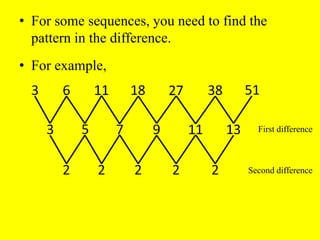
• For some sequences, you need to find the
pattern in the difference.
• For example,
First difference
Second difference
• Simple Geometric Patterns
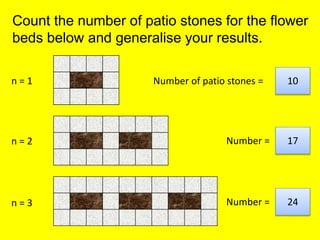
Count the number of patio stones for the flower
beds below and generalise your results.
n = 1
n = 2
n = 3
Number of patio stones = 10
Number = 17
Number = 24
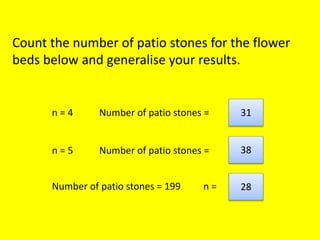
n = 4
n = 5
n =
Number of patio stones = 31
Number of patio stones = 38
28Number of patio stones = 199
Count the number of patio stones for the flower
beds below and generalise your results.
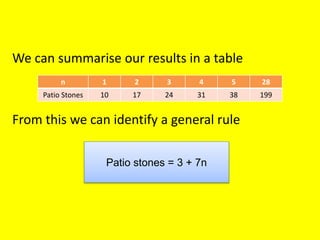
We can summarise our results in a table
From this we can identify a general rule
n 1 2 3 4 5 28
Patio Stones 10 17 24 31 38 199
Patio stones = 3 + 7n
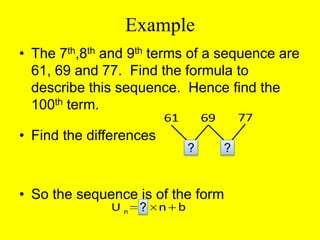
• The 7th,8th and 9th terms of a sequence are
61, 69 and 77. Find the formula to
describe this sequence. Hence find the
100th term.
• Find the differences
• So the sequence is of the form
? ?
?
Example
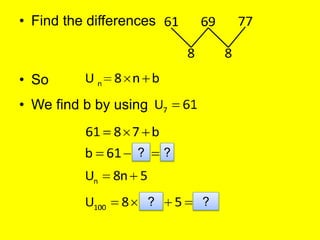
• Find the differences
• So
• We find b by using
? ?
? ?
Home work
 solve exercise 1 – Q-3,4
Math Lesson 3

Math Lesson 3

  • 1.
    Welcome Md. Abdul Quddus Department:Mathematics Campus : 05
  • 2.
  • 6.
    Number & geometricpattern Today’s Lesson
  • 7.
    Learning outcome After thislesson students . . . • will be able to explain geometric pattern • can be solve the problem • will draw the pattern
  • 8.
  • 9.
    • For somesequences, you need to find the pattern in the difference. • For example, First difference Second difference
  • 10.
  • 11.
    Count the numberof patio stones for the flower beds below and generalise your results. n = 1 n = 2 n = 3 Number of patio stones = 10 Number = 17 Number = 24
  • 12.
    n = 4 n= 5 n = Number of patio stones = 31 Number of patio stones = 38 28Number of patio stones = 199 Count the number of patio stones for the flower beds below and generalise your results.
  • 13.
    We can summariseour results in a table From this we can identify a general rule n 1 2 3 4 5 28 Patio Stones 10 17 24 31 38 199 Patio stones = 3 + 7n
  • 14.
    • The 7th,8thand 9th terms of a sequence are 61, 69 and 77. Find the formula to describe this sequence. Hence find the 100th term. • Find the differences • So the sequence is of the form ? ? ? Example
  • 15.
    • Find thedifferences • So • We find b by using ? ? ? ?
  • 16.
    Home work  solveexercise 1 – Q-3,4