tree
TAF 3053
EULAR
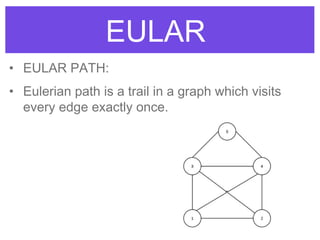
• EULAR PATH:
• Eulerian path is a trail in a graph which visits
every edge exactly once.
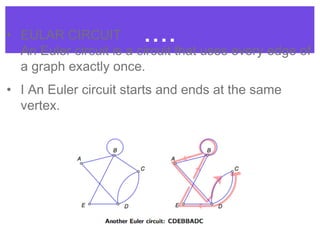
....• EULAR CIRCUIT
An Euler circuit is a circuit that uses every edge of
a graph exactly once.
• I An Euler circuit starts and ends at the same
vertex.
2. Determine what are the properties that
differentiate between a and b in Question 1?
• EULAR PATH:
• Starting at initial vertex and ending at other vertex.
• Some degree vertex are odd.
• Odd degree vertex => 2.
• EULAR CIRCUIT:
• Starting with initial vertex and ending at initial vertex.
• All degree vertex are even.
3. What are the algorithm or step
by step to determine a and b in
Question 1?
• Euler Path :
•  Pick any vertex to start 
•  From that vertex pick an edge to traverse
•  Darken that edge, as a reminder that you can't
traverse it again
•  Travel that edge, coming to the next vertex 
•  Repeat 2-4 until all edges have been traversed, and
you are back at the starting vertex
...• Euler Circuit
•  Step One: Randomly moves from node to node, until
stuck. Since all nodes had even degree, the circuit must
have stopped at its starting point. (It is a circuit.)
•  Step Two: If any of the arcs have not been included in
our circuit, find an arc that touches our partial circuit,
and add in a new circuit.
•  Each time we add a new circuit, we have included more
nodes.
•  Since there are only a finite number of nodes,
eventually the whole graph is included.
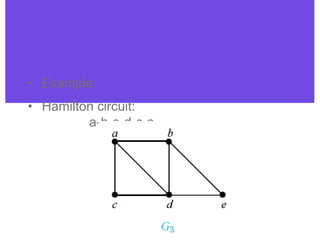
• Example:
• Hamilton circuit:
a-b-e-d-c-a
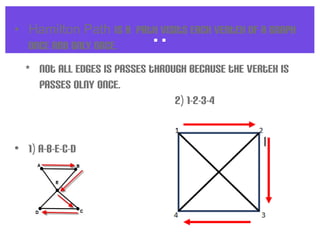
..• Hamilton Path is a path visits each vertex of a graph
once and only once.
• Not all edges is passes through because the vertex is
passes olny once.
2) 1-2-3-4
• 1) A-B-E-C-D
5. Determine what are the
properties that differentiate
between a and b in Question 4?
• HAMILTON CIRCUIT:
• When this initial vertex is connected to each
vertex until it meet the end at initial vertex
• HAMILTON PATH:
• The initial vertex is connected each vertex
until it meet the last vertex before initial
vertex
6. What are the algorithm or step
by step to determine a and b in
Question 4?
• TO DETERMINE HAMILTON CIRCUIT
• DIRAC’S THEOREM: If G is a simple graph with n vertices with
n 3 such that the≥
• degree of every vertex in G is at least n/2, then G has a
Hamilton circuit
• ORE’S THEOREM : If G is a simple graph with n vertices with n
3 such that≥
• deg(u) + deg(v) n for every pair of nonadjacent vertices u≥
and v in G, then G has a Hamilton circuit.
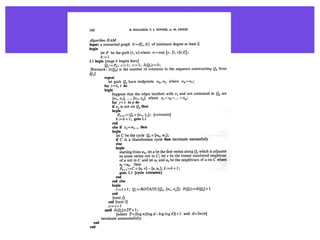
`• Randomized algorithm
• A randomized algorithm for Hamiltonian path
that is fast on most graphs is the following:
Start from a random vertex, and continue if
there is a neighbor not visited. If there are no
more unvisited neighbors, and the path formed
isn't Hamiltonian, pick a neighbor uniformly at
random, and rotate using that neighbor as a
pivot. (That is, add an edge to that neighbor, and
remove one of the existing edges from that
neighbor so as not to form a loop.) Then, continue
the algorithm at the new end of the path.
`

Math

  • 1.
  • 2.
    EULAR • EULAR PATH: •Eulerian path is a trail in a graph which visits every edge exactly once.
  • 3.
    ....• EULAR CIRCUIT AnEuler circuit is a circuit that uses every edge of a graph exactly once. • I An Euler circuit starts and ends at the same vertex.
  • 4.
    2. Determine whatare the properties that differentiate between a and b in Question 1? • EULAR PATH: • Starting at initial vertex and ending at other vertex. • Some degree vertex are odd. • Odd degree vertex => 2. • EULAR CIRCUIT: • Starting with initial vertex and ending at initial vertex. • All degree vertex are even.
  • 5.
    3. What arethe algorithm or step by step to determine a and b in Question 1? • Euler Path : •  Pick any vertex to start  •  From that vertex pick an edge to traverse •  Darken that edge, as a reminder that you can't traverse it again •  Travel that edge, coming to the next vertex  •  Repeat 2-4 until all edges have been traversed, and you are back at the starting vertex
  • 6.
    ...• Euler Circuit • Step One: Randomly moves from node to node, until stuck. Since all nodes had even degree, the circuit must have stopped at its starting point. (It is a circuit.) •  Step Two: If any of the arcs have not been included in our circuit, find an arc that touches our partial circuit, and add in a new circuit. •  Each time we add a new circuit, we have included more nodes. •  Since there are only a finite number of nodes, eventually the whole graph is included.
  • 7.
    • Example: • Hamiltoncircuit: a-b-e-d-c-a
  • 8.
    ..• Hamilton Pathis a path visits each vertex of a graph once and only once. • Not all edges is passes through because the vertex is passes olny once. 2) 1-2-3-4 • 1) A-B-E-C-D
  • 9.
    5. Determine whatare the properties that differentiate between a and b in Question 4? • HAMILTON CIRCUIT: • When this initial vertex is connected to each vertex until it meet the end at initial vertex • HAMILTON PATH: • The initial vertex is connected each vertex until it meet the last vertex before initial vertex
  • 10.
    6. What arethe algorithm or step by step to determine a and b in Question 4? • TO DETERMINE HAMILTON CIRCUIT • DIRAC’S THEOREM: If G is a simple graph with n vertices with n 3 such that the≥ • degree of every vertex in G is at least n/2, then G has a Hamilton circuit • ORE’S THEOREM : If G is a simple graph with n vertices with n 3 such that≥ • deg(u) + deg(v) n for every pair of nonadjacent vertices u≥ and v in G, then G has a Hamilton circuit.
  • 11.
    `• Randomized algorithm •A randomized algorithm for Hamiltonian path that is fast on most graphs is the following: Start from a random vertex, and continue if there is a neighbor not visited. If there are no more unvisited neighbors, and the path formed isn't Hamiltonian, pick a neighbor uniformly at random, and rotate using that neighbor as a pivot. (That is, add an edge to that neighbor, and remove one of the existing edges from that neighbor so as not to form a loop.) Then, continue the algorithm at the new end of the path.
  • 12.