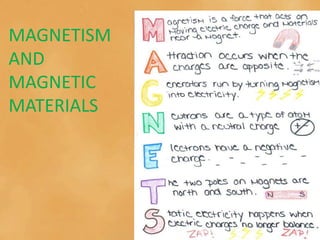
MAGNETISM
AND
MAGNETIC
MATERIALS
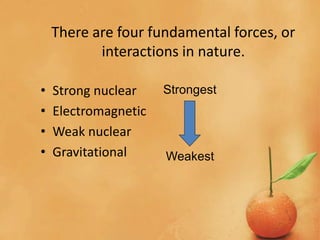
There are four fundamental forces, or
interactions in nature.
• Strong nuclear
• Electromagnetic
• Weak nuclear
• Gravitational
Strongest
Weakest
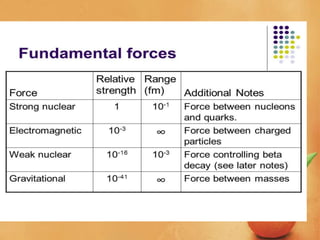
Strong nuclear force
• Holds the nuclei of atoms together
• Very strong, but only over very, very, very
short distances (within the nucleus of the
atom)
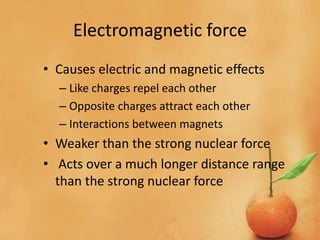
Electromagnetic force
• Causes electric and magnetic effects
– Like charges repel each other
– Opposite charges attract each other
– Interactions between magnets
• Weaker than the strong nuclear force
• Acts over a much longer distance range
than the strong nuclear force
Weak nuclear force
• Responsible for nuclear decay
• Weak and has a very short distance range
Gravitational force
• Weakest of all fundamental forces, but acts
over very long distances
• Always attractive
• Acts between any two pieces of matter in the
universe
• Very important in explaining the structure of
the universe
Remember…
• The weak nuclear force is NOT the weakest
of the fundamental forces.
• GRAVITY is the weakest force, but most
important in understanding how objects in
the universe interact.
Spin Magnetic Dipole Moment
-
- -
- -
- --
I
N
S
μs
Sources of Magnetism
Orbital Magnetic Dipole Moment
- I
μorb N
S
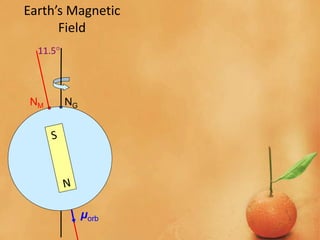
Earth’s Magnetic
Field
11.5°
NM NG
μorb
Motion of a Charge in a Magnetic Field
            
            
            
            
            
            
            
            
v
+
q, m
F
B
R
FB = FC
 qv B = m v2 /R
mv
 R =
qB
Magnetic Force on a Wire (cont.)
F = qv B
F = ILB
I
. . . . . . . . . . . .
. . . . . . . . . . . .
. . . . . . . . . . . .
. . . . . . . . . . . .
. . . . . . . . . . . .
. . . . . . . . . . . .
B
Current is the flow of positive charge. As a certain amount of
charge, q, moves with speed v through a wire of length L, the
force of this quantity of charge is:
where L is a vector of magnitude L pointing in the direction of I.
Electric Generators
In a motor we have seen that a current loop in an external magnetic field produces a
torque on the loop. In a generator we’ll see that a torque on a current loop inside a
magnetic field produces a current. In summary:
Motor: Current + Magnetic field  Torque
Generator: Torque + Magnetic field  Current
Turbines in a power plant are usually rotated either by a waterfall or by steam created heat
produced from nuclear power or the burning of coal. As the turbines rotate, current loops
turn through a magnetic field to generate electricity.
• This process converts mechanical energy into
electrical energy.
.
Continued…
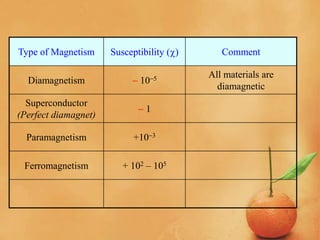
Type of Magnetism Susceptibility () Comment
Diamagnetism  105 All materials are
diamagnetic
Superconductor
(Perfect diamagnet)
 1
Paramagnetism +103
Ferromagnetism + 102 – 105
ORDERINGS IN MAGNETIC MATERIALS
• a material is "ferromagnetic" in this narrower
sense only if all of its magnetic ions add a positive
contribution to the net magnetization.
• If some of the magnetic ions subtract from the
net magnetization (if they are partially anti-
aligned), then the material is "ferrimagnetic".[3]
• If the moments of the aligned and anti-aligned
ions balance completely so as to have zero net
magnetization, despite the magnetic ordering,
then it is an antiferromagnet.
• These alignment effects only occur
at temperatures below a certain critical
temperature, called the Curie
temperature (for ferromagnets and
ferrimagnets) or the Néel temperature(for
antiferromagnets).
• Weiss theory of ferromagnetism is also called domain theory of
ferromagnetism. It has following points:
• The domains which are aligned approximately along the direction of the
applied magnetic field grow in size at the cost of unfavorably oriented
domains, that is, those align opposite to the field direction get reduced. In
other words, the domain boundaries move so as to expand the favorable
domains.
• Also domains rotate and orient themselves in the direction of the external
magnetic field.
• In the presence of the weak external field, the magnetisation in the
material occur mostly by the process of domain growing, but in the strong
magnetic field the material is magnetised mostly by the process of domain
alignment. When the field is removed, the domain boundaries do not
recover their original positions and thus the material is not completely
demagnetised, but some residual magnetism remains in it.
SPIN ARRANGEMENTS IN MAGNETITE: an e.g. of
FERRIMAGNETISM
©2003Brooks/Cole,adivisionofThomsonLearning,Inc.ThomsonLearning™isatrademarkusedhereinunderlicense.
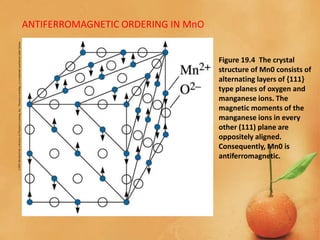
Figure 19.4 The crystal
structure of Mn0 consists of
alternating layers of {111}
type planes of oxygen and
manganese ions. The
magnetic moments of the
manganese ions in every
other (111) plane are
oppositely aligned.
Consequently, Mn0 is
antiferromagnetic.
ANTIFERROMAGNETIC ORDERING IN MnO
Magnetic domain walls
Wall thickness, t, is typically about 100 nm
24M V V K SRINIVAS PRASAD
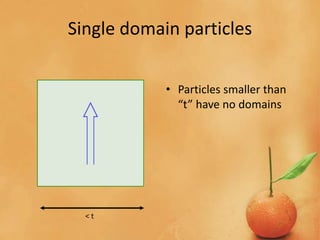
Single domain particles
• Particles smaller than
“t” have no domains
< t
hysteresis curve
ERASE HEAD
• Before passing over the record head,
a tape in a recorder passes over the
erase head which applies a high
amplitude, high frequency AC
magnetic field to the tape to erase
any previously recorded signal and to
thoroughly randomize the
magnetization of the magnetic
emulsion. Typically, the tape passes
over the erase head immediately
before passing over the record head.
• The gap in the erase head is wider
than those in the record head; the
tape stays in the field of the head
longer to thoroughly erase any
previously recorded signal.
BIASING
• Biasing
• High fidelity tape recording requires a high
frequency biasing signal to be applied to
the tape head along with the signal to
"stir" the magnetization of the tape and
make sure each part of the signal has the
same magnetic starting conditions for
recording. This is because magnetic tapes
are very sensitive to their previous
magnetic history, a property
called hysteresis.
• A magnetic "image" of a sound signal can
be stored on tape in the form of
magnetized iron oxide or chromium
dioxide granules in a magnetic emulsion.
The tiny granules are fixed on a polyester
film base, but the direction and extent of
their magnetization can be changed to
record an input signal from a tape head.
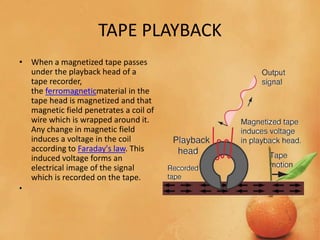
TAPE PLAYBACK
• When a magnetized tape passes
under the playback head of a
tape recorder,
the ferromagneticmaterial in the
tape head is magnetized and that
magnetic field penetrates a coil of
wire which is wrapped around it.
Any change in magnetic field
induces a voltage in the coil
according to Faraday's law. This
induced voltage forms an
electrical image of the signal
which is recorded on the tape.
•
FIG. - A HARD DISK
HOW A HARD DISK STORES DATA?
THANK YOU !

Material sciences introduction to magnetism

  • 1.
  • 2.
    There are fourfundamental forces, or interactions in nature. • Strong nuclear • Electromagnetic • Weak nuclear • Gravitational Strongest Weakest
  • 3.
    Strong nuclear force •Holds the nuclei of atoms together • Very strong, but only over very, very, very short distances (within the nucleus of the atom)
  • 4.
    Electromagnetic force • Causeselectric and magnetic effects – Like charges repel each other – Opposite charges attract each other – Interactions between magnets • Weaker than the strong nuclear force • Acts over a much longer distance range than the strong nuclear force
  • 5.
    Weak nuclear force •Responsible for nuclear decay • Weak and has a very short distance range
  • 6.
    Gravitational force • Weakestof all fundamental forces, but acts over very long distances • Always attractive • Acts between any two pieces of matter in the universe • Very important in explaining the structure of the universe
  • 7.
    Remember… • The weaknuclear force is NOT the weakest of the fundamental forces. • GRAVITY is the weakest force, but most important in understanding how objects in the universe interact.
  • 9.
    Spin Magnetic DipoleMoment - - - - - - -- I N S μs Sources of Magnetism
  • 10.
    Orbital Magnetic DipoleMoment - I μorb N S
  • 11.
  • 12.
    Motion of aCharge in a Magnetic Field                                                                                                         v + q, m F B R FB = FC  qv B = m v2 /R mv  R = qB
  • 13.
    Magnetic Force ona Wire (cont.) F = qv B F = ILB I . . . . . . . . . . . . . . . . . . . . . . . . . . . . . . . . . . . . . . . . . . . . . . . . . . . . . . . . . . . . . . . . . . . . . . . . B Current is the flow of positive charge. As a certain amount of charge, q, moves with speed v through a wire of length L, the force of this quantity of charge is: where L is a vector of magnitude L pointing in the direction of I.
  • 14.
    Electric Generators In amotor we have seen that a current loop in an external magnetic field produces a torque on the loop. In a generator we’ll see that a torque on a current loop inside a magnetic field produces a current. In summary: Motor: Current + Magnetic field  Torque Generator: Torque + Magnetic field  Current Turbines in a power plant are usually rotated either by a waterfall or by steam created heat produced from nuclear power or the burning of coal. As the turbines rotate, current loops turn through a magnetic field to generate electricity. • This process converts mechanical energy into electrical energy. . Continued…
  • 15.
    Type of MagnetismSusceptibility () Comment Diamagnetism  105 All materials are diamagnetic Superconductor (Perfect diamagnet)  1 Paramagnetism +103 Ferromagnetism + 102 – 105
  • 16.
    ORDERINGS IN MAGNETICMATERIALS • a material is "ferromagnetic" in this narrower sense only if all of its magnetic ions add a positive contribution to the net magnetization. • If some of the magnetic ions subtract from the net magnetization (if they are partially anti- aligned), then the material is "ferrimagnetic".[3] • If the moments of the aligned and anti-aligned ions balance completely so as to have zero net magnetization, despite the magnetic ordering, then it is an antiferromagnet.
  • 17.
    • These alignmenteffects only occur at temperatures below a certain critical temperature, called the Curie temperature (for ferromagnets and ferrimagnets) or the Néel temperature(for antiferromagnets).
  • 18.
    • Weiss theoryof ferromagnetism is also called domain theory of ferromagnetism. It has following points: • The domains which are aligned approximately along the direction of the applied magnetic field grow in size at the cost of unfavorably oriented domains, that is, those align opposite to the field direction get reduced. In other words, the domain boundaries move so as to expand the favorable domains. • Also domains rotate and orient themselves in the direction of the external magnetic field. • In the presence of the weak external field, the magnetisation in the material occur mostly by the process of domain growing, but in the strong magnetic field the material is magnetised mostly by the process of domain alignment. When the field is removed, the domain boundaries do not recover their original positions and thus the material is not completely demagnetised, but some residual magnetism remains in it.
  • 21.
    SPIN ARRANGEMENTS INMAGNETITE: an e.g. of FERRIMAGNETISM
  • 22.
    ©2003Brooks/Cole,adivisionofThomsonLearning,Inc.ThomsonLearning™isatrademarkusedhereinunderlicense. Figure 19.4 Thecrystal structure of Mn0 consists of alternating layers of {111} type planes of oxygen and manganese ions. The magnetic moments of the manganese ions in every other (111) plane are oppositely aligned. Consequently, Mn0 is antiferromagnetic. ANTIFERROMAGNETIC ORDERING IN MnO
  • 23.
    Magnetic domain walls Wallthickness, t, is typically about 100 nm
  • 24.
    24M V VK SRINIVAS PRASAD
  • 25.
    Single domain particles •Particles smaller than “t” have no domains < t
  • 26.
  • 29.
    ERASE HEAD • Beforepassing over the record head, a tape in a recorder passes over the erase head which applies a high amplitude, high frequency AC magnetic field to the tape to erase any previously recorded signal and to thoroughly randomize the magnetization of the magnetic emulsion. Typically, the tape passes over the erase head immediately before passing over the record head. • The gap in the erase head is wider than those in the record head; the tape stays in the field of the head longer to thoroughly erase any previously recorded signal.
  • 30.
    BIASING • Biasing • Highfidelity tape recording requires a high frequency biasing signal to be applied to the tape head along with the signal to "stir" the magnetization of the tape and make sure each part of the signal has the same magnetic starting conditions for recording. This is because magnetic tapes are very sensitive to their previous magnetic history, a property called hysteresis. • A magnetic "image" of a sound signal can be stored on tape in the form of magnetized iron oxide or chromium dioxide granules in a magnetic emulsion. The tiny granules are fixed on a polyester film base, but the direction and extent of their magnetization can be changed to record an input signal from a tape head.
  • 31.
    TAPE PLAYBACK • Whena magnetized tape passes under the playback head of a tape recorder, the ferromagneticmaterial in the tape head is magnetized and that magnetic field penetrates a coil of wire which is wrapped around it. Any change in magnetic field induces a voltage in the coil according to Faraday's law. This induced voltage forms an electrical image of the signal which is recorded on the tape. •
  • 32.
    FIG. - AHARD DISK
  • 33.
    HOW A HARDDISK STORES DATA?
  • 35.