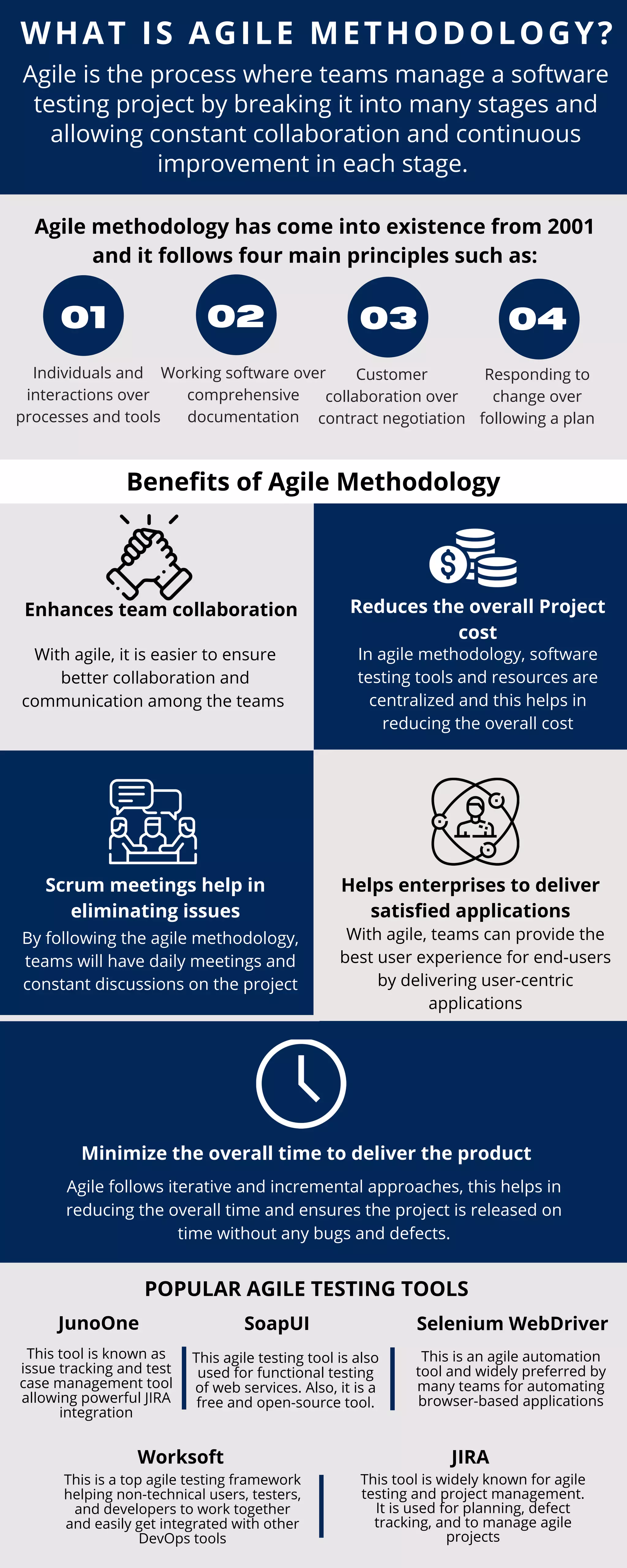
WHAT IS AGILE METHODOLOGY?
Agile is the process where teams manage a software
testing project by breaking it into many stages and
allowing constant collaboration and continuous
improvement in each stage.
Agile methodology has come into existence from 2001
and it follows four main principles such as:
This is a top agile testing framework
helping non-technical users, testers,
and developers to work together
and easily get integrated with other
DevOps tools
With agile, it is easier to ensure
better collaboration and
communication among the teams
Agile follows iterative and incremental approaches, this helps in
reducing the overall time and ensures the project is released on
time without any bugs and defects.
In agile methodology, software
testing tools and resources are
centralized and this helps in
reducing the overall cost
By following the agile methodology,
teams will have daily meetings and
constant discussions on the project
With agile, teams can provide the
best user experience for end-users
by delivering user-centric
applications
This tool is widely known for agile
testing and project management.
It is used for planning, defect
tracking, and to manage agile
projects
Benefits of Agile Methodology
Individuals and
interactions over
processes and tools
Working software over
comprehensive
documentation
Responding to
change over
following a plan
Customer
collaboration over
contract negotiation
POPULAR AGILE TESTING TOOLS
Reduces the overall Project
cost
Scrum meetings help in
eliminating issues
Helps enterprises to deliver
satisfied applications
Minimize the overall time to deliver the product
This tool is known as
issue tracking and test
case management tool
allowing powerful JIRA
integration
This agile testing tool is also
used for functional testing
of web services. Also, it is a
free and open-source tool.
This is an agile automation
tool and widely preferred by
many teams for automating
browser-based applications
Enhances team collaboration
01 02 03
Worksoft
JunoOne Selenium WebDriverSoapUI
JIRA
04
| |
|

Agile methodology

  • 1.
    WHAT IS AGILEMETHODOLOGY? Agile is the process where teams manage a software testing project by breaking it into many stages and allowing constant collaboration and continuous improvement in each stage. Agile methodology has come into existence from 2001 and it follows four main principles such as: This is a top agile testing framework helping non-technical users, testers, and developers to work together and easily get integrated with other DevOps tools With agile, it is easier to ensure better collaboration and communication among the teams Agile follows iterative and incremental approaches, this helps in reducing the overall time and ensures the project is released on time without any bugs and defects. In agile methodology, software testing tools and resources are centralized and this helps in reducing the overall cost By following the agile methodology, teams will have daily meetings and constant discussions on the project With agile, teams can provide the best user experience for end-users by delivering user-centric applications This tool is widely known for agile testing and project management. It is used for planning, defect tracking, and to manage agile projects Benefits of Agile Methodology Individuals and interactions over processes and tools Working software over comprehensive documentation Responding to change over following a plan Customer collaboration over contract negotiation POPULAR AGILE TESTING TOOLS Reduces the overall Project cost Scrum meetings help in eliminating issues Helps enterprises to deliver satisfied applications Minimize the overall time to deliver the product This tool is known as issue tracking and test case management tool allowing powerful JIRA integration This agile testing tool is also used for functional testing of web services. Also, it is a free and open-source tool. This is an agile automation tool and widely preferred by many teams for automating browser-based applications Enhances team collaboration 01 02 03 Worksoft JunoOne Selenium WebDriverSoapUI JIRA 04 | | |