UNIT II RESEARCH PROBLEM & RESEARCH DESIGN - Research Problem: Defining the
Research Problem - Research Design: Definition - Classification - Features of good Research
Design - Steps in Research design - Sampling Design: Factors Affecting the size of sample - Types
of Sampling.
Research Problem - Introduction
 Generally speaking a research problem is a situation that needs a solution and for which
there are possible solutions or a question that researcher wants to answer
 A research problem is a specific issue or gap in existing knowledge that you aim to
address in your research.
 Identification & formulation of a research problem is the first step of the research process.
 Selection of research problem depends on several factors such as researcher’s knowledge,
skills, interest, expertise, motivation &creativity with respect to the subject of inquiry.
 A research problem can be simply defined as a statement that identifies the problem or
situation to be studied.
 The research problem is a thesis that examines a knowledge gap, a problem, or a
discrepancy in a specific area. The purpose of a scientist's study or analysis is identified
and defined using research problems.
Definition
The issue or topic that a researcher wants to explore through research is known as a research
problem. Any research work must begin here because it establishes the investigation's path,
parameters, and goals.
R.S. Woodworth defines problem as ‘a situation for which we have no ready & successful response
by instinct or by previous acquired habit. We must find out what to do’, i.e. the solution can be
found out only after an investigation
Characteristics of a good thesis research problem
1 The problem can be stated clearly and concisely.
2 The problem generates research questions.
3 It is grounded in theory.
4 It relates to one or more academic fields of study.
5 It has a base in the research literature.
6 It has potential significance/importance.
7 It is do-able within the time frame, budget.
8 Sufficient data are available or can be obtained.
9 The researcher’s methodological strengths can be applied to the problem.
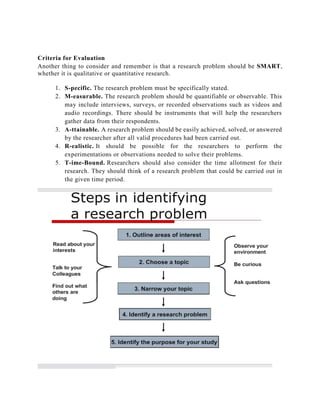
Criteria for Evaluation
Another thing to consider and remember is that a research problem should be SMART,
whether it is qualitative or quantitative research.
1. S-pecific. The research problem must be specifically stated.
2. M-easurable. The research problem should be quantifiable or observable. This
may include interviews, surveys, or recorded observations such as videos and
audio recordings. There should be instruments that will help the researchers
gather data from their respondents.
3. A-ttainable. A research problem should be easily achieved, solved, or answered
by the researcher after all valid procedures had been carried out.
4. R-ealistic. It should be possible for the researchers to perform the
experimentations or observations needed to solve their problems.
5. T-ime-Bound. Researchers should also consider the time allotment for their
research. They should think of a research problem that could be carried out in
the given time period.
Steps in Selecting Research Problem
Technique for the purpose involves the undertaking of the following steps generally one after the
other: (i) statement of the problem in a general way; (ii)understanding the nature of the problem;
(iii) surveying the available literature (iv) developing theideas through discussions; and (v)
rephrasing the research problem into a working proposition.
A brief description of all these points will be helpful.
(i) Statement of the problem in a general way: First of all the problem should be stated in abroad
general way, keeping in view either some practical concern or some scientific or intellectual
interest. For this purpose, the researcher must immerse himself thoroughly in the subject matter
concerning which he wishes to pose a problem.
(ii) Understanding the nature of the problem: The next step in defining the problem is to
understand its origin and nature clearly. The best way of understanding the problem is to discuss
it with those who first raised it in order to find out how the problem originally came about and
with what objectives in view. If the researcher has stated the problem himself, he should consider
once again all those points that induced him to make a general statement concerning the problem.
(iii) Surveying the available literature: All available literature concerning the problem at hand
must necessarily be surveyed and examined before a definition of the research problem is given.
This means that the researcher must be well-conversant with relevant theories in the field, reports
and records as also all other relevant literature. At times such studies may also suggest useful and
even new lines of approach to the present problem.
(iv) Developing the ideas through discussions: Discussion concerning a problem often produces
useful information. Various new ideas can be developed through such an exercise. Hence, a
researcher must discuss his problem with his colleagues and others who have enough experience
in the same area or in working on similar problems. This is quite often known as an experience
survey. People with rich experience are in a position to enlighten the researcher on different aspects
of his proposed study and their advice and comments are usually invaluable to the researcher. They
help him sharpen his focus of attention on specific aspects within the field.
(v) Rephrasing the research problem: Finally, the researcher must sit to rephrase the research
problem into a working proposition. Once the nature of the problem has been clearly understood,
the environment (within which the problem has got to be studied) has been defined, discussions
over the problem have taken place and the available literature has been surveyed and examined,
rephrasing the problem into analytical or operational terms is not a difficult task.
Research Design
When a research is carried-out, it follows a definite pattern or plan of action throughout the
procedure, i.e., since the problem identification to the report preparation and presentation. This
definite pattern or plan of action is called "research design". It is a map that guides the researcher
in collecting and analyzing the data. In other words, research design acts as a blueprint that is
followed throughout the research work.
For example, a building cannot be constructed without the knowledge of its structure. A builder
cannot order raw materials or set dates till he knows the structure of this building, such as office
building, school, home, etc.
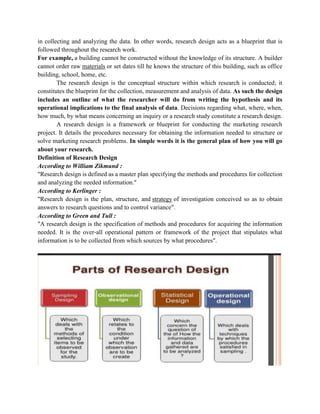
The research design is the conceptual structure within which research is conducted; it
constitutes the blueprint for the collection, measurement and analysis of data. As such the design
includes an outline of what the researcher will do from writing the hypothesis and its
operational implications to the final analysis of data. Decisions regarding what, where, when,
how much, by what means concerning an inquiry or a research study constitute a research design.
A research design is a framework or blueprint for conducting the marketing research
project. It details the procedures necessary for obtaining the information needed to structure or
solve marketing research problems. In simple words it is the general plan of how you will go
about your research.
Definition of Research Design
According to William Zikmund :
"Research design is defined as a master plan specifying the methods and procedures for collection
and analyzing the needed information."
According to Kerlinger :
"Research design is the plan, structure, and strategy of investigation conceived so as to obtain
answers to research questions and to control variance".
According to Green and Tull :
"A research design is the specification of methods and procedures for acquiring the information
needed. It is the over-all operational pattern or framework of the project that stipulates what
information is to be collected from which sources by what procedures".
Features of a Good Research Design
It is considered that a good research design should reduce the biasness while should maximize the
reliability of data being collected and analysed. A good research design should provide the
opportunity as per the various aspects of research problem. It should minimize the experimental
error and should provide maximum information. Hence, it can be concluded the selection of
research design relies upon the research problem and the nature of research. Following are the
major features of a good research design :
1) Objectivity :
Objectivity refers to the ability of the research instruments to give conclusions that are free from
observer's personal biases. A good research design should be able select those instruments only
that provide objective conclusions. Usually, it is believed that maintaining objectivity is pretty
easy, but it proves to be difficult during execution of research and data analysis.
2) Reliability :
Another essential feature of a good research design is the reliability of responses. The instruments
used in research should be able to provide similar responses to a question asked from a respondent.
If the response varies, the instrument is considered unreliable. In other words, reliability of
research design is measured in terms of consistency in responses.
3) Validity :
An important characteristic of a good research design is its ability to answer the questions in the
way it was intended to. It should focus on the objective of the research and make specific
arrangements or plan for achieving that objective.
For example, when a research is conducted to measure the effects of advertisements in viewers,
it should be able to answer this, and not the sale of a particular product.
4) Generalisability :
A research design is said to be generalisable if the outcome of the research is applicable on a bigger
population from which the sample is selected. A research design can be made generalisable by
properly defining the population properly, selecting the sample carefully, analyzing the statistical
data appropriately, and by preparing it methodologically. Therefore, the more the outcomes are
generalisable, more efficient is the research design.
5) Sufficient Information :
Any research is conducted to gain insight of the hidden facts, figures and information. The research
design should be able to provide sufficient information to the researcher so that he can analyse the
research problem in a broad perspective. The research design should be able to identify the research
problem and research objective.
6) Other Features :
Along with the above, there are some other features also that make a research design good. These
are adaptability, flexibility. efficiency, etc. A good research design should be able to minimize the
errors and maximize the accuracy.
Importance of Research Design
Purpose of research design / Use of research designs are as follows :
1) Reduces Cost :
Research design is needed to reduce the excessive costs in terms of time, money and effort by
planning the research work in advance.
2) Facilitate the Smooth Scaling :
In order to perform the process of scaling smoothly, an efficient research design is of utmost
importance. It makes the research process effective enough to give maximum relevant outcome in
an easy way.
3) Helps in Relevant Data Collection and Analysis :
Research design helps the researchers in planning the methods of data collection and analysis as
per the objective of research. It is also responsible for the reliable research work as it is the
foundation for entire research. Lack of proper attention in preparation of research design can harm
the entire research work.
4) Assists in Smooth Flow of Research Operations :
Research design is necessary to give better and effective structure to the research. Since all the
decisions are made in advance, therefore, research design facilitates the smooth flow of research
operations and reduces the possible problems of researchers.
5) Helps in Getting Reviews from Experts :
Research design helps in developing an overview about the whole research process and thus assists
in getting responses and reviews from different experts in that field.
6) Provides a Direction to Executives :
Research design directs the researcher as well as the executives involved in the research for giving
their relevant assistance.
Factors Affecting Research Design
Various factors that affect research design are as follows :
1) Research Questions :
Research questions perform an important role in selecting the method to carry-out research. There
are various forms of research designs which include their own methods for collecting data.
For example, a survey can be conducted for the respondents to ask them descriptive or
interconnected questions while a case study or a field survey can be used to identify the firm's
decision-making process.
2) Time and Budget Limits :
Researchers are bound with restricted amount of time and budget to complete the research study.
The researcher can select experimental or descriptive research when the time and budget
constraints we favorable to him for the detailed study. otherwise exploratory research design can
be adopted when the time is limited.
3) Research Objective :
Every research is carried out to obtain the results which help to achieve some objectives. This
research objective influences the selection of research design. Researcher should adopt the
research design which is suitable for research objective and also provides best solution to the
problem along with the valuable result.
4) Research Problem :
Selection of the research design is greatly affected by the type of research problems. For
example, the researcher selects experimental research design to find out cause and-effect
relationship of the research problem. Similarly, if the research problem includes in depth study,
then the researcher generally adopts experimental research design method.
5) Personal Experiences :
Selection of research design also depends upon the personal experience of researchers.
For example, the researcher who has expertise in statistical analysis would be liable to select the
quantitative research designs. While, those researchers who are specialists in theoretical facets of
research will be forced to select qualitative research design.
6) Target Audience :
The type of target audience plays very important role in selection of research design. Researcher
must consider the target audience for which the research is carried-out. Audiences may either be
general public, business professionals or government.
For example, if the research is proposed for general public, then the researcher should select
qualitative research design. Similarly, quantitative research design would be appropriate for the
researcher to introduce the report in front of the business experts.
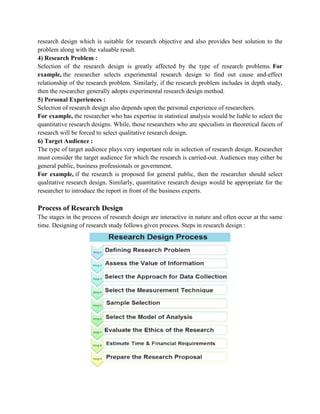
Process of Research Design
The stages in the process of research design are interactive in nature and often occur at the same
time. Designing of research study follows given process. Steps in research design :
Step 1: Defining Research Problem :
The definition of research problem is the foremost and important part of a research design process.
Defining the research problem includes supplying the information that is required by the
management. Without defining the research problem appropriately, it is not possible for the
researcher to conclude the accurate, results. While defining research problem, the researchers first
analyse the problems or opportunities in management, then they analyse the situation. The purpose
of clarifying the research problem is to make sure that the area of concern for research is properly
reflected and management decision is correctly described. After situation analysis, they develop a
model for research which helps in the next step which is specification of information.
Step 2: Assess the Value of Information :
When a research problem is approached, it is usually based on some information. These data are
obtained from past experiences as well as other sources. On the basis of this information, some
preliminary judgement are made regarding the research problem. There is always a need for
additional information which is available without additional cost and delay but waiting and paying
for the valuable information is quite difficult.
For example, a car manufacturing industry may be concerned about decrease in the sale of a
particular model. A researcher will look for the solutions by analyzing various aspects.
For this, the researcher has to continuously collect a lot of information and needs to evaluate them
by understanding their value and filtering out useless information.
Step 3: Select the Approach for Data Collection :
For any type of research, a researcher needs data. Once, it is identified that which kind of
information is required for conducting the research, the researchers proceed towards collecting the
data. The data can be collected using secondary or primary sources.
Secondary data is the previous collected information for some other purpose, while the primary
data is collected by the researcher especially for the research problem.
Step 4: Select the Measurement Technique :
After collecting data, the measurement technique for the collected data is selected. The major
measurement techniques used in research are as follows :
i) Questionnaire :
Questionnaire is a formal structure which contains questions to collect the information from the
respondents regarding his attitude, beliefs, behavior, knowledge, etc.
ii) Attitude Scales :
Attitude scales are used to extract the beliefs and feelings of the respondents regarding an object
or issue.
iii) Observation :
It is the monitoring of behaviors and psychological changes of the respondents. It is widely used
in research.
iv) Projective Techniques and Depth Interview :
Sometimes direct questions are not sufficient to get true responses from the individuals, that is
why. different approaches like depth interviews and projective techniques are used. These
techniques allow the respondents to give their responses without any fear. Researcher neither
disagrees nor gives advice in these techniques.
Step 5: Sample Selection :
Once, the measurement technique has been selected, the next step is selecting the sample to
conduct the research. The researchers in this stage select a sample out of the total population
instead of considering the population as a whole. Sample can be selected by using two techniques,
i.e., random sampling techniques, and non-random sampling techniques.
Step 6: Selecting Model of Analysis :
Researchers select the model of analysis or technique of data analysis, before collecting data. After
this, researchers evaluate the techniques using hypothetical values to ensure that the measurement
technique would provide the desired outcome regarding the research problem.
Step 7: Evaluate the Ethics of Research :
While conducting research, it becomes very much necessary for the researcher to follow ethical
practices. The researches which are conducted ethically draws interests of general public,
respondents, clients and other research professionals. Hence, it becomes the duty of the researcher
to evaluate the practices in research, to avoid any biasness on behalf of the observer and researcher
as well.
Step 8: Estimate Time and Financial Requirements :
This step is one of the most important steps in designing research. Here, researchers use different
methods like Critical Path Method (CPM) and Programme Evaluation Review Technique (PERT)
to design the plan as well as control process and to determine the resources required.
A flowchart of these activities along with their approximate time is prepared for visual assessment
of the research process. With the help of this chart, the researcher can find out the sequence of
activities to be taken.
Step 9: Prepare the Research Proposal :
The final step in the process of research design is preparing the research proposal. A research
proposal or the research design is prepared the operation and control of research. An effective
research proposal is prepared before actual conduction of the research.
Types of Research Design
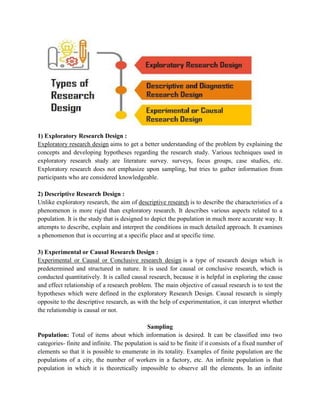
Based on the aim of study, there are three types of research design :
1) Exploratory Research Design :
Exploratory research design aims to get a better understanding of the problem by explaining the
concepts and developing hypotheses regarding the research study. Various techniques used in
exploratory research study are literature survey. surveys, focus groups, case studies, etc.
Exploratory research does not emphasize upon sampling, but tries to gather information from
participants who are considered knowledgeable.
2) Descriptive Research Design :
Unlike exploratory research, the aim of descriptive research is to describe the characteristics of a
phenomenon is more rigid than exploratory research. It describes various aspects related to a
population. It is the study that is designed to depict the population in much more accurate way. It
attempts to describe, explain and interpret the conditions in much detailed approach. It examines
a phenomenon that is occurring at a specific place and at specific time.
3) Experimental or Causal Research Design :
Experimental or Causal or Conclusive research design is a type of research design which is
predetermined and structured in nature. It is used for causal or conclusive research, which is
conducted quantitatively. It is called causal research, because it is helpful in exploring the cause
and effect relationship of a research problem. The main objective of casual research is to test the
hypotheses which were defined in the exploratory Research Design. Causal research is simply
opposite to the descriptive research, as with the help of experimentation, it can interpret whether
the relationship is causal or not.
Sampling
Population: Total of items about which information is desired. It can be classified into two
categories- finite and infinite. The population is said to be finite if it consists of a fixed number of
elements so that it is possible to enumerate in its totality. Examples of finite population are the
populations of a city, the number of workers in a factory, etc. An infinite population is that
population in which it is theoretically impossible to observe all the elements. In an infinite
population the number of items is infinite. Example of infinite population is the number of stars in
sky. From practical consideration, we use the term infinite population for a population that cannot
be enumerated in a reasonable period of time.
Sample: It is part of the population that represents the characteristics of the population.
Population Sample Sampling: It is the process of selecting the sample for estimating the
population characteristics. In other words, it is the process of obtaining information about an entire
population by examining only a part of it.
Sampling Unit: Elementary units or group of such units which besides being clearly defined,
identifiable and observable, are convenient for purpose of sampling are called sampling units. For
instance, in a family budget enquiry, usually a family is considered as the sampling unit since it is
found to be convenient for sampling and for ascertaining the required information. In a crop
survey, a farm or a group of farms owned or operated by a household may be considered as the
sampling unit.
Sampling Frame: A list containing all sampling units is known as sampling frame. Sampling
frame consists of a list of items from which the sample is to be drawn.
Sample Survey: An investigation in which elaborate information is collected on a sample basis is
known as sample survey.
PURPOSE OF SAMPLING
The basic purpose of sampling is to provide an estimate of the population parameter and to test the
hypothesis. Advantages of sampling are –
 Save time and money.
 Enable collection of comprehensive data.
 Enable more accurate measurement as it conducted by trained and experienced investigators.
 Sampling remains the only way when population contains infinitely many members.
 In certain situation, sampling is the only way of data collection. For example, in testing the
pathological status of blood, boiling status of rice, etc.
 It provides a valid estimation of sampling error.
Factors Affecting the size of the sample:
Size of the sample depends upon a number of factors, the chief of which are stated
below.
1. Homogeneity or heterogeneity of universe
It the universe is comparatively homogeneous a smaller size of the sample may be
sufficient. I fall the units were exactly alike one single unit could serve as sample, but if the
universe s heterogenous very few units are similar and thus the sample has to be essentially
large in size.
2. Number of classes proposed
If a large number of classes are to be formed the sample must be large enough so that
every class may be of a proper size suitable for statistical treatment. If the size of the sample
is small there may be some classes which may contain once or two units only. Some may
remain totally unrepresented. The result is that they can not be analysed properly and the
generalisation based upon them ill also not be correct. Thus large the number of classes
proposed greater will be the size of the sample.
3. Nature of study
The size of the sample will also depend upon the nature of study. If an intensive study
is to be made continuing for a pretty long time, large sample is unfit for the purpose, as it
will require very large finance and other resources. Thus, in case of opinion surveys, where
people have to be contacted for knowing their opinion about the problem under study the
interview is quite short and much larger number of units may be included in the sample.
Similarly in case of general study large number of cases can be taken but if the study of a
technical nature, a large number may become difficult to manage to
4. Practical consideration
Practical considerations as availability of finance, time at our disposal, number of
trained field workers etc. may also be taken as important factor in deciding the size of the
sample. The limitations of these resources necessarily limit the size of the sample. One
thing must be made clear at this stage. Although, these practical considerations do weigh
heavily in determining the size of the sample it should never be done at the cost of accuracy.
Any amount of money, howsoever, small spent on an unrepresentative sample is pure and
simple waste and must be avoided at all cost.
5. Standard of accuracy
It is generally considered that larger the size of the sample greater is the standard of
accuracy or representativeness. Although, this is not true in all cases, as mere largeness of
Size is no guarantee for representativeness. A small but well selected sample may give
better results than a larger and thoughtlessly selected sample. National Opinion Research
Centre (N.O.R.C.) the premier opinion survey agency of America is now turning more and
more to small size samples. In 1946 N.O.R.C. selected about 2500 cases in a standard poll.
In 1948 it was reduced to 1300 cases only. As the technique of sampling is becoming more
and more scientific and refined better standard of accuracy has been possible to be achieved
by comparatively smaller samples.
6. Size of the questionnaire or schedule
The size of the questionnaire and the nature of questions to be asked is also a limiting
factor for the size of the sample. Larger the size of schedule more complicated the questions
to be asked, smaller is to be the size for proper administration.
7. Nature of cases to be contacted
The nature of cases to be contacted plays its own part in deciding the size of the
sample. If the cases are geographically scattered a small sample is more suitable. On the
other hand if the refusal rate is likely to be heavy or losses of cases likely to be quite big, a
large sample has to be selected, so that after providing for the cases who may refuse to reply
or those that may not be available due to other causes, the actual number of cases that is left
out may be large enough to permit statistical analysis.
8. Type of sampling used
If absolute random sampling has been used a much larger sample is required. Random
sample is reliable only when sufficiently large number of units have been selected, because
it is only in large number of cases that law of statistical regularity properly works and every
class of units gets a chance of being selected. On the other hand, if stratified sample has
been selected reliability can be achieved in a much smaller size. But in stratified sampling
the essential condition is that stratification must be proper. If stratification is unsuitable and
improper a larger number will only add to the bias in the sample.
These are some of the broad considerations that are to be kept in mind. In fact no rigid
number can be prescribed for an optimum size of the sample. The nature of the problem is
the only deciding factor and the common sense and experience of the researcher the only
Sample Design Characteristics -
Based on the factors explained earlier characteristics of the sample design are as follows
Sample design must be -
(a) Representative
It should be representative to give a true picture of the population.
(b) Adequacy
The size of the sample should be adequate to provide reliability.
(c) Independence
All items of the sample should be selected independently of one another.
(d) Homogeneity - There should be no basic difference in the nature of units in the universe and
in the sample
(e) Lack of bias - It should be unbiased and obtained by a random method or probability process.
(f) Smallness in size - The size of the sample should be small and economical.
(g) Accuracy and completeness - A sample should never give incomplete information and it
should not omit any unit included in the sample.
I Representative basis.
A. Probability sampling is based on the concept of random selection.
B. Non-probability sampling is non-random.
II Selection basis
Sample may be restricted or unrestricted.
Probability Sampling is of following types:
(1) Simple Random Sampling
(2) Stratified Random Sampling
(3) Systematic Random Sampling
(4) Cluster Sampling
(5) Area Sampling
(6) Multi-Stage Sampling
(7) Double Sampling.
Non-Probability Sampling may be classified into:
(1) Deliberate Sampling or Purposive Sampling or Judgmental Sampling.
(2) Quota Sampling.
(3) Spot Sampling.
Probability Sampling
It is known as random or chance sampling. In this system every item of population has every
chance to be included. Its best technique for representative sample. In random sampling there in
equal probability of item to be included in sample. The actual practice for random sampling is
done with the use of random number table.
Probability sampling: Probability sampling is a sampling technique where a researcher sets a
selection of a few criteria and chooses members of a population randomly. All the members have
an equal opportunity to be a part of the sample with this selection parameter.
Non-Probability Sampling
It is also known as deliberate purposive or judgement sampling. In this type of sample items are
selected deliberately by researcher. There is no assurance that every element has some specifiable
chance of being included. The researcher may select sample favourable to research study and if
researcher is unbias than there is relibility of the result. Quota sampling is also an example of non
probabily sampling. All the various types of sampling are explained in the detailed. Non-
probability sampling: In non-probability sampling, the researcher chooses members for research
at random
1. Deliberate Sampling
This is also known as purposive, judgement sample. It invaulved the deliberate or convience
selection of sample. It constitutes the representation of all universe. If data of
petrol users is to be collected in relation to their reaction of quality of the petrol, than researcher
may select few petrol pumps and conduct interview of the pet buyers. This is called convience
sampling. In care of judgement sampling the judgement of the researcher is used for selecting
sample.
2. Simple Random Sampling
This is also known as chance sampling. In this procedure of sampling design there are equal
chances of the any item to get selected. The sample in this system are controlled by the probability
Random number table used here, for selecting simple known as random sampling.
3. Systematic Sampling
This is most rational and practical way for selecting sample. In cause test of 100 person is available
for slowly to we select so every 5th person i.e. 5, 10, 15 etc. is selected as systematic sample. But
this type of sampling in possible only when such a rise in available for the reference.
4. Stratified Sampling
This method of selecting sample is used in selecting items when there is no homogenous group in
the universe. So the universe is classified in different level of the strata to selected sample
belonging to each strata on the basis of chance sampling. Therefore first classification is made and
there chance sampling is done. Its known as stratified sampling. In the composition population in
the region, if increasing demand is required to be assessed by increasing income than as there is
no homogenous group so the population will be classified as Higher - Middle and Lower income
group than based on chance sampling items will be selected from each of the strata of the classified
group.
5. Quota Sampling
If the classification and chance selection as explained in stratified sampling in becoming costly,
than these strata are subclassified in quota and selection of items in quota are left to the judgement
of interviewer. The quota is normally in proportion to the strata. This excercise
is conducted as non-probability sampling. As we have seen classified strata Higher - Middle or
lower income grap than HIG in 20%, M.I.G 30% and L.I.G. 50% in the compostion of population
quota is proportionately worked cut as per the size of the strata 20%, 30%, 50% judgement
sampling will be done in quote sampling in the ratio of 2:3:5.
6. Area Sampling
This sampling is done in relation to the geographical aréa under study. Total area is divided in the
small region. These small geographical regions are selected randomly. All these small region are
included in sample. This sampling in possible only when information of area grouping is available.
For the purpose of area sampling Nation is divided in state, state in division, district, taluka, block
and village group on the bases of the records available.
7. Cluster Sampling
This sampling is just like area sampling. The classification of population in group is called cluster
and sample in selected from each of cluster. Suppose Bank wants to issue ATM card to its credit
card holders to about 1,000 custmors using credit card. 1000 card holders are to be divided in 20
groups, each group will hane. 50 eardhaldous if size is to kept 300 card holders so 15 cardholders
will be selected in each group randomly. This will make work of investigation easier and increase
the efficiency in the field investigation.
8. Multi-Stage Sampling
This is an extenstion of area or group sampling. When national level big studies are conducted
then nation is divided state further in division thus in district and finally at village block level.
Now states in the nation divisions in the state, districts in the division and lastly village bolocks in
district are selected on random bases. So the group classification of various sloges is described
multi stage sampling,
9. Spot Sampling
When it is not possible to fixed sample of the size in advance because of the complexity of sample
design then it is decided at the spot in ongoing process. The progress of the survey is closely
monitered and on the basis of the information received as the work progress the appropriate design
is adopted by assessment on the spot.
10. Double Sampling
It may be more convenient or economical to collect some information by sample and then use this
information as the basis for selecting a subsample for further study. This procedure is called double
sampling, sequential sampling, or multiphase sampling. It is usaully found with stratified and/or
cluster designs. The calculation procedures are described in more advanced texts. Double sampling
can be illustrated by the dining club example. You might use a telephone survey or another
inexpensive survey method to discover who would be interested
in joining such a club and the degree of their interest. You might then stratify the interested
respondents by degree of interest and subsample among them for intensive interviewing on
expected consumption patterns, reactions to various services, and so on. Whether it is more
desirable to gather such information by one-stage or two-stage sampling depends largely on
the relative costs of the two methods.
Because of the wide range of sampling designs available, it is often difficult to select
an approach that meets the needs of the research question and helps to contain the costs of
the project. To help with these choices, exhibit may be used to compare the various advantages
and disadvantages of probability sampling. Nonprobability sampling techniques are covered
in the next section. They are used frequently and offer the researcher the benefit of low cost.
However, they are not based on a theoretical framework and do not operate.
Types of non-probability sampling with examples
The non-probability method is a sampling method that involves a collection of feedback based on
a researcher or statistician’s sample selection capabilities and not on a fixed selection process. In
most situations, the output of a survey conducted with a non-probable sample leads to skewed
results which may not represent the desired target population
. But, there are situations such as the preliminary stages of research or cost constraints for
conducting research, where non-probability sampling will be much more useful than the other
type.Four types of non-probability sampling explain the purpose of this sampling method in a
better manner:
Convenience sampling: This method is dependent on the ease of access to subjects such as
surveying customers at a mall or passers-by on a busy street.It is usually termed as convenience
sampling, because of the researcher’s ease of carrying it out and getting in touch with the subjects.
Researchers have nearly no authority to select the sample elements, and it’s purely done based on
proximity and not representativeness.This non-probability sampling method is used when
there are time and cost limitations in collecting feedback. In situations where there are resource
limitations such as the initial stages of research, convenience sampling is used. For example,
startups and NGOs usually conduct convenience sampling at a mall to distribute leaflets of
upcoming events or promotion of a cause – they do that by standing at the mall entrance and giving
out pamphlets randomly.
Judgmental or purposive sampling: Judgemental or purposive samples are formed by the
discretion of the researcher Researchers purely consider the purpose of the study,along with
the understanding of the target audience. For instance, when researchers want to understand the
thought process of people interested in studying for their master’s degree. The selection criteria
will be: “Are you interested in doing your masters in …?” and those who respond with a “No” are
excluded from the sample.
Snowball sampling: Snowball sampling is a sampling method that researchers apply when
the subjects are difficult to trace. For example, it will be extremely challenging to survey
shelterless people or illegal immigrants. In such cases, using the snowball theory, researchers can
track a few categories to interview and derive results. Researchers also implement this sampling
method in situations where the topic is highly sensitive and not openly discussed—for example,
surveys to gather information about HIV Aids. Not many victims will readily respond to the
questions. Still, researchers can contact people they might know or volunteers associated with the
cause to get in touch with the victims and collect information.
Quota sampling: In Quota sampling, the selection of members in this sampling technique
happens based on a pre-set standard. In this case, as a sample is formed based on specific attributes,
the created sample will have the same qualities found in the total population. It is a rapid method
of collecting samples.
Uses of probability sampling
There are multiple uses of probability sampling:
 Reduce Sample Bias: Using the probability sampling method, the bias in the sample
derived from a population is negligible to non-existent. The selection of the sample mainly
depicts the understanding and the inference of the researcher. Probability sampling leads
to higher quality data collection as the sample appropriately represents the population.
 Diverse Population: When the population is vast and diverse, it is essential to have
adequate representation so that the data is not skewed towards one demographic. For
example, if Square would like to understand the people that could make their point-of-sale
devices, a survey conducted from a sample of people across the US from different
industries and socio-economic backgrounds helps.
 Create an Accurate Sample: Probability sampling helps the researchers plan and create
an accurate sample. This helps to obtain well-defined data.
Uses of non-probability sampling
Non-probability sampling is used for the following:
 Create a hypothesis: Researchers use the non-probability sampling method to create an
assumption when limited to no prior information is available. This method helps with the
immediate return of data and builds a base for further research.
 Exploratory research: Researchers use this sampling technique widely when conducting
qualitative research, pilot studies, or exploratory research.
 Budget and time constraints: The non-probability method when there are budget and
time constraints, and some preliminary data must be collected. Since the survey design is
not rigid, it is easier to pick respondents at random and have them take the survey
or questionnaire.

UNIT II RESEARCH PROBLEM.docx

  • 1.
    UNIT II RESEARCHPROBLEM & RESEARCH DESIGN - Research Problem: Defining the Research Problem - Research Design: Definition - Classification - Features of good Research Design - Steps in Research design - Sampling Design: Factors Affecting the size of sample - Types of Sampling. Research Problem - Introduction  Generally speaking a research problem is a situation that needs a solution and for which there are possible solutions or a question that researcher wants to answer  A research problem is a specific issue or gap in existing knowledge that you aim to address in your research.  Identification & formulation of a research problem is the first step of the research process.  Selection of research problem depends on several factors such as researcher’s knowledge, skills, interest, expertise, motivation &creativity with respect to the subject of inquiry.  A research problem can be simply defined as a statement that identifies the problem or situation to be studied.  The research problem is a thesis that examines a knowledge gap, a problem, or a discrepancy in a specific area. The purpose of a scientist's study or analysis is identified and defined using research problems. Definition The issue or topic that a researcher wants to explore through research is known as a research problem. Any research work must begin here because it establishes the investigation's path, parameters, and goals. R.S. Woodworth defines problem as ‘a situation for which we have no ready & successful response by instinct or by previous acquired habit. We must find out what to do’, i.e. the solution can be found out only after an investigation Characteristics of a good thesis research problem 1 The problem can be stated clearly and concisely. 2 The problem generates research questions. 3 It is grounded in theory. 4 It relates to one or more academic fields of study. 5 It has a base in the research literature. 6 It has potential significance/importance. 7 It is do-able within the time frame, budget. 8 Sufficient data are available or can be obtained. 9 The researcher’s methodological strengths can be applied to the problem.
  • 2.
    Criteria for Evaluation Anotherthing to consider and remember is that a research problem should be SMART, whether it is qualitative or quantitative research. 1. S-pecific. The research problem must be specifically stated. 2. M-easurable. The research problem should be quantifiable or observable. This may include interviews, surveys, or recorded observations such as videos and audio recordings. There should be instruments that will help the researchers gather data from their respondents. 3. A-ttainable. A research problem should be easily achieved, solved, or answered by the researcher after all valid procedures had been carried out. 4. R-ealistic. It should be possible for the researchers to perform the experimentations or observations needed to solve their problems. 5. T-ime-Bound. Researchers should also consider the time allotment for their research. They should think of a research problem that could be carried out in the given time period.
  • 3.
    Steps in SelectingResearch Problem Technique for the purpose involves the undertaking of the following steps generally one after the other: (i) statement of the problem in a general way; (ii)understanding the nature of the problem; (iii) surveying the available literature (iv) developing theideas through discussions; and (v) rephrasing the research problem into a working proposition. A brief description of all these points will be helpful. (i) Statement of the problem in a general way: First of all the problem should be stated in abroad general way, keeping in view either some practical concern or some scientific or intellectual interest. For this purpose, the researcher must immerse himself thoroughly in the subject matter concerning which he wishes to pose a problem. (ii) Understanding the nature of the problem: The next step in defining the problem is to understand its origin and nature clearly. The best way of understanding the problem is to discuss it with those who first raised it in order to find out how the problem originally came about and with what objectives in view. If the researcher has stated the problem himself, he should consider once again all those points that induced him to make a general statement concerning the problem. (iii) Surveying the available literature: All available literature concerning the problem at hand must necessarily be surveyed and examined before a definition of the research problem is given. This means that the researcher must be well-conversant with relevant theories in the field, reports and records as also all other relevant literature. At times such studies may also suggest useful and even new lines of approach to the present problem. (iv) Developing the ideas through discussions: Discussion concerning a problem often produces useful information. Various new ideas can be developed through such an exercise. Hence, a researcher must discuss his problem with his colleagues and others who have enough experience in the same area or in working on similar problems. This is quite often known as an experience survey. People with rich experience are in a position to enlighten the researcher on different aspects of his proposed study and their advice and comments are usually invaluable to the researcher. They help him sharpen his focus of attention on specific aspects within the field. (v) Rephrasing the research problem: Finally, the researcher must sit to rephrase the research problem into a working proposition. Once the nature of the problem has been clearly understood, the environment (within which the problem has got to be studied) has been defined, discussions over the problem have taken place and the available literature has been surveyed and examined, rephrasing the problem into analytical or operational terms is not a difficult task. Research Design When a research is carried-out, it follows a definite pattern or plan of action throughout the procedure, i.e., since the problem identification to the report preparation and presentation. This definite pattern or plan of action is called "research design". It is a map that guides the researcher
  • 4.
    in collecting andanalyzing the data. In other words, research design acts as a blueprint that is followed throughout the research work. For example, a building cannot be constructed without the knowledge of its structure. A builder cannot order raw materials or set dates till he knows the structure of this building, such as office building, school, home, etc. The research design is the conceptual structure within which research is conducted; it constitutes the blueprint for the collection, measurement and analysis of data. As such the design includes an outline of what the researcher will do from writing the hypothesis and its operational implications to the final analysis of data. Decisions regarding what, where, when, how much, by what means concerning an inquiry or a research study constitute a research design. A research design is a framework or blueprint for conducting the marketing research project. It details the procedures necessary for obtaining the information needed to structure or solve marketing research problems. In simple words it is the general plan of how you will go about your research. Definition of Research Design According to William Zikmund : "Research design is defined as a master plan specifying the methods and procedures for collection and analyzing the needed information." According to Kerlinger : "Research design is the plan, structure, and strategy of investigation conceived so as to obtain answers to research questions and to control variance". According to Green and Tull : "A research design is the specification of methods and procedures for acquiring the information needed. It is the over-all operational pattern or framework of the project that stipulates what information is to be collected from which sources by what procedures".
  • 5.
    Features of aGood Research Design It is considered that a good research design should reduce the biasness while should maximize the reliability of data being collected and analysed. A good research design should provide the opportunity as per the various aspects of research problem. It should minimize the experimental error and should provide maximum information. Hence, it can be concluded the selection of research design relies upon the research problem and the nature of research. Following are the major features of a good research design : 1) Objectivity : Objectivity refers to the ability of the research instruments to give conclusions that are free from observer's personal biases. A good research design should be able select those instruments only that provide objective conclusions. Usually, it is believed that maintaining objectivity is pretty easy, but it proves to be difficult during execution of research and data analysis. 2) Reliability : Another essential feature of a good research design is the reliability of responses. The instruments used in research should be able to provide similar responses to a question asked from a respondent. If the response varies, the instrument is considered unreliable. In other words, reliability of research design is measured in terms of consistency in responses. 3) Validity : An important characteristic of a good research design is its ability to answer the questions in the way it was intended to. It should focus on the objective of the research and make specific arrangements or plan for achieving that objective. For example, when a research is conducted to measure the effects of advertisements in viewers, it should be able to answer this, and not the sale of a particular product. 4) Generalisability : A research design is said to be generalisable if the outcome of the research is applicable on a bigger population from which the sample is selected. A research design can be made generalisable by properly defining the population properly, selecting the sample carefully, analyzing the statistical data appropriately, and by preparing it methodologically. Therefore, the more the outcomes are generalisable, more efficient is the research design. 5) Sufficient Information : Any research is conducted to gain insight of the hidden facts, figures and information. The research design should be able to provide sufficient information to the researcher so that he can analyse the research problem in a broad perspective. The research design should be able to identify the research problem and research objective. 6) Other Features : Along with the above, there are some other features also that make a research design good. These are adaptability, flexibility. efficiency, etc. A good research design should be able to minimize the errors and maximize the accuracy.
  • 6.
    Importance of ResearchDesign Purpose of research design / Use of research designs are as follows : 1) Reduces Cost : Research design is needed to reduce the excessive costs in terms of time, money and effort by planning the research work in advance. 2) Facilitate the Smooth Scaling : In order to perform the process of scaling smoothly, an efficient research design is of utmost importance. It makes the research process effective enough to give maximum relevant outcome in an easy way. 3) Helps in Relevant Data Collection and Analysis : Research design helps the researchers in planning the methods of data collection and analysis as per the objective of research. It is also responsible for the reliable research work as it is the foundation for entire research. Lack of proper attention in preparation of research design can harm the entire research work. 4) Assists in Smooth Flow of Research Operations : Research design is necessary to give better and effective structure to the research. Since all the decisions are made in advance, therefore, research design facilitates the smooth flow of research operations and reduces the possible problems of researchers. 5) Helps in Getting Reviews from Experts : Research design helps in developing an overview about the whole research process and thus assists in getting responses and reviews from different experts in that field. 6) Provides a Direction to Executives : Research design directs the researcher as well as the executives involved in the research for giving their relevant assistance. Factors Affecting Research Design Various factors that affect research design are as follows : 1) Research Questions : Research questions perform an important role in selecting the method to carry-out research. There are various forms of research designs which include their own methods for collecting data. For example, a survey can be conducted for the respondents to ask them descriptive or interconnected questions while a case study or a field survey can be used to identify the firm's decision-making process. 2) Time and Budget Limits : Researchers are bound with restricted amount of time and budget to complete the research study. The researcher can select experimental or descriptive research when the time and budget constraints we favorable to him for the detailed study. otherwise exploratory research design can be adopted when the time is limited. 3) Research Objective : Every research is carried out to obtain the results which help to achieve some objectives. This research objective influences the selection of research design. Researcher should adopt the
  • 7.
    research design whichis suitable for research objective and also provides best solution to the problem along with the valuable result. 4) Research Problem : Selection of the research design is greatly affected by the type of research problems. For example, the researcher selects experimental research design to find out cause and-effect relationship of the research problem. Similarly, if the research problem includes in depth study, then the researcher generally adopts experimental research design method. 5) Personal Experiences : Selection of research design also depends upon the personal experience of researchers. For example, the researcher who has expertise in statistical analysis would be liable to select the quantitative research designs. While, those researchers who are specialists in theoretical facets of research will be forced to select qualitative research design. 6) Target Audience : The type of target audience plays very important role in selection of research design. Researcher must consider the target audience for which the research is carried-out. Audiences may either be general public, business professionals or government. For example, if the research is proposed for general public, then the researcher should select qualitative research design. Similarly, quantitative research design would be appropriate for the researcher to introduce the report in front of the business experts. Process of Research Design The stages in the process of research design are interactive in nature and often occur at the same time. Designing of research study follows given process. Steps in research design :
  • 8.
    Step 1: DefiningResearch Problem : The definition of research problem is the foremost and important part of a research design process. Defining the research problem includes supplying the information that is required by the management. Without defining the research problem appropriately, it is not possible for the researcher to conclude the accurate, results. While defining research problem, the researchers first analyse the problems or opportunities in management, then they analyse the situation. The purpose of clarifying the research problem is to make sure that the area of concern for research is properly reflected and management decision is correctly described. After situation analysis, they develop a model for research which helps in the next step which is specification of information. Step 2: Assess the Value of Information : When a research problem is approached, it is usually based on some information. These data are obtained from past experiences as well as other sources. On the basis of this information, some preliminary judgement are made regarding the research problem. There is always a need for additional information which is available without additional cost and delay but waiting and paying for the valuable information is quite difficult. For example, a car manufacturing industry may be concerned about decrease in the sale of a particular model. A researcher will look for the solutions by analyzing various aspects. For this, the researcher has to continuously collect a lot of information and needs to evaluate them by understanding their value and filtering out useless information. Step 3: Select the Approach for Data Collection : For any type of research, a researcher needs data. Once, it is identified that which kind of information is required for conducting the research, the researchers proceed towards collecting the data. The data can be collected using secondary or primary sources. Secondary data is the previous collected information for some other purpose, while the primary data is collected by the researcher especially for the research problem. Step 4: Select the Measurement Technique : After collecting data, the measurement technique for the collected data is selected. The major measurement techniques used in research are as follows : i) Questionnaire : Questionnaire is a formal structure which contains questions to collect the information from the respondents regarding his attitude, beliefs, behavior, knowledge, etc. ii) Attitude Scales : Attitude scales are used to extract the beliefs and feelings of the respondents regarding an object or issue. iii) Observation : It is the monitoring of behaviors and psychological changes of the respondents. It is widely used in research.
  • 9.
    iv) Projective Techniquesand Depth Interview : Sometimes direct questions are not sufficient to get true responses from the individuals, that is why. different approaches like depth interviews and projective techniques are used. These techniques allow the respondents to give their responses without any fear. Researcher neither disagrees nor gives advice in these techniques. Step 5: Sample Selection : Once, the measurement technique has been selected, the next step is selecting the sample to conduct the research. The researchers in this stage select a sample out of the total population instead of considering the population as a whole. Sample can be selected by using two techniques, i.e., random sampling techniques, and non-random sampling techniques. Step 6: Selecting Model of Analysis : Researchers select the model of analysis or technique of data analysis, before collecting data. After this, researchers evaluate the techniques using hypothetical values to ensure that the measurement technique would provide the desired outcome regarding the research problem. Step 7: Evaluate the Ethics of Research : While conducting research, it becomes very much necessary for the researcher to follow ethical practices. The researches which are conducted ethically draws interests of general public, respondents, clients and other research professionals. Hence, it becomes the duty of the researcher to evaluate the practices in research, to avoid any biasness on behalf of the observer and researcher as well. Step 8: Estimate Time and Financial Requirements : This step is one of the most important steps in designing research. Here, researchers use different methods like Critical Path Method (CPM) and Programme Evaluation Review Technique (PERT) to design the plan as well as control process and to determine the resources required. A flowchart of these activities along with their approximate time is prepared for visual assessment of the research process. With the help of this chart, the researcher can find out the sequence of activities to be taken. Step 9: Prepare the Research Proposal : The final step in the process of research design is preparing the research proposal. A research proposal or the research design is prepared the operation and control of research. An effective research proposal is prepared before actual conduction of the research. Types of Research Design Based on the aim of study, there are three types of research design :
  • 10.
    1) Exploratory ResearchDesign : Exploratory research design aims to get a better understanding of the problem by explaining the concepts and developing hypotheses regarding the research study. Various techniques used in exploratory research study are literature survey. surveys, focus groups, case studies, etc. Exploratory research does not emphasize upon sampling, but tries to gather information from participants who are considered knowledgeable. 2) Descriptive Research Design : Unlike exploratory research, the aim of descriptive research is to describe the characteristics of a phenomenon is more rigid than exploratory research. It describes various aspects related to a population. It is the study that is designed to depict the population in much more accurate way. It attempts to describe, explain and interpret the conditions in much detailed approach. It examines a phenomenon that is occurring at a specific place and at specific time. 3) Experimental or Causal Research Design : Experimental or Causal or Conclusive research design is a type of research design which is predetermined and structured in nature. It is used for causal or conclusive research, which is conducted quantitatively. It is called causal research, because it is helpful in exploring the cause and effect relationship of a research problem. The main objective of casual research is to test the hypotheses which were defined in the exploratory Research Design. Causal research is simply opposite to the descriptive research, as with the help of experimentation, it can interpret whether the relationship is causal or not. Sampling Population: Total of items about which information is desired. It can be classified into two categories- finite and infinite. The population is said to be finite if it consists of a fixed number of elements so that it is possible to enumerate in its totality. Examples of finite population are the populations of a city, the number of workers in a factory, etc. An infinite population is that population in which it is theoretically impossible to observe all the elements. In an infinite
  • 11.
    population the numberof items is infinite. Example of infinite population is the number of stars in sky. From practical consideration, we use the term infinite population for a population that cannot be enumerated in a reasonable period of time. Sample: It is part of the population that represents the characteristics of the population. Population Sample Sampling: It is the process of selecting the sample for estimating the population characteristics. In other words, it is the process of obtaining information about an entire population by examining only a part of it. Sampling Unit: Elementary units or group of such units which besides being clearly defined, identifiable and observable, are convenient for purpose of sampling are called sampling units. For instance, in a family budget enquiry, usually a family is considered as the sampling unit since it is found to be convenient for sampling and for ascertaining the required information. In a crop survey, a farm or a group of farms owned or operated by a household may be considered as the sampling unit. Sampling Frame: A list containing all sampling units is known as sampling frame. Sampling frame consists of a list of items from which the sample is to be drawn. Sample Survey: An investigation in which elaborate information is collected on a sample basis is known as sample survey. PURPOSE OF SAMPLING The basic purpose of sampling is to provide an estimate of the population parameter and to test the hypothesis. Advantages of sampling are –  Save time and money.  Enable collection of comprehensive data.  Enable more accurate measurement as it conducted by trained and experienced investigators.  Sampling remains the only way when population contains infinitely many members.  In certain situation, sampling is the only way of data collection. For example, in testing the pathological status of blood, boiling status of rice, etc.  It provides a valid estimation of sampling error. Factors Affecting the size of the sample: Size of the sample depends upon a number of factors, the chief of which are stated below. 1. Homogeneity or heterogeneity of universe It the universe is comparatively homogeneous a smaller size of the sample may be sufficient. I fall the units were exactly alike one single unit could serve as sample, but if the universe s heterogenous very few units are similar and thus the sample has to be essentially large in size. 2. Number of classes proposed If a large number of classes are to be formed the sample must be large enough so that every class may be of a proper size suitable for statistical treatment. If the size of the sample
  • 12.
    is small theremay be some classes which may contain once or two units only. Some may remain totally unrepresented. The result is that they can not be analysed properly and the generalisation based upon them ill also not be correct. Thus large the number of classes proposed greater will be the size of the sample. 3. Nature of study The size of the sample will also depend upon the nature of study. If an intensive study is to be made continuing for a pretty long time, large sample is unfit for the purpose, as it will require very large finance and other resources. Thus, in case of opinion surveys, where people have to be contacted for knowing their opinion about the problem under study the interview is quite short and much larger number of units may be included in the sample. Similarly in case of general study large number of cases can be taken but if the study of a technical nature, a large number may become difficult to manage to 4. Practical consideration Practical considerations as availability of finance, time at our disposal, number of trained field workers etc. may also be taken as important factor in deciding the size of the sample. The limitations of these resources necessarily limit the size of the sample. One thing must be made clear at this stage. Although, these practical considerations do weigh heavily in determining the size of the sample it should never be done at the cost of accuracy. Any amount of money, howsoever, small spent on an unrepresentative sample is pure and simple waste and must be avoided at all cost. 5. Standard of accuracy It is generally considered that larger the size of the sample greater is the standard of accuracy or representativeness. Although, this is not true in all cases, as mere largeness of Size is no guarantee for representativeness. A small but well selected sample may give better results than a larger and thoughtlessly selected sample. National Opinion Research Centre (N.O.R.C.) the premier opinion survey agency of America is now turning more and more to small size samples. In 1946 N.O.R.C. selected about 2500 cases in a standard poll. In 1948 it was reduced to 1300 cases only. As the technique of sampling is becoming more and more scientific and refined better standard of accuracy has been possible to be achieved by comparatively smaller samples. 6. Size of the questionnaire or schedule The size of the questionnaire and the nature of questions to be asked is also a limiting factor for the size of the sample. Larger the size of schedule more complicated the questions to be asked, smaller is to be the size for proper administration. 7. Nature of cases to be contacted The nature of cases to be contacted plays its own part in deciding the size of the sample. If the cases are geographically scattered a small sample is more suitable. On the other hand if the refusal rate is likely to be heavy or losses of cases likely to be quite big, a large sample has to be selected, so that after providing for the cases who may refuse to reply or those that may not be available due to other causes, the actual number of cases that is left
  • 13.
    out may belarge enough to permit statistical analysis. 8. Type of sampling used If absolute random sampling has been used a much larger sample is required. Random sample is reliable only when sufficiently large number of units have been selected, because it is only in large number of cases that law of statistical regularity properly works and every class of units gets a chance of being selected. On the other hand, if stratified sample has been selected reliability can be achieved in a much smaller size. But in stratified sampling the essential condition is that stratification must be proper. If stratification is unsuitable and improper a larger number will only add to the bias in the sample. These are some of the broad considerations that are to be kept in mind. In fact no rigid number can be prescribed for an optimum size of the sample. The nature of the problem is the only deciding factor and the common sense and experience of the researcher the only Sample Design Characteristics - Based on the factors explained earlier characteristics of the sample design are as follows Sample design must be - (a) Representative It should be representative to give a true picture of the population. (b) Adequacy The size of the sample should be adequate to provide reliability. (c) Independence All items of the sample should be selected independently of one another. (d) Homogeneity - There should be no basic difference in the nature of units in the universe and in the sample (e) Lack of bias - It should be unbiased and obtained by a random method or probability process. (f) Smallness in size - The size of the sample should be small and economical. (g) Accuracy and completeness - A sample should never give incomplete information and it should not omit any unit included in the sample. I Representative basis. A. Probability sampling is based on the concept of random selection. B. Non-probability sampling is non-random. II Selection basis Sample may be restricted or unrestricted. Probability Sampling is of following types: (1) Simple Random Sampling (2) Stratified Random Sampling (3) Systematic Random Sampling (4) Cluster Sampling (5) Area Sampling
  • 14.
    (6) Multi-Stage Sampling (7)Double Sampling. Non-Probability Sampling may be classified into: (1) Deliberate Sampling or Purposive Sampling or Judgmental Sampling. (2) Quota Sampling. (3) Spot Sampling. Probability Sampling It is known as random or chance sampling. In this system every item of population has every chance to be included. Its best technique for representative sample. In random sampling there in equal probability of item to be included in sample. The actual practice for random sampling is done with the use of random number table. Probability sampling: Probability sampling is a sampling technique where a researcher sets a selection of a few criteria and chooses members of a population randomly. All the members have an equal opportunity to be a part of the sample with this selection parameter. Non-Probability Sampling It is also known as deliberate purposive or judgement sampling. In this type of sample items are selected deliberately by researcher. There is no assurance that every element has some specifiable chance of being included. The researcher may select sample favourable to research study and if researcher is unbias than there is relibility of the result. Quota sampling is also an example of non probabily sampling. All the various types of sampling are explained in the detailed. Non- probability sampling: In non-probability sampling, the researcher chooses members for research at random 1. Deliberate Sampling This is also known as purposive, judgement sample. It invaulved the deliberate or convience selection of sample. It constitutes the representation of all universe. If data of petrol users is to be collected in relation to their reaction of quality of the petrol, than researcher may select few petrol pumps and conduct interview of the pet buyers. This is called convience sampling. In care of judgement sampling the judgement of the researcher is used for selecting sample. 2. Simple Random Sampling This is also known as chance sampling. In this procedure of sampling design there are equal chances of the any item to get selected. The sample in this system are controlled by the probability Random number table used here, for selecting simple known as random sampling. 3. Systematic Sampling This is most rational and practical way for selecting sample. In cause test of 100 person is available for slowly to we select so every 5th person i.e. 5, 10, 15 etc. is selected as systematic sample. But this type of sampling in possible only when such a rise in available for the reference. 4. Stratified Sampling This method of selecting sample is used in selecting items when there is no homogenous group in the universe. So the universe is classified in different level of the strata to selected sample
  • 15.
    belonging to eachstrata on the basis of chance sampling. Therefore first classification is made and there chance sampling is done. Its known as stratified sampling. In the composition population in the region, if increasing demand is required to be assessed by increasing income than as there is no homogenous group so the population will be classified as Higher - Middle and Lower income group than based on chance sampling items will be selected from each of the strata of the classified group. 5. Quota Sampling If the classification and chance selection as explained in stratified sampling in becoming costly, than these strata are subclassified in quota and selection of items in quota are left to the judgement of interviewer. The quota is normally in proportion to the strata. This excercise is conducted as non-probability sampling. As we have seen classified strata Higher - Middle or lower income grap than HIG in 20%, M.I.G 30% and L.I.G. 50% in the compostion of population quota is proportionately worked cut as per the size of the strata 20%, 30%, 50% judgement sampling will be done in quote sampling in the ratio of 2:3:5. 6. Area Sampling This sampling is done in relation to the geographical aréa under study. Total area is divided in the small region. These small geographical regions are selected randomly. All these small region are included in sample. This sampling in possible only when information of area grouping is available. For the purpose of area sampling Nation is divided in state, state in division, district, taluka, block and village group on the bases of the records available. 7. Cluster Sampling This sampling is just like area sampling. The classification of population in group is called cluster and sample in selected from each of cluster. Suppose Bank wants to issue ATM card to its credit card holders to about 1,000 custmors using credit card. 1000 card holders are to be divided in 20 groups, each group will hane. 50 eardhaldous if size is to kept 300 card holders so 15 cardholders will be selected in each group randomly. This will make work of investigation easier and increase the efficiency in the field investigation. 8. Multi-Stage Sampling This is an extenstion of area or group sampling. When national level big studies are conducted then nation is divided state further in division thus in district and finally at village block level. Now states in the nation divisions in the state, districts in the division and lastly village bolocks in district are selected on random bases. So the group classification of various sloges is described multi stage sampling, 9. Spot Sampling When it is not possible to fixed sample of the size in advance because of the complexity of sample design then it is decided at the spot in ongoing process. The progress of the survey is closely monitered and on the basis of the information received as the work progress the appropriate design is adopted by assessment on the spot.
  • 16.
    10. Double Sampling Itmay be more convenient or economical to collect some information by sample and then use this information as the basis for selecting a subsample for further study. This procedure is called double sampling, sequential sampling, or multiphase sampling. It is usaully found with stratified and/or cluster designs. The calculation procedures are described in more advanced texts. Double sampling can be illustrated by the dining club example. You might use a telephone survey or another inexpensive survey method to discover who would be interested in joining such a club and the degree of their interest. You might then stratify the interested respondents by degree of interest and subsample among them for intensive interviewing on expected consumption patterns, reactions to various services, and so on. Whether it is more desirable to gather such information by one-stage or two-stage sampling depends largely on the relative costs of the two methods. Because of the wide range of sampling designs available, it is often difficult to select an approach that meets the needs of the research question and helps to contain the costs of the project. To help with these choices, exhibit may be used to compare the various advantages and disadvantages of probability sampling. Nonprobability sampling techniques are covered in the next section. They are used frequently and offer the researcher the benefit of low cost. However, they are not based on a theoretical framework and do not operate. Types of non-probability sampling with examples The non-probability method is a sampling method that involves a collection of feedback based on a researcher or statistician’s sample selection capabilities and not on a fixed selection process. In most situations, the output of a survey conducted with a non-probable sample leads to skewed results which may not represent the desired target population . But, there are situations such as the preliminary stages of research or cost constraints for conducting research, where non-probability sampling will be much more useful than the other type.Four types of non-probability sampling explain the purpose of this sampling method in a better manner: Convenience sampling: This method is dependent on the ease of access to subjects such as surveying customers at a mall or passers-by on a busy street.It is usually termed as convenience sampling, because of the researcher’s ease of carrying it out and getting in touch with the subjects. Researchers have nearly no authority to select the sample elements, and it’s purely done based on proximity and not representativeness.This non-probability sampling method is used when there are time and cost limitations in collecting feedback. In situations where there are resource limitations such as the initial stages of research, convenience sampling is used. For example, startups and NGOs usually conduct convenience sampling at a mall to distribute leaflets of upcoming events or promotion of a cause – they do that by standing at the mall entrance and giving out pamphlets randomly. Judgmental or purposive sampling: Judgemental or purposive samples are formed by the discretion of the researcher Researchers purely consider the purpose of the study,along with the understanding of the target audience. For instance, when researchers want to understand the
  • 17.
    thought process ofpeople interested in studying for their master’s degree. The selection criteria will be: “Are you interested in doing your masters in …?” and those who respond with a “No” are excluded from the sample. Snowball sampling: Snowball sampling is a sampling method that researchers apply when the subjects are difficult to trace. For example, it will be extremely challenging to survey shelterless people or illegal immigrants. In such cases, using the snowball theory, researchers can track a few categories to interview and derive results. Researchers also implement this sampling method in situations where the topic is highly sensitive and not openly discussed—for example, surveys to gather information about HIV Aids. Not many victims will readily respond to the questions. Still, researchers can contact people they might know or volunteers associated with the cause to get in touch with the victims and collect information. Quota sampling: In Quota sampling, the selection of members in this sampling technique happens based on a pre-set standard. In this case, as a sample is formed based on specific attributes, the created sample will have the same qualities found in the total population. It is a rapid method of collecting samples. Uses of probability sampling There are multiple uses of probability sampling:  Reduce Sample Bias: Using the probability sampling method, the bias in the sample derived from a population is negligible to non-existent. The selection of the sample mainly depicts the understanding and the inference of the researcher. Probability sampling leads to higher quality data collection as the sample appropriately represents the population.  Diverse Population: When the population is vast and diverse, it is essential to have adequate representation so that the data is not skewed towards one demographic. For example, if Square would like to understand the people that could make their point-of-sale devices, a survey conducted from a sample of people across the US from different industries and socio-economic backgrounds helps.  Create an Accurate Sample: Probability sampling helps the researchers plan and create an accurate sample. This helps to obtain well-defined data. Uses of non-probability sampling Non-probability sampling is used for the following:  Create a hypothesis: Researchers use the non-probability sampling method to create an assumption when limited to no prior information is available. This method helps with the immediate return of data and builds a base for further research.  Exploratory research: Researchers use this sampling technique widely when conducting qualitative research, pilot studies, or exploratory research.  Budget and time constraints: The non-probability method when there are budget and time constraints, and some preliminary data must be collected. Since the survey design is not rigid, it is easier to pick respondents at random and have them take the survey or questionnaire.