STATES OF MATTER
& CONVERSION
• What is matter made of?
- Matter is made up of tiny particles called molecules.
- Molecule is a group of atoms bonded together.
- Atoms are so small, that they cannot be seen by naked eye.
- The molecules of every substance are different from the molecules
of any other substance.
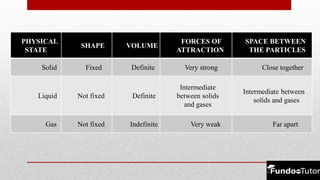
PHYSICAL
STATE
SHAPE VOLUME
FORCES OF
ATTRACTION
SPACE BETWEEN
THE PARTICLES
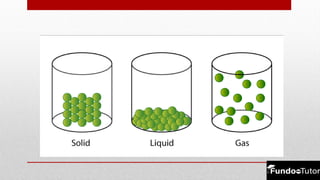
Solid Fixed Definite Very strong Close together
Liquid Not fixed Definite
Intermediate
between solids
and gases
Intermediate between
solids and gases
Gas Not fixed Indefinite Very weak Far apart
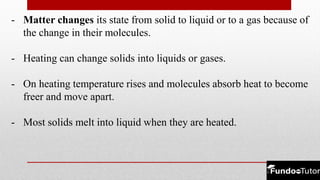
- Matter changes its state from solid to liquid or to a gas because of
the change in their molecules.
- Heating can change solids into liquids or gases.
- On heating temperature rises and molecules absorb heat to become
freer and move apart.
- Most solids melt into liquid when they are heated.
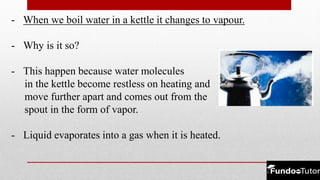
- When we boil water in a kettle it changes to vapour.
- Why is it so?
- This happen because water molecules
in the kettle become restless on heating and
move further apart and comes out from the
spout in the form of vapor.
- Liquid evaporates into a gas when it is heated.
- On freezing water (liquid), it changes to ice (solid).
- Why is it so?
- On freezing water molecules give up
their heat and settle closer together.
- Thus liquid water becomes solid and hard.
- A liquid freezes into a solid when it is
cooled and a gas condenses into a liquid
when it is cooled.
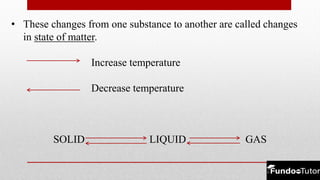
• These changes from one substance to another are called changes
in state of matter.
Increase temperature
Decrease temperature
SOLID LIQUID GAS
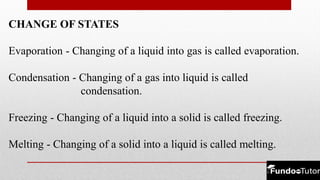
CHANGE OF STATES
Evaporation - Changing of a liquid into gas is called evaporation.
Condensation - Changing of a gas into liquid is called
condensation.
Freezing - Changing of a liquid into a solid is called freezing.
Melting - Changing of a solid into a liquid is called melting.
• State True (T) or false (F).
(i) Material that does not retain its fixed shape is called liquid.
_________
(ii) Matter can exist in one of three main states: solid, liquid, or gas.
______
(iii) A solid's particles are loosely packed._______
(iv) Gas can flow and expands to fill all the space available to it.
________
(v) On freezing water molecules give up their heat and settle closer
together. ___________
• Fill in the blanks.
(i) All materials are made up of _______________.
(ii) All matter takes up space and has some _____________.
(iii) Matter is made up of very small particles called
________________.
(iv) Solid, liquid and _______ are the three states of matter.
(v) Water changes to _____________ on heating.
(vi) Materials that do not dissolve in water are said to be
_______________
(vii) _____________ molecules are totally free to move around.
• Match the following.
(1) Molecule (A) Materials that dissolve in water.
(2) Insoluble substances (B) Melt into liquid when they are
heated.
(3) Most solids (C) Particles are packed densely enough
that volume is maintained.
(4) Soluble substances (D) Group of atoms bonded together.
(5) Liquid (E) Materials that do not dissolve in water.
• Answer the following:
1. Define matter?
2. Write any 3 physical properties of matter.
3. Why are solids hard substances?
4. Why liquid does not retain its fixed shape?
5. Write two characteristics of gas.
6. Write an experiment to show that gas has weight.
7. Differentiate between solid and liquid.
8. What happen when you boil water in a container?
9. Write an example when a solid melts on heating and solidifies
again on cooling.

Material and its properties

  • 1.
  • 2.
    • What ismatter made of? - Matter is made up of tiny particles called molecules. - Molecule is a group of atoms bonded together. - Atoms are so small, that they cannot be seen by naked eye. - The molecules of every substance are different from the molecules of any other substance.
  • 4.
    PHYSICAL STATE SHAPE VOLUME FORCES OF ATTRACTION SPACEBETWEEN THE PARTICLES Solid Fixed Definite Very strong Close together Liquid Not fixed Definite Intermediate between solids and gases Intermediate between solids and gases Gas Not fixed Indefinite Very weak Far apart
  • 5.
    - Matter changesits state from solid to liquid or to a gas because of the change in their molecules. - Heating can change solids into liquids or gases. - On heating temperature rises and molecules absorb heat to become freer and move apart. - Most solids melt into liquid when they are heated.
  • 6.
    - When weboil water in a kettle it changes to vapour. - Why is it so? - This happen because water molecules in the kettle become restless on heating and move further apart and comes out from the spout in the form of vapor. - Liquid evaporates into a gas when it is heated.
  • 7.
    - On freezingwater (liquid), it changes to ice (solid). - Why is it so? - On freezing water molecules give up their heat and settle closer together. - Thus liquid water becomes solid and hard. - A liquid freezes into a solid when it is cooled and a gas condenses into a liquid when it is cooled.
  • 8.
    • These changesfrom one substance to another are called changes in state of matter. Increase temperature Decrease temperature SOLID LIQUID GAS
  • 9.
    CHANGE OF STATES Evaporation- Changing of a liquid into gas is called evaporation. Condensation - Changing of a gas into liquid is called condensation. Freezing - Changing of a liquid into a solid is called freezing. Melting - Changing of a solid into a liquid is called melting.
  • 10.
    • State True(T) or false (F). (i) Material that does not retain its fixed shape is called liquid. _________ (ii) Matter can exist in one of three main states: solid, liquid, or gas. ______
  • 11.
    (iii) A solid'sparticles are loosely packed._______ (iv) Gas can flow and expands to fill all the space available to it. ________ (v) On freezing water molecules give up their heat and settle closer together. ___________
  • 12.
    • Fill inthe blanks. (i) All materials are made up of _______________. (ii) All matter takes up space and has some _____________. (iii) Matter is made up of very small particles called ________________.
  • 13.
    (iv) Solid, liquidand _______ are the three states of matter. (v) Water changes to _____________ on heating. (vi) Materials that do not dissolve in water are said to be _______________ (vii) _____________ molecules are totally free to move around.
  • 14.
    • Match thefollowing. (1) Molecule (A) Materials that dissolve in water. (2) Insoluble substances (B) Melt into liquid when they are heated. (3) Most solids (C) Particles are packed densely enough that volume is maintained. (4) Soluble substances (D) Group of atoms bonded together. (5) Liquid (E) Materials that do not dissolve in water.
  • 15.
    • Answer thefollowing: 1. Define matter? 2. Write any 3 physical properties of matter.
  • 16.
    3. Why aresolids hard substances? 4. Why liquid does not retain its fixed shape?
  • 17.
    5. Write twocharacteristics of gas. 6. Write an experiment to show that gas has weight.
  • 18.
    7. Differentiate betweensolid and liquid. 8. What happen when you boil water in a container?
  • 19.
    9. Write anexample when a solid melts on heating and solidifies again on cooling.