Mastering
Social Media
Kay Ridge
Social Media and Marketing
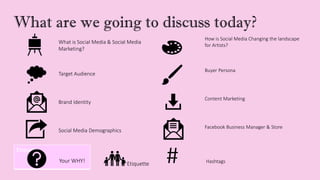
What are we going to discuss today?
What is Social Media & Social Media
Marketing?
How is Social Media Changing the landscape
for Artists?
Target Audience
Buyer Persona
Brand Identity
Content Marketing
Social Media Demographics
Facebook Business Manager & Store
Etiquette
Your WHY! Etiquette # Hashtags
Please take out your
smart phone, laptop or iPad
Log into Facebook
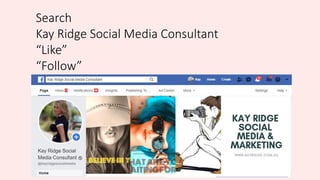
Search
Kay Ridge Social Media Consultant
“Like”
“Follow”
What is Social Media?
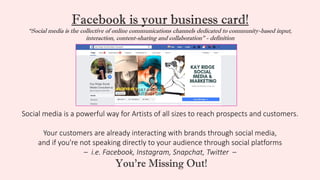
Facebook is your business card!
“Social media is the collective of online communications channels dedicated to community-based input,
interaction, content-sharing and collaboration” - definition
Social media is a powerful way for Artists of all sizes to reach prospects and customers.
Your customers are already interacting with brands through social media,
and if you're not speaking directly to your audience through social platforms
– i.e. Facebook, Instagram, Snapchat, Twitter –
You’re Missing Out!
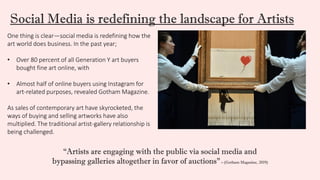
One thing is clear—social media is redefining how the
art world does business. In the past year;
• Over 80 percent of all Generation Y art buyers
bought fine art online, with
• Almost half of online buyers using Instagram for
art-related purposes, revealed Gotham Magazine.
As sales of contemporary art have skyrocketed, the
ways of buying and selling artworks have also
multiplied. The traditional artist-gallery relationship is
being challenged.
Social Media is redefining the landscape for Artists
“Artists are engaging with the public via social media and
bypassing galleries altogether in favor of auctions”– (Gotham Magazine, 2019)
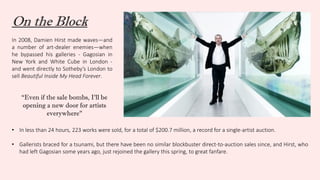
On the Block
In 2008, Damien Hirst made waves—and
a number of art-dealer enemies—when
he bypassed his galleries - Gagosian in
New York and White Cube in London -
and went directly to Sotheby’s London to
sell Beautiful Inside My Head Forever.
“Even if the sale bombs, I’ll be
opening a new door for artists
everywhere”
• In less than 24 hours, 223 works were sold, for a total of $200.7 million, a record for a single-artist auction.
• Gallerists braced for a tsunami, but there have been no similar blockbuster direct-to-auction sales since, and Hirst, who
had left Gagosian some years ago, just rejoined the gallery this spring, to great fanfare.
Who is your target
audience?
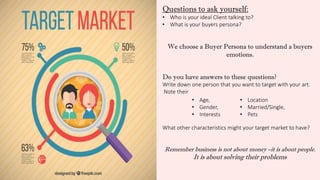
Questions to ask yourself:
• Who is your ideal Client talking to?
• What is your buyers persona?
We choose a Buyer Persona to understand a buyers
emotions.
Do you have answers to these questions?
Write down one person that you want to target with your art.
Note their
What other characteristics might your target market to have?
Remember business is not about money –it is about people.
It is about solving their problems
• Age,
• Gender,
• Interests
• Location
• Married/Single,
• Pets
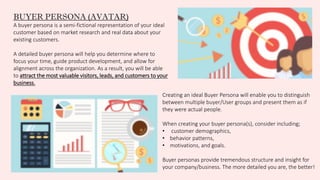
BUYER PERSONA (AVATAR)
A buyer persona is a semi-fictional representation of your ideal
customer based on market research and real data about your
existing customers.
A detailed buyer persona will help you determine where to
focus your time, guide product development, and allow for
alignment across the organization. As a result, you will be able
to attract the most valuable visitors, leads, and customers to your
business.
Creating an ideal Buyer Persona will enable you to distinguish
between multiple buyer/User groups and present them as if
they were actual people.
When creating your buyer persona(s), consider including;
• customer demographics,
• behavior patterns,
• motivations, and goals.
Buyer personas provide tremendous structure and insight for
your company/business. The more detailed you are, the better!
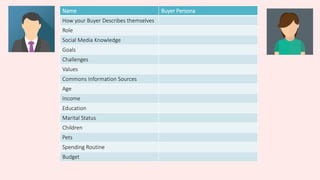
Name Buyer Persona
How your Buyer Describes themselves
Role
Social Media Knowledge
Goals
Challenges
Values
Commons Information Sources
Age
Income
Education
Marital Status
Children
Pets
Spending Routine
Budget
Brand
Identity
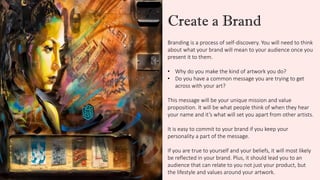
Create a Brand
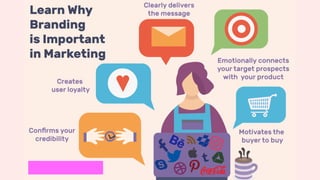
Branding is a process of self-discovery. You will need to think
about what your brand will mean to your audience once you
present it to them.
• Why do you make the kind of artwork you do?
• Do you have a common message you are trying to get
across with your art?
This message will be your unique mission and value
proposition. It will be what people think of when they hear
your name and it’s what will set you apart from other artists.
It is easy to commit to your brand if you keep your
personality a part of the message.
If you are true to yourself and your beliefs, it will most likely
be reflected in your brand. Plus, it should lead you to an
audience that can relate to you not just your product, but
the lifestyle and values around your artwork.
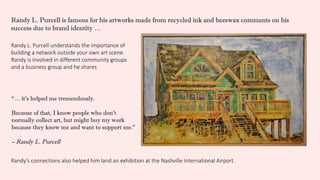
Randy L. Purcell understands the importance of
building a network outside your own art scene.
Randy is involved in different community groups
and a business group and he shares
“… it’s helped me tremendously.
Because of that, I know people who don’t
normally collect art, but might buy my work
because they know me and want to support me.”
– Randy L. Purcell
Randy’s connections also helped him land an exhibition at the Nashville International Airport.
Randy L. Purcell is famous for his artworks made from recycled ink and beeswax comments on his
success due to brand identity …
When asked by a local magazine about her
marketing strategies, Debra Joy Groesser instantly
brought up her monthly newsletter–and with good
reason. She sells a work off every single one!
She also mails a paper newsletter a few times a
year. She “was in real estate for ten years and
morphed that contact list into [her] artist one.”
Debra revealed
“It’s a very effective way to stay in contact
with my collectors, friends, and fans.”
Debra Joy Groesser, famous for her award winning oil paintings, praises the effectiveness of social media
marketing.
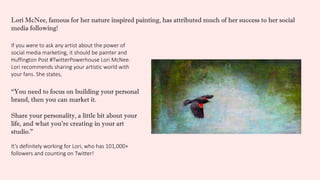
If you were to ask any artist about the power of
social media marketing, it should be painter and
Huffington Post #TwitterPowerhouse Lori McNee.
Lori recommends sharing your artistic world with
your fans. She states,
It’s definitely working for Lori, who has 101,000+
followers and counting on Twitter!
“You need to focus on building your personal
brand, then you can market it.
Share your personality, a little bit about your
life, and what you’re creating in your art
studio.”
Lori McNee, famous for her nature inspired painting, has attributed much of her success to her social
media following!
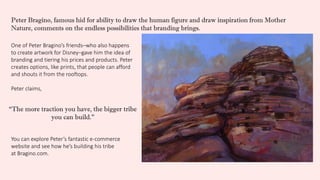
One of Peter Bragino’s friends–who also happens
to create artwork for Disney–gave him the idea of
branding and tiering his prices and products. Peter
creates options, like prints, that people can afford
and shouts it from the rooftops.
Peter claims,
You can explore Peter’s fantastic e-commerce
website and see how he’s building his tribe
at Bragino.com.
“The more traction you have, the bigger tribe
you can build.”
Peter Bragino, famous hid for ability to draw the human figure and draw inspiration from Mother
Nature, comments on the endless possibilities that branding brings.
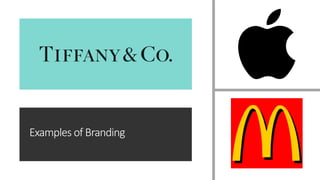
Examples of Branding
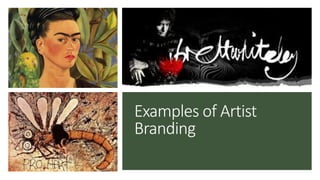
Examples of Artist
Branding
Brand Alignment
As an Artist you are a visual
storyteller. The way you paint is
unique! You are your Brand
Create well defined Brand
Guidelines -Logo, Colours, Voice,
Tone, signature
Ensure your Customers know
what your brand is about –
communication, the story you tell
Consistency –maintain your
brand
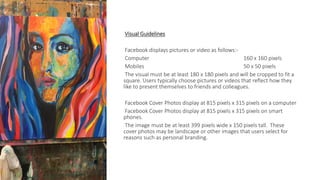
Visual Guidelines
Facebook displays pictures or video as follows:-
Computer 160 x 160 pixels
Mobiles 50 x 50 pixels
The visual must be at least 180 x 180 pixels and will be cropped to fit a
square. Users typically choose pictures or videos that reflect how they
like to present themselves to friends and colleagues.
Facebook Cover Photos display at 815 pixels x 315 pixels on a computer
Facebook Cover Photos display at 815 pixels x 315 pixels on smart
phones.
The image must be at least 399 pixels wide x 150 pixels tall. These
cover photos may be landscape or other images that users select for
reasons such as personal branding.
What is Content Marketing?
Content Marketing promotes your art business by providing valuable and engaging content for your customers.
It will:
Create word of mouth about your art business (when your content is shared)
Build up credibility as an Artist (when you share your story and experiences)
Build an emotional connection to your work (through your art story)
Create an online presence for your brand (where potential buyers will look to learn more about you)
All of these outcomes will help you sell more art.
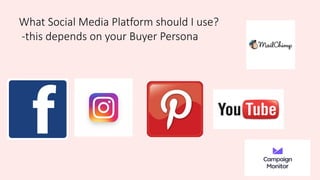
What Social Media Platform should I use?
-this depends on your Buyer Persona
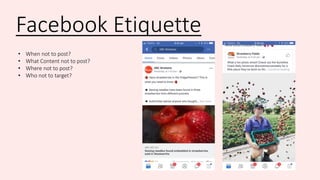
Facebook Etiquette
• When not to post?
• What Content not to post?
• Where not to post?
• Who not to target?
What do you need to do to promote your art on Facebook?
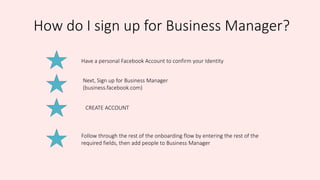
How do I sign up for Business Manager?
Have a personal Facebook Account to confirm your Identity
Next, Sign up for Business Manager
(business.facebook.com)
CREATE ACCOUNT
Follow through the rest of the onboarding flow by entering the rest of the
required fields, then add people to Business Manager
Facebook Business Manager
Facebook has over 1.44 billion monthly Users
Must have components
1. An Artist Statement -Tell a Story Instead of a Mission
Your artist statement is your chance to tell your own unique story and share your world. It’s what sets you apart from
other artists. Tell your viewer why you create your art and what inspires you. Share what your art means to you and
what is special about your creative process. The story of your art is much more welcoming than a mission statement. It
allows the viewer to get to know you. And we suggest keeping it simple so your story doesn’t get lost in the details. You
can go more in depth if viewers ask.
2. Make it unique to you, talk in the first person
3. Keep it short and sweet
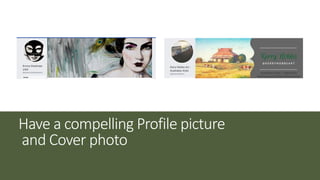
Have a compelling Profile picture
and Cover photo
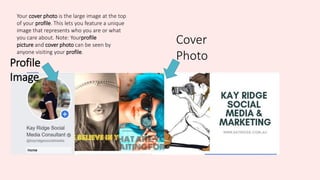
Your cover photo is the large image at the top
of your profile. This lets you feature a unique
image that represents who you are or what
you care about. Note: Yourprofile
picture and cover photo can be seen by
anyone visiting your profile.
Cover
PhotoProfile
Image
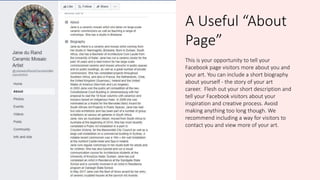
A Useful “About
Page”
This is your opportunity to tell your
Facebook page visitors more about you and
your art. You can include a short biography
about yourself - the story of your art
career. Flesh out your short description and
tell your Facebook visitors about your
inspiration and creative process. Avoid
making anything too long though. We
recommend including a way for visitors to
contact you and view more of your art.
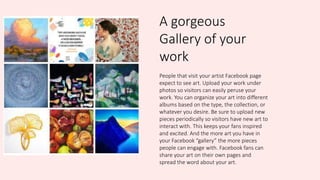
A gorgeous
Gallery of your
work
People that visit your artist Facebook page
expect to see art. Upload your work under
photos so visitors can easily peruse your
work. You can organize your art into different
albums based on the type, the collection, or
whatever you desire. Be sure to upload new
pieces periodically so visitors have new art to
interact with. This keeps your fans inspired
and excited. And the more art you have in
your Facebook “gallery” the more pieces
people can engage with. Facebook fans can
share your art on their own pages and
spread the word about your art.
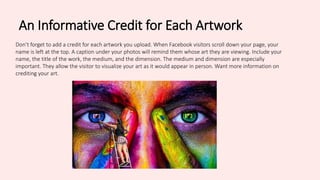
An Informative Credit for Each Artwork
Don’t forget to add a credit for each artwork you upload. When Facebook visitors scroll down your page, your
name is left at the top. A caption under your photos will remind them whose art they are viewing. Include your
name, the title of the work, the medium, and the dimension. The medium and dimension are especially
important. They allow the visitor to visualize your art as it would appear in person. Want more information on
crediting your art.
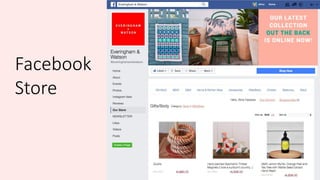
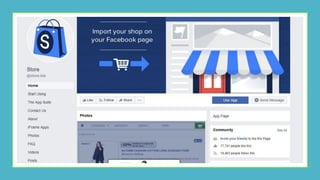
Facebook
Store
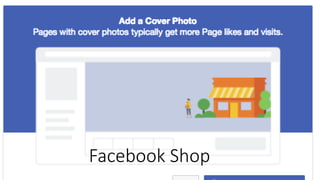
Facebook Shop
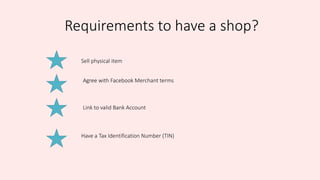
Requirements to have a shop?
Sell physical item
Agree with Facebook Merchant terms
Link to valid Bank Account
Have a Tax Identification Number (TIN)
Apart from Facebook what other social media should I consider?
Instagram
Pinterest
While every now and then you can advertise your latest artwork for sale, most often you should share content your
fans will find intriguing—something that isn’t persuading them to buy an artwork outright, but instead is building up a
good relationship with your art business.
For instance, Facebook, Twitter, Instagram, and Pinterest all allow you to share blog posts, photos of your artistic
process, videos from the studio, and more on your business page. This not only shows potential buyers what you have
been up to in the art world (creating that emotional connection again!), but it gets your name out there every time you
post something helpful and interesting for your fans to share.
Create an Art Blog -A fun and easy way to share your artist story is by creating a blog. There are many free and easy-to-
use websites for blogging these days. And, if you are worried about writer’s block, we created a list of 50 topics to write
about that will impress art buyers and tell your story better than a regular advertisement.
Send a Newsletter -For example, sharing a personal invitation to your upcoming gallery show may feel like an exciting
and exclusive opportunity to your subscribers, and also might help you build a crowd at your showing and land a sale.
Your Why!
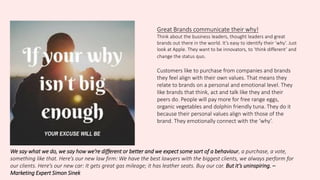
Great Brands communicate their why!
Think about the business leaders, thought leaders and great
brands out there in the world. It’s easy to identify their ‘why’. Just
look at Apple. They want to be innovators, to ‘think different’ and
change the status quo.
Customers like to purchase from companies and brands
they feel align with their own values. That means they
relate to brands on a personal and emotional level. They
like brands that think, act and talk like they and their
peers do. People will pay more for free range eggs,
organic vegetables and dolphin friendly tuna. They do it
because their personal values align with those of the
brand. They emotionally connect with the ‘why’.
We say what we do, we say how we’re different or better and we expect some sort of a behaviour, a purchase, a vote,
something like that. Here’s our new law firm: We have the best lawyers with the biggest clients, we always perform for
our clients. Here’s our new car: It gets great gas mileage; it has leather seats. Buy our car. But it’s uninspiring. –
Marketing Expert Simon Sinek
Identifying Your ‘Why’
Plenty of businesses can tell you what they do, some can tell you how they do
it, but not everyone can say why. It’s vital everyone in your business
understands the answers to all three – the what, how and the why. Begin by
asking yourself a few questions about your business, bearing in mind your
answers need to be focused on what matters to your current and desired
customers.
Why: This is the core belief of your business. Why does the business exist?
Why do you do what you do in the way you do it? What gets you out of bed
every morning?
How: How does your business accomplish the core belief? In what ways do
you provide products or services differently to and better than your
competitors? Some people refer to the ‘how’ as your USP, but it also relates to
the ways in which you operate e.g. ‘service with a smile’.
What: What the company does to achieve that core belief. What product/s
and/or service/s do you offer? What does your company do?
Remember:
Like, Follow and comment other Artists or
creative items that have a large following
Hashtags on Facebook? Yes or No?
Not convinced? Let’s do a mini-experiment. How many times have you used Facebook search to find your work
colleague, what your 2001 high school crush looks like now, or a hashtag you’ve seen in a marketing campaign?
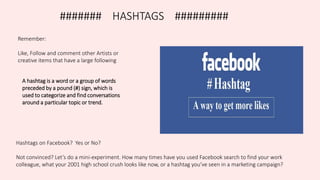
A hashtag is a word or a group of words
preceded by a pound (#) sign, which is
used to categorize and find conversations
around a particular topic or trend.
####### HASHTAGS #########
Even if your answer is “once”, your target customer does the same—so making your Facebook content visible
to them is only going to help with your organic reach.
Using hashtags is a fantastic way to do that.
If you’re using that hashtag in relevant Facebook posts, someone searching for the hashtag could land on
your content—without even following your page or profile.
Location-based hashtags, like #MALENY, could help to make your Facebook content visible to local people
while boosting engagement, too.
Location based Hashtags tend to get more comments.
Location-based hashtags, like #SMWLDN, could help to make your Facebook content visible to local people
while boosting engagement, too.
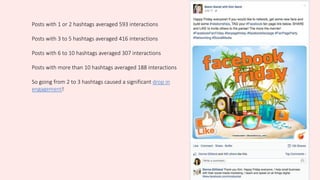
Posts with 1 or 2 hashtags averaged 593 interactions
Posts with 3 to 5 hashtags averaged 416 interactions
Posts with 6 to 10 hashtags averaged 307 interactions
Posts with more than 10 hashtags averaged 188 interactions
So going from 2 to 3 hashtags caused a significant drop in
engagement!
Key Rules when using Hashtags on Facebook (This rule does not apply on Instagram)
How to Use Hashtags?
Remember that a hashtag is a single
word. There should not be any
spaces — even if the term contains
multiple words, punctuation, and
special characters. The different words
of a hashtag can be distinguished by
using capital letters. For instance, a very
popular hashtag campaign by Red
Bull #PutACanOnIt is basically “Put a can
on it.” The use of capital letters makes it
easier to distinguish the different words
of a hashtag.
For a business, it’s important to perfect the art of targeting your audience. So get as specific as possible when
using hashtags.
Get creative. The right hashtag has the power to go viral. After you’ve gotten the hang of using hashtags, try
coming up with a new one. Who knows, it might become a trend!
Hashtags are not just for marketing and promotion but for engagement as well. Use hashtags to start a
conversation and participate in that conversation. Engaging with your users is a key to a well-rounded business.
A few quick tips for using #hashtags on Facebook:
1. Use relevant keywords to your business and the audience you are trying to target. (If you are a local business,
use the name of your city too).
2. Use tools like Hashtagify.me to find other trending hashtags related to your specific tag.
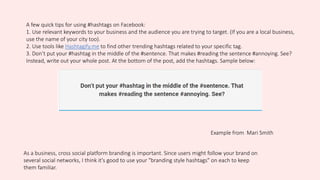
3. Don’t put your #hashtag in the middle of the #sentence. That makes #reading the sentence #annoying. See?
Instead, write out your whole post. At the bottom of the post, add the hashtags. Sample below:
Example from Mari Smith
As a business, cross social platform branding is important. Since users might follow your brand on
several social networks, I think it's good to use your "branding style hashtags" on each to keep
them familiar.
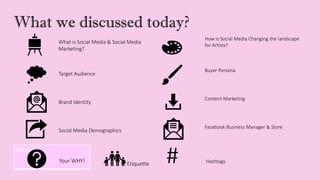
What we discussed today?
What is Social Media & Social Media
Marketing?
How is Social Media Changing the landscape
for Artists?
Target Audience
Buyer Persona
Brand Identity
Content Marketing
Social Media Demographics
Facebook Business Manager & Store
Etiquette
Your WHY! Etiquette # Hashtags
Mastering Social Media for Artists

Mastering Social Media for Artists

  • 1.
  • 5.
    What are wegoing to discuss today? What is Social Media & Social Media Marketing? How is Social Media Changing the landscape for Artists? Target Audience Buyer Persona Brand Identity Content Marketing Social Media Demographics Facebook Business Manager & Store Etiquette Your WHY! Etiquette # Hashtags
  • 6.
    Please take outyour smart phone, laptop or iPad Log into Facebook
  • 7.
    Search Kay Ridge SocialMedia Consultant “Like” “Follow”
  • 8.
  • 9.
    Facebook is yourbusiness card! “Social media is the collective of online communications channels dedicated to community-based input, interaction, content-sharing and collaboration” - definition Social media is a powerful way for Artists of all sizes to reach prospects and customers. Your customers are already interacting with brands through social media, and if you're not speaking directly to your audience through social platforms – i.e. Facebook, Instagram, Snapchat, Twitter – You’re Missing Out!
  • 10.
    One thing isclear—social media is redefining how the art world does business. In the past year; • Over 80 percent of all Generation Y art buyers bought fine art online, with • Almost half of online buyers using Instagram for art-related purposes, revealed Gotham Magazine. As sales of contemporary art have skyrocketed, the ways of buying and selling artworks have also multiplied. The traditional artist-gallery relationship is being challenged. Social Media is redefining the landscape for Artists “Artists are engaging with the public via social media and bypassing galleries altogether in favor of auctions”– (Gotham Magazine, 2019)
  • 11.
    On the Block In2008, Damien Hirst made waves—and a number of art-dealer enemies—when he bypassed his galleries - Gagosian in New York and White Cube in London - and went directly to Sotheby’s London to sell Beautiful Inside My Head Forever. “Even if the sale bombs, I’ll be opening a new door for artists everywhere” • In less than 24 hours, 223 works were sold, for a total of $200.7 million, a record for a single-artist auction. • Gallerists braced for a tsunami, but there have been no similar blockbuster direct-to-auction sales since, and Hirst, who had left Gagosian some years ago, just rejoined the gallery this spring, to great fanfare.
  • 12.
    Who is yourtarget audience?
  • 13.
    Questions to askyourself: • Who is your ideal Client talking to? • What is your buyers persona? We choose a Buyer Persona to understand a buyers emotions. Do you have answers to these questions? Write down one person that you want to target with your art. Note their What other characteristics might your target market to have? Remember business is not about money –it is about people. It is about solving their problems • Age, • Gender, • Interests • Location • Married/Single, • Pets
  • 14.
    BUYER PERSONA (AVATAR) Abuyer persona is a semi-fictional representation of your ideal customer based on market research and real data about your existing customers. A detailed buyer persona will help you determine where to focus your time, guide product development, and allow for alignment across the organization. As a result, you will be able to attract the most valuable visitors, leads, and customers to your business. Creating an ideal Buyer Persona will enable you to distinguish between multiple buyer/User groups and present them as if they were actual people. When creating your buyer persona(s), consider including; • customer demographics, • behavior patterns, • motivations, and goals. Buyer personas provide tremendous structure and insight for your company/business. The more detailed you are, the better!
  • 15.
    Name Buyer Persona Howyour Buyer Describes themselves Role Social Media Knowledge Goals Challenges Values Commons Information Sources Age Income Education Marital Status Children Pets Spending Routine Budget
  • 16.
  • 17.
    Create a Brand Brandingis a process of self-discovery. You will need to think about what your brand will mean to your audience once you present it to them. • Why do you make the kind of artwork you do? • Do you have a common message you are trying to get across with your art? This message will be your unique mission and value proposition. It will be what people think of when they hear your name and it’s what will set you apart from other artists. It is easy to commit to your brand if you keep your personality a part of the message. If you are true to yourself and your beliefs, it will most likely be reflected in your brand. Plus, it should lead you to an audience that can relate to you not just your product, but the lifestyle and values around your artwork.
  • 18.
    Randy L. Purcellunderstands the importance of building a network outside your own art scene. Randy is involved in different community groups and a business group and he shares “… it’s helped me tremendously. Because of that, I know people who don’t normally collect art, but might buy my work because they know me and want to support me.” – Randy L. Purcell Randy’s connections also helped him land an exhibition at the Nashville International Airport. Randy L. Purcell is famous for his artworks made from recycled ink and beeswax comments on his success due to brand identity …
  • 19.
    When asked bya local magazine about her marketing strategies, Debra Joy Groesser instantly brought up her monthly newsletter–and with good reason. She sells a work off every single one! She also mails a paper newsletter a few times a year. She “was in real estate for ten years and morphed that contact list into [her] artist one.” Debra revealed “It’s a very effective way to stay in contact with my collectors, friends, and fans.” Debra Joy Groesser, famous for her award winning oil paintings, praises the effectiveness of social media marketing.
  • 20.
    If you wereto ask any artist about the power of social media marketing, it should be painter and Huffington Post #TwitterPowerhouse Lori McNee. Lori recommends sharing your artistic world with your fans. She states, It’s definitely working for Lori, who has 101,000+ followers and counting on Twitter! “You need to focus on building your personal brand, then you can market it. Share your personality, a little bit about your life, and what you’re creating in your art studio.” Lori McNee, famous for her nature inspired painting, has attributed much of her success to her social media following!
  • 21.
    One of PeterBragino’s friends–who also happens to create artwork for Disney–gave him the idea of branding and tiering his prices and products. Peter creates options, like prints, that people can afford and shouts it from the rooftops. Peter claims, You can explore Peter’s fantastic e-commerce website and see how he’s building his tribe at Bragino.com. “The more traction you have, the bigger tribe you can build.” Peter Bragino, famous hid for ability to draw the human figure and draw inspiration from Mother Nature, comments on the endless possibilities that branding brings.
  • 23.
  • 24.
  • 25.
    Brand Alignment As anArtist you are a visual storyteller. The way you paint is unique! You are your Brand Create well defined Brand Guidelines -Logo, Colours, Voice, Tone, signature Ensure your Customers know what your brand is about – communication, the story you tell Consistency –maintain your brand
  • 26.
    Visual Guidelines Facebook displayspictures or video as follows:- Computer 160 x 160 pixels Mobiles 50 x 50 pixels The visual must be at least 180 x 180 pixels and will be cropped to fit a square. Users typically choose pictures or videos that reflect how they like to present themselves to friends and colleagues. Facebook Cover Photos display at 815 pixels x 315 pixels on a computer Facebook Cover Photos display at 815 pixels x 315 pixels on smart phones. The image must be at least 399 pixels wide x 150 pixels tall. These cover photos may be landscape or other images that users select for reasons such as personal branding.
  • 28.
    What is ContentMarketing? Content Marketing promotes your art business by providing valuable and engaging content for your customers. It will: Create word of mouth about your art business (when your content is shared) Build up credibility as an Artist (when you share your story and experiences) Build an emotional connection to your work (through your art story) Create an online presence for your brand (where potential buyers will look to learn more about you) All of these outcomes will help you sell more art.
  • 30.
    What Social MediaPlatform should I use? -this depends on your Buyer Persona
  • 32.
    Facebook Etiquette • Whennot to post? • What Content not to post? • Where not to post? • Who not to target?
  • 33.
    What do youneed to do to promote your art on Facebook?
  • 34.
    How do Isign up for Business Manager? Have a personal Facebook Account to confirm your Identity Next, Sign up for Business Manager (business.facebook.com) CREATE ACCOUNT Follow through the rest of the onboarding flow by entering the rest of the required fields, then add people to Business Manager
  • 35.
  • 36.
    Facebook has over1.44 billion monthly Users Must have components 1. An Artist Statement -Tell a Story Instead of a Mission Your artist statement is your chance to tell your own unique story and share your world. It’s what sets you apart from other artists. Tell your viewer why you create your art and what inspires you. Share what your art means to you and what is special about your creative process. The story of your art is much more welcoming than a mission statement. It allows the viewer to get to know you. And we suggest keeping it simple so your story doesn’t get lost in the details. You can go more in depth if viewers ask. 2. Make it unique to you, talk in the first person 3. Keep it short and sweet
  • 37.
    Have a compellingProfile picture and Cover photo
  • 38.
    Your cover photois the large image at the top of your profile. This lets you feature a unique image that represents who you are or what you care about. Note: Yourprofile picture and cover photo can be seen by anyone visiting your profile. Cover PhotoProfile Image
  • 39.
    A Useful “About Page” Thisis your opportunity to tell your Facebook page visitors more about you and your art. You can include a short biography about yourself - the story of your art career. Flesh out your short description and tell your Facebook visitors about your inspiration and creative process. Avoid making anything too long though. We recommend including a way for visitors to contact you and view more of your art.
  • 40.
    A gorgeous Gallery ofyour work People that visit your artist Facebook page expect to see art. Upload your work under photos so visitors can easily peruse your work. You can organize your art into different albums based on the type, the collection, or whatever you desire. Be sure to upload new pieces periodically so visitors have new art to interact with. This keeps your fans inspired and excited. And the more art you have in your Facebook “gallery” the more pieces people can engage with. Facebook fans can share your art on their own pages and spread the word about your art.
  • 41.
    An Informative Creditfor Each Artwork Don’t forget to add a credit for each artwork you upload. When Facebook visitors scroll down your page, your name is left at the top. A caption under your photos will remind them whose art they are viewing. Include your name, the title of the work, the medium, and the dimension. The medium and dimension are especially important. They allow the visitor to visualize your art as it would appear in person. Want more information on crediting your art.
  • 43.
  • 44.
  • 45.
    Requirements to havea shop? Sell physical item Agree with Facebook Merchant terms Link to valid Bank Account Have a Tax Identification Number (TIN)
  • 48.
    Apart from Facebookwhat other social media should I consider? Instagram Pinterest While every now and then you can advertise your latest artwork for sale, most often you should share content your fans will find intriguing—something that isn’t persuading them to buy an artwork outright, but instead is building up a good relationship with your art business. For instance, Facebook, Twitter, Instagram, and Pinterest all allow you to share blog posts, photos of your artistic process, videos from the studio, and more on your business page. This not only shows potential buyers what you have been up to in the art world (creating that emotional connection again!), but it gets your name out there every time you post something helpful and interesting for your fans to share. Create an Art Blog -A fun and easy way to share your artist story is by creating a blog. There are many free and easy-to- use websites for blogging these days. And, if you are worried about writer’s block, we created a list of 50 topics to write about that will impress art buyers and tell your story better than a regular advertisement. Send a Newsletter -For example, sharing a personal invitation to your upcoming gallery show may feel like an exciting and exclusive opportunity to your subscribers, and also might help you build a crowd at your showing and land a sale.
  • 50.
  • 51.
    Great Brands communicatetheir why! Think about the business leaders, thought leaders and great brands out there in the world. It’s easy to identify their ‘why’. Just look at Apple. They want to be innovators, to ‘think different’ and change the status quo. Customers like to purchase from companies and brands they feel align with their own values. That means they relate to brands on a personal and emotional level. They like brands that think, act and talk like they and their peers do. People will pay more for free range eggs, organic vegetables and dolphin friendly tuna. They do it because their personal values align with those of the brand. They emotionally connect with the ‘why’. We say what we do, we say how we’re different or better and we expect some sort of a behaviour, a purchase, a vote, something like that. Here’s our new law firm: We have the best lawyers with the biggest clients, we always perform for our clients. Here’s our new car: It gets great gas mileage; it has leather seats. Buy our car. But it’s uninspiring. – Marketing Expert Simon Sinek
  • 52.
    Identifying Your ‘Why’ Plentyof businesses can tell you what they do, some can tell you how they do it, but not everyone can say why. It’s vital everyone in your business understands the answers to all three – the what, how and the why. Begin by asking yourself a few questions about your business, bearing in mind your answers need to be focused on what matters to your current and desired customers. Why: This is the core belief of your business. Why does the business exist? Why do you do what you do in the way you do it? What gets you out of bed every morning? How: How does your business accomplish the core belief? In what ways do you provide products or services differently to and better than your competitors? Some people refer to the ‘how’ as your USP, but it also relates to the ways in which you operate e.g. ‘service with a smile’. What: What the company does to achieve that core belief. What product/s and/or service/s do you offer? What does your company do?
  • 53.
    Remember: Like, Follow andcomment other Artists or creative items that have a large following Hashtags on Facebook? Yes or No? Not convinced? Let’s do a mini-experiment. How many times have you used Facebook search to find your work colleague, what your 2001 high school crush looks like now, or a hashtag you’ve seen in a marketing campaign? A hashtag is a word or a group of words preceded by a pound (#) sign, which is used to categorize and find conversations around a particular topic or trend. ####### HASHTAGS #########
  • 54.
    Even if youranswer is “once”, your target customer does the same—so making your Facebook content visible to them is only going to help with your organic reach. Using hashtags is a fantastic way to do that. If you’re using that hashtag in relevant Facebook posts, someone searching for the hashtag could land on your content—without even following your page or profile. Location-based hashtags, like #MALENY, could help to make your Facebook content visible to local people while boosting engagement, too. Location based Hashtags tend to get more comments. Location-based hashtags, like #SMWLDN, could help to make your Facebook content visible to local people while boosting engagement, too.
  • 55.
    Posts with 1or 2 hashtags averaged 593 interactions Posts with 3 to 5 hashtags averaged 416 interactions Posts with 6 to 10 hashtags averaged 307 interactions Posts with more than 10 hashtags averaged 188 interactions So going from 2 to 3 hashtags caused a significant drop in engagement!
  • 56.
    Key Rules whenusing Hashtags on Facebook (This rule does not apply on Instagram) How to Use Hashtags? Remember that a hashtag is a single word. There should not be any spaces — even if the term contains multiple words, punctuation, and special characters. The different words of a hashtag can be distinguished by using capital letters. For instance, a very popular hashtag campaign by Red Bull #PutACanOnIt is basically “Put a can on it.” The use of capital letters makes it easier to distinguish the different words of a hashtag. For a business, it’s important to perfect the art of targeting your audience. So get as specific as possible when using hashtags. Get creative. The right hashtag has the power to go viral. After you’ve gotten the hang of using hashtags, try coming up with a new one. Who knows, it might become a trend! Hashtags are not just for marketing and promotion but for engagement as well. Use hashtags to start a conversation and participate in that conversation. Engaging with your users is a key to a well-rounded business.
  • 57.
    A few quicktips for using #hashtags on Facebook: 1. Use relevant keywords to your business and the audience you are trying to target. (If you are a local business, use the name of your city too). 2. Use tools like Hashtagify.me to find other trending hashtags related to your specific tag. 3. Don’t put your #hashtag in the middle of the #sentence. That makes #reading the sentence #annoying. See? Instead, write out your whole post. At the bottom of the post, add the hashtags. Sample below: Example from Mari Smith As a business, cross social platform branding is important. Since users might follow your brand on several social networks, I think it's good to use your "branding style hashtags" on each to keep them familiar.
  • 58.
    What we discussedtoday? What is Social Media & Social Media Marketing? How is Social Media Changing the landscape for Artists? Target Audience Buyer Persona Brand Identity Content Marketing Social Media Demographics Facebook Business Manager & Store Etiquette Your WHY! Etiquette # Hashtags