Institute for Software Technology – Maximilian Fellner 2013 1
Specification of a
Visual Programming
Language by Example
Behavior-Driven Development with Cucumber for Catrobat
Master’s Thesis by Maximilian Fellner
Institute for Software Technology – Maximilian Fellner 2013
Question:
What are the advantages of
standards and specifications?
2
Institute for Software Technology – Maximilian Fellner 2013
Standardization
‣ Competitive advantages
‣ Strategic alliances
‣ Reduction of costs
‣ Safety & quality
‣ Public interest
3
Economic Benefits of Standardization, Deutsches Institut für Normung, Beuth Verlag
Institute for Software Technology – Maximilian Fellner 2013
Specification
‣ Understand the requirements
‣ Describe a product abstractly
‣ Formulate binding contracts
‣ Quality assurance
4
Prerequisite for standardization
Institute for Software Technology – Maximilian Fellner 2013
Existing approaches to
language specification
‣ Natural language
‣ Formal semantics
‣ Reference implementations
‣ Test suites
‣ Syntax specified by context-free grammars and regular expressions
5
Institute for Software Technology – Maximilian Fellner 2013
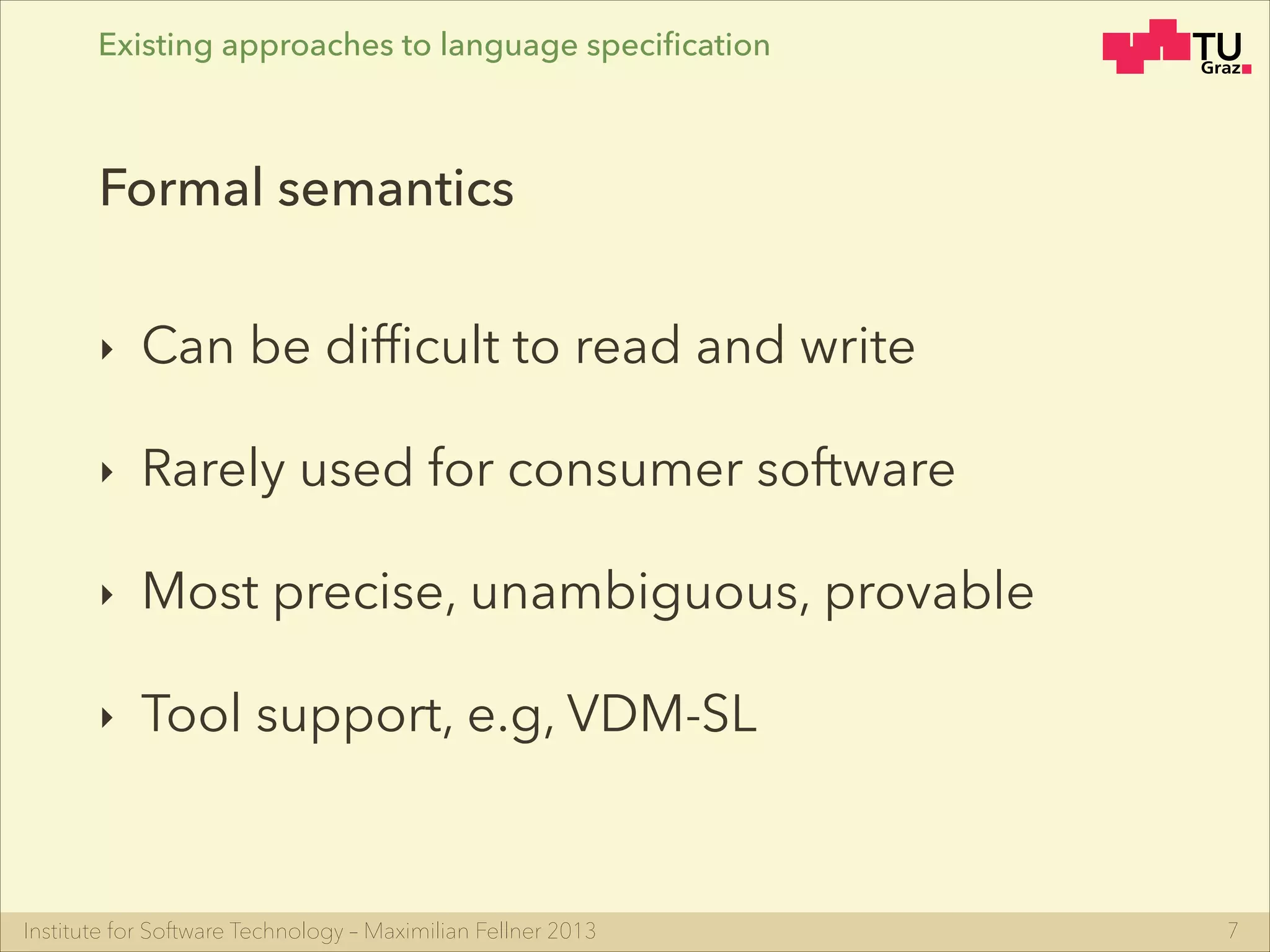
Existing approaches to language specification
‣ Specification documents,

e.g., ECMA-262 (JavaScript)
‣ Readily understood by most
‣ Free choice of content and format
‣ Cannot be automatically verified
6
Natural language
Institute for Software Technology – Maximilian Fellner 2013
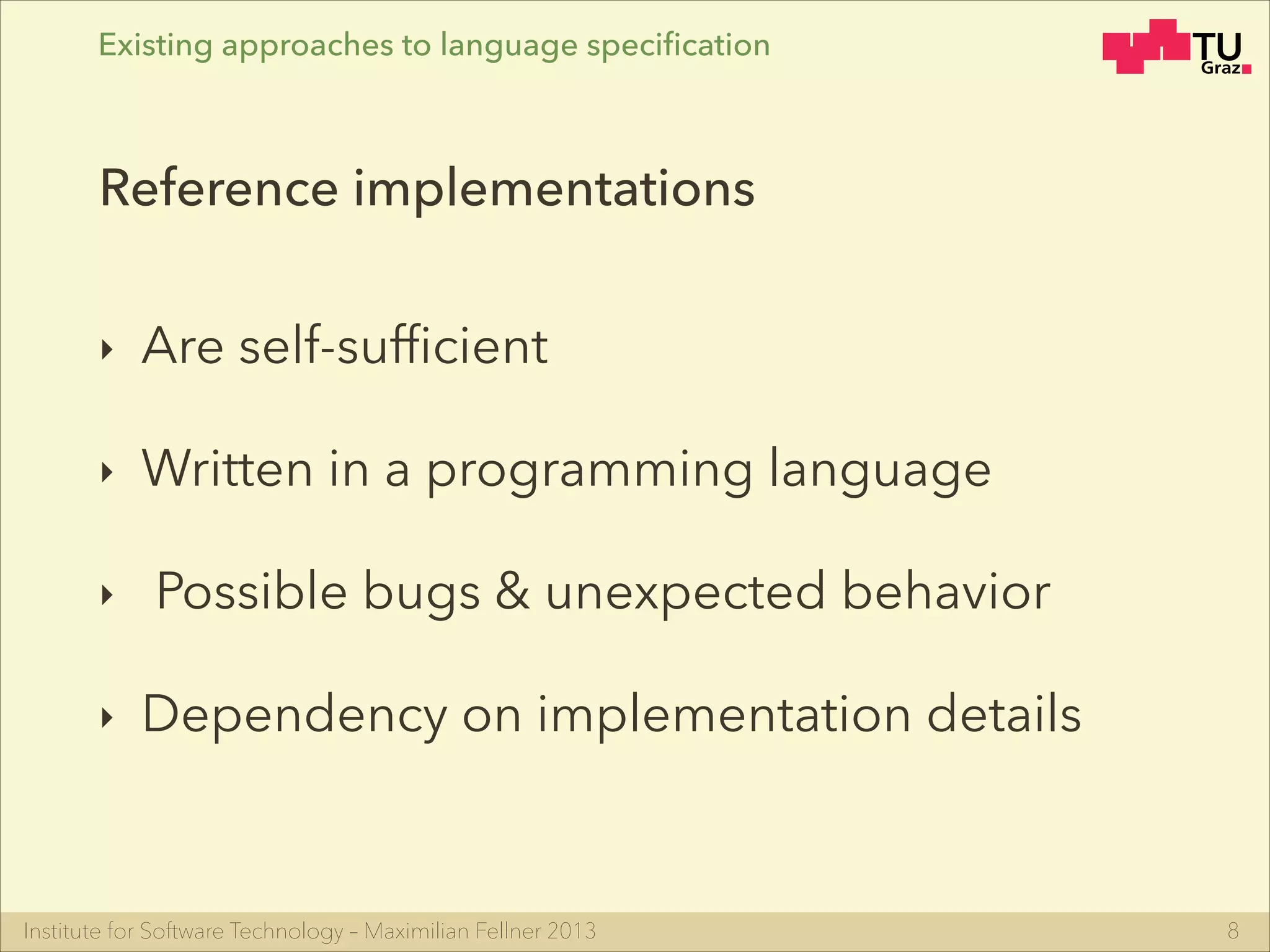
Existing approaches to language specification
‣ Can be difficult to read and write
‣ Rarely used for consumer software
‣ Most precise, unambiguous, provable
‣ Tool support, e.g, VDM-SL
7
Formal semantics
Institute for Software Technology – Maximilian Fellner 2013
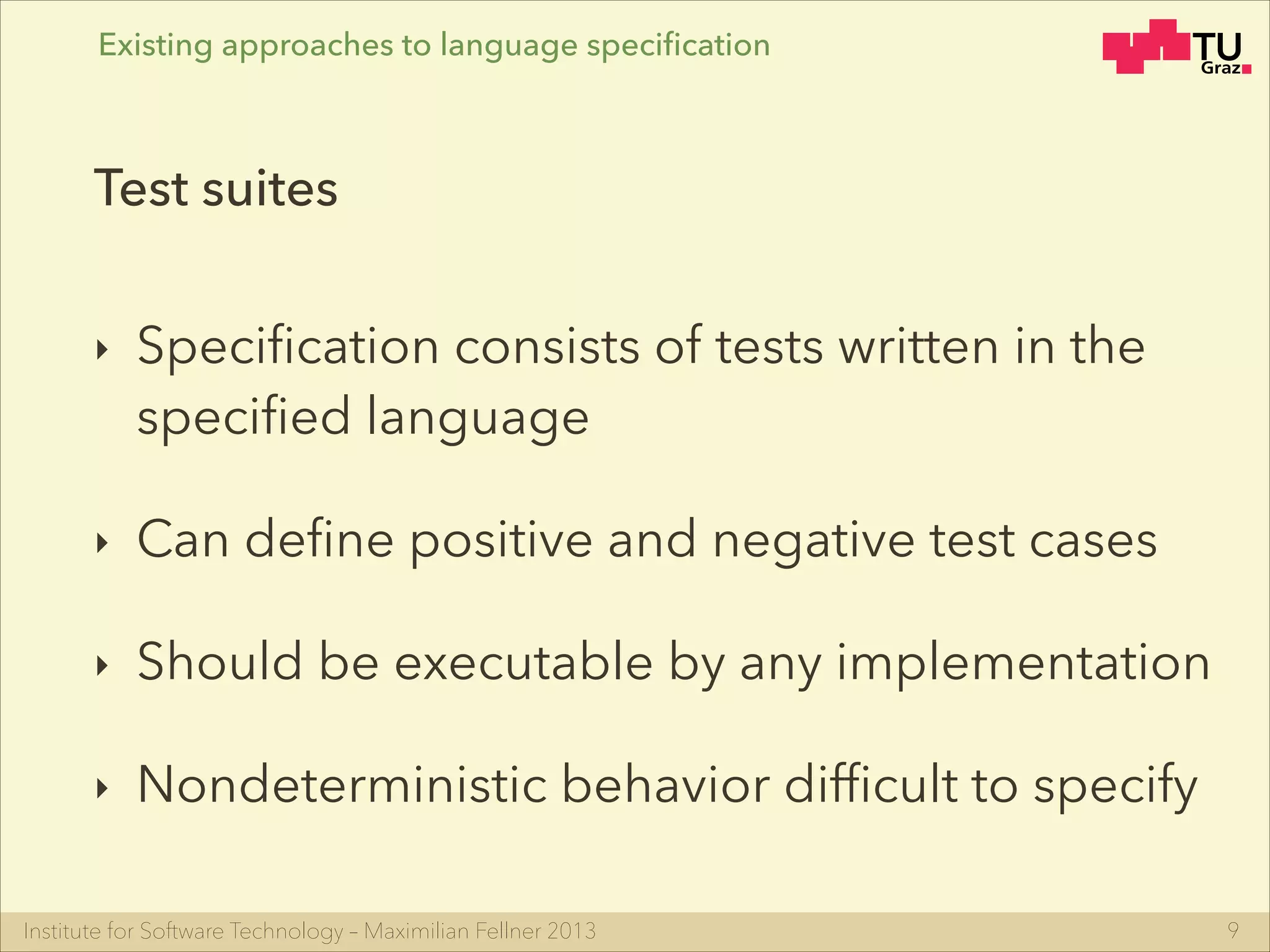
‣ Are self-sufficient
‣ Written in a programming language
‣ Possible bugs & unexpected behavior
‣ Dependency on implementation details
8
Reference implementations
Existing approaches to language specification
Institute for Software Technology – Maximilian Fellner 2013
‣ Specification consists of tests written in the
specified language
‣ Can define positive and negative test cases
‣ Should be executable by any implementation
‣ Nondeterministic behavior difficult to specify
9
Test suites
Existing approaches to language specification
Institute for Software Technology – Maximilian Fellner 2013
‣ Languages with greater abstraction
‣ No tool support for specification
‣ Visual tests not feasible
10
Visual programming languages
Existing approaches to language specification
Institute for Software Technology – Maximilian Fellner 2013
Can we combine the
advantages of natural language
and those of test suites?
11
Question:
Institute for Software Technology – Maximilian Fellner 2013
Specification by Example
12
From business goals to executable specification
‣ Introduced by Gojko Adzic
‣ Agile methodology
‣ Acceptance Test-Driven Development
‣ Behavior-Driven Development
Institute for Software Technology – Maximilian Fellner 2013 13
Right Product
Built Right
Business
Failure
Success
Useless
Software
Maintenance
Difficulties
test-driven development
programming languages
frameworks & tools
specification by example
project management
Success of a software product, adapted from Adzic [1]
business intent
Institute for Software Technology – Maximilian Fellner 2013
Question:
How can tests better specify
the business intent?
14
Institute for Software Technology – Maximilian Fellner 2013 15
Customer Tests
(or Acceptance Tests)
Business Intent
Usability Testing
Is it pleasurable?
Component Tests
Architect Intent
Exploratory Testing
Is it self-consistent?
Unit Tests
Developer Intent
Property Testing
Is it responsive, secure, scalable?
Per Functionality Cross-Functional
Business
Facing
Technology
Facing
The testing matrix, adapted from Meszaros [2]
Institute for Software Technology – Maximilian Fellner 2013
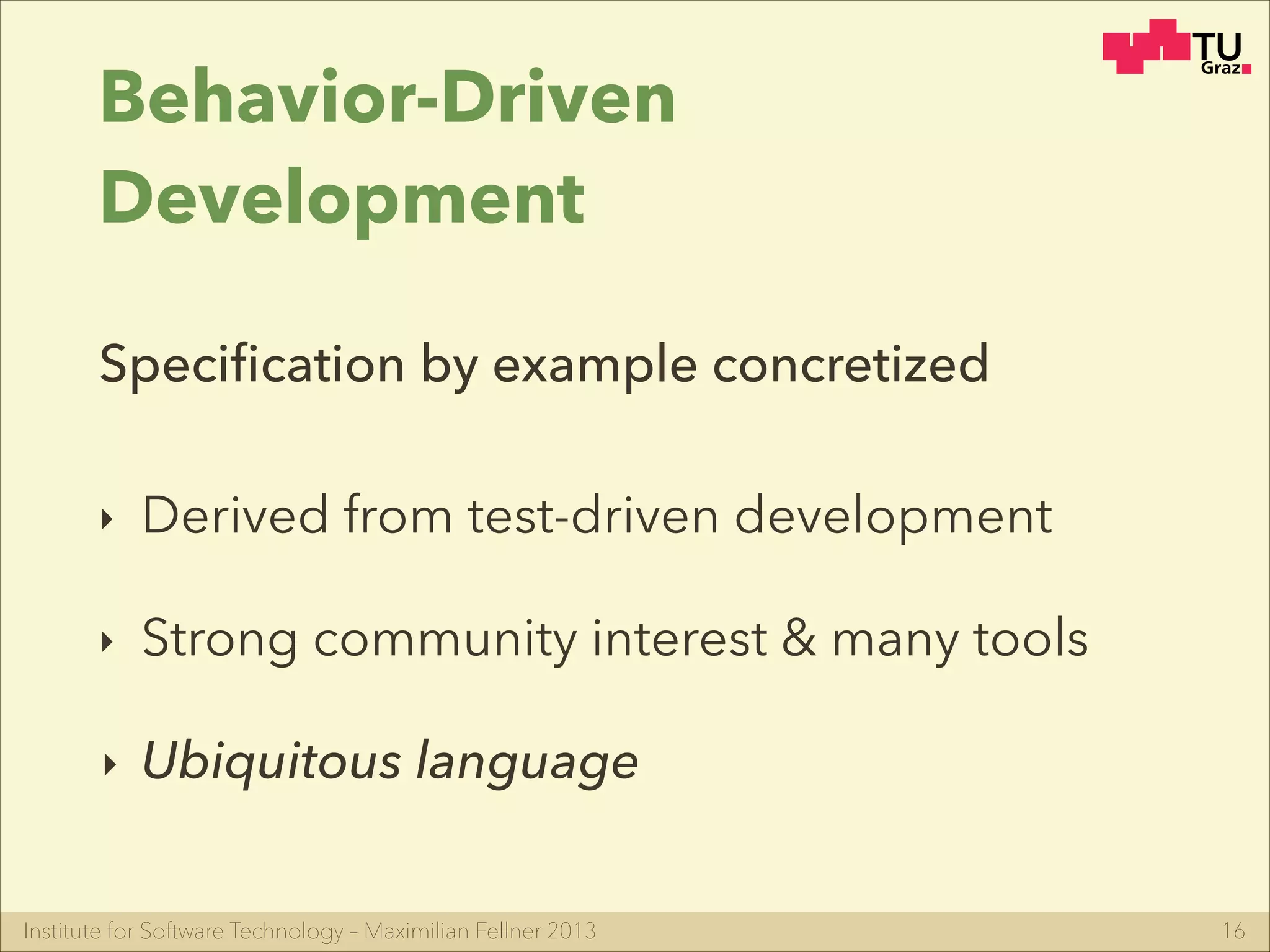
Behavior-Driven
Development
‣ Derived from test-driven development
‣ Strong community interest & many tools
‣ Ubiquitous language
16
Specification by example concretized
Institute for Software Technology – Maximilian Fellner 2013
What is a ubiquitous language?
A common language for a
shared understanding of the
domain.
17
E. Evans, Domain-Driven Design: Tackling Complexity in the Heart of Software [3]
Institute for Software Technology – Maximilian Fellner 2013 18
Title (one line describing the story)
!
Narrative:
As a [role]
I want [feature] So that [benefit]
!
Acceptance Criteria: (presented as Scenarios)
Scenario: Title
Given [context]
And [some more context]…
When [event]
Then [outcome]
And [another outcome]…
D. North. What’s in a story? [4]
Institute for Software Technology – Maximilian Fellner 2013
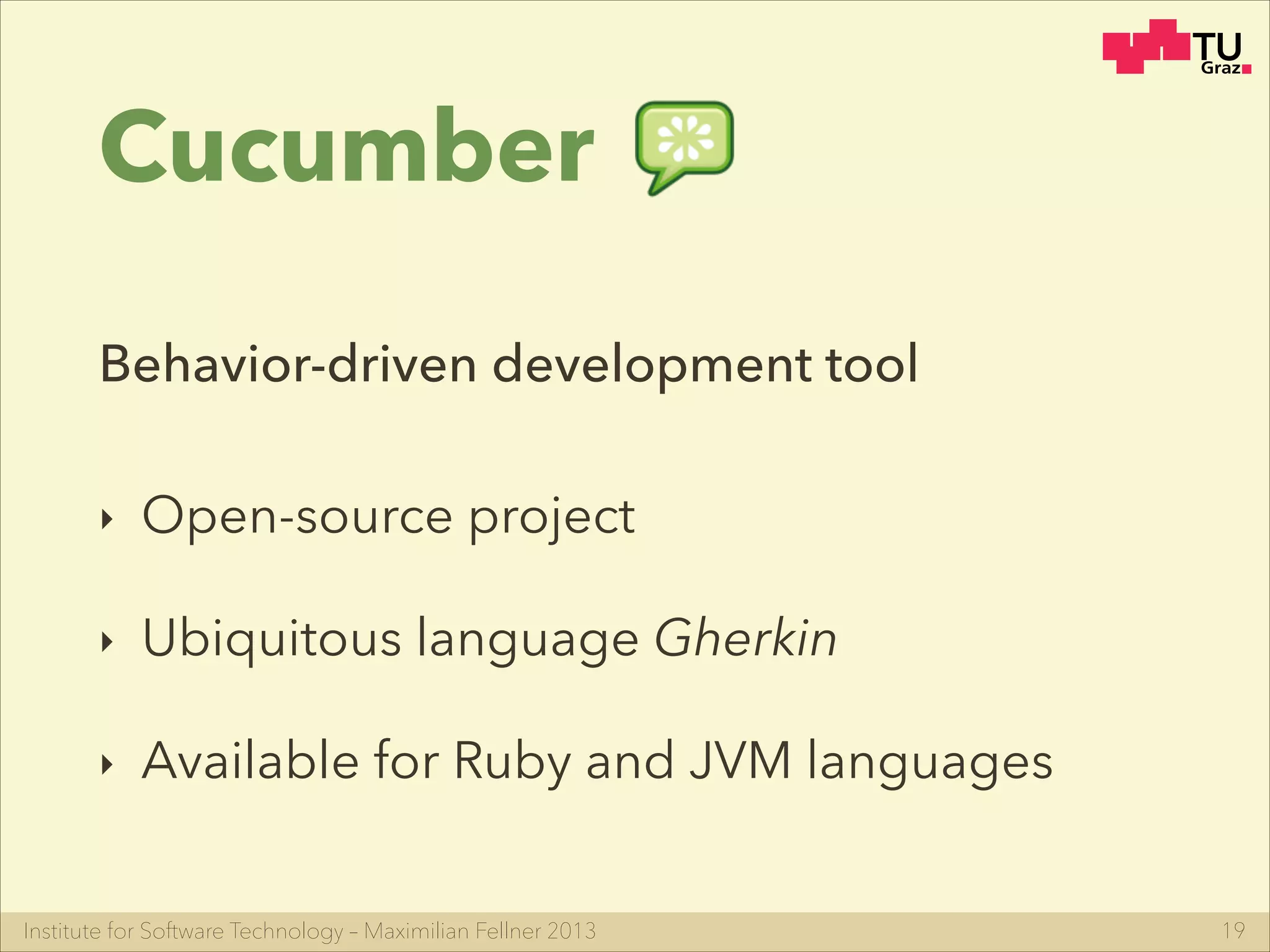
Cucumber
‣ Open-source project
‣ Ubiquitous language Gherkin
‣ Available for Ruby and JVM languages
19
Behavior-driven development tool
Institute for Software Technology – Maximilian Fellner 2013
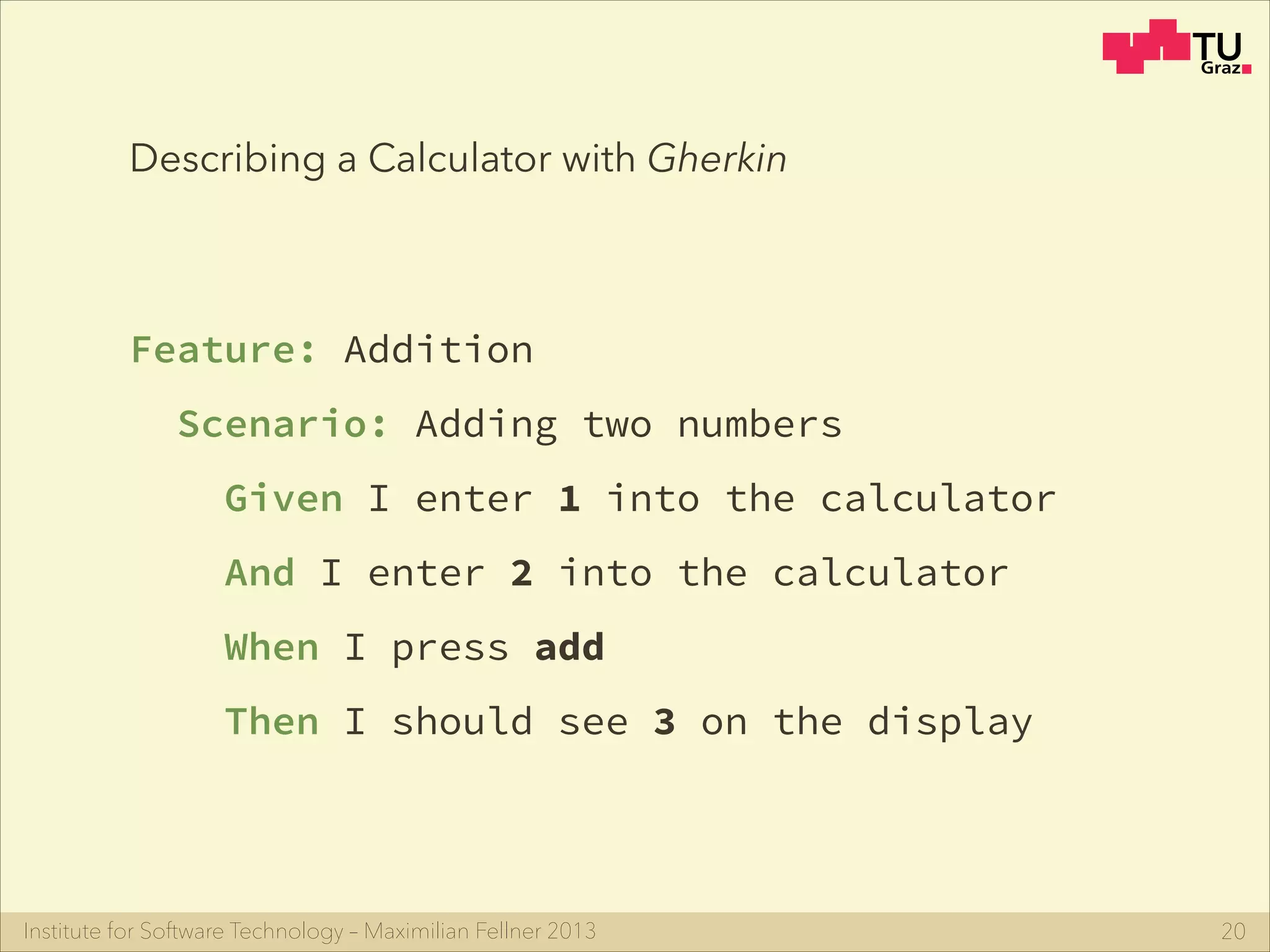
Describing a Calculator with Gherkin
Feature: Addition
Scenario: Adding two numbers
Given I enter 1 into the calculator
And I enter 2 into the calculator
When I press add
Then I should see 3 on the display
20
Institute for Software Technology – Maximilian Fellner 2013
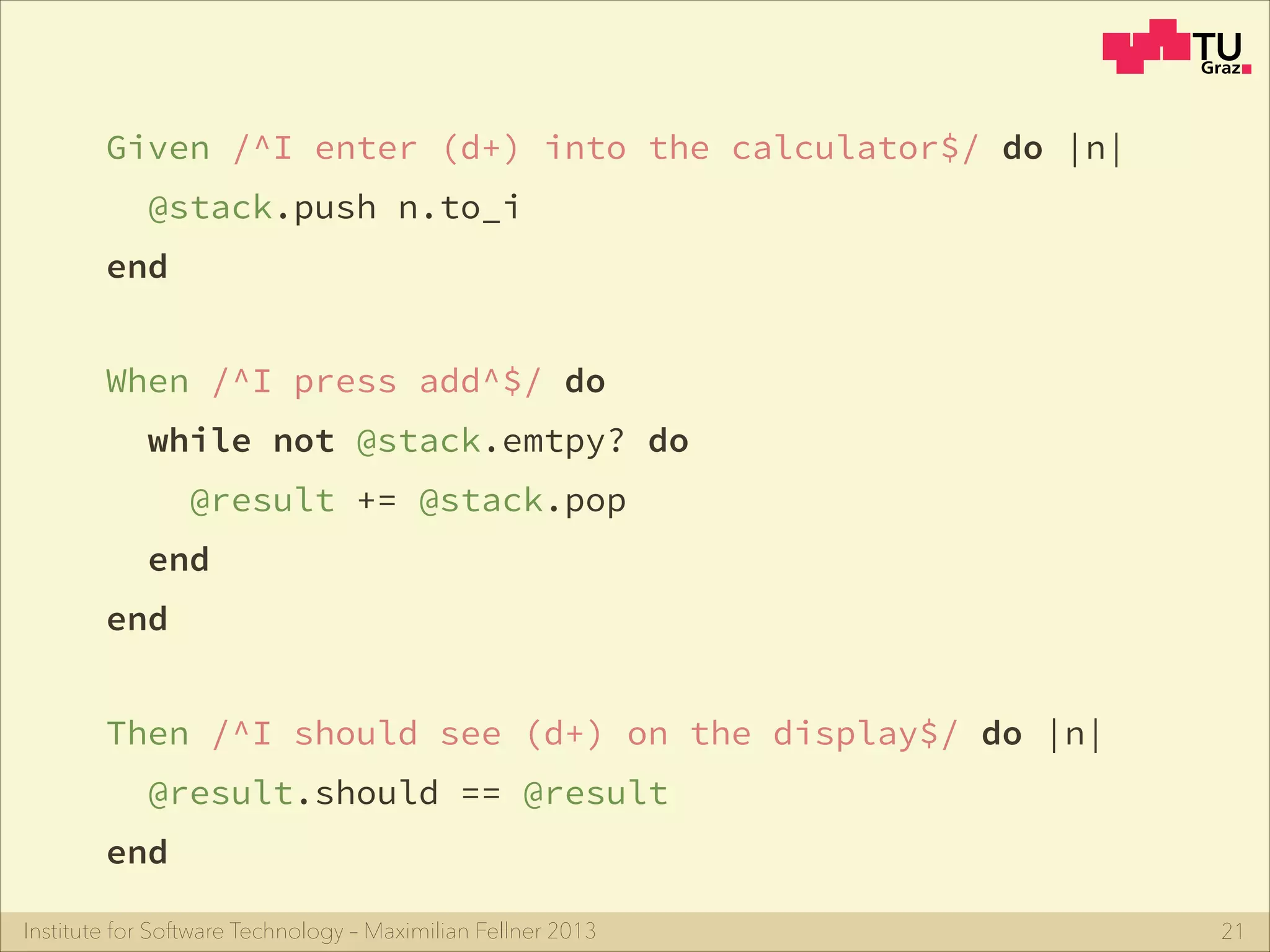
Given /^I enter (d+) into the calculator$/ do |n|
@stack.push n.to_i
end
21
Then /^I should see (d+) on the display$/ do |n|
@result.should == @result
end
When /^I press add^$/ do
while not @stack.emtpy? do
@result += @stack.pop
end
end
Institute for Software Technology – Maximilian Fellner 2013 22
Project
Features
Scenarios
Steps
Step Definitions
Support Code
Automation Library
System
Business Facing
Technology Facing
The Cucumber testing stack, adapted from Hellesoy and Wynne [5]
Institute for Software Technology – Maximilian Fellner 2013
Cucumber
‣ Gherkin is simple but effective
‣ Steps are platform independent
‣ Definition methods are reusable
‣ Redundant code is reduced
23
Advantages of steps & step definitions
Institute for Software Technology – Maximilian Fellner 2013 24
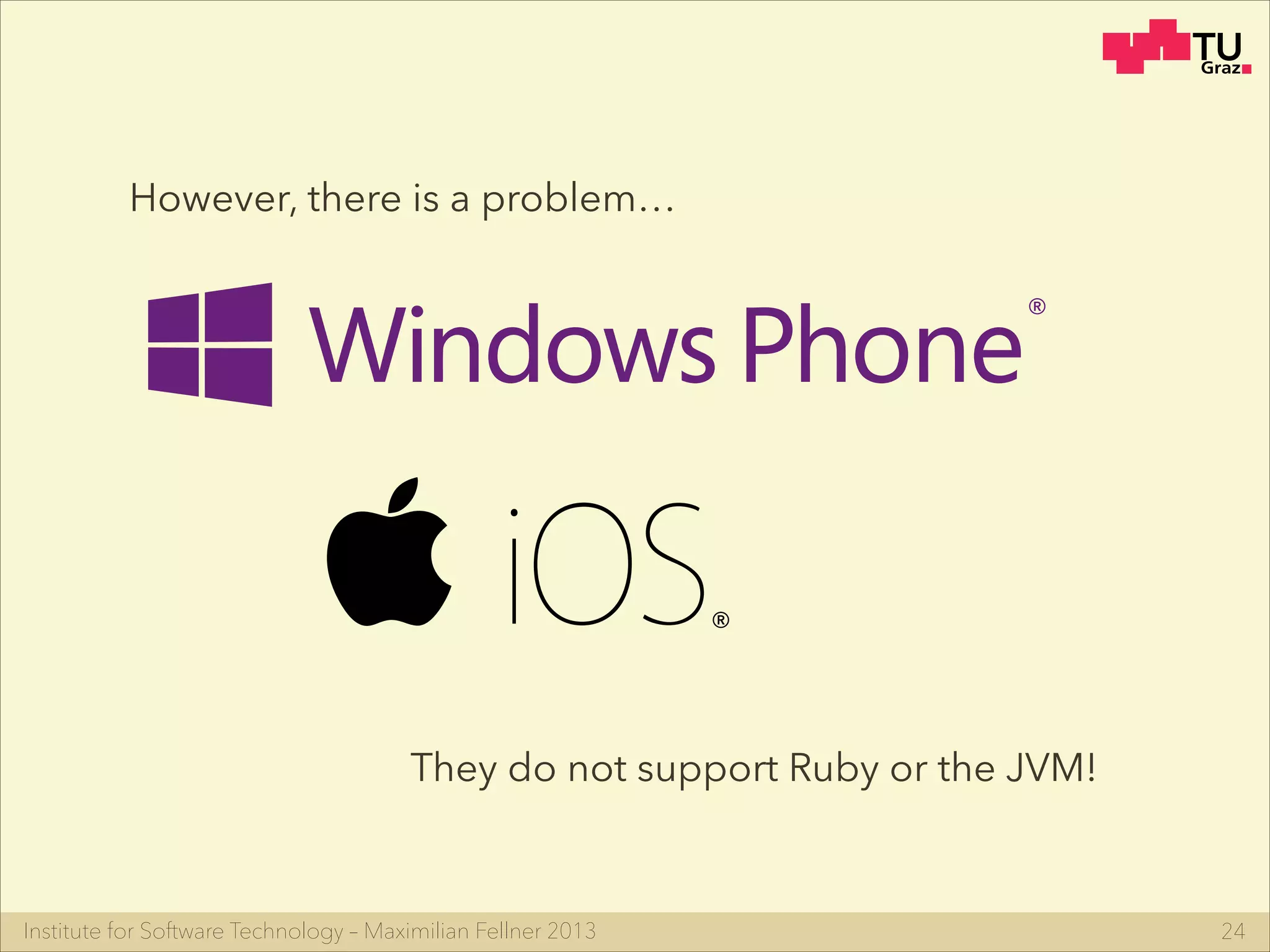
However, there is a problem…
They do not support Ruby or the JVM!
®
®
Institute for Software Technology – Maximilian Fellner 2013
Existing approaches to
Cucumber on mobile
‣ Open-source software by Xamarin Inc.
‣ Extends Ruby variant of Cucumber
‣ Supports Google Android & Apple iOS
25
E.g., Calabash
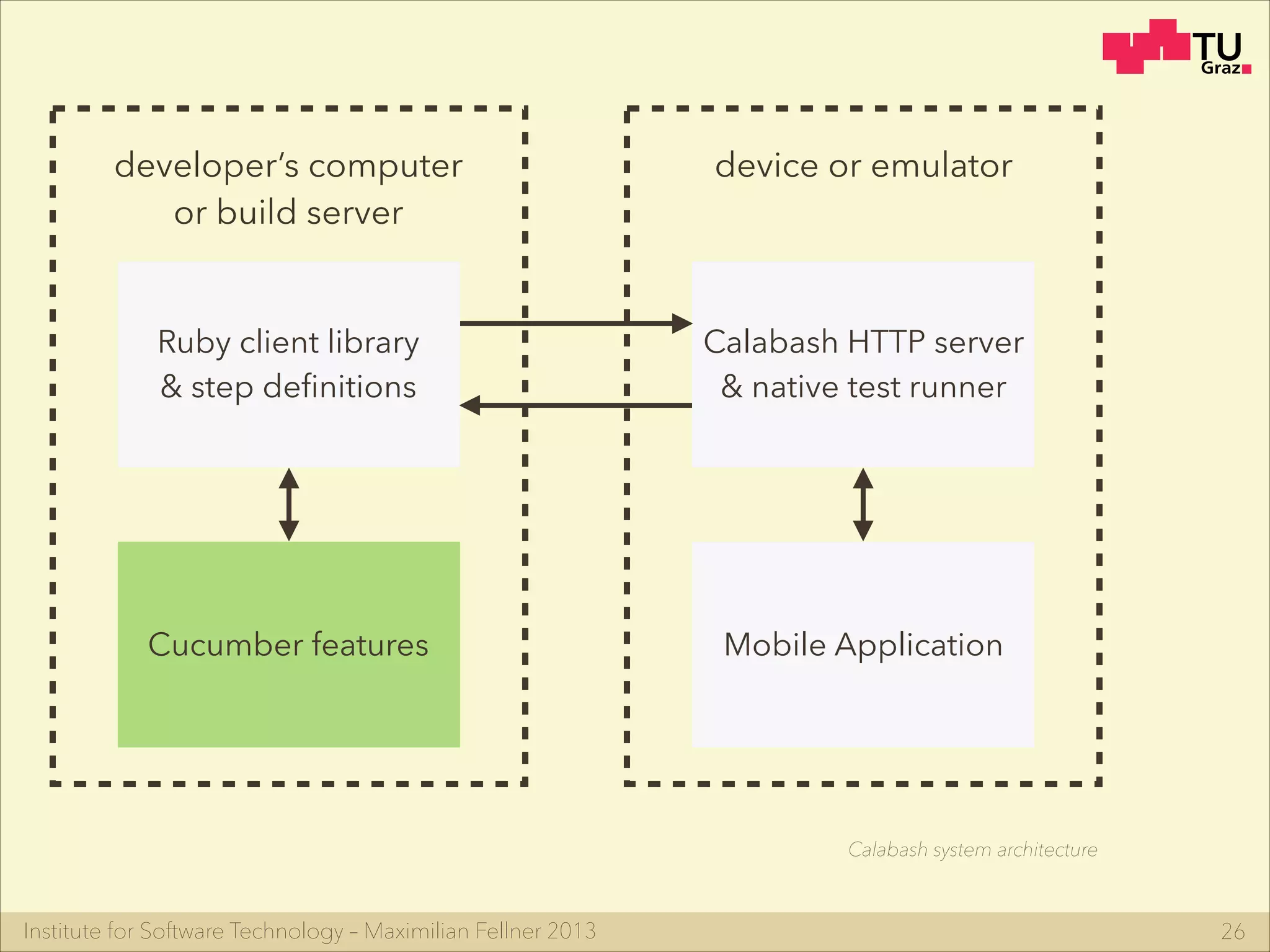
Institute for Software Technology – Maximilian Fellner 2013 26
developer’s computer
or build server
Ruby client library
& step definitions
Cucumber features
device or emulator
Calabash HTTP server
& native test runner
Mobile Application
Calabash system architecture
Institute for Software Technology – Maximilian Fellner 2013
Existing approaches to Cucumber on mobile
‣ Ruby installation required
‣ Only pre-defined operations available
‣ Step-definitions are written in Ruby
‣ No integration with native libraries
27
Disadvantages
Institute for Software Technology – Maximilian Fellner 2013
Cucumber JVM on Android
‣ Use Java implementation of Cucumber
‣ Integrate with Android test framework
‣ Run Cucumber directly on the device
28
A different approach
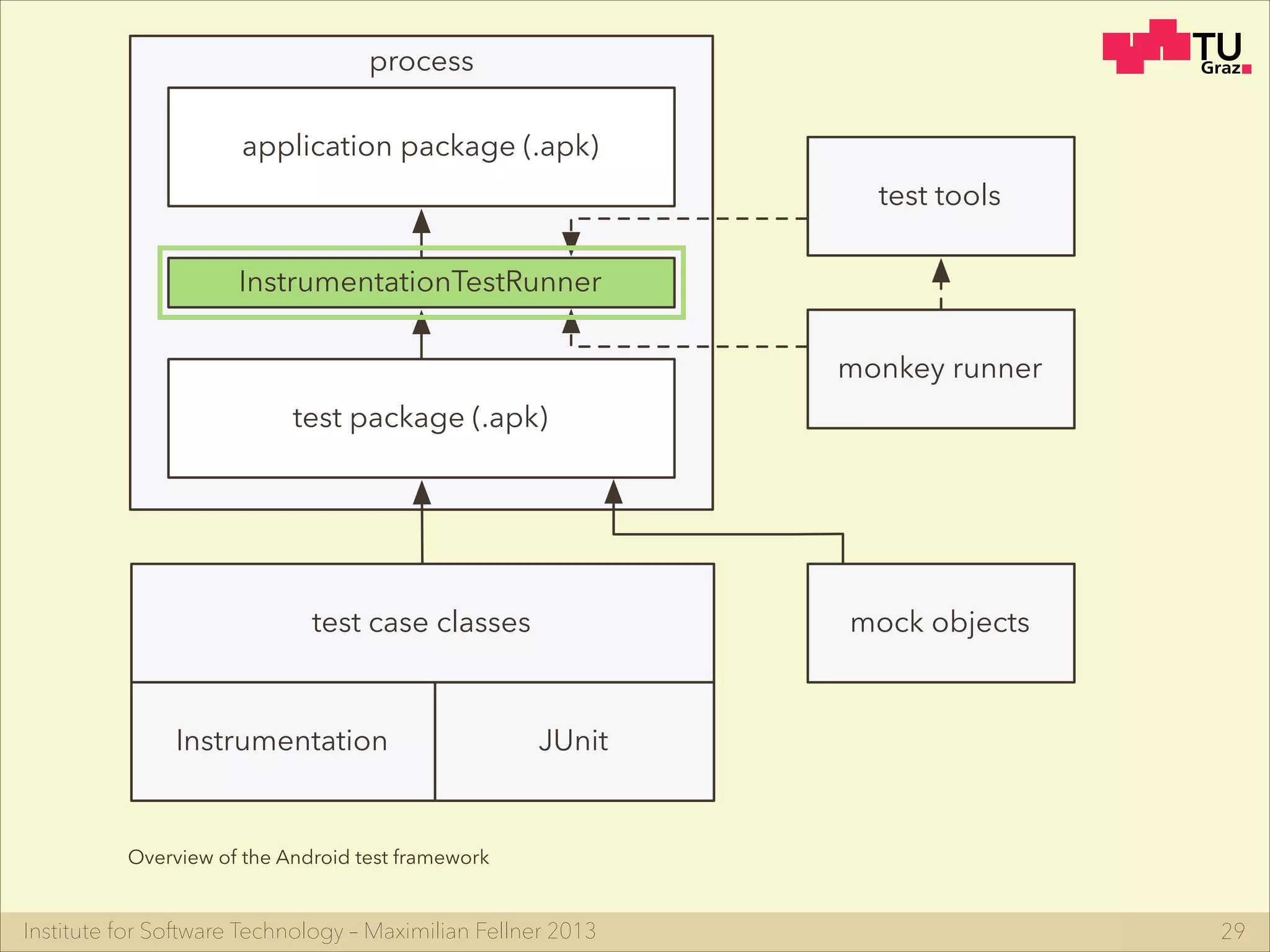
Institute for Software Technology – Maximilian Fellner 2013 29
Overview of the Android test framework
application package (.apk)
InstrumentationTestRunner
test package (.apk)
test tools
monkey runner
test case classes
Instrumentation JUnit
mock objects
process
Institute for Software Technology – Maximilian Fellner 2013 30
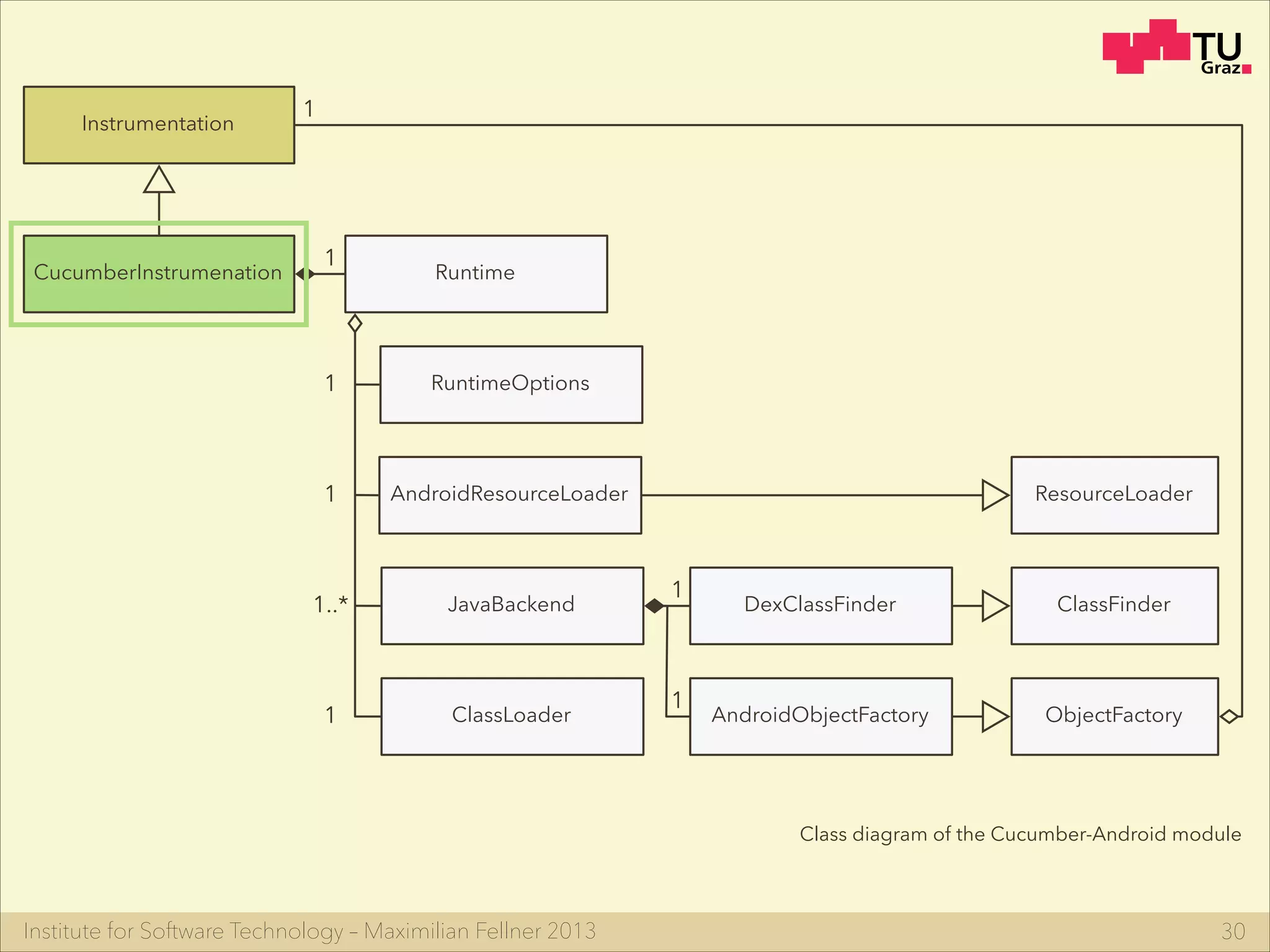
Class diagram of the Cucumber-Android module
Instrumentation
CucumberInstrumenation Runtime
RuntimeOptions
AndroidResourceLoader
ClassLoader
JavaBackend1..* DexClassFinder
AndroidObjectFactory
ResourceLoader
ClassFinder
ObjectFactory1
1
1
1
1
1
1
Institute for Software Technology – Maximilian Fellner 2013
Cucumber JVM on Android
‣ Still no solution for Windows Phone and iOS
‣ Best option is to improve Cucumber
‣ Gherkin parser is based on Ragel
‣ Cucumber runtime can be ported to C
31
Remaining issue
Institute for Software Technology – Maximilian Fellner 2013
The visual language
Catrobat
‣ Android, Windows Phone, iOS, Web
‣ Phones, tablets & desktop browsers
‣ Inspired by Scratch
‣ Sophisticated bricks (blocks)
32
Cross-platform, mobile, visual
Institute for Software Technology – Maximilian Fellner 2013
The visual language Catrobat
33
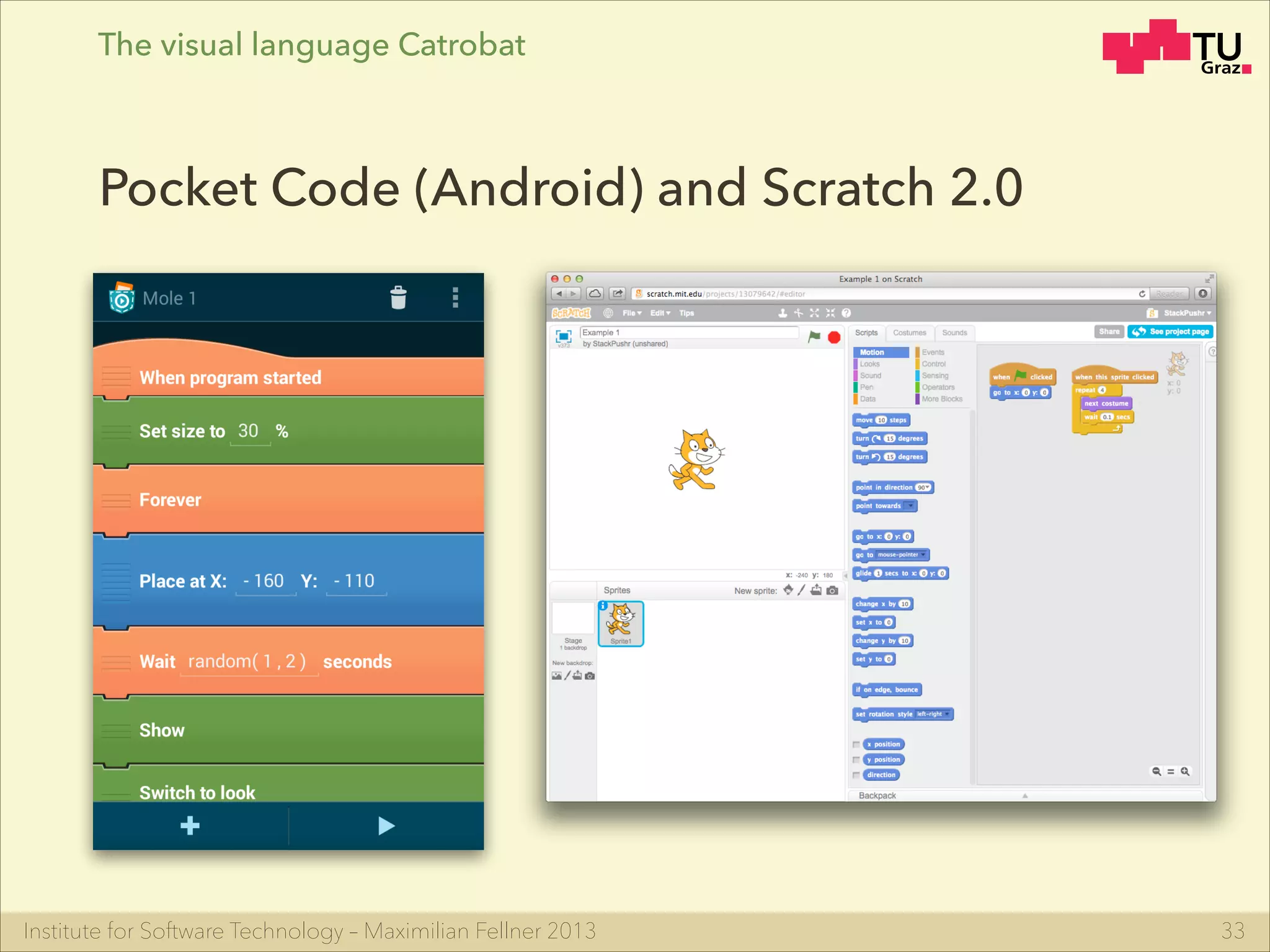
Pocket Code (Android) and Scratch 2.0
Institute for Software Technology – Maximilian Fellner 2013
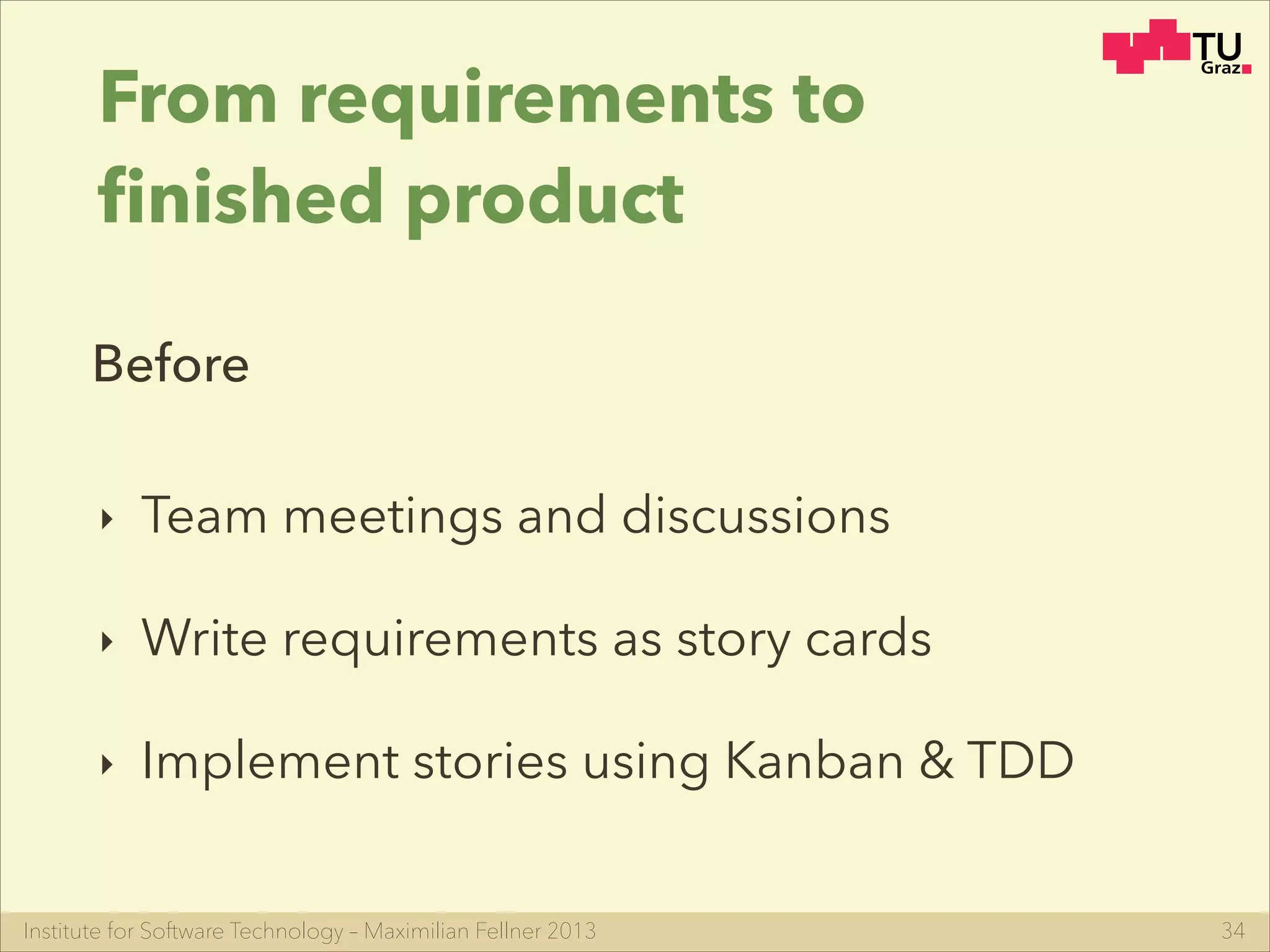
From requirements to
finished product
‣ Team meetings and discussions
‣ Write requirements as story cards
‣ Implement stories using Kanban & TDD
34
Before
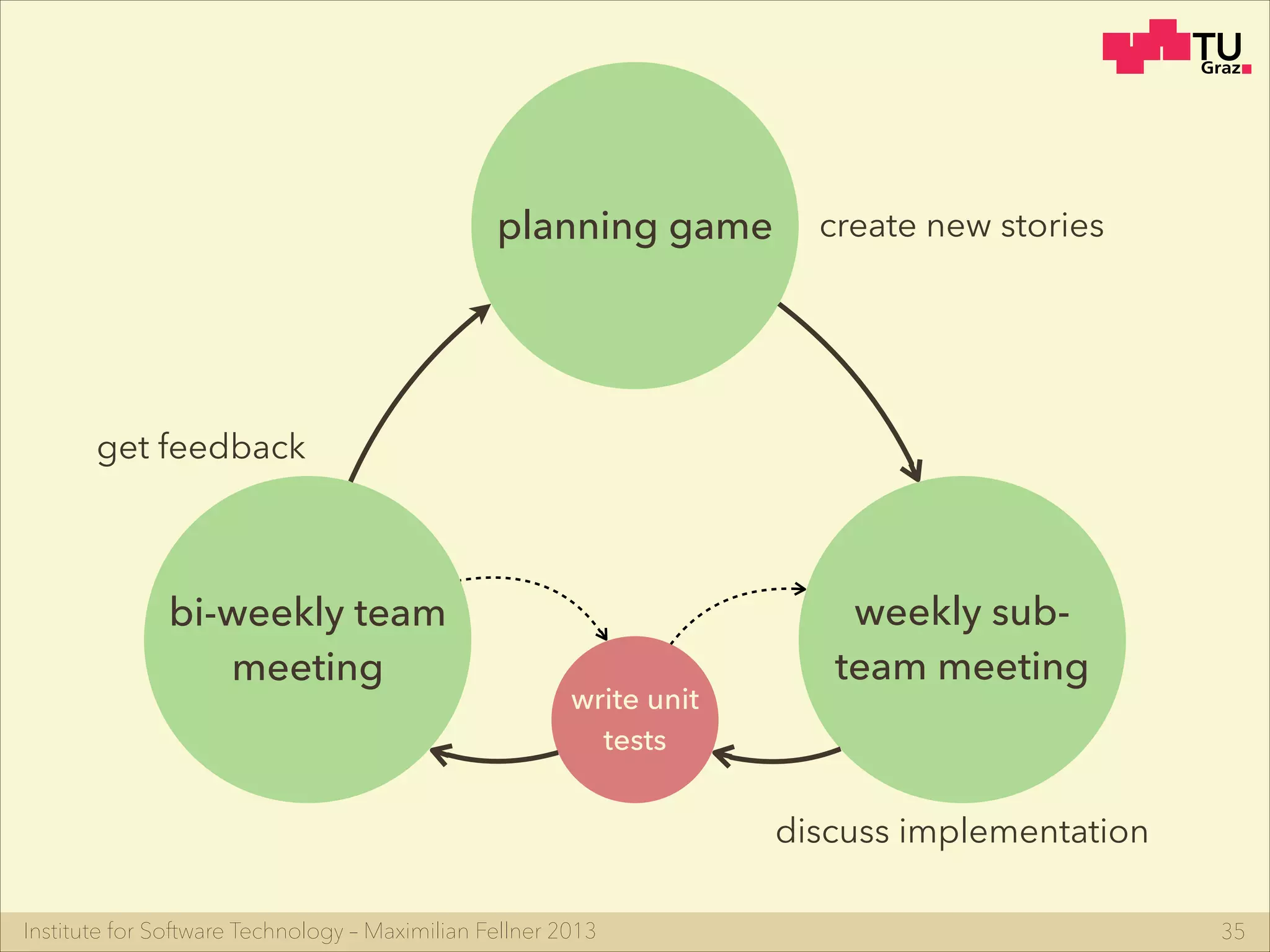
Institute for Software Technology – Maximilian Fellner 2013 35
weekly sub-
team meeting
bi-weekly team
meeting
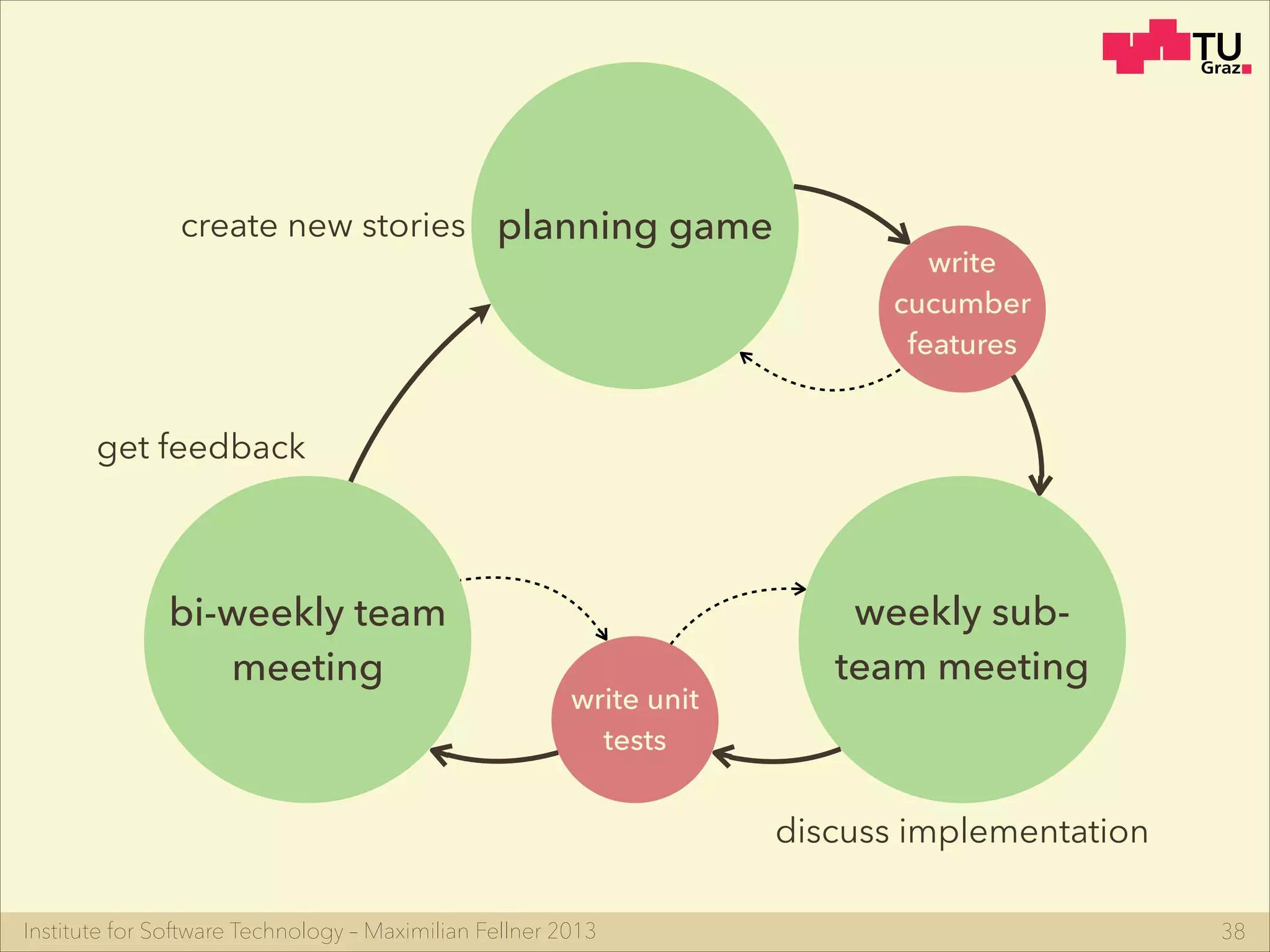
planning game create new stories
discuss implementation
get feedback
write unit
tests
Institute for Software Technology – Maximilian Fellner 2013
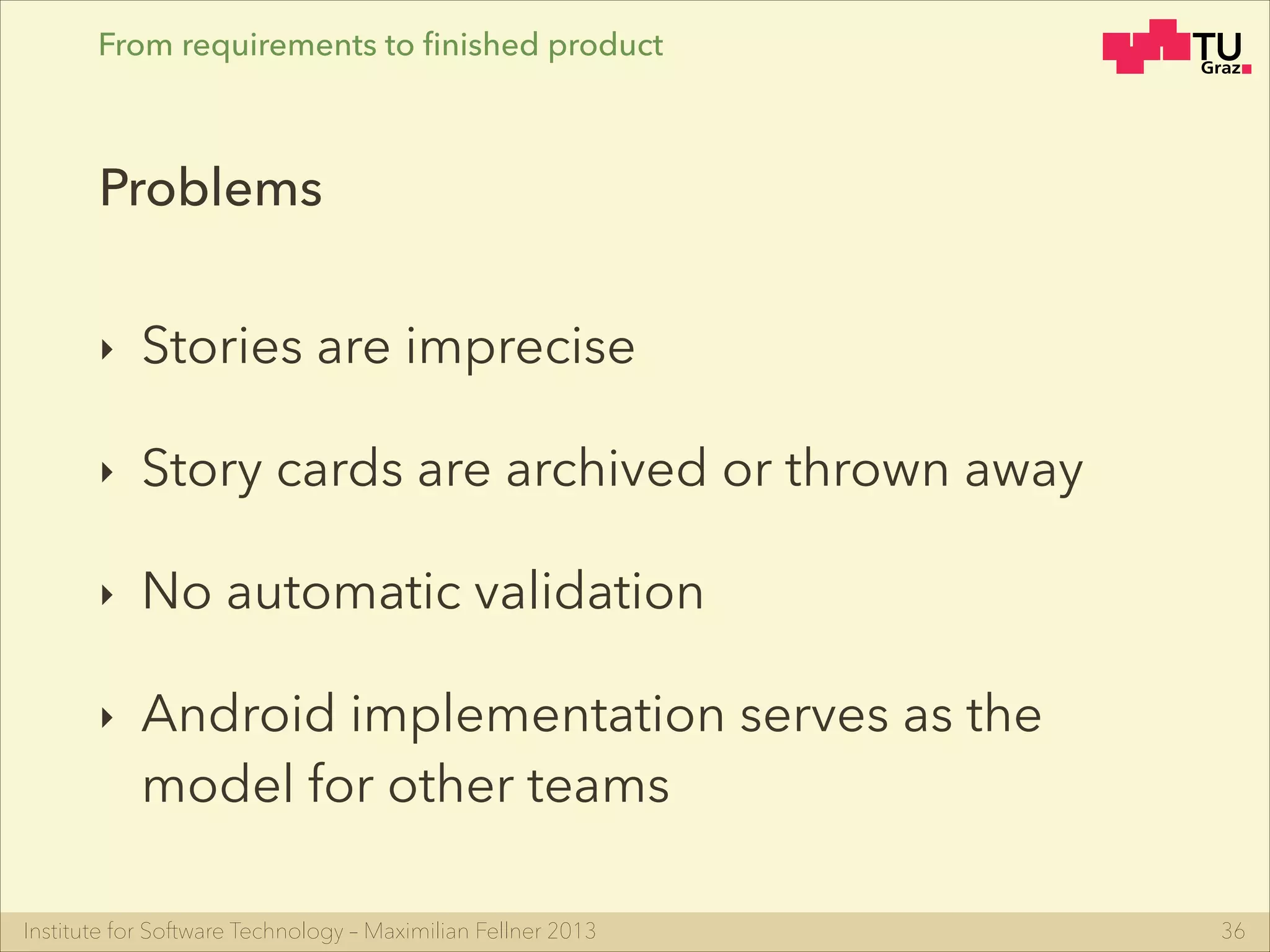
From requirements to finished product
‣ Stories are imprecise
‣ Story cards are archived or thrown away
‣ No automatic validation
‣ Android implementation serves as the
model for other teams
36
Problems
Institute for Software Technology – Maximilian Fellner 2013
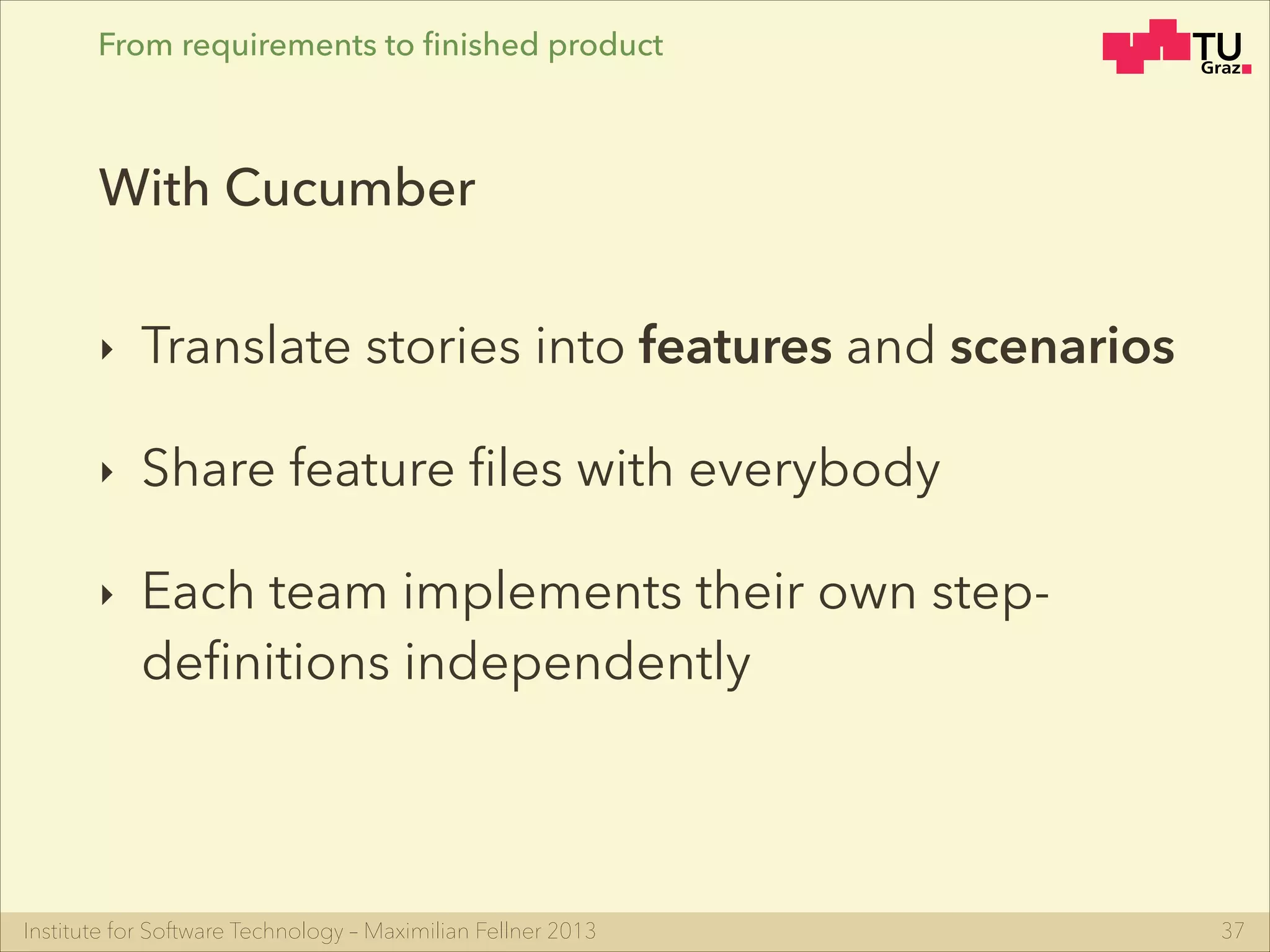
From requirements to finished product
‣ Translate stories into features and scenarios
‣ Share feature files with everybody
‣ Each team implements their own step-
definitions independently
37
With Cucumber
Institute for Software Technology – Maximilian Fellner 2013 38
weekly sub-
team meeting
bi-weekly team
meeting
planning gamecreate new stories
discuss implementation
get feedback
write unit
tests
write
cucumber
features
Institute for Software Technology – Maximilian Fellner 2013
From requirements to finished product
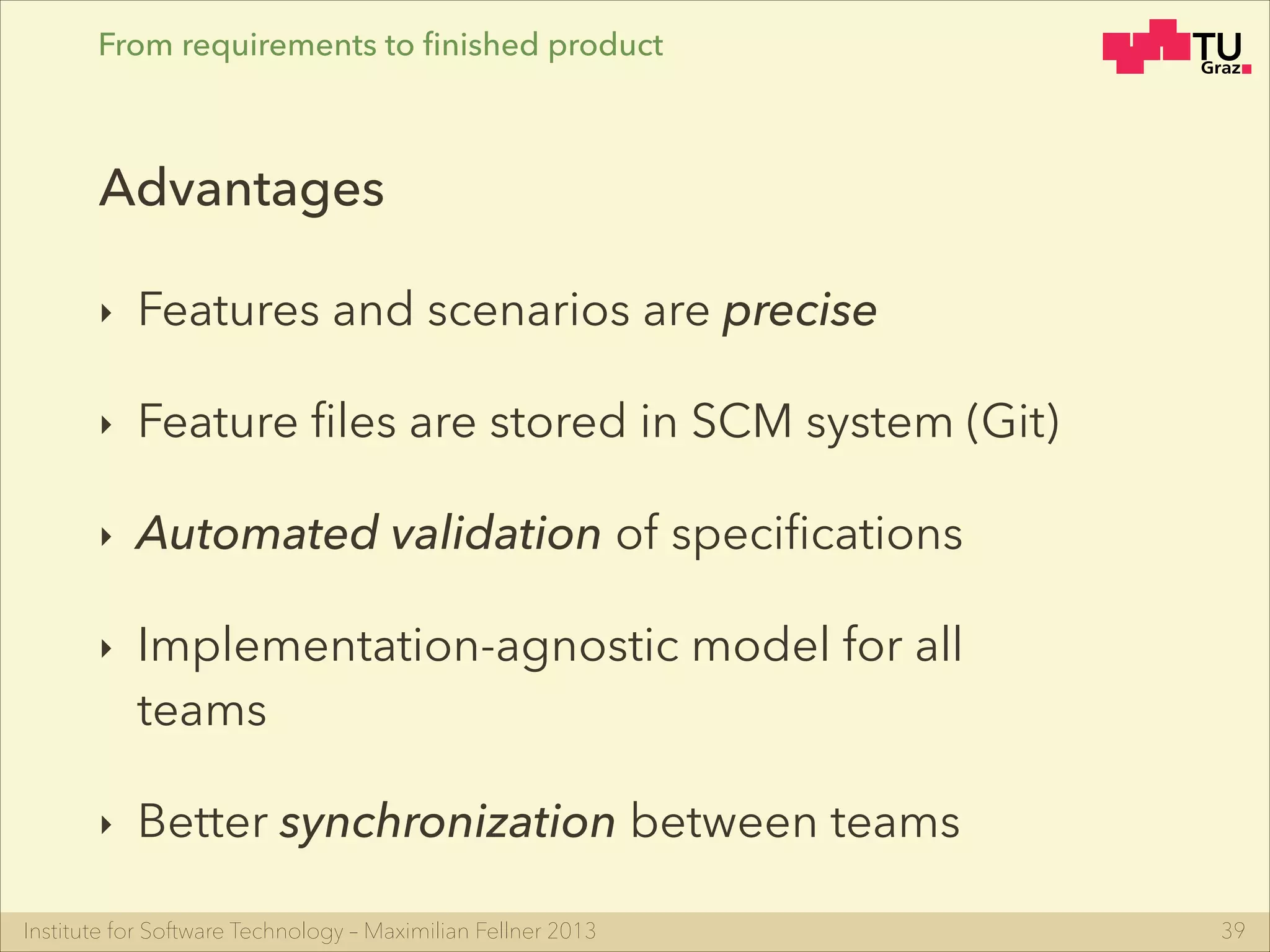
‣ Features and scenarios are precise
‣ Feature files are stored in SCM system (Git)
‣ Automated validation of specifications
‣ Implementation-agnostic model for all
teams
‣ Better synchronization between teams
39
Advantages
Institute for Software Technology – Maximilian Fellner 2013
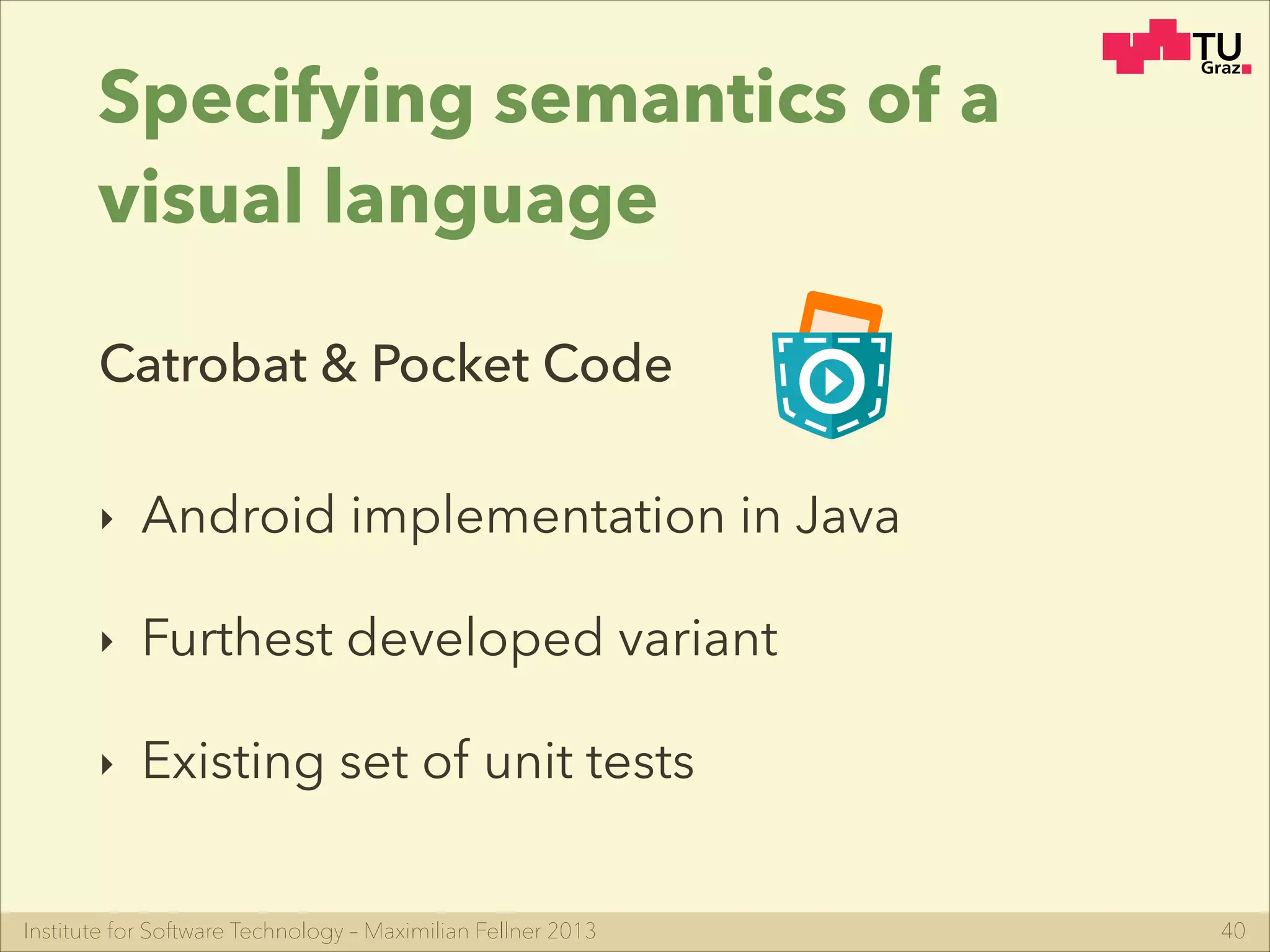
Specifying semantics of a
visual language
‣ Android implementation in Java
‣ Furthest developed variant
‣ Existing set of unit tests
40
Catrobat & Pocket Code
Institute for Software Technology – Maximilian Fellner 2013
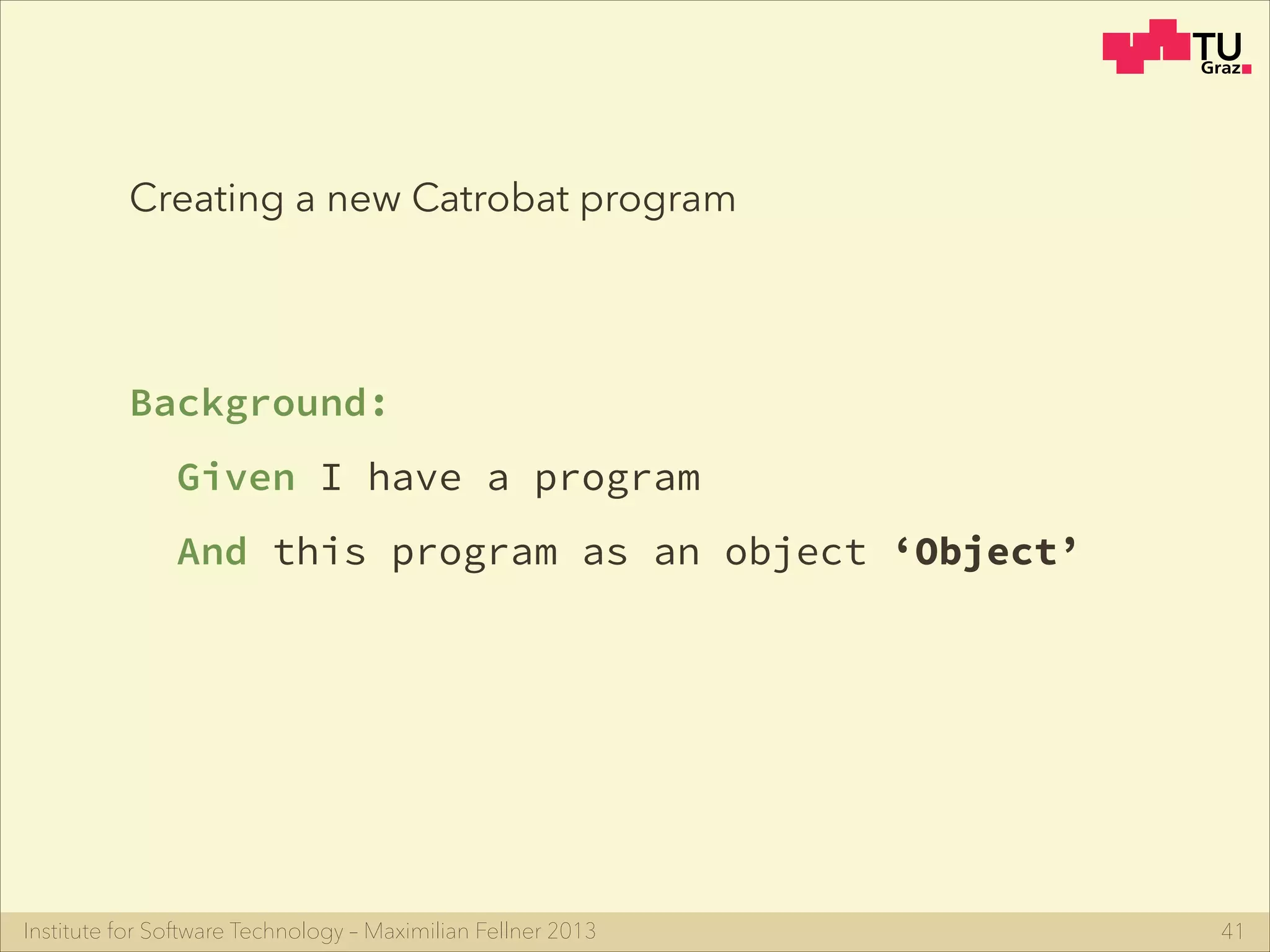
Creating a new Catrobat program
Background:
Given I have a program
And this program as an object ‘Object’
41
Institute for Software Technology – Maximilian Fellner 2013
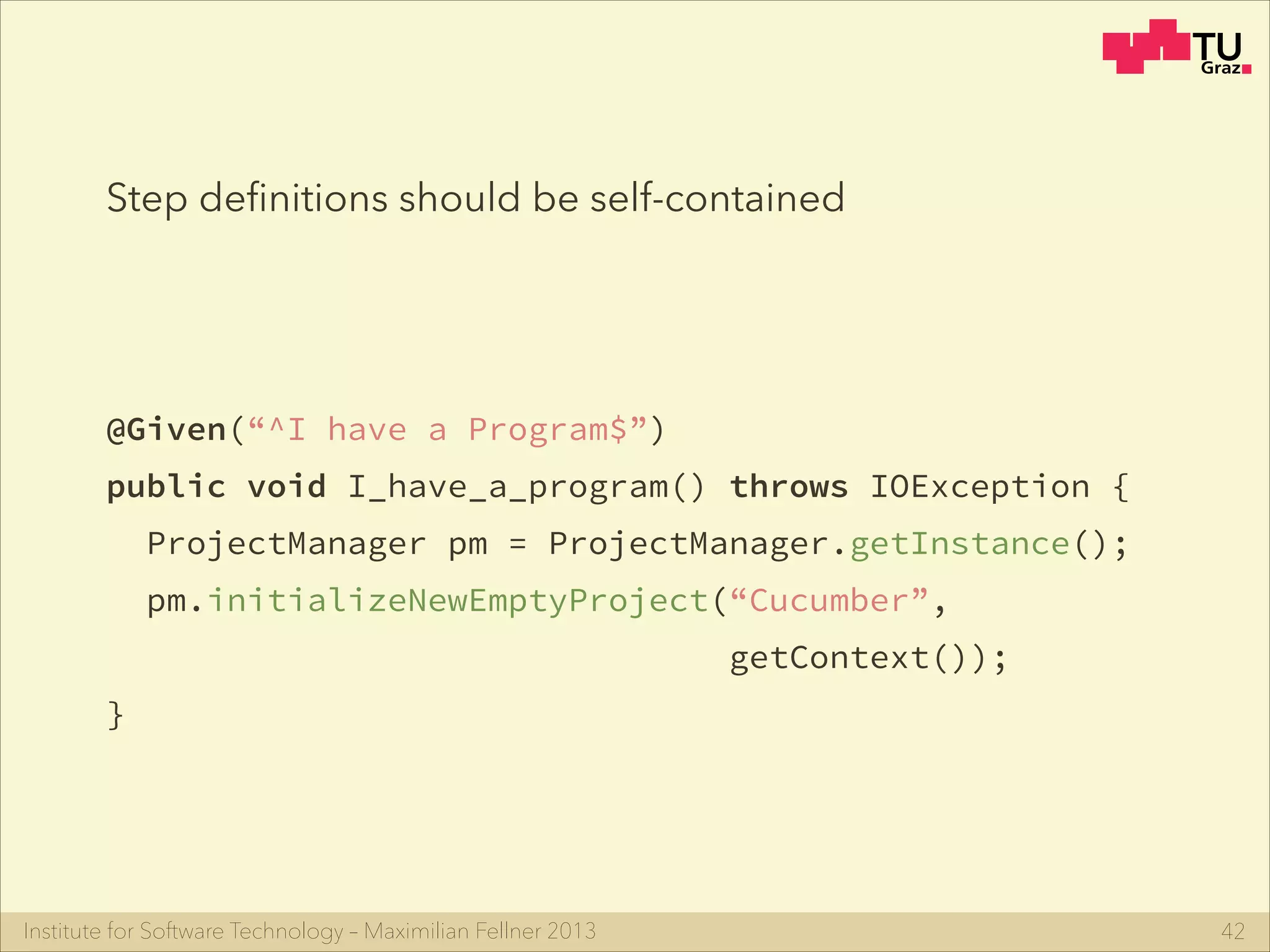
@Given(“^I have a Program$”)
public void I_have_a_program() throws IOException {
ProjectManager pm = ProjectManager.getInstance();
pm.initializeNewEmptyProject(“Cucumber”,
getContext());
}
42
Step definitions should be self-contained
Institute for Software Technology – Maximilian Fellner 2013
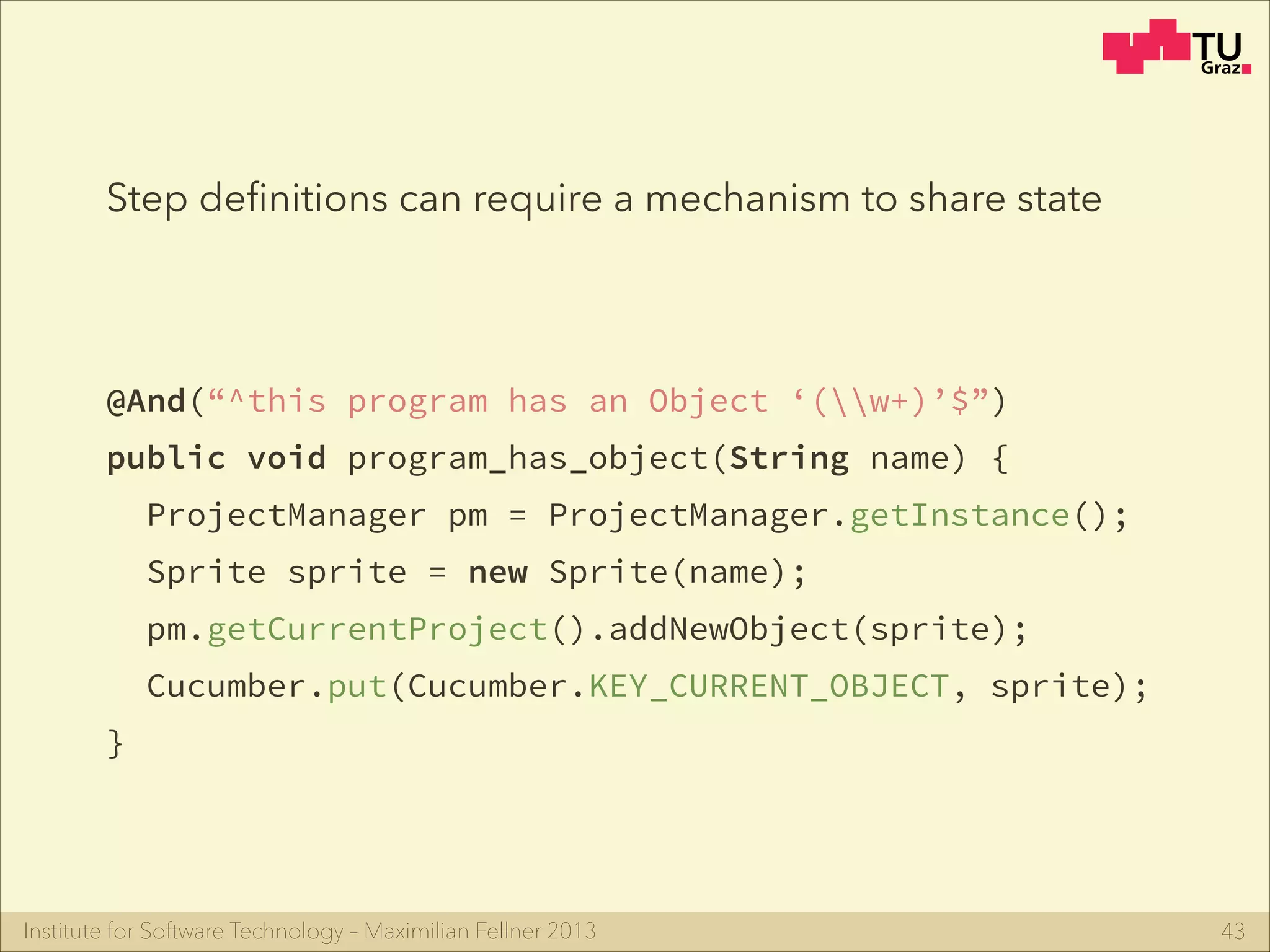
@And(“^this program has an Object ‘(w+)’$”)
public void program_has_object(String name) {
ProjectManager pm = ProjectManager.getInstance();
Sprite sprite = new Sprite(name);
pm.getCurrentProject().addNewObject(sprite);
Cucumber.put(Cucumber.KEY_CURRENT_OBJECT, sprite);
}
43
Step definitions can require a mechanism to share state
Institute for Software Technology – Maximilian Fellner 2013
Behavior-Driven Development asks:
How will the system behave
when a user interacts with it?
44
Institute for Software Technology – Maximilian Fellner 2013
How will a Catrobat program
behave when it is executed?
45
The language specification should answer:
Institute for Software Technology – Maximilian Fellner 2013
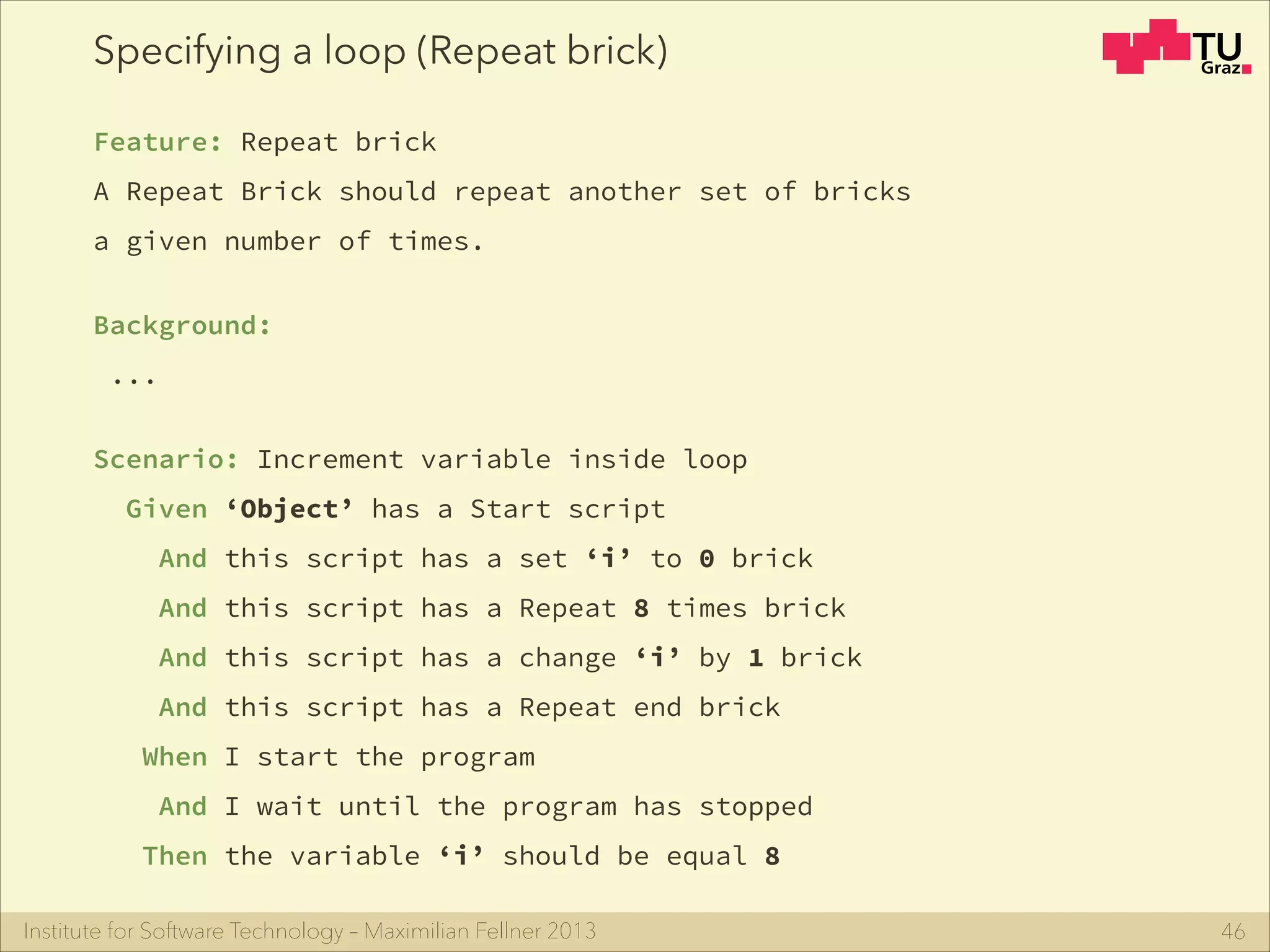
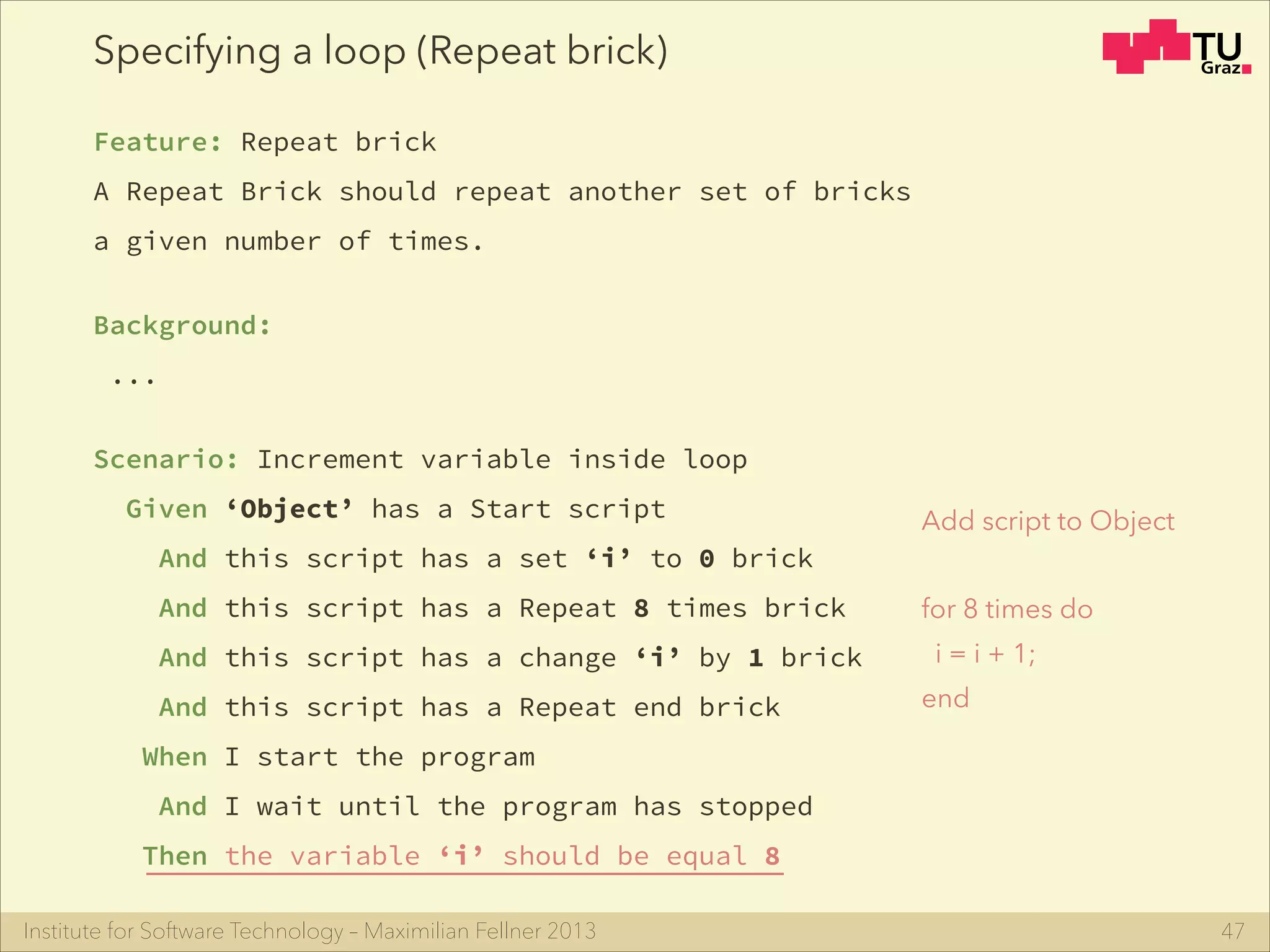
Specifying a loop (Repeat brick)
Feature: Repeat brick
A Repeat Brick should repeat another set of bricks
a given number of times.
!
Background:
...
!
Scenario: Increment variable inside loop
Given ‘Object’ has a Start script
And this script has a set ‘i’ to 0 brick
And this script has a Repeat 8 times brick
And this script has a change ‘i’ by 1 brick
And this script has a Repeat end brick
When I start the program
And I wait until the program has stopped
Then the variable ‘i’ should be equal 8
46
Institute for Software Technology – Maximilian Fellner 2013
Specifying a loop (Repeat brick)
Feature: Repeat brick
A Repeat Brick should repeat another set of bricks
a given number of times.
!
Background:
...
!
Scenario: Increment variable inside loop
Given ‘Object’ has a Start script
And this script has a set ‘i’ to 0 brick
And this script has a Repeat 8 times brick
And this script has a change ‘i’ by 1 brick
And this script has a Repeat end brick
When I start the program
And I wait until the program has stopped
Then the variable ‘i’ should be equal 8
47
Add script to Object
for 8 times do
i = i + 1;
end
Institute for Software Technology – Maximilian Fellner 2013
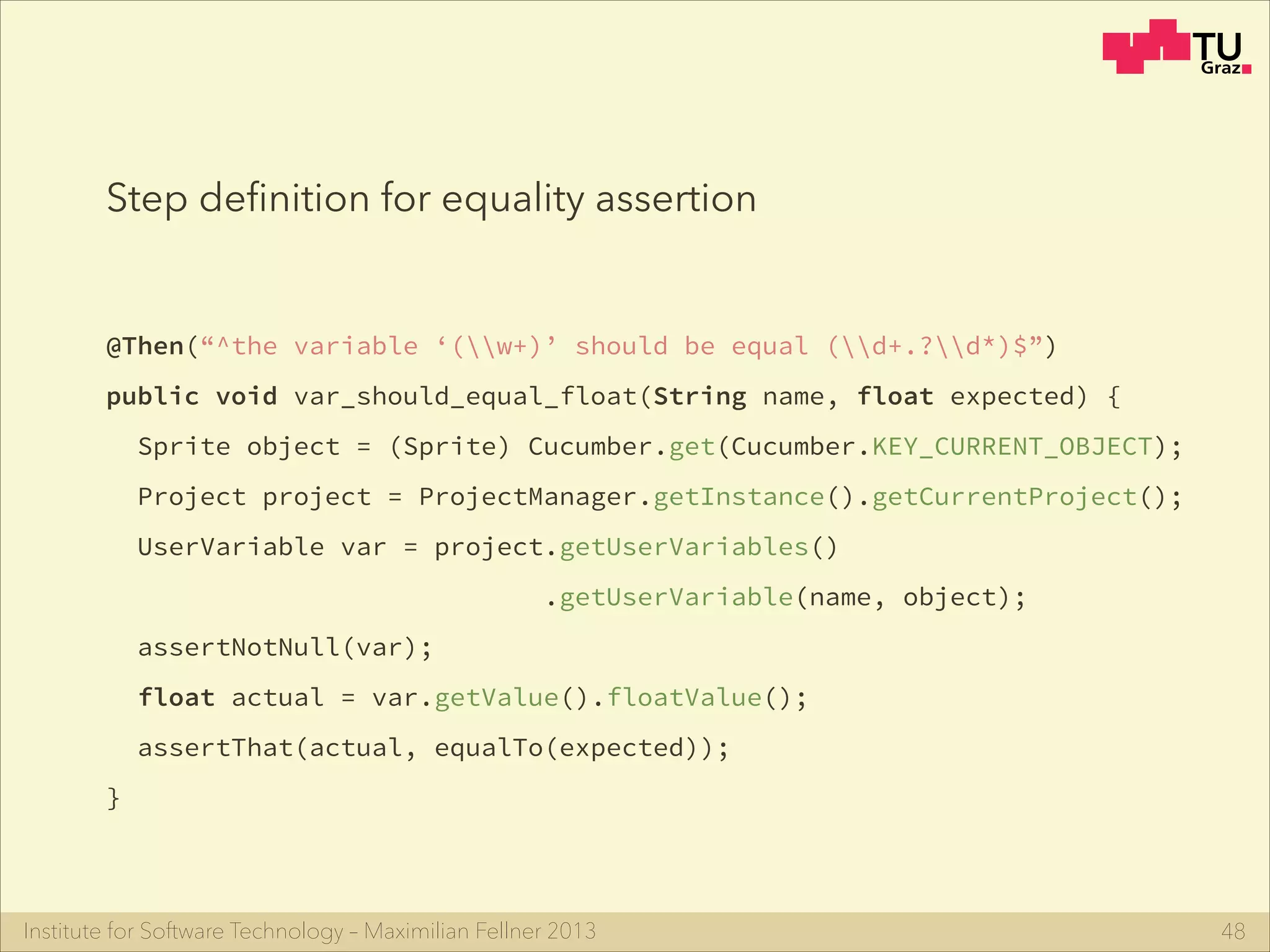
@Then(“^the variable ‘(w+)’ should be equal (d+.?d*)$”)
public void var_should_equal_float(String name, float expected) {
Sprite object = (Sprite) Cucumber.get(Cucumber.KEY_CURRENT_OBJECT);
Project project = ProjectManager.getInstance().getCurrentProject();
UserVariable var = project.getUserVariables()
.getUserVariable(name, object);
assertNotNull(var);
float actual = var.getValue().floatValue();
assertThat(actual, equalTo(expected));
}
48
Step definition for equality assertion
Institute for Software Technology – Maximilian Fellner 2013 49
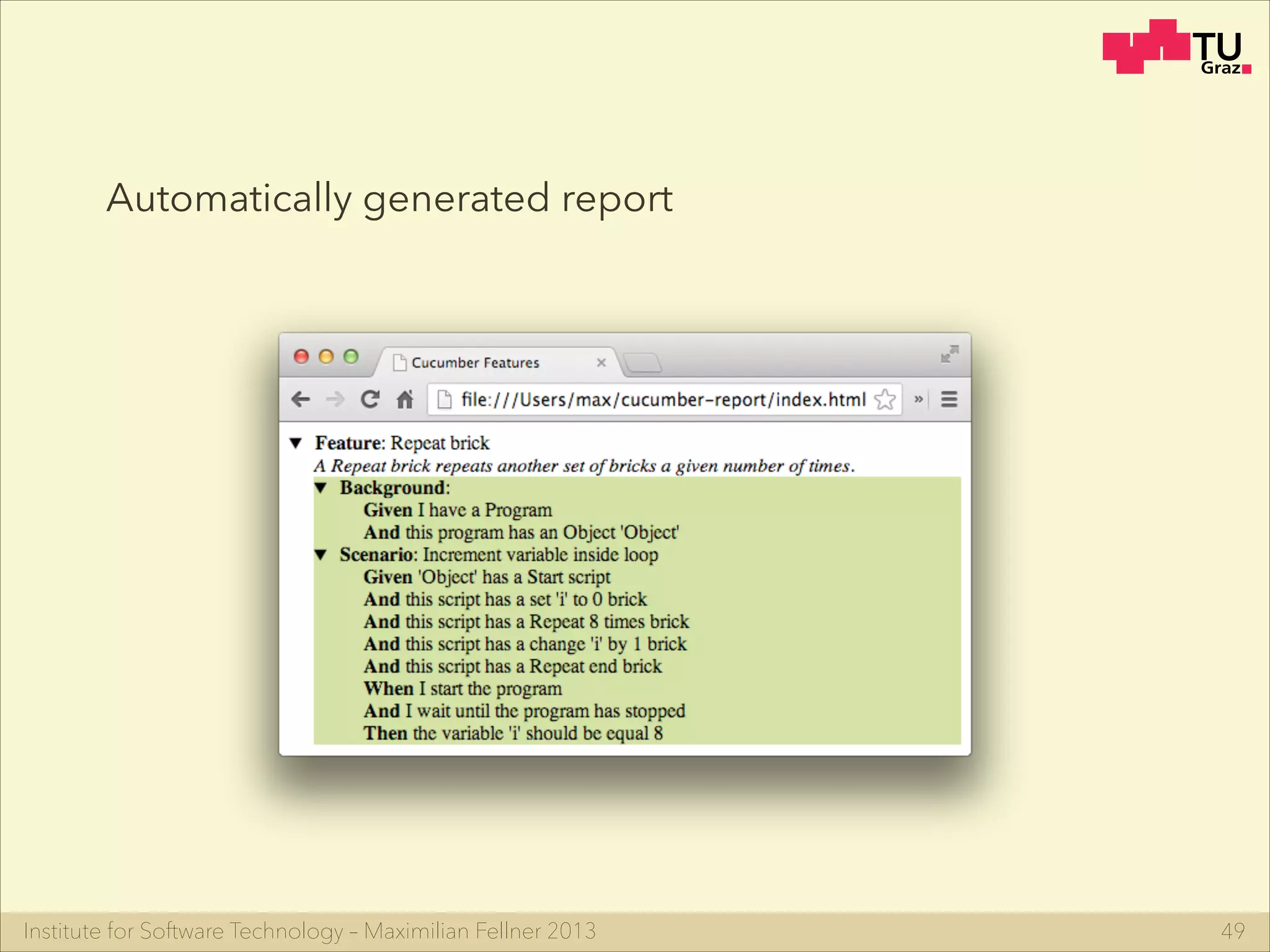
Automatically generated report
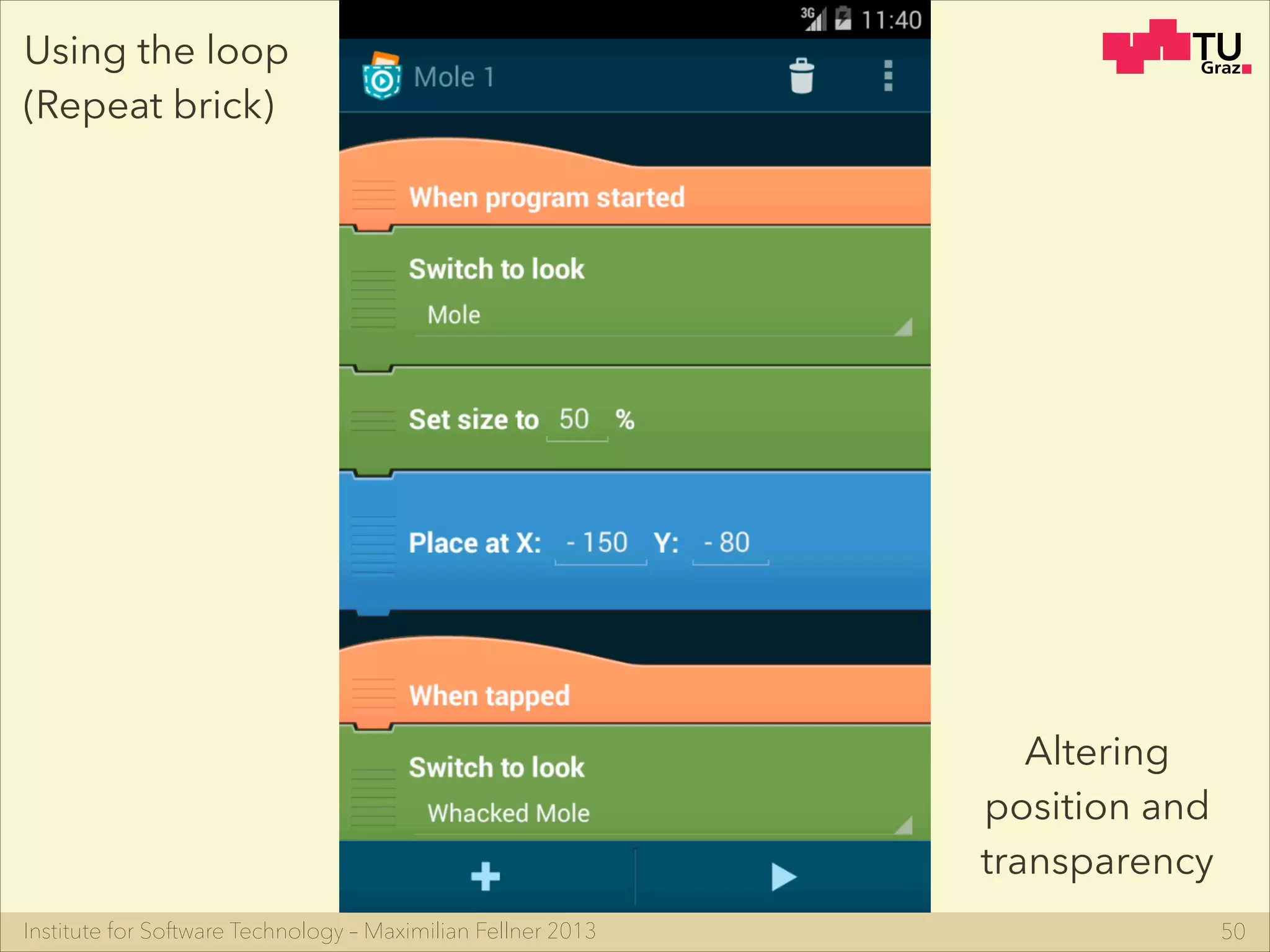
Institute for Software Technology – Maximilian Fellner 2013 50
Using the loop
(Repeat brick)
Altering
position and
transparency
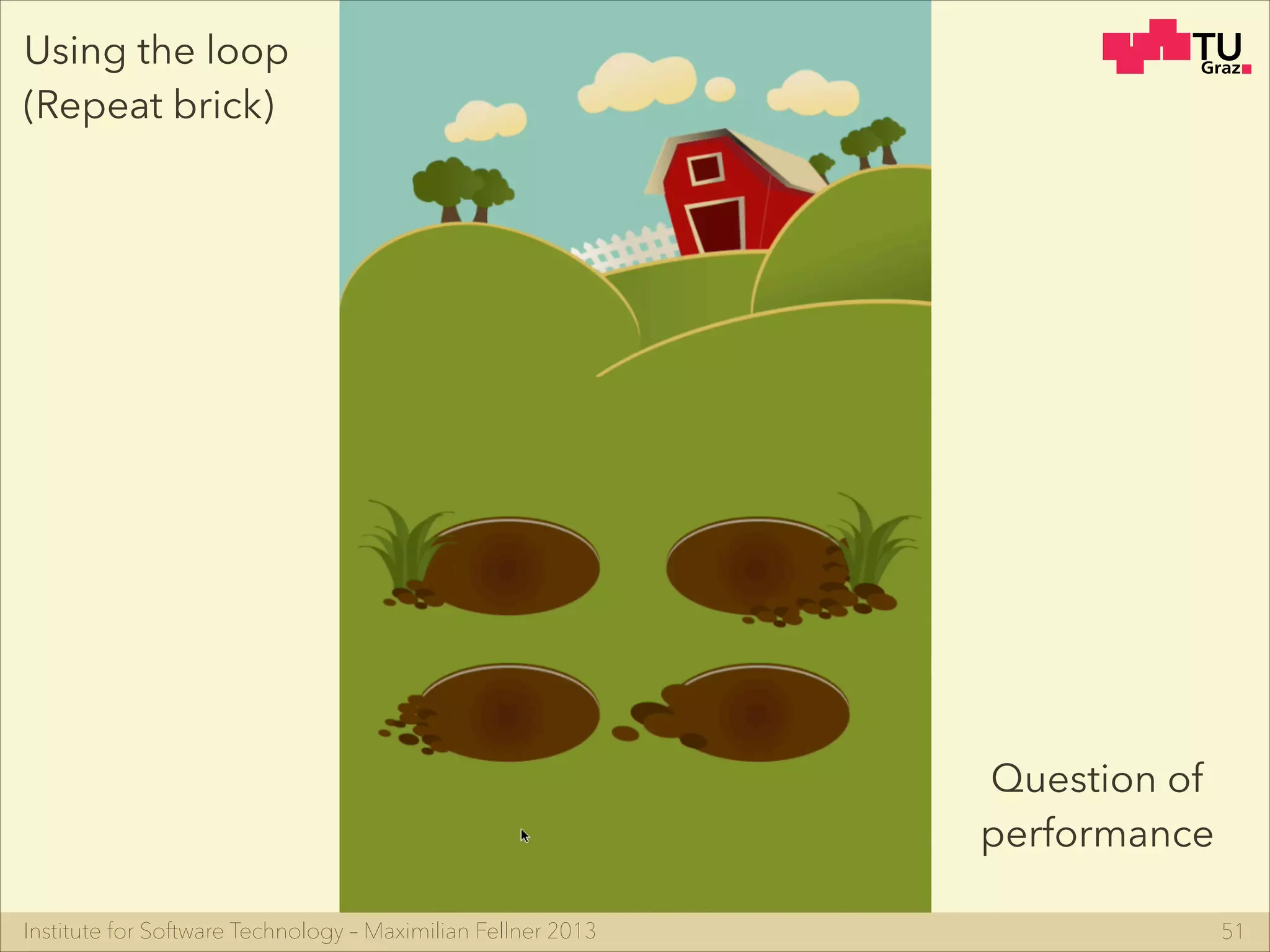
Institute for Software Technology – Maximilian Fellner 2013 51
Using the loop
(Repeat brick)
Question of
performance
Institute for Software Technology – Maximilian Fellner 2013
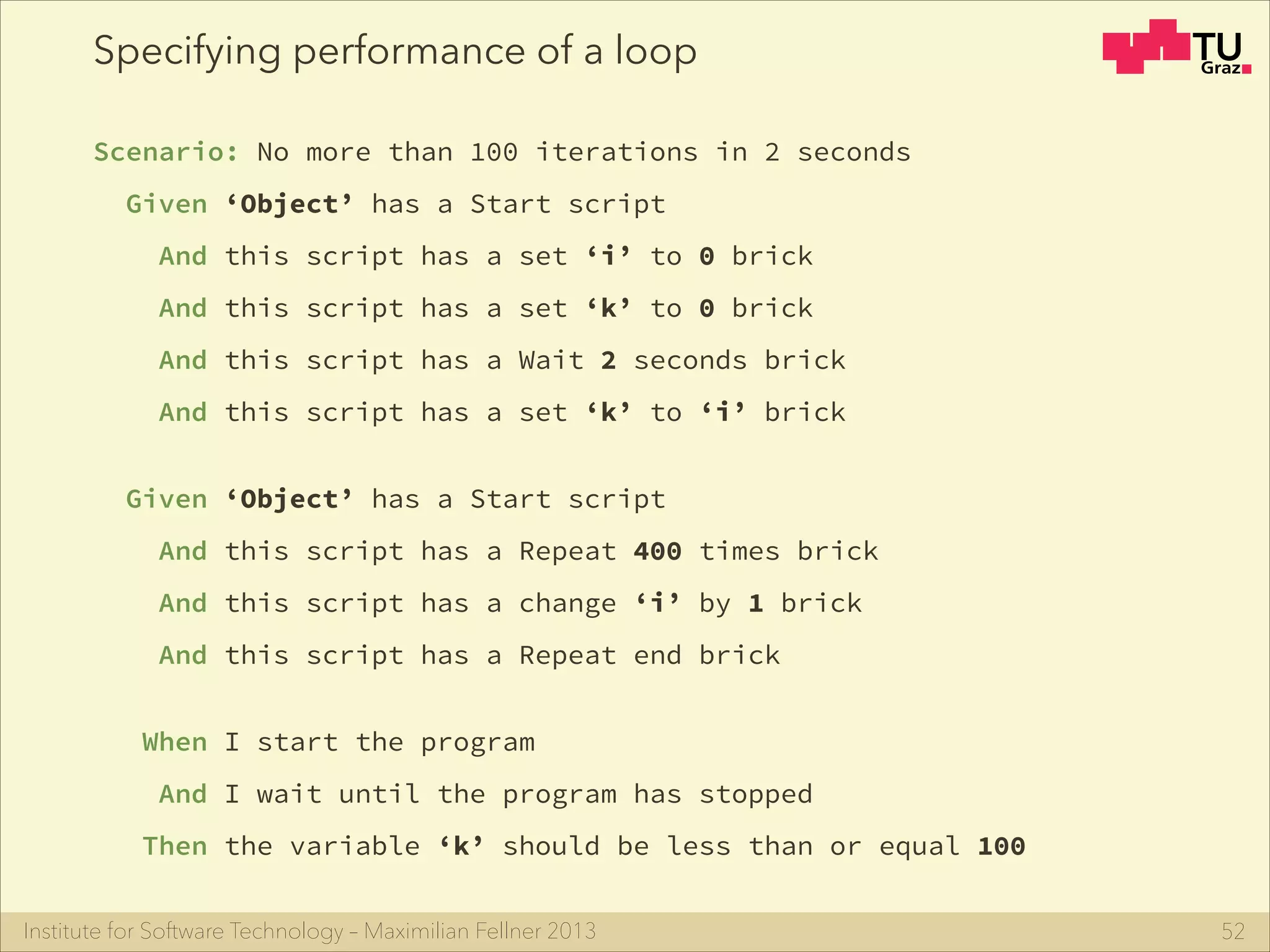
Specifying performance of a loop
Scenario: No more than 100 iterations in 2 seconds
Given ‘Object’ has a Start script
And this script has a set ‘i’ to 0 brick
And this script has a set ‘k’ to 0 brick
And this script has a Wait 2 seconds brick
And this script has a set ‘k’ to ‘i’ brick
!
Given ‘Object’ has a Start script
And this script has a Repeat 400 times brick
And this script has a change ‘i’ by 1 brick
And this script has a Repeat end brick
!
When I start the program
And I wait until the program has stopped
Then the variable ‘k’ should be less than or equal 100
52
Institute for Software Technology – Maximilian Fellner 2013
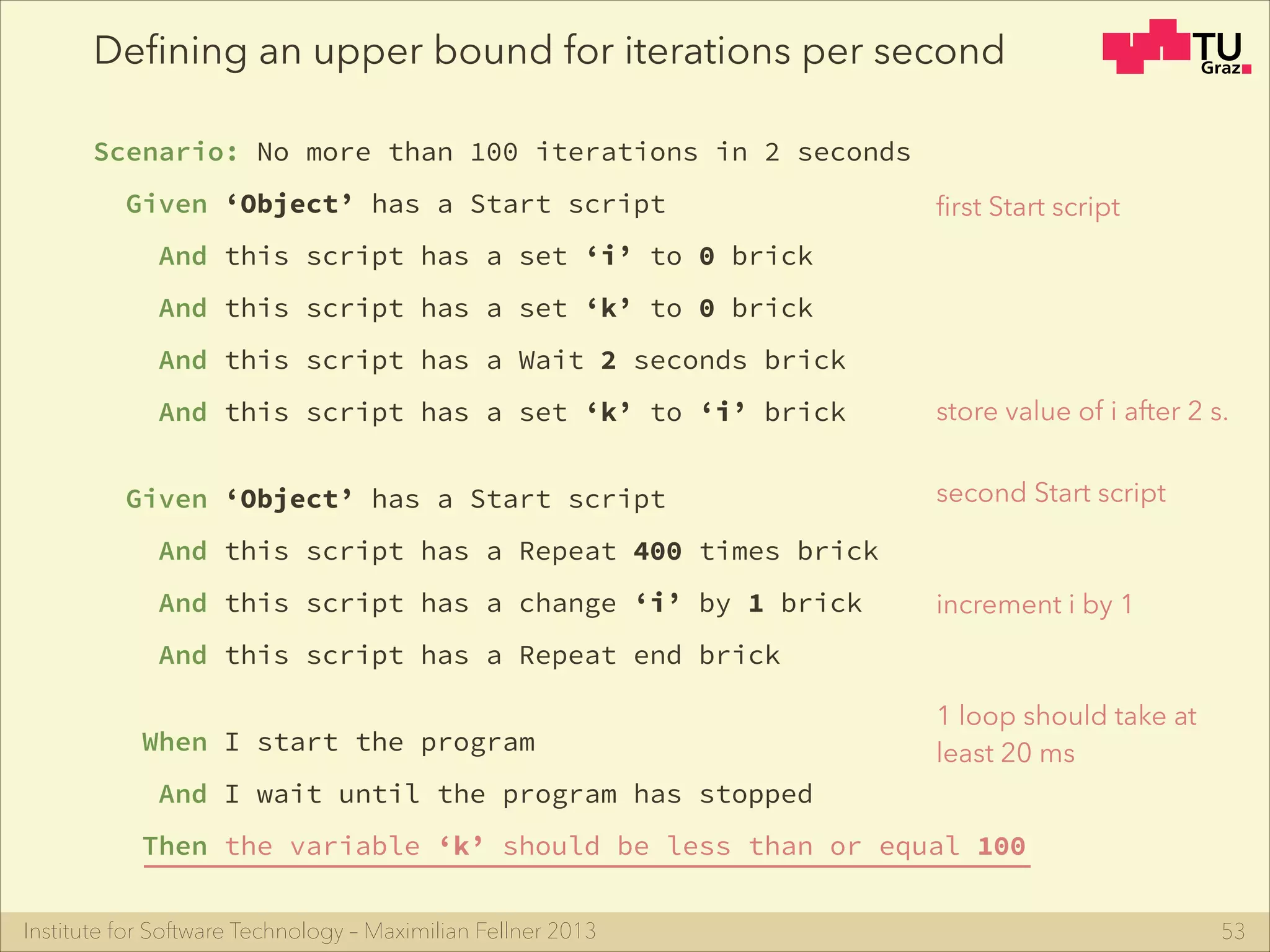
Defining an upper bound for iterations per second
Scenario: No more than 100 iterations in 2 seconds
Given ‘Object’ has a Start script
And this script has a set ‘i’ to 0 brick
And this script has a set ‘k’ to 0 brick
And this script has a Wait 2 seconds brick
And this script has a set ‘k’ to ‘i’ brick
!
Given ‘Object’ has a Start script
And this script has a Repeat 400 times brick
And this script has a change ‘i’ by 1 brick
And this script has a Repeat end brick
!
When I start the program
And I wait until the program has stopped
Then the variable ‘k’ should be less than or equal 100
53
first Start script
second Start script
store value of i after 2 s.
increment i by 1
1 loop should take at
least 20 ms
Institute for Software Technology – Maximilian Fellner 2013
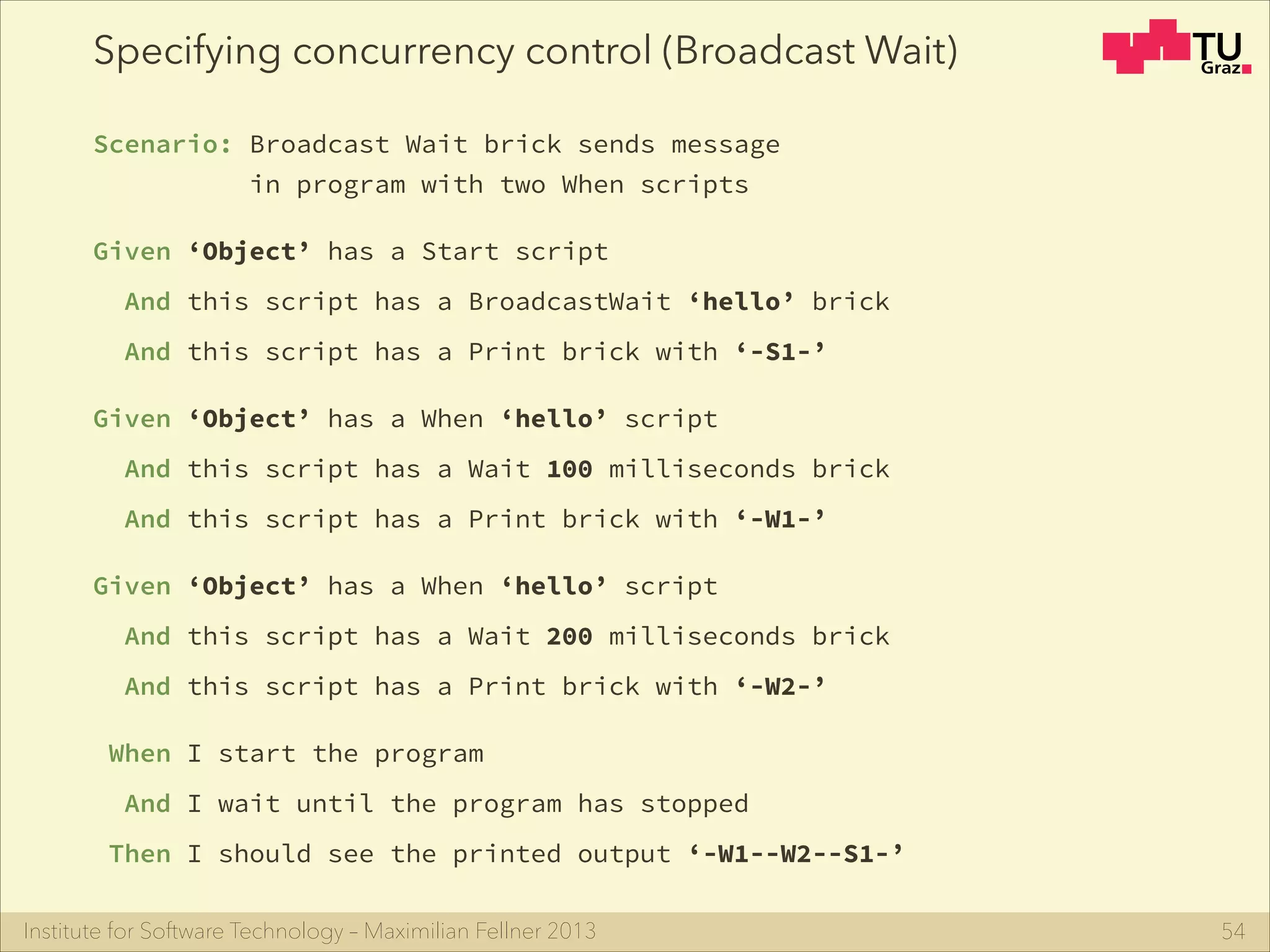
Specifying concurrency control (Broadcast Wait)
Scenario: Broadcast Wait brick sends message
in program with two When scripts
Given ‘Object’ has a Start script
And this script has a BroadcastWait ‘hello’ brick
And this script has a Print brick with ‘-S1-’
Given ‘Object’ has a When ‘hello’ script
And this script has a Wait 100 milliseconds brick
And this script has a Print brick with ‘-W1-’
Given ‘Object’ has a When ‘hello’ script

And this script has a Wait 200 milliseconds brick
And this script has a Print brick with ‘-W2-’
When I start the program
And I wait until the program has stopped
Then I should see the printed output ‘-W1--W2--S1-’
54
Institute for Software Technology – Maximilian Fellner 2013
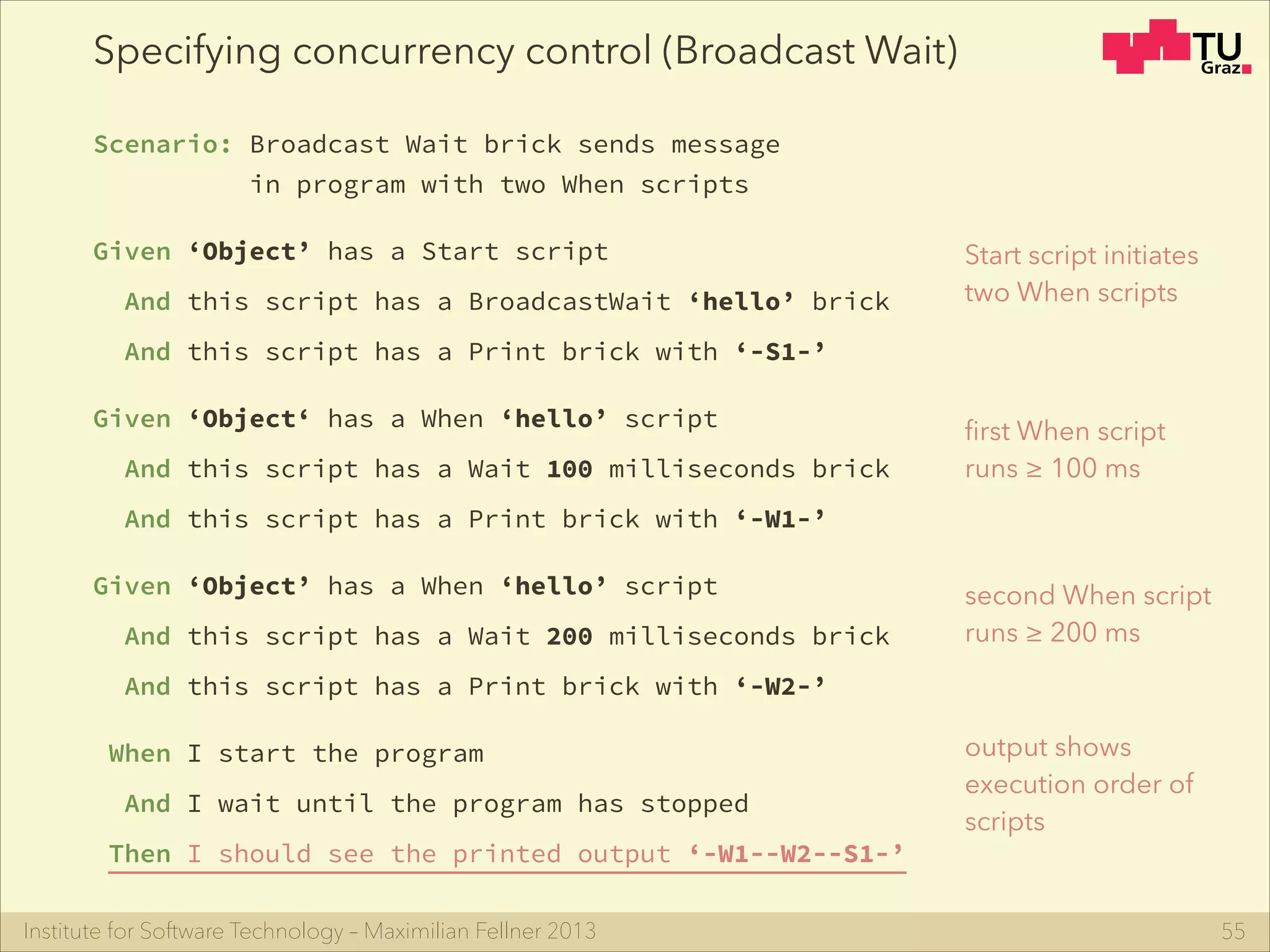
Specifying concurrency control (Broadcast Wait)
Scenario: Broadcast Wait brick sends message
in program with two When scripts
Given ‘Object’ has a Start script
And this script has a BroadcastWait ‘hello’ brick
And this script has a Print brick with ‘-S1-’
Given ‘Object‘ has a When ‘hello’ script
And this script has a Wait 100 milliseconds brick
And this script has a Print brick with ‘-W1-’
Given ‘Object’ has a When ‘hello’ script

And this script has a Wait 200 milliseconds brick
And this script has a Print brick with ‘-W2-’
When I start the program
And I wait until the program has stopped
Then I should see the printed output ‘-W1--W2--S1-’
55
Start script initiates
two When scripts
first When script
runs ≥ 100 ms
second When script
runs ≥ 200 ms
output shows
execution order of
scripts
Institute for Software Technology – Maximilian Fellner 2013
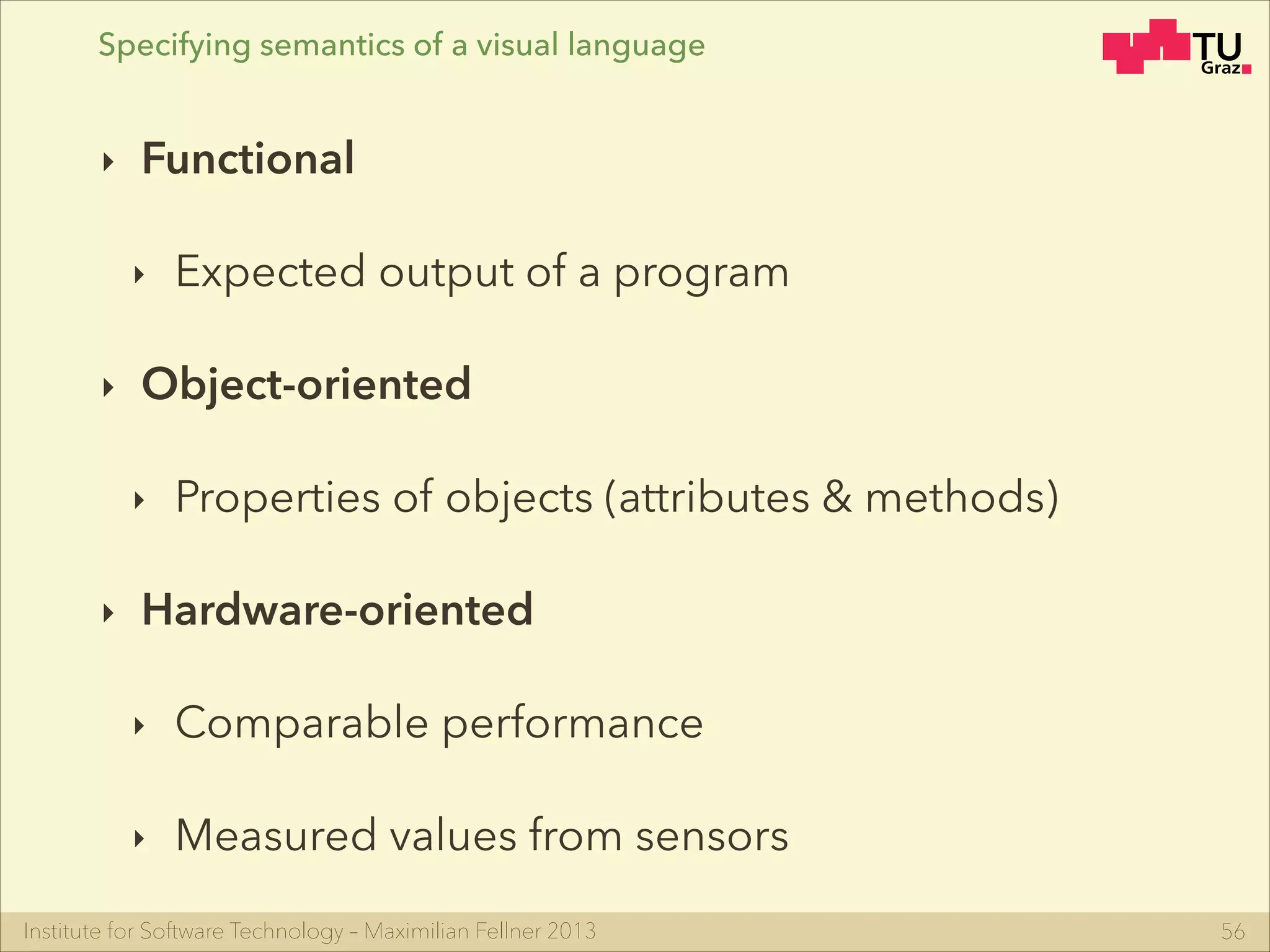
‣ Functional
‣ Expected output of a program
‣ Object-oriented
‣ Properties of objects (attributes & methods)
‣ Hardware-oriented
‣ Comparable performance
‣ Measured values from sensors
56
Specifying semantics of a visual language
Institute for Software Technology – Maximilian Fellner 2013
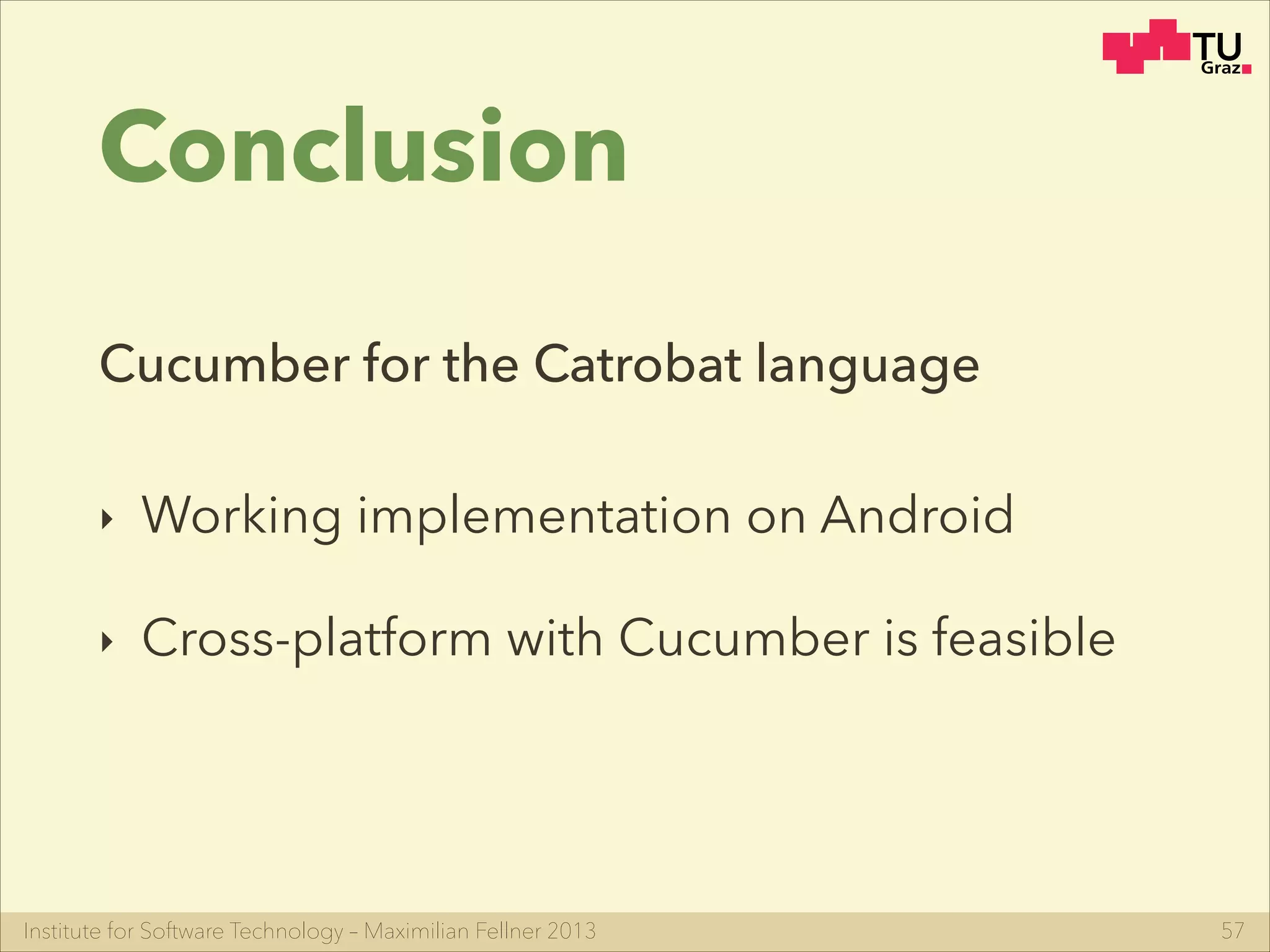
Conclusion
‣ Working implementation on Android
‣ Cross-platform with Cucumber is feasible
57
Cucumber for the Catrobat language
Institute for Software Technology – Maximilian Fellner 2013
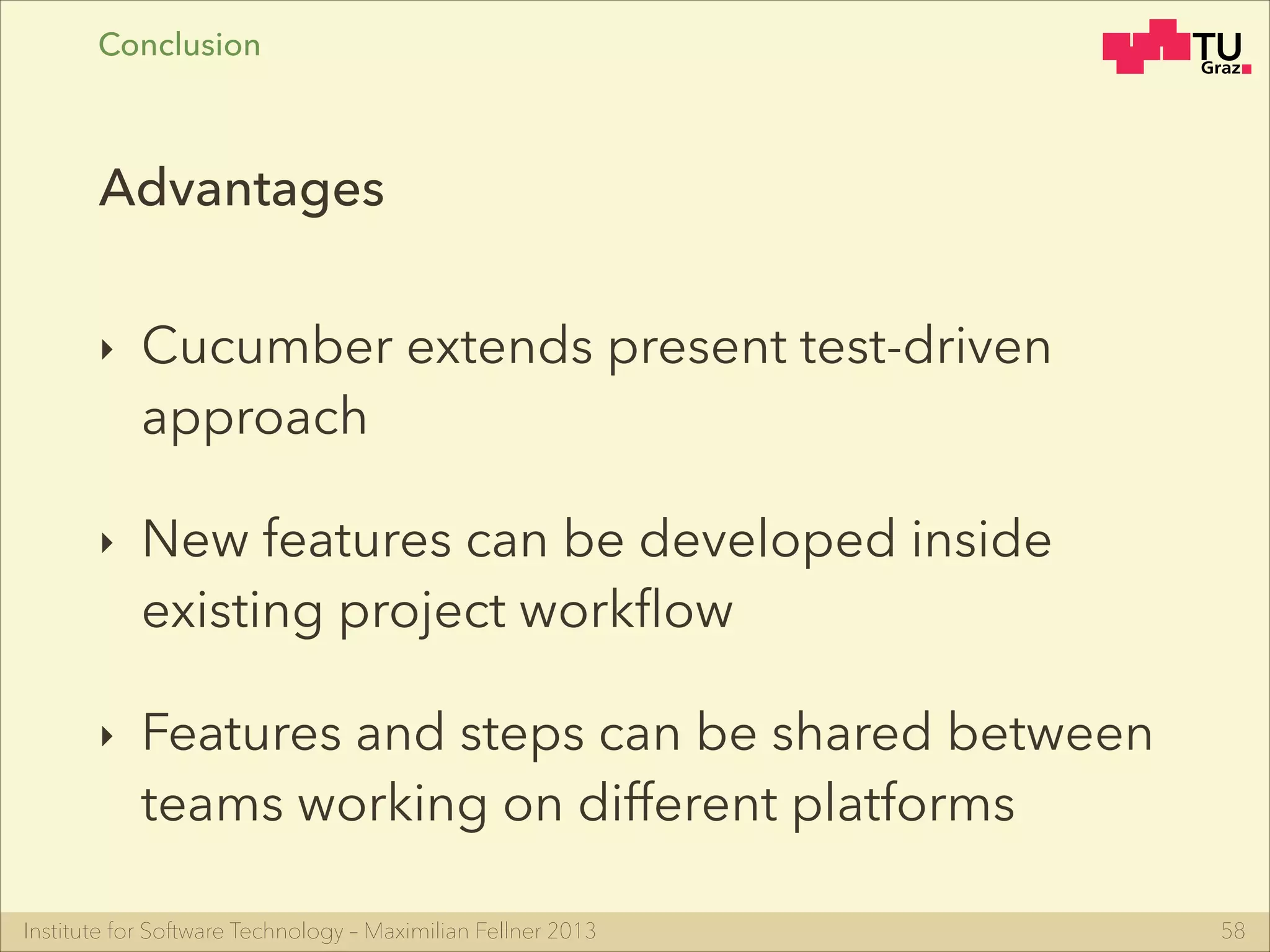
‣ Cucumber extends present test-driven
approach
‣ New features can be developed inside
existing project workflow
‣ Features and steps can be shared between
teams working on different platforms
58
Advantages
Conclusion
Institute for Software Technology – Maximilian Fellner 2013
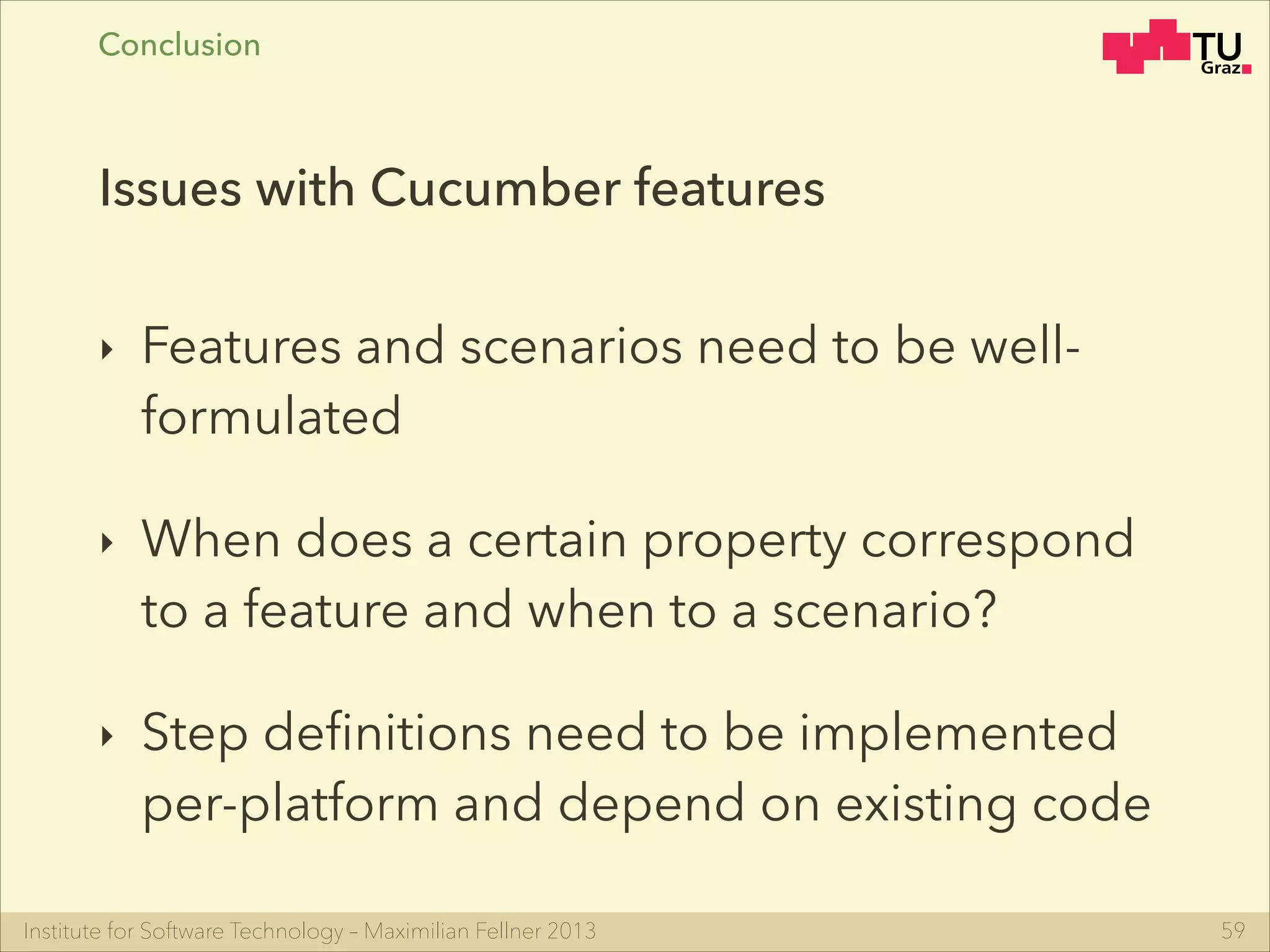
‣ Features and scenarios need to be well-
formulated
‣ When does a certain property correspond
to a feature and when to a scenario?
‣ Step definitions need to be implemented
per-platform and depend on existing code
59
Issues with Cucumber features
Conclusion
Institute for Software Technology – Maximilian Fellner 2013
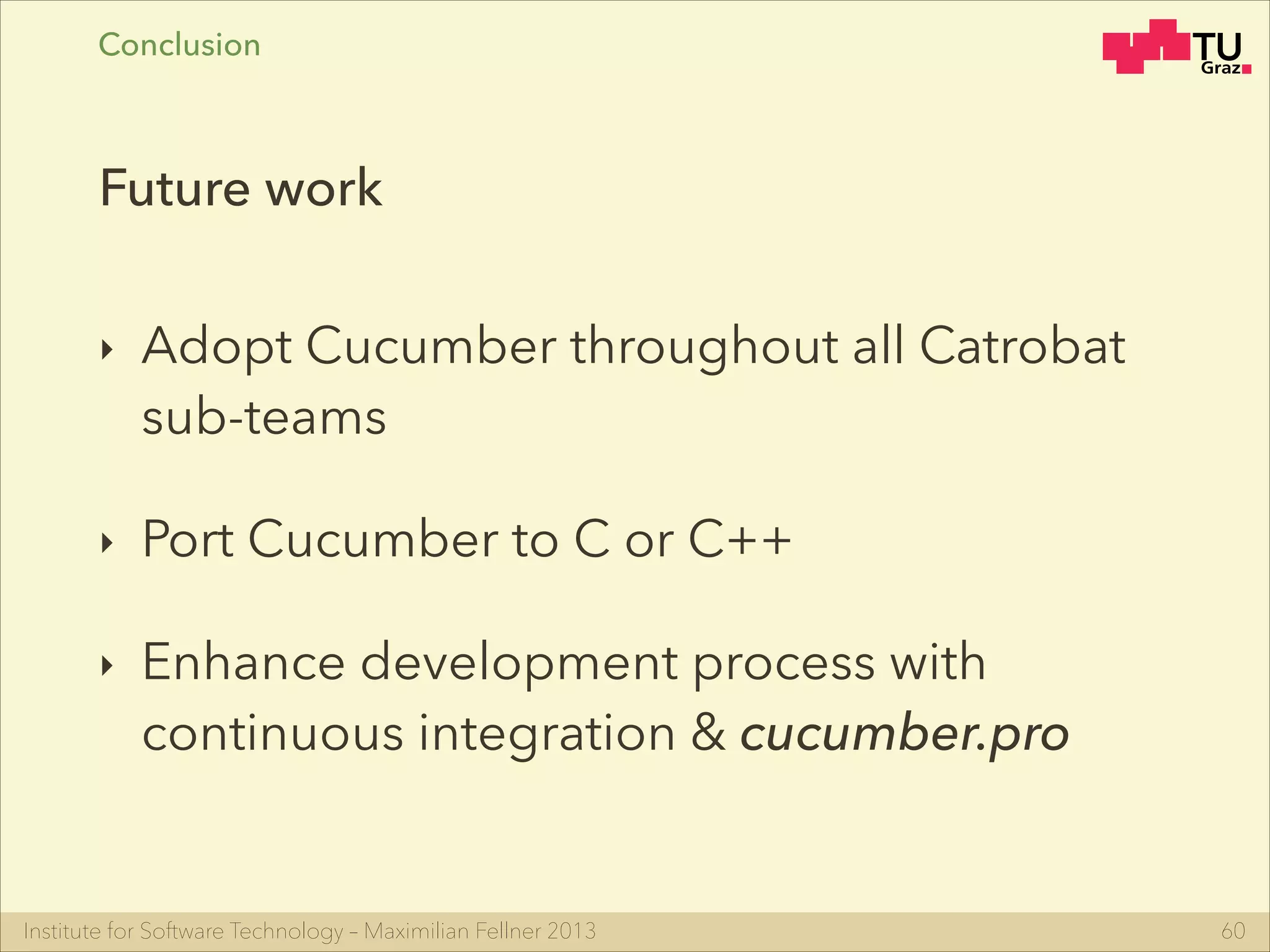
‣ Adopt Cucumber throughout all Catrobat
sub-teams
‣ Port Cucumber to C or C++
‣ Enhance development process with
continuous integration & cucumber.pro
60
Future work
Conclusion
Institute for Software Technology – Maximilian Fellner 2013 61
Bibliography
1. G. Adzic. Specification by Example: How Successful Teams Deliver the Right Software. Manning Pubs
Co Series. Manning, 2011. isbn: 9781617290084.
2. G. Meszaros. XUnit Test Patterns: Refactoring Test Code. A Martin Fowler signature book. Addison
Wesley Professional, 2007. isbn: 9780131495050.
3. E. Evans. Domain-Driven Design: Tackling Complexity in the Heart of Software. Addison Wesley
Professional, 2004. isbn: 9780321125217.
4. D. North. What’s in a story? Online; accessed 2013-10-05. url: http: //dannorth.net/whats-in-a-story.
5. A. Hellesoy and M. Wynne. The Cucumber Book: Behaviour-Driven Development for Testers and
Developers. Pragmatic Programmers. Pragmatic Book- shelf, 2012. isbn: 9781934356807.

Specification of a Visual Programming Language by Example

  • 1.
    Institute for SoftwareTechnology – Maximilian Fellner 2013 1 Specification of a Visual Programming Language by Example Behavior-Driven Development with Cucumber for Catrobat Master’s Thesis by Maximilian Fellner
  • 2.
    Institute for SoftwareTechnology – Maximilian Fellner 2013 Question: What are the advantages of standards and specifications? 2
  • 3.
    Institute for SoftwareTechnology – Maximilian Fellner 2013 Standardization ‣ Competitive advantages ‣ Strategic alliances ‣ Reduction of costs ‣ Safety & quality ‣ Public interest 3 Economic Benefits of Standardization, Deutsches Institut für Normung, Beuth Verlag
  • 4.
    Institute for SoftwareTechnology – Maximilian Fellner 2013 Specification ‣ Understand the requirements ‣ Describe a product abstractly ‣ Formulate binding contracts ‣ Quality assurance 4 Prerequisite for standardization
  • 5.
    Institute for SoftwareTechnology – Maximilian Fellner 2013 Existing approaches to language specification ‣ Natural language ‣ Formal semantics ‣ Reference implementations ‣ Test suites ‣ Syntax specified by context-free grammars and regular expressions 5
  • 6.
    Institute for SoftwareTechnology – Maximilian Fellner 2013 Existing approaches to language specification ‣ Specification documents,
 e.g., ECMA-262 (JavaScript) ‣ Readily understood by most ‣ Free choice of content and format ‣ Cannot be automatically verified 6 Natural language
  • 7.
    Institute for SoftwareTechnology – Maximilian Fellner 2013 Existing approaches to language specification ‣ Can be difficult to read and write ‣ Rarely used for consumer software ‣ Most precise, unambiguous, provable ‣ Tool support, e.g, VDM-SL 7 Formal semantics
  • 8.
    Institute for SoftwareTechnology – Maximilian Fellner 2013 ‣ Are self-sufficient ‣ Written in a programming language ‣ Possible bugs & unexpected behavior ‣ Dependency on implementation details 8 Reference implementations Existing approaches to language specification
  • 9.
    Institute for SoftwareTechnology – Maximilian Fellner 2013 ‣ Specification consists of tests written in the specified language ‣ Can define positive and negative test cases ‣ Should be executable by any implementation ‣ Nondeterministic behavior difficult to specify 9 Test suites Existing approaches to language specification
  • 10.
    Institute for SoftwareTechnology – Maximilian Fellner 2013 ‣ Languages with greater abstraction ‣ No tool support for specification ‣ Visual tests not feasible 10 Visual programming languages Existing approaches to language specification
  • 11.
    Institute for SoftwareTechnology – Maximilian Fellner 2013 Can we combine the advantages of natural language and those of test suites? 11 Question:
  • 12.
    Institute for SoftwareTechnology – Maximilian Fellner 2013 Specification by Example 12 From business goals to executable specification ‣ Introduced by Gojko Adzic ‣ Agile methodology ‣ Acceptance Test-Driven Development ‣ Behavior-Driven Development
  • 13.
    Institute for SoftwareTechnology – Maximilian Fellner 2013 13 Right Product Built Right Business Failure Success Useless Software Maintenance Difficulties test-driven development programming languages frameworks & tools specification by example project management Success of a software product, adapted from Adzic [1] business intent
  • 14.
    Institute for SoftwareTechnology – Maximilian Fellner 2013 Question: How can tests better specify the business intent? 14
  • 15.
    Institute for SoftwareTechnology – Maximilian Fellner 2013 15 Customer Tests (or Acceptance Tests) Business Intent Usability Testing Is it pleasurable? Component Tests Architect Intent Exploratory Testing Is it self-consistent? Unit Tests Developer Intent Property Testing Is it responsive, secure, scalable? Per Functionality Cross-Functional Business Facing Technology Facing The testing matrix, adapted from Meszaros [2]
  • 16.
    Institute for SoftwareTechnology – Maximilian Fellner 2013 Behavior-Driven Development ‣ Derived from test-driven development ‣ Strong community interest & many tools ‣ Ubiquitous language 16 Specification by example concretized
  • 17.
    Institute for SoftwareTechnology – Maximilian Fellner 2013 What is a ubiquitous language? A common language for a shared understanding of the domain. 17 E. Evans, Domain-Driven Design: Tackling Complexity in the Heart of Software [3]
  • 18.
    Institute for SoftwareTechnology – Maximilian Fellner 2013 18 Title (one line describing the story) ! Narrative: As a [role] I want [feature] So that [benefit] ! Acceptance Criteria: (presented as Scenarios) Scenario: Title Given [context] And [some more context]… When [event] Then [outcome] And [another outcome]… D. North. What’s in a story? [4]
  • 19.
    Institute for SoftwareTechnology – Maximilian Fellner 2013 Cucumber ‣ Open-source project ‣ Ubiquitous language Gherkin ‣ Available for Ruby and JVM languages 19 Behavior-driven development tool
  • 20.
    Institute for SoftwareTechnology – Maximilian Fellner 2013 Describing a Calculator with Gherkin Feature: Addition Scenario: Adding two numbers Given I enter 1 into the calculator And I enter 2 into the calculator When I press add Then I should see 3 on the display 20
  • 21.
    Institute for SoftwareTechnology – Maximilian Fellner 2013 Given /^I enter (d+) into the calculator$/ do |n| @stack.push n.to_i end 21 Then /^I should see (d+) on the display$/ do |n| @result.should == @result end When /^I press add^$/ do while not @stack.emtpy? do @result += @stack.pop end end
  • 22.
    Institute for SoftwareTechnology – Maximilian Fellner 2013 22 Project Features Scenarios Steps Step Definitions Support Code Automation Library System Business Facing Technology Facing The Cucumber testing stack, adapted from Hellesoy and Wynne [5]
  • 23.
    Institute for SoftwareTechnology – Maximilian Fellner 2013 Cucumber ‣ Gherkin is simple but effective ‣ Steps are platform independent ‣ Definition methods are reusable ‣ Redundant code is reduced 23 Advantages of steps & step definitions
  • 24.
    Institute for SoftwareTechnology – Maximilian Fellner 2013 24 However, there is a problem… They do not support Ruby or the JVM! ® ®
  • 25.
    Institute for SoftwareTechnology – Maximilian Fellner 2013 Existing approaches to Cucumber on mobile ‣ Open-source software by Xamarin Inc. ‣ Extends Ruby variant of Cucumber ‣ Supports Google Android & Apple iOS 25 E.g., Calabash
  • 26.
    Institute for SoftwareTechnology – Maximilian Fellner 2013 26 developer’s computer or build server Ruby client library & step definitions Cucumber features device or emulator Calabash HTTP server & native test runner Mobile Application Calabash system architecture
  • 27.
    Institute for SoftwareTechnology – Maximilian Fellner 2013 Existing approaches to Cucumber on mobile ‣ Ruby installation required ‣ Only pre-defined operations available ‣ Step-definitions are written in Ruby ‣ No integration with native libraries 27 Disadvantages
  • 28.
    Institute for SoftwareTechnology – Maximilian Fellner 2013 Cucumber JVM on Android ‣ Use Java implementation of Cucumber ‣ Integrate with Android test framework ‣ Run Cucumber directly on the device 28 A different approach
  • 29.
    Institute for SoftwareTechnology – Maximilian Fellner 2013 29 Overview of the Android test framework application package (.apk) InstrumentationTestRunner test package (.apk) test tools monkey runner test case classes Instrumentation JUnit mock objects process
  • 30.
    Institute for SoftwareTechnology – Maximilian Fellner 2013 30 Class diagram of the Cucumber-Android module Instrumentation CucumberInstrumenation Runtime RuntimeOptions AndroidResourceLoader ClassLoader JavaBackend1..* DexClassFinder AndroidObjectFactory ResourceLoader ClassFinder ObjectFactory1 1 1 1 1 1 1
  • 31.
    Institute for SoftwareTechnology – Maximilian Fellner 2013 Cucumber JVM on Android ‣ Still no solution for Windows Phone and iOS ‣ Best option is to improve Cucumber ‣ Gherkin parser is based on Ragel ‣ Cucumber runtime can be ported to C 31 Remaining issue
  • 32.
    Institute for SoftwareTechnology – Maximilian Fellner 2013 The visual language Catrobat ‣ Android, Windows Phone, iOS, Web ‣ Phones, tablets & desktop browsers ‣ Inspired by Scratch ‣ Sophisticated bricks (blocks) 32 Cross-platform, mobile, visual
  • 33.
    Institute for SoftwareTechnology – Maximilian Fellner 2013 The visual language Catrobat 33 Pocket Code (Android) and Scratch 2.0
  • 34.
    Institute for SoftwareTechnology – Maximilian Fellner 2013 From requirements to finished product ‣ Team meetings and discussions ‣ Write requirements as story cards ‣ Implement stories using Kanban & TDD 34 Before
  • 35.
    Institute for SoftwareTechnology – Maximilian Fellner 2013 35 weekly sub- team meeting bi-weekly team meeting planning game create new stories discuss implementation get feedback write unit tests
  • 36.
    Institute for SoftwareTechnology – Maximilian Fellner 2013 From requirements to finished product ‣ Stories are imprecise ‣ Story cards are archived or thrown away ‣ No automatic validation ‣ Android implementation serves as the model for other teams 36 Problems
  • 37.
    Institute for SoftwareTechnology – Maximilian Fellner 2013 From requirements to finished product ‣ Translate stories into features and scenarios ‣ Share feature files with everybody ‣ Each team implements their own step- definitions independently 37 With Cucumber
  • 38.
    Institute for SoftwareTechnology – Maximilian Fellner 2013 38 weekly sub- team meeting bi-weekly team meeting planning gamecreate new stories discuss implementation get feedback write unit tests write cucumber features
  • 39.
    Institute for SoftwareTechnology – Maximilian Fellner 2013 From requirements to finished product ‣ Features and scenarios are precise ‣ Feature files are stored in SCM system (Git) ‣ Automated validation of specifications ‣ Implementation-agnostic model for all teams ‣ Better synchronization between teams 39 Advantages
  • 40.
    Institute for SoftwareTechnology – Maximilian Fellner 2013 Specifying semantics of a visual language ‣ Android implementation in Java ‣ Furthest developed variant ‣ Existing set of unit tests 40 Catrobat & Pocket Code
  • 41.
    Institute for SoftwareTechnology – Maximilian Fellner 2013 Creating a new Catrobat program Background: Given I have a program And this program as an object ‘Object’ 41
  • 42.
    Institute for SoftwareTechnology – Maximilian Fellner 2013 @Given(“^I have a Program$”) public void I_have_a_program() throws IOException { ProjectManager pm = ProjectManager.getInstance(); pm.initializeNewEmptyProject(“Cucumber”, getContext()); } 42 Step definitions should be self-contained
  • 43.
    Institute for SoftwareTechnology – Maximilian Fellner 2013 @And(“^this program has an Object ‘(w+)’$”) public void program_has_object(String name) { ProjectManager pm = ProjectManager.getInstance(); Sprite sprite = new Sprite(name); pm.getCurrentProject().addNewObject(sprite); Cucumber.put(Cucumber.KEY_CURRENT_OBJECT, sprite); } 43 Step definitions can require a mechanism to share state
  • 44.
    Institute for SoftwareTechnology – Maximilian Fellner 2013 Behavior-Driven Development asks: How will the system behave when a user interacts with it? 44
  • 45.
    Institute for SoftwareTechnology – Maximilian Fellner 2013 How will a Catrobat program behave when it is executed? 45 The language specification should answer:
  • 46.
    Institute for SoftwareTechnology – Maximilian Fellner 2013 Specifying a loop (Repeat brick) Feature: Repeat brick A Repeat Brick should repeat another set of bricks a given number of times. ! Background: ... ! Scenario: Increment variable inside loop Given ‘Object’ has a Start script And this script has a set ‘i’ to 0 brick And this script has a Repeat 8 times brick And this script has a change ‘i’ by 1 brick And this script has a Repeat end brick When I start the program And I wait until the program has stopped Then the variable ‘i’ should be equal 8 46
  • 47.
    Institute for SoftwareTechnology – Maximilian Fellner 2013 Specifying a loop (Repeat brick) Feature: Repeat brick A Repeat Brick should repeat another set of bricks a given number of times. ! Background: ... ! Scenario: Increment variable inside loop Given ‘Object’ has a Start script And this script has a set ‘i’ to 0 brick And this script has a Repeat 8 times brick And this script has a change ‘i’ by 1 brick And this script has a Repeat end brick When I start the program And I wait until the program has stopped Then the variable ‘i’ should be equal 8 47 Add script to Object for 8 times do i = i + 1; end
  • 48.
    Institute for SoftwareTechnology – Maximilian Fellner 2013 @Then(“^the variable ‘(w+)’ should be equal (d+.?d*)$”) public void var_should_equal_float(String name, float expected) { Sprite object = (Sprite) Cucumber.get(Cucumber.KEY_CURRENT_OBJECT); Project project = ProjectManager.getInstance().getCurrentProject(); UserVariable var = project.getUserVariables() .getUserVariable(name, object); assertNotNull(var); float actual = var.getValue().floatValue(); assertThat(actual, equalTo(expected)); } 48 Step definition for equality assertion
  • 49.
    Institute for SoftwareTechnology – Maximilian Fellner 2013 49 Automatically generated report
  • 50.
    Institute for SoftwareTechnology – Maximilian Fellner 2013 50 Using the loop (Repeat brick) Altering position and transparency
  • 51.
    Institute for SoftwareTechnology – Maximilian Fellner 2013 51 Using the loop (Repeat brick) Question of performance
  • 52.
    Institute for SoftwareTechnology – Maximilian Fellner 2013 Specifying performance of a loop Scenario: No more than 100 iterations in 2 seconds Given ‘Object’ has a Start script And this script has a set ‘i’ to 0 brick And this script has a set ‘k’ to 0 brick And this script has a Wait 2 seconds brick And this script has a set ‘k’ to ‘i’ brick ! Given ‘Object’ has a Start script And this script has a Repeat 400 times brick And this script has a change ‘i’ by 1 brick And this script has a Repeat end brick ! When I start the program And I wait until the program has stopped Then the variable ‘k’ should be less than or equal 100 52
  • 53.
    Institute for SoftwareTechnology – Maximilian Fellner 2013 Defining an upper bound for iterations per second Scenario: No more than 100 iterations in 2 seconds Given ‘Object’ has a Start script And this script has a set ‘i’ to 0 brick And this script has a set ‘k’ to 0 brick And this script has a Wait 2 seconds brick And this script has a set ‘k’ to ‘i’ brick ! Given ‘Object’ has a Start script And this script has a Repeat 400 times brick And this script has a change ‘i’ by 1 brick And this script has a Repeat end brick ! When I start the program And I wait until the program has stopped Then the variable ‘k’ should be less than or equal 100 53 first Start script second Start script store value of i after 2 s. increment i by 1 1 loop should take at least 20 ms
  • 54.
    Institute for SoftwareTechnology – Maximilian Fellner 2013 Specifying concurrency control (Broadcast Wait) Scenario: Broadcast Wait brick sends message in program with two When scripts Given ‘Object’ has a Start script And this script has a BroadcastWait ‘hello’ brick And this script has a Print brick with ‘-S1-’ Given ‘Object’ has a When ‘hello’ script And this script has a Wait 100 milliseconds brick And this script has a Print brick with ‘-W1-’ Given ‘Object’ has a When ‘hello’ script
 And this script has a Wait 200 milliseconds brick And this script has a Print brick with ‘-W2-’ When I start the program And I wait until the program has stopped Then I should see the printed output ‘-W1--W2--S1-’ 54
  • 55.
    Institute for SoftwareTechnology – Maximilian Fellner 2013 Specifying concurrency control (Broadcast Wait) Scenario: Broadcast Wait brick sends message in program with two When scripts Given ‘Object’ has a Start script And this script has a BroadcastWait ‘hello’ brick And this script has a Print brick with ‘-S1-’ Given ‘Object‘ has a When ‘hello’ script And this script has a Wait 100 milliseconds brick And this script has a Print brick with ‘-W1-’ Given ‘Object’ has a When ‘hello’ script
 And this script has a Wait 200 milliseconds brick And this script has a Print brick with ‘-W2-’ When I start the program And I wait until the program has stopped Then I should see the printed output ‘-W1--W2--S1-’ 55 Start script initiates two When scripts first When script runs ≥ 100 ms second When script runs ≥ 200 ms output shows execution order of scripts
  • 56.
    Institute for SoftwareTechnology – Maximilian Fellner 2013 ‣ Functional ‣ Expected output of a program ‣ Object-oriented ‣ Properties of objects (attributes & methods) ‣ Hardware-oriented ‣ Comparable performance ‣ Measured values from sensors 56 Specifying semantics of a visual language
  • 57.
    Institute for SoftwareTechnology – Maximilian Fellner 2013 Conclusion ‣ Working implementation on Android ‣ Cross-platform with Cucumber is feasible 57 Cucumber for the Catrobat language
  • 58.
    Institute for SoftwareTechnology – Maximilian Fellner 2013 ‣ Cucumber extends present test-driven approach ‣ New features can be developed inside existing project workflow ‣ Features and steps can be shared between teams working on different platforms 58 Advantages Conclusion
  • 59.
    Institute for SoftwareTechnology – Maximilian Fellner 2013 ‣ Features and scenarios need to be well- formulated ‣ When does a certain property correspond to a feature and when to a scenario? ‣ Step definitions need to be implemented per-platform and depend on existing code 59 Issues with Cucumber features Conclusion
  • 60.
    Institute for SoftwareTechnology – Maximilian Fellner 2013 ‣ Adopt Cucumber throughout all Catrobat sub-teams ‣ Port Cucumber to C or C++ ‣ Enhance development process with continuous integration & cucumber.pro 60 Future work Conclusion
  • 61.
    Institute for SoftwareTechnology – Maximilian Fellner 2013 61 Bibliography 1. G. Adzic. Specification by Example: How Successful Teams Deliver the Right Software. Manning Pubs Co Series. Manning, 2011. isbn: 9781617290084. 2. G. Meszaros. XUnit Test Patterns: Refactoring Test Code. A Martin Fowler signature book. Addison Wesley Professional, 2007. isbn: 9780131495050. 3. E. Evans. Domain-Driven Design: Tackling Complexity in the Heart of Software. Addison Wesley Professional, 2004. isbn: 9780321125217. 4. D. North. What’s in a story? Online; accessed 2013-10-05. url: http: //dannorth.net/whats-in-a-story. 5. A. Hellesoy and M. Wynne. The Cucumber Book: Behaviour-Driven Development for Testers and Developers. Pragmatic Programmers. Pragmatic Book- shelf, 2012. isbn: 9781934356807.