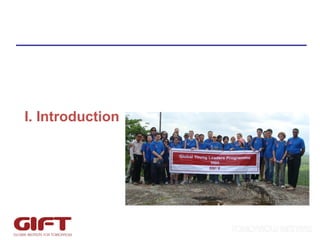
I. Introduction
Country Background Population:14 million 74% of the population is dependent on agricultural income Economic aspects: GDP grew 9.8% per annum (1997-2007) GDP per capita: $350 per annum One of the poorest countries in the world (137th of 179 countries on Human Development Index, 22nd lowest GDP per capita)  High growth rates with investment opportunities in rural communities
Cambodia Challenges Environmental Deforestation  40% of primary forests already lost (intense illegal logging) Still suffering an annual net deforestation of 140,000 hectares Absence of sustainable forest management Destruction of the Carbon Sink (and Climate change impacts) Main sources of energy in rural areas is wood based (85%) Poverty drives unsustainable pressure on environment  Social Above 40% of rural population live under national poverty line  (0.45 USD per person per day) Incomplete legal framework and rampant corruption Under-developed medical and educational infrastructure
Birth of Eco-Biz Establishment of a for-profit  social enterprise   EDBU  –  created in 2007 to develop market opportunities for the products that are created from GERES technologies.
Eco-Biz : The Triple Bottom Line Promote sustainable forestry, improve income and empower rural communities.  Commercially market and distribute fair trade and environmentally friendly products.  A Triple Bottom Line Company  Bottom line: Social, Economic and Environment Economic   Social  Environment
Eco-Biz Products Wood Vinegar Palm Sugar Green Charcoal
II. Business Model
Business Model – Short Term GERES CFA Forest Sell Premium Sell Market Price Eco-Biz buys Sugar Palm Sugar Fuel Wood Raw Materials Wood Vinegar Eco-Biz $$ Eco-Biz buys Wood Other Sources Green Charcoal
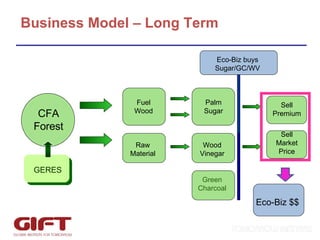
Business Model – Long Term GERES CFA Forest Sell Premium Sell Market Price Eco-Biz buys Sugar/GC/WV Palm Sugar Fuel Wood Green Charcoal Wood Vinegar Eco-Biz $$ Raw Material
Production Method and Technology
Technological Improvements Less fuel wood used. Less demand on our forests
Supply Chain & Logistic (Palm Sugar) Palm Tree Collection of Palm Juice Warehouse Wholesale Market Collection of Palm Sugar Delivery of  Packaged Sugar Village Village Production of Palm Sugar “ Producer” Producer owns 10-30 palm trees. Palm juice is collected twice a day between January and May. The juice is converted to paste. Each producer uses the “Vattanak” stove using collected or bought fuel wood. Palm paste is converted to granulated sugar. It is dried and bagged ready for collection. “ Buyer” Eco-biz will market the sugar as a sustainable sourced organic product both in domestic and overseas market. “ Eco-Biz” Eco-biz will collect the sugar from producers each day. Payment will be made on the spot. Producers will be paid either premium price or a normal price, depending on where they source their fuel wood. Collected sugar is processed by Eco-Biz and transported to Phnom Penh where it will be sold.
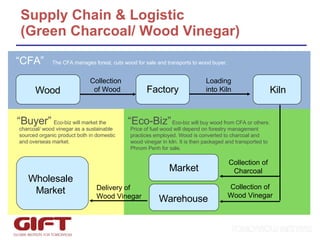
Supply Chain & Logistic  (Green Charcoal/ Wood Vinegar) “ CFA” The CFA manages forest, cuts wood for sale and transports to wood buyer. “ Buyer” Eco-biz will market the charcoal/ wood vinegar as a sustainable sourced organic product both in domestic and overseas market. “ Eco-Biz” Eco-biz will buy wood from CFA or others. Price of fuel wood will depend on forestry management practices employed. Wood is converted to charcoal and wood vinegar in kiln. It is then packaged and transported to Phnom Penh for sale. Wood Collection  of Wood Market Wholesale Market Collection of Charcoal Delivery of  Wood Vinegar Factory Kiln Loading into Kiln Collection of Wood Vinegar Warehouse
Quality Assurance and Certification Palm Sugar Training of domestic palm sugar producer Quality control at purchase point and rejection of product that fails standards Processing to ensure compliance with (i) product standard (colour, consistency) and (ii) compliance with food and health standards Secure and humidity controlled warehousing with inventory control Green charcoal/wood vinegar Spot check of raw materials and final check of product  Control of production process in Phase 1 Training of CFA co-operative prior to implementing Phase 2 Certification Palm sugar: establish fair trade products (short term), obtain organic certification (long term) Green charcoal/wood vinegar: FSC or equivalent certification (long term)  CFA: obtain carbon credit certification from REDD for forests that are sustainably managed (long term )
Production Forecast
III. Marketing Plan
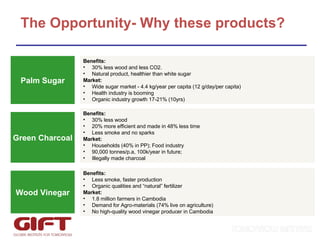
The Opportunity- Why these products? Green Charcoal Benefits:   30% less wood  20% more efficient and made in 48% less time Less smoke and no sparks Market:   Households (40% in PP); Food industry 90,000 tonnes/p.a, 100k/year in future;  Illegally made charcoal Wood Vinegar Benefits:   Less smoke, faster production Organic qualities and “natural” fertilizer Market:   1.8 million farmers in Cambodia  Demand for Agro-materials (74% live on agriculture) No high-quality wood vinegar producer in Cambodia Palm Sugar Benefits: 30% less wood and less CO2. Natural product, healthier than white sugar  Market:   Wide sugar market - 4.4 kg/year per capita (12 g/day/per capita)   Health industry is booming Organic industry growth 17-21% (10yrs)
Product Overview “ Premium Brand”—Better quality with high social/ environment impact B2B pricing: Domestic: minimum $1.25/kg, International: $2/kg international B2B:Plastic bags (10c a bag)  Domestic:   High-end: Confirel, Organic Internationally (France Certification); Low-end: DATe , CEDAC  International: India, Indonesia, Thailand, Bangladesh Phase I - Penetrate into domestic retail market Phase II - Explore international wholesale market (pharma/health) B2B Domestic Wholesale (Hotel, Restaurants, B2B Export Wholesale Domestic(30%) & International (70%) Palm Sugar Green Charcoal Wood Vinegar Target Market Domestic market   (national) Domestic and International Customer Group B2B Short term- Hotel Industry, Restaurants B2C Long Term - Individual consumers   B2B Domestic agriculture/ insect repellent manufacturers, Wholesalers for pharmaceutical, healthcare, agriculture products, insect repellent, NGO’s involved in agriculture (CEDAC and others) Distribution Channels Phase I-Retail, direct sales through vans Phase II- Explore possibility of wholesale middlemen for other  Domestic wholesalers and NGO involved in agriculture International exporters  Competitors No branded charcoal in market today. Charcoal made through illegal logging biggest competitor  Unique product, hence no branded competitor in local market Packaging Gunny bags- on a rotation basis (0.7c per bag) Plastic drums -1L plastic HCPE bottles (0.6c per bottle) Positioning & Pricing Premium Brand Phase I: 10%-15% lower than base market   (23c) Phase II: Mark-up to market price (25C) Short team: “Positioned as a Natural fertilizer” -explore “green label certification” option Long Term-Explore Organic and other international certifications. Phase I: 0.75C/litre Phase II: 0.85c/litre -1c/litre, (CEDAC is 1.80c/litre with 30% )
Palm Sugar: Market Phases Position as high quality “premium brand” with social and environment impact Penetrate into domestic wholesale market (ie. hotel/restaurant suppliers - ie. BoneCafe, Hong Huot CO ltd; Nutraceutical ie. Aspen Pharma) Explore international food & health processors: Taikoo; UNFI Price at $1.25/kg for domestic; price at $2/kg international Explore Fair Trade certification Establish a stable domestic network Establish customer “loyalty” Build EcoBiz brand as “experts” on palm sugar in Cambodia internationally Increase awareness about EcoBiz palm sugar’s social and environment impact to international audience through literature/ media  Explore large global sugar suppliers, price at $2/kg (Taikoo, UNFI, other) Expand market base domestically and increase market share Focus on becoming the “preferred supplier” for key  international suppliers Seek organic certification to create product niche and to obtain entry into new market Gradually increase price to establish product premium Phase I:  Market Entry ( 3-6 mths) Phase II:  Market Presence  ( 6mths-1.5 yrs) Phase III:  Market Growth (1.5yrs+)
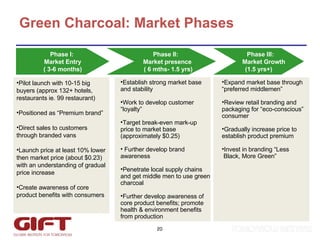
Green Charcoal: Market Phases Pilot launch with 10-15 big buyers ( approx 132+ hotels, restaurants ie. 99 restaurant ) Positioned as “Premium brand”  Direct sales to customers  through branded vans Launch price at least 10% lower then market price (about $0.23) with an understanding of gradual price increase Create awareness of core product benefits with consumers Establish strong market base and stability Work to develop customer “loyalty” Target break-even mark-up price to market base (approximately $0.25) Further develop brand awareness Penetrate local supply chains and get middle men to use green charcoal Further develop awareness of core product benefits; promote health & environment benefits from production  Expand market base through “preferred middlemen” Review retail branding and packaging for “eco-conscious” consumer Gradually increase price to establish product premium Invest in branding “Less  Black, More Green” Phase I:  Market Entry ( 3-6 months) Phase II:  Market presence  ( 6 mths- 1.5 yrs) Phase III:  Market Growth (1.5 yrs+)
Wood Vinegar: Market Phases Significant potential to build domestic wholesale and retail market (fertilizer combinations, composting  Test product application with CEDAC  farmers and other NGO’s as fertilizer  /animal feed ($1.80/litre with $0.30/litre  commission to CEDAC Explore Singapore Green label  application (preferred by farmers) Explore sale opportunities of existing  stock (17,000 approx litres with  domestic fertilizer companies/  wholesalers ($0.75/ litre) Manage legal and compliance related export requirements.  Build domestic wholesale market and explore markets for international wholesale distribution (healthcare, pharmaceutical)  Increase profit margin (reduce cost price and increase sale price) Manage stock supply to meet requirements Plan for organic certification Move forward with aggressive  advertisement strategy targeted  toward CEDAC farmers  Ensure premium and organic certifications are secured to explore opportunities with certified organic association Gradually increase price to establish product premium post organic certification Penetrate deeper in the CEDAC  farmer base as key customers Phase I:  Market Entry ( 3-6 months) Phase II:  Market presence  ( 6 mths- 1.5 yrs) Phase III:  Market Growth (1.5 yrs+)
Branding Approach “ 100% natural, premium taste, Eco-friendly product”  Innovative packaging: measurement indicators Create engaging website  Leverage social media and PR Increase presence on industry related websites & blogs Bundling/incentive schemes Exposure in industry publications conferences, tradeshows Tap NGO network globally for co-partnership opportunities  Recycle packaging + incentive Conversion program Resin paper packaging with burnt logo Build loyalty program Local co-partnerships to support community events (I.e. 99 restaurant, media)  Exploit local PR opportunities Key account theme-night programs, price-off promotions & tracking scheme to measure results Better service and reliable delivery “ Word of Mouth” tactics Establish credible endorsements Create engaging website Leverage social media and PR Increase presence on industry related websites & blogs Tap NGO network for co-partnership opportunities Build loyalty program with CEDAC farmers Exposure in industry publications, conferences, tradeshows PALM SUGAR “ UNIQUE TASTE,  SUPPORT GROWTH,  100% NATURAL” GREEN CHARCOAL “ LESS BLACK, MORE GREEN” More Energy, More Eco-friendly WOOD VINEGAR “ LESS CHEMICAL, MORE LIFE”
IV.  Business Organization  and Governance
Board of Directors CEO  (Ruben) GERES Investors Accounting Clerk Finance & Admin. Sales  and  Operation Marketing & Operation Organization Structure
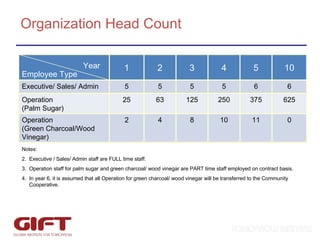
Organization Head Count Employee Type Year Notes: Executive / Sales/ Admin staff are FULL time staff. Operation staff for palm sugar and green charcoal/ wood vinegar are PART time staff employed on contract basis. In year 6, it is assumed that all Operation for green charcoal/ wood vinegar will be transferred to the Community Cooperative.  0 11 10 8 4 2 Operation  (Green Charcoal/Wood Vinegar) 625 375 250 125 63 25 Operation  (Palm Sugar) 6 6 5 5 5 5 Executive/ Sales/ Admin 10 5 4 3 2 1
Structure of Investment Eco-Biz Shareholders GERES Private Investor Sweat Equity and New Capital New Capital
Forging Multi-stakeholder Partnership Creating a viable business model for village community products Village Community CFA - develop supply of sustainable wood as fuel/raw material for production Domestic palm producers  -  the seller of the unpackaged product at source GERES assist and educate CFA to develop sustainable wood supplies build Vattanak stoves for the domestic palm producer Consumers CEDAC - Education and penetration of small scale agriculture markets for wood vinegar Others (e.g. Restaurant) build [and maintain] the Yoshimura kiln for Eco-Biz educate CFA in Phase to operate Yoshimura kiln as a co-operative Eco-Biz GERES Consumers Village Community
V. Financials
Rural Poverty Alleviation Increase income by reducing costs and buying at a premium  Sustainable Forestry Management Concurrent injection of profits back to the community via GERES  Responsible strategic business expansion to match the rate of forestry management Price-differentiation to create economic incentives for the local community to use CFA certified wood rather than rely on illegal logging Investment Objective A Social, Environmental and Economical investment
Break-even :  Year 2 Revenue in Year 5:  ~ $2,650,000 USD Net profit in Year 5 :   ~ $550,000 USD *all financial model assumptions can be found in Appendix A Financial Summary A Social, Environmental and Economical investment
Call for Investment A Social, Environmental and Economical investment  Eco-Biz seeks $500,000 USD  of External Investment For a 49% stake in Eco-Biz Payback: Year 5 Dividend returns: of 20 % per annum of any  positive   retained earnings  to investors starting from Year 3 IRR: 6% for 5-year holding period 25% for 10-year holding period
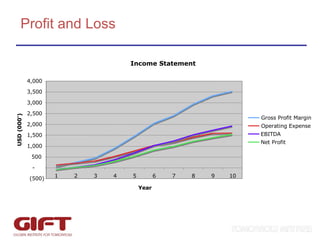
Profit and Loss Income Statement (500) - 500 1,000 1,500 2,000 2,500 3,000 3,500 4,000 1 2 3 4 5 6 7 8 9 10 Year USD (000') Gross Profit Margin Operating Expense EBITDA Net Profit
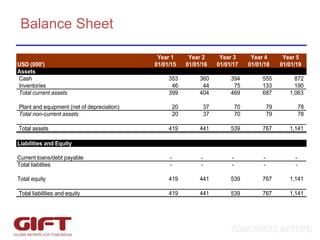
Balance Sheet
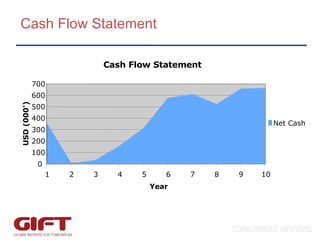
Cash Flow Statement Cash Flow Statement 0 100 200 300 400 500 600 700 1 2 3 4 5 6 7 8 9 10 Year USD (000') Net Cash
Cash Flow Statement (Cont’d)
Sales Projection Wood Vinegar Sales and Production 0.0 50.0 100.0 150.0 200.0 250.0 300.0 350.0 400.0 1 2 3 4 5 6 7 8 9 10 Year USD (000') Sales COGS Gross Margin Palm Sugar Sales and Production 0 1000 2000 3000 4000 5000 6000 7000 1 2 3 4 5 6 7 8 9 10 Year USD (000') Green Charcoal Sales and Production 0.0 10.0 20.0 30.0 40.0 50.0 60.0 70.0 1 2 3 4 5 6 7 8 9 10 Year USD (000')
Sales Projection (Cont’d)
Operating Expense, CAPEX Operating Expense Year 1 Year 2 Year 3 Year 4 Year 5 Year 6 Year 7 Year 8 Year 9 Year 10 USD (000') 2010 2011 2012 2013 2014 2015 2016 2017 2018 2019 Company setup cost 5 0 0 0 0 0 0 0 0 0 Office expenses  (inc rental, utilities and others) 13 9 12 20 26 40 46 55 64 71 Salary and benefits 56 59 64 78 85 93 103 113 123 134 Transport and travelling 8 9 9 10 11 11 12 13 13 14 Sales and marketing 53 134 227 420 653 887 1011 1229 1387 1384 Total 134 211 313 528 775 1030 1172 1409 1588 1604 Capital Expenditure Year 1 Year 2 Year 3 Year 4 Year 5 Year 6 Year 7 Year 8 Year 9 Year 10 USD (000') 2010 2011 2012 2013 2014 2015 2016 2017 2018 2019 Purchase of kiln and equipment (22) (22) (41) (20) (10) 0 0 0 0 0 Sale of kiln and equipment 0 0 0 0 0 78 0 0 0 0 Total (22) (22) (41) (20) (10) 78 0 0 0 0
Return and Exit Strategy Dividend returns of 20 % per annum  of any positive retained earnings to investors starting from year 3 Exit options can be accomplished through equity dilution
VI. Risk Assessment
Risk Assessment Risk Description Cat Consequence Risk Mitigation Measures “ Green Charcoal” vs. “Traditional charcoal” Marketing & Finance It may not be easy to compete with illegal operators High Marketing & Promotion to differentiate & promote new legally sourced product Difficulty of exporting Wood Vinegar  Marketing & Legal Restricted from lucrative export market High Sell to wholesalers who have obtained export licenses Corruption along supply chain Financial Reduced margins High Obtain certification from Government Establishment & monitoring of Cooperative Supply Chain No product ; WV or green charcoal High Training & Education with community Palm Sugar: Seasonality  (Jan to May) Finance, Operations  & Marketing Quantity of Palm Sugar  High Better fore-casting and inventory planning. Non-perishable packaging. Limited wood sources. Only very limited land & sustainable forests exists. Long time to develop new forests. Finance, Operations  & Marketing Qty of Charcoal/WV. Palm sugar producers will purchase illegal fuel wood High Promote sustainable forestry practices to farmers. Provide price incentive to wood  suppliers.
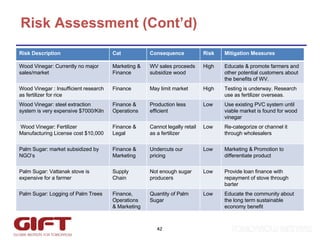
Risk Assessment (Cont’d) Risk Description Cat Consequence Risk Mitigation Measures Wood Vinegar: Currently no major sales/market Marketing & Finance WV sales proceeds subsidize wood  High Educate & promote farmers and other potential customers about the benefits of WV. Wood Vinegar : Insufficient research as fertilizer for rice Finance  May limit market High Testing is underway. Research use as fertilizer overseas. Wood Vinegar: steel extraction system is very expensive $7000/Kiln Finance & Operations Production less efficient Low Use existing PVC system until viable market is found for wood vinegar Wood Vinegar: Fertilizer Manufacturing License cost $10,000 Finance & Legal Cannot legally retail as a fertilizer Low Re-categorize or channel it through wholesalers Palm Sugar: market subsidized by NGO’s Finance &  Marketing Undercuts our pricing Low Marketing & Promotion to differentiate product Palm Sugar: Vattanak stove is expensive for a farmer Supply Chain Not enough sugar producers Low Provide loan finance with repayment of stove through barter Palm Sugar: Logging of Palm Trees Finance, Operations  & Marketing Quantity of Palm Sugar  Low Educate the community about the long term sustainable economy benefit
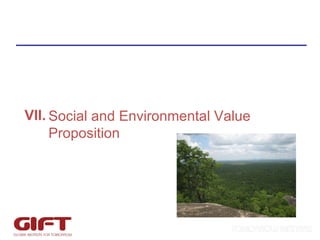
VII.  Social and Environmental Value Proposition
Value Creation for Society Increased income and creation of jobs Allows for greater access to education, water, information, energy, etc. Empowerment of people Participatory process Capacity building Promote power and autonomy in decision-making for local communities Preservation of traditional family rural culture and improved life Allow rural families to make a decent living while remaining in their village Minimal erosion to Cambodian traditional way of life Safer and healthier working conditions Reduction in air pollution Safety improvements in rural economic activities. Improve quality of life of  village communities
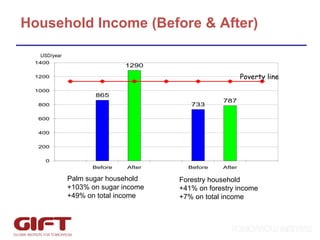
Household Income (Before & After) Palm sugar household +103% on sugar income +49% on total income Forestry household +41% on forestry income +7% on total income Poverty line USD/year
From Farmers to Entrepreneurs  Building individual and family entrepreneurs and economic independence Creating more productive and efficient forest products  Forming more efficient distribution channels through further outreach Creating economic, social and environmental capital Providing a steady stream of income to family units Learning about value-add products, capturing greater value along the value chain Rooting positive change in people’s lives Empowering villagers with environmental and business acumen
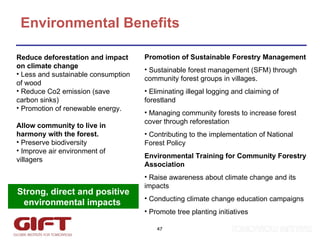
Environmental Benefits Reduce deforestation  and impact on climate change Less and sustainable consumption of wood  Reduce Co2 emission (save carbon sinks)  Promotion of renewable energy. Allow  community  to live in harmony with the forest.   Preserve biodiversity Improve air environment of villagers Strong, direct and positive environmental impacts   Promotion of Sustainable Forestry Management Sustainable forest management (SFM) through community forest groups in villages.  Eliminating  illegal  logging  and  claiming of  forestland Managing  community forests to increase forest cover through reforestation Contributing  to the implementation of National Forest Policy Environmental Training for Community   Forestry   Association Raise awareness about climate change and its impacts  Conducting climate change education campaigns Promote  tree  planting initiative s
Quantitative  Environmental  Benefits  (6-year) Reduction of Pesticides from Wood Vinegar What we spend What we achieve USD 1,500 to build 1 kiln in 1 year Reduction of  3,000 liters of  chemical pesticides  Forest Impact from Palm Sugar and Green Charcoal Savings 3,300 hectares of forest ~ 4,000 football fields Reduction in Carbon Emissions from Green Charcoal and Vattanak stove More than 10,000 tCO2e Avoided Deforestation 30,000,000 trees saved Carbon Sequestration   250,000 tCO2e
VIII. Implementation
Implementation Plan –  Short-Term Issues Month 3 6 9 12 Governance/ HR Reforming business entity; adapt HR & accounting system Employee recruitment Contribution to forest and organic certification process Operations/ Supply Chain Product Technology development; packaging Building new kilns and new distribution centers Sales & Marketing Market Entry for all products Market Presence; creating brand awareness: Palm Sugar (70% Export + 30%Domestic), Green Charcoal (Domestic), Wood Vinegar (Domestic) Finance Investment initiated Account Auditing
Implementation Plan –  Mid-term, Long-term Issues Month 2 3 4 5 Governance/ HR Contribution to forest and organic certification process Operations/ Supply Chain Establishment of new CFA to support production capacity Handing over of kiln to community for charcoal and vinegar production Sales & Marketing Expansion of Wood vinegar customer base to include CEDAC farmers Finance Breakeven point by end of year 2 Cashflow positive
IX. Conclusion
Conclusion Fulfilling economic, social, and environmental goals at the same time Eco-Biz is a social enterprise seeking to simultaneously promote sustainable forestry practices and sustainable rural livelihoods in Cambodia.  It will market and distribute products created through socially-uplifting and environmentally-friendly practices and technologies developed by GERES Cambodia and other organizations.  Altogether, Eco-Biz’s initiatives will be designed to fulfill a triple bottom line: economic, social, and environmental
Appendices
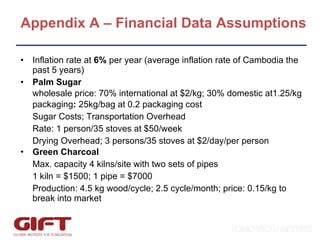
Inflation rate at  6%  per year   (average inflation rate of Cambodia the past 5 years) Palm Sugar wholesale price: 70% international at $2/kg; 30% domestic at1.25/kg  packaging :  25kg/bag at 0.2 packaging cost  Sugar Costs; Transportation Overhead  Rate: 1 person/35 stoves at $50/week Drying Overhead; 3 persons/35 stoves at $2/day/per person Green Charcoal Max. capacity 4 kilns/site with two sets of pipes 1 kiln = $1500; 1 pipe = $7000 Production: 4.5 kg wood/cycle; 2.5 cycle/month; price: 0.15/kg to break into market  Appendix A – Financial Data Assumptions
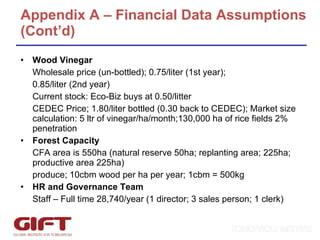
Wood Vinegar Wholesale price (un-bottled); 0.75/liter (1st year);  0.85/liter (2nd year) Current stock: Eco-Biz buys at 0.50/litter CEDEC Price; 1.80/liter bottled (0.30 back to CEDEC); Market size calculation: 5 ltr of vinegar/ha/month;130,000 ha of rice fields 2% penetration  Forest Capacity CFA area is 550ha (natural reserve 50ha; replanting area; 225ha; productive area 225ha) produce; 10cbm wood per ha per year; 1cbm = 500kg HR and Governance Team Staff – Full time 28,740/year (1 director; 3 sales person; 1 clerk) Appendix A – Financial Data Assumptions (Cont’d)
Appendix B: Environmental Impacts Wood Vinegar Assumptions Capacity of 1 kiln per cycle is 200 liters of wood vinegar. Number of cycles per kiln/per month is 2.  => Annual capacity of a kiln is : 2 x 200 x 12 = 4,800 (lit) An average amount of 5 liters wood vinegar/per hectare is needed for a farm.  => 4,800 (lit) / 5 (lit/ha) = 960 (ha): the area that 1 kiln can provide pesticide annually.  Amount of chemical which is needed is 3 liter / hectare  for 960 hectare (the same area), we need 960 (ha) x 3 (lit) = 2880 liters    Conclusion: By spending USD 1,500 to build 1 kiln, we can reduce the  use of nearly 3,000 liters of chemical pesticides. In 6 years, we can reduce  216,000 liters of chemical pesticide.  Forest impacts from Charcoal Yearly demand of charcoal in Phnom Penh is 90,000 tons.  By using green charcoal, we can save 214,286 m 3  of wood yearly only  for Phnom Penh. This is equal to 214,286 m 3  of wood x 1/400hactare per m 3  = 536 of forest .  In 6 years time, we can save 6x 536 = 3,216 hectares of forest  year  Num. of kiln Chemical pesticide reduction 2009 2 6000 2010 4 12000 2011 8 24000 2012 16 48000 2013 20 60000 2014 22 66000 sum 216,000 kiln  wood used  Green charcoal  1,285,714(m^3)  Normal charcoal  1,500,000(m^3)
Appendix B: Environmental Impacts (Cont’d) Forest Impacts From  Palm Sugar (Vattanak stove) Each vattanak stove saves 4 tons of wood per year. 13,544 tones of wood are saved after 6 years. 13,544(tons)*1000(kg/tons)/500(kg/m 3 ) =33860 m 3  of wood 33860(m 3 )/400(m 3 /ha) =85 ha of forest saved in 6 years Total Area of Forest Saved  is 3301 ha  A football field is 0.73 ha (from internet) 3301/0.73=3787~4000 football field The cost of planting trees is USD100 per hectare 3300*100=330,000 USD is the total amount of saving we achieve Avoided deforestation 2680+85=2765~3000 ha of forest saved in 6 years The density of forest is 10,000 trees/ha =>Avoided deforestation=30,000,000 trees Carbon sequestration 3000*0.6*18*5(year) =162,000 tCO2e 3000*0.4*15*5(year) =90,000 tCO2e 162,000+90,000=252,000 tCO2e~250,000 Year Number of stoves Saved wood (tones) 2009 36 144 2010 100 400 2011 250 1000 2012 500 2000 2013 1000 4000 2014 1500 6000 Sum 13,544 tree Rate of sequestrationt CO2/ha/year Share in forest Eucalyptus 15 40% Acacia 18  60%
Carbon Emission Reduction 2000kg of wood is approximately = 350 kg of green charcoal. (Renewable source and efficient kiln)  2000kg of wood is approximately = 300 kg of normal charcoal. (Illegal logged and inefficient kiln) =>We are saving wood equal to 50kg of charcoal =286 kg of wood~300kg 300 kg of wood x 12 month per year x 2 cycle per month = 7,200 kg of wood saved yearly by one kiln 7,200(kg) / 500(kg/m 3 )=14.4 m 3 14.4(m 3 ) / 400(m 3 /ha)=0.036 ha of forests is saved by 1 kiln in 1 year 14.6 (tCO2e/ha)*0.036(ha)=0.5 tCO2e  Appendix B: Environmental Impacts (Cont’d) year  Num. of kiln Emission  Reductions t/CO2e  2009  2 1 2010  4 2 2011  8 4 2012  16 8 2013  20 10 2014  22 11 sum 36 Year Number of stoves Emission reduction(tCO2e) 2009 36 106.2 2010 100 295 2011 250 737.5 2012 500 1475 2013 1000 2950 2014 1500 4425 sum 10,000

Business Case for EcoBiz

  • 1.
  • 2.
    Country Background Population:14million 74% of the population is dependent on agricultural income Economic aspects: GDP grew 9.8% per annum (1997-2007) GDP per capita: $350 per annum One of the poorest countries in the world (137th of 179 countries on Human Development Index, 22nd lowest GDP per capita) High growth rates with investment opportunities in rural communities
  • 3.
    Cambodia Challenges EnvironmentalDeforestation 40% of primary forests already lost (intense illegal logging) Still suffering an annual net deforestation of 140,000 hectares Absence of sustainable forest management Destruction of the Carbon Sink (and Climate change impacts) Main sources of energy in rural areas is wood based (85%) Poverty drives unsustainable pressure on environment Social Above 40% of rural population live under national poverty line (0.45 USD per person per day) Incomplete legal framework and rampant corruption Under-developed medical and educational infrastructure
  • 4.
    Birth of Eco-BizEstablishment of a for-profit social enterprise EDBU – created in 2007 to develop market opportunities for the products that are created from GERES technologies.
  • 5.
    Eco-Biz : TheTriple Bottom Line Promote sustainable forestry, improve income and empower rural communities. Commercially market and distribute fair trade and environmentally friendly products. A Triple Bottom Line Company Bottom line: Social, Economic and Environment Economic Social Environment
  • 6.
    Eco-Biz Products WoodVinegar Palm Sugar Green Charcoal
  • 7.
  • 8.
    Business Model –Short Term GERES CFA Forest Sell Premium Sell Market Price Eco-Biz buys Sugar Palm Sugar Fuel Wood Raw Materials Wood Vinegar Eco-Biz $$ Eco-Biz buys Wood Other Sources Green Charcoal
  • 9.
    Business Model –Long Term GERES CFA Forest Sell Premium Sell Market Price Eco-Biz buys Sugar/GC/WV Palm Sugar Fuel Wood Green Charcoal Wood Vinegar Eco-Biz $$ Raw Material
  • 10.
  • 11.
    Technological Improvements Lessfuel wood used. Less demand on our forests
  • 12.
    Supply Chain &Logistic (Palm Sugar) Palm Tree Collection of Palm Juice Warehouse Wholesale Market Collection of Palm Sugar Delivery of Packaged Sugar Village Village Production of Palm Sugar “ Producer” Producer owns 10-30 palm trees. Palm juice is collected twice a day between January and May. The juice is converted to paste. Each producer uses the “Vattanak” stove using collected or bought fuel wood. Palm paste is converted to granulated sugar. It is dried and bagged ready for collection. “ Buyer” Eco-biz will market the sugar as a sustainable sourced organic product both in domestic and overseas market. “ Eco-Biz” Eco-biz will collect the sugar from producers each day. Payment will be made on the spot. Producers will be paid either premium price or a normal price, depending on where they source their fuel wood. Collected sugar is processed by Eco-Biz and transported to Phnom Penh where it will be sold.
  • 13.
    Supply Chain &Logistic (Green Charcoal/ Wood Vinegar) “ CFA” The CFA manages forest, cuts wood for sale and transports to wood buyer. “ Buyer” Eco-biz will market the charcoal/ wood vinegar as a sustainable sourced organic product both in domestic and overseas market. “ Eco-Biz” Eco-biz will buy wood from CFA or others. Price of fuel wood will depend on forestry management practices employed. Wood is converted to charcoal and wood vinegar in kiln. It is then packaged and transported to Phnom Penh for sale. Wood Collection of Wood Market Wholesale Market Collection of Charcoal Delivery of Wood Vinegar Factory Kiln Loading into Kiln Collection of Wood Vinegar Warehouse
  • 14.
    Quality Assurance andCertification Palm Sugar Training of domestic palm sugar producer Quality control at purchase point and rejection of product that fails standards Processing to ensure compliance with (i) product standard (colour, consistency) and (ii) compliance with food and health standards Secure and humidity controlled warehousing with inventory control Green charcoal/wood vinegar Spot check of raw materials and final check of product Control of production process in Phase 1 Training of CFA co-operative prior to implementing Phase 2 Certification Palm sugar: establish fair trade products (short term), obtain organic certification (long term) Green charcoal/wood vinegar: FSC or equivalent certification (long term) CFA: obtain carbon credit certification from REDD for forests that are sustainably managed (long term )
  • 15.
  • 16.
  • 17.
    The Opportunity- Whythese products? Green Charcoal Benefits: 30% less wood 20% more efficient and made in 48% less time Less smoke and no sparks Market: Households (40% in PP); Food industry 90,000 tonnes/p.a, 100k/year in future; Illegally made charcoal Wood Vinegar Benefits: Less smoke, faster production Organic qualities and “natural” fertilizer Market: 1.8 million farmers in Cambodia Demand for Agro-materials (74% live on agriculture) No high-quality wood vinegar producer in Cambodia Palm Sugar Benefits: 30% less wood and less CO2. Natural product, healthier than white sugar Market: Wide sugar market - 4.4 kg/year per capita (12 g/day/per capita) Health industry is booming Organic industry growth 17-21% (10yrs)
  • 18.
    Product Overview “Premium Brand”—Better quality with high social/ environment impact B2B pricing: Domestic: minimum $1.25/kg, International: $2/kg international B2B:Plastic bags (10c a bag) Domestic: High-end: Confirel, Organic Internationally (France Certification); Low-end: DATe , CEDAC International: India, Indonesia, Thailand, Bangladesh Phase I - Penetrate into domestic retail market Phase II - Explore international wholesale market (pharma/health) B2B Domestic Wholesale (Hotel, Restaurants, B2B Export Wholesale Domestic(30%) & International (70%) Palm Sugar Green Charcoal Wood Vinegar Target Market Domestic market (national) Domestic and International Customer Group B2B Short term- Hotel Industry, Restaurants B2C Long Term - Individual consumers B2B Domestic agriculture/ insect repellent manufacturers, Wholesalers for pharmaceutical, healthcare, agriculture products, insect repellent, NGO’s involved in agriculture (CEDAC and others) Distribution Channels Phase I-Retail, direct sales through vans Phase II- Explore possibility of wholesale middlemen for other Domestic wholesalers and NGO involved in agriculture International exporters Competitors No branded charcoal in market today. Charcoal made through illegal logging biggest competitor Unique product, hence no branded competitor in local market Packaging Gunny bags- on a rotation basis (0.7c per bag) Plastic drums -1L plastic HCPE bottles (0.6c per bottle) Positioning & Pricing Premium Brand Phase I: 10%-15% lower than base market (23c) Phase II: Mark-up to market price (25C) Short team: “Positioned as a Natural fertilizer” -explore “green label certification” option Long Term-Explore Organic and other international certifications. Phase I: 0.75C/litre Phase II: 0.85c/litre -1c/litre, (CEDAC is 1.80c/litre with 30% )
  • 19.
    Palm Sugar: MarketPhases Position as high quality “premium brand” with social and environment impact Penetrate into domestic wholesale market (ie. hotel/restaurant suppliers - ie. BoneCafe, Hong Huot CO ltd; Nutraceutical ie. Aspen Pharma) Explore international food & health processors: Taikoo; UNFI Price at $1.25/kg for domestic; price at $2/kg international Explore Fair Trade certification Establish a stable domestic network Establish customer “loyalty” Build EcoBiz brand as “experts” on palm sugar in Cambodia internationally Increase awareness about EcoBiz palm sugar’s social and environment impact to international audience through literature/ media Explore large global sugar suppliers, price at $2/kg (Taikoo, UNFI, other) Expand market base domestically and increase market share Focus on becoming the “preferred supplier” for key international suppliers Seek organic certification to create product niche and to obtain entry into new market Gradually increase price to establish product premium Phase I: Market Entry ( 3-6 mths) Phase II: Market Presence ( 6mths-1.5 yrs) Phase III: Market Growth (1.5yrs+)
  • 20.
    Green Charcoal: MarketPhases Pilot launch with 10-15 big buyers ( approx 132+ hotels, restaurants ie. 99 restaurant ) Positioned as “Premium brand” Direct sales to customers through branded vans Launch price at least 10% lower then market price (about $0.23) with an understanding of gradual price increase Create awareness of core product benefits with consumers Establish strong market base and stability Work to develop customer “loyalty” Target break-even mark-up price to market base (approximately $0.25) Further develop brand awareness Penetrate local supply chains and get middle men to use green charcoal Further develop awareness of core product benefits; promote health & environment benefits from production Expand market base through “preferred middlemen” Review retail branding and packaging for “eco-conscious” consumer Gradually increase price to establish product premium Invest in branding “Less Black, More Green” Phase I: Market Entry ( 3-6 months) Phase II: Market presence ( 6 mths- 1.5 yrs) Phase III: Market Growth (1.5 yrs+)
  • 21.
    Wood Vinegar: MarketPhases Significant potential to build domestic wholesale and retail market (fertilizer combinations, composting Test product application with CEDAC farmers and other NGO’s as fertilizer /animal feed ($1.80/litre with $0.30/litre commission to CEDAC Explore Singapore Green label application (preferred by farmers) Explore sale opportunities of existing stock (17,000 approx litres with domestic fertilizer companies/ wholesalers ($0.75/ litre) Manage legal and compliance related export requirements. Build domestic wholesale market and explore markets for international wholesale distribution (healthcare, pharmaceutical) Increase profit margin (reduce cost price and increase sale price) Manage stock supply to meet requirements Plan for organic certification Move forward with aggressive advertisement strategy targeted toward CEDAC farmers Ensure premium and organic certifications are secured to explore opportunities with certified organic association Gradually increase price to establish product premium post organic certification Penetrate deeper in the CEDAC farmer base as key customers Phase I: Market Entry ( 3-6 months) Phase II: Market presence ( 6 mths- 1.5 yrs) Phase III: Market Growth (1.5 yrs+)
  • 22.
    Branding Approach “100% natural, premium taste, Eco-friendly product” Innovative packaging: measurement indicators Create engaging website Leverage social media and PR Increase presence on industry related websites & blogs Bundling/incentive schemes Exposure in industry publications conferences, tradeshows Tap NGO network globally for co-partnership opportunities Recycle packaging + incentive Conversion program Resin paper packaging with burnt logo Build loyalty program Local co-partnerships to support community events (I.e. 99 restaurant, media) Exploit local PR opportunities Key account theme-night programs, price-off promotions & tracking scheme to measure results Better service and reliable delivery “ Word of Mouth” tactics Establish credible endorsements Create engaging website Leverage social media and PR Increase presence on industry related websites & blogs Tap NGO network for co-partnership opportunities Build loyalty program with CEDAC farmers Exposure in industry publications, conferences, tradeshows PALM SUGAR “ UNIQUE TASTE, SUPPORT GROWTH, 100% NATURAL” GREEN CHARCOAL “ LESS BLACK, MORE GREEN” More Energy, More Eco-friendly WOOD VINEGAR “ LESS CHEMICAL, MORE LIFE”
  • 23.
    IV. BusinessOrganization and Governance
  • 24.
    Board of DirectorsCEO (Ruben) GERES Investors Accounting Clerk Finance & Admin. Sales and Operation Marketing & Operation Organization Structure
  • 25.
    Organization Head CountEmployee Type Year Notes: Executive / Sales/ Admin staff are FULL time staff. Operation staff for palm sugar and green charcoal/ wood vinegar are PART time staff employed on contract basis. In year 6, it is assumed that all Operation for green charcoal/ wood vinegar will be transferred to the Community Cooperative. 0 11 10 8 4 2 Operation (Green Charcoal/Wood Vinegar) 625 375 250 125 63 25 Operation (Palm Sugar) 6 6 5 5 5 5 Executive/ Sales/ Admin 10 5 4 3 2 1
  • 26.
    Structure of InvestmentEco-Biz Shareholders GERES Private Investor Sweat Equity and New Capital New Capital
  • 27.
    Forging Multi-stakeholder PartnershipCreating a viable business model for village community products Village Community CFA - develop supply of sustainable wood as fuel/raw material for production Domestic palm producers - the seller of the unpackaged product at source GERES assist and educate CFA to develop sustainable wood supplies build Vattanak stoves for the domestic palm producer Consumers CEDAC - Education and penetration of small scale agriculture markets for wood vinegar Others (e.g. Restaurant) build [and maintain] the Yoshimura kiln for Eco-Biz educate CFA in Phase to operate Yoshimura kiln as a co-operative Eco-Biz GERES Consumers Village Community
  • 28.
  • 29.
    Rural Poverty AlleviationIncrease income by reducing costs and buying at a premium Sustainable Forestry Management Concurrent injection of profits back to the community via GERES Responsible strategic business expansion to match the rate of forestry management Price-differentiation to create economic incentives for the local community to use CFA certified wood rather than rely on illegal logging Investment Objective A Social, Environmental and Economical investment
  • 30.
    Break-even : Year 2 Revenue in Year 5: ~ $2,650,000 USD Net profit in Year 5 : ~ $550,000 USD *all financial model assumptions can be found in Appendix A Financial Summary A Social, Environmental and Economical investment
  • 31.
    Call for InvestmentA Social, Environmental and Economical investment Eco-Biz seeks $500,000 USD of External Investment For a 49% stake in Eco-Biz Payback: Year 5 Dividend returns: of 20 % per annum of any positive retained earnings to investors starting from Year 3 IRR: 6% for 5-year holding period 25% for 10-year holding period
  • 32.
    Profit and LossIncome Statement (500) - 500 1,000 1,500 2,000 2,500 3,000 3,500 4,000 1 2 3 4 5 6 7 8 9 10 Year USD (000') Gross Profit Margin Operating Expense EBITDA Net Profit
  • 33.
  • 34.
    Cash Flow StatementCash Flow Statement 0 100 200 300 400 500 600 700 1 2 3 4 5 6 7 8 9 10 Year USD (000') Net Cash
  • 35.
  • 36.
    Sales Projection WoodVinegar Sales and Production 0.0 50.0 100.0 150.0 200.0 250.0 300.0 350.0 400.0 1 2 3 4 5 6 7 8 9 10 Year USD (000') Sales COGS Gross Margin Palm Sugar Sales and Production 0 1000 2000 3000 4000 5000 6000 7000 1 2 3 4 5 6 7 8 9 10 Year USD (000') Green Charcoal Sales and Production 0.0 10.0 20.0 30.0 40.0 50.0 60.0 70.0 1 2 3 4 5 6 7 8 9 10 Year USD (000')
  • 37.
  • 38.
    Operating Expense, CAPEXOperating Expense Year 1 Year 2 Year 3 Year 4 Year 5 Year 6 Year 7 Year 8 Year 9 Year 10 USD (000') 2010 2011 2012 2013 2014 2015 2016 2017 2018 2019 Company setup cost 5 0 0 0 0 0 0 0 0 0 Office expenses (inc rental, utilities and others) 13 9 12 20 26 40 46 55 64 71 Salary and benefits 56 59 64 78 85 93 103 113 123 134 Transport and travelling 8 9 9 10 11 11 12 13 13 14 Sales and marketing 53 134 227 420 653 887 1011 1229 1387 1384 Total 134 211 313 528 775 1030 1172 1409 1588 1604 Capital Expenditure Year 1 Year 2 Year 3 Year 4 Year 5 Year 6 Year 7 Year 8 Year 9 Year 10 USD (000') 2010 2011 2012 2013 2014 2015 2016 2017 2018 2019 Purchase of kiln and equipment (22) (22) (41) (20) (10) 0 0 0 0 0 Sale of kiln and equipment 0 0 0 0 0 78 0 0 0 0 Total (22) (22) (41) (20) (10) 78 0 0 0 0
  • 39.
    Return and ExitStrategy Dividend returns of 20 % per annum of any positive retained earnings to investors starting from year 3 Exit options can be accomplished through equity dilution
  • 40.
  • 41.
    Risk Assessment RiskDescription Cat Consequence Risk Mitigation Measures “ Green Charcoal” vs. “Traditional charcoal” Marketing & Finance It may not be easy to compete with illegal operators High Marketing & Promotion to differentiate & promote new legally sourced product Difficulty of exporting Wood Vinegar Marketing & Legal Restricted from lucrative export market High Sell to wholesalers who have obtained export licenses Corruption along supply chain Financial Reduced margins High Obtain certification from Government Establishment & monitoring of Cooperative Supply Chain No product ; WV or green charcoal High Training & Education with community Palm Sugar: Seasonality (Jan to May) Finance, Operations & Marketing Quantity of Palm Sugar High Better fore-casting and inventory planning. Non-perishable packaging. Limited wood sources. Only very limited land & sustainable forests exists. Long time to develop new forests. Finance, Operations & Marketing Qty of Charcoal/WV. Palm sugar producers will purchase illegal fuel wood High Promote sustainable forestry practices to farmers. Provide price incentive to wood suppliers.
  • 42.
    Risk Assessment (Cont’d)Risk Description Cat Consequence Risk Mitigation Measures Wood Vinegar: Currently no major sales/market Marketing & Finance WV sales proceeds subsidize wood High Educate & promote farmers and other potential customers about the benefits of WV. Wood Vinegar : Insufficient research as fertilizer for rice Finance May limit market High Testing is underway. Research use as fertilizer overseas. Wood Vinegar: steel extraction system is very expensive $7000/Kiln Finance & Operations Production less efficient Low Use existing PVC system until viable market is found for wood vinegar Wood Vinegar: Fertilizer Manufacturing License cost $10,000 Finance & Legal Cannot legally retail as a fertilizer Low Re-categorize or channel it through wholesalers Palm Sugar: market subsidized by NGO’s Finance & Marketing Undercuts our pricing Low Marketing & Promotion to differentiate product Palm Sugar: Vattanak stove is expensive for a farmer Supply Chain Not enough sugar producers Low Provide loan finance with repayment of stove through barter Palm Sugar: Logging of Palm Trees Finance, Operations & Marketing Quantity of Palm Sugar Low Educate the community about the long term sustainable economy benefit
  • 43.
    VII. Socialand Environmental Value Proposition
  • 44.
    Value Creation forSociety Increased income and creation of jobs Allows for greater access to education, water, information, energy, etc. Empowerment of people Participatory process Capacity building Promote power and autonomy in decision-making for local communities Preservation of traditional family rural culture and improved life Allow rural families to make a decent living while remaining in their village Minimal erosion to Cambodian traditional way of life Safer and healthier working conditions Reduction in air pollution Safety improvements in rural economic activities. Improve quality of life of village communities
  • 45.
    Household Income (Before& After) Palm sugar household +103% on sugar income +49% on total income Forestry household +41% on forestry income +7% on total income Poverty line USD/year
  • 46.
    From Farmers toEntrepreneurs Building individual and family entrepreneurs and economic independence Creating more productive and efficient forest products Forming more efficient distribution channels through further outreach Creating economic, social and environmental capital Providing a steady stream of income to family units Learning about value-add products, capturing greater value along the value chain Rooting positive change in people’s lives Empowering villagers with environmental and business acumen
  • 47.
    Environmental Benefits Reducedeforestation and impact on climate change Less and sustainable consumption of wood Reduce Co2 emission (save carbon sinks) Promotion of renewable energy. Allow community to live in harmony with the forest. Preserve biodiversity Improve air environment of villagers Strong, direct and positive environmental impacts Promotion of Sustainable Forestry Management Sustainable forest management (SFM) through community forest groups in villages. Eliminating illegal logging and claiming of forestland Managing community forests to increase forest cover through reforestation Contributing to the implementation of National Forest Policy Environmental Training for Community Forestry Association Raise awareness about climate change and its impacts Conducting climate change education campaigns Promote tree planting initiative s
  • 48.
    Quantitative Environmental Benefits (6-year) Reduction of Pesticides from Wood Vinegar What we spend What we achieve USD 1,500 to build 1 kiln in 1 year Reduction of 3,000 liters of chemical pesticides Forest Impact from Palm Sugar and Green Charcoal Savings 3,300 hectares of forest ~ 4,000 football fields Reduction in Carbon Emissions from Green Charcoal and Vattanak stove More than 10,000 tCO2e Avoided Deforestation 30,000,000 trees saved Carbon Sequestration 250,000 tCO2e
  • 49.
  • 50.
    Implementation Plan – Short-Term Issues Month 3 6 9 12 Governance/ HR Reforming business entity; adapt HR & accounting system Employee recruitment Contribution to forest and organic certification process Operations/ Supply Chain Product Technology development; packaging Building new kilns and new distribution centers Sales & Marketing Market Entry for all products Market Presence; creating brand awareness: Palm Sugar (70% Export + 30%Domestic), Green Charcoal (Domestic), Wood Vinegar (Domestic) Finance Investment initiated Account Auditing
  • 51.
    Implementation Plan – Mid-term, Long-term Issues Month 2 3 4 5 Governance/ HR Contribution to forest and organic certification process Operations/ Supply Chain Establishment of new CFA to support production capacity Handing over of kiln to community for charcoal and vinegar production Sales & Marketing Expansion of Wood vinegar customer base to include CEDAC farmers Finance Breakeven point by end of year 2 Cashflow positive
  • 52.
  • 53.
    Conclusion Fulfilling economic,social, and environmental goals at the same time Eco-Biz is a social enterprise seeking to simultaneously promote sustainable forestry practices and sustainable rural livelihoods in Cambodia. It will market and distribute products created through socially-uplifting and environmentally-friendly practices and technologies developed by GERES Cambodia and other organizations. Altogether, Eco-Biz’s initiatives will be designed to fulfill a triple bottom line: economic, social, and environmental
  • 54.
  • 55.
    Inflation rate at 6% per year (average inflation rate of Cambodia the past 5 years) Palm Sugar wholesale price: 70% international at $2/kg; 30% domestic at1.25/kg packaging : 25kg/bag at 0.2 packaging cost Sugar Costs; Transportation Overhead Rate: 1 person/35 stoves at $50/week Drying Overhead; 3 persons/35 stoves at $2/day/per person Green Charcoal Max. capacity 4 kilns/site with two sets of pipes 1 kiln = $1500; 1 pipe = $7000 Production: 4.5 kg wood/cycle; 2.5 cycle/month; price: 0.15/kg to break into market Appendix A – Financial Data Assumptions
  • 56.
    Wood Vinegar Wholesaleprice (un-bottled); 0.75/liter (1st year); 0.85/liter (2nd year) Current stock: Eco-Biz buys at 0.50/litter CEDEC Price; 1.80/liter bottled (0.30 back to CEDEC); Market size calculation: 5 ltr of vinegar/ha/month;130,000 ha of rice fields 2% penetration Forest Capacity CFA area is 550ha (natural reserve 50ha; replanting area; 225ha; productive area 225ha) produce; 10cbm wood per ha per year; 1cbm = 500kg HR and Governance Team Staff – Full time 28,740/year (1 director; 3 sales person; 1 clerk) Appendix A – Financial Data Assumptions (Cont’d)
  • 57.
    Appendix B: EnvironmentalImpacts Wood Vinegar Assumptions Capacity of 1 kiln per cycle is 200 liters of wood vinegar. Number of cycles per kiln/per month is 2. => Annual capacity of a kiln is : 2 x 200 x 12 = 4,800 (lit) An average amount of 5 liters wood vinegar/per hectare is needed for a farm. => 4,800 (lit) / 5 (lit/ha) = 960 (ha): the area that 1 kiln can provide pesticide annually. Amount of chemical which is needed is 3 liter / hectare for 960 hectare (the same area), we need 960 (ha) x 3 (lit) = 2880 liters   Conclusion: By spending USD 1,500 to build 1 kiln, we can reduce the use of nearly 3,000 liters of chemical pesticides. In 6 years, we can reduce 216,000 liters of chemical pesticide. Forest impacts from Charcoal Yearly demand of charcoal in Phnom Penh is 90,000 tons. By using green charcoal, we can save 214,286 m 3 of wood yearly only for Phnom Penh. This is equal to 214,286 m 3 of wood x 1/400hactare per m 3 = 536 of forest . In 6 years time, we can save 6x 536 = 3,216 hectares of forest year Num. of kiln Chemical pesticide reduction 2009 2 6000 2010 4 12000 2011 8 24000 2012 16 48000 2013 20 60000 2014 22 66000 sum 216,000 kiln wood used Green charcoal 1,285,714(m^3) Normal charcoal 1,500,000(m^3)
  • 58.
    Appendix B: EnvironmentalImpacts (Cont’d) Forest Impacts From Palm Sugar (Vattanak stove) Each vattanak stove saves 4 tons of wood per year. 13,544 tones of wood are saved after 6 years. 13,544(tons)*1000(kg/tons)/500(kg/m 3 ) =33860 m 3 of wood 33860(m 3 )/400(m 3 /ha) =85 ha of forest saved in 6 years Total Area of Forest Saved is 3301 ha A football field is 0.73 ha (from internet) 3301/0.73=3787~4000 football field The cost of planting trees is USD100 per hectare 3300*100=330,000 USD is the total amount of saving we achieve Avoided deforestation 2680+85=2765~3000 ha of forest saved in 6 years The density of forest is 10,000 trees/ha =>Avoided deforestation=30,000,000 trees Carbon sequestration 3000*0.6*18*5(year) =162,000 tCO2e 3000*0.4*15*5(year) =90,000 tCO2e 162,000+90,000=252,000 tCO2e~250,000 Year Number of stoves Saved wood (tones) 2009 36 144 2010 100 400 2011 250 1000 2012 500 2000 2013 1000 4000 2014 1500 6000 Sum 13,544 tree Rate of sequestrationt CO2/ha/year Share in forest Eucalyptus 15 40% Acacia 18 60%
  • 59.
    Carbon Emission Reduction2000kg of wood is approximately = 350 kg of green charcoal. (Renewable source and efficient kiln) 2000kg of wood is approximately = 300 kg of normal charcoal. (Illegal logged and inefficient kiln) =>We are saving wood equal to 50kg of charcoal =286 kg of wood~300kg 300 kg of wood x 12 month per year x 2 cycle per month = 7,200 kg of wood saved yearly by one kiln 7,200(kg) / 500(kg/m 3 )=14.4 m 3 14.4(m 3 ) / 400(m 3 /ha)=0.036 ha of forests is saved by 1 kiln in 1 year 14.6 (tCO2e/ha)*0.036(ha)=0.5 tCO2e Appendix B: Environmental Impacts (Cont’d) year Num. of kiln Emission Reductions t/CO2e 2009 2 1 2010 4 2 2011 8 4 2012 16 8 2013 20 10 2014 22 11 sum 36 Year Number of stoves Emission reduction(tCO2e) 2009 36 106.2 2010 100 295 2011 250 737.5 2012 500 1475 2013 1000 2950 2014 1500 4425 sum 10,000