Warren
Reeve
Duchac
Accounting
26e
Budgeting
22
C H A P T E R
human/iStock/360/Getty
Images
• Budgets play an important role for organizations of
all sizes and forms.
o For example, budgets are used in managing the operations
of government agencies, churches, hospitals, and other
nonprofit organizations.
• This chapter describes and illustrates budgeting for a
manufacturing company.
Nature and Objectives of Budgeting
©2016 Cengage Learning. All Rights Reserved. May not be scanned, copied or duplicated, or posted to a publicly accessible website, in whole or in part.
• Budgeting affects the following managerial functions:
o Planning
§ Planning involves setting goals to guide decisions and help motivate
employees.
o Directing
§ Directing involves decisions and actions to achieve budgeted goals.
– A budgetary unit of a company is called a responsibility center.
§ Each responsibility center is led by a manager who has the authority and
responsibility for achieving the center’s budgeted goals.
o Controlling
§ Controlling involves comparing actual performance against the budgeted
goals.
Objectives of Budgeting
©2016 Cengage Learning. All Rights Reserved. May not be scanned, copied or duplicated, or posted to a publicly accessible website, in whole or in part.
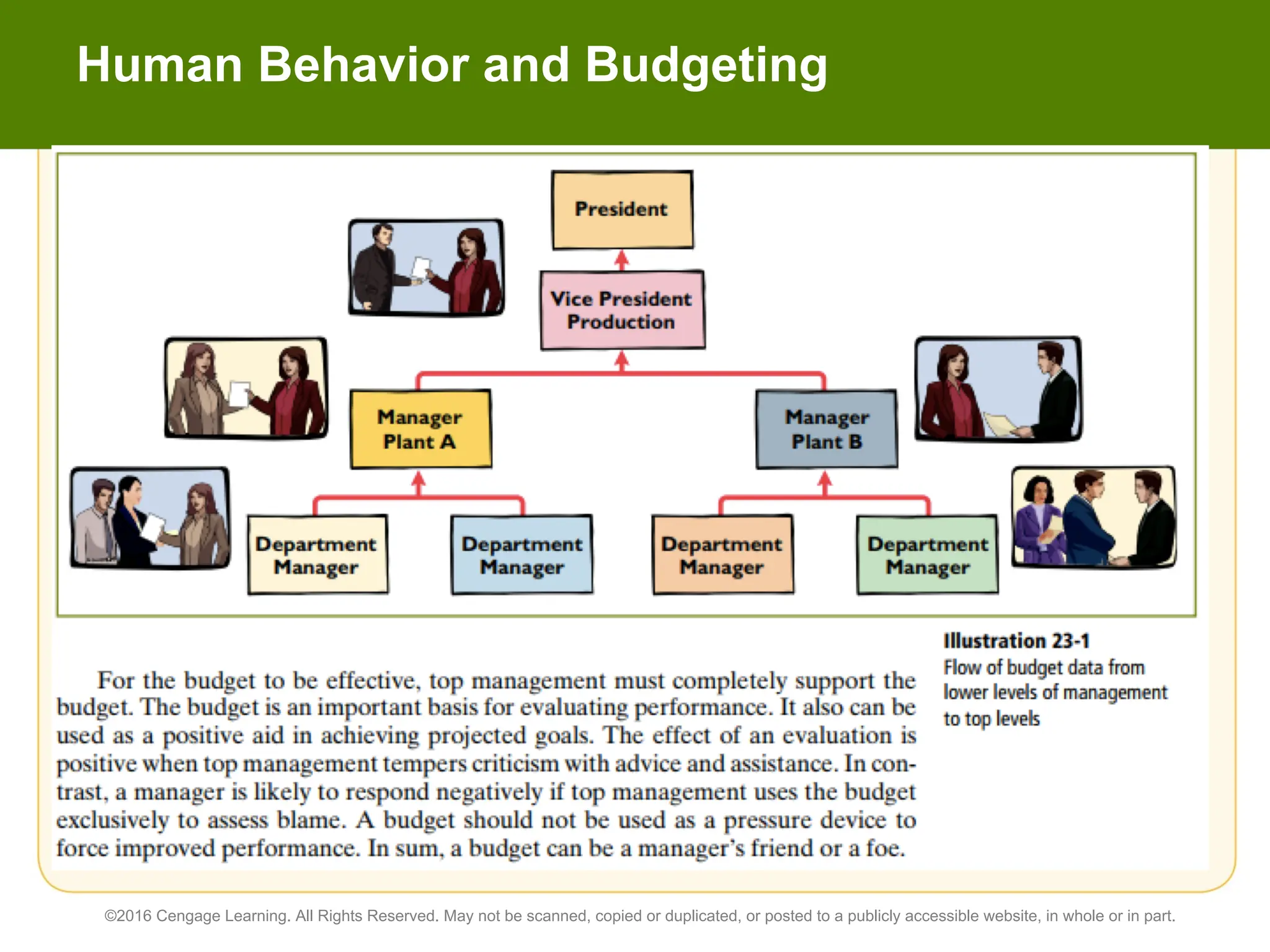
Human Behavior and Budgeting
• Human behavior problems can arise in the budgeting
process in the following situations:
o Budgeted goals are set too tight, which are very hard or
impossible to achieve.
§ It is important for employees and managers to be involved in the
budgeting process.
o Budgeted goals are set too loose, which are very easy to
achieve.
§ Such budget “padding” is called budgetary slack.
o Budgeted goals conflict with the objectives of the company
and employees.
§ Goal conflict occurs when the employees’ or managers’ self-interest
differs from the company’s objectives or goals.
©2016 Cengage Learning. All Rights Reserved. May not be scanned, copied or duplicated, or posted to a publicly accessible website, in whole or in part.
Human Behavior and Budgeting
©2016 Cengage Learning. All Rights Reserved. May not be scanned, copied or duplicated, or posted to a publicly accessible website, in whole or in part.
• The budgetary period for operating activities
normally includes the fiscal year of a company.
• For control purposes, annual budgets are usually
subdivided into shorter time periods, such as quarters
of the year, months, or weeks.
• A variation of fiscal-year budgeting, called
continuous budgeting, maintains a 12-month
projection into the future.
• The 12-month budget is continually revised by
replacing the data for the month just ended with the
budget data for the same month in the next year.
Budgeting Systems
(slide 1 of 3)
©2016 Cengage Learning. All Rights Reserved. May not be scanned, copied or duplicated, or posted to a publicly accessible website, in whole or in part.
• Developing an annual budget usually begins several
months prior to the end of the current year.
• The responsibility of developing an annual budget is
normally assigned to a budget committee.
• The budget process is monitored and summarized by
the Accounting Department, which reports to the
committee.
Budgeting Systems
(slide 2 of 3)
©2016 Cengage Learning. All Rights Reserved. May not be scanned, copied or duplicated, or posted to a publicly accessible website, in whole or in part.
• There are several methods of developing budget
estimates.
o One method, called zero-based budgeting, requires
managers to estimate sales, production, and other
operating data as though operations are being started for
the first time.
o A more common approach is to start with last year’s budget
and revise it for actual results and expected changes for
the coming year.
§ Two major budgets using this approach are the static budget and
the flexible budget.
Budgeting Systems
(slide 3 of 3)
©2016 Cengage Learning. All Rights Reserved. May not be scanned, copied or duplicated, or posted to a publicly accessible website, in whole or in part.
• A static budget shows the expected results of a
responsibility center for only one activity level. Once
the budget has been determined, it is not changed,
even if the activity changes.
• Static budgeting is used by many service companies,
government entities, and for some functions of
manufacturing companies, such as purchasing,
engineering, and accounting.
• A disadvantage of static budgets is that they do not
adjust for changes in activity levels.
Static Budget
©2016 Cengage Learning. All Rights Reserved. May not be scanned, copied or duplicated, or posted to a publicly accessible website, in whole or in part.
• Flexible budgets show the expected results of a
responsibility center for several activity levels.
• A flexible budget is constructed as follows:
o Step 1: Identify the relevant activity levels.
§ The relevant levels of activity could be expressed in units, machine
hours, direct labor hours, or some other activity base.
o Step 2: Identify the fixed and variable cost components of
the costs being budgeted.
o Step 3: Prepare the budget for each activity level by
multiplying the variable cost per unit by the activity level
and then adding the monthly fixed cost.
Flexible Budget
©2016 Cengage Learning. All Rights Reserved. May not be scanned, copied or duplicated, or posted to a publicly accessible website, in whole or in part.
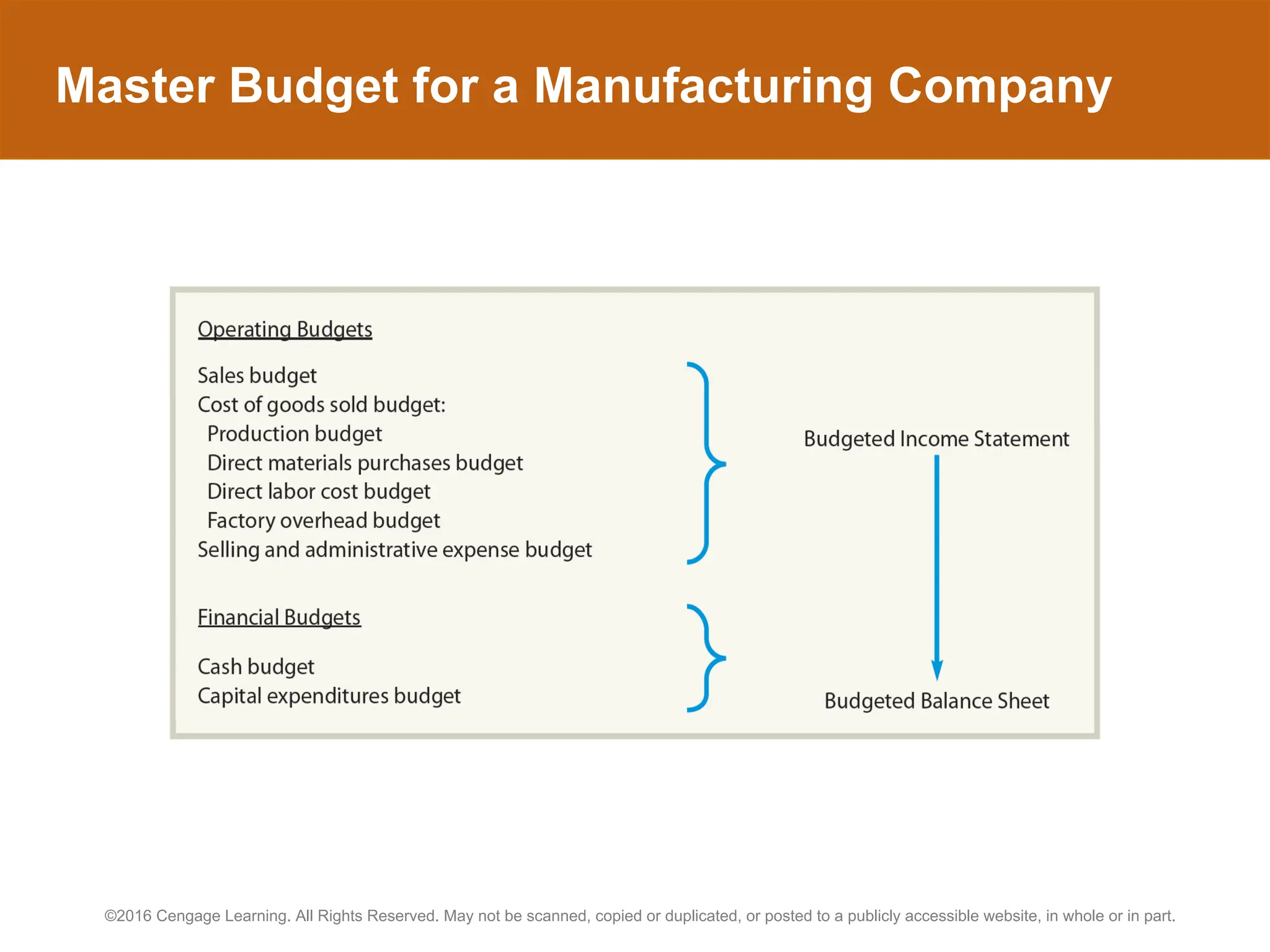
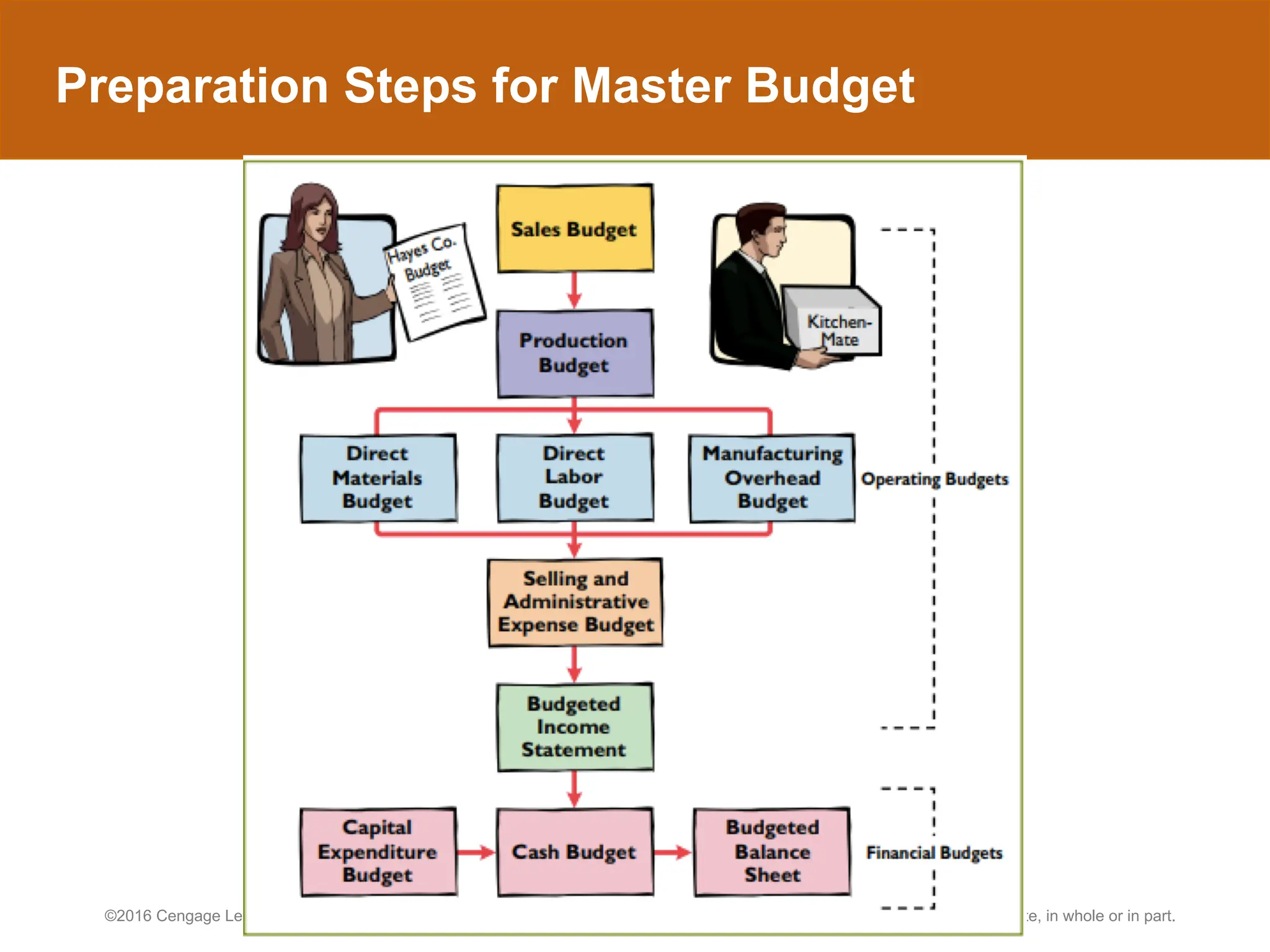
• The master budget is an integrated set of operating
and financing budgets for a period of time.
o The operating budgets can be used to prepare a budgeted
income statement.
o The financial budgets provide information for a budgeted
balance sheet.
• Most companies prepare a master budget on a
yearly basis.
Master Budget
©2016 Cengage Learning. All Rights Reserved. May not be scanned, copied or duplicated, or posted to a publicly accessible website, in whole or in part.
Master Budget for a Manufacturing Company
©2016 Cengage Learning. All Rights Reserved. May not be scanned, copied or duplicated, or posted to a publicly accessible website, in whole or in part.
Preparation Steps for Master Budget
©2016 Cengage Learning. All Rights Reserved. May not be scanned, copied or duplicated, or posted to a publicly accessible website, in whole or in part.
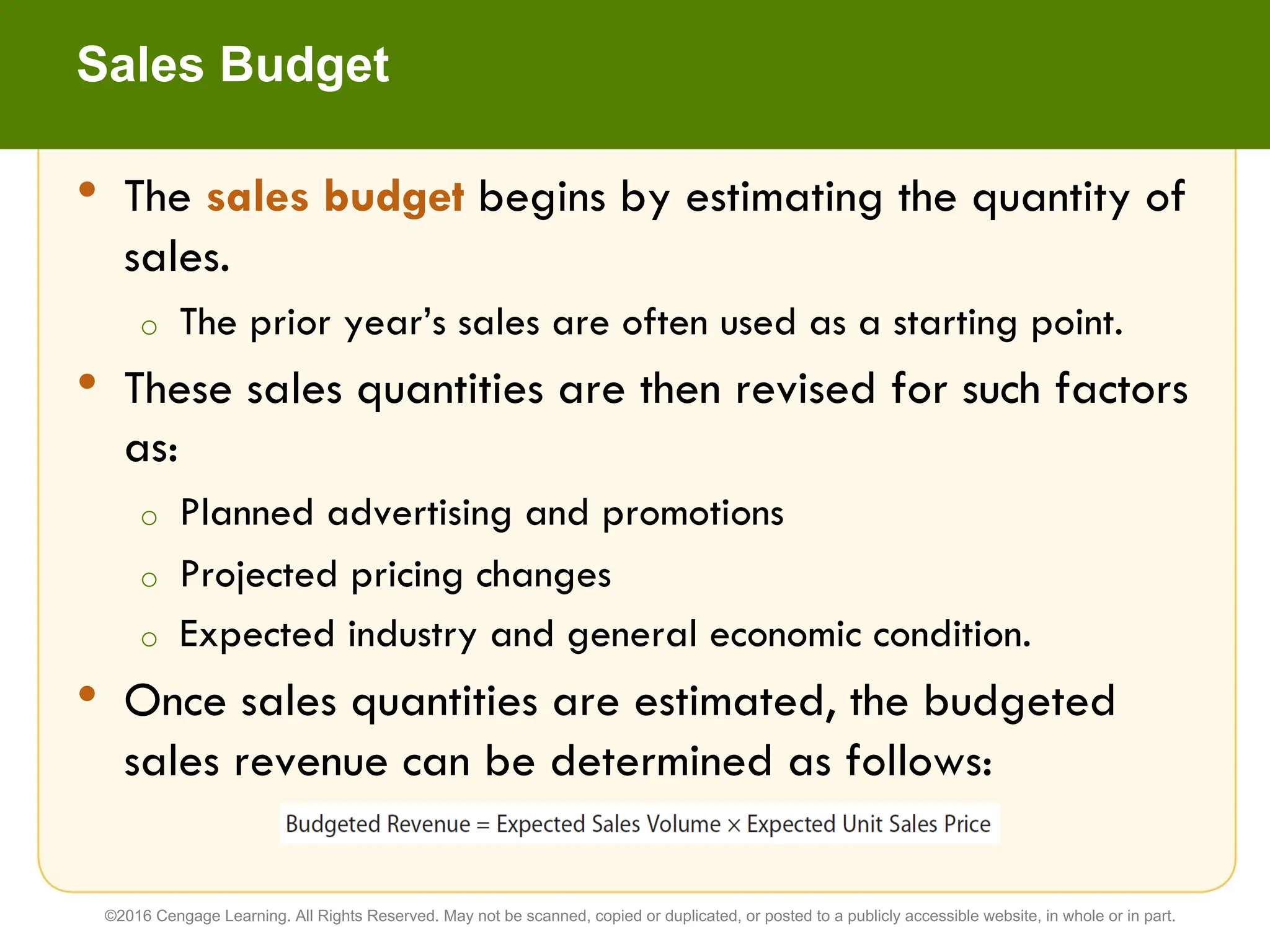
• The sales budget begins by estimating the quantity of
sales.
o The prior year’s sales are often used as a starting point.
• These sales quantities are then revised for such factors
as:
o Planned advertising and promotions
o Projected pricing changes
o Expected industry and general economic condition.
• Once sales quantities are estimated, the budgeted
sales revenue can be determined as follows:
Sales Budget
©2016 Cengage Learning. All Rights Reserved. May not be scanned, copied or duplicated, or posted to a publicly accessible website, in whole or in part.
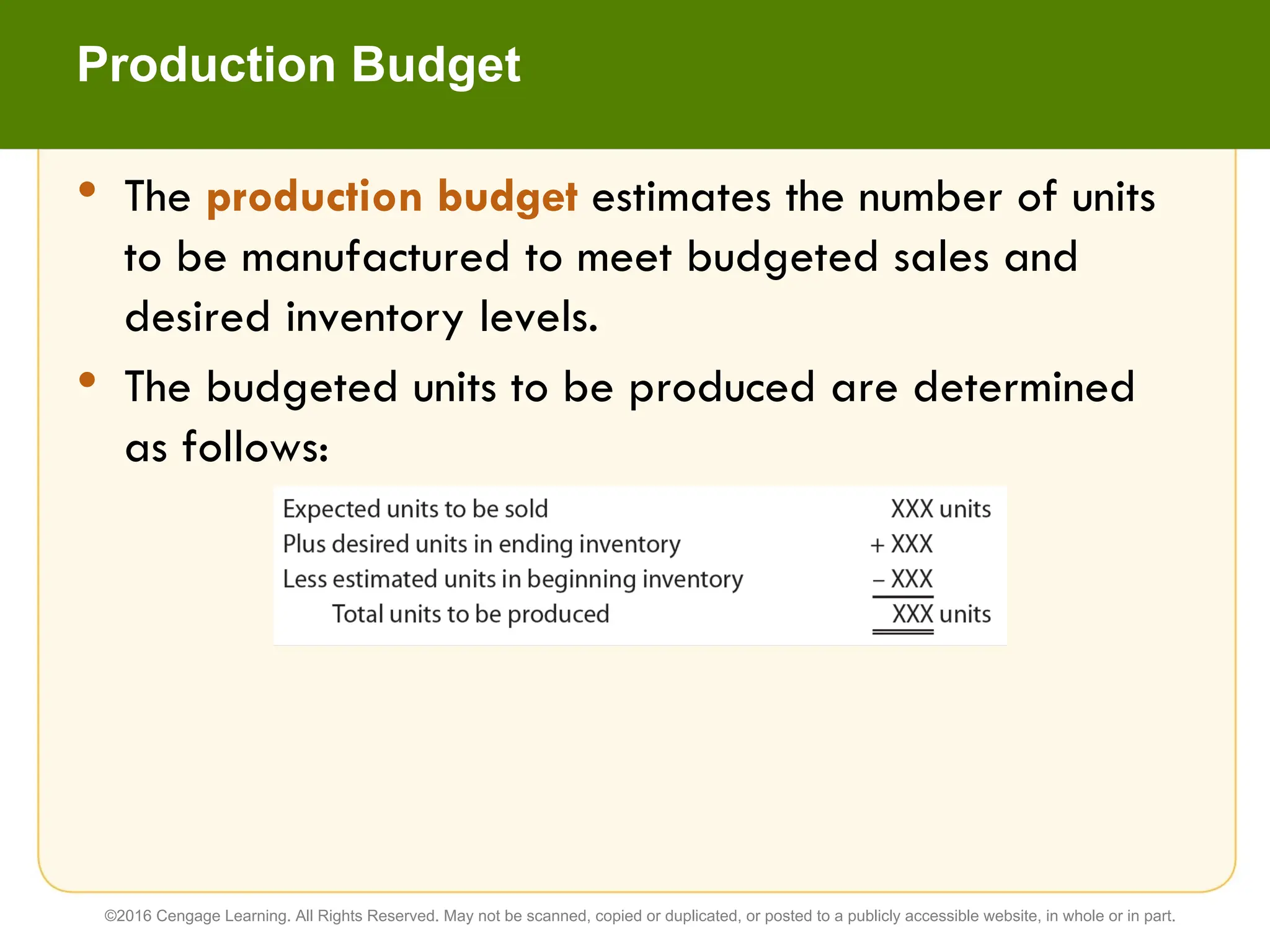
• The production budget estimates the number of units
to be manufactured to meet budgeted sales and
desired inventory levels.
• The budgeted units to be produced are determined
as follows:
Production Budget
©2016 Cengage Learning. All Rights Reserved. May not be scanned, copied or duplicated, or posted to a publicly accessible website, in whole or in part.
• The direct materials purchases budget estimates the
quantities of direct materials to be purchased to
support budgeted production and desired inventory
levels.
Direct Materials Purchases Budget
(slide 1 of 2)
©2016 Cengage Learning. All Rights Reserved. May not be scanned, copied or duplicated, or posted to a publicly accessible website, in whole or in part.
Direct Materials Purchases Budget
(slide 2 of 2)
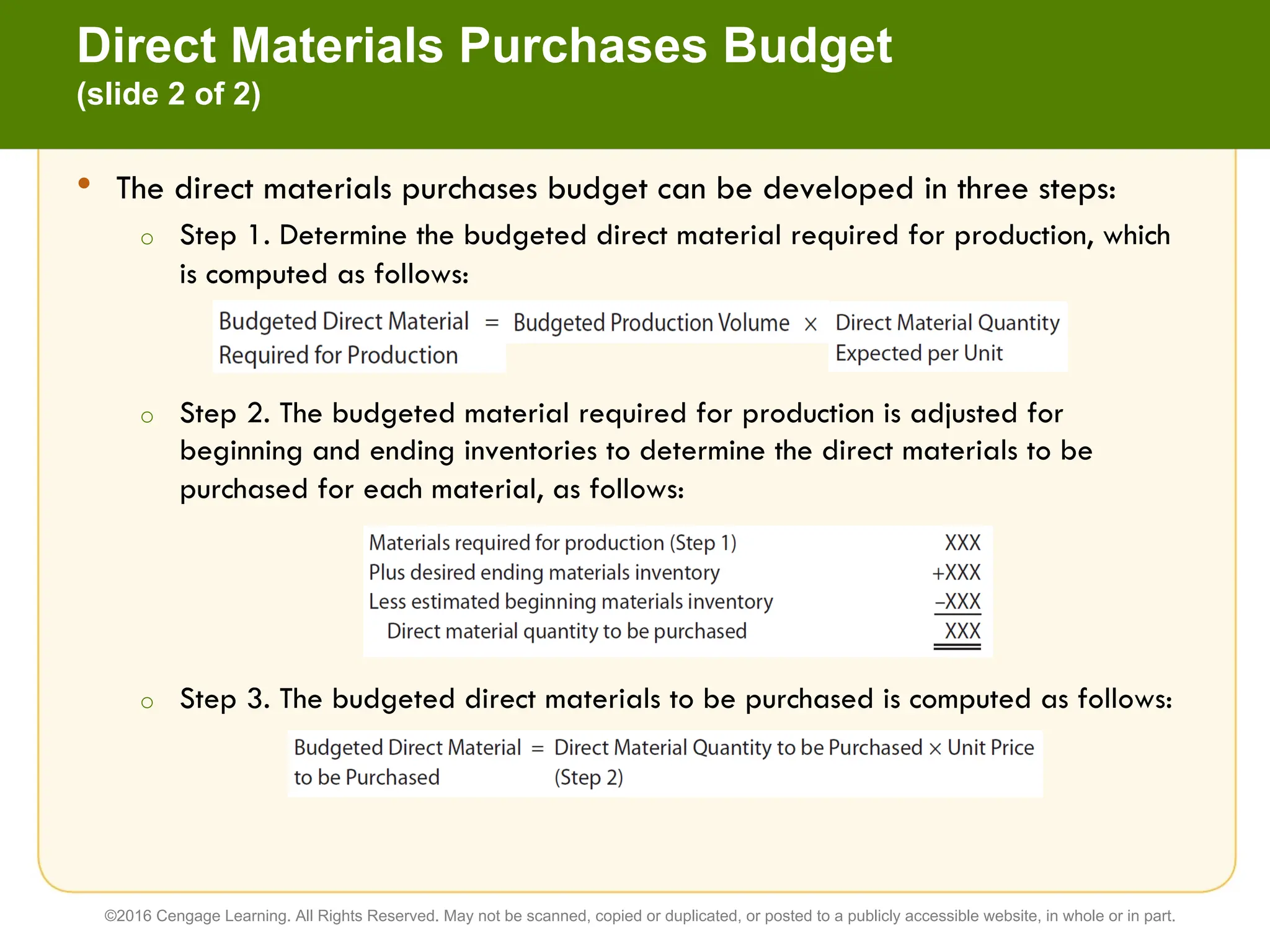
• The direct materials purchases budget can be developed in three steps:
o Step 1. Determine the budgeted direct material required for production, which
is computed as follows:
o Step 2. The budgeted material required for production is adjusted for
beginning and ending inventories to determine the direct materials to be
purchased for each material, as follows:
o Step 3. The budgeted direct materials to be purchased is computed as follows:
©2016 Cengage Learning. All Rights Reserved. May not be scanned, copied or duplicated, or posted to a publicly accessible website, in whole or in part.
Direct Labor Cost Budget
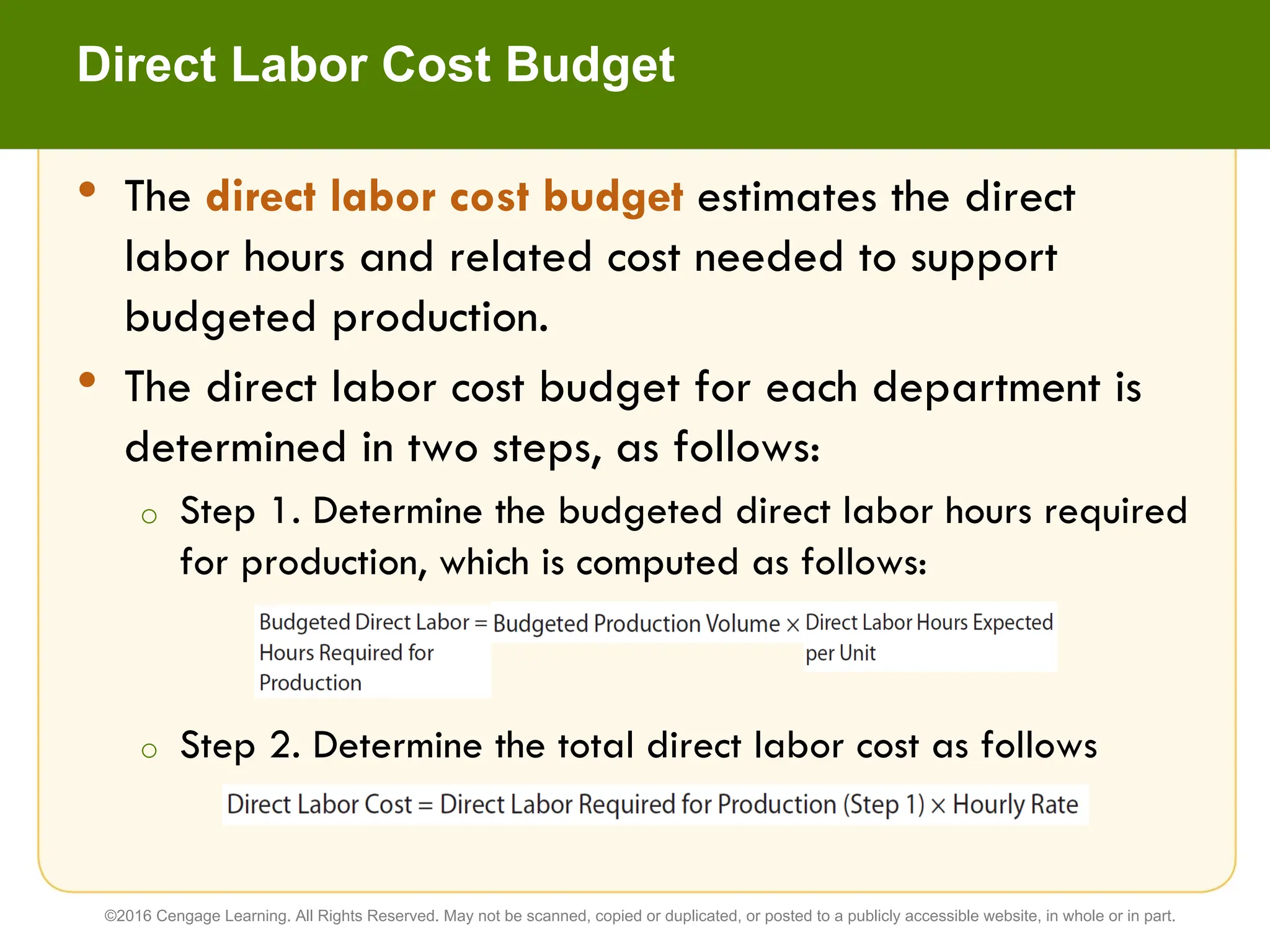
• The direct labor cost budget estimates the direct
labor hours and related cost needed to support
budgeted production.
• The direct labor cost budget for each department is
determined in two steps, as follows:
o Step 1. Determine the budgeted direct labor hours required
for production, which is computed as follows:
o Step 2. Determine the total direct labor cost as follows
©2016 Cengage Learning. All Rights Reserved. May not be scanned, copied or duplicated, or posted to a publicly accessible website, in whole or in part.
• The factory overhead cost budget estimates the cost
for each item of factory overhead needed to support
budgeted production.
• The factory overhead cost budget may be supported
by departmental schedules.
o Such schedules normally separate factory overhead costs
into fixed and variable costs to better enable department
managers to monitor and evaluate costs during the year.
Factory Overhead Cost Budget
©2016 Cengage Learning. All Rights Reserved. May not be scanned, copied or duplicated, or posted to a publicly accessible website, in whole or in part.
• The cost of goods sold budget is prepared by
integrating the following budgets:
o Direct materials purchases budget
o Direct labor cost budget
o Factory overhead cost budget
• The estimated and desired inventories for direct
materials, work in process, and finished goods must be
integrated into the cost of goods sold budget.
Cost of Goods Sold Budget
©2016 Cengage Learning. All Rights Reserved. May not be scanned, copied or duplicated, or posted to a publicly accessible website, in whole or in part.
• The sales budget is often used as the starting point for
the selling and administrative expenses budget.
• The selling and administrative expenses budget is
normally supported by departmental schedules.
Selling and Administrative Expenses Budget
©2016 Cengage Learning. All Rights Reserved. May not be scanned, copied or duplicated, or posted to a publicly accessible website, in whole or in part.
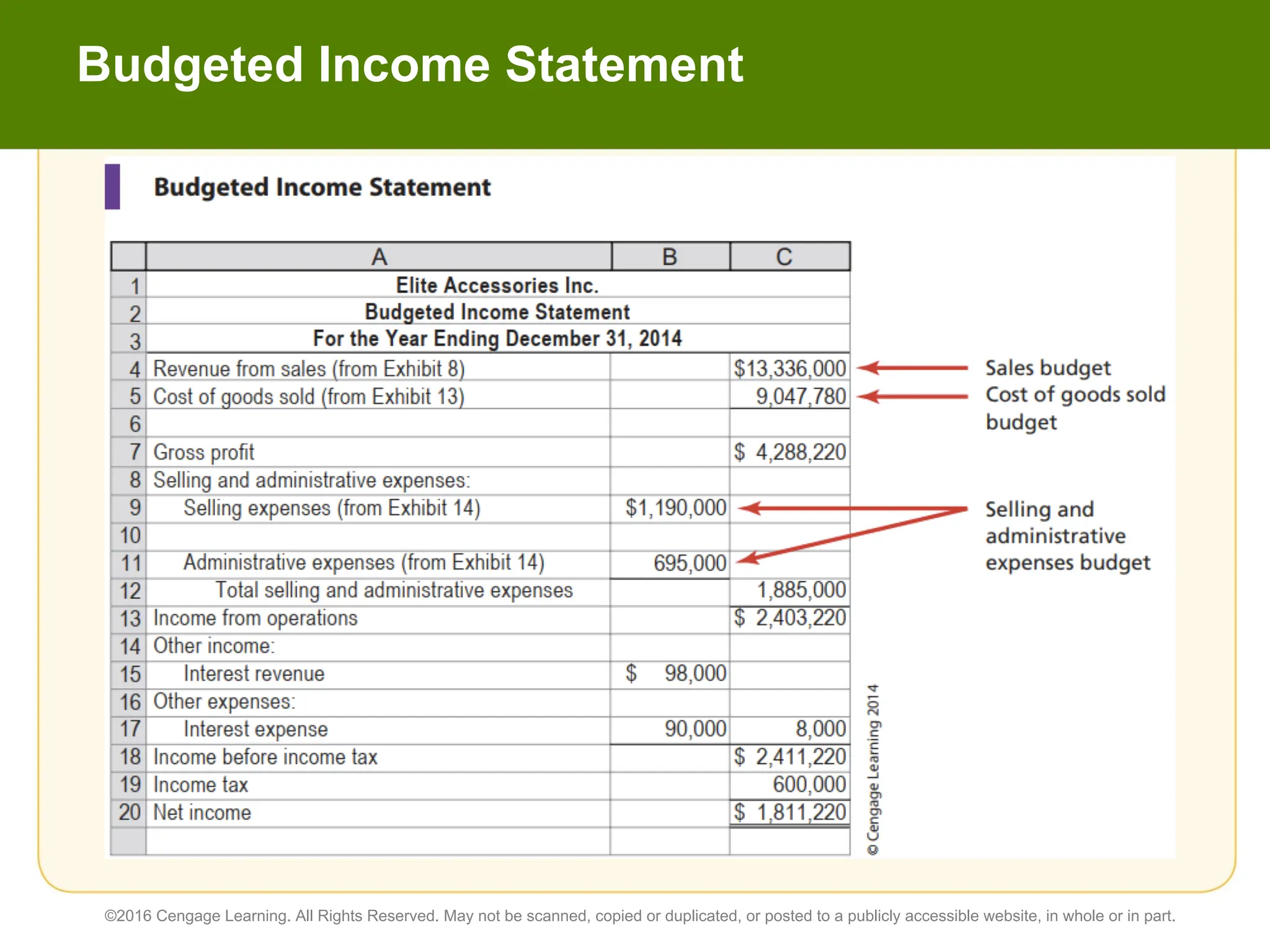
• The budgeted income statement is prepared by
integrating the following budgets:
o Sales budget
o Cost of goods sold budget
o Selling and administrative expenses budget
• In addition, estimates of other income, other expense,
and income tax are also integrated into the budgeted
income statement.
• This budget summarizes the budgeted operating
activities of the company.
Budgeted Income Statement
©2016 Cengage Learning. All Rights Reserved. May not be scanned, copied or duplicated, or posted to a publicly accessible website, in whole or in part.
Budgeted Income Statement
©2016 Cengage Learning. All Rights Reserved. May not be scanned, copied or duplicated, or posted to a publicly accessible website, in whole or in part.
• The cash budget estimates the expected receipts
(inflows) and payments (outflows) of cash for a period
of time.
o The primary source of estimated cash receipts is from cash
sales and collections on account.
o In addition, cash receipts may be obtained from plans to
issue equity or debt financing as well as other sources such
as interest revenue.
o To estimate cash receipts from cash sales and collections on
account, a schedule of collections from sales is prepared.
Cash Budget
(Slide 1 of 2)
©2016 Cengage Learning. All Rights Reserved. May not be scanned, copied or duplicated, or posted to a publicly accessible website, in whole or in part.
o Estimated cash payments must be budgeted for operating
costs and expenses such as manufacturing costs, selling
expenses, and administrative expenses.
o In addition, estimated cash payments may be planned for
capital expenditures, dividends, interest payments, or long-
term debt payments.
o To estimate cash payments for manufacturing costs, a
schedule of payments for manufacturing costs is prepared.
Cash Budget
(Slide 2 of 2)
©2016 Cengage Learning. All Rights Reserved. May not be scanned, copied or duplicated, or posted to a publicly accessible website, in whole or in part.
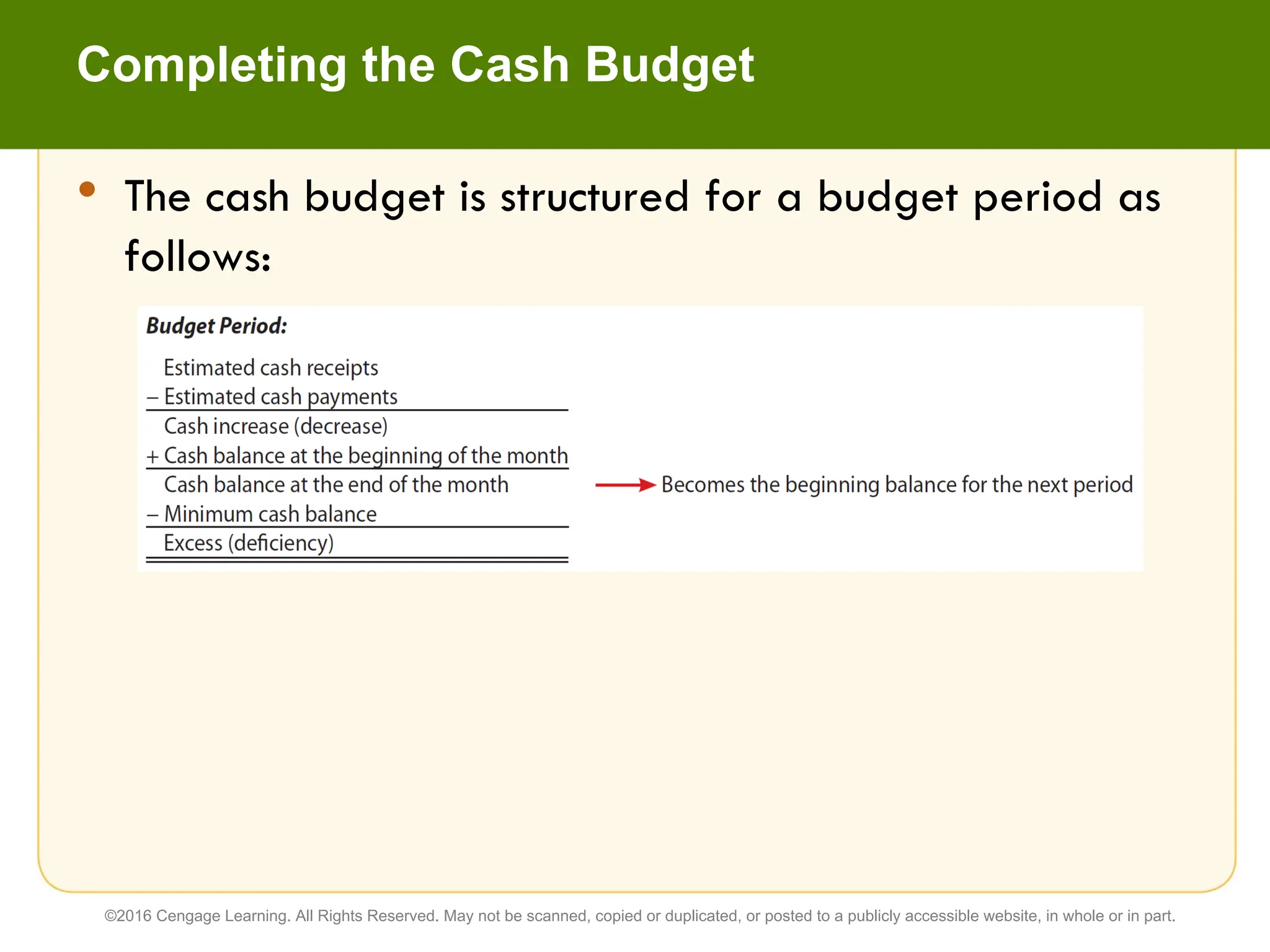
• The cash budget is structured for a budget period as
follows:
Completing the Cash Budget
©2016 Cengage Learning. All Rights Reserved. May not be scanned, copied or duplicated, or posted to a publicly accessible website, in whole or in part.
• The capital expenditures budget summarizes plans
for acquiring fixed assets.
o Such expenditures are necessary as machinery and other
fixed assets wear out or become obsolete.
o In addition, purchasing additional fixed assets may be
necessary to meet increasing demand for the company’s
product.
• Capital expenditures budgets are often prepared for
five to ten years into the future.
o This is necessary because fixed assets often must be
ordered years in advance.
Capital Expenditures Budget
©2016 Cengage Learning. All Rights Reserved. May not be scanned, copied or duplicated, or posted to a publicly accessible website, in whole or in part.
• The budgeted balance sheet is prepared based on
the operating and financial budgets of the master
budget.
• The budgeted balance sheet is dated as of the end of
the budget period and is similar to a normal balance
sheet except that estimated amounts are used.
Budgeted Balance Sheet
©2016 Cengage Learning. All Rights Reserved. May not be scanned, copied or duplicated, or posted to a publicly accessible website, in whole or in part.

Accounting Principles Chapter 22_Budgeting.pdf

  • 1.
    Warren Reeve Duchac Accounting 26e Budgeting 22 C H AP T E R human/iStock/360/Getty Images
  • 2.
    • Budgets playan important role for organizations of all sizes and forms. o For example, budgets are used in managing the operations of government agencies, churches, hospitals, and other nonprofit organizations. • This chapter describes and illustrates budgeting for a manufacturing company. Nature and Objectives of Budgeting ©2016 Cengage Learning. All Rights Reserved. May not be scanned, copied or duplicated, or posted to a publicly accessible website, in whole or in part.
  • 3.
    • Budgeting affectsthe following managerial functions: o Planning § Planning involves setting goals to guide decisions and help motivate employees. o Directing § Directing involves decisions and actions to achieve budgeted goals. – A budgetary unit of a company is called a responsibility center. § Each responsibility center is led by a manager who has the authority and responsibility for achieving the center’s budgeted goals. o Controlling § Controlling involves comparing actual performance against the budgeted goals. Objectives of Budgeting ©2016 Cengage Learning. All Rights Reserved. May not be scanned, copied or duplicated, or posted to a publicly accessible website, in whole or in part.
  • 4.
    Human Behavior andBudgeting • Human behavior problems can arise in the budgeting process in the following situations: o Budgeted goals are set too tight, which are very hard or impossible to achieve. § It is important for employees and managers to be involved in the budgeting process. o Budgeted goals are set too loose, which are very easy to achieve. § Such budget “padding” is called budgetary slack. o Budgeted goals conflict with the objectives of the company and employees. § Goal conflict occurs when the employees’ or managers’ self-interest differs from the company’s objectives or goals. ©2016 Cengage Learning. All Rights Reserved. May not be scanned, copied or duplicated, or posted to a publicly accessible website, in whole or in part.
  • 5.
    Human Behavior andBudgeting ©2016 Cengage Learning. All Rights Reserved. May not be scanned, copied or duplicated, or posted to a publicly accessible website, in whole or in part.
  • 6.
    • The budgetaryperiod for operating activities normally includes the fiscal year of a company. • For control purposes, annual budgets are usually subdivided into shorter time periods, such as quarters of the year, months, or weeks. • A variation of fiscal-year budgeting, called continuous budgeting, maintains a 12-month projection into the future. • The 12-month budget is continually revised by replacing the data for the month just ended with the budget data for the same month in the next year. Budgeting Systems (slide 1 of 3) ©2016 Cengage Learning. All Rights Reserved. May not be scanned, copied or duplicated, or posted to a publicly accessible website, in whole or in part.
  • 7.
    • Developing anannual budget usually begins several months prior to the end of the current year. • The responsibility of developing an annual budget is normally assigned to a budget committee. • The budget process is monitored and summarized by the Accounting Department, which reports to the committee. Budgeting Systems (slide 2 of 3) ©2016 Cengage Learning. All Rights Reserved. May not be scanned, copied or duplicated, or posted to a publicly accessible website, in whole or in part.
  • 8.
    • There areseveral methods of developing budget estimates. o One method, called zero-based budgeting, requires managers to estimate sales, production, and other operating data as though operations are being started for the first time. o A more common approach is to start with last year’s budget and revise it for actual results and expected changes for the coming year. § Two major budgets using this approach are the static budget and the flexible budget. Budgeting Systems (slide 3 of 3) ©2016 Cengage Learning. All Rights Reserved. May not be scanned, copied or duplicated, or posted to a publicly accessible website, in whole or in part.
  • 9.
    • A staticbudget shows the expected results of a responsibility center for only one activity level. Once the budget has been determined, it is not changed, even if the activity changes. • Static budgeting is used by many service companies, government entities, and for some functions of manufacturing companies, such as purchasing, engineering, and accounting. • A disadvantage of static budgets is that they do not adjust for changes in activity levels. Static Budget ©2016 Cengage Learning. All Rights Reserved. May not be scanned, copied or duplicated, or posted to a publicly accessible website, in whole or in part.
  • 10.
    • Flexible budgetsshow the expected results of a responsibility center for several activity levels. • A flexible budget is constructed as follows: o Step 1: Identify the relevant activity levels. § The relevant levels of activity could be expressed in units, machine hours, direct labor hours, or some other activity base. o Step 2: Identify the fixed and variable cost components of the costs being budgeted. o Step 3: Prepare the budget for each activity level by multiplying the variable cost per unit by the activity level and then adding the monthly fixed cost. Flexible Budget ©2016 Cengage Learning. All Rights Reserved. May not be scanned, copied or duplicated, or posted to a publicly accessible website, in whole or in part.
  • 11.
    • The masterbudget is an integrated set of operating and financing budgets for a period of time. o The operating budgets can be used to prepare a budgeted income statement. o The financial budgets provide information for a budgeted balance sheet. • Most companies prepare a master budget on a yearly basis. Master Budget ©2016 Cengage Learning. All Rights Reserved. May not be scanned, copied or duplicated, or posted to a publicly accessible website, in whole or in part.
  • 12.
    Master Budget fora Manufacturing Company ©2016 Cengage Learning. All Rights Reserved. May not be scanned, copied or duplicated, or posted to a publicly accessible website, in whole or in part.
  • 13.
    Preparation Steps forMaster Budget ©2016 Cengage Learning. All Rights Reserved. May not be scanned, copied or duplicated, or posted to a publicly accessible website, in whole or in part.
  • 14.
    • The salesbudget begins by estimating the quantity of sales. o The prior year’s sales are often used as a starting point. • These sales quantities are then revised for such factors as: o Planned advertising and promotions o Projected pricing changes o Expected industry and general economic condition. • Once sales quantities are estimated, the budgeted sales revenue can be determined as follows: Sales Budget ©2016 Cengage Learning. All Rights Reserved. May not be scanned, copied or duplicated, or posted to a publicly accessible website, in whole or in part.
  • 15.
    • The productionbudget estimates the number of units to be manufactured to meet budgeted sales and desired inventory levels. • The budgeted units to be produced are determined as follows: Production Budget ©2016 Cengage Learning. All Rights Reserved. May not be scanned, copied or duplicated, or posted to a publicly accessible website, in whole or in part.
  • 16.
    • The directmaterials purchases budget estimates the quantities of direct materials to be purchased to support budgeted production and desired inventory levels. Direct Materials Purchases Budget (slide 1 of 2) ©2016 Cengage Learning. All Rights Reserved. May not be scanned, copied or duplicated, or posted to a publicly accessible website, in whole or in part.
  • 17.
    Direct Materials PurchasesBudget (slide 2 of 2) • The direct materials purchases budget can be developed in three steps: o Step 1. Determine the budgeted direct material required for production, which is computed as follows: o Step 2. The budgeted material required for production is adjusted for beginning and ending inventories to determine the direct materials to be purchased for each material, as follows: o Step 3. The budgeted direct materials to be purchased is computed as follows: ©2016 Cengage Learning. All Rights Reserved. May not be scanned, copied or duplicated, or posted to a publicly accessible website, in whole or in part.
  • 18.
    Direct Labor CostBudget • The direct labor cost budget estimates the direct labor hours and related cost needed to support budgeted production. • The direct labor cost budget for each department is determined in two steps, as follows: o Step 1. Determine the budgeted direct labor hours required for production, which is computed as follows: o Step 2. Determine the total direct labor cost as follows ©2016 Cengage Learning. All Rights Reserved. May not be scanned, copied or duplicated, or posted to a publicly accessible website, in whole or in part.
  • 19.
    • The factoryoverhead cost budget estimates the cost for each item of factory overhead needed to support budgeted production. • The factory overhead cost budget may be supported by departmental schedules. o Such schedules normally separate factory overhead costs into fixed and variable costs to better enable department managers to monitor and evaluate costs during the year. Factory Overhead Cost Budget ©2016 Cengage Learning. All Rights Reserved. May not be scanned, copied or duplicated, or posted to a publicly accessible website, in whole or in part.
  • 20.
    • The costof goods sold budget is prepared by integrating the following budgets: o Direct materials purchases budget o Direct labor cost budget o Factory overhead cost budget • The estimated and desired inventories for direct materials, work in process, and finished goods must be integrated into the cost of goods sold budget. Cost of Goods Sold Budget ©2016 Cengage Learning. All Rights Reserved. May not be scanned, copied or duplicated, or posted to a publicly accessible website, in whole or in part.
  • 21.
    • The salesbudget is often used as the starting point for the selling and administrative expenses budget. • The selling and administrative expenses budget is normally supported by departmental schedules. Selling and Administrative Expenses Budget ©2016 Cengage Learning. All Rights Reserved. May not be scanned, copied or duplicated, or posted to a publicly accessible website, in whole or in part.
  • 22.
    • The budgetedincome statement is prepared by integrating the following budgets: o Sales budget o Cost of goods sold budget o Selling and administrative expenses budget • In addition, estimates of other income, other expense, and income tax are also integrated into the budgeted income statement. • This budget summarizes the budgeted operating activities of the company. Budgeted Income Statement ©2016 Cengage Learning. All Rights Reserved. May not be scanned, copied or duplicated, or posted to a publicly accessible website, in whole or in part.
  • 23.
    Budgeted Income Statement ©2016Cengage Learning. All Rights Reserved. May not be scanned, copied or duplicated, or posted to a publicly accessible website, in whole or in part.
  • 24.
    • The cashbudget estimates the expected receipts (inflows) and payments (outflows) of cash for a period of time. o The primary source of estimated cash receipts is from cash sales and collections on account. o In addition, cash receipts may be obtained from plans to issue equity or debt financing as well as other sources such as interest revenue. o To estimate cash receipts from cash sales and collections on account, a schedule of collections from sales is prepared. Cash Budget (Slide 1 of 2) ©2016 Cengage Learning. All Rights Reserved. May not be scanned, copied or duplicated, or posted to a publicly accessible website, in whole or in part.
  • 25.
    o Estimated cashpayments must be budgeted for operating costs and expenses such as manufacturing costs, selling expenses, and administrative expenses. o In addition, estimated cash payments may be planned for capital expenditures, dividends, interest payments, or long- term debt payments. o To estimate cash payments for manufacturing costs, a schedule of payments for manufacturing costs is prepared. Cash Budget (Slide 2 of 2) ©2016 Cengage Learning. All Rights Reserved. May not be scanned, copied or duplicated, or posted to a publicly accessible website, in whole or in part.
  • 26.
    • The cashbudget is structured for a budget period as follows: Completing the Cash Budget ©2016 Cengage Learning. All Rights Reserved. May not be scanned, copied or duplicated, or posted to a publicly accessible website, in whole or in part.
  • 27.
    • The capitalexpenditures budget summarizes plans for acquiring fixed assets. o Such expenditures are necessary as machinery and other fixed assets wear out or become obsolete. o In addition, purchasing additional fixed assets may be necessary to meet increasing demand for the company’s product. • Capital expenditures budgets are often prepared for five to ten years into the future. o This is necessary because fixed assets often must be ordered years in advance. Capital Expenditures Budget ©2016 Cengage Learning. All Rights Reserved. May not be scanned, copied or duplicated, or posted to a publicly accessible website, in whole or in part.
  • 28.
    • The budgetedbalance sheet is prepared based on the operating and financial budgets of the master budget. • The budgeted balance sheet is dated as of the end of the budget period and is similar to a normal balance sheet except that estimated amounts are used. Budgeted Balance Sheet ©2016 Cengage Learning. All Rights Reserved. May not be scanned, copied or duplicated, or posted to a publicly accessible website, in whole or in part.