Budgeting and Profit
Planning
Chapter
two
BUDGETING BASICS
 A formal written statement of management’s
plans for a specified future time period,
expressed in financial terms
 Primary way to communicate agreed-upon
objectives to all parts of the company
 Promotes efficiency
 Control device - important basis for performance
evaluation once adopted
BUDGETING BASICS
Benefits of Budgeting
Requires all levels of management to plan
ahead and formalize goals on a
recurring basis
Provides definite objectives for evaluating
performance at each level of
responsibility
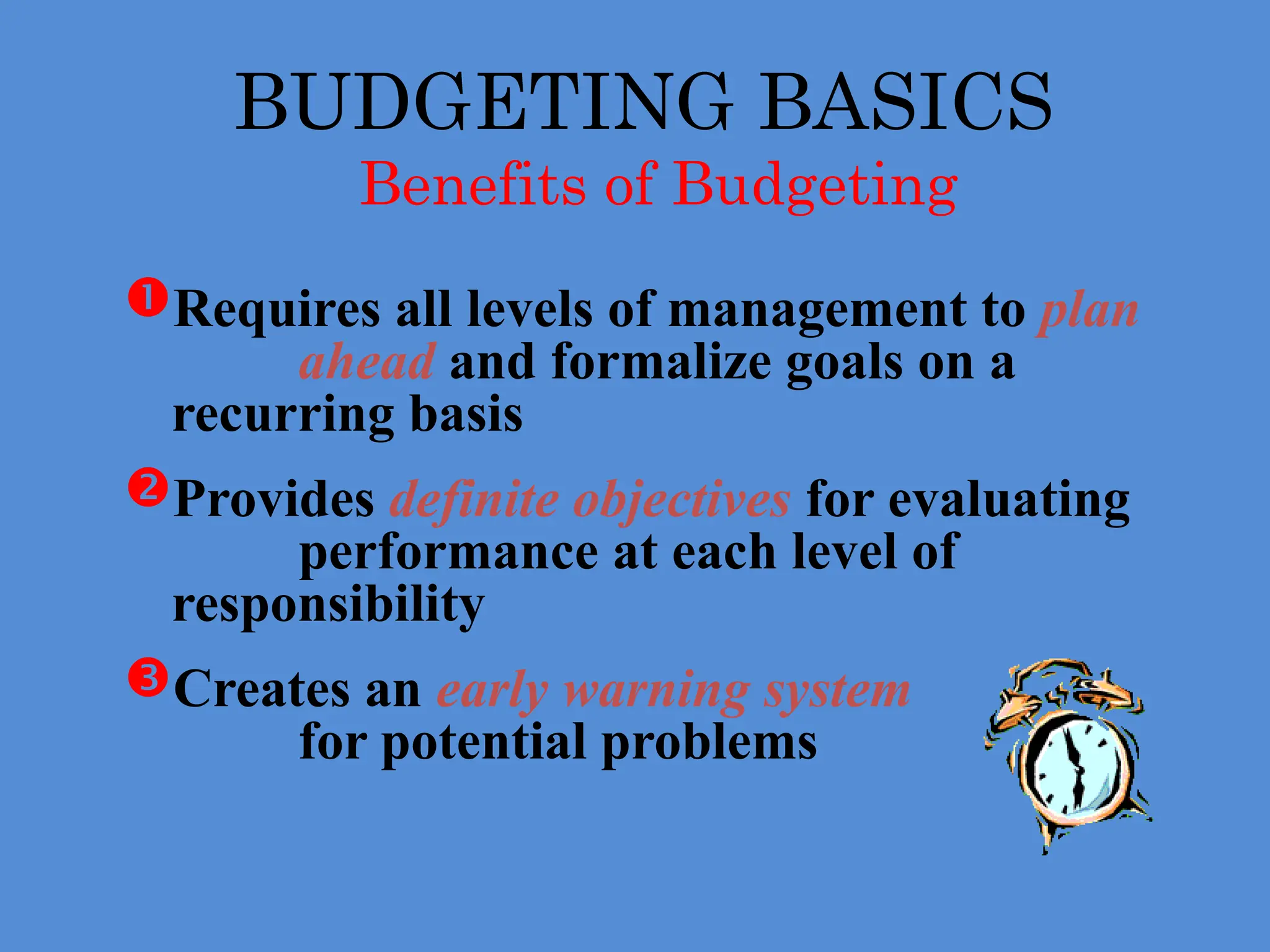
Creates an early warning system
for potential problems
BUDGETING BASICS
Benefits of Budgeting
Facilitates coordination of activities
within the business
Results in greater management
awareness of the entity’s overall
operations and the impact of
external factors
Motivates personnel throughout
organization to meet planned
objectives
BUDGETING BASICS
Role of Accounting
 Historical accounting data on
revenues, costs, and expenses
help in formulating future
budgets
 Accountants are normally
responsible for presenting
management’s budgeting goals in
financial terms
 The budget and its
administration are, however,
entirely management’s
responsibility
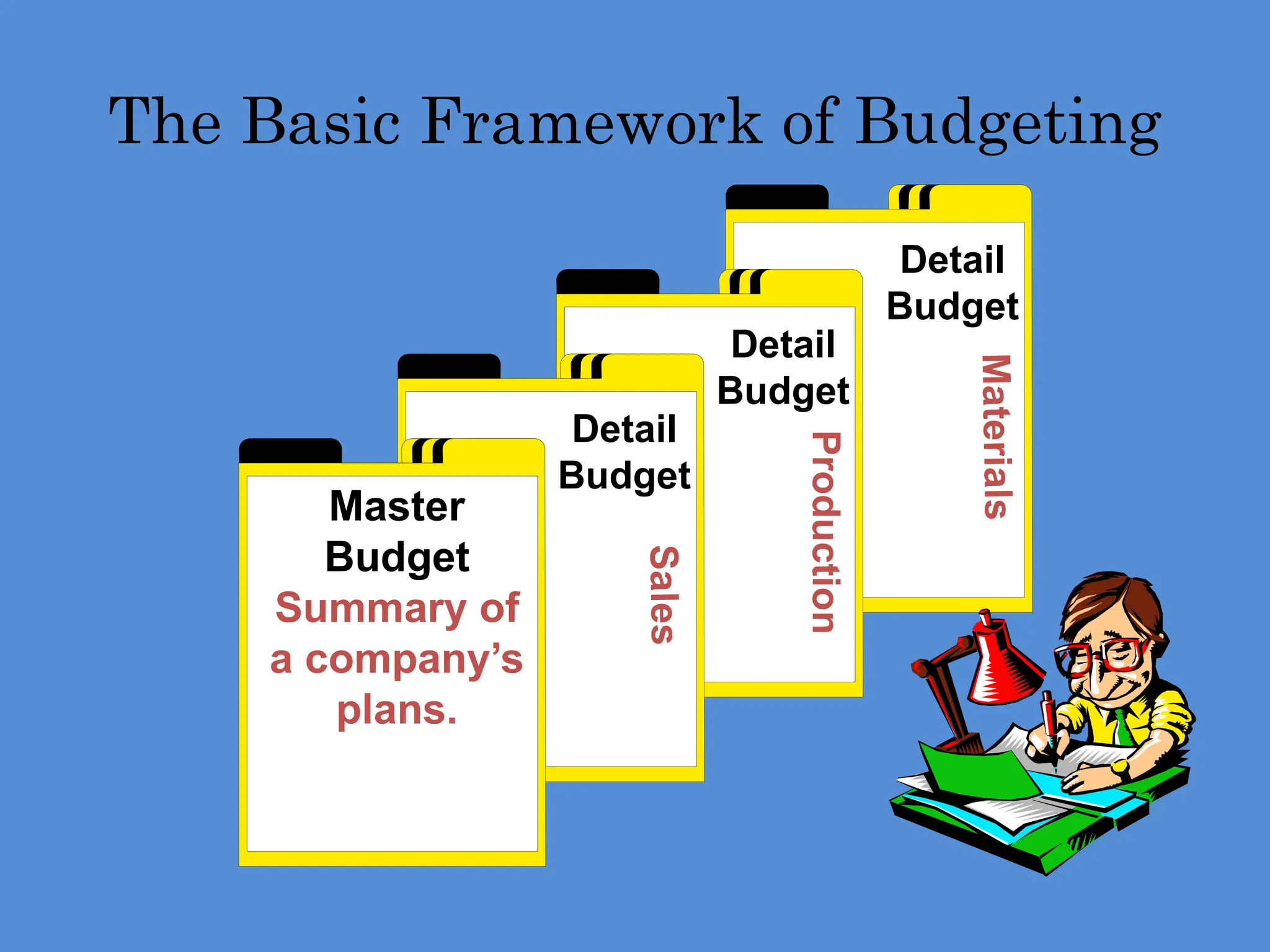
The Basic Framework of Budgeting
Detail
Budget
Detail
Budget
Detail
Budget
Master
Budget
Summary of
a company’s
plans.
Sal
es
Production
Mat
eri
als
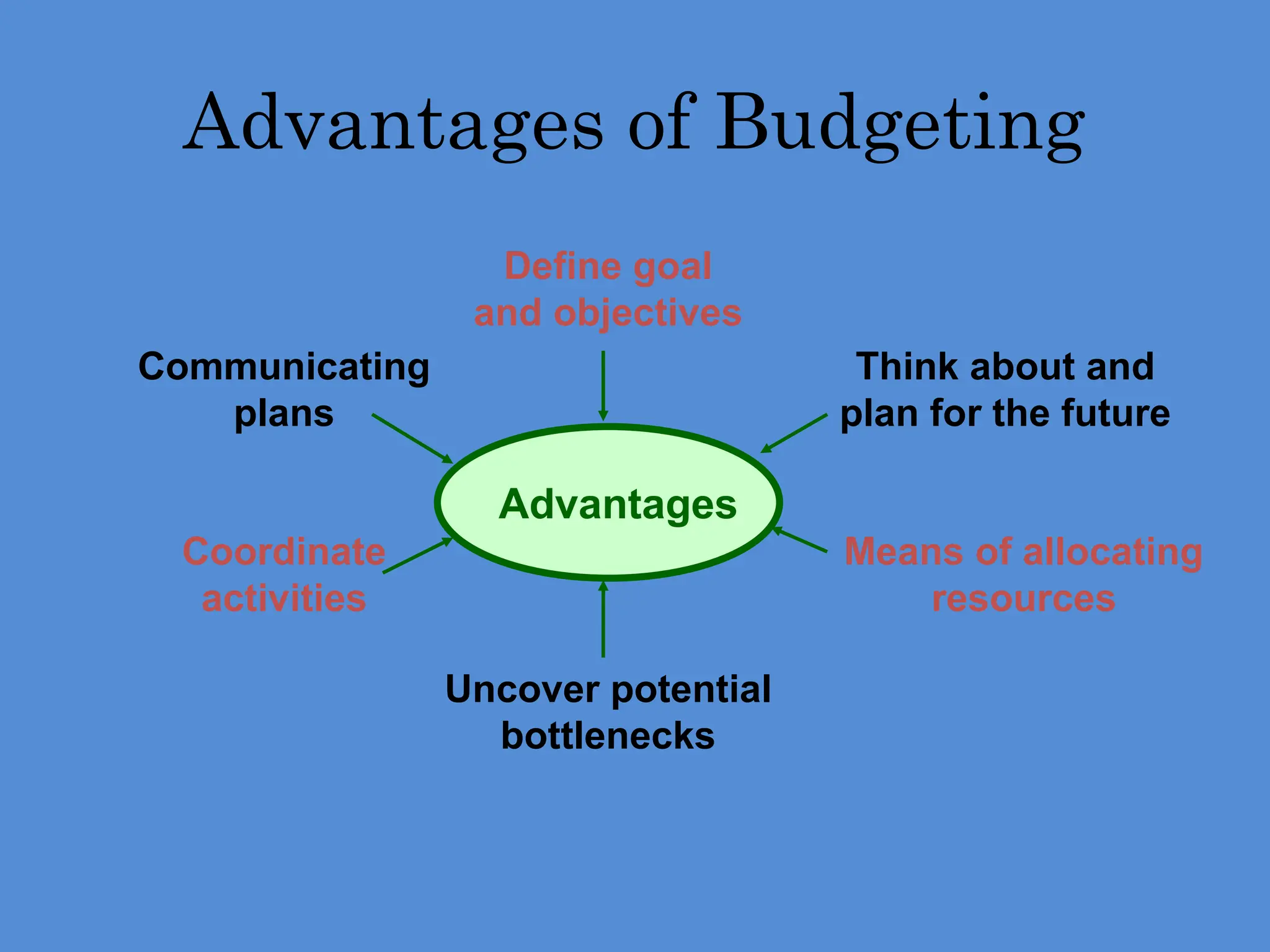
Advantages of Budgeting
Advantages
Communicating
plans
Think about and
plan for the future
Means of allocating
resources
Uncover potential
bottlenecks
Coordinate
activities
Define goal
and objectives
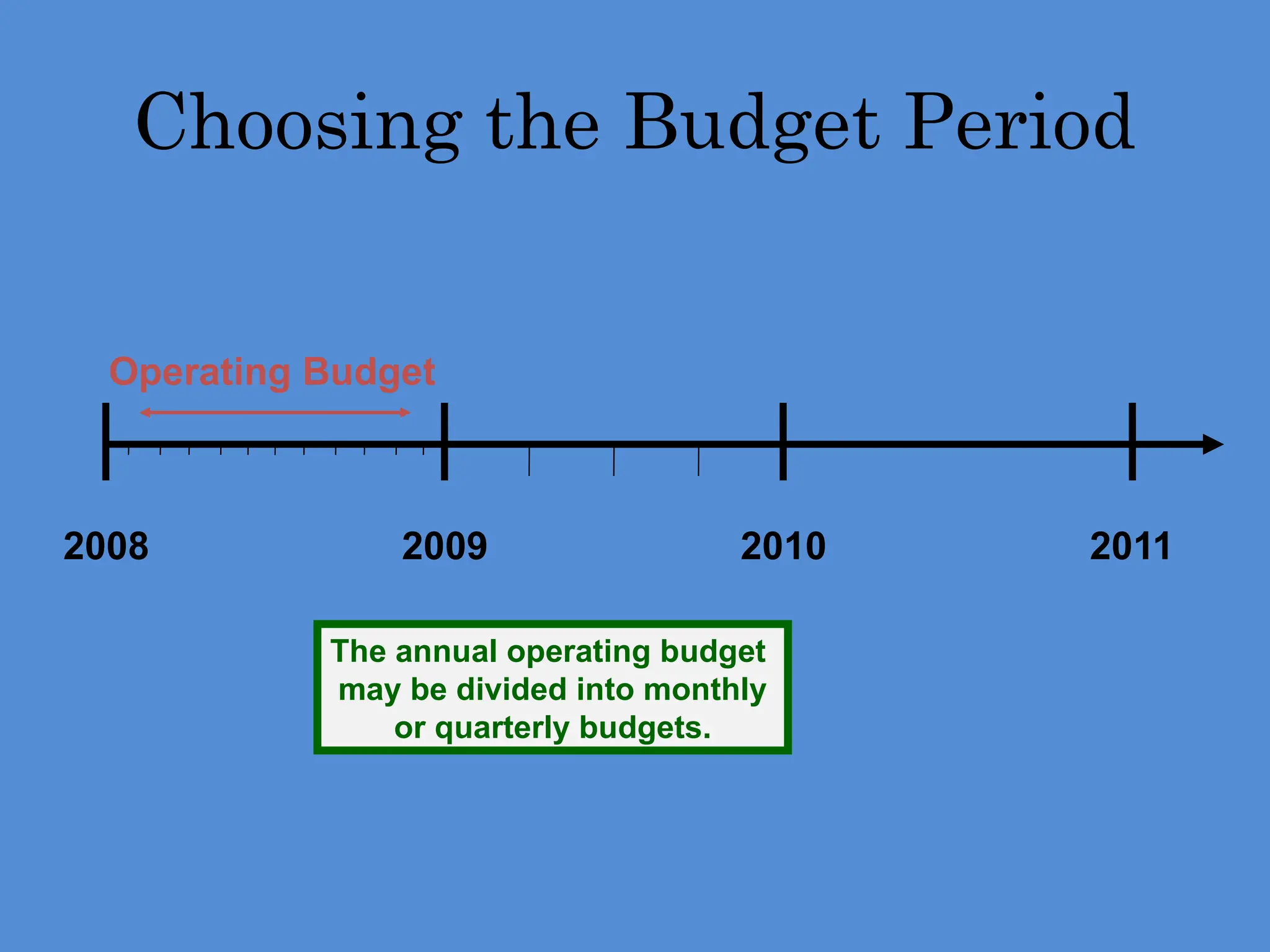
Choosing the Budget Period
Operating Budget
2008 2009 2010 2011
The annual operating budget
may be divided into monthly
or quarterly budgets.
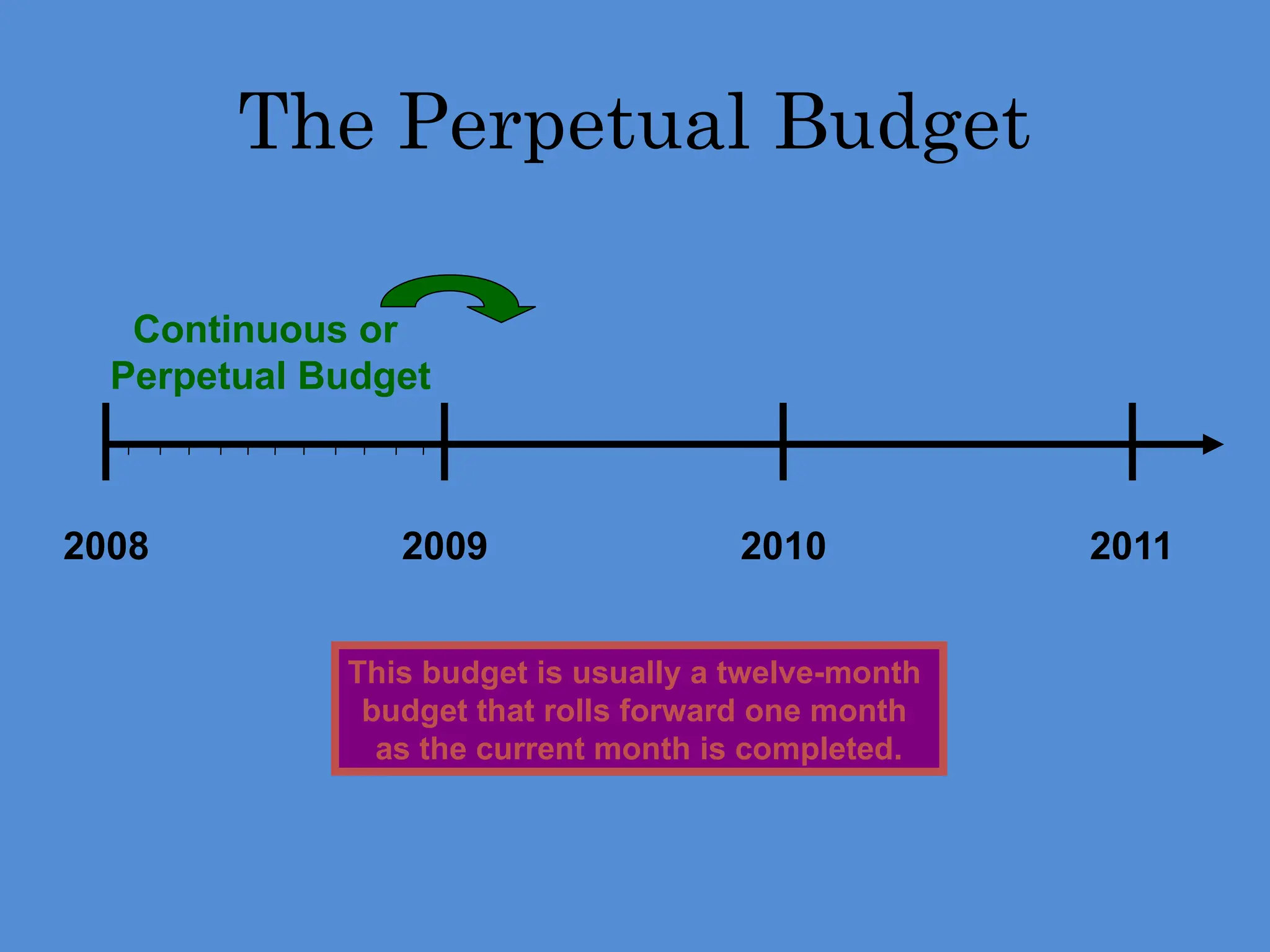
The Perpetual Budget
2008 2009 2010 2011
Continuous or
Perpetual Budget
This budget is usually a twelve-month
budget that rolls forward one month
as the current month is completed.
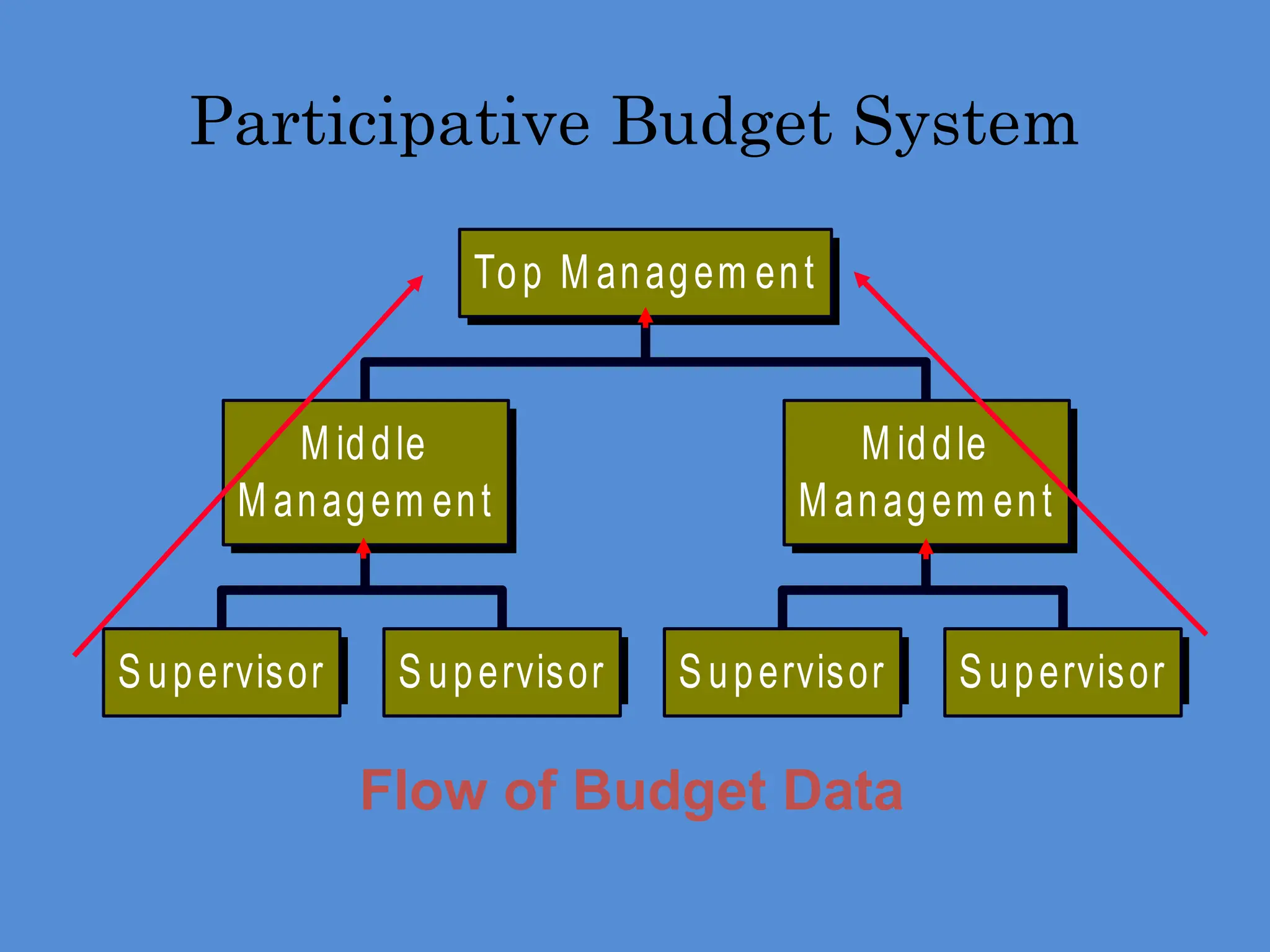
Participative Budget System
Flow of Budget Data
Supervisor Supervisor
M iddle
M anagem ent
Supervisor Supervisor
M iddle
M anagem ent
Top M anagem ent
Responsibility Accounting
Managers should be held responsible for those items
— and only those items — that
the manager can actually control
to a significant extent.
The Budget Committee
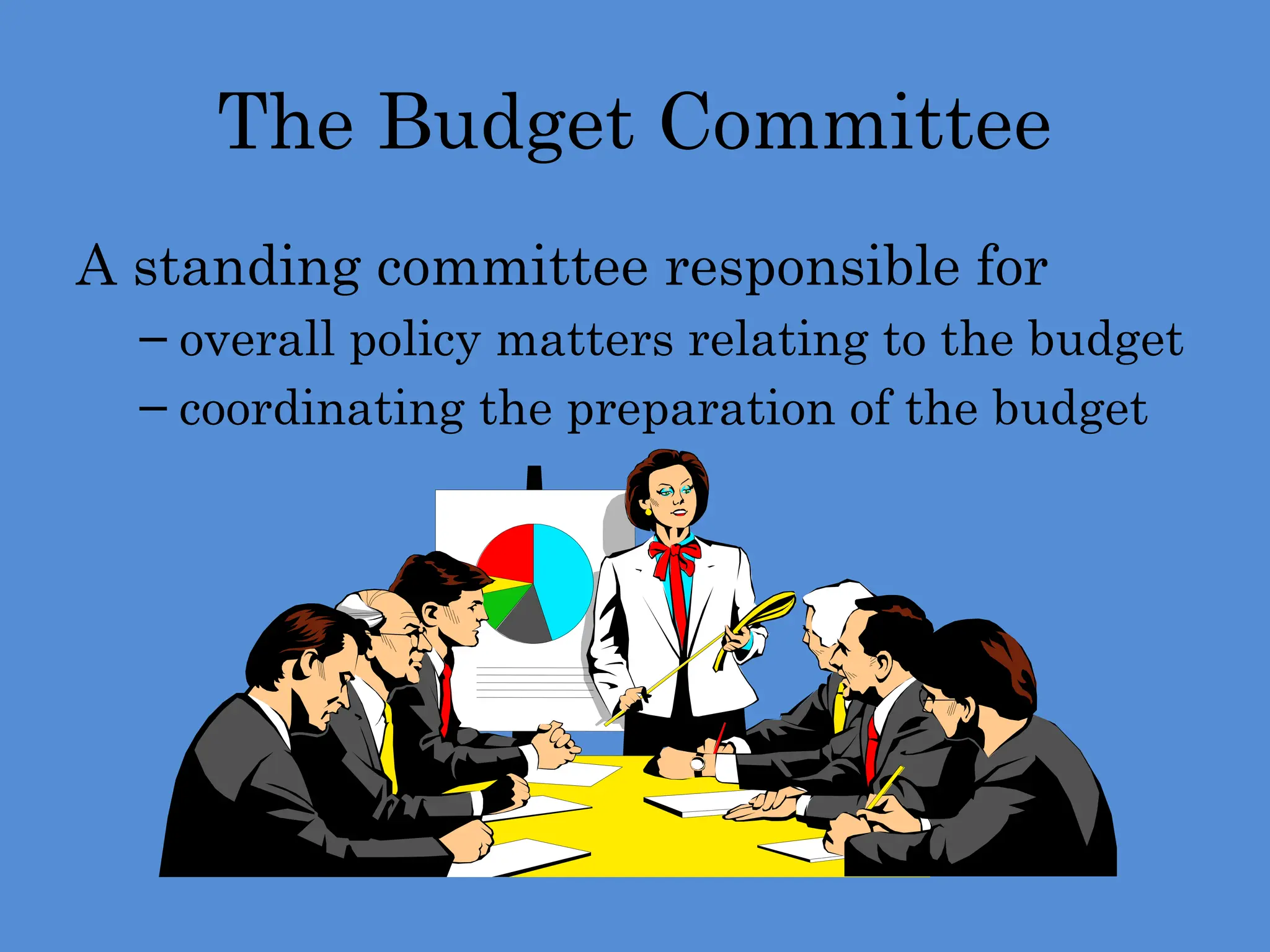
A standing committee responsible for
– overall policy matters relating to the budget
– coordinating the preparation of the budget
Chapter 9 Quiz: Question 1
Which of the following is NOT true about the Master Budget?
a) It is composed of many interrelated budgets.
b) It consists of 2 classes of budgets: Operating Budgets and Financial
Budgets.
c) Within the master budget the first budget to be prepared is the
sales budget.
d) It constitutes a plan of action for a specified period of time.
e) All of the above are true.
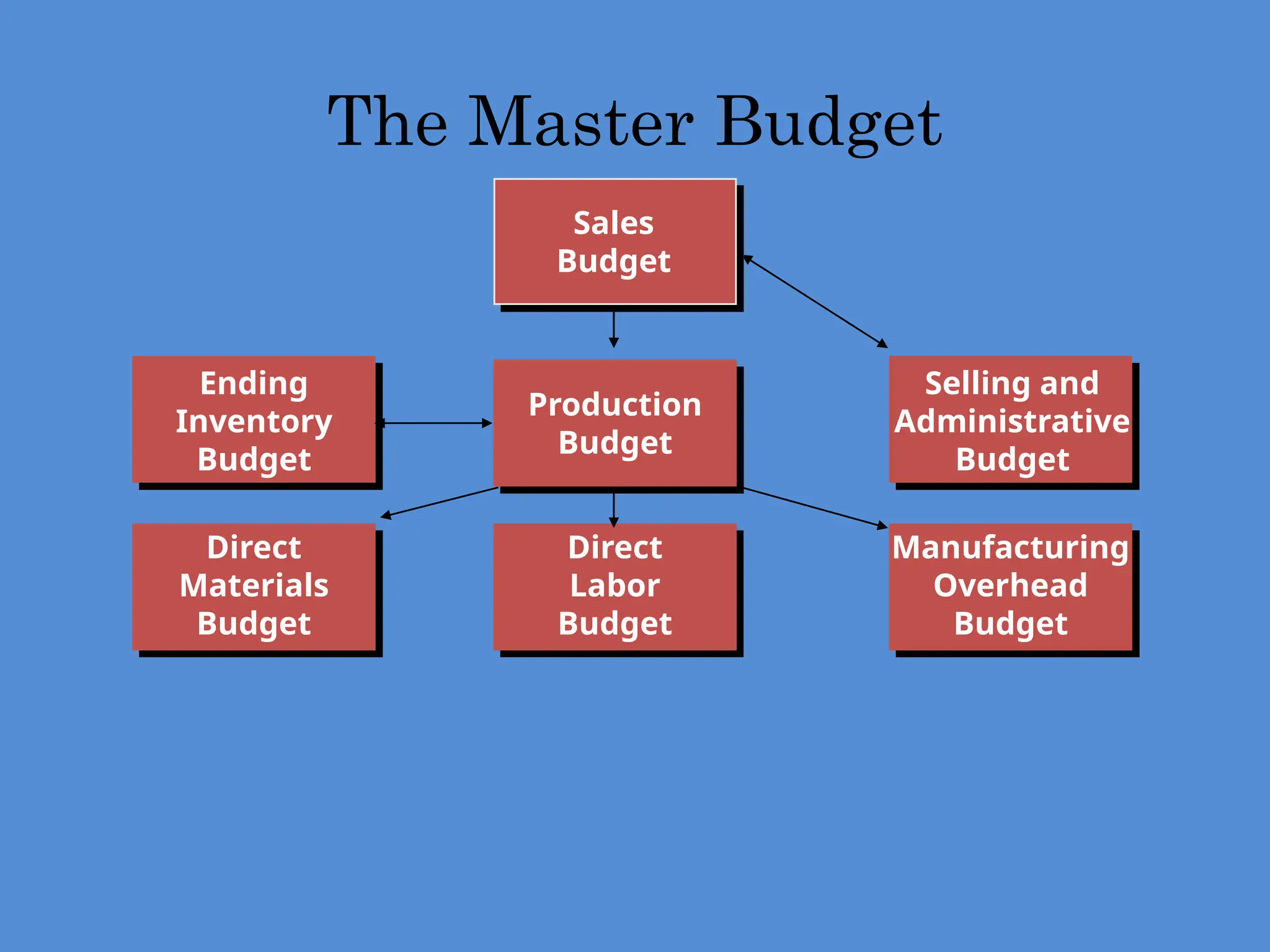
The Master Budget
Selling and
Administrative
Budget
Production
Budget
Ending
Inventory
Budget
Direct
Materials
Budget
Direct
Labor
Budget
Manufacturing
Overhead
Budget
Sales
Budget
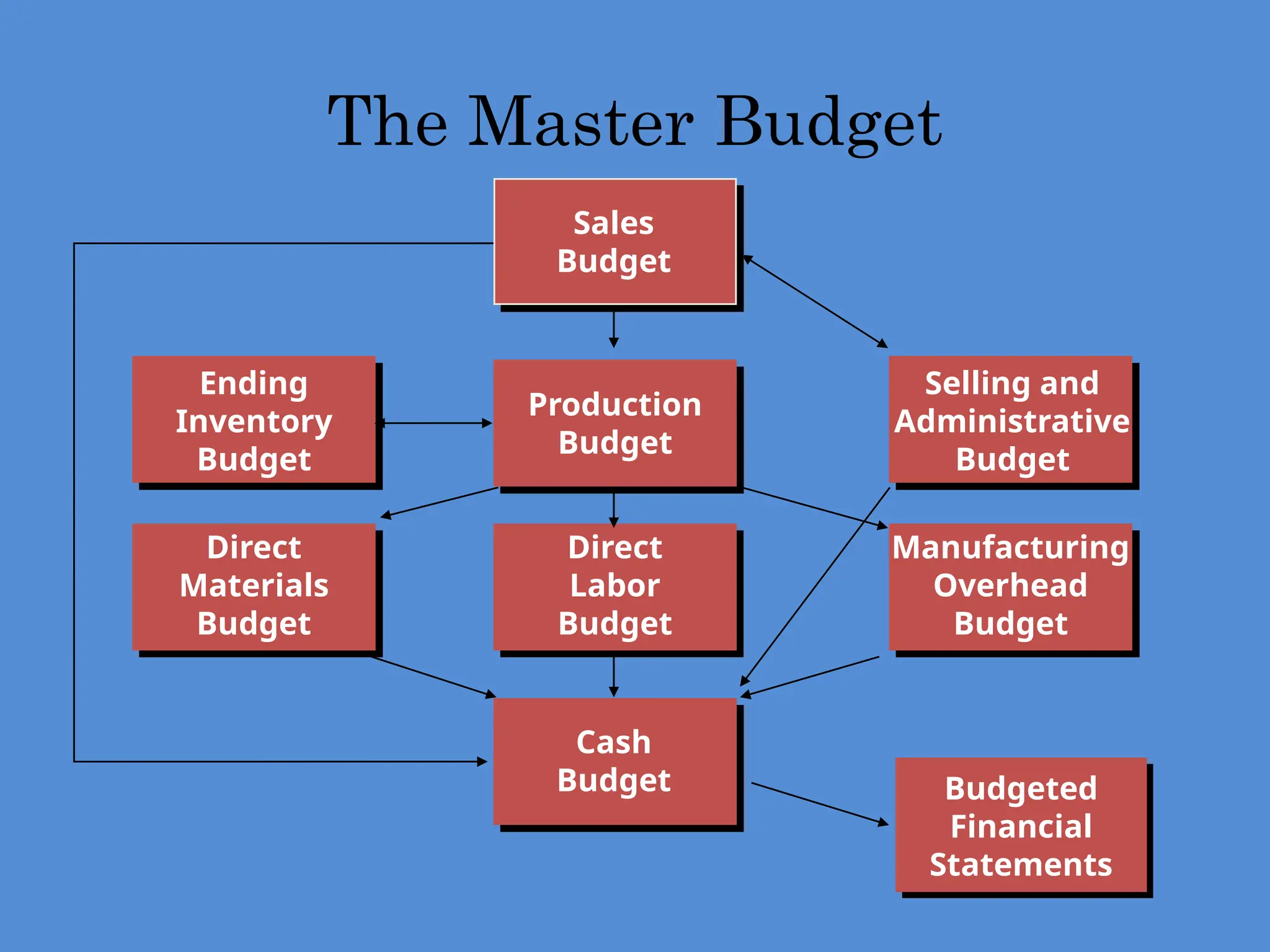
The Master Budget
Direct
Materials
Budget
Ending
Inventory
Budget
Production
Budget
Selling and
Administrative
Budget
Direct
Labor
Budget
Manufacturing
Overhead
Budget
Cash
Budget
Sales
Budget
Budgeted
Financial
Statements
The Sales Budget
A detailed schedule showing expected
sales for the budgeted periods
expressed in units and dollars.
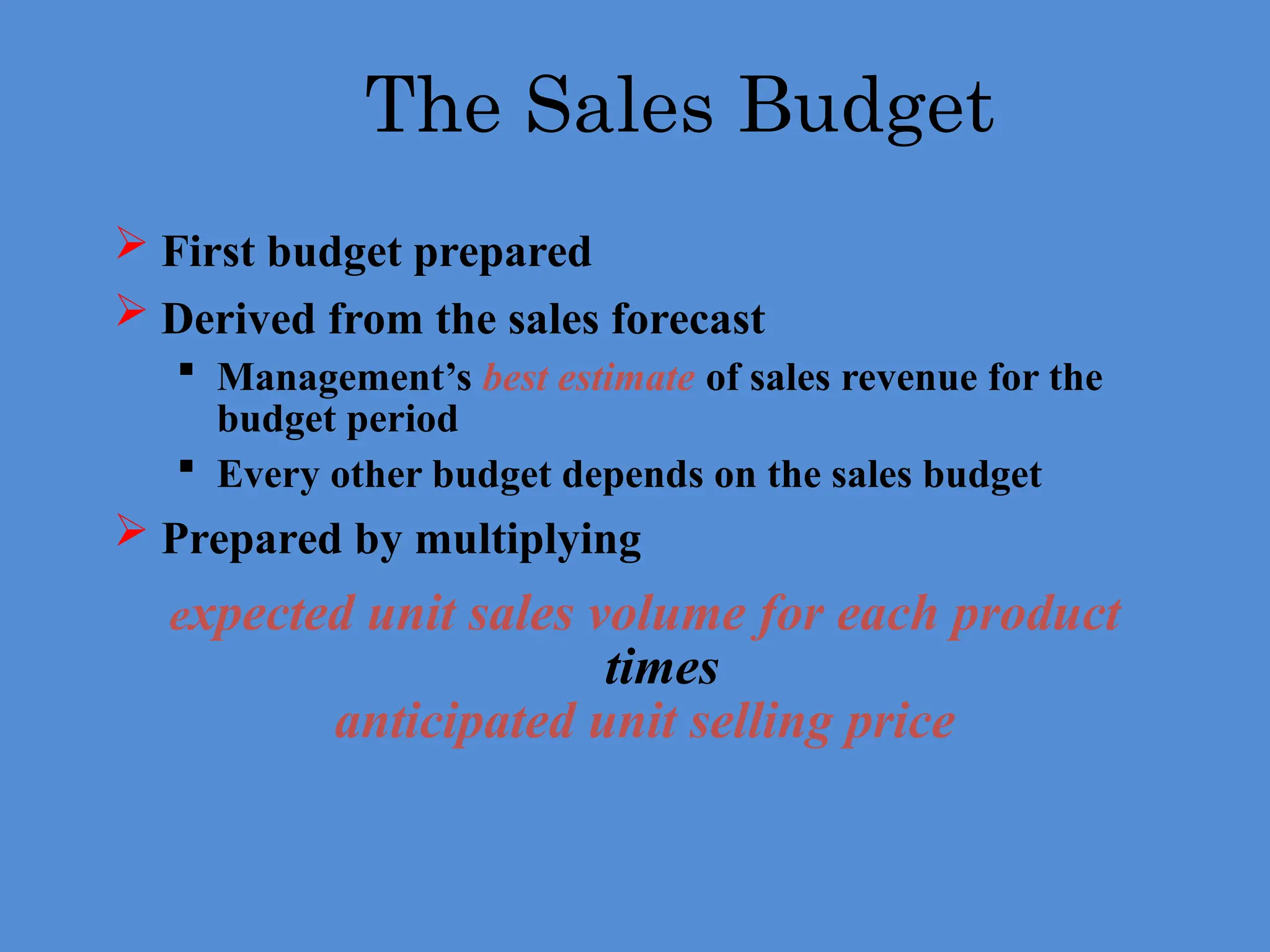
The Sales Budget
 First budget prepared
 Derived from the sales forecast
 Management’s best estimate of sales revenue for the
budget period
 Every other budget depends on the sales budget
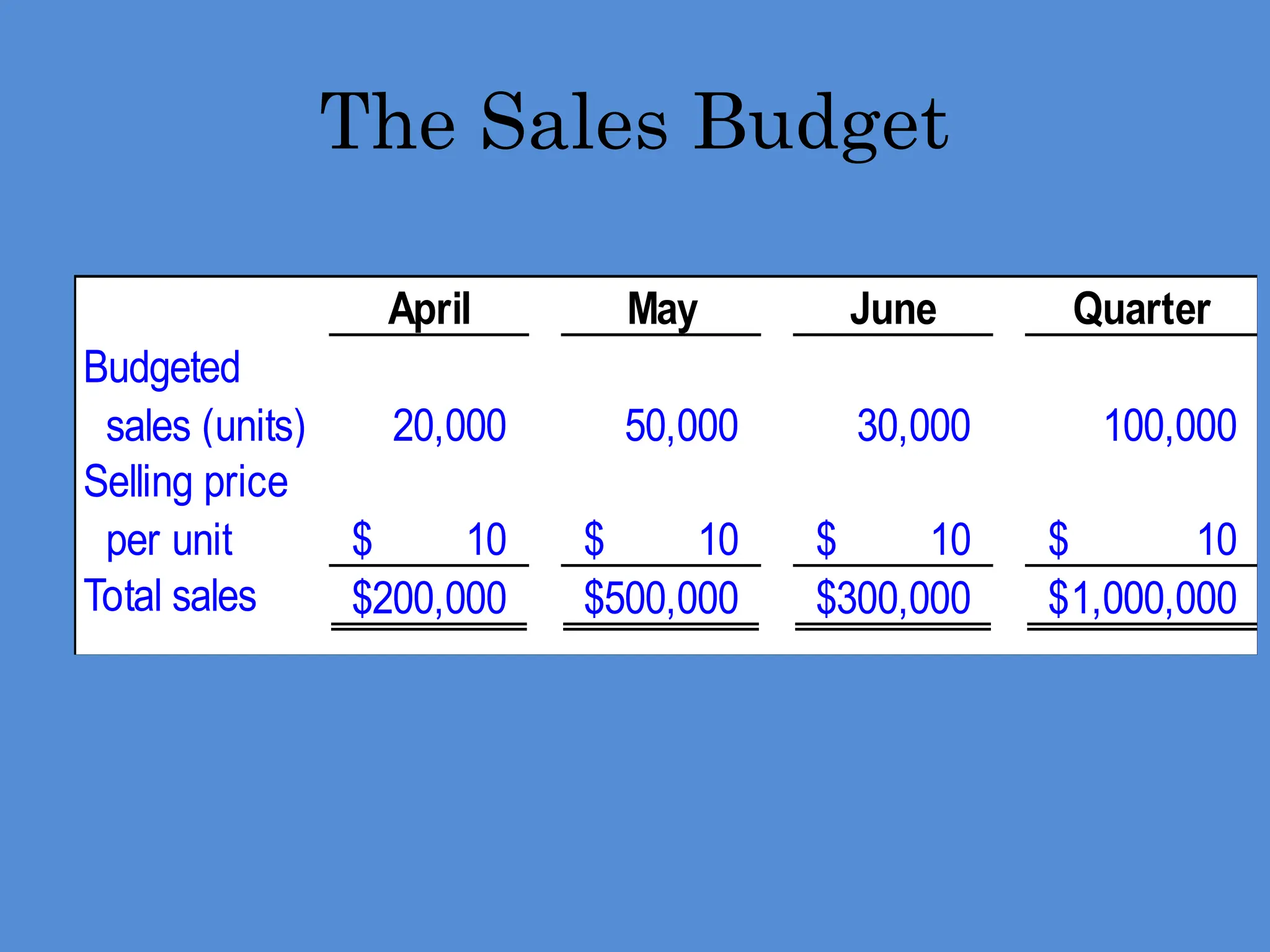
 Prepared by multiplying
expected unit sales volume for each product
times
anticipated unit selling price
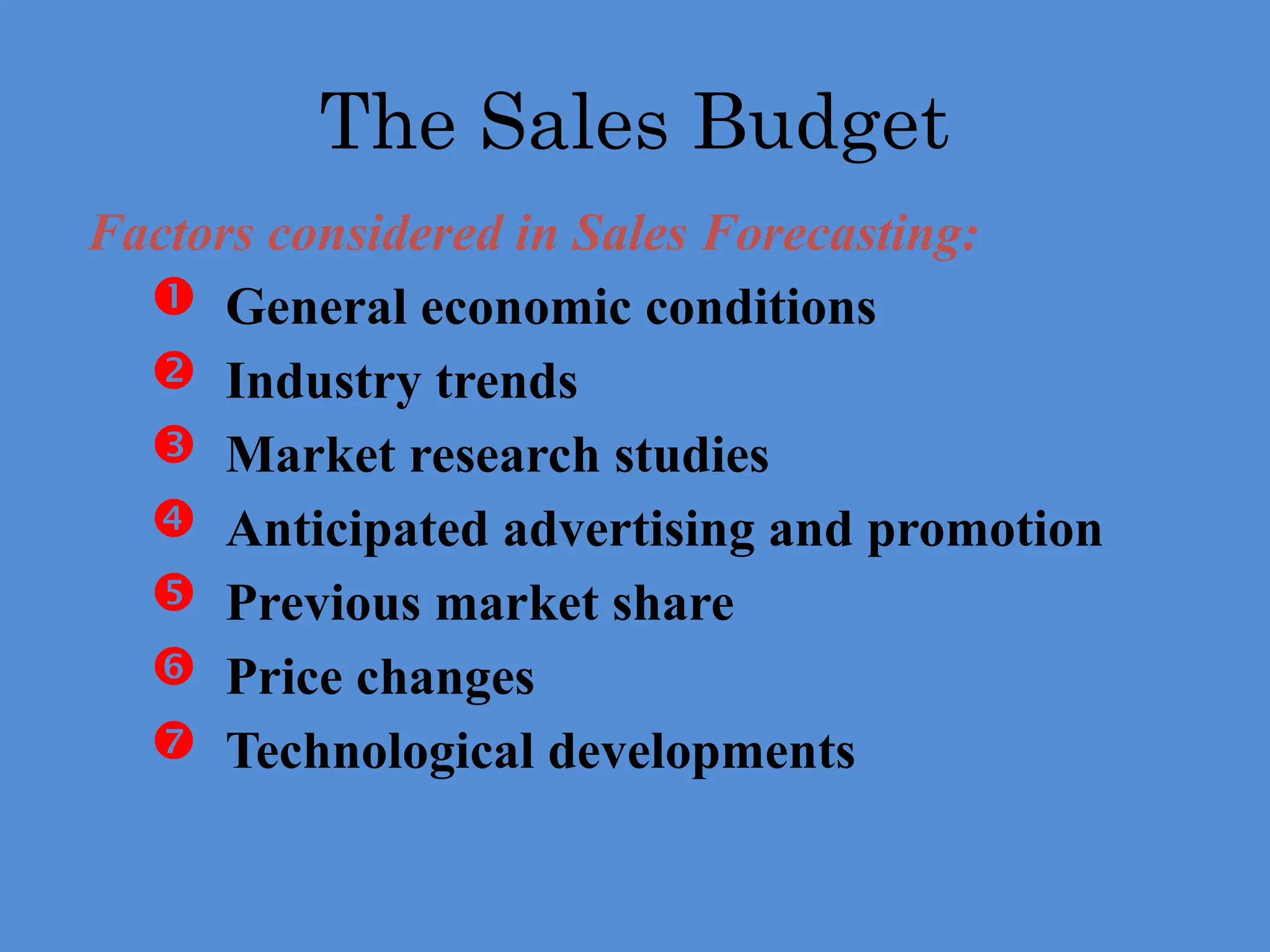
Factors considered in Sales Forecasting:
 General economic conditions
 Industry trends
 Market research studies
 Anticipated advertising and promotion
 Previous market share
 Price changes
 Technological developments
The Sales Budget
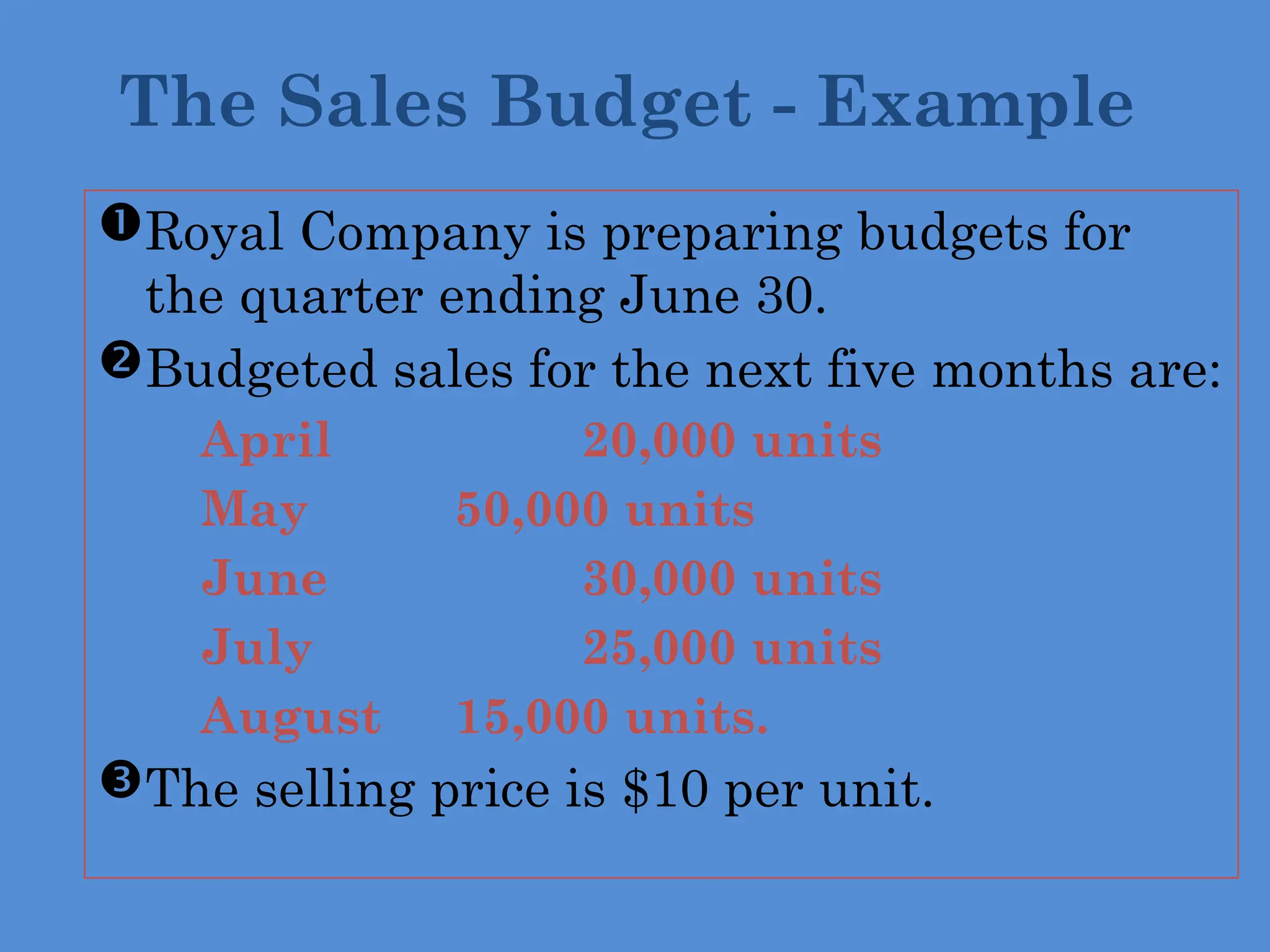
Royal Company is preparing budgets for
the quarter ending June 30.
Budgeted sales for the next five months are:
 April 20,000 units
 May 50,000 units
 June 30,000 units
 July 25,000 units
 August 15,000 units.
The selling price is $10 per unit.
The Sales Budget - Example
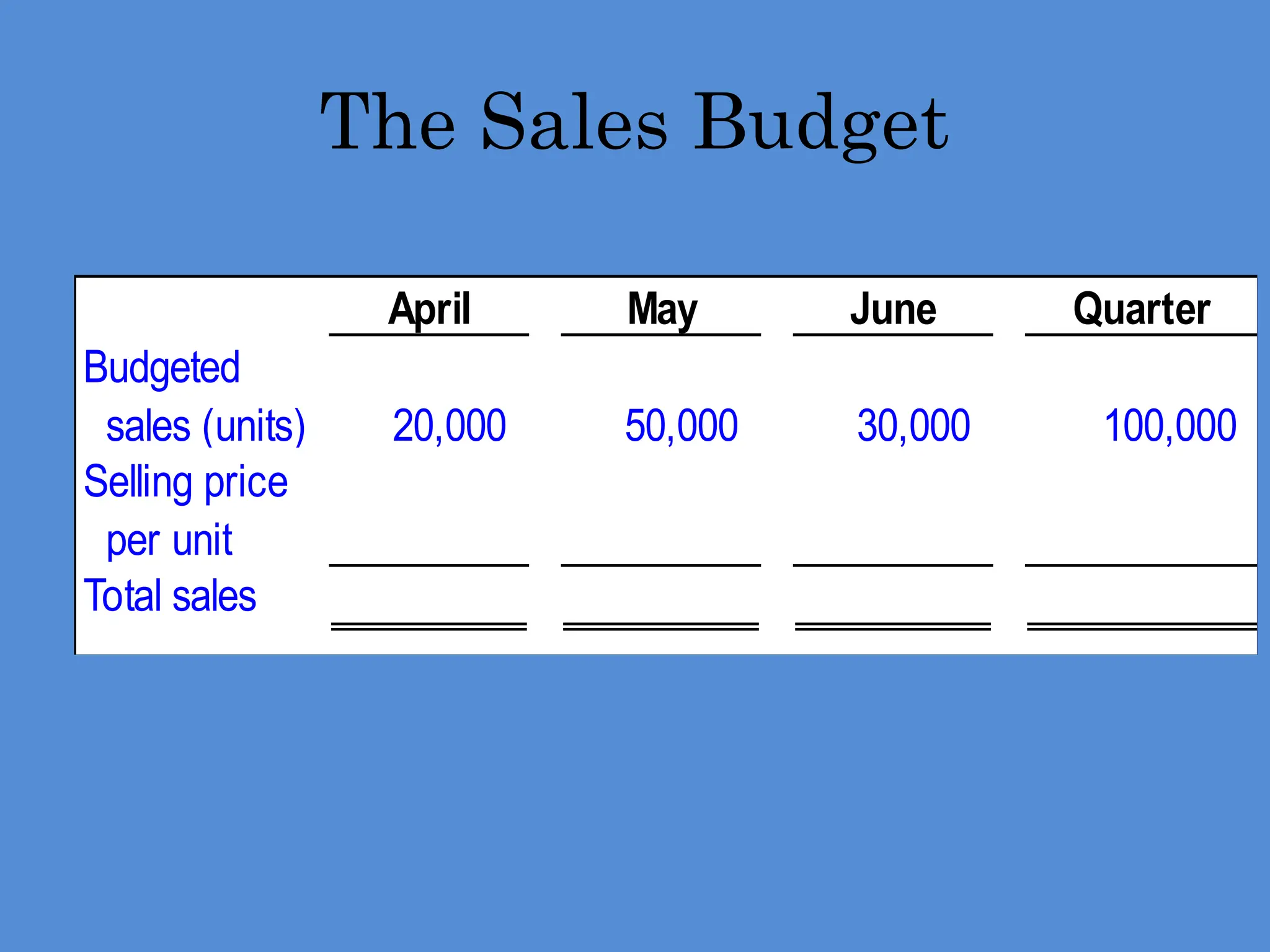
The Sales Budget
April May June Quarter
Budgeted
sales (units) 20,000 50,000 30,000 100,000
Selling price
per unit
Total sales
The Sales Budget
April May June Quarter
Budgeted
sales (units) 20,000 50,000 30,000 100,000
Selling price
per unit 10
$ 10
$ 10
$ 10
$
Total sales 200,000
$ 500,000
$ 300,000
$ 1,000,000
$
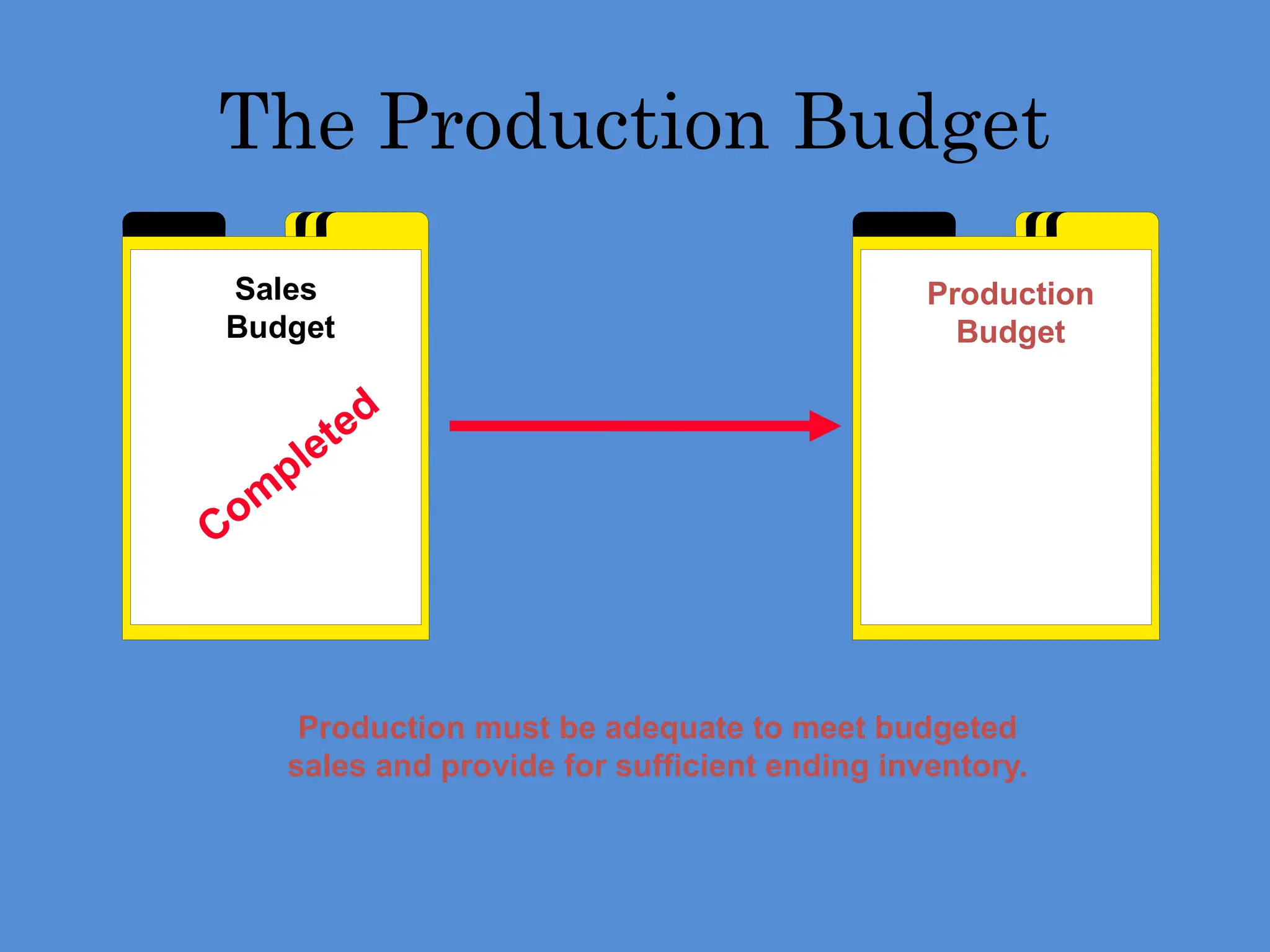
The Production Budget
Sales
Budget
Production
Budget
Com
pleted
Production must be adequate to meet budgeted
sales and provide for sufficient ending inventory.
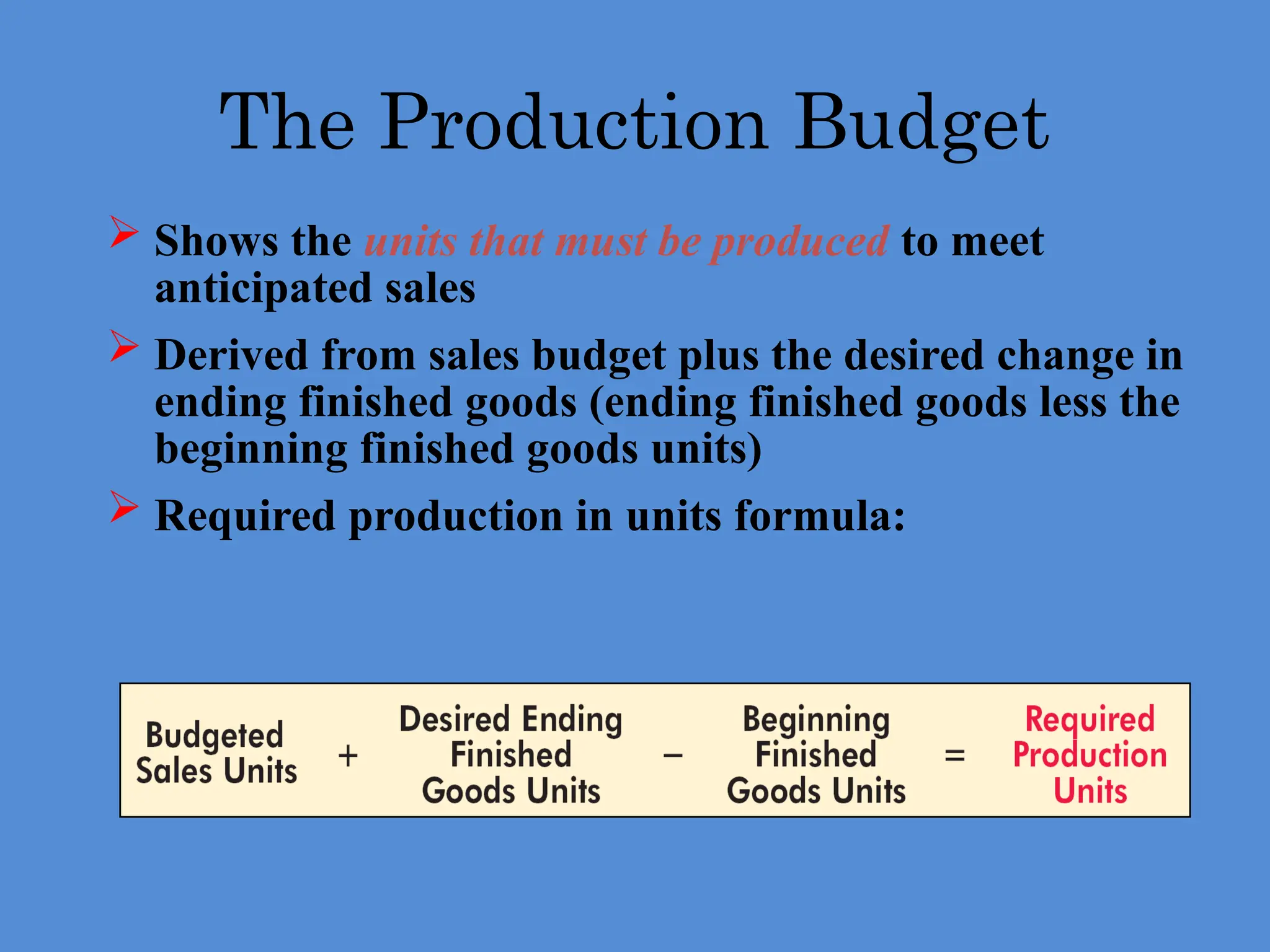
 Shows the units that must be produced to meet
anticipated sales
 Derived from sales budget plus the desired change in
ending finished goods (ending finished goods less the
beginning finished goods units)
 Required production in units formula:
The Production Budget
• Royal Company wants ending inventory to
be equal to 20% of the following month’s
budgeted sales in units.
• On March 31, 4,000 units were on hand.
 Let’s prepare the production budget.
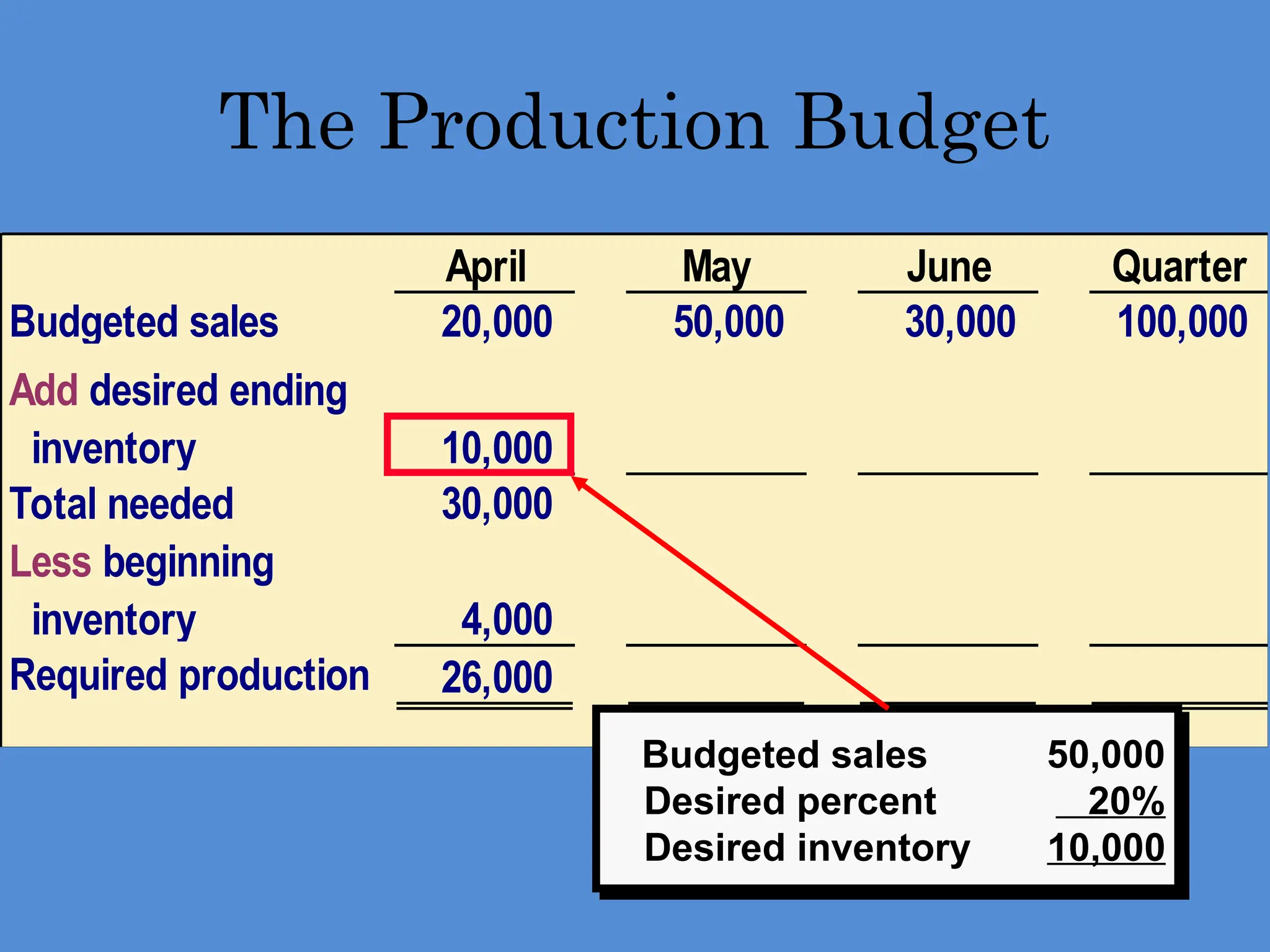
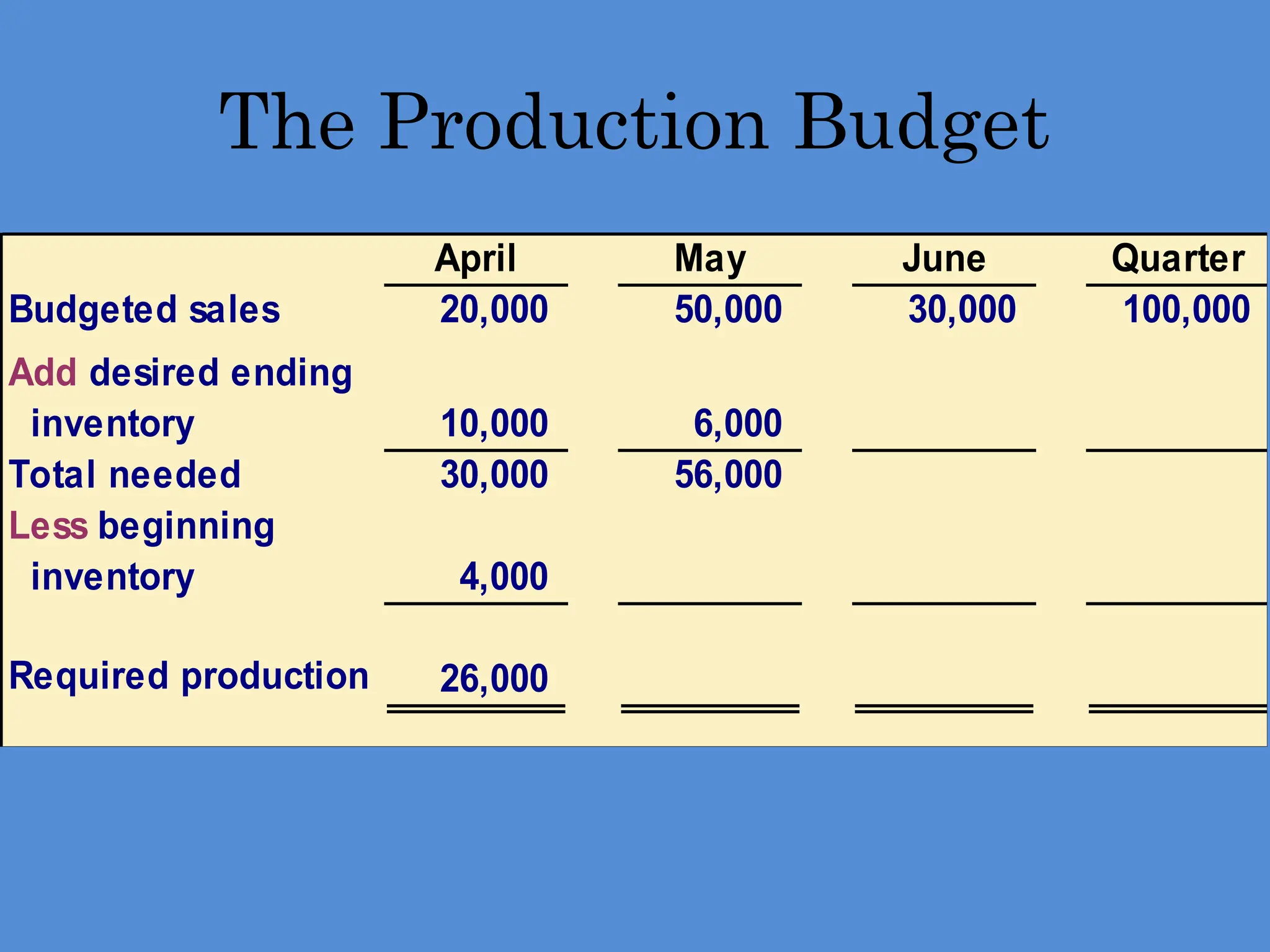
April May June Quarter
Budgeted sales 20,000 50,000 30,000 100,000
Add desired ending
inventory 10,000
Total needed 30,000
Less beginning
inventory 4,000
Required production 26,000
The Production Budget
Budgeted sales 50,000
Desired percent 20%
Desired inventory 10,000
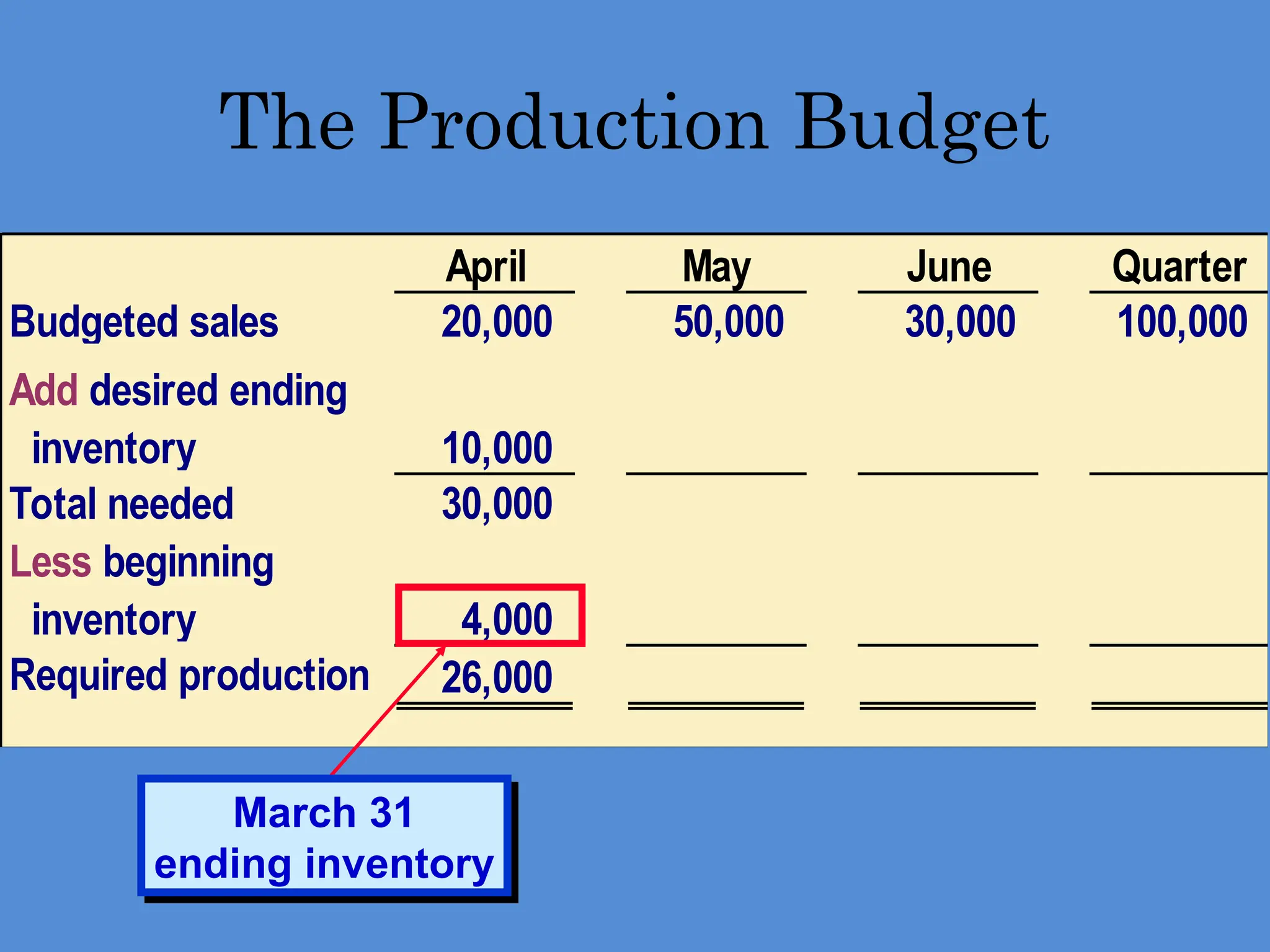
April May June Quarter
Budgeted sales 20,000 50,000 30,000 100,000
Add desired ending
inventory 10,000
Total needed 30,000
Less beginning
inventory 4,000
Required production 26,000
The Production Budget
March 31
ending inventory
The Production Budget
April May June Quarter
Budgeted sales 20,000 50,000 30,000 100,000
Add desired ending
inventory 10,000 6,000
Total needed 30,000 56,000
Less beginning
inventory 4,000
Required production 26,000
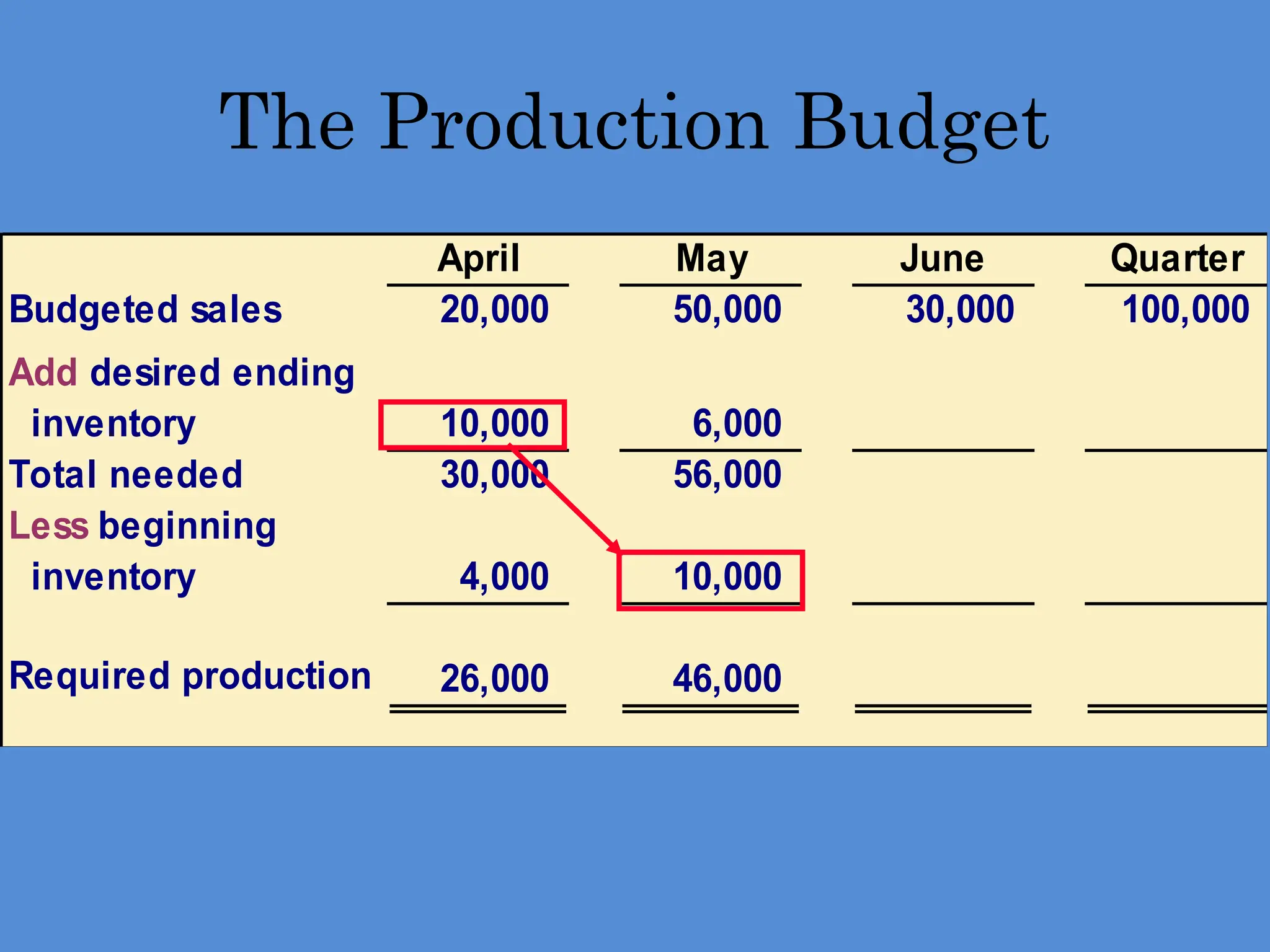
April May June Quarter
Budgeted sales 20,000 50,000 30,000 100,000
Add desired ending
inventory 10,000 6,000
Total needed 30,000 56,000
Less beginning
inventory 4,000 10,000
Required production 26,000 46,000
The Production Budget
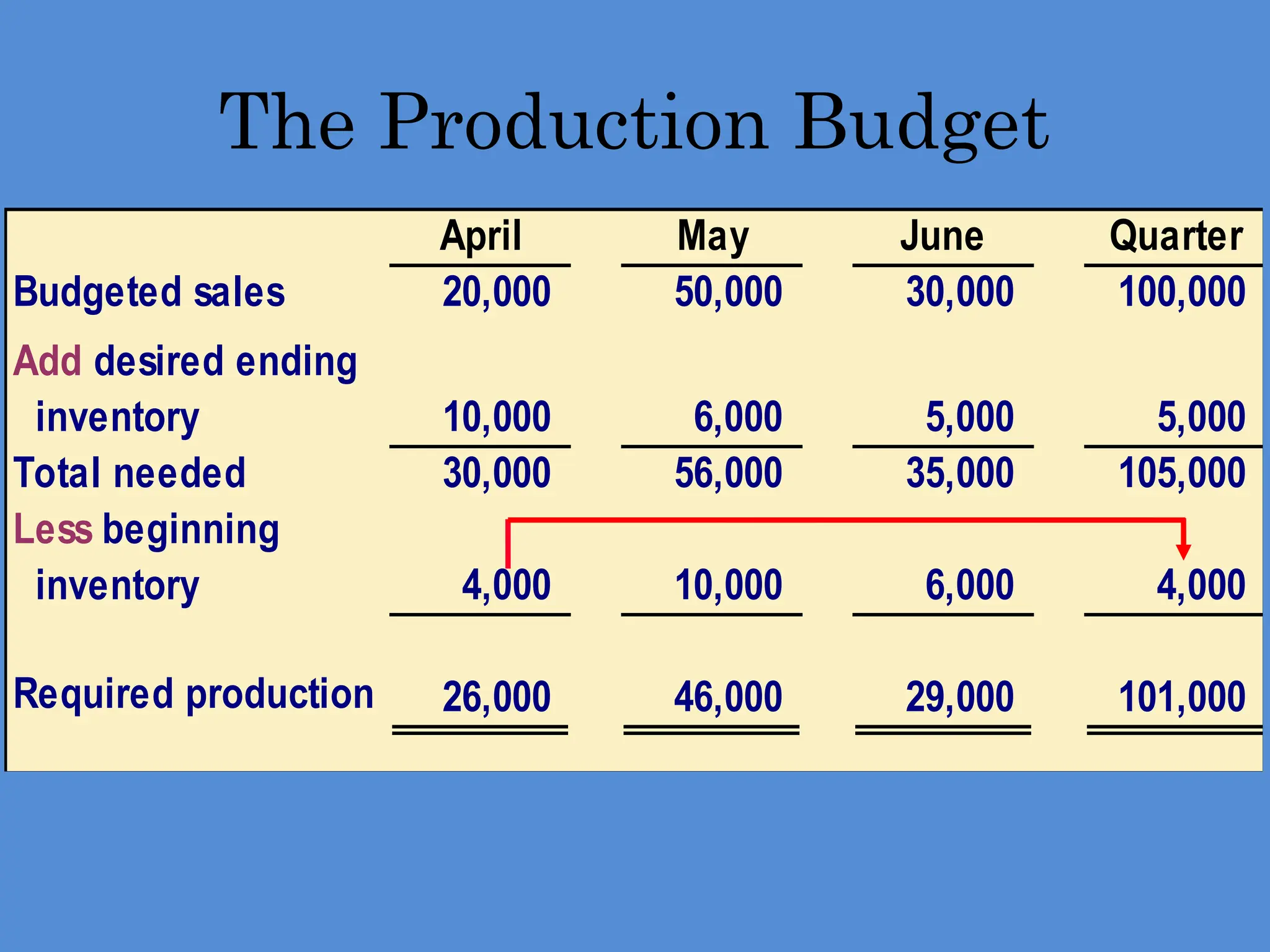
April May June Quarter
Budgeted sales 20,000 50,000 30,000 100,000
Add desired ending
inventory 10,000 6,000 5,000 5,000
Total needed 30,000 56,000 35,000 105,000
Less beginning
inventory 4,000 10,000 6,000 4,000
Required production 26,000 46,000 29,000 101,000
The Production Budget
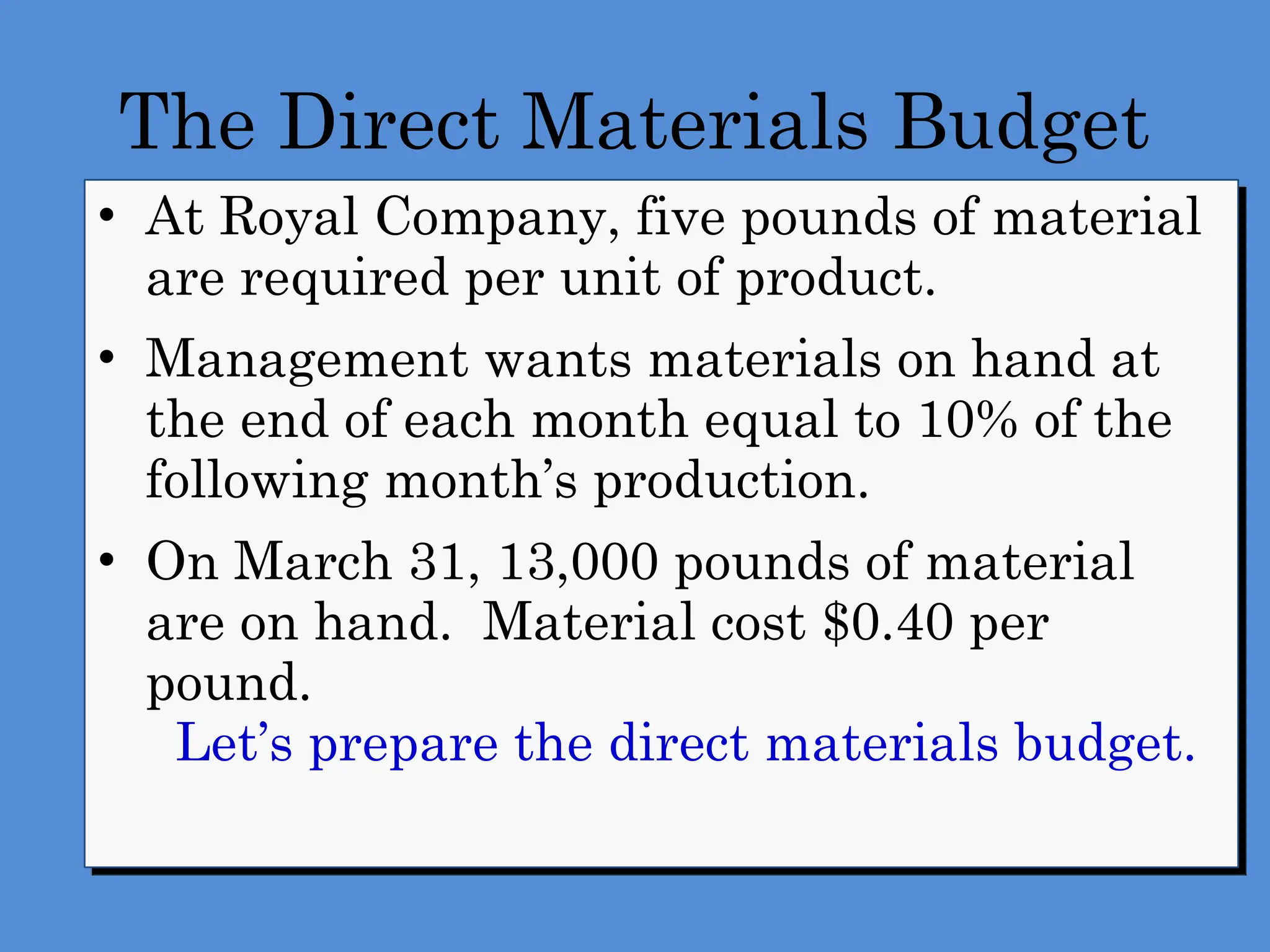
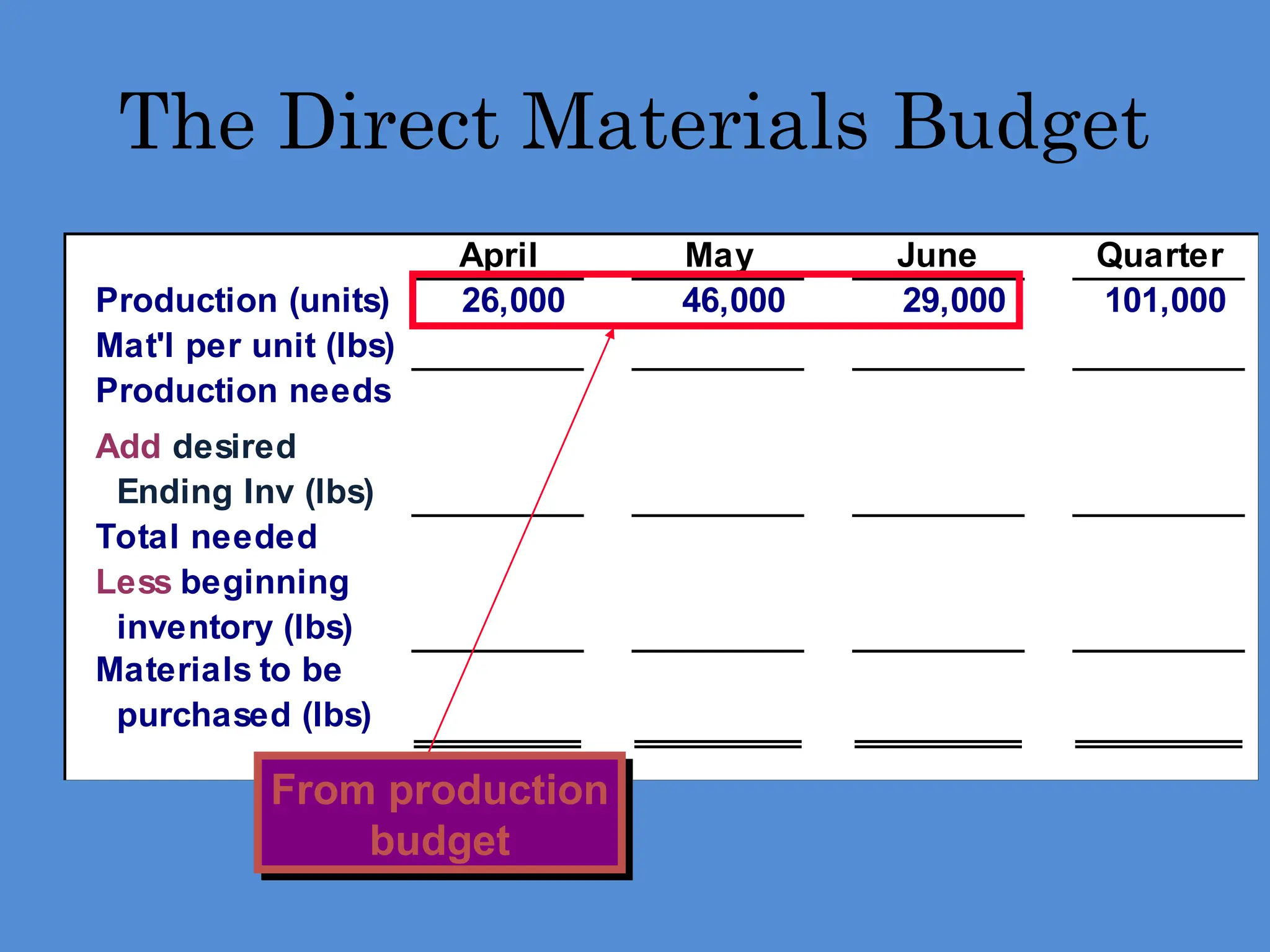
The Direct Materials Budget
• At Royal Company, five pounds of material
are required per unit of product.
• Management wants materials on hand at
the end of each month equal to 10% of the
following month’s production.
• On March 31, 13,000 pounds of material
are on hand. Material cost $0.40 per
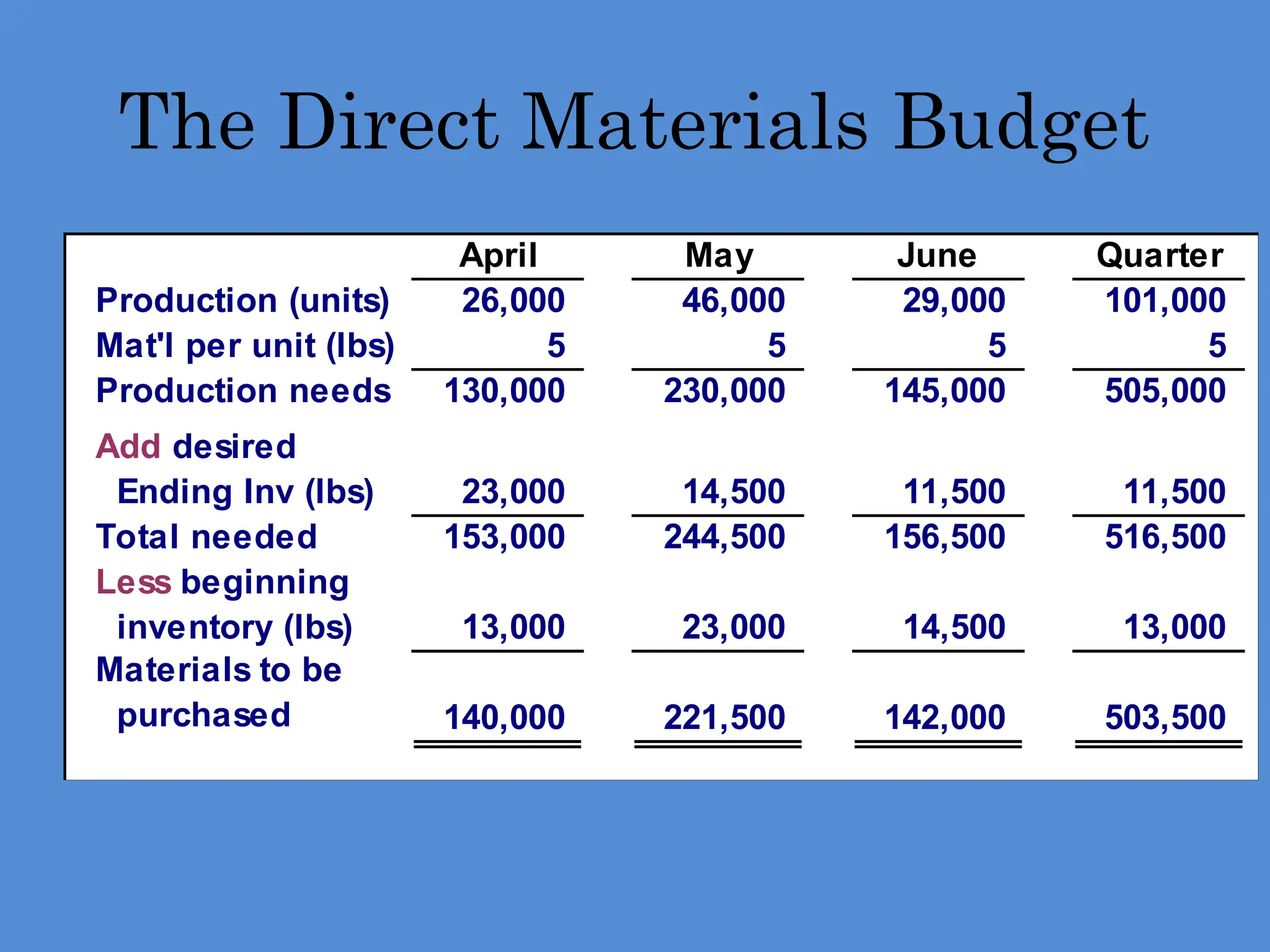
pound.
Let’s prepare the direct materials budget.
April May June Quarter
Production (units) 26,000 46,000 29,000 101,000
Mat'l per unit (lbs)
Production needs
Add desired
Ending Inv (lbs)
Total needed
Less beginning
inventory (lbs)
Materials to be
purchased (lbs)
The Direct Materials Budget
From production
budget
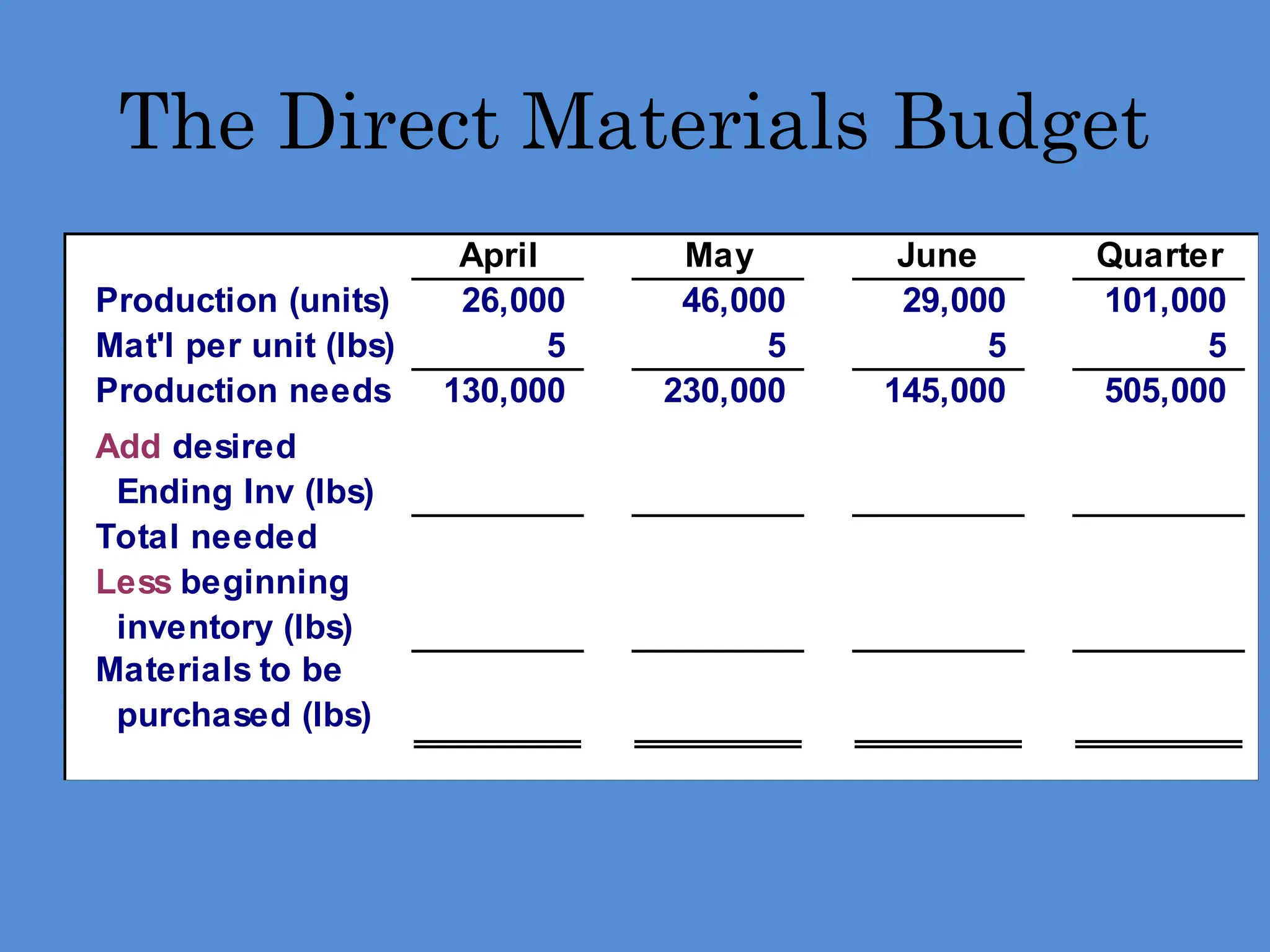
The Direct Materials Budget
April May June Quarter
Production (units) 26,000 46,000 29,000 101,000
Mat'l per unit (lbs) 5 5 5 5
Production needs 130,000 230,000 145,000 505,000
Add desired
Ending Inv (lbs)
Total needed
Less beginning
inventory (lbs)
Materials to be
purchased (lbs)
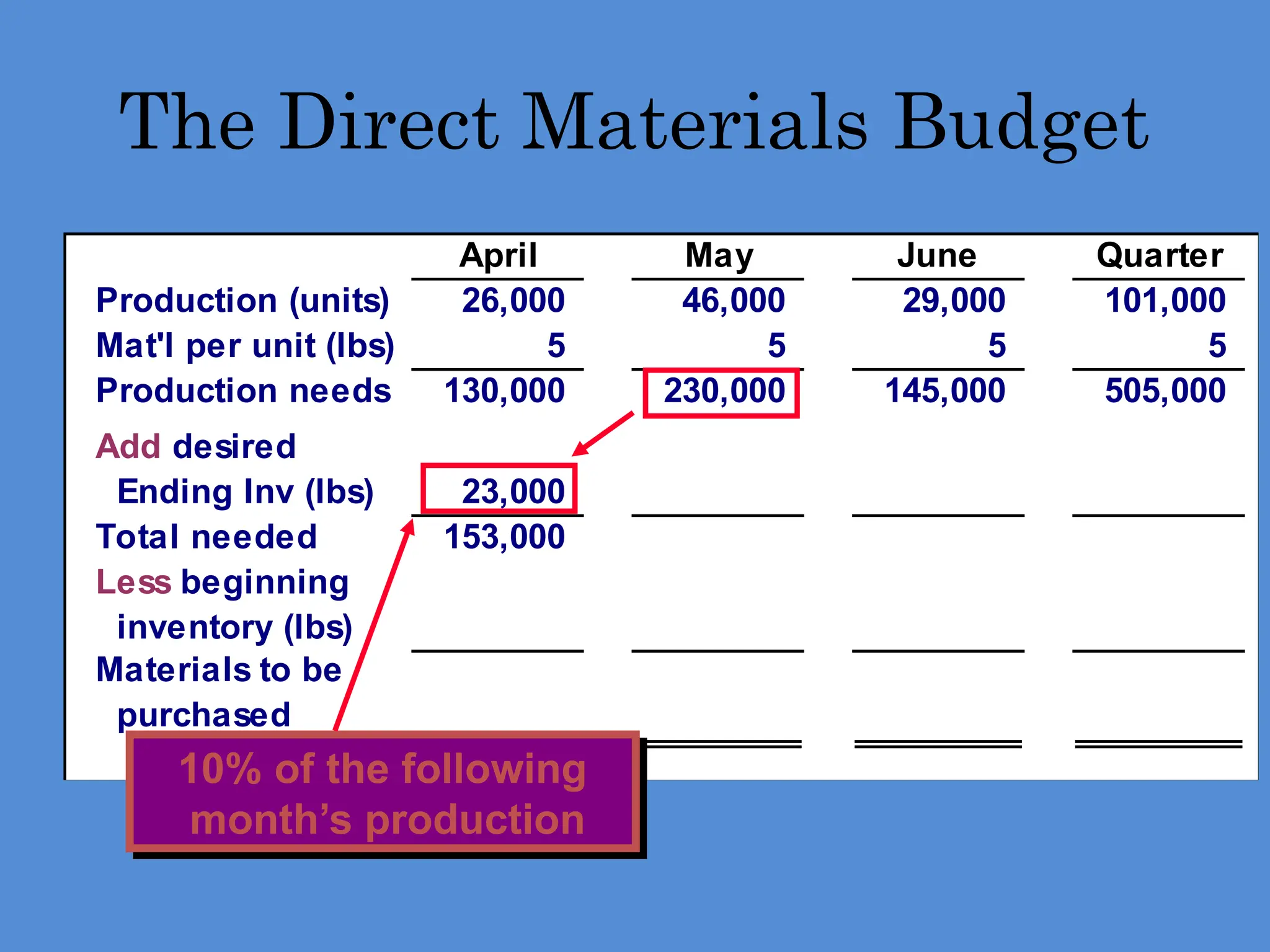
April May June Quarter
Production (units) 26,000 46,000 29,000 101,000
Mat'l per unit (lbs) 5 5 5 5
Production needs 130,000 230,000 145,000 505,000
Add desired
Ending Inv (lbs) 23,000
Total needed 153,000
Less beginning
inventory (lbs)
Materials to be
purchased
The Direct Materials Budget
10% of the following
month’s production
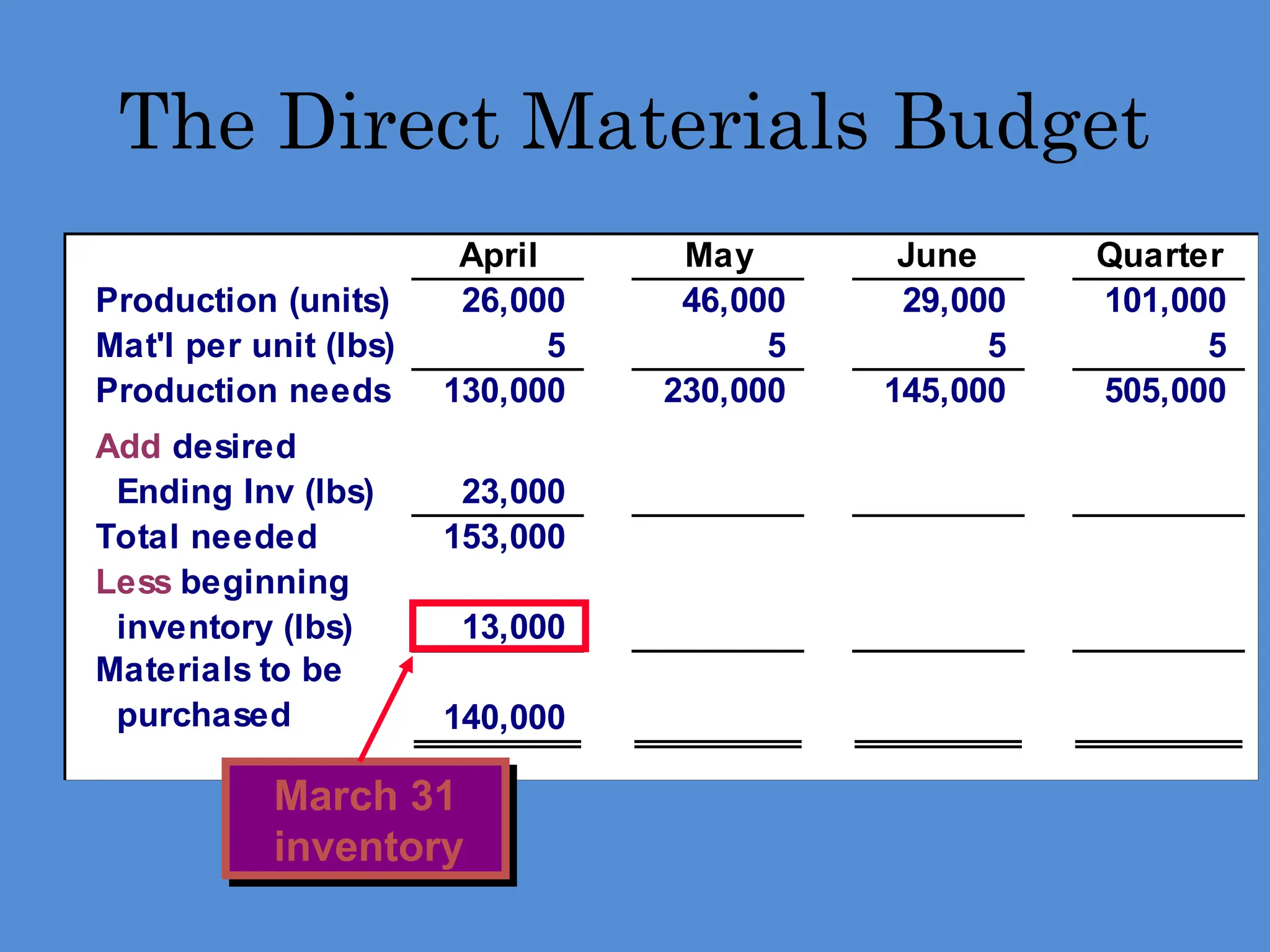
April May June Quarter
Production (units) 26,000 46,000 29,000 101,000
Mat'l per unit (lbs) 5 5 5 5
Production needs 130,000 230,000 145,000 505,000
Add desired
Ending Inv (lbs) 23,000
Total needed 153,000
Less beginning
inventory (lbs) 13,000
Materials to be
purchased 140,000
The Direct Materials Budget
March 31
inventory
The Direct Materials Budget
April May June Quarter
Production (units) 26,000 46,000 29,000 101,000
Mat'l per unit (lbs) 5 5 5 5
Production needs 130,000 230,000 145,000 505,000
Add desired
Ending Inv (lbs) 23,000 14,500 11,500 11,500
Total needed 153,000 244,500 156,500 516,500
Less beginning
inventory (lbs) 13,000 23,000 14,500 13,000
Materials to be
purchased 140,000 221,500 142,000 503,500
April May June Quarter
Production (units) 26,000 46,000 29,000 101,000
Mat'l per unit (lbs) 5 5 5 5
Production needs 130,000 230,000 145,000 505,000
Add desired
Ending Inv (lbs) 23,000 14,500 11,500 11,500
Total needed 153,000 244,500 156,500 516,500
Less beginning
inventory (lbs) 13,000 23,000 14,500 13,000
Materials to be
purchased 140,000 221,500 142,000 503,500
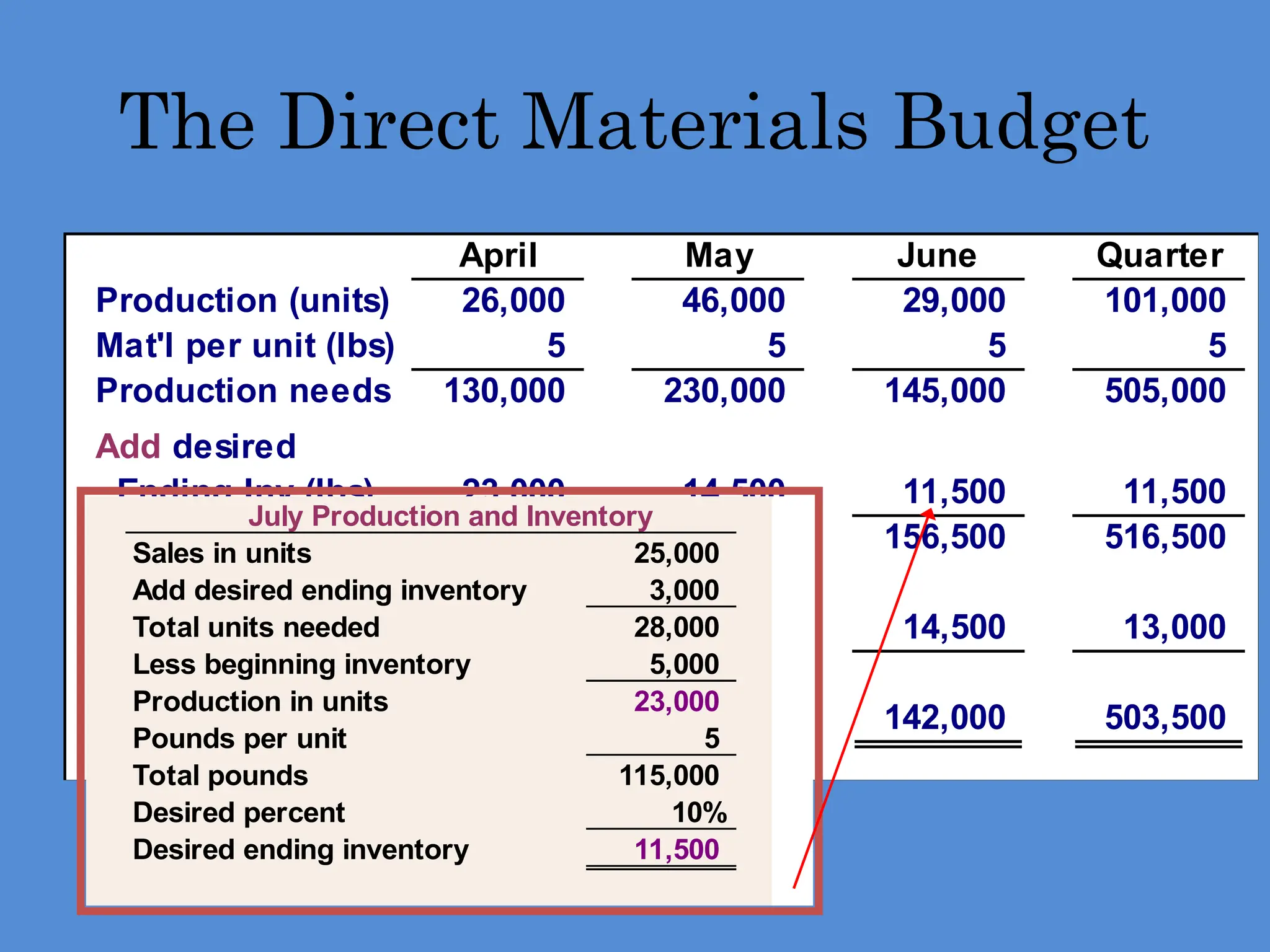
The Direct Materials Budget
July Production and Inventory
Sales in units 25,000
Add desired ending inventory 3,000
Total units needed 28,000
Less beginning inventory 5,000
Production in units 23,000
Pounds per unit 5
Total pounds 115,000
Desired percent 10%
Desired ending inventory 11,500
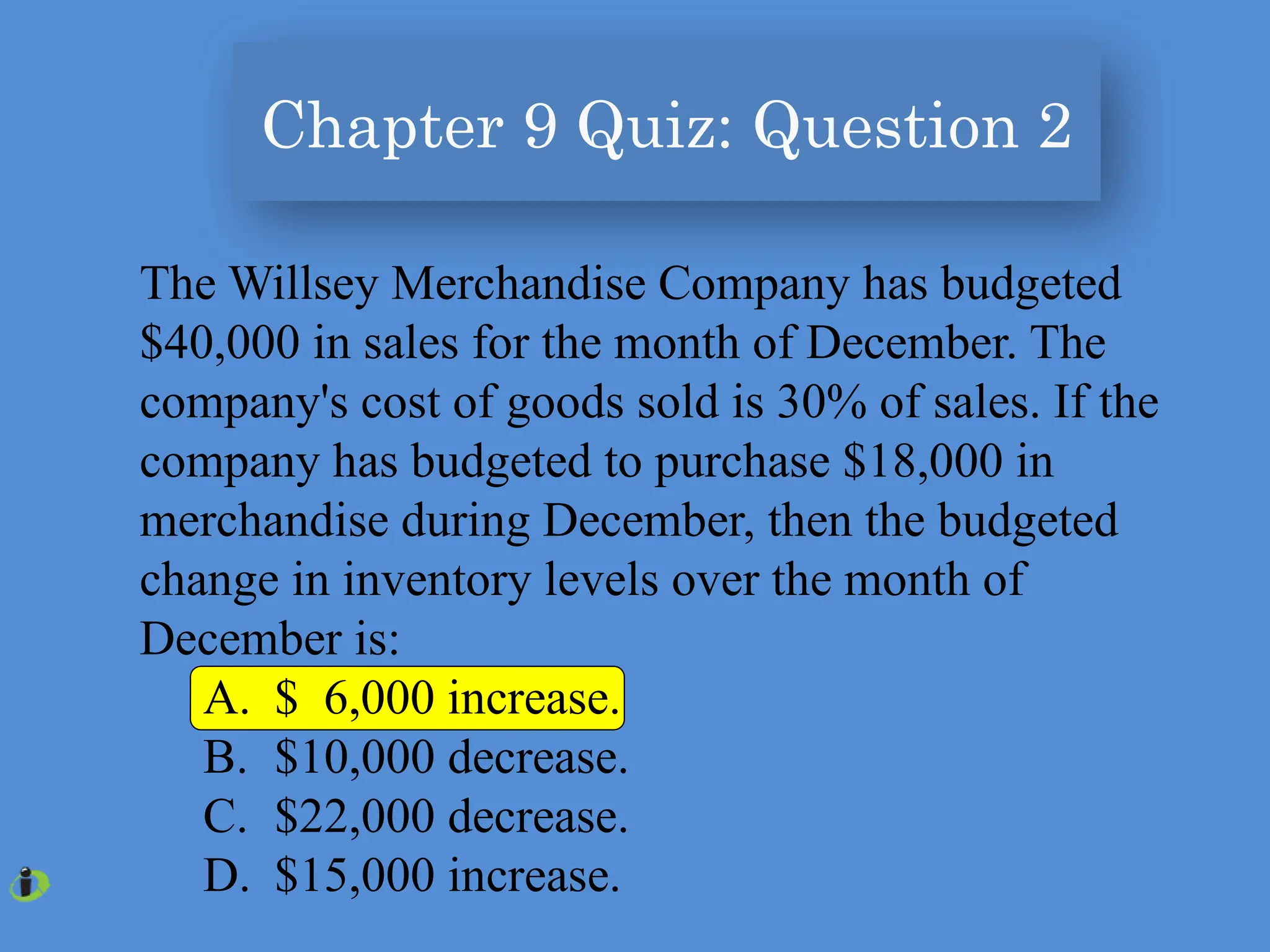
Chapter 9 Quiz: Question 2
The Willsey Merchandise Company has budgeted
$40,000 in sales for the month of December. The
company's cost of goods sold is 30% of sales. If the
company has budgeted to purchase $18,000 in
merchandise during December, then the budgeted
change in inventory levels over the month of
December is:
A. $ 6,000 increase.
B. $10,000 decrease.
C. $22,000 decrease.
D. $15,000 increase.
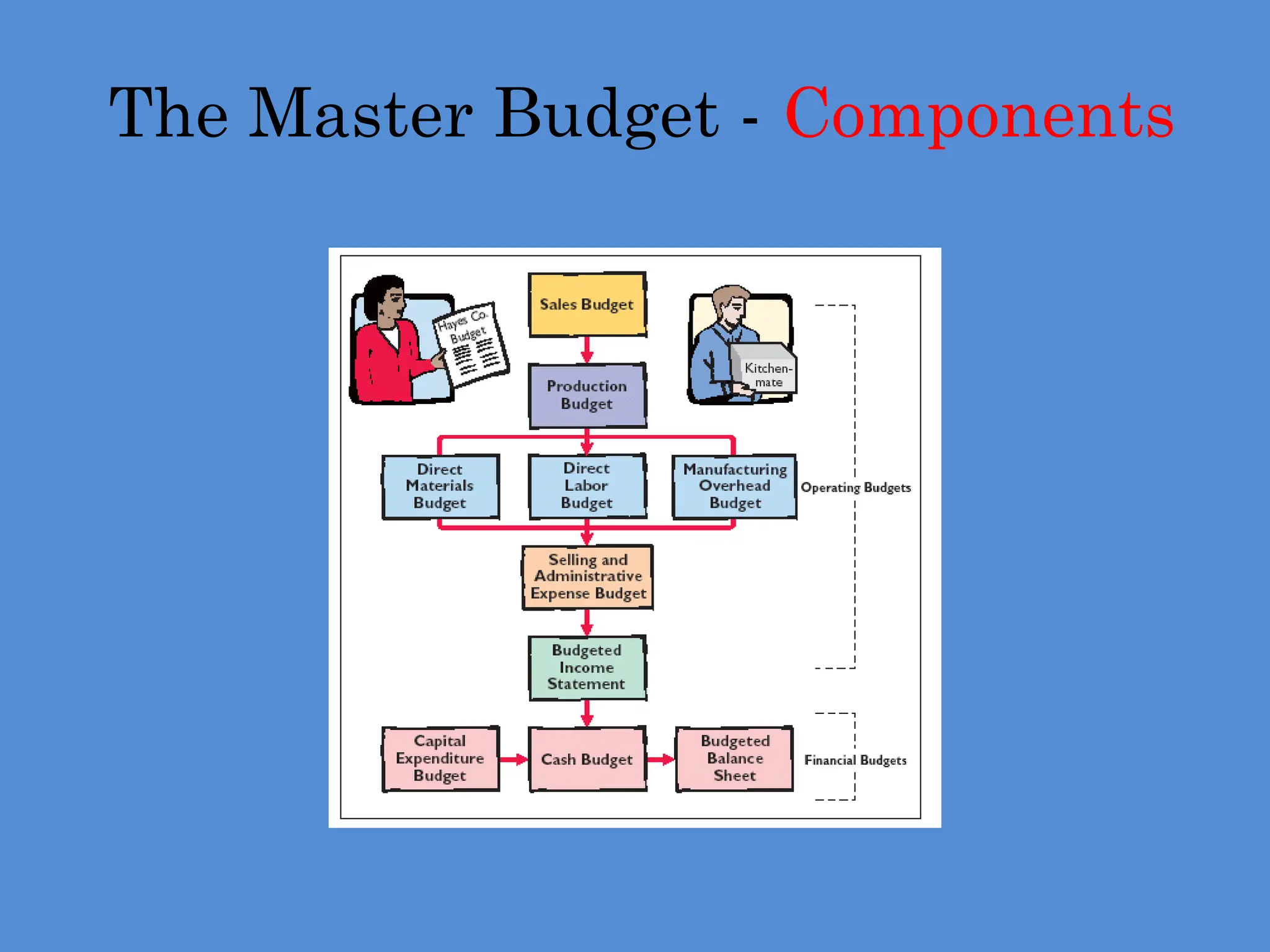
The Master Budget - Components
Expected Cash Collections
• All sales are on account.
• Royal’s collection pattern is:
 70% collected in the month of sale,
 25% collected in the month following sale,
 5% is uncollectible.
• The March 31 accounts receivable
balance of $30,000 will be collected in
full.
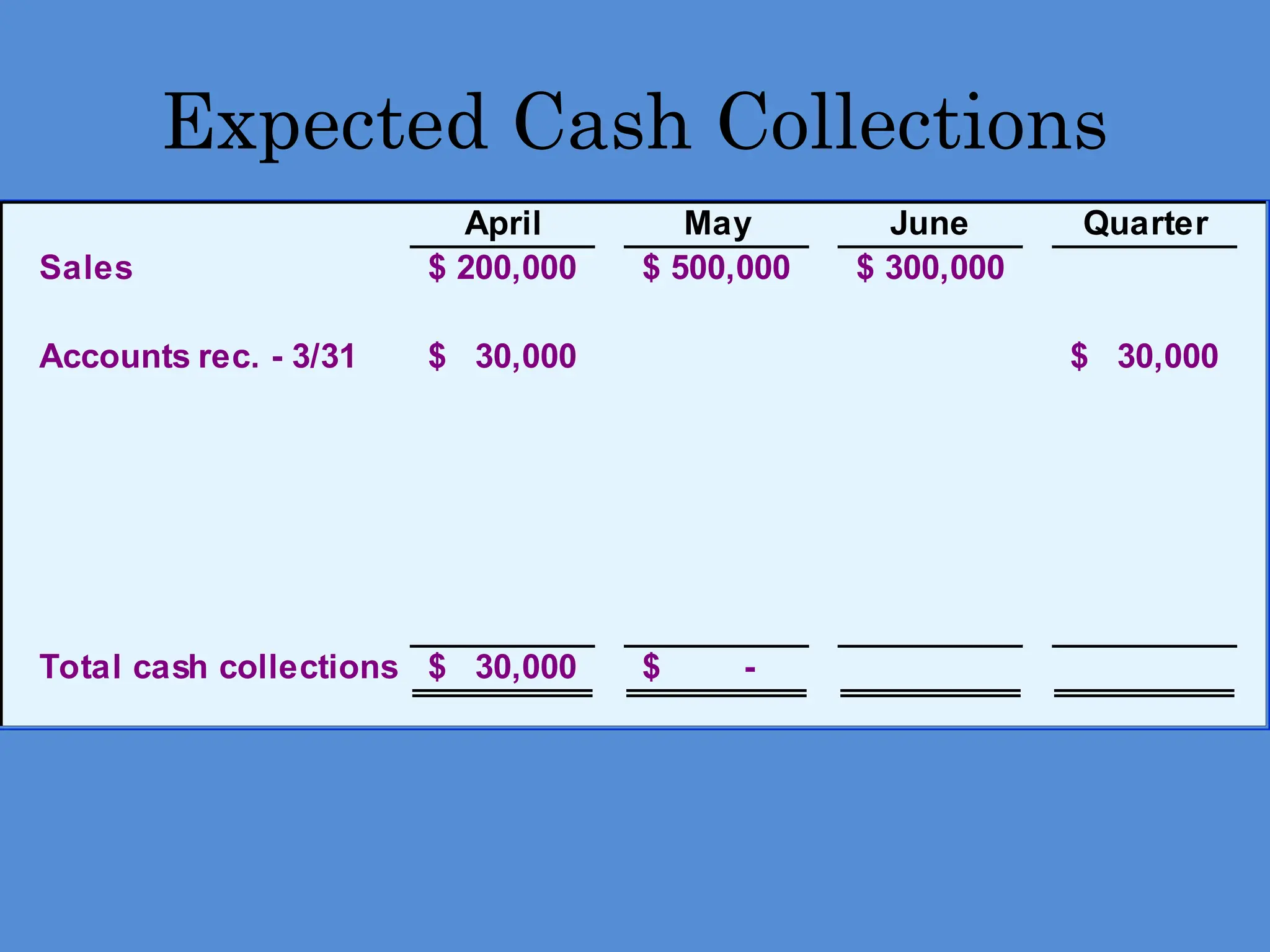
Expected Cash Collections
April May June Quarter
Sales 200,000
$ 500,000
$ 300,000
$
Accounts rec. - 3/31 30,000
$ 30,000
$
Total cash collections 30,000
$ -
$
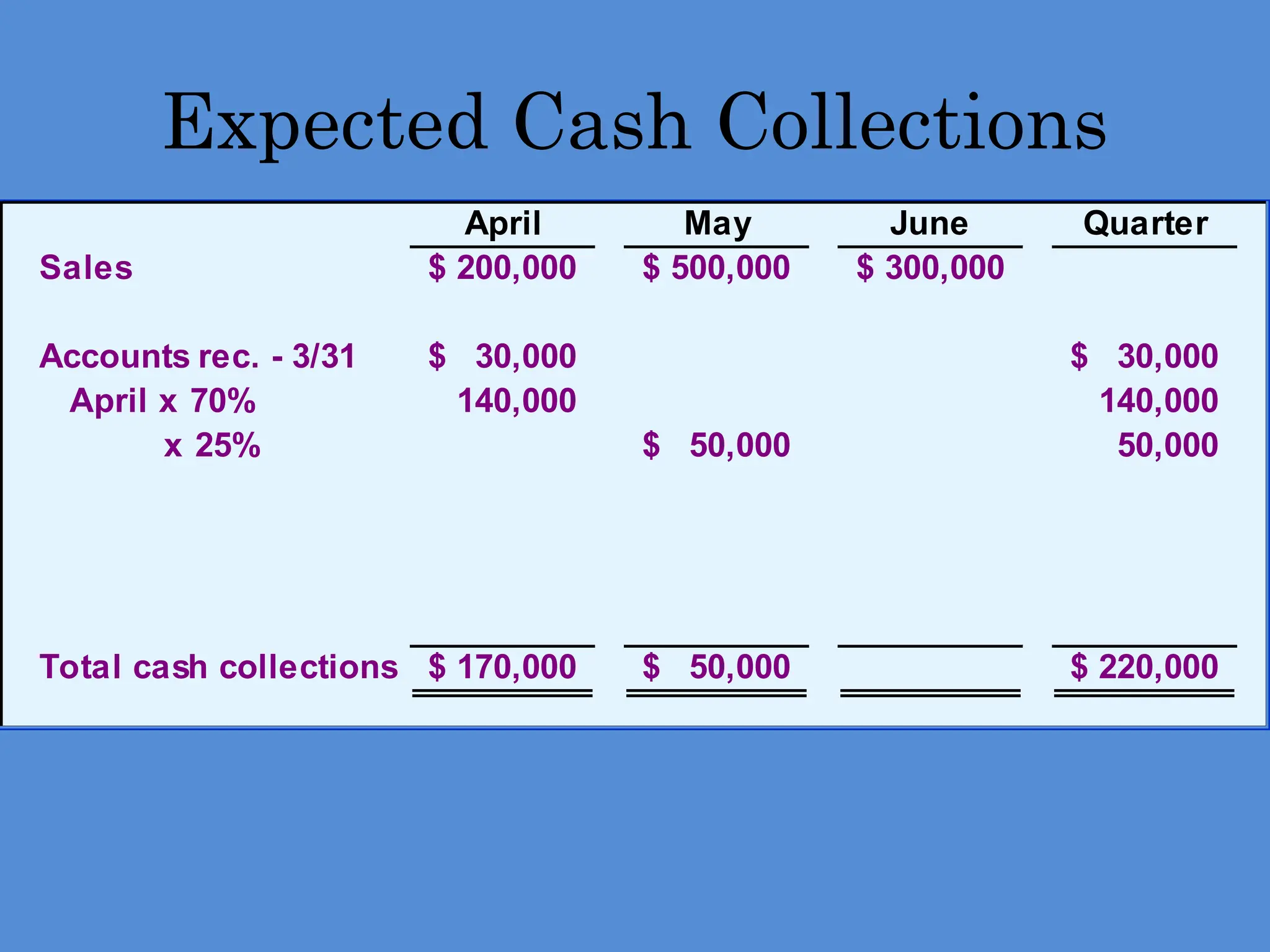
Expected Cash Collections
April May June Quarter
Sales 200,000
$ 500,000
$ 300,000
$
Accounts rec. - 3/31 30,000
$ 30,000
$
April x 70% 140,000 140,000
x 25% 50,000
$ 50,000
Total cash collections 170,000
$ 50,000
$ 220,000
$
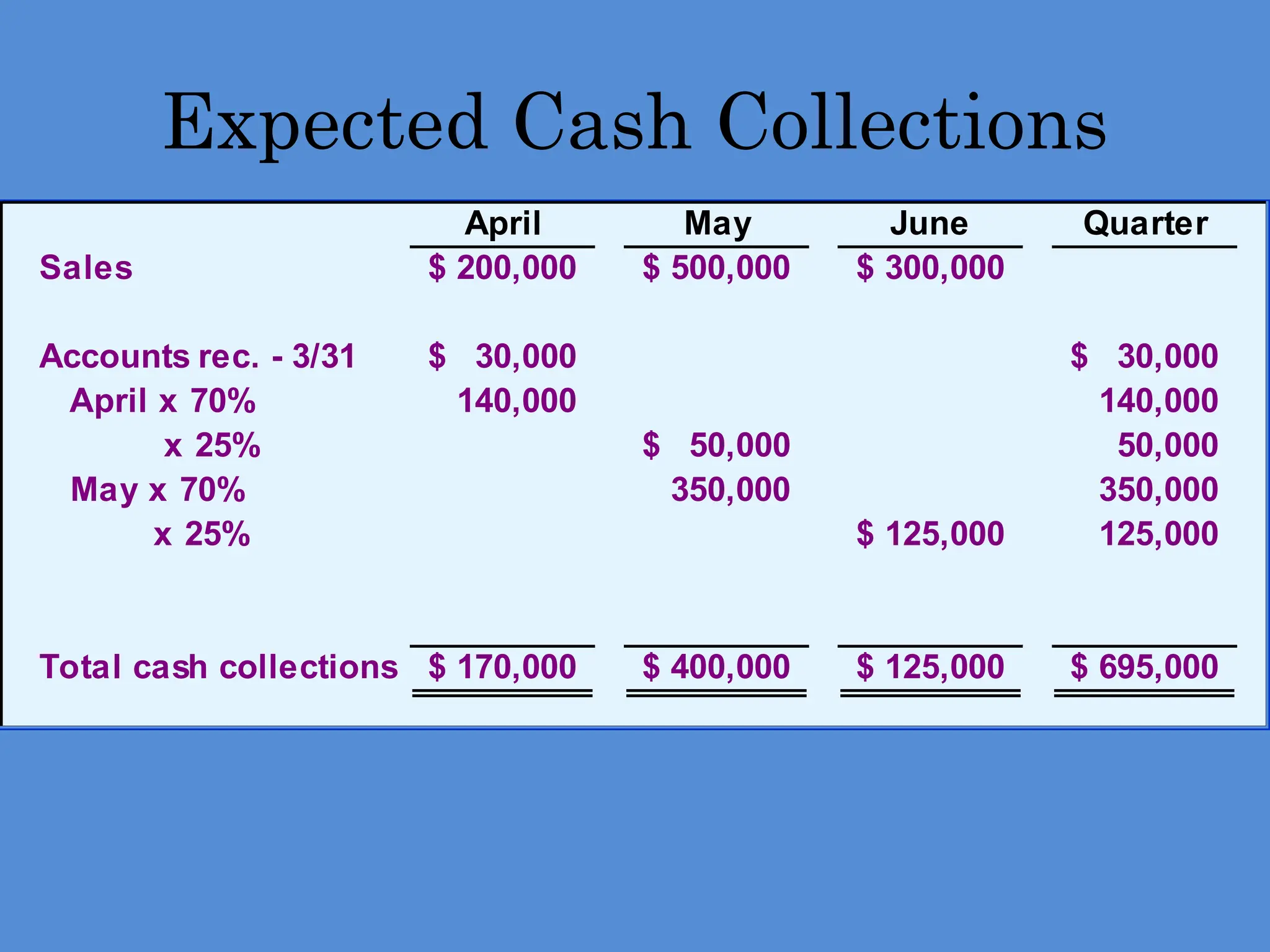
Expected Cash Collections
April May June Quarter
Sales 200,000
$ 500,000
$ 300,000
$
Accounts rec. - 3/31 30,000
$ 30,000
$
April x 70% 140,000 140,000
x 25% 50,000
$ 50,000
May x 70% 350,000 350,000
x 25% 125,000
$ 125,000
Total cash collections 170,000
$ 400,000
$ 125,000
$ 695,000
$
Expected Cash Collections
April May June Quarter
Sales 200,000
$ 500,000
$ 300,000
$
Accounts rec. - 3/31 30,000
$ 30,000
$
April x 70% 140,000 140,000
x 25% 50,000
$ 50,000
May x 70% 350,000 350,000
x 25% 125,000
$ 125,000
June x 70% 210,000 210,000
Total cash collections 170,000
$ 400,000
$ 335,000
$ 905,000
$
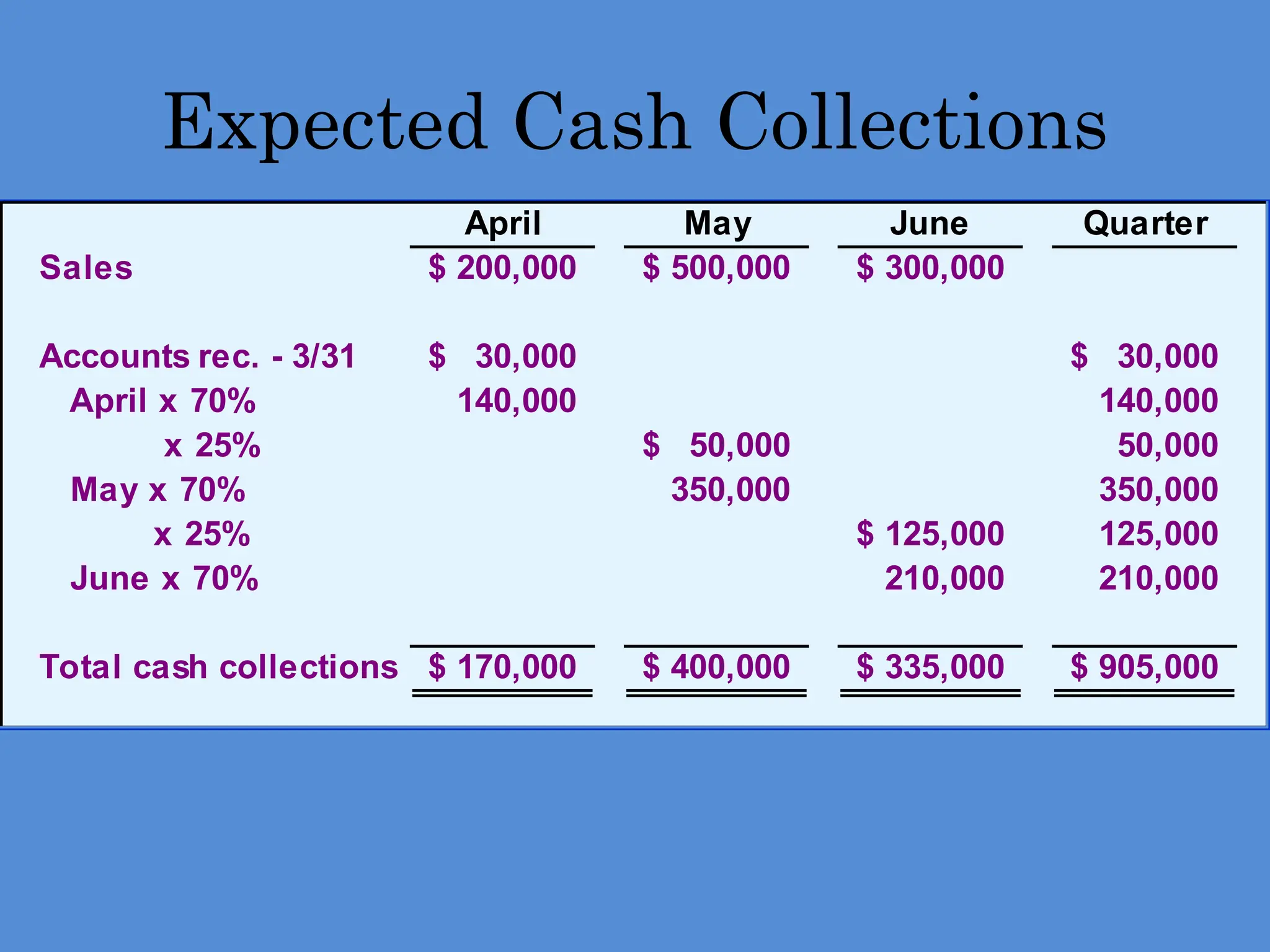
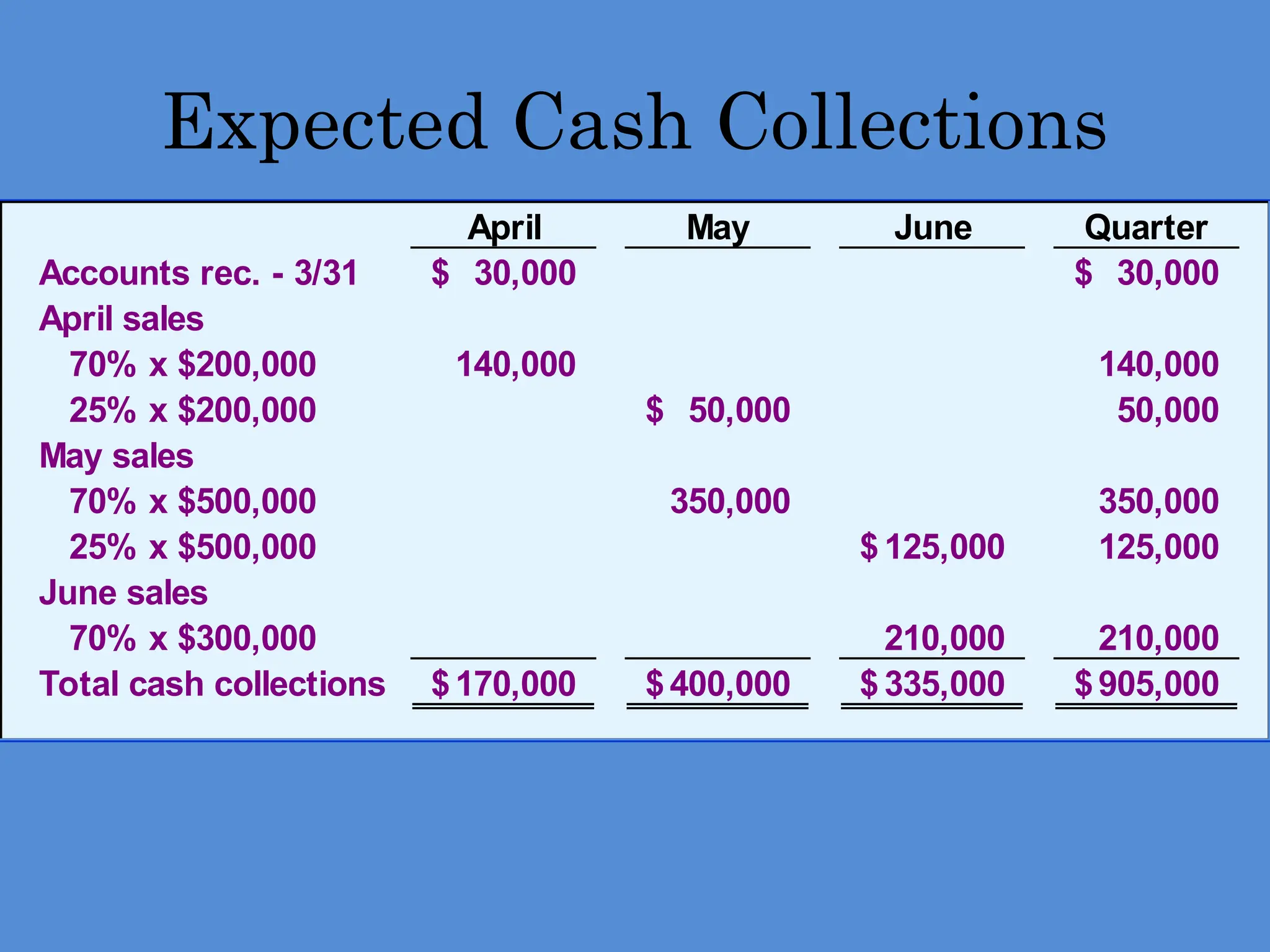
Expected Cash Collections
April May June Quarter
Accounts rec. - 3/31 30,000
$ 30,000
$
April sales
70% x $200,000 140,000 140,000
25% x $200,000 50,000
$ 50,000
May sales
70% x $500,000 350,000 350,000
25% x $500,000 125,000
$ 125,000
June sales
70% x $300,000 210,000 210,000
Total cash collections 170,000
$ 400,000
$ 335,000
$ 905,000
$
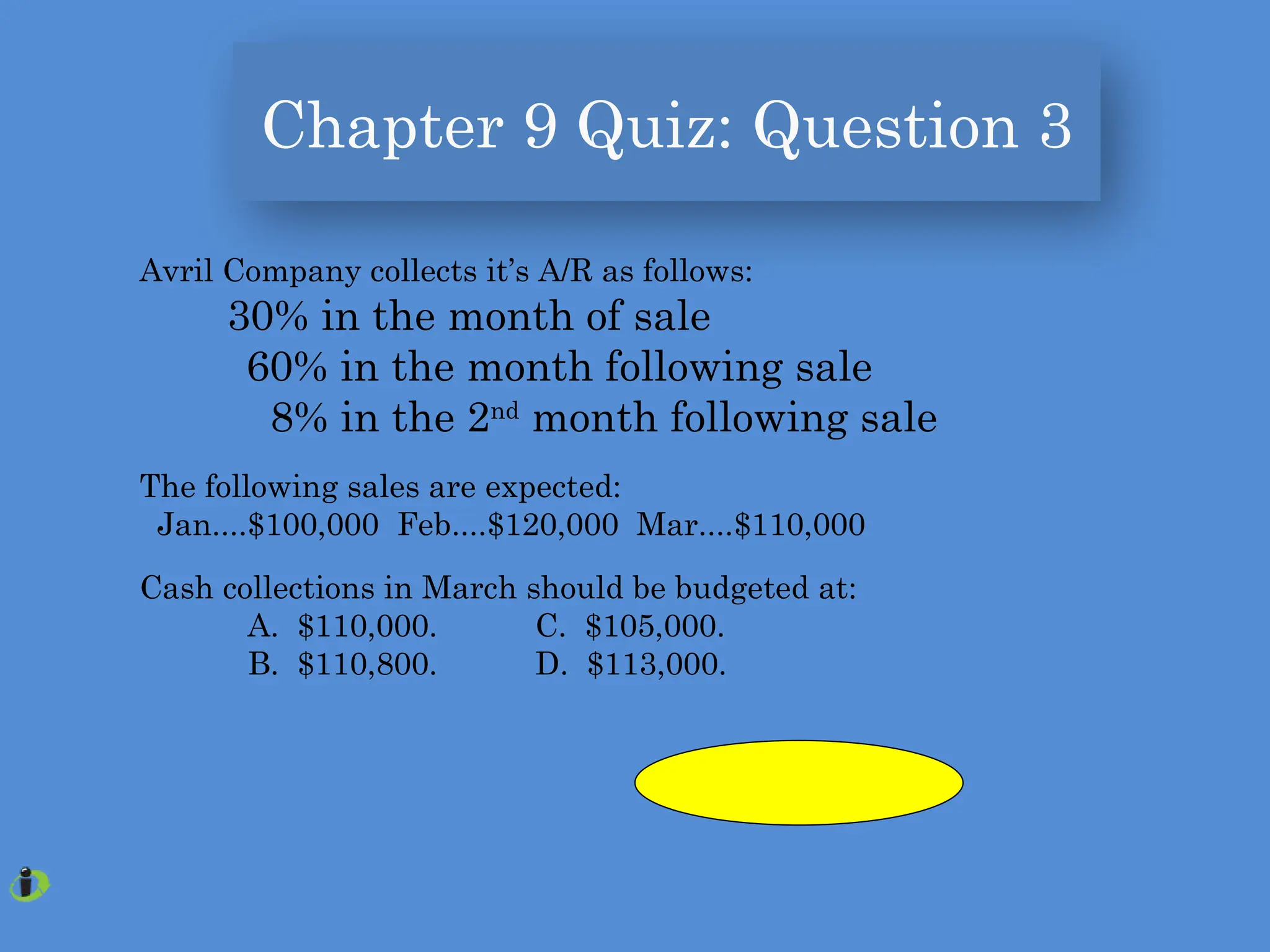
Chapter 9 Quiz: Question 3
Avril Company collects it’s A/R as follows:
30% in the month of sale
60% in the month following sale
8% in the 2nd
month following sale
The following sales are expected:
Jan....$100,000 Feb....$120,000 Mar....$110,000
Cash collections in March should be budgeted at:
A. $110,000. C. $105,000.
B. $110,800. D. $113,000.
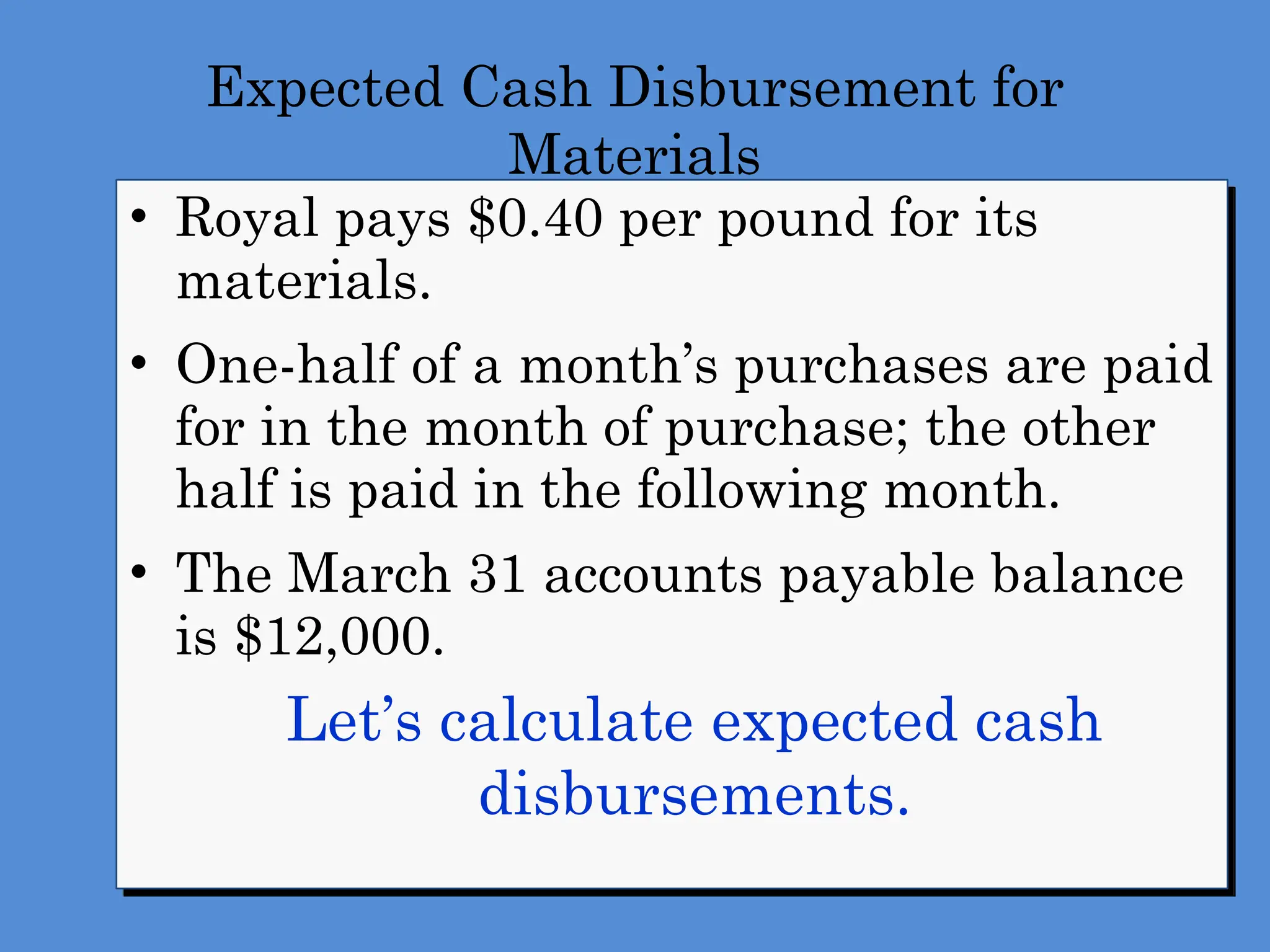
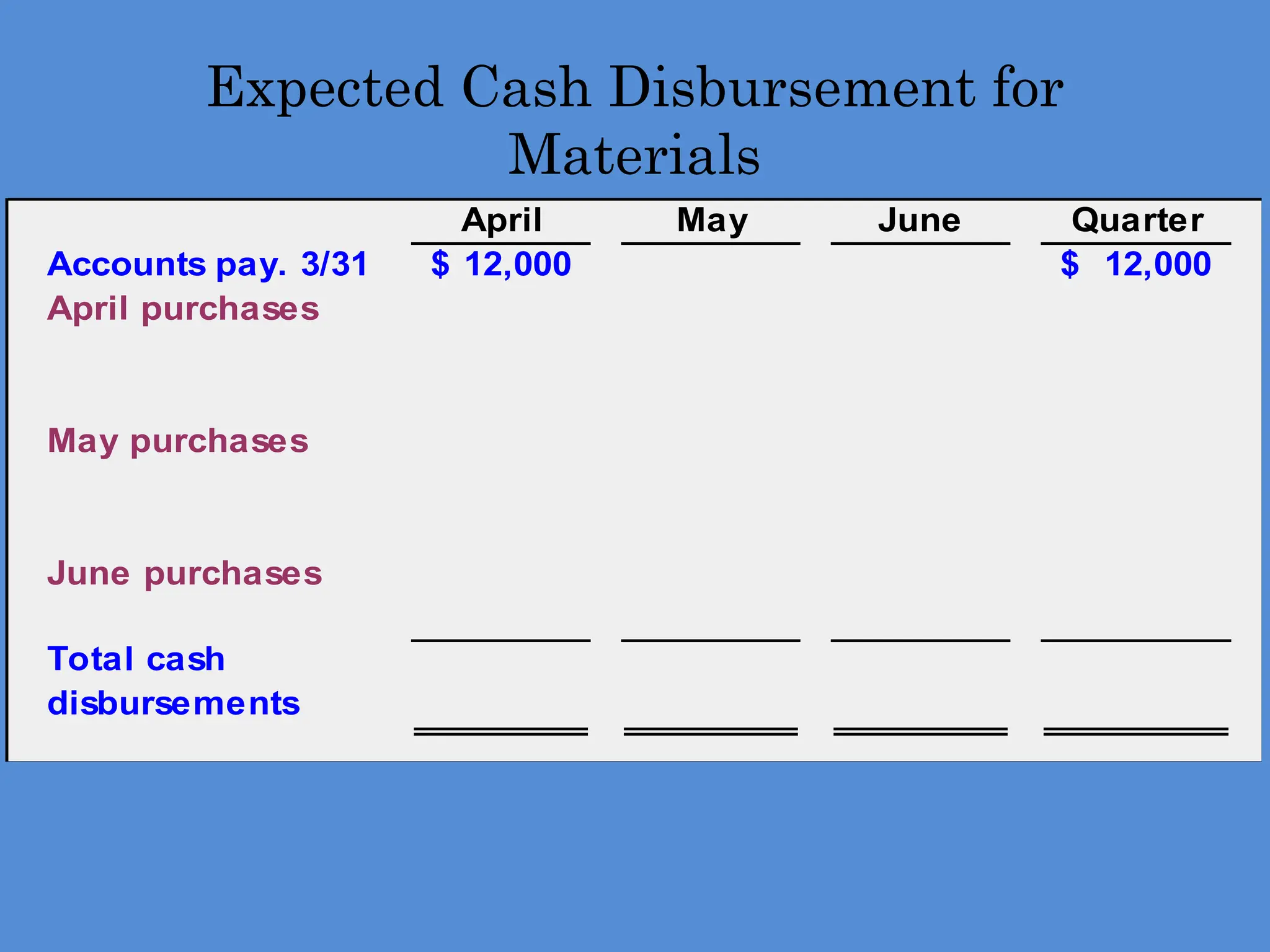
Expected Cash Disbursement for
Materials
• Royal pays $0.40 per pound for its
materials.
• One-half of a month’s purchases are paid
for in the month of purchase; the other
half is paid in the following month.
• The March 31 accounts payable balance
is $12,000.
 Let’s calculate expected cash
disbursements.
Expected Cash Disbursement for
Materials
April May June Quarter
Accounts pay. 3/31 12,000
$ 12,000
$
April purchases
May purchases
June purchases
Total cash
disbursements
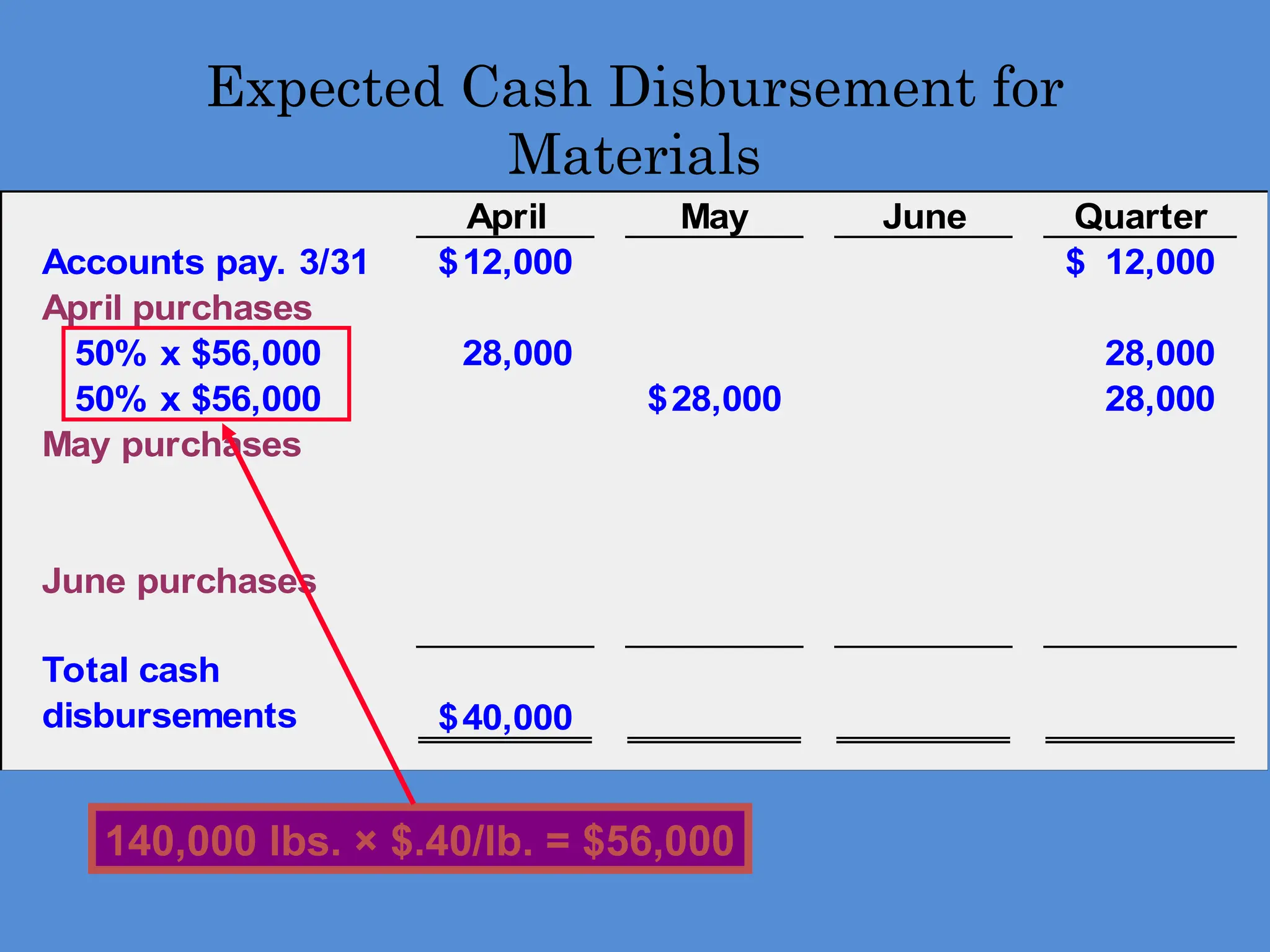
April May June Quarter
Accounts pay. 3/31 12,000
$ 12,000
$
April purchases
50% x $56,000 28,000 28,000
50% x $56,000 28,000
$ 28,000
May purchases
June purchases
Total cash
disbursements 40,000
$
Expected Cash Disbursement for
Materials
140,000 lbs. × $.40/lb. = $56,000
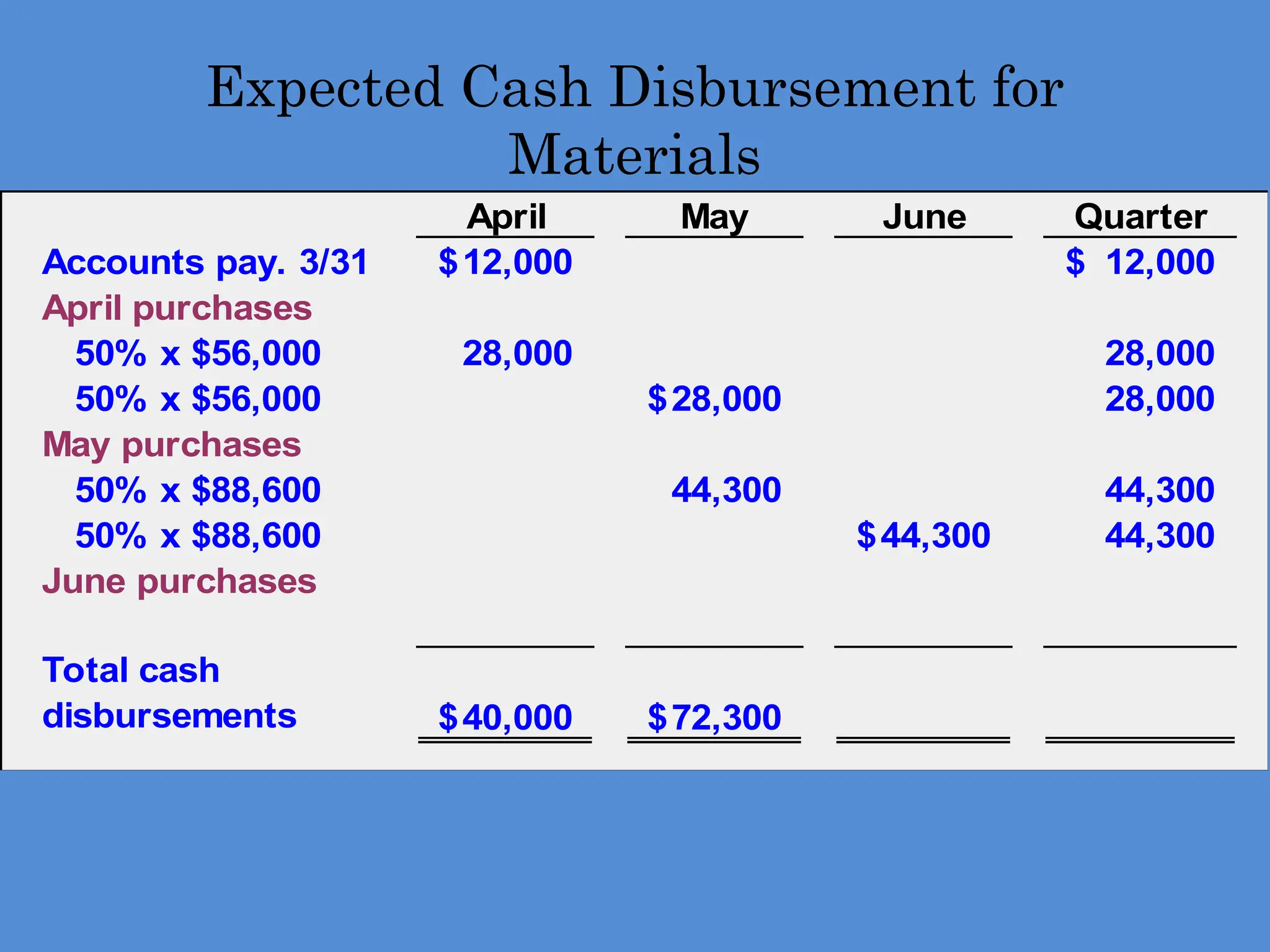
Expected Cash Disbursement for
Materials
April May June Quarter
Accounts pay. 3/31 12,000
$ 12,000
$
April purchases
50% x $56,000 28,000 28,000
50% x $56,000 28,000
$ 28,000
May purchases
50% x $88,600 44,300 44,300
50% x $88,600 44,300
$ 44,300
June purchases
Total cash
disbursements 40,000
$ 72,300
$
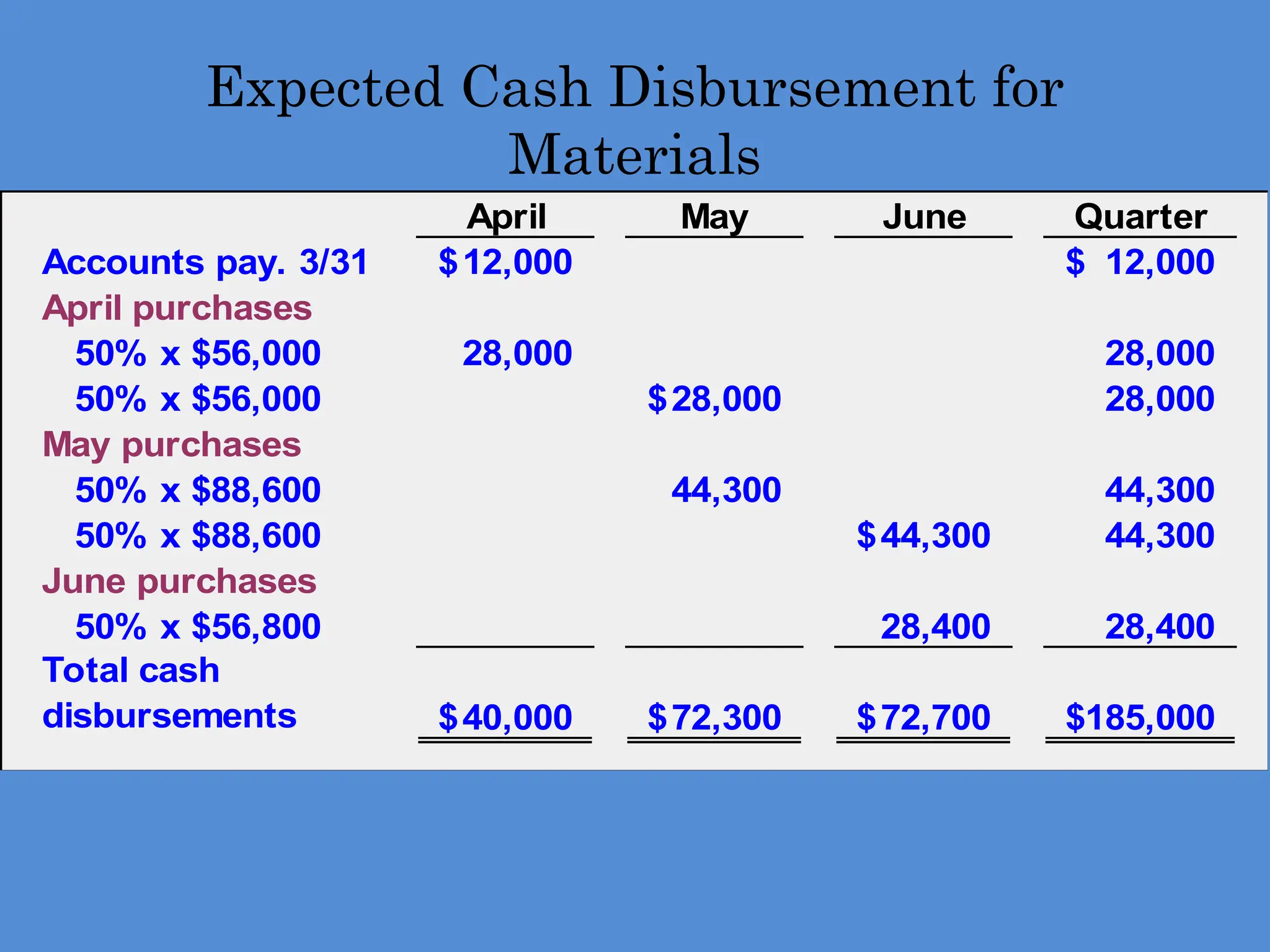
Expected Cash Disbursement for
Materials
April May June Quarter
Accounts pay. 3/31 12,000
$ 12,000
$
April purchases
50% x $56,000 28,000 28,000
50% x $56,000 28,000
$ 28,000
May purchases
50% x $88,600 44,300 44,300
50% x $88,600 44,300
$ 44,300
June purchases
50% x $56,800 28,400 28,400
Total cash
disbursements 40,000
$ 72,300
$ 72,700
$ 185,000
$
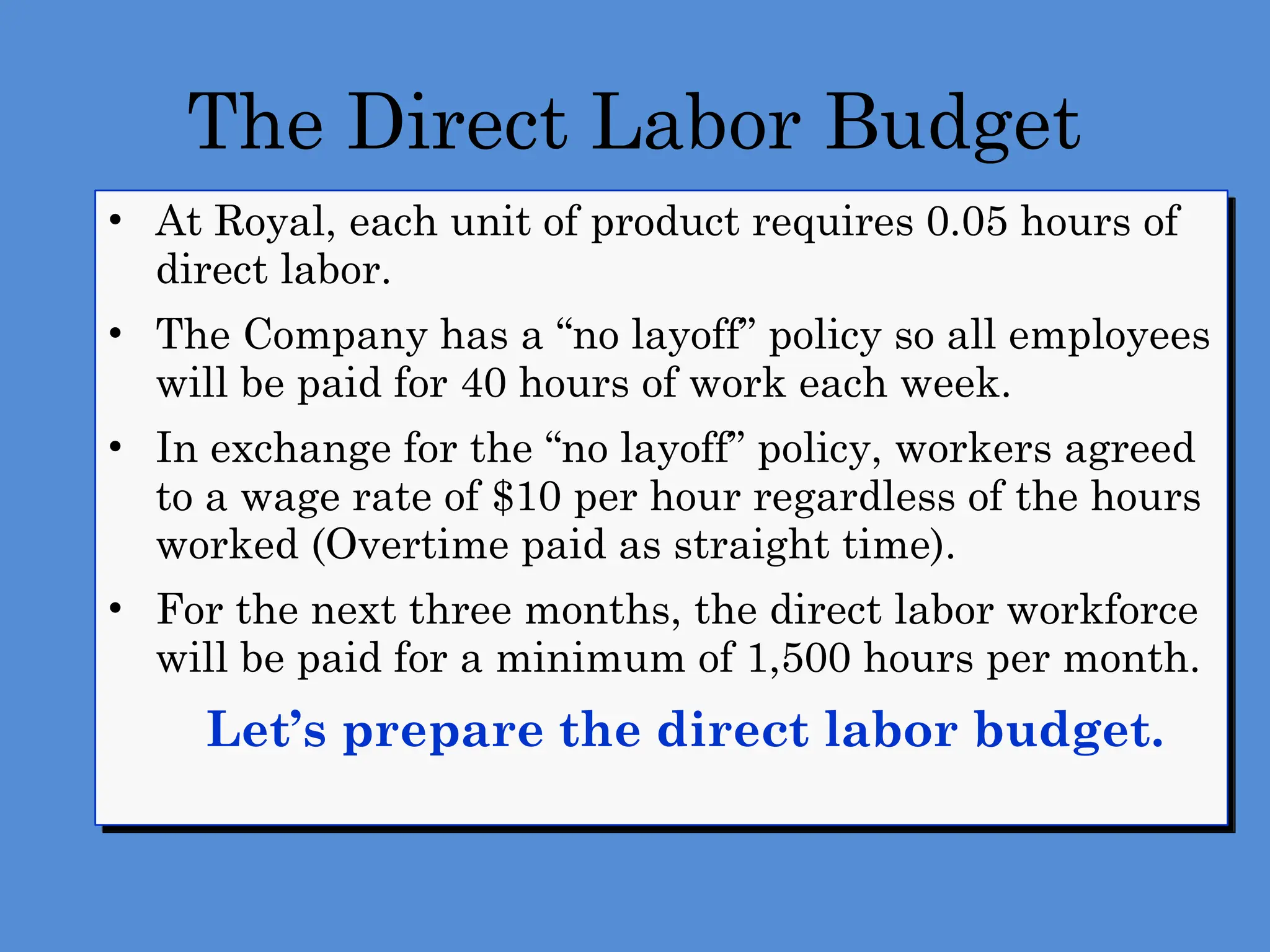
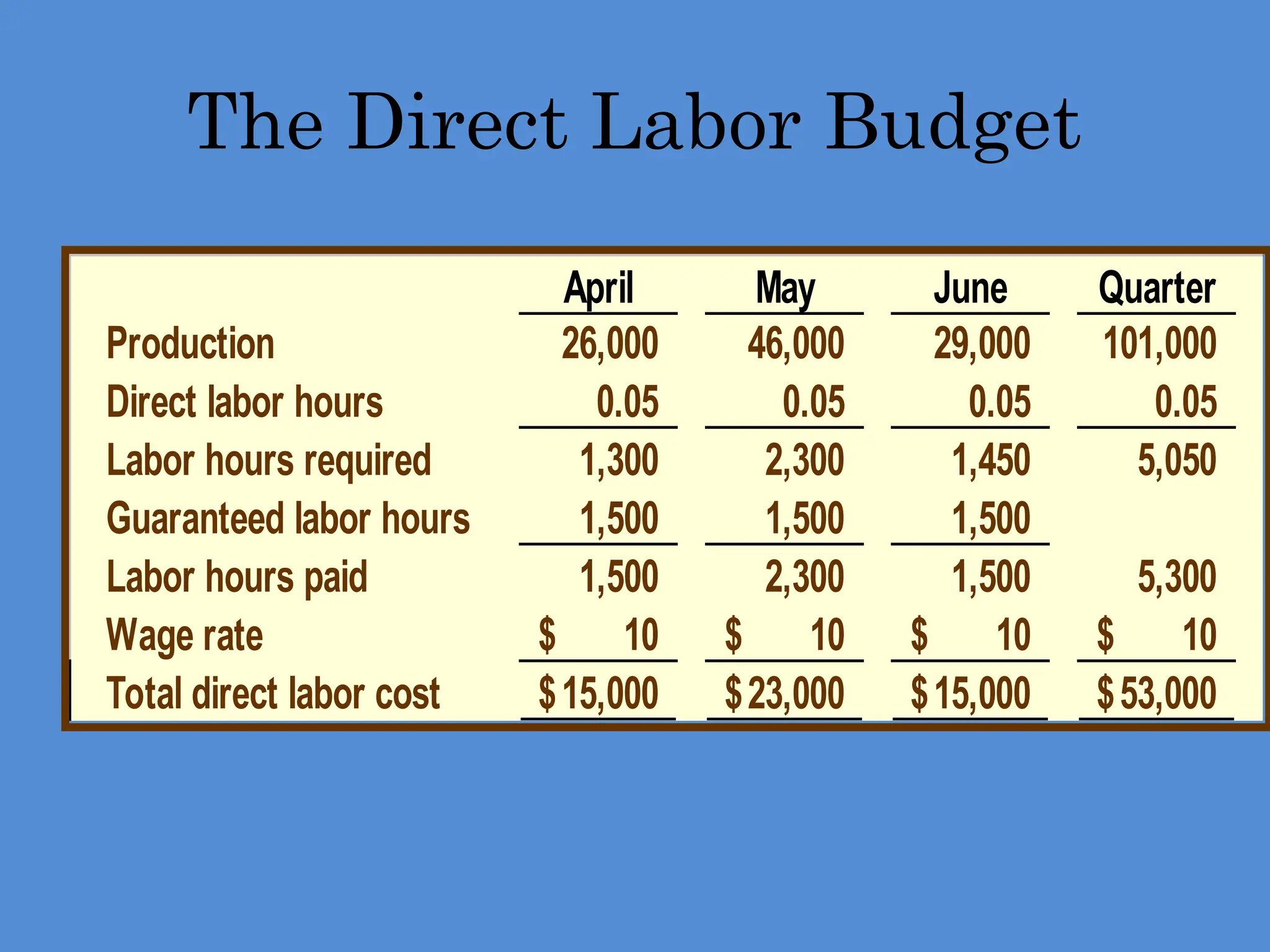
The Direct Labor Budget
• At Royal, each unit of product requires 0.05 hours of
direct labor.
• The Company has a “no layoff” policy so all employees
will be paid for 40 hours of work each week.
• In exchange for the “no layoff” policy, workers agreed
to a wage rate of $10 per hour regardless of the hours
worked (Overtime paid as straight time).
• For the next three months, the direct labor workforce
will be paid for a minimum of 1,500 hours per month.
 Let’s prepare the direct labor budget.
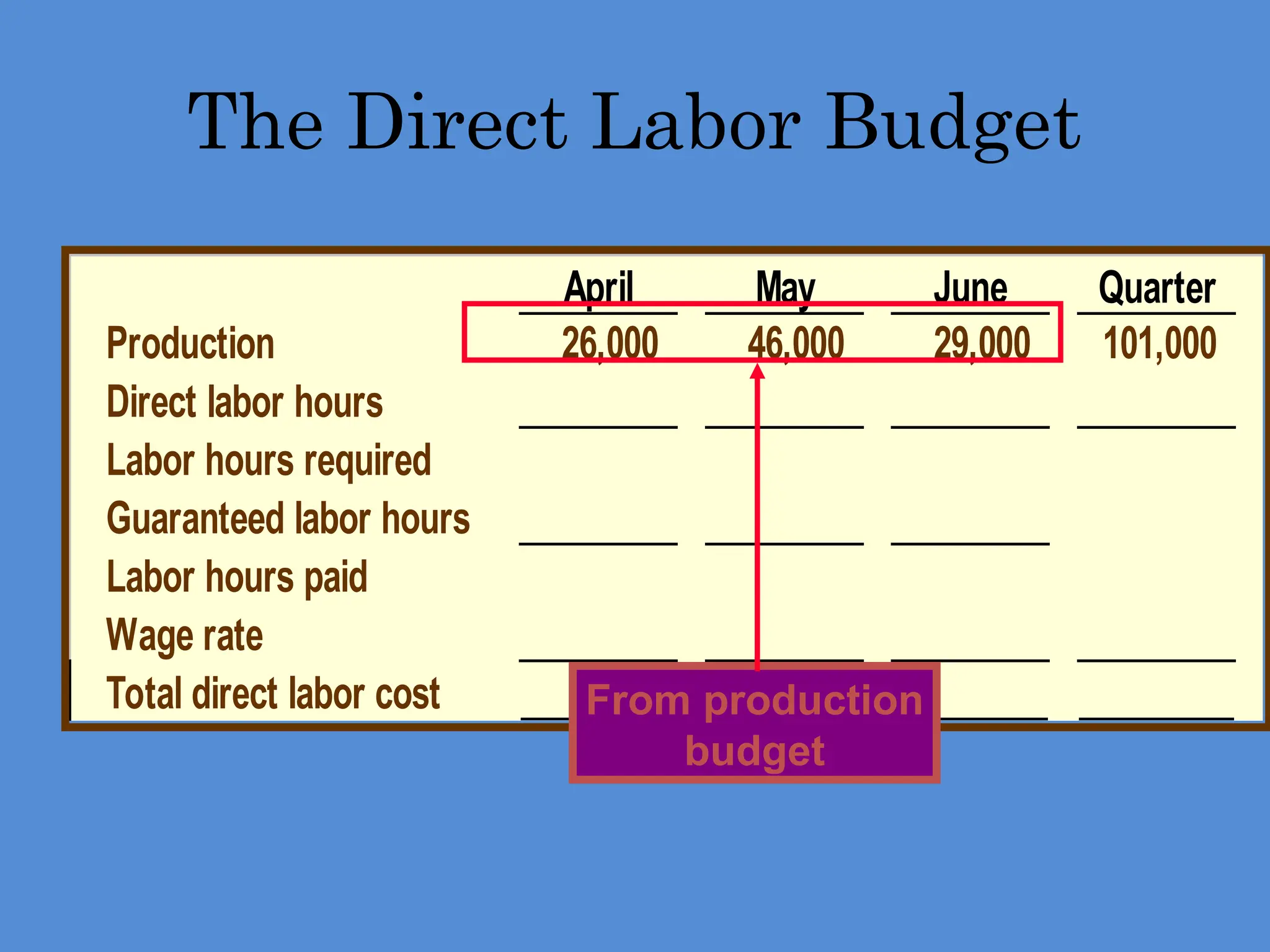
April May June Quarter
Production 26,000 46,000 29,000 101,000
Direct labor hours
Labor hours required
Guaranteed labor hours
Labor hours paid
Wage rate
Total direct labor cost
The Direct Labor Budget
From production
budget
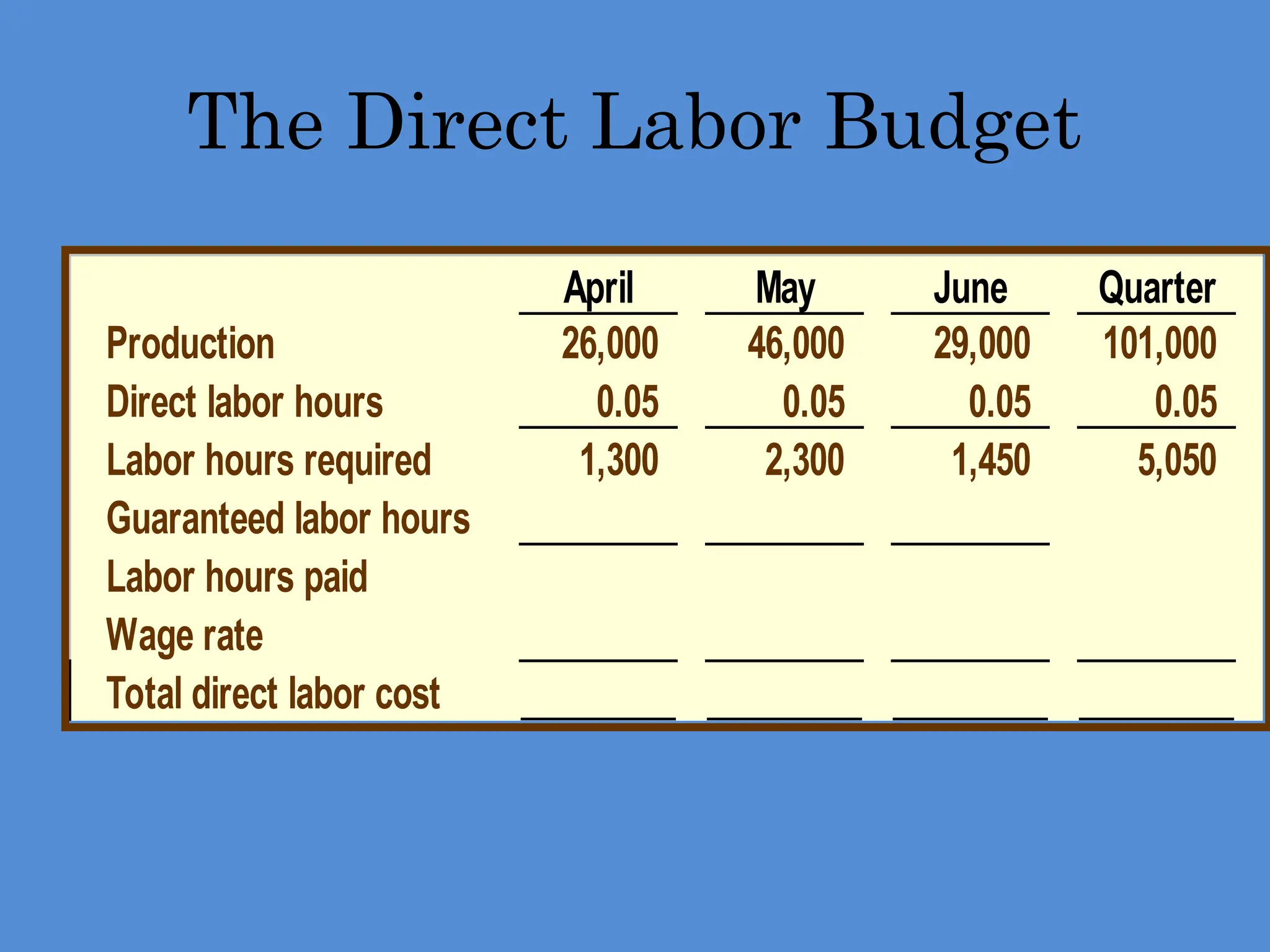
The Direct Labor Budget
April May June Quarter
Production 26,000 46,000 29,000 101,000
Direct labor hours 0.05 0.05 0.05 0.05
Labor hours required 1,300 2,300 1,450 5,050
Guaranteed labor hours
Labor hours paid
Wage rate
Total direct labor cost
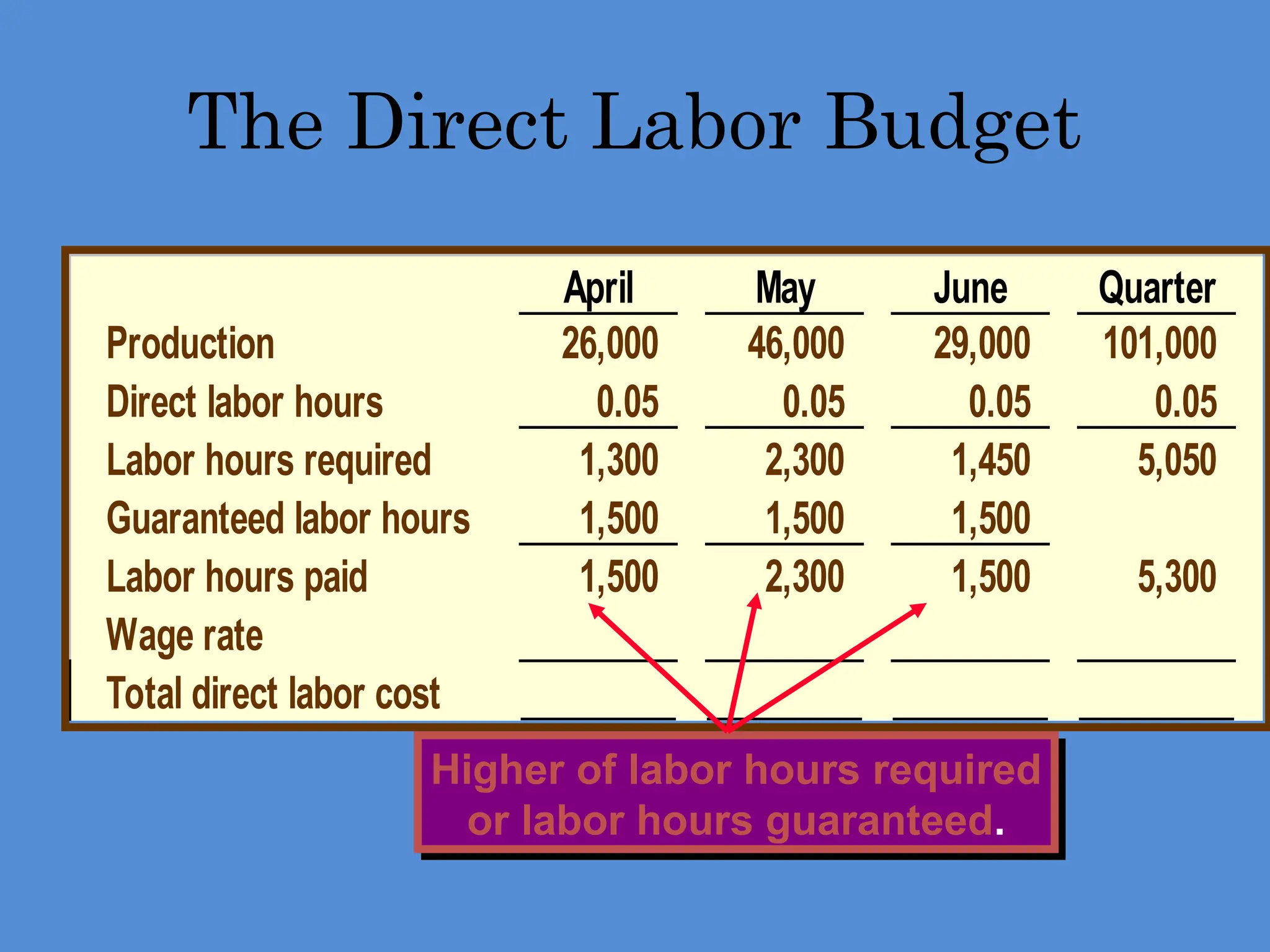
April May June Quarter
Production 26,000 46,000 29,000 101,000
Direct labor hours 0.05 0.05 0.05 0.05
Labor hours required 1,300 2,300 1,450 5,050
Guaranteed labor hours 1,500 1,500 1,500
Labor hours paid 1,500 2,300 1,500 5,300
Wage rate
Total direct labor cost
The Direct Labor Budget
Higher of labor hours required
or labor hours guaranteed.
The Direct Labor Budget
April May June Quarter
Production 26,000 46,000 29,000 101,000
Direct labor hours 0.05 0.05 0.05 0.05
Labor hours required 1,300 2,300 1,450 5,050
Guaranteed labor hours 1,500 1,500 1,500
Labor hours paid 1,500 2,300 1,500 5,300
Wage rate 10
$ 10
$ 10
$ 10
$
Total direct labor cost 15,000
$ 23,000
$ 15,000
$ 53,000
$
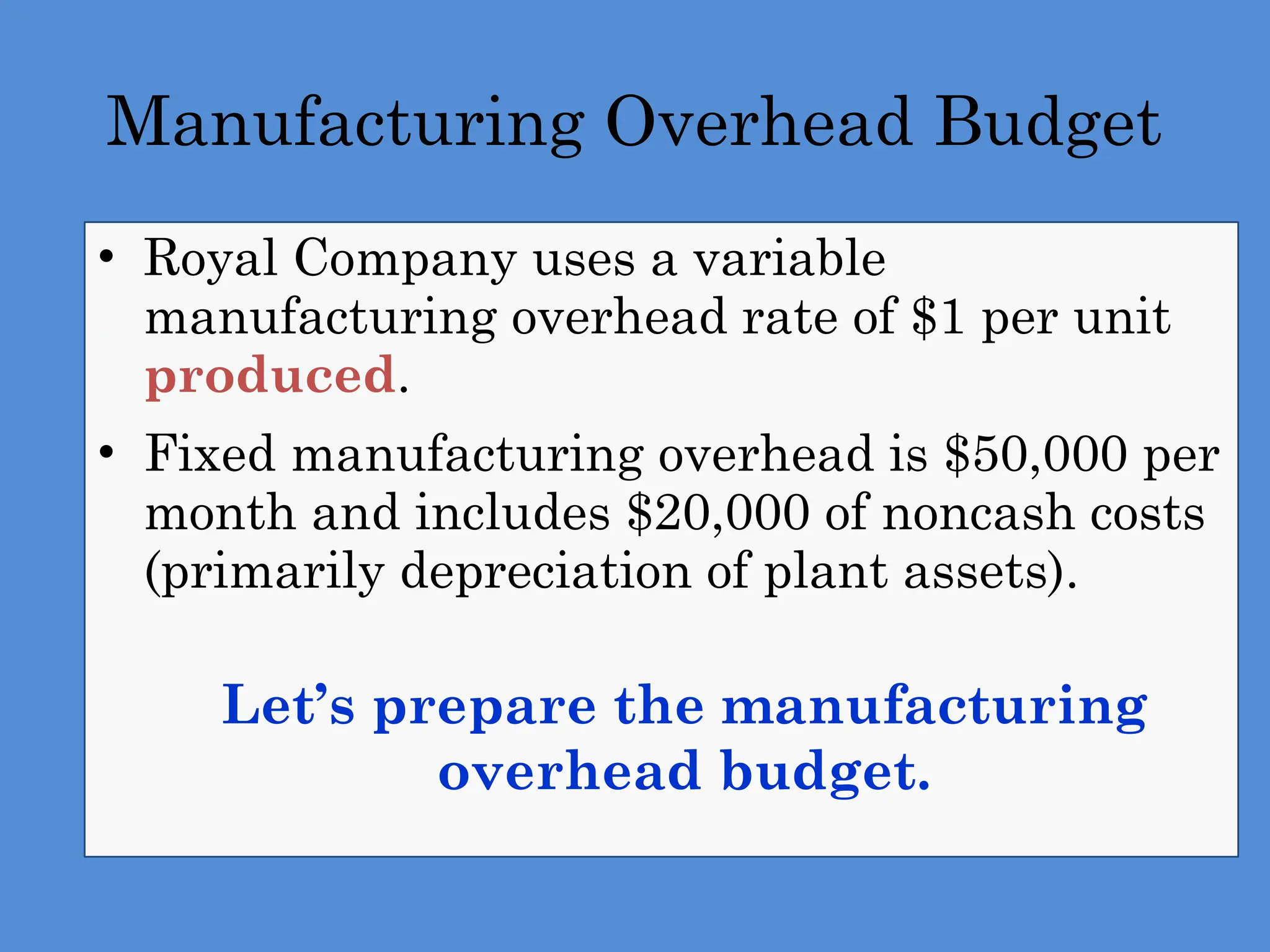
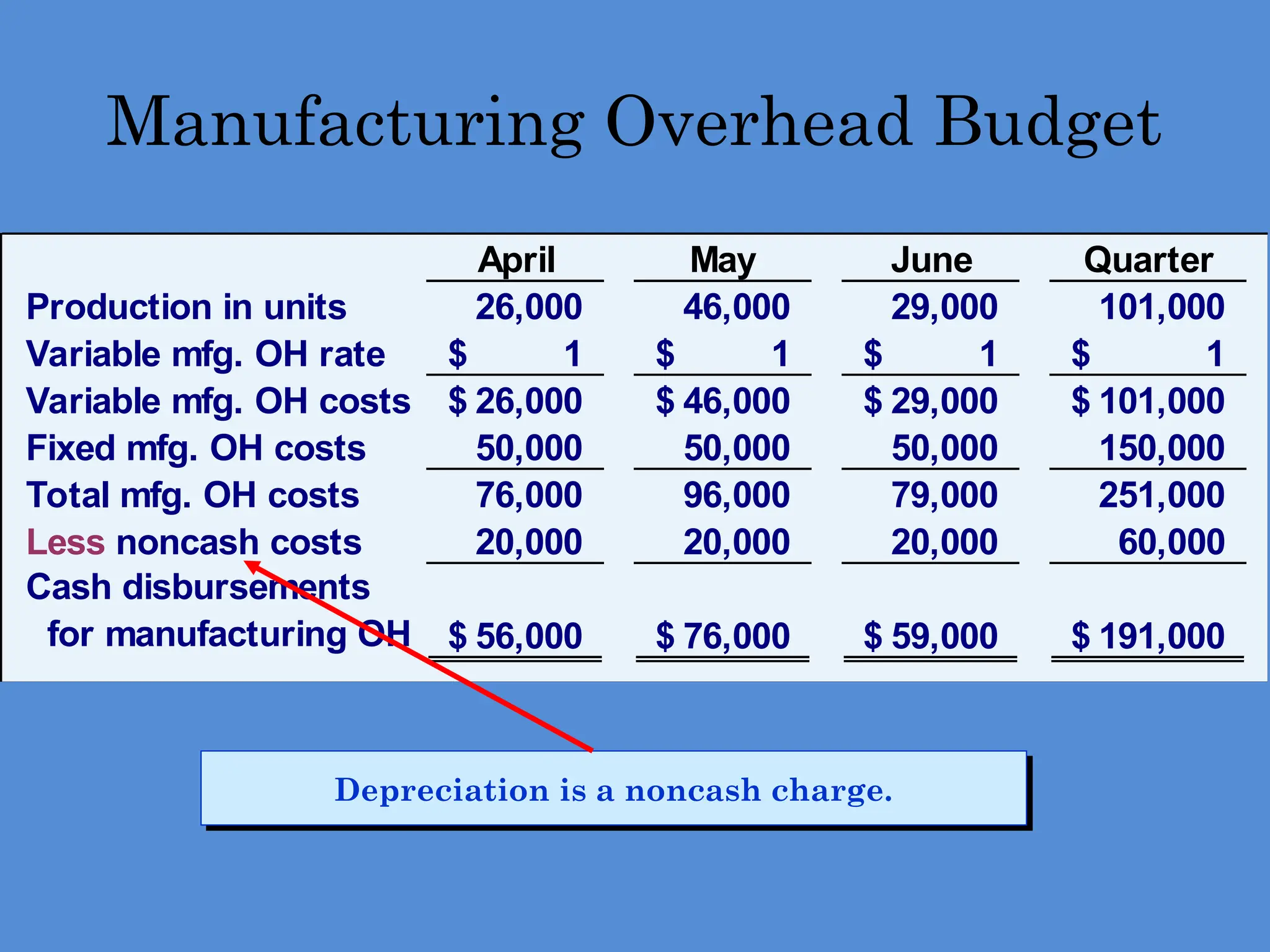
Manufacturing Overhead Budget
• Royal Company uses a variable
manufacturing overhead rate of $1 per unit
produced.
• Fixed manufacturing overhead is $50,000 per
month and includes $20,000 of noncash costs
(primarily depreciation of plant assets).
 Let’s prepare the manufacturing
overhead budget.
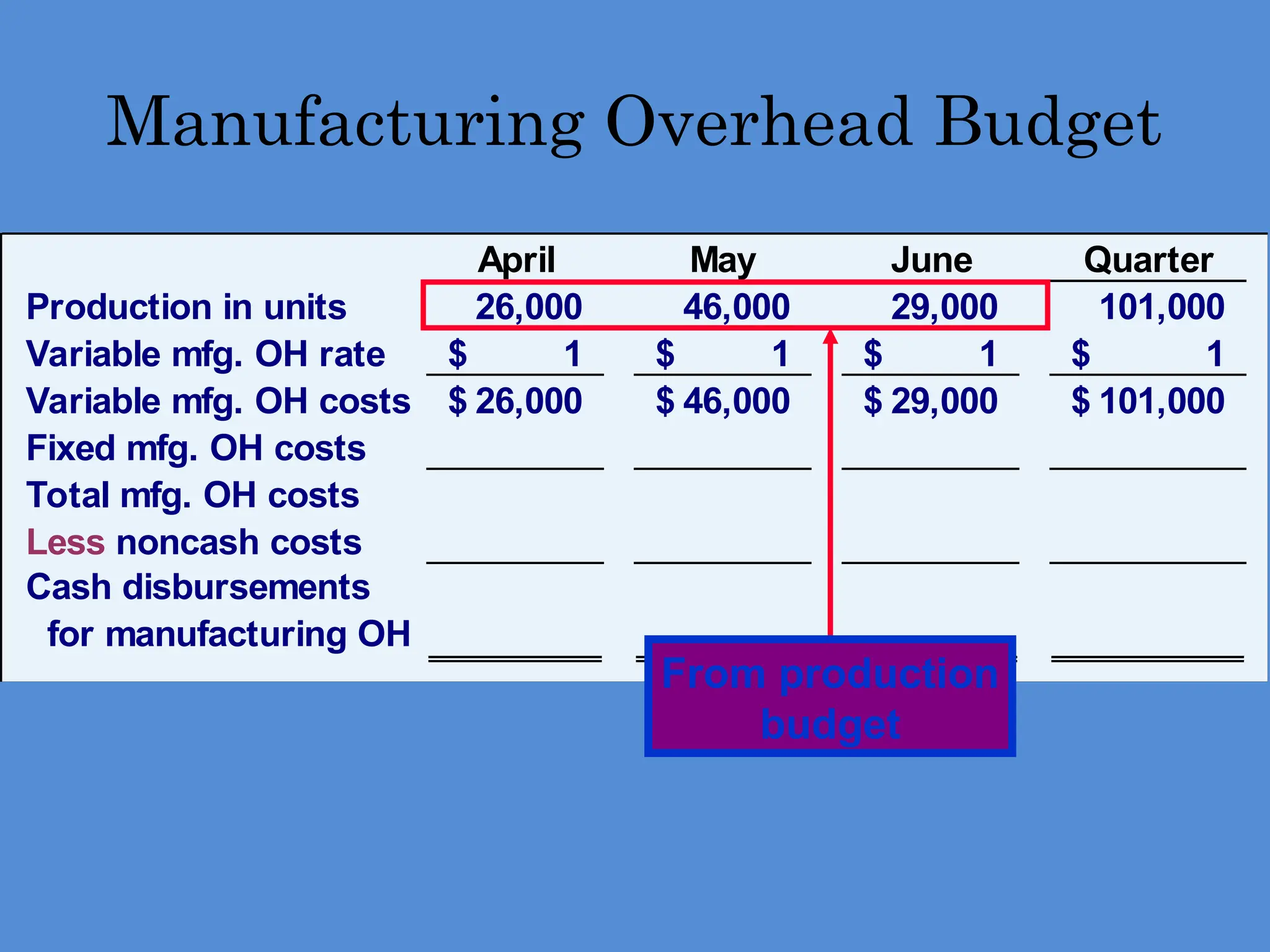
April May June Quarter
Production in units 26,000 46,000 29,000 101,000
Variable mfg. OH rate 1
$ 1
$ 1
$ 1
$
Variable mfg. OH costs 26,000
$ 46,000
$ 29,000
$ 101,000
$
Fixed mfg. OH costs
Total mfg. OH costs
Less noncash costs
Cash disbursements
for manufacturing OH
Manufacturing Overhead Budget
From production
budget
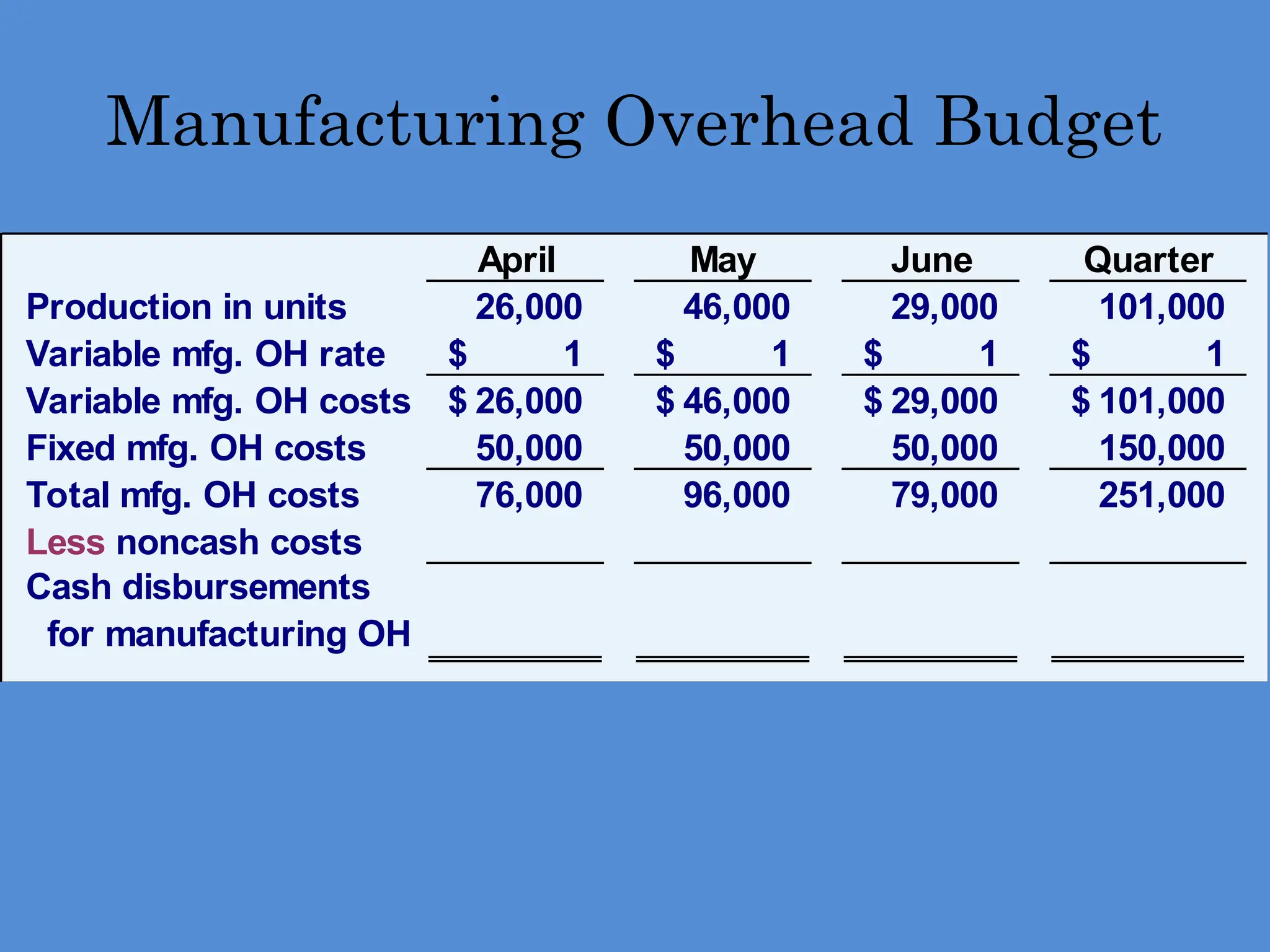
Manufacturing Overhead Budget
April May June Quarter
Production in units 26,000 46,000 29,000 101,000
Variable mfg. OH rate 1
$ 1
$ 1
$ 1
$
Variable mfg. OH costs 26,000
$ 46,000
$ 29,000
$ 101,000
$
Fixed mfg. OH costs 50,000 50,000 50,000 150,000
Total mfg. OH costs 76,000 96,000 79,000 251,000
Less noncash costs
Cash disbursements
for manufacturing OH
Manufacturing Overhead Budget
April May June Quarter
Production in units 26,000 46,000 29,000 101,000
Variable mfg. OH rate 1
$ 1
$ 1
$ 1
$
Variable mfg. OH costs 26,000
$ 46,000
$ 29,000
$ 101,000
$
Fixed mfg. OH costs 50,000 50,000 50,000 150,000
Total mfg. OH costs 76,000 96,000 79,000 251,000
Less noncash costs 20,000 20,000 20,000 60,000
Cash disbursements
for manufacturing OH 56,000
$ 76,000
$ 59,000
$ 191,000
$
Depreciation is a noncash charge.
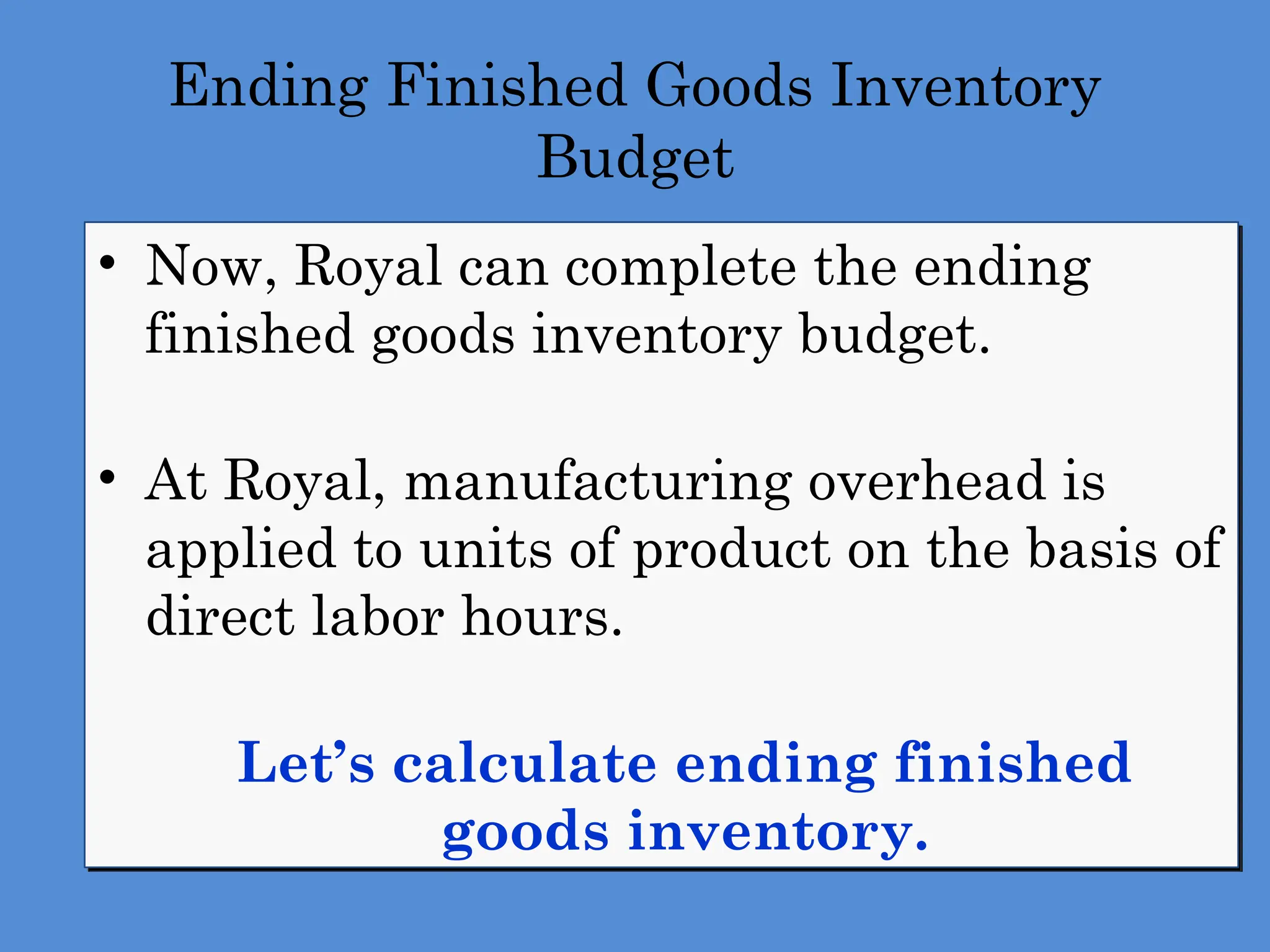
Ending Finished Goods Inventory
Budget
• Now, Royal can complete the ending
finished goods inventory budget.
• At Royal, manufacturing overhead is
applied to units of product on the basis of
direct labor hours.
 Let’s calculate ending finished
goods inventory.
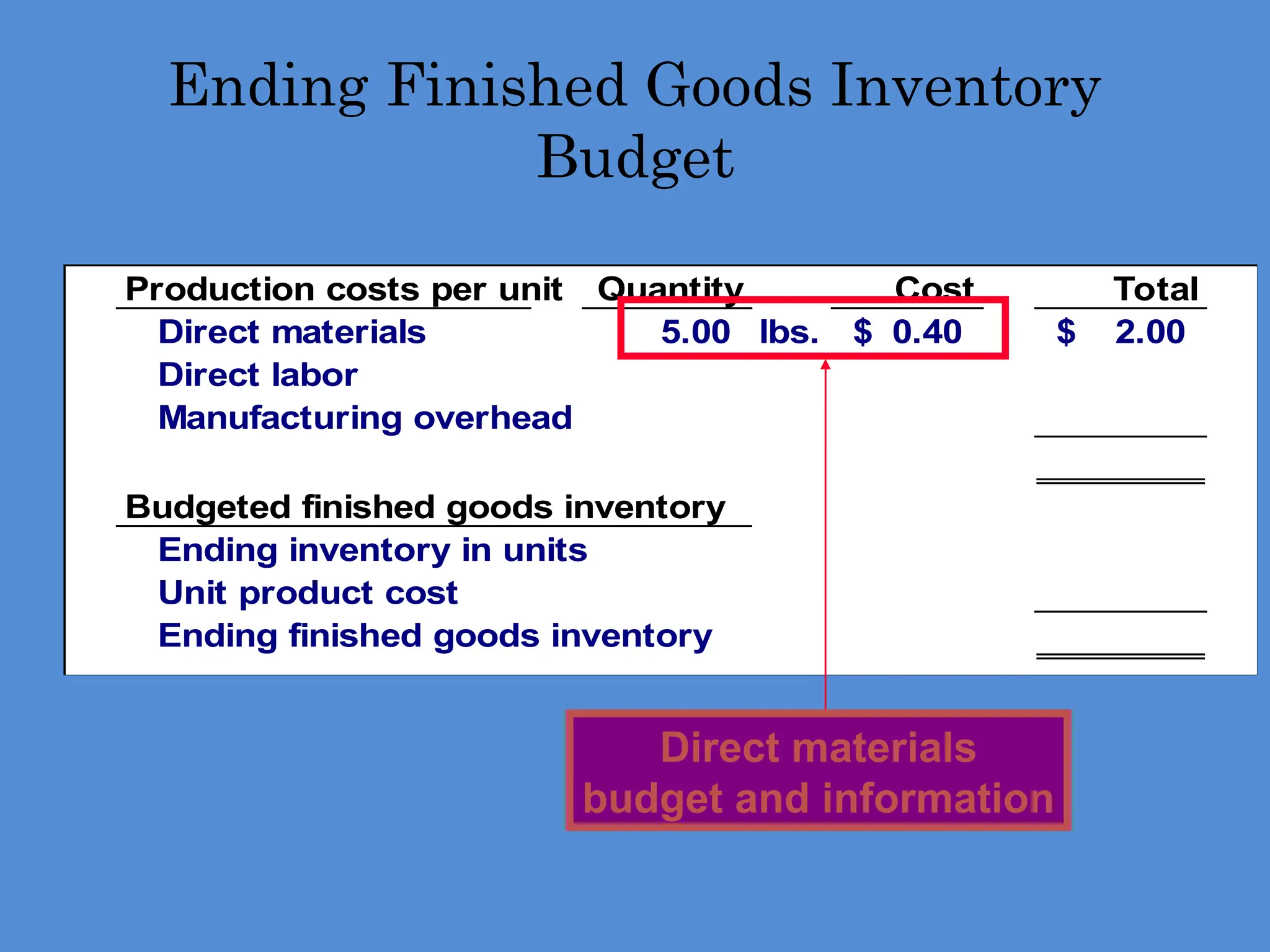
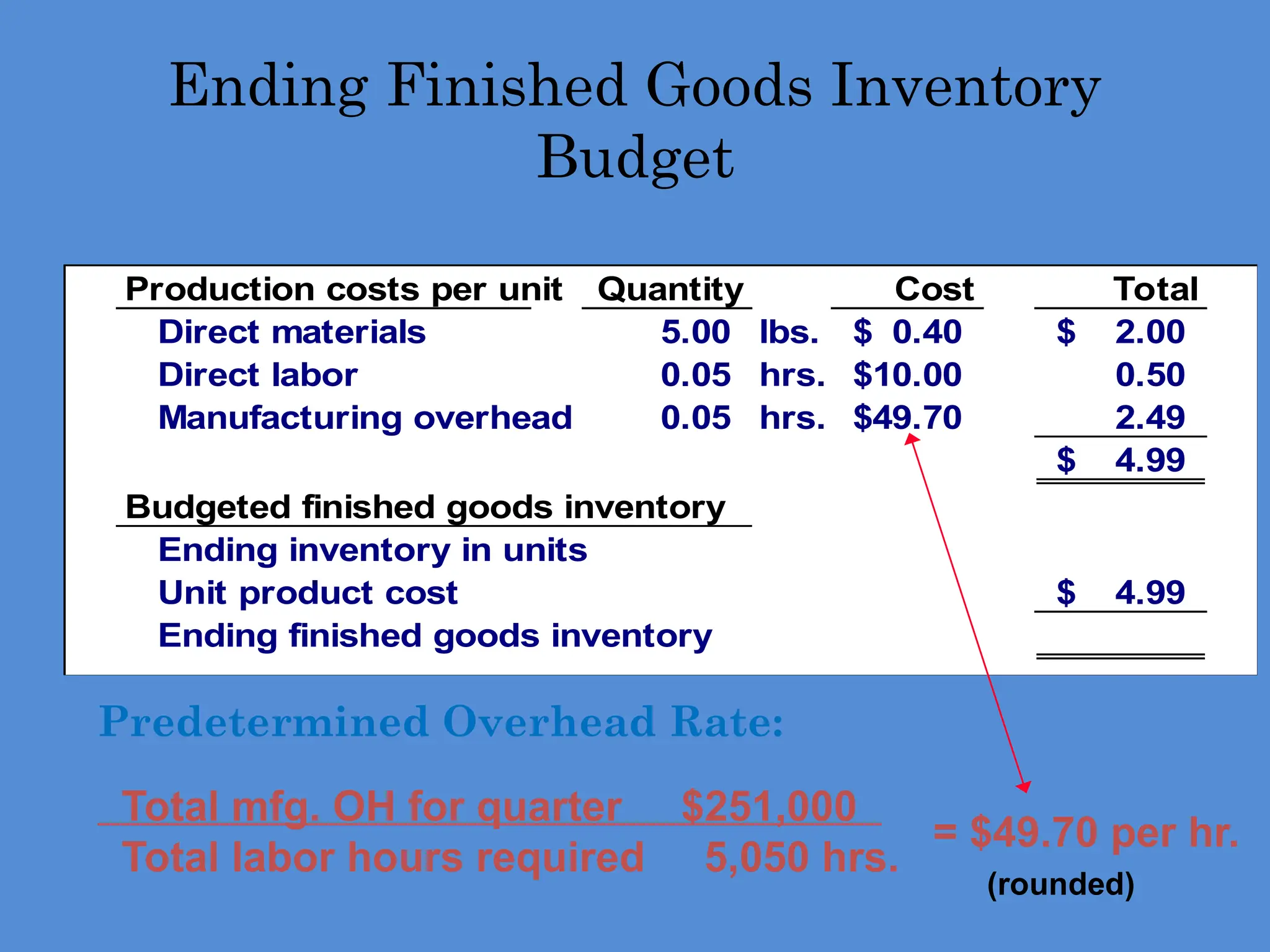
Production costs per unit Quantity Cost Total
Direct materials 5.00 lbs. 0.40
$ 2.00
$
Direct labor
Manufacturing overhead
Budgeted finished goods inventory
Ending inventory in units
Unit product cost
Ending finished goods inventory
Ending Finished Goods Inventory
Budget
Direct materials
budget and information
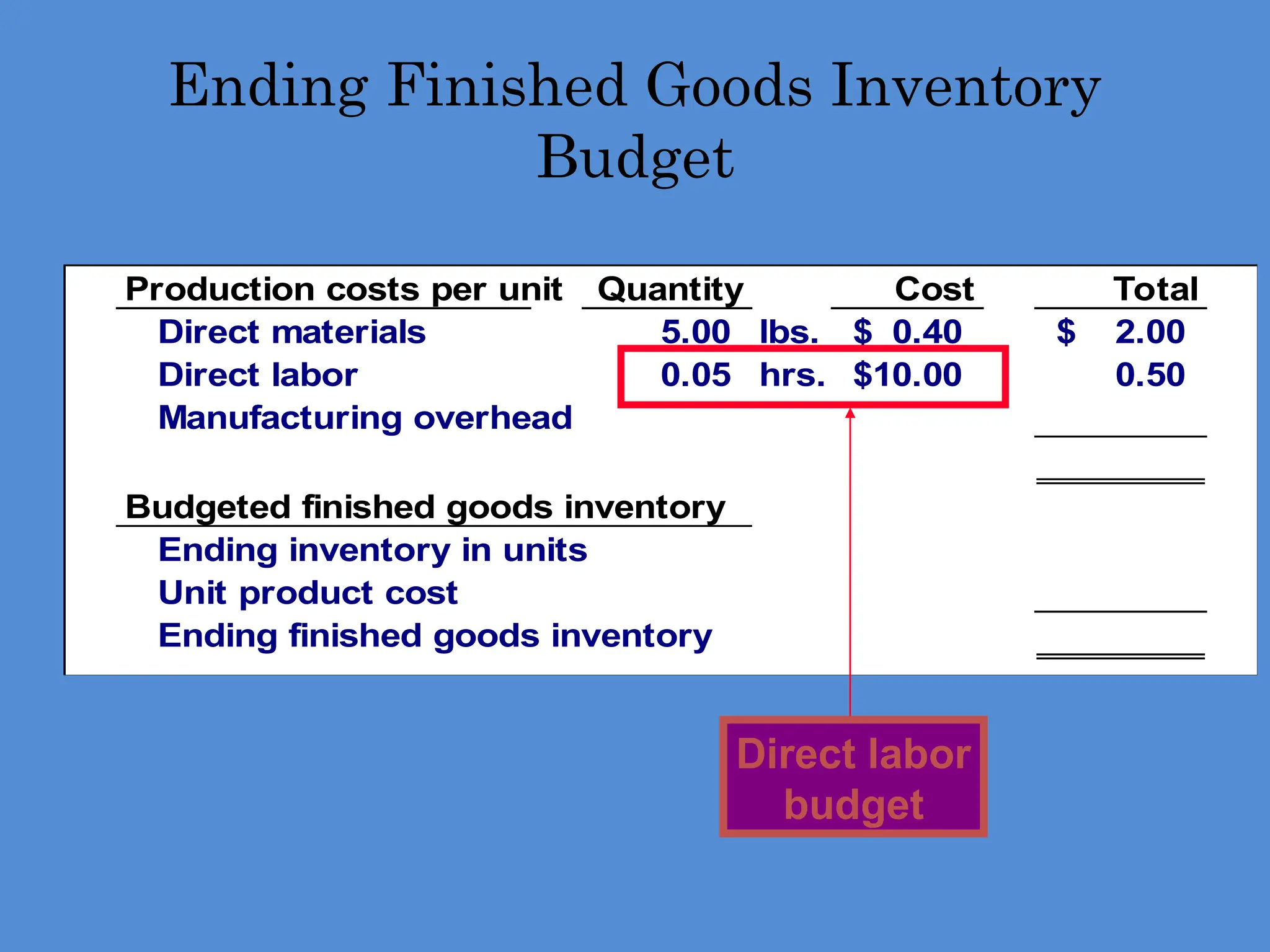
Production costs per unit Quantity Cost Total
Direct materials 5.00 lbs. 0.40
$ 2.00
$
Direct labor 0.05 hrs. 10.00
$ 0.50
Manufacturing overhead
Budgeted finished goods inventory
Ending inventory in units
Unit product cost
Ending finished goods inventory
Ending Finished Goods Inventory
Budget
Direct labor
budget
Production costs per unit Quantity Cost Total
Direct materials 5.00 lbs. 0.40
$ 2.00
$
Direct labor 0.05 hrs. 10.00
$ 0.50
Manufacturing overhead 0.05 hrs. 49.70
$ 2.49
4.99
$
Budgeted finished goods inventory
Ending inventory in units
Unit product cost 4.99
$
Ending finished goods inventory
Ending Finished Goods Inventory
Budget
Total mfg. OH for quarter $251,000
Total labor hours required 5,050 hrs.
= $49.70 per hr.
(rounded)
Predetermined Overhead Rate:
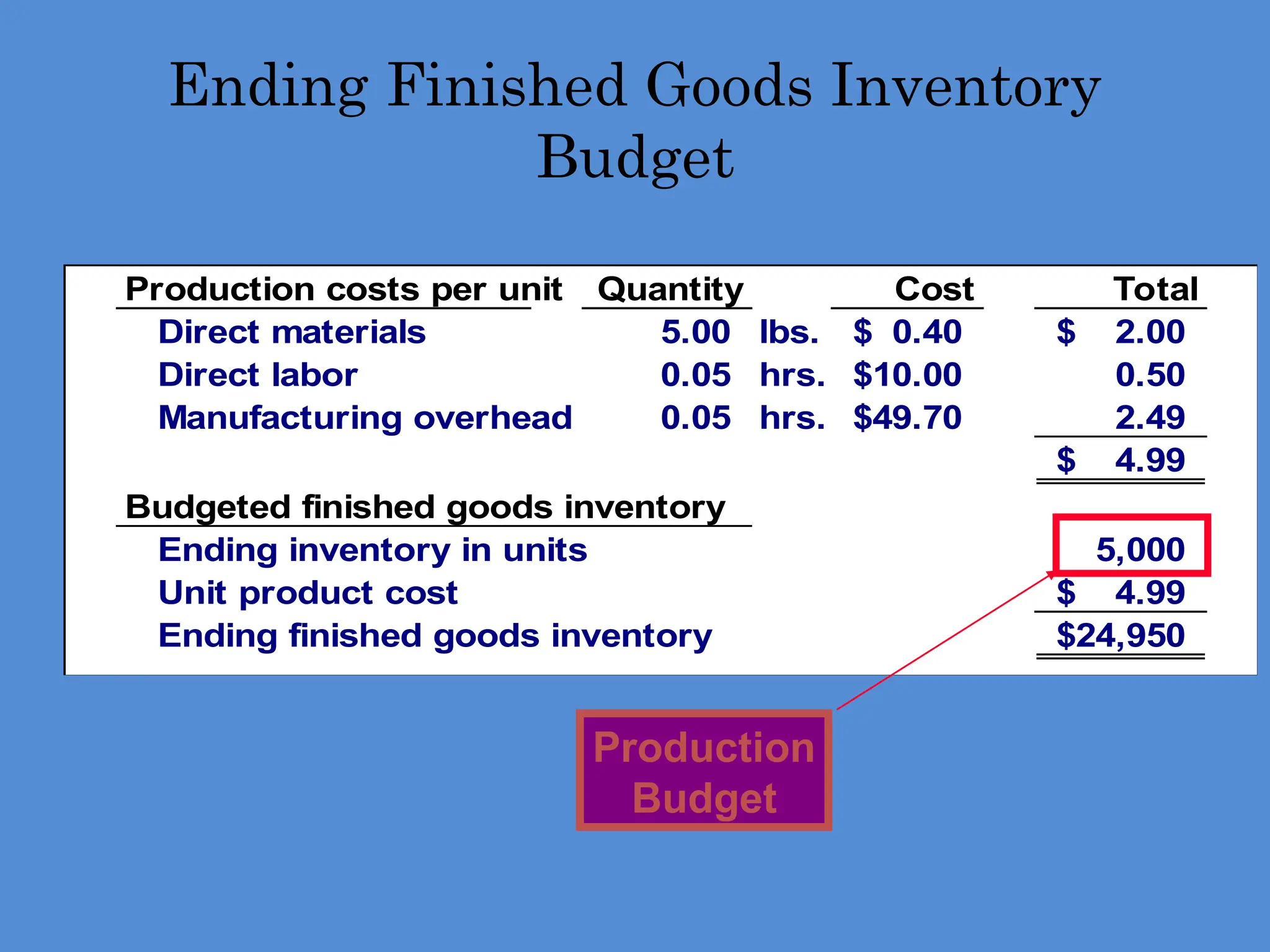
Production costs per unit Quantity Cost Total
Direct materials 5.00 lbs. 0.40
$ 2.00
$
Direct labor 0.05 hrs. 10.00
$ 0.50
Manufacturing overhead 0.05 hrs. 49.70
$ 2.49
4.99
$
Budgeted finished goods inventory
Ending inventory in units 5,000
Unit product cost 4.99
$
Ending finished goods inventory 24,950
$
Ending Finished Goods Inventory
Budget
Production
Budget
Selling and Administrative Expense
Budget
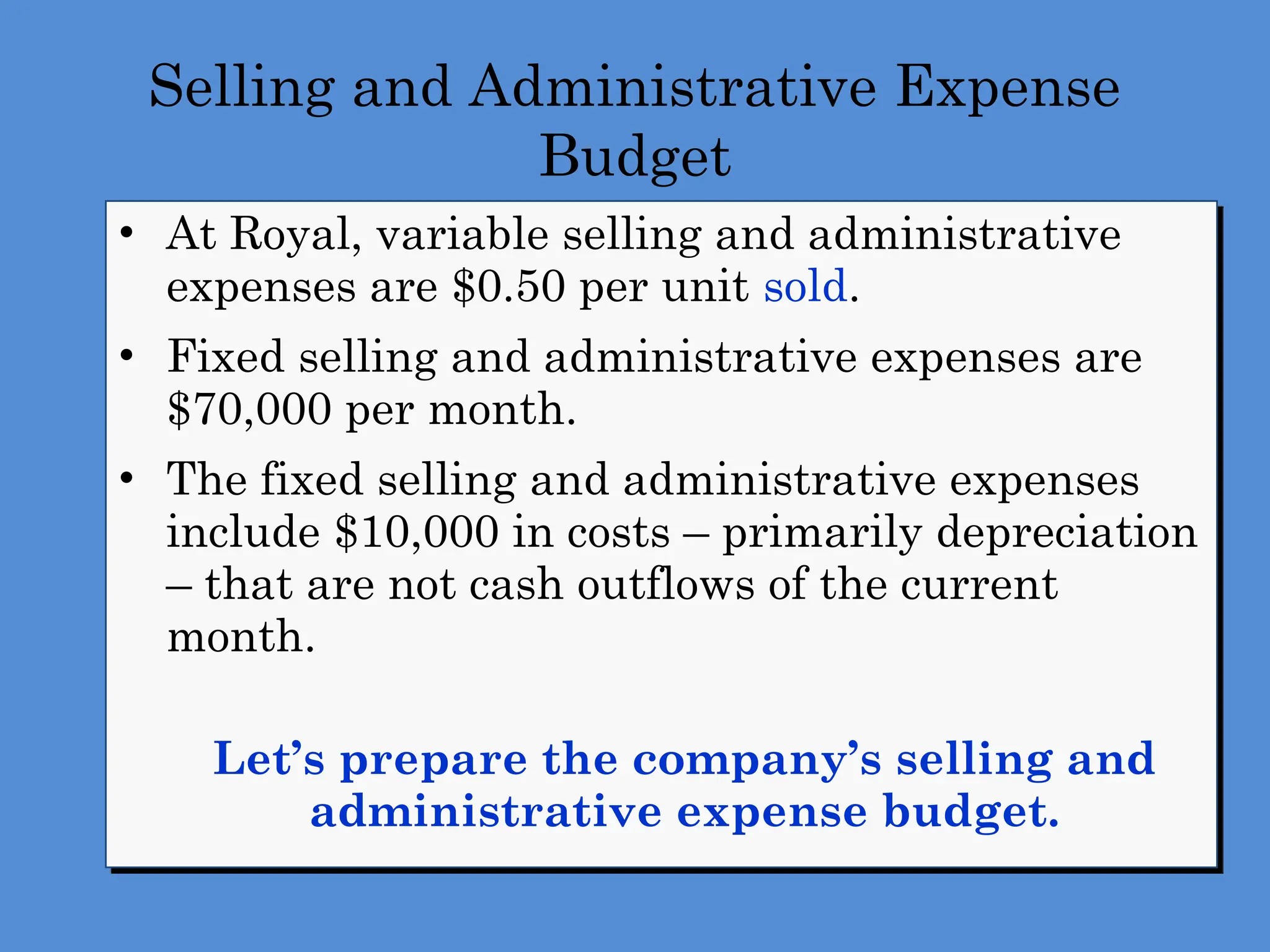
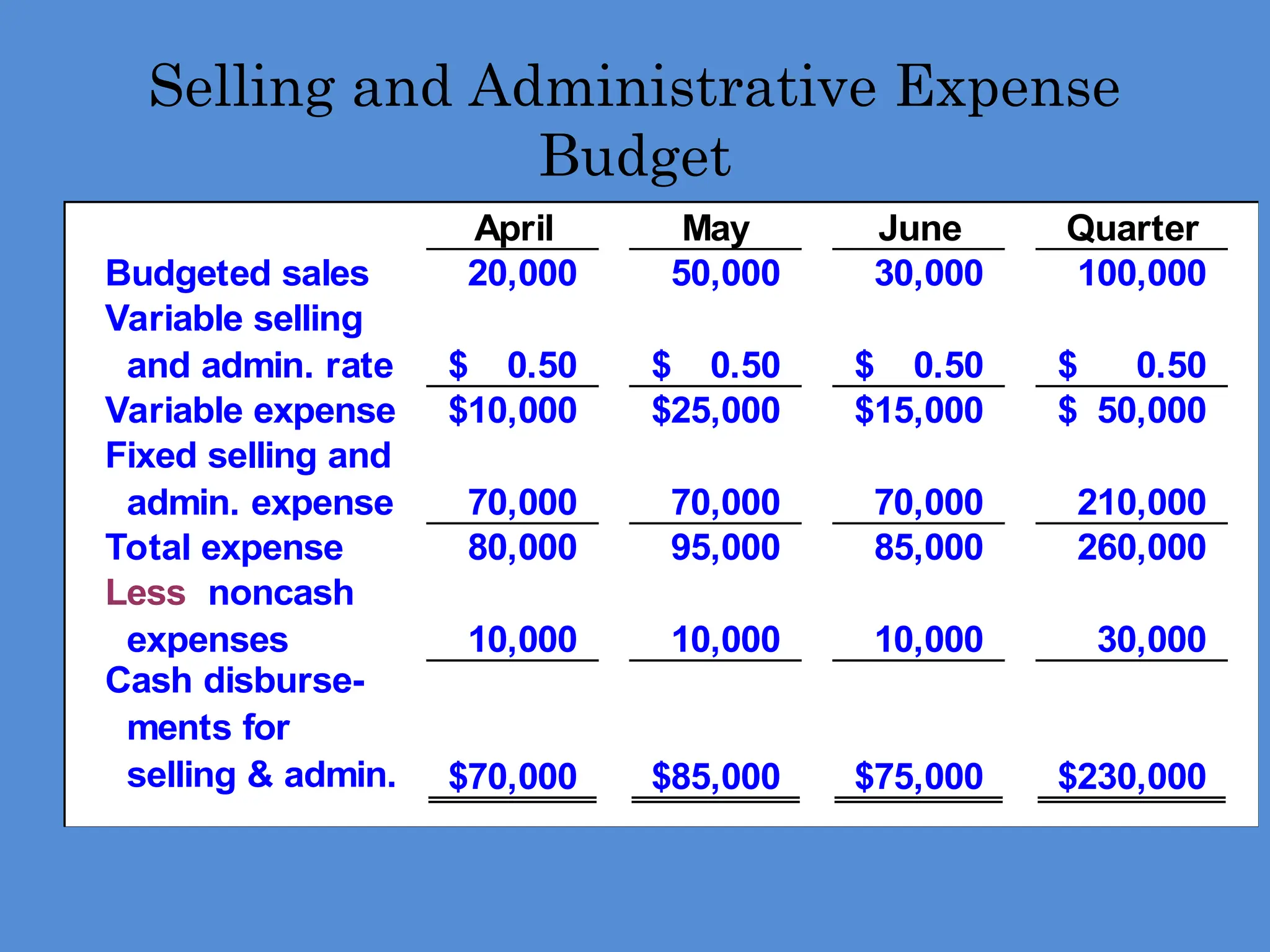
• At Royal, variable selling and administrative
expenses are $0.50 per unit sold.
• Fixed selling and administrative expenses are
$70,000 per month.
• The fixed selling and administrative expenses
include $10,000 in costs – primarily depreciation
– that are not cash outflows of the current
month.
Let’s prepare the company’s selling and
administrative expense budget.
Selling and Administrative Expense
Budget
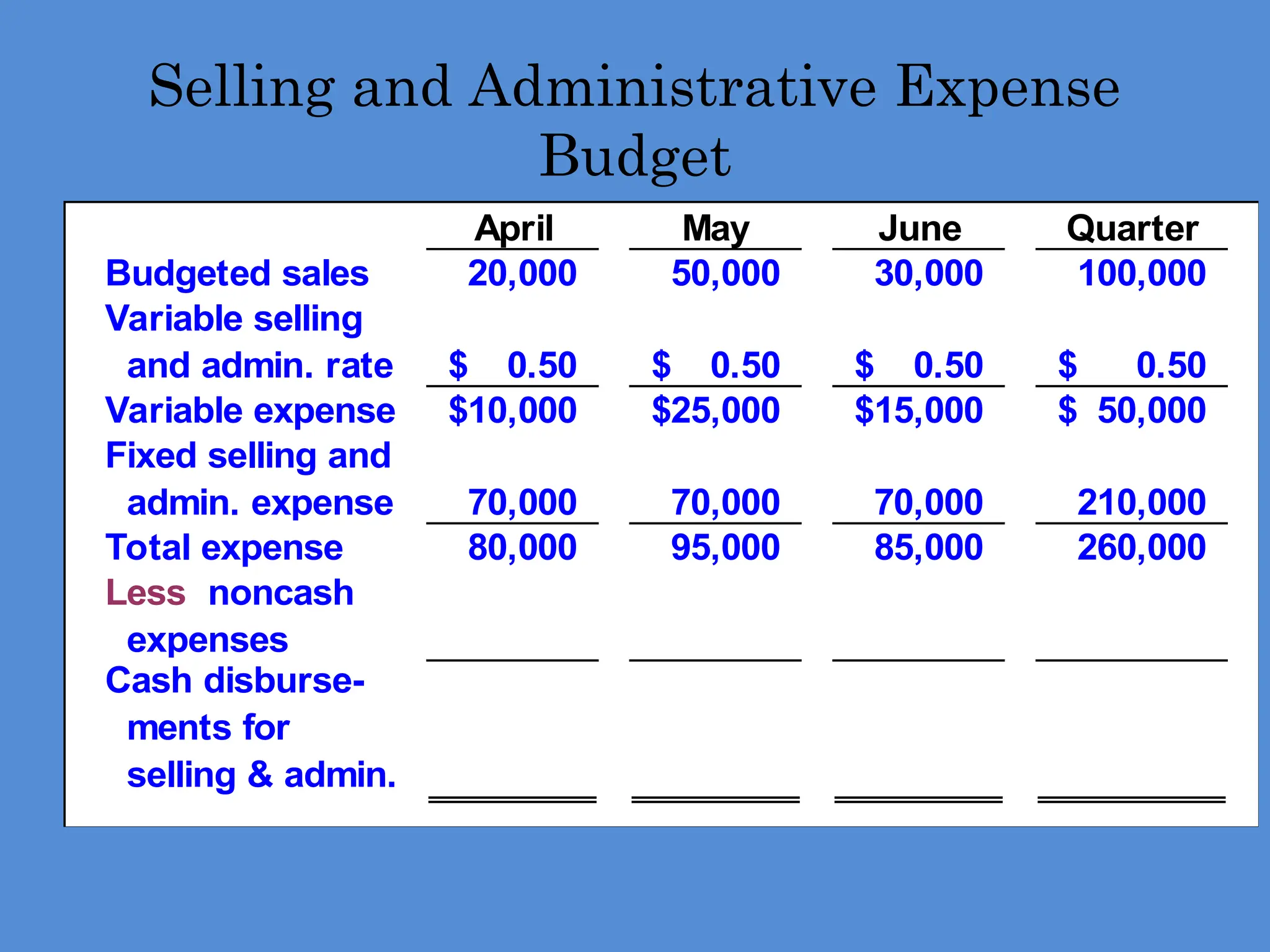
April May June Quarter
Budgeted sales 20,000 50,000 30,000 100,000
Variable selling
and admin. rate 0.50
$ 0.50
$ 0.50
$ 0.50
$
Variable expense 10,000
$ 25,000
$ 15,000
$ 50,000
$
Fixed selling and
admin. expense 70,000 70,000 70,000 210,000
Total expense 80,000 95,000 85,000 260,000
Less noncash
expenses
Cash disburse-
ments for
selling & admin.
Selling and Administrative Expense
Budget
April May June Quarter
Budgeted sales 20,000 50,000 30,000 100,000
Variable selling
and admin. rate 0.50
$ 0.50
$ 0.50
$ 0.50
$
Variable expense 10,000
$ 25,000
$ 15,000
$ 50,000
$
Fixed selling and
admin. expense 70,000 70,000 70,000 210,000
Total expense 80,000 95,000 85,000 260,000
Less noncash
expenses 10,000 10,000 10,000 30,000
Cash disburse-
ments for
selling & admin. 70,000
$ 85,000
$ 75,000
$ 230,000
$
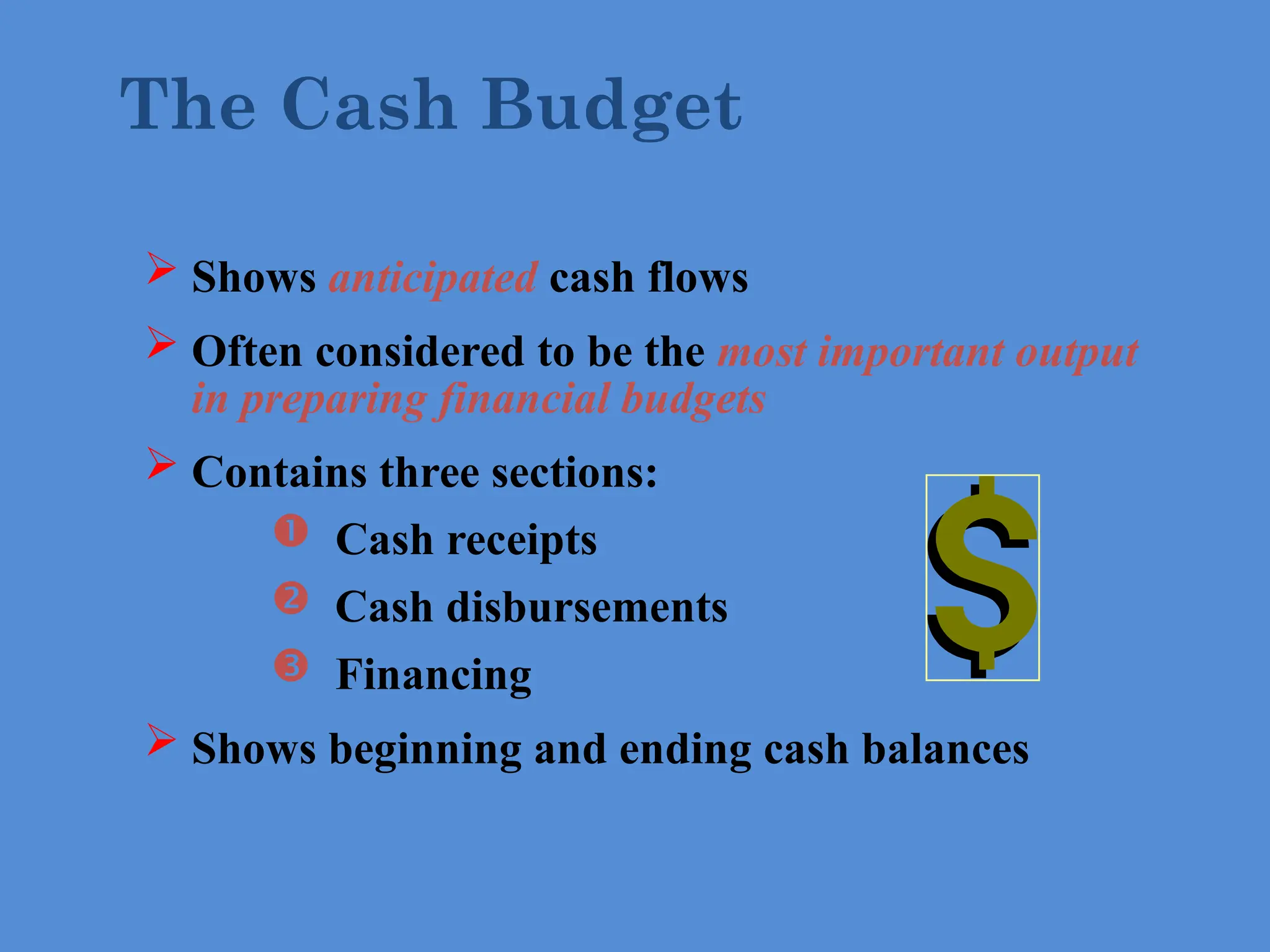
 Shows anticipated cash flows
 Often considered to be the most important output
in preparing financial budgets
 Contains three sections:
 Cash receipts
 Cash disbursements
 Financing
 Shows beginning and ending cash balances
The Cash Budget
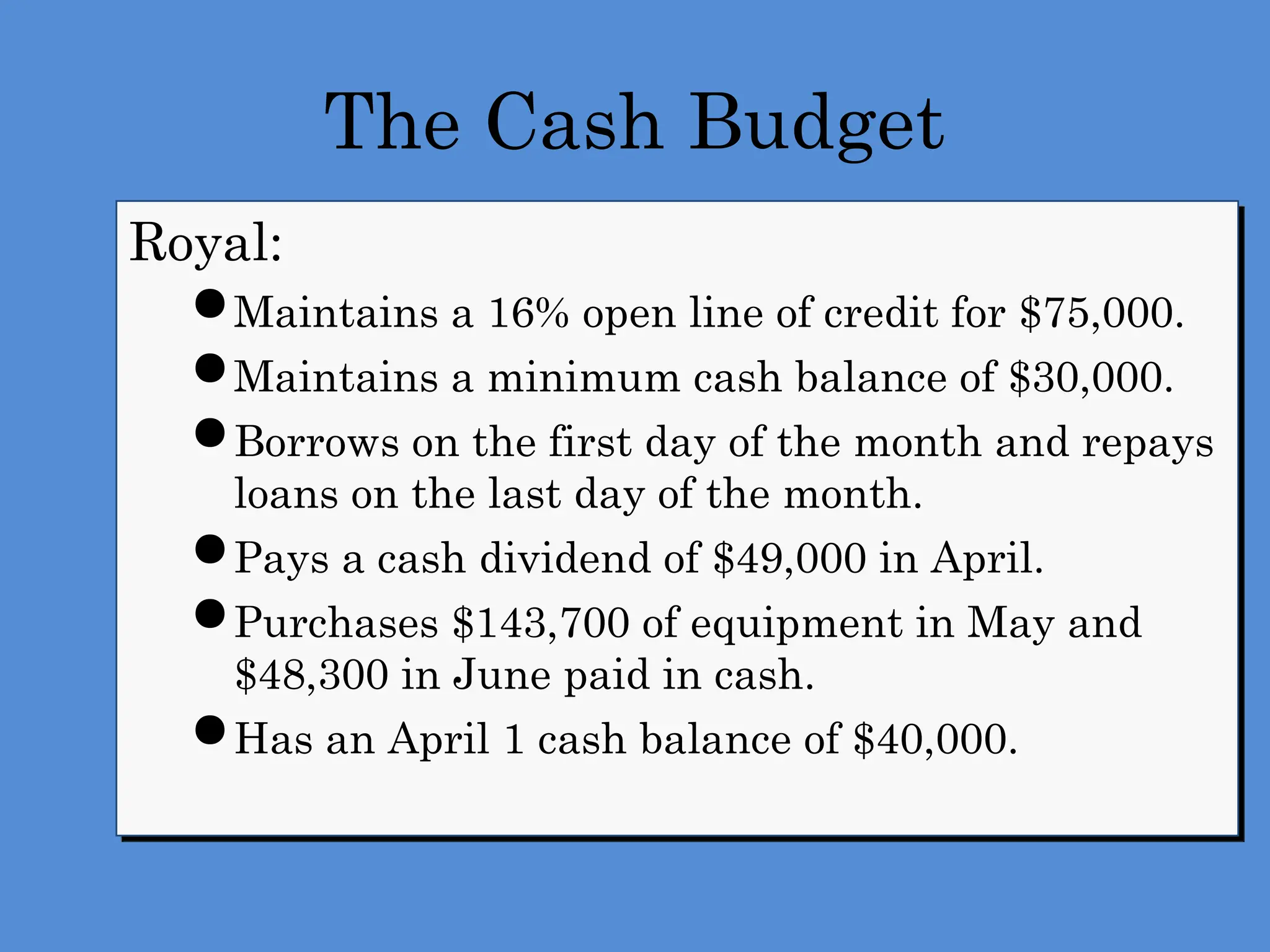
The Cash Budget
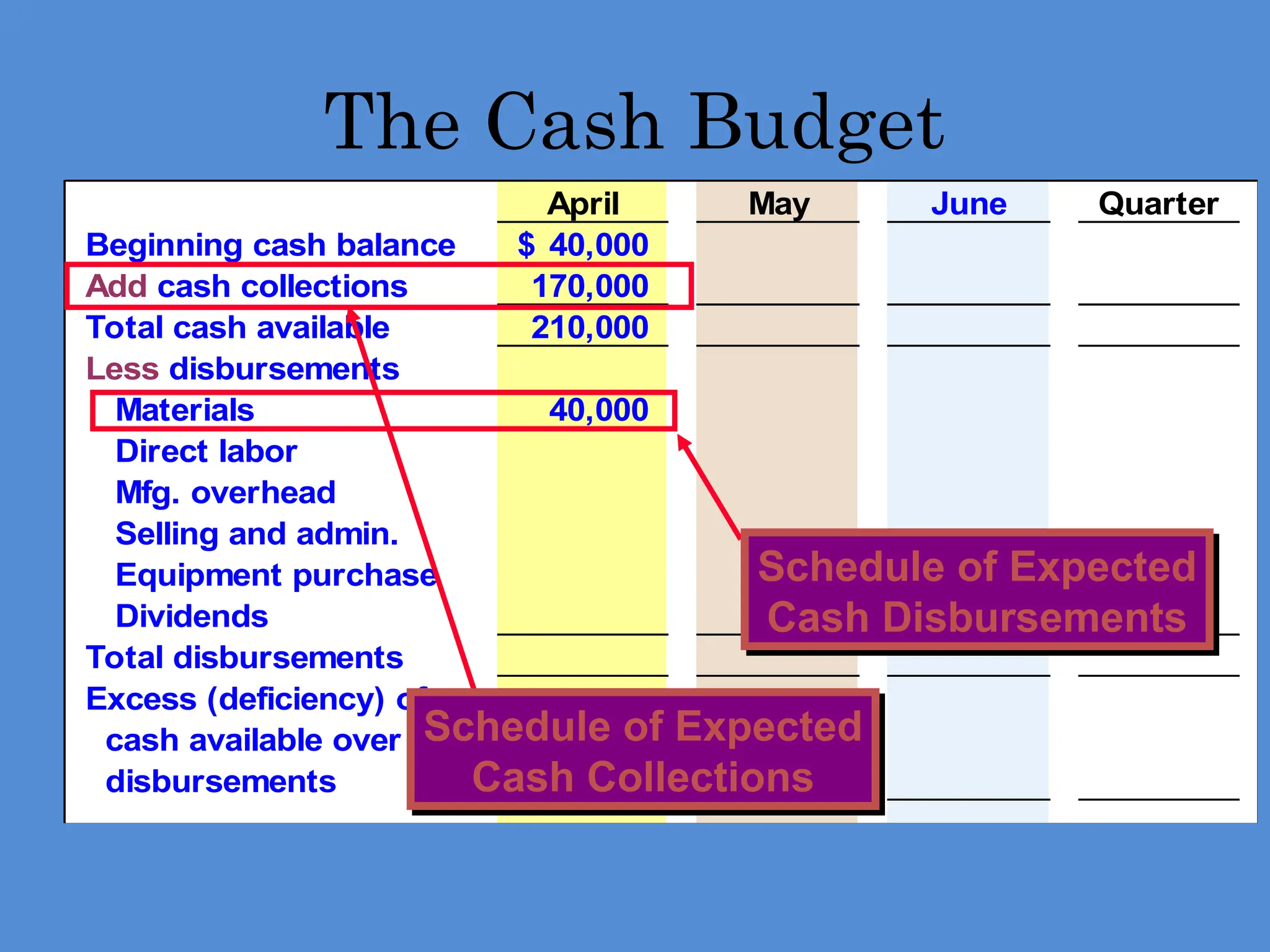
Royal:
 Maintains a 16% open line of credit for $75,000.
 Maintains a minimum cash balance of $30,000.
 Borrows on the first day of the month and repays
loans on the last day of the month.
 Pays a cash dividend of $49,000 in April.
 Purchases $143,700 of equipment in May and
$48,300 in June paid in cash.
 Has an April 1 cash balance of $40,000.
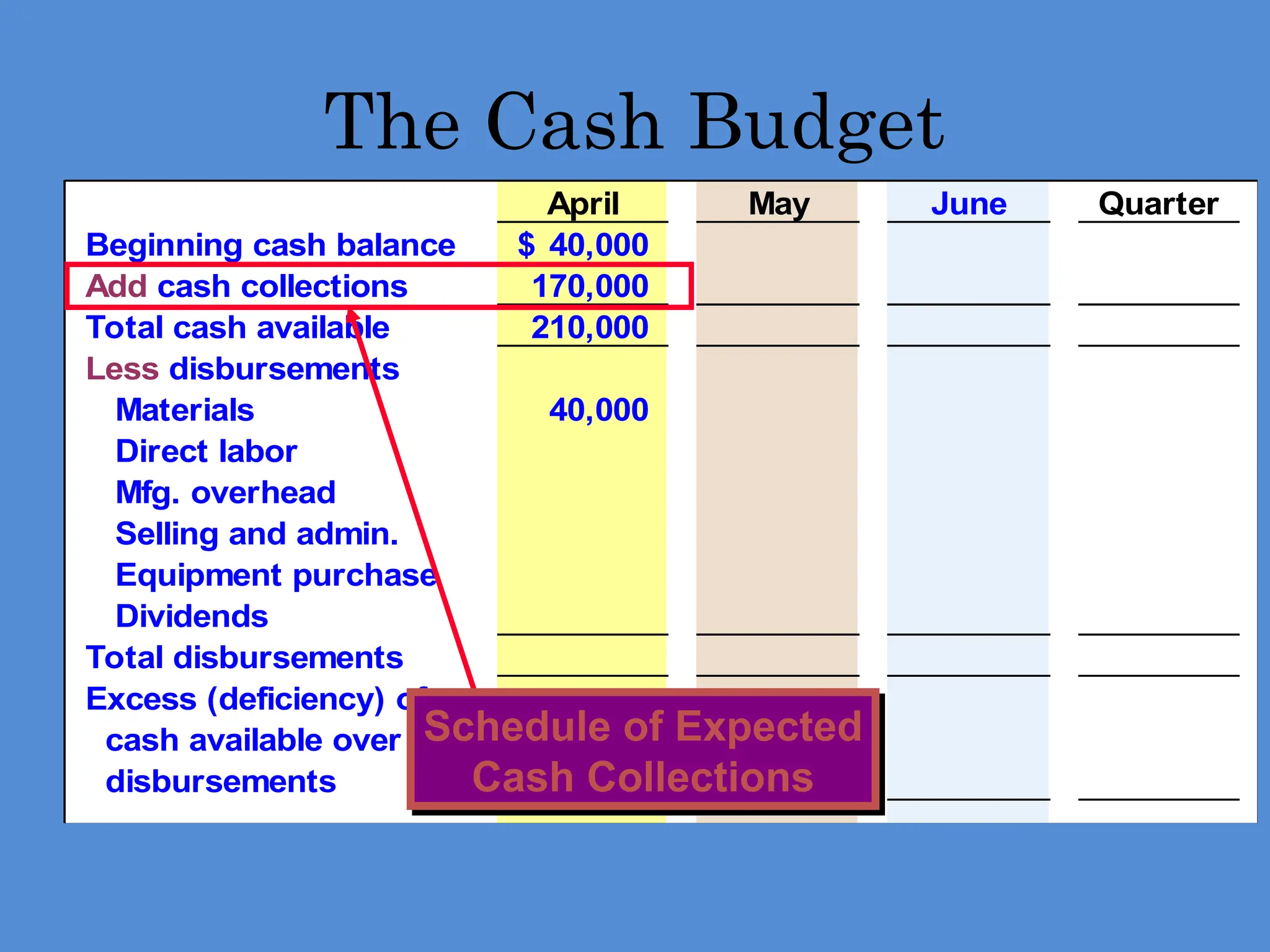
April May June Quarter
Beginning cash balance 40,000
$
Add cash collections 170,000
Total cash available 210,000
Less disbursements
Materials 40,000
Direct labor
Mfg. overhead
Selling and admin.
Equipment purchase
Dividends
Total disbursements
Excess (deficiency) of
cash available over
disbursements
The Cash Budget
Schedule of Expected
Cash Collections
April May June Quarter
Beginning cash balance 40,000
$
Add cash collections 170,000
Total cash available 210,000
Less disbursements
Materials 40,000
Direct labor
Mfg. overhead
Selling and admin.
Equipment purchase
Dividends
Total disbursements
Excess (deficiency) of
cash available over
disbursements
The Cash Budget
Schedule of Expected
Cash Collections
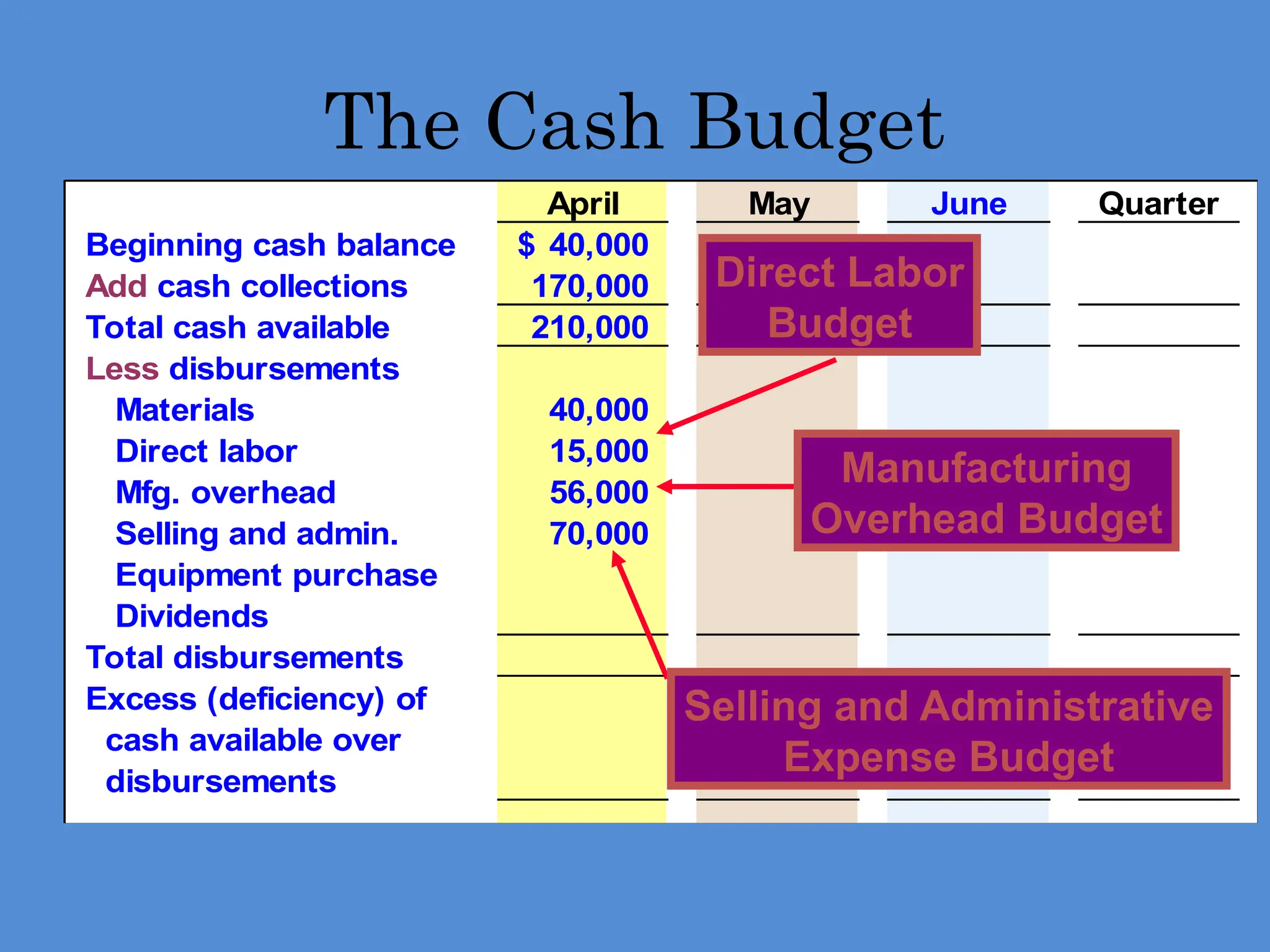
Schedule of Expected
Cash Disbursements
April May June Quarter
Beginning cash balance 40,000
$
Add cash collections 170,000
Total cash available 210,000
Less disbursements
Materials 40,000
Direct labor 15,000
Mfg. overhead 56,000
Selling and admin. 70,000
Equipment purchase
Dividends
Total disbursements
Excess (deficiency) of
cash available over
disbursements
The Cash Budget
Direct Labor
Budget
Manufacturing
Overhead Budget
Selling and Administrative
Expense Budget
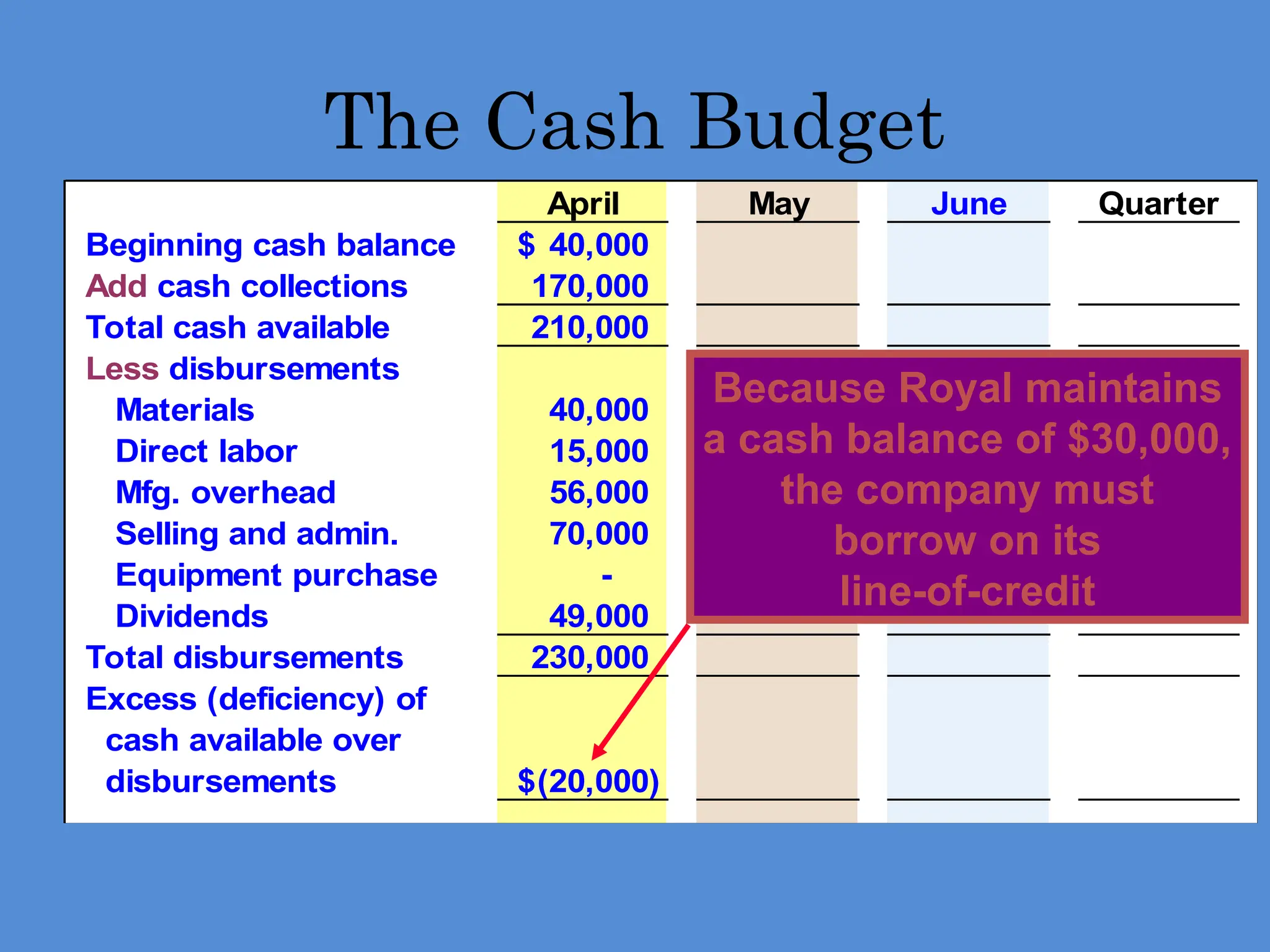
April May June Quarter
Beginning cash balance 40,000
$
Add cash collections 170,000
Total cash available 210,000
Less disbursements
Materials 40,000
Direct labor 15,000
Mfg. overhead 56,000
Selling and admin. 70,000
Equipment purchase -
Dividends 49,000
Total disbursements 230,000
Excess (deficiency) of
cash available over
disbursements (20,000)
$
The Cash Budget
Because Royal maintains
a cash balance of $30,000,
the company must
borrow on its
line-of-credit
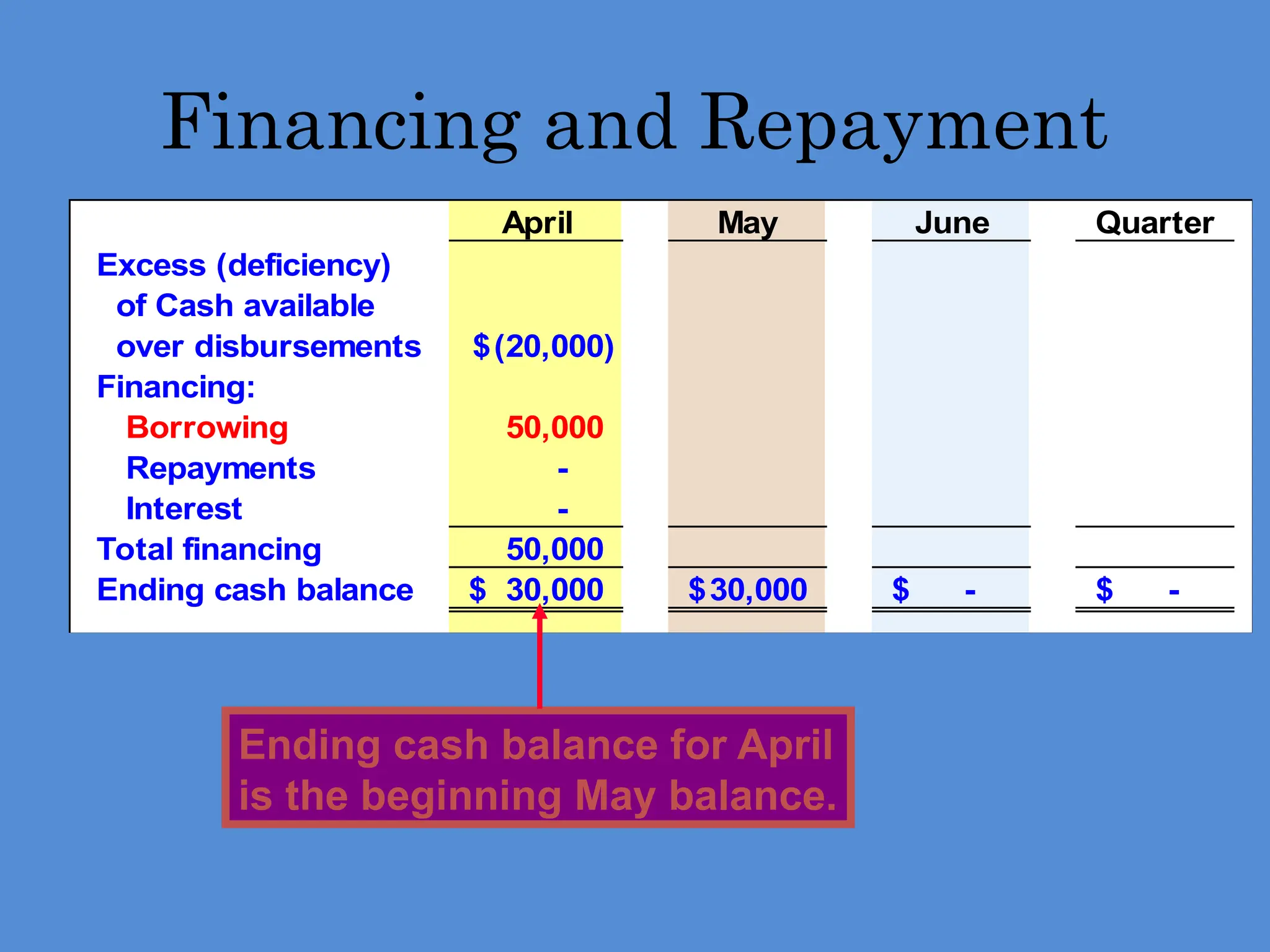
April May June Quarter
Excess (deficiency)
of Cash available
over disbursements (20,000)
$
Financing:
Borrowing 50,000
Repayments -
Interest -
Total financing 50,000
Ending cash balance 30,000
$ 30,000
$ -
$ -
$
Financing and Repayment
Ending cash balance for April
is the beginning May balance.
CASH BUDGET
 Contributes to more effective cash
management
 Shows managers need for additional
financing before actual need arises
 Indicates when excess cash will be
available
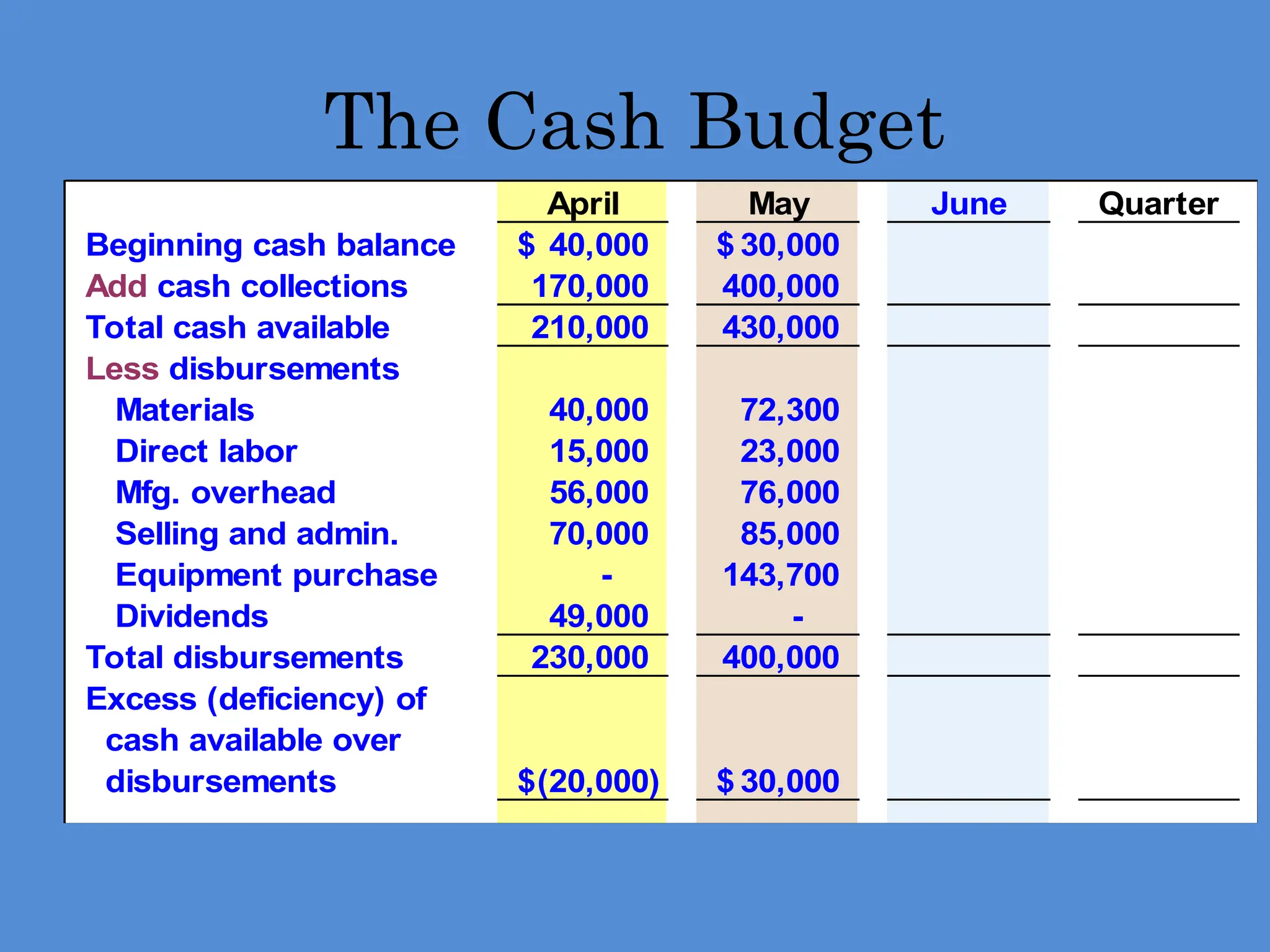
The Cash Budget
April May June Quarter
Beginning cash balance 40,000
$ 30,000
$
Add cash collections 170,000 400,000
Total cash available 210,000 430,000
Less disbursements
Materials 40,000 72,300
Direct labor 15,000 23,000
Mfg. overhead 56,000 76,000
Selling and admin. 70,000 85,000
Equipment purchase - 143,700
Dividends 49,000 -
Total disbursements 230,000 400,000
Excess (deficiency) of
cash available over
disbursements (20,000)
$ 30,000
$
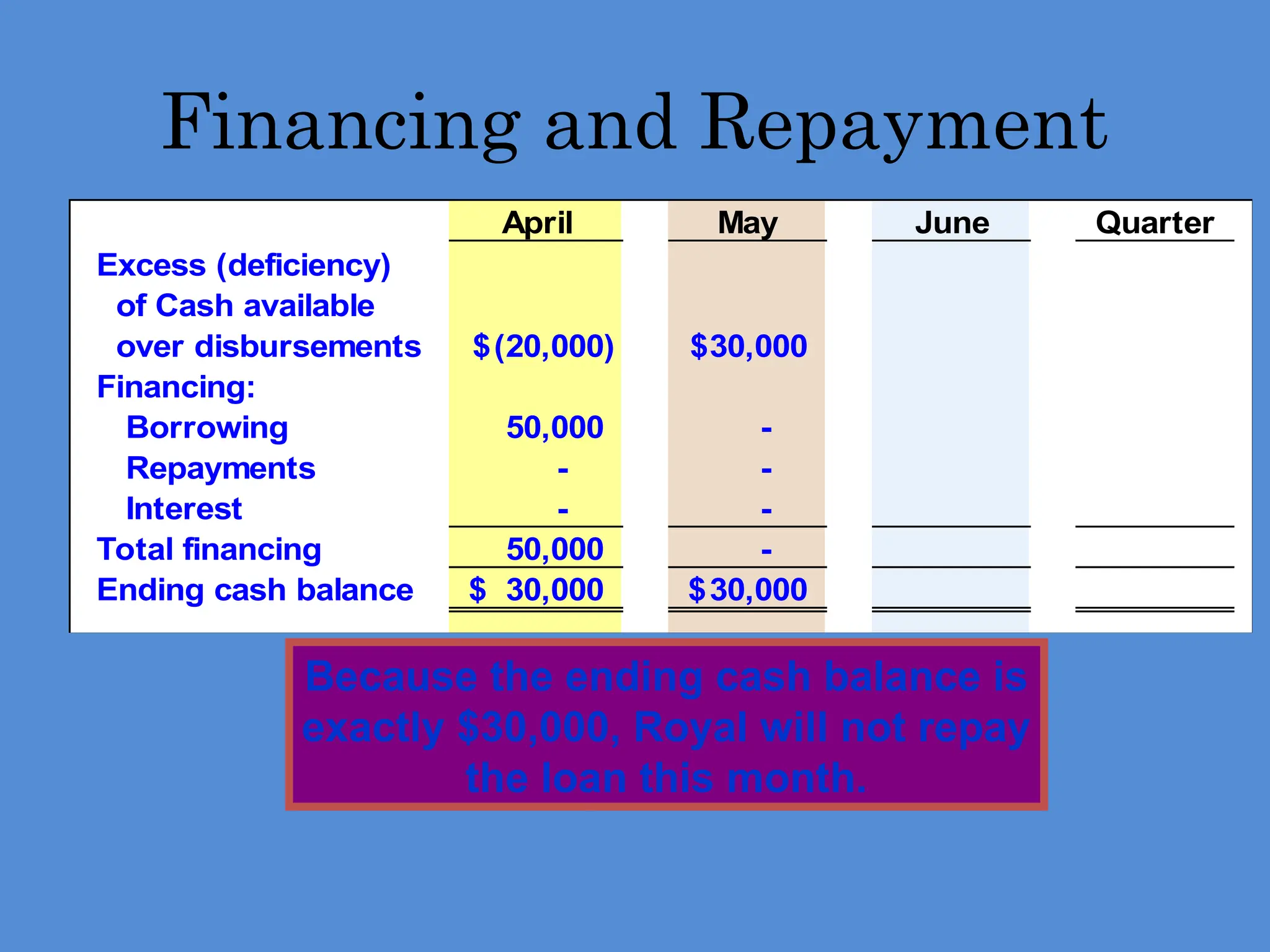
Financing and Repayment
Because the ending cash balance is
exactly $30,000, Royal will not repay
the loan this month.
April May June Quarter
Excess (deficiency)
of Cash available
over disbursements (20,000)
$ 30,000
$
Financing:
Borrowing 50,000 -
Repayments - -
Interest - -
Total financing 50,000 -
Ending cash balance 30,000
$ 30,000
$
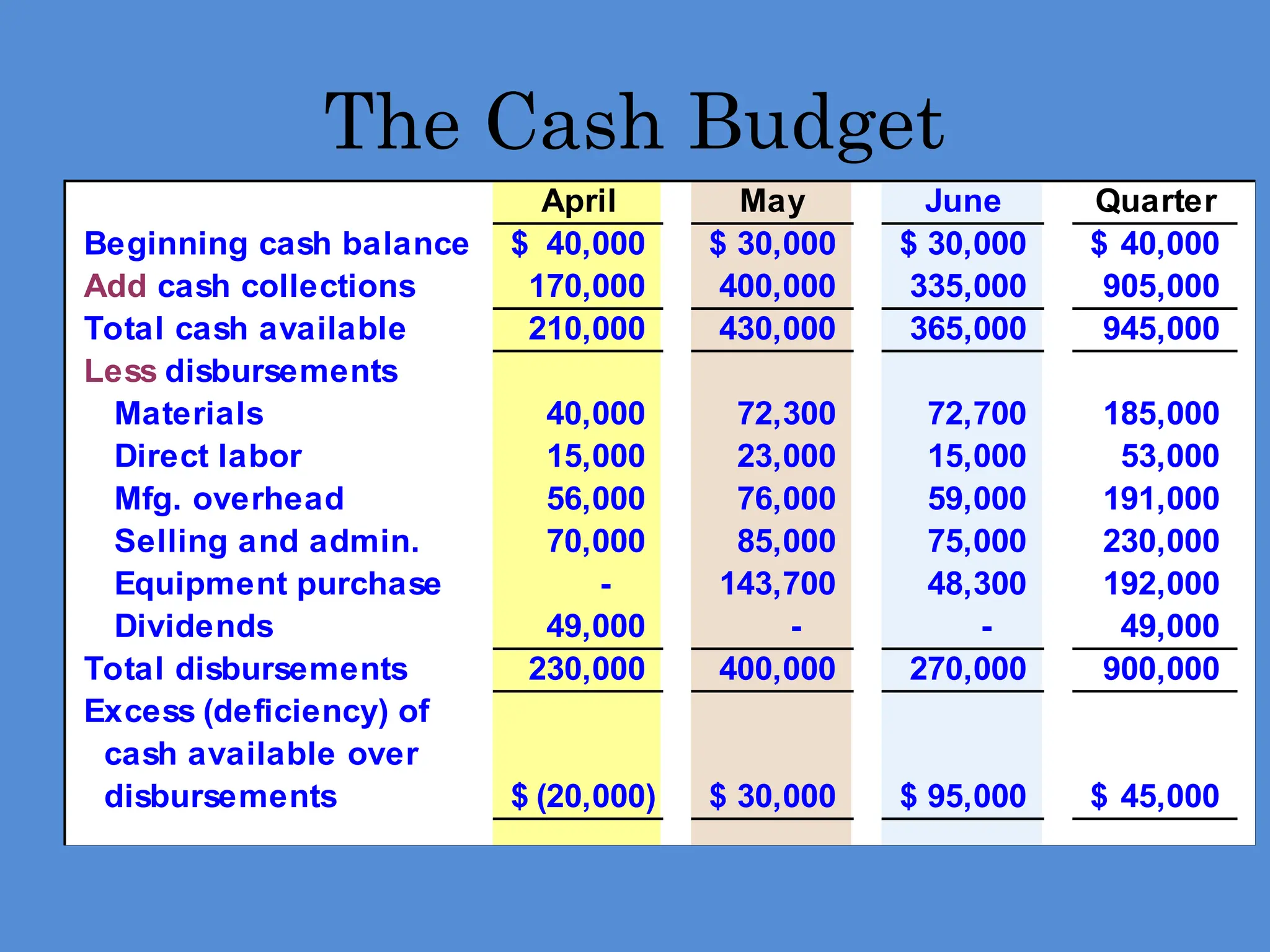
April May June Quarter
Beginning cash balance 40,000
$ 30,000
$ 30,000
$ 40,000
$
Add cash collections 170,000 400,000 335,000 905,000
Total cash available 210,000 430,000 365,000 945,000
Less disbursements
Materials 40,000 72,300 72,700 185,000
Direct labor 15,000 23,000 15,000 53,000
Mfg. overhead 56,000 76,000 59,000 191,000
Selling and admin. 70,000 85,000 75,000 230,000
Equipment purchase - 143,700 48,300 192,000
Dividends 49,000 - - 49,000
Total disbursements 230,000 400,000 270,000 900,000
Excess (deficiency) of
cash available over
disbursements (20,000)
$ 30,000
$ 95,000
$ 45,000
$
The Cash Budget
April May June Quarter
Beginning cash balance 40,000
$ 30,000
$ 30,000
$ 40,000
$
Add cash collections 170,000 400,000 335,000 905,000
Total cash available 210,000 430,000 365,000 945,000
Less disbursements
Materials 40,000 72,300 72,700 185,000
Direct labor 15,000 23,000 15,000 53,000
Mfg. overhead 56,000 76,000 59,000 191,000
Selling and admin. 70,000 85,000 75,000 230,000
Equipment purchase - 143,700 48,300 192,000
Dividends 49,000 - - 49,000
Total disbursements 230,000 400,000 270,000 900,000
Excess (deficiency) of
cash available over
disbursements (20,000)
$ 30,000
$ 95,000
$ 45,000
$
The Cash Budget
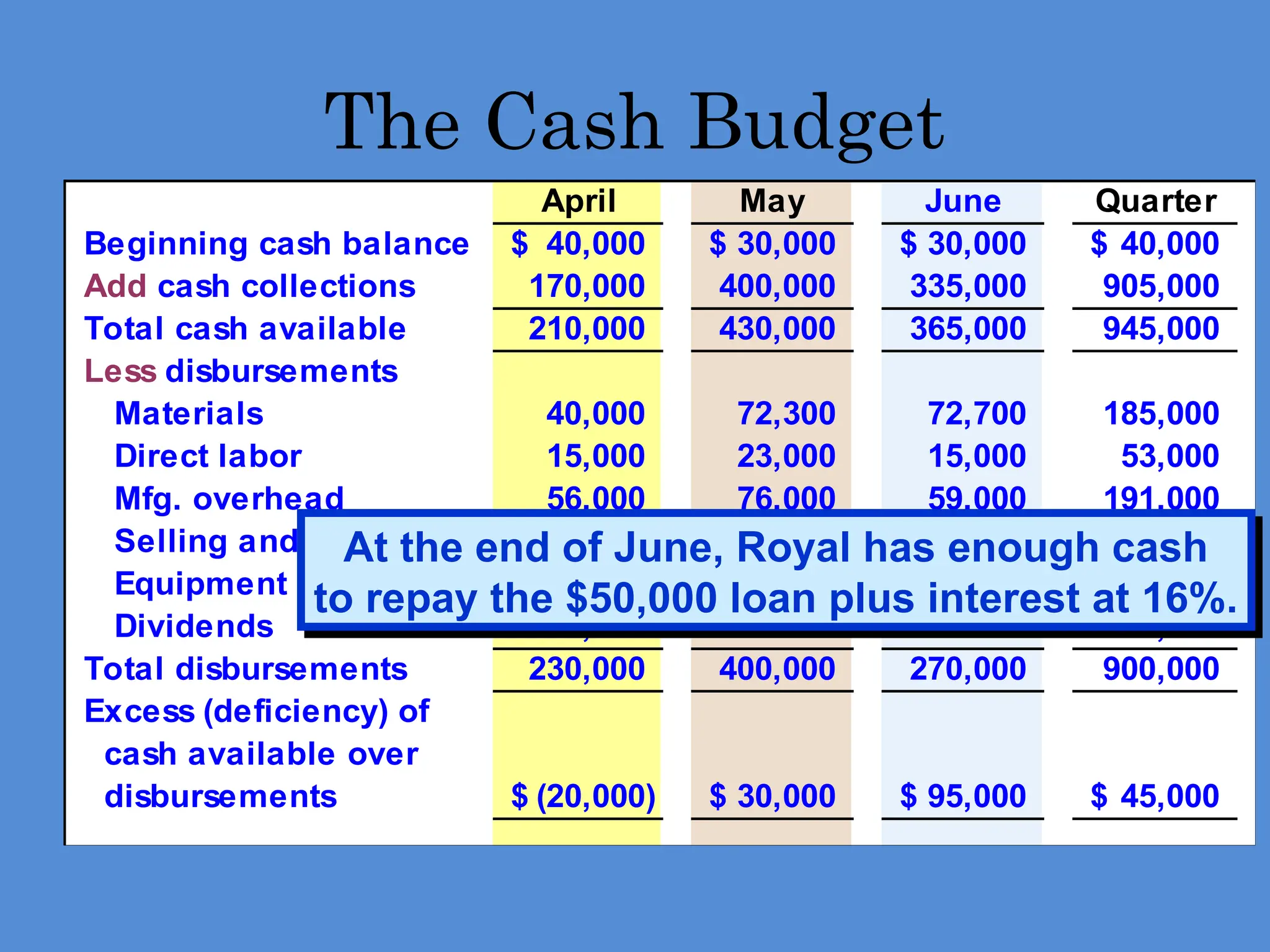
At the end of June, Royal has enough cash
to repay the $50,000 loan plus interest at 16%.
April May June Quarter
Excess (deficiency)
of Cash available
over disbursements (20,000)
$ 30,000
$ 95,000
$ 45,000
$
Financing:
Borrowing 50,000 - - 50,000
Repayments - - (50,000) (50,000)
Interest - - (2,000) (2,000)
Total financing 50,000 - (52,000) (2,000)
Ending cash balance 30,000
$ 30,000
$ 43,000
$ 43,000
$
Financing and Repayment
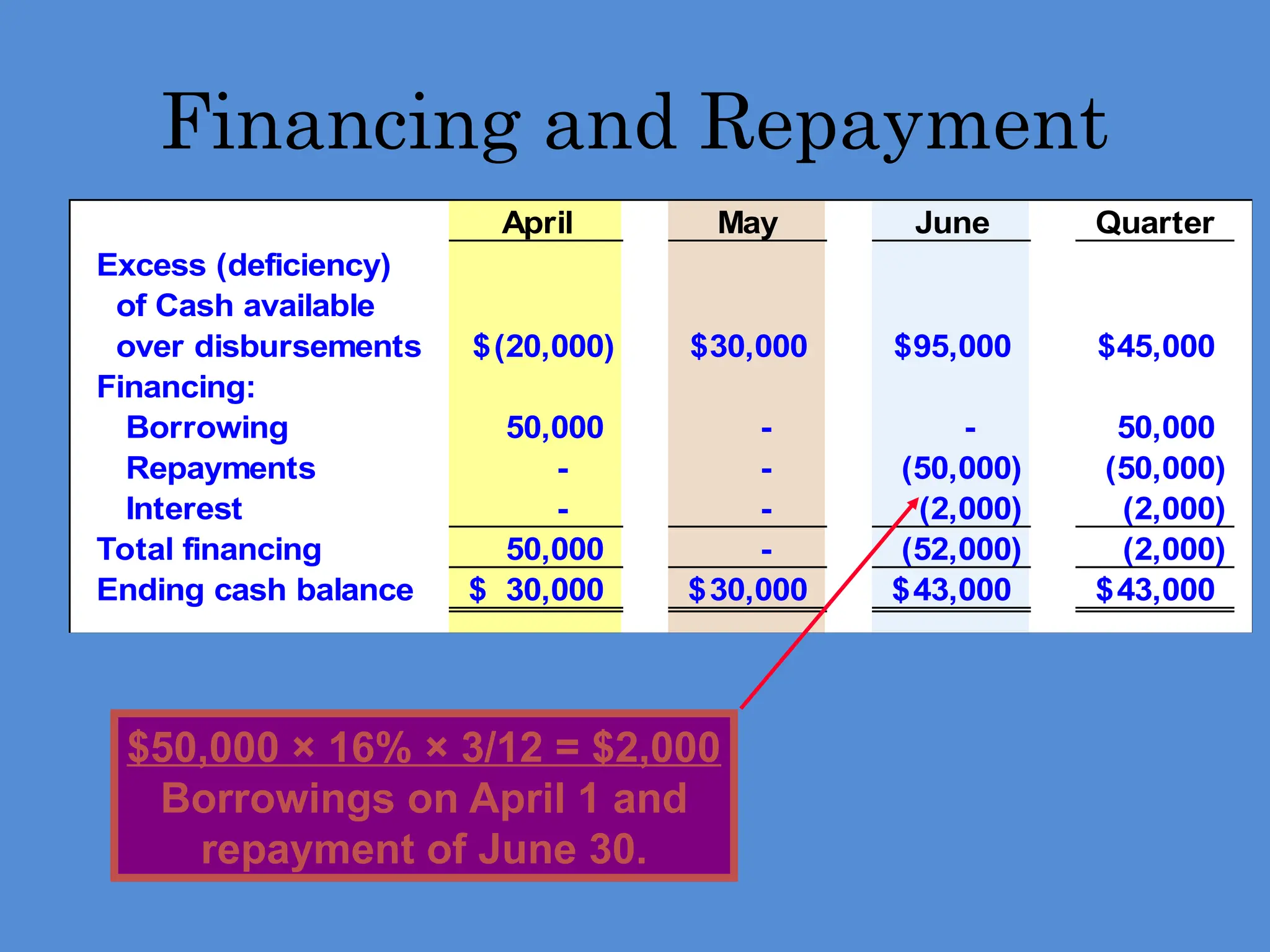
$50,000 × 16% × 3/12 = $2,000
Borrowings on April 1 and
repayment of June 30.
The Budgeted Income Statement
Cash
Budget
Budgeted
Income
Statement
Com
pleted
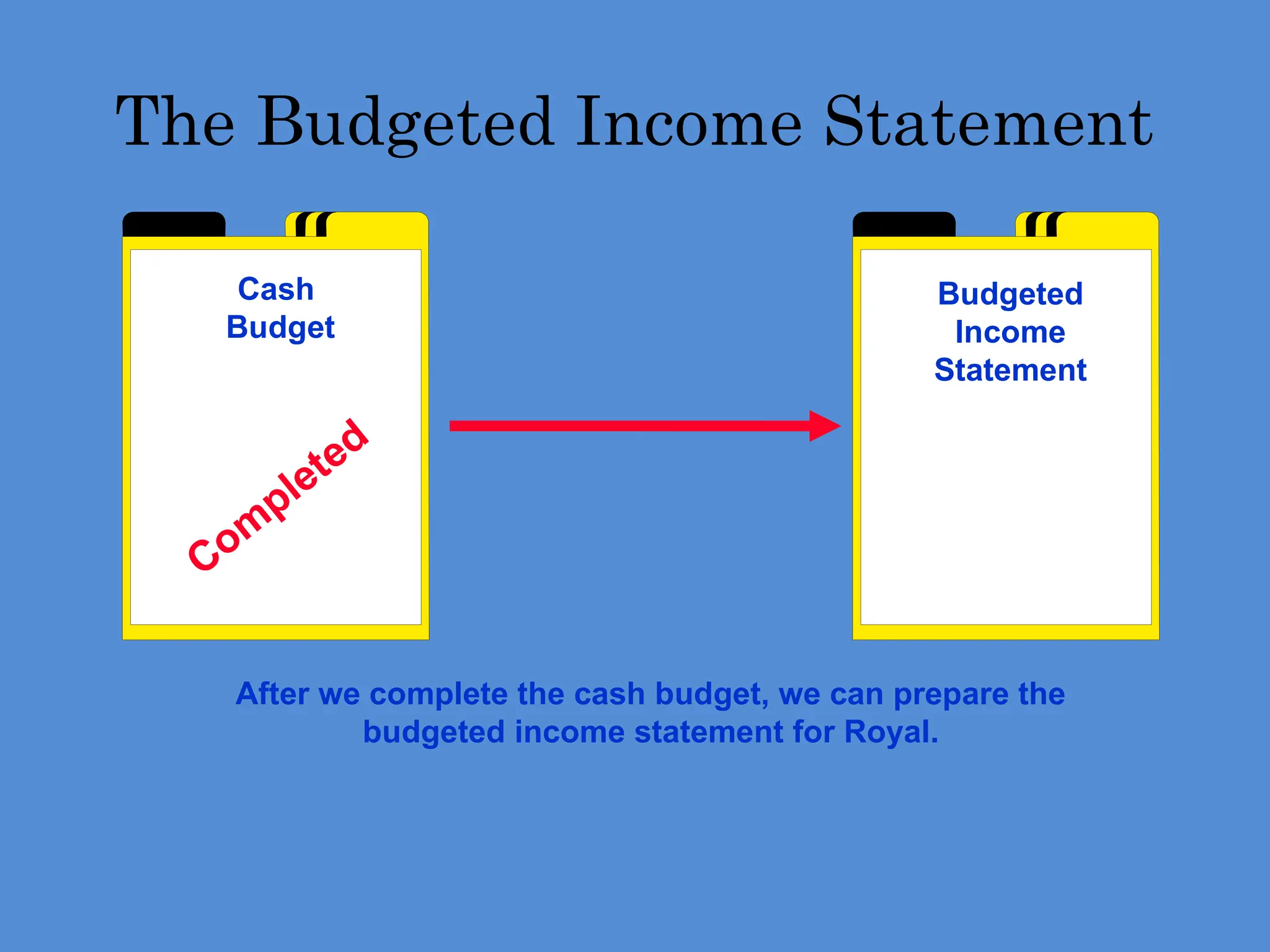
After we complete the cash budget, we can prepare the
budgeted income statement for Royal.
The Budgeted Income Statement
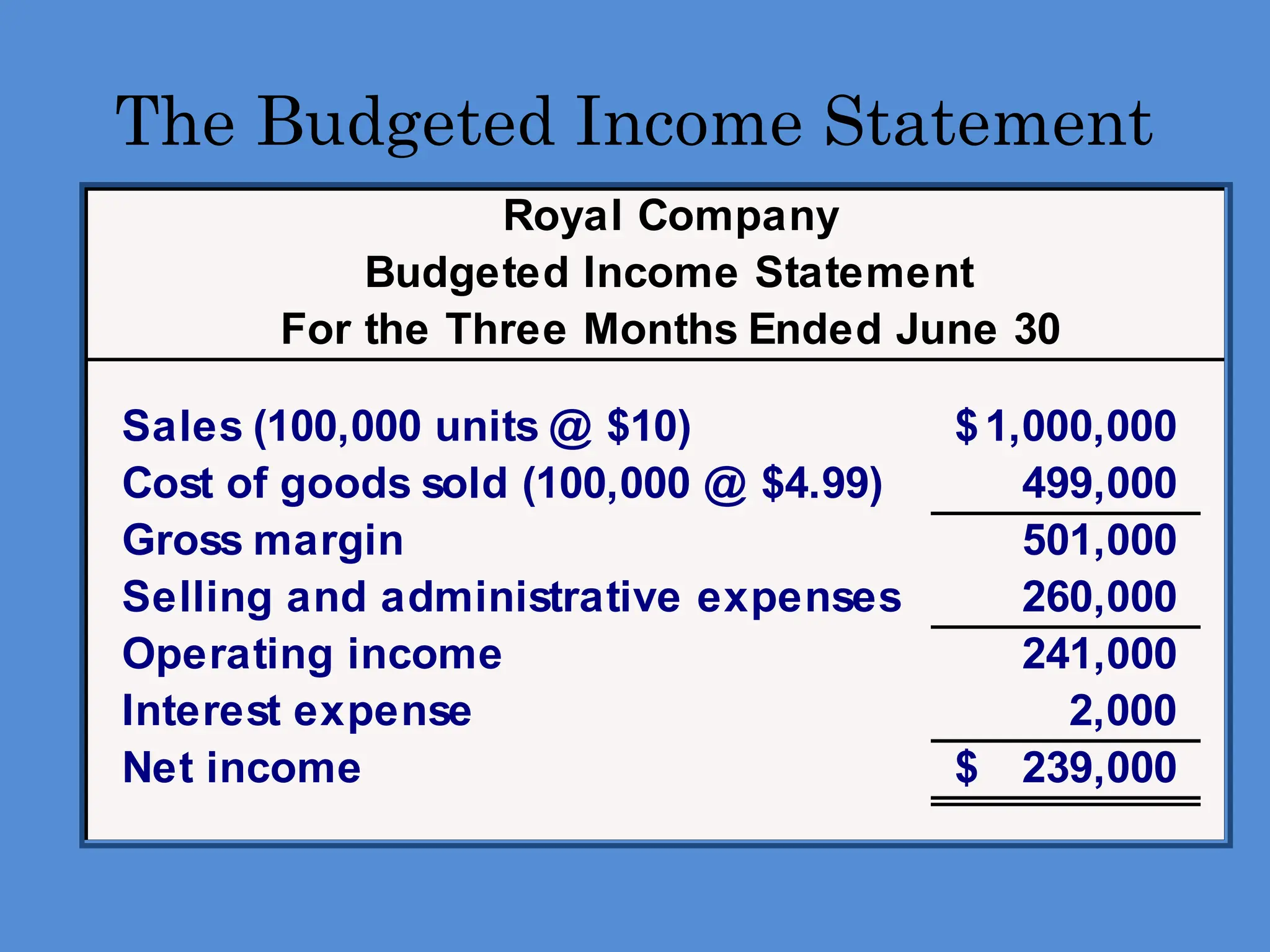
Royal Company
Budgeted Income Statement
For the Three Months Ended June 30
Sales (100,000 units @ $10) 1,000,000
$
Cost of goods sold (100,000 @ $4.99) 499,000
Gross margin 501,000
Selling and administrative expenses 260,000
Operating income 241,000
Interest expense 2,000
Net income 239,000
$
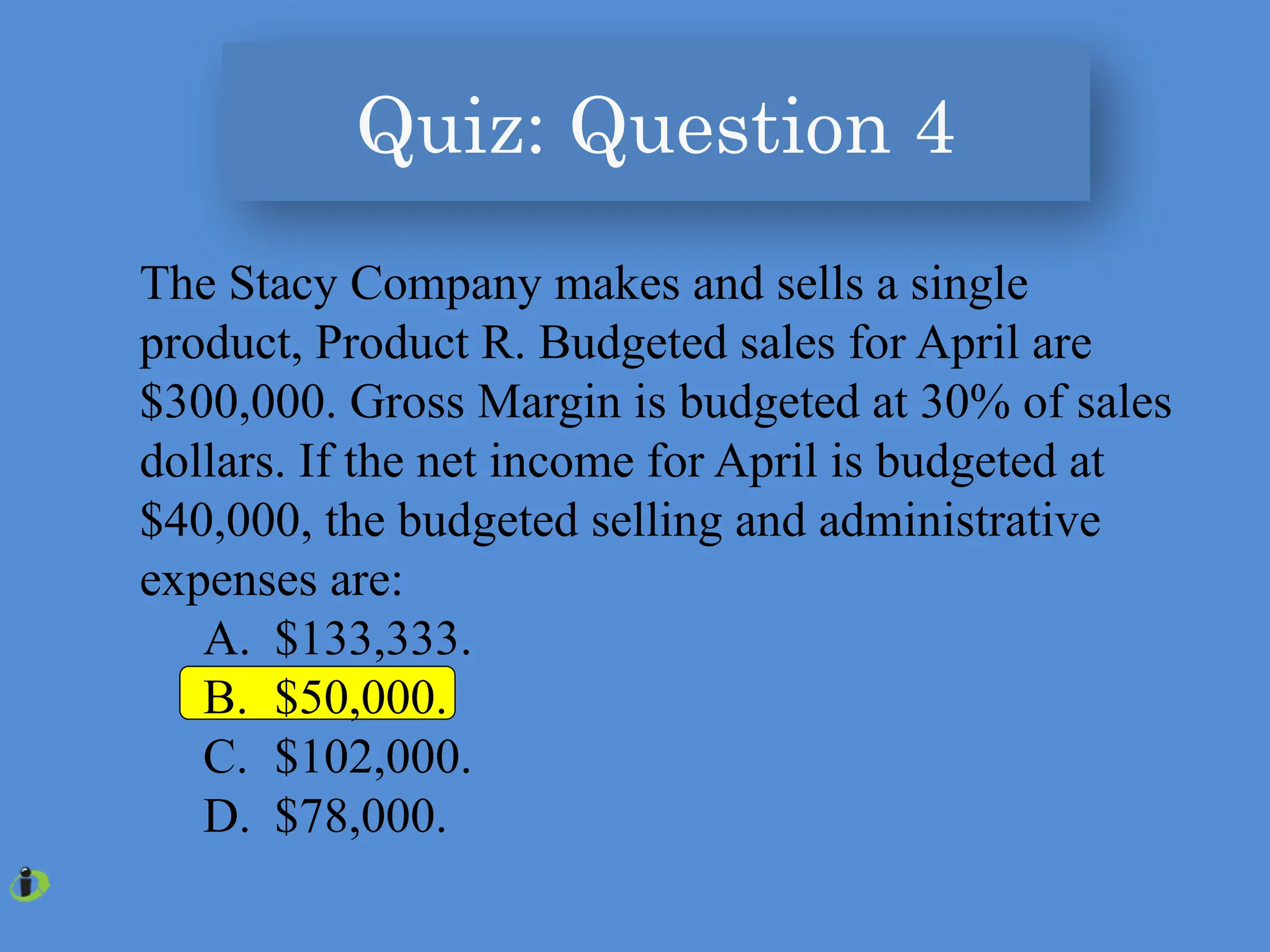
The Stacy Company makes and sells a single
product, Product R. Budgeted sales for April are
$300,000. Gross Margin is budgeted at 30% of sales
dollars. If the net income for April is budgeted at
$40,000, the budgeted selling and administrative
expenses are:
A. $133,333.
B. $50,000.
C. $102,000.
D. $78,000.
Quiz: Question 4
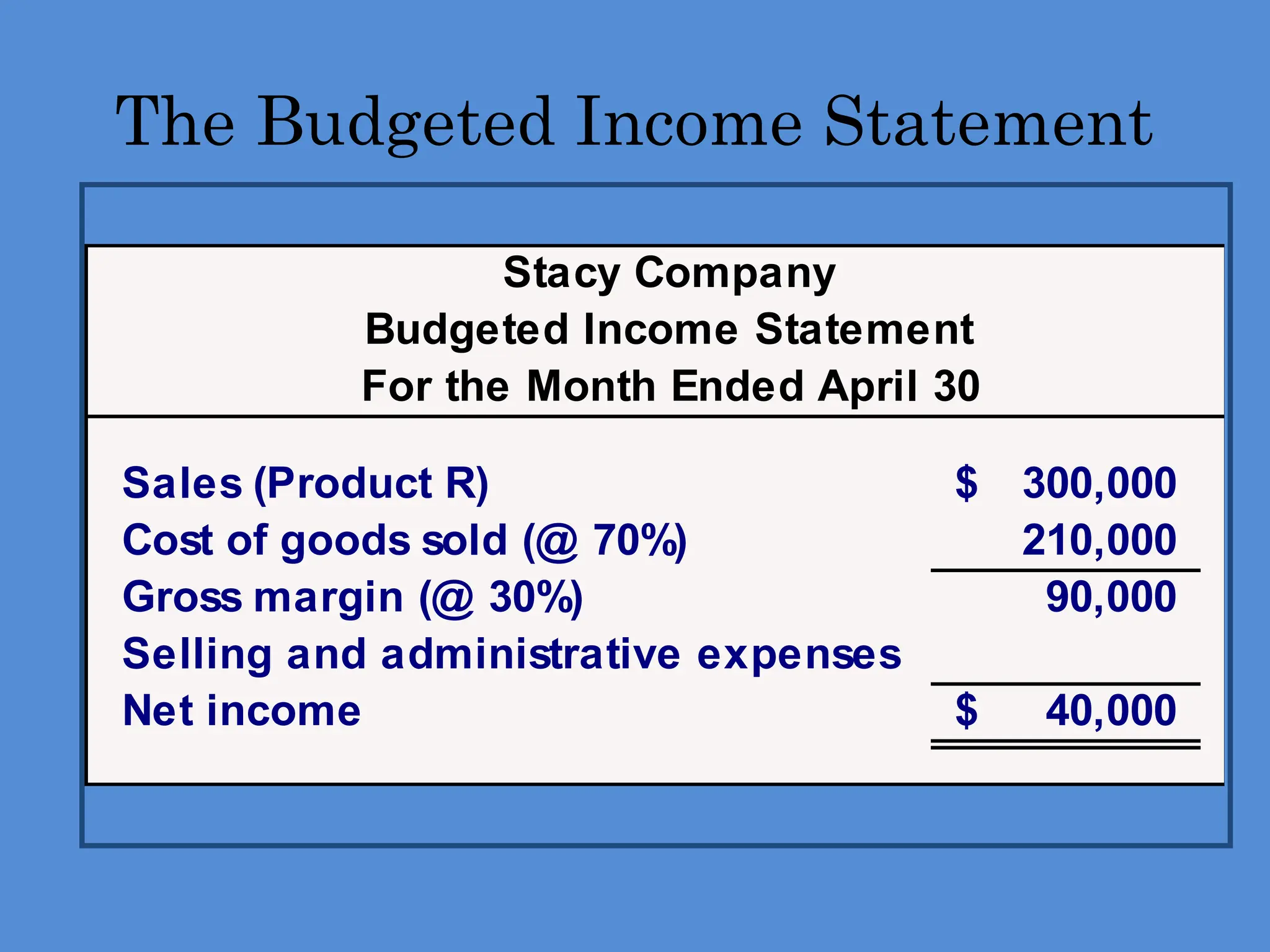
The Budgeted Income Statement
Stacy Company
Budgeted Income Statement
For the Month Ended April 30
Sales (Product R) 300,000
$
Cost of goods sold (@ 70%) 210,000
Gross margin (@ 30%) 90,000
Selling and administrative expenses
Net income 40,000
$
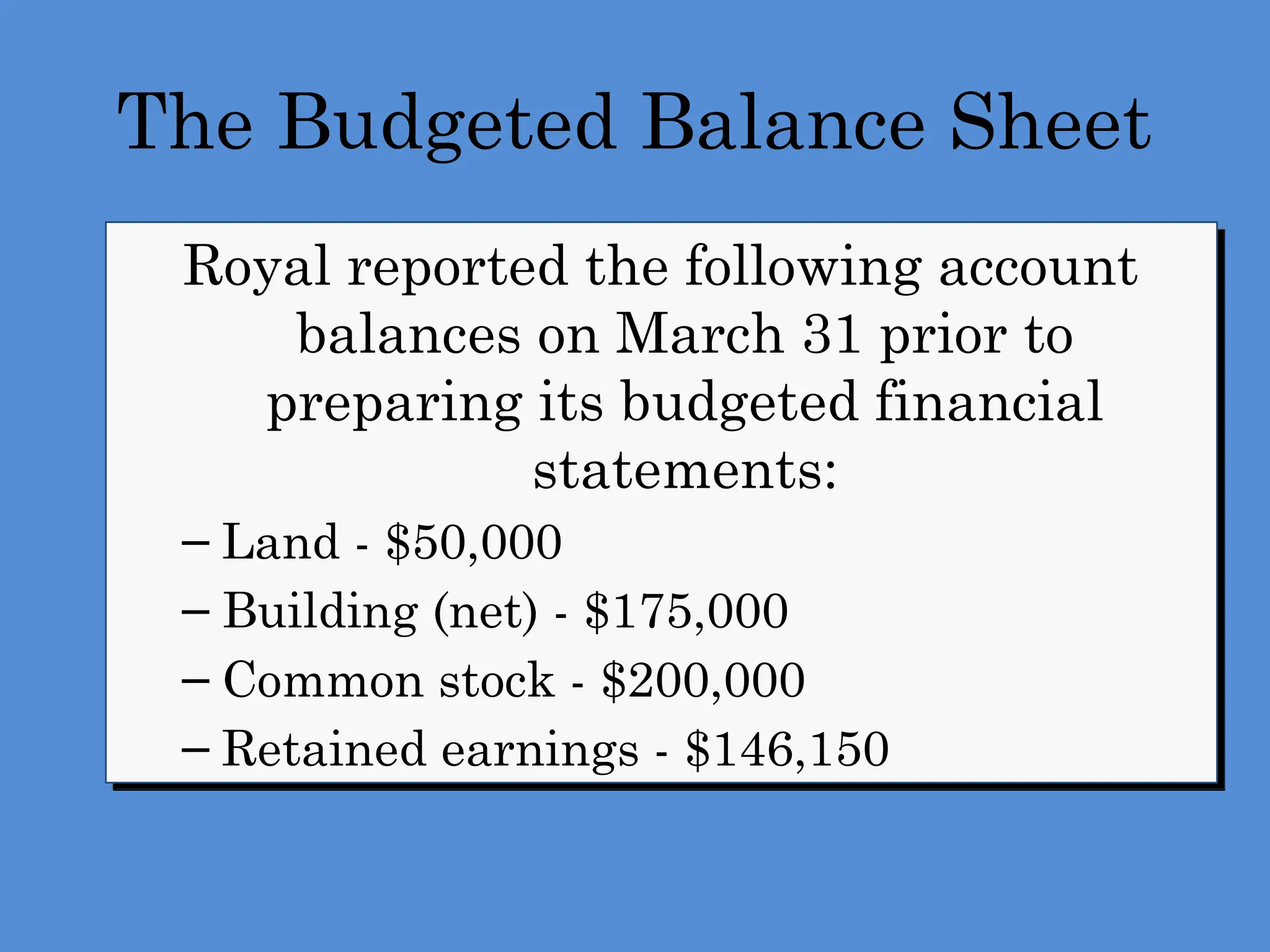
The Budgeted Balance Sheet
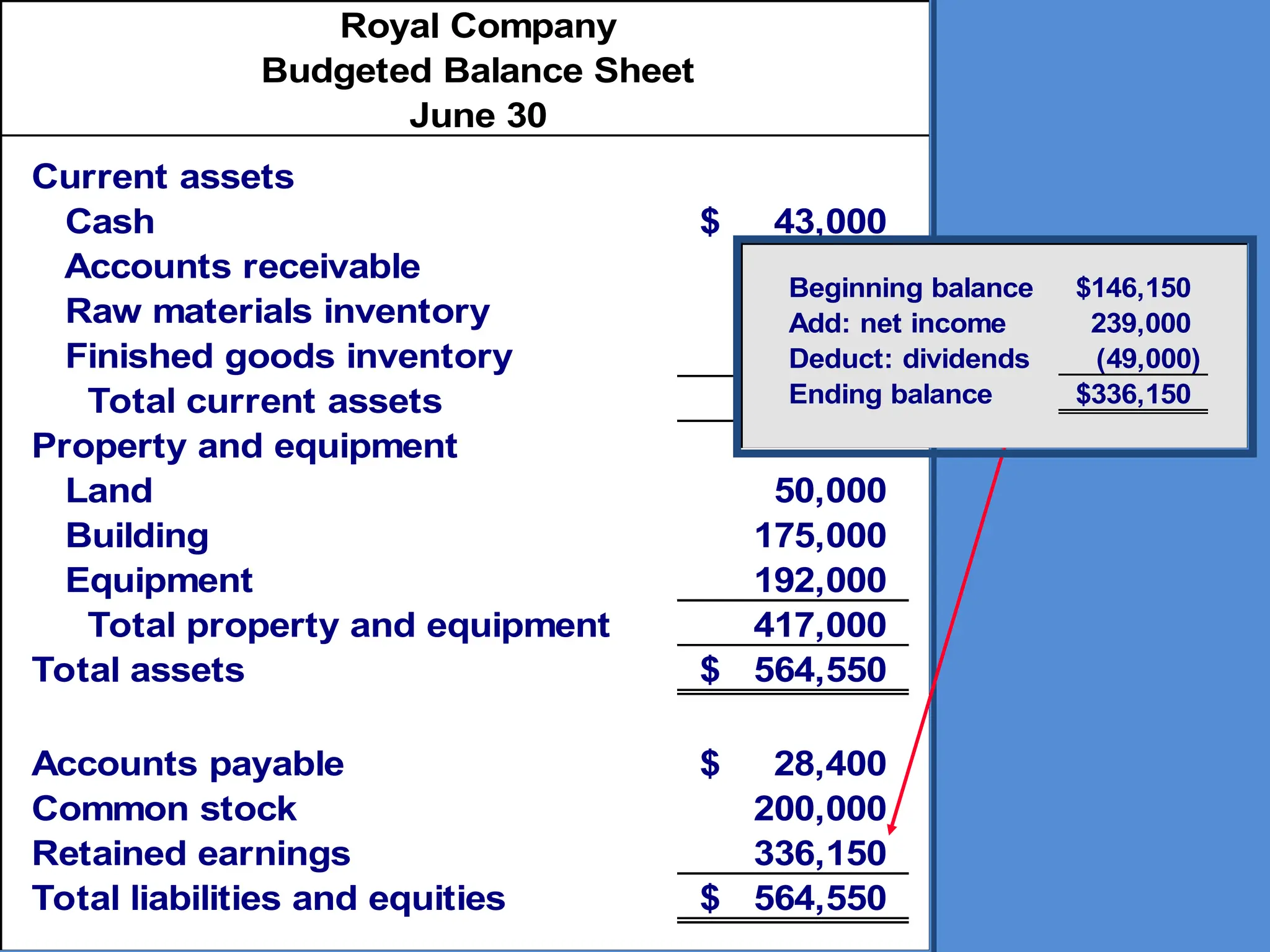
Royal reported the following account
balances on March 31 prior to
preparing its budgeted financial
statements:
– Land - $50,000
– Building (net) - $175,000
– Common stock - $200,000
– Retained earnings - $146,150
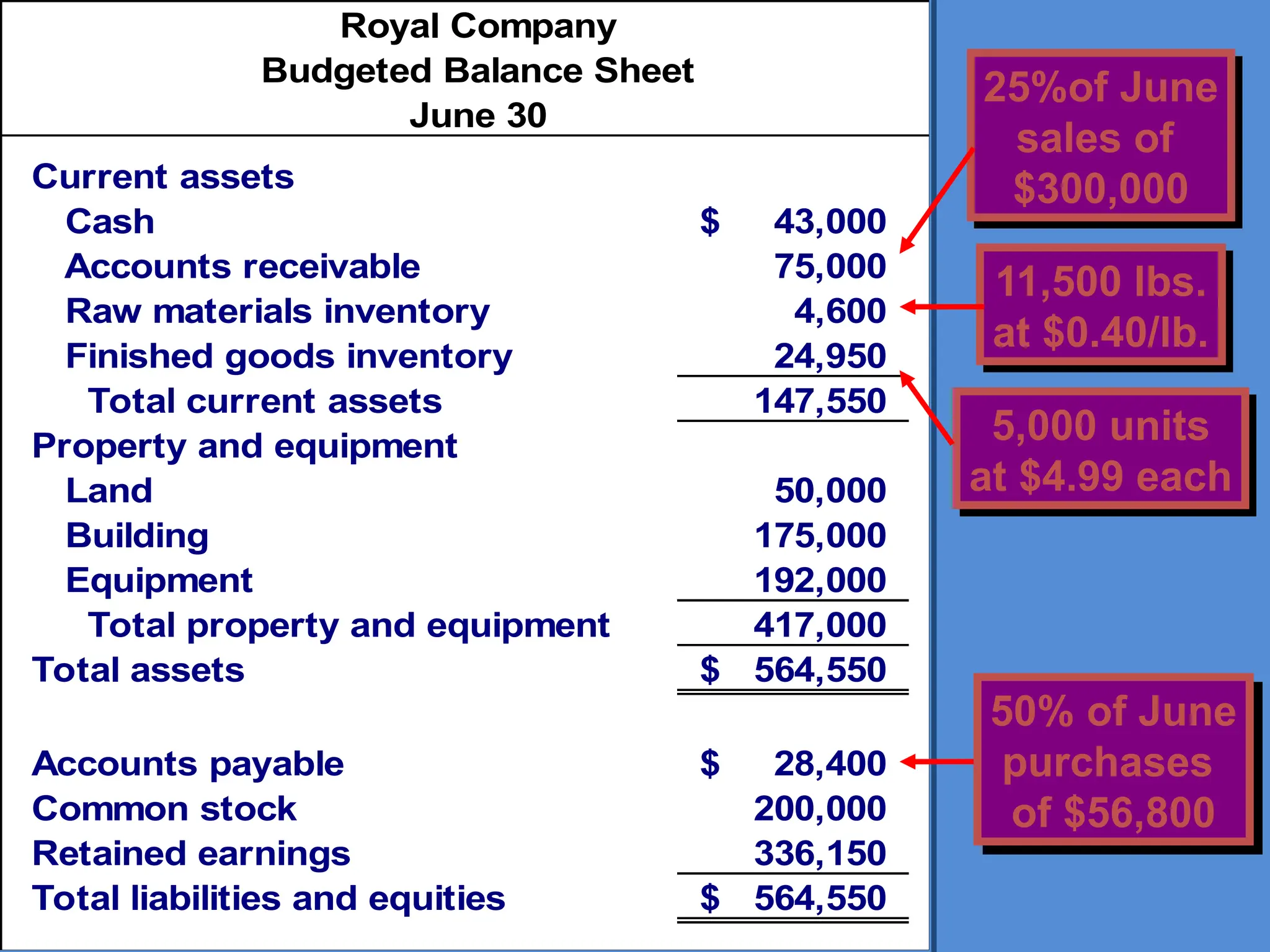
Royal Company
Budgeted Balance Sheet
June 30
Current assets
Cash 43,000
$
Accounts receivable 75,000
Raw materials inventory 4,600
Finished goods inventory 24,950
Total current assets 147,550
Property and equipment
Land 50,000
Building 175,000
Equipment 192,000
Total property and equipment 417,000
Total assets 564,550
$
Accounts payable 28,400
$
Common stock 200,000
Retained earnings 336,150
Total liabilities and equities 564,550
$
25%of June
sales of
$300,000
5,000 units
at $4.99 each
11,500 lbs.
at $0.40/lb.
50% of June
purchases
of $56,800
Royal Company
Budgeted Balance Sheet
June 30
Current assets
Cash 43,000
$
Accounts receivable 75,000
Raw materials inventory 4,600
Finished goods inventory 24,950
Total current assets 147,550
Property and equipment
Land 50,000
Building 175,000
Equipment 192,000
Total property and equipment 417,000
Total assets 564,550
$
Accounts payable 28,400
$
Common stock 200,000
Retained earnings 336,150
Total liabilities and equities 564,550
$
Beginning balance 146,150
$
Add: net income 239,000
Deduct: dividends (49,000)
Ending balance 336,150
$
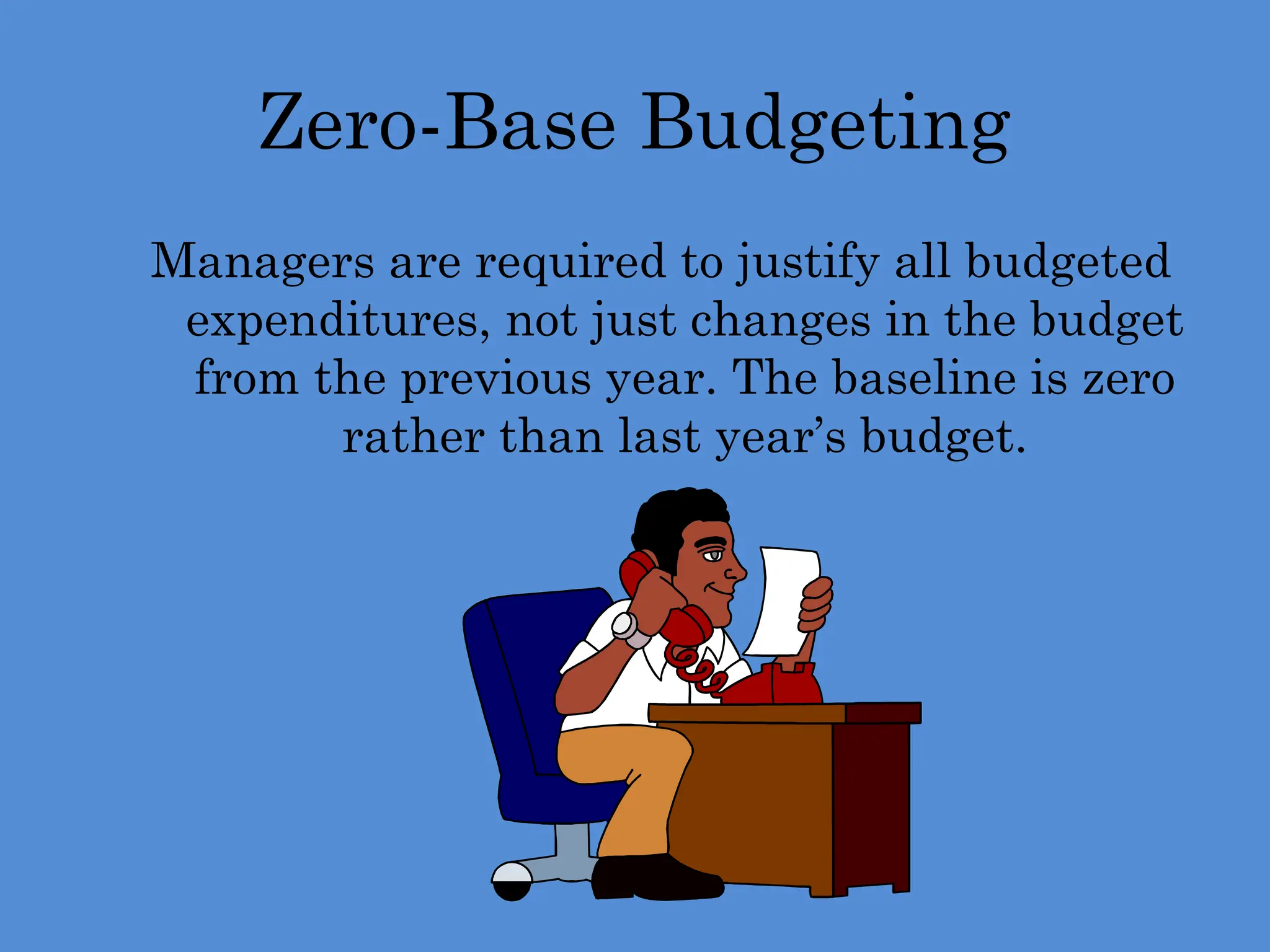
Zero-Base Budgeting
Managers are required to justify all budgeted
expenditures, not just changes in the budget
from the previous year. The baseline is zero
rather than last year’s budget.
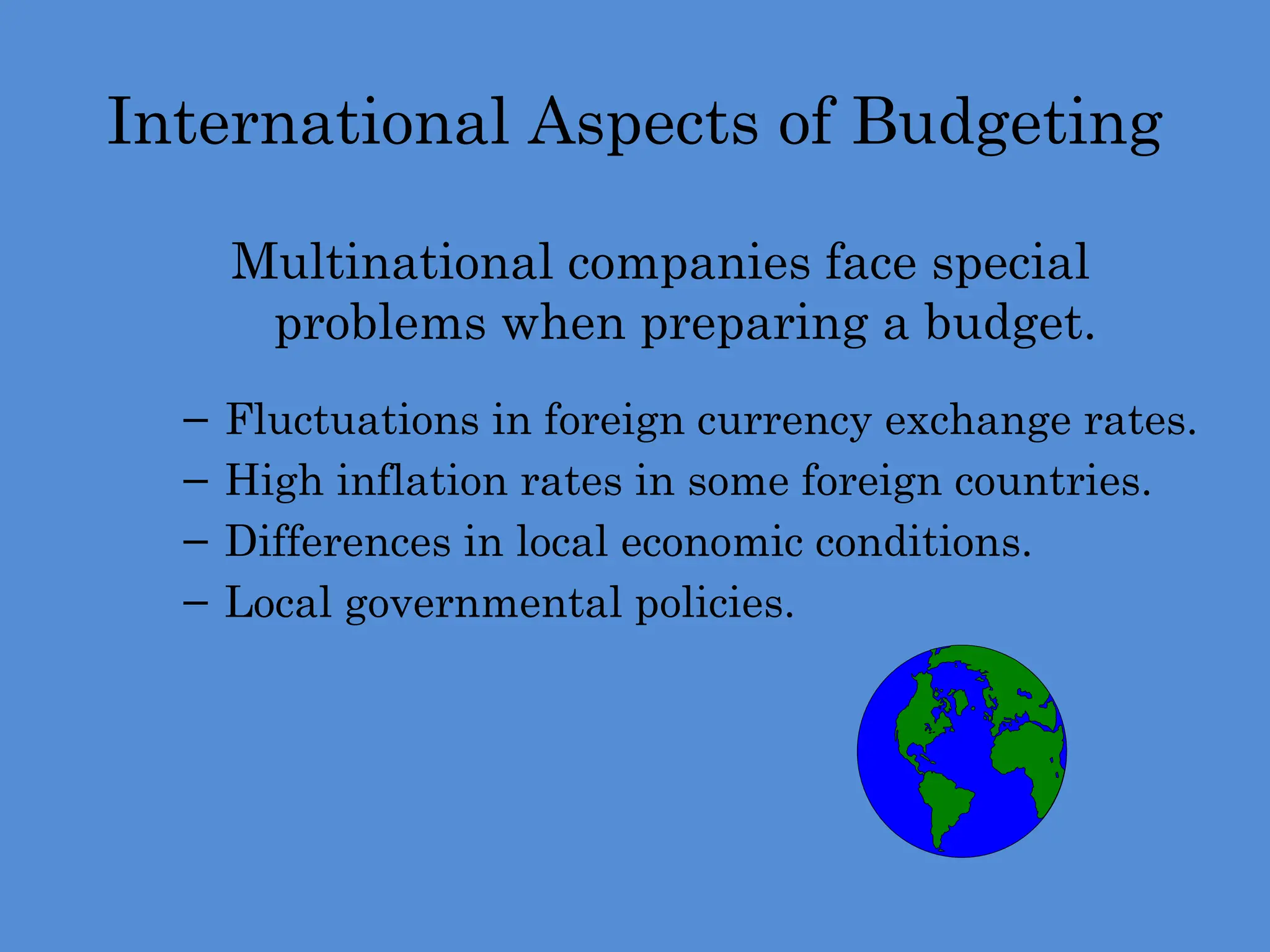
International Aspects of Budgeting
Multinational companies face special
problems when preparing a budget.
– Fluctuations in foreign currency exchange rates.
– High inflation rates in some foreign countries.
– Differences in local economic conditions.
– Local governmental policies.
End of Chapter 9

2. Budgeting and Profit Planning lecture not on budgeting

  • 1.
  • 2.
    BUDGETING BASICS  Aformal written statement of management’s plans for a specified future time period, expressed in financial terms  Primary way to communicate agreed-upon objectives to all parts of the company  Promotes efficiency  Control device - important basis for performance evaluation once adopted
  • 3.
    BUDGETING BASICS Benefits ofBudgeting Requires all levels of management to plan ahead and formalize goals on a recurring basis Provides definite objectives for evaluating performance at each level of responsibility Creates an early warning system for potential problems
  • 4.
    BUDGETING BASICS Benefits ofBudgeting Facilitates coordination of activities within the business Results in greater management awareness of the entity’s overall operations and the impact of external factors Motivates personnel throughout organization to meet planned objectives
  • 5.
    BUDGETING BASICS Role ofAccounting  Historical accounting data on revenues, costs, and expenses help in formulating future budgets  Accountants are normally responsible for presenting management’s budgeting goals in financial terms  The budget and its administration are, however, entirely management’s responsibility
  • 6.
    The Basic Frameworkof Budgeting Detail Budget Detail Budget Detail Budget Master Budget Summary of a company’s plans. Sal es Production Mat eri als
  • 7.
    Advantages of Budgeting Advantages Communicating plans Thinkabout and plan for the future Means of allocating resources Uncover potential bottlenecks Coordinate activities Define goal and objectives
  • 8.
    Choosing the BudgetPeriod Operating Budget 2008 2009 2010 2011 The annual operating budget may be divided into monthly or quarterly budgets.
  • 9.
    The Perpetual Budget 20082009 2010 2011 Continuous or Perpetual Budget This budget is usually a twelve-month budget that rolls forward one month as the current month is completed.
  • 10.
    Participative Budget System Flowof Budget Data Supervisor Supervisor M iddle M anagem ent Supervisor Supervisor M iddle M anagem ent Top M anagem ent
  • 11.
    Responsibility Accounting Managers shouldbe held responsible for those items — and only those items — that the manager can actually control to a significant extent.
  • 12.
    The Budget Committee Astanding committee responsible for – overall policy matters relating to the budget – coordinating the preparation of the budget
  • 13.
    Chapter 9 Quiz:Question 1 Which of the following is NOT true about the Master Budget? a) It is composed of many interrelated budgets. b) It consists of 2 classes of budgets: Operating Budgets and Financial Budgets. c) Within the master budget the first budget to be prepared is the sales budget. d) It constitutes a plan of action for a specified period of time. e) All of the above are true.
  • 14.
    The Master Budget Sellingand Administrative Budget Production Budget Ending Inventory Budget Direct Materials Budget Direct Labor Budget Manufacturing Overhead Budget Sales Budget
  • 15.
    The Master Budget Direct Materials Budget Ending Inventory Budget Production Budget Sellingand Administrative Budget Direct Labor Budget Manufacturing Overhead Budget Cash Budget Sales Budget Budgeted Financial Statements
  • 16.
    The Sales Budget Adetailed schedule showing expected sales for the budgeted periods expressed in units and dollars.
  • 17.
    The Sales Budget First budget prepared  Derived from the sales forecast  Management’s best estimate of sales revenue for the budget period  Every other budget depends on the sales budget  Prepared by multiplying expected unit sales volume for each product times anticipated unit selling price
  • 18.
    Factors considered inSales Forecasting:  General economic conditions  Industry trends  Market research studies  Anticipated advertising and promotion  Previous market share  Price changes  Technological developments The Sales Budget
  • 19.
    Royal Company ispreparing budgets for the quarter ending June 30. Budgeted sales for the next five months are:  April 20,000 units  May 50,000 units  June 30,000 units  July 25,000 units  August 15,000 units. The selling price is $10 per unit. The Sales Budget - Example
  • 20.
    The Sales Budget AprilMay June Quarter Budgeted sales (units) 20,000 50,000 30,000 100,000 Selling price per unit Total sales
  • 21.
    The Sales Budget AprilMay June Quarter Budgeted sales (units) 20,000 50,000 30,000 100,000 Selling price per unit 10 $ 10 $ 10 $ 10 $ Total sales 200,000 $ 500,000 $ 300,000 $ 1,000,000 $
  • 22.
    The Production Budget Sales Budget Production Budget Com pleted Productionmust be adequate to meet budgeted sales and provide for sufficient ending inventory.
  • 23.
     Shows theunits that must be produced to meet anticipated sales  Derived from sales budget plus the desired change in ending finished goods (ending finished goods less the beginning finished goods units)  Required production in units formula: The Production Budget
  • 24.
    The Production Budget •Royal Company wants ending inventory to be equal to 20% of the following month’s budgeted sales in units. • On March 31, 4,000 units were on hand.  Let’s prepare the production budget.
  • 25.
    April May JuneQuarter Budgeted sales 20,000 50,000 30,000 100,000 Add desired ending inventory 10,000 Total needed 30,000 Less beginning inventory 4,000 Required production 26,000 The Production Budget Budgeted sales 50,000 Desired percent 20% Desired inventory 10,000
  • 26.
    April May JuneQuarter Budgeted sales 20,000 50,000 30,000 100,000 Add desired ending inventory 10,000 Total needed 30,000 Less beginning inventory 4,000 Required production 26,000 The Production Budget March 31 ending inventory
  • 27.
    The Production Budget AprilMay June Quarter Budgeted sales 20,000 50,000 30,000 100,000 Add desired ending inventory 10,000 6,000 Total needed 30,000 56,000 Less beginning inventory 4,000 Required production 26,000
  • 28.
    April May JuneQuarter Budgeted sales 20,000 50,000 30,000 100,000 Add desired ending inventory 10,000 6,000 Total needed 30,000 56,000 Less beginning inventory 4,000 10,000 Required production 26,000 46,000 The Production Budget
  • 29.
    April May JuneQuarter Budgeted sales 20,000 50,000 30,000 100,000 Add desired ending inventory 10,000 6,000 5,000 5,000 Total needed 30,000 56,000 35,000 105,000 Less beginning inventory 4,000 10,000 6,000 4,000 Required production 26,000 46,000 29,000 101,000 The Production Budget
  • 30.
    The Direct MaterialsBudget • At Royal Company, five pounds of material are required per unit of product. • Management wants materials on hand at the end of each month equal to 10% of the following month’s production. • On March 31, 13,000 pounds of material are on hand. Material cost $0.40 per pound. Let’s prepare the direct materials budget.
  • 31.
    April May JuneQuarter Production (units) 26,000 46,000 29,000 101,000 Mat'l per unit (lbs) Production needs Add desired Ending Inv (lbs) Total needed Less beginning inventory (lbs) Materials to be purchased (lbs) The Direct Materials Budget From production budget
  • 32.
    The Direct MaterialsBudget April May June Quarter Production (units) 26,000 46,000 29,000 101,000 Mat'l per unit (lbs) 5 5 5 5 Production needs 130,000 230,000 145,000 505,000 Add desired Ending Inv (lbs) Total needed Less beginning inventory (lbs) Materials to be purchased (lbs)
  • 33.
    April May JuneQuarter Production (units) 26,000 46,000 29,000 101,000 Mat'l per unit (lbs) 5 5 5 5 Production needs 130,000 230,000 145,000 505,000 Add desired Ending Inv (lbs) 23,000 Total needed 153,000 Less beginning inventory (lbs) Materials to be purchased The Direct Materials Budget 10% of the following month’s production
  • 34.
    April May JuneQuarter Production (units) 26,000 46,000 29,000 101,000 Mat'l per unit (lbs) 5 5 5 5 Production needs 130,000 230,000 145,000 505,000 Add desired Ending Inv (lbs) 23,000 Total needed 153,000 Less beginning inventory (lbs) 13,000 Materials to be purchased 140,000 The Direct Materials Budget March 31 inventory
  • 35.
    The Direct MaterialsBudget April May June Quarter Production (units) 26,000 46,000 29,000 101,000 Mat'l per unit (lbs) 5 5 5 5 Production needs 130,000 230,000 145,000 505,000 Add desired Ending Inv (lbs) 23,000 14,500 11,500 11,500 Total needed 153,000 244,500 156,500 516,500 Less beginning inventory (lbs) 13,000 23,000 14,500 13,000 Materials to be purchased 140,000 221,500 142,000 503,500
  • 36.
    April May JuneQuarter Production (units) 26,000 46,000 29,000 101,000 Mat'l per unit (lbs) 5 5 5 5 Production needs 130,000 230,000 145,000 505,000 Add desired Ending Inv (lbs) 23,000 14,500 11,500 11,500 Total needed 153,000 244,500 156,500 516,500 Less beginning inventory (lbs) 13,000 23,000 14,500 13,000 Materials to be purchased 140,000 221,500 142,000 503,500 The Direct Materials Budget July Production and Inventory Sales in units 25,000 Add desired ending inventory 3,000 Total units needed 28,000 Less beginning inventory 5,000 Production in units 23,000 Pounds per unit 5 Total pounds 115,000 Desired percent 10% Desired ending inventory 11,500
  • 37.
    Chapter 9 Quiz:Question 2 The Willsey Merchandise Company has budgeted $40,000 in sales for the month of December. The company's cost of goods sold is 30% of sales. If the company has budgeted to purchase $18,000 in merchandise during December, then the budgeted change in inventory levels over the month of December is: A. $ 6,000 increase. B. $10,000 decrease. C. $22,000 decrease. D. $15,000 increase.
  • 38.
    The Master Budget- Components
  • 39.
    Expected Cash Collections •All sales are on account. • Royal’s collection pattern is:  70% collected in the month of sale,  25% collected in the month following sale,  5% is uncollectible. • The March 31 accounts receivable balance of $30,000 will be collected in full.
  • 40.
    Expected Cash Collections AprilMay June Quarter Sales 200,000 $ 500,000 $ 300,000 $ Accounts rec. - 3/31 30,000 $ 30,000 $ Total cash collections 30,000 $ - $
  • 41.
    Expected Cash Collections AprilMay June Quarter Sales 200,000 $ 500,000 $ 300,000 $ Accounts rec. - 3/31 30,000 $ 30,000 $ April x 70% 140,000 140,000 x 25% 50,000 $ 50,000 Total cash collections 170,000 $ 50,000 $ 220,000 $
  • 42.
    Expected Cash Collections AprilMay June Quarter Sales 200,000 $ 500,000 $ 300,000 $ Accounts rec. - 3/31 30,000 $ 30,000 $ April x 70% 140,000 140,000 x 25% 50,000 $ 50,000 May x 70% 350,000 350,000 x 25% 125,000 $ 125,000 Total cash collections 170,000 $ 400,000 $ 125,000 $ 695,000 $
  • 43.
    Expected Cash Collections AprilMay June Quarter Sales 200,000 $ 500,000 $ 300,000 $ Accounts rec. - 3/31 30,000 $ 30,000 $ April x 70% 140,000 140,000 x 25% 50,000 $ 50,000 May x 70% 350,000 350,000 x 25% 125,000 $ 125,000 June x 70% 210,000 210,000 Total cash collections 170,000 $ 400,000 $ 335,000 $ 905,000 $
  • 44.
    Expected Cash Collections AprilMay June Quarter Accounts rec. - 3/31 30,000 $ 30,000 $ April sales 70% x $200,000 140,000 140,000 25% x $200,000 50,000 $ 50,000 May sales 70% x $500,000 350,000 350,000 25% x $500,000 125,000 $ 125,000 June sales 70% x $300,000 210,000 210,000 Total cash collections 170,000 $ 400,000 $ 335,000 $ 905,000 $
  • 45.
    Chapter 9 Quiz:Question 3 Avril Company collects it’s A/R as follows: 30% in the month of sale 60% in the month following sale 8% in the 2nd month following sale The following sales are expected: Jan....$100,000 Feb....$120,000 Mar....$110,000 Cash collections in March should be budgeted at: A. $110,000. C. $105,000. B. $110,800. D. $113,000.
  • 46.
    Expected Cash Disbursementfor Materials • Royal pays $0.40 per pound for its materials. • One-half of a month’s purchases are paid for in the month of purchase; the other half is paid in the following month. • The March 31 accounts payable balance is $12,000.  Let’s calculate expected cash disbursements.
  • 47.
    Expected Cash Disbursementfor Materials April May June Quarter Accounts pay. 3/31 12,000 $ 12,000 $ April purchases May purchases June purchases Total cash disbursements
  • 48.
    April May JuneQuarter Accounts pay. 3/31 12,000 $ 12,000 $ April purchases 50% x $56,000 28,000 28,000 50% x $56,000 28,000 $ 28,000 May purchases June purchases Total cash disbursements 40,000 $ Expected Cash Disbursement for Materials 140,000 lbs. × $.40/lb. = $56,000
  • 49.
    Expected Cash Disbursementfor Materials April May June Quarter Accounts pay. 3/31 12,000 $ 12,000 $ April purchases 50% x $56,000 28,000 28,000 50% x $56,000 28,000 $ 28,000 May purchases 50% x $88,600 44,300 44,300 50% x $88,600 44,300 $ 44,300 June purchases Total cash disbursements 40,000 $ 72,300 $
  • 50.
    Expected Cash Disbursementfor Materials April May June Quarter Accounts pay. 3/31 12,000 $ 12,000 $ April purchases 50% x $56,000 28,000 28,000 50% x $56,000 28,000 $ 28,000 May purchases 50% x $88,600 44,300 44,300 50% x $88,600 44,300 $ 44,300 June purchases 50% x $56,800 28,400 28,400 Total cash disbursements 40,000 $ 72,300 $ 72,700 $ 185,000 $
  • 51.
    The Direct LaborBudget • At Royal, each unit of product requires 0.05 hours of direct labor. • The Company has a “no layoff” policy so all employees will be paid for 40 hours of work each week. • In exchange for the “no layoff” policy, workers agreed to a wage rate of $10 per hour regardless of the hours worked (Overtime paid as straight time). • For the next three months, the direct labor workforce will be paid for a minimum of 1,500 hours per month.  Let’s prepare the direct labor budget.
  • 52.
    April May JuneQuarter Production 26,000 46,000 29,000 101,000 Direct labor hours Labor hours required Guaranteed labor hours Labor hours paid Wage rate Total direct labor cost The Direct Labor Budget From production budget
  • 53.
    The Direct LaborBudget April May June Quarter Production 26,000 46,000 29,000 101,000 Direct labor hours 0.05 0.05 0.05 0.05 Labor hours required 1,300 2,300 1,450 5,050 Guaranteed labor hours Labor hours paid Wage rate Total direct labor cost
  • 54.
    April May JuneQuarter Production 26,000 46,000 29,000 101,000 Direct labor hours 0.05 0.05 0.05 0.05 Labor hours required 1,300 2,300 1,450 5,050 Guaranteed labor hours 1,500 1,500 1,500 Labor hours paid 1,500 2,300 1,500 5,300 Wage rate Total direct labor cost The Direct Labor Budget Higher of labor hours required or labor hours guaranteed.
  • 55.
    The Direct LaborBudget April May June Quarter Production 26,000 46,000 29,000 101,000 Direct labor hours 0.05 0.05 0.05 0.05 Labor hours required 1,300 2,300 1,450 5,050 Guaranteed labor hours 1,500 1,500 1,500 Labor hours paid 1,500 2,300 1,500 5,300 Wage rate 10 $ 10 $ 10 $ 10 $ Total direct labor cost 15,000 $ 23,000 $ 15,000 $ 53,000 $
  • 56.
    Manufacturing Overhead Budget •Royal Company uses a variable manufacturing overhead rate of $1 per unit produced. • Fixed manufacturing overhead is $50,000 per month and includes $20,000 of noncash costs (primarily depreciation of plant assets).  Let’s prepare the manufacturing overhead budget.
  • 57.
    April May JuneQuarter Production in units 26,000 46,000 29,000 101,000 Variable mfg. OH rate 1 $ 1 $ 1 $ 1 $ Variable mfg. OH costs 26,000 $ 46,000 $ 29,000 $ 101,000 $ Fixed mfg. OH costs Total mfg. OH costs Less noncash costs Cash disbursements for manufacturing OH Manufacturing Overhead Budget From production budget
  • 58.
    Manufacturing Overhead Budget AprilMay June Quarter Production in units 26,000 46,000 29,000 101,000 Variable mfg. OH rate 1 $ 1 $ 1 $ 1 $ Variable mfg. OH costs 26,000 $ 46,000 $ 29,000 $ 101,000 $ Fixed mfg. OH costs 50,000 50,000 50,000 150,000 Total mfg. OH costs 76,000 96,000 79,000 251,000 Less noncash costs Cash disbursements for manufacturing OH
  • 59.
    Manufacturing Overhead Budget AprilMay June Quarter Production in units 26,000 46,000 29,000 101,000 Variable mfg. OH rate 1 $ 1 $ 1 $ 1 $ Variable mfg. OH costs 26,000 $ 46,000 $ 29,000 $ 101,000 $ Fixed mfg. OH costs 50,000 50,000 50,000 150,000 Total mfg. OH costs 76,000 96,000 79,000 251,000 Less noncash costs 20,000 20,000 20,000 60,000 Cash disbursements for manufacturing OH 56,000 $ 76,000 $ 59,000 $ 191,000 $ Depreciation is a noncash charge.
  • 60.
    Ending Finished GoodsInventory Budget • Now, Royal can complete the ending finished goods inventory budget. • At Royal, manufacturing overhead is applied to units of product on the basis of direct labor hours.  Let’s calculate ending finished goods inventory.
  • 61.
    Production costs perunit Quantity Cost Total Direct materials 5.00 lbs. 0.40 $ 2.00 $ Direct labor Manufacturing overhead Budgeted finished goods inventory Ending inventory in units Unit product cost Ending finished goods inventory Ending Finished Goods Inventory Budget Direct materials budget and information
  • 62.
    Production costs perunit Quantity Cost Total Direct materials 5.00 lbs. 0.40 $ 2.00 $ Direct labor 0.05 hrs. 10.00 $ 0.50 Manufacturing overhead Budgeted finished goods inventory Ending inventory in units Unit product cost Ending finished goods inventory Ending Finished Goods Inventory Budget Direct labor budget
  • 63.
    Production costs perunit Quantity Cost Total Direct materials 5.00 lbs. 0.40 $ 2.00 $ Direct labor 0.05 hrs. 10.00 $ 0.50 Manufacturing overhead 0.05 hrs. 49.70 $ 2.49 4.99 $ Budgeted finished goods inventory Ending inventory in units Unit product cost 4.99 $ Ending finished goods inventory Ending Finished Goods Inventory Budget Total mfg. OH for quarter $251,000 Total labor hours required 5,050 hrs. = $49.70 per hr. (rounded) Predetermined Overhead Rate:
  • 64.
    Production costs perunit Quantity Cost Total Direct materials 5.00 lbs. 0.40 $ 2.00 $ Direct labor 0.05 hrs. 10.00 $ 0.50 Manufacturing overhead 0.05 hrs. 49.70 $ 2.49 4.99 $ Budgeted finished goods inventory Ending inventory in units 5,000 Unit product cost 4.99 $ Ending finished goods inventory 24,950 $ Ending Finished Goods Inventory Budget Production Budget
  • 65.
    Selling and AdministrativeExpense Budget • At Royal, variable selling and administrative expenses are $0.50 per unit sold. • Fixed selling and administrative expenses are $70,000 per month. • The fixed selling and administrative expenses include $10,000 in costs – primarily depreciation – that are not cash outflows of the current month. Let’s prepare the company’s selling and administrative expense budget.
  • 66.
    Selling and AdministrativeExpense Budget April May June Quarter Budgeted sales 20,000 50,000 30,000 100,000 Variable selling and admin. rate 0.50 $ 0.50 $ 0.50 $ 0.50 $ Variable expense 10,000 $ 25,000 $ 15,000 $ 50,000 $ Fixed selling and admin. expense 70,000 70,000 70,000 210,000 Total expense 80,000 95,000 85,000 260,000 Less noncash expenses Cash disburse- ments for selling & admin.
  • 67.
    Selling and AdministrativeExpense Budget April May June Quarter Budgeted sales 20,000 50,000 30,000 100,000 Variable selling and admin. rate 0.50 $ 0.50 $ 0.50 $ 0.50 $ Variable expense 10,000 $ 25,000 $ 15,000 $ 50,000 $ Fixed selling and admin. expense 70,000 70,000 70,000 210,000 Total expense 80,000 95,000 85,000 260,000 Less noncash expenses 10,000 10,000 10,000 30,000 Cash disburse- ments for selling & admin. 70,000 $ 85,000 $ 75,000 $ 230,000 $
  • 68.
     Shows anticipatedcash flows  Often considered to be the most important output in preparing financial budgets  Contains three sections:  Cash receipts  Cash disbursements  Financing  Shows beginning and ending cash balances The Cash Budget
  • 69.
    The Cash Budget Royal: Maintains a 16% open line of credit for $75,000.  Maintains a minimum cash balance of $30,000.  Borrows on the first day of the month and repays loans on the last day of the month.  Pays a cash dividend of $49,000 in April.  Purchases $143,700 of equipment in May and $48,300 in June paid in cash.  Has an April 1 cash balance of $40,000.
  • 70.
    April May JuneQuarter Beginning cash balance 40,000 $ Add cash collections 170,000 Total cash available 210,000 Less disbursements Materials 40,000 Direct labor Mfg. overhead Selling and admin. Equipment purchase Dividends Total disbursements Excess (deficiency) of cash available over disbursements The Cash Budget Schedule of Expected Cash Collections
  • 71.
    April May JuneQuarter Beginning cash balance 40,000 $ Add cash collections 170,000 Total cash available 210,000 Less disbursements Materials 40,000 Direct labor Mfg. overhead Selling and admin. Equipment purchase Dividends Total disbursements Excess (deficiency) of cash available over disbursements The Cash Budget Schedule of Expected Cash Collections Schedule of Expected Cash Disbursements
  • 72.
    April May JuneQuarter Beginning cash balance 40,000 $ Add cash collections 170,000 Total cash available 210,000 Less disbursements Materials 40,000 Direct labor 15,000 Mfg. overhead 56,000 Selling and admin. 70,000 Equipment purchase Dividends Total disbursements Excess (deficiency) of cash available over disbursements The Cash Budget Direct Labor Budget Manufacturing Overhead Budget Selling and Administrative Expense Budget
  • 73.
    April May JuneQuarter Beginning cash balance 40,000 $ Add cash collections 170,000 Total cash available 210,000 Less disbursements Materials 40,000 Direct labor 15,000 Mfg. overhead 56,000 Selling and admin. 70,000 Equipment purchase - Dividends 49,000 Total disbursements 230,000 Excess (deficiency) of cash available over disbursements (20,000) $ The Cash Budget Because Royal maintains a cash balance of $30,000, the company must borrow on its line-of-credit
  • 74.
    April May JuneQuarter Excess (deficiency) of Cash available over disbursements (20,000) $ Financing: Borrowing 50,000 Repayments - Interest - Total financing 50,000 Ending cash balance 30,000 $ 30,000 $ - $ - $ Financing and Repayment Ending cash balance for April is the beginning May balance.
  • 75.
    CASH BUDGET  Contributesto more effective cash management  Shows managers need for additional financing before actual need arises  Indicates when excess cash will be available
  • 76.
    The Cash Budget AprilMay June Quarter Beginning cash balance 40,000 $ 30,000 $ Add cash collections 170,000 400,000 Total cash available 210,000 430,000 Less disbursements Materials 40,000 72,300 Direct labor 15,000 23,000 Mfg. overhead 56,000 76,000 Selling and admin. 70,000 85,000 Equipment purchase - 143,700 Dividends 49,000 - Total disbursements 230,000 400,000 Excess (deficiency) of cash available over disbursements (20,000) $ 30,000 $
  • 77.
    Financing and Repayment Becausethe ending cash balance is exactly $30,000, Royal will not repay the loan this month. April May June Quarter Excess (deficiency) of Cash available over disbursements (20,000) $ 30,000 $ Financing: Borrowing 50,000 - Repayments - - Interest - - Total financing 50,000 - Ending cash balance 30,000 $ 30,000 $
  • 78.
    April May JuneQuarter Beginning cash balance 40,000 $ 30,000 $ 30,000 $ 40,000 $ Add cash collections 170,000 400,000 335,000 905,000 Total cash available 210,000 430,000 365,000 945,000 Less disbursements Materials 40,000 72,300 72,700 185,000 Direct labor 15,000 23,000 15,000 53,000 Mfg. overhead 56,000 76,000 59,000 191,000 Selling and admin. 70,000 85,000 75,000 230,000 Equipment purchase - 143,700 48,300 192,000 Dividends 49,000 - - 49,000 Total disbursements 230,000 400,000 270,000 900,000 Excess (deficiency) of cash available over disbursements (20,000) $ 30,000 $ 95,000 $ 45,000 $ The Cash Budget
  • 79.
    April May JuneQuarter Beginning cash balance 40,000 $ 30,000 $ 30,000 $ 40,000 $ Add cash collections 170,000 400,000 335,000 905,000 Total cash available 210,000 430,000 365,000 945,000 Less disbursements Materials 40,000 72,300 72,700 185,000 Direct labor 15,000 23,000 15,000 53,000 Mfg. overhead 56,000 76,000 59,000 191,000 Selling and admin. 70,000 85,000 75,000 230,000 Equipment purchase - 143,700 48,300 192,000 Dividends 49,000 - - 49,000 Total disbursements 230,000 400,000 270,000 900,000 Excess (deficiency) of cash available over disbursements (20,000) $ 30,000 $ 95,000 $ 45,000 $ The Cash Budget At the end of June, Royal has enough cash to repay the $50,000 loan plus interest at 16%.
  • 80.
    April May JuneQuarter Excess (deficiency) of Cash available over disbursements (20,000) $ 30,000 $ 95,000 $ 45,000 $ Financing: Borrowing 50,000 - - 50,000 Repayments - - (50,000) (50,000) Interest - - (2,000) (2,000) Total financing 50,000 - (52,000) (2,000) Ending cash balance 30,000 $ 30,000 $ 43,000 $ 43,000 $ Financing and Repayment $50,000 × 16% × 3/12 = $2,000 Borrowings on April 1 and repayment of June 30.
  • 81.
    The Budgeted IncomeStatement Cash Budget Budgeted Income Statement Com pleted After we complete the cash budget, we can prepare the budgeted income statement for Royal.
  • 82.
    The Budgeted IncomeStatement Royal Company Budgeted Income Statement For the Three Months Ended June 30 Sales (100,000 units @ $10) 1,000,000 $ Cost of goods sold (100,000 @ $4.99) 499,000 Gross margin 501,000 Selling and administrative expenses 260,000 Operating income 241,000 Interest expense 2,000 Net income 239,000 $
  • 83.
    The Stacy Companymakes and sells a single product, Product R. Budgeted sales for April are $300,000. Gross Margin is budgeted at 30% of sales dollars. If the net income for April is budgeted at $40,000, the budgeted selling and administrative expenses are: A. $133,333. B. $50,000. C. $102,000. D. $78,000. Quiz: Question 4
  • 84.
    The Budgeted IncomeStatement Stacy Company Budgeted Income Statement For the Month Ended April 30 Sales (Product R) 300,000 $ Cost of goods sold (@ 70%) 210,000 Gross margin (@ 30%) 90,000 Selling and administrative expenses Net income 40,000 $
  • 85.
    The Budgeted BalanceSheet Royal reported the following account balances on March 31 prior to preparing its budgeted financial statements: – Land - $50,000 – Building (net) - $175,000 – Common stock - $200,000 – Retained earnings - $146,150
  • 86.
    Royal Company Budgeted BalanceSheet June 30 Current assets Cash 43,000 $ Accounts receivable 75,000 Raw materials inventory 4,600 Finished goods inventory 24,950 Total current assets 147,550 Property and equipment Land 50,000 Building 175,000 Equipment 192,000 Total property and equipment 417,000 Total assets 564,550 $ Accounts payable 28,400 $ Common stock 200,000 Retained earnings 336,150 Total liabilities and equities 564,550 $ 25%of June sales of $300,000 5,000 units at $4.99 each 11,500 lbs. at $0.40/lb. 50% of June purchases of $56,800
  • 87.
    Royal Company Budgeted BalanceSheet June 30 Current assets Cash 43,000 $ Accounts receivable 75,000 Raw materials inventory 4,600 Finished goods inventory 24,950 Total current assets 147,550 Property and equipment Land 50,000 Building 175,000 Equipment 192,000 Total property and equipment 417,000 Total assets 564,550 $ Accounts payable 28,400 $ Common stock 200,000 Retained earnings 336,150 Total liabilities and equities 564,550 $ Beginning balance 146,150 $ Add: net income 239,000 Deduct: dividends (49,000) Ending balance 336,150 $
  • 88.
    Zero-Base Budgeting Managers arerequired to justify all budgeted expenditures, not just changes in the budget from the previous year. The baseline is zero rather than last year’s budget.
  • 89.
    International Aspects ofBudgeting Multinational companies face special problems when preparing a budget. – Fluctuations in foreign currency exchange rates. – High inflation rates in some foreign countries. – Differences in local economic conditions. – Local governmental policies.
  • 90.