Erin Hyer Master Artist Presentation part 1 
Leon Pourtau and His Work 
Drawing II master piece part I 
Erin Hyer: Leon Pourtau 
Leon Portau was a French oil painting artist who was born in 1872 
and died in 1898.The first image I would like to talk about is a self 
portrait of his that he made in 1890. His color scheme seems to be 
that like analogous because it is of neutral colors like brownish 
reds, dark greens, browns and blacks. 
The second image I would like to talk about is the one I saw in the 
Phoenix art museum called “Provence Landscape” which was made 
in 1891. It was the only piece I saw of his in the museum. As I 
further researched Leon, I saw that his technique in brush strokes 
were more like layers of dabs of paint. In this painting he used 
several dabs of paint, all different colors, as a way to blend the 
colors to make up one big color. The over all color scheme of this 
piece had most neutral colors but there was a small example of complementary colors in the lady 
and the child with them wearing red and blue. Leon was an artist in an artistic era called post-impressionism. 
Impressionism was nearing its end and impressionism is evident in Leon’s work 
by seeing that he likes to paint outside mostly and incorporated a lot of sunlight. He really 
studied how the light in the day changed a composition. 
The third image is mostly complementary colors with a red cloth and window sill and a 
blue dress. Overall, I see blue and red everywhere in the painting but it is cleverly mixed with
red and blue. The image also helps to prove that Pourtau didn’t always 
paint outside but he furthered his studies by studying light indoors. 
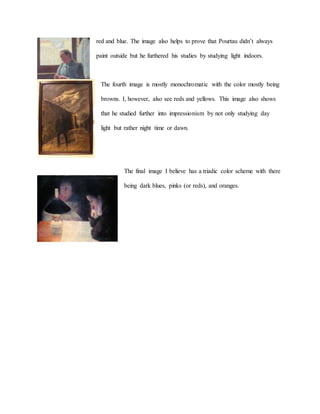
The fourth image is mostly monochromatic with the color mostly being 
browns. I, however, also see reds and yellows. This image also shows 
that he studied further into impressionism by not only studying day 
light but rather night time or dawn. 
The final image I believe has a triadic color scheme with there 
being dark blues, pinks (or reds), and oranges.

Master artist presentation (part 1) leon pourtau

  • 1.
    Erin Hyer MasterArtist Presentation part 1 Leon Pourtau and His Work Drawing II master piece part I Erin Hyer: Leon Pourtau Leon Portau was a French oil painting artist who was born in 1872 and died in 1898.The first image I would like to talk about is a self portrait of his that he made in 1890. His color scheme seems to be that like analogous because it is of neutral colors like brownish reds, dark greens, browns and blacks. The second image I would like to talk about is the one I saw in the Phoenix art museum called “Provence Landscape” which was made in 1891. It was the only piece I saw of his in the museum. As I further researched Leon, I saw that his technique in brush strokes were more like layers of dabs of paint. In this painting he used several dabs of paint, all different colors, as a way to blend the colors to make up one big color. The over all color scheme of this piece had most neutral colors but there was a small example of complementary colors in the lady and the child with them wearing red and blue. Leon was an artist in an artistic era called post-impressionism. Impressionism was nearing its end and impressionism is evident in Leon’s work by seeing that he likes to paint outside mostly and incorporated a lot of sunlight. He really studied how the light in the day changed a composition. The third image is mostly complementary colors with a red cloth and window sill and a blue dress. Overall, I see blue and red everywhere in the painting but it is cleverly mixed with
  • 2.
    red and blue.The image also helps to prove that Pourtau didn’t always paint outside but he furthered his studies by studying light indoors. The fourth image is mostly monochromatic with the color mostly being browns. I, however, also see reds and yellows. This image also shows that he studied further into impressionism by not only studying day light but rather night time or dawn. The final image I believe has a triadic color scheme with there being dark blues, pinks (or reds), and oranges.