
Mass Media & Communication
                                 Group
UMT Lahore, Pakistan            Members
                             Nayab Zahra
  Presented to: Sir              090303-001
   Ahmad Sheikh
                             Fatima Ahmad
                                 100403-007

                              Ifra Qureshi
                                  090303-020

                             M. Ali Aktar
                                 100403-006
                                      UMT
                             SUBMITTED TO MR. AHMAD
                                     SHEIKH
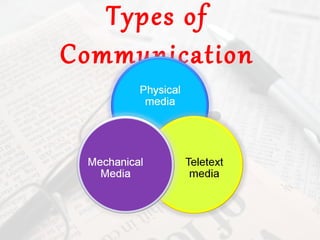
Types of
Communication
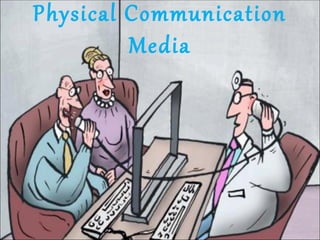
Physical Communication
         Media
Physical Media
• Physical media we mean channels where the
  person who is talking can be seen and heard
  by the audience.

• See the body language and feel the climate
  in the room.

• If a message is perceived as important to the
  receiver they expect to hear it live from their
  manager.
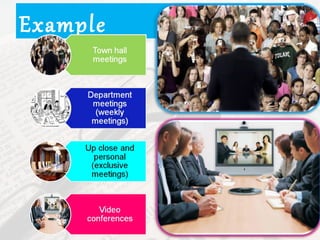
Example
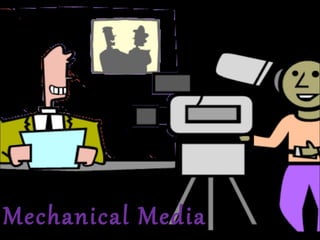
Mechanical Media
Mechanical
Communication
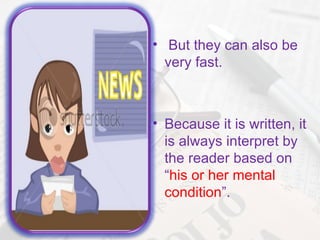
• But they can also be
  very fast.


• Because it is written, it
  is always interpret by
  the reader based on
  “his or her mental
  condition”.
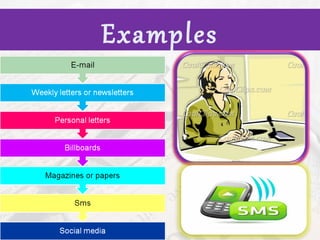
Examples
Broadcast Media
Broadcast
•
     Media/Broadcasting
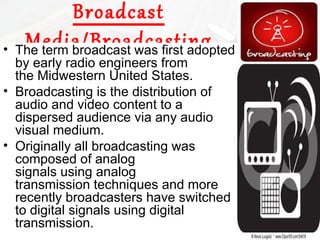
    The term broadcast was first adopted
  by early radio engineers from
  the Midwestern United States.
• Broadcasting is the distribution of
  audio and video content to a
  dispersed audience via any audio
  visual medium.
• Originally all broadcasting was
  composed of analog
  signals using analog
  transmission techniques and more
  recently broadcasters have switched
  to digital signals using digital
  transmission.
Digital Media
 • Digital media is a form
   of electronic
   media where data is
   stored in digital form. It
   can refer to the
   technical aspect
   of storage and
   transmission of
   information or to the
   “End Product", such
   as digital
   video, augmented
   reality or digital art.
• This emerged in the latter part of the 20th
  century. New media are the cultural objects        N
  which use digital computer technology for
  distribution and exhibition. Internet, websites,   E
  computer multimedia, video games.                  W
• New media does not include television
  programs, feature films, magazines, books, or
  paper-based publications unless they contain
  technologies that enable digital interactivity.
• Wikipedia, an online encyclopedia, is an
  example, combining Internet accessible digital
                                                     M
  text, images and video with web-links, creative    E
  participation of contributors, interactive
  feedback of users and formation of a participant   D
  community of editors and donors for the benefit
  of non-community readers.                          I
                                                     A
Hypermedia
• Hypermedia is a computer-based
  information retrieval system that enables a
  user to gain or provide access to texts,
  audio and video recordings, photographs
  and computer graphics related to a
  particular subject.
• Hypermedia is used as a logical extension
  of the term hypertext in which graphics,
  audio, video, plain text
  and hyperlinks intertwine to create a
  generally non-linear medium of
  information.
• The World Wide Web is a classic example
  of hypermedia, whereas a non
  interactive cinema presentation is an
  example of standard multimedia due to the
  absence of hyperlinks.
Static Media
• Static media include text
  and still-pictures (graphics,
  photo, illustrations). These
  media are stable over time,
  i.e. enabling the observer to
  perceive the information in
  a self-chosen speed.
• Examples:
  Text
  Pictures
Dynamic
             Media
• Dynamic media are those
  including sound, voice,
  animation, video, (interactive-)
  and simulations.
• Compared to static media,
  dynamic media represent
  unstable information from the
  point of view of the observer.
• The flow of the information is
  normally beyond the control of
  the observer. Examples:
   Songs
   Videos
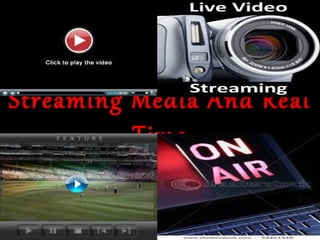
Streaming Media And Real
          Time
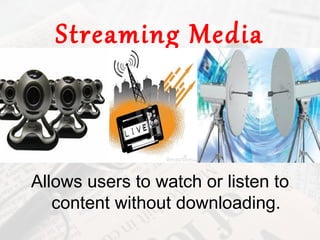
Streaming Media


Allows users to watch or listen to
   content without downloading.
Real event or function is
• When an
          Time Media
  processed instantaneously, it is
  said to occur in real-time. To say
  something takes place in real-
  time is the same as saying it is
  happening "live" or "on-the-fly."
• Real-time also describes the
  way streaming media is
  processed. Instead of waiting for
  a file to completely download, the
  information is played back as it is
  downloaded. This allows for
  news broadcasts, sound clips,
  and other streaming audio and
  video data to be played live from
  the Internet.
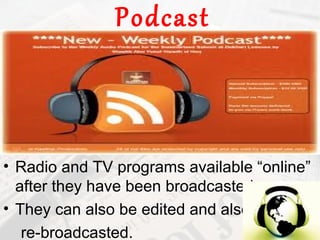
Podcast


• Radio and TV programs available “online”
  after they have been broadcasted.
• They can also be edited and also
   re-broadcasted.
Teletext
Brief History
• Teletext developed in the United Kingdom in
  the early 1970s.
• It offers text-based information. Subtitle (or
  closed captioning) information is also
  transmitted in the teletext signal.
• It is basically set up by the researcher to send
  Closed captioning information to the
  audience across the country .
Close caption
             information on a
• CCI is the process of displaying text
  television, video screen or other visual display.
• Purpose; to provide additional information.
• It show a transcription of the audio portion of
  a program.
Development
• In 1972 the BBC demonstrated their system,
  now known as Ceefax ("see facts") on various
  news shows.
• The ITA announced their own service in 1973,
  known as ORACLE.
• In 1973–74, towards the end of 1974 the BBC
  news department started with 30 pages. The
  Ceefax service was later expanded to 100 pages
  and was launched formally in 1976.
• By 1984, the teletext system evolved into what
  is now known as World System Teletext (WST).
Usage
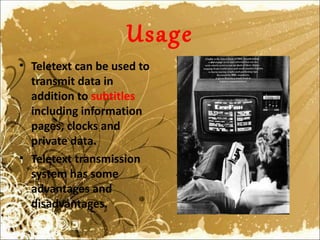
• Teletext can be used to
  transmit data in
  addition to subtitles
  including information
  pages, clocks and
  private data.
• Teletext transmission
  system has some
  advantages and
  disadvantages.
Teletext broadcast
            service
• It is free and easily accessible to viewers
  throughout the country.
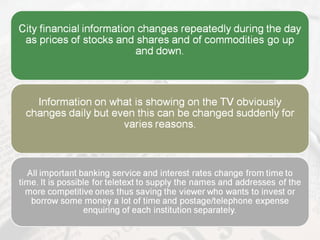
• Viewers access news, exchange rates and
  much other resource information on demand
  from Teletext 24/7.
Applications of
  Teletext
Advantages of the Teletext
                    system and reliable.
• Teletext technology is well proven
• Teletext is aimed mainly at the domestic user, though
  some of the information has commercial importance.
• People are able to obtain information at any time the
  TV station is transmitting.
• People can see the news.
• people can choose for themselves how long to spend
  on any particular item.
• Teletext information is frequently updated and urgent
  newsflashes.
Advantages of the Teletext
        system
• People whose hearing is not very good can use
  teletext .
• service covers news reviews, documentaries,
  films and other entertainments.
• The viewer can control whether or not the
  subtitles are displayed.
• A broadcaster can provide more than one
  language in a Teletext subtitle service.
Advantages of the Teletext
        system
• Teletext subtitling has been adopted in most
  countries that use the PAL television system
  to provide an important service for TV
  viewers who are hearing impaired.
• Teletext is transmitted along with ordinary
  television programme signals and thus does
  not require separate transmitters or
  additional radio frequencies.
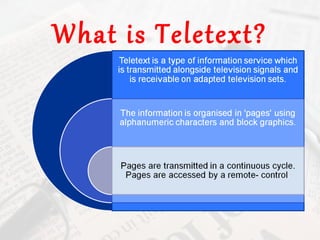
What is Teletext?
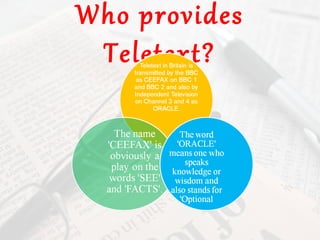
Who provides
 Teletext?
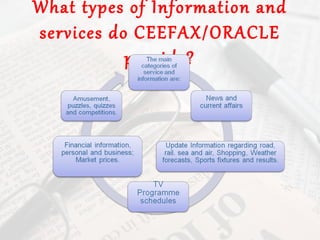
What types of Information and
services do CEEFAX/ORACLE
           provide?
What equipment is
     needed to receive
   teletext in the home?
• Most users of teletext use a TV set with an
  adaptor that was built-in when the TV set
  was made in the factory.


• It is also possible to buy separate
  adaptors to convert a non-teletext TV to
  receive teletext.
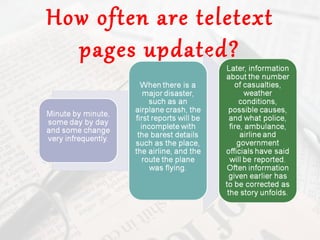
How often are teletext
  pages updated?
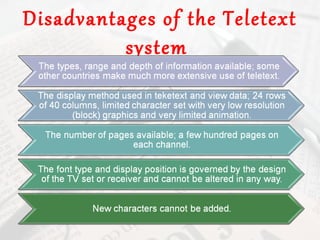
Disadvantages of the Teletext
          system
Zahra
 090303-001

Fatima
Ahmad
     
 100403-007

 Ifra
Qureshi
     
 090303-020

M. Ali
Aktar
      

Mass media and communication

  • 1.
    Mass Media &Communication Group UMT Lahore, Pakistan Members Nayab Zahra Presented to: Sir 090303-001 Ahmad Sheikh Fatima Ahmad  100403-007  Ifra Qureshi  090303-020 M. Ali Aktar  100403-006 UMT SUBMITTED TO MR. AHMAD SHEIKH
  • 2.
  • 3.
  • 4.
    Physical Media • Physicalmedia we mean channels where the person who is talking can be seen and heard by the audience. • See the body language and feel the climate in the room. • If a message is perceived as important to the receiver they expect to hear it live from their manager.
  • 5.
  • 6.
  • 7.
  • 8.
    • But theycan also be very fast. • Because it is written, it is always interpret by the reader based on “his or her mental condition”.
  • 9.
  • 10.
  • 11.
    Broadcast • Media/Broadcasting The term broadcast was first adopted by early radio engineers from the Midwestern United States. • Broadcasting is the distribution of audio and video content to a dispersed audience via any audio visual medium. • Originally all broadcasting was composed of analog signals using analog transmission techniques and more recently broadcasters have switched to digital signals using digital transmission.
  • 12.
    Digital Media •Digital media is a form of electronic media where data is stored in digital form. It can refer to the technical aspect of storage and transmission of information or to the “End Product", such as digital video, augmented reality or digital art.
  • 13.
    • This emergedin the latter part of the 20th century. New media are the cultural objects N which use digital computer technology for distribution and exhibition. Internet, websites, E computer multimedia, video games. W • New media does not include television programs, feature films, magazines, books, or paper-based publications unless they contain technologies that enable digital interactivity. • Wikipedia, an online encyclopedia, is an example, combining Internet accessible digital M text, images and video with web-links, creative E participation of contributors, interactive feedback of users and formation of a participant D community of editors and donors for the benefit of non-community readers. I A
  • 14.
    Hypermedia • Hypermedia isa computer-based information retrieval system that enables a user to gain or provide access to texts, audio and video recordings, photographs and computer graphics related to a particular subject. • Hypermedia is used as a logical extension of the term hypertext in which graphics, audio, video, plain text and hyperlinks intertwine to create a generally non-linear medium of information. • The World Wide Web is a classic example of hypermedia, whereas a non interactive cinema presentation is an example of standard multimedia due to the absence of hyperlinks.
  • 15.
    Static Media • Staticmedia include text and still-pictures (graphics, photo, illustrations). These media are stable over time, i.e. enabling the observer to perceive the information in a self-chosen speed. • Examples: Text Pictures
  • 16.
    Dynamic Media • Dynamic media are those including sound, voice, animation, video, (interactive-) and simulations. • Compared to static media, dynamic media represent unstable information from the point of view of the observer. • The flow of the information is normally beyond the control of the observer. Examples:  Songs  Videos
  • 17.
  • 18.
    Streaming Media Allows usersto watch or listen to content without downloading.
  • 19.
    Real event orfunction is • When an Time Media processed instantaneously, it is said to occur in real-time. To say something takes place in real- time is the same as saying it is happening "live" or "on-the-fly." • Real-time also describes the way streaming media is processed. Instead of waiting for a file to completely download, the information is played back as it is downloaded. This allows for news broadcasts, sound clips, and other streaming audio and video data to be played live from the Internet.
  • 20.
    Podcast • Radio andTV programs available “online” after they have been broadcasted. • They can also be edited and also re-broadcasted.
  • 22.
  • 24.
    Brief History • Teletextdeveloped in the United Kingdom in the early 1970s. • It offers text-based information. Subtitle (or closed captioning) information is also transmitted in the teletext signal. • It is basically set up by the researcher to send Closed captioning information to the audience across the country .
  • 25.
    Close caption information on a • CCI is the process of displaying text television, video screen or other visual display. • Purpose; to provide additional information. • It show a transcription of the audio portion of a program.
  • 26.
    Development • In 1972the BBC demonstrated their system, now known as Ceefax ("see facts") on various news shows. • The ITA announced their own service in 1973, known as ORACLE. • In 1973–74, towards the end of 1974 the BBC news department started with 30 pages. The Ceefax service was later expanded to 100 pages and was launched formally in 1976. • By 1984, the teletext system evolved into what is now known as World System Teletext (WST).
  • 27.
    Usage • Teletext canbe used to transmit data in addition to subtitles including information pages, clocks and private data. • Teletext transmission system has some advantages and disadvantages.
  • 28.
    Teletext broadcast service • It is free and easily accessible to viewers throughout the country. • Viewers access news, exchange rates and much other resource information on demand from Teletext 24/7.
  • 29.
  • 30.
    Advantages of theTeletext system and reliable. • Teletext technology is well proven • Teletext is aimed mainly at the domestic user, though some of the information has commercial importance. • People are able to obtain information at any time the TV station is transmitting. • People can see the news. • people can choose for themselves how long to spend on any particular item. • Teletext information is frequently updated and urgent newsflashes.
  • 31.
    Advantages of theTeletext system • People whose hearing is not very good can use teletext . • service covers news reviews, documentaries, films and other entertainments. • The viewer can control whether or not the subtitles are displayed. • A broadcaster can provide more than one language in a Teletext subtitle service.
  • 32.
    Advantages of theTeletext system • Teletext subtitling has been adopted in most countries that use the PAL television system to provide an important service for TV viewers who are hearing impaired. • Teletext is transmitted along with ordinary television programme signals and thus does not require separate transmitters or additional radio frequencies.
  • 33.
  • 34.
  • 35.
    What types ofInformation and services do CEEFAX/ORACLE provide?
  • 36.
    What equipment is needed to receive teletext in the home? • Most users of teletext use a TV set with an adaptor that was built-in when the TV set was made in the factory. • It is also possible to buy separate adaptors to convert a non-teletext TV to receive teletext.
  • 37.
    How often areteletext pages updated?
  • 39.
    Disadvantages of theTeletext system
  • 40.
    Zahra 090303-001 Fatima Ahmad  100403-007  Ifra Qureshi  090303-020 M. Ali Aktar 