Brick Masonry
• Technical terms –Dimension 190X90X90
• Stretcher- Long lateral face of brick shows L
• Header- Smaller lateral face showing width
• Arries – Edges
• Bed joint- Horiz layer of mortar
• Perpends- vertical joint separating bricks
• Lap- Horiz dist bet vertical joint in successive
courses.
• Closer- A piece of brick used to close the bond
at the end of brick courses.
• Queen closer- Brick cut along length in two
equal halves. Used to develop face lap.
• King closer- Half length and breadth cut with
corner. Used for door window openings.
• Bat- A piece of brick obtained by cutting
length. ½ and ¾ bats are common.
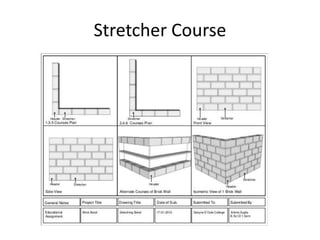
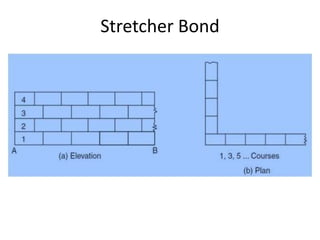
Stretcher Course
Stretcher Bond
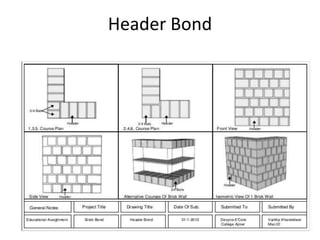
Header Bond
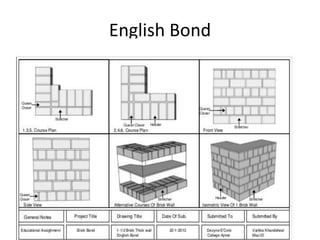
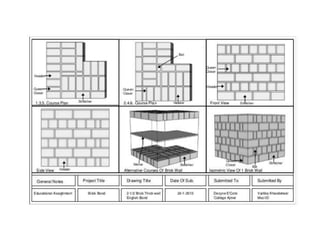
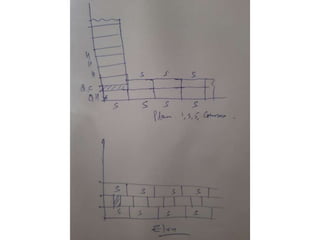
English Bond
• Salient features
• Stretcher and Header courses are placed
alternately in the masonry wall.
• Queen closer is placed to quoin header in order
to develop face lap of L/4.
• Each header is centrally supported over Stretcher
below it.
• If thickness of wall is even multiple of half brick
then courses showing stretchers/headers in front
elevation show similar view in rear elevation.
• If thickness of wall is odd multiple of half brick
then courses showing stretchers show headers
in rear elevation and vice versa.
• If thickness of wall is more than 2 brick then
interior filling is done by headers only.
English Bond
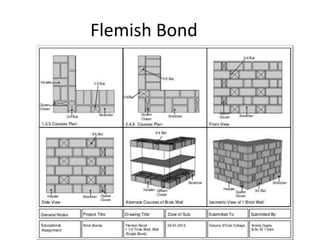
Flemish Bond
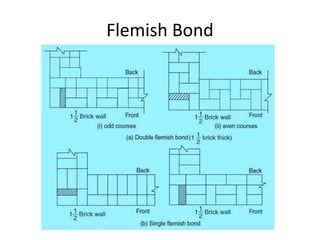
• In every course Stretchers and Headers are
placed alternately.
• Queen closer is placed next to quoin header to
develop the face lap.
• Every header is centrally supported over a
stretcher below it.
Double Flemish Bond
• H and S are placed alternately in front and
back elevation.
• Half and ¾ bats are used in walls having
thickness equal to odd multiple of half bricks.
• No brickbats are used in walls having even
multiple of half brick.
• Facing and backing of wall in each course have
the same appearance.
Single Flemish Bond
• Elevation in front is of Flemish bond and it
shows English bond in rear elevation.
• Appearance of Flemish bond and strength of
English bond are combined.
• Min thickness of wall shall be 1.5 brick.
Flemish Bond
Flemish Bond
Stone Masonry
• Stone Masonry
•  The construction of stones bonded together
with mortar is termed as stone masonry where
the stones are available in a abundance in
nature.
• construction of various building components
such as walls, columns, footings, arches, lintels,
beams etc.
• the stone masonry can be
• classified broadly in the following two
categories
• 1. Rubble masonry
• 2. Ashlar masonry
• 1) Rubble masonry:
• In this category, the stones used are either
undressed or roughly dressed having wider
joints.
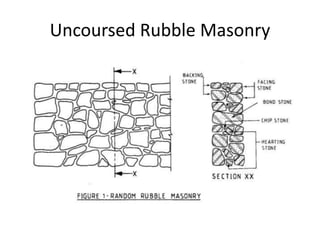
• (i) Uncoursed rubble masonry: This is the
• cheapest, roughest and poorest form of stone
• masonry. Uncoursed rubble
• masonry can be divided into the following.
• a) Uncoursed random rubble
• b) Uncoursed squared rubble
Uncoursed Rubble Masonry
Coursed Rubble Masonry
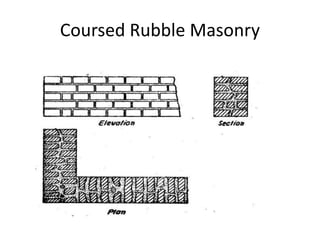
In this type of stone
• masonry the uniform height stones are used in
• horizontal layers not less than 13cm in height.
• Generally, the stone beds are hammered or
chisel dressed to a depth of at least 10cm from
the face.
Coursed Rubble Masonry
Polygonal rubble masonry
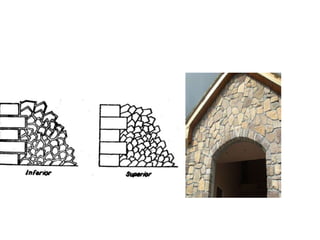
• Polygonal rubble masonry: In this type of
• masonry the stones are roughly dressed to an
• irregular polygonal shape. The stones should be
• so arranged as to avoid long vertical joints in
face
• work and to break joints as much as possible.
• Small stone chips should not be used to support
• the stones on the facing as shown in the figure
Ashlar Masonry
• Ashlar Masonry
•  This type of masonry is built from accurately
• dressed stones with uniform and fine joints of
• about 3mm thickness by arranging the stone
• blocks in various patterns.
•  The backing of Ashlar masonry walls may be
built of Ashlar masonry or rubble masonry. The
size of stones blocks should be in proportion to
wall thickness.
• The various types of masonry can be classified
• under the following categories are
• 1) Ashlar fine
• 2) Ashlar rough
• 3) Ashlar rock or quarry faced
• 4) Ashlar facing
• 5) Ashlar chamfered
• 6) Ashlar block in course
• Ashlar Fine • Ashlar Rough
• Ashlar Rock face
Supervision-Stone Masonry
Comparision of BW and SW

BT_Masonry.pptx

  • 1.
    Brick Masonry • Technicalterms –Dimension 190X90X90 • Stretcher- Long lateral face of brick shows L • Header- Smaller lateral face showing width • Arries – Edges • Bed joint- Horiz layer of mortar • Perpends- vertical joint separating bricks • Lap- Horiz dist bet vertical joint in successive courses.
  • 2.
    • Closer- Apiece of brick used to close the bond at the end of brick courses. • Queen closer- Brick cut along length in two equal halves. Used to develop face lap. • King closer- Half length and breadth cut with corner. Used for door window openings. • Bat- A piece of brick obtained by cutting length. ½ and ¾ bats are common.
  • 3.
  • 4.
  • 5.
  • 6.
    English Bond • Salientfeatures • Stretcher and Header courses are placed alternately in the masonry wall. • Queen closer is placed to quoin header in order to develop face lap of L/4. • Each header is centrally supported over Stretcher below it. • If thickness of wall is even multiple of half brick then courses showing stretchers/headers in front elevation show similar view in rear elevation.
  • 7.
    • If thicknessof wall is odd multiple of half brick then courses showing stretchers show headers in rear elevation and vice versa. • If thickness of wall is more than 2 brick then interior filling is done by headers only.
  • 8.
  • 11.
    Flemish Bond • Inevery course Stretchers and Headers are placed alternately. • Queen closer is placed next to quoin header to develop the face lap. • Every header is centrally supported over a stretcher below it.
  • 12.
    Double Flemish Bond •H and S are placed alternately in front and back elevation. • Half and ¾ bats are used in walls having thickness equal to odd multiple of half bricks. • No brickbats are used in walls having even multiple of half brick. • Facing and backing of wall in each course have the same appearance.
  • 13.
    Single Flemish Bond •Elevation in front is of Flemish bond and it shows English bond in rear elevation. • Appearance of Flemish bond and strength of English bond are combined. • Min thickness of wall shall be 1.5 brick.
  • 14.
  • 15.
  • 16.
    Stone Masonry • StoneMasonry •  The construction of stones bonded together with mortar is termed as stone masonry where the stones are available in a abundance in nature. • construction of various building components such as walls, columns, footings, arches, lintels, beams etc.
  • 17.
    • the stonemasonry can be • classified broadly in the following two categories • 1. Rubble masonry • 2. Ashlar masonry
  • 18.
    • 1) Rubblemasonry: • In this category, the stones used are either undressed or roughly dressed having wider joints. • (i) Uncoursed rubble masonry: This is the • cheapest, roughest and poorest form of stone • masonry. Uncoursed rubble • masonry can be divided into the following. • a) Uncoursed random rubble • b) Uncoursed squared rubble
  • 19.
  • 20.
    Coursed Rubble Masonry Inthis type of stone • masonry the uniform height stones are used in • horizontal layers not less than 13cm in height. • Generally, the stone beds are hammered or chisel dressed to a depth of at least 10cm from the face.
  • 21.
  • 22.
    Polygonal rubble masonry •Polygonal rubble masonry: In this type of • masonry the stones are roughly dressed to an • irregular polygonal shape. The stones should be • so arranged as to avoid long vertical joints in face • work and to break joints as much as possible. • Small stone chips should not be used to support • the stones on the facing as shown in the figure
  • 24.
    Ashlar Masonry • AshlarMasonry •  This type of masonry is built from accurately • dressed stones with uniform and fine joints of • about 3mm thickness by arranging the stone • blocks in various patterns. •  The backing of Ashlar masonry walls may be built of Ashlar masonry or rubble masonry. The size of stones blocks should be in proportion to wall thickness.
  • 25.
    • The varioustypes of masonry can be classified • under the following categories are • 1) Ashlar fine • 2) Ashlar rough • 3) Ashlar rock or quarry faced • 4) Ashlar facing • 5) Ashlar chamfered • 6) Ashlar block in course
  • 26.
    • Ashlar Fine• Ashlar Rough
  • 27.
  • 28.
  • 29.