*Located to the southeast of Abu Dhabi Island
around 17km from downtown Abu Dhabi
*Total site area = 590 hectares
*Total populations = 40,000 residents
*Land use = Mixed land use (residential,
commercial, institutional and lightweight
industry)
*As a model of urban environmental
sustainability
*The project established by Masdar
construction since 2007 aim to be one of the
world’s most sustainable development
*Best practice project for sustainable urban
planning and development
*Prototypical sustainability city
*Condé Nast Traveller Innovation & Design
Award (Sustainability) - Masdar
*Best Sustainable Development, Cityscape Abu
Dhabi – Masdar
*FT ArcelorMittal Boldness in Business Awards -
Masdar
*Cityscape Abu Dhabi – Sustainable
Development Award, Masdar City, Abu Dhabi
*AJ100 Sustainability Initiative of the Year
2008 for Masdar City, Abu Dhabi
*Developed jointly by architectural firm
Foster & Partners with Abu Dhabi
government
*Plan to achieve the goal :-
 Synergy
 Mobility
 Energy
 Quality of life
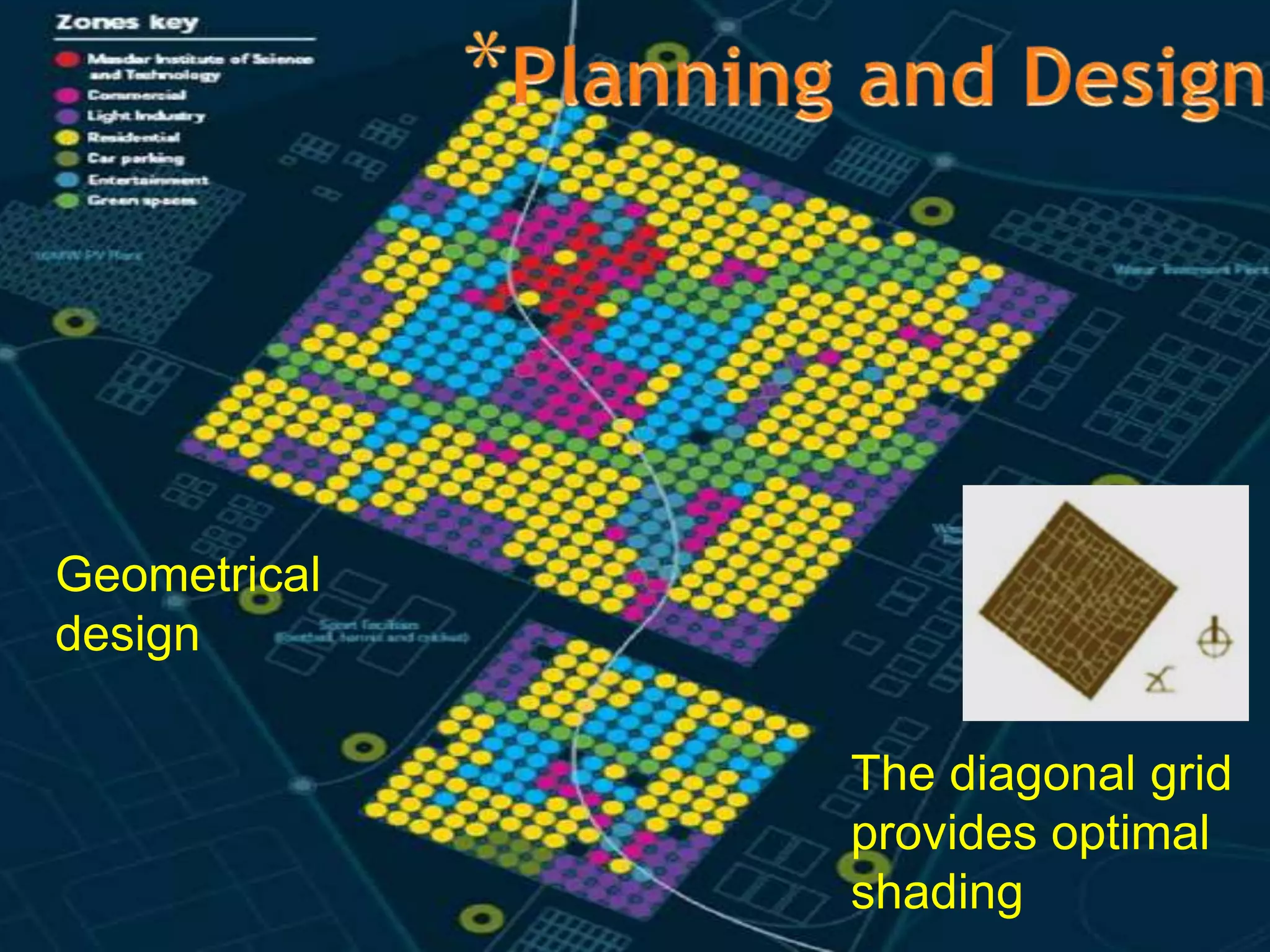
Geometrical
design
The diagonal grid
provides optimal
shading
Global
challenge
• Loss of biodiversity and exploration of natural
resources
Goal &
Strategy
• Create new habitats
Target
• All valuable species been relocated
• Balanced land use
• Consolidated open spaces
• Landscaped of vegetation
*Century before modern era, people design
settlements to moderate desert heat to
obtain both defensive benefits and stronger
winds
*This idea inspired Fosters and Partners to
elevate Masdar above surrounding area
*Rise 23 foot-high concrete base to maximize
its exposure
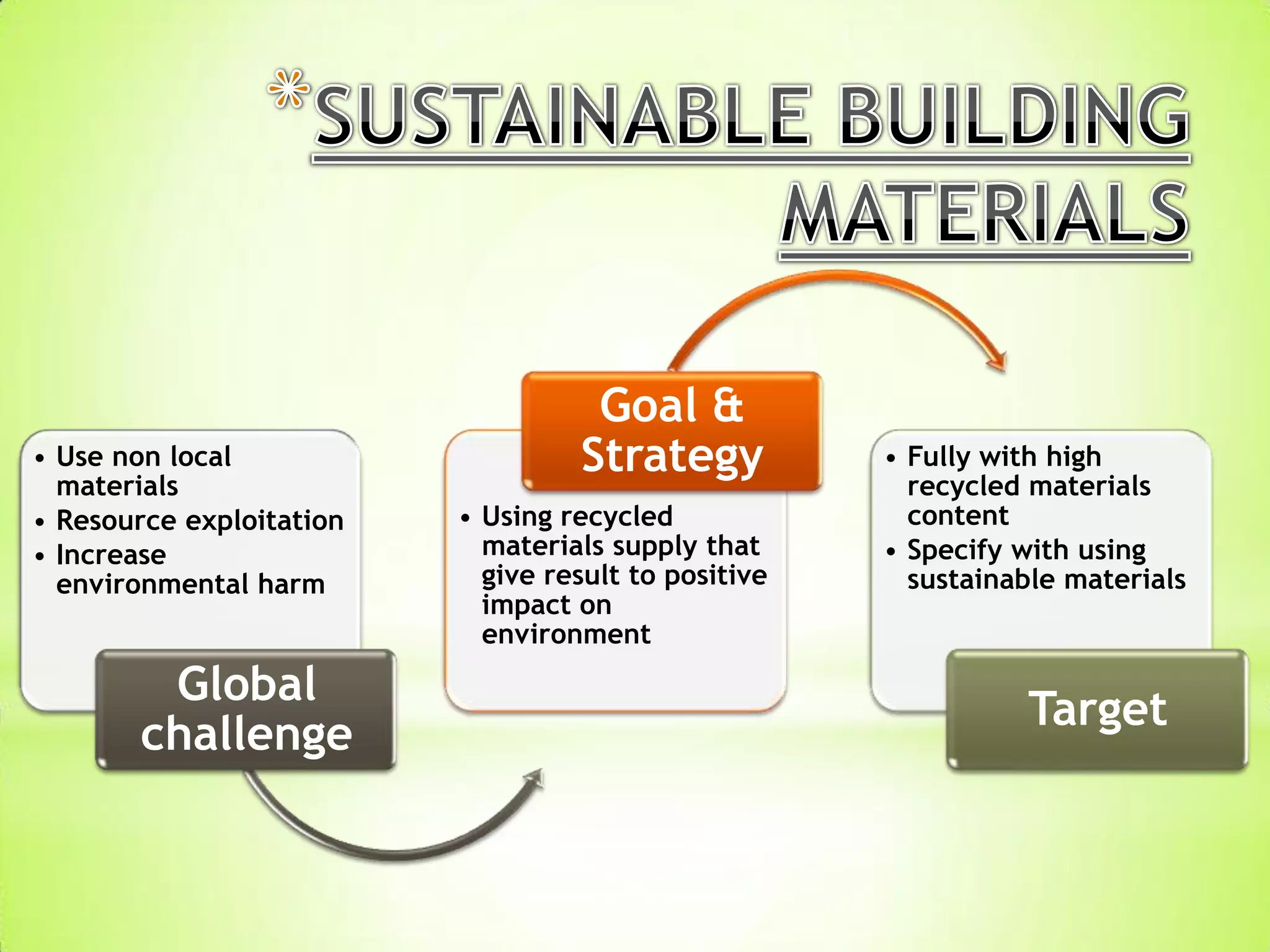
• Use non local
materials
• Resource exploitation
• Increase
environmental harm
Global
challenge
• Using recycled
materials supply that
give result to positive
impact on
environment
Goal &
Strategy • Fully with high
recycled materials
content
• Specify with using
sustainable materials
Target
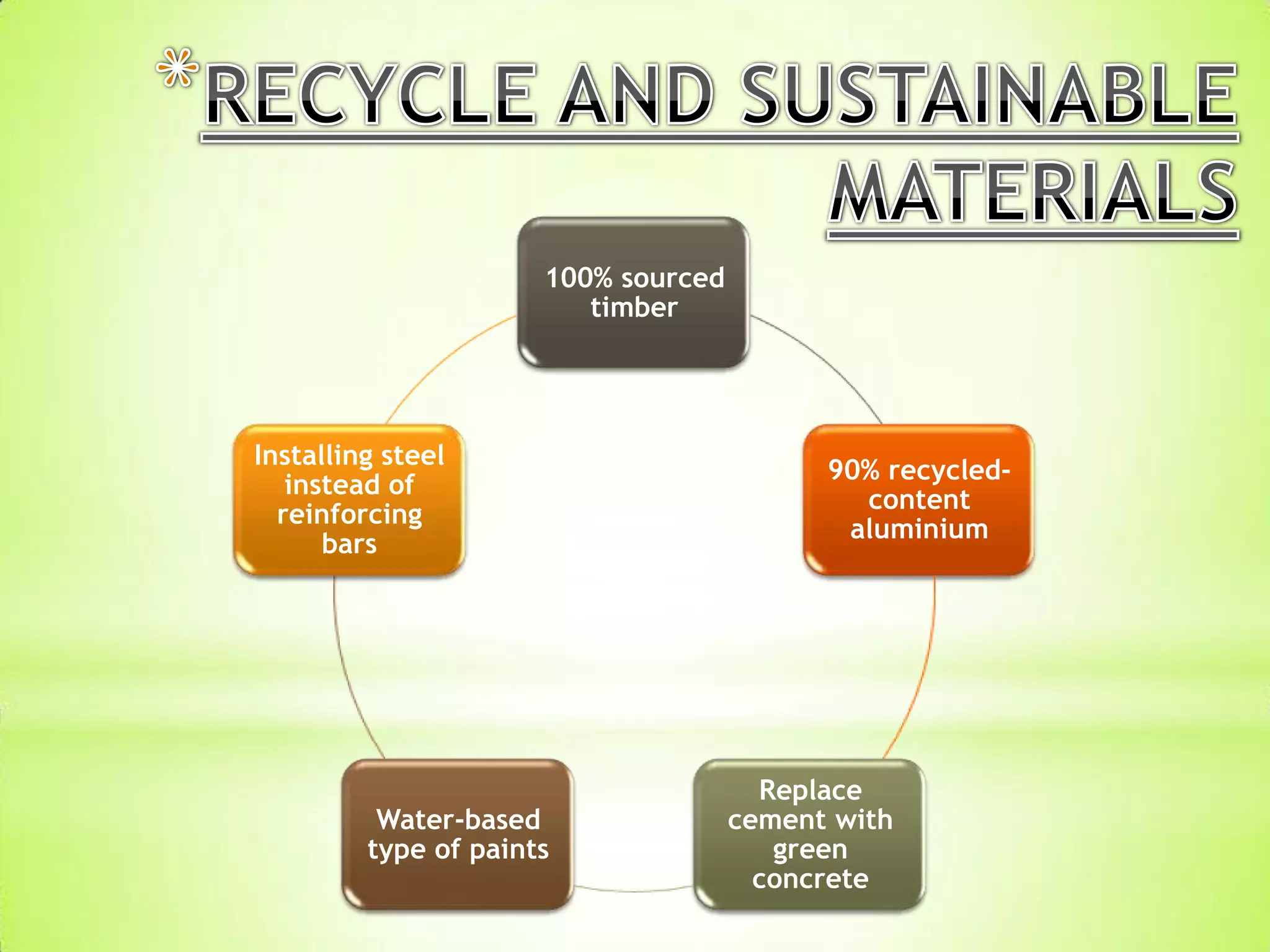
100% sourced
timber
90% recycled-
content
aluminium
Replace
cement with
green
concrete
Water-based
type of paints
Installing steel
instead of
reinforcing
bars
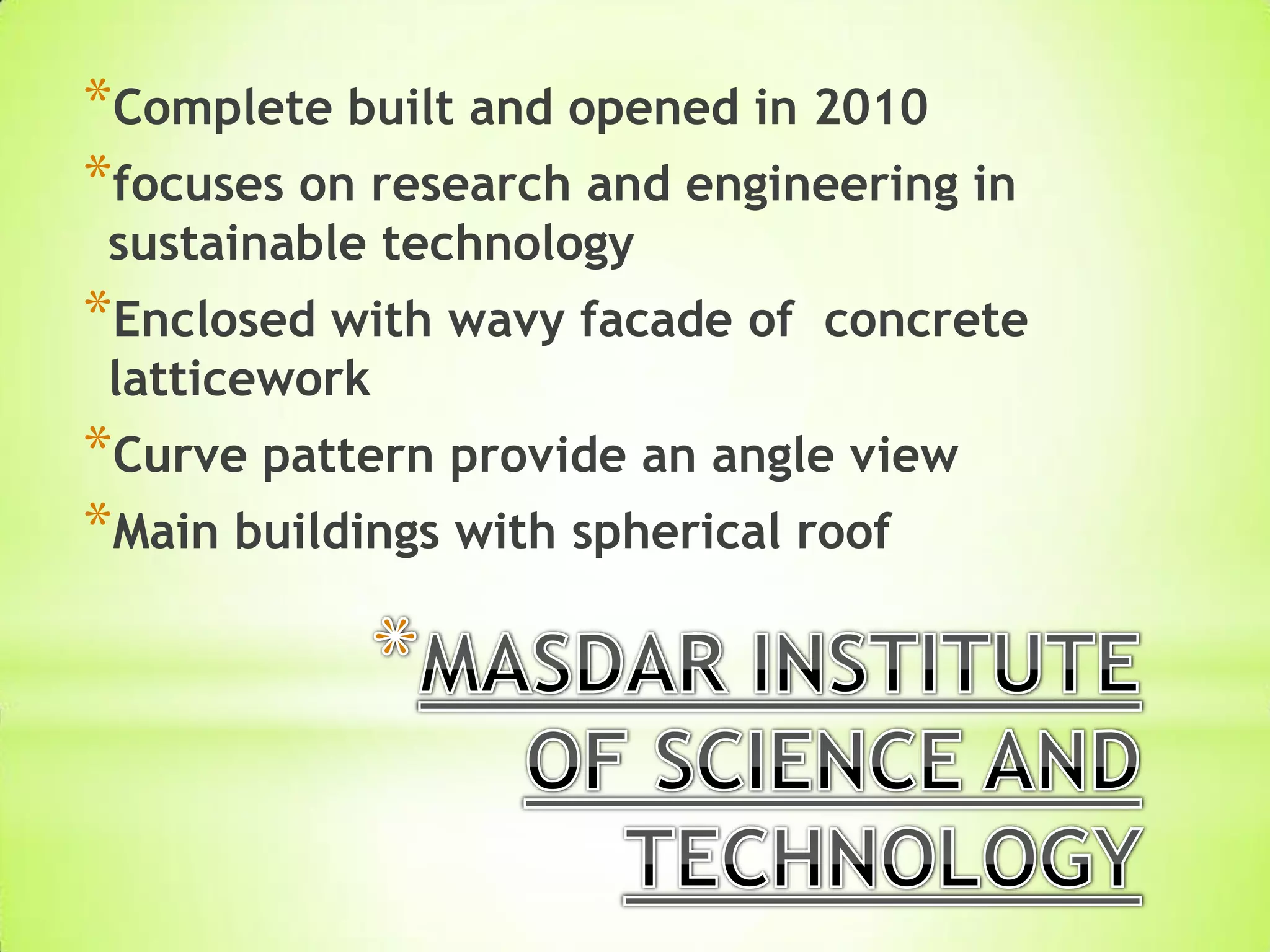
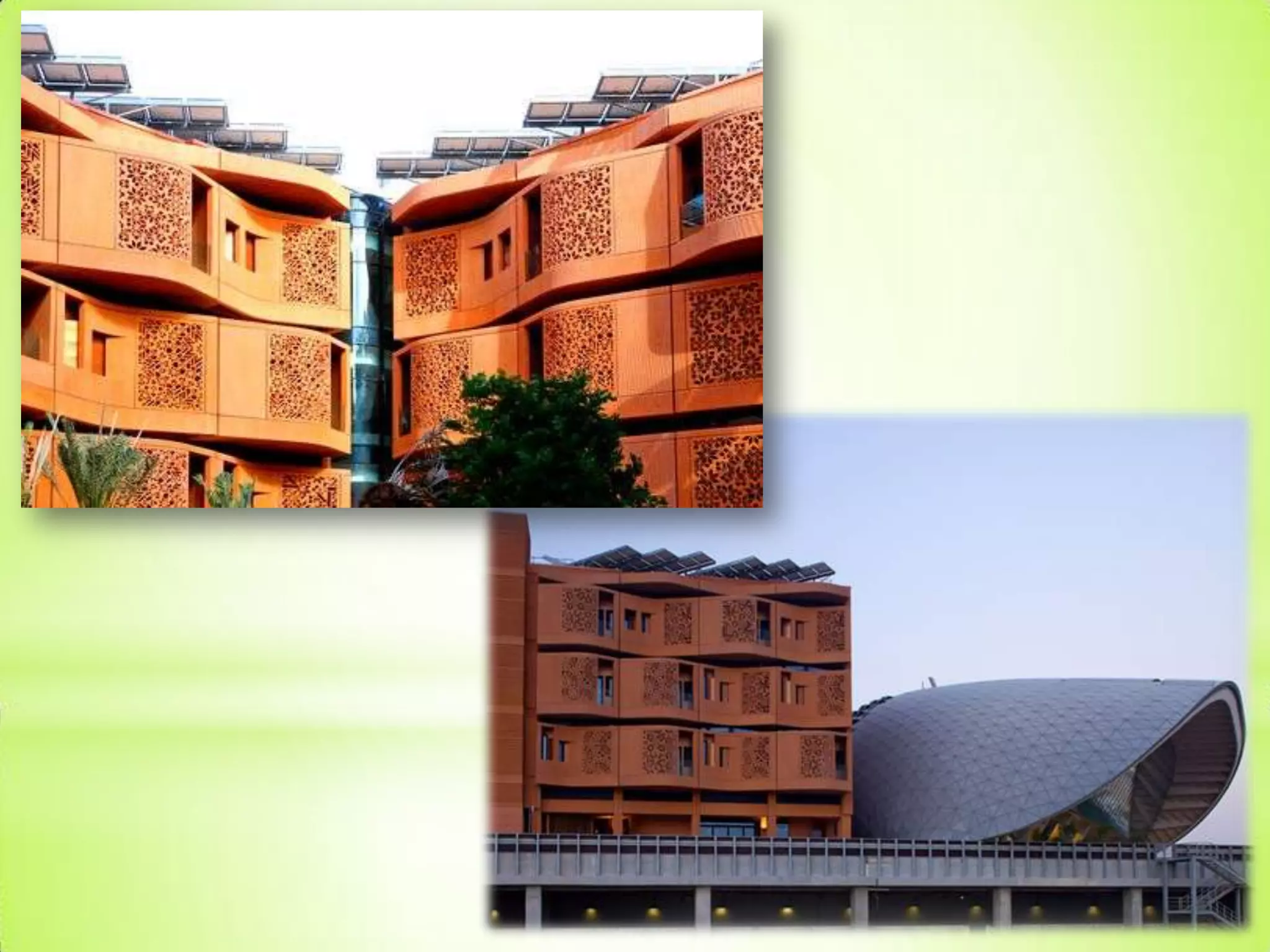
*Complete built and opened in 2010
*focuses on research and engineering in
sustainable technology
*Enclosed with wavy facade of concrete
latticework
*Curve pattern provide an angle view
*Main buildings with spherical roof
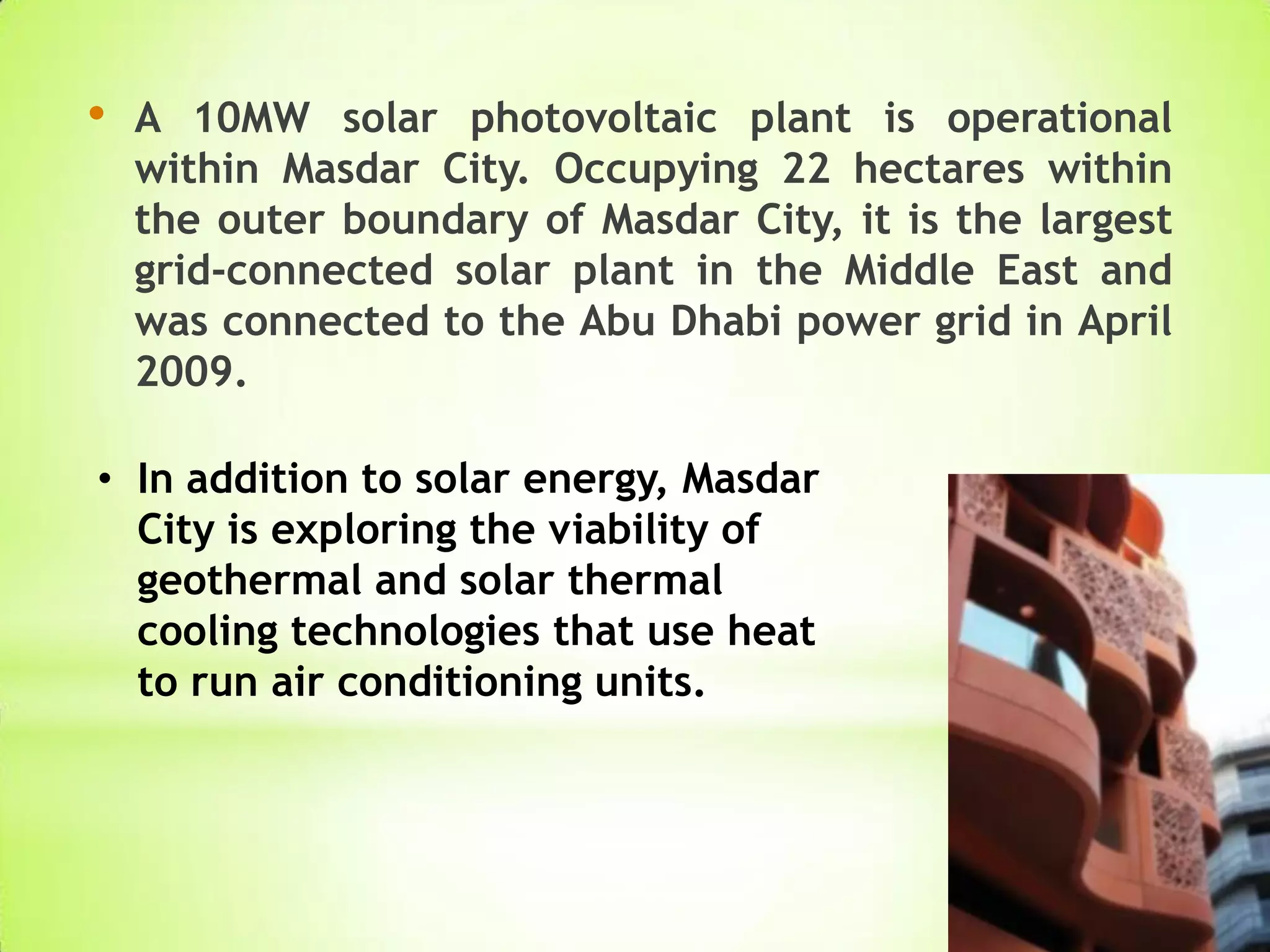
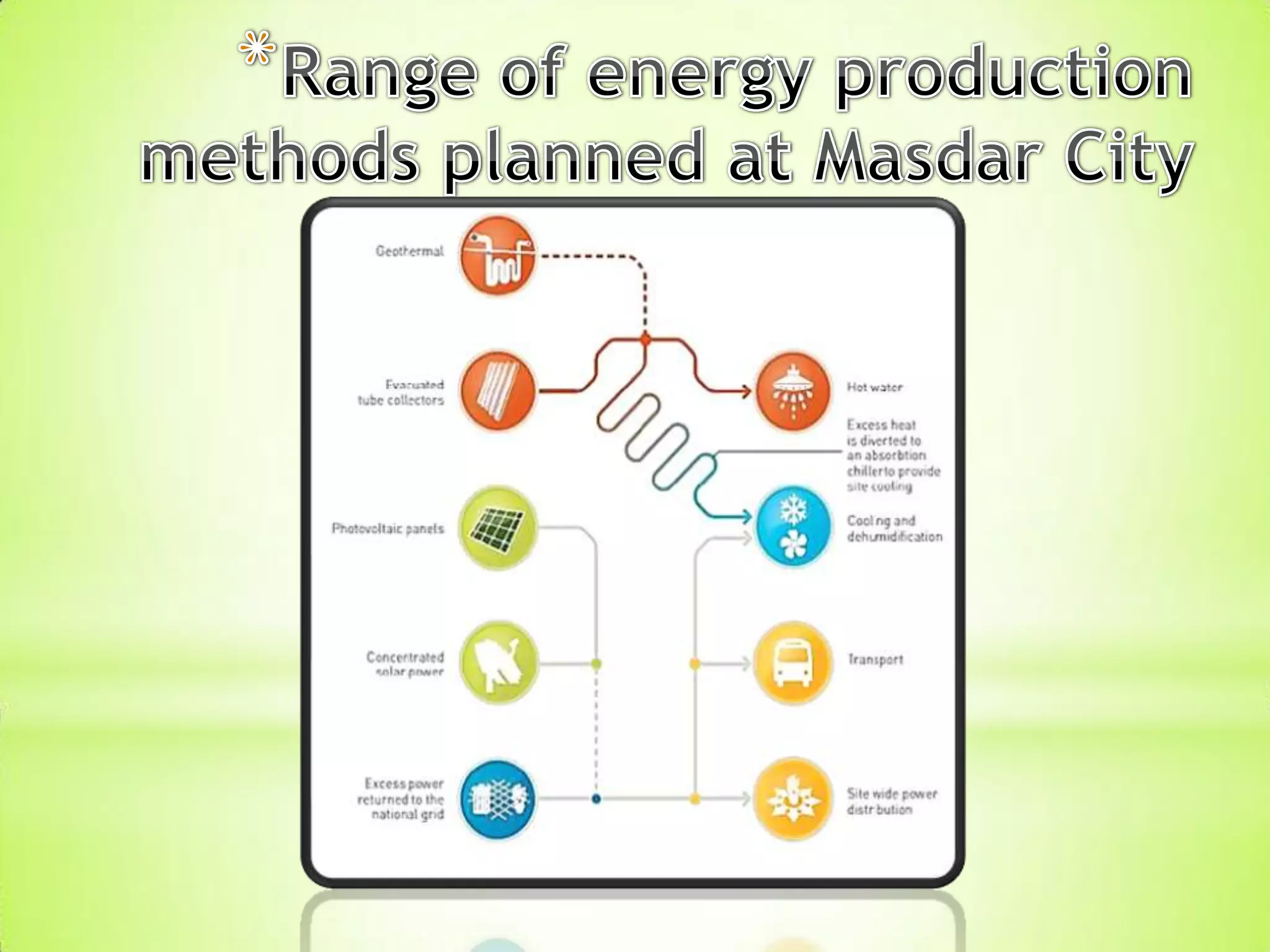
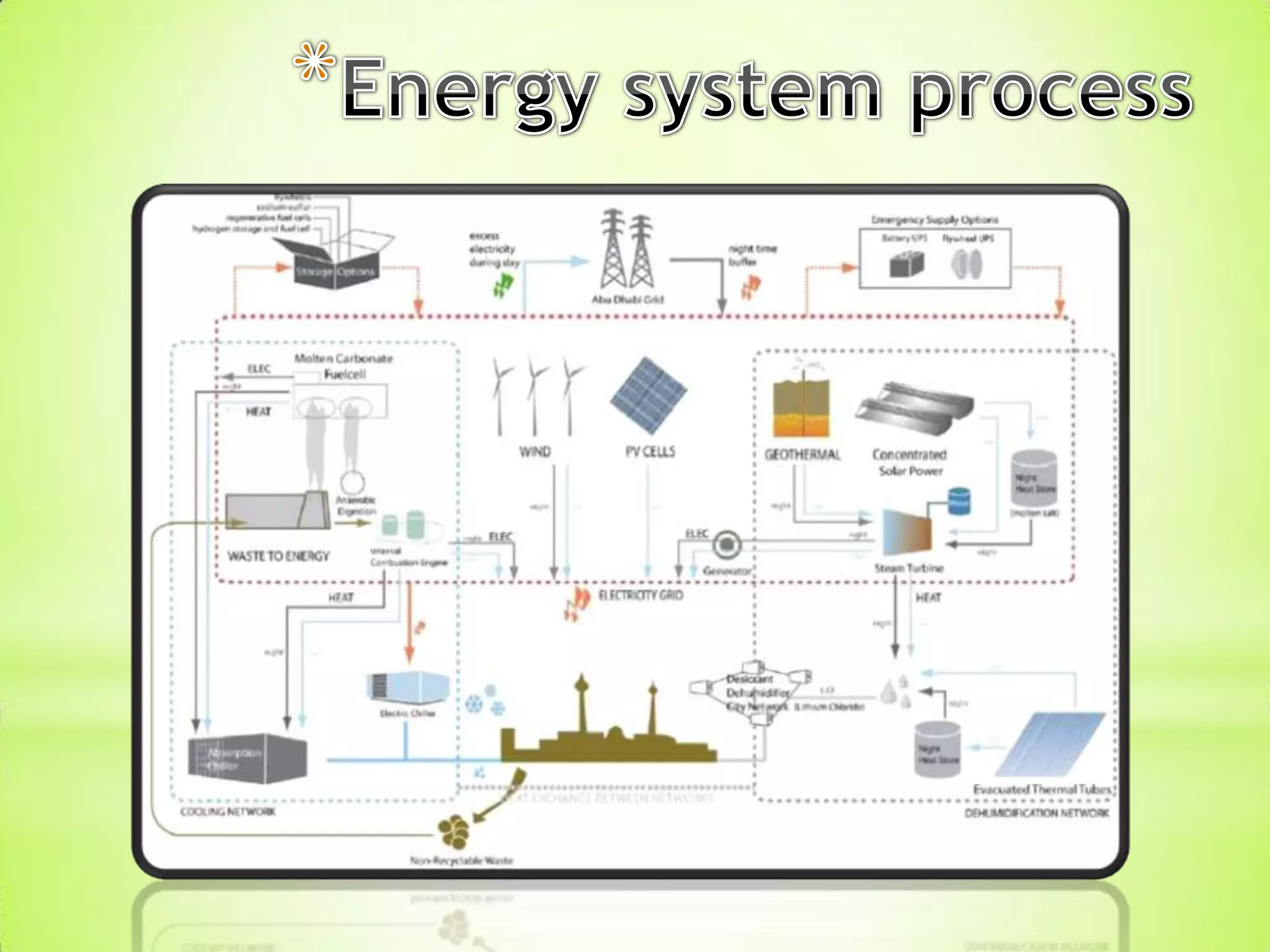
• A 10MW solar photovoltaic plant is operational
within Masdar City. Occupying 22 hectares within
the outer boundary of Masdar City, it is the largest
grid-connected solar plant in the Middle East and
was connected to the Abu Dhabi power grid in April
2009.
• In addition to solar energy, Masdar
City is exploring the viability of
geothermal and solar thermal
cooling technologies that use heat
to run air conditioning units.
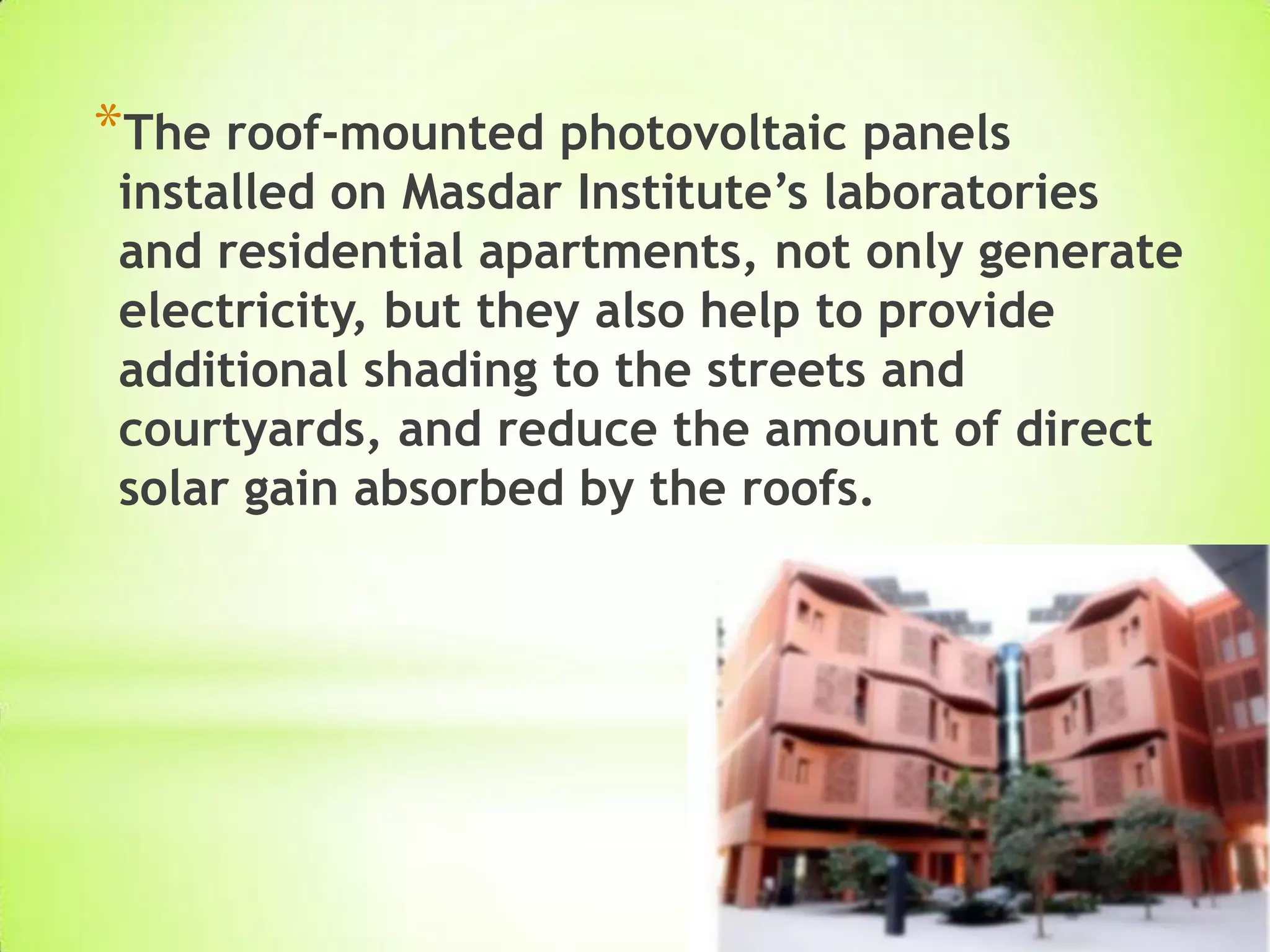
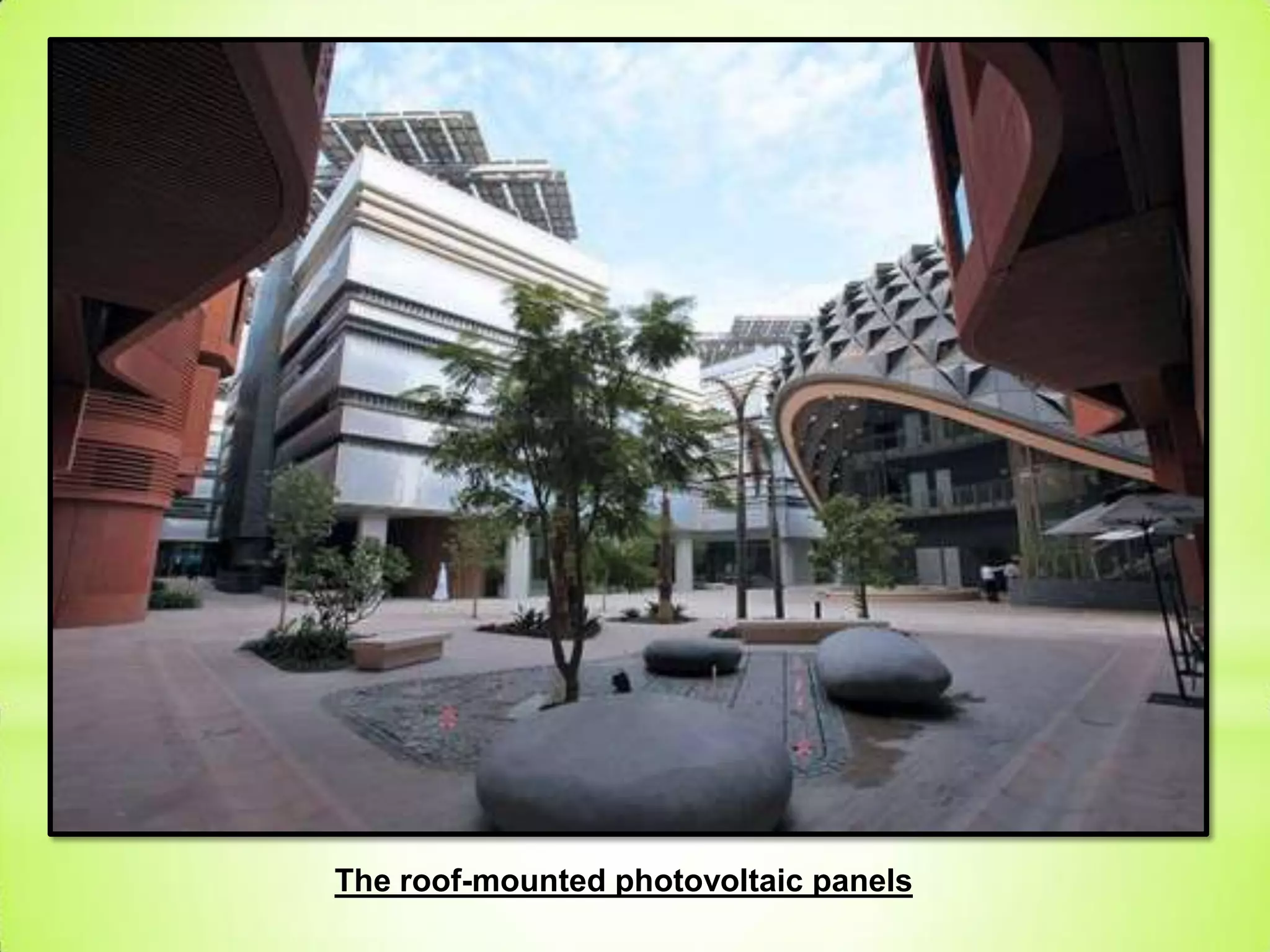
*The roof-mounted photovoltaic panels
installed on Masdar Institute’s laboratories
and residential apartments, not only generate
electricity, but they also help to provide
additional shading to the streets and
courtyards, and reduce the amount of direct
solar gain absorbed by the roofs.
The roof-mounted photovoltaic panels
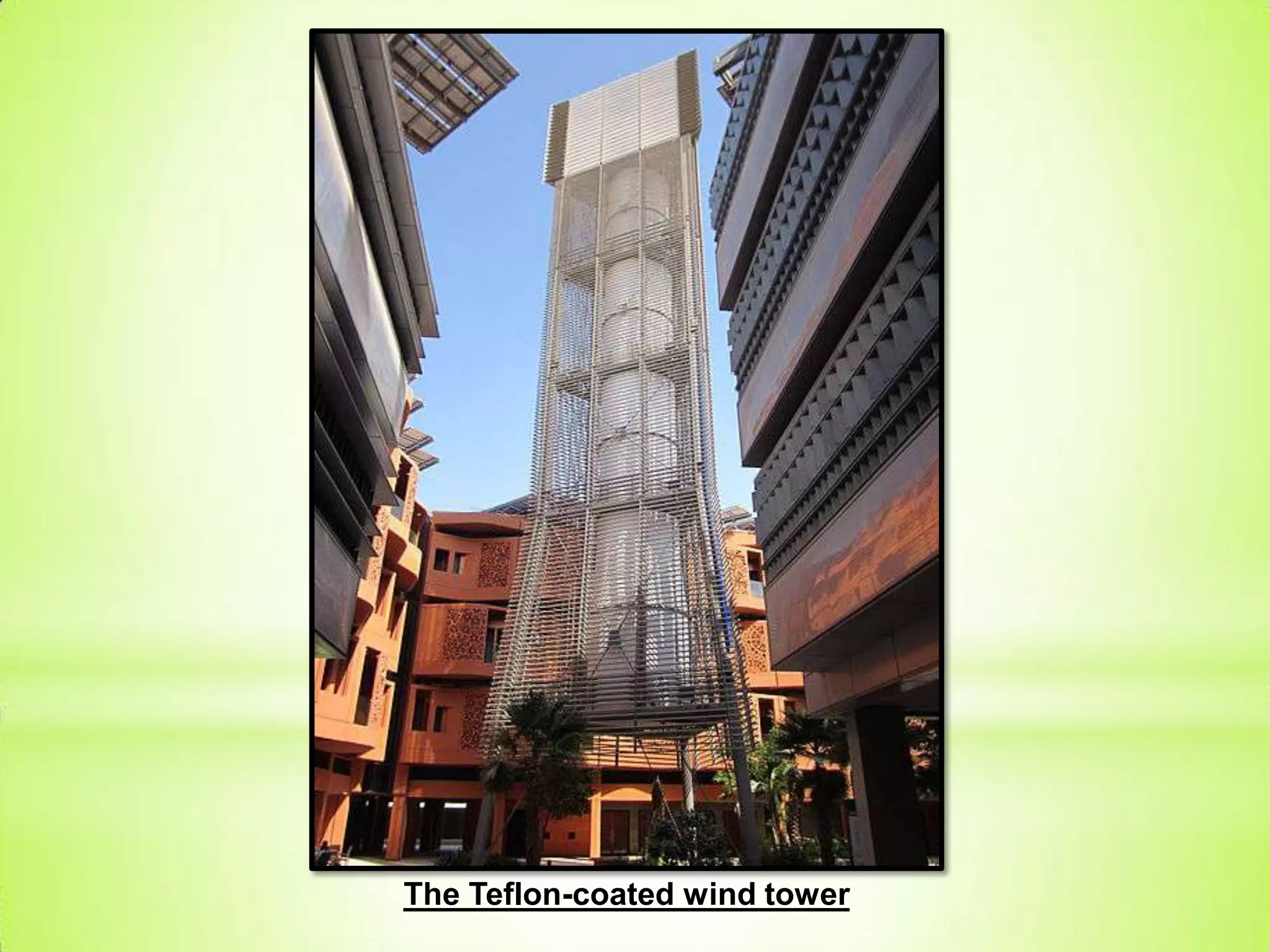
The Teflon-coated wind tower
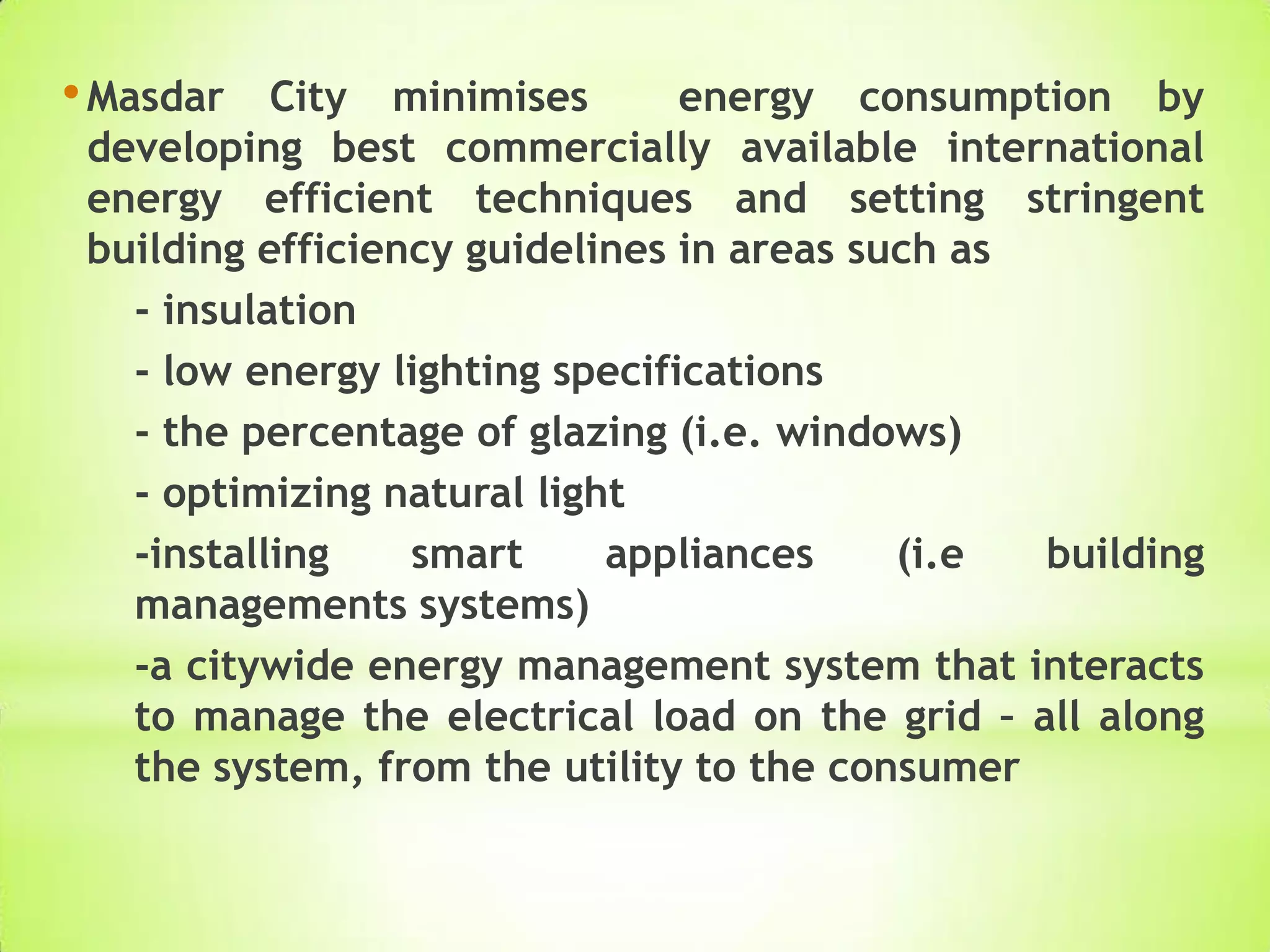
•Masdar City minimises energy consumption by
developing best commercially available international
energy efficient techniques and setting stringent
building efficiency guidelines in areas such as
- insulation
- low energy lighting specifications
- the percentage of glazing (i.e. windows)
- optimizing natural light
-installing smart appliances (i.e building
managements systems)
-a citywide energy management system that interacts
to manage the electrical load on the grid – all along
the system, from the utility to the consumer
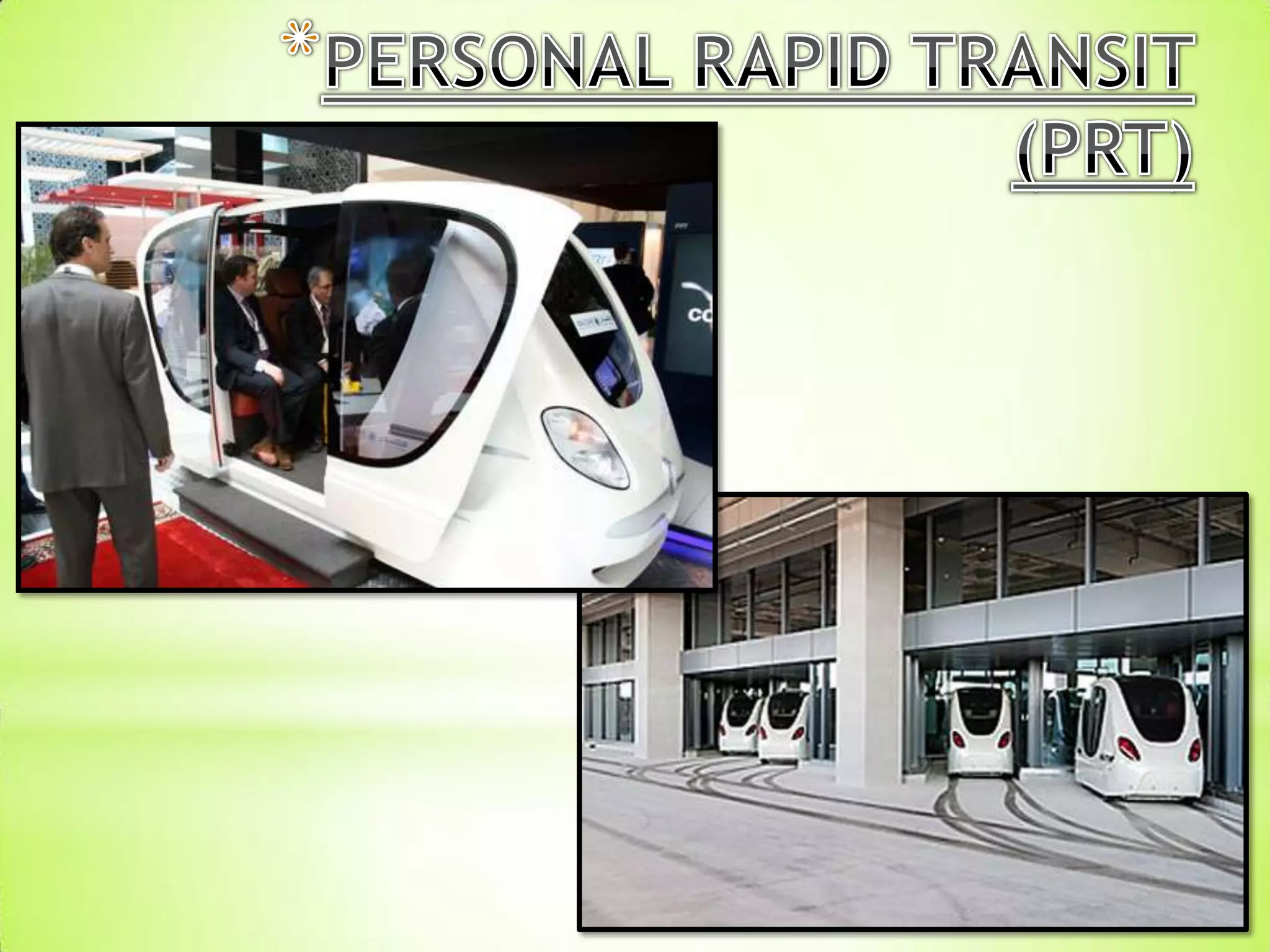
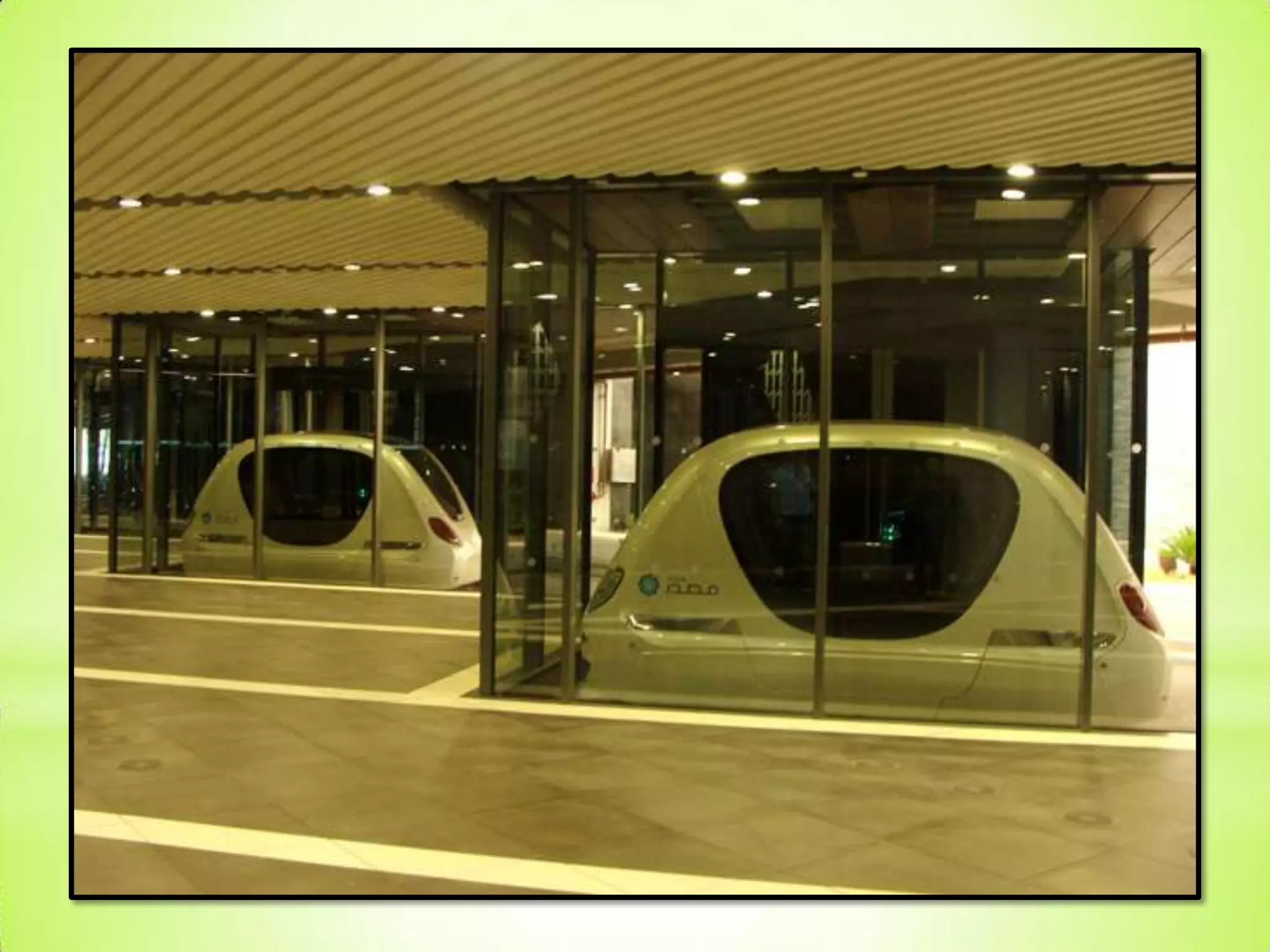
*Personal Rapid Transit (PRT) system of 100%
electric-powered, automated vehicles has been in
operation since 2010 with existing road and
railways connecting to other locations outside the
city.
*PRT vehicles are sized for individual or small
group travel, typically carrying no more than 3 to
6 passengers per vehicle.
*The PRT vehicles will travel at speeds up to
40km/h, with the longest routes in the city taking
around 10 minutes.
*The innovative system reached a milestone of
having served 500,000 passengers in November
2012.
*Description : PRT Network
*Peak capacity : 500 p/ph/pd currently
*Times operation : 24 hrs/d & 7days/week
*Configuration : Network
*Connection : Direct (Non stop)
*Passenger seated/standing : 4 adults + 2
children
*Drive : Electric
*Track length : 1200 meters (one-way)
Transportation network
*The dedicated guide way in the undercroft, an
artificial basement created by raising the
pedestrian level, will also accommodate the
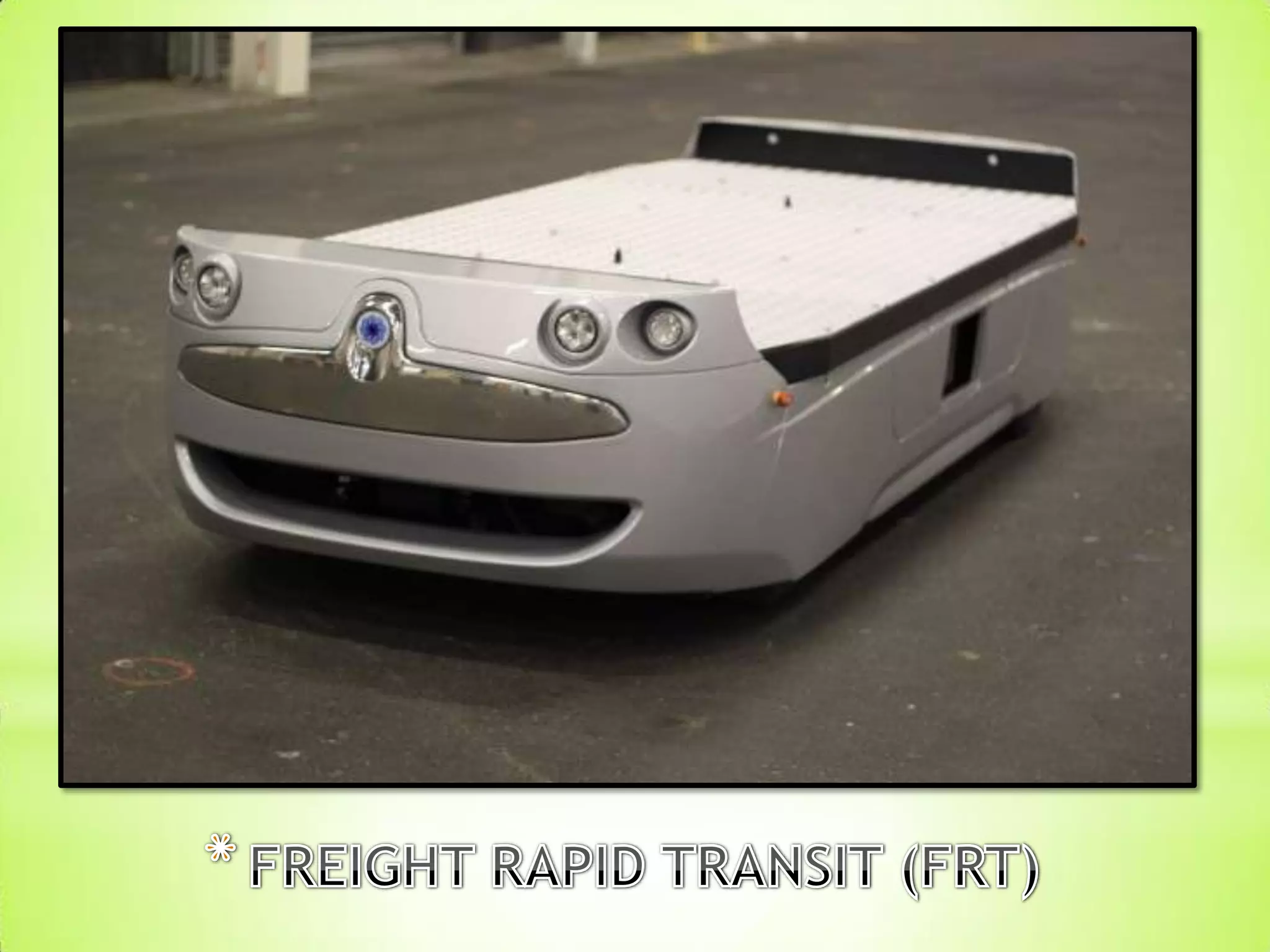
Freight Rapid Transit system (FRT).
*The FRT system is capable of making 5,000 trips
per day carrying the loads and deliveries for
residents, stores and hotels.
*The flatbed vehicles can carry two pallets, with a
maximum total payload of 1,600kg.
*The vehicles will be recharged at the
stations, avoiding the necessity of additional
parking space (garage). The stations feature
angled berths, allowing all vehicles independent
entry and exit.
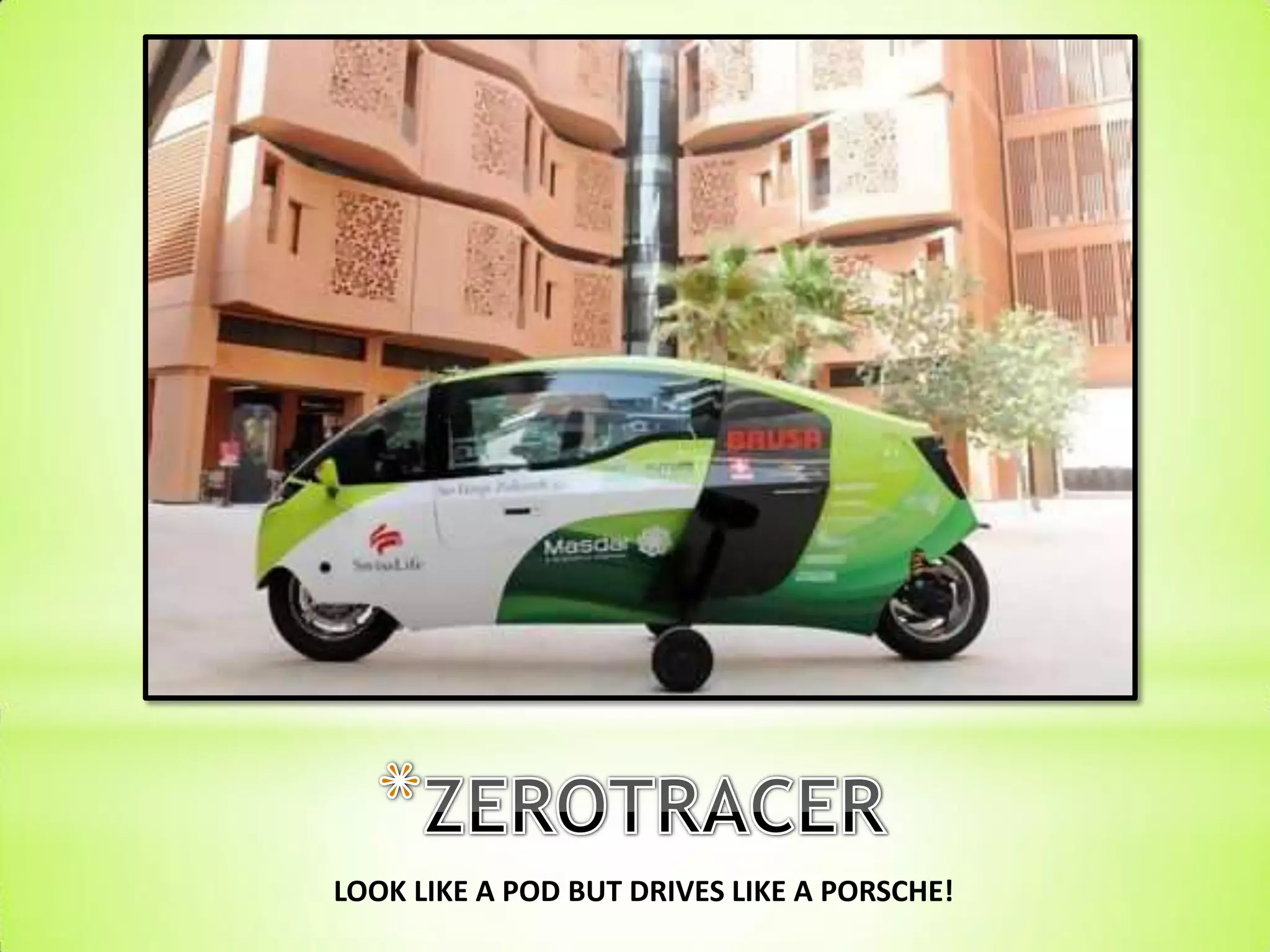
LOOK LIKE A POD BUT DRIVES LIKE A PORSCHE!
•Zerotracer is an electric-powered motorcycle that
can accelerate from zero to 100km/h in 4.5
seconds as fast as a Porsche 911 car.
•Designed by the Swiss engineering company
Designwerk. It has a top speed of 240km/h and
can travel 300km on a single charge.
•The Zerotracer set a record for distance covered
by an electric vehicle in February 2012 by
travelling 30,000km in 80 days as part of the Zero
Emission Race.
•It makes perfect sense to have a zero-emission
electric vehicle at Masdar City, a sustainable
urban development where the electricity is
obtained from solar energy.
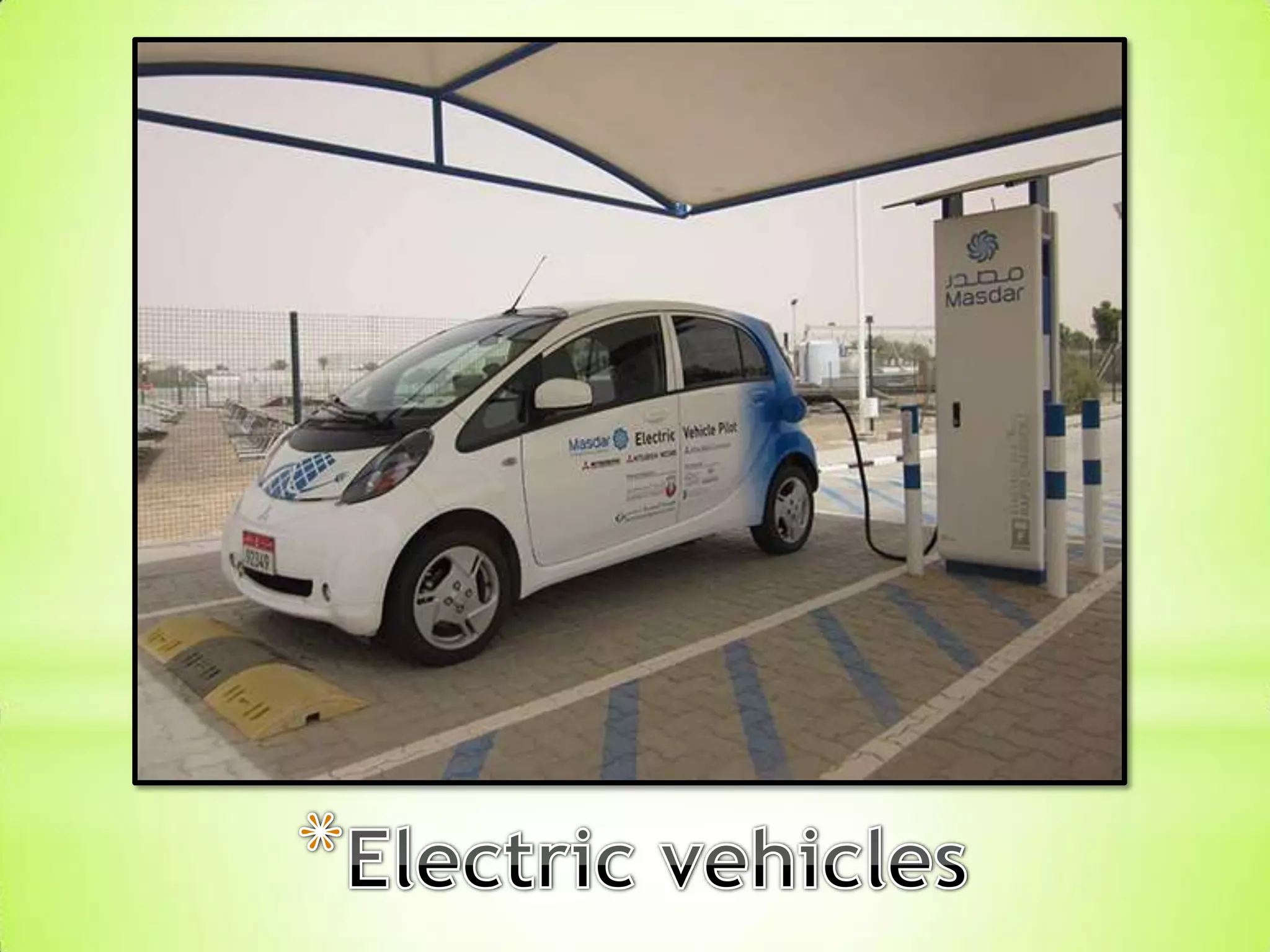
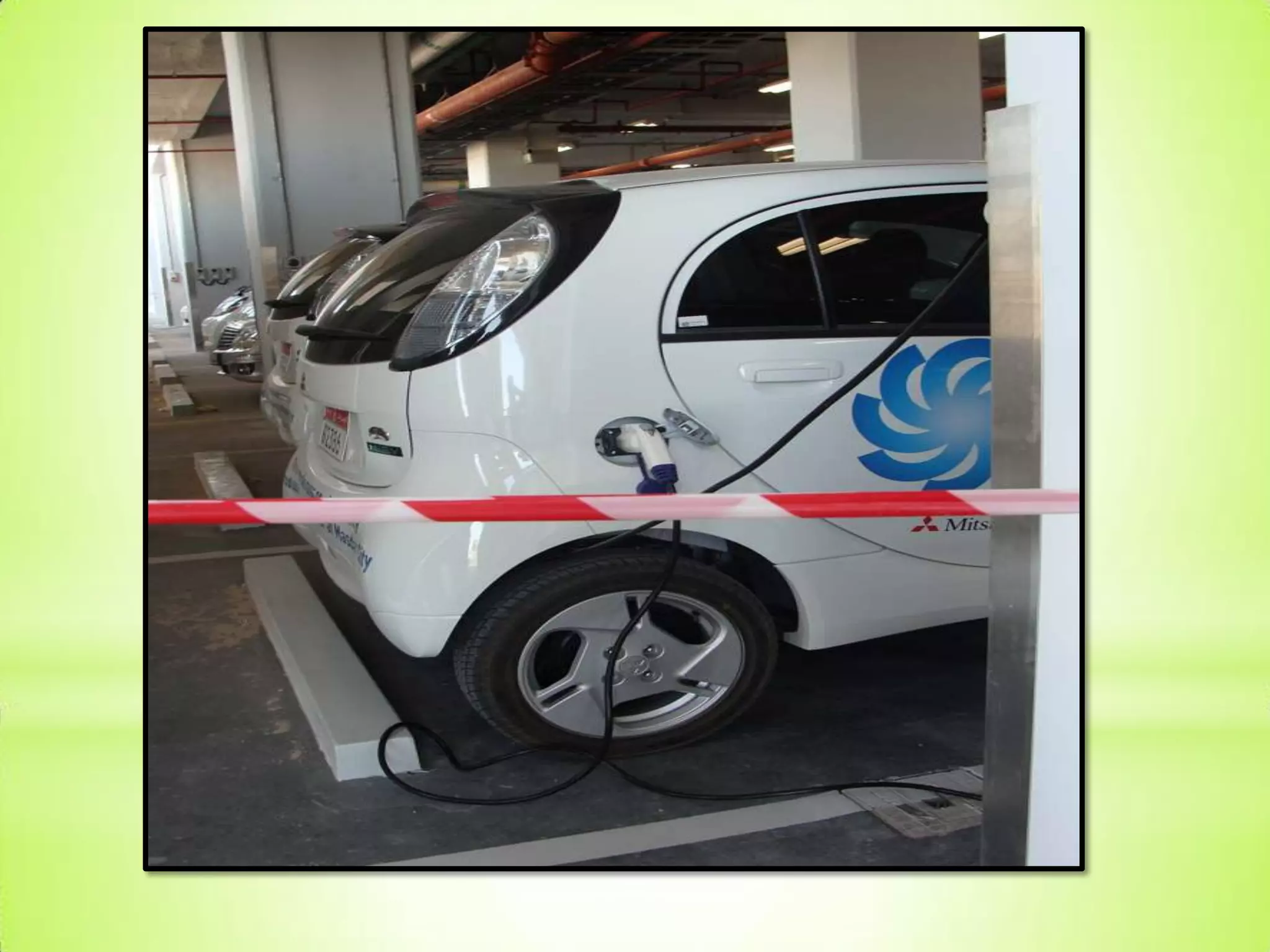
*Masdar City also has initiated an electric car pilot
with Mitsubishi Heavy Industries to test a point-
to-point transportation solution for the city that
uses Mitsubishi Motor’s i-MiEV, five-door
hatchbacks.
*The EV pilot project, launched in January
2011, aims to assess the efficiency of EVs and
rapid charger technology in the region’s climate
conditions.
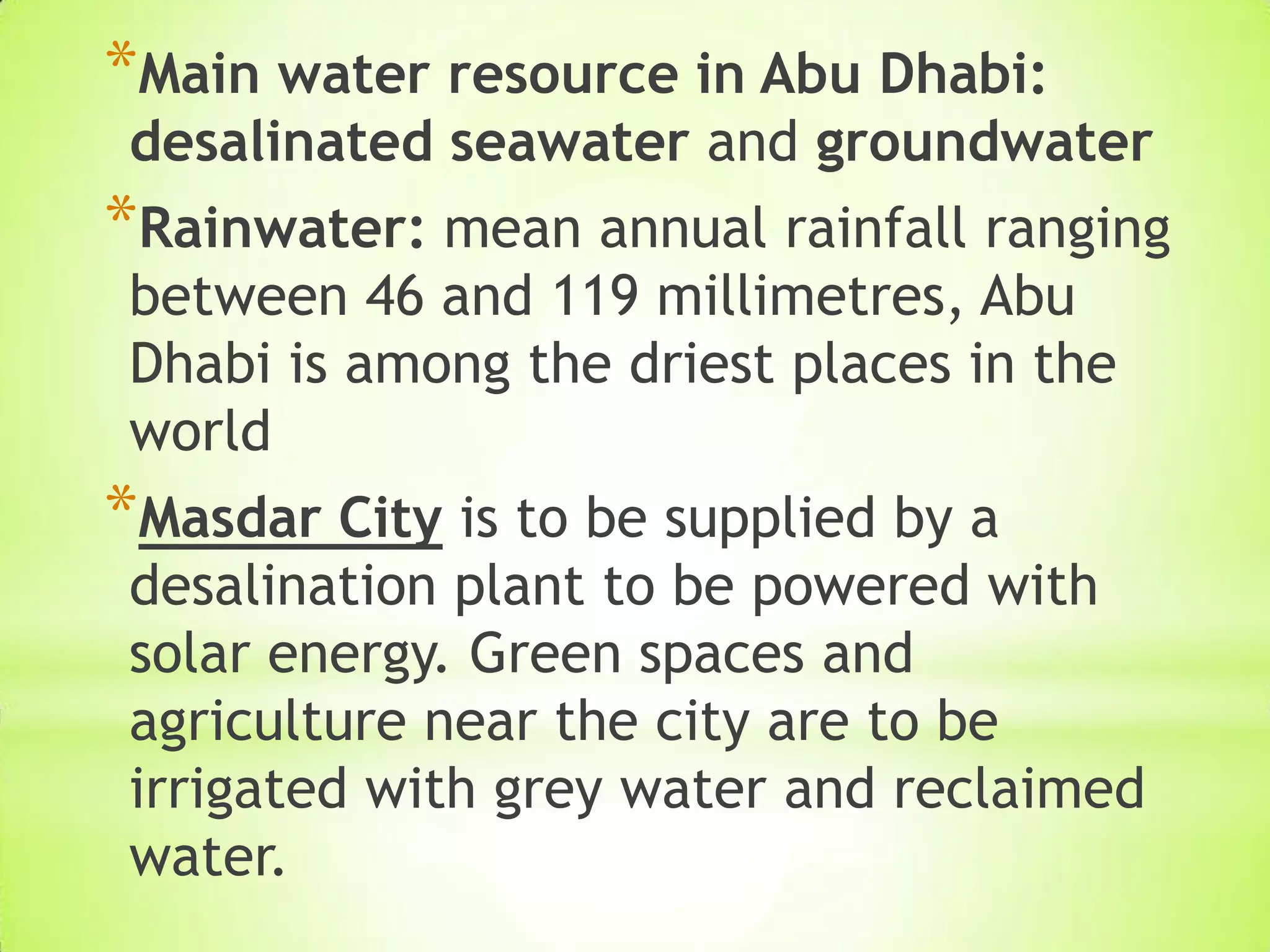
*Main water resource in Abu Dhabi:
desalinated seawater and groundwater
*Rainwater: mean annual rainfall ranging
between 46 and 119 millimetres, Abu
Dhabi is among the driest places in the
world
*Masdar City is to be supplied by a
desalination plant to be powered with
solar energy. Green spaces and
agriculture near the city are to be
irrigated with grey water and reclaimed
water.
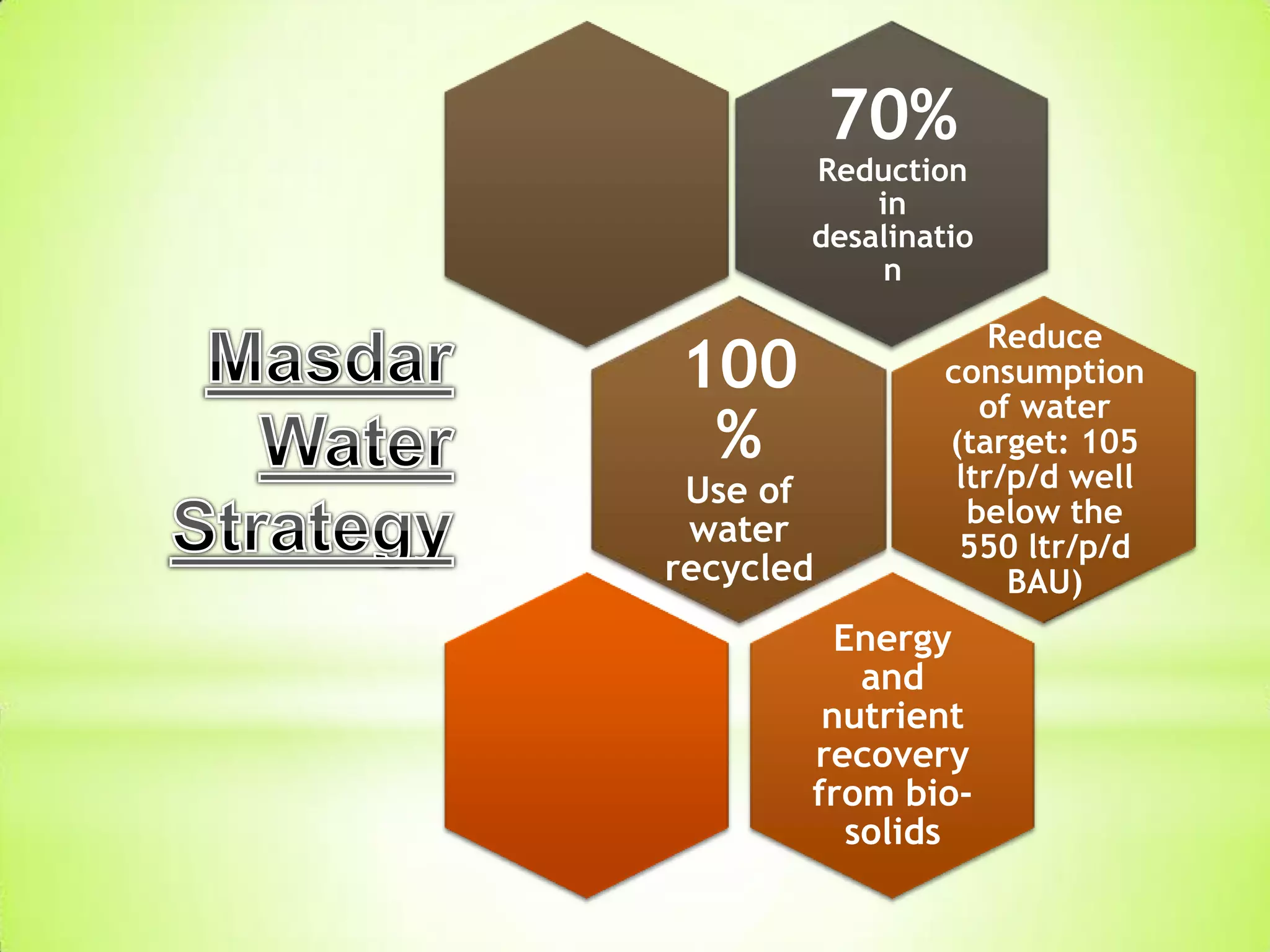
70%
Reduction
in
desalinatio
n
100
%
Use of
water
recycled
Reduce
consumption
of water
(target: 105
ltr/p/d well
below the
550 ltr/p/d
BAU)
Energy
and
nutrient
recovery
from bio-
solids
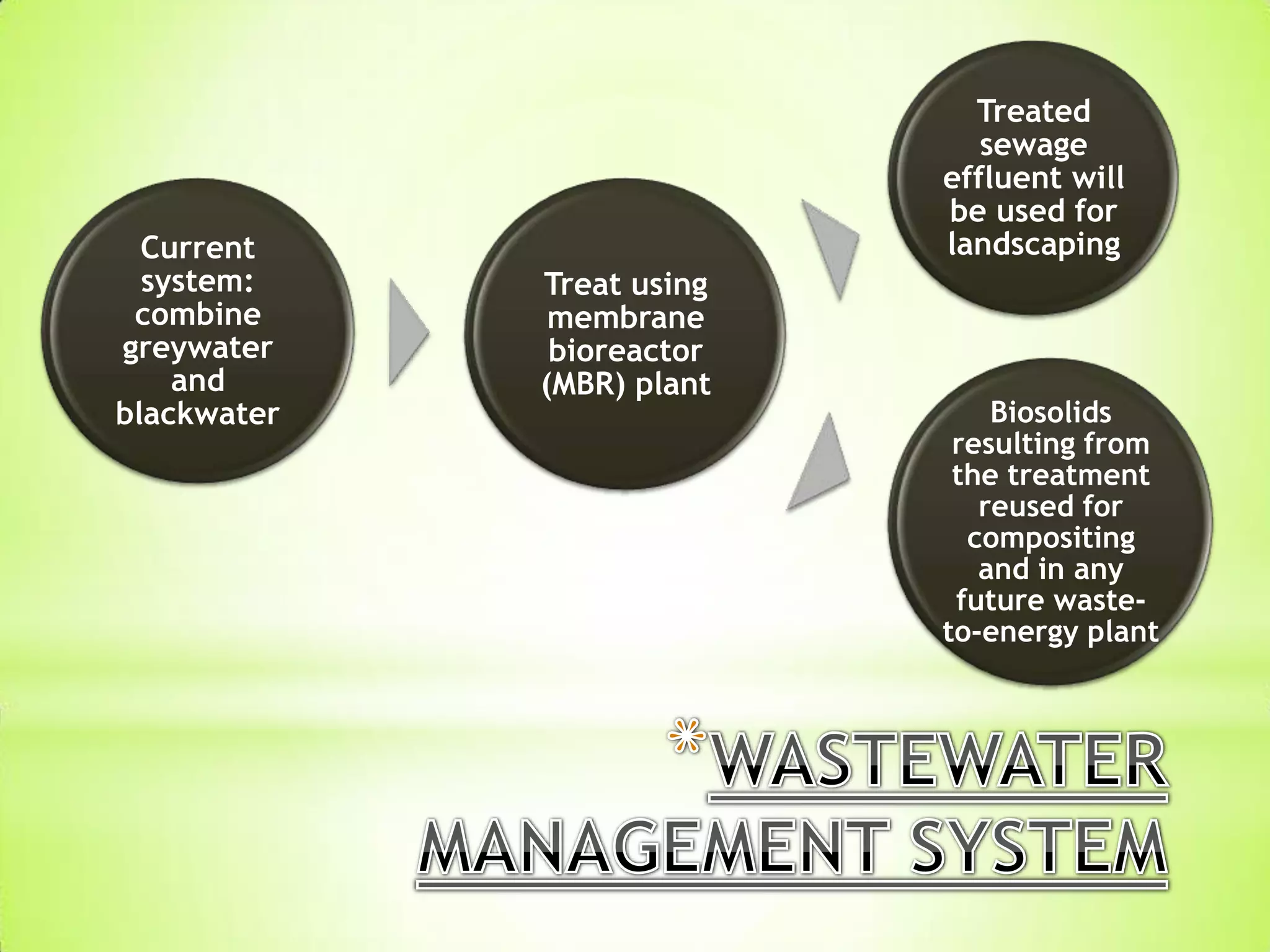
Current
system:
combine
greywater
and
blackwater
Treat using
membrane
bioreactor
(MBR) plant
Treated
sewage
effluent will
be used for
landscaping
Biosolids
resulting from
the treatment
reused for
compositing
and in any
future waste-
to-energy plant
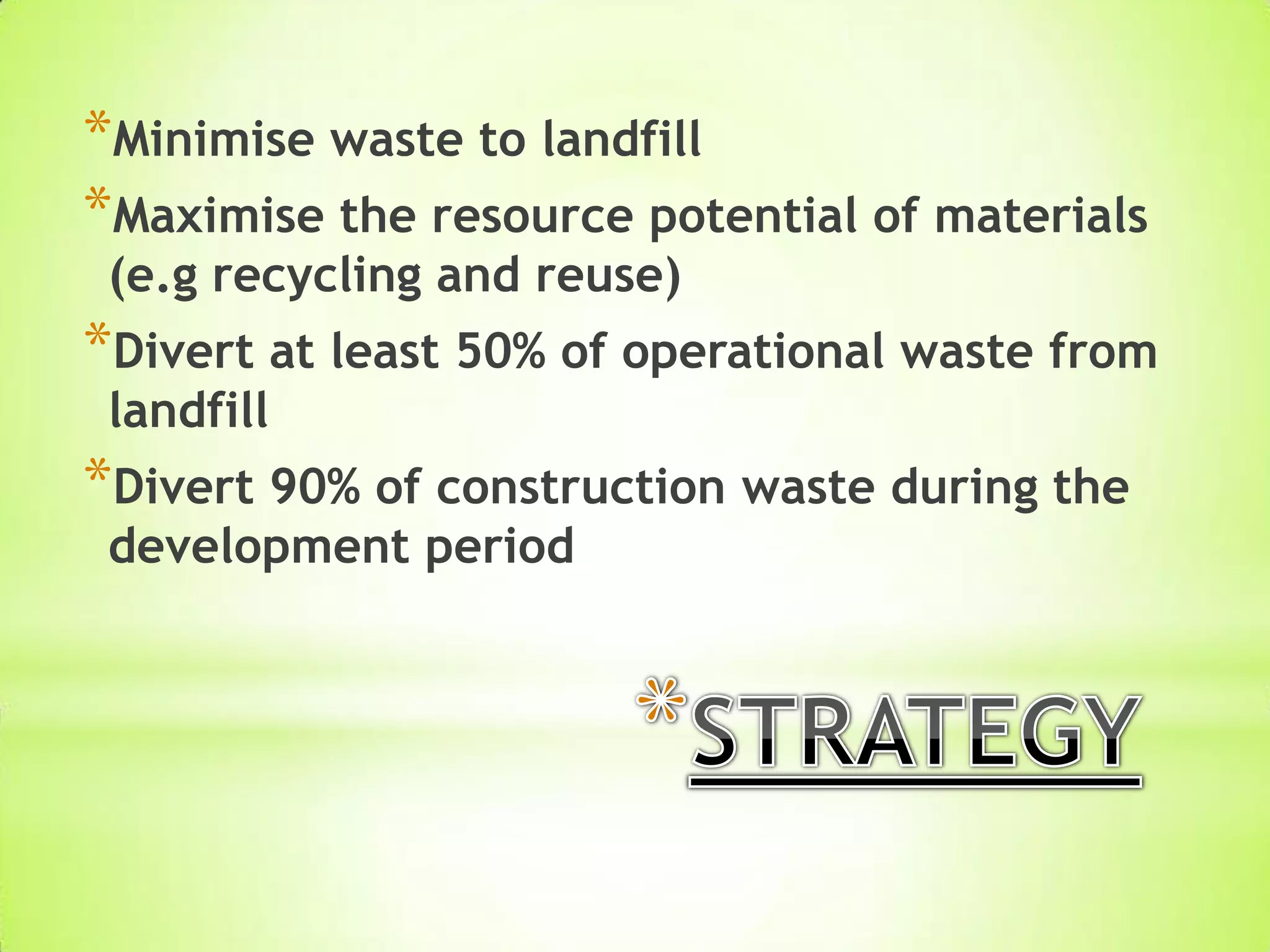
*Minimise waste to landfill
*Maximise the resource potential of materials
(e.g recycling and reuse)
*Divert at least 50% of operational waste from
landfill
*Divert 90% of construction waste during the
development period
*

Task 4 best practices of masdar city

  • 2.
    *Located to thesoutheast of Abu Dhabi Island around 17km from downtown Abu Dhabi *Total site area = 590 hectares *Total populations = 40,000 residents *Land use = Mixed land use (residential, commercial, institutional and lightweight industry)
  • 3.
    *As a modelof urban environmental sustainability *The project established by Masdar construction since 2007 aim to be one of the world’s most sustainable development *Best practice project for sustainable urban planning and development *Prototypical sustainability city
  • 4.
    *Condé Nast TravellerInnovation & Design Award (Sustainability) - Masdar *Best Sustainable Development, Cityscape Abu Dhabi – Masdar *FT ArcelorMittal Boldness in Business Awards - Masdar *Cityscape Abu Dhabi – Sustainable Development Award, Masdar City, Abu Dhabi *AJ100 Sustainability Initiative of the Year 2008 for Masdar City, Abu Dhabi
  • 5.
    *Developed jointly byarchitectural firm Foster & Partners with Abu Dhabi government *Plan to achieve the goal :-  Synergy  Mobility  Energy  Quality of life
  • 6.
  • 7.
    Global challenge • Loss ofbiodiversity and exploration of natural resources Goal & Strategy • Create new habitats Target • All valuable species been relocated • Balanced land use • Consolidated open spaces • Landscaped of vegetation
  • 8.
    *Century before modernera, people design settlements to moderate desert heat to obtain both defensive benefits and stronger winds *This idea inspired Fosters and Partners to elevate Masdar above surrounding area *Rise 23 foot-high concrete base to maximize its exposure
  • 9.
    • Use nonlocal materials • Resource exploitation • Increase environmental harm Global challenge • Using recycled materials supply that give result to positive impact on environment Goal & Strategy • Fully with high recycled materials content • Specify with using sustainable materials Target
  • 10.
    100% sourced timber 90% recycled- content aluminium Replace cementwith green concrete Water-based type of paints Installing steel instead of reinforcing bars
  • 11.
    *Complete built andopened in 2010 *focuses on research and engineering in sustainable technology *Enclosed with wavy facade of concrete latticework *Curve pattern provide an angle view *Main buildings with spherical roof
  • 14.
    • A 10MWsolar photovoltaic plant is operational within Masdar City. Occupying 22 hectares within the outer boundary of Masdar City, it is the largest grid-connected solar plant in the Middle East and was connected to the Abu Dhabi power grid in April 2009. • In addition to solar energy, Masdar City is exploring the viability of geothermal and solar thermal cooling technologies that use heat to run air conditioning units.
  • 15.
    *The roof-mounted photovoltaicpanels installed on Masdar Institute’s laboratories and residential apartments, not only generate electricity, but they also help to provide additional shading to the streets and courtyards, and reduce the amount of direct solar gain absorbed by the roofs.
  • 16.
  • 17.
  • 18.
    •Masdar City minimisesenergy consumption by developing best commercially available international energy efficient techniques and setting stringent building efficiency guidelines in areas such as - insulation - low energy lighting specifications - the percentage of glazing (i.e. windows) - optimizing natural light -installing smart appliances (i.e building managements systems) -a citywide energy management system that interacts to manage the electrical load on the grid – all along the system, from the utility to the consumer
  • 24.
    *Personal Rapid Transit(PRT) system of 100% electric-powered, automated vehicles has been in operation since 2010 with existing road and railways connecting to other locations outside the city. *PRT vehicles are sized for individual or small group travel, typically carrying no more than 3 to 6 passengers per vehicle. *The PRT vehicles will travel at speeds up to 40km/h, with the longest routes in the city taking around 10 minutes. *The innovative system reached a milestone of having served 500,000 passengers in November 2012.
  • 25.
    *Description : PRTNetwork *Peak capacity : 500 p/ph/pd currently *Times operation : 24 hrs/d & 7days/week *Configuration : Network *Connection : Direct (Non stop) *Passenger seated/standing : 4 adults + 2 children *Drive : Electric *Track length : 1200 meters (one-way)
  • 26.
  • 28.
    *The dedicated guideway in the undercroft, an artificial basement created by raising the pedestrian level, will also accommodate the Freight Rapid Transit system (FRT). *The FRT system is capable of making 5,000 trips per day carrying the loads and deliveries for residents, stores and hotels. *The flatbed vehicles can carry two pallets, with a maximum total payload of 1,600kg. *The vehicles will be recharged at the stations, avoiding the necessity of additional parking space (garage). The stations feature angled berths, allowing all vehicles independent entry and exit.
  • 29.
    LOOK LIKE APOD BUT DRIVES LIKE A PORSCHE!
  • 30.
    •Zerotracer is anelectric-powered motorcycle that can accelerate from zero to 100km/h in 4.5 seconds as fast as a Porsche 911 car. •Designed by the Swiss engineering company Designwerk. It has a top speed of 240km/h and can travel 300km on a single charge. •The Zerotracer set a record for distance covered by an electric vehicle in February 2012 by travelling 30,000km in 80 days as part of the Zero Emission Race. •It makes perfect sense to have a zero-emission electric vehicle at Masdar City, a sustainable urban development where the electricity is obtained from solar energy.
  • 33.
    *Masdar City alsohas initiated an electric car pilot with Mitsubishi Heavy Industries to test a point- to-point transportation solution for the city that uses Mitsubishi Motor’s i-MiEV, five-door hatchbacks. *The EV pilot project, launched in January 2011, aims to assess the efficiency of EVs and rapid charger technology in the region’s climate conditions.
  • 35.
    *Main water resourcein Abu Dhabi: desalinated seawater and groundwater *Rainwater: mean annual rainfall ranging between 46 and 119 millimetres, Abu Dhabi is among the driest places in the world *Masdar City is to be supplied by a desalination plant to be powered with solar energy. Green spaces and agriculture near the city are to be irrigated with grey water and reclaimed water.
  • 36.
    70% Reduction in desalinatio n 100 % Use of water recycled Reduce consumption of water (target:105 ltr/p/d well below the 550 ltr/p/d BAU) Energy and nutrient recovery from bio- solids
  • 38.
    Current system: combine greywater and blackwater Treat using membrane bioreactor (MBR) plant Treated sewage effluentwill be used for landscaping Biosolids resulting from the treatment reused for compositing and in any future waste- to-energy plant
  • 40.
    *Minimise waste tolandfill *Maximise the resource potential of materials (e.g recycling and reuse) *Divert at least 50% of operational waste from landfill *Divert 90% of construction waste during the development period
  • 42.