TIME’S ARROW
by
Martin Amis (1991)
A STUDY GUIDE

1
CONTENTS
Page 3 – Essay Task and Assessment Objectives
Page 5 – Critical overview of Time’s Arrow
Page 8 – Life and Contexts
Page 15 – Critical Essays: Overview: From Other People to Time's Arrow
Page 16 - Extract on Amis and Postmodernism
Page 19 - Extract on Amis’s Linguistic Inventiveness
Page 21 - Extract on Author, Reader, Narrator, Narration
Page 22 – Extract on Genre
Page 23 - Tracing Time’s Arrow
Page 28 - Extract from The Representation of Memory in Time's Arrow
Page 31 - Extract from Martin Amis, Time’s Arrow and the Postmodern Sublime
Page 36 - Extract From Martin Amis's Money and Time's Arrow
Page 39 – Reviews of Time’s Arrow from 1991
Page 43 – Interviews
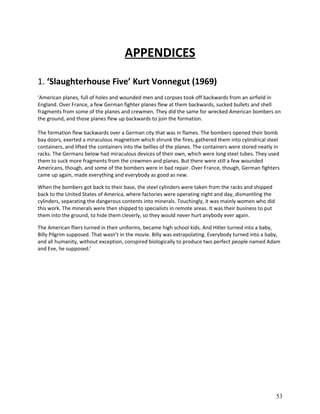
Page 53 – Appendix 1 – Extract from ‘Slaughterhouse 5’
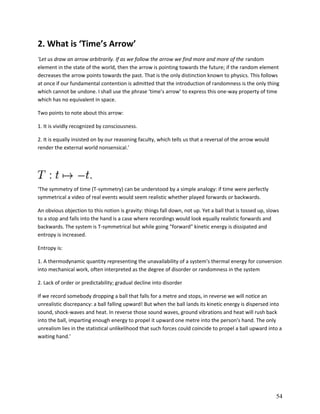
Page 54 – Appendix 2 – What is Time’s Arrow
Page 55 onwards – additional articles

Bibliography:
Amis, M (2001) Experience Vintage London
Brown, A (last accessed November 21 2013) The Representation of Memory in Time’s Arrow and
Shame (http://www.thepequod.org.uk/essays/litcrit/memory.htm)
Diedrick, J (2004 2nd Ed.) Understanding Martin Amis University of South Carolina Press
Finney, B (2008) Martin Amis: Routledge Guides to Literature Routledge Oxford
Finney, B (last accessed November 21st 2013) Martin Amis, Time’s Arrow and the Postmodern Sublime
(http://www.csulb.edu/~bhfinney/amistimesarrow.html)
Reynolds, M & Noakes, J (2003) Martin Amis: the Essential Guide Vintage Living Texts Vintage London
Self, W (Spring 1993) An Interview with Martin Amis Mississippi Review, Vol 21, No 3, New British Fiction
pp 143-169 University of Southern Mississippi

2
Task 2: An essay on linked texts (2000 words)
Compare and contrast the use of different
narrative techniques in Martin Amis' 'Time's
Arrow' (1991) and Laurent Binet's 'HHhH'
(2012).
You will submit an essay considering two texts exploring contrasts and comparisons between
them, informed by interpretations of other readers. The term ‘other readers’ is defined as:
1. reference to recognised critics;
2. different theatrical interpretations of drama where candidates discuss different
directors’ presentations or different actors’ portrayals;
3. exploring a text in relation to, for example, Aristotelian or other concepts of tragedy;
4. developing a theoretical approach to the study of their texts (feminism or Marxism, for
example);
5. different interpretations of texts produced through rewriting or television/film
adaptations.

Your Task 2 coursework will be marked out of 25 based on three Assessment Objectives divided
specifically into the listed bullet-points:
AO1: articulate creative, informed and relevant responses to literary texts, using appropriate
terminology and concepts, and coherent, accurate written expression. (5 marks)
•

excellent and consistently detailed understanding of at least two text(s) and task
undertaken;

•

consistently fluent and accurate writing in appropriate register;

•

critical terminology accurately and confidently used;

3
•

well-structured, coherent and detailed argument consistently developed throughout the
answer.

AO3: explore connections and comparisons between different literary texts, informed by
interpretations of other readers. (10 marks)
•

excellent and consistently detailed effective comparison of relationships between texts;

•

well-informed and effective exploration of different readings of texts.

AO4: demonstrate understanding of the significance and influence of the contexts in which
literary texts are written and received. (10 marks)
•

consistently well-developed and consistently detailed well-informed understanding of
the significance and influence of contexts in which literary texts are written and
understood, as appropriate to the task undertaken.

4
Time's Arrow, Or, The Nature of the Offense
(1991)
Finney, B (2008) Martin Amis: Routledge Guides to Literature Routledge Oxford
Amis thought of calling London Fields, his novel depicting a world on the brink of planetary death,
"Time's Arrow," as "MA" says in the Note at the beginning. Time's arrow points towards death (LF 432).
Amis sees himself as representative of growing up in the post-World War II world, a world that is
radically different from its pre-war status. He sees the origins of modernity's self-destructive momentum
in the Holocaust, the Soviet gulags and the explosion of the first atomic bomb. Amis considers the
Holocaust to be "the central event of the twentieth century" (Bellante and Bellante 1992: 16) (see Life
and Contexts, p. 19). His attitude to modernity is ambivalent, both ameliorative and pessimistic, and in
Time's Arrow this double vision finds narrative expression in the two incarnations through which its
protagonist/narrator lives his life (see Criticism, pp. 102-3). Prompted to write this short novel by
reading Robert Jay Lifton's The Nazi Doctors (see Life and Contexts, p. 22), Amis, aware of the delicacy
of writing about the Holocaust as an Aryan, reached for "documentation and technique" (WAC 13) (see
Criticism, p. 97). One technique he employs in this novel is that of temporal reversal. In the Afterword,
he acknowledges that he was indebted to the passage in Kurt Vonnegut's Slaughterhouse Five (1969)
where Billy Pilgrim watches backwards a film of the bombing of Dresden. Amis first tried out this
technique of narrative inversion in his short story, "Bujak and the Strong Force or God's Dice" (1985),
collected in Einstein's Monsters (see Works, p. 67). Temporal inversion enabled him to turn a story of
unprecedented atrocity into a seemingly philanthropic one. As he has remarked, "Almost any deed, any
action, has its morality reversed, if you turn the arrow around" (De Curtis 1991: 147). The other
technique Amis employed was also partly inspired by Lifton. This was his division of the protagonist from
the narrator, the latter representing the soul or "voice of conscience" (TA 47) which his Nazi doctor
protagonist repressed during his adult lifetime. Lifton described how the Nazi doctors were
psychologically able to break their Hippocratic oath through "the division of the self into two functioning
wholes, so that a part self-acts as an entire self" (Lifton 2000: 418). The "sharer of his body," the
narrator cannot see into Tod's mind (TA 55) (see Criticism, p. 103).
The novel recounts backwards the life of a Nazi doctor who is at the point of death on an operating
table in America to which he escaped after the Nazis were defeated in 1945. His soul, innocent because
it had been kept separate from his mind and body throughout his life, relives his life backwards without
understanding that this is what is happening. The action is told by what Amis has called "the soul that
[Unverdorben] should have had" (De Curtis 1991: 146). Odilo Unverdorben (which is German for "uncorrupt") is his birth name. But in the course of his escape after the war he assumes successive aliases:
Hamilton de Souza for his short stay in Portugal, John Young in New York, and finally (that is at the start
of the book) Tod (German for "death") Friendly. Amis spends two- thirds of the novel getting
Unverdorben back to Auschwitz "to try to familiarize the reader with a backward-time-world" (De Curtis
1991: 146). Amis employs total speech reversal only once in the opening dialogue (TA 7) before the
narrator learns to translate words back into their conventional order. Once readers have learnt to
reverse the sequence of everything, they are rewarded with a truly absurd world in which sustenance
issues from the toilet (TA 11), the doctor takes candy from babies and money from the church collection
bowl (TA 12), water rises while smoke falls (TA 42), trash trucks litter the streets (TA 43), and John
Kennedy is "flung together by the doctors' knives and the sniper's bullets and introduced onto the

5
streets of Dallas and a hero's welcome" (TA 81). Unverdorben has a succession of affairs. Ironically, the
narrator comments on how, unlike most conversations, "with this man-woman stuff, you could run
them any way you liked—and still get no further forward" (TA 51). This is because Unverdorben's affairs
end where they began—in estrangement.
The novel consists of< eight chapters divided into three parts. Part I covers Tod Friendly's life in a
typical town in the American Northeast (Chapters 1 and 2) and John Young's life in New York (Chapter 3)
which he is forced to flee when his past threatens to catch up with him. Part II has four chapters.
Chapter 4 covers his stay in Portugal where he had fled from Germany, assuming the first of his aliases,
Hamilton de Souza. It opens with his reverse boat trip from New York to Lisbon in which "we leave no
mark in the ocean, as if we are successfully covering our tracks" (TA 99), which is precisely what the
protagonist is doing in the reverse direction. Chapter 5 recounts Odilo Unverdorben's stay at Auschwitz
where he helped the notorious Dr. Josef Mengele ("Uncle Pepi") in the extermination of the Jews,
although in inverted time this becomes the creation of the Jews. Chapter 6 recounts his earlier service at
Schloss Hartheim where the physically "impaired" were put to death and his period spent with the Nazi
SS forcing the Jews into ghettos. Chapter 7 covers Unverdorben's days at medical school and with the
Reserve Medical Corps. With this chapter, he and his dreams revert to innocence: He is "innocent,
emotional, popular, and stupid" (TA 150). Part III consists of Chapter 8, a mere eight pages in which
Unverdorben reverts to his childhood in Solingen, the birthplace of Adolf Eichmann. At the end (1916),
he enters his mother's body and waits for death from his father's body at the moment of conception (TA
164).
The chapter devoted to Auschwitz provides the justification for both techniques—temporal inversion
and doubling. When everything in the book is viewed backwards in time, "the only thing that makes
sense in that world is Auschwitz," Amis explains, "which is a sort of tribute to its perverted perfection—
100 percent wrong" (Bellante and Bellante 1992: 16). When he was a doctor in New York, John Young
bewildered his uncomprehending alter ego by doing his patients harm. A man comes into the
emergency room with a bandage which is removed, has a rusty nail driven into his head, and is led back
to the waiting room to holler with pain (TA 76). But at Auschwitz, the reverse takes place. "Our
preternatural purpose?" asks the narrator. "To dream a race" (TA 120). With time's arrow flying
backwards, Unverdorben reverses his role in the gassing of the Jews: "It was I, Odilo Unverdorben, who
personally removed the pellets of Zyklon B and entrusted them to the pharmacist" (TA 121). Further
ironies abound: "to prevent needless suffering, the dental work was usually completed while the
patients were not yet alive" (TA 121). Just as the gruesome task of extracting gassed victims' teeth for
their gold is recast as a humanitarian act (the gold is donated by the Reichsbank and thieving officials
like Unverdorben), so the rounding up and incarceration of the Jews becomes a reuniting of families
who are returned to their homes. As Richard Menke puts it, the narrator has "recast genocide as
genesis" (Menke 1998: 964). The narrator's delusion may embody a contemporary nostalgia for a return
to an Edenic pre-war state, when the pursuit of reason had not yet been contaminated by the Nazis'
ruthless application of a perverted rationality that brought the Age of Reason to an abrupt end.
Amis's reversal of not just chronology but causality parallels the Nazis doctors' reversal of morality. As
he points out, "the entire medical profession in Germany [went] from healing to killing in the name of
healing" (Trueheart 1991: 2). The Hippocratic oath that all doctors take (part of which is quoted in the
novel) makes them swear to "wield the special power" they are given (TA 81) "to help the sick" (TA 25),
not kill the healthy. Power forms one of the novel's recurrent motifs, associated with not just doctors
but also sex. The first (i.e., last) time that Tod (as well as the narrator) has sex with Irene, as he "loomed
above her," he is "flooded by thoughts and feelings I've never had before. To do with power" (TA 37).

6
Like surgery, sex offers "instant invasion and lordship" (TA 51). The lust for power that Unverdorben
shares with his fellow Nazis (epitomized by Uncle Pepi) also characterizes his earlier (later) relations with
his wife, Herta, who becomes "his chimpanzee required to do the housework naked, on all fours" (TA
151). His inadequacies make him turn all his women into subordinated recipients of his perverted will to
power. It is ironic that as soon as he acquires power rounding up Jews for the Waffen-SS unit he joins he
becomes sexually impotent. The power he acquires renders him powerless: "I am omnipotent. Also
impotent" (TA 140). Chapter 6 begins, "Multiply zero by zero and you still get zero" (TA 137).
Unverdorben has added political to sexual power and ultimately ends up impotent in both areas.
Amis's use of an unreliable narrator is an essential part of his narrative strategy. In Experience he
writes, "If the trick is to work, the unreliable narrator must in fact be very unreliable indeed: reliably
partial" (E 380). Early on, the narrator concludes, "I am generally rather slow on the uptake. Possibly
even subnormal, or mildly autistic" (TA 29). He keeps on "expecting the world to make sense. It doesn't"
(TA 82). Confronted with two selves, each of which is in its own form of self-denial, the implied reader is
constantly required to supply the truth about the historical events that the protagonist wants to repress
and that the narrator misinterprets. As Amis explained, "the reader has to become a kind of soul or
conscience and has to do the moral reordering from his chair" (Wachtel 1996: 47). This is a risky strategy
seeing that the younger generation, on Amis's own testimony, either do not know the facts about the
Holocaust or see it as a myth.1
For those readers who discern the irony, the effect is contradictory: They simultaneously get pleasure
from the conceits produced by the reversal of history and, forced to recollect the atrocities that actually
occurred, recast the comedy as dark satire. Amis calls this book "a sort of anti-comedy," adding, "Irony
and indirection and humour are still the only things you have to work with" (Bigsby 1992: 172-3). In
Experience Amis asserts, "style is morality" (E 122). His use of irony compels a reader, in reversing the
events and the narrator's interpretation of them, to enter the novel as a participant. Unverdorben's
successive aliases are another instance of how Amis uses language to make a moral point. The book
traces the progress of the protagonist from death (the meaning of "Tod") to childish innocence (the
meaning of "Unverdorben"). But the pervading use of irony compels the reader to reverse this
progression and read it as a journey from innocent childhood to deathly maturity (see Criticism, pp. 1512). How, then, is the reader to understand the final paragraph in which the narrator sees "an arrow fly—
but wrongly. Point first" (TA 165)? Is the narrator destined to relive his life in reverse—i.e., historical—
time when he will be made to experience his life in real time? Or will he again become separated from
the intellectual self that shies away from the consequences of its actions? Does he embody the wishful
fantasy that it is still possible to reverse the deleterious history of the world since World War II? Or is he
condemned to once more be excluded from Unverdorben's consciousness and, Sisyphus-like, relive the
same nightmare again?

1 Amis visited Auschwitz in 1995, where his guide told him, "We now have people coming here [. . .]
who think that all this has been constructed to deceive them. Not just from Germany. From
Holland, from Scandinavia. They believe that nothing happened here and the Holocaust is a myth"
(E 369).

7
Life and Contexts
From Finney, B (2008) Martin Amis: Routledge Guides to Literature Routledge Oxford

The years of ascendancy, 1985-95 (p17)
In autumn 1984, Amis and Antonia settled into a house in Notting Hill, and he rented a flat in nearby
Westbourne Park where he could go to write. He had already started work on his next novel (London
Fields), but divided his time over the next two years (1985-7) between the novel and two other books—
a collection of essays and reviews and a collection of his short fiction. For his first book of nonfiction,
The Moronic Inferno and Other Visits to America, he collected most of the American pieces he had
written (amounting to about half his .published journalism), many as a special writer for the Observer
(see Works, p. 77). This anthology of twenty-seven essays and reviews was published in July 1986. In the
introduction, he writes that when he came to collect these pieces from the previous fifteen years he
found that he "had already written a book about America—unpremeditated, accidental, and in
instalments" (Ml ix). The main alterations he made were to restore cuts made by editors and to
occasionally add comments as postscripts. He says that he got the title phrase, "moronic inferno" from
Bellow (his description of Chicago in Humboldt's Gift) who got it from Wyndham Lewis. In fact, the year
before this book appeared, he had taken part in a late-night television program, a discussion between
himself, Michael Ignatieff (the host) and Saul Bellow, titled Saul Bellow and the Moronic Inferno.
According to Amis, the phrase serves as "a metaphor for human infamy." He insists that it is "not a
peculiarly American condition. It is global" (MI x). This did not prevent reviewers like Fiona MacCarthy in
The Times from accusing him of dwelling on the worst side of America. The accusation is particularly
inapposite for a writer so identified with things American who claims, "I feel fractionally American
myself" (MI ix) (see Works, p. 78). Many of his reviews of American writers are favourable, especially
the two pieces on Bellow with which the book opens and closes. Some of his profiles are extremely
barbed, but the form his criticism takes is invariably comic or ironic. His biggest reservation about
America, he admits in the introduction, concerns the status of America as a superpower with the power
to bring about planetary extinction. This surfaces again in his concluding sentences to a postscript on his
piece about President Reagan: "For President Reagan is not just America's keeper: like his opposite
number, he is the keeper of the planet, of all life, of the past and the future" (MI 96).
Amis writes that he first became interested in nuclear weapons in summer 1984 (EM 6). His
awakening interest in the nuclear threat is evidenced by his publication in various periodicals of all five
stories collected in Einstein3s Monsters between autumn 1984 and June 1987, and by a piece focusing
on the literature of nuclear weapons published in the Observer in December 1985 ("Kilotons of Human
Blood"). His father's reaction to this piece of journalism, what he called "ban-it bullshit," was to lament
(to Conquest) that Martin had "gone all lefty and of the crappiest neutralist kind," all the worse for it
happening when he was thirty-seven years old (Amis, K. 2001: 1021-2). Einstein's Monsters took the
unusual shape of five stories and a polemical introduction ("Thinkability"), all affected by the threat of
nuclear apocalypse (see Works, p. 67). In "Thinkability," he claims that two events awakened his
interest in this subject: the impending birth of his son Louis (born in November 1984—Jacob, his second
son, was born in 1986 while he was at work on this book) and his reading Jonathan Schell's 1982 classic
study of the likely effects of an outbreak of nuclear war, The Fate of the Earth, on which he depends for
much of his factual information, as well as "for ideas and for imagery" ("Author's Note," EM). Amis

8
claims that fatherhood reawoke the anxiety he had repressed as a child when told to take cover under
his school desk during practice nuclear alerts, and that his newly released feelings surfaced in the five
stories that he wrote (or rewrote) in succession (E 59-60). The stories reveal Amis's new concerns as a
father of young children in the way, as John Lanchester wrote, they are "haunted [. . .] by the imagined
deaths of children" (Lanchester 1987: 11).
Simultaneously, in the Introduction, he blames his father and his generation for getting it "hugely
wrong," for failing to "see the nature of what they were dealing with." He even goes as far as to suggest,
"Perhaps there will be no hope until they are gone" (EM 13). Amis recounts his father's greeting the first
time they met after Einstein's Monsters was published in April 1987: "I READ YOUR THING ON NUCLEAR
WEAPONS AND IT'S GOT ABSOLUTELY BUGGER-ALL TO SAY ABOUT WHAT WE'RE SUPPOSED TO DO
ABOUT THEM" (E 59). In "Thinkability," Amis in effect accepts his father's criticism ("I don't know what
to do about them" [EM 16]), while defending his right to protest the futility of Mutual Assured
Destruction. In the "Author's Note," he explains that the title refers not to nuclear weapons but to us:
"We are Einstein's monsters, not fully human, not for now." Our acceptance of them, he believes, is
responsible for "many of the deformations and perversities" of late modernity (EM 7). In an interview at
the time he finished this book, Amis says that writing about nuclear weapons helped him realize why he
had always taking a jaundiced view of the modern world: In a world threatened by imminent nuclear
destruction, "everything tends towards disorder. From an ordered state to a disordered state"
(McGrath 1987: 196). Amis never departs from this entropic interpretation of the development of the
world since 1945, although his explanation of the reasons for this extend beyond the Cold War
confrontation (that at any rate evaporated after 1989) to encompass the Holocaust, Stalin's mass
exterminations, environmental pollution, and, more recently, the terrorist attacks of September 11,
2001 (see Works, p. 54).
During the later 1980s Amis spent most summer vacations on Cape Cod at Antonia's father's vacation
home. On one occasion, his son fell seriously ill, and, finding that there was no expert medical
assistance available in the vicinity, Amis had to drive him all the way to New York. This incident,
including the enormous medical bill that followed, brought home to Amis the downside of living in
America (McGrath 1987: 187-8). Besides spending time in Spain with his family, Amis also travelled
twice to Israel (1986 and 1987), the second time to give a talk on the forthcoming More Die of
Heartbreak at a conference on the work of Saul Bellow, who was present. In his talk, Amis compared
the work of Bellow to that of Larkin who had died in 1985: "Love was not a possibility for Larkin [. . .] For
him, death crowded love out. With Bellow it seems to be the other way around" (E 202). Both writers
headed to Jerusalem where they cemented their friendship. Amis visited Bellow in Chicago the
following year on his way to cover the Republican Convention in New Orleans and again in 1989 with
Hitchens when Hitchens and Bellow got into a bitter argument about the state of Israel with which
Bellow identified and which Hitchens criticized. Although Amis's own views of Israel had soured
somewhat during his second visit, he was left silent and embarrassed by Hitchens' furious onslaught at
Bellow's dinner table. What Amis found most offensive on his second visit to Israel was the arrogance of
the orthodox Jews, one of whom, he claims, made Amis "see in his eyes the assertion that he could do
anything" to him and his family, "and that this would only validate his rectitude" (E 263). Amis carefully
balances this impression with a reference to members of the Christian right absurdly attempting to
show the Jews that an alternative was on offer. Amis's conclusion points to his own lifelong agnosticism:
"Humankind, or I myself, cannot bear very much religion" (E 263).
In November 1990, Margaret Thatcher's eleven-and-a-half-year reign as Prime Minister came to an
end, although the Conservative Party still held on to power under her more centrist successor, John

9
Major. Under Thatcher, Britain had been radically transformed. Trade-union power, which had brought
down Heath's government and dictated economic policy to Callaghan in the 1970s, had been
undermined by Thatcher's breaking the miner's strike of 1984 and further reduced by legislation.
Keynesianism had been replaced by supply-side economic policies and by denationalization. The longstanding consensual model of politics had been abandoned. Unemployment had risen to as high as 13
percent, and the manufacturing base had shrunk faster and further than had that of other members of
the European Community. Stuart Hall offers a convincing explanation of how Thatcher managed to stay
in power while pursuing policies that benefited the wealthy and targeted workers. "The aim," Hall
wrote, "was to reconstruct social life as a whole around a return to the old values—the philosophies of
tradition, Englishness, respectability, patriarchalism, family, and the nation" (Hall 1988: 39). What is
remarkable is that Thatcher's appeal to Victorian values was popular among those who suffered most
from her legislation. Hall explains that Thatcherism broke down the old barriers of class by appealing to
a multiple subject. So, "the liberty-loving citizen is also the worried parent, the respectable housewife,
the careful manager of the household budget, the solid English citizen eproud to be British . . .'" (Hall
1988: 49).
Like most of the writers of his generation, Amis was opposed to what Thatcher stood for, to "the
boutique squalor of Thatcher's England" (WAC 19). He told Mira Stout at the time Thatcher's reign was
nearing its end, "I think Thatcher has done a lot of harm. The money age we're living through now is a
short-term, futureless kind of prosperity [. . .] you can feel the whole of society deteriorating around
you [. . .] Civility, civilization is falling apart" (Stout 1990: 36) (see Criticism, p. 106). For Amis,
Thatcherism joins those other manifestations of the decline of Western culture. At the same time, it
made Britain the perfect subject for a comic writer like Amis. As he told Christopher Bigsby, "we are at
the forefront of decline and what happens to a developed nation after its manly noon has passed is
uniquely interesting" (Bigsby 1992: 183). Needless to say, Kingsley was a devotee of Thatcher who, after
his first meeting with her, pronounced her "bright and tough and nice," adding "and by God she doesn't
half hate lefties" (Amis, K. 2001: 840). He even had sexual dreams about her. In 1990, Kingsley was
awarded a knighthood for being, according to Martin, "audibly and visibly right-wing, or
conservative/monarchist" (E 90-1).
Kingsley reported to Robert Conquest at this time, "Martin is getting het up again over greenhouse
effect and all that." His father told him that "it was all left-trendy" and asked Conquest for a book with
some facts, "or demonstrations that there aren't any facts" (Amis, K. 2001: 1090). Kingsley may be
referring to the interviews Martin was giving after the publication of London Fields in September 1989
(see Works, p. 50). Set in 1999, the novel, a kind of prequel to Other People, portrays a London
suffering from the vaguely defined effects of both nuclear fallout and ecological disaster. He was telling
journalists that in the brief period since industrialization began, "we turned paradise into a toilet"
(Morrison 1990: 102). In the novel, he told Melvyn Bragg, he was "after a kind of millennial unease [. . .]
a general unease about the fate of the planet," the "imminent prospect of planetary death" (Bragg
1989) (see Works, p. 52). Ironically, the hardback was dedicated to Kingsley Amis. Or maybe not ironically. Father and son were in many ways extraordinarily close. In a dual interview at this time, Kingsley
confessed, "I admire Martin. He is the only younger writer I think is any good," while Martin said,
"We've always been affectionate. We've always embraced when we meet, without embarrassment, all
our lives" (Amis and Amis 1989:11,14).
London Fields consolidated Amis's reputation as a comic ironist and unique stylist. It is his longest and
possibly most ambitious novel to date. Some reviewers felt it was too long. But, in general, it was
treated with respect. In a note prefacing the book Amis writes that he thought of calling the novel,

10
among other titles, The Death of Love (see Works, p. 51). For its central character it has Nicola Six, the
novel's murderee (another possible title), who, having come to the end of love, embodies a premise
Amis got from a newspaper article he read five years earlier which assumed that "people who are
murdered are somehow psychologically predisposed to be murdered" (Stead 1990: 42). Paralleling the
planet with its falling skies and rising oceans, Nicola brings about her own destruction. She manipulates
both of the major male characters (potential murderers) in the novel by doing advertisements for love
with upper-class Guy and by using pornographic videos of herself with lower-class Keith, a reincarnation
of John Self in Money. In his review of the book, Graham Fuller called the media-driven Keith "the
sleaziest excrescence of Thatcherite greed in fiction" (Fuller 1990: 75). The other major character is an
American author with writer's block who seizes on Nicola's plan to have herself murdered on her thirtyfifth birthday as a God-given plot for his next book. Both he and one of the two children featured in the
novel are suffering from the effects of environmental poisoning. In the New York Times Book Review,
Bette Pesetsky called London Fields "a large book of comic and satirical invention [. . .] a picaresque
novel rich in its effects" (Pesetsky 1990: 42). Stephen Amidon caught its unusual tone when he called
the novel "a nightmare from which you wake up laughing" (Amidon 1989: 17).
That year, 1990, while his father was receiving recognition with his knighthood, his son was being
ostentatiously passed over in the shortlist for the Booker Prize. John Linklater in the Glasgow Herald
and Jane Ellison in the Guardian both asked what the Booker judges had against Amis. Jane Ellison
reported that the two women judges on the five-member panel, Maggie Gee and Helen McNeil, insisted
upon his exclusion. Ellison raised a minor storm by claiming that "blockbuster porn is currently a genre
that is monopolised almost exclusively by women." And in her concluding paragraph, she defended
Amis against the charge of pornography: "You may not like the sort of sex that Amis writes about, but it
is not pornographic. It is not thrown into London Fields at an exact ratio of one paragraph to every five
pages, it is not written purely to keep the reader salivating (it is far too nasty for that)" (Ellison 1989:
21). David Lodge, who chaired the judges, expressed his regret that London Fields was effectively
vetoed by the two women judges on the grounds of its alleged sexism, arguing that it contained
"important metafictional and fabulatory elements" that none of the six shortlisted novels possessed"
(Lodge 1992: 208) (see Works and Criticism, pp. 97, 143). Amis, however, has shown a relative
imperviousness to public opinion. He learned a degree of insouciance from his father who, he writes in
Experience, showed little evidence of being gratified by his knighthood and never talked about it (E 90).
Looked at another way, as Julian Barnes pointed out, "If his father, whom he loves, dislikes his books,
then it really doesn't matter what any critics say" (Stout 1990: 35).
In 1988, Amis started on the first of three drafts written, over the next eighteen months, of what he
expected to be his next novel about literary rivalry and middle age (Bellante and Bellante 1992: 16). But
in the latter part of 1989, he put aside The Information after his friend Robert Jay Lifton, who was on
Cape Cod with him that summer, gave Amis his book, The Nazi Doctors. The story of the pseudomedical philosophy of the Nazis, which Lifton recounted, struck Amis as "the only story that would gain
meaning backwards" (see Works, p. 54). That philosophy justified the idea of killing as a means of
healing. Amis felt that as an Aryan the only possible response to this absurd premise was "[d]isgusted
laughter" (Trueheart 1991: B2). As Amis later explained, "Nazism was a biomedical vision to excise the
cancer of Jewry. To turn it into something that creates Jewry is a respectable irony" (Reynolds and
Noakes 2003: 20). At first, he thought it was going to be a short story, but it kept growing until he found
he had written a short novel. Time's Arrow, or, The Nature of the Offence was published in September
1991 (see Works, p. 54). The book opens with its protagonist, a Nazi doctor who had escaped to
America, at the point of death, producing his double or soul. The soul, which has been repressed from

11
the doctor's consciousness throughout his life, experiences his life in reverse, but its childlike innocence
prevents it from interpreting events in their full significance, a task that Amis leaves to the reader.
Most reviewers greeted the novel with admiration. Frank Kermode praised it for its "wit, ingenuity,
and an admirably impassioned assurance" (Kermode 1991: 11). More than one critic discerned a new
moral seriousness in this work. David Lehman is representative: "The novel's inversions of causality and
chronology seem perfectly in keeping with the Nazis' inversion of morality" (Lehman 1991: 15). But a
few reviewers obtusely failed to attend to the ironic tone. James Buchan's review in the Spectator was
the most outrageous example of this tendency, which led to his adopting a wholly inappropriate tone of
moral outrage. Accusing Amis of an act of "literary sadism," he claimed that what Amis does in this book
is "fabricate an Auschwitz out of literary sources and use it as a setting for an elegant and trivial fiction"
(Buchan 1991: 37). Amis made an exception to his usual show of indifference to the opinions of
reviewers by writing a letter to the Spectator. Where Buchan accused Amis of rearranging Primo Levi
"for literary fun and profit," Amis responds bitingly, "All books [. . .] are written 'for profit'. All reviews
too—however exalted, however eagerly cynical" (Amis 1990a: 25) (see Criticism, p. 97). The widespread
respect this book earned in most quarters was reflected by the fact that it was his only novel to be
shortlisted for the Booker Prize. When the prize went to Ben Okri, Roger Scruton wrote to the TLS
protesting "the slovenly butchering of Martin Amis on grounds of immorality, despite (or maybe
because of) the fact that Time's Arrow is the first Martin Amis novel to contain the faintest hint of a
moral idea" (Scruton 1991: 12). This was a somewhat backhanded compliment, but it shows that even
the most qualified readers (the Booker judges) were capable of misreading this ironic book.
In the late autumn of 1991, Amis went on a gruelling American tour to promote Time's Arrow. The
next summer, he was in Hollywood writing the script for another science-fiction movie, Mars Attacks.
According to Amis, scriptwriting should not be confused with writing fiction. It is all about making
concessions. The producer of Mars Attacks told Amis that his screenplay was "too hip for the house"
(Pulver 2001: 14). When the movie was released in 1996, Amis was not included among the six names
appearing under the writing credits. But he used the experience when writing his short story, "Career
Move," which anticipated its extended use in The Information (see Works, p. 70). In 1992, Amis entered
into an extramarital affair with Isabel Fonseca. This was the first indication that he was experiencing a
particularly acute midlife crisis. Isabel was born and raised in the West Village. Her father was a
Uruguayan sculptor and her mother a Jewish American. Her parents lived in Manhattan and had a large
vacation home in East Hampton. Educated at Columbia and Oxford Universities, she had worked as a
reader at Bloomsbury Publishing, where she edited the Soho Square Anthology, and as an assistant
editor at the TLS. Like Antonia, Isabel had inherited wealth but was younger. She lived close to Amis in
Ladbroke Grove and saw him and Antonia socially. She was at work on a book about Gypsies in eastern
Europe at the time they became lovers. Amis described her as "exceptionally kind, and warm, and
bighearted" (Shnayerson 1995: 136). In spring 1993, Amis moved out of the family home. Although he
went to see Antonia that summer in Cape Cod, they failed to reconcile, and the marriage was at an end.
As a child, Amis had been so hurt and disturbed by the breakup of his father's first marriage that he had
sworn to himself that he would never do that to his children. So this break with Antonia acted as a
double defeat to him. It is ironic that the year in which he followed in his father's footsteps with the
breakup of his first marriage coincides with the time when Kingsley added his son to what he called his
"Inner Audience" (Amis, K. 2001: 1126), many friends thought that Amis had been scarred by his father's
divorce. In Experience he writes that he left Antonia for Isabel "for love," although he stresses that
being separated from his two sons caused him a lot of pain: "Divorce: the incredibly violent thing" he
comments, reiterating his father's judgment (E 256, 7). Amis's midlife crisis did not end with the breakup
of his first marriage. In March 1993, the papers broke the news that among the victims of Frederick

12
West's serial murders was Lucy Partington, Amis's cousin, who had disappeared mysteriously twenty
years earlier.2 Reading the news in a taxi from Heathrow, Amis felt "an apprehension of [. . .]
obliterating defeat" (E 66).
In October 1993, his collection of occasional journalism, Visiting Mrs. Nabokov and Other Excursions,
was published (see Works, p. 79). He calls it "an attempt at order and completion" from which "much
has been left out" (VMN viii, ix). Most of the reviewers saw it as a collection of occasional journalism
without much rationale to it, while commenting on Amis's brilliant stylistic feats in some of the pieces.
The hard times continued into 1994 when his sister Sally suffered a stroke, and Isabel's brother, Bruno,
a painter, died of AIDS. That summer, Amis was suffering from an abscess in his gum. He had lived with
acute teeth problems all his adult life. Out of fear, he had not been to a dentist for five years.
Determined to put off dealing with his teeth until he finished the final draft of The Information, he
found himself unusually experiencing severe anxiety about completing it. That autumn, once the novel
was more or less done, he began reconstructive surgery on not just his teeth but his lower jaw as well
with a New York specialist. In Experience Amis describes in graphic detail the series of painful
operations (including removing a tumour and rebuilding his chin with cow bone) that he underwent
over the next few months. He recovered in between treatments at Isabel's parents' home in New York
and for five days in San Juan, Puerto Rico, part of what Bellow called "one huge U.S. recreational slum"
(E 207). That Christmas Eve, when Isabel's mother passed round the dinner table drawings of Isabel's
brother, Bruno, dying, and a photograph of him aged twelve, Amis found that for him the photograph
made a disastrous connection: "it encompassed my own sons (in their limbs and lineaments so like the
boy in the photograph) and the matter of thwarted parental love, and all the discontinuities and
disappearances of 1994" (E 199).
His troubles were far from over. Towards the end of 1994, he asked his agent, Pat Kavanagh, Julian
Barnes's wife, to negotiate a £500,000 advance on his next book, The Information. His long-standing
publisher, Cape offered £330,000 for the novel with an additional £70,000 for a collection of his short
stories. The best offer Pat Kavanagh could get from an auction was from HarperCollins for £460,000 for
the two books. Reluctant to abandon Cape, Amis called in Andrew Wylie, the American agent of
Hitchens, Bellow and Isabel, to help Pat persuade Cape that they could afford more than they thought.
At this point, the news of these negotiations was leaked to the press, which went to town with it. In the
Independent, John Walsh accused Amis of acting out of envy of his better-paid friends, Julian Barnes
and Ian McEwan. Many newspapers portrayed Wylie as the Jackal, a foreign poacher on English turf.
Even Isabel Fonseca was cast in the role of a Lady Macbeth leading her husband to ruin and worse—
removal to the USA. It was further alleged that Amis's huge advance would leave first-time authors
penniless. The most unlikely attack came from the novelist A. S. Byatt. Speaking to the Daily Telegraph,
she denounced him for indulging "in a kind of male turkey cocking." "I always earn out my advances,"
she declared self- righteously, "and I don't see why I should subsidize his greed, simply because he has a
divorce to pay for and has just had all his teeth re-done" (Glass 1995: 18). In Experience, Amis records
that subsequently Byatt offered him an apology, excusing herself by saying that she had a toothache
(what irony) when the journalist rang her (E 247). At the time, her remarks only added fuel to the
flames. Gossip columnists accused Amis of wasting his money on cosmetic surgery to his teeth, of
arrogance, of sucking up to America, and so on. When Amis under Wylie's direction chose
HarperCollins, which meant breaking with Pat Kavanagh (just as his father had done in 1976), he
2 In 1994, Frederick West, who lived in Gloucester, was charged with the serial murder of twelve
women and his wife Rose with that of ten of them, the first murder dating back to 1973. On January
1, 1995, Frederick West hung himself in his prison cell. His wife was sentenced later that year to life
imprisonment.

13
received a letter from Julian Barnes angrily breaking off their friendship, causing Amis more "doubts and
questions" (E 248). Although Amis wrote back to him asking Barnes to stay his friend, Barnes would not
relent, and it was not until 2006 that they made up their differences. Amis told one interviewer at the
time that the break with Pat and Julian "pushed me up against my limit" (Shnayerson 1995: 162).
The abuse heaped on Amis by even the so-called quality British press during this period turned him
into a celebrity, however notorious. He had become the Mick Jagger of the literary world, and for the
British press he would remain a name worth invoking (and misrepresenting) in the future. With Rushdie,
Amis had inadvertently raised the public profile of the British novelist to a level perhaps last seen in
Dickens's day. In the Guardian, Charles Glass put things in perspective when he wrote that it was sheer
common sense that made Amis request a large advance. His motivation, Glass suggested, "is more
understandable than the sanctimonious, petty and ill-informed criticism of him" (Glass 1995: 18).
Reporting on the whole affair for the New Yorker, Jonathan Wilson observed that it would be hard to
imagine that Amis's supposed "crimes" "could cause so much as a ripple in the United States." But,
given a xenophobic press, "in England this depressingly cruel assault upon a British literary personality
ballooned until it took on the surreal atmosphere of a ritual sacrifice" (Wilson 1995: 102). Amis's friend
Ian McEwan discerned in this English resentment of success an anti-intellectual streak (Shnayerson
1995: 162). Amis comments in Experience, "this wasn't a story about me. It was a story about England"
(E 235). England did not emerge well from it. Behind the moral and antimaterialist posturing on the part
of the gossip writers lurks the motivation of envy at a writer with so much more ability and financial
success than they have.

14
CRITICAL ESSAYS
From Finney, B (2008) Martin Amis: Routledge Guides to Literature Routledge Oxford

Overview: From Other People to Time's Arrow
By the time his fourth novel was published, the reviewers' responses to his work had become enough of
a phenomenon for Claude Rawson to devote an essay in the London Review of Books to their treatment
of Other People. Rawson notes that within three weeks the novel had received twenty-one reviews (or
interviews about it) and four broadcasts. Thirteen of the reviews were solo treatments, which is an
indication of how important Amis was perceived to be by 1981. Rawson attributes this partly to Amis's
acquisition of a public personality, being much photographed for this occasion. Rawson claims to discern
in Amis "a remarkable management of the reputation game" (1981: 21). His public persona, whether
consciously cultivated or not, was destined to blow up in his face in 1994-5. What made Amis so
attractive to the press was the controversy that swirled about him and his work since the publication of
his first novel. Paul Ableman, in his piece on Other People for the Spectator, wrote that "Reviewing
Martin Amis is like trying to hear a bird sing in the midst of an artillery duel. 'Most powerful, wonderful,
titanic English novelist alive' boom the guns on one side. 'Talentless, jumped-up, nepotistic little nobody'
comes the answering fire" (Ableman 1981: 22). As was the case with The Rachel Papers, Rawson cites at
least one reviewer, Richard Rayner of Time Out, who was unready "to accept any simple distinction
between author and characters," especially when it comes to the same old charge of misogyny (Rawson
1981: 20). In an interview in the same issue of Time Out, Amis strongly defended himself, insisting, "my
fiction isn't anti-women, it's anti-people. Everyone has a bad time in it" (Rawson 1981: 20). One of his
woman interviewers, Helen Chislett, concluded, "Talking to him, the woman-hating image does seem
nothing more than a good publicity stunt," popular in a militant feminist climate (Rawson 1981: 20).
Finally, Rawson considers the spurious charge of a form of plagiarism in the Times Literary Supplement
by Blake Morrison, who alleges that Amis is a "self-confessed raider of others' texts" and lifted the
Martian technique used in the novel from Craig Raine (Rawson 1981: 21). Rawson dismisses this
accusation on the grounds that this literary tradition antedates Raine by centuries. Morrison appears to
be confusing plagiarism with not just established literary conventions but also inter- textuality (see
Works, pp. 43-4).
Amis's fiction from Money to Time's Arrow drew a range of similar responses with more favourable
than unfavourable ones. Amis noticed an increasing divergence between the British and American
reactions to his work, starting with Money. Whereas American reviewers appreciated the irony with
which he treated John Self, "one or two reviewers in London, even intelligent reviewers, said that it
was really depressing," missing the irony completely (McGrath 1987: 191). The furore over the failure
of the selection committee to include Amis's London Fields in the shortlist for the Booker Prize (see
Life and Contexts and Criticism, pp. 22, 143), because of its alleged sexism, "got him more column
inches than most of those on it" (Bragg 1989b: 1). The public controversy helped make the novel a
bestseller and turned Amis into "the rock star of English literature" (Thomson 1998: 14). Time's Arrow
was shortlisted for the Booker Prize but failed to win it. This might have been partly due to his ironic
treatment of a sensitive subject—the Holocaust (see Works, p. 54). While most reviewers felt that
Time's Arrow had, as the TLS reviewer wrote, "the hallmark of something earned, struggled for,
originated" (Harrison 1991: 13), James Buchan was the most egregious of the few reviewers who

15
unjustifiably accused Amis of anti- Semitism. While some English reviewers used the slur of antiSemitism, no such imputation came from reviewers in America or Israel.

Extract on Amis and Postmodernism
James Diedrick, John Dern, and Gavin Keulks all place much of Amis's fiction within the context of
postmodern fiction. Diedrick offers a comprehensive definition of what he understands by the term. He
traces it back to Theodor Adorno and Max Horkheimer's Dialectic of Enlightenment (1947), in which
they argue that reason, which had been celebrated since the Enlightenment as a force for liberation
from superstition, had proved itself to be enslaving. Jean-François Lyotard subsequently developed this
argument in The Postmodern Condition (1984). He pointed to the Holocaust as an outcome of the cult
of reason and advocated the abandonment of the grand narratives of the Enlightenment in favour of
postmodern micro-narratives, each of which constructs its own rules as it invents itself. Diedrick further
connects aesthetic to political postmodernity, instancing such historical factors as the arrival of the
nuclear age, the West's shift from production to information-processing, and the hegemonic presence
of electronic media. This more per iodized conception of postmodernism is most closely associated with
Fredric Jameson, an American Marxist critic, who argued in Postmodernism, or, The Cultural Logic of
Late Capitalism (1991) that post-modernism arose during the third phase of capitalism—multinational
capitalism—which became the principal world economic mode in the late 1950s. He characterizes
postmodernism negatively as the cultural dominant determined by this capitalist base, charging that the
modern world has become commoditi2ed, depthless, lacking in emotion, ahistorical, and addicted to a
world of images that lack originals. To these features, Dern adds postmodern literature's "combination
of forms and its challenge to those forms" (2000: 2), and Keulks, among other aspects, emphasizes "selfreflexivity and authorial involution" (2003: 27)—involution involving the incorporation of the author
within the text, depriving him of originary authority. A problem that persists through all the discussions
of postmodernism is that the term is used, often indiscriminately, to refer to the postmodern world of
the past half-century and to the artistic/literary techniques used to represent that world.
Amis has always maintained an ambiguous relation to postmodernism that he has found both an
attractive artistic response to the contemporary world "with tremendous predictive? power," and,
^ultimately, "something of a dead end" (Reynolds and Noakes 2003: 17) (see Works, p. 84). His most
considered assessment of it came in a 1991 review of the American postmodern novelist, Don DeLillo's
Mao II:
Post-modernism in fiction was never a school or a movement [. . .] It was, instead, evolutionary:
something that a lot of writers everywhere began finding themselves doing at roughly the same time.
Even its exponents could see, in post-modernism, the potential for huge boredom. Why all the
tricksiness and self-reflection? Why did writers stop telling stories and start going on about how they
were telling them? Well, nowadays the world looks pretty post-modern [. . .] Post-modernism may not
have led anywhere much; but it was no false trail. (WAC 313)
Amis adopted this ambivalent response to postmodernist literature from the mid- 1980s on, telling
Haffenden, "Yes, I have enough of the postmodernist in me— although I hope I'm on the humorous
wing of postmodernism—to want to remind the reader that it is no use getting het-up about a
character, since the character is only there to serve this fiction" (Haffenden 1985: 19). This explains, he
has said, his relegation of plot in his novels to "something that will let comic invention flow" (Bigsby

16
1992: 179-80). In a review he wrote the same year he published Money, a novel widely hailed as
postmodern, he advocated a midpoint between realism and postmodernism: "The contemporary writer
[. . .] must combine [. . .] the strengths of the Victorian novel together with the alienations of postmodernism" (WAC 79). Robert Baker claims that Amis's "singular voice [. . .] masks an underlying
conservatism that holds at political arm's length the more radical and more deeply thought through
innovations of American postmodernist literature" (Baker 2005: 553). Yet, many of the characteristics
associated with more extreme forms of postmodern fiction appealed to Amis as appropriate narrative
ways of embodying the soullessness and absurdities of the postmodern Western world.
David Hawkes assumes that Amis first makes use of postmodern techniques in his second novel, Dead
Babies (1975), his first novel in which plot is sacrificed to other concerns: "Whereas The Rachel Papers
is generally realistic in mode, Dead Babies presents a world peopled by excessive, exaggerated
parodies of human beings." He justifies this on the grounds that this novel prefigures "the demise of
the soul [that] will figure alongside the death of love [. . .] as the characteristic developments of the
postmodern era" (Hawkes 1997: 30). These are precisely the themes that also inform The Rachel
Papers, although Diedrick claims that Charles is too close to his author for this novel to qualify as high
postmodern art (2004: 38). Keulks thinks that Amis's form of comedy in The Rachel Papers is "a
revisionist model more conducive to postmodern instability" (2003: 128). Keulks discerns a different
form of postmodernism in Dead Babies and largely agrees with Hawkes when he asserts that its
characters "reflect Martin's deterministic views of the amorality and disconnection of postmodern
life" (2003: 141). Diedrick has argued that Amis was profoundly influenced by J. G. Ballard, especially
his novel Crash, the 1974 French edition of which offered its author's interpretation of the
postmodern condition: "Over our lives preside the twin leitmotifs of the 20th century: sex and
paranoia [. . .] The century's most terrifying casualty [is] the death of affect" (quoted in Diedrick 2006:
188). Ballard is here referring to what Jameson called "the waning of affect," by which he means the
contemporary decline in the ability to feel deeply leading to the depthlessness of postmodern art. The
only novel of Amis that Ballard reviewed was Other People, which Ballard called a "metaphysical
thriller" that "hurls another spadeful of earth onto the over-ripe coffin of the bourgeois novel" (can a
coffin ripen?) (Diedrick 2006: 193). Other People is the first of Amis's novels that Diedrick specifically
identifies as postmodern, commenting that because of her amnesia, "Mary [. . .] is a radical
embodiment of the 'death of affect' Ballard associated with the postmodern condition" (2006: 192).
*
Catherine Bernard comes to a similar conclusion by a different route. Comparing Amis's Money, London
Fields, and Time's Arrow to Swift's Waterland and Out of this World, Bernard argues that if these
metafictional novels "question and foreground .the way we make sense of the world, they also [. . .]
reaffirm the necessity for fiction to shoulder reality." She claims that these novels are a reworking of the
mimetic tradition of fiction "in which only the degradation of literary codes may measure up to the
degradation of the world" (Bernard 1993: 122). Like Swift, Amis uses excess and the subversion of
mimetic conventions to represent the modern world's self-alienation and sense of loss. "If hackneyed
mimetic stratagems prove unable to account for an insane world, the same stratagems, carried to their
limits, may recover a contradictory relevance to the referent" (Bernard 1993: 123). Amis undercuts
truth, causality, motivation, and representation itself to show the provisional nature of certainty in a
world where uncertainty is the more common experience. " Waterland and London Fields, as mockdetective stories, tend to highlight certain mimetic realistic principles in order to subvert them from
within. Instead of ultimately reinstating order, Tom Crick's and Sam's tales emphasize the
conventionality of such notions as cause and effect" (Bernard 1993: 132). As for excess, Bernard argues

17
that Money and London Fields "rely on a rhetoric of excess, on the systematization of a mode of
representation the distortion of which ultimately proves to bear a new and disconcerting relevance"
(Bernard 1993: 137). She sees the characters in both these novels as representative modern figures of
their time, "products of a diseased world hurtling to its end" (Bernard 1993: 138). This is why, like
Nicola, who plans her own eclipse just after the eclipse of the sun, they all "identify with the planet" (LF
259). For Bernard, Marmaduke's inch-high eczema acts as "a sadly burlesque equivalent of the
impending apocalypse" (1993: 141). Representation using this kind of excess "thus appears but makebelieve, a masquerade intending to conceal the frightening eclipse of meaning" (Bernard 1993: 142).
Amis's make-believe draws attention to the make-believe harboured by his protagonists in these novels:
"In [. . .] Money, and London Fields illusion seems to have consumed reality, just as John Self or Keith
Talent are consumed by make-believe, by the vapid rhetoric of television" (Bernard 1993: 143). As Amis
told Will Self, "What people are up to now is Post-Modernist, in the sense that they are loose beings in
search of a form. And the art that they bring to this now, to shape their lives, is TV" (Self 1993a: 151).
My own essay on Time's Arrow (Finney 2006) uses a specific postmodernist concept—the postmodern
sublime—to show that London Fields and Time's Arrow belong to the mode of the postmodern.
According to Lyotard, the sublime entails a "combination of pleasure and pain, the pleasure that reason
should exceed all presentation, the pain that imagination or sensibility should not be equal to the
concept" (Lyotard 1984: 81). This leads modern art to stage a permanent crisis of representation. If
modern art is distinguished by its presentation of "the unpresentable in presentation itself" (Lyotard
1984: 81), then the postmodern mode is distinguished—and leant its jubilatory connotation—by its
"invention of new rules" (Lyotard 1984: 80), of "allusions to the conceivable which cannot be presented"
(Lyotard 1984: 81). Both of Amis's novels, I argue, are postmodern in that they "offer critiques of
representation, of what Lyotard calls 'the "lack of reality" of reality'" (Finney 2006: 103). Concentrating
on Time's Arrow, I argue that:
the first mode [the melancholic], like the chronological account of Odilo Unverdorben's life in Time's
Arrow, induces feelings of regret (albeit extreme), whereas the second mode [celebratory], like the
chronologically reversed account of his life, produces feelings of jubilation—ones that derive from the
radical critique of conventional representation inherent in the postmodern sublime.
(Finney 2006: 103)
In 1979, Amis wrote an essay, "The Sublime and the Ridiculous: Nabokov's Black Farces," in which he
declared: "Sublimity replaces the ideas of motivation and plot with those of obsession and destiny
[. . .] The sublime is a perverse mode, by definition. But there is art in its madness" (Amis 1980a: 76)
(see Criticism, p. 91). So, I suggest, "Lyotard does offer a useful definition of the way modern art
critiques representational realism, a critique that assumes its most radical form through the
postmodern sublime, which simultaneously evokes pleasure and pain in the reader" (Finney 2006:
104). Accordingly, in Time's Arrow, Amis offers the reader "both a literal [and pleasurable] fantasy (a
journey to innocence) and a figurative [and painful] dismissal of that fantasy (an impossible return to
childhood or to pre-Holocaust history)" (Finney 2006: 113). As Dermot McCarthy puts it, "the
normative convention of realistic fiction—the inability to see the future—becomes the [postmodern]
inability to recall the past" (McCarthy 1999: 294).

18
Extract on Amis’s Linguistic Inventiveness (p151)
Amis frequently says that he enjoys impositions of difficulty. He appears to agree with the Russian
Formalists, who asserted that the aim of creative writers is to renew readers' perceptions by
defamiliarizing language that has become automatized by overuse. Discussing Other People and Time's
Arrow, he says, "You're always looking for a way to see the world as if you've never seen it before. As if
you'd never really got used to living here on this planet" (Riviere 1998: 121). For the contemporary
novelist, he admits, "[i]t becomes harder and harder to be original, to see things with an innocent eye [. .
.] As the planet gets progressively less innocent, you need a more innocent eye to see it" (Riviere 1998:
122). In a discussion of The Information, Catherine Bernard claims that Amis stretches pathetic fallacy to
such a limit that Richard's attempts to anthropomorphize the universe only result in humiliation and
loss. "The history of fiction does not only chronicle the slow degradation of the protagonist. It is
coincidental with the 'progress of literature (downward) [... ] forced in that direction by the progress of
cosmology [... ] From geocentric to heliocentric to galactocentric to plain eccentric [I 328-9]'" (Bernard
2006: 127). Amis's use of italics emphasizes the failure of Richard's and literature's use of pathetic fallacy
to find a comforting place in an expanding universe. Another instance of the way in which Amis uses
pathetic fallacy for specific effect concerns the spurious magazine for which Richard works. "The paper
had been put to bed. To put to bed was what you did with children—whereas grownups took each other
there. Crooned at and lullabied, given snacks and glasses of water, its fears assuaged, The Little
Magazine had been put to bed" (I 120). In treating The Little Magazine as a child, the trope
simultaneously relegates all it stands for to the realm of childishness.
Phil Joffe also devotes an essay to naming in Time's Arrow. His argument centers on how Amis
capitalized on the way the Nazis, in designating Jews as vermin, literalized metaphors. "Germans were
habituated to thinking of Jews, not as human beings, but as untermenschen, as lice, as vermin, as
diseases such as typhus against which Germans needed to be inoculated." He cites Theodor Adorno's
declaration that "language itself [was] damaged, possibly beyond creative repair, by the politics of terror
and mass murder." Joffe suggests that the Nazis employed a wide vocabulary of euphemisms to avoid
confronting the reality of their murderous activities. "By renaming, they sought to make verbally
manageable the atrocious [. . .] And so, the Jews were singled out for 'special handling,' they were
'resettled,' then 'liquidated,' never merely murdered" (Joffe 1995: 3). Turning to Time's Arrow, Joffe
shows how "Amis reveals the linguistic duplicities of the Nazis in some of the 'revealing examples of
camp argo' [TA 124], which the narrator provides." One such instance that he offers is the cynical
contempt with which "the Nazis suggest that [those prisoners who are bent over from starvation and
hopelessness] are Jews who will soon be converted (St. Paul's conversion of the Jews), but into ash,
only." In conclusion, he analyses the fact that Odilo Unverdorben "prides himself on the precision with
which he uses language and on his superb vocabulary, his excellent English." This, he argues, "is Amis's
way of drawing to our notice our assumption that those who insist on precision and accuracy in
language are less inclined to delude themselves about the consequences of their actions, which then
makes Odilo more fully culpable in his crimes against humanity" (Joffe 1995: 7).
In my own essay on Time's Arrow, I show the effects of Robert Jay Lifton's The Nazi Doctors on Amis's
depiction of the misuse of language by Unverdorben. Lifton, it is pointed out, reveals how the Nazis'
practice of misnaming was firmly established at Auschwitz where '"Outpatient centers' were a 'place for
selections' and hospital areas, 'waiting rooms' before death" (Lifton 2000: 186). Amis undermines this
Nazi distortion of terminology by employing irony to assert an opposing ethic. Unverdorben's successive
name changes present a further instance of the way in which Amis uses irony to upend Nazi doctrine.

19
When the novel's chronology is reversed, Tod Friendly becomes John Young: despite Tod's
association with death (in German), he becomes a younger Jack-of-all-trades. John then transforms
into the gold-rich Hamilton de Souza, who assumes his birth name of Odilo Unverdorben. His last
name means "un-depraved" or "un-corrupt" in German. Thus he moves from death to innocence.
The reader simultaneously transposes the narrative inversion, of course, which shifts Unverdorben's
journey: he becomes a bearer of death, mirroring the change in his ideology. (Finney 2006: 113)
I parallel Diedrick's observation that Unverdorben's name "contains both himself and his double" (2004:
138) with Amis's use of irony, which "offers both a literal fantasy (a journey to innocence) and a
figurative dismissal of that fantasy (an impossible return to childhood or to pre-Holocaust history)." I
conclude by showing how, for Amis, style and morality are indissolubly linked: "The dual use of language
parallels the dual time scheme and the dual codes of ethics" (Finney 2006: 113).
Amis has repeatedly stressed the importance of voice in his writing: "Style is serving something else,
which is I suppose a voice. When you're writing you run it through your mind until your tuning-fork is
still, as it were" (Haffenden 1985: 15-16). He is acutely aware of the metrical element in prose. "Under
Nabokov's prose, under Burgess's prose [. . .] the English sentence is like a poetic meter. It's a basic
rhythm from which the writer is free to glance off in unexpected directions. But the sentence is still
there" (Riviere 1998: 120). Convinced that most of his contemporaries write with rhythms of thought
that are thirty years out of date, he wants to "suggest the new rhythms of thought which change all the
time." The principal way in which modern rhythms of thought are changing is that they are "heading
away from innocence" (Laurence and McGee 1995). Amis searches for these modern rhythms, starting
with his first novel, which, Diedrick asserts, "possesses a ferocious verbal energy" (2004: 29). In Money,
Self describes four different voices competing within him (M 104-5). Yet, Amis has talked about the
gamble he took in this novel, putting all his eggs "in the basket of voice"—one unifying voice that
incorporates its rival sub-voices (Weich 2003). As Diedrick explains, "Taken together, all four voices
constitute a fragmented, decentered self" (2004: 75-6). Benyei, however, calls Self's voice dialogic; it is
split between the voices of money and pornography and "another voice—an educated, poetic one." He
calls this double-voicedness "irony, which has been nominated as the supreme trope of fetishism"
(Benyei 2006: 46). Mars-Jones offers an interesting overview of Amis's use of voice: "Amis's originality as
a stylist has been to separate verbal beauty from the cause it has traditionally served, to detach lyrical
language from the lyrical impulse." He concludes, "Only in satire [. . .] could [Amis] write so many pages
[. . .] full of commandingly vivid detail, none of it sensuous. Not a sensation enjoyed, hardly even a tune
heard with pleasure, no food taken into the body without latent or patent disgust" (Mars-Jones 1995:
19).
Many reviewers have considered Amis's inventive use of language his principal asset, something they
praised even as they were savaging his later work. But it was also attacked, first and notably by his
father. Amis told John Haffenden, "what he dislikes about my prose is overkill." He went on to make a
declaration that has been frequently used as evidence by critics charging that his work is spoiled by
unnecessary stylistic embellishments. "I would certainly sacrifice any psychological or realistic truth for a
phrase, for a paragraph that has a spin on it: that sounds whorish, but I think it's the higher
consideration [. . .] I would sooner let the words prompt me, rather than what I am actually
representing" (Haffenden 1985: 16). The most perceptive critic of his style has been Adam Mars-Jones,
who voiced his reservations most clearly in two assessments of Einstein's Monsters. In a review of the
book he wrote, "No one works harder on a sentence than Martin Amis, and no one stores up more
pleasure for the reader with his phrasing. But sometimes it seems that the heed to stamp each sentence
with his literary personality defeats his ambition as a literary artist" (Mars-Jones 1987: 457). Three years

20
later, in Venus Envy, he articulated his criticism more explicitly. "Martin Amis' progress has not been so
much a career as an escalation, the persona increasingly truculent, the style ever more bristling. His very
method is overkill" (Mars-Jones 1990: 12). It seems no coincidence that Mars- Jones employs Kingsley's
term, "overkill."
A style like Martin Amis' represents [. . .] a radical doubt about the business of writing, an authorial
identity crisis that can be postponed by having each sentence declare the presence of the author
[. . .] It is this absence of a neutral register from Martin Amis' work [. . .] that his father Kingsley
complains of, the lack of workaday sentences not hell-bent on shock or charm. (Mars-Jones 1990:
14)
He charges Amis with a "desire to make a mark at all costs." As an example, he cites from "Thinkability"
"the warped atoms, the grovelling dead" ( E M 4). Mars-Jones comments, "this is a holocaust with a
monogram, almost a copyright logo" (Mars-Jones 1990: 17). But, Einstein's Monsters, especially
"Thinkability," its polemical opening essay, is not representative of Amis at his best. David Thomson
offers a fairer assessment of Amis's "energetic wordplay" when offering an overview of Amis's
achievement: "his chief virtue as a novelist is his inventive and wickedly comic language" (Thomson
1998: 17).

Extract on Author, Reader, Narrator, Narration (p130)
Time's Arrow employs a variant of the duped narrator, splitting Odilo Unverdorben into, on the one
hand, the protagonist who had committed atrocities as an Auschwitz doctor and then escaped to
America and, on the other hand, the innocent narrator who represents Odilo's soul. Adam Glaz offers an
interesting insight into this split by first concentrating on the use of first and third person in the text. For
the first long part of the novel, "the story is told in the third person. The narrator, the protagonist's alter
ego, an inner voice or conscience, refers to himself as me and to the protagonist as him" (Glaz 2006:
111). However, he observes, once the narrator-protagonist arrives in Auschwitz "the two personas are
united and third-person narration changes into first-person narration: T is the narrator-Odilo
Unverdorben" (Glaz 2006: 113). Of course, in normal chronological time, the Auschwitz period was the
moment in his life when Odilo underwent a classic split in personality, the doubling which Lifton
diagnosed (see Works and Criticism, pp. 54,103). In what McCarthy wittily calls the "chronological"
world of Time's Arrow, once we reach the Auschwitz period, "Amis unites the protagonist and the
narrator—in Time's Arrow this is a state as abnormal as a personality split in the real world [. . .] What in
the real world requires a personality split, in this novel requires a merger" (Glaz 2006: 113). Glaz then
distinguishes the thermodynamic time's arrow (everything progresses from order to disorder) from the
psychological time's arrow (which controls the way in which memory works). Whereas before Auschwitz
the thermodynamic time's arrow was reversed (Odilo recovers his health) while the psychological time's
arrow proceeded normally (enabling the narrator to discern that time was running in a reverse
direction), once they arrive at the camp, "both the thermodynamic and the psychological time's arrows
point in the same direction, opposite to the one found in the real world" (Glaz 2006: 113). However,
when they approach the beginning of the war (in reverse), "the integrated Odilo becomes two selves
and minds again. Everything returns to the initial abnormality: again there is a split not only between the
narrator and the protagonist but also within the narrator himself," who once again knows that time is
running in reverse (Glaz 2006: 114). Glaz ends, then, by suggesting that not only is there a split between
protagonist and narrator, but within the narrator. But he offers no narrative reason why the pair return
to their initial state.

21
Extract on Genre (p136)
…In his earlier book, Diedrick saw the three post-apocalyptic stories in Einstein's Monsters as examples
of Amis's undisguised use of science fiction, a genre he had already made use of in his film script, Saturn
3 (1980), and in Invasion of the Space Invaders (1982) (see Works, p. 67). David Moyle suggests that
after Amis "snapped into cold war reality, his fiction [. . .] began to break the laws of commonly
understood reality" (1995: 306). In the first story, "Bujak and the Strong Force," the narrator says, "we
live in a shameful shadowland" in which "our idea of the human has changed, thinned out" (EM 48).
Moyle writes that this "'shameful shadowland,' while technologically advancing, is spiritually /
emotionally regressing" (Moyle 1995: 307). It is around this paradox that Amis constructs his futuristic
stories. The first post-apocalyptic story, "The Time Disease," offers a variant on science fiction's play
with the idea of time travel. Diedrick thinks that the next story, "The Little Puppy That Could" employs
the genre of the mythic fable, in this case the myth of Andromeda. The last story, "The Immortals," is set
in 2045 and has a protagonist who is deluded by the effects of solar radiation into thinking of himself as
immortal. These futuristic visions of a world transformed by nuclear warfare equally inform London
Fields. Moyle compares Nicola to Dr. Frankenstein in her hubristic attempt to control the course of
human life. "Nicola, endowed by Amis with the science- fictionesque ability of prescience, of foresight,
stands as a symbol of our nuclear death wish" (1995: 311). In the case of Time's Arrow, Moyle suggests
that Amis reverts to the idea he makes use of in "Bujak and the Strong Force" which derives from
Stephen Hawking's speculation as to whether, if the universe began to contract, time's thermodynamic
arrow would reverse and disorder begin to decrease. The backward-flowing universe which in Auschwitz
turns chaos into order satirically comments on the reverse actuality of our post-Holocaust world. Moyle
concludes that when Amis turned to science fiction, he did so "because it suddenly seemed necessary to
break earth-bound rules in order to express adequately his perception of the world; a world in which
horror has moved beyond the black hole" (1995: 314-15).
In The English Novel in History, 1950-1995 Steven Connor describes the rise in the nineteenth century of
what came to be called the condition-of-England novel, which involved both "an enactment of the
problem of imagining the whole of a nation and a Utopian prefiguring of such a vision of healing unity"
(1996: 44). In an aside, he remarks that Money addresses the condition of England "via flagrant violation
of every requirement of the condition of England novel" (Connor 1996: 92). Jon Begley takes Connor's
aside as his starting point for an examination of just how Money flouts this genre's conventions.-Begley
sees Money as questioning the ability of this narrative genre to embrace the complexities of a global
economy that helps determine nation states while undermining their powers of self-determination:
"Amis's departure from generic convention implies an acute recognition of the contemporary
inadequacy of narratives premised upon national circumscription and social organicism" (Begley 2004:
80). While still concerning itself with the genre's traditional conflict between humanist values and
materialism, Amis broadens his canvas with his chapters alternating between London and New York to
register "the condition of a declining, post-imperial Britain within an international framework of
deregulated finance capitalism, economic globalization, and cultural democratization" (Begley 2004: 80).
To add force to his diagnosis of the new globalized condition of England, Amis deliberately marginalizes
the importance of national governments, "the scarcity of references to Reagan and Thatcher affirming
the subordination of political power to the exigencies of global economic conditions" (Begley 2004: 81).
Simultaneously, Amis registers the condition-of- England novel "against the backdrop of a transatlantic
shift in cultural and economic influence" (Begley 2004: 82). Far from offering a narrative that provides
an imagined organic community, Amis's "transatlantic variation on the condition-of-England novel"
represents "a nation increasingly excluded from the determining forces of the Zeitgeist [. . .] incapable of

22
self-determination, [. . .] and seemingly destined to adopt the commodified culture emanating from
America's frontier of global consumerism" (Begley 2004: 83).
Amis is clearly fascinated by the conventions of the detective/murder/mystery novel. He first (mis)uses
the genre in Other People, returns to it in London Fields, employs it again in Time's Arrow, and comes
closest to a straight parody of it in Night Train. Viewed in the light of this genre, London Fields "opens as
a perverted murder mystery," as Wendy Nakanishi puts it, "and ends rather as a 'why-dunnit' than a
who-dunnit'" (Nakanishi 2006). London Fields portrays Sam as a deluded detective attempting to
write a traditional murder story in which he, as detective, remains in control of events and restores
order at the end. As I observe, however, "What Sam fails to see is that he too is writing within a
narrative genre, the thriller, which he is simultaneously subverting by turning it into a 'whydoit.'"
(Finney 1995: 12). Finally, Sam discovers that he has been set up to become the murderer by an
author who remains absent from the narrative.
Dermot McCarthy argues that Time's Arrow also follows "the conventions of the detective or mystery
novel." Like that genre, the novel reverts to the past as it advances in its attempt to reconstruct the
original scene of the crime. "To use a video metaphor, the narrative structure of the novel is the
'reverse scan' implicit in the detective's quest: Time's Arrow is a 'replay' of an action that has already
happened." McCarthy sees the "I/him" split within the narrator's consciousness as the perfect
expression of "the gap between amnesia [loss of memory] and anamnesis [a recollection of past
events] which the narrative closes when the narrator as amnesiac detective discovers that he is the
criminal he has been seeking." McCarthy links the narrator's schizophrenic state with that of the
contemporary generation which has equally forgotten the horrors of Auschwitz: "His narrator's
condition may be Amis's comment on contemporary historical sensibility, the woeful historical
ignorance amongst contemporary youth, or the ignorance/indifference of their educators, but the
narrator-detective's belatedness is also the necessary precondition for his ironic knowledge"
(McCarthy 1999: 306). As was the case with Samson Young, this narrator ultimately finds himself the
object of his search: "once we recognize how the template of the detective mystery underlies the
narrative structure, it is possible to see behind Amis's construction of the narrator the figure of the
interrogator." However, what McCarthy calls the chronillogical method "inverts the paradigm and its
conventions: the interrogator interrogates himself and undergoes his own torture." He is both
criminal and victim. Finally, McCarthy compares the interrogative narrative of the mystery to the
psychoanalytic genre. Once again, the reversal of chronology "makes Time's Arrow an ironic form of
the 'talking cure' because it produces narration that mimics as it understands the therapeutic norm—
moving as it does from the articulate to the pre-articulate. The end is terrible silence, the muted
significance of smoke above a crematorium" (McCarthy 1999: 307). Actually, the end may be silent,
but it is the silent, traumatic experience of rebirth that now again awaits the narrator (see Works, p.
57).

From Diedrick, J (2004 2nd Ed.) Understanding Martin Amis University of South Carolina Press

Tracing Time’s Arrow

23
Schindler's List (1993), Steven Spielberg's film about the Holocaust, contains a much-discussed sequence
that might have been taken from the pages of Time's Arrow (1991). Three hundred women on a train
bound for Oskar Schindler's new factory in Czechoslovakia end up instead at the Nazi death camp at
Auschwitz-Birkenau. They are stripped, shaved, and herded into the showers, and the viewer follows
them, horribly aware of what happened to hundreds of thousands like them. The women look up at the
shower heads, the lights go out, and a collective scream erupts. Then, in defiance of viewer expectation,
the sound of water is heard: this is not the moment of death but a decontamination process.
Momentarily relieved, the viewer braces for the next horror, but it does not come. Schindler learns that
his train was misrouted, rushes to the camp, bribes the commandant, and takes the women to his
factory--back to jobs they held before they were first sent to the camps. It is almost as if the film were
suddenly running backwards: the women enter the gas chamber, the lights go out--then life-giving water
showers down on them, and they return to the trains, to their jobs, to their husbands and loved ones.
The viewer knows this exception is just that, knows from the film itself that systematic terror and
extermination were the norm. But in the midst of this knowledge, Spielberg creates a brief sequence
that is the filmic equivalent of poetic justice, imagining what it might look like if history were reversed, if
the genocidal horror were undone.
Time's Arrow is also about the Holocaust. In the midst of imagining both the bureaucracy and
psychology of genocidal evil, it too offers poetic justice--on a grand historical scale. It does so by means
of an audacious variation on the folk wisdom that just before death individuals see their entire lives
flash before them. At the moment of his death in an American hospital, one-time Nazi doctor Odilo
Unverdorben "gives birth" to a doppleganger (literally, "double-goer"), a child-like innocent who re-lives
Unverdorben's life--in reverse. He inhabits Unverdorben, who is unaware of his presence, like a
"passenger or parasite" (8). Though he lacks access to his host's thoughts, he is "awash with his
emotions" (7). He also possesses a rudimentary conscience--most notably an aversion to human
suffering. Fortunately for the narrative, this narrator is "equipped with a fair amount of value-free
information, or general knowledge," and a "superb vocabulary" (8,9). But he is unaware that his
backward trajectory through time violates ordinary chronology. He is also utterly ignorant of history.
During his time in America, where Unverdorben works as a surgeon, the narrator witnesses
Unverdorben inflict terrible wounds on his patients and send them home in agony. He concludes that
doctors "demolish the human body" (74). When he finally arrives at Auschwitz-Birkenau, however, "the
world...has a new habit. It makes sense" (129). Here he and Odilo create life, heal wounds, send inmates
to freedom. "Our preternatural purpose? To dream a race. To make a people from the weather. From
thunder and from lightning. With gas, with electricity, with shit, with fire" (120). In his descriptions of
breathing life back into the victims of Nazi genocide the narrator effects a poetic undoing of the
Holocaust, all the more poignant for the reader's knowledge that it never can be undone. "You present it
as a miracle, but the reader is supplying all the tragedy," Amis has said of the narrative perspective he
employs in Time's Arrow. "It was that kind of double-edged effect that I wanted." [1] As in Jonathan
Swift's "A Modest Proposal," the narrator never registers horror at the systematic human cruelty
occurring around him--which increases the reader's horror. The result is a short novel with what M. John
Harrison has called "a long ironic reach." [2]
Time's Arrow is a remarkable imaginative achievement, and it places special demands on the reader.
Disorientation is one's initial response to a world in which time moves in reverse and effect always
precedes cause. A simple process like gardening becomes a bizarre ritual of uglification when it takes
place in reverse: "all the tulips and roses he patiently drained and crushed, then sealed their exhumed
corpses and took them in the paper bag to the store for money. All the weeds and nettles he screwed

24
into the soil--and the earth took this ugliness, snatched at it with a sudden grip" (18-19). Everything in
Time's Arrow is narrated backwards: old people become younger and more vigorous, children grow
smaller and eventually enter hospitals from which they never return. Eating, drinking, love-making, even
an abortion are all described in reverse. Early on, Amis even reverses words and sentences, so that "how
are you today?" becomes "Aid ut oo y'rrah?" (7)--though after this initial demonstration the narrator
helpfully translates.
Faced with this confusion, the reader develops coping mechanisms. Conversations in Time's Arrow
always run in reverse sequence, for instance, and the reader soon learns to read them from finish to
start. Before long, this inverted world becomes comprehensible, because it follows predictable rules. In
adapting to its crazy logic, the reader is also preparing to confront another inverted world: Auschwitz
and its obscene logic. Although other fiction can be cited in which time is reversed--the Dresden firebombing sequence in Kurt Vonnegut's Slaughterhouse Five is perhaps the best-known example [3] --the
narrative conceit of Time's Arrow is placed wholly in the service of a grim moral reckoning. Even
passages which may smack of verbal showmanship when quoted in isolation are part of this larger
purpose, like the narrator's bewildered response to the world he inhabits: "it's all strange to me. I know I
live on a fierce and magical planet, which sheds or surrenders rain or even flings it off in whipstroke
after whipstroke, which fires out bolts of electric gold into the firmament at 186,000 miles per second,
which with a single shrug of its tectonic plates can erect a city in half an hour" (15). In the actual world,
of course, it is destruction that is easy, creation that is difficult--a fact which this ironic reversal forces us
to confront. In so doing, it prepares the reader to confront Auschwitz. [4]
Writing about Spielberg’s use of "close research" in making Schindler's List, Amis revealed his own
concern with historical authenticity in Time's Arrow: "nearing the Holocaust, a trespasser finds that
his imagination is decently absenting itself, and reaches for documentation and technique. The last
thing he wants to do, once there, is make anything up." [5] In his brief "Afterword" to Time's Arrow,
Amis acknowledges several documentary sources, including the writings of Primo Levi (himself a
survivor of the death camps). But he singles out one book in particular: The Nazi Doctors, by his friend
Robert Jay Lifton. Lifton, a psychologist, interviewed survivors of the Nazi death camps as well as
surviving Nazi doctors. The Nazi Doctors is simultaneously a history of "medicalized killing" [6] during
the Nazi regime, which began with eugenics and ended in the Final Solution; a series of portraits of
individual Nazi doctors, including the notorious Joseph Mengele; and a theory of psychological
"doubling" that attempts to explain how men sworn to uphold the Hippocratic oath could dedicate
themselves to mass murder. In his "Afterword" Amis says of The Nazi Doctors "my novel would not
and could not have been written without it" (167), and it is easy to see why. [7]
When the novel's trajectory is reversed and Odilo Unverdorben's life and career is summarized using
ordinary chronology, for instance, it becomes apparent that he is typical of the Nazi doctors Lifton
studied. Unverdorben is born in 1916 in Solingen, the birthplace of Adolf Eichmann. When he comes
of age he enters medical school, marries, and joins the Reserve Medical Corps. He is posted to Schloss
Hartheim, the notorious medical facility where "impaired" children and adults were put to death
("above its archways and gables the evening sky is full of our unmentionable mistakes," the narrators
says, "hydrocephalic clouds and the wrongly curved palate of the west, and the cinders of our fires"
(146)). It was here that Hitler experimented with various means of medical killing, rehearsing the
systematic eugenics he would soon pursue against entire populations. "National Socialism is nothing
more than applied biology" (151), the narrator notes--a claim originally made by National Socialist
Deputy Party Leader Rudolf Hess in 1934 (Lifton 31).

25
After Schloss Hartheim, Unverdorben works with the SS forcing the Jews into ghettos. His wife Herta
becomes pregnant. Soon after he is transferred to Auschwitz. He kills inmates with injections of
phenol and assists Mengele (fictionalized here as "Uncle Pepi") with his gruesome experiments (The
Nazi Doctors contains a long chapter on Mengele, whom the Gypsy children in the camps called
"Uncle Mengele"). Herta gives birth but the baby dies soon after. She writes her husband letters
questioning his actions; they grow more and more estranged. He defends his work by noting "I am
famed for my quiet dedication" (133). Soon he is assisting the mass exterminations by inserting pellets
of Zyklon B into the gas chambers. Lifton writes that "no individual self is inherently evil, murderous,
genocidal. Yet under certain conditions virtually any self is capable of becoming all of these" (497).
The narrator echoes this when he concludes that "Odilo Unverdorben, as a moral being, is absolutely
unexceptional, liable to do what everybody else does, good or bad, with no limit, once under the
cover of numbers" (157).
At war's end Unverdorben flees to escape prosecution: first to the Vatican, then to Portugal (where he
takes on the first of his aliases--"Hamilton de Souza"), and finally to America. Once in America,
Unverdorben takes the name "John Young" and goes to work as a surgeon, first in a New York
hospital, then for American Medical Services on a commercial strip somewhere in New England. He
follows the path of many of the doctors Lifton interviewed, reconnecting with the Hippocratic sphere
and attempting to reclaim his pre-Nazi self (Lifton 456-7). But of course he can never be whole again;
as the narrator observes, he "can't feel, won't connect, never opens up, always holds something back"
(52). In the late 1950s, Unverdorben is in danger of being discovered once again, and he changes his
name one last time. He becomes "Tod T. Friendly" ("Tod" means "death" in German) and loses
himself in "affable, melting-pot, primary-color, You're-okay-I'm-okay America" (6). As presented in
Time's Arrow, America is a good hiding place for a war criminal--a Lotus-like land of attenuated
memory, where no one inquires about Unverdorben's past and few care about history. Here
Unverdorben ages and dies in obscurity--but not in peace. "His dreams are full of figures who scatter
in the wind like leaves," the narrator observes, "full of souls who form constellations like the stars I
hate to see" (29).
When viewed in relation to Lifton's theory of psychological "doubling," the narrator of Time's Arrow
can be seen as that part of Unverdorben that Unverdorben disavowed at the moment he began
performing euthanasia at Schloss Hartheim. Unverdorben's name is significant in this regard: the
definitions of "verdorben" in German include "tainted," "rotten," "depraved," and "corrupt," while
"unverdorben" signifies the opposite of these, and also "innocent" and "unsophisticated." His
surname contains both himself and his double, in other words. [8] In Lifton's theory, "doubling"
involves the creation of a "second self" that exists alongside the original self. In extreme situations, he
argues, this second self "can become the usurper from within and replace the original self until it
`speaks' for the entire person" (420). The Nazi doctor, Lifton continues, struck a Faustian bargain with
Auschwitz and the regime: "to do the killing, he offered an opposing self (the evolving Auschwitz
self)--a self that, in violating his own prior moral standards, met with no effective resistance and in
fact made use of his original skills (in this case, medical-scientific)" (420-1).
This description applies precisely to Unverdorben, who struck his bargain before Auschwitz, at Schloss
Hartheim. Significantly, when the narrator returns to the period in Unverdorben's history before his
host embraced the ideology of "medical killing," he emerges from his dungeon of suppression to
hover in the higher regions, like a soul or conscience. "I who have no name and no body--I have
slipped out from under him and am now scattered above like flakes of ash-blonde human hair" (147).

26
A terrible irony is embedded in this image, which associates the ghostly narrator with the Jews whose
ashes will soon float through the skies of Auschwitz.
Like the relationship between Unverdorben and his double, the relationship between the two
"halves" of Time's Arrow--the Auschwitz and pre-Auschwitz sections--is an uncanny one. Freud
explained the uncanny as a return of the repressed, a moment when something in the individual's
psychic past emerges unbidden and the familiar suddenly turns strange. [9] The narrator's reversetime observations of post-war American hospitals, doctors and doctoring in the first half of Time's
Arrow function in this way, eerily anticipating his eventual immersion in Auschwitz and intimating the
terrible secret of his host's past. For the narrator, they constitute moments of precognition (which
replaces memory in his time-reversed world), anticipating the appalling future his narrative will
reveal.
From the narrator's reverse-time perspective, Unverdorben's medical work in America involves an
endless fight "against health, against life and love" (93). Borrowing a phrase Lifton uses to describe
the Auschwitz environment (426), the narrator calls the hospital "an atrocity-producing situation"
(92). It is easy to see why: "Some guy comes in with a bandage around his head. We don't mess about.
We'll soon have that off. He's got a hole in his head. So what do we do? We stick a nail in it. Get the
nail--a good rusty one--from the trash or wherever. And lead him out to the Waiting Room where he's
allowed to linger and holler for a while before we ferry him back to the night" (76). Well before
Auschwitz, then, the narrator has looked directly into the face of human suffering. "Its face is fierce
and distant and ancient" (93).
As for the doctors themselves, "it is abruptly open to question, this idea the doctors hold in secret,
that they must wield the special power; because if the power remains unused, then it will become
unmoored, and turn back against their own lives" (80-81). Although he is describing surgeons in a New
York hospital here, there is something eerie about this passage, which becomes fully apparent when
we come to the end of the novel: it could stand as a description of the Auschwitz doctors themselves.
Similarly, the narrator's description of hospital patients surrendering autonomy and control intimates
the radical victimization the Auschwitz inmates suffered at the hands of Unverdorben: "all the
intelligent pain of the victims, all the dreams of the unlistened to, all the entreating eyes: all this is
swept up in the fierce rhythm of the hospital" (88). By the time the reader reaches Auschwitz with the
narrator and enters the medical experimentation rooms with "Uncle Pepi" (Dr. Mengele), his earlier
perceptions echo through the years with new and shattering relevance: "Meanwhile, on their beds
and trolleys, the victims look on with anxious faces" (90).
There is more to Amis's method here than rendering the ways in which Unverdorben's past continues
to haunt his present. M. John Harrison has written that the narrator's description of the doctors'
exercise of power "approaches one of the deep political underpinnings of every society: the
assumption of authority over other people's bodies, other people's most internal processes." [10]
This assumed monstrous proportions under the Nazi regime, but it persists in "free" societies as well.
Nor is it confined to those invested with institutional authority--as the continuing scourge of sexual
violence attests. Early in the novel, the narrator describes the fate of women in crisis centers. It is a
haunting reversal, all the more so because only the reader recognizes the source of the women's
pain--the assumption of authority over their bodies by individual men: "the women at the crisis
centres and the refuges are all hiding from their redeemers. . . . The welts, the abrasions and the black

27
eyes get starker, more livid, until it is time for the women to return, in an ecstasy of distress, to the
men who will suddenly heal them. Some requires more specialised treatment. They stagger off and go
and lie in a park or a basement or wherever, until men come along and rape them, and then they're
okay again" (31).
Yet in the midst of these assaults on the body, which begin with individual acts of violence and
proceed through Unverdorben's regress to the extermination camps, Amis's benighted narrator
maintains his child-like, life-affirming innocence. "Skin is soft. Touch it. It gives. It gives to the touch"
(36). He also possesses an unconditional love for others that is the only antidote for the horrors the
novel unsparingly records. Near the end of the novel, when to his mind the Jews who died in the
camps have been restored to life, the narrator says "I love them as a parent should, which is to say
that I don't love them for their qualities (remarkable as these seem to me to be, naturally), and only
wish them to exist, and to flourish, and to have their right to life and love" (152). As Frank Kermode
has written, the "image of inhumanity" contained in Time's Arrow "mirrors a notion of humanity, a
tenderness for fragile flesh, not extinct though always rare and difficult of access." [11]
Amis explores the developments that have recently threatened this image of humanity as never
before. But amidst his savage indignation at these developments, a voice of tender innocence can be
heard, all the more poignant for the despair that finally overcomes it: "I within, who came at the
wrong time--either too soon, or after it was all too late" (165).

Brown, A (last accessed November 21 2013) The Representation of Memory in Time’s Arrow
and Shame (http://www.thepequod.org.uk/essays/litcrit/memory.htm)

Extract from The Representation of Memory in
Time's Arrow…
Particularly since Einstein described his theory of relativity in 1920, we have become highly aware that
'time' is both that numerical system of units by which we measure temporal progression - forwards
moving and consistent - and an abstract concept which depends on the relative perception of the
observer; a particular sequence of absolute time units may seem to occupy a longer or shorter duration,
depending on its context, its significance in relation to that individual or in relation to the environment.
In terms of human life, Stefan Zweig lucidly suggests in his preface to his biography of Mary, Queen of
Scots, "Only in semblance are the outward and inward seasons of a life identical; in verity, wealth of
experience is the sole measure of living, and the spirit is timed by another clock than that of the
calendar. Under the intoxication of destiny, the mind may traverse lengthy periods in a few days;
whereas long years may count for nothing when life is void of momentous spiritual happenings." (Stefan
Zweig, Mary, Queen of Scotland and the Isles, Macmillan, Toronto, 1935).
Time then is both an empirical scale and a fluid interpretation of progress. Rituals (such as birthdays) are
able to locate their participants simultaneously on an annual timeline and in the context of a
momentary event. The word 'momentary' itself suggests the dual definition of time both as a specific
temporal period, but one weighted for its relative importance by emotion. If man has a desire to

28
position himself in relation to significant events, the novel can, temporarily at least, satisfy this desire
since its "invisible speedlines suggest a different nexus of sequence and progress" (Time's Arrow, p.95).
No matter how much it may disrupt time or present a fragmentary world, a narrative always has
coherence by being bounded by, even if only signified by the opening and terminating words, a
beginning and an end.1 Every event within its frame can be orientated to its textual limits.
If time has two categories, the novel has analogues to these. The narrative as it runs technically - words
following each other, with fabula as the scheme of events in temporal order - links to time as an
empirical force, progressive and linear. The plot, by contrast, might be seen as corresponding to time as
it is distorted by consciousness and imagination, able, through prolepsis and analepsis, to make leaps
forwards or backwards in time and, in making selective choices of how much text to dedicate to
particular episodes in a character's life, demonstrating judgement about the importance of some
segments of time over others. Traditional narrative asserts meaning, order and closure through the
diagram of beginning, middle and end and most of what happens in the narrative can be seen to have a
logical relationship with the culminating significant movements, which are often 'momentous' for the
characters, in the conclusion to the novel.
Although post-war fiction is characterised by disunity, in which heroes (or often anti-heroes) fail to
position themselves in a world in which traditional moral, religious or social means of judging position
and value are themselves unstable, the modern period is also marked by the ability to synthesise
individual experiences across boundaries as history is being made. With the growth of television,
historical events can be shared across space and cultures, and are celebrated or recalled in an almost
ritualistic way. Most people in the West, for example, can remember where they were when they first
learnt that Kennedy had been assassinated or Princess Diana killed. Time's Arrow suggests that a
memory receives additional importance (though not necessarily moral value) when it recalls an
individual as having influenced, or shared with others in this unifying way, a global event. By being able,
through plot, to disrupt empirical time in a way physics cannot, the novel temporarily escapes the
insistent narrative progressive drive of real life, making it possible for a character to return and perceive
himself in relation to that epiphanic period. This demonstrates the insignificant nature of those actions
by which we seek to achieve an order of time in the present.
Aside from the general anachronism of Time's Arrow, there is no other symbolic disruption of the
temporal sequence and the novel is marked by its close representation of the events of normal life. The
combination of naturalistic detail in a non-realistic structure demonstrates the vacuity of the modern
world in which conventions and codes of understanding are effectively meaningless. Dialogue in the
novel makes almost as much sense running backwards as forwards, depressingly implying that what we
say in reality has little significance; doctors cure patients by wounding them, thus proving the common
maxim, "you have to be cruel to be kind" (p.41); other people are merely coincidental in the subject's
environment, particularly for Tod whose sexual potency anaesthetises human personality: "the fact that
a woman's body has a head on top of it isn't much more than a detail" (p.87). Anything which
traditionally requires and asserts order, even the catching of a taxi (p.74), is shown to be, ironically and
humorously, orderless, because it can be used with equal validity in a world where order is reversed.
In contrast to the banality of the everyday, the Holocaust represents a surety of order. Its historical
significance is doubled because, in this world where "the future always comes true" (p.162), it is not
simply likely to happen, it is inevitable. It is placed at the end of the novel, the textual location where
conventionally the ultimate resolution of a character occurs. Yet the Holocaust happens towards the
beginning of Odilo's life where memory has, comparatively, just started. Effectively, every action of

29
Tod's post-war life is useless memory because it leads away from temporally, even though it advances
towards textually, the moment revered for defining the qualities of a character. Only through the
reverse time structure can Tod's actions be imbued with any meaning because of their significance in a
context to come:
How many times have I asked myself: when is the world going to start making sense? Yet the answer is
out there. It is rushing towards me over the uneven ground. (p.123)
In reality, of course, life obeys narrative time rather than plot, progressing physically and linearly and
only able to make only mental reversals (memories) back in time.
Memories which are judged to be significant for the individual will automatically gather extra
significance because the day-to-day timeline against which they are measured is set at such a low level
of activity and consequence. The novel reconstructs this by not placing time (as represented by an
amount of textual space) and memory (what is said in that text) in a one-to-one ratio. Thus the
Holocaust episode occupies a comparatively large amount of the novel. That such events have a great
effect on confirming identity is represented by making the Holocaust the moment for the resolution of
the body and soul dichotomy present in Tod.
Disturbingly, what we might recognise as the soul of Time's Arrow, the narrative voice, is aware of the
event in the past but is forced into retracing the dispassionate and simple physical movements towards
it. It is essentially inert, the objective observer (as we are of it) of Tod's self which lacks complete
consciousness and which acts in response to primitive bodily whims. By combining himself with his
object of observation in the integrative 'we', the narrator is implicitly a part of Tod; but simultaneously
that part is detached, judgmental but unable to physically affect Tod's actions. Although the closer Tod
and his narrator get to the Holocaust the less disharmonised the relationship between them, the
reader's desire for cathartic justice, to see Tod's conscience come into line with our understanding of
the Holocaust as the modern paradigm of the human capacity for evil (as suggested by our capitalisation
of the word itself), is denied. Rather than providing us with an exemplum of repentance, the novel
suggests the tendency of the human consciousness to evade - a fact heightened metaphorically by Tod's
physical status as a permanent refugee - facing up to its guilt.
Problematically, however, if history is the nightmare from which he is trying to escape, it is also the
period when Tod's (Odilo's) own identity becomes unified into the singular 'I' (p.124) and participates in
the wider 'we' of the military machine. This is because it is timeless, like the station at Treblinka (p.151),
and self-contained:
Here there is no why. Here there is no when, no how, no where. Our preternatural purpose? To dream a
race. (p.128)
It is the reduction to a purity (a zero) of creation or destruction which satisfies Odilo although, of course,
it is only in this world where creation and destruction are reversed that slaughter can have a positive
outcome. The mundane memories and experiences which follow the Holocaust are similarly timeless,
but they are also undefining:

30
The afternoon passed in...the inspection of various little perplexities: waste disposer, toenail,
shirtbutton, lightbulb. Consciousness isn't intolerable. It is beautiful: the eternal creation and dissolution
of mental forms. Peace. (p.82)
Mundane actions (such as catching taxis) do not require order but they are nevertheless coupled with a
forward physical drive. They take up empirical time (and textual space) but do not possess any
significance in abstract terms. Memory is an image, a temporary state of timelessness, which cannot be
experienced without a consciousness of its contradictory relationship with the inevitable forward
trajectory of physical life. This is paralleled in the reader's experience of the novel which is experienced
progressively and textually, in each sequential word, whilst regressing temporally and with surety to a
conclusion which will, all too fictionally, undo the horror of the Holocaust.
In Time's Arrow, as Richard Menke points out, "The novel's narrative reversals, which present literary art
as history's double, ultimately ratify the one-sidedness of the relationship between the two" (p.142).
The literary is as transient as memory; the historical is certain. Man desires, as evidenced in Time's
Arrow, to locate himself within the grand narrative of history. A temporary convergence can be achieved
through memory, or through literature as the structured correlative of the remembering process. Time's
Arrow is the exception which proves the rule that memory is only a temporary, false escape by running
backwards to allow memory and history to physically, hence permanently, coincide.

Finney, B (last accessed November 21st 2013) Martin Amis, Time’s Arrow and the Postmodern Sublime
(http://www.csulb.edu/~bhfinney/amistimesarrow.html)

Extract from Martin Amis, Time’s Arrow and
the Postmodern Sublime
Numerous elements make narrative inversion a particularly appropriate vehicle for such terrible
subjects. First, its dual reversal of chronology and causality perfectly portrays the Nazis' reversal of
morality. Certainly, it is less paradoxical to represent death as birth (and vice-versa) than for Nazi
doctors to base their practice on "a manifest absurdity—a vision and practice of killing to heal'"
(Easterbrook 57). Using a wider perspective, Daniel Oertel suggests that Time's Arrow's "incoherent
narrative structure"—incoherent to the narrator—"becomes a suitable metaphor for the incoherence of
history" (132). The novel fulfils Amis's impossible fantasy that history could be reversed and the
atrocities of the mid- twentieth century undone. As Dermot McCarthy argues, "the 'terrible journey'
back into WWII and the Nazi Holocaust... is a mirror inversion of the journey Amis sees his own
generation taking toward nuclear holocaust" (303). Narrated in inverse order, the Holocaust is portrayed
simultaneously as the end-product and the origin of contemporaneity. It reverts to an archaic time in
Western history, which "Germans ... have been preserved in ice from the beginning of time" (131), and it
also reimagined as progress: "But this was our mission, after all: to make Germany whole" (141). It is "a
combination of the atavistic and the modern" (168) that produces what McCarthy, using a neologism,
calls a "chronillogical world" (296)—precisely how Amis views post-Holocaust civilization.

31
"Invention," Lyotard insists, "is always born of dissension" (Postmodern xxv), and indeed Amis strives to
dissent from Nazi consensus about racial superiority. Amis's modern esthetic, like Lyotard's, "is based on
a never-ending critique of representation that should contribute to the preservation of heterogeneity, of
optimal dissensus" (Bertens 133). Not just his argument but his entire narrative strategy stands opposed
to consensus, especially Nazism. Time's Arrow,negatively inverts temporality, rationality and causality.
The protagonist is characterized by his willingness to accept fascist ideology with what Lipton describes
as its "promise of unity, oneness, fusion" (499). Even in later life the protagonist "sheds the thing he
often can't seem to bear: his identity, his quiddity, lost in the crowd's promiscuity" (49).
The consequences of telling Unverdorben's story backwards are multiple, subtle and highly ironic. As
Diedrick observes, the opening description of Unverdorben's/Tod Friendly's actions as a postwar
American doctor "eerily anticipate] his eventual immersion in Auschwitz and intimat[e] the terrible
secret of his ... past" (139). In reverse chronology a patient enters the operating room looking cured and
emerges with a rusty nail planted in his head by the doctor (76). From the opening pages doctors
represent figures of authority "containing ... "above all power (5). This "precognition," as Diedrick calls
it, comes from the recurring dream of a figure from the "future": Uncle Pepi, modeled on Dr. Josef
Mengele, Auschwitz's notorious "Angel of Death." As a "biological soldier"—a term
first coined by the Nazis in a manual on eugenic sterilization (Lifton 30)— Unverdorben joins the ranks of
these doctors who "must wield the special power" (81). It is ironical, Amis writes, that as a doctor, "[y]ou
have to harden your heart to pain and suffering" (82). Yet this is part of the rationale for the Hippocratic
oath, which is excerpted in the novel: "I will abstain from all intentional wrongdoing and harm..." (25). In
Amis's inverted time scheme the protagonist deconstructs the oath by supposedly killing to heal; in
exercising his power as a doctor he reinscribes the newly inferior term (healing) within the newly
superior one of killing.
Power forms a recurrent motif in the novel, often becoming associated with sex. The first (and therefore
last) time the protagonist has sex with Irene, the narrator says, "loom[ing] above her," that he is
"flooded by thoughts and feelings I've never had before. To do with power" (37). Power is equated with
the ultimate authority over life, a fact literalized by the six figures in the photograph from
Unverdorben's Auschwitz period who exercised power over their six victims (72). Sex makes
Unverdorben feel lordly: "you get everything on the first date.... Instant invasion and lordship" (51). It is
as invasive (war-like) an act as surgery and becomes as perverted ("lording" it over the woman) in
Unverdorben's hands. Power elevates its possessors to the status of gods: Lifton describes how the
Nazis "saw themselves as 'children of the gods,' empowered to destroy and kill on behalf of their higher
calling" (449). Perversion of power characterizes Unverdorben's sexual encounters with his wife, Herta,
when she is "his chimpanzee required to do the housework naked, on all fours" (151). Herta is a young
secretary when he meets her, and all his lovers occupy subordinate social positions. Ironically, this
sexual power-play proves self-defeating when Unverdorben turns impotent. Perhaps this derives from
his discovering an alternative outlet for exercising power in his role with the Waffen SS unit? Or perhaps
it comments upon the dead-end where his cult of power terminates? He finds himself "omnipotent. Also
impotent...powerful and powerless" (140). Amis appears to have adopted this paradoxical trait from
Lifton's description of Nazi doctors who "called forth feelings of omnipotence and related sadism on the
one hand, and of impotence and sometimes masochism on the other" (448). Amis's inverted narrative
deconstructs Unverdorben's pursuit of power to reveal its attachment to its opposite. In adding his
efforts to the consensual metanarrative of racial superiority, Unverdorben has multiplied zero by zero
and still arrived at nothing, to adapt one heading of the novel (137).

32
Other critics have commented on the startling effects of this chronological and causal inversion. Such
effects range from the bizarre (factories and automobiles effect an environmental clean-up (48)),
through the perverse (Irene is blamed for her untidiness because the apartment is more messy when
she leaves—that is, arrives (85)), to the tragic (the Nazis' purpose is to "dream a race" (120)). Amis never
misses the opportunity to put these effects to use. For instance, he adopts the convention of reverse
dialog. However, the conversations between Unverdorben and his lovers have an uncanny way of
reading just as satisfactorily backwards as forwards, mirroring casual affairs which seem to work equally
well recounted in reverse. After one such conversation the narrator comments: "I have noticed in the
past, of course, that most conversations would make much better sense if you ran them backward. But
with this man-woman stuff, you could run them any way you liked—and still get no further forward"
(51). Amis's use of inverted dialog judges the power-induced encounters that Unverdorben pursues
where the symmetry of the encounter reveals the termination of the affair in the opening exchange.
Similarly, Unverdorben's journey by ship backwards across the Atlantic (from America to Europe) carries
an ethical charge. The narrator observes, "we leave no mark on the ocean, as if we are successfully
covering our tracks" (99). This is precisely what Unverdorben was doing in real chronological time—
erasing his past. But in reality he was leaving indelible tracks in his wake that have vexed to nightmare
the present age.
To effect this reversal Amis splits the narrating from the narrated subject. It appears that his strange
narrator derives from Lifton's psychological concept of "'doubling': the division of the self into two
functioning wholes, so that a part-self acts as an entire self" (418). Early in the novel the narrator
describes feelings of estrangement from his body: "Something isn't quite working: this body I'm in won't
take orders from this will of mine" (6). On the next page he explains, "I have no access to his thoughts—
but I'm awash with his emotions" (7). The protagonist's mind therefore directs the actions of his body.
But the protagonist must exclude his emotions from his part-self to perform his murderous procedures
as a Nazi doctor. According to Lifton: "The requirements of conscience were transferred to the
Auschwitz self, which placed it within its own criteria for good (duty, loyalty to group...etc.), thereby
freeing the original self from responsibility for actions there." This leads to "repudiation by the original
self of anything done by the Auschwitz self" (421, 422), which leads in turn to an impaired narrating
subject that, unlike the reader, is disabled from judging the narrated subject's actions with coherence.
Deprived of life's experience, driven into a symbolic limbo from which to view his alter-ego's life in
reverse, the narrator is unable to discern meaning and should be thought of as the doctor's soul, "the
soul he should have had," according to Amis (DeCurtis 146). This contrasts London Fields in that Keith
Talent "thought of time as moving past him while he just stayed the same," but "in his soul he could tell
what time was doing" (172). In Time's Arrow the narrator/soul stands outside time whereas the
protagonist is the one who "didn't expect time to leave him alone" (London Fields 172).
*
Richard Menke has called this narrator "supremely reliable," although "he may be relied upon to get
things diametrically, and often poignantly, wrong" (960). As Amis has observed, "If the trick is to work,
the unreliable narrator must in fact be very reliable indeed: reliably partial" (Experience 380). The
narrator's partiality manifests itself in the sympathetic feelings he shows towards the disadvantaged and
the marginalized in both American and German societies. In the States he is affronted at the
protagonist's treatment of his patients and his women, while in Europe he applauds the dispersal of the
Jews who are no longer victims of discrimination. In this sense the narrator aligns himself with Lyotard's
stand against consensus in favor of heterogeneity—such as the Jewish minority in Europe. The narrator's
exceptional stance parallels Lyotard's radical esthetic of the postmodern sublime: One can only

33
champion difference by stepping outside the rules governing consensus— both the rules of esthetic
practice (hence the inversion) and those of the postwar capitalist world that the narrator constantly
condemns for its materialism and unfeeling practices. As Lyotard argues, the effect of the Differend is to
turn those outside the consensus into victims because they lack common ground on which to argue their
case. This is the case with the narrator, who becomes the victim of his exclusion from the master
narrative that legitimated Unverdorben's wartime conduct in Germany. As Menke aptly puts it, the
narrator "recast[s] genocide as genesis" (964). The narrator remains as ignorant of Unverdorben's
criminal participation in the Holocaust as do many of those born since World War II.[viii] The narrator is
simultaneously deluded and the embodiment of a contemporary nostalgia for a reversal of the
escalating horrors that constitute history after World War II.
What then should we make of the final paragraph in which the arrow of time reverts to its normal
direction, point first? Few critics have attended to this crucial swerve in the narrative. Michael Trussler
claims that "ghosts can be said to spatialize time: their accusatory presence insists on infinite repetition
over the irreversible loss of what we normally associate with the calendar" (28). Yet he fails to apply this
insight to the predicament of the narrator at the novel's end. Is the narrator destined to relive his life in
reverse—that is, historical—time, made to experience his life in real time? Or will he be again divided
from the intellectual self that cannot feel the consequences of its actions? The hapless narrator
embodies the barren fantasy that we could reverse the effects of history while illustrating the naivety
that such a forgetting would involve. He is the source of the inextricable combination of pleasure and
pain that the postmodern sublime produces in the reader. In earlier novels such as Other People and
London Fields Amis stages a murderous act of narrative closure by killing off his narrator. But in Time's
Arrow he rejects closure because this narrative should never be forgotten, only endlessly retold. Far
from releasing readers in the final paragraph, the narrative condemns them to share with the narrator
an endless oscillation between past and present, incorporating the past into our sense of modernity.
The reader is the missing third entity in the book. Confronted with two selves, each of which exhibits
self-denial, the reader is constantly required to supply the historical events the protagonist seeks to
forget and the narrator misunderstands. Witness the opening dialog, which offers the only instance of
total speech reversal before the narrator learns to translate these words into conventional order:
"Dug. Dug," says the lady in the pharmacy.
"Dug," I join in. "Oo y'rrah?"
"Aid ut oo y'rrah?" (7)
The reader is compelled to work out the conventional order:
"How're you today?"
"Good," I join in. "How're you?"
"Good. Good," says the lady in the pharmacy.
To reach this understanding the reader must undergo three stages of comprehension. Read in reverse
order, the dialog appears nonsensical: readers are presented with the unpresentable found in the

34
postmodern sublime and experience the pain of incomprehension. But before they can reach the
"translation"—offering, as Lyotard suggests, pleasure which "derives from pain" (Postmodern 77)—they
must first confront the intermediate stage in which "Good" reads as "Gud" and "How're you?" as "Harr'y
oo?" The full "translation" situates the reader in the unpleasant world of modernity. But the
intermediate language suggests an interspace between the repellant modern and the Utopian premodern, an imaginary space detached from the poor "translation" of the narrator although nonetheless
removed, like him, from the protagonist's hellish experiences. The novel, in other words, instructs its
implied reader in positioning himself in relation to both incarnations of Unverdorben. If the experienced
protagonist becomes an unsympathetic anti-hero, the innocent narrator proves too naive to be
trusted. The narrative construction of Time's Arrow compels the reader to create meaning
independent from the interpretations offered by either self.
Readers are made to vacillate between enjoying the conceits produced by history's reversal and
remembering with horror the disasters that—ironically—the narrator perceives in inverted and
therefore celebratory form. An obvious instance is the narrator's reference to John F. Kennedy's
assassination, a watermark in postwar Western history, mythologized as the downfall of a modern
Camelot: "JFK: flown down from Washington and flung together by the doctors' knives and the
sniper's bullets and introduced onto the streets of Dallas and a hero's welcome" (81). Readers enjoy
the fantasy even as they remember the collective pain which arose as the unfolding event was
transmitted over the airways. In Lyotardian terms, the pleasure of this imagined, impossible
resurrection "derives from the pain" we experience in recollecting historical markers. The reader must
engage with the text in an unusually active way, because, as Trussler writes, "we as readers are party
to, if not complicit with, a knowledge that the book desperately desires both to repress and expose"
(37). At first, the narrator's naivety anaesthetizes Unverdorben's actions from acceptable moral
contexts. Yet, as Amis explains, the narrator unconsciously urges readers to provide the missing
history through his unease with esthetics: "He keeps wondering why it has to be so ugly, this
essentially benevolent action" (Reynolds and Noakes 21). This entire strategy assumes a collective
memory of recent Western history, especially the Holocaust, that raises important questions about
the literary use of irony.
Amis's use of irony was attacked by some reviewers of the novel, but he maintains that it is entirely
appropriate: "Nazism was a biomedical vision to excise the cancer of Jewry. To turn it into something
that creates Jewry is a respectable irony" (20). Irony allows an alert reader to appreciate the fallible
narrator's misunderstanding of his narration: such a reader reconstructs an exactly opposite meaning.
The final definition of irony in the Oxford English Dictionary is: "The use of language with one meaning
for a privileged audience and another for those addressed or concerned." According to Lifton, the Nazis'
misuse of language gave their doctors a "discourse in which killing was no longer killing" (445). He
reveals how this practice of misnaming was firmly established at Auschwitz where "'Outpatient centers'
were a 'place for selections'; and hospital areas, 'waiting rooms' before death" (186). In Time's Arrow,
Amis effectively undermines Nazi misuse of language to rationalize mass murder, employing irony to
assert an opposing ethic. Unverdorben's various name- changes further confirm the ways Amis
reinforces morality through irony. When the novel's chronology is reversed, Tod Friendly becomes John
Young: despite Tod's association with death (in German), he becomes a younger Jack-of-all- trades).
John then transforms into the gold-rich Hamilton de Souza, who assumes his birth name of Odilo
Unverdorben. His last name means "un-depraved" or "un- corrupt" in German. Thus he moves from
death to innocence. The reader simultaneously transposes the narrative inversion, of course, which
shifts Unverdorben's journey: he becomes a bearer of death, mirroring the change in his ideology. As
Diedrick observes, Unverdorben's name "contains both himself and his double" (138), just as Amis's use

35
of irony offers both a literal fantasy (a journey to innocence) and a figurative dismissal of that fantasy
(an impossible return to childhood or to pre-Holocaust history). The dual use of language parallels the
dual time scheme and the dual codes of ethics. Irony, he concludes, "doesn't incite you to transform
society; it strengthens you to tolerate it" ("Jane's" 35).

Finney, B (last accessed November 21st 2013) What's Amis in Contemporary British Fiction? Martin
Amis's Money and Time's Arrow (http://www.csulb.edu/~bhfinney/amismoney.html)

Extract From What's Amis in Contemporary
British Fiction? Martin Amis's Money and
Time's Arrow
…Then Amis published Time's Arrow (1991) which restored his reputation among critics and earned a
nomination for the Booker Prize. Taking as its central character a Nazi doctor who participated in the
horror of Auschwitz and then escaped to anonymity in America, the book traces his life backwards from
his death in the United States from an automobile accident to his birth in Germany. This is his only novel
to take the past for its subject. The device of reversing the flight of time's arrow is not original in itself. It
has been employed, for instance, by numerous science fiction writers including Brian Aldiss, J. G. Ballard
and Philip K. Dick. But the audacious combination of reversing narrative chronology so as to retell the
story of the Holocaust is both unique and strangely moving. It is bold enough for an Aryan to try and
recount this catastrophic event in the history of the Jews. But to render it as the one healing episode in a
senseless world by reversing the order in which we experience life requires literary courage and a
command of language that Amis clearly has.
The Holocaust is, as Amis has said, "the central event of the twentieth century" (Bellante 16). And the
Nazi doctors' role in the death camps was crucial. In an Afterword to the novel Amis acknowledges his
debt to his friend Robert Jay Lifton's book, The Nazi Doctors. The perverse story it tells of an entire
profession adopting an ideology of killing as a means of healing (their notion of ethnic cleansing striking
chilling echoes in the Serbian atrocities against Croatians, Bosnians and Albanians in the 1990s) struck
him as "the only story that would gain meaning backwards" (Trueheart Bl). By moving the narration in
the direction of the Holocaust Amis imparts to this novel the same feeling of apocalypse that London
Fields has set in the Crisis of the near future. At the same time to reverse history is to undo it, to return
to the innocence of a time before the European Fall - a common theme of Holocaust poetry.
To achieve both effects he introduces as the narrator of the book, not the doctor, but his doppelganger,
the doctor's soul, "the soul he should have had," as Amis put it to one interviewer (DeCurtis 146). It is a
wholly fictional device that works for the most part and contributes a terrible sense of irony to the
historical events we see unfolding in reverse. The doctor and narrator share the same body but
otherwise have different identities. The narrator admits that he's slow on the uptake: "It may very well
be that I'm not playing with a f 3 :t full deck" (29). He has no memory of the past as does the doctor. So

36
when the doctor seeks to lose his earlier identity the narrator observes: "My presence is never tinier.
But it's the same story. Render up your soul, and gain power" (49). The doctor clearly abandoned this
"voice of conscience" (47) in the process of becoming a doctor with the doctor's power of life and death
over others. Both his wife and later girlfriend tell him he has no soul. His soul which comes to life, which
is born at the moment of the doctor's death on the first page of the book, is consequently essentially
child-like and innocent of the terrible dreams from which the doctor suffers.
Those dreams act for both narrator and reader as anticipations - the narrator talks of "the prophesy of
my dreams" (140), of "a terrible secret" he feels he is journeying towards (5). But for the doctor they
represent ( I 1
the past that haunts him throughout the rest of his life. So for the narrator there is something
deterministic about the way he is forced to experience the doctor's life in strict reverse. As he
remarks, "Suicide isn't an option, is it. Not in this world" (25). The doctor's dreams begin on the
second page with an image of a male shape in a white coat and black boots. (Doctors preside over the
novel, "life's gatekeepers' (4), who give life h I to the protagonist at the end of the book and deprive
him of it at the beginning.) "In his wake, a blizzard of p ^ wind and sleet, like a storm of human souls"
(8). The souls become stars in the night sky, souls of babies with enormous power. Next come
nightmares featuring a wooden shed and implements. Amis is using the doctor's nightmares to
prepare the reader for the period late in the book when he works at Auschwitz. The shed turns out to
be Room 1 in which prisoners are put to death by injection. The doctor's most horrific dream occurs
shortly before he regresses to the death camp. "He dreams he is shitting human bones" (106). The
dreams are -M 5 then replaced by the historical event, the mass extermination of the Jews, played in
reverse.
The way Amis makes use of the technique of narrative reversal is responsible for the savage irony of
this book. It is not surprising that Time's Arrow has been compared to Swift's A Modest Proposal, for
it shares with that work an indignation that is all the more powerful for its restraint. Amis maintains a
comic tone throughout, although it is "disgusted laughter" he cultivates to "laugh the wicked off the
stage" (Trueheart Bl-2). David Lehman called the novel "a fictional deconstruction of time" in which
history is undone (15). And time, according to Amis, is linked to morality. "Almost any deed," Amis
has said, "any action, has its morality reversed, if you turn time's arrow around" (DeCurtis 147). On
reading The Nazi Doctors, Amis realized that "[h]ere was a psychotically inverted world, and if you did
it backward in time, it would make sense." (DeCurtis 146). The sea change that chronological reversal
has on causality and moral responsibility enables Amis to defamiliarize an event the shock value of
which has become blunted by reiteration.
In fact it is the very playfulness with which he treats the horror of the death camp that makes it
strange, both linguistically, in Shklovsky's definition of ostranenie, and narratively. He spends the first
two thirds of the novel acclimatizing the reader to the looking glass world that the narrator inhabits.
In his inverted world fire and violence are creative. Earthquakes erect cities in half an hour. Moral acts
are reversed. And of course this makes no kind of sense to him. The doctor's attempts to compensate
for his past by buying toys for kids on the street when reversed becomes in the narrator's eyes a mean
way of taking toys from the children so as to cash them in at the store for a couple of bucks.
Kennedy's assassination is triumphantly transformed into a hero's welcome on his return to life in the
streets of Dallas. The conversations of lovers told in reverse have ^ an uncanny way of reading just as
satisfactorily as when recorded chronologically, just as love affairs seem to work just as well
recounted back to front. The boat taking him from Europe to the States in its inverted form a. leaves

37
"no mark in the ocean, as if we are successfully covering our tracks" (99), which is precisely what the *
doctor was doing.
Above all there is the absurd reversal between the doctor's perfectly ethical medical practice in the
United States and his lethal medical procedures at Auschwitz. In America he is called Tod Friendly.
"Tod" means "death" in German. Amis explains his last name: "'Friendly' America, forgiving, forgetful
America" (Bellante 16). His German name is Odilo Unverdorben. His surname in German means
"uncorrupt, innocent," as if original sin were undone. In the perplexed narrator's eyes Dr Friendly
performs disfavours to his American patients:
The babies get wheeled or carried in here, and they're well enough, and you look them over and say
something like "This little fella's just fine." And you're always dead wrong. Always. A day or two later
the baby will be back, crimson-eared, or whoofing with croup. And you never do a damn thing for
them. (44)
By comparison Dr Unverdorben performs miraculous resuscitations for his Jewish patients at
Auschwitz. I"Our preternatural purpose? To dream a race" (120). They start off as corpses stacked in
the Chamber.
"Entirely intelligibly, though, to prevent needless suffering, the dental work was usually completed
while the patients were not yet alive" (121). Next the poison gas is returned to the vents: "It was I,
Odilo Unverdorben, who personally removed the pellets of Zyklon B and entrusted them to the
pharmacist in his white coat" i^fl (121). After getting dressed, they leave the Sprinkleroom and
miraculously are rejoined on the platform by their menfolk who have synchronistically "completed
their term of labour service" (123).
The deluded narrator is so happy at this late turn of events that he begins to use the first person
pronoun in this section when describing Odilo's apparent acts of resuscitation. And yet ironically the
distance at this point between his and Odilo's moral vision is at its maximum. Amis relies on three
different perspectives for this section to work. There is Odilo's perverted misinterpretation of the
Hippocratic oath. There is the naive narrator's celebration of Odilo's seeming miracles of healing. And
there is the modern reader's sinking knowledge of what really went on at Nazi death camps like
Auschwitz. The reader, who is expected to identify with the [implied] author, not the narrator,
supplies the truth and the tragedy, as Amis has explained (DeCurtis 146). David Lehman has
ingeniously suggested that in the Auschwitz section Amis is appropriating the definitive motif of
deconstruction - erasure: "The very instrument of revisionist history is put to the service of
heartbreaking fiction" (15). Amis has said that he came up with the technical device of narrational
reversal before finding the subject suited to this treatment. But Amis, a novelist and not a theorist, is
always "looking for [...] a way to see the world differently" (Morrison 99). In Time's Arrow he has
brilliantly combined a postmodern use of narrative defamiliarization with his recent insistence on the
need for moral vision. Powerfully imagined, savagely ironic, strangely moving, the novel is a
celebration of the fictive and of what the fictive imagination can wrest from history.

38
REVIEWS OF ‘TIME’S ARROW’
Slouching towards Auschwitz to be born again - 'Amis's profound book adds a new
and terrifying dimension to the Shakespearean tragic conception of time out of
joint' JAMES WOOD, September 19, 1991, The Guardian.
MARTIN Amis is a better writer than he is a novelist. He paddles in character, splashes in the world, but
immerses himself in waves of language. Language is his real energiser, his distraction, his fatal Cleopatra.
We read him for his language, and for his presence as an author - that jousting voice, that glossy,
contemporary, almost synthetic vocabulary, that curling, languorous wit. But writers who are more
interested in words than people have difficulty in generating significance - human, moral significance.
Amis's recent books have only achieved it by insisting on their own significance (the 20th century is a
mess because Amis tells us it is). His latest novel is his best book for several reasons, but the chief one is
that it does not need to insist on anything; others are that Amis's language, though still rich, has shed
some of its narcissistic glitter, and that form and content, usually estranged, here achieve conjugal
compactness.
It tells the story, backwards, of the life of a Nazi war criminal. The novel begins with the man's birth from
death into life, as an old man, somewhere in contemporary America. We move back through the years,
watching this man move from the country to New York (where he drops one bogus name and picks up
another), from New York to the Vatican (ditto), from the Vatican to Auschwitz. The novel is narrated by
the man's soul, a spirit who is aware that a dreadful secret awaits the man it inhabits. This is complex,
and somewhat illogical, since the spirit is both full of a nervous foreboding (at what is sure to happen)
and a sense of (retrospective) guilt. How to feel guilt at what has not yet happened? One is forced to
imagine - though Amis does not suggest it - a backwards version of Nietzsche's doctrine of Eternal
Recurrence (in which we are condemned to repeat our lives, again and again). Amis's Nazi is speeding
backwards towards a monstrous secret; but his soul has already lived his life forwards. Some distant
memory, some guilty secretion from this former life floods his soul.
Amis's backwards world is rigorously imagined. It is a world of pathos and cruel hilarity. At church, one
takes money from the collection boxes, not the other way around; doctors wound, they do not heal;
garbage men spread rubbish over the streets; we vomit our food daily, we do not ingest it. But the crux,
the test of Amis's vision - that which not only tests its rigour and comprehensiveness, but also tests its
moral worth, its redemptive artistry, its capacity to go beyond the mere novelty of inversion - is what he
does with Auschwitz. Shockingly, Auschwitz in a backwards world becomes a good place. History flows
sweetly, from 1945 to 1939, and the Jews are healed in Auschwitz.
Amis's literary precursor is Kurt Vonnegut's Slaughterhouse 5, in which the hero watches a second world
war movie forwards, then backwards. Vonnegut, like Amis, turns this backwards narrative into a Utopian
fantasy: 'When the bombers got back to their base, the steel cylinders were taken from the racks and
shipped back to the United States of America, where factories were operating day and night,
dismantling the cylinders, separating the dangerous contents into minerals . . . The minerals were then

39
shipped to specialists in remote areas. It was their business to put them into the ground, to hide them
cleverly, so they would never hurt anybody again.'
As Vonnegut does, so Amis grates his Utopian vision against the dystopian historical event. A charge of
sadness and yearning flickers and sparks. There is something wistful, wildly naive about this backwards
world, in which Nazis help poor Jews on to their feet and out of the gas chambers into innocent air.
When Amis's benign Nazi looks at his prospering Jews, and asks, 'Our perpetual purpose? To dream a
race,' he means the Jews, not the Aryans. Such ironies are almost unbearable, and yet this is not
tasteless - how can it be more tasteless than Auschwitz itself? There can be no poetry after Auschwitz,
declared Adorno: Amis's grotesque inversion proves him right. There can, certainly, be no conventional
poetry, conventionally judged and evaluated. Auschwitz overwhelms and distorts any literary
representation of it; Amis's ironies are possible only because the historical horror looms so powerfully.
By reversing the narrative, Amis not only moves us with a vision of what might have been in some
benign world, but hints also at the very moral delusion of the Nazis. Did not these evil men believe
precisely that they were doing good, dreaming a race, turning back history and time? The Nazis first
attempted to turn the Holocaust into a Utopian narrative, not Amis.
These are moral complexities, not simply technical or literary complexities. The reader is strangely torn between seeing the Utopian bliss of an Auschwitz reversed, and realising that this reversed vision is
itself a Nazi vision of history (it depends who's doing the envisioning). Again and again, in moments like
this, Amis's novel seems to me to transcend its own virtuosity. For one thing, the book is exquisitely
written. Amis's sometimes raucous Americanisms are starved down into sentences of shy purity and
elegance. Amis's fanatically imagined world, in which good acts are bad, and bad acts are good, mimics
the moral inversion and confusion that Nazism enacted. The world that followed the Holocaust was a
world turned upside down morally. Amis's novel also achieves an oblique evocation of the guilt and the
tyranny of memory. The backwards momentum of the Nazi's life, narrated by a soul who knows what
has already happened, is not unlike the way in which a guilty man (say a Nazi war criminal) goes back,
again and again, over past crimes. Memory, especially guilty memory, forces us to live our lives
backwards. Amis's narrator-soul seems to understand this (though he does not say it).
Nietzsche's Zarathustra wrote: 'I do not want to live again.' Reading this novel, one thinks often of
Nietzsche's revulsion at the idea of being condemned to live one's life again and again - but imagine
living one's life backwards again and again! Nietzsche also thought that only the Superman, only the
Ubermensch, would survive the gloomy repetition of Eternal Recurrence. Amis's profound book, which
adds a new and terrifying dimension to the Shakespearean tragic conception of time being 'out of joint',
reminds us, on the contrary, that the Ubermensch survives not even time's arrow itself.

When the Clock Runs Backwards: TIME'S
ARROW, By Martin Amis
November 10, 1991|David Chute – LA Times
The splendid, slender new Martin Amis novel "Time's Arrow" is bound to become controversial at some
point. For starters, it's about the Holocaust. The central character is a former Nazi doctor from
Auschwitz, now known as Tod Friendly (Tod meaning death in German), who is hiding out in the suburbs

40
as the story opens. Or is "opens" quite the right word? The other salient feature of the novel is that its
narrative travels backward in time: "One thing led to another--actually it was more like the other way
around." We begin at the tag end of Tod's existence and finish up with the commencement, as the guy is
about to be reborn--or un-born or de-birthed, or whatever you want to call it.
It might be possible to dismiss this bold novel with strategic applications of sarcasm or moral dudgeon-overlooking the small point that Amis' radical structural ploy is no self-indulgent literary gimmick. The
slippery concept may be hard to get a handle on intellectually, but intuitively and emotionally it works
like a charm. Ultimately the book's playfulness, its teasing quality, actually amplifies the emotional
impact. It "makes strange" historical events that have been recited often, bringing us right up against
them suddenly from new and unexpected angles, and shocking us at the very sight and thought of them,
all over again.
Still, there's no denying that "Time's Arrow" is a playful book. At first, a fair portion of its entertainment
value derives from the zest with which Amis works out the implications of his premise. Because we
always get the result first and the cause afterwards, he can toy with us, peppering the narrative with
incidental puzzles. A garden patiently tended goes from bad to worse: "All the weeds and nettles (Tod)
screwed into the soil--and the earth took this ugliness, snatched at it with a sudden grip. Such, then, are
the fruits of Tod's meticulous vandalism." And just when we begin to think we've really had enough of
this sort of horseplay, and are ready to settle down to something a tad more substantial, Amis obliges.
In spades.
It's an intense experience, watching someone get younger rather than older; rather like watching Cliff
Robertson get smarter in the film "Charlie." People not only get younger, they get better, prettier,
cleaner, less corrupt; all the marks of their crimes and illnesses fall away. The perversion of ancient
medical codes of honor described in the nonfiction classic "The Nazi Doctors," by Amis' friend Robert J.
Lifton, seem to be confirmed in this topsy-turvy landscape. "Because I am a healer, everything I do heals,
somehow," Tod Friendly insists.
Working as a doctor in the early chapters, Tod seems to make people worse rather than better: They
come into his office smiling and feeling fine, and stagger out looking awful. Doctoring hookers, "(Tod)
just goes there to rub dirt in their wounds. And backs off quick, before the long suffering pimp shows up,
and knocks the girl into shape with his jewelled fists." As Herr Doctor Odilo Unverdorben of Auschwitz,
however, Tod comes on like a miracle healer, and not just of individuals. All that horrendous damage is
undone before our eyes, as countless shattered children, families, cultures, entire nations, are magically
reconstituted in all their original splendor.
In an interview in the current issue of Details, Amis declares: "What distinguishes the Holocaust from
the great brutalities is the state murder of children. So at the end of the book, when he's a child himself,
he suddenly catches on." Well, yes, but who's this "he," exactly? The clock runs in reverse in "Time's
Arrow" only for the narrator, who is explicitly not Tod but a mysterious entity who secretly shares Tod's
existence, "the soul (Tod) should have had, who came at the wrong time, after it was all too late."
Although he seems increasingly to identify with Tod as the book progresses (or regresses), this "entity" is
in fact as much a spectator of the narrative as we are, a passive passenger in the skull of Tod, at one
point noting that in his roller-coaster new world, not even the escape hatch of suicide is open. And
surely, for the premise to work at all, time must appear to be running forward, normally, for the persons
directly involved?

41
Working all the sharp angles in this fiction seems to have restored some of Amis' relish for the game. A
scandalous Young Turk at the outset of his career, Amis in recent years has been morally responsible
almost to a fault, embracing social responsibility with all the implacable fervor of a convert. The stories
in "Einstein's Monsters" were glum parables about atomic weaponry. "London Fields" was a sciencefiction novel that expanded upon current trends of social collapse. The weight of all that mature concern
didn't exactly put wings to his prose: The high-kicking, scalding flights of rhetoric and invective that
graced such wizard early works as "Success" and "Dead Babies" have begun to seem relics of the
author's dissipated youth.
The best news about "Time's Arrow," the news with the most profound implications for the future good
health of Anglo-American literature, is that it is Martin Amis' most structurally extreme and thrilling
book since his pivotal "Other People: A Mystery Story" in 1981. The book is a sweeping return to form,
gripping from start to finish, completely free of the pall of gray London soot that seemed to have settled
over the writer's soul, yet as morally upright as even he could wish. Martin Amis has finally managed to
integrate his early literary and his grown-up moral ferocities, to their mutual benefit.

42
INTERVIEWS
Portrait: The literary lip of Ladbroke Grove
He is a small man with a big head, a big voice, and an even bigger reputation: he's
the most brilliant British writer of the late 20th century. What's more, he knows
he's good. James Wood assesses the talent of Martin Amis , September 7, 1991,
The Guardian
PRODIGIOUS, electric, and now comfortably afloat on a steady sea of work, Martin Amis has
nevertheless looked like a writer searching for his best book, his uncontested triumph. Time's Arrow, his
latest novel, seems to be that book: after lounging on some plush cushions, Amis has finally climbed on
to the throne. He has trimmed his style of some of its lace (it now has a beady moral hem); his new
subject - the Holocaust - is big enough for sure, but doesn't have the global sponginess of his millennial
last novel London Fields. Even Amis's fondness for raps, digressions and corrective digs, has been belted
in. Amis has long been a moralist in search of a morality. His last three books of fiction - Money,
Einstein's Monsters, and London Fields - have imported morality but have not generated their own. In
these books, Amis links his characters with the vicissitudes of the late 20th century - his creations are
emblematic, world-historical. 'I am a thing made up of time lag, culture shock, zone shift', says John Self
in Money. Amis got some of this from Saul Bellow, an admired friend. Bellow's characters are heroes of
the late 20th century, filled with the age's bewilderments and plenitudes. This provides not just
grandiosity, but moral enlargement, a moral edge. The novelist condemns and preaches, in the largest
terms. The novelist holds the moral compass or spirit-level simply by virtue of his godly ability to make
these large sweeping connections and denunciations. These linkages, in Amis, have always been stated,
not suggested. A sense of forcedness, of exteriority (the godlike artist spilling his nail-parings all over his
characters) has always been there.
In Time's Arrow, morality builds up like a back-draught from within the novel's fiery world. We never did
need Amis to tell us how sick money was, how late the 20th century was, how old the poor planet was;
but even Amis realises that he does not need to tell us how evil the Holocaust was. Indeed, he doesn't:
in this book, by way of compensation, he tells up how good the Holocaust was. His new novel is the
story of a Nazi war criminal forced to live his life backwards, in a world in which time goes backwards,
like a reversed film. We begin in the present day, with the old man's birth from death into life. We see
him in America, using (what we later learn) is an assumed name; at length we see him leaving America
and setting sail for Europe, and the Vatican (where he drops his American name, and acquires a
European one); finally we go back with him to Auschwitz. Running backwards, the death camp goes from
1945 to 1939: in other words, Jews come into the camp dead, or in bad shape, and are repaired and
fattened up . . . Amis turns the story of the concentration camps into a Utopian narrative. Most
remarkably, Amis has created a world in which the smallest human action is grotesquely difficult. Think
about it for a moment: if everything goes backward, then so do we - we absorb shit, we don't excrete it;
we excrete food, we don't absorb it. Morally, this world is upside down. Good acts are bad and bad acts
are good. We go to the doctor at the end of an illness, fit and well, and the doctor proceeds to rough us
up; we go into a camp and come out smiling. The book's world mimics the very inversion or explosion of
moral values that the Holocaust enacted. It is a stunning achievement, perilous and daring.

43
I met Amis at his work flat in Westbourne Park. It was August - the light falling unevasive and wide - and
inside, the main room was darkened. In a smaller room, you can see the dartboard and pinball machine
that have launched a thousand articles. One wall of the main room is covered in hardback books, a
picket-fence of vertical spines, each with its influential name - Bellow, Roth, Nabokov.
Amis is small, but his voice is big - bigger certainly than he is. His voice is deep and froggy, busted by
cigarettes. He drawls madly and his vowels are restored antiques (Hackney becomes Heckney, for
instance). In Money, John Self looks at the character called Martin Amis, and sees 'the areas of waste
and fatigue, the moonspots and boneshadow you're bound to get if you hang out in the 20th century'.
Presumably, Amis has done his share of hanging out in the 20th century, but he seems to have skipped
its more decisive corruptions and dents. He looks younger than 41. There are no moonspots. His skin is
good, tautly inhospitable; his frame is boyishly compact; his mouth is voluptuous, pampered, sluggish.
His head is large. He once wrote that Saul Bellow looked like 'an omniscient tortoise': Amis looks like a
knowledgeable gargoyle.
We talked first, as we should, about his style, his language, the brag and pitch and dash of his original
voice. Much contemporary English fiction at present seems without style or verbal emphasis. In Barnes,
in Byatt, in Ishiguro you encounter the same becalmed surface, the plain sailing of literary English. There
is above all, a placidity about this style: it seems incapable of absorbing contemporary energies and
rhythms (colloquial English, street slang, American English: what Arthur Miller called 'emergency
speech') material eruptions, large swathes of experience, explosions of the heart. Amis is different,
almost unique. His style rocks and sways. It has vitamins, it has enhanced flavourings. It is intrusive and
self-regarding: it knows it's good.
All this has made him, by a long way, the most influential English writer of the last 10 years. A dozen
imitators have novels out at the moment; a score of journalists have learnt how to borrow his mean
lucidity and American swagger; interviewers come away from him trying to out-Amis Amis. As Amis
himself might put it: you can't stop people once they start creating. 'One never knows, with some of my
contemporaries,' he drawls, 'if they considered a style and rejected it, or if they're just incapable of it. It
would be nice to know - I mean, in abstract art, it's nice to know that these guys who do things with
blotches and sequins can actually draw . . .' I ask him if he knows how influential, how iconic he has
become to a younger generation of writers. 'Well occasionally I do read in book reviews, references to
'the baleful influence of Martin Amis'. May be it's the attitude of the prose that people copy - the prose
responding helplessly, but intensely, to the society around it. Reading some of my contemporaries I feel
that their novels could be set any time in the last 30 or 40 years.'
Amis began writing shadowed by Dickens; later in his career he would learn from Bellow, and go
American - 'the American stuff began later.' Fresh out of Oxford, he maundered at the TLS as an
assistant, moonlighting on his first novel, The Rachel Papers. What could be more Dickensian than this
passage from that novel: 'The skin had shrunken over her skull, to accentuate her jaw and provide
commodious cellerage for the gloomy pools that were her eyes; her breasts had long foresaken their
native home and now flanked her navel; and her buttocks when she wore stretch-slacks, would dance
behind her knees like punchballs . . .' The writing is excitable and melodramatic - Amis had yet to learn
how to stay cool, how to leer, how to smirk rather than giggle.
At this time, Martin Amis was young, shimmeringly precocious, doubtless insufferable, cleverer than
most novelists (he still is - it is one of his motors, and perhaps one of his brakes too) and ambitious as
hell. 'Allied with the routine iconoclasm of being 22, there was a feeling that there were places to go

44
that the English novel didn't go, and was being too fastidious about.' So began Amis's obsession with
sex, with bad behaviour, with tumultuous excess and riot (in his fiction that is). Excess indeed, became
the very intonation of his comic voice. Amis uses exaggeration and repetition, as Dickens does, like a
rhyme, like a beat. His American influences have not affected this very English style - this debating room,
browbeating, almost parliamentary rhetoric (Dickens certainly learnt it from doing parliamentary
sketches). So he begins sentences with the same opening words, he repeats phrases, he squeezes a
subject for its pungent comic essences. The effect, as in this superb passage from Money, is of a rap, a
riff: 'You just cannot park round here anymore. You can doublepark on people: people can doublepark
on you. Cars are doubling while houses are halving. Houses divide, into two, into four, into 16. If a
landlord or developer comes across a decent sized room he turns it into a labyrinth, a Chinese puzzle.
The bell-button grills in the flaky porches look like the dashboards of ancient space ships. Rooms divide,
rooms multiply. Houses split - houses are tripleparked. People are doubling also, dividing, splitting.' This
is pure Dickens, but cleverer, more nimble, less blundering.
Meanwhile, Amis was learning from Nabokov. Like him, he is not so much a good observer of detail, as a
great transformer of detail, an imaginer, a metaphorician. Certainly, he has produced some of the finest
sentences in English writing of the last few years: 'She sat up suddenly and drank most of the pint of
water that had colourlessly monitored her sleep.' Or this, on smoking a cigarette: 'Slowly I sipped its
fire'; 'A pigeon clockworked past on the pavement'; a limousine seen with its 'zooty chauffeur.'
Sometimes, like his friend and former Oxford tutor, the poet Craig Raine, Amis goes Martian, forcing and
pressing his weird flashbulb metaphors on the dazzled earthling: 'The rain made toadstools of the
people on the street . . . Faceless stalks in mackintoshes, beneath the black flowers of their umbrellas.'
At some point in the late-Seventies or early-Eighties, in time for Money (1984), Amis got Bellow. Few
English readers realise the size of Bellow's influence on the younger writer. The two are friends now Amis drops in on his second literary father in Chicago, or drives up to Vermont to see him at his summer
house. Like the good thief (using this word as Eliot does, to distinguish the minor poet who imitates
from the major one who steals) Amis understands his subject well: he is by far the best English
commentator on the American writer. Since he has been warming himself in Bellow's generous rays, his
novels have become more ambitious, more Bellovian and given to a certain amount of moral inflation;
Bellow has refined Amis's sense of the menace and thrill of modernity ('So late in the century, so late in
the goddamned day'); above all Bellow has disrupted Amis's rhythms, flooded his syntax. Amis's
sentences now have an American spring. 'When I wrote Money', says Amis, 'I wanted a character who
didn't, like so many guys in English fiction, go to America and look down on Americans. I wanted one
who looked up to Americans - and that's me all right. I look up. After all, the novel this century has been
American.'
Money prefigures the inverted world of Amis's latest novel. Whenever Amis seeks to evoke the moral
chaos of John Self's life, he makes it go backwards: 'As I tunnelled backwards into my cab . . . I backed off
into sleep for the second night running in this town where the locks and light switches all go the wrong
way . . . I have to get up in the middle of the night to check out the can. My daily tiredness peak arrives
exactly when it wants to, often after morning coffee . . .' This is moral tumult, life-tumult: it's not so far
from this to time-tumult itself.
But Kurt Vonnegut's novel Slaughterhouse 5 is the real precursor of Time's Arrow (Amis acknowledges
this). At one point in Vonnegut's novel, its hero watches a second world war movie forwards and then
backwards. Forwards the story has all the usual entropic doom and helplessness; backwards, and one
glimpses Utopia. Here is Vonnegut:

45
'American planes, full of holes and wounded men and corpses took off backwards from an airfield in
England . . . The formation flew backwards over a German city that was in flames. The bombers opened
their bomb bay doors, exerted a miraculous magnetism which shrunk the fires, gathered them into
cylindrical steel containers, and lifted the containers into the bellies of the planes . . . When the bombers
got back to their base, the steel cylinders were taken from the racks and shipped back to the United
States of America, where factories were operating night and day, dismantling the cylinders, separating
the dangerous contents into minerals . . . The minerals were then shipped to specialists in remote areas.
It was their business to put them into the ground, to hide them cleverly, so they would never hurt
anybody again.'
Amis's genius has been to take Vonnegut's idea out of its celluloid conjecture and into a living world,
then to imagine its grotesquerie as well as its Utopia (for instance, wars may end in happiness in a
backwards world, but love affairs must always begin in tears and recriminations and infidelity; garbage
would not be collected in a world going backwards but would be strewn all over the streets by special
trucks, and then picked up by ordinary citizens; viewed backwards, Amis's career for instance, would
look decidedly shaky, as if subject to some mysterious wasting disease). The real crux, the real dare of
course, is Amis's writing about the Holocaust: how could it not be? Lord, a writer who imagines
Auschwitz as good? Who's hero stands in the gas chambers, exulting that the Jews are being brought
back to life? A writer who dares this murderous irony: 'Our perpetual purpose? To dream a race' - the
Jews, that is.
One suspects that this frightening but also moving book will bring some stormy weather with it. There
are some Jewish writers (the American novelist Cynthia Ozick is one) who disapprove of any fiction
about the Holocaust, lest it soften the historicity of the real event. Documentary representation is all. In
fairness to Amis, one should say that his reverse fiction is so grotesque that it works to reinforce the
actuality - the actual, forward momentum of the historical event. As we read, we grate Amis's Utopian
version against our knowledge of the dystopian event, and a pathos, a charge of great sadness, flickers
and sparks off this collision. As in the Vonnegut passage, the feeling is of glimpsing an unimaginable
beauty: it could have been like this, in another world, in another time.
Still, Amis is a little nervous, perhaps a little defensive. His novel has an afterword, which reads like a
massing of Jewish friends on his behalf: 'My brother-and-sister-in-law, Chaim and Susannah
Tannenbaum . . . Tom Maschler, Zachary Leader, Sholom Globerman, Saul and Janis Bellow . . .' Amis's
defensiveness emerges as it did when talking about London Fields and Einstein's Monsters. He stops
talking about being a novelist, and talks instead about 'reading up on the subject' - a bit of historical
body-building for the puny artist or imaginer. Thus he says to me, shifting in his seat and lighting another
cigarette: 'When I read Robert Jay Lifton's The Nazi Doctors, I knew that my subject had arrived. I
thought, this is going to keep me busy. Have you read much about this?' he asks me. Then, suddenly,
before I can reply, I get an Amis rap: 'Do you know about all the different permutations of response,
when you have to read this stuff? You start off incredulous - how could the Germans do such things?
Then you swear a lot, then tearfulness, coldness, vengefulness, then a dull acceptance - and that's just
the mind. The body is different - your sleep is completely destroyed.' I asked him how he slept during
the writing of the novel. 'Very poor, almost hysterically disrupted.'
Amis is facing his picketfence of books now, as if in supplication. As he talks, his head - glowing and
domed - seems to get bigger, while his body, folded into a chair, shrinks. Amis rarely looks at me, though
when he does, his eyes are shrewd. I notice that his hand shakes when he lights a cigarette, or drinks his

46
coffee. His voice, absurdly suave and granulated, booms. 'I think I'm obsessed by this subject. My father
is, too. We hardly meet without discussing the Holocaust . . . In my civilian moments, I was worried while
writing this book, about what right I have to go near this. Of all contemporary writers, I may well be the
least qualified.'
One of his achievements in Time's Arrow, has been to write comically about grotesque things. I suggest
to him that Kafka does this too. 'Yes, Kafka is very funny. But so was Nazism. It was thoroughly
ridiculous. I mean, leading Nazis really thought that they were descended from the ice-clouds, via
Atlantis. This is National Enquirer stuff.' Always, Amis is darting about, throwing these comic javelins at
every topic. 'Everything is ridiculous backwards,' he drawls, smokily, 'except talk between men and
women, which can go either way and still be meaningless.' His face tightens into a smirk. 'It's true. It's
the only true and real thing in this book.'

47
From Reynolds, M & Noakes, J (2003) Martin Amis: the Essential Guide Vintage Living Texts
Vintage London

Extract from an Interview
JN: So why did the phrase 'Time's Arrow' stay with you?
MA: I don't know. I'd been reading popular science, and reading about the arrow of time, and I'd been
interested in that, and it's not a totally fanciful notion to turn back, to reverse the arrow of time,
because certain theories now exploded about the fate of the universe include this idea of the big crunch
when everything has been flung out by the big bang, but then the explosive force of that thrust
weakens, and then gravity starts to pull everything back in. And many physicists have theorised about
the possibility of time going backwards in that event, and light going backwards too. But a philosopher
of science friend said to me, 'Don't get into that, that's a can of worms for you. Just imagine it as a film
going backwards.'
JN: How difficult - technically - was that to do? After all, you even try and do the language backwards at
one point.
MA: Yes, right at the beginning. But I realised that that would have to be stylised very quickly — only a
few bleats of backward speak are allowed. And then I just simply reversed the order of people saying
things.
JN: But even the conversations ...
MA: Yes. The conversations are backwards in time, although each particular utterance is given as it were
forward in time as a convention, otherwise the novel would have been impossible to read or write.
JN: So running the film backwards, that was the method, that was what you had in mind?
MA: Yes. I thought it was going to be a short story, a poetic short story of four or five pages, of a life
done backwards.
And I'd toyed with it in a short story where I'd just done a paragraph like that. But then I thought that,
even as a short story, there's not very much point to this. It's a conceit, and a beautiful and sad, tragic
conceit. But then I read The Nazi Doctors by my friend Robert J. Lifton, and I thought, now, there would
be a point. And I thought a long short story, then I thought a novella, and it became, in the end, a short
novel.
JN: To juxtapose something which is tricksy and witty from a literary point of view with a huge ...
MA: ... historical tragedy ... Yes, but I mean I still think I have something to say, and the subtitle of that
novel is 'The Nature of the Offence'. And what I'm saying is that the Holocaust would have been exacdy
what the Nazis said it was — i.e., a biomedical initiative for the cleansing of Germany - if, and only if,
the arrow of time ran the other way. That's how fundamental the error was. And I think the novel
expresses that. Nazism was a biomedical vision to excise the cancer of Jewry. To turn it into something
that creates Jewry is a respectable irony. People who say that you can't use sophisticated means to
speak about the Holocaust . .. you know, you can only go near the subject in a sepulchral hush. With the
Holocaust, it's a respectable position. Cynthia Ozick has my respect, as does George Steiner for saying
that actually you can't write about it. But those who automatically think that sophisticated and witty or
ironic means for writing about something serious . .. that that's something impermissible, [that] is just a

48
humourlessness in another guise. You cannot take away your sense of humour. To excise that reduces
you. Humour and common sense — as Clive James once said, 'Humour is just common sense dancing'.
And those who have no humour have no common sense either, and shouldn't be trusted with anything.
JN: To my mind, it's a way of reversing orders. There's that moment when Odilo says, 'Creation is easy'
— and it's brilliant because it does mean that, going backwards, people come out of Auschwitz whole ...
MA: . .. and are then placed in ghettos and concentration camps, and then distributed among the
population, and employment is found for them, and all the Nuremberg laws are reversed so they get
their pets back, and their radios back. It seems philanthropic, if and only if, the arrow of time is
reversed, and that's the most fundamental law of the universe . . . that it can't be.
JN: The fact that we don't know what crimes have been committed by the protagonist, because of time
going backwards, puts the reader in a very curious position in relation to that character.
MA: The reader has to do all the morality, because these terrible events are described as benevolent,
but also in such a way that, I hope, there is a sort of disgust and an unreality and self-delusion in the
way it's shown. He keeps wondering why it has to be so ugly, this essentially benevolent action, why it
is so filthy and ugly. It was a coprocentric universe. They called Auschwitz 'anus mundi'. So it's there,
but the narrator can't spot it, the reader has to do all that.
JN: You end it with that little piece in the acknowledgements saying thank you to your sister Sally for
giving you your earliest memory. What function does memory have in that work or any of the others?
MA: I don't think I rely upon it as much as some writers - Nabokov, Ian McEwan. Nabokov says explicitiy
that your childhood is your treasure chest as a writer. I can't say I find myself feeling that often. But
when I wrote Experience you find that the memories are there, and unearthing them is like developing
your muscles, and it gets stronger die more you do it. I think it's all there, but unconscious, it's all in the
unconscious with me.

49
Self, W (Spring 1993) An Interview with Martin Amis Mississippi Review, Vol 21, No 3, New
British Fiction pp 143-169 University of Southern Mississippi

Extract from an Interview with Martin Amis
…WS: That's the point about Tod's soul, his homunculus, his inner being, isn't it?
MA: That was a kind of instant decision, because I knew the novel couldn't be written any other way,
except with an innocent narrator. But it also comments on the idea that one is just obeying orders, that
one has no free will. And of course, later on, this was the most commonly grasped for excuse: we were
only obeying orders.
WS: This makes the 'moral' thrust of the criticism against you even more disturbing. Because it's quite
clear that that's what you are commenting on, given your credits at the end of the book. And especially
Levi's 'If this is a Man'; because his suicide occurred, and some say it was predicated on, the growing tide
of German revanchism, and their desire to abandon the notion of collective guilt—which they are. I was
grilling a twenty-four year old Swabian about this the other night. And it's true, the new generation
doesn't see themselves—as Germans—as having any responsibility for this. But I think the Germans
committed a crime against the idea of nationhood that was so profound, that they must be denied the
opportunity to become a nation— in that sense—perhaps ever again.
…WS: In Time's Arrow, the narrator experiences life backward, beginning at the moment of his death.
Did reversing the path of time make the novel more difficult to write?
MA: Once I'd got the convention straight of how I was going to do time backward, I would say it was
easier to write than many of my other books. It felt like a gift from the gods. I became more and more
convinced that what makes you uneasy writing a book like that is you think you can't go near the
Holocaust unless you're going to say something appropriate or decorous, in the literary sense as well as
the moral sense. But I did become convinced that I was putting my finger on what the subtitle calls "The
Nature of the Offense," which in a sentence is that the Nazi project would have achieved what its
propaganda said it would achieve — it would heal Germany; it was a biomedical vision for the greater
health of the society — all that would be true if and only if time ran the other way. A big if. A fairly basic
if. It did seem to me that that's how wrong they got it. And that emboldened me; everything seemed to
fall into place in the way you always hope it will.
When I was doing backwards-in-time scenes, I would write them out in note form in real time, then start
at the bottom and work my way back to the top.
WS: Inverting the dialogue would seem to be relatively straightforward, but a character moving
backward in time has only heard what comes after each spoken line. What would seem more

50
complicated is the description of facial expressions and whatnot as the narrator interprets what he sees
and hears.
MA: But for the narrator, this is how the world is. It's an innocent narrator. That's why another oddity of
the book is that all the moral work has to be done by the reader. It's all presented as Auschwitz is not
very nice, but by God they're doing a great job there. And so it's the reader, not the narrator, who is
dealing with the morality. That felt right for the book, too; you couldn't do it straight. It was the time of
Life is Beautiful and Maus, those graphic novels. It seemed that we were having to come at the
Holocaust from other directions. We're approaching the point historically where no survivors exist.
Those images of the rail tracks and the smoke stacks and the terrible emaciated bodies are almost too
familiar to us now. There has to be another route to Auschwitz.
…MA: I would say that the only aggressive feeling that I actually have towards women is to do with their
power over me. That I've spent a big chunk of the last thirty years thinking about them, following them
around, wanting to get off with them, absolutely enthralled. And that's bound to produce a slave's
whinny for mercy every now and then. Tod, according to the narrator of Time's Arrow, is an insatiable
chaser. He actually gets out of his chair to look at a passing shape, just because it might be a woman.
The narrator says, 'Women are great,' and I pretty much go along with him there.
WS: Would you like to be Jewish?
MA: I'm a very definite philo-semite. My first love was Jewish. That's as formative as things get. I do like
this kind of heightened intelligence, this tendency towards transcendentalism, which one associates
with Jews. Because they are homeless, they're always looking upward.
WS: But isn't it also a corrective to the anti-intellectualism of Little England. It's a culture in which it's
acceptable for men to be both effete and scholarly.
…WS: You like to kick ass though, don't you?
MA: Whose ass?
WS: Well, the people in the philistine journalistic culture, who are scheming their careers, using the
medium of tomorrow's fish and chip paper.
MA: I'd like to kick ass in a very particular sense. I'll give you an example. In the correspondence I had
with James Buchan, who reviewed Time's Arrow for the Spectator: he had said in his review that the
whole thing came down to a question of taste. Well, I'm glad it comes down to that, because, if I come
to your house, then I'm going to behave with good taste. But if you're going to enter the experience of
reading me, it's so intimate, there's so much at stake, that really good taste is something that we're not
going to bother with. It has no bearing upon art at all.
WS: Do you think there's something essentially phony about aestheticism?

51
MA: Aesthetics as a field is fine, but good taste is just borrowing some social more and trying to plaster
it all over literature.
WS: In that sense Time's Arrow was a definite advance on your earlier work.
MA: I don't know. It's too early to say. We won't know until it's been around for a few years. But in some
ways I do view it as a bit of a diversion, in that what I feel I'm here for is to write about this city and what
it's like to be alive in it now. That's the main thing. But I'm delighted to see any novel that comes along,
asking to be written.

52
APPENDICES
1. ‘Slaughterhouse Five’ Kurt Vonnegut (1969)
‘American planes, full of holes and wounded men and corpses took off backwards from an airfield in
England. Over France, a few German fighter planes flew at them backwards, sucked bullets and shell
fragments from some of the planes and crewmen. They did the same for wrecked American bombers on
the ground, and those planes flew up backwards to join the formation.
The formation flew backwards over a German city that was in flames. The bombers opened their bomb
bay doors, exerted a miraculous magnetism which shrunk the fires, gathered them into cylindrical steel
containers, and lifted the containers into the bellies of the planes. The containers were stored neatly in
racks. The Germans below had miraculous devices of their own, which were long steel tubes. They used
them to suck more fragments from the crewmen and planes. But there were still a few wounded
Americans, though, and some of the bombers were in bad repair. Over France, though, German fighters
came up again, made everything and everybody as good as new.
When the bombers got back to their base, the steel cylinders were taken from the racks and shipped
back to the United States of America, where factories were operating night and day, dismantling the
cylinders, separating the dangerous contents into minerals. Touchingly, it was mainly women who did
this work. The minerals were then shipped to specialists in remote areas. It was their business to put
them into the ground, to hide them cleverly, so they would never hurt anybody ever again.
The American fliers turned in their uniforms, became high school kids. And Hitler turned into a baby,
Billy Pilgrim supposed. That wasn’t in the movie. Billy was extrapolating. Everybody turned into a baby,
and all humanity, without exception, conspired biologically to produce two perfect people named Adam
and Eve, he supposed.’

53
2. What is ‘Time’s Arrow’
‘Let us draw an arrow arbitrarily. If as we follow the arrow we find more and more of the random
element in the state of the world, then the arrow is pointing towards the future; if the random element
decreases the arrow points towards the past. That is the only distinction known to physics. This follows
at once if our fundamental contention is admitted that the introduction of randomness is the only thing
which cannot be undone. I shall use the phrase ‘time’s arrow’ to express this one-way property of time
which has no equivalent in space.
Two points to note about this arrow:
1. It is vividly recognized by consciousness.
2. It is equally insisted on by our reasoning faculty, which tells us that a reversal of the arrow would
render the external world nonsensical.’

‘The symmetry of time (T-symmetry) can be understood by a simple analogy: if time were perfectly
symmetrical a video of real events would seem realistic whether played forwards or backwards.
An obvious objection to this notion is gravity: things fall down, not up. Yet a ball that is tossed up, slows
to a stop and falls into the hand is a case where recordings would look equally realistic forwards and
backwards. The system is T-symmetrical but while going "forward" kinetic energy is dissipated and
entropy is increased.
Entropy is:
1. A thermodynamic quantity representing the unavailability of a system's thermal energy for conversion
into mechanical work, often interpreted as the degree of disorder or randomness in the system
2. Lack of order or predictability; gradual decline into disorder
If we record somebody dropping a ball that falls for a metre and stops, in reverse we will notice an
unrealistic discrepancy: a ball falling upward! But when the ball lands its kinetic energy is dispersed into
sound, shock-waves and heat. In reverse those sound waves, ground vibrations and heat will rush back
into the ball, imparting enough energy to propel it upward one metre into the person's hand. The only
unrealism lies in the statistical unlikelihood that such forces could coincide to propel a ball upward into a
waiting hand.’

54
55

Martin Amis Time's Arrow Study Guide

  • 1.
    TIME’S ARROW by Martin Amis(1991) A STUDY GUIDE 1
  • 2.
    CONTENTS Page 3 –Essay Task and Assessment Objectives Page 5 – Critical overview of Time’s Arrow Page 8 – Life and Contexts Page 15 – Critical Essays: Overview: From Other People to Time's Arrow Page 16 - Extract on Amis and Postmodernism Page 19 - Extract on Amis’s Linguistic Inventiveness Page 21 - Extract on Author, Reader, Narrator, Narration Page 22 – Extract on Genre Page 23 - Tracing Time’s Arrow Page 28 - Extract from The Representation of Memory in Time's Arrow Page 31 - Extract from Martin Amis, Time’s Arrow and the Postmodern Sublime Page 36 - Extract From Martin Amis's Money and Time's Arrow Page 39 – Reviews of Time’s Arrow from 1991 Page 43 – Interviews Page 53 – Appendix 1 – Extract from ‘Slaughterhouse 5’ Page 54 – Appendix 2 – What is Time’s Arrow Page 55 onwards – additional articles Bibliography: Amis, M (2001) Experience Vintage London Brown, A (last accessed November 21 2013) The Representation of Memory in Time’s Arrow and Shame (http://www.thepequod.org.uk/essays/litcrit/memory.htm) Diedrick, J (2004 2nd Ed.) Understanding Martin Amis University of South Carolina Press Finney, B (2008) Martin Amis: Routledge Guides to Literature Routledge Oxford Finney, B (last accessed November 21st 2013) Martin Amis, Time’s Arrow and the Postmodern Sublime (http://www.csulb.edu/~bhfinney/amistimesarrow.html) Reynolds, M & Noakes, J (2003) Martin Amis: the Essential Guide Vintage Living Texts Vintage London Self, W (Spring 1993) An Interview with Martin Amis Mississippi Review, Vol 21, No 3, New British Fiction pp 143-169 University of Southern Mississippi 2
  • 3.
    Task 2: Anessay on linked texts (2000 words) Compare and contrast the use of different narrative techniques in Martin Amis' 'Time's Arrow' (1991) and Laurent Binet's 'HHhH' (2012). You will submit an essay considering two texts exploring contrasts and comparisons between them, informed by interpretations of other readers. The term ‘other readers’ is defined as: 1. reference to recognised critics; 2. different theatrical interpretations of drama where candidates discuss different directors’ presentations or different actors’ portrayals; 3. exploring a text in relation to, for example, Aristotelian or other concepts of tragedy; 4. developing a theoretical approach to the study of their texts (feminism or Marxism, for example); 5. different interpretations of texts produced through rewriting or television/film adaptations. Your Task 2 coursework will be marked out of 25 based on three Assessment Objectives divided specifically into the listed bullet-points: AO1: articulate creative, informed and relevant responses to literary texts, using appropriate terminology and concepts, and coherent, accurate written expression. (5 marks) • excellent and consistently detailed understanding of at least two text(s) and task undertaken; • consistently fluent and accurate writing in appropriate register; • critical terminology accurately and confidently used; 3
  • 4.
    • well-structured, coherent anddetailed argument consistently developed throughout the answer. AO3: explore connections and comparisons between different literary texts, informed by interpretations of other readers. (10 marks) • excellent and consistently detailed effective comparison of relationships between texts; • well-informed and effective exploration of different readings of texts. AO4: demonstrate understanding of the significance and influence of the contexts in which literary texts are written and received. (10 marks) • consistently well-developed and consistently detailed well-informed understanding of the significance and influence of contexts in which literary texts are written and understood, as appropriate to the task undertaken. 4
  • 5.
    Time's Arrow, Or,The Nature of the Offense (1991) Finney, B (2008) Martin Amis: Routledge Guides to Literature Routledge Oxford Amis thought of calling London Fields, his novel depicting a world on the brink of planetary death, "Time's Arrow," as "MA" says in the Note at the beginning. Time's arrow points towards death (LF 432). Amis sees himself as representative of growing up in the post-World War II world, a world that is radically different from its pre-war status. He sees the origins of modernity's self-destructive momentum in the Holocaust, the Soviet gulags and the explosion of the first atomic bomb. Amis considers the Holocaust to be "the central event of the twentieth century" (Bellante and Bellante 1992: 16) (see Life and Contexts, p. 19). His attitude to modernity is ambivalent, both ameliorative and pessimistic, and in Time's Arrow this double vision finds narrative expression in the two incarnations through which its protagonist/narrator lives his life (see Criticism, pp. 102-3). Prompted to write this short novel by reading Robert Jay Lifton's The Nazi Doctors (see Life and Contexts, p. 22), Amis, aware of the delicacy of writing about the Holocaust as an Aryan, reached for "documentation and technique" (WAC 13) (see Criticism, p. 97). One technique he employs in this novel is that of temporal reversal. In the Afterword, he acknowledges that he was indebted to the passage in Kurt Vonnegut's Slaughterhouse Five (1969) where Billy Pilgrim watches backwards a film of the bombing of Dresden. Amis first tried out this technique of narrative inversion in his short story, "Bujak and the Strong Force or God's Dice" (1985), collected in Einstein's Monsters (see Works, p. 67). Temporal inversion enabled him to turn a story of unprecedented atrocity into a seemingly philanthropic one. As he has remarked, "Almost any deed, any action, has its morality reversed, if you turn the arrow around" (De Curtis 1991: 147). The other technique Amis employed was also partly inspired by Lifton. This was his division of the protagonist from the narrator, the latter representing the soul or "voice of conscience" (TA 47) which his Nazi doctor protagonist repressed during his adult lifetime. Lifton described how the Nazi doctors were psychologically able to break their Hippocratic oath through "the division of the self into two functioning wholes, so that a part self-acts as an entire self" (Lifton 2000: 418). The "sharer of his body," the narrator cannot see into Tod's mind (TA 55) (see Criticism, p. 103). The novel recounts backwards the life of a Nazi doctor who is at the point of death on an operating table in America to which he escaped after the Nazis were defeated in 1945. His soul, innocent because it had been kept separate from his mind and body throughout his life, relives his life backwards without understanding that this is what is happening. The action is told by what Amis has called "the soul that [Unverdorben] should have had" (De Curtis 1991: 146). Odilo Unverdorben (which is German for "uncorrupt") is his birth name. But in the course of his escape after the war he assumes successive aliases: Hamilton de Souza for his short stay in Portugal, John Young in New York, and finally (that is at the start of the book) Tod (German for "death") Friendly. Amis spends two- thirds of the novel getting Unverdorben back to Auschwitz "to try to familiarize the reader with a backward-time-world" (De Curtis 1991: 146). Amis employs total speech reversal only once in the opening dialogue (TA 7) before the narrator learns to translate words back into their conventional order. Once readers have learnt to reverse the sequence of everything, they are rewarded with a truly absurd world in which sustenance issues from the toilet (TA 11), the doctor takes candy from babies and money from the church collection bowl (TA 12), water rises while smoke falls (TA 42), trash trucks litter the streets (TA 43), and John Kennedy is "flung together by the doctors' knives and the sniper's bullets and introduced onto the 5
  • 6.
    streets of Dallasand a hero's welcome" (TA 81). Unverdorben has a succession of affairs. Ironically, the narrator comments on how, unlike most conversations, "with this man-woman stuff, you could run them any way you liked—and still get no further forward" (TA 51). This is because Unverdorben's affairs end where they began—in estrangement. The novel consists of< eight chapters divided into three parts. Part I covers Tod Friendly's life in a typical town in the American Northeast (Chapters 1 and 2) and John Young's life in New York (Chapter 3) which he is forced to flee when his past threatens to catch up with him. Part II has four chapters. Chapter 4 covers his stay in Portugal where he had fled from Germany, assuming the first of his aliases, Hamilton de Souza. It opens with his reverse boat trip from New York to Lisbon in which "we leave no mark in the ocean, as if we are successfully covering our tracks" (TA 99), which is precisely what the protagonist is doing in the reverse direction. Chapter 5 recounts Odilo Unverdorben's stay at Auschwitz where he helped the notorious Dr. Josef Mengele ("Uncle Pepi") in the extermination of the Jews, although in inverted time this becomes the creation of the Jews. Chapter 6 recounts his earlier service at Schloss Hartheim where the physically "impaired" were put to death and his period spent with the Nazi SS forcing the Jews into ghettos. Chapter 7 covers Unverdorben's days at medical school and with the Reserve Medical Corps. With this chapter, he and his dreams revert to innocence: He is "innocent, emotional, popular, and stupid" (TA 150). Part III consists of Chapter 8, a mere eight pages in which Unverdorben reverts to his childhood in Solingen, the birthplace of Adolf Eichmann. At the end (1916), he enters his mother's body and waits for death from his father's body at the moment of conception (TA 164). The chapter devoted to Auschwitz provides the justification for both techniques—temporal inversion and doubling. When everything in the book is viewed backwards in time, "the only thing that makes sense in that world is Auschwitz," Amis explains, "which is a sort of tribute to its perverted perfection— 100 percent wrong" (Bellante and Bellante 1992: 16). When he was a doctor in New York, John Young bewildered his uncomprehending alter ego by doing his patients harm. A man comes into the emergency room with a bandage which is removed, has a rusty nail driven into his head, and is led back to the waiting room to holler with pain (TA 76). But at Auschwitz, the reverse takes place. "Our preternatural purpose?" asks the narrator. "To dream a race" (TA 120). With time's arrow flying backwards, Unverdorben reverses his role in the gassing of the Jews: "It was I, Odilo Unverdorben, who personally removed the pellets of Zyklon B and entrusted them to the pharmacist" (TA 121). Further ironies abound: "to prevent needless suffering, the dental work was usually completed while the patients were not yet alive" (TA 121). Just as the gruesome task of extracting gassed victims' teeth for their gold is recast as a humanitarian act (the gold is donated by the Reichsbank and thieving officials like Unverdorben), so the rounding up and incarceration of the Jews becomes a reuniting of families who are returned to their homes. As Richard Menke puts it, the narrator has "recast genocide as genesis" (Menke 1998: 964). The narrator's delusion may embody a contemporary nostalgia for a return to an Edenic pre-war state, when the pursuit of reason had not yet been contaminated by the Nazis' ruthless application of a perverted rationality that brought the Age of Reason to an abrupt end. Amis's reversal of not just chronology but causality parallels the Nazis doctors' reversal of morality. As he points out, "the entire medical profession in Germany [went] from healing to killing in the name of healing" (Trueheart 1991: 2). The Hippocratic oath that all doctors take (part of which is quoted in the novel) makes them swear to "wield the special power" they are given (TA 81) "to help the sick" (TA 25), not kill the healthy. Power forms one of the novel's recurrent motifs, associated with not just doctors but also sex. The first (i.e., last) time that Tod (as well as the narrator) has sex with Irene, as he "loomed above her," he is "flooded by thoughts and feelings I've never had before. To do with power" (TA 37). 6
  • 7.
    Like surgery, sexoffers "instant invasion and lordship" (TA 51). The lust for power that Unverdorben shares with his fellow Nazis (epitomized by Uncle Pepi) also characterizes his earlier (later) relations with his wife, Herta, who becomes "his chimpanzee required to do the housework naked, on all fours" (TA 151). His inadequacies make him turn all his women into subordinated recipients of his perverted will to power. It is ironic that as soon as he acquires power rounding up Jews for the Waffen-SS unit he joins he becomes sexually impotent. The power he acquires renders him powerless: "I am omnipotent. Also impotent" (TA 140). Chapter 6 begins, "Multiply zero by zero and you still get zero" (TA 137). Unverdorben has added political to sexual power and ultimately ends up impotent in both areas. Amis's use of an unreliable narrator is an essential part of his narrative strategy. In Experience he writes, "If the trick is to work, the unreliable narrator must in fact be very unreliable indeed: reliably partial" (E 380). Early on, the narrator concludes, "I am generally rather slow on the uptake. Possibly even subnormal, or mildly autistic" (TA 29). He keeps on "expecting the world to make sense. It doesn't" (TA 82). Confronted with two selves, each of which is in its own form of self-denial, the implied reader is constantly required to supply the truth about the historical events that the protagonist wants to repress and that the narrator misinterprets. As Amis explained, "the reader has to become a kind of soul or conscience and has to do the moral reordering from his chair" (Wachtel 1996: 47). This is a risky strategy seeing that the younger generation, on Amis's own testimony, either do not know the facts about the Holocaust or see it as a myth.1 For those readers who discern the irony, the effect is contradictory: They simultaneously get pleasure from the conceits produced by the reversal of history and, forced to recollect the atrocities that actually occurred, recast the comedy as dark satire. Amis calls this book "a sort of anti-comedy," adding, "Irony and indirection and humour are still the only things you have to work with" (Bigsby 1992: 172-3). In Experience Amis asserts, "style is morality" (E 122). His use of irony compels a reader, in reversing the events and the narrator's interpretation of them, to enter the novel as a participant. Unverdorben's successive aliases are another instance of how Amis uses language to make a moral point. The book traces the progress of the protagonist from death (the meaning of "Tod") to childish innocence (the meaning of "Unverdorben"). But the pervading use of irony compels the reader to reverse this progression and read it as a journey from innocent childhood to deathly maturity (see Criticism, pp. 1512). How, then, is the reader to understand the final paragraph in which the narrator sees "an arrow fly— but wrongly. Point first" (TA 165)? Is the narrator destined to relive his life in reverse—i.e., historical— time when he will be made to experience his life in real time? Or will he again become separated from the intellectual self that shies away from the consequences of its actions? Does he embody the wishful fantasy that it is still possible to reverse the deleterious history of the world since World War II? Or is he condemned to once more be excluded from Unverdorben's consciousness and, Sisyphus-like, relive the same nightmare again? 1 Amis visited Auschwitz in 1995, where his guide told him, "We now have people coming here [. . .] who think that all this has been constructed to deceive them. Not just from Germany. From Holland, from Scandinavia. They believe that nothing happened here and the Holocaust is a myth" (E 369). 7
  • 8.
    Life and Contexts FromFinney, B (2008) Martin Amis: Routledge Guides to Literature Routledge Oxford The years of ascendancy, 1985-95 (p17) In autumn 1984, Amis and Antonia settled into a house in Notting Hill, and he rented a flat in nearby Westbourne Park where he could go to write. He had already started work on his next novel (London Fields), but divided his time over the next two years (1985-7) between the novel and two other books— a collection of essays and reviews and a collection of his short fiction. For his first book of nonfiction, The Moronic Inferno and Other Visits to America, he collected most of the American pieces he had written (amounting to about half his .published journalism), many as a special writer for the Observer (see Works, p. 77). This anthology of twenty-seven essays and reviews was published in July 1986. In the introduction, he writes that when he came to collect these pieces from the previous fifteen years he found that he "had already written a book about America—unpremeditated, accidental, and in instalments" (Ml ix). The main alterations he made were to restore cuts made by editors and to occasionally add comments as postscripts. He says that he got the title phrase, "moronic inferno" from Bellow (his description of Chicago in Humboldt's Gift) who got it from Wyndham Lewis. In fact, the year before this book appeared, he had taken part in a late-night television program, a discussion between himself, Michael Ignatieff (the host) and Saul Bellow, titled Saul Bellow and the Moronic Inferno. According to Amis, the phrase serves as "a metaphor for human infamy." He insists that it is "not a peculiarly American condition. It is global" (MI x). This did not prevent reviewers like Fiona MacCarthy in The Times from accusing him of dwelling on the worst side of America. The accusation is particularly inapposite for a writer so identified with things American who claims, "I feel fractionally American myself" (MI ix) (see Works, p. 78). Many of his reviews of American writers are favourable, especially the two pieces on Bellow with which the book opens and closes. Some of his profiles are extremely barbed, but the form his criticism takes is invariably comic or ironic. His biggest reservation about America, he admits in the introduction, concerns the status of America as a superpower with the power to bring about planetary extinction. This surfaces again in his concluding sentences to a postscript on his piece about President Reagan: "For President Reagan is not just America's keeper: like his opposite number, he is the keeper of the planet, of all life, of the past and the future" (MI 96). Amis writes that he first became interested in nuclear weapons in summer 1984 (EM 6). His awakening interest in the nuclear threat is evidenced by his publication in various periodicals of all five stories collected in Einstein3s Monsters between autumn 1984 and June 1987, and by a piece focusing on the literature of nuclear weapons published in the Observer in December 1985 ("Kilotons of Human Blood"). His father's reaction to this piece of journalism, what he called "ban-it bullshit," was to lament (to Conquest) that Martin had "gone all lefty and of the crappiest neutralist kind," all the worse for it happening when he was thirty-seven years old (Amis, K. 2001: 1021-2). Einstein's Monsters took the unusual shape of five stories and a polemical introduction ("Thinkability"), all affected by the threat of nuclear apocalypse (see Works, p. 67). In "Thinkability," he claims that two events awakened his interest in this subject: the impending birth of his son Louis (born in November 1984—Jacob, his second son, was born in 1986 while he was at work on this book) and his reading Jonathan Schell's 1982 classic study of the likely effects of an outbreak of nuclear war, The Fate of the Earth, on which he depends for much of his factual information, as well as "for ideas and for imagery" ("Author's Note," EM). Amis 8
  • 9.
    claims that fatherhoodreawoke the anxiety he had repressed as a child when told to take cover under his school desk during practice nuclear alerts, and that his newly released feelings surfaced in the five stories that he wrote (or rewrote) in succession (E 59-60). The stories reveal Amis's new concerns as a father of young children in the way, as John Lanchester wrote, they are "haunted [. . .] by the imagined deaths of children" (Lanchester 1987: 11). Simultaneously, in the Introduction, he blames his father and his generation for getting it "hugely wrong," for failing to "see the nature of what they were dealing with." He even goes as far as to suggest, "Perhaps there will be no hope until they are gone" (EM 13). Amis recounts his father's greeting the first time they met after Einstein's Monsters was published in April 1987: "I READ YOUR THING ON NUCLEAR WEAPONS AND IT'S GOT ABSOLUTELY BUGGER-ALL TO SAY ABOUT WHAT WE'RE SUPPOSED TO DO ABOUT THEM" (E 59). In "Thinkability," Amis in effect accepts his father's criticism ("I don't know what to do about them" [EM 16]), while defending his right to protest the futility of Mutual Assured Destruction. In the "Author's Note," he explains that the title refers not to nuclear weapons but to us: "We are Einstein's monsters, not fully human, not for now." Our acceptance of them, he believes, is responsible for "many of the deformations and perversities" of late modernity (EM 7). In an interview at the time he finished this book, Amis says that writing about nuclear weapons helped him realize why he had always taking a jaundiced view of the modern world: In a world threatened by imminent nuclear destruction, "everything tends towards disorder. From an ordered state to a disordered state" (McGrath 1987: 196). Amis never departs from this entropic interpretation of the development of the world since 1945, although his explanation of the reasons for this extend beyond the Cold War confrontation (that at any rate evaporated after 1989) to encompass the Holocaust, Stalin's mass exterminations, environmental pollution, and, more recently, the terrorist attacks of September 11, 2001 (see Works, p. 54). During the later 1980s Amis spent most summer vacations on Cape Cod at Antonia's father's vacation home. On one occasion, his son fell seriously ill, and, finding that there was no expert medical assistance available in the vicinity, Amis had to drive him all the way to New York. This incident, including the enormous medical bill that followed, brought home to Amis the downside of living in America (McGrath 1987: 187-8). Besides spending time in Spain with his family, Amis also travelled twice to Israel (1986 and 1987), the second time to give a talk on the forthcoming More Die of Heartbreak at a conference on the work of Saul Bellow, who was present. In his talk, Amis compared the work of Bellow to that of Larkin who had died in 1985: "Love was not a possibility for Larkin [. . .] For him, death crowded love out. With Bellow it seems to be the other way around" (E 202). Both writers headed to Jerusalem where they cemented their friendship. Amis visited Bellow in Chicago the following year on his way to cover the Republican Convention in New Orleans and again in 1989 with Hitchens when Hitchens and Bellow got into a bitter argument about the state of Israel with which Bellow identified and which Hitchens criticized. Although Amis's own views of Israel had soured somewhat during his second visit, he was left silent and embarrassed by Hitchens' furious onslaught at Bellow's dinner table. What Amis found most offensive on his second visit to Israel was the arrogance of the orthodox Jews, one of whom, he claims, made Amis "see in his eyes the assertion that he could do anything" to him and his family, "and that this would only validate his rectitude" (E 263). Amis carefully balances this impression with a reference to members of the Christian right absurdly attempting to show the Jews that an alternative was on offer. Amis's conclusion points to his own lifelong agnosticism: "Humankind, or I myself, cannot bear very much religion" (E 263). In November 1990, Margaret Thatcher's eleven-and-a-half-year reign as Prime Minister came to an end, although the Conservative Party still held on to power under her more centrist successor, John 9
  • 10.
    Major. Under Thatcher,Britain had been radically transformed. Trade-union power, which had brought down Heath's government and dictated economic policy to Callaghan in the 1970s, had been undermined by Thatcher's breaking the miner's strike of 1984 and further reduced by legislation. Keynesianism had been replaced by supply-side economic policies and by denationalization. The longstanding consensual model of politics had been abandoned. Unemployment had risen to as high as 13 percent, and the manufacturing base had shrunk faster and further than had that of other members of the European Community. Stuart Hall offers a convincing explanation of how Thatcher managed to stay in power while pursuing policies that benefited the wealthy and targeted workers. "The aim," Hall wrote, "was to reconstruct social life as a whole around a return to the old values—the philosophies of tradition, Englishness, respectability, patriarchalism, family, and the nation" (Hall 1988: 39). What is remarkable is that Thatcher's appeal to Victorian values was popular among those who suffered most from her legislation. Hall explains that Thatcherism broke down the old barriers of class by appealing to a multiple subject. So, "the liberty-loving citizen is also the worried parent, the respectable housewife, the careful manager of the household budget, the solid English citizen eproud to be British . . .'" (Hall 1988: 49). Like most of the writers of his generation, Amis was opposed to what Thatcher stood for, to "the boutique squalor of Thatcher's England" (WAC 19). He told Mira Stout at the time Thatcher's reign was nearing its end, "I think Thatcher has done a lot of harm. The money age we're living through now is a short-term, futureless kind of prosperity [. . .] you can feel the whole of society deteriorating around you [. . .] Civility, civilization is falling apart" (Stout 1990: 36) (see Criticism, p. 106). For Amis, Thatcherism joins those other manifestations of the decline of Western culture. At the same time, it made Britain the perfect subject for a comic writer like Amis. As he told Christopher Bigsby, "we are at the forefront of decline and what happens to a developed nation after its manly noon has passed is uniquely interesting" (Bigsby 1992: 183). Needless to say, Kingsley was a devotee of Thatcher who, after his first meeting with her, pronounced her "bright and tough and nice," adding "and by God she doesn't half hate lefties" (Amis, K. 2001: 840). He even had sexual dreams about her. In 1990, Kingsley was awarded a knighthood for being, according to Martin, "audibly and visibly right-wing, or conservative/monarchist" (E 90-1). Kingsley reported to Robert Conquest at this time, "Martin is getting het up again over greenhouse effect and all that." His father told him that "it was all left-trendy" and asked Conquest for a book with some facts, "or demonstrations that there aren't any facts" (Amis, K. 2001: 1090). Kingsley may be referring to the interviews Martin was giving after the publication of London Fields in September 1989 (see Works, p. 50). Set in 1999, the novel, a kind of prequel to Other People, portrays a London suffering from the vaguely defined effects of both nuclear fallout and ecological disaster. He was telling journalists that in the brief period since industrialization began, "we turned paradise into a toilet" (Morrison 1990: 102). In the novel, he told Melvyn Bragg, he was "after a kind of millennial unease [. . .] a general unease about the fate of the planet," the "imminent prospect of planetary death" (Bragg 1989) (see Works, p. 52). Ironically, the hardback was dedicated to Kingsley Amis. Or maybe not ironically. Father and son were in many ways extraordinarily close. In a dual interview at this time, Kingsley confessed, "I admire Martin. He is the only younger writer I think is any good," while Martin said, "We've always been affectionate. We've always embraced when we meet, without embarrassment, all our lives" (Amis and Amis 1989:11,14). London Fields consolidated Amis's reputation as a comic ironist and unique stylist. It is his longest and possibly most ambitious novel to date. Some reviewers felt it was too long. But, in general, it was treated with respect. In a note prefacing the book Amis writes that he thought of calling the novel, 10
  • 11.
    among other titles,The Death of Love (see Works, p. 51). For its central character it has Nicola Six, the novel's murderee (another possible title), who, having come to the end of love, embodies a premise Amis got from a newspaper article he read five years earlier which assumed that "people who are murdered are somehow psychologically predisposed to be murdered" (Stead 1990: 42). Paralleling the planet with its falling skies and rising oceans, Nicola brings about her own destruction. She manipulates both of the major male characters (potential murderers) in the novel by doing advertisements for love with upper-class Guy and by using pornographic videos of herself with lower-class Keith, a reincarnation of John Self in Money. In his review of the book, Graham Fuller called the media-driven Keith "the sleaziest excrescence of Thatcherite greed in fiction" (Fuller 1990: 75). The other major character is an American author with writer's block who seizes on Nicola's plan to have herself murdered on her thirtyfifth birthday as a God-given plot for his next book. Both he and one of the two children featured in the novel are suffering from the effects of environmental poisoning. In the New York Times Book Review, Bette Pesetsky called London Fields "a large book of comic and satirical invention [. . .] a picaresque novel rich in its effects" (Pesetsky 1990: 42). Stephen Amidon caught its unusual tone when he called the novel "a nightmare from which you wake up laughing" (Amidon 1989: 17). That year, 1990, while his father was receiving recognition with his knighthood, his son was being ostentatiously passed over in the shortlist for the Booker Prize. John Linklater in the Glasgow Herald and Jane Ellison in the Guardian both asked what the Booker judges had against Amis. Jane Ellison reported that the two women judges on the five-member panel, Maggie Gee and Helen McNeil, insisted upon his exclusion. Ellison raised a minor storm by claiming that "blockbuster porn is currently a genre that is monopolised almost exclusively by women." And in her concluding paragraph, she defended Amis against the charge of pornography: "You may not like the sort of sex that Amis writes about, but it is not pornographic. It is not thrown into London Fields at an exact ratio of one paragraph to every five pages, it is not written purely to keep the reader salivating (it is far too nasty for that)" (Ellison 1989: 21). David Lodge, who chaired the judges, expressed his regret that London Fields was effectively vetoed by the two women judges on the grounds of its alleged sexism, arguing that it contained "important metafictional and fabulatory elements" that none of the six shortlisted novels possessed" (Lodge 1992: 208) (see Works and Criticism, pp. 97, 143). Amis, however, has shown a relative imperviousness to public opinion. He learned a degree of insouciance from his father who, he writes in Experience, showed little evidence of being gratified by his knighthood and never talked about it (E 90). Looked at another way, as Julian Barnes pointed out, "If his father, whom he loves, dislikes his books, then it really doesn't matter what any critics say" (Stout 1990: 35). In 1988, Amis started on the first of three drafts written, over the next eighteen months, of what he expected to be his next novel about literary rivalry and middle age (Bellante and Bellante 1992: 16). But in the latter part of 1989, he put aside The Information after his friend Robert Jay Lifton, who was on Cape Cod with him that summer, gave Amis his book, The Nazi Doctors. The story of the pseudomedical philosophy of the Nazis, which Lifton recounted, struck Amis as "the only story that would gain meaning backwards" (see Works, p. 54). That philosophy justified the idea of killing as a means of healing. Amis felt that as an Aryan the only possible response to this absurd premise was "[d]isgusted laughter" (Trueheart 1991: B2). As Amis later explained, "Nazism was a biomedical vision to excise the cancer of Jewry. To turn it into something that creates Jewry is a respectable irony" (Reynolds and Noakes 2003: 20). At first, he thought it was going to be a short story, but it kept growing until he found he had written a short novel. Time's Arrow, or, The Nature of the Offence was published in September 1991 (see Works, p. 54). The book opens with its protagonist, a Nazi doctor who had escaped to America, at the point of death, producing his double or soul. The soul, which has been repressed from 11
  • 12.
    the doctor's consciousnessthroughout his life, experiences his life in reverse, but its childlike innocence prevents it from interpreting events in their full significance, a task that Amis leaves to the reader. Most reviewers greeted the novel with admiration. Frank Kermode praised it for its "wit, ingenuity, and an admirably impassioned assurance" (Kermode 1991: 11). More than one critic discerned a new moral seriousness in this work. David Lehman is representative: "The novel's inversions of causality and chronology seem perfectly in keeping with the Nazis' inversion of morality" (Lehman 1991: 15). But a few reviewers obtusely failed to attend to the ironic tone. James Buchan's review in the Spectator was the most outrageous example of this tendency, which led to his adopting a wholly inappropriate tone of moral outrage. Accusing Amis of an act of "literary sadism," he claimed that what Amis does in this book is "fabricate an Auschwitz out of literary sources and use it as a setting for an elegant and trivial fiction" (Buchan 1991: 37). Amis made an exception to his usual show of indifference to the opinions of reviewers by writing a letter to the Spectator. Where Buchan accused Amis of rearranging Primo Levi "for literary fun and profit," Amis responds bitingly, "All books [. . .] are written 'for profit'. All reviews too—however exalted, however eagerly cynical" (Amis 1990a: 25) (see Criticism, p. 97). The widespread respect this book earned in most quarters was reflected by the fact that it was his only novel to be shortlisted for the Booker Prize. When the prize went to Ben Okri, Roger Scruton wrote to the TLS protesting "the slovenly butchering of Martin Amis on grounds of immorality, despite (or maybe because of) the fact that Time's Arrow is the first Martin Amis novel to contain the faintest hint of a moral idea" (Scruton 1991: 12). This was a somewhat backhanded compliment, but it shows that even the most qualified readers (the Booker judges) were capable of misreading this ironic book. In the late autumn of 1991, Amis went on a gruelling American tour to promote Time's Arrow. The next summer, he was in Hollywood writing the script for another science-fiction movie, Mars Attacks. According to Amis, scriptwriting should not be confused with writing fiction. It is all about making concessions. The producer of Mars Attacks told Amis that his screenplay was "too hip for the house" (Pulver 2001: 14). When the movie was released in 1996, Amis was not included among the six names appearing under the writing credits. But he used the experience when writing his short story, "Career Move," which anticipated its extended use in The Information (see Works, p. 70). In 1992, Amis entered into an extramarital affair with Isabel Fonseca. This was the first indication that he was experiencing a particularly acute midlife crisis. Isabel was born and raised in the West Village. Her father was a Uruguayan sculptor and her mother a Jewish American. Her parents lived in Manhattan and had a large vacation home in East Hampton. Educated at Columbia and Oxford Universities, she had worked as a reader at Bloomsbury Publishing, where she edited the Soho Square Anthology, and as an assistant editor at the TLS. Like Antonia, Isabel had inherited wealth but was younger. She lived close to Amis in Ladbroke Grove and saw him and Antonia socially. She was at work on a book about Gypsies in eastern Europe at the time they became lovers. Amis described her as "exceptionally kind, and warm, and bighearted" (Shnayerson 1995: 136). In spring 1993, Amis moved out of the family home. Although he went to see Antonia that summer in Cape Cod, they failed to reconcile, and the marriage was at an end. As a child, Amis had been so hurt and disturbed by the breakup of his father's first marriage that he had sworn to himself that he would never do that to his children. So this break with Antonia acted as a double defeat to him. It is ironic that the year in which he followed in his father's footsteps with the breakup of his first marriage coincides with the time when Kingsley added his son to what he called his "Inner Audience" (Amis, K. 2001: 1126), many friends thought that Amis had been scarred by his father's divorce. In Experience he writes that he left Antonia for Isabel "for love," although he stresses that being separated from his two sons caused him a lot of pain: "Divorce: the incredibly violent thing" he comments, reiterating his father's judgment (E 256, 7). Amis's midlife crisis did not end with the breakup of his first marriage. In March 1993, the papers broke the news that among the victims of Frederick 12
  • 13.
    West's serial murderswas Lucy Partington, Amis's cousin, who had disappeared mysteriously twenty years earlier.2 Reading the news in a taxi from Heathrow, Amis felt "an apprehension of [. . .] obliterating defeat" (E 66). In October 1993, his collection of occasional journalism, Visiting Mrs. Nabokov and Other Excursions, was published (see Works, p. 79). He calls it "an attempt at order and completion" from which "much has been left out" (VMN viii, ix). Most of the reviewers saw it as a collection of occasional journalism without much rationale to it, while commenting on Amis's brilliant stylistic feats in some of the pieces. The hard times continued into 1994 when his sister Sally suffered a stroke, and Isabel's brother, Bruno, a painter, died of AIDS. That summer, Amis was suffering from an abscess in his gum. He had lived with acute teeth problems all his adult life. Out of fear, he had not been to a dentist for five years. Determined to put off dealing with his teeth until he finished the final draft of The Information, he found himself unusually experiencing severe anxiety about completing it. That autumn, once the novel was more or less done, he began reconstructive surgery on not just his teeth but his lower jaw as well with a New York specialist. In Experience Amis describes in graphic detail the series of painful operations (including removing a tumour and rebuilding his chin with cow bone) that he underwent over the next few months. He recovered in between treatments at Isabel's parents' home in New York and for five days in San Juan, Puerto Rico, part of what Bellow called "one huge U.S. recreational slum" (E 207). That Christmas Eve, when Isabel's mother passed round the dinner table drawings of Isabel's brother, Bruno, dying, and a photograph of him aged twelve, Amis found that for him the photograph made a disastrous connection: "it encompassed my own sons (in their limbs and lineaments so like the boy in the photograph) and the matter of thwarted parental love, and all the discontinuities and disappearances of 1994" (E 199). His troubles were far from over. Towards the end of 1994, he asked his agent, Pat Kavanagh, Julian Barnes's wife, to negotiate a £500,000 advance on his next book, The Information. His long-standing publisher, Cape offered £330,000 for the novel with an additional £70,000 for a collection of his short stories. The best offer Pat Kavanagh could get from an auction was from HarperCollins for £460,000 for the two books. Reluctant to abandon Cape, Amis called in Andrew Wylie, the American agent of Hitchens, Bellow and Isabel, to help Pat persuade Cape that they could afford more than they thought. At this point, the news of these negotiations was leaked to the press, which went to town with it. In the Independent, John Walsh accused Amis of acting out of envy of his better-paid friends, Julian Barnes and Ian McEwan. Many newspapers portrayed Wylie as the Jackal, a foreign poacher on English turf. Even Isabel Fonseca was cast in the role of a Lady Macbeth leading her husband to ruin and worse— removal to the USA. It was further alleged that Amis's huge advance would leave first-time authors penniless. The most unlikely attack came from the novelist A. S. Byatt. Speaking to the Daily Telegraph, she denounced him for indulging "in a kind of male turkey cocking." "I always earn out my advances," she declared self- righteously, "and I don't see why I should subsidize his greed, simply because he has a divorce to pay for and has just had all his teeth re-done" (Glass 1995: 18). In Experience, Amis records that subsequently Byatt offered him an apology, excusing herself by saying that she had a toothache (what irony) when the journalist rang her (E 247). At the time, her remarks only added fuel to the flames. Gossip columnists accused Amis of wasting his money on cosmetic surgery to his teeth, of arrogance, of sucking up to America, and so on. When Amis under Wylie's direction chose HarperCollins, which meant breaking with Pat Kavanagh (just as his father had done in 1976), he 2 In 1994, Frederick West, who lived in Gloucester, was charged with the serial murder of twelve women and his wife Rose with that of ten of them, the first murder dating back to 1973. On January 1, 1995, Frederick West hung himself in his prison cell. His wife was sentenced later that year to life imprisonment. 13
  • 14.
    received a letterfrom Julian Barnes angrily breaking off their friendship, causing Amis more "doubts and questions" (E 248). Although Amis wrote back to him asking Barnes to stay his friend, Barnes would not relent, and it was not until 2006 that they made up their differences. Amis told one interviewer at the time that the break with Pat and Julian "pushed me up against my limit" (Shnayerson 1995: 162). The abuse heaped on Amis by even the so-called quality British press during this period turned him into a celebrity, however notorious. He had become the Mick Jagger of the literary world, and for the British press he would remain a name worth invoking (and misrepresenting) in the future. With Rushdie, Amis had inadvertently raised the public profile of the British novelist to a level perhaps last seen in Dickens's day. In the Guardian, Charles Glass put things in perspective when he wrote that it was sheer common sense that made Amis request a large advance. His motivation, Glass suggested, "is more understandable than the sanctimonious, petty and ill-informed criticism of him" (Glass 1995: 18). Reporting on the whole affair for the New Yorker, Jonathan Wilson observed that it would be hard to imagine that Amis's supposed "crimes" "could cause so much as a ripple in the United States." But, given a xenophobic press, "in England this depressingly cruel assault upon a British literary personality ballooned until it took on the surreal atmosphere of a ritual sacrifice" (Wilson 1995: 102). Amis's friend Ian McEwan discerned in this English resentment of success an anti-intellectual streak (Shnayerson 1995: 162). Amis comments in Experience, "this wasn't a story about me. It was a story about England" (E 235). England did not emerge well from it. Behind the moral and antimaterialist posturing on the part of the gossip writers lurks the motivation of envy at a writer with so much more ability and financial success than they have. 14
  • 15.
    CRITICAL ESSAYS From Finney,B (2008) Martin Amis: Routledge Guides to Literature Routledge Oxford Overview: From Other People to Time's Arrow By the time his fourth novel was published, the reviewers' responses to his work had become enough of a phenomenon for Claude Rawson to devote an essay in the London Review of Books to their treatment of Other People. Rawson notes that within three weeks the novel had received twenty-one reviews (or interviews about it) and four broadcasts. Thirteen of the reviews were solo treatments, which is an indication of how important Amis was perceived to be by 1981. Rawson attributes this partly to Amis's acquisition of a public personality, being much photographed for this occasion. Rawson claims to discern in Amis "a remarkable management of the reputation game" (1981: 21). His public persona, whether consciously cultivated or not, was destined to blow up in his face in 1994-5. What made Amis so attractive to the press was the controversy that swirled about him and his work since the publication of his first novel. Paul Ableman, in his piece on Other People for the Spectator, wrote that "Reviewing Martin Amis is like trying to hear a bird sing in the midst of an artillery duel. 'Most powerful, wonderful, titanic English novelist alive' boom the guns on one side. 'Talentless, jumped-up, nepotistic little nobody' comes the answering fire" (Ableman 1981: 22). As was the case with The Rachel Papers, Rawson cites at least one reviewer, Richard Rayner of Time Out, who was unready "to accept any simple distinction between author and characters," especially when it comes to the same old charge of misogyny (Rawson 1981: 20). In an interview in the same issue of Time Out, Amis strongly defended himself, insisting, "my fiction isn't anti-women, it's anti-people. Everyone has a bad time in it" (Rawson 1981: 20). One of his woman interviewers, Helen Chislett, concluded, "Talking to him, the woman-hating image does seem nothing more than a good publicity stunt," popular in a militant feminist climate (Rawson 1981: 20). Finally, Rawson considers the spurious charge of a form of plagiarism in the Times Literary Supplement by Blake Morrison, who alleges that Amis is a "self-confessed raider of others' texts" and lifted the Martian technique used in the novel from Craig Raine (Rawson 1981: 21). Rawson dismisses this accusation on the grounds that this literary tradition antedates Raine by centuries. Morrison appears to be confusing plagiarism with not just established literary conventions but also inter- textuality (see Works, pp. 43-4). Amis's fiction from Money to Time's Arrow drew a range of similar responses with more favourable than unfavourable ones. Amis noticed an increasing divergence between the British and American reactions to his work, starting with Money. Whereas American reviewers appreciated the irony with which he treated John Self, "one or two reviewers in London, even intelligent reviewers, said that it was really depressing," missing the irony completely (McGrath 1987: 191). The furore over the failure of the selection committee to include Amis's London Fields in the shortlist for the Booker Prize (see Life and Contexts and Criticism, pp. 22, 143), because of its alleged sexism, "got him more column inches than most of those on it" (Bragg 1989b: 1). The public controversy helped make the novel a bestseller and turned Amis into "the rock star of English literature" (Thomson 1998: 14). Time's Arrow was shortlisted for the Booker Prize but failed to win it. This might have been partly due to his ironic treatment of a sensitive subject—the Holocaust (see Works, p. 54). While most reviewers felt that Time's Arrow had, as the TLS reviewer wrote, "the hallmark of something earned, struggled for, originated" (Harrison 1991: 13), James Buchan was the most egregious of the few reviewers who 15
  • 16.
    unjustifiably accused Amisof anti- Semitism. While some English reviewers used the slur of antiSemitism, no such imputation came from reviewers in America or Israel. Extract on Amis and Postmodernism James Diedrick, John Dern, and Gavin Keulks all place much of Amis's fiction within the context of postmodern fiction. Diedrick offers a comprehensive definition of what he understands by the term. He traces it back to Theodor Adorno and Max Horkheimer's Dialectic of Enlightenment (1947), in which they argue that reason, which had been celebrated since the Enlightenment as a force for liberation from superstition, had proved itself to be enslaving. Jean-François Lyotard subsequently developed this argument in The Postmodern Condition (1984). He pointed to the Holocaust as an outcome of the cult of reason and advocated the abandonment of the grand narratives of the Enlightenment in favour of postmodern micro-narratives, each of which constructs its own rules as it invents itself. Diedrick further connects aesthetic to political postmodernity, instancing such historical factors as the arrival of the nuclear age, the West's shift from production to information-processing, and the hegemonic presence of electronic media. This more per iodized conception of postmodernism is most closely associated with Fredric Jameson, an American Marxist critic, who argued in Postmodernism, or, The Cultural Logic of Late Capitalism (1991) that post-modernism arose during the third phase of capitalism—multinational capitalism—which became the principal world economic mode in the late 1950s. He characterizes postmodernism negatively as the cultural dominant determined by this capitalist base, charging that the modern world has become commoditi2ed, depthless, lacking in emotion, ahistorical, and addicted to a world of images that lack originals. To these features, Dern adds postmodern literature's "combination of forms and its challenge to those forms" (2000: 2), and Keulks, among other aspects, emphasizes "selfreflexivity and authorial involution" (2003: 27)—involution involving the incorporation of the author within the text, depriving him of originary authority. A problem that persists through all the discussions of postmodernism is that the term is used, often indiscriminately, to refer to the postmodern world of the past half-century and to the artistic/literary techniques used to represent that world. Amis has always maintained an ambiguous relation to postmodernism that he has found both an attractive artistic response to the contemporary world "with tremendous predictive? power," and, ^ultimately, "something of a dead end" (Reynolds and Noakes 2003: 17) (see Works, p. 84). His most considered assessment of it came in a 1991 review of the American postmodern novelist, Don DeLillo's Mao II: Post-modernism in fiction was never a school or a movement [. . .] It was, instead, evolutionary: something that a lot of writers everywhere began finding themselves doing at roughly the same time. Even its exponents could see, in post-modernism, the potential for huge boredom. Why all the tricksiness and self-reflection? Why did writers stop telling stories and start going on about how they were telling them? Well, nowadays the world looks pretty post-modern [. . .] Post-modernism may not have led anywhere much; but it was no false trail. (WAC 313) Amis adopted this ambivalent response to postmodernist literature from the mid- 1980s on, telling Haffenden, "Yes, I have enough of the postmodernist in me— although I hope I'm on the humorous wing of postmodernism—to want to remind the reader that it is no use getting het-up about a character, since the character is only there to serve this fiction" (Haffenden 1985: 19). This explains, he has said, his relegation of plot in his novels to "something that will let comic invention flow" (Bigsby 16
  • 17.
    1992: 179-80). Ina review he wrote the same year he published Money, a novel widely hailed as postmodern, he advocated a midpoint between realism and postmodernism: "The contemporary writer [. . .] must combine [. . .] the strengths of the Victorian novel together with the alienations of postmodernism" (WAC 79). Robert Baker claims that Amis's "singular voice [. . .] masks an underlying conservatism that holds at political arm's length the more radical and more deeply thought through innovations of American postmodernist literature" (Baker 2005: 553). Yet, many of the characteristics associated with more extreme forms of postmodern fiction appealed to Amis as appropriate narrative ways of embodying the soullessness and absurdities of the postmodern Western world. David Hawkes assumes that Amis first makes use of postmodern techniques in his second novel, Dead Babies (1975), his first novel in which plot is sacrificed to other concerns: "Whereas The Rachel Papers is generally realistic in mode, Dead Babies presents a world peopled by excessive, exaggerated parodies of human beings." He justifies this on the grounds that this novel prefigures "the demise of the soul [that] will figure alongside the death of love [. . .] as the characteristic developments of the postmodern era" (Hawkes 1997: 30). These are precisely the themes that also inform The Rachel Papers, although Diedrick claims that Charles is too close to his author for this novel to qualify as high postmodern art (2004: 38). Keulks thinks that Amis's form of comedy in The Rachel Papers is "a revisionist model more conducive to postmodern instability" (2003: 128). Keulks discerns a different form of postmodernism in Dead Babies and largely agrees with Hawkes when he asserts that its characters "reflect Martin's deterministic views of the amorality and disconnection of postmodern life" (2003: 141). Diedrick has argued that Amis was profoundly influenced by J. G. Ballard, especially his novel Crash, the 1974 French edition of which offered its author's interpretation of the postmodern condition: "Over our lives preside the twin leitmotifs of the 20th century: sex and paranoia [. . .] The century's most terrifying casualty [is] the death of affect" (quoted in Diedrick 2006: 188). Ballard is here referring to what Jameson called "the waning of affect," by which he means the contemporary decline in the ability to feel deeply leading to the depthlessness of postmodern art. The only novel of Amis that Ballard reviewed was Other People, which Ballard called a "metaphysical thriller" that "hurls another spadeful of earth onto the over-ripe coffin of the bourgeois novel" (can a coffin ripen?) (Diedrick 2006: 193). Other People is the first of Amis's novels that Diedrick specifically identifies as postmodern, commenting that because of her amnesia, "Mary [. . .] is a radical embodiment of the 'death of affect' Ballard associated with the postmodern condition" (2006: 192). * Catherine Bernard comes to a similar conclusion by a different route. Comparing Amis's Money, London Fields, and Time's Arrow to Swift's Waterland and Out of this World, Bernard argues that if these metafictional novels "question and foreground .the way we make sense of the world, they also [. . .] reaffirm the necessity for fiction to shoulder reality." She claims that these novels are a reworking of the mimetic tradition of fiction "in which only the degradation of literary codes may measure up to the degradation of the world" (Bernard 1993: 122). Like Swift, Amis uses excess and the subversion of mimetic conventions to represent the modern world's self-alienation and sense of loss. "If hackneyed mimetic stratagems prove unable to account for an insane world, the same stratagems, carried to their limits, may recover a contradictory relevance to the referent" (Bernard 1993: 123). Amis undercuts truth, causality, motivation, and representation itself to show the provisional nature of certainty in a world where uncertainty is the more common experience. " Waterland and London Fields, as mockdetective stories, tend to highlight certain mimetic realistic principles in order to subvert them from within. Instead of ultimately reinstating order, Tom Crick's and Sam's tales emphasize the conventionality of such notions as cause and effect" (Bernard 1993: 132). As for excess, Bernard argues 17
  • 18.
    that Money andLondon Fields "rely on a rhetoric of excess, on the systematization of a mode of representation the distortion of which ultimately proves to bear a new and disconcerting relevance" (Bernard 1993: 137). She sees the characters in both these novels as representative modern figures of their time, "products of a diseased world hurtling to its end" (Bernard 1993: 138). This is why, like Nicola, who plans her own eclipse just after the eclipse of the sun, they all "identify with the planet" (LF 259). For Bernard, Marmaduke's inch-high eczema acts as "a sadly burlesque equivalent of the impending apocalypse" (1993: 141). Representation using this kind of excess "thus appears but makebelieve, a masquerade intending to conceal the frightening eclipse of meaning" (Bernard 1993: 142). Amis's make-believe draws attention to the make-believe harboured by his protagonists in these novels: "In [. . .] Money, and London Fields illusion seems to have consumed reality, just as John Self or Keith Talent are consumed by make-believe, by the vapid rhetoric of television" (Bernard 1993: 143). As Amis told Will Self, "What people are up to now is Post-Modernist, in the sense that they are loose beings in search of a form. And the art that they bring to this now, to shape their lives, is TV" (Self 1993a: 151). My own essay on Time's Arrow (Finney 2006) uses a specific postmodernist concept—the postmodern sublime—to show that London Fields and Time's Arrow belong to the mode of the postmodern. According to Lyotard, the sublime entails a "combination of pleasure and pain, the pleasure that reason should exceed all presentation, the pain that imagination or sensibility should not be equal to the concept" (Lyotard 1984: 81). This leads modern art to stage a permanent crisis of representation. If modern art is distinguished by its presentation of "the unpresentable in presentation itself" (Lyotard 1984: 81), then the postmodern mode is distinguished—and leant its jubilatory connotation—by its "invention of new rules" (Lyotard 1984: 80), of "allusions to the conceivable which cannot be presented" (Lyotard 1984: 81). Both of Amis's novels, I argue, are postmodern in that they "offer critiques of representation, of what Lyotard calls 'the "lack of reality" of reality'" (Finney 2006: 103). Concentrating on Time's Arrow, I argue that: the first mode [the melancholic], like the chronological account of Odilo Unverdorben's life in Time's Arrow, induces feelings of regret (albeit extreme), whereas the second mode [celebratory], like the chronologically reversed account of his life, produces feelings of jubilation—ones that derive from the radical critique of conventional representation inherent in the postmodern sublime. (Finney 2006: 103) In 1979, Amis wrote an essay, "The Sublime and the Ridiculous: Nabokov's Black Farces," in which he declared: "Sublimity replaces the ideas of motivation and plot with those of obsession and destiny [. . .] The sublime is a perverse mode, by definition. But there is art in its madness" (Amis 1980a: 76) (see Criticism, p. 91). So, I suggest, "Lyotard does offer a useful definition of the way modern art critiques representational realism, a critique that assumes its most radical form through the postmodern sublime, which simultaneously evokes pleasure and pain in the reader" (Finney 2006: 104). Accordingly, in Time's Arrow, Amis offers the reader "both a literal [and pleasurable] fantasy (a journey to innocence) and a figurative [and painful] dismissal of that fantasy (an impossible return to childhood or to pre-Holocaust history)" (Finney 2006: 113). As Dermot McCarthy puts it, "the normative convention of realistic fiction—the inability to see the future—becomes the [postmodern] inability to recall the past" (McCarthy 1999: 294). 18
  • 19.
    Extract on Amis’sLinguistic Inventiveness (p151) Amis frequently says that he enjoys impositions of difficulty. He appears to agree with the Russian Formalists, who asserted that the aim of creative writers is to renew readers' perceptions by defamiliarizing language that has become automatized by overuse. Discussing Other People and Time's Arrow, he says, "You're always looking for a way to see the world as if you've never seen it before. As if you'd never really got used to living here on this planet" (Riviere 1998: 121). For the contemporary novelist, he admits, "[i]t becomes harder and harder to be original, to see things with an innocent eye [. . .] As the planet gets progressively less innocent, you need a more innocent eye to see it" (Riviere 1998: 122). In a discussion of The Information, Catherine Bernard claims that Amis stretches pathetic fallacy to such a limit that Richard's attempts to anthropomorphize the universe only result in humiliation and loss. "The history of fiction does not only chronicle the slow degradation of the protagonist. It is coincidental with the 'progress of literature (downward) [... ] forced in that direction by the progress of cosmology [... ] From geocentric to heliocentric to galactocentric to plain eccentric [I 328-9]'" (Bernard 2006: 127). Amis's use of italics emphasizes the failure of Richard's and literature's use of pathetic fallacy to find a comforting place in an expanding universe. Another instance of the way in which Amis uses pathetic fallacy for specific effect concerns the spurious magazine for which Richard works. "The paper had been put to bed. To put to bed was what you did with children—whereas grownups took each other there. Crooned at and lullabied, given snacks and glasses of water, its fears assuaged, The Little Magazine had been put to bed" (I 120). In treating The Little Magazine as a child, the trope simultaneously relegates all it stands for to the realm of childishness. Phil Joffe also devotes an essay to naming in Time's Arrow. His argument centers on how Amis capitalized on the way the Nazis, in designating Jews as vermin, literalized metaphors. "Germans were habituated to thinking of Jews, not as human beings, but as untermenschen, as lice, as vermin, as diseases such as typhus against which Germans needed to be inoculated." He cites Theodor Adorno's declaration that "language itself [was] damaged, possibly beyond creative repair, by the politics of terror and mass murder." Joffe suggests that the Nazis employed a wide vocabulary of euphemisms to avoid confronting the reality of their murderous activities. "By renaming, they sought to make verbally manageable the atrocious [. . .] And so, the Jews were singled out for 'special handling,' they were 'resettled,' then 'liquidated,' never merely murdered" (Joffe 1995: 3). Turning to Time's Arrow, Joffe shows how "Amis reveals the linguistic duplicities of the Nazis in some of the 'revealing examples of camp argo' [TA 124], which the narrator provides." One such instance that he offers is the cynical contempt with which "the Nazis suggest that [those prisoners who are bent over from starvation and hopelessness] are Jews who will soon be converted (St. Paul's conversion of the Jews), but into ash, only." In conclusion, he analyses the fact that Odilo Unverdorben "prides himself on the precision with which he uses language and on his superb vocabulary, his excellent English." This, he argues, "is Amis's way of drawing to our notice our assumption that those who insist on precision and accuracy in language are less inclined to delude themselves about the consequences of their actions, which then makes Odilo more fully culpable in his crimes against humanity" (Joffe 1995: 7). In my own essay on Time's Arrow, I show the effects of Robert Jay Lifton's The Nazi Doctors on Amis's depiction of the misuse of language by Unverdorben. Lifton, it is pointed out, reveals how the Nazis' practice of misnaming was firmly established at Auschwitz where '"Outpatient centers' were a 'place for selections' and hospital areas, 'waiting rooms' before death" (Lifton 2000: 186). Amis undermines this Nazi distortion of terminology by employing irony to assert an opposing ethic. Unverdorben's successive name changes present a further instance of the way in which Amis uses irony to upend Nazi doctrine. 19
  • 20.
    When the novel'schronology is reversed, Tod Friendly becomes John Young: despite Tod's association with death (in German), he becomes a younger Jack-of-all-trades. John then transforms into the gold-rich Hamilton de Souza, who assumes his birth name of Odilo Unverdorben. His last name means "un-depraved" or "un-corrupt" in German. Thus he moves from death to innocence. The reader simultaneously transposes the narrative inversion, of course, which shifts Unverdorben's journey: he becomes a bearer of death, mirroring the change in his ideology. (Finney 2006: 113) I parallel Diedrick's observation that Unverdorben's name "contains both himself and his double" (2004: 138) with Amis's use of irony, which "offers both a literal fantasy (a journey to innocence) and a figurative dismissal of that fantasy (an impossible return to childhood or to pre-Holocaust history)." I conclude by showing how, for Amis, style and morality are indissolubly linked: "The dual use of language parallels the dual time scheme and the dual codes of ethics" (Finney 2006: 113). Amis has repeatedly stressed the importance of voice in his writing: "Style is serving something else, which is I suppose a voice. When you're writing you run it through your mind until your tuning-fork is still, as it were" (Haffenden 1985: 15-16). He is acutely aware of the metrical element in prose. "Under Nabokov's prose, under Burgess's prose [. . .] the English sentence is like a poetic meter. It's a basic rhythm from which the writer is free to glance off in unexpected directions. But the sentence is still there" (Riviere 1998: 120). Convinced that most of his contemporaries write with rhythms of thought that are thirty years out of date, he wants to "suggest the new rhythms of thought which change all the time." The principal way in which modern rhythms of thought are changing is that they are "heading away from innocence" (Laurence and McGee 1995). Amis searches for these modern rhythms, starting with his first novel, which, Diedrick asserts, "possesses a ferocious verbal energy" (2004: 29). In Money, Self describes four different voices competing within him (M 104-5). Yet, Amis has talked about the gamble he took in this novel, putting all his eggs "in the basket of voice"—one unifying voice that incorporates its rival sub-voices (Weich 2003). As Diedrick explains, "Taken together, all four voices constitute a fragmented, decentered self" (2004: 75-6). Benyei, however, calls Self's voice dialogic; it is split between the voices of money and pornography and "another voice—an educated, poetic one." He calls this double-voicedness "irony, which has been nominated as the supreme trope of fetishism" (Benyei 2006: 46). Mars-Jones offers an interesting overview of Amis's use of voice: "Amis's originality as a stylist has been to separate verbal beauty from the cause it has traditionally served, to detach lyrical language from the lyrical impulse." He concludes, "Only in satire [. . .] could [Amis] write so many pages [. . .] full of commandingly vivid detail, none of it sensuous. Not a sensation enjoyed, hardly even a tune heard with pleasure, no food taken into the body without latent or patent disgust" (Mars-Jones 1995: 19). Many reviewers have considered Amis's inventive use of language his principal asset, something they praised even as they were savaging his later work. But it was also attacked, first and notably by his father. Amis told John Haffenden, "what he dislikes about my prose is overkill." He went on to make a declaration that has been frequently used as evidence by critics charging that his work is spoiled by unnecessary stylistic embellishments. "I would certainly sacrifice any psychological or realistic truth for a phrase, for a paragraph that has a spin on it: that sounds whorish, but I think it's the higher consideration [. . .] I would sooner let the words prompt me, rather than what I am actually representing" (Haffenden 1985: 16). The most perceptive critic of his style has been Adam Mars-Jones, who voiced his reservations most clearly in two assessments of Einstein's Monsters. In a review of the book he wrote, "No one works harder on a sentence than Martin Amis, and no one stores up more pleasure for the reader with his phrasing. But sometimes it seems that the heed to stamp each sentence with his literary personality defeats his ambition as a literary artist" (Mars-Jones 1987: 457). Three years 20
  • 21.
    later, in VenusEnvy, he articulated his criticism more explicitly. "Martin Amis' progress has not been so much a career as an escalation, the persona increasingly truculent, the style ever more bristling. His very method is overkill" (Mars-Jones 1990: 12). It seems no coincidence that Mars- Jones employs Kingsley's term, "overkill." A style like Martin Amis' represents [. . .] a radical doubt about the business of writing, an authorial identity crisis that can be postponed by having each sentence declare the presence of the author [. . .] It is this absence of a neutral register from Martin Amis' work [. . .] that his father Kingsley complains of, the lack of workaday sentences not hell-bent on shock or charm. (Mars-Jones 1990: 14) He charges Amis with a "desire to make a mark at all costs." As an example, he cites from "Thinkability" "the warped atoms, the grovelling dead" ( E M 4). Mars-Jones comments, "this is a holocaust with a monogram, almost a copyright logo" (Mars-Jones 1990: 17). But, Einstein's Monsters, especially "Thinkability," its polemical opening essay, is not representative of Amis at his best. David Thomson offers a fairer assessment of Amis's "energetic wordplay" when offering an overview of Amis's achievement: "his chief virtue as a novelist is his inventive and wickedly comic language" (Thomson 1998: 17). Extract on Author, Reader, Narrator, Narration (p130) Time's Arrow employs a variant of the duped narrator, splitting Odilo Unverdorben into, on the one hand, the protagonist who had committed atrocities as an Auschwitz doctor and then escaped to America and, on the other hand, the innocent narrator who represents Odilo's soul. Adam Glaz offers an interesting insight into this split by first concentrating on the use of first and third person in the text. For the first long part of the novel, "the story is told in the third person. The narrator, the protagonist's alter ego, an inner voice or conscience, refers to himself as me and to the protagonist as him" (Glaz 2006: 111). However, he observes, once the narrator-protagonist arrives in Auschwitz "the two personas are united and third-person narration changes into first-person narration: T is the narrator-Odilo Unverdorben" (Glaz 2006: 113). Of course, in normal chronological time, the Auschwitz period was the moment in his life when Odilo underwent a classic split in personality, the doubling which Lifton diagnosed (see Works and Criticism, pp. 54,103). In what McCarthy wittily calls the "chronological" world of Time's Arrow, once we reach the Auschwitz period, "Amis unites the protagonist and the narrator—in Time's Arrow this is a state as abnormal as a personality split in the real world [. . .] What in the real world requires a personality split, in this novel requires a merger" (Glaz 2006: 113). Glaz then distinguishes the thermodynamic time's arrow (everything progresses from order to disorder) from the psychological time's arrow (which controls the way in which memory works). Whereas before Auschwitz the thermodynamic time's arrow was reversed (Odilo recovers his health) while the psychological time's arrow proceeded normally (enabling the narrator to discern that time was running in a reverse direction), once they arrive at the camp, "both the thermodynamic and the psychological time's arrows point in the same direction, opposite to the one found in the real world" (Glaz 2006: 113). However, when they approach the beginning of the war (in reverse), "the integrated Odilo becomes two selves and minds again. Everything returns to the initial abnormality: again there is a split not only between the narrator and the protagonist but also within the narrator himself," who once again knows that time is running in reverse (Glaz 2006: 114). Glaz ends, then, by suggesting that not only is there a split between protagonist and narrator, but within the narrator. But he offers no narrative reason why the pair return to their initial state. 21
  • 22.
    Extract on Genre(p136) …In his earlier book, Diedrick saw the three post-apocalyptic stories in Einstein's Monsters as examples of Amis's undisguised use of science fiction, a genre he had already made use of in his film script, Saturn 3 (1980), and in Invasion of the Space Invaders (1982) (see Works, p. 67). David Moyle suggests that after Amis "snapped into cold war reality, his fiction [. . .] began to break the laws of commonly understood reality" (1995: 306). In the first story, "Bujak and the Strong Force," the narrator says, "we live in a shameful shadowland" in which "our idea of the human has changed, thinned out" (EM 48). Moyle writes that this "'shameful shadowland,' while technologically advancing, is spiritually / emotionally regressing" (Moyle 1995: 307). It is around this paradox that Amis constructs his futuristic stories. The first post-apocalyptic story, "The Time Disease," offers a variant on science fiction's play with the idea of time travel. Diedrick thinks that the next story, "The Little Puppy That Could" employs the genre of the mythic fable, in this case the myth of Andromeda. The last story, "The Immortals," is set in 2045 and has a protagonist who is deluded by the effects of solar radiation into thinking of himself as immortal. These futuristic visions of a world transformed by nuclear warfare equally inform London Fields. Moyle compares Nicola to Dr. Frankenstein in her hubristic attempt to control the course of human life. "Nicola, endowed by Amis with the science- fictionesque ability of prescience, of foresight, stands as a symbol of our nuclear death wish" (1995: 311). In the case of Time's Arrow, Moyle suggests that Amis reverts to the idea he makes use of in "Bujak and the Strong Force" which derives from Stephen Hawking's speculation as to whether, if the universe began to contract, time's thermodynamic arrow would reverse and disorder begin to decrease. The backward-flowing universe which in Auschwitz turns chaos into order satirically comments on the reverse actuality of our post-Holocaust world. Moyle concludes that when Amis turned to science fiction, he did so "because it suddenly seemed necessary to break earth-bound rules in order to express adequately his perception of the world; a world in which horror has moved beyond the black hole" (1995: 314-15). In The English Novel in History, 1950-1995 Steven Connor describes the rise in the nineteenth century of what came to be called the condition-of-England novel, which involved both "an enactment of the problem of imagining the whole of a nation and a Utopian prefiguring of such a vision of healing unity" (1996: 44). In an aside, he remarks that Money addresses the condition of England "via flagrant violation of every requirement of the condition of England novel" (Connor 1996: 92). Jon Begley takes Connor's aside as his starting point for an examination of just how Money flouts this genre's conventions.-Begley sees Money as questioning the ability of this narrative genre to embrace the complexities of a global economy that helps determine nation states while undermining their powers of self-determination: "Amis's departure from generic convention implies an acute recognition of the contemporary inadequacy of narratives premised upon national circumscription and social organicism" (Begley 2004: 80). While still concerning itself with the genre's traditional conflict between humanist values and materialism, Amis broadens his canvas with his chapters alternating between London and New York to register "the condition of a declining, post-imperial Britain within an international framework of deregulated finance capitalism, economic globalization, and cultural democratization" (Begley 2004: 80). To add force to his diagnosis of the new globalized condition of England, Amis deliberately marginalizes the importance of national governments, "the scarcity of references to Reagan and Thatcher affirming the subordination of political power to the exigencies of global economic conditions" (Begley 2004: 81). Simultaneously, Amis registers the condition-of- England novel "against the backdrop of a transatlantic shift in cultural and economic influence" (Begley 2004: 82). Far from offering a narrative that provides an imagined organic community, Amis's "transatlantic variation on the condition-of-England novel" represents "a nation increasingly excluded from the determining forces of the Zeitgeist [. . .] incapable of 22
  • 23.
    self-determination, [. ..] and seemingly destined to adopt the commodified culture emanating from America's frontier of global consumerism" (Begley 2004: 83). Amis is clearly fascinated by the conventions of the detective/murder/mystery novel. He first (mis)uses the genre in Other People, returns to it in London Fields, employs it again in Time's Arrow, and comes closest to a straight parody of it in Night Train. Viewed in the light of this genre, London Fields "opens as a perverted murder mystery," as Wendy Nakanishi puts it, "and ends rather as a 'why-dunnit' than a who-dunnit'" (Nakanishi 2006). London Fields portrays Sam as a deluded detective attempting to write a traditional murder story in which he, as detective, remains in control of events and restores order at the end. As I observe, however, "What Sam fails to see is that he too is writing within a narrative genre, the thriller, which he is simultaneously subverting by turning it into a 'whydoit.'" (Finney 1995: 12). Finally, Sam discovers that he has been set up to become the murderer by an author who remains absent from the narrative. Dermot McCarthy argues that Time's Arrow also follows "the conventions of the detective or mystery novel." Like that genre, the novel reverts to the past as it advances in its attempt to reconstruct the original scene of the crime. "To use a video metaphor, the narrative structure of the novel is the 'reverse scan' implicit in the detective's quest: Time's Arrow is a 'replay' of an action that has already happened." McCarthy sees the "I/him" split within the narrator's consciousness as the perfect expression of "the gap between amnesia [loss of memory] and anamnesis [a recollection of past events] which the narrative closes when the narrator as amnesiac detective discovers that he is the criminal he has been seeking." McCarthy links the narrator's schizophrenic state with that of the contemporary generation which has equally forgotten the horrors of Auschwitz: "His narrator's condition may be Amis's comment on contemporary historical sensibility, the woeful historical ignorance amongst contemporary youth, or the ignorance/indifference of their educators, but the narrator-detective's belatedness is also the necessary precondition for his ironic knowledge" (McCarthy 1999: 306). As was the case with Samson Young, this narrator ultimately finds himself the object of his search: "once we recognize how the template of the detective mystery underlies the narrative structure, it is possible to see behind Amis's construction of the narrator the figure of the interrogator." However, what McCarthy calls the chronillogical method "inverts the paradigm and its conventions: the interrogator interrogates himself and undergoes his own torture." He is both criminal and victim. Finally, McCarthy compares the interrogative narrative of the mystery to the psychoanalytic genre. Once again, the reversal of chronology "makes Time's Arrow an ironic form of the 'talking cure' because it produces narration that mimics as it understands the therapeutic norm— moving as it does from the articulate to the pre-articulate. The end is terrible silence, the muted significance of smoke above a crematorium" (McCarthy 1999: 307). Actually, the end may be silent, but it is the silent, traumatic experience of rebirth that now again awaits the narrator (see Works, p. 57). From Diedrick, J (2004 2nd Ed.) Understanding Martin Amis University of South Carolina Press Tracing Time’s Arrow 23
  • 24.
    Schindler's List (1993),Steven Spielberg's film about the Holocaust, contains a much-discussed sequence that might have been taken from the pages of Time's Arrow (1991). Three hundred women on a train bound for Oskar Schindler's new factory in Czechoslovakia end up instead at the Nazi death camp at Auschwitz-Birkenau. They are stripped, shaved, and herded into the showers, and the viewer follows them, horribly aware of what happened to hundreds of thousands like them. The women look up at the shower heads, the lights go out, and a collective scream erupts. Then, in defiance of viewer expectation, the sound of water is heard: this is not the moment of death but a decontamination process. Momentarily relieved, the viewer braces for the next horror, but it does not come. Schindler learns that his train was misrouted, rushes to the camp, bribes the commandant, and takes the women to his factory--back to jobs they held before they were first sent to the camps. It is almost as if the film were suddenly running backwards: the women enter the gas chamber, the lights go out--then life-giving water showers down on them, and they return to the trains, to their jobs, to their husbands and loved ones. The viewer knows this exception is just that, knows from the film itself that systematic terror and extermination were the norm. But in the midst of this knowledge, Spielberg creates a brief sequence that is the filmic equivalent of poetic justice, imagining what it might look like if history were reversed, if the genocidal horror were undone. Time's Arrow is also about the Holocaust. In the midst of imagining both the bureaucracy and psychology of genocidal evil, it too offers poetic justice--on a grand historical scale. It does so by means of an audacious variation on the folk wisdom that just before death individuals see their entire lives flash before them. At the moment of his death in an American hospital, one-time Nazi doctor Odilo Unverdorben "gives birth" to a doppleganger (literally, "double-goer"), a child-like innocent who re-lives Unverdorben's life--in reverse. He inhabits Unverdorben, who is unaware of his presence, like a "passenger or parasite" (8). Though he lacks access to his host's thoughts, he is "awash with his emotions" (7). He also possesses a rudimentary conscience--most notably an aversion to human suffering. Fortunately for the narrative, this narrator is "equipped with a fair amount of value-free information, or general knowledge," and a "superb vocabulary" (8,9). But he is unaware that his backward trajectory through time violates ordinary chronology. He is also utterly ignorant of history. During his time in America, where Unverdorben works as a surgeon, the narrator witnesses Unverdorben inflict terrible wounds on his patients and send them home in agony. He concludes that doctors "demolish the human body" (74). When he finally arrives at Auschwitz-Birkenau, however, "the world...has a new habit. It makes sense" (129). Here he and Odilo create life, heal wounds, send inmates to freedom. "Our preternatural purpose? To dream a race. To make a people from the weather. From thunder and from lightning. With gas, with electricity, with shit, with fire" (120). In his descriptions of breathing life back into the victims of Nazi genocide the narrator effects a poetic undoing of the Holocaust, all the more poignant for the reader's knowledge that it never can be undone. "You present it as a miracle, but the reader is supplying all the tragedy," Amis has said of the narrative perspective he employs in Time's Arrow. "It was that kind of double-edged effect that I wanted." [1] As in Jonathan Swift's "A Modest Proposal," the narrator never registers horror at the systematic human cruelty occurring around him--which increases the reader's horror. The result is a short novel with what M. John Harrison has called "a long ironic reach." [2] Time's Arrow is a remarkable imaginative achievement, and it places special demands on the reader. Disorientation is one's initial response to a world in which time moves in reverse and effect always precedes cause. A simple process like gardening becomes a bizarre ritual of uglification when it takes place in reverse: "all the tulips and roses he patiently drained and crushed, then sealed their exhumed corpses and took them in the paper bag to the store for money. All the weeds and nettles he screwed 24
  • 25.
    into the soil--andthe earth took this ugliness, snatched at it with a sudden grip" (18-19). Everything in Time's Arrow is narrated backwards: old people become younger and more vigorous, children grow smaller and eventually enter hospitals from which they never return. Eating, drinking, love-making, even an abortion are all described in reverse. Early on, Amis even reverses words and sentences, so that "how are you today?" becomes "Aid ut oo y'rrah?" (7)--though after this initial demonstration the narrator helpfully translates. Faced with this confusion, the reader develops coping mechanisms. Conversations in Time's Arrow always run in reverse sequence, for instance, and the reader soon learns to read them from finish to start. Before long, this inverted world becomes comprehensible, because it follows predictable rules. In adapting to its crazy logic, the reader is also preparing to confront another inverted world: Auschwitz and its obscene logic. Although other fiction can be cited in which time is reversed--the Dresden firebombing sequence in Kurt Vonnegut's Slaughterhouse Five is perhaps the best-known example [3] --the narrative conceit of Time's Arrow is placed wholly in the service of a grim moral reckoning. Even passages which may smack of verbal showmanship when quoted in isolation are part of this larger purpose, like the narrator's bewildered response to the world he inhabits: "it's all strange to me. I know I live on a fierce and magical planet, which sheds or surrenders rain or even flings it off in whipstroke after whipstroke, which fires out bolts of electric gold into the firmament at 186,000 miles per second, which with a single shrug of its tectonic plates can erect a city in half an hour" (15). In the actual world, of course, it is destruction that is easy, creation that is difficult--a fact which this ironic reversal forces us to confront. In so doing, it prepares the reader to confront Auschwitz. [4] Writing about Spielberg’s use of "close research" in making Schindler's List, Amis revealed his own concern with historical authenticity in Time's Arrow: "nearing the Holocaust, a trespasser finds that his imagination is decently absenting itself, and reaches for documentation and technique. The last thing he wants to do, once there, is make anything up." [5] In his brief "Afterword" to Time's Arrow, Amis acknowledges several documentary sources, including the writings of Primo Levi (himself a survivor of the death camps). But he singles out one book in particular: The Nazi Doctors, by his friend Robert Jay Lifton. Lifton, a psychologist, interviewed survivors of the Nazi death camps as well as surviving Nazi doctors. The Nazi Doctors is simultaneously a history of "medicalized killing" [6] during the Nazi regime, which began with eugenics and ended in the Final Solution; a series of portraits of individual Nazi doctors, including the notorious Joseph Mengele; and a theory of psychological "doubling" that attempts to explain how men sworn to uphold the Hippocratic oath could dedicate themselves to mass murder. In his "Afterword" Amis says of The Nazi Doctors "my novel would not and could not have been written without it" (167), and it is easy to see why. [7] When the novel's trajectory is reversed and Odilo Unverdorben's life and career is summarized using ordinary chronology, for instance, it becomes apparent that he is typical of the Nazi doctors Lifton studied. Unverdorben is born in 1916 in Solingen, the birthplace of Adolf Eichmann. When he comes of age he enters medical school, marries, and joins the Reserve Medical Corps. He is posted to Schloss Hartheim, the notorious medical facility where "impaired" children and adults were put to death ("above its archways and gables the evening sky is full of our unmentionable mistakes," the narrators says, "hydrocephalic clouds and the wrongly curved palate of the west, and the cinders of our fires" (146)). It was here that Hitler experimented with various means of medical killing, rehearsing the systematic eugenics he would soon pursue against entire populations. "National Socialism is nothing more than applied biology" (151), the narrator notes--a claim originally made by National Socialist Deputy Party Leader Rudolf Hess in 1934 (Lifton 31). 25
  • 26.
    After Schloss Hartheim,Unverdorben works with the SS forcing the Jews into ghettos. His wife Herta becomes pregnant. Soon after he is transferred to Auschwitz. He kills inmates with injections of phenol and assists Mengele (fictionalized here as "Uncle Pepi") with his gruesome experiments (The Nazi Doctors contains a long chapter on Mengele, whom the Gypsy children in the camps called "Uncle Mengele"). Herta gives birth but the baby dies soon after. She writes her husband letters questioning his actions; they grow more and more estranged. He defends his work by noting "I am famed for my quiet dedication" (133). Soon he is assisting the mass exterminations by inserting pellets of Zyklon B into the gas chambers. Lifton writes that "no individual self is inherently evil, murderous, genocidal. Yet under certain conditions virtually any self is capable of becoming all of these" (497). The narrator echoes this when he concludes that "Odilo Unverdorben, as a moral being, is absolutely unexceptional, liable to do what everybody else does, good or bad, with no limit, once under the cover of numbers" (157). At war's end Unverdorben flees to escape prosecution: first to the Vatican, then to Portugal (where he takes on the first of his aliases--"Hamilton de Souza"), and finally to America. Once in America, Unverdorben takes the name "John Young" and goes to work as a surgeon, first in a New York hospital, then for American Medical Services on a commercial strip somewhere in New England. He follows the path of many of the doctors Lifton interviewed, reconnecting with the Hippocratic sphere and attempting to reclaim his pre-Nazi self (Lifton 456-7). But of course he can never be whole again; as the narrator observes, he "can't feel, won't connect, never opens up, always holds something back" (52). In the late 1950s, Unverdorben is in danger of being discovered once again, and he changes his name one last time. He becomes "Tod T. Friendly" ("Tod" means "death" in German) and loses himself in "affable, melting-pot, primary-color, You're-okay-I'm-okay America" (6). As presented in Time's Arrow, America is a good hiding place for a war criminal--a Lotus-like land of attenuated memory, where no one inquires about Unverdorben's past and few care about history. Here Unverdorben ages and dies in obscurity--but not in peace. "His dreams are full of figures who scatter in the wind like leaves," the narrator observes, "full of souls who form constellations like the stars I hate to see" (29). When viewed in relation to Lifton's theory of psychological "doubling," the narrator of Time's Arrow can be seen as that part of Unverdorben that Unverdorben disavowed at the moment he began performing euthanasia at Schloss Hartheim. Unverdorben's name is significant in this regard: the definitions of "verdorben" in German include "tainted," "rotten," "depraved," and "corrupt," while "unverdorben" signifies the opposite of these, and also "innocent" and "unsophisticated." His surname contains both himself and his double, in other words. [8] In Lifton's theory, "doubling" involves the creation of a "second self" that exists alongside the original self. In extreme situations, he argues, this second self "can become the usurper from within and replace the original self until it `speaks' for the entire person" (420). The Nazi doctor, Lifton continues, struck a Faustian bargain with Auschwitz and the regime: "to do the killing, he offered an opposing self (the evolving Auschwitz self)--a self that, in violating his own prior moral standards, met with no effective resistance and in fact made use of his original skills (in this case, medical-scientific)" (420-1). This description applies precisely to Unverdorben, who struck his bargain before Auschwitz, at Schloss Hartheim. Significantly, when the narrator returns to the period in Unverdorben's history before his host embraced the ideology of "medical killing," he emerges from his dungeon of suppression to hover in the higher regions, like a soul or conscience. "I who have no name and no body--I have slipped out from under him and am now scattered above like flakes of ash-blonde human hair" (147). 26
  • 27.
    A terrible ironyis embedded in this image, which associates the ghostly narrator with the Jews whose ashes will soon float through the skies of Auschwitz. Like the relationship between Unverdorben and his double, the relationship between the two "halves" of Time's Arrow--the Auschwitz and pre-Auschwitz sections--is an uncanny one. Freud explained the uncanny as a return of the repressed, a moment when something in the individual's psychic past emerges unbidden and the familiar suddenly turns strange. [9] The narrator's reversetime observations of post-war American hospitals, doctors and doctoring in the first half of Time's Arrow function in this way, eerily anticipating his eventual immersion in Auschwitz and intimating the terrible secret of his host's past. For the narrator, they constitute moments of precognition (which replaces memory in his time-reversed world), anticipating the appalling future his narrative will reveal. From the narrator's reverse-time perspective, Unverdorben's medical work in America involves an endless fight "against health, against life and love" (93). Borrowing a phrase Lifton uses to describe the Auschwitz environment (426), the narrator calls the hospital "an atrocity-producing situation" (92). It is easy to see why: "Some guy comes in with a bandage around his head. We don't mess about. We'll soon have that off. He's got a hole in his head. So what do we do? We stick a nail in it. Get the nail--a good rusty one--from the trash or wherever. And lead him out to the Waiting Room where he's allowed to linger and holler for a while before we ferry him back to the night" (76). Well before Auschwitz, then, the narrator has looked directly into the face of human suffering. "Its face is fierce and distant and ancient" (93). As for the doctors themselves, "it is abruptly open to question, this idea the doctors hold in secret, that they must wield the special power; because if the power remains unused, then it will become unmoored, and turn back against their own lives" (80-81). Although he is describing surgeons in a New York hospital here, there is something eerie about this passage, which becomes fully apparent when we come to the end of the novel: it could stand as a description of the Auschwitz doctors themselves. Similarly, the narrator's description of hospital patients surrendering autonomy and control intimates the radical victimization the Auschwitz inmates suffered at the hands of Unverdorben: "all the intelligent pain of the victims, all the dreams of the unlistened to, all the entreating eyes: all this is swept up in the fierce rhythm of the hospital" (88). By the time the reader reaches Auschwitz with the narrator and enters the medical experimentation rooms with "Uncle Pepi" (Dr. Mengele), his earlier perceptions echo through the years with new and shattering relevance: "Meanwhile, on their beds and trolleys, the victims look on with anxious faces" (90). There is more to Amis's method here than rendering the ways in which Unverdorben's past continues to haunt his present. M. John Harrison has written that the narrator's description of the doctors' exercise of power "approaches one of the deep political underpinnings of every society: the assumption of authority over other people's bodies, other people's most internal processes." [10] This assumed monstrous proportions under the Nazi regime, but it persists in "free" societies as well. Nor is it confined to those invested with institutional authority--as the continuing scourge of sexual violence attests. Early in the novel, the narrator describes the fate of women in crisis centers. It is a haunting reversal, all the more so because only the reader recognizes the source of the women's pain--the assumption of authority over their bodies by individual men: "the women at the crisis centres and the refuges are all hiding from their redeemers. . . . The welts, the abrasions and the black 27
  • 28.
    eyes get starker,more livid, until it is time for the women to return, in an ecstasy of distress, to the men who will suddenly heal them. Some requires more specialised treatment. They stagger off and go and lie in a park or a basement or wherever, until men come along and rape them, and then they're okay again" (31). Yet in the midst of these assaults on the body, which begin with individual acts of violence and proceed through Unverdorben's regress to the extermination camps, Amis's benighted narrator maintains his child-like, life-affirming innocence. "Skin is soft. Touch it. It gives. It gives to the touch" (36). He also possesses an unconditional love for others that is the only antidote for the horrors the novel unsparingly records. Near the end of the novel, when to his mind the Jews who died in the camps have been restored to life, the narrator says "I love them as a parent should, which is to say that I don't love them for their qualities (remarkable as these seem to me to be, naturally), and only wish them to exist, and to flourish, and to have their right to life and love" (152). As Frank Kermode has written, the "image of inhumanity" contained in Time's Arrow "mirrors a notion of humanity, a tenderness for fragile flesh, not extinct though always rare and difficult of access." [11] Amis explores the developments that have recently threatened this image of humanity as never before. But amidst his savage indignation at these developments, a voice of tender innocence can be heard, all the more poignant for the despair that finally overcomes it: "I within, who came at the wrong time--either too soon, or after it was all too late" (165). Brown, A (last accessed November 21 2013) The Representation of Memory in Time’s Arrow and Shame (http://www.thepequod.org.uk/essays/litcrit/memory.htm) Extract from The Representation of Memory in Time's Arrow… Particularly since Einstein described his theory of relativity in 1920, we have become highly aware that 'time' is both that numerical system of units by which we measure temporal progression - forwards moving and consistent - and an abstract concept which depends on the relative perception of the observer; a particular sequence of absolute time units may seem to occupy a longer or shorter duration, depending on its context, its significance in relation to that individual or in relation to the environment. In terms of human life, Stefan Zweig lucidly suggests in his preface to his biography of Mary, Queen of Scots, "Only in semblance are the outward and inward seasons of a life identical; in verity, wealth of experience is the sole measure of living, and the spirit is timed by another clock than that of the calendar. Under the intoxication of destiny, the mind may traverse lengthy periods in a few days; whereas long years may count for nothing when life is void of momentous spiritual happenings." (Stefan Zweig, Mary, Queen of Scotland and the Isles, Macmillan, Toronto, 1935). Time then is both an empirical scale and a fluid interpretation of progress. Rituals (such as birthdays) are able to locate their participants simultaneously on an annual timeline and in the context of a momentary event. The word 'momentary' itself suggests the dual definition of time both as a specific temporal period, but one weighted for its relative importance by emotion. If man has a desire to 28
  • 29.
    position himself inrelation to significant events, the novel can, temporarily at least, satisfy this desire since its "invisible speedlines suggest a different nexus of sequence and progress" (Time's Arrow, p.95). No matter how much it may disrupt time or present a fragmentary world, a narrative always has coherence by being bounded by, even if only signified by the opening and terminating words, a beginning and an end.1 Every event within its frame can be orientated to its textual limits. If time has two categories, the novel has analogues to these. The narrative as it runs technically - words following each other, with fabula as the scheme of events in temporal order - links to time as an empirical force, progressive and linear. The plot, by contrast, might be seen as corresponding to time as it is distorted by consciousness and imagination, able, through prolepsis and analepsis, to make leaps forwards or backwards in time and, in making selective choices of how much text to dedicate to particular episodes in a character's life, demonstrating judgement about the importance of some segments of time over others. Traditional narrative asserts meaning, order and closure through the diagram of beginning, middle and end and most of what happens in the narrative can be seen to have a logical relationship with the culminating significant movements, which are often 'momentous' for the characters, in the conclusion to the novel. Although post-war fiction is characterised by disunity, in which heroes (or often anti-heroes) fail to position themselves in a world in which traditional moral, religious or social means of judging position and value are themselves unstable, the modern period is also marked by the ability to synthesise individual experiences across boundaries as history is being made. With the growth of television, historical events can be shared across space and cultures, and are celebrated or recalled in an almost ritualistic way. Most people in the West, for example, can remember where they were when they first learnt that Kennedy had been assassinated or Princess Diana killed. Time's Arrow suggests that a memory receives additional importance (though not necessarily moral value) when it recalls an individual as having influenced, or shared with others in this unifying way, a global event. By being able, through plot, to disrupt empirical time in a way physics cannot, the novel temporarily escapes the insistent narrative progressive drive of real life, making it possible for a character to return and perceive himself in relation to that epiphanic period. This demonstrates the insignificant nature of those actions by which we seek to achieve an order of time in the present. Aside from the general anachronism of Time's Arrow, there is no other symbolic disruption of the temporal sequence and the novel is marked by its close representation of the events of normal life. The combination of naturalistic detail in a non-realistic structure demonstrates the vacuity of the modern world in which conventions and codes of understanding are effectively meaningless. Dialogue in the novel makes almost as much sense running backwards as forwards, depressingly implying that what we say in reality has little significance; doctors cure patients by wounding them, thus proving the common maxim, "you have to be cruel to be kind" (p.41); other people are merely coincidental in the subject's environment, particularly for Tod whose sexual potency anaesthetises human personality: "the fact that a woman's body has a head on top of it isn't much more than a detail" (p.87). Anything which traditionally requires and asserts order, even the catching of a taxi (p.74), is shown to be, ironically and humorously, orderless, because it can be used with equal validity in a world where order is reversed. In contrast to the banality of the everyday, the Holocaust represents a surety of order. Its historical significance is doubled because, in this world where "the future always comes true" (p.162), it is not simply likely to happen, it is inevitable. It is placed at the end of the novel, the textual location where conventionally the ultimate resolution of a character occurs. Yet the Holocaust happens towards the beginning of Odilo's life where memory has, comparatively, just started. Effectively, every action of 29
  • 30.
    Tod's post-war lifeis useless memory because it leads away from temporally, even though it advances towards textually, the moment revered for defining the qualities of a character. Only through the reverse time structure can Tod's actions be imbued with any meaning because of their significance in a context to come: How many times have I asked myself: when is the world going to start making sense? Yet the answer is out there. It is rushing towards me over the uneven ground. (p.123) In reality, of course, life obeys narrative time rather than plot, progressing physically and linearly and only able to make only mental reversals (memories) back in time. Memories which are judged to be significant for the individual will automatically gather extra significance because the day-to-day timeline against which they are measured is set at such a low level of activity and consequence. The novel reconstructs this by not placing time (as represented by an amount of textual space) and memory (what is said in that text) in a one-to-one ratio. Thus the Holocaust episode occupies a comparatively large amount of the novel. That such events have a great effect on confirming identity is represented by making the Holocaust the moment for the resolution of the body and soul dichotomy present in Tod. Disturbingly, what we might recognise as the soul of Time's Arrow, the narrative voice, is aware of the event in the past but is forced into retracing the dispassionate and simple physical movements towards it. It is essentially inert, the objective observer (as we are of it) of Tod's self which lacks complete consciousness and which acts in response to primitive bodily whims. By combining himself with his object of observation in the integrative 'we', the narrator is implicitly a part of Tod; but simultaneously that part is detached, judgmental but unable to physically affect Tod's actions. Although the closer Tod and his narrator get to the Holocaust the less disharmonised the relationship between them, the reader's desire for cathartic justice, to see Tod's conscience come into line with our understanding of the Holocaust as the modern paradigm of the human capacity for evil (as suggested by our capitalisation of the word itself), is denied. Rather than providing us with an exemplum of repentance, the novel suggests the tendency of the human consciousness to evade - a fact heightened metaphorically by Tod's physical status as a permanent refugee - facing up to its guilt. Problematically, however, if history is the nightmare from which he is trying to escape, it is also the period when Tod's (Odilo's) own identity becomes unified into the singular 'I' (p.124) and participates in the wider 'we' of the military machine. This is because it is timeless, like the station at Treblinka (p.151), and self-contained: Here there is no why. Here there is no when, no how, no where. Our preternatural purpose? To dream a race. (p.128) It is the reduction to a purity (a zero) of creation or destruction which satisfies Odilo although, of course, it is only in this world where creation and destruction are reversed that slaughter can have a positive outcome. The mundane memories and experiences which follow the Holocaust are similarly timeless, but they are also undefining: 30
  • 31.
    The afternoon passedin...the inspection of various little perplexities: waste disposer, toenail, shirtbutton, lightbulb. Consciousness isn't intolerable. It is beautiful: the eternal creation and dissolution of mental forms. Peace. (p.82) Mundane actions (such as catching taxis) do not require order but they are nevertheless coupled with a forward physical drive. They take up empirical time (and textual space) but do not possess any significance in abstract terms. Memory is an image, a temporary state of timelessness, which cannot be experienced without a consciousness of its contradictory relationship with the inevitable forward trajectory of physical life. This is paralleled in the reader's experience of the novel which is experienced progressively and textually, in each sequential word, whilst regressing temporally and with surety to a conclusion which will, all too fictionally, undo the horror of the Holocaust. In Time's Arrow, as Richard Menke points out, "The novel's narrative reversals, which present literary art as history's double, ultimately ratify the one-sidedness of the relationship between the two" (p.142). The literary is as transient as memory; the historical is certain. Man desires, as evidenced in Time's Arrow, to locate himself within the grand narrative of history. A temporary convergence can be achieved through memory, or through literature as the structured correlative of the remembering process. Time's Arrow is the exception which proves the rule that memory is only a temporary, false escape by running backwards to allow memory and history to physically, hence permanently, coincide. Finney, B (last accessed November 21st 2013) Martin Amis, Time’s Arrow and the Postmodern Sublime (http://www.csulb.edu/~bhfinney/amistimesarrow.html) Extract from Martin Amis, Time’s Arrow and the Postmodern Sublime Numerous elements make narrative inversion a particularly appropriate vehicle for such terrible subjects. First, its dual reversal of chronology and causality perfectly portrays the Nazis' reversal of morality. Certainly, it is less paradoxical to represent death as birth (and vice-versa) than for Nazi doctors to base their practice on "a manifest absurdity—a vision and practice of killing to heal'" (Easterbrook 57). Using a wider perspective, Daniel Oertel suggests that Time's Arrow's "incoherent narrative structure"—incoherent to the narrator—"becomes a suitable metaphor for the incoherence of history" (132). The novel fulfils Amis's impossible fantasy that history could be reversed and the atrocities of the mid- twentieth century undone. As Dermot McCarthy argues, "the 'terrible journey' back into WWII and the Nazi Holocaust... is a mirror inversion of the journey Amis sees his own generation taking toward nuclear holocaust" (303). Narrated in inverse order, the Holocaust is portrayed simultaneously as the end-product and the origin of contemporaneity. It reverts to an archaic time in Western history, which "Germans ... have been preserved in ice from the beginning of time" (131), and it also reimagined as progress: "But this was our mission, after all: to make Germany whole" (141). It is "a combination of the atavistic and the modern" (168) that produces what McCarthy, using a neologism, calls a "chronillogical world" (296)—precisely how Amis views post-Holocaust civilization. 31
  • 32.
    "Invention," Lyotard insists,"is always born of dissension" (Postmodern xxv), and indeed Amis strives to dissent from Nazi consensus about racial superiority. Amis's modern esthetic, like Lyotard's, "is based on a never-ending critique of representation that should contribute to the preservation of heterogeneity, of optimal dissensus" (Bertens 133). Not just his argument but his entire narrative strategy stands opposed to consensus, especially Nazism. Time's Arrow,negatively inverts temporality, rationality and causality. The protagonist is characterized by his willingness to accept fascist ideology with what Lipton describes as its "promise of unity, oneness, fusion" (499). Even in later life the protagonist "sheds the thing he often can't seem to bear: his identity, his quiddity, lost in the crowd's promiscuity" (49). The consequences of telling Unverdorben's story backwards are multiple, subtle and highly ironic. As Diedrick observes, the opening description of Unverdorben's/Tod Friendly's actions as a postwar American doctor "eerily anticipate] his eventual immersion in Auschwitz and intimat[e] the terrible secret of his ... past" (139). In reverse chronology a patient enters the operating room looking cured and emerges with a rusty nail planted in his head by the doctor (76). From the opening pages doctors represent figures of authority "containing ... "above all power (5). This "precognition," as Diedrick calls it, comes from the recurring dream of a figure from the "future": Uncle Pepi, modeled on Dr. Josef Mengele, Auschwitz's notorious "Angel of Death." As a "biological soldier"—a term first coined by the Nazis in a manual on eugenic sterilization (Lifton 30)— Unverdorben joins the ranks of these doctors who "must wield the special power" (81). It is ironical, Amis writes, that as a doctor, "[y]ou have to harden your heart to pain and suffering" (82). Yet this is part of the rationale for the Hippocratic oath, which is excerpted in the novel: "I will abstain from all intentional wrongdoing and harm..." (25). In Amis's inverted time scheme the protagonist deconstructs the oath by supposedly killing to heal; in exercising his power as a doctor he reinscribes the newly inferior term (healing) within the newly superior one of killing. Power forms a recurrent motif in the novel, often becoming associated with sex. The first (and therefore last) time the protagonist has sex with Irene, the narrator says, "loom[ing] above her," that he is "flooded by thoughts and feelings I've never had before. To do with power" (37). Power is equated with the ultimate authority over life, a fact literalized by the six figures in the photograph from Unverdorben's Auschwitz period who exercised power over their six victims (72). Sex makes Unverdorben feel lordly: "you get everything on the first date.... Instant invasion and lordship" (51). It is as invasive (war-like) an act as surgery and becomes as perverted ("lording" it over the woman) in Unverdorben's hands. Power elevates its possessors to the status of gods: Lifton describes how the Nazis "saw themselves as 'children of the gods,' empowered to destroy and kill on behalf of their higher calling" (449). Perversion of power characterizes Unverdorben's sexual encounters with his wife, Herta, when she is "his chimpanzee required to do the housework naked, on all fours" (151). Herta is a young secretary when he meets her, and all his lovers occupy subordinate social positions. Ironically, this sexual power-play proves self-defeating when Unverdorben turns impotent. Perhaps this derives from his discovering an alternative outlet for exercising power in his role with the Waffen SS unit? Or perhaps it comments upon the dead-end where his cult of power terminates? He finds himself "omnipotent. Also impotent...powerful and powerless" (140). Amis appears to have adopted this paradoxical trait from Lifton's description of Nazi doctors who "called forth feelings of omnipotence and related sadism on the one hand, and of impotence and sometimes masochism on the other" (448). Amis's inverted narrative deconstructs Unverdorben's pursuit of power to reveal its attachment to its opposite. In adding his efforts to the consensual metanarrative of racial superiority, Unverdorben has multiplied zero by zero and still arrived at nothing, to adapt one heading of the novel (137). 32
  • 33.
    Other critics havecommented on the startling effects of this chronological and causal inversion. Such effects range from the bizarre (factories and automobiles effect an environmental clean-up (48)), through the perverse (Irene is blamed for her untidiness because the apartment is more messy when she leaves—that is, arrives (85)), to the tragic (the Nazis' purpose is to "dream a race" (120)). Amis never misses the opportunity to put these effects to use. For instance, he adopts the convention of reverse dialog. However, the conversations between Unverdorben and his lovers have an uncanny way of reading just as satisfactorily backwards as forwards, mirroring casual affairs which seem to work equally well recounted in reverse. After one such conversation the narrator comments: "I have noticed in the past, of course, that most conversations would make much better sense if you ran them backward. But with this man-woman stuff, you could run them any way you liked—and still get no further forward" (51). Amis's use of inverted dialog judges the power-induced encounters that Unverdorben pursues where the symmetry of the encounter reveals the termination of the affair in the opening exchange. Similarly, Unverdorben's journey by ship backwards across the Atlantic (from America to Europe) carries an ethical charge. The narrator observes, "we leave no mark on the ocean, as if we are successfully covering our tracks" (99). This is precisely what Unverdorben was doing in real chronological time— erasing his past. But in reality he was leaving indelible tracks in his wake that have vexed to nightmare the present age. To effect this reversal Amis splits the narrating from the narrated subject. It appears that his strange narrator derives from Lifton's psychological concept of "'doubling': the division of the self into two functioning wholes, so that a part-self acts as an entire self" (418). Early in the novel the narrator describes feelings of estrangement from his body: "Something isn't quite working: this body I'm in won't take orders from this will of mine" (6). On the next page he explains, "I have no access to his thoughts— but I'm awash with his emotions" (7). The protagonist's mind therefore directs the actions of his body. But the protagonist must exclude his emotions from his part-self to perform his murderous procedures as a Nazi doctor. According to Lifton: "The requirements of conscience were transferred to the Auschwitz self, which placed it within its own criteria for good (duty, loyalty to group...etc.), thereby freeing the original self from responsibility for actions there." This leads to "repudiation by the original self of anything done by the Auschwitz self" (421, 422), which leads in turn to an impaired narrating subject that, unlike the reader, is disabled from judging the narrated subject's actions with coherence. Deprived of life's experience, driven into a symbolic limbo from which to view his alter-ego's life in reverse, the narrator is unable to discern meaning and should be thought of as the doctor's soul, "the soul he should have had," according to Amis (DeCurtis 146). This contrasts London Fields in that Keith Talent "thought of time as moving past him while he just stayed the same," but "in his soul he could tell what time was doing" (172). In Time's Arrow the narrator/soul stands outside time whereas the protagonist is the one who "didn't expect time to leave him alone" (London Fields 172). * Richard Menke has called this narrator "supremely reliable," although "he may be relied upon to get things diametrically, and often poignantly, wrong" (960). As Amis has observed, "If the trick is to work, the unreliable narrator must in fact be very reliable indeed: reliably partial" (Experience 380). The narrator's partiality manifests itself in the sympathetic feelings he shows towards the disadvantaged and the marginalized in both American and German societies. In the States he is affronted at the protagonist's treatment of his patients and his women, while in Europe he applauds the dispersal of the Jews who are no longer victims of discrimination. In this sense the narrator aligns himself with Lyotard's stand against consensus in favor of heterogeneity—such as the Jewish minority in Europe. The narrator's exceptional stance parallels Lyotard's radical esthetic of the postmodern sublime: One can only 33
  • 34.
    champion difference bystepping outside the rules governing consensus— both the rules of esthetic practice (hence the inversion) and those of the postwar capitalist world that the narrator constantly condemns for its materialism and unfeeling practices. As Lyotard argues, the effect of the Differend is to turn those outside the consensus into victims because they lack common ground on which to argue their case. This is the case with the narrator, who becomes the victim of his exclusion from the master narrative that legitimated Unverdorben's wartime conduct in Germany. As Menke aptly puts it, the narrator "recast[s] genocide as genesis" (964). The narrator remains as ignorant of Unverdorben's criminal participation in the Holocaust as do many of those born since World War II.[viii] The narrator is simultaneously deluded and the embodiment of a contemporary nostalgia for a reversal of the escalating horrors that constitute history after World War II. What then should we make of the final paragraph in which the arrow of time reverts to its normal direction, point first? Few critics have attended to this crucial swerve in the narrative. Michael Trussler claims that "ghosts can be said to spatialize time: their accusatory presence insists on infinite repetition over the irreversible loss of what we normally associate with the calendar" (28). Yet he fails to apply this insight to the predicament of the narrator at the novel's end. Is the narrator destined to relive his life in reverse—that is, historical—time, made to experience his life in real time? Or will he be again divided from the intellectual self that cannot feel the consequences of its actions? The hapless narrator embodies the barren fantasy that we could reverse the effects of history while illustrating the naivety that such a forgetting would involve. He is the source of the inextricable combination of pleasure and pain that the postmodern sublime produces in the reader. In earlier novels such as Other People and London Fields Amis stages a murderous act of narrative closure by killing off his narrator. But in Time's Arrow he rejects closure because this narrative should never be forgotten, only endlessly retold. Far from releasing readers in the final paragraph, the narrative condemns them to share with the narrator an endless oscillation between past and present, incorporating the past into our sense of modernity. The reader is the missing third entity in the book. Confronted with two selves, each of which exhibits self-denial, the reader is constantly required to supply the historical events the protagonist seeks to forget and the narrator misunderstands. Witness the opening dialog, which offers the only instance of total speech reversal before the narrator learns to translate these words into conventional order: "Dug. Dug," says the lady in the pharmacy. "Dug," I join in. "Oo y'rrah?" "Aid ut oo y'rrah?" (7) The reader is compelled to work out the conventional order: "How're you today?" "Good," I join in. "How're you?" "Good. Good," says the lady in the pharmacy. To reach this understanding the reader must undergo three stages of comprehension. Read in reverse order, the dialog appears nonsensical: readers are presented with the unpresentable found in the 34
  • 35.
    postmodern sublime andexperience the pain of incomprehension. But before they can reach the "translation"—offering, as Lyotard suggests, pleasure which "derives from pain" (Postmodern 77)—they must first confront the intermediate stage in which "Good" reads as "Gud" and "How're you?" as "Harr'y oo?" The full "translation" situates the reader in the unpleasant world of modernity. But the intermediate language suggests an interspace between the repellant modern and the Utopian premodern, an imaginary space detached from the poor "translation" of the narrator although nonetheless removed, like him, from the protagonist's hellish experiences. The novel, in other words, instructs its implied reader in positioning himself in relation to both incarnations of Unverdorben. If the experienced protagonist becomes an unsympathetic anti-hero, the innocent narrator proves too naive to be trusted. The narrative construction of Time's Arrow compels the reader to create meaning independent from the interpretations offered by either self. Readers are made to vacillate between enjoying the conceits produced by history's reversal and remembering with horror the disasters that—ironically—the narrator perceives in inverted and therefore celebratory form. An obvious instance is the narrator's reference to John F. Kennedy's assassination, a watermark in postwar Western history, mythologized as the downfall of a modern Camelot: "JFK: flown down from Washington and flung together by the doctors' knives and the sniper's bullets and introduced onto the streets of Dallas and a hero's welcome" (81). Readers enjoy the fantasy even as they remember the collective pain which arose as the unfolding event was transmitted over the airways. In Lyotardian terms, the pleasure of this imagined, impossible resurrection "derives from the pain" we experience in recollecting historical markers. The reader must engage with the text in an unusually active way, because, as Trussler writes, "we as readers are party to, if not complicit with, a knowledge that the book desperately desires both to repress and expose" (37). At first, the narrator's naivety anaesthetizes Unverdorben's actions from acceptable moral contexts. Yet, as Amis explains, the narrator unconsciously urges readers to provide the missing history through his unease with esthetics: "He keeps wondering why it has to be so ugly, this essentially benevolent action" (Reynolds and Noakes 21). This entire strategy assumes a collective memory of recent Western history, especially the Holocaust, that raises important questions about the literary use of irony. Amis's use of irony was attacked by some reviewers of the novel, but he maintains that it is entirely appropriate: "Nazism was a biomedical vision to excise the cancer of Jewry. To turn it into something that creates Jewry is a respectable irony" (20). Irony allows an alert reader to appreciate the fallible narrator's misunderstanding of his narration: such a reader reconstructs an exactly opposite meaning. The final definition of irony in the Oxford English Dictionary is: "The use of language with one meaning for a privileged audience and another for those addressed or concerned." According to Lifton, the Nazis' misuse of language gave their doctors a "discourse in which killing was no longer killing" (445). He reveals how this practice of misnaming was firmly established at Auschwitz where "'Outpatient centers' were a 'place for selections'; and hospital areas, 'waiting rooms' before death" (186). In Time's Arrow, Amis effectively undermines Nazi misuse of language to rationalize mass murder, employing irony to assert an opposing ethic. Unverdorben's various name- changes further confirm the ways Amis reinforces morality through irony. When the novel's chronology is reversed, Tod Friendly becomes John Young: despite Tod's association with death (in German), he becomes a younger Jack-of-all- trades). John then transforms into the gold-rich Hamilton de Souza, who assumes his birth name of Odilo Unverdorben. His last name means "un-depraved" or "un- corrupt" in German. Thus he moves from death to innocence. The reader simultaneously transposes the narrative inversion, of course, which shifts Unverdorben's journey: he becomes a bearer of death, mirroring the change in his ideology. As Diedrick observes, Unverdorben's name "contains both himself and his double" (138), just as Amis's use 35
  • 36.
    of irony offersboth a literal fantasy (a journey to innocence) and a figurative dismissal of that fantasy (an impossible return to childhood or to pre-Holocaust history). The dual use of language parallels the dual time scheme and the dual codes of ethics. Irony, he concludes, "doesn't incite you to transform society; it strengthens you to tolerate it" ("Jane's" 35). Finney, B (last accessed November 21st 2013) What's Amis in Contemporary British Fiction? Martin Amis's Money and Time's Arrow (http://www.csulb.edu/~bhfinney/amismoney.html) Extract From What's Amis in Contemporary British Fiction? Martin Amis's Money and Time's Arrow …Then Amis published Time's Arrow (1991) which restored his reputation among critics and earned a nomination for the Booker Prize. Taking as its central character a Nazi doctor who participated in the horror of Auschwitz and then escaped to anonymity in America, the book traces his life backwards from his death in the United States from an automobile accident to his birth in Germany. This is his only novel to take the past for its subject. The device of reversing the flight of time's arrow is not original in itself. It has been employed, for instance, by numerous science fiction writers including Brian Aldiss, J. G. Ballard and Philip K. Dick. But the audacious combination of reversing narrative chronology so as to retell the story of the Holocaust is both unique and strangely moving. It is bold enough for an Aryan to try and recount this catastrophic event in the history of the Jews. But to render it as the one healing episode in a senseless world by reversing the order in which we experience life requires literary courage and a command of language that Amis clearly has. The Holocaust is, as Amis has said, "the central event of the twentieth century" (Bellante 16). And the Nazi doctors' role in the death camps was crucial. In an Afterword to the novel Amis acknowledges his debt to his friend Robert Jay Lifton's book, The Nazi Doctors. The perverse story it tells of an entire profession adopting an ideology of killing as a means of healing (their notion of ethnic cleansing striking chilling echoes in the Serbian atrocities against Croatians, Bosnians and Albanians in the 1990s) struck him as "the only story that would gain meaning backwards" (Trueheart Bl). By moving the narration in the direction of the Holocaust Amis imparts to this novel the same feeling of apocalypse that London Fields has set in the Crisis of the near future. At the same time to reverse history is to undo it, to return to the innocence of a time before the European Fall - a common theme of Holocaust poetry. To achieve both effects he introduces as the narrator of the book, not the doctor, but his doppelganger, the doctor's soul, "the soul he should have had," as Amis put it to one interviewer (DeCurtis 146). It is a wholly fictional device that works for the most part and contributes a terrible sense of irony to the historical events we see unfolding in reverse. The doctor and narrator share the same body but otherwise have different identities. The narrator admits that he's slow on the uptake: "It may very well be that I'm not playing with a f 3 :t full deck" (29). He has no memory of the past as does the doctor. So 36
  • 37.
    when the doctorseeks to lose his earlier identity the narrator observes: "My presence is never tinier. But it's the same story. Render up your soul, and gain power" (49). The doctor clearly abandoned this "voice of conscience" (47) in the process of becoming a doctor with the doctor's power of life and death over others. Both his wife and later girlfriend tell him he has no soul. His soul which comes to life, which is born at the moment of the doctor's death on the first page of the book, is consequently essentially child-like and innocent of the terrible dreams from which the doctor suffers. Those dreams act for both narrator and reader as anticipations - the narrator talks of "the prophesy of my dreams" (140), of "a terrible secret" he feels he is journeying towards (5). But for the doctor they represent ( I 1 the past that haunts him throughout the rest of his life. So for the narrator there is something deterministic about the way he is forced to experience the doctor's life in strict reverse. As he remarks, "Suicide isn't an option, is it. Not in this world" (25). The doctor's dreams begin on the second page with an image of a male shape in a white coat and black boots. (Doctors preside over the novel, "life's gatekeepers' (4), who give life h I to the protagonist at the end of the book and deprive him of it at the beginning.) "In his wake, a blizzard of p ^ wind and sleet, like a storm of human souls" (8). The souls become stars in the night sky, souls of babies with enormous power. Next come nightmares featuring a wooden shed and implements. Amis is using the doctor's nightmares to prepare the reader for the period late in the book when he works at Auschwitz. The shed turns out to be Room 1 in which prisoners are put to death by injection. The doctor's most horrific dream occurs shortly before he regresses to the death camp. "He dreams he is shitting human bones" (106). The dreams are -M 5 then replaced by the historical event, the mass extermination of the Jews, played in reverse. The way Amis makes use of the technique of narrative reversal is responsible for the savage irony of this book. It is not surprising that Time's Arrow has been compared to Swift's A Modest Proposal, for it shares with that work an indignation that is all the more powerful for its restraint. Amis maintains a comic tone throughout, although it is "disgusted laughter" he cultivates to "laugh the wicked off the stage" (Trueheart Bl-2). David Lehman called the novel "a fictional deconstruction of time" in which history is undone (15). And time, according to Amis, is linked to morality. "Almost any deed," Amis has said, "any action, has its morality reversed, if you turn time's arrow around" (DeCurtis 147). On reading The Nazi Doctors, Amis realized that "[h]ere was a psychotically inverted world, and if you did it backward in time, it would make sense." (DeCurtis 146). The sea change that chronological reversal has on causality and moral responsibility enables Amis to defamiliarize an event the shock value of which has become blunted by reiteration. In fact it is the very playfulness with which he treats the horror of the death camp that makes it strange, both linguistically, in Shklovsky's definition of ostranenie, and narratively. He spends the first two thirds of the novel acclimatizing the reader to the looking glass world that the narrator inhabits. In his inverted world fire and violence are creative. Earthquakes erect cities in half an hour. Moral acts are reversed. And of course this makes no kind of sense to him. The doctor's attempts to compensate for his past by buying toys for kids on the street when reversed becomes in the narrator's eyes a mean way of taking toys from the children so as to cash them in at the store for a couple of bucks. Kennedy's assassination is triumphantly transformed into a hero's welcome on his return to life in the streets of Dallas. The conversations of lovers told in reverse have ^ an uncanny way of reading just as satisfactorily as when recorded chronologically, just as love affairs seem to work just as well recounted back to front. The boat taking him from Europe to the States in its inverted form a. leaves 37
  • 38.
    "no mark inthe ocean, as if we are successfully covering our tracks" (99), which is precisely what the * doctor was doing. Above all there is the absurd reversal between the doctor's perfectly ethical medical practice in the United States and his lethal medical procedures at Auschwitz. In America he is called Tod Friendly. "Tod" means "death" in German. Amis explains his last name: "'Friendly' America, forgiving, forgetful America" (Bellante 16). His German name is Odilo Unverdorben. His surname in German means "uncorrupt, innocent," as if original sin were undone. In the perplexed narrator's eyes Dr Friendly performs disfavours to his American patients: The babies get wheeled or carried in here, and they're well enough, and you look them over and say something like "This little fella's just fine." And you're always dead wrong. Always. A day or two later the baby will be back, crimson-eared, or whoofing with croup. And you never do a damn thing for them. (44) By comparison Dr Unverdorben performs miraculous resuscitations for his Jewish patients at Auschwitz. I"Our preternatural purpose? To dream a race" (120). They start off as corpses stacked in the Chamber. "Entirely intelligibly, though, to prevent needless suffering, the dental work was usually completed while the patients were not yet alive" (121). Next the poison gas is returned to the vents: "It was I, Odilo Unverdorben, who personally removed the pellets of Zyklon B and entrusted them to the pharmacist in his white coat" i^fl (121). After getting dressed, they leave the Sprinkleroom and miraculously are rejoined on the platform by their menfolk who have synchronistically "completed their term of labour service" (123). The deluded narrator is so happy at this late turn of events that he begins to use the first person pronoun in this section when describing Odilo's apparent acts of resuscitation. And yet ironically the distance at this point between his and Odilo's moral vision is at its maximum. Amis relies on three different perspectives for this section to work. There is Odilo's perverted misinterpretation of the Hippocratic oath. There is the naive narrator's celebration of Odilo's seeming miracles of healing. And there is the modern reader's sinking knowledge of what really went on at Nazi death camps like Auschwitz. The reader, who is expected to identify with the [implied] author, not the narrator, supplies the truth and the tragedy, as Amis has explained (DeCurtis 146). David Lehman has ingeniously suggested that in the Auschwitz section Amis is appropriating the definitive motif of deconstruction - erasure: "The very instrument of revisionist history is put to the service of heartbreaking fiction" (15). Amis has said that he came up with the technical device of narrational reversal before finding the subject suited to this treatment. But Amis, a novelist and not a theorist, is always "looking for [...] a way to see the world differently" (Morrison 99). In Time's Arrow he has brilliantly combined a postmodern use of narrative defamiliarization with his recent insistence on the need for moral vision. Powerfully imagined, savagely ironic, strangely moving, the novel is a celebration of the fictive and of what the fictive imagination can wrest from history. 38
  • 39.
    REVIEWS OF ‘TIME’SARROW’ Slouching towards Auschwitz to be born again - 'Amis's profound book adds a new and terrifying dimension to the Shakespearean tragic conception of time out of joint' JAMES WOOD, September 19, 1991, The Guardian. MARTIN Amis is a better writer than he is a novelist. He paddles in character, splashes in the world, but immerses himself in waves of language. Language is his real energiser, his distraction, his fatal Cleopatra. We read him for his language, and for his presence as an author - that jousting voice, that glossy, contemporary, almost synthetic vocabulary, that curling, languorous wit. But writers who are more interested in words than people have difficulty in generating significance - human, moral significance. Amis's recent books have only achieved it by insisting on their own significance (the 20th century is a mess because Amis tells us it is). His latest novel is his best book for several reasons, but the chief one is that it does not need to insist on anything; others are that Amis's language, though still rich, has shed some of its narcissistic glitter, and that form and content, usually estranged, here achieve conjugal compactness. It tells the story, backwards, of the life of a Nazi war criminal. The novel begins with the man's birth from death into life, as an old man, somewhere in contemporary America. We move back through the years, watching this man move from the country to New York (where he drops one bogus name and picks up another), from New York to the Vatican (ditto), from the Vatican to Auschwitz. The novel is narrated by the man's soul, a spirit who is aware that a dreadful secret awaits the man it inhabits. This is complex, and somewhat illogical, since the spirit is both full of a nervous foreboding (at what is sure to happen) and a sense of (retrospective) guilt. How to feel guilt at what has not yet happened? One is forced to imagine - though Amis does not suggest it - a backwards version of Nietzsche's doctrine of Eternal Recurrence (in which we are condemned to repeat our lives, again and again). Amis's Nazi is speeding backwards towards a monstrous secret; but his soul has already lived his life forwards. Some distant memory, some guilty secretion from this former life floods his soul. Amis's backwards world is rigorously imagined. It is a world of pathos and cruel hilarity. At church, one takes money from the collection boxes, not the other way around; doctors wound, they do not heal; garbage men spread rubbish over the streets; we vomit our food daily, we do not ingest it. But the crux, the test of Amis's vision - that which not only tests its rigour and comprehensiveness, but also tests its moral worth, its redemptive artistry, its capacity to go beyond the mere novelty of inversion - is what he does with Auschwitz. Shockingly, Auschwitz in a backwards world becomes a good place. History flows sweetly, from 1945 to 1939, and the Jews are healed in Auschwitz. Amis's literary precursor is Kurt Vonnegut's Slaughterhouse 5, in which the hero watches a second world war movie forwards, then backwards. Vonnegut, like Amis, turns this backwards narrative into a Utopian fantasy: 'When the bombers got back to their base, the steel cylinders were taken from the racks and shipped back to the United States of America, where factories were operating day and night, dismantling the cylinders, separating the dangerous contents into minerals . . . The minerals were then 39
  • 40.
    shipped to specialistsin remote areas. It was their business to put them into the ground, to hide them cleverly, so they would never hurt anybody again.' As Vonnegut does, so Amis grates his Utopian vision against the dystopian historical event. A charge of sadness and yearning flickers and sparks. There is something wistful, wildly naive about this backwards world, in which Nazis help poor Jews on to their feet and out of the gas chambers into innocent air. When Amis's benign Nazi looks at his prospering Jews, and asks, 'Our perpetual purpose? To dream a race,' he means the Jews, not the Aryans. Such ironies are almost unbearable, and yet this is not tasteless - how can it be more tasteless than Auschwitz itself? There can be no poetry after Auschwitz, declared Adorno: Amis's grotesque inversion proves him right. There can, certainly, be no conventional poetry, conventionally judged and evaluated. Auschwitz overwhelms and distorts any literary representation of it; Amis's ironies are possible only because the historical horror looms so powerfully. By reversing the narrative, Amis not only moves us with a vision of what might have been in some benign world, but hints also at the very moral delusion of the Nazis. Did not these evil men believe precisely that they were doing good, dreaming a race, turning back history and time? The Nazis first attempted to turn the Holocaust into a Utopian narrative, not Amis. These are moral complexities, not simply technical or literary complexities. The reader is strangely torn between seeing the Utopian bliss of an Auschwitz reversed, and realising that this reversed vision is itself a Nazi vision of history (it depends who's doing the envisioning). Again and again, in moments like this, Amis's novel seems to me to transcend its own virtuosity. For one thing, the book is exquisitely written. Amis's sometimes raucous Americanisms are starved down into sentences of shy purity and elegance. Amis's fanatically imagined world, in which good acts are bad, and bad acts are good, mimics the moral inversion and confusion that Nazism enacted. The world that followed the Holocaust was a world turned upside down morally. Amis's novel also achieves an oblique evocation of the guilt and the tyranny of memory. The backwards momentum of the Nazi's life, narrated by a soul who knows what has already happened, is not unlike the way in which a guilty man (say a Nazi war criminal) goes back, again and again, over past crimes. Memory, especially guilty memory, forces us to live our lives backwards. Amis's narrator-soul seems to understand this (though he does not say it). Nietzsche's Zarathustra wrote: 'I do not want to live again.' Reading this novel, one thinks often of Nietzsche's revulsion at the idea of being condemned to live one's life again and again - but imagine living one's life backwards again and again! Nietzsche also thought that only the Superman, only the Ubermensch, would survive the gloomy repetition of Eternal Recurrence. Amis's profound book, which adds a new and terrifying dimension to the Shakespearean tragic conception of time being 'out of joint', reminds us, on the contrary, that the Ubermensch survives not even time's arrow itself. When the Clock Runs Backwards: TIME'S ARROW, By Martin Amis November 10, 1991|David Chute – LA Times The splendid, slender new Martin Amis novel "Time's Arrow" is bound to become controversial at some point. For starters, it's about the Holocaust. The central character is a former Nazi doctor from Auschwitz, now known as Tod Friendly (Tod meaning death in German), who is hiding out in the suburbs 40
  • 41.
    as the storyopens. Or is "opens" quite the right word? The other salient feature of the novel is that its narrative travels backward in time: "One thing led to another--actually it was more like the other way around." We begin at the tag end of Tod's existence and finish up with the commencement, as the guy is about to be reborn--or un-born or de-birthed, or whatever you want to call it. It might be possible to dismiss this bold novel with strategic applications of sarcasm or moral dudgeon-overlooking the small point that Amis' radical structural ploy is no self-indulgent literary gimmick. The slippery concept may be hard to get a handle on intellectually, but intuitively and emotionally it works like a charm. Ultimately the book's playfulness, its teasing quality, actually amplifies the emotional impact. It "makes strange" historical events that have been recited often, bringing us right up against them suddenly from new and unexpected angles, and shocking us at the very sight and thought of them, all over again. Still, there's no denying that "Time's Arrow" is a playful book. At first, a fair portion of its entertainment value derives from the zest with which Amis works out the implications of his premise. Because we always get the result first and the cause afterwards, he can toy with us, peppering the narrative with incidental puzzles. A garden patiently tended goes from bad to worse: "All the weeds and nettles (Tod) screwed into the soil--and the earth took this ugliness, snatched at it with a sudden grip. Such, then, are the fruits of Tod's meticulous vandalism." And just when we begin to think we've really had enough of this sort of horseplay, and are ready to settle down to something a tad more substantial, Amis obliges. In spades. It's an intense experience, watching someone get younger rather than older; rather like watching Cliff Robertson get smarter in the film "Charlie." People not only get younger, they get better, prettier, cleaner, less corrupt; all the marks of their crimes and illnesses fall away. The perversion of ancient medical codes of honor described in the nonfiction classic "The Nazi Doctors," by Amis' friend Robert J. Lifton, seem to be confirmed in this topsy-turvy landscape. "Because I am a healer, everything I do heals, somehow," Tod Friendly insists. Working as a doctor in the early chapters, Tod seems to make people worse rather than better: They come into his office smiling and feeling fine, and stagger out looking awful. Doctoring hookers, "(Tod) just goes there to rub dirt in their wounds. And backs off quick, before the long suffering pimp shows up, and knocks the girl into shape with his jewelled fists." As Herr Doctor Odilo Unverdorben of Auschwitz, however, Tod comes on like a miracle healer, and not just of individuals. All that horrendous damage is undone before our eyes, as countless shattered children, families, cultures, entire nations, are magically reconstituted in all their original splendor. In an interview in the current issue of Details, Amis declares: "What distinguishes the Holocaust from the great brutalities is the state murder of children. So at the end of the book, when he's a child himself, he suddenly catches on." Well, yes, but who's this "he," exactly? The clock runs in reverse in "Time's Arrow" only for the narrator, who is explicitly not Tod but a mysterious entity who secretly shares Tod's existence, "the soul (Tod) should have had, who came at the wrong time, after it was all too late." Although he seems increasingly to identify with Tod as the book progresses (or regresses), this "entity" is in fact as much a spectator of the narrative as we are, a passive passenger in the skull of Tod, at one point noting that in his roller-coaster new world, not even the escape hatch of suicide is open. And surely, for the premise to work at all, time must appear to be running forward, normally, for the persons directly involved? 41
  • 42.
    Working all thesharp angles in this fiction seems to have restored some of Amis' relish for the game. A scandalous Young Turk at the outset of his career, Amis in recent years has been morally responsible almost to a fault, embracing social responsibility with all the implacable fervor of a convert. The stories in "Einstein's Monsters" were glum parables about atomic weaponry. "London Fields" was a sciencefiction novel that expanded upon current trends of social collapse. The weight of all that mature concern didn't exactly put wings to his prose: The high-kicking, scalding flights of rhetoric and invective that graced such wizard early works as "Success" and "Dead Babies" have begun to seem relics of the author's dissipated youth. The best news about "Time's Arrow," the news with the most profound implications for the future good health of Anglo-American literature, is that it is Martin Amis' most structurally extreme and thrilling book since his pivotal "Other People: A Mystery Story" in 1981. The book is a sweeping return to form, gripping from start to finish, completely free of the pall of gray London soot that seemed to have settled over the writer's soul, yet as morally upright as even he could wish. Martin Amis has finally managed to integrate his early literary and his grown-up moral ferocities, to their mutual benefit. 42
  • 43.
    INTERVIEWS Portrait: The literarylip of Ladbroke Grove He is a small man with a big head, a big voice, and an even bigger reputation: he's the most brilliant British writer of the late 20th century. What's more, he knows he's good. James Wood assesses the talent of Martin Amis , September 7, 1991, The Guardian PRODIGIOUS, electric, and now comfortably afloat on a steady sea of work, Martin Amis has nevertheless looked like a writer searching for his best book, his uncontested triumph. Time's Arrow, his latest novel, seems to be that book: after lounging on some plush cushions, Amis has finally climbed on to the throne. He has trimmed his style of some of its lace (it now has a beady moral hem); his new subject - the Holocaust - is big enough for sure, but doesn't have the global sponginess of his millennial last novel London Fields. Even Amis's fondness for raps, digressions and corrective digs, has been belted in. Amis has long been a moralist in search of a morality. His last three books of fiction - Money, Einstein's Monsters, and London Fields - have imported morality but have not generated their own. In these books, Amis links his characters with the vicissitudes of the late 20th century - his creations are emblematic, world-historical. 'I am a thing made up of time lag, culture shock, zone shift', says John Self in Money. Amis got some of this from Saul Bellow, an admired friend. Bellow's characters are heroes of the late 20th century, filled with the age's bewilderments and plenitudes. This provides not just grandiosity, but moral enlargement, a moral edge. The novelist condemns and preaches, in the largest terms. The novelist holds the moral compass or spirit-level simply by virtue of his godly ability to make these large sweeping connections and denunciations. These linkages, in Amis, have always been stated, not suggested. A sense of forcedness, of exteriority (the godlike artist spilling his nail-parings all over his characters) has always been there. In Time's Arrow, morality builds up like a back-draught from within the novel's fiery world. We never did need Amis to tell us how sick money was, how late the 20th century was, how old the poor planet was; but even Amis realises that he does not need to tell us how evil the Holocaust was. Indeed, he doesn't: in this book, by way of compensation, he tells up how good the Holocaust was. His new novel is the story of a Nazi war criminal forced to live his life backwards, in a world in which time goes backwards, like a reversed film. We begin in the present day, with the old man's birth from death into life. We see him in America, using (what we later learn) is an assumed name; at length we see him leaving America and setting sail for Europe, and the Vatican (where he drops his American name, and acquires a European one); finally we go back with him to Auschwitz. Running backwards, the death camp goes from 1945 to 1939: in other words, Jews come into the camp dead, or in bad shape, and are repaired and fattened up . . . Amis turns the story of the concentration camps into a Utopian narrative. Most remarkably, Amis has created a world in which the smallest human action is grotesquely difficult. Think about it for a moment: if everything goes backward, then so do we - we absorb shit, we don't excrete it; we excrete food, we don't absorb it. Morally, this world is upside down. Good acts are bad and bad acts are good. We go to the doctor at the end of an illness, fit and well, and the doctor proceeds to rough us up; we go into a camp and come out smiling. The book's world mimics the very inversion or explosion of moral values that the Holocaust enacted. It is a stunning achievement, perilous and daring. 43
  • 44.
    I met Amisat his work flat in Westbourne Park. It was August - the light falling unevasive and wide - and inside, the main room was darkened. In a smaller room, you can see the dartboard and pinball machine that have launched a thousand articles. One wall of the main room is covered in hardback books, a picket-fence of vertical spines, each with its influential name - Bellow, Roth, Nabokov. Amis is small, but his voice is big - bigger certainly than he is. His voice is deep and froggy, busted by cigarettes. He drawls madly and his vowels are restored antiques (Hackney becomes Heckney, for instance). In Money, John Self looks at the character called Martin Amis, and sees 'the areas of waste and fatigue, the moonspots and boneshadow you're bound to get if you hang out in the 20th century'. Presumably, Amis has done his share of hanging out in the 20th century, but he seems to have skipped its more decisive corruptions and dents. He looks younger than 41. There are no moonspots. His skin is good, tautly inhospitable; his frame is boyishly compact; his mouth is voluptuous, pampered, sluggish. His head is large. He once wrote that Saul Bellow looked like 'an omniscient tortoise': Amis looks like a knowledgeable gargoyle. We talked first, as we should, about his style, his language, the brag and pitch and dash of his original voice. Much contemporary English fiction at present seems without style or verbal emphasis. In Barnes, in Byatt, in Ishiguro you encounter the same becalmed surface, the plain sailing of literary English. There is above all, a placidity about this style: it seems incapable of absorbing contemporary energies and rhythms (colloquial English, street slang, American English: what Arthur Miller called 'emergency speech') material eruptions, large swathes of experience, explosions of the heart. Amis is different, almost unique. His style rocks and sways. It has vitamins, it has enhanced flavourings. It is intrusive and self-regarding: it knows it's good. All this has made him, by a long way, the most influential English writer of the last 10 years. A dozen imitators have novels out at the moment; a score of journalists have learnt how to borrow his mean lucidity and American swagger; interviewers come away from him trying to out-Amis Amis. As Amis himself might put it: you can't stop people once they start creating. 'One never knows, with some of my contemporaries,' he drawls, 'if they considered a style and rejected it, or if they're just incapable of it. It would be nice to know - I mean, in abstract art, it's nice to know that these guys who do things with blotches and sequins can actually draw . . .' I ask him if he knows how influential, how iconic he has become to a younger generation of writers. 'Well occasionally I do read in book reviews, references to 'the baleful influence of Martin Amis'. May be it's the attitude of the prose that people copy - the prose responding helplessly, but intensely, to the society around it. Reading some of my contemporaries I feel that their novels could be set any time in the last 30 or 40 years.' Amis began writing shadowed by Dickens; later in his career he would learn from Bellow, and go American - 'the American stuff began later.' Fresh out of Oxford, he maundered at the TLS as an assistant, moonlighting on his first novel, The Rachel Papers. What could be more Dickensian than this passage from that novel: 'The skin had shrunken over her skull, to accentuate her jaw and provide commodious cellerage for the gloomy pools that were her eyes; her breasts had long foresaken their native home and now flanked her navel; and her buttocks when she wore stretch-slacks, would dance behind her knees like punchballs . . .' The writing is excitable and melodramatic - Amis had yet to learn how to stay cool, how to leer, how to smirk rather than giggle. At this time, Martin Amis was young, shimmeringly precocious, doubtless insufferable, cleverer than most novelists (he still is - it is one of his motors, and perhaps one of his brakes too) and ambitious as hell. 'Allied with the routine iconoclasm of being 22, there was a feeling that there were places to go 44
  • 45.
    that the Englishnovel didn't go, and was being too fastidious about.' So began Amis's obsession with sex, with bad behaviour, with tumultuous excess and riot (in his fiction that is). Excess indeed, became the very intonation of his comic voice. Amis uses exaggeration and repetition, as Dickens does, like a rhyme, like a beat. His American influences have not affected this very English style - this debating room, browbeating, almost parliamentary rhetoric (Dickens certainly learnt it from doing parliamentary sketches). So he begins sentences with the same opening words, he repeats phrases, he squeezes a subject for its pungent comic essences. The effect, as in this superb passage from Money, is of a rap, a riff: 'You just cannot park round here anymore. You can doublepark on people: people can doublepark on you. Cars are doubling while houses are halving. Houses divide, into two, into four, into 16. If a landlord or developer comes across a decent sized room he turns it into a labyrinth, a Chinese puzzle. The bell-button grills in the flaky porches look like the dashboards of ancient space ships. Rooms divide, rooms multiply. Houses split - houses are tripleparked. People are doubling also, dividing, splitting.' This is pure Dickens, but cleverer, more nimble, less blundering. Meanwhile, Amis was learning from Nabokov. Like him, he is not so much a good observer of detail, as a great transformer of detail, an imaginer, a metaphorician. Certainly, he has produced some of the finest sentences in English writing of the last few years: 'She sat up suddenly and drank most of the pint of water that had colourlessly monitored her sleep.' Or this, on smoking a cigarette: 'Slowly I sipped its fire'; 'A pigeon clockworked past on the pavement'; a limousine seen with its 'zooty chauffeur.' Sometimes, like his friend and former Oxford tutor, the poet Craig Raine, Amis goes Martian, forcing and pressing his weird flashbulb metaphors on the dazzled earthling: 'The rain made toadstools of the people on the street . . . Faceless stalks in mackintoshes, beneath the black flowers of their umbrellas.' At some point in the late-Seventies or early-Eighties, in time for Money (1984), Amis got Bellow. Few English readers realise the size of Bellow's influence on the younger writer. The two are friends now Amis drops in on his second literary father in Chicago, or drives up to Vermont to see him at his summer house. Like the good thief (using this word as Eliot does, to distinguish the minor poet who imitates from the major one who steals) Amis understands his subject well: he is by far the best English commentator on the American writer. Since he has been warming himself in Bellow's generous rays, his novels have become more ambitious, more Bellovian and given to a certain amount of moral inflation; Bellow has refined Amis's sense of the menace and thrill of modernity ('So late in the century, so late in the goddamned day'); above all Bellow has disrupted Amis's rhythms, flooded his syntax. Amis's sentences now have an American spring. 'When I wrote Money', says Amis, 'I wanted a character who didn't, like so many guys in English fiction, go to America and look down on Americans. I wanted one who looked up to Americans - and that's me all right. I look up. After all, the novel this century has been American.' Money prefigures the inverted world of Amis's latest novel. Whenever Amis seeks to evoke the moral chaos of John Self's life, he makes it go backwards: 'As I tunnelled backwards into my cab . . . I backed off into sleep for the second night running in this town where the locks and light switches all go the wrong way . . . I have to get up in the middle of the night to check out the can. My daily tiredness peak arrives exactly when it wants to, often after morning coffee . . .' This is moral tumult, life-tumult: it's not so far from this to time-tumult itself. But Kurt Vonnegut's novel Slaughterhouse 5 is the real precursor of Time's Arrow (Amis acknowledges this). At one point in Vonnegut's novel, its hero watches a second world war movie forwards and then backwards. Forwards the story has all the usual entropic doom and helplessness; backwards, and one glimpses Utopia. Here is Vonnegut: 45
  • 46.
    'American planes, fullof holes and wounded men and corpses took off backwards from an airfield in England . . . The formation flew backwards over a German city that was in flames. The bombers opened their bomb bay doors, exerted a miraculous magnetism which shrunk the fires, gathered them into cylindrical steel containers, and lifted the containers into the bellies of the planes . . . When the bombers got back to their base, the steel cylinders were taken from the racks and shipped back to the United States of America, where factories were operating night and day, dismantling the cylinders, separating the dangerous contents into minerals . . . The minerals were then shipped to specialists in remote areas. It was their business to put them into the ground, to hide them cleverly, so they would never hurt anybody again.' Amis's genius has been to take Vonnegut's idea out of its celluloid conjecture and into a living world, then to imagine its grotesquerie as well as its Utopia (for instance, wars may end in happiness in a backwards world, but love affairs must always begin in tears and recriminations and infidelity; garbage would not be collected in a world going backwards but would be strewn all over the streets by special trucks, and then picked up by ordinary citizens; viewed backwards, Amis's career for instance, would look decidedly shaky, as if subject to some mysterious wasting disease). The real crux, the real dare of course, is Amis's writing about the Holocaust: how could it not be? Lord, a writer who imagines Auschwitz as good? Who's hero stands in the gas chambers, exulting that the Jews are being brought back to life? A writer who dares this murderous irony: 'Our perpetual purpose? To dream a race' - the Jews, that is. One suspects that this frightening but also moving book will bring some stormy weather with it. There are some Jewish writers (the American novelist Cynthia Ozick is one) who disapprove of any fiction about the Holocaust, lest it soften the historicity of the real event. Documentary representation is all. In fairness to Amis, one should say that his reverse fiction is so grotesque that it works to reinforce the actuality - the actual, forward momentum of the historical event. As we read, we grate Amis's Utopian version against our knowledge of the dystopian event, and a pathos, a charge of great sadness, flickers and sparks off this collision. As in the Vonnegut passage, the feeling is of glimpsing an unimaginable beauty: it could have been like this, in another world, in another time. Still, Amis is a little nervous, perhaps a little defensive. His novel has an afterword, which reads like a massing of Jewish friends on his behalf: 'My brother-and-sister-in-law, Chaim and Susannah Tannenbaum . . . Tom Maschler, Zachary Leader, Sholom Globerman, Saul and Janis Bellow . . .' Amis's defensiveness emerges as it did when talking about London Fields and Einstein's Monsters. He stops talking about being a novelist, and talks instead about 'reading up on the subject' - a bit of historical body-building for the puny artist or imaginer. Thus he says to me, shifting in his seat and lighting another cigarette: 'When I read Robert Jay Lifton's The Nazi Doctors, I knew that my subject had arrived. I thought, this is going to keep me busy. Have you read much about this?' he asks me. Then, suddenly, before I can reply, I get an Amis rap: 'Do you know about all the different permutations of response, when you have to read this stuff? You start off incredulous - how could the Germans do such things? Then you swear a lot, then tearfulness, coldness, vengefulness, then a dull acceptance - and that's just the mind. The body is different - your sleep is completely destroyed.' I asked him how he slept during the writing of the novel. 'Very poor, almost hysterically disrupted.' Amis is facing his picketfence of books now, as if in supplication. As he talks, his head - glowing and domed - seems to get bigger, while his body, folded into a chair, shrinks. Amis rarely looks at me, though when he does, his eyes are shrewd. I notice that his hand shakes when he lights a cigarette, or drinks his 46
  • 47.
    coffee. His voice,absurdly suave and granulated, booms. 'I think I'm obsessed by this subject. My father is, too. We hardly meet without discussing the Holocaust . . . In my civilian moments, I was worried while writing this book, about what right I have to go near this. Of all contemporary writers, I may well be the least qualified.' One of his achievements in Time's Arrow, has been to write comically about grotesque things. I suggest to him that Kafka does this too. 'Yes, Kafka is very funny. But so was Nazism. It was thoroughly ridiculous. I mean, leading Nazis really thought that they were descended from the ice-clouds, via Atlantis. This is National Enquirer stuff.' Always, Amis is darting about, throwing these comic javelins at every topic. 'Everything is ridiculous backwards,' he drawls, smokily, 'except talk between men and women, which can go either way and still be meaningless.' His face tightens into a smirk. 'It's true. It's the only true and real thing in this book.' 47
  • 48.
    From Reynolds, M& Noakes, J (2003) Martin Amis: the Essential Guide Vintage Living Texts Vintage London Extract from an Interview JN: So why did the phrase 'Time's Arrow' stay with you? MA: I don't know. I'd been reading popular science, and reading about the arrow of time, and I'd been interested in that, and it's not a totally fanciful notion to turn back, to reverse the arrow of time, because certain theories now exploded about the fate of the universe include this idea of the big crunch when everything has been flung out by the big bang, but then the explosive force of that thrust weakens, and then gravity starts to pull everything back in. And many physicists have theorised about the possibility of time going backwards in that event, and light going backwards too. But a philosopher of science friend said to me, 'Don't get into that, that's a can of worms for you. Just imagine it as a film going backwards.' JN: How difficult - technically - was that to do? After all, you even try and do the language backwards at one point. MA: Yes, right at the beginning. But I realised that that would have to be stylised very quickly — only a few bleats of backward speak are allowed. And then I just simply reversed the order of people saying things. JN: But even the conversations ... MA: Yes. The conversations are backwards in time, although each particular utterance is given as it were forward in time as a convention, otherwise the novel would have been impossible to read or write. JN: So running the film backwards, that was the method, that was what you had in mind? MA: Yes. I thought it was going to be a short story, a poetic short story of four or five pages, of a life done backwards. And I'd toyed with it in a short story where I'd just done a paragraph like that. But then I thought that, even as a short story, there's not very much point to this. It's a conceit, and a beautiful and sad, tragic conceit. But then I read The Nazi Doctors by my friend Robert J. Lifton, and I thought, now, there would be a point. And I thought a long short story, then I thought a novella, and it became, in the end, a short novel. JN: To juxtapose something which is tricksy and witty from a literary point of view with a huge ... MA: ... historical tragedy ... Yes, but I mean I still think I have something to say, and the subtitle of that novel is 'The Nature of the Offence'. And what I'm saying is that the Holocaust would have been exacdy what the Nazis said it was — i.e., a biomedical initiative for the cleansing of Germany - if, and only if, the arrow of time ran the other way. That's how fundamental the error was. And I think the novel expresses that. Nazism was a biomedical vision to excise the cancer of Jewry. To turn it into something that creates Jewry is a respectable irony. People who say that you can't use sophisticated means to speak about the Holocaust . .. you know, you can only go near the subject in a sepulchral hush. With the Holocaust, it's a respectable position. Cynthia Ozick has my respect, as does George Steiner for saying that actually you can't write about it. But those who automatically think that sophisticated and witty or ironic means for writing about something serious . .. that that's something impermissible, [that] is just a 48
  • 49.
    humourlessness in anotherguise. You cannot take away your sense of humour. To excise that reduces you. Humour and common sense — as Clive James once said, 'Humour is just common sense dancing'. And those who have no humour have no common sense either, and shouldn't be trusted with anything. JN: To my mind, it's a way of reversing orders. There's that moment when Odilo says, 'Creation is easy' — and it's brilliant because it does mean that, going backwards, people come out of Auschwitz whole ... MA: . .. and are then placed in ghettos and concentration camps, and then distributed among the population, and employment is found for them, and all the Nuremberg laws are reversed so they get their pets back, and their radios back. It seems philanthropic, if and only if, the arrow of time is reversed, and that's the most fundamental law of the universe . . . that it can't be. JN: The fact that we don't know what crimes have been committed by the protagonist, because of time going backwards, puts the reader in a very curious position in relation to that character. MA: The reader has to do all the morality, because these terrible events are described as benevolent, but also in such a way that, I hope, there is a sort of disgust and an unreality and self-delusion in the way it's shown. He keeps wondering why it has to be so ugly, this essentially benevolent action, why it is so filthy and ugly. It was a coprocentric universe. They called Auschwitz 'anus mundi'. So it's there, but the narrator can't spot it, the reader has to do all that. JN: You end it with that little piece in the acknowledgements saying thank you to your sister Sally for giving you your earliest memory. What function does memory have in that work or any of the others? MA: I don't think I rely upon it as much as some writers - Nabokov, Ian McEwan. Nabokov says explicitiy that your childhood is your treasure chest as a writer. I can't say I find myself feeling that often. But when I wrote Experience you find that the memories are there, and unearthing them is like developing your muscles, and it gets stronger die more you do it. I think it's all there, but unconscious, it's all in the unconscious with me. 49
  • 50.
    Self, W (Spring1993) An Interview with Martin Amis Mississippi Review, Vol 21, No 3, New British Fiction pp 143-169 University of Southern Mississippi Extract from an Interview with Martin Amis …WS: That's the point about Tod's soul, his homunculus, his inner being, isn't it? MA: That was a kind of instant decision, because I knew the novel couldn't be written any other way, except with an innocent narrator. But it also comments on the idea that one is just obeying orders, that one has no free will. And of course, later on, this was the most commonly grasped for excuse: we were only obeying orders. WS: This makes the 'moral' thrust of the criticism against you even more disturbing. Because it's quite clear that that's what you are commenting on, given your credits at the end of the book. And especially Levi's 'If this is a Man'; because his suicide occurred, and some say it was predicated on, the growing tide of German revanchism, and their desire to abandon the notion of collective guilt—which they are. I was grilling a twenty-four year old Swabian about this the other night. And it's true, the new generation doesn't see themselves—as Germans—as having any responsibility for this. But I think the Germans committed a crime against the idea of nationhood that was so profound, that they must be denied the opportunity to become a nation— in that sense—perhaps ever again. …WS: In Time's Arrow, the narrator experiences life backward, beginning at the moment of his death. Did reversing the path of time make the novel more difficult to write? MA: Once I'd got the convention straight of how I was going to do time backward, I would say it was easier to write than many of my other books. It felt like a gift from the gods. I became more and more convinced that what makes you uneasy writing a book like that is you think you can't go near the Holocaust unless you're going to say something appropriate or decorous, in the literary sense as well as the moral sense. But I did become convinced that I was putting my finger on what the subtitle calls "The Nature of the Offense," which in a sentence is that the Nazi project would have achieved what its propaganda said it would achieve — it would heal Germany; it was a biomedical vision for the greater health of the society — all that would be true if and only if time ran the other way. A big if. A fairly basic if. It did seem to me that that's how wrong they got it. And that emboldened me; everything seemed to fall into place in the way you always hope it will. When I was doing backwards-in-time scenes, I would write them out in note form in real time, then start at the bottom and work my way back to the top. WS: Inverting the dialogue would seem to be relatively straightforward, but a character moving backward in time has only heard what comes after each spoken line. What would seem more 50
  • 51.
    complicated is thedescription of facial expressions and whatnot as the narrator interprets what he sees and hears. MA: But for the narrator, this is how the world is. It's an innocent narrator. That's why another oddity of the book is that all the moral work has to be done by the reader. It's all presented as Auschwitz is not very nice, but by God they're doing a great job there. And so it's the reader, not the narrator, who is dealing with the morality. That felt right for the book, too; you couldn't do it straight. It was the time of Life is Beautiful and Maus, those graphic novels. It seemed that we were having to come at the Holocaust from other directions. We're approaching the point historically where no survivors exist. Those images of the rail tracks and the smoke stacks and the terrible emaciated bodies are almost too familiar to us now. There has to be another route to Auschwitz. …MA: I would say that the only aggressive feeling that I actually have towards women is to do with their power over me. That I've spent a big chunk of the last thirty years thinking about them, following them around, wanting to get off with them, absolutely enthralled. And that's bound to produce a slave's whinny for mercy every now and then. Tod, according to the narrator of Time's Arrow, is an insatiable chaser. He actually gets out of his chair to look at a passing shape, just because it might be a woman. The narrator says, 'Women are great,' and I pretty much go along with him there. WS: Would you like to be Jewish? MA: I'm a very definite philo-semite. My first love was Jewish. That's as formative as things get. I do like this kind of heightened intelligence, this tendency towards transcendentalism, which one associates with Jews. Because they are homeless, they're always looking upward. WS: But isn't it also a corrective to the anti-intellectualism of Little England. It's a culture in which it's acceptable for men to be both effete and scholarly. …WS: You like to kick ass though, don't you? MA: Whose ass? WS: Well, the people in the philistine journalistic culture, who are scheming their careers, using the medium of tomorrow's fish and chip paper. MA: I'd like to kick ass in a very particular sense. I'll give you an example. In the correspondence I had with James Buchan, who reviewed Time's Arrow for the Spectator: he had said in his review that the whole thing came down to a question of taste. Well, I'm glad it comes down to that, because, if I come to your house, then I'm going to behave with good taste. But if you're going to enter the experience of reading me, it's so intimate, there's so much at stake, that really good taste is something that we're not going to bother with. It has no bearing upon art at all. WS: Do you think there's something essentially phony about aestheticism? 51
  • 52.
    MA: Aesthetics asa field is fine, but good taste is just borrowing some social more and trying to plaster it all over literature. WS: In that sense Time's Arrow was a definite advance on your earlier work. MA: I don't know. It's too early to say. We won't know until it's been around for a few years. But in some ways I do view it as a bit of a diversion, in that what I feel I'm here for is to write about this city and what it's like to be alive in it now. That's the main thing. But I'm delighted to see any novel that comes along, asking to be written. 52
  • 53.
    APPENDICES 1. ‘Slaughterhouse Five’Kurt Vonnegut (1969) ‘American planes, full of holes and wounded men and corpses took off backwards from an airfield in England. Over France, a few German fighter planes flew at them backwards, sucked bullets and shell fragments from some of the planes and crewmen. They did the same for wrecked American bombers on the ground, and those planes flew up backwards to join the formation. The formation flew backwards over a German city that was in flames. The bombers opened their bomb bay doors, exerted a miraculous magnetism which shrunk the fires, gathered them into cylindrical steel containers, and lifted the containers into the bellies of the planes. The containers were stored neatly in racks. The Germans below had miraculous devices of their own, which were long steel tubes. They used them to suck more fragments from the crewmen and planes. But there were still a few wounded Americans, though, and some of the bombers were in bad repair. Over France, though, German fighters came up again, made everything and everybody as good as new. When the bombers got back to their base, the steel cylinders were taken from the racks and shipped back to the United States of America, where factories were operating night and day, dismantling the cylinders, separating the dangerous contents into minerals. Touchingly, it was mainly women who did this work. The minerals were then shipped to specialists in remote areas. It was their business to put them into the ground, to hide them cleverly, so they would never hurt anybody ever again. The American fliers turned in their uniforms, became high school kids. And Hitler turned into a baby, Billy Pilgrim supposed. That wasn’t in the movie. Billy was extrapolating. Everybody turned into a baby, and all humanity, without exception, conspired biologically to produce two perfect people named Adam and Eve, he supposed.’ 53
  • 54.
    2. What is‘Time’s Arrow’ ‘Let us draw an arrow arbitrarily. If as we follow the arrow we find more and more of the random element in the state of the world, then the arrow is pointing towards the future; if the random element decreases the arrow points towards the past. That is the only distinction known to physics. This follows at once if our fundamental contention is admitted that the introduction of randomness is the only thing which cannot be undone. I shall use the phrase ‘time’s arrow’ to express this one-way property of time which has no equivalent in space. Two points to note about this arrow: 1. It is vividly recognized by consciousness. 2. It is equally insisted on by our reasoning faculty, which tells us that a reversal of the arrow would render the external world nonsensical.’ ‘The symmetry of time (T-symmetry) can be understood by a simple analogy: if time were perfectly symmetrical a video of real events would seem realistic whether played forwards or backwards. An obvious objection to this notion is gravity: things fall down, not up. Yet a ball that is tossed up, slows to a stop and falls into the hand is a case where recordings would look equally realistic forwards and backwards. The system is T-symmetrical but while going "forward" kinetic energy is dissipated and entropy is increased. Entropy is: 1. A thermodynamic quantity representing the unavailability of a system's thermal energy for conversion into mechanical work, often interpreted as the degree of disorder or randomness in the system 2. Lack of order or predictability; gradual decline into disorder If we record somebody dropping a ball that falls for a metre and stops, in reverse we will notice an unrealistic discrepancy: a ball falling upward! But when the ball lands its kinetic energy is dispersed into sound, shock-waves and heat. In reverse those sound waves, ground vibrations and heat will rush back into the ball, imparting enough energy to propel it upward one metre into the person's hand. The only unrealism lies in the statistical unlikelihood that such forces could coincide to propel a ball upward into a waiting hand.’ 54
  • 55.