Evaluation Lucy Johnson 4064 Alleyn’s School 10802
1
The Academy defines short films as “original motion picture [with] a running time of 40
minutes or less”. Most short films range from five to ten minutes, due to budgetary
constraints on the heavily student-based form. Short films are often seen as a lesser form of
the feature filmhowever, the comparison between feature and short is more akin to a novel
and a poem. Philip Larkin described poetry as having a “single emotional spearpoint”. I drew
from this idea with my linear narrative set over a single day and location, like The Arrival
which uses a single shot alongside these techniques to position the viewer with the
protagonist. Short films’ small budgets can be used to great effect for example The Fly’s use
of sound creates the robbery without it actually being seen. Short films are necessary for
the industry since they are some of the most interesting examples of auteur productions
due to the lack of studio restraints. The online accessibility of short films in the 21st Century
is representative of the changing film industry as a whole which is increasingly becoming
more geared to online streaming.
My filmconcerns a young woman who encounters a mysterious presence when she arrives
home. The title Contact enforces the central theme of loneliness that is conveyed through
the lack of dialogue. The title is ambiguous and relates to the ambiguity within the film
itself. Similarly, Echo is vague, and its meaning reflects the grief the character is processing
alongside the repetition of her actions. My title relates to both contact in terms of isolation,
and in relation to the horror and science-fiction genres since extra-terrestrial contact is a
key idea in science-fiction.
Steve Neale defines genre as: “Specific systemof expectation and hypothesis which
spectators bring with them to the cinema”. Genre can also be defined by its semantic and
syntactic elements. I drew from the semantic elements of the horror film by using a
Victorian house which references the haunted house trope alongside the lowkey
underlighting on the protagonist’s face, which alludes to the visual act of telling ghost
stories.
My filmfalls under the Horror genre with a sub-genre of the ghost film. None of the set
films can be defined as psychological horrors, which is likely due to large budgets that are
often needed for horror. I was inspired by introspective horror films such as A Ghost Story
alongside the science-fiction film Arrival. I drew from Arrival’s use of sound which was used
to create the alien presence with my ‘presence’ never being seen. I layered human whispers
over my distorted electronic score, to create a disorientating effect but not a wholly
Evaluation Lucy Johnson 4064 Alleyn’s School 10802
2
malevolent tone. I tried to combine the sense of horror with an underlying sense of isolation
as I was inspired by science-fiction films which use their genre as a metaphor for emotion,
for example Her and isolation. My film conforms to an audience’s expectation of horror
however, The Fly subverts audience expectations of a crime thriller when the film morphs
into a black-comedy.
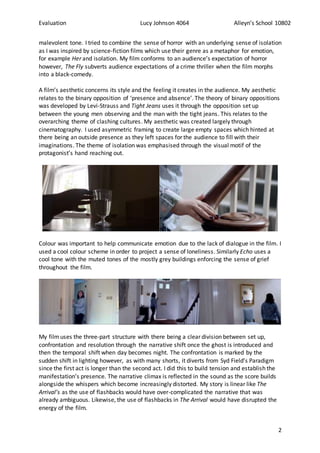
A film’s aesthetic concerns its style and the feeling it creates in the audience. My aesthetic
relates to the binary opposition of ‘presence and absence’. The theory of binary oppositions
was developed by Levi-Strauss and Tight Jeans uses it through the opposition set up
between the young men observing and the man with the tight jeans. This relates to the
overarching theme of clashing cultures. My aesthetic was created largely through
cinematography. I used asymmetric framing to create large empty spaces which hinted at
there being an outside presence as they left spaces for the audience to fill with their
imaginations. The theme of isolation was emphasised through the visual motif of the
protagonist’s hand reaching out.
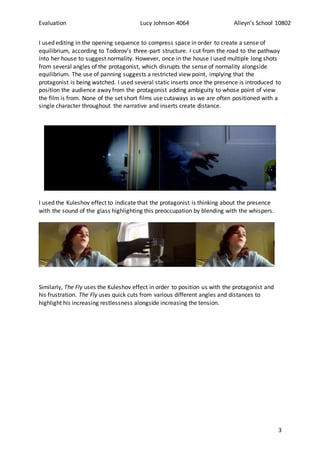
Colour was important to help communicate emotion due to the lack of dialogue in the film. I
used a cool colour scheme in order to project a sense of loneliness. Similarly Echo uses a
cool tone with the muted tones of the mostly grey buildings enforcing the sense of grief
throughout the film.
My filmuses the three-part structure with there being a clear division between set up,
confrontation and resolution through the narrative shift once the ghost is introduced and
then the temporal shift when day becomes night. The confrontation is marked by the
sudden shift in lighting however, as with many shorts, it diverts from Syd Field’s Paradigm
since the first act is longer than the second act. I did this to build tension and establish the
manifestation’s presence. The narrative climax is reflected in the sound as the score builds
alongside the whispers which become increasingly distorted. My story is linear like The
Arrival’s as the use of flashbacks would have over-complicated the narrative that was
already ambiguous. Likewise, the use of flashbacks in The Arrival would have disrupted the
energy of the film.
Evaluation Lucy Johnson 4064 Alleyn’s School 10802
3
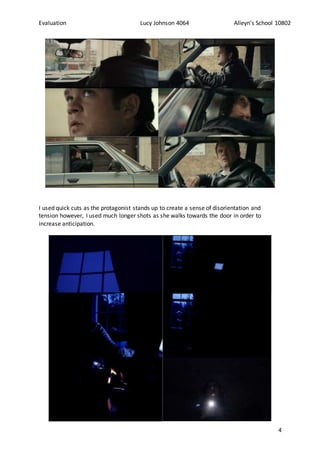
I used editing in the opening sequence to compress space in order to create a sense of
equilibrium, according to Todorov’s three-part structure. I cut from the road to the pathway
into her house to suggest normality. However, once in the house I used multiple long shots
from several angles of the protagonist, which disrupts the sense of normality alongside
equilibrium. The use of panning suggests a restricted view point, implying that the
protagonist is being watched. I used several static inserts once the presence is introduced to
position the audience away from the protagonist adding ambiguity to whose point of view
the film is from. None of the set short films use cutaways as we are often positioned with a
single character throughout the narrative and inserts create distance.
I used the Kuleshov effect to indicate that the protagonist is thinking about the presence
with the sound of the glass highlighting this preoccupation by blending with the whispers.
Similarly, The Fly uses the Kuleshov effect in order to position us with the protagonist and
his frustration. The Fly uses quick cuts from various different angles and distances to
highlight his increasing restlessness alongside increasing the tension.
Evaluation Lucy Johnson 4064 Alleyn’s School 10802
4
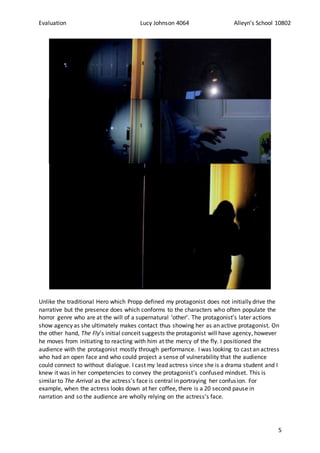
I used quick cuts as the protagonist stands up to create a sense of disorientation and
tension however, I used much longer shots as she walks towards the door in order to
increase anticipation.
Evaluation Lucy Johnson 4064 Alleyn’s School 10802
5
Unlike the traditional Hero which Propp defined my protagonist does not initially drive the
narrative but the presence does which conforms to the characters who often populate the
horror genre who are at the will of a supernatural ‘other’. The protagonist’s later actions
show agency as she ultimately makes contact thus showing her as an active protagonist. On
the other hand, The Fly’s initial conceit suggests the protagonist will have agency, however
he moves from initiating to reacting with him at the mercy of the fly. I positioned the
audience with the protagonist mostly through performance. I was looking to cast an actress
who had an open face and who could project a sense of vulnerability that the audience
could connect to without dialogue. I cast my lead actress since she is a drama student and I
knew it was in her competencies to convey the protagonist’s confused mindset. This is
similar to The Arrival as the actress’s face is central in portraying her confusion. For
example, when the actress looks down at her coffee, there is a 20 second pause in
narration and so the audience are wholly relying on the actress’s face.
Evaluation Lucy Johnson 4064 Alleyn’s School 10802
6
Patrick Phillips writes that: “Spectatorship is primarily concerned with the way the individual
is positioned between projector and screen in a darkened space”. The preferred reading of
the film is that the ghost is not entirely malevolent, with the end suggesting hope through
contact. The open ending means that the audience has to be active similarly to in The
Arrival, as the audience have to engage with the text in order to interpret what will happen
next. When surveying spectator response 60% felt that a positive or non-threatening
interaction with the presence would occur after the end of the film. With the majority of the
audience feeling that the presence was not wholly antagonistic. When asked about their
emotional response only 10% of the audience felt ‘sad’ and ‘contemplative’ with the
majority of the audience feeling ‘tense’. Whilst this was not an oppositional reading, since I
did intend to build a sense of tension throughout, it remains a negotiated reading since the
theme of isolation was not wholly communicated.
My filmuses an open ending that lacks a restoration of equilibrium, as is similar with many
of the short films. Operator uses an open ending with the film reflecting on the cyclical
nature of the protagonist’s profession. I used Barthes’ enigma code with the multiple
enigmas set up through the narrative in order to entice the viewer. However, few of these
enigmas are resolved. Short films often use unresolved enigmas and open endings due to
their time restraints and the difficulties with condensing the five-part structure into five to
ten minutes.
Word count: 1500.

4064 lucy johnson evaluation

  • 1.
    Evaluation Lucy Johnson4064 Alleyn’s School 10802 1 The Academy defines short films as “original motion picture [with] a running time of 40 minutes or less”. Most short films range from five to ten minutes, due to budgetary constraints on the heavily student-based form. Short films are often seen as a lesser form of the feature filmhowever, the comparison between feature and short is more akin to a novel and a poem. Philip Larkin described poetry as having a “single emotional spearpoint”. I drew from this idea with my linear narrative set over a single day and location, like The Arrival which uses a single shot alongside these techniques to position the viewer with the protagonist. Short films’ small budgets can be used to great effect for example The Fly’s use of sound creates the robbery without it actually being seen. Short films are necessary for the industry since they are some of the most interesting examples of auteur productions due to the lack of studio restraints. The online accessibility of short films in the 21st Century is representative of the changing film industry as a whole which is increasingly becoming more geared to online streaming. My filmconcerns a young woman who encounters a mysterious presence when she arrives home. The title Contact enforces the central theme of loneliness that is conveyed through the lack of dialogue. The title is ambiguous and relates to the ambiguity within the film itself. Similarly, Echo is vague, and its meaning reflects the grief the character is processing alongside the repetition of her actions. My title relates to both contact in terms of isolation, and in relation to the horror and science-fiction genres since extra-terrestrial contact is a key idea in science-fiction. Steve Neale defines genre as: “Specific systemof expectation and hypothesis which spectators bring with them to the cinema”. Genre can also be defined by its semantic and syntactic elements. I drew from the semantic elements of the horror film by using a Victorian house which references the haunted house trope alongside the lowkey underlighting on the protagonist’s face, which alludes to the visual act of telling ghost stories. My filmfalls under the Horror genre with a sub-genre of the ghost film. None of the set films can be defined as psychological horrors, which is likely due to large budgets that are often needed for horror. I was inspired by introspective horror films such as A Ghost Story alongside the science-fiction film Arrival. I drew from Arrival’s use of sound which was used to create the alien presence with my ‘presence’ never being seen. I layered human whispers over my distorted electronic score, to create a disorientating effect but not a wholly
  • 2.
    Evaluation Lucy Johnson4064 Alleyn’s School 10802 2 malevolent tone. I tried to combine the sense of horror with an underlying sense of isolation as I was inspired by science-fiction films which use their genre as a metaphor for emotion, for example Her and isolation. My film conforms to an audience’s expectation of horror however, The Fly subverts audience expectations of a crime thriller when the film morphs into a black-comedy. A film’s aesthetic concerns its style and the feeling it creates in the audience. My aesthetic relates to the binary opposition of ‘presence and absence’. The theory of binary oppositions was developed by Levi-Strauss and Tight Jeans uses it through the opposition set up between the young men observing and the man with the tight jeans. This relates to the overarching theme of clashing cultures. My aesthetic was created largely through cinematography. I used asymmetric framing to create large empty spaces which hinted at there being an outside presence as they left spaces for the audience to fill with their imaginations. The theme of isolation was emphasised through the visual motif of the protagonist’s hand reaching out. Colour was important to help communicate emotion due to the lack of dialogue in the film. I used a cool colour scheme in order to project a sense of loneliness. Similarly Echo uses a cool tone with the muted tones of the mostly grey buildings enforcing the sense of grief throughout the film. My filmuses the three-part structure with there being a clear division between set up, confrontation and resolution through the narrative shift once the ghost is introduced and then the temporal shift when day becomes night. The confrontation is marked by the sudden shift in lighting however, as with many shorts, it diverts from Syd Field’s Paradigm since the first act is longer than the second act. I did this to build tension and establish the manifestation’s presence. The narrative climax is reflected in the sound as the score builds alongside the whispers which become increasingly distorted. My story is linear like The Arrival’s as the use of flashbacks would have over-complicated the narrative that was already ambiguous. Likewise, the use of flashbacks in The Arrival would have disrupted the energy of the film.
  • 3.
    Evaluation Lucy Johnson4064 Alleyn’s School 10802 3 I used editing in the opening sequence to compress space in order to create a sense of equilibrium, according to Todorov’s three-part structure. I cut from the road to the pathway into her house to suggest normality. However, once in the house I used multiple long shots from several angles of the protagonist, which disrupts the sense of normality alongside equilibrium. The use of panning suggests a restricted view point, implying that the protagonist is being watched. I used several static inserts once the presence is introduced to position the audience away from the protagonist adding ambiguity to whose point of view the film is from. None of the set short films use cutaways as we are often positioned with a single character throughout the narrative and inserts create distance. I used the Kuleshov effect to indicate that the protagonist is thinking about the presence with the sound of the glass highlighting this preoccupation by blending with the whispers. Similarly, The Fly uses the Kuleshov effect in order to position us with the protagonist and his frustration. The Fly uses quick cuts from various different angles and distances to highlight his increasing restlessness alongside increasing the tension.
  • 4.
    Evaluation Lucy Johnson4064 Alleyn’s School 10802 4 I used quick cuts as the protagonist stands up to create a sense of disorientation and tension however, I used much longer shots as she walks towards the door in order to increase anticipation.
  • 5.
    Evaluation Lucy Johnson4064 Alleyn’s School 10802 5 Unlike the traditional Hero which Propp defined my protagonist does not initially drive the narrative but the presence does which conforms to the characters who often populate the horror genre who are at the will of a supernatural ‘other’. The protagonist’s later actions show agency as she ultimately makes contact thus showing her as an active protagonist. On the other hand, The Fly’s initial conceit suggests the protagonist will have agency, however he moves from initiating to reacting with him at the mercy of the fly. I positioned the audience with the protagonist mostly through performance. I was looking to cast an actress who had an open face and who could project a sense of vulnerability that the audience could connect to without dialogue. I cast my lead actress since she is a drama student and I knew it was in her competencies to convey the protagonist’s confused mindset. This is similar to The Arrival as the actress’s face is central in portraying her confusion. For example, when the actress looks down at her coffee, there is a 20 second pause in narration and so the audience are wholly relying on the actress’s face.
  • 6.
    Evaluation Lucy Johnson4064 Alleyn’s School 10802 6 Patrick Phillips writes that: “Spectatorship is primarily concerned with the way the individual is positioned between projector and screen in a darkened space”. The preferred reading of the film is that the ghost is not entirely malevolent, with the end suggesting hope through contact. The open ending means that the audience has to be active similarly to in The Arrival, as the audience have to engage with the text in order to interpret what will happen next. When surveying spectator response 60% felt that a positive or non-threatening interaction with the presence would occur after the end of the film. With the majority of the audience feeling that the presence was not wholly antagonistic. When asked about their emotional response only 10% of the audience felt ‘sad’ and ‘contemplative’ with the majority of the audience feeling ‘tense’. Whilst this was not an oppositional reading, since I did intend to build a sense of tension throughout, it remains a negotiated reading since the theme of isolation was not wholly communicated. My filmuses an open ending that lacks a restoration of equilibrium, as is similar with many of the short films. Operator uses an open ending with the film reflecting on the cyclical nature of the protagonist’s profession. I used Barthes’ enigma code with the multiple enigmas set up through the narrative in order to entice the viewer. However, few of these enigmas are resolved. Short films often use unresolved enigmas and open endings due to their time restraints and the difficulties with condensing the five-part structure into five to ten minutes. Word count: 1500.