Presented By
Abu Kaiser Mohammad Masum
Id :161-15-6759
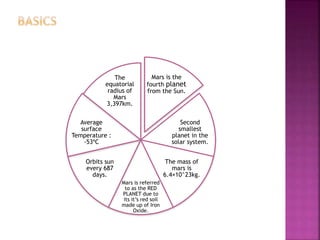
Mars is the
fourth planet
from the Sun.
Second
smallest
planet in the
solar system.
The mass of
mars is
6.4×10^23kg.
Mars is referred
to as the RED
PLANET due to
its it’s red soil
made up of Iron
Oxide.
Orbits sun
every 687
days.
Average
surface
Temperature :
-53ºC
The
equatorial
radius of
Mars
3,397km.
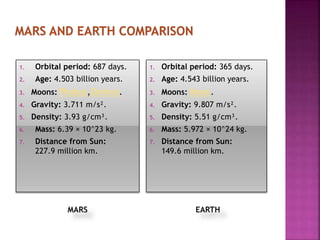
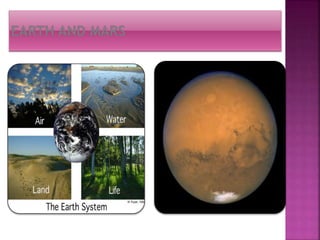
mars and earth comparison
MARS EARTH
1. Orbital period: 687 days.
2. Age: 4.503 billion years.
3. Moons: Phobos,Deimos.
4. Gravity: 3.711 m/s².
5. Density: 3.93 g/cm³.
6. Mass: 6.39 × 10^23 kg.
7. Distance from Sun:
227.9 million km.
1. Orbital period: 365 days.
2. Age: 4.543 billion years.
3. Moons: Moon.
4. Gravity: 9.807 m/s².
5. Density: 5.51 g/cm³.
6. Mass: 5.972 × 10^24 kg.
7. Distance from Sun:
149.6 million km.
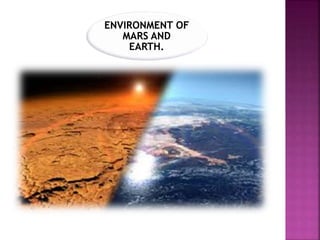
ENVIRONMENT OF
MARS AND
EARTH.
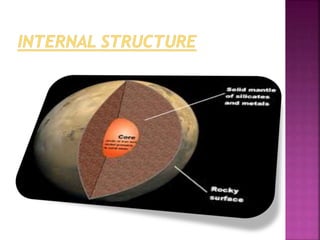
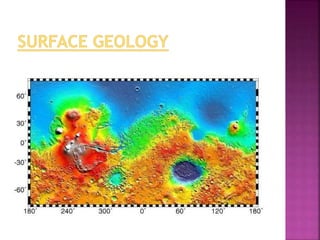
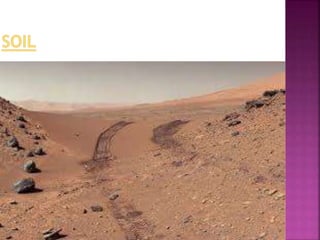
Physical Characteristics OF MARS
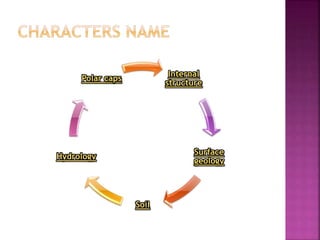
Internal
structure
Surface
geology
Soil
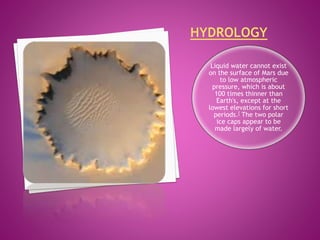
Hydrology
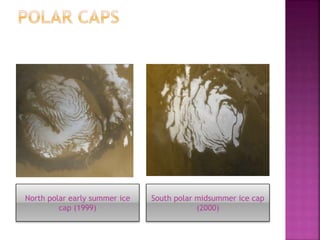
Polar caps
Liquid water cannot exist
on the surface of Mars due
to low atmospheric
pressure, which is about
100 times thinner than
Earth's, except at the
lowest elevations for short
periods.[ The two polar
ice caps appear to be
made largely of water.
North polar early summer ice
cap (1999)
South polar midsummer ice cap
(2000)
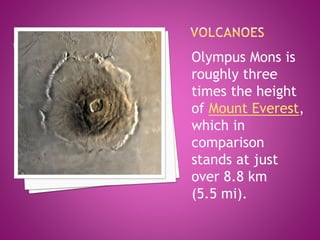
Olympus Mons is
roughly three
times the height
of Mount Everest,
which in
comparison
stands at just
over 8.8 km
(5.5 mi).
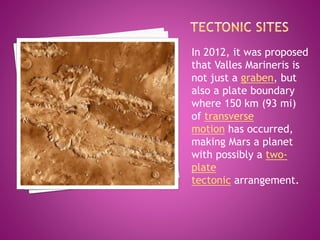
In 2012, it was proposed
that Valles Marineris is
not just a graben, but
also a plate boundary
where 150 km (93 mi)
of transverse
motion has occurred,
making Mars a planet
with possibly a two-
plate
tectonic arrangement.
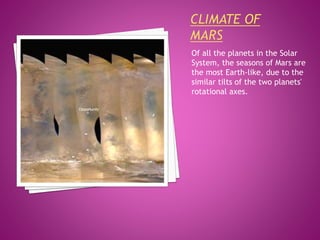
Of all the planets in the Solar
System, the seasons of Mars are
the most Earth-like, due to the
similar tilts of the two planets'
rotational axes.
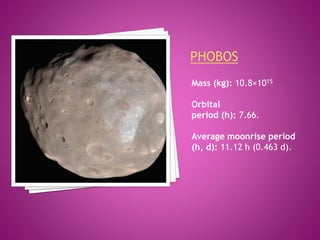
Mass (kg): 10.8×10¹⁵
Orbital
period (h): 7.66.
Average moonrise period
(h, d): 11.12 h (0.463 d).
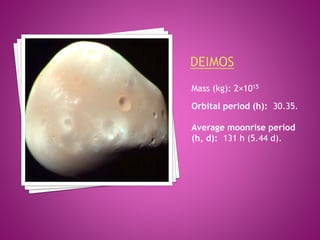
Mass (kg): 2×10¹⁵
Orbital period (h): 30.35.
Average moonrise period
(h, d): 131 h (5.44 d).
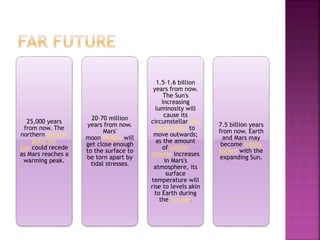
25,000 years
from now. The
northern Martian
polar ice
cap could recede
as Mars reaches a
warming peak.
20–70 million
years from now.
Mars'
moon Phobos will
get close enough
to the surface to
be torn apart by
tidal stresses.
1.5–1.6 billion
years from now.
The Sun's
increasing
luminosity will
cause its
circumstellar hab
itable zone to
move outwards;
as the amount
of carbon
dioxide increases
in Mars's
atmosphere, its
surface
temperature will
rise to levels akin
to Earth during
the ice age.
7.5 billion years
from now. Earth
and Mars may
become tidally
locked with the
expanding Sun.
Planned for March
2016 is the launch
of
the InSight lander,
together with two
identical CubeSats
that will fly by
Mars and provide
landing telemetry.
The lander and
CubeSats are
planned to arrive
at Mars in
September 2016.
NASA plans to
launch its Mars
2020 astrobiology
rover in 2020.
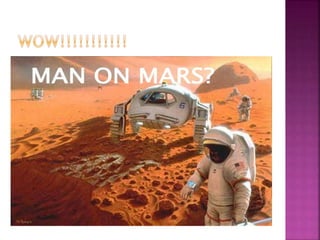
Several plans for
a human mission to
Mars have been
proposed
throughout the
20th century and
into the 21st
century, but no
active plan has an
arrival date sooner
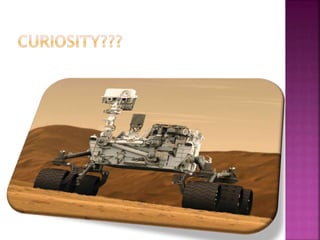
Curiosity is a car-
sized robotic
rover exploring Gale
Crater on Mars as part
of NASA's Mars Science
Laboratory mission
(MSL).[3] As of March 20,
2016, Curiosity has been on
Mars for
1287 sols (1322 total days)
since landing on August 6,
2012.
The rover's goals include:
investigation of the
Martian climate andgeology;
assessment of whether the
selected field site inside Gale
Crater has ever
offered environmental
conditions favorable
for microbial life, including
investigation of the role of
water; and planetary
habitabilitystudies in
preparation for future human
exploration.
 Curiosity's design will serve as the basis for the planned Mars 2020rover.
In December 2012, Curiosity's two-year mission was extended
indefinitely.
Mars

Mars

  • 1.
    Presented By Abu KaiserMohammad Masum Id :161-15-6759
  • 3.
    Mars is the fourthplanet from the Sun. Second smallest planet in the solar system. The mass of mars is 6.4×10^23kg. Mars is referred to as the RED PLANET due to its it’s red soil made up of Iron Oxide. Orbits sun every 687 days. Average surface Temperature : -53ºC The equatorial radius of Mars 3,397km.
  • 5.
    mars and earthcomparison
  • 6.
    MARS EARTH 1. Orbitalperiod: 687 days. 2. Age: 4.503 billion years. 3. Moons: Phobos,Deimos. 4. Gravity: 3.711 m/s². 5. Density: 3.93 g/cm³. 6. Mass: 6.39 × 10^23 kg. 7. Distance from Sun: 227.9 million km. 1. Orbital period: 365 days. 2. Age: 4.543 billion years. 3. Moons: Moon. 4. Gravity: 9.807 m/s². 5. Density: 5.51 g/cm³. 6. Mass: 5.972 × 10^24 kg. 7. Distance from Sun: 149.6 million km.
  • 9.
  • 10.
  • 11.
  • 15.
    Liquid water cannotexist on the surface of Mars due to low atmospheric pressure, which is about 100 times thinner than Earth's, except at the lowest elevations for short periods.[ The two polar ice caps appear to be made largely of water.
  • 16.
    North polar earlysummer ice cap (1999) South polar midsummer ice cap (2000)
  • 19.
    Olympus Mons is roughlythree times the height of Mount Everest, which in comparison stands at just over 8.8 km (5.5 mi).
  • 20.
    In 2012, itwas proposed that Valles Marineris is not just a graben, but also a plate boundary where 150 km (93 mi) of transverse motion has occurred, making Mars a planet with possibly a two- plate tectonic arrangement.
  • 24.
    Of all theplanets in the Solar System, the seasons of Mars are the most Earth-like, due to the similar tilts of the two planets' rotational axes.
  • 27.
    Mass (kg): 10.8×10¹⁵ Orbital period(h): 7.66. Average moonrise period (h, d): 11.12 h (0.463 d).
  • 28.
    Mass (kg): 2×10¹⁵ Orbitalperiod (h): 30.35. Average moonrise period (h, d): 131 h (5.44 d).
  • 30.
    25,000 years from now.The northern Martian polar ice cap could recede as Mars reaches a warming peak. 20–70 million years from now. Mars' moon Phobos will get close enough to the surface to be torn apart by tidal stresses. 1.5–1.6 billion years from now. The Sun's increasing luminosity will cause its circumstellar hab itable zone to move outwards; as the amount of carbon dioxide increases in Mars's atmosphere, its surface temperature will rise to levels akin to Earth during the ice age. 7.5 billion years from now. Earth and Mars may become tidally locked with the expanding Sun.
  • 33.
    Planned for March 2016is the launch of the InSight lander, together with two identical CubeSats that will fly by Mars and provide landing telemetry. The lander and CubeSats are planned to arrive at Mars in September 2016. NASA plans to launch its Mars 2020 astrobiology rover in 2020. Several plans for a human mission to Mars have been proposed throughout the 20th century and into the 21st century, but no active plan has an arrival date sooner
  • 36.
    Curiosity is acar- sized robotic rover exploring Gale Crater on Mars as part of NASA's Mars Science Laboratory mission (MSL).[3] As of March 20, 2016, Curiosity has been on Mars for 1287 sols (1322 total days) since landing on August 6, 2012. The rover's goals include: investigation of the Martian climate andgeology; assessment of whether the selected field site inside Gale Crater has ever offered environmental conditions favorable for microbial life, including investigation of the role of water; and planetary habitabilitystudies in preparation for future human exploration.
  • 37.
     Curiosity's designwill serve as the basis for the planned Mars 2020rover. In December 2012, Curiosity's two-year mission was extended indefinitely.