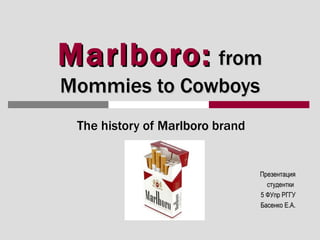
Marlboro:   from Mommies to Cowboys The history of  Marlboro  brand Презентация студентки  5 ФУпр РГГУ Басенко Е.А.
Marlboro   Marlboro   is a cigarette brand, produced by Altria  Group   (well-known as Phillip Morris) since  1924 .   Marlboro is one of the best-known  cigarette brands in the world,  thanks to a wide advertising  campaign and  automobile sport  sponsorship  (for example, supporting Ferrari team since 1970s) The brand is named after  Gre at Marlborough Street , the location of its original  London Factory. 
1920s   Marlboro was first advertised as a premium cigarette for women, a milder version of the smokes well dressed men might puff on after dinner.
1920s   They were positioned as cigarettes for emancipated women, and the tip of the cigarette was coloured pink (red) to hide the lipstick prints and protect women’s white teeth from yellowing.
The advertising slogan was:   “ Mild As May”. Th у  “face” of the brand was Hollywood actress May West. Cigarettes were sold in soft white packs and didn’t have a filter.
1953   Officially proved that smoking causes lung cancer. Ma ny smokers  turned  to filtered brands.  Philip Morris didn't have a filtered cigarette, so it scrapped the old campaign in favor of re-launching Marlboro as the company's   filtered alternative.
1953:   Gee, Dad, you always get the best of everything… even   Marlboro! The target market of the brand became people, who didn’t want to die from lung cancer, but were not able to quit smoking. The image ad, which now looks blasphemous, became history:
I n one picture the baby actually asks mom to have a cigarette instead of scolding him. It plays up the women-as-hysterical stereotype and also shows changing expectations about good motherhood.
1954:  Leo Burnett I t didn't help that filtered cigarettes were considered softer versions of the real thing, cigarettes for sissies. The sales decreased, and Marlboro’s market share in United States in 1954 was only 0,25%. For help, Marlboro turned to  Leo Burnett's  advertising company.  "I said, 'What's  the most masculine symbol you can   think of?' And right off the top of his head one of these writers spoke up and said  a cowboy .  And I said, 'That's for sure.'"
1950s :  Marlboro Man The first Marlboro men weren't limited to cowboys. They were all sorts of rugged individuals who smoked their cigarettes while performing equally manly tasks, from fixing their cars to fishing or hunting.
1954:  Flip-top  box Designer Frank Gianninoto created first time in history flip-top box – a pack from hard cardboard with a flipping cap.
“ The filter doesn’t go  between you and the flavour” 1955
1956-1957 “ You get a lot to like: filter, flavour, flip-top box”
1958-1959 Better “makin’s”: … more flavor … more filter … more cigarette.
Better makin’s
Why don’t you settle back and have a full-flavoured smoke? By 1957, Marlboro's sales  has  skyrocket ed by 5000%.  Unfortunately for Philip Morris, however, 1957 also brought with it one of the first rounds of negative publicity. A study published in  Reader's Digest  linked smoking with cancer.  Instead of focusing on the mysterious tattooed Marlboro Man, it turned the camera to sultry singer Julie London, who would share a smoke with her lucky male companion in between verses of the dreamy new  "Settle Back With a Marlboro"  theme. These commercials, paired with print ads that showed apparently  wealthy men relaxing for a smoke .
1960s But as American politics became more complicated in the 1960s,  Jack Landry, the Marlboro brand manager  at Philip Morris, saw an opening into which the cowboy fit like a glove. "In a world that was becoming increasingly complex and frustrating for the ordinary man," Landry explained, "the cowboy represented an antithesis -- a man whose environment was simplistic and relatively pressure free.  He was his own man in a world he owned."
Come to Marlboro Country Marlboro's television advertisements in the '60s reflected the  idea of freedom in wide-open spaces , especially once the theme from the movie  The Magnificent Seven  was added to the scenes of cowboys leading their herds through dusty canyons of "Marlboro Country" or charging off to rein in a stray colt.
Part of the success of the campaign might be attributable to the fact that Marlboro forged some credibility by using  real cowboys  in  ads.
While a government ban couldn't kill the Marlboro Man, the instrument that ended up doing the trick was the product itself. Two Marlboro men,  Wayne McLaren  and  David McLean,  died of lung cancer, but not before McLaren could testify in favor of anti-smoking legislation.  Wayne McLaren, 1970s
1967:   “Longhorns” and Menthol cigarettes released
1970s
1972:   “ Special Beach Offer”
1985:   25 cigarettes’ pack released
1990s:   maintaining Cowboy theme
Marlboro  marketing around the world
Now Marlboro  now owns more than  40 percent of the market , up more than 2.5 percentage points in as many year . I ts profits are possibly more than  $200 million a year. Marlboro  is  t he most smoked brand  by 41.8% of middle school students and 52.0% of high school students .

Marlboro 2

  • 1.
    Marlboro: from Mommies to Cowboys The history of Marlboro brand Презентация студентки 5 ФУпр РГГУ Басенко Е.А.
  • 2.
    Marlboro Marlboro is a cigarette brand, produced by Altria Group (well-known as Phillip Morris) since 1924 . Marlboro is one of the best-known cigarette brands in the world, thanks to a wide advertising campaign and automobile sport sponsorship (for example, supporting Ferrari team since 1970s) The brand is named after  Gre at Marlborough Street , the location of its original London Factory. 
  • 3.
    1920s Marlboro was first advertised as a premium cigarette for women, a milder version of the smokes well dressed men might puff on after dinner.
  • 4.
    1920s They were positioned as cigarettes for emancipated women, and the tip of the cigarette was coloured pink (red) to hide the lipstick prints and protect women’s white teeth from yellowing.
  • 5.
    The advertising sloganwas: “ Mild As May”. Th у “face” of the brand was Hollywood actress May West. Cigarettes were sold in soft white packs and didn’t have a filter.
  • 6.
    1953 Officially proved that smoking causes lung cancer. Ma ny smokers turned to filtered brands. Philip Morris didn't have a filtered cigarette, so it scrapped the old campaign in favor of re-launching Marlboro as the company's filtered alternative.
  • 7.
    1953: Gee, Dad, you always get the best of everything… even Marlboro! The target market of the brand became people, who didn’t want to die from lung cancer, but were not able to quit smoking. The image ad, which now looks blasphemous, became history:
  • 8.
    I n onepicture the baby actually asks mom to have a cigarette instead of scolding him. It plays up the women-as-hysterical stereotype and also shows changing expectations about good motherhood.
  • 9.
    1954: LeoBurnett I t didn't help that filtered cigarettes were considered softer versions of the real thing, cigarettes for sissies. The sales decreased, and Marlboro’s market share in United States in 1954 was only 0,25%. For help, Marlboro turned to Leo Burnett's advertising company. "I said, 'What's the most masculine symbol you can think of?' And right off the top of his head one of these writers spoke up and said a cowboy . And I said, 'That's for sure.'"
  • 10.
    1950s : Marlboro Man The first Marlboro men weren't limited to cowboys. They were all sorts of rugged individuals who smoked their cigarettes while performing equally manly tasks, from fixing their cars to fishing or hunting.
  • 11.
    1954: Flip-top box Designer Frank Gianninoto created first time in history flip-top box – a pack from hard cardboard with a flipping cap.
  • 12.
    “ The filterdoesn’t go between you and the flavour” 1955
  • 13.
    1956-1957 “ Youget a lot to like: filter, flavour, flip-top box”
  • 14.
    1958-1959 Better “makin’s”:… more flavor … more filter … more cigarette.
  • 15.
  • 16.
    Why don’t yousettle back and have a full-flavoured smoke? By 1957, Marlboro's sales has skyrocket ed by 5000%. Unfortunately for Philip Morris, however, 1957 also brought with it one of the first rounds of negative publicity. A study published in  Reader's Digest  linked smoking with cancer. Instead of focusing on the mysterious tattooed Marlboro Man, it turned the camera to sultry singer Julie London, who would share a smoke with her lucky male companion in between verses of the dreamy new "Settle Back With a Marlboro" theme. These commercials, paired with print ads that showed apparently wealthy men relaxing for a smoke .
  • 17.
    1960s But asAmerican politics became more complicated in the 1960s, Jack Landry, the Marlboro brand manager at Philip Morris, saw an opening into which the cowboy fit like a glove. "In a world that was becoming increasingly complex and frustrating for the ordinary man," Landry explained, "the cowboy represented an antithesis -- a man whose environment was simplistic and relatively pressure free. He was his own man in a world he owned."
  • 18.
    Come to MarlboroCountry Marlboro's television advertisements in the '60s reflected the idea of freedom in wide-open spaces , especially once the theme from the movie  The Magnificent Seven  was added to the scenes of cowboys leading their herds through dusty canyons of "Marlboro Country" or charging off to rein in a stray colt.
  • 19.
    Part of thesuccess of the campaign might be attributable to the fact that Marlboro forged some credibility by using real cowboys in ads.
  • 20.
    While a governmentban couldn't kill the Marlboro Man, the instrument that ended up doing the trick was the product itself. Two Marlboro men, Wayne McLaren and David McLean, died of lung cancer, but not before McLaren could testify in favor of anti-smoking legislation. Wayne McLaren, 1970s
  • 21.
    1967: “Longhorns” and Menthol cigarettes released
  • 22.
  • 23.
    1972: “ Special Beach Offer”
  • 24.
    1985: 25 cigarettes’ pack released
  • 25.
    1990s: maintaining Cowboy theme
  • 26.
    Marlboro marketingaround the world
  • 27.
    Now Marlboro now owns more than 40 percent of the market , up more than 2.5 percentage points in as many year . I ts profits are possibly more than $200 million a year. Marlboro is t he most smoked brand by 41.8% of middle school students and 52.0% of high school students .