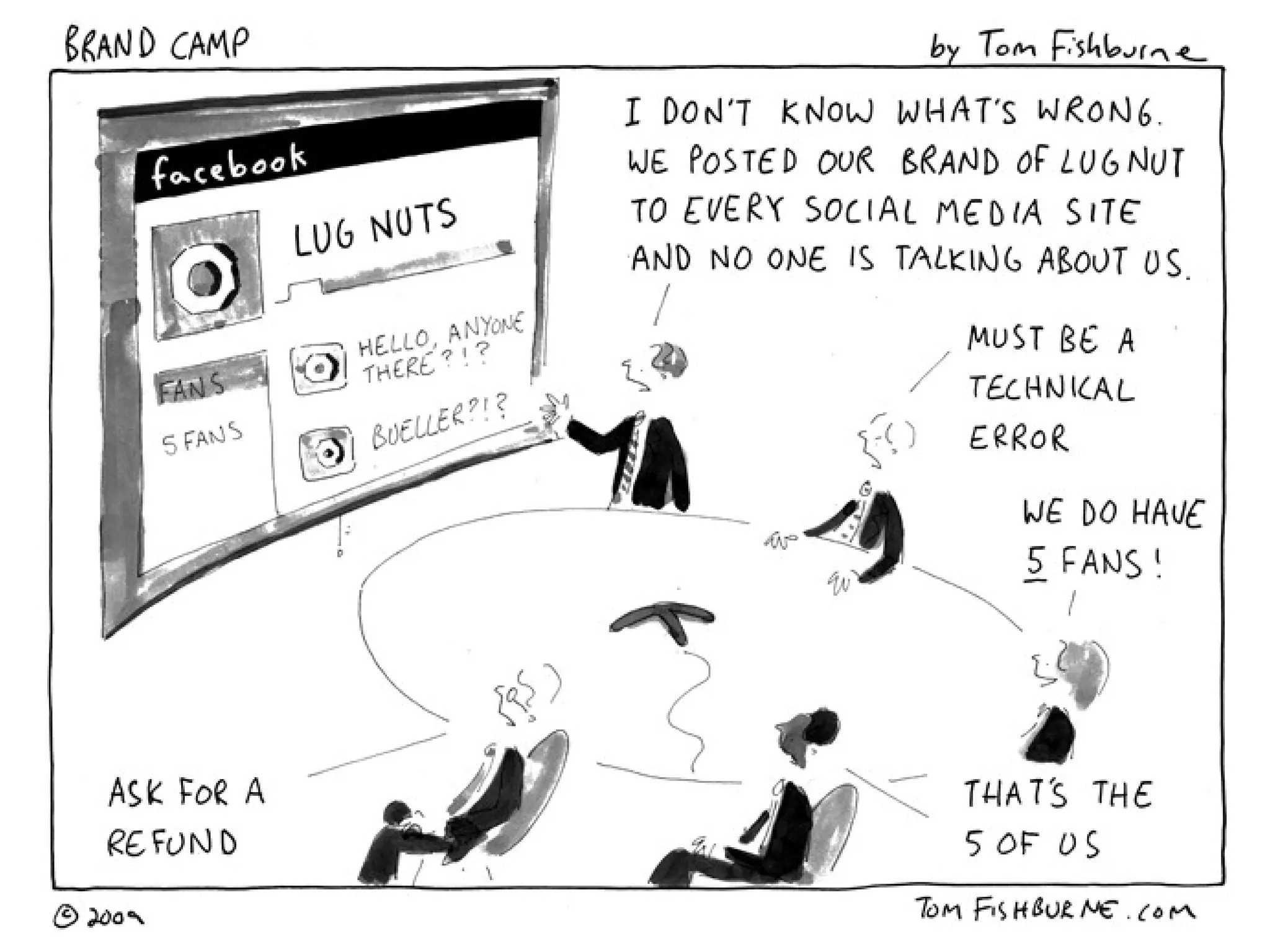
Analytics, Search,  Social Media, Optimization:  Why Has Marketing  Gotten So Geeky? presented by :  Kate O’Neill CEO & Founding Partner,  [meta]marketer
Paging Dr. Drucker: “ The aim of marketing is to  know and understand the customer   so well the product or service  fits him and sells itself.” “ Because the purpose of business is to create a customer,  the business enterprise has two—and only two— basic functions: marketing and innovation. Marketing and innovation produce results;  all the rest are costs. ”
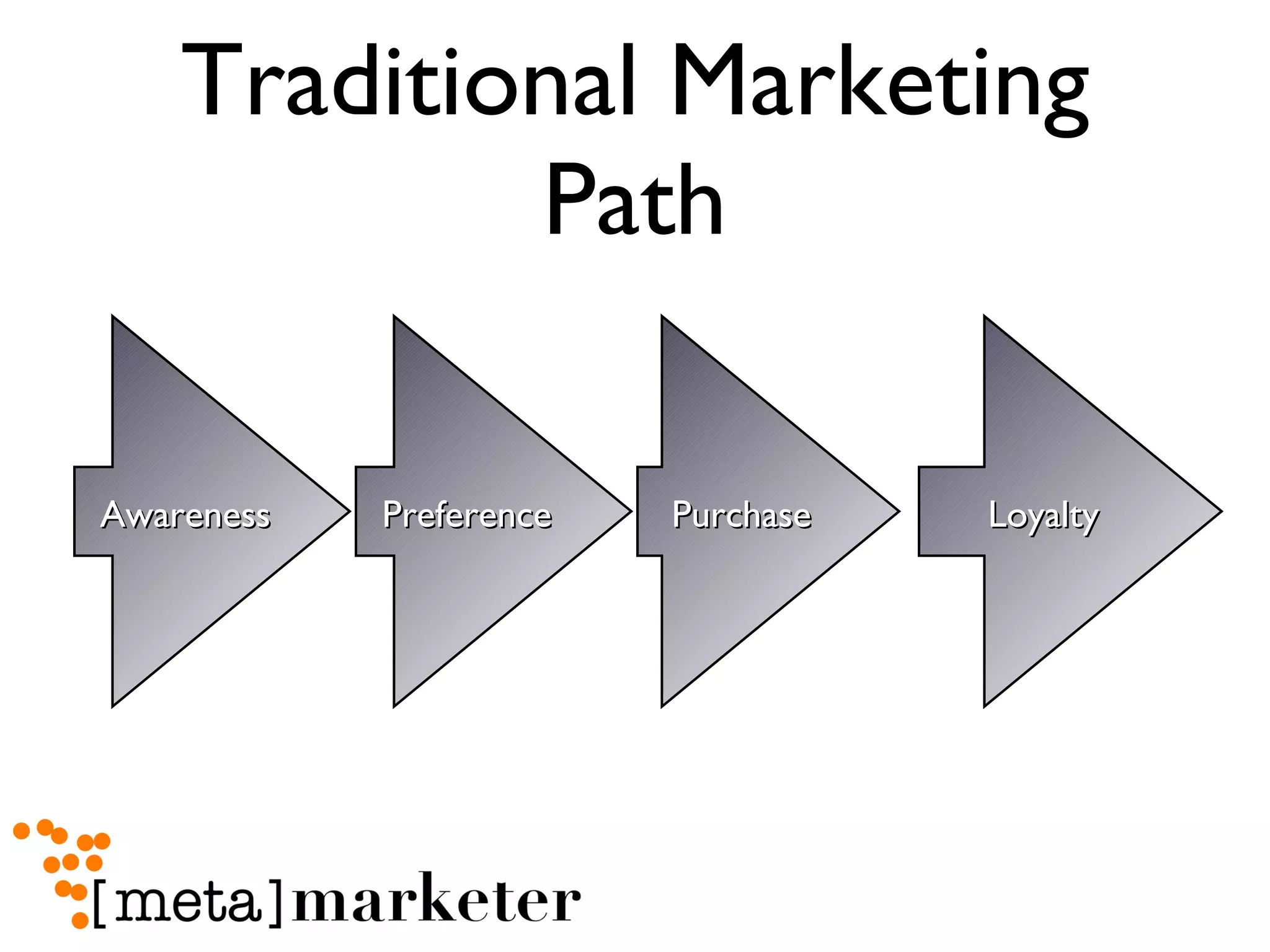
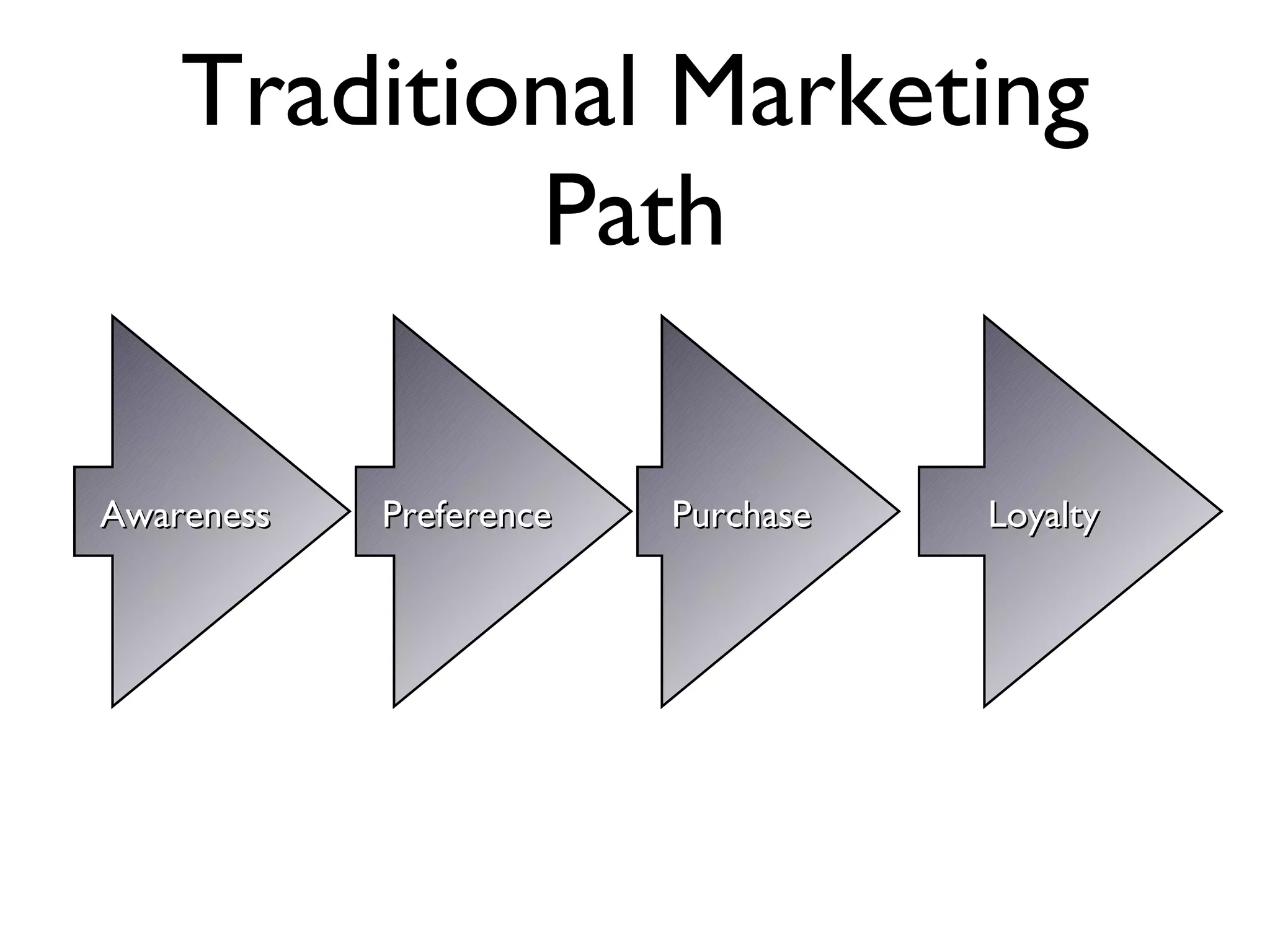
Traditional Marketing Path Awareness Preference Purchase Loyalty
What’s changed? Search Social Analytics Technologies not to mention… customer expectations  of  relevance,  usability,  portability, etc. Let’s look at the landscape  >
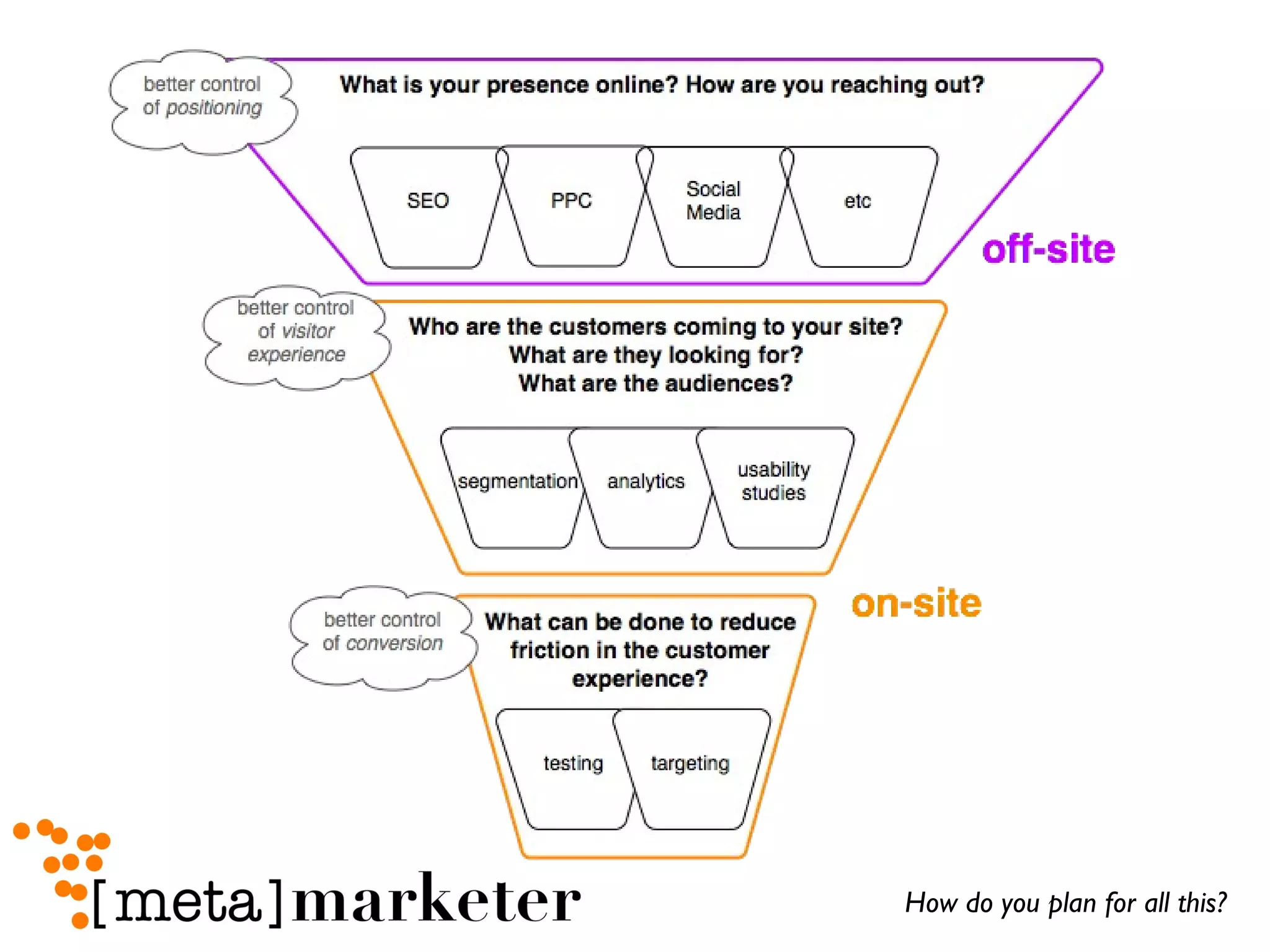
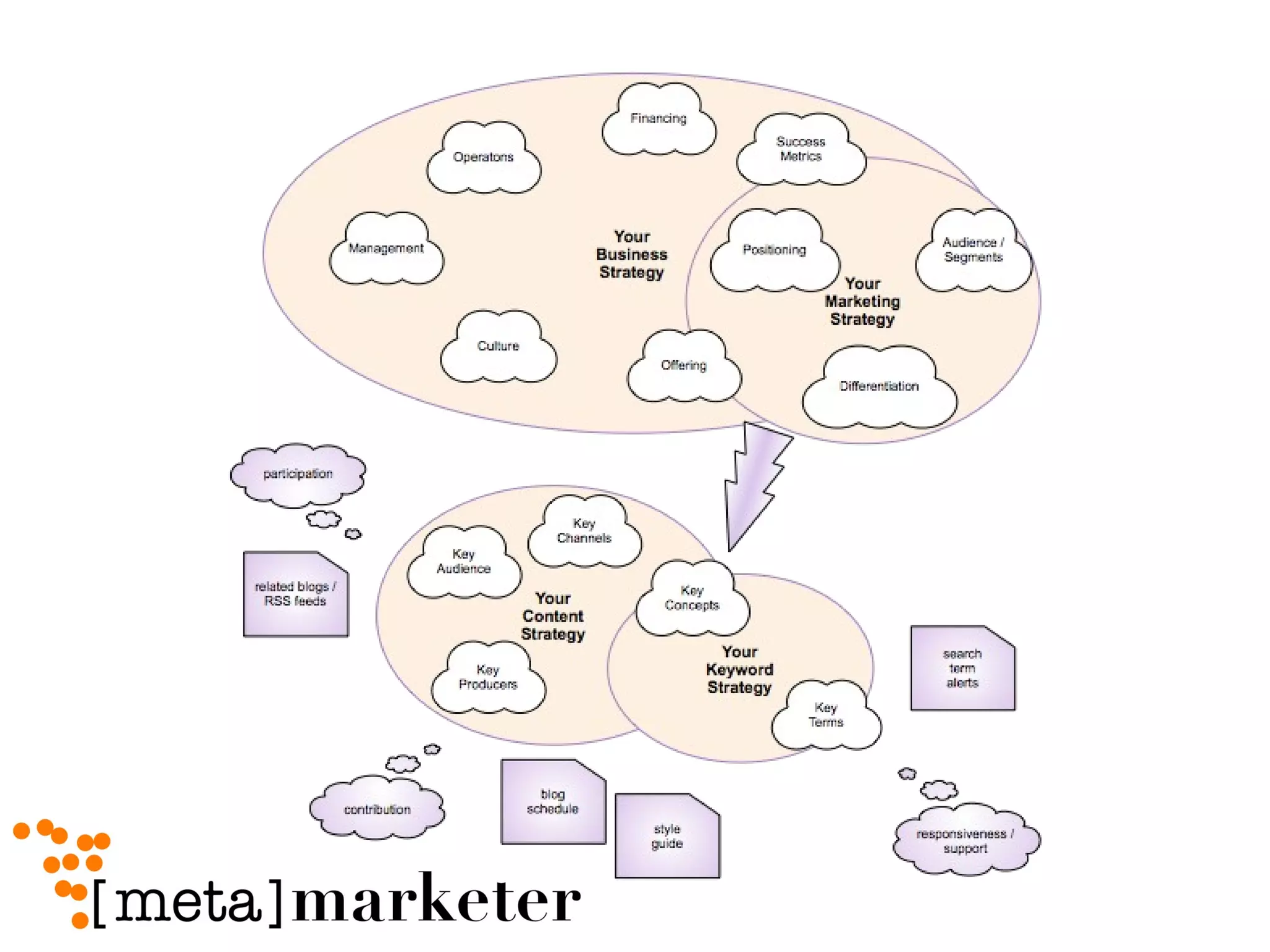
How do you plan for all this?
 
Let’s Talk  About  Search .
What’s changing in  the Web landscape?
Remember the  Pre-Search Web?
 
And  then ...
 
Google  changed  everything .
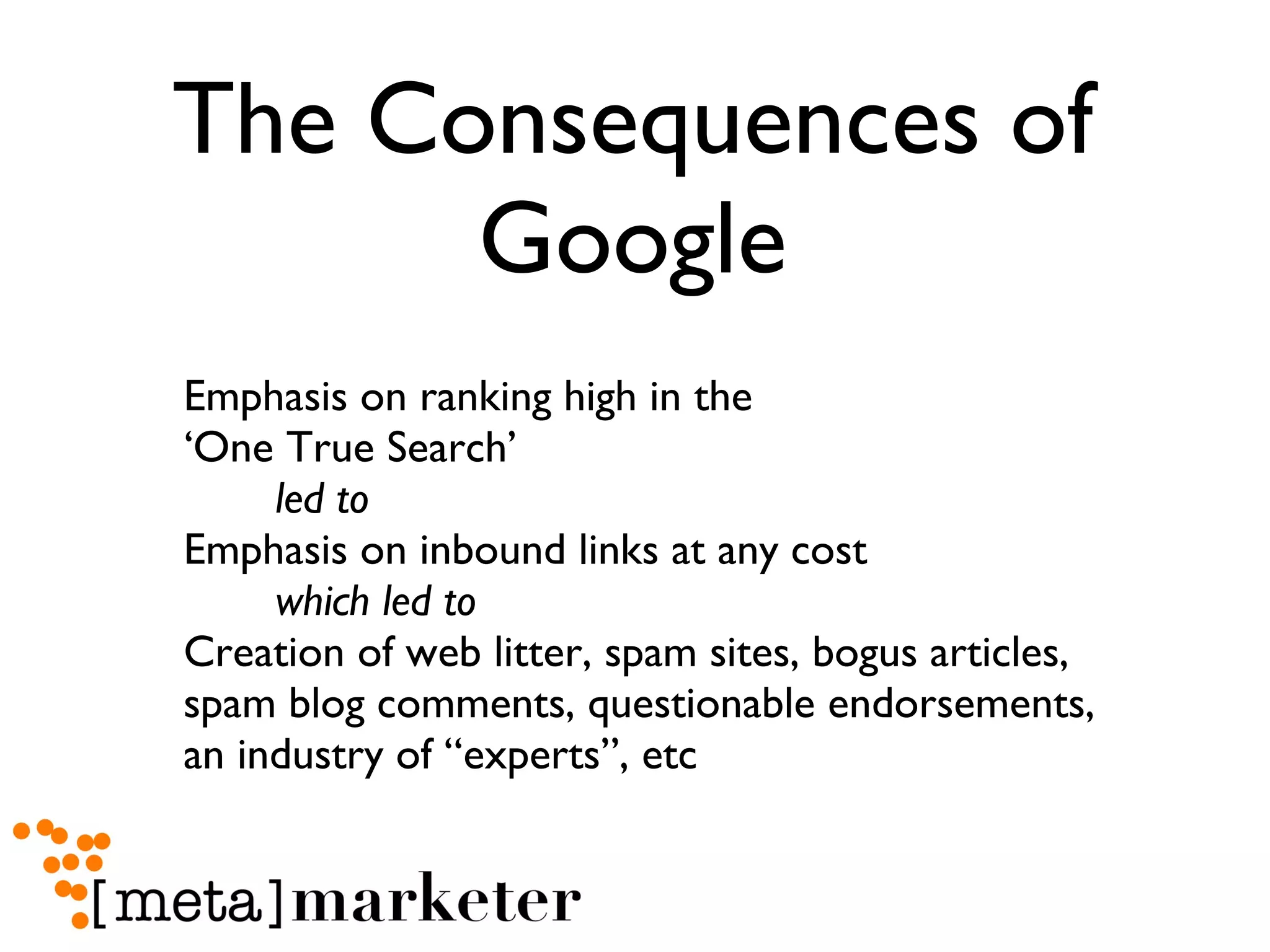
The Consequences of Google Emphasis on ranking high in the  ‘One True Search’  led to   Emphasis on inbound links at any cost  which led to   Creation of web litter, spam sites, bogus articles,  spam blog comments, questionable endorsements,  an industry of “experts”, etc
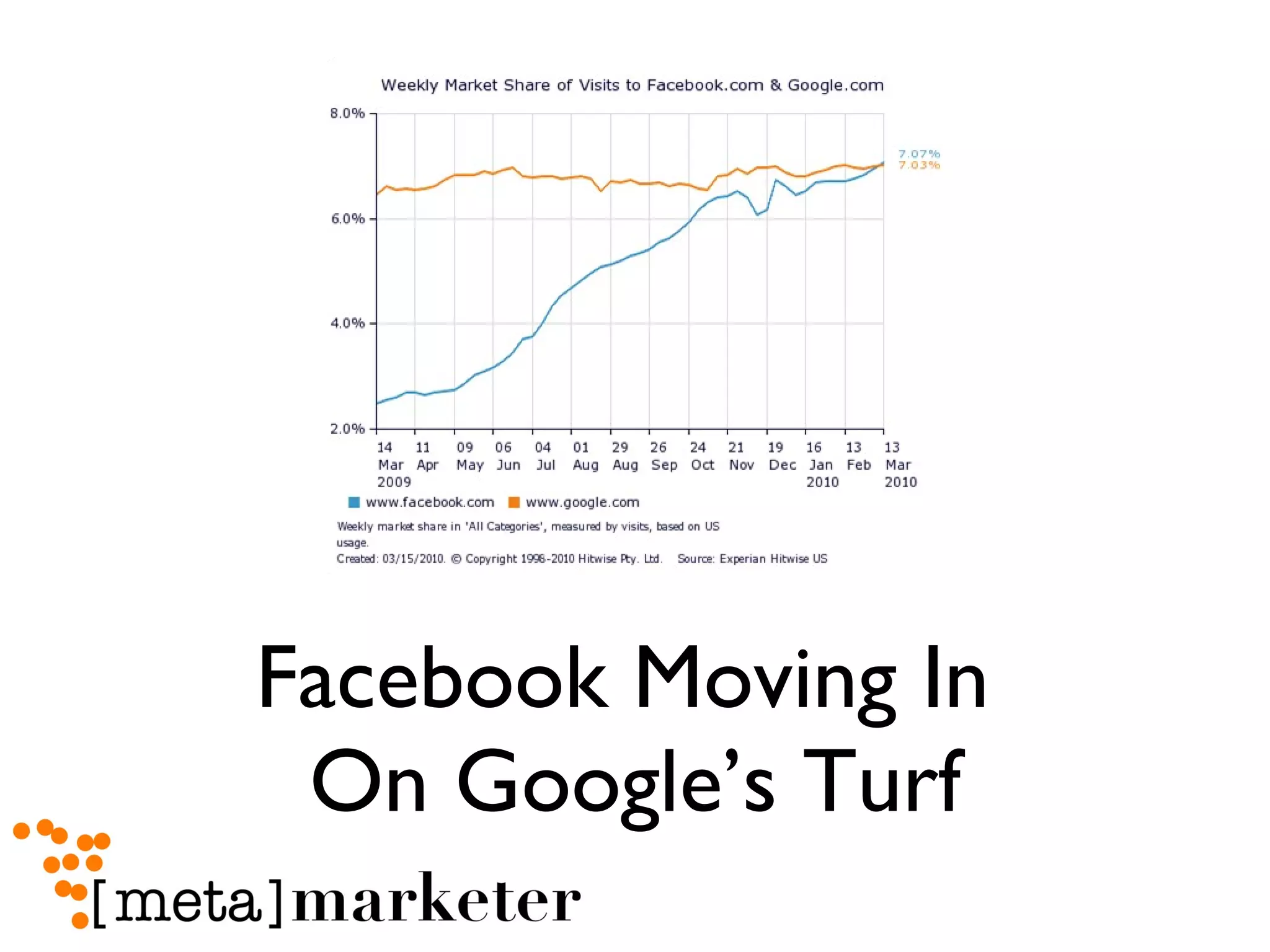
The Audacity  of Google Facebook
Facebook Moving In  On Google’s Turf
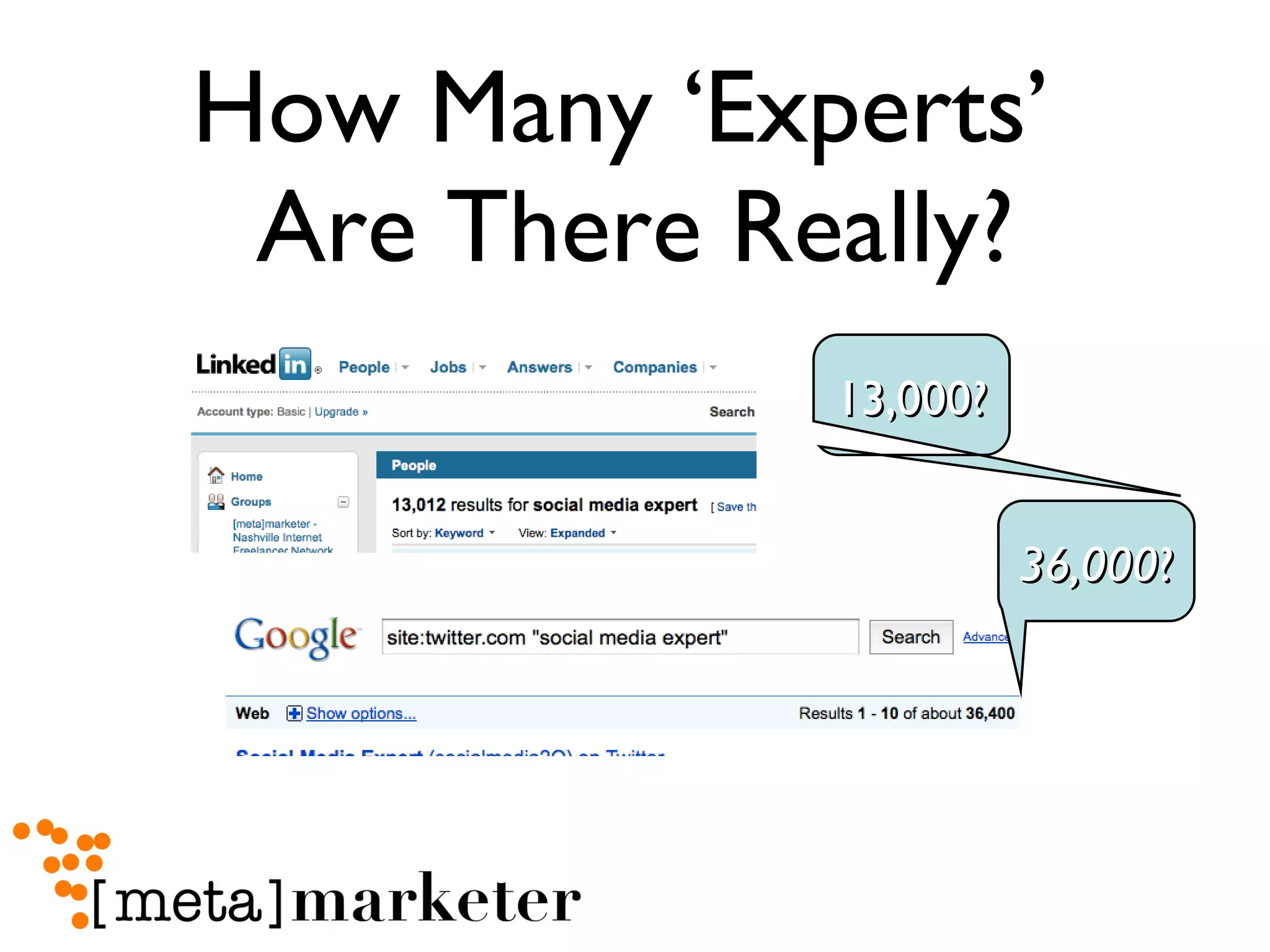
It’s (Almost) a  Post-Search World, Baby But we’re a changed user base Bringing the mindset of shady SEO to social media (unfortunately) - manipulate results, rank high, add junk We’ve got hundreds of “experts” early in the game. Really?
How Many ‘Experts’  Are There Really? 13,000? 36,000 ?
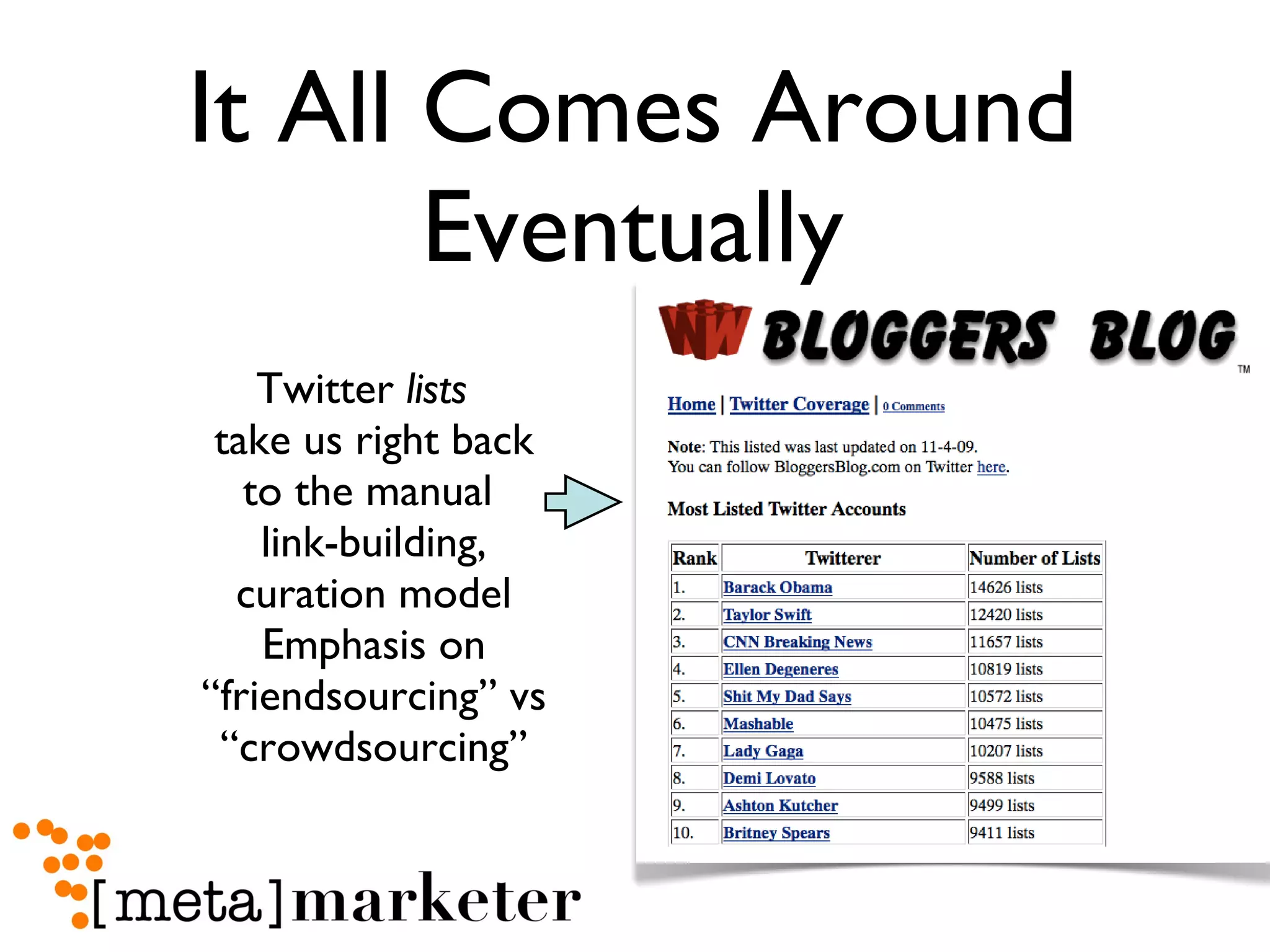
It All Comes Around Eventually Twitter  lists   take us right back to the manual  link-building, curation model Emphasis on “friendsourcing” vs “crowdsourcing”
So: what’s changing in the Web landscape? Google > Facebook Search > Spontaneity Findability > Trustability
And let’s not forget  “the Cloud” Data portability Mobile apps & mobile web Location-based apps & games Augmented reality Context relevance takes on geography and proximity
The “Burden of Proof” In a digital world, everything is  potentially  measurable Business insights need data and validation Marketing has the  opportunity  to move from  the hot seat to the driver’s seat  with the tools to inform the business
Analytics : With Great Power Comes Great Accountability.
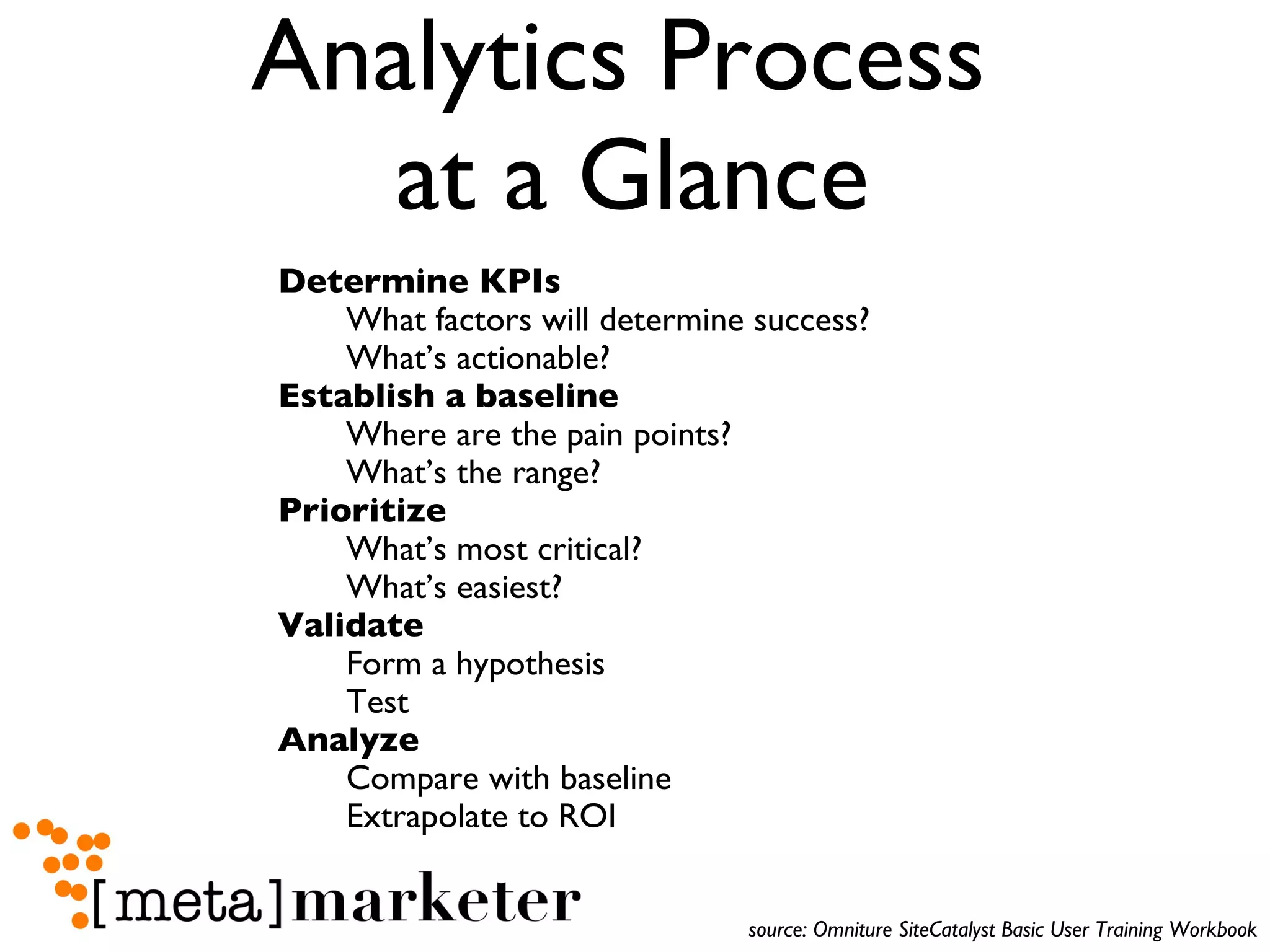
Analytics Process  at a Glance Determine KPIs What factors will determine success?  What’s actionable? Establish a baseline Where are the pain points? What’s the range? Prioritize What’s most critical? What’s easiest? Validate Form a hypothesis Test Analyze Compare with baseline Extrapolate to ROI source: Omniture SiteCatalyst Basic User Training Workbook
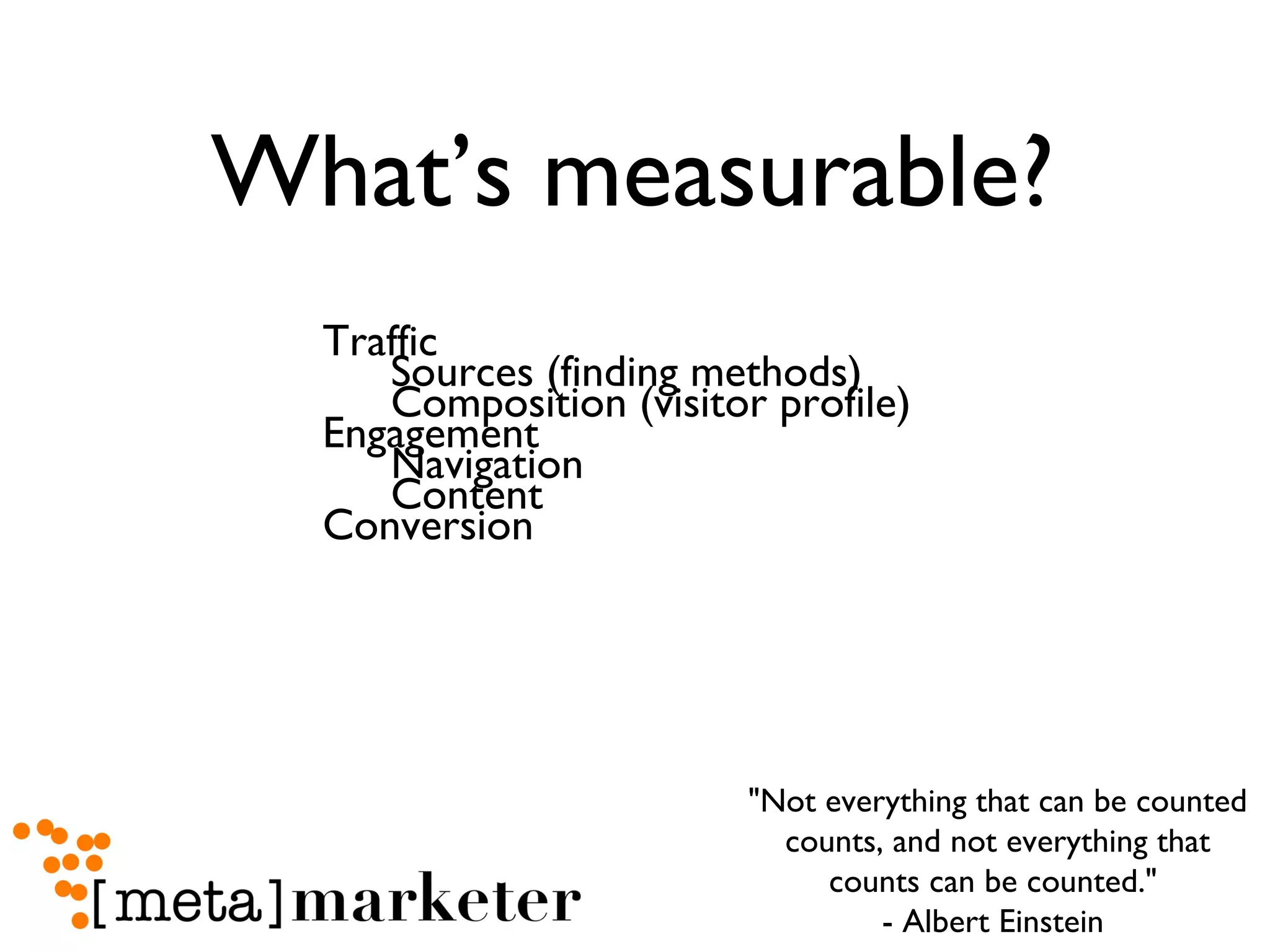
What’s measurable? Traffic Sources (finding methods) Composition (visitor profile) Engagement Navigation Content Conversion "Not everything that can be counted counts, and not everything that counts can be counted."  - Albert Einstein
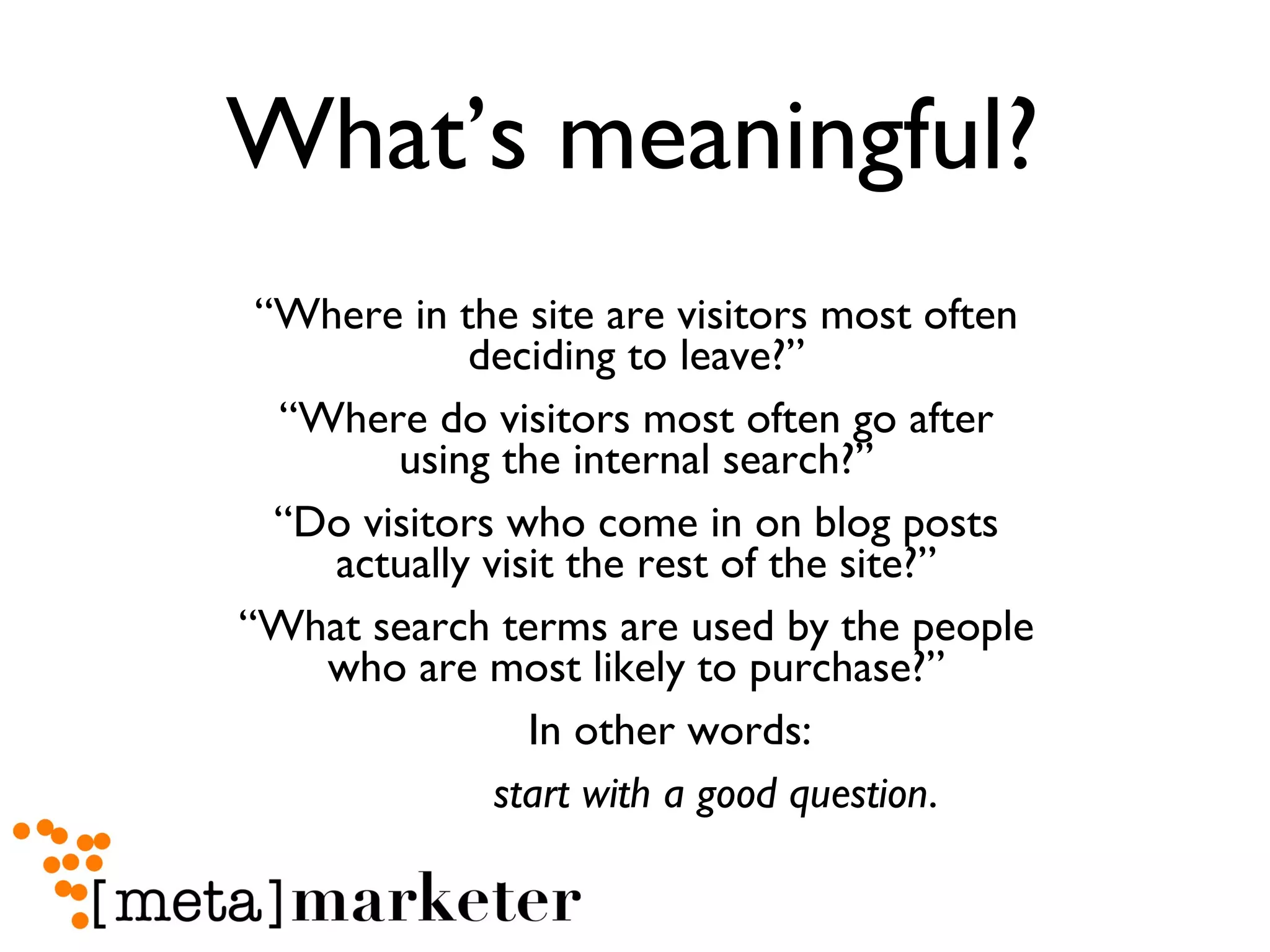
What’s meaningful? “ Where in the site are visitors most often deciding to leave?” “ Where do visitors most often go after using the internal search?” “ Do visitors who come in on blog posts actually visit the rest of the site?” “ What search terms are used by the people who are most likely to purchase?” In other words:  start with a good question .
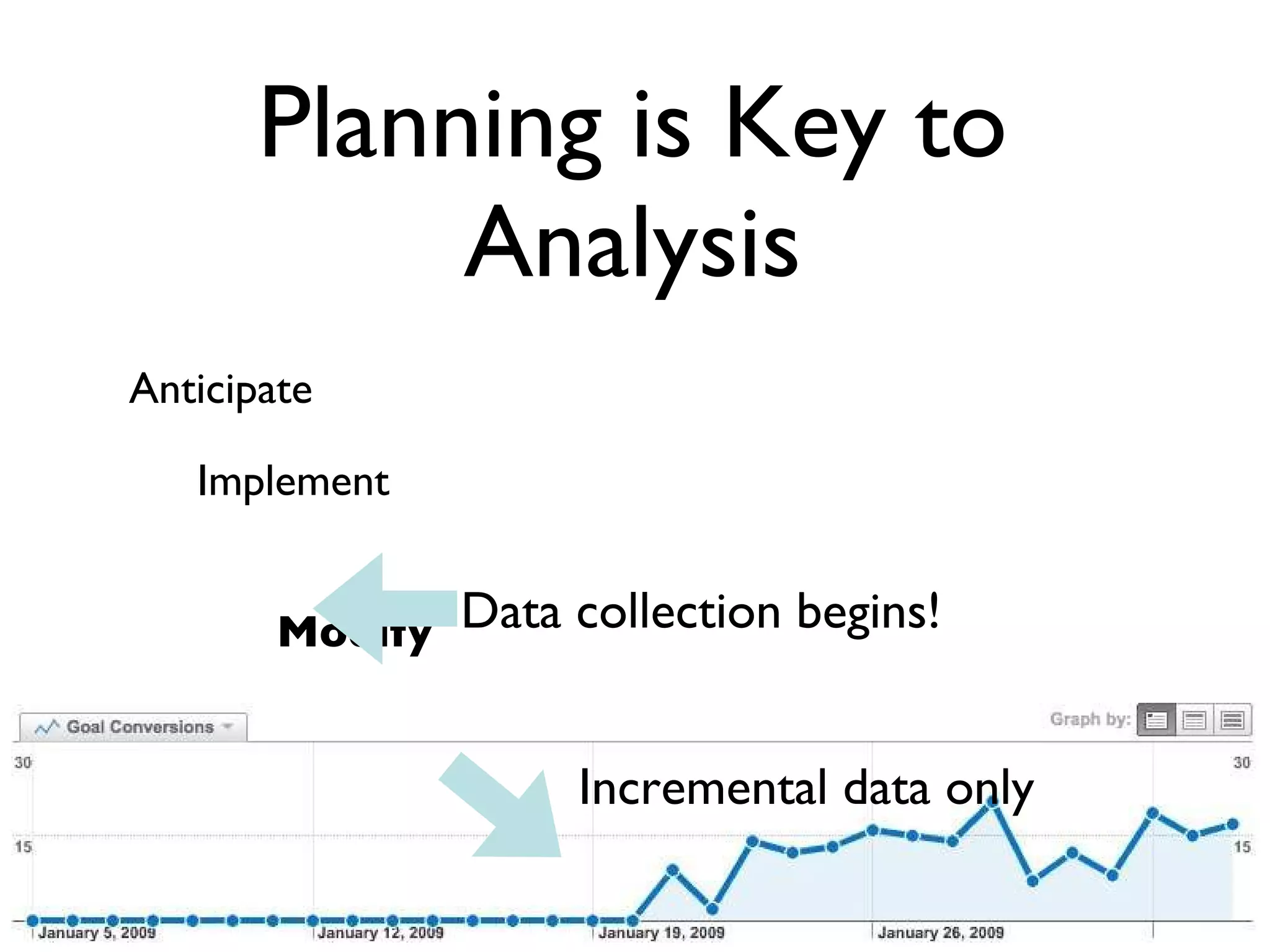
Planning is Key to Analysis Anticipate Implement Modify Data collection begins! Incremental data only
Conversion Metrics Conversion Rate  (Orders or Leads per Visit) Orders Revenue Leads Generated  Offline Sales Completed
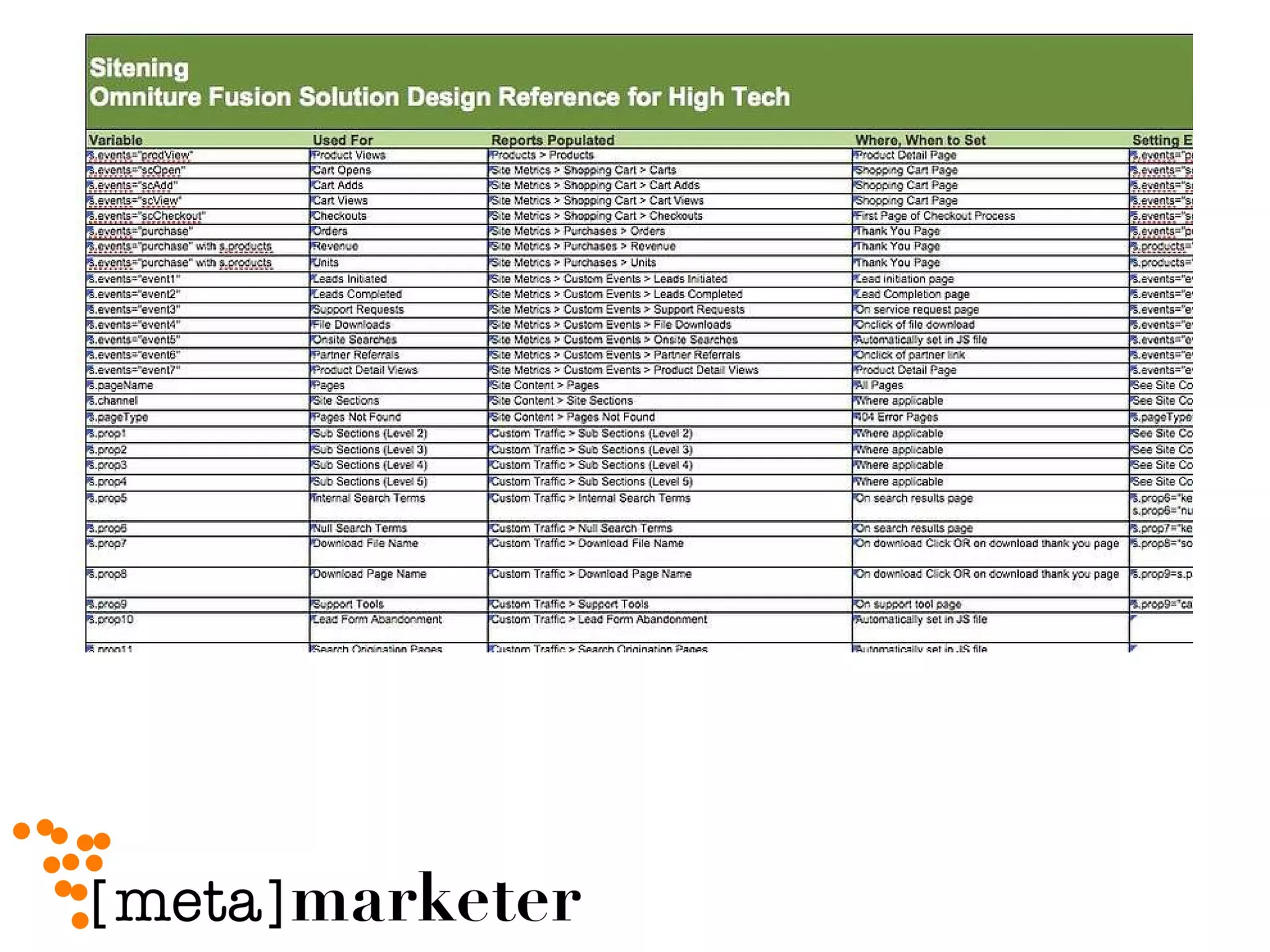
Model the Site identify actions / events, content hierarchies, products (e-commerce), and potentially interesting characteristics
Types of Reports Metrics Trending Pathing Next Page / Previous Page Fall-out Dashboards
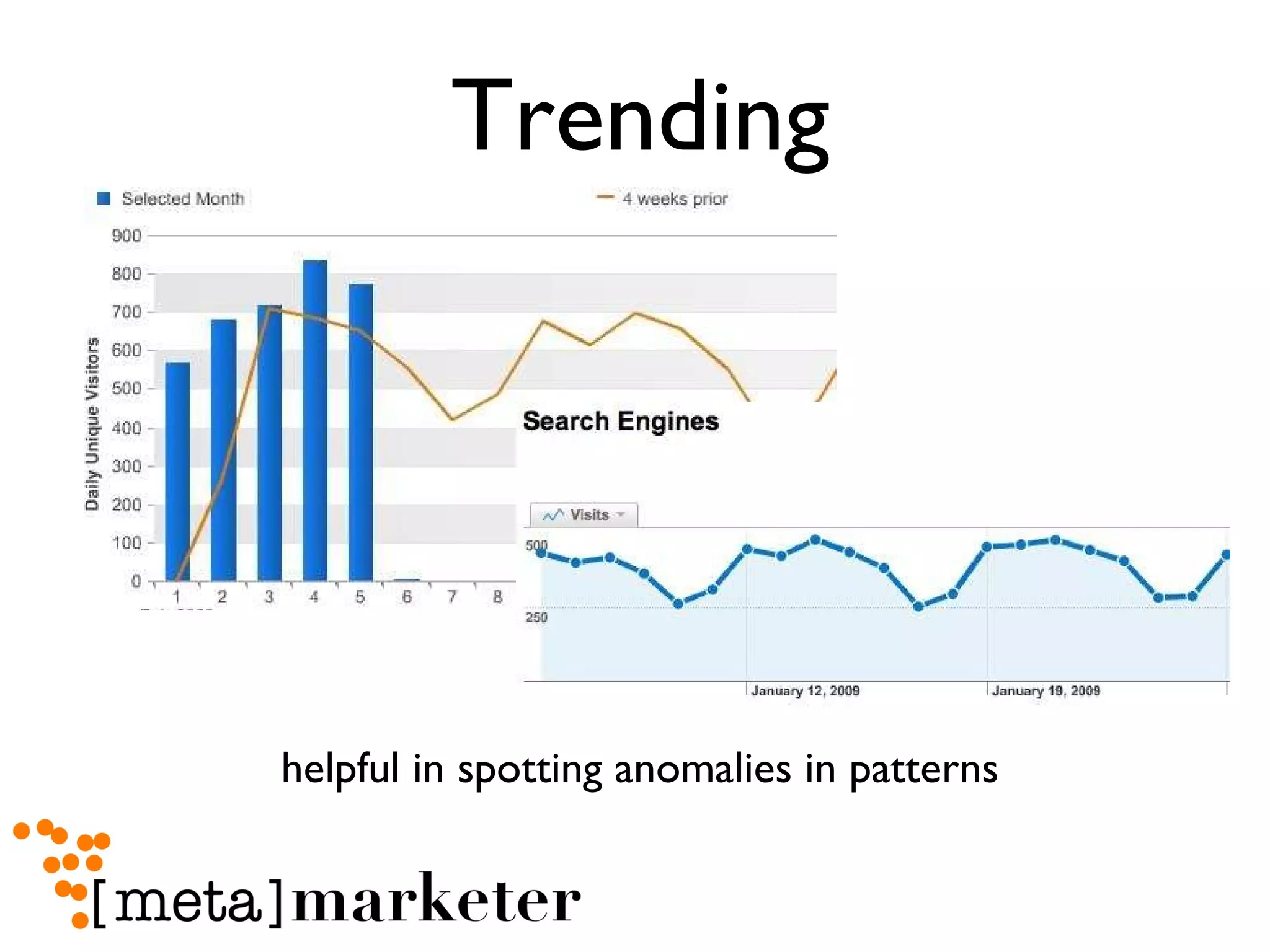
Trending helpful in spotting anomalies in patterns
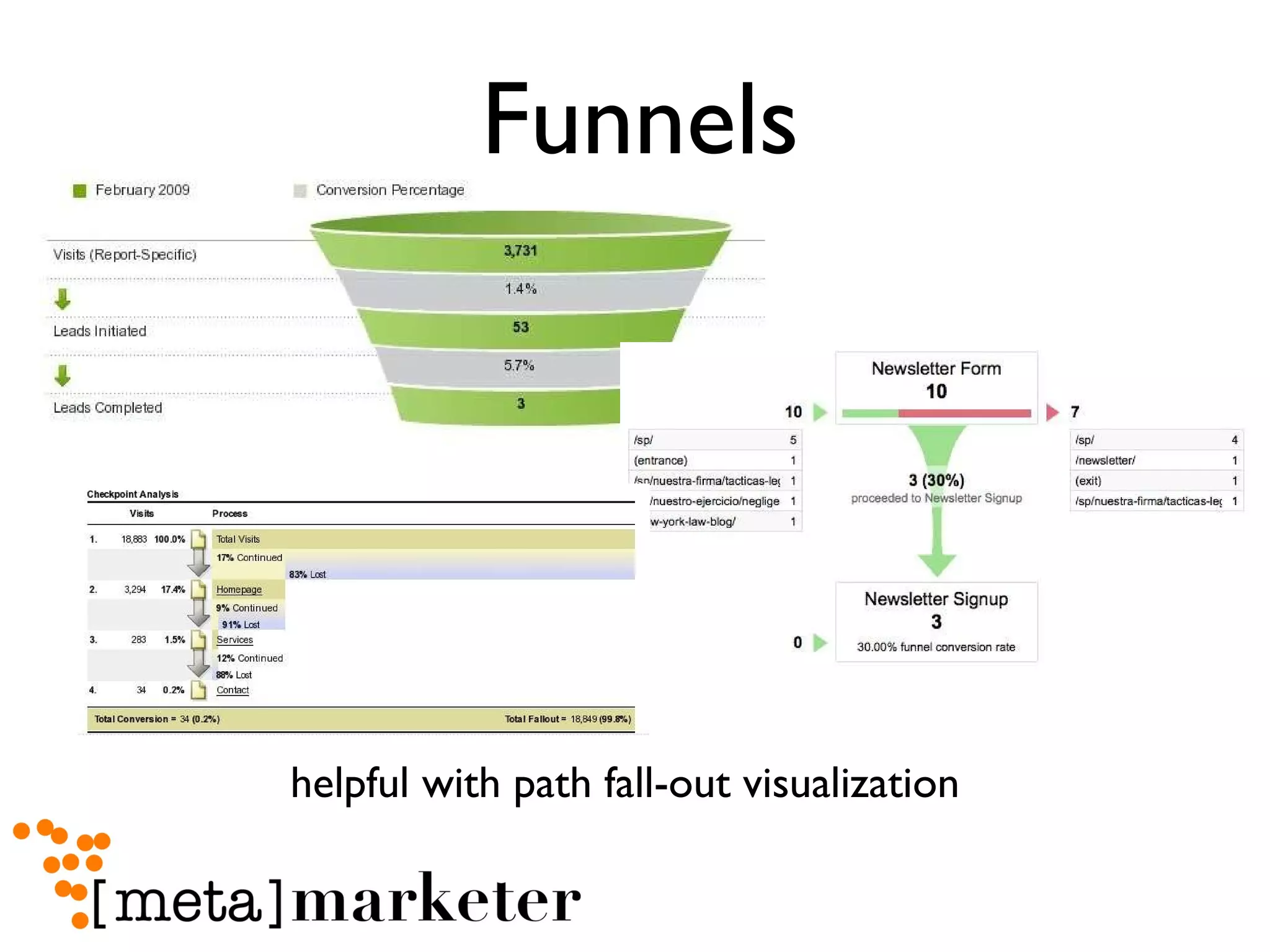
Funnels helpful with path fall-out visualization
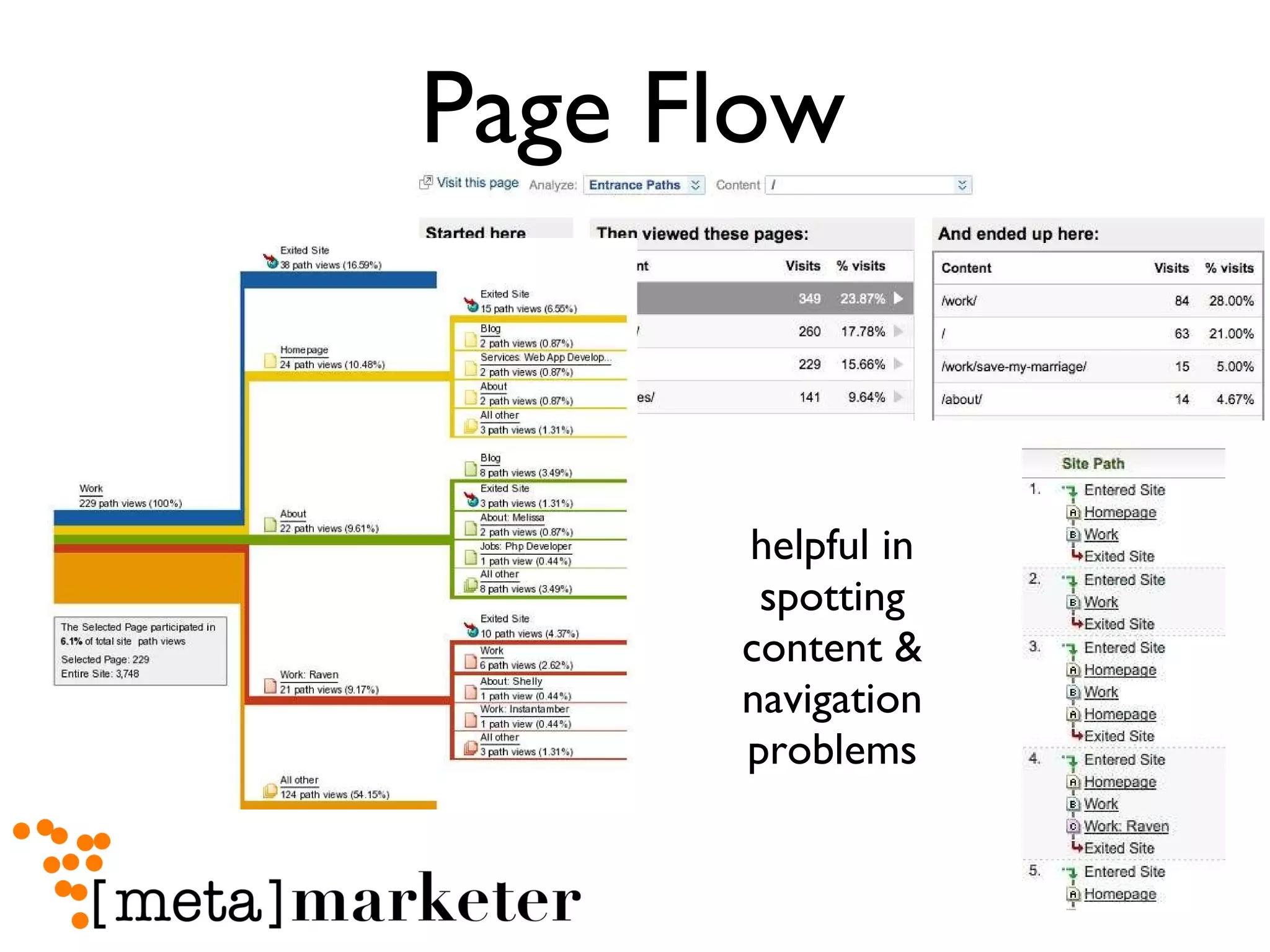
Page Flow helpful in spotting content & navigation problems
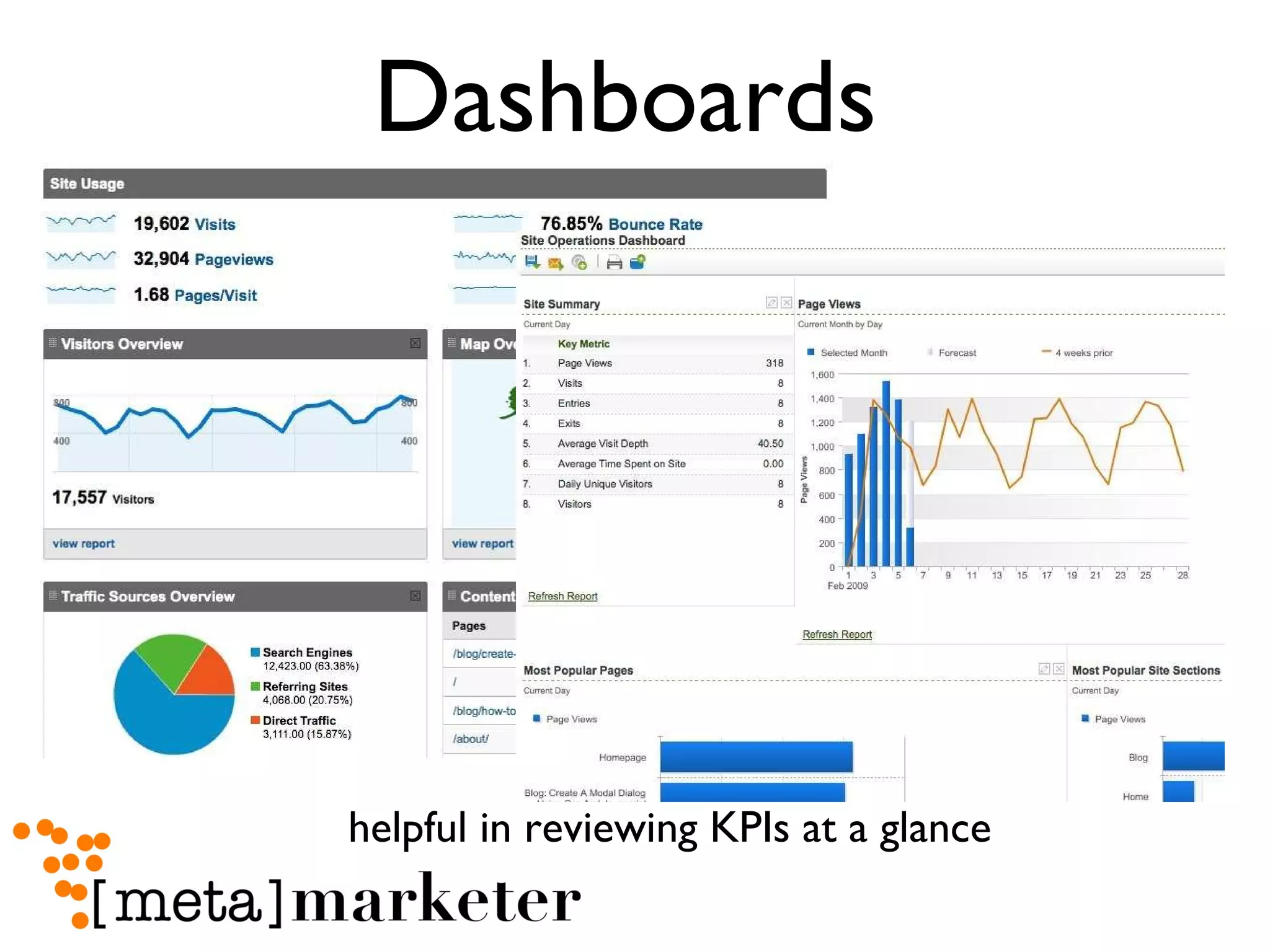
Dashboards helpful in reviewing KPIs at a glance
Traffic:  Who’s coming to the site?
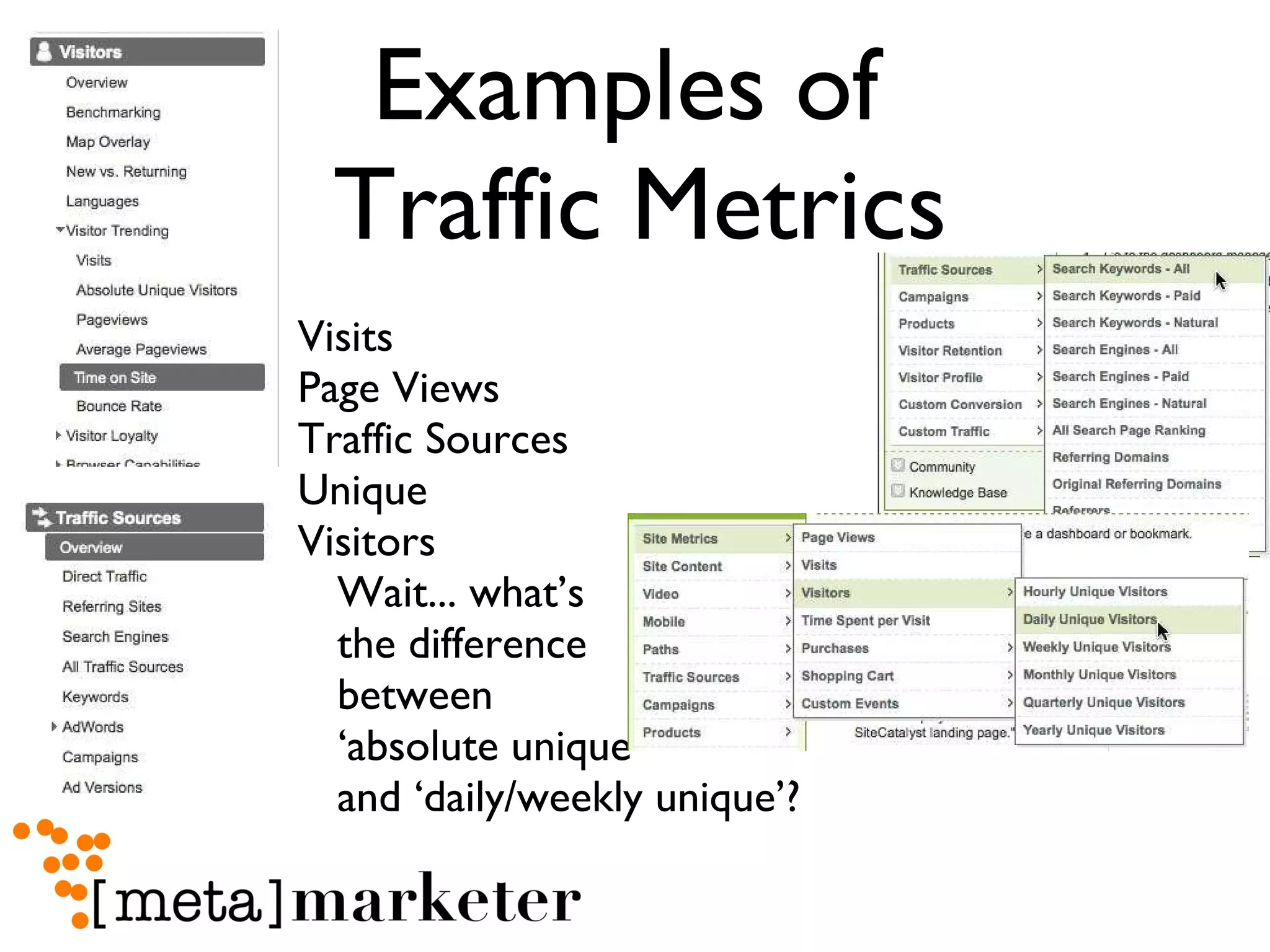
Examples of  Traffic Metrics Visits Page Views Traffic Sources Unique  Visitors Wait... what’s  the difference  between  ‘absolute unique’  and ‘daily/weekly unique’?
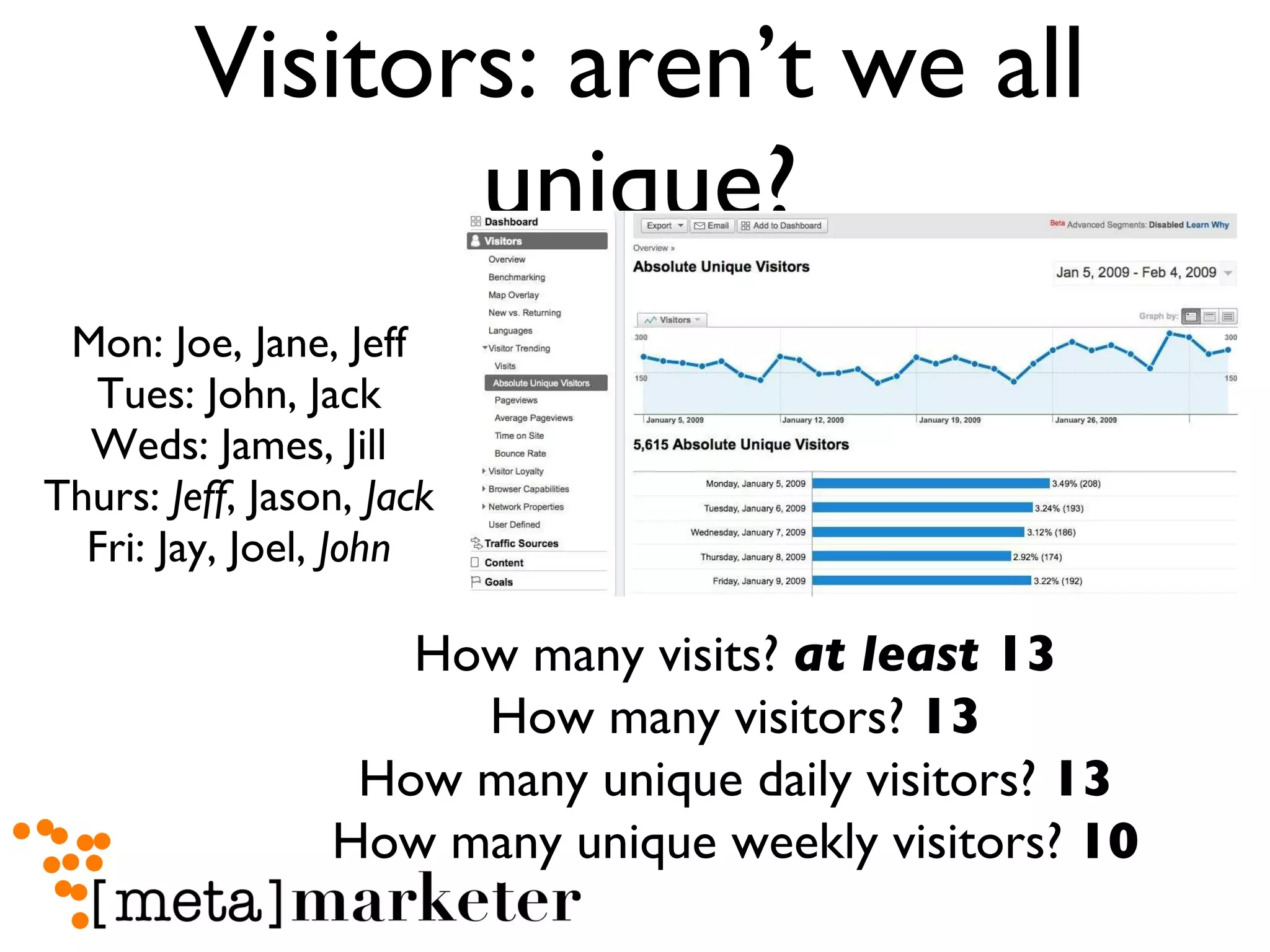
Visitors: aren’t we all unique? Mon: Joe, Jane, Jeff Tues: John, Jack Weds: James, Jill Thurs:  Jeff , Jason,  Jack Fri: Jay, Joel,  John How many visits?  at least  13 How many visitors?  13 How many unique daily visitors?  13 How many unique weekly visitors?  10
Engagement:  What’s happening once people get there?
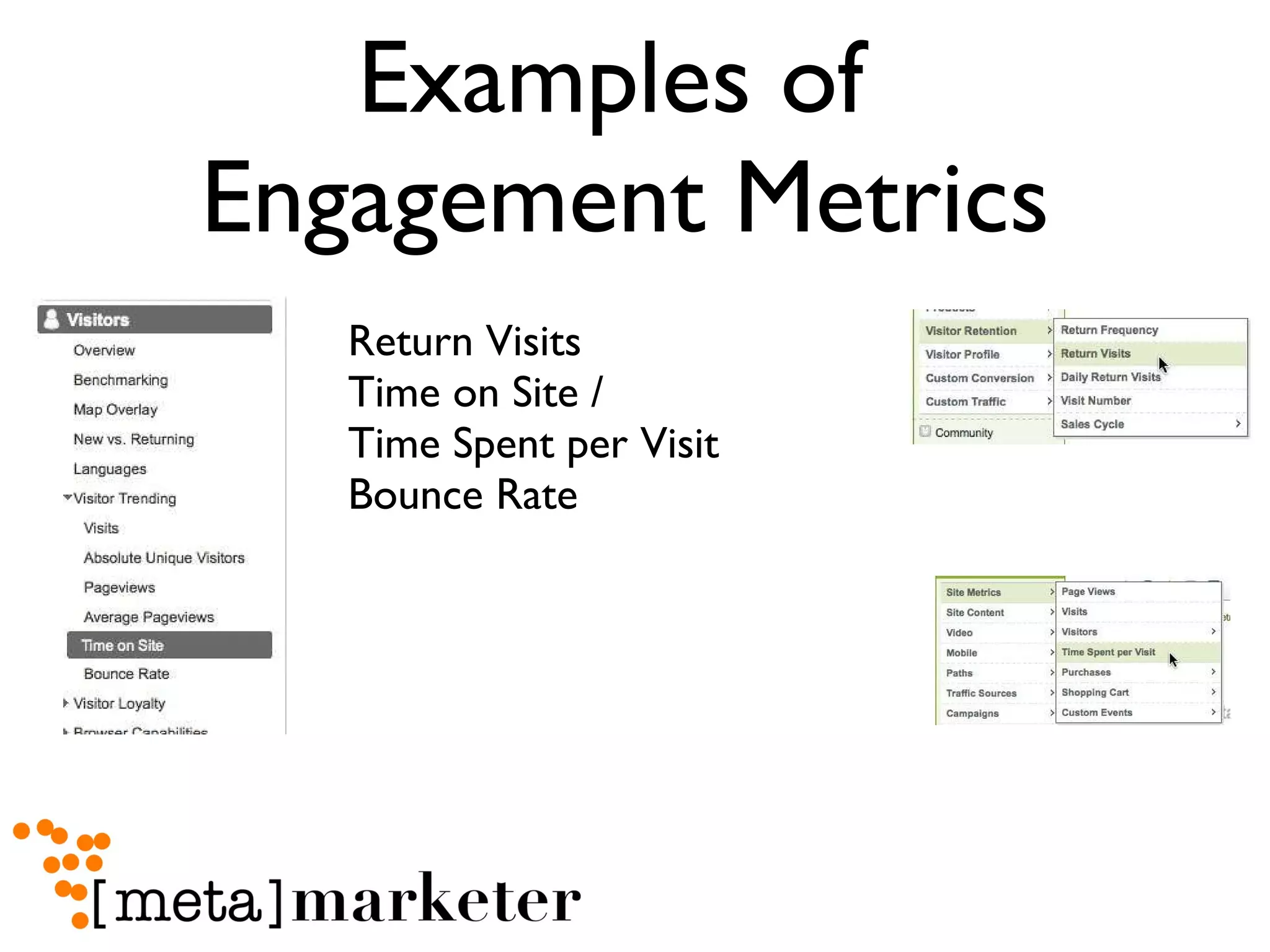
Examples of  Engagement Metrics Return Visits Time on Site /  Time Spent per Visit Bounce Rate
Are You Ready  for the  Social  Web?
Defining Social Media publishing power to the masses participation conversation accountability, transparency, measurability
What do we mean by social media?  Twitter, Facebook, MySpace, LinkedIn, blogs but also YouTube, Ning, Flickr, Vimeo, Bebo, Last.fm, imeem, Plaxo, Tumblr, etc.
 
 
Social Media Measurements
 
Traditional Marketing Path Awareness Preference Purchase Loyalty
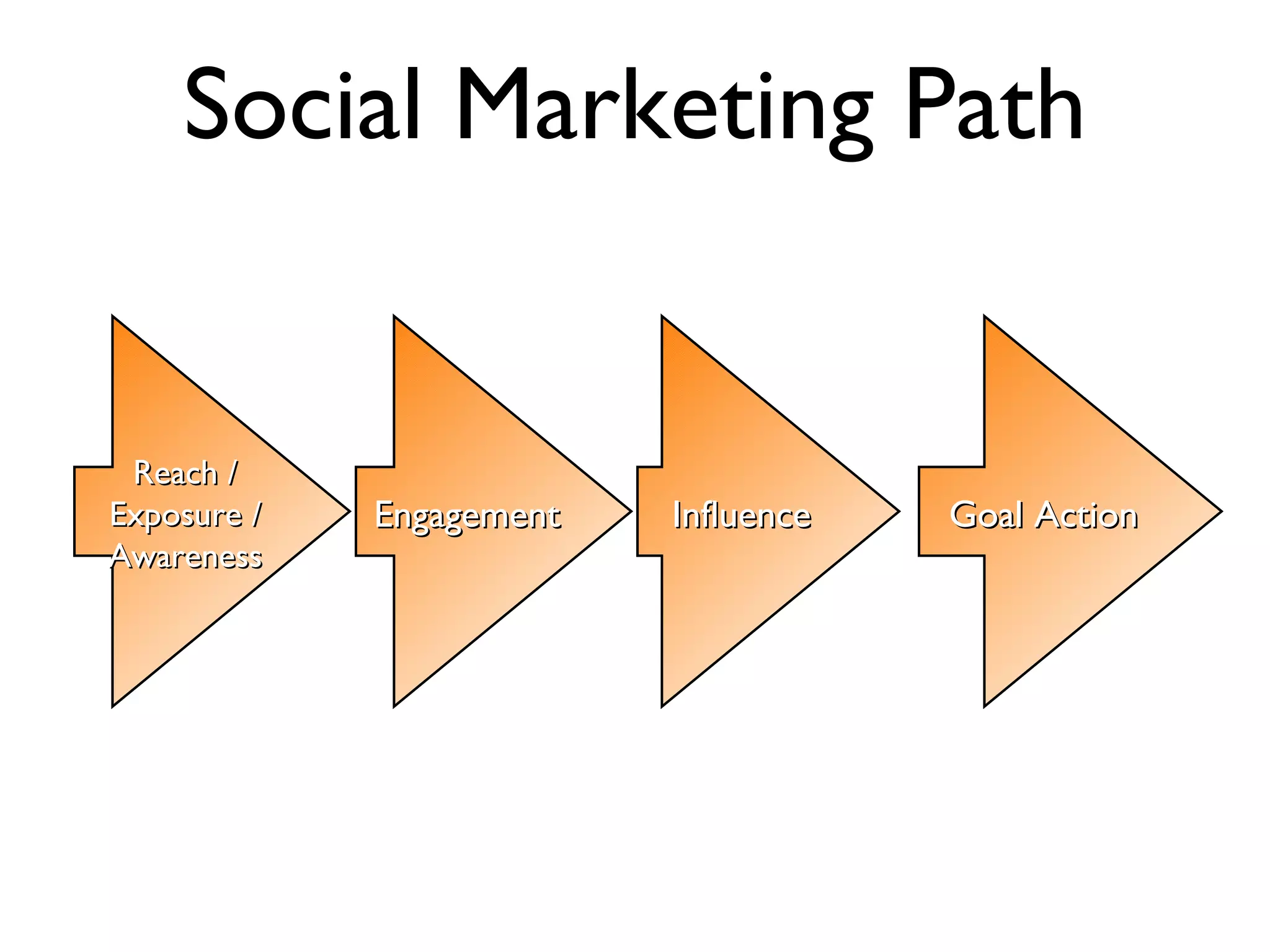
Social Marketing Path Reach / Exposure / Awareness Engagement Influence Goal Action
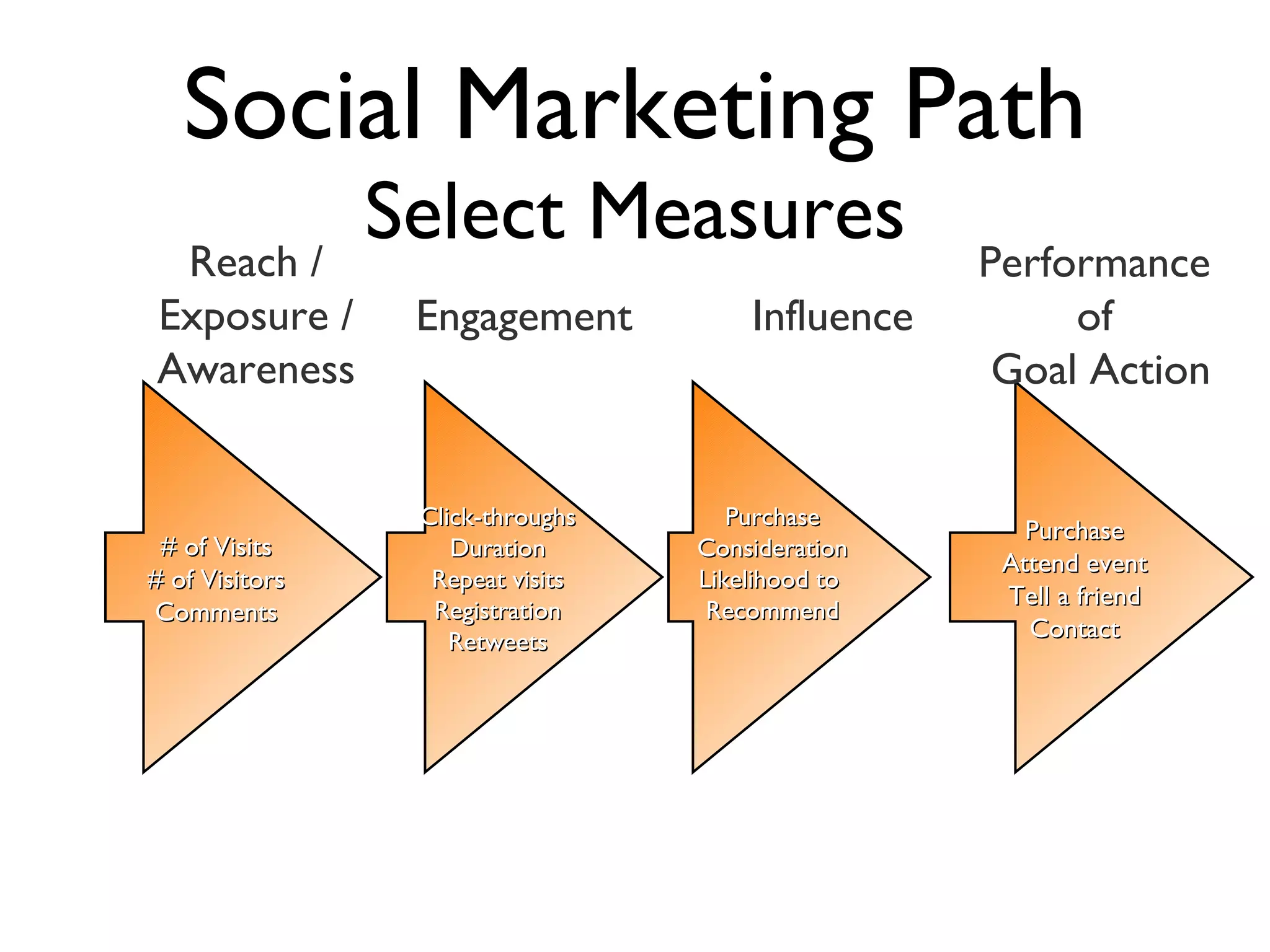
Social Marketing Path Select Measures # of Visits # of Visitors Comments Click-throughs Duration Repeat visits Registration Retweets Purchase Consideration Likelihood to  Recommend Purchase Attend event Tell a friend Contact Reach / Exposure / Awareness Engagement Influence Performance  of  Goal Action
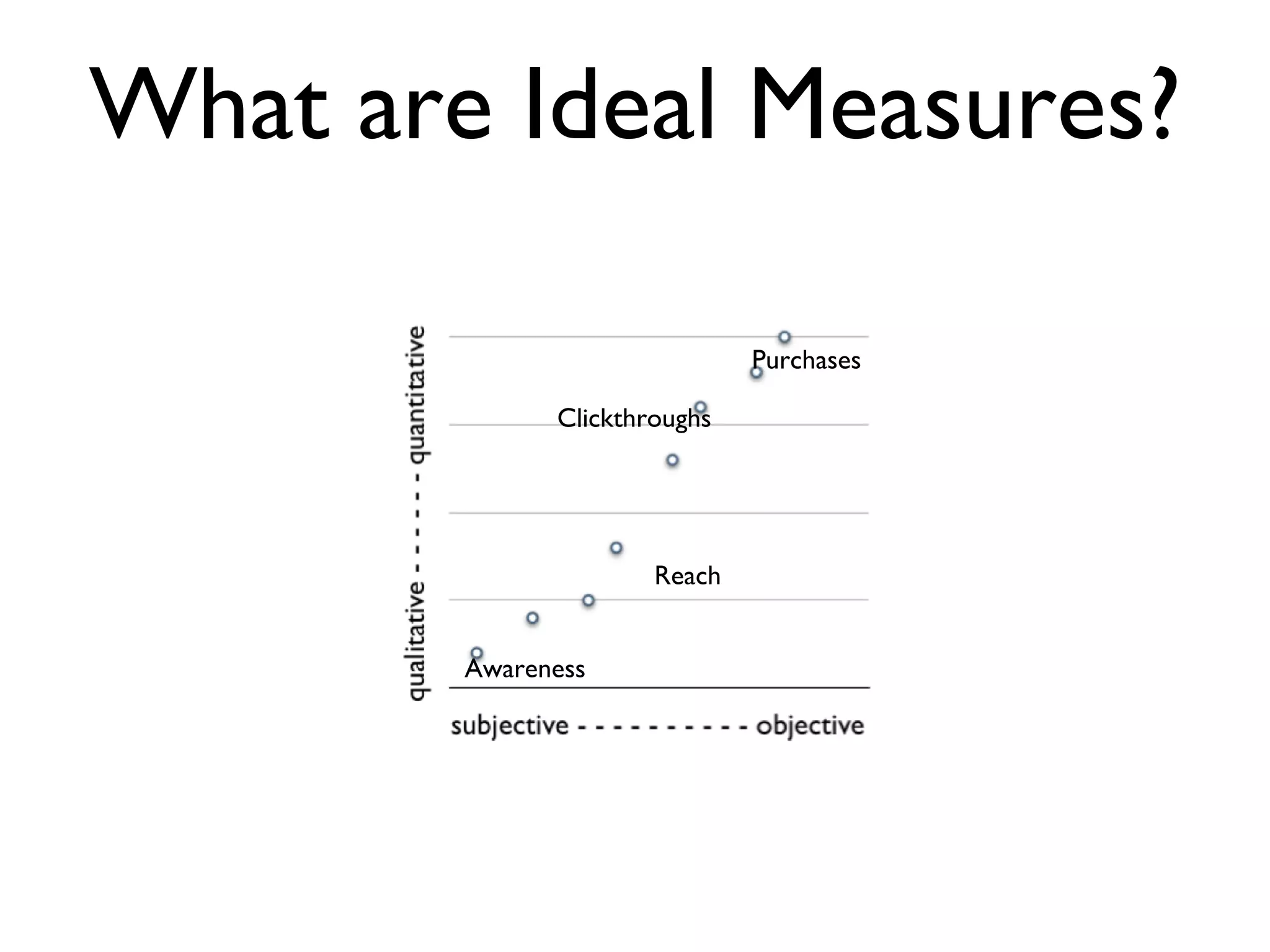
What are Ideal Measures? Reach Clickthroughs Purchases Awareness
 
Unprecedented Technologies: A Look at  Optimization
How are most  design decisions made?
HPPO H ighest P aid P erson’s O pinion Not irrelevant, but not comprehensive.
By Committee “I need my department to be featured on the home page!” “Can we use something  other than  red for the Buy buttons? I hate red.”
Designer’s Aesthetic Flash! Prettiness over performance
Finger in the Wind What seems to be trendy What someone mentioned at a party What’s reported in the news
In other words... in a vacuum.
How  should  design decisions be made?
You need user input. You are not your audience. Even if you are.
You need data. Users lie. Aggregate data doesn’t.
HPPO Data trumps opinions.  Even highly paid ones. Use conversion-related metrics  to determine executive-relevant  strengths and weaknesses of the site.
Committee If it isn’t interesting  to the user,  ditch it. Use engagement metrics  to determine what keeps users on the site.
Design for  Design’s Sake Think users like your design? Prove it. If your creative success can’t be measured,  it may not be valued.
Finger in  the Wind “ Great idea! I’ll add it to the testing roadmap.” Trendy ideas are worth knowing about. But they may not work in your situation.
Balance objective  and subjective input what people think or feel  versus  what people do
Balance qualitative  and quantitative input what you can intuit  versus  what you can measure
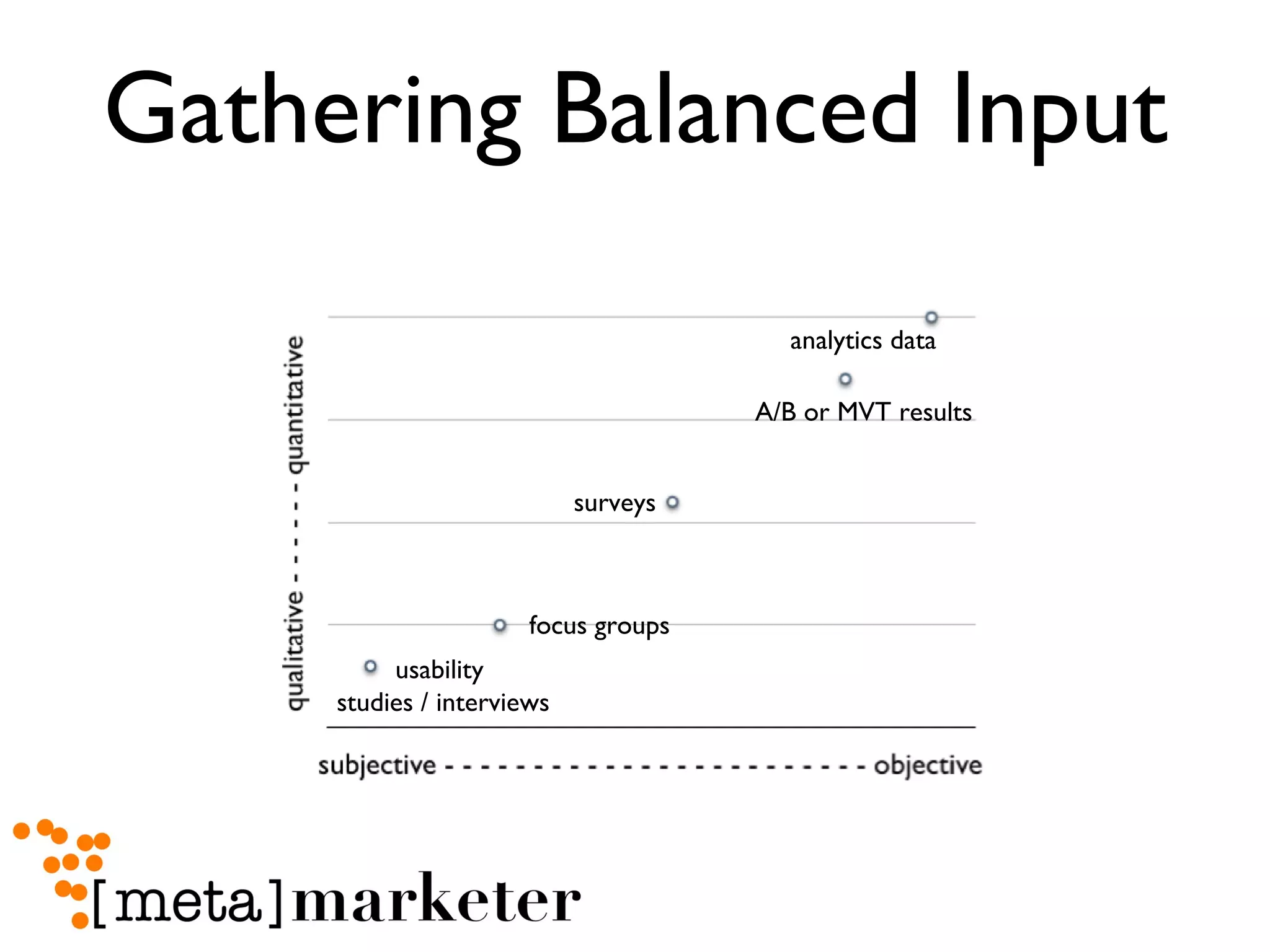
Gathering Balanced Input focus groups A/B or MVT results usability  studies / interviews surveys analytics data
What to do? Balance subjective & objective testing (And know that you may get it wrong) Find the story behind the story (But know that you may get it wrong) Look for a narrative in onsite testing (But know that you may get it wrong) Look for the unobvious AND the obvious (And know that you may get it wrong)

If you’re still going to get it wrong, why test? Because you can not only  measure lift  when you’re right...  (Woo hoo!) you can also  contain risk  when you’re wrong.  (And it just might save your job.) In short, test your way to greatness.
Customer Expectations Are Changing
What Customers  Have Come to Expect: Interaction : Through social channels, click to chat support, etc. Responsiveness : Replies to complaints on Twitter and elsewhere, fast  fast  FAST turnaround Customization : Ability to set up custom levels of interactions, or even better, learn without them telling you Relevance : Specific, targeted messaging and experiences Respect : Nothing foisted on them, no invasions of privacy or security
Q&A
Follow me? Twitter:  @kateo @metamarketer @corpidealist Facebook:  facebook.com/kateoneill LinkedIn:  linkedin.com/in/kateoneill Blogs:  metamarketer.com corporateidealist.com Email:  [email_address] [email_address] [email_address]

Analytics, Search, Social Media, and Optimization: Why Has Marketing Gotten So Geeky?

  • 1.
    Analytics, Search, Social Media, Optimization: Why Has Marketing Gotten So Geeky? presented by : Kate O’Neill CEO & Founding Partner, [meta]marketer
  • 2.
    Paging Dr. Drucker:“ The aim of marketing is to know and understand the customer so well the product or service fits him and sells itself.” “ Because the purpose of business is to create a customer, the business enterprise has two—and only two— basic functions: marketing and innovation. Marketing and innovation produce results; all the rest are costs. ”
  • 3.
    Traditional Marketing PathAwareness Preference Purchase Loyalty
  • 4.
    What’s changed? SearchSocial Analytics Technologies not to mention… customer expectations of relevance, usability, portability, etc. Let’s look at the landscape >
  • 5.
    How do youplan for all this?
  • 6.
  • 7.
    Let’s Talk About Search .
  • 8.
    What’s changing in the Web landscape?
  • 9.
    Remember the Pre-Search Web?
  • 10.
  • 11.
  • 12.
  • 13.
    Google changed everything .
  • 14.
    The Consequences ofGoogle Emphasis on ranking high in the ‘One True Search’ led to Emphasis on inbound links at any cost which led to Creation of web litter, spam sites, bogus articles, spam blog comments, questionable endorsements, an industry of “experts”, etc
  • 15.
    The Audacity of Google Facebook
  • 16.
    Facebook Moving In On Google’s Turf
  • 17.
    It’s (Almost) a Post-Search World, Baby But we’re a changed user base Bringing the mindset of shady SEO to social media (unfortunately) - manipulate results, rank high, add junk We’ve got hundreds of “experts” early in the game. Really?
  • 18.
    How Many ‘Experts’ Are There Really? 13,000? 36,000 ?
  • 19.
    It All ComesAround Eventually Twitter lists take us right back to the manual link-building, curation model Emphasis on “friendsourcing” vs “crowdsourcing”
  • 20.
    So: what’s changingin the Web landscape? Google > Facebook Search > Spontaneity Findability > Trustability
  • 21.
    And let’s notforget “the Cloud” Data portability Mobile apps & mobile web Location-based apps & games Augmented reality Context relevance takes on geography and proximity
  • 22.
    The “Burden ofProof” In a digital world, everything is potentially measurable Business insights need data and validation Marketing has the opportunity to move from the hot seat to the driver’s seat with the tools to inform the business
  • 23.
    Analytics : WithGreat Power Comes Great Accountability.
  • 24.
    Analytics Process at a Glance Determine KPIs What factors will determine success? What’s actionable? Establish a baseline Where are the pain points? What’s the range? Prioritize What’s most critical? What’s easiest? Validate Form a hypothesis Test Analyze Compare with baseline Extrapolate to ROI source: Omniture SiteCatalyst Basic User Training Workbook
  • 25.
    What’s measurable? TrafficSources (finding methods) Composition (visitor profile) Engagement Navigation Content Conversion "Not everything that can be counted counts, and not everything that counts can be counted." - Albert Einstein
  • 26.
    What’s meaningful? “Where in the site are visitors most often deciding to leave?” “ Where do visitors most often go after using the internal search?” “ Do visitors who come in on blog posts actually visit the rest of the site?” “ What search terms are used by the people who are most likely to purchase?” In other words: start with a good question .
  • 27.
    Planning is Keyto Analysis Anticipate Implement Modify Data collection begins! Incremental data only
  • 28.
    Conversion Metrics ConversionRate (Orders or Leads per Visit) Orders Revenue Leads Generated Offline Sales Completed
  • 29.
    Model the Siteidentify actions / events, content hierarchies, products (e-commerce), and potentially interesting characteristics
  • 30.
    Types of ReportsMetrics Trending Pathing Next Page / Previous Page Fall-out Dashboards
  • 31.
    Trending helpful inspotting anomalies in patterns
  • 32.
    Funnels helpful withpath fall-out visualization
  • 33.
    Page Flow helpfulin spotting content & navigation problems
  • 34.
    Dashboards helpful inreviewing KPIs at a glance
  • 35.
    Traffic: Who’scoming to the site?
  • 36.
    Examples of Traffic Metrics Visits Page Views Traffic Sources Unique Visitors Wait... what’s the difference between ‘absolute unique’ and ‘daily/weekly unique’?
  • 37.
    Visitors: aren’t weall unique? Mon: Joe, Jane, Jeff Tues: John, Jack Weds: James, Jill Thurs: Jeff , Jason, Jack Fri: Jay, Joel, John How many visits? at least 13 How many visitors? 13 How many unique daily visitors? 13 How many unique weekly visitors? 10
  • 38.
    Engagement: What’shappening once people get there?
  • 39.
    Examples of Engagement Metrics Return Visits Time on Site / Time Spent per Visit Bounce Rate
  • 40.
    Are You Ready for the Social Web?
  • 41.
    Defining Social Mediapublishing power to the masses participation conversation accountability, transparency, measurability
  • 42.
    What do wemean by social media? Twitter, Facebook, MySpace, LinkedIn, blogs but also YouTube, Ning, Flickr, Vimeo, Bebo, Last.fm, imeem, Plaxo, Tumblr, etc.
  • 43.
  • 44.
  • 45.
  • 46.
  • 47.
    Traditional Marketing PathAwareness Preference Purchase Loyalty
  • 48.
    Social Marketing PathReach / Exposure / Awareness Engagement Influence Goal Action
  • 49.
    Social Marketing PathSelect Measures # of Visits # of Visitors Comments Click-throughs Duration Repeat visits Registration Retweets Purchase Consideration Likelihood to Recommend Purchase Attend event Tell a friend Contact Reach / Exposure / Awareness Engagement Influence Performance of Goal Action
  • 50.
    What are IdealMeasures? Reach Clickthroughs Purchases Awareness
  • 51.
  • 52.
    Unprecedented Technologies: ALook at Optimization
  • 53.
    How are most design decisions made?
  • 54.
    HPPO H ighestP aid P erson’s O pinion Not irrelevant, but not comprehensive.
  • 55.
    By Committee “Ineed my department to be featured on the home page!” “Can we use something other than red for the Buy buttons? I hate red.”
  • 56.
    Designer’s Aesthetic Flash!Prettiness over performance
  • 57.
    Finger in theWind What seems to be trendy What someone mentioned at a party What’s reported in the news
  • 58.
    In other words...in a vacuum.
  • 59.
    How should design decisions be made?
  • 60.
    You need userinput. You are not your audience. Even if you are.
  • 61.
    You need data.Users lie. Aggregate data doesn’t.
  • 62.
    HPPO Data trumpsopinions. Even highly paid ones. Use conversion-related metrics to determine executive-relevant strengths and weaknesses of the site.
  • 63.
    Committee If itisn’t interesting to the user, ditch it. Use engagement metrics to determine what keeps users on the site.
  • 64.
    Design for Design’s Sake Think users like your design? Prove it. If your creative success can’t be measured, it may not be valued.
  • 65.
    Finger in the Wind “ Great idea! I’ll add it to the testing roadmap.” Trendy ideas are worth knowing about. But they may not work in your situation.
  • 66.
    Balance objective and subjective input what people think or feel versus what people do
  • 67.
    Balance qualitative and quantitative input what you can intuit versus what you can measure
  • 68.
    Gathering Balanced Inputfocus groups A/B or MVT results usability studies / interviews surveys analytics data
  • 69.
    What to do?Balance subjective & objective testing (And know that you may get it wrong) Find the story behind the story (But know that you may get it wrong) Look for a narrative in onsite testing (But know that you may get it wrong) Look for the unobvious AND the obvious (And know that you may get it wrong)
  • 70.
    If you’re stillgoing to get it wrong, why test? Because you can not only measure lift when you’re right... (Woo hoo!) you can also contain risk when you’re wrong. (And it just might save your job.) In short, test your way to greatness.
  • 71.
  • 72.
    What Customers Have Come to Expect: Interaction : Through social channels, click to chat support, etc. Responsiveness : Replies to complaints on Twitter and elsewhere, fast fast FAST turnaround Customization : Ability to set up custom levels of interactions, or even better, learn without them telling you Relevance : Specific, targeted messaging and experiences Respect : Nothing foisted on them, no invasions of privacy or security
  • 73.
  • 74.
    Follow me? Twitter: @kateo @metamarketer @corpidealist Facebook: facebook.com/kateoneill LinkedIn: linkedin.com/in/kateoneill Blogs: metamarketer.com corporateidealist.com Email: [email_address] [email_address] [email_address]

Editor's Notes

  • #6 back up to web analytics
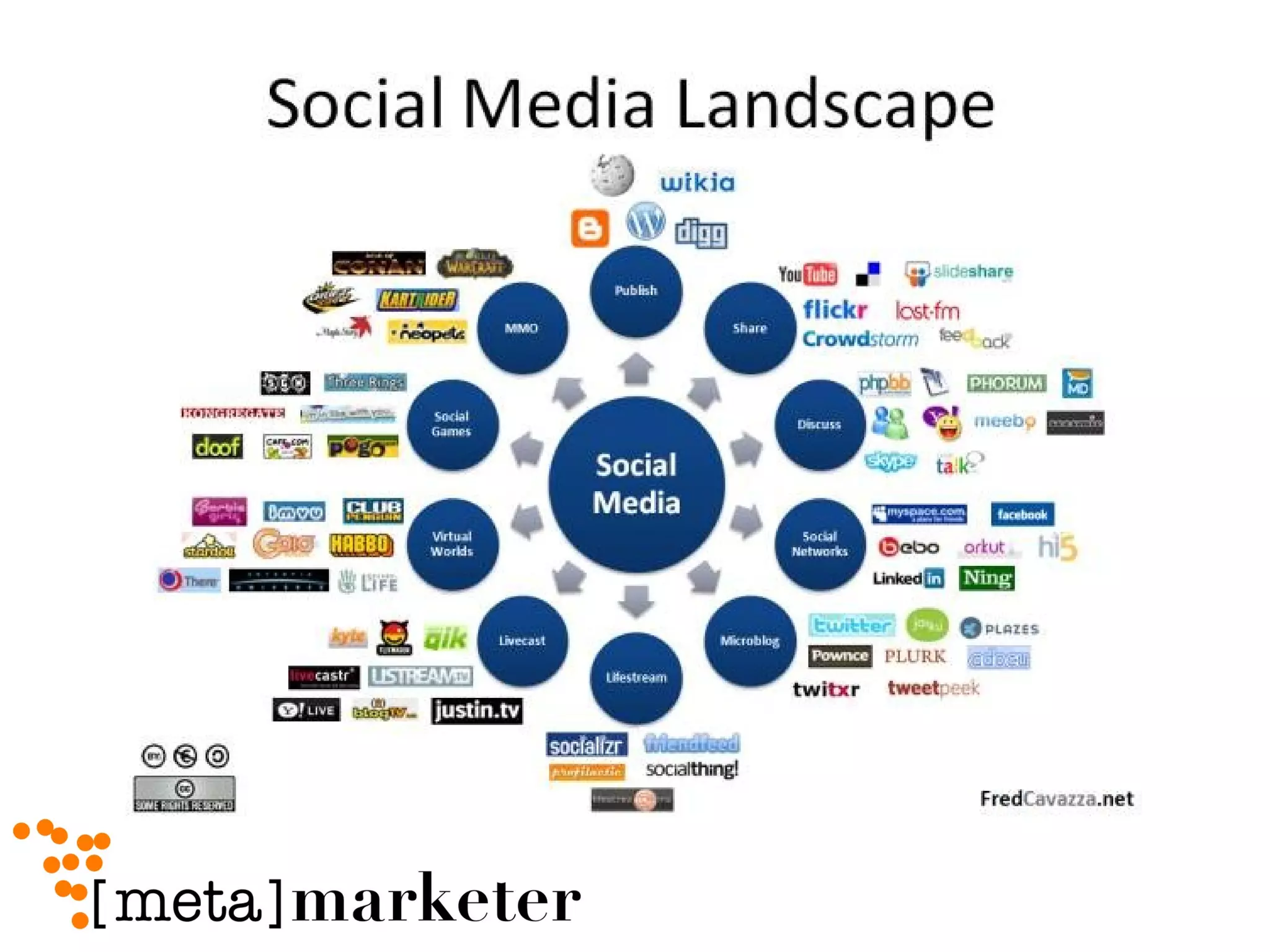
  • #44 As you can see, those different tools and services can be grouped into categories: Publication tools with blogs ( Typepad , Blogger …), wik is ( Wikipedia , Wik ia , Wetpa int …) and c itize n journ alism po rtals ( Digg , Newsvine …) Sharing tools for v ideo s ( You Tube …), pictures ( FlickR …), links ( del.icio.u s , Ma.g nolia …), music ( Last. fm , iL ike …), slideshows ( Slideshar e ), products reviews ( Crowdstorm , Stylehiv e …) or products feedb acks ( Feedback 2.0 , G etSatisfac tion …) Discussions tools like f orums ( PHP bb , vBulleti n , Phorum …), video forums ( Seesmic ), instant messaging ( Yahoo! Messeng er , Windows Liv e Messenger , Meebo …) and VoIP ( Skype , Google Talk …) So cial ne tworks ( F acebook , My Space , Bebo , Hi5 , Orkut …), nic he soci al networks ( LinkedIn , Boompa …) and tools for creating social n etworks ( Ning ) Micropu blication tools ( Twitter , Pow nce , Jaiku , Plurk , Adoc u …) and alike ( twi txr , tweetpeek ) Social aggregat ion tool s like lif estream ( FriendF eed , Socia liz r , So cialt hing! , lifestrea.ms , Profilactic …) Platf orms for l ivecas t hosting ( Justin.tv , BlogTV , Yahoo! Live , UStrea m …) and there mobile equivalent ( Q ik , Fli xwagon , K yte , L iveCastr …) Vi rtual w orlds ( Secon d Lif e , Entropia Univers e , The re …), 3D chats ( H abbo , IMVU …) and teens dedicated virtual universes ( S tardoll , C lub Penguin … ) Social gaming plat forms ( ImInL ikeWithYou , Do of …), casual gaming portal s ( Pogo , Ca fe , Kongregate …) and social networks enabeled games ( Th ree Rings , SGN ) M MO ( Neop ets , Gaia O nline , Kart R ider , D rift City , Maple Story ) and MMORPG ( Wor ld of Wa rcraft , A ge of Conan …)
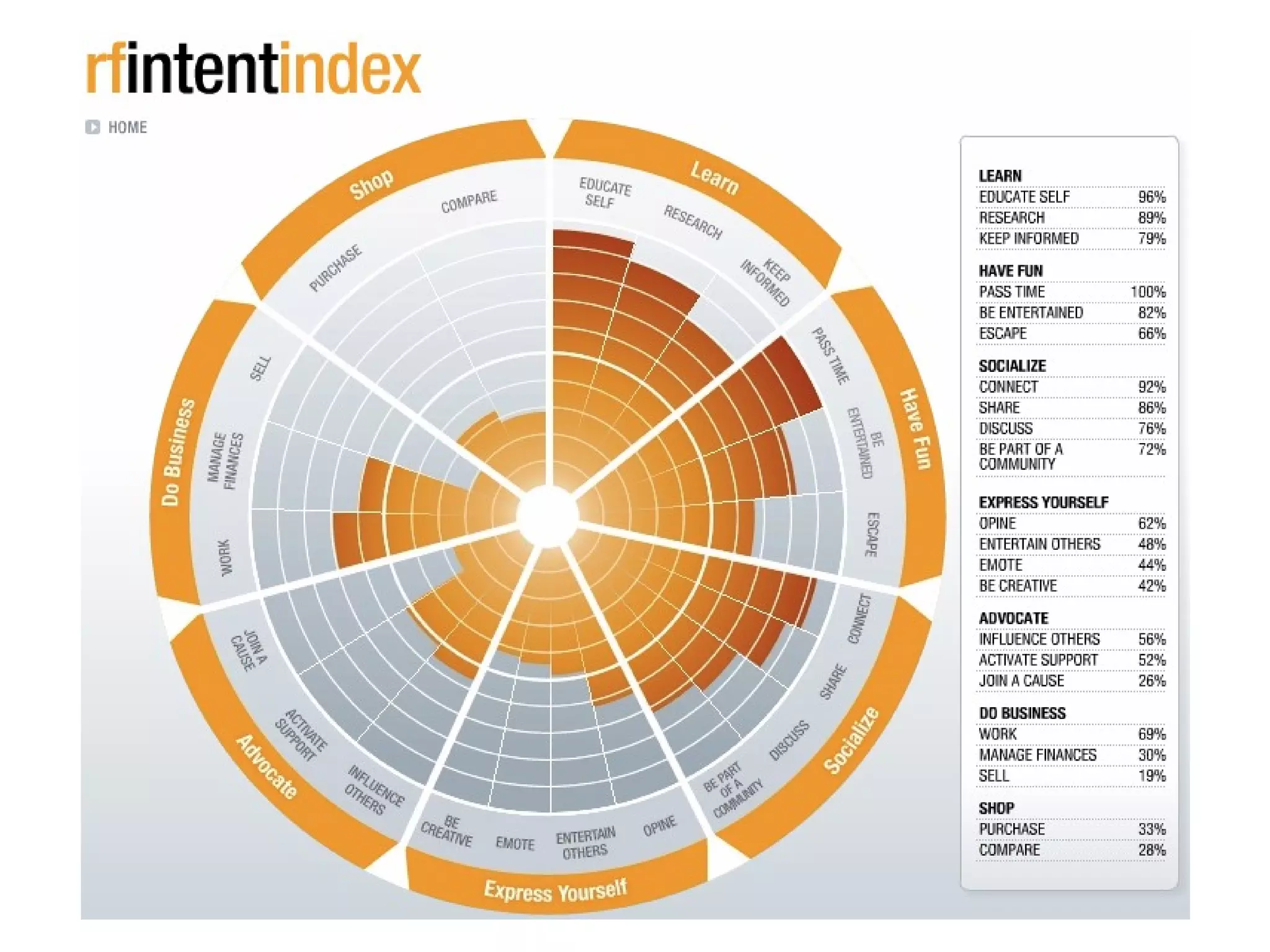
  • #47 why people are online
  • #52 just be prepared that you won’t know it all
  • #65 the acquisition of Omniture by Adobe in September is a clear argument for objectivity in design
  • #69 the only reason I have test results as less objective and less quantitative is that you’re often testing your own biases and can end up “proving” something that isn’t true across the board