Marketing Concept
Kulbir Singh
Introduction
A correct understanding of marketing concept is
fundamental to the study of modern marketing
and marketing management. Marketing Concept
has two words: Marketing and Concept. A
Concept is a philosophy, an attitude, a course of
thinking, an idea or notion relating to any aspect
of divine and human creations. The philosophy
of an organisation in the dynamic realm of
marketing is referred to as a Marketing concept.
Definition
The marketing concept can be defined as, “the
philosophy that an organization should try to
provide products that satisfy customers needs
through a coordinated set of activities that also
allows the organisation to achieve its goals”.
According to Prof, Robert, F, Hartley marketing
concept is, “An integration of marketing
activities directed towards customer
satisfaction”.
Types of Marketing Concepts
Traditional Concepts
• Exchange Concept: The Exchange concept holds
that the exchange of a product between the seller
and the buyer is the central idea of marketing.
• Production Concept: The production concept
holds that the consumer prefer the goods which are
easily available at lower prices. Therefore, it is
necessary to produce in large quantities at lower
costs.
• Product Concept: It is a belief of the management
that consumers favour the products of superior
quality, better performance and innovative features.
Therefore, successful marketing requires continuous
product planning and development and
improvement in quality standards.
• Selling Concept: This concept assumes that
consumers will not buy goods voluntarily unless the
seller undertakes a large scale selling and
promotional efforts. Selling to be effective, must be
preceded by reversal marketing activities such as
needs assessment marketing research, product
development, pricing and distribution.
Modern Concepts
• Marketing Concept: This is the modern concept of
marketing or marketing philosophy. This concept holds that
the primary task of a business firm is to study the needs,
desires and the preferences of the potential consumers and
produce goods which are actually needed by the
consumers. When an organisation practices the marketing
concept, all it’s activities are directed to satisfy the
consumer.
• Social Concepts: According to this concept, the task of
management is to identify and satisfy consumer wants, in
conformity with social interests. Firms should not only
consider consumer wants and profits but also society
interests while making their marketing decision.
Holistic Marketing Concept: Holistic marketing
concept is a new marketing concept. Holistic
marketing recognizes that “everything matters” with
marketing- and that a broad, integrated perspective is
often necessary. There are four components of
holistic marketing concept. They are…
• Relationship marketing
• Integrated marketing
• Internal marketing
• Social responsibility marketing
Features of Modern Marketing Concepts
• The consumer is the key. Therefore the satisfaction of
consumer is the prime object of an enterprise.
• A business enterprise has dual objectives of customer
satisfaction and profit maximization. Profit is a by-product
of supplying what the customer wants.
• Needs and wants of customers must be identified properly
and deeply before starting production.
• Goods must be produced according to these needs and
wants. In other words, these needs and wants must be
converted into goods and services.
• All the resources of production must be utilized to their
best extent so that the cost of production may be
minimized
• Every activity of an enterprise must start with the
customer and end with the satisfaction of customer.
• Customers are classified into groups in the basis of
income, life-style, education, age, volume of purchase etc.
(called market segmentation) and the firm chooses one of
the segments or classes of customers for presenting its
product or service. This selected segment is called target
market.
• Another feature of modern concept of marketing is
integrative marketing. It seeks to co-ordinate various
marketing functions such as advertising personnel,
finance, selling, product management etc., for the
ultimate objective of customer satisfaction.
• Modern marketing concept emphasizes the role of
information as the key to both customer satisfaction and
profitability.
Importance of Marketing
Importance to Business
• Awareness and recognition
• Helpful in planning and decision making
• Increased sales and profits
• Building trust
• Helpful in communication between society
and firm
Importance to consumer
• Educate people
• Customer satisfaction
• Provide good quality products
• Increase in knowledge
• Provides time and place utility
• Provides marketing information
Importance to society
• Marketing helps to achieve, maintain and raise
the standard of living of the society
• Marketing helps to increase national income
• Marketing provides employment
opportunities
• To maintain economic stability and
development
• Development of agriculture and industries
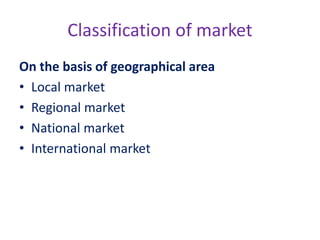
Classification of market
On the basis of geographical area
• Local market
• Regional market
• National market
• International market
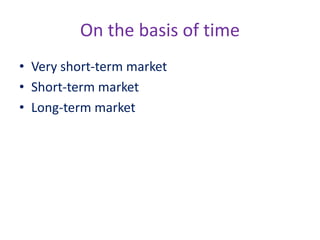
On the basis of time
• Very short-term market
• Short-term market
• Long-term market
On the basis of volume of business
• Wholesale market
• Retail market
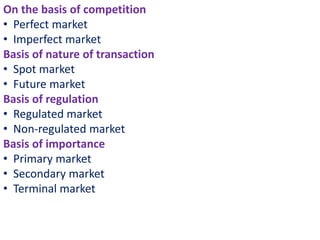
On the basis of competition
• Perfect market
• Imperfect market
Basis of nature of transaction
• Spot market
• Future market
Basis of regulation
• Regulated market
• Non-regulated market
Basis of importance
• Primary market
• Secondary market
• Terminal market
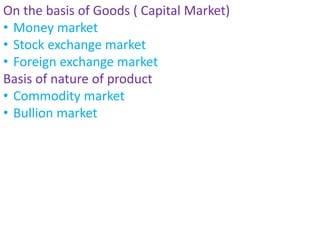
On the basis of Goods ( Capital Market)
• Money market
• Stock exchange market
• Foreign exchange market
Basis of nature of product
• Commodity market
• Bullion market
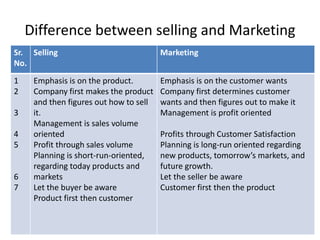
Difference between selling and Marketing
Sr.
No.
Selling Marketing
1
2
3
4
5
6
7
Emphasis is on the product.
Company first makes the product
and then figures out how to sell
it.
Management is sales volume
oriented
Profit through sales volume
Planning is short-run-oriented,
regarding today products and
markets
Let the buyer be aware
Product first then customer
Emphasis is on the customer wants
Company first determines customer
wants and then figures out to make it
Management is profit oriented
Profits through Customer Satisfaction
Planning is long-run oriented regarding
new products, tomorrow’s markets, and
future growth.
Let the seller be aware
Customer first then the product
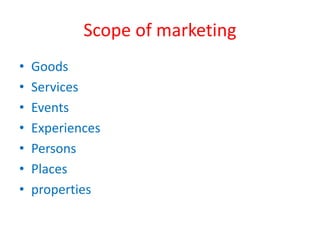
Scope of marketing
• Goods
• Services
• Events
• Experiences
• Persons
• Places
• properties
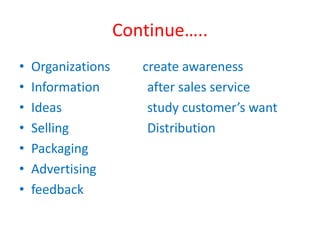
Continue…..
• Organizations create awareness
• Information after sales service
• Ideas study customer’s want
• Selling Distribution
• Packaging
• Advertising
• feedback
Thanks

Marketing Concept.pptx

  • 1.
  • 2.
    Introduction A correct understandingof marketing concept is fundamental to the study of modern marketing and marketing management. Marketing Concept has two words: Marketing and Concept. A Concept is a philosophy, an attitude, a course of thinking, an idea or notion relating to any aspect of divine and human creations. The philosophy of an organisation in the dynamic realm of marketing is referred to as a Marketing concept.
  • 3.
    Definition The marketing conceptcan be defined as, “the philosophy that an organization should try to provide products that satisfy customers needs through a coordinated set of activities that also allows the organisation to achieve its goals”. According to Prof, Robert, F, Hartley marketing concept is, “An integration of marketing activities directed towards customer satisfaction”.
  • 4.
    Types of MarketingConcepts Traditional Concepts • Exchange Concept: The Exchange concept holds that the exchange of a product between the seller and the buyer is the central idea of marketing. • Production Concept: The production concept holds that the consumer prefer the goods which are easily available at lower prices. Therefore, it is necessary to produce in large quantities at lower costs.
  • 5.
    • Product Concept:It is a belief of the management that consumers favour the products of superior quality, better performance and innovative features. Therefore, successful marketing requires continuous product planning and development and improvement in quality standards. • Selling Concept: This concept assumes that consumers will not buy goods voluntarily unless the seller undertakes a large scale selling and promotional efforts. Selling to be effective, must be preceded by reversal marketing activities such as needs assessment marketing research, product development, pricing and distribution.
  • 6.
    Modern Concepts • MarketingConcept: This is the modern concept of marketing or marketing philosophy. This concept holds that the primary task of a business firm is to study the needs, desires and the preferences of the potential consumers and produce goods which are actually needed by the consumers. When an organisation practices the marketing concept, all it’s activities are directed to satisfy the consumer. • Social Concepts: According to this concept, the task of management is to identify and satisfy consumer wants, in conformity with social interests. Firms should not only consider consumer wants and profits but also society interests while making their marketing decision.
  • 7.
    Holistic Marketing Concept:Holistic marketing concept is a new marketing concept. Holistic marketing recognizes that “everything matters” with marketing- and that a broad, integrated perspective is often necessary. There are four components of holistic marketing concept. They are… • Relationship marketing • Integrated marketing • Internal marketing • Social responsibility marketing
  • 8.
    Features of ModernMarketing Concepts • The consumer is the key. Therefore the satisfaction of consumer is the prime object of an enterprise. • A business enterprise has dual objectives of customer satisfaction and profit maximization. Profit is a by-product of supplying what the customer wants. • Needs and wants of customers must be identified properly and deeply before starting production. • Goods must be produced according to these needs and wants. In other words, these needs and wants must be converted into goods and services. • All the resources of production must be utilized to their best extent so that the cost of production may be minimized
  • 9.
    • Every activityof an enterprise must start with the customer and end with the satisfaction of customer. • Customers are classified into groups in the basis of income, life-style, education, age, volume of purchase etc. (called market segmentation) and the firm chooses one of the segments or classes of customers for presenting its product or service. This selected segment is called target market. • Another feature of modern concept of marketing is integrative marketing. It seeks to co-ordinate various marketing functions such as advertising personnel, finance, selling, product management etc., for the ultimate objective of customer satisfaction. • Modern marketing concept emphasizes the role of information as the key to both customer satisfaction and profitability.
  • 10.
    Importance of Marketing Importanceto Business • Awareness and recognition • Helpful in planning and decision making • Increased sales and profits • Building trust • Helpful in communication between society and firm
  • 11.
    Importance to consumer •Educate people • Customer satisfaction • Provide good quality products • Increase in knowledge • Provides time and place utility • Provides marketing information
  • 12.
    Importance to society •Marketing helps to achieve, maintain and raise the standard of living of the society • Marketing helps to increase national income • Marketing provides employment opportunities • To maintain economic stability and development • Development of agriculture and industries
  • 13.
    Classification of market Onthe basis of geographical area • Local market • Regional market • National market • International market
  • 14.
    On the basisof time • Very short-term market • Short-term market • Long-term market
  • 15.
    On the basisof volume of business • Wholesale market • Retail market
  • 16.
    On the basisof competition • Perfect market • Imperfect market Basis of nature of transaction • Spot market • Future market Basis of regulation • Regulated market • Non-regulated market Basis of importance • Primary market • Secondary market • Terminal market
  • 17.
    On the basisof Goods ( Capital Market) • Money market • Stock exchange market • Foreign exchange market Basis of nature of product • Commodity market • Bullion market
  • 18.
    Difference between sellingand Marketing Sr. No. Selling Marketing 1 2 3 4 5 6 7 Emphasis is on the product. Company first makes the product and then figures out how to sell it. Management is sales volume oriented Profit through sales volume Planning is short-run-oriented, regarding today products and markets Let the buyer be aware Product first then customer Emphasis is on the customer wants Company first determines customer wants and then figures out to make it Management is profit oriented Profits through Customer Satisfaction Planning is long-run oriented regarding new products, tomorrow’s markets, and future growth. Let the seller be aware Customer first then the product
  • 19.
    Scope of marketing •Goods • Services • Events • Experiences • Persons • Places • properties
  • 20.
    Continue….. • Organizations createawareness • Information after sales service • Ideas study customer’s want • Selling Distribution • Packaging • Advertising • feedback
  • 21.