Social Network Analysis
         Tuesday 6th December 2011
Using Social Graph constructs to understand user
  behaviour, recommendations and influence
 Marketing Analytics Conference
         Alpesh Doshi, Fintricity
Social Graphs and their application
Agenda

• What is a Social Graph? Social Network
  Analysis?
• Examples of Graphs
• Characteristics of Social Graphs?
• How can you use Graphs in the real world?
• The Future
• Summary
What is a Social Graph? Social Network Analysis
The definitions of these set the foundation of a network of social
objects a foundation for a new business approach
• Social Network Analysis (SNA) has its origins in
  both social science and network theory and graph
  theory
   – Network Theory concerns itself with the formulation and solution
     of problems that have a network structure – usually captured in a
     graph
   – Graph Theory provides a set of abstract concepts and methods
     for the analysis of graphs
• Social Graph - The social graph is a term coined by scientists
  working in the social areas of graph theory. It has been described as
  "the global mapping of everybody and how they're related". The term
  was popularized at the Facebook
What is a Social Graph?
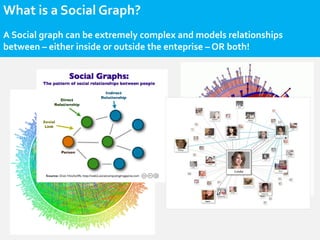
A Social graph can be extremely complex and models relationships
between – either inside or outside the enteprise – OR both!
What is a Social Graph?
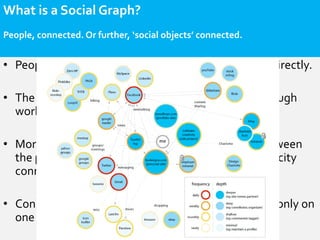
People, connected. Or further, ‘social objects’ connected.


• People are connected to each other directly and indirectly.

• The way they are connected varies. It could be through
  work, friendship, common interests, etc.

• More importantly, there is something common between
  the people that are connected. An implicity or explicity
  connection

• Connections are spread across the social web – not only on
  one site or application
What could you capture on a Social Graph?
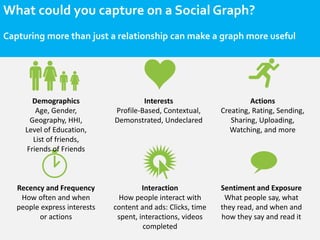
Capturing more than just a relationship can make a graph more useful


       Demographics                    Interests                       Actions
        Age, Gender,          Profile-Based, Contextual,      Creating, Rating, Sending,
      Geography, HHI,         Demonstrated, Undeclared           Sharing, Uploading,
     Level of Education,                                        Watching, and more
       List of friends,
     Friends of Friends


   Recency and Frequency               Interaction            Sentiment and Exposure
    How often and when         How people interact with        What people say, what
   people express interests   content and ads: Clicks, time   they read, and when and
         or actions            spent, interactions, videos    how they say and read it
                                       completed
Some Characteristics of a graph
Multi-relational graphs are the foundation. These are graphs where
relationships are described in more than one way.
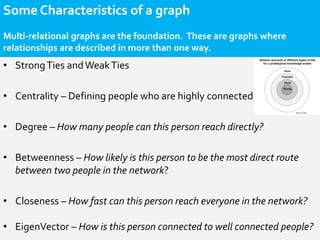
• Strong Ties and Weak Ties

• Centrality – Defining people who are highly connected

• Degree – How many people can this person reach directly?

• Betweenness – How likely is this person to be the most direct route
  between two people in the network?

• Closeness – How fast can this person reach everyone in the network?

• EigenVector – How is this person connected to well connected people?
Where can you use Graphs?
How can you apply social graphs, and social network analysis for business
benefit? Some examples

•   Recommendation Engines
•   Interest Graphs
•   Influence Networks
•   Sentiment Analysis
•   Searching, Scoring, Ranking
Where can you use Graphs? Recommendation
Recommendation engines are a natural fit for graphs.


• Recommendation engines need a ‘boost’ –
  and can apply to many different types of
  recommendation
   •   Recommend to read articles/content
   •   Recommend collaborators
   •   Recommend sites to post content
   •   Recommend people with similar interests
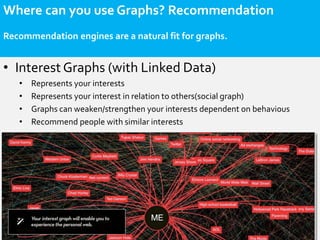
Where can you use Graphs? Recommendation
Recommendation engines are a natural fit for graphs.


• Interest Graphs (with Linked Data)
   •   Represents your interests
   •   Represents your interest in relation to others(social graph)
   •   Graphs can weaken/strengthen your interests dependent on behavious
   •   Recommend people with similar interests
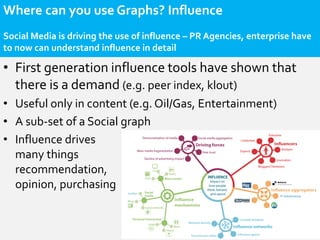
Where can you use Graphs? Influence
Social Media is driving the use of influence – PR Agencies, enterprise have
to now can understand influence in detail

• First generation influence tools have shown that
  there is a demand (e.g. peer index, klout)
• Useful only in content (e.g. Oil/Gas, Entertainment)
• A sub-set of a Social graph
• Influence drives
  many things
  recommendation,
  opinion, purchasing
Where can you use Graphs? Searching, Scoring, Ranking
This can help identify and segment users by different categories together with the
social graph

• Searching
    • Combining a social graph with linked data (semantics and ontologies)
    • Graphs can be searched in different ways to discover relevant information


• Scoring
    • Score individuals, content, objects to create patterns of associations
    • Can be used for targeted advertising, content selection


• Ranking
   • Ranking use, importance, connectedness etc
   • Marketing uses included finding the most important customers
     (together with modelling influence
Conclusions
Social Graphs will change the way marketing is done in the future. It will
become a fabric and key component in any marketing activity
• Social Graphs are not new!

• But their uses in marketing are nascent

• The implementation of a scalable graph database technology is
  relatively new – therefore can better implement solutions around
  this space.

• Application of social graphs to marketing allow more targeted,
  integrated and cost effective solutions
Questions?
                                  Alpesh Doshi, Fintricity
                                 e: alpesh.doshi@fintricity.com
                                 o: +44 870 020 1656, m: +44 7973 822820
                                 Linkedin: www.linkedin.com/in/alpeshdoshi
                                 Twitter: @alpeshdoshi


Content from this presentation taken from Giorgos Cheliotis under Creative Commons

Marketing analytics alpesh doshi social network analysis - using social graph constructs

  • 1.
    Social Network Analysis Tuesday 6th December 2011 Using Social Graph constructs to understand user behaviour, recommendations and influence Marketing Analytics Conference Alpesh Doshi, Fintricity
  • 2.
    Social Graphs andtheir application Agenda • What is a Social Graph? Social Network Analysis? • Examples of Graphs • Characteristics of Social Graphs? • How can you use Graphs in the real world? • The Future • Summary
  • 3.
    What is aSocial Graph? Social Network Analysis The definitions of these set the foundation of a network of social objects a foundation for a new business approach • Social Network Analysis (SNA) has its origins in both social science and network theory and graph theory – Network Theory concerns itself with the formulation and solution of problems that have a network structure – usually captured in a graph – Graph Theory provides a set of abstract concepts and methods for the analysis of graphs • Social Graph - The social graph is a term coined by scientists working in the social areas of graph theory. It has been described as "the global mapping of everybody and how they're related". The term was popularized at the Facebook
  • 4.
    What is aSocial Graph? A Social graph can be extremely complex and models relationships between – either inside or outside the enteprise – OR both!
  • 5.
    What is aSocial Graph? People, connected. Or further, ‘social objects’ connected. • People are connected to each other directly and indirectly. • The way they are connected varies. It could be through work, friendship, common interests, etc. • More importantly, there is something common between the people that are connected. An implicity or explicity connection • Connections are spread across the social web – not only on one site or application
  • 6.
    What could youcapture on a Social Graph? Capturing more than just a relationship can make a graph more useful Demographics Interests Actions Age, Gender, Profile-Based, Contextual, Creating, Rating, Sending, Geography, HHI, Demonstrated, Undeclared Sharing, Uploading, Level of Education, Watching, and more List of friends, Friends of Friends Recency and Frequency Interaction Sentiment and Exposure How often and when How people interact with What people say, what people express interests content and ads: Clicks, time they read, and when and or actions spent, interactions, videos how they say and read it completed
  • 7.
    Some Characteristics ofa graph Multi-relational graphs are the foundation. These are graphs where relationships are described in more than one way. • Strong Ties and Weak Ties • Centrality – Defining people who are highly connected • Degree – How many people can this person reach directly? • Betweenness – How likely is this person to be the most direct route between two people in the network? • Closeness – How fast can this person reach everyone in the network? • EigenVector – How is this person connected to well connected people?
  • 8.
    Where can youuse Graphs? How can you apply social graphs, and social network analysis for business benefit? Some examples • Recommendation Engines • Interest Graphs • Influence Networks • Sentiment Analysis • Searching, Scoring, Ranking
  • 9.
    Where can youuse Graphs? Recommendation Recommendation engines are a natural fit for graphs. • Recommendation engines need a ‘boost’ – and can apply to many different types of recommendation • Recommend to read articles/content • Recommend collaborators • Recommend sites to post content • Recommend people with similar interests
  • 10.
    Where can youuse Graphs? Recommendation Recommendation engines are a natural fit for graphs. • Interest Graphs (with Linked Data) • Represents your interests • Represents your interest in relation to others(social graph) • Graphs can weaken/strengthen your interests dependent on behavious • Recommend people with similar interests
  • 11.
    Where can youuse Graphs? Influence Social Media is driving the use of influence – PR Agencies, enterprise have to now can understand influence in detail • First generation influence tools have shown that there is a demand (e.g. peer index, klout) • Useful only in content (e.g. Oil/Gas, Entertainment) • A sub-set of a Social graph • Influence drives many things recommendation, opinion, purchasing
  • 12.
    Where can youuse Graphs? Searching, Scoring, Ranking This can help identify and segment users by different categories together with the social graph • Searching • Combining a social graph with linked data (semantics and ontologies) • Graphs can be searched in different ways to discover relevant information • Scoring • Score individuals, content, objects to create patterns of associations • Can be used for targeted advertising, content selection • Ranking • Ranking use, importance, connectedness etc • Marketing uses included finding the most important customers (together with modelling influence
  • 13.
    Conclusions Social Graphs willchange the way marketing is done in the future. It will become a fabric and key component in any marketing activity • Social Graphs are not new! • But their uses in marketing are nascent • The implementation of a scalable graph database technology is relatively new – therefore can better implement solutions around this space. • Application of social graphs to marketing allow more targeted, integrated and cost effective solutions
  • 14.
    Questions? Alpesh Doshi, Fintricity e: alpesh.doshi@fintricity.com o: +44 870 020 1656, m: +44 7973 822820 Linkedin: www.linkedin.com/in/alpeshdoshi Twitter: @alpeshdoshi Content from this presentation taken from Giorgos Cheliotis under Creative Commons