MARKET
STRUCTURE
Market
▪ Market is a place (need not be any physical entity) where the sales
and purchases of goods and services are taken place.
▪ The parties involved are usually buyers and sellers.
▪ It could be physical place, where the parties meet face-to-face.
▪ It could also be a virtual (online) market – no physical (direct) contact
between buyers and sellers.
▪ Technically a market is any place where two or more parties can meet
to engage in an economic transaction
▪ A market transaction may involve goods, services, information,
currency, or any combination of these that pass from one party to
another.
Market Structure
▪ Market structure is the organisational characteristics of a
market.
▪ The organisational characteristics are mainly relied on nature of
competition and pricing.
▪ The organisational characteristics relied on two sides of every
market – demand and supply
▪ The way in which these two components explains how the
market as a whole behaves.
Key Features of Market Structure
The existence of several market structures is based on these important
characteristics.
▪ Number of sellers and buyers – they are the agents in the market,
▪ The relative ability of these agents to set the price in the market.
▪ The degree of concentration among the agents in the market –
explains the market share.
▪ The degree of uniqueness and differentiation of the products and
services – how the company’s offerings differ from the other
company’s offerings.
▪ The goal of all firms is profit maximisation.
Key Features of Market Structure
▪ The economies of scale – determine how cost efficient a
firm is in producing the goods and services at a low cost.
▪ The degree of vertical integration – the combining of
different stages of production and distribution, managed by
a single firm.
▪ The freedom of entry to the market and exit from the
market.
▪ The customer turnover – the number of customers willing to
change their choice with respect to the goods and services
at the time of adverse market conditions.
Role of Time Element in the Determination of Value
▪ Alfred Marshall, who propounded the theory explaining demand and supply as the
determinants of price.
▪ The adjustments in supply largely depends on time.
▪ According to him, time is short or long according to the extent to which supply can
adjust itself.
▪ A period of time is required for changes to be made in the size, scale and
organisation of firms as well as of the industry.
▪ Marshall divided time into different periods from the viewpoint of supply.
Market Period Short Run Long Run
Role of Time Element in the Determination of Value
▪ The market period is a very short period in which the supply is fixed,
that is, no adjustment can take place in supply conditions.
Market Period
Short Run
▪ Short run is a period in which supply can be adjusted to a limited
extent.
▪ During the short period the firms can expand output with given
equipment by changing the amounts of variable factors employed.
▪ There will be fixed cost in the short-run.
Role of Time Element in the Determination of Value
▪ The long run is a period long enough to permit the firms to build new
plants or abandon old ones.
▪ In the long run new firms can enter into the industry and existing firms
may leave the industry.
▪ All costs in the long-run will be considered as variable costs.
▪ During the long period forces of supply fully adjust them to a given
change in demand
▪ the size of individual firms as well as the size of the whole industry
expands or contracts according to the requirements of the demand.
Long Run
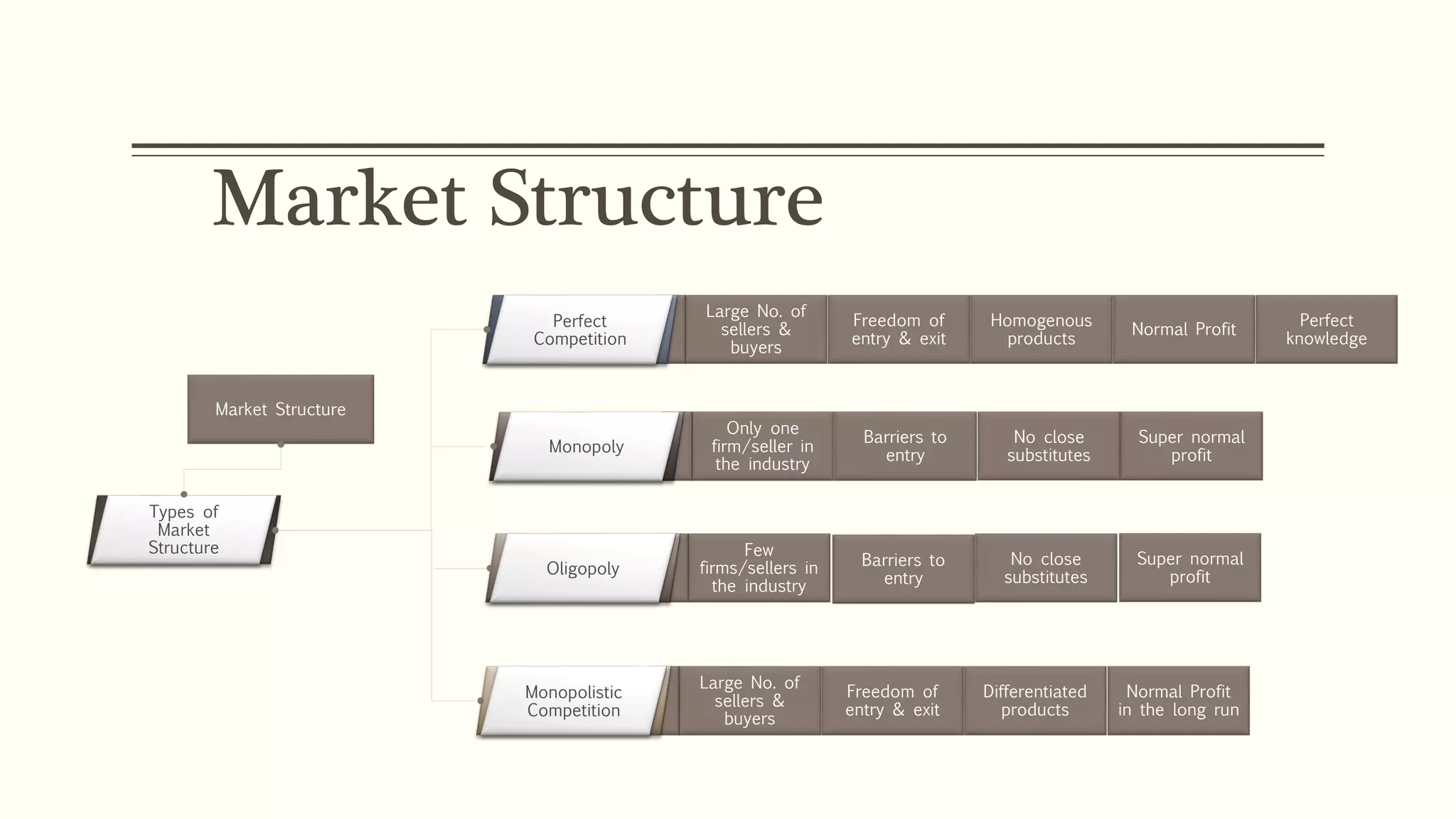
Market Structure
Large No. of
sellers &
buyers
Only one
firm/seller in
the industry
Few
firms/sellers in
the industry
Large No. of
sellers &
buyers
Freedom of
entry & exit
Barriers to
entry
Super normal
profit
Freedom of
entry & exit
Differentiated
products
Perfect
Competition
Monopoly
Oligopoly
Monopolistic
Competition
Market Structure
Types of
Market
Structure
Homogenous
products
Normal Profit
Perfect
knowledge
No close
substitutes
Barriers to
entry
No close
substitutes
Super normal
profit
Normal Profit
in the long run

Market structure

  • 1.
  • 2.
    Market ▪ Market isa place (need not be any physical entity) where the sales and purchases of goods and services are taken place. ▪ The parties involved are usually buyers and sellers. ▪ It could be physical place, where the parties meet face-to-face. ▪ It could also be a virtual (online) market – no physical (direct) contact between buyers and sellers. ▪ Technically a market is any place where two or more parties can meet to engage in an economic transaction ▪ A market transaction may involve goods, services, information, currency, or any combination of these that pass from one party to another.
  • 3.
    Market Structure ▪ Marketstructure is the organisational characteristics of a market. ▪ The organisational characteristics are mainly relied on nature of competition and pricing. ▪ The organisational characteristics relied on two sides of every market – demand and supply ▪ The way in which these two components explains how the market as a whole behaves.
  • 4.
    Key Features ofMarket Structure The existence of several market structures is based on these important characteristics. ▪ Number of sellers and buyers – they are the agents in the market, ▪ The relative ability of these agents to set the price in the market. ▪ The degree of concentration among the agents in the market – explains the market share. ▪ The degree of uniqueness and differentiation of the products and services – how the company’s offerings differ from the other company’s offerings. ▪ The goal of all firms is profit maximisation.
  • 5.
    Key Features ofMarket Structure ▪ The economies of scale – determine how cost efficient a firm is in producing the goods and services at a low cost. ▪ The degree of vertical integration – the combining of different stages of production and distribution, managed by a single firm. ▪ The freedom of entry to the market and exit from the market. ▪ The customer turnover – the number of customers willing to change their choice with respect to the goods and services at the time of adverse market conditions.
  • 6.
    Role of TimeElement in the Determination of Value ▪ Alfred Marshall, who propounded the theory explaining demand and supply as the determinants of price. ▪ The adjustments in supply largely depends on time. ▪ According to him, time is short or long according to the extent to which supply can adjust itself. ▪ A period of time is required for changes to be made in the size, scale and organisation of firms as well as of the industry. ▪ Marshall divided time into different periods from the viewpoint of supply. Market Period Short Run Long Run
  • 7.
    Role of TimeElement in the Determination of Value ▪ The market period is a very short period in which the supply is fixed, that is, no adjustment can take place in supply conditions. Market Period Short Run ▪ Short run is a period in which supply can be adjusted to a limited extent. ▪ During the short period the firms can expand output with given equipment by changing the amounts of variable factors employed. ▪ There will be fixed cost in the short-run.
  • 8.
    Role of TimeElement in the Determination of Value ▪ The long run is a period long enough to permit the firms to build new plants or abandon old ones. ▪ In the long run new firms can enter into the industry and existing firms may leave the industry. ▪ All costs in the long-run will be considered as variable costs. ▪ During the long period forces of supply fully adjust them to a given change in demand ▪ the size of individual firms as well as the size of the whole industry expands or contracts according to the requirements of the demand. Long Run
  • 9.
    Market Structure Large No.of sellers & buyers Only one firm/seller in the industry Few firms/sellers in the industry Large No. of sellers & buyers Freedom of entry & exit Barriers to entry Super normal profit Freedom of entry & exit Differentiated products Perfect Competition Monopoly Oligopoly Monopolistic Competition Market Structure Types of Market Structure Homogenous products Normal Profit Perfect knowledge No close substitutes Barriers to entry No close substitutes Super normal profit Normal Profit in the long run