Kick-start Your Future!
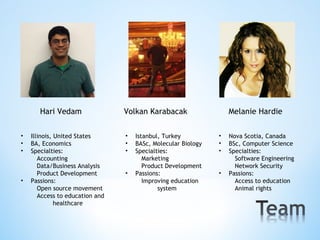
Hari Vedam                Volkan Karabacak                  Melanie Hardie

•   Illinois, United States      •   Istanbul, Turkey          •   Nova Scotia, Canada
•   BA, Economics                •   BASc, Molecular Biology   •   BSc, Computer Science
•   Specialties:                 •   Specialties:              •   Specialties:
       Accounting                       Marketing                    Software Engineering
       Data/Business Analysis           Product Development          Network Security
       Product Development       •   Passions:                 •   Passions:
•   Passions:                           Improving education          Access to education
       Open source movement                  system                  Animal rights
       Access to education and
              healthcare
We believe access to education should be available
to everyone. Online learning platforms are making
this more a reality every day. However, until these
web based forms of education become recognized by
employers, access to traditional education streams
remain imperative to most individuals who are
seeking work.
For some, the reality is that dreams to pursue a
formal education must be set aside. Our mission is
to provide alternatives such that everyone may have
the opportunity to create a better future for
themselves and their families.
Our initial hypotheses are:
•Students find it hard to raise tuition money
•There exist charitable people that cannot find local causes
to donate to
•People would donate to students if they were provided
with a web-based platform on which to do so


Using the online validation board, we identified our riskiest
assumptions to be:
•Students have trouble finding funding sources
•People in any given area want to support local students
We set out to validate our assumptions using a web-based
survey that asked the following:
Students:
•What resources do you seek out when raising tuition money?
•How and where do you search for these resources?
•What challenges, if any, did you encounter?

Potential Donors:
•Have you ever donated to a charitable cause?
•What was the cause and what motivated you to donate?
•Would you consider donating to a local student?
We received 24 survey responses, including 16
email addresses. Broken down into students and
donors:
•15 responded as students
•11 provided their email address   to be notified
as early adopters
•9 responded as donors
•5 provided their email address to be notified as
early adopters
Summary of our findings:
•Students fund education through family contributions,
jobs, savings and scholarships/grants
•Students encounter the following challenges when
searching for funds:
   • Searching online is time consuming and frustrating
   • Hard to find relevant scholarships for which they
      qualify
   • Many different websites and applications
   • Information is limited
•People who would contribute to a student would do so in
addition to the causes they already support
•People donate to causes that they have a connection to
Based on feedback, we updated our
business model as follows:
•Service provided is modified such that
the old value proposition becomes a
feature of the new value proposition,
instead of the proposition itself
• Student  customer segment for which
 the service is designed is broadened
• Potentialdonor customer segment is
 more focused
Value Proposition:
•Free web service accessible via web and mobile
applications
•Main function is to maintain a database of scholarships
which are suggested to student users based on the
information provided in their profile, for which they
may apply directly from our web service
• Eliminates frustration of searching multiple websites
  for applicable scholarships
• Eases pain of filling out multiple forms by offering an
  integrated application template
•Features a ‘Personal Education Fund’ that allows users
to raise money toward their educational pursuits from
donor contributions (family, friends, school alumni)
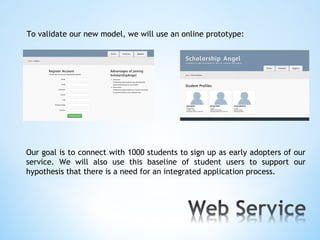
To validate our new model, we will use an online prototype:


Our goal is to connect with 1000 students to sign up as early adopters of our
service. We will also use this baseline of student users to support our
hypothesis that there is a need for an integrated application process.
Market opportunity

Market opportunity

  • 1.
  • 2.
    Hari Vedam Volkan Karabacak Melanie Hardie • Illinois, United States • Istanbul, Turkey • Nova Scotia, Canada • BA, Economics • BASc, Molecular Biology • BSc, Computer Science • Specialties: • Specialties: • Specialties: Accounting Marketing Software Engineering Data/Business Analysis Product Development Network Security Product Development • Passions: • Passions: • Passions: Improving education Access to education Open source movement system Animal rights Access to education and healthcare
  • 3.
    We believe accessto education should be available to everyone. Online learning platforms are making this more a reality every day. However, until these web based forms of education become recognized by employers, access to traditional education streams remain imperative to most individuals who are seeking work. For some, the reality is that dreams to pursue a formal education must be set aside. Our mission is to provide alternatives such that everyone may have the opportunity to create a better future for themselves and their families.
  • 4.
    Our initial hypothesesare: •Students find it hard to raise tuition money •There exist charitable people that cannot find local causes to donate to •People would donate to students if they were provided with a web-based platform on which to do so Using the online validation board, we identified our riskiest assumptions to be: •Students have trouble finding funding sources •People in any given area want to support local students
  • 5.
    We set outto validate our assumptions using a web-based survey that asked the following: Students: •What resources do you seek out when raising tuition money? •How and where do you search for these resources? •What challenges, if any, did you encounter? Potential Donors: •Have you ever donated to a charitable cause? •What was the cause and what motivated you to donate? •Would you consider donating to a local student?
  • 6.
    We received 24survey responses, including 16 email addresses. Broken down into students and donors: •15 responded as students •11 provided their email address to be notified as early adopters •9 responded as donors •5 provided their email address to be notified as early adopters
  • 7.
    Summary of ourfindings: •Students fund education through family contributions, jobs, savings and scholarships/grants •Students encounter the following challenges when searching for funds: • Searching online is time consuming and frustrating • Hard to find relevant scholarships for which they qualify • Many different websites and applications • Information is limited •People who would contribute to a student would do so in addition to the causes they already support •People donate to causes that they have a connection to
  • 8.
    Based on feedback,we updated our business model as follows: •Service provided is modified such that the old value proposition becomes a feature of the new value proposition, instead of the proposition itself • Student customer segment for which the service is designed is broadened • Potentialdonor customer segment is more focused
  • 9.
    Value Proposition: •Free webservice accessible via web and mobile applications •Main function is to maintain a database of scholarships which are suggested to student users based on the information provided in their profile, for which they may apply directly from our web service • Eliminates frustration of searching multiple websites for applicable scholarships • Eases pain of filling out multiple forms by offering an integrated application template •Features a ‘Personal Education Fund’ that allows users to raise money toward their educational pursuits from donor contributions (family, friends, school alumni)
  • 10.
    To validate ournew model, we will use an online prototype: Our goal is to connect with 1000 students to sign up as early adopters of our service. We will also use this baseline of student users to support our hypothesis that there is a need for an integrated application process.