Market Analysis before applying social media3rd LectureUniversity of Gdańsk – March 16, 2010
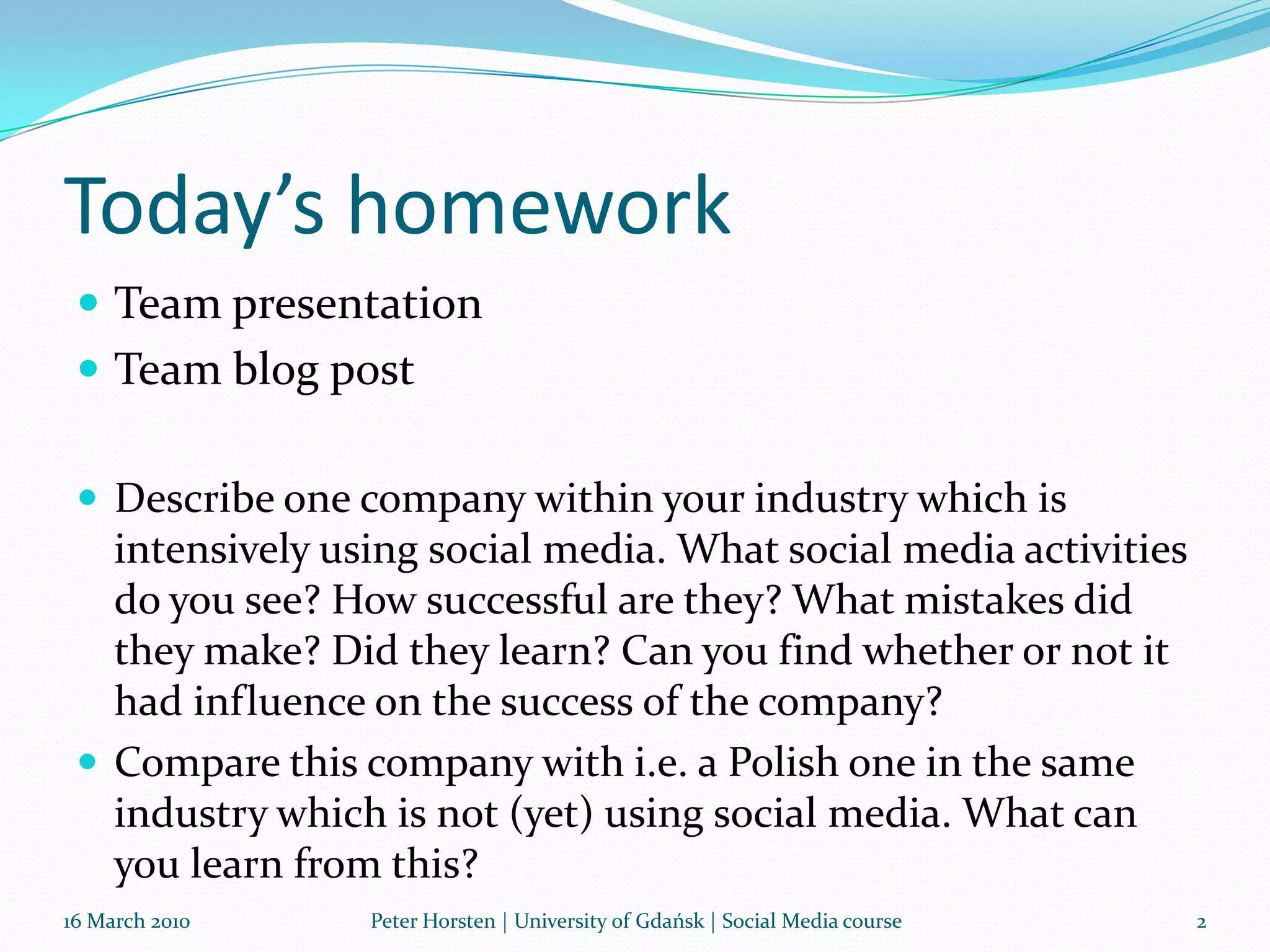
Today’s homeworkTeam presentationTeam blog postDescribe one company within your industry which is intensively using social media. What social media activities do you see? How successful are they? What mistakes did they make? Did they learn? Can you find whether or not it had influence on the success of the company?Compare this company with i.e. a Polish one in the same industry which is not (yet) using social media. What can you learn from this?16 March 2010Peter Horsten | University of Gdańsk | Social Media course2
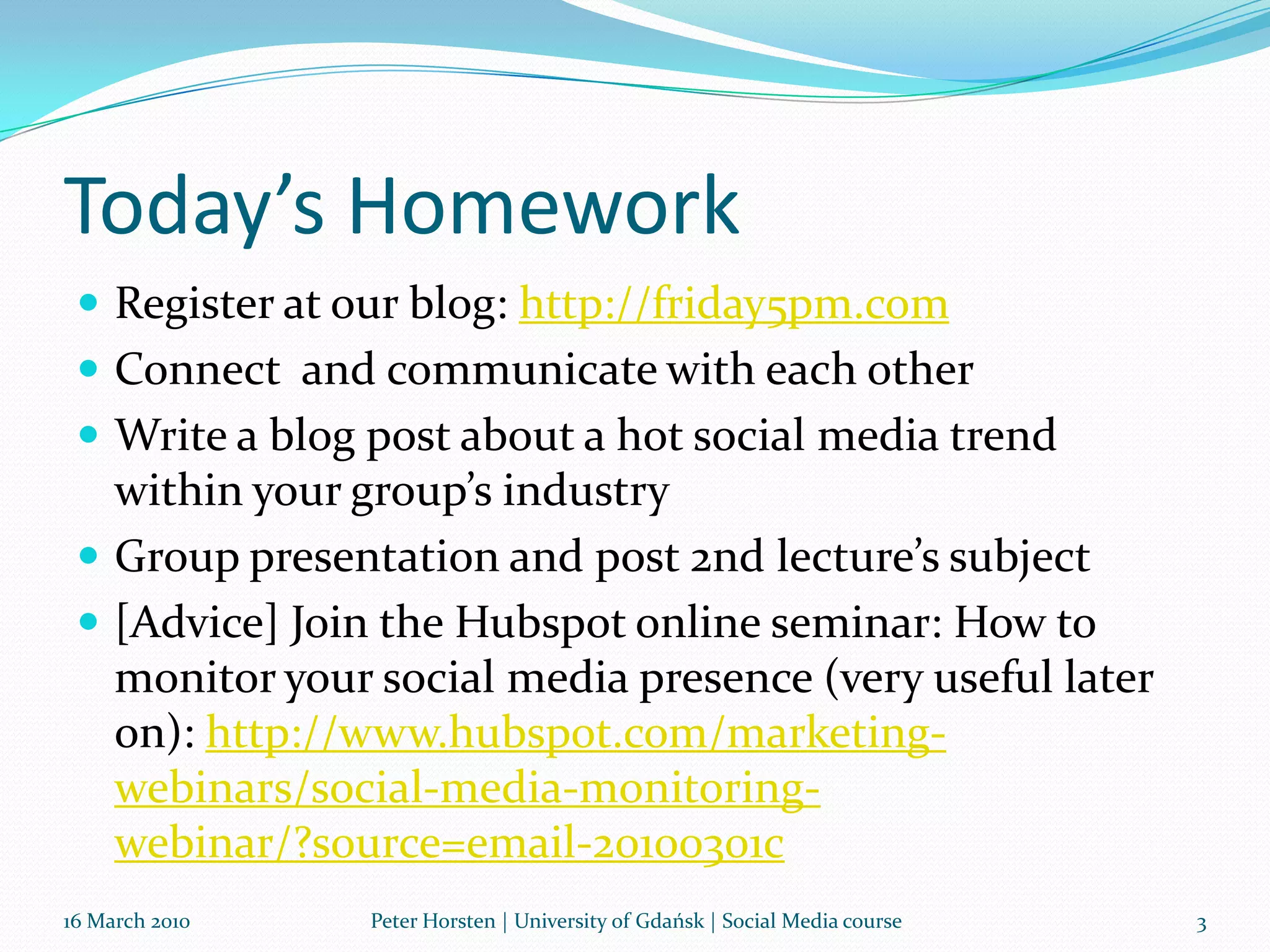
Today’s Homework Register at our blog: http://friday5pm.com
Connect  and communicate with each other
Write a blog post about a hot social media trend within your group’s industry
Group presentation and post 2nd lecture’s subject
[Advice] Join the Hubspot online seminar: How to monitor your social media presence (very useful later on): http://www.hubspot.com/marketing-webinars/social-media-monitoring-webinar/?source=email-20100301c16 March 2010Peter Horsten | University of Gdańsk | Social Media course3
16 March 2010Peter Horsten | University of Gdańsk | Social Media course4
16 March 2010Peter Horsten | University of Gdańsk | Social Media course5
Josh Bernoff of Forrester writes:In any other business endeavor we start by figuring out what we want to accomplish. Social technologies are not magic. They accomplish things, too. It’s time to stop doing social because it’s cool. It’s time to start doing it because it’s effective.16 March 2010Peter Horsten | University of Gdańsk | Social Media course6
SWOTThe S.W.O.T. process requires research and analysis of current and future likely factors of social media and its impact on business strategies. When evaluating these factors, the use of an interrelationship and affinity diagram enables us to sort through the collective meaning of the factors and then categorize them—meaning determining the rank and how the categories relate to or influence each other.16 March 2010Peter Horsten | University of Gdańsk | Social Media course7
Social media SWOTSource: http://mindblogging.typepad.com/whataconcept/2010/01/social-media-swot-analysis.htmlIdentifying Your StrengthsWho are your Ambassadors? Who on your team are the ones who seems to be passionate about the company, knows even the most obscure information about what it happening, and is always willing to pitch in to offer an idea, a creative idea, or simply a helping hand?What creative assets are available that can be used within your social media channels? What pictures, videos, articles, and stories can be repurposed and shared with the community?Where is your organization already active in the community? Are their conversations happening right now about your brand that you can begin participating in? Do you have an active email list that you can leverage to invite your customers to join you on other online channels? Do you have partners that already have an online presence where your voice would be welcomed ?16 March 2010Peter Horsten | University of Gdańsk | Social Media course8
Identify Your WeaknessesWhat information silos within the organization that prevent collaboration?Where is there a lack of, or inconsistent visions related to the goals of participation in social media?What knowledge gaps exist and what additional and ongoing training for the team will be needed?Identify OpportunitiesHow can that organization improve efficiency and save money through social media channels?How can the sales team leverage social media to identify better qualified leads and get a jump on the competition?How can customers be involved in the organizations ongoing development of new products and services?16 March 2010Peter Horsten | University of Gdańsk | Social Media course9
Identify ThreatsHow will your organization protect intellectual property and the organization's reputation?How can information and use of various channels be managed in such a way that it does not become a chaotic, noisy mess with no purpose.With so many people and departments involved, how can we maintain accountability?16 March 2010Peter Horsten | University of Gdańsk | Social Media course10
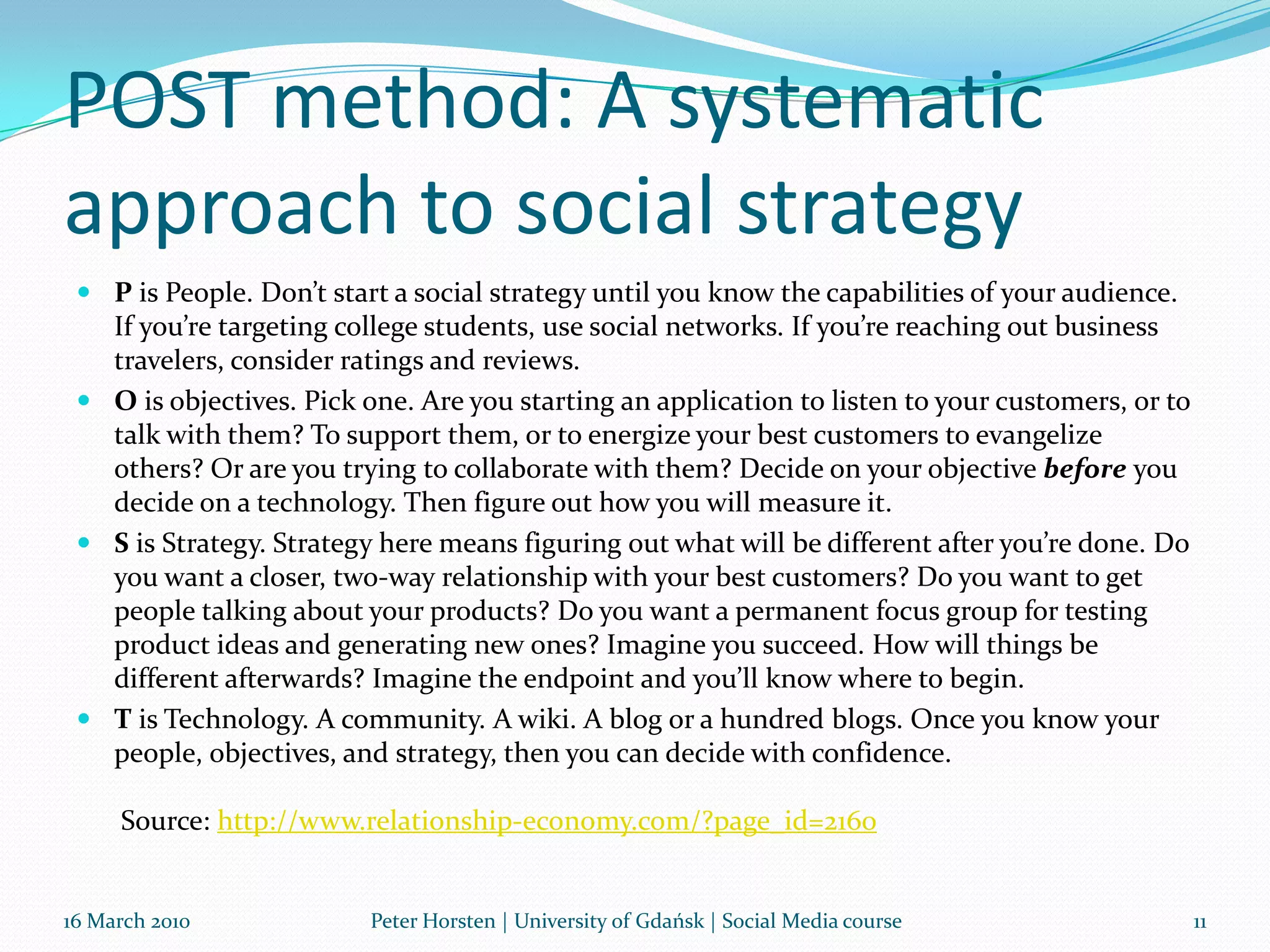
POST method: A systematic approach to social strategyP is People. Don’t start a social strategy until you know the capabilities of your audience. If you’re targeting college students, use social networks. If you’re reaching out business travelers, consider ratings and reviews. O is objectives. Pick one. Are you starting an application to listen to your customers, or to talk with them? To support them, or to energize your best customers to evangelize others? Or are you trying to collaborate with them? Decide on your objective before you decide on a technology. Then figure out how you will measure it.S is Strategy. Strategy here means figuring out what will be different after you’re done. Do you want a closer, two-way relationship with your best customers? Do you want to get people talking about your products? Do you want a permanent focus group for testing product ideas and generating new ones? Imagine you succeed. How will things be different afterwards? Imagine the endpoint and you’ll know where to begin.T is Technology. A community. A wiki. A blog or a hundred blogs. Once you know your people, objectives, and strategy, then you can decide with confidence. Source: http://www.relationship-economy.com/?page_id=216016 March 2010Peter Horsten | University of Gdańsk | Social Media course11
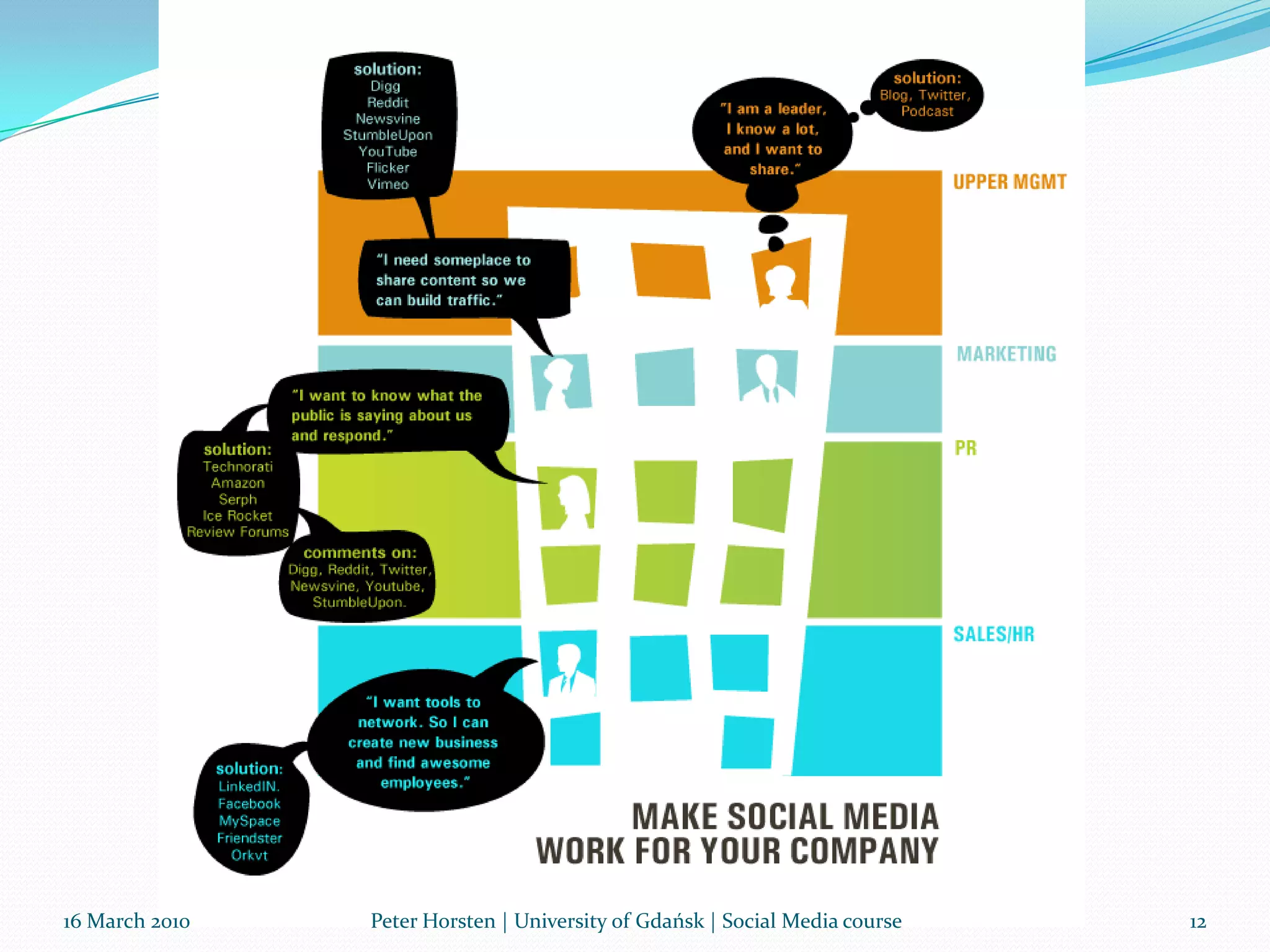
16 March 2010Peter Horsten | University of Gdańsk | Social Media course12

Market analysis before applying social media 20100316 3rd lecture

  • 1.
    Market Analysis beforeapplying social media3rd LectureUniversity of Gdańsk – March 16, 2010
  • 2.
    Today’s homeworkTeam presentationTeamblog postDescribe one company within your industry which is intensively using social media. What social media activities do you see? How successful are they? What mistakes did they make? Did they learn? Can you find whether or not it had influence on the success of the company?Compare this company with i.e. a Polish one in the same industry which is not (yet) using social media. What can you learn from this?16 March 2010Peter Horsten | University of Gdańsk | Social Media course2
  • 3.
    Today’s Homework Registerat our blog: http://friday5pm.com
  • 4.
    Connect andcommunicate with each other
  • 5.
    Write a blogpost about a hot social media trend within your group’s industry
  • 6.
    Group presentation andpost 2nd lecture’s subject
  • 7.
    [Advice] Join theHubspot online seminar: How to monitor your social media presence (very useful later on): http://www.hubspot.com/marketing-webinars/social-media-monitoring-webinar/?source=email-20100301c16 March 2010Peter Horsten | University of Gdańsk | Social Media course3
  • 8.
    16 March 2010PeterHorsten | University of Gdańsk | Social Media course4
  • 9.
    16 March 2010PeterHorsten | University of Gdańsk | Social Media course5
  • 10.
    Josh Bernoff ofForrester writes:In any other business endeavor we start by figuring out what we want to accomplish. Social technologies are not magic. They accomplish things, too. It’s time to stop doing social because it’s cool. It’s time to start doing it because it’s effective.16 March 2010Peter Horsten | University of Gdańsk | Social Media course6
  • 11.
    SWOTThe S.W.O.T. processrequires research and analysis of current and future likely factors of social media and its impact on business strategies. When evaluating these factors, the use of an interrelationship and affinity diagram enables us to sort through the collective meaning of the factors and then categorize them—meaning determining the rank and how the categories relate to or influence each other.16 March 2010Peter Horsten | University of Gdańsk | Social Media course7
  • 12.
    Social media SWOTSource:http://mindblogging.typepad.com/whataconcept/2010/01/social-media-swot-analysis.htmlIdentifying Your StrengthsWho are your Ambassadors? Who on your team are the ones who seems to be passionate about the company, knows even the most obscure information about what it happening, and is always willing to pitch in to offer an idea, a creative idea, or simply a helping hand?What creative assets are available that can be used within your social media channels? What pictures, videos, articles, and stories can be repurposed and shared with the community?Where is your organization already active in the community? Are their conversations happening right now about your brand that you can begin participating in? Do you have an active email list that you can leverage to invite your customers to join you on other online channels? Do you have partners that already have an online presence where your voice would be welcomed ?16 March 2010Peter Horsten | University of Gdańsk | Social Media course8
  • 13.
    Identify Your WeaknessesWhatinformation silos within the organization that prevent collaboration?Where is there a lack of, or inconsistent visions related to the goals of participation in social media?What knowledge gaps exist and what additional and ongoing training for the team will be needed?Identify OpportunitiesHow can that organization improve efficiency and save money through social media channels?How can the sales team leverage social media to identify better qualified leads and get a jump on the competition?How can customers be involved in the organizations ongoing development of new products and services?16 March 2010Peter Horsten | University of Gdańsk | Social Media course9
  • 14.
    Identify ThreatsHow willyour organization protect intellectual property and the organization's reputation?How can information and use of various channels be managed in such a way that it does not become a chaotic, noisy mess with no purpose.With so many people and departments involved, how can we maintain accountability?16 March 2010Peter Horsten | University of Gdańsk | Social Media course10
  • 15.
    POST method: Asystematic approach to social strategyP is People. Don’t start a social strategy until you know the capabilities of your audience. If you’re targeting college students, use social networks. If you’re reaching out business travelers, consider ratings and reviews. O is objectives. Pick one. Are you starting an application to listen to your customers, or to talk with them? To support them, or to energize your best customers to evangelize others? Or are you trying to collaborate with them? Decide on your objective before you decide on a technology. Then figure out how you will measure it.S is Strategy. Strategy here means figuring out what will be different after you’re done. Do you want a closer, two-way relationship with your best customers? Do you want to get people talking about your products? Do you want a permanent focus group for testing product ideas and generating new ones? Imagine you succeed. How will things be different afterwards? Imagine the endpoint and you’ll know where to begin.T is Technology. A community. A wiki. A blog or a hundred blogs. Once you know your people, objectives, and strategy, then you can decide with confidence. Source: http://www.relationship-economy.com/?page_id=216016 March 2010Peter Horsten | University of Gdańsk | Social Media course11
  • 16.
    16 March 2010PeterHorsten | University of Gdańsk | Social Media course12
  • 17.
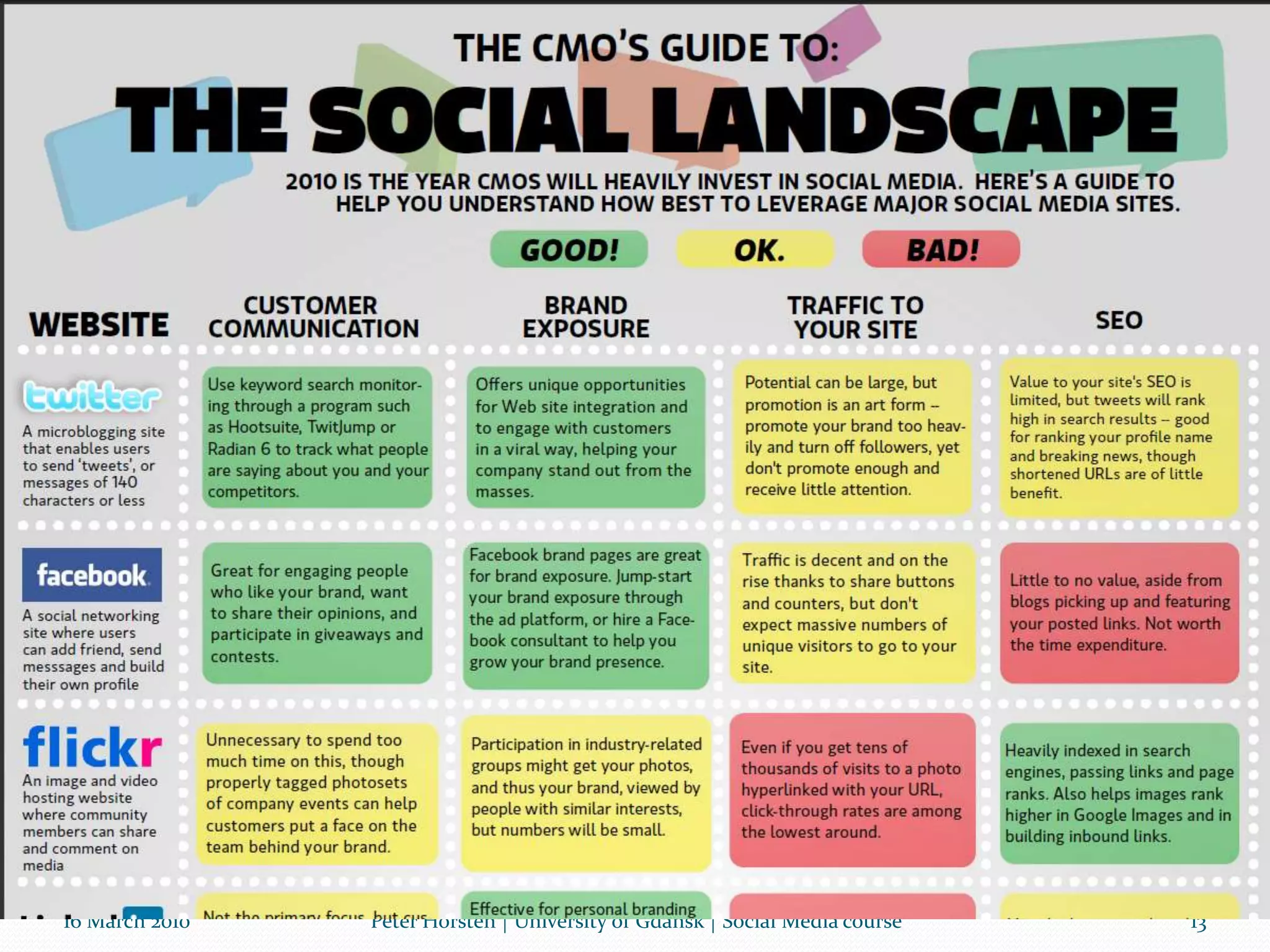
    16 March 2010PeterHorsten | University of Gdańsk | Social Media course13
  • 18.
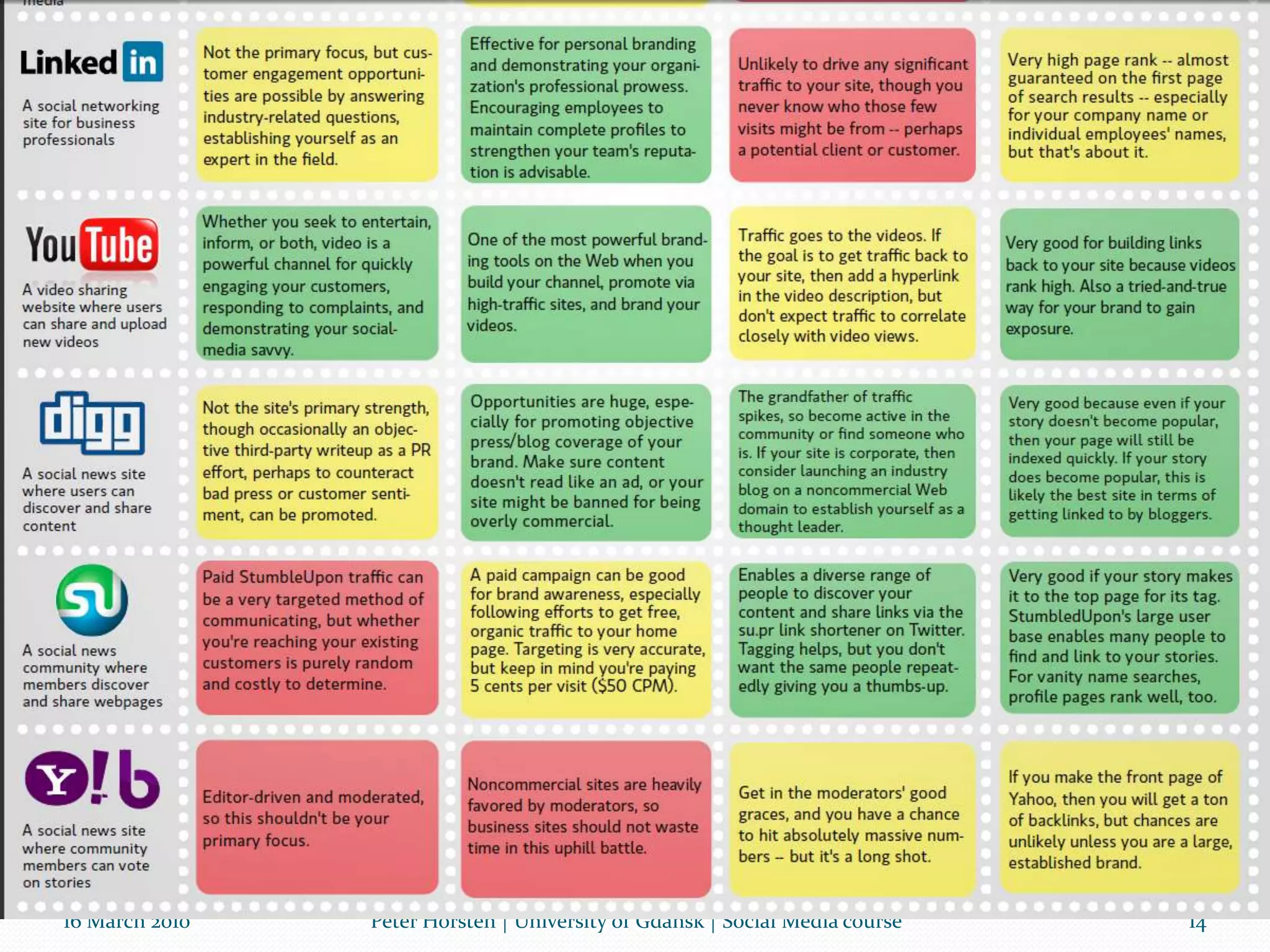
    16 March 2010PeterHorsten | University of Gdańsk | Social Media course14
  • 19.
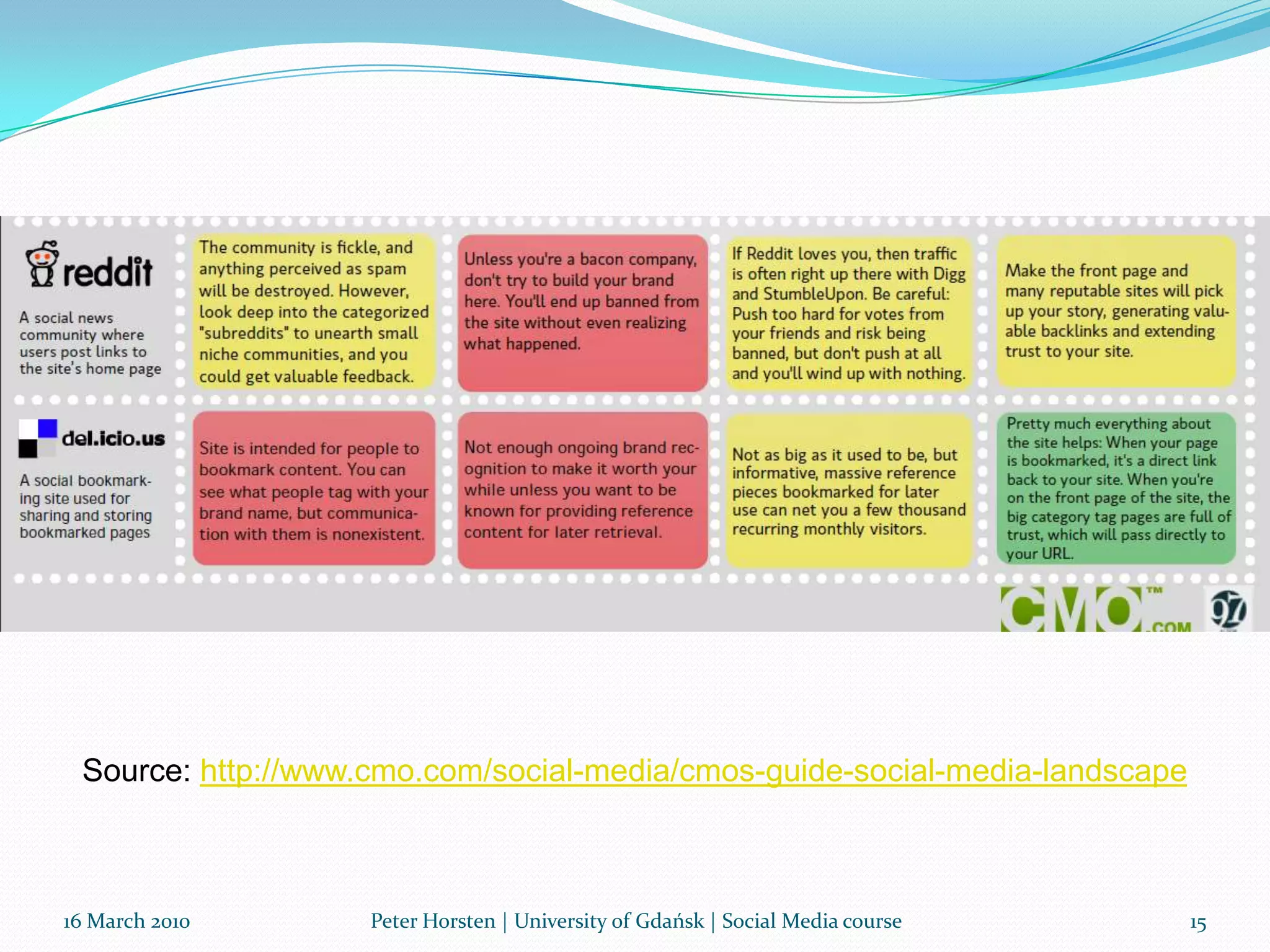
    16 March 2010PeterHorsten | University of Gdańsk | Social Media course15Source: http://www.cmo.com/social-media/cmos-guide-social-media-landscape
  • 20.
    Next time’s homeworkTeampresentationTeam blog postDescribe the “POST” for your companyChoose from the available social networks what to use.16 March 2010Peter Horsten | University of Gdańsk | Social Media course16