Saudi Arabia Auto Industry SWOT
Strengths:
• The regional economy is liquid with petrodollars. High business confidence and
increased disposable incomes provide a favorable background for the
automotive sector.
• Saudi Arabia is the largest importer of cars and automotive parts in the Middle
East.
• As the main OPEC swing producer, the kingdom is in a strong position within
the cartel.
• The recent oil price boom has boosted growth in the non-oil sector and
infrastructure is now much improved.
• A large and growing local population means solid domestic demand for goods,
services and infrastructure in spite of the global macroeconomic crisis.
Weaknesses:
• There is no local production of passenger cars and only a small number of
commercial vehicles are assembled locally.
• The domestic market is largely dependent on international car manufacturers
for the style and design of autos and its profitability is hostage to the demands
of those major suppliers.
• Dependence on oil means growth, exports and government revenue remain
highly vulnerable to shifts in world oil prices.
• The private sector is dependent on expatriate labour, reflecting a shortage of
marketable skills among nationals and a high unemployment rate among Saudi
citizens.
Opportunities
• Trade liberalization between the Gulf Cooperation Council (GCC) and the
EU will open the Saudi market to more European imports.
Confidential
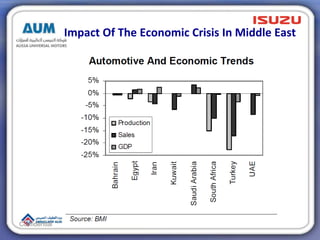
Impact Of The Economic Crisis In Middle East
Confidential
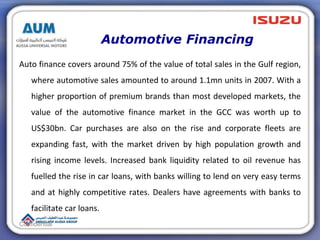
Automotive Financing
Auto finance covers around 75% of the value of total sales in the Gulf region,
where automotive sales amounted to around 1.1mn units in 2007. With a
higher proportion of premium brands than most developed markets, the
value of the automotive finance market in the GCC was worth up to
US$30bn. Car purchases are also on the rise and corporate fleets are
expanding fast, with the market driven by high population growth and
rising income levels. Increased bank liquidity related to oil revenue has
fuelled the rise in car loans, with banks willing to lend on very easy terms
and at highly competitive rates. Dealers have agreements with banks to
facilitate car loans.
Confidential
After-Sales Business
With competition between rival carmakers and dealers increasing
as more firms look to bulk up their presence on the large and
lucrative Saudi market, more attention is being paid to after
sales services, which had not always kept pace with the
increasingly sophisticated market. After-sales is seen as a key
area in which dealers can boost their value-added offerings.
Confidential

Market analysis

  • 1.
    Saudi Arabia AutoIndustry SWOT Strengths: • The regional economy is liquid with petrodollars. High business confidence and increased disposable incomes provide a favorable background for the automotive sector. • Saudi Arabia is the largest importer of cars and automotive parts in the Middle East. • As the main OPEC swing producer, the kingdom is in a strong position within the cartel. • The recent oil price boom has boosted growth in the non-oil sector and infrastructure is now much improved. • A large and growing local population means solid domestic demand for goods, services and infrastructure in spite of the global macroeconomic crisis.
  • 2.
    Weaknesses: • There isno local production of passenger cars and only a small number of commercial vehicles are assembled locally. • The domestic market is largely dependent on international car manufacturers for the style and design of autos and its profitability is hostage to the demands of those major suppliers. • Dependence on oil means growth, exports and government revenue remain highly vulnerable to shifts in world oil prices. • The private sector is dependent on expatriate labour, reflecting a shortage of marketable skills among nationals and a high unemployment rate among Saudi citizens.
  • 3.
    Opportunities • Trade liberalizationbetween the Gulf Cooperation Council (GCC) and the EU will open the Saudi market to more European imports. Confidential
  • 4.
    Impact Of TheEconomic Crisis In Middle East Confidential
  • 5.
    Automotive Financing Auto financecovers around 75% of the value of total sales in the Gulf region, where automotive sales amounted to around 1.1mn units in 2007. With a higher proportion of premium brands than most developed markets, the value of the automotive finance market in the GCC was worth up to US$30bn. Car purchases are also on the rise and corporate fleets are expanding fast, with the market driven by high population growth and rising income levels. Increased bank liquidity related to oil revenue has fuelled the rise in car loans, with banks willing to lend on very easy terms and at highly competitive rates. Dealers have agreements with banks to facilitate car loans. Confidential
  • 6.
    After-Sales Business With competitionbetween rival carmakers and dealers increasing as more firms look to bulk up their presence on the large and lucrative Saudi market, more attention is being paid to after sales services, which had not always kept pace with the increasingly sophisticated market. After-sales is seen as a key area in which dealers can boost their value-added offerings. Confidential

Editor's Notes

  • #5 Overall, the GCC market is a strong one for vehicle sales, and has been less hard hit than others in the Middle East and beyond. An affluent, rapidly growing population and a sophisticated consumer profile are all strengths.
  • #6 Link it to new lease campaign